







A Graph Service for Global Web
Entities Traversal and Reputation
Evaluation Based on HBase
Chris Huang, Scott Miao
2014/5/5
Who are we
• Scott Miao
• Developer, SPN, Trend Micro
• Worked on hadoop ecosystem since 2011
• Expertise in HDFS/MR/HBase
• Contributor for HBase/HDFS
• @takeshi.miao
• Chris Huang
• RD Manager, SPN, Trend Micro
• Hadoop Architect
• Worked on hadoop ecosystem since 2009
• Contributor for Bigtop
• @chenhsiu48
Our blog ‘Dumbo in TW’: http://dumbointaiwan.blogspot.tw/
Challenges We Faced
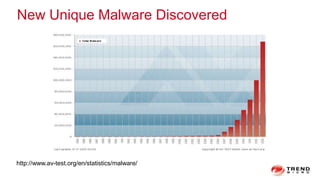
New Unique Malware Discovered
http://www.av-test.org/en/statistics/malware/
Social Engineering vs. Cyber Attacks
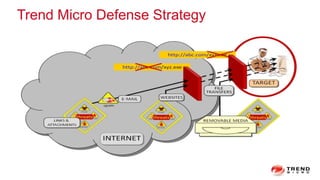
Trend Micro Defense Strategy
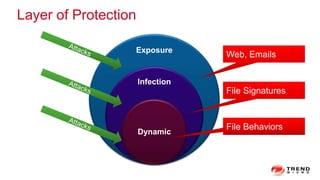
Layer of Protection
Exposure
Infection
Dynamic
Web, Emails
File Signatures
File Behaviors
See The Threat Entity
Connectivity
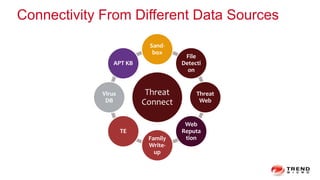
Connectivity From Different Data Sources
Threat
Connect
Sand-
box
File
Detecti
on
Threat
Web
Web
Reputa
tionFamily
Write-
up
TE
Virus
DB
APT KB
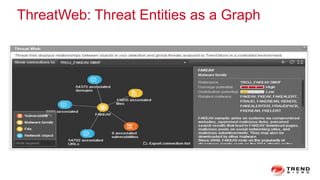
ThreatWeb: Threat Entities as a Graph
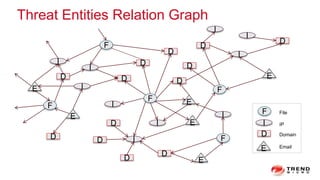
Threat Entities Relation Graph
F
D
I
DD
D
I
I
D
DF
F
D
I
I
I
E
E
E
E
E
E
I
I
ID
D
D
D
F
D
D F
I
I
F
D
E
File
IP
Domain
Email
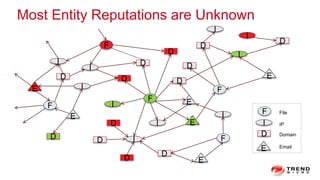
Most Entity Reputations are Unknown
F
D
I
DD
D
I
I
D
DF
F
D
I
I
I
E
E
E
E
E
E
I
I
ID
D
D
D
F
D
D F
I
I
F
D
E
File
IP
Domain
Email
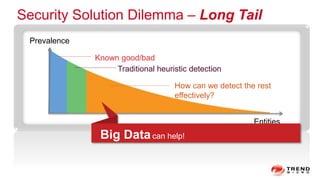
Security Solution Dilemma – Long Tail
Prevalence
Entities
Known good/bad
Traditional heuristic detection
Big Datacan help!
How can we detect the rest
effectively?
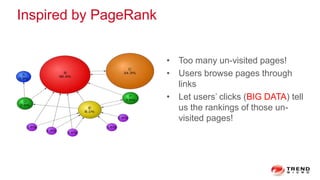
Inspired by PageRank
• Too many un-visited pages!
• Users browse pages through
links
• Let users’ clicks (BIG DATA) tell
us the rankings of those un-
visited pages!
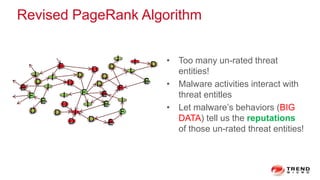
Revised PageRank Algorithm
• Too many un-rated threat
entities!
• Malware activities interact with
threat entitles
• Let malware’s behaviors (BIG
DATA) tell us the reputations
of those un-rated threat entities!
F
D
I
DD
D
I
I
D
DF
F
D
II
I
E
E
E
E E
E
I
I
ID
D
D
D
F
D
D F
I
The Graph Problem
The Problems
• Store large size of Graph data
• Access large size of Graph data
• Process large size of Graph data
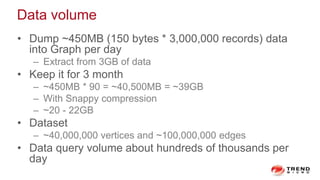
Data volume
• Dump ~450MB (150 bytes * 3,000,000 records) data
into Graph per day
– Extract from 3GB of data
• Keep it for 3 month
– ~450MB * 90 = ~40,500MB = ~39GB
– With Snappy compression
– ~20 - 22GB
• Dataset
– ~40,000,000 vertices and ~100,000,000 edges
• Data query volume about hundreds of thousands per
day
BIG
GRAPH
!!
http://news.gamme.com.tw/544510
Store
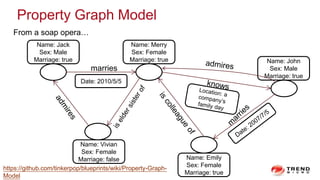
Property Graph Model
Name: Jack
Sex: Male
Marriage: true
Name: Merry
Sex: Female
Marriage: true
marries
Name: Vivian
Sex: Female
Marriage: false
Name: John
Sex: Male
Marriage: true
Date: 2010/5/5
Name: Emily
Sex: Female
Marriage: true
From a soap opera…
https://github.com/tinkerpop/blueprints/wiki/Property-Graph-
Model
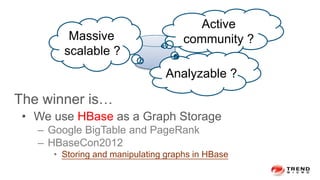
• We use HBase as a Graph Storage
– Google BigTable and PageRank
– HBaseCon2012
• Storing and manipulating graphs in HBase
The winner is…
Massive
scalable ?
Active
community ?
Analyzable ?
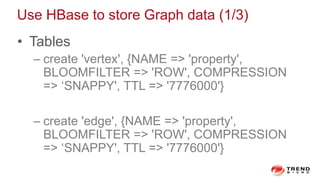
Use HBase to store Graph data (1/3)
• Tables
– create 'vertex', {NAME => 'property',
BLOOMFILTER => 'ROW', COMPRESSION
=> ‘SNAPPY', TTL => '7776000'}
– create 'edge', {NAME => 'property',
BLOOMFILTER => 'ROW', COMPRESSION
=> ‘SNAPPY', TTL => '7776000'}
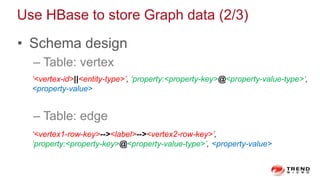
Use HBase to store Graph data (2/3)
• Schema design
– Table: vertex
– Table: edge
‘<vertex-id>||<entity-type>’, ‘property:<property-key>@<property-value-type>’,
<property-value>
‘<vertex1-row-key>--><label>--><vertex2-row-key>’,
‘property:<property-key>@<property-value-type>’, <property-value>
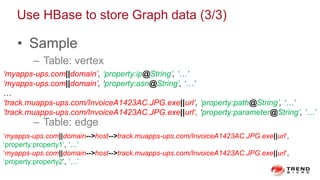
Use HBase to store Graph data (3/3)
• Sample
– Table: vertex
– Table: edge
‘myapps-ups.com||domain’, ‘property:ip@String’, ‘…’
‘myapps-ups.com||domain’, ‘property:asn@String’, ‘…’
…
‘track.muapps-ups.com/InvoiceA1423AC.JPG.exe||url’, ‘property:path@String’, ‘…’
‘track.muapps-ups.com/InvoiceA1423AC.JPG.exe||url’, ‘property:parameter@String’, ‘…’
‘myapps-ups.com||domain-->host-->track.muapps-ups.com/InvoiceA1423AC.JPG.exe||url’,
‘property:property1’, ‘…’
‘myapps-ups.com||domain-->host-->track.muapps-ups.com/InvoiceA1423AC.JPG.exe||url’,
‘property:property2’, ‘…’
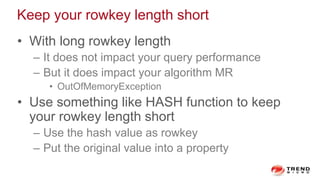
Keep your rowkey length short
• With long rowkey length
– It does not impact your query performance
– But it does impact your algorithm MR
• OutOfMemoryException
• Use something like HASH function to keep
your rowkey length short
– Use the hash value as rowkey
– Put the original value into a property
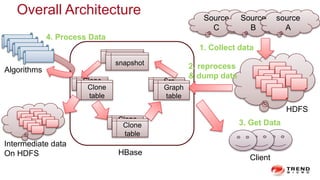
Overall Architecture
Src
table
snapshot
Clone
table
Clone
table
Graph
table
snapshot
Clone
table
Clone
table
HBase
Source
C
Source
B
source
A
HDFS
1. Collect data
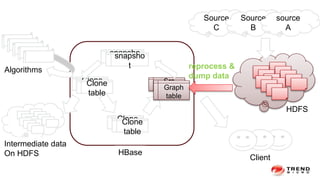
2. reprocess
& dump data
3. Get Data
Client
4. Process Data
Algorithms
Intermediate data
On HDFS
Src
table
snapsho
t
Clone
table
Clone
table
Graph
table
snapsho
t
Clone
table
Clone
table
HBase
Source
C
Source
B
source
A
HDFS
reprocess &
dump data
Client
Algorithms
Intermediate data
On HDFS
Preprocess and Dump Data
• HBase schema design is simple and human-
readable
• It is easy to write your dumping tool if needed
– MR/Pig/Completebulkload
– Can write cron-job to clean up the broken-edge
data
– TTL can also help to retire old data
• We already have a lot practices for these
tasks
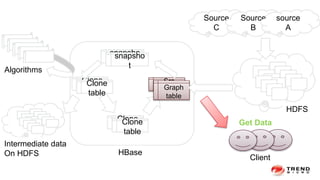
Access
Src
table
snapsho
t
Clone
table
Clone
table
Graph
table
snapsho
t
Clone
table
Clone
table
HBase
Source
C
Source
B
source
A
HDFS
Get Data
Client
Algorithms
Intermediate data
On HDFS
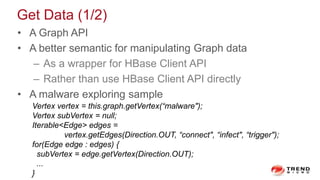
Get Data (1/2)
• A Graph API
• A better semantic for manipulating Graph data
– As a wrapper for HBase Client API
– Rather than use HBase Client API directly
• A malware exploring sample
Vertex vertex = this.graph.getVertex(“malware");
Vertex subVertex = null;
Iterable<Edge> edges =
vertex.getEdges(Direction.OUT, “connect", “infect", “trigger");
for(Edge edge : edges) {
subVertex = edge.getVertex(Direction.OUT);
...
}
Get Data (2/2)
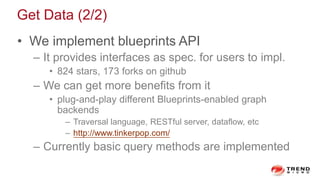
• We implement blueprints API
– It provides interfaces as spec. for users to impl.
• 824 stars, 173 forks on github
– We can get more benefits from it
• plug-and-play different Blueprints-enabled graph
backends
– Traversal language, RESTful server, dataflow, etc
– http://www.tinkerpop.com/
– Currently basic query methods are implemented
Clients
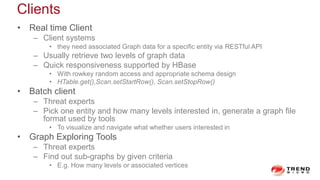
• Real time Client
– Client systems
• they need associated Graph data for a specific entity via RESTful API
– Usually retrieve two levels of graph data
– Quick responsiveness supported by HBase
• With rowkey random access and appropriate schema design
• HTable.get(),Scan.setStartRow(), Scan.setStopRow()
• Batch client
– Threat experts
– Pick one entity and how many levels interested in, generate a graph file
format used by tools
• To visualize and navigate what whether users interested in
• Graph Exploring Tools
– Threat experts
– Find out sub-graphs by given criteria
• E.g. How many levels or associated vertices
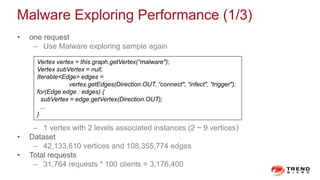
Malware Exploring Performance (1/3)
• one request
– Use Malware exploring sample again
– 1 vertex with 2 levels associated instances (2 ~ 9 vertices)
• Dataset
– 42,133,610 vertices and 108,355,774 edges
• Total requests
– 31,764 requests * 100 clients = 3,176,400
Vertex vertex = this.graph.getVertex(“malware");
Vertex subVertex = null;
Iterable<Edge> edges =
vertex.getEdges(Direction.OUT, “connect", “infect", “trigger");
for(Edge edge : edges) {
subVertex = edge.getVertex(Direction.OUT);
...
}
Malware Exploring Performance (2/3)
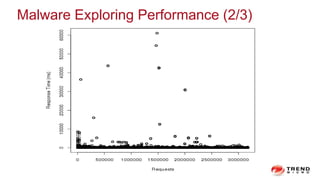
Malware Exploring Performance (3/3)
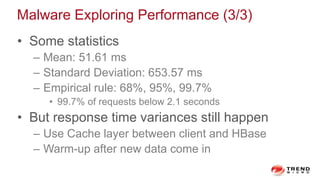
• Some statistics
– Mean: 51.61 ms
– Standard Deviation: 653.57 ms
– Empirical rule: 68%, 95%, 99.7%
• 99.7% of requests below 2.1 seconds
• But response time variances still happen
– Use Cache layer between client and HBase
– Warm-up after new data come in
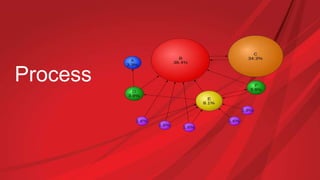
Process
Src
table
snapshot
Clone
table
Clone
table
Graph
table
snapshot
Clone
table
Clone
table
HBase
Source
C
Source
B
source
A
HDFS
Client
Process Data
Algorithms
Intermediate data
On HDFS
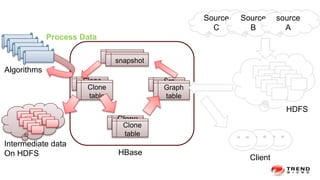
• Human-readable HBase schema design
– Write your own MR
– Write your own Pig/UDFs
• So we can write the algorithms to further
process our graph data
– To predict unknown reputation by known threats
– E.g. a revised PageRank algorithm
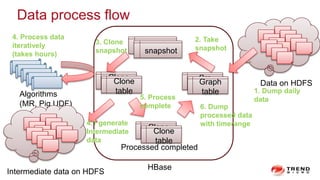
Data process flow
Src
table
snapshot
Clone
table Data on HDFS
Algorithms
(MR, Pig UDF)
Clone
table
Processed completed
Graph
table
snapshot
Clone
table
Clone
table
Intermediate data on HDFS
HBase
1. Dump daily
data
2. Take
snapshot
3. Clone
snapshot
4. Process data
iteratively
(takes hours)
4.1 generate
Intermediate
data
5. Process
complete 6. Dump
processed data
with timerange
A customized TableInputFormat (1/2)
• One Mapper for one region by default
– Each Mapper process too much data
• OutOfMemoryException
• Too long to process
– Use small split region size ?
• Will overload your HBase cluster !!
• Before: about ~40 Mappers
• After: about ~500 Mappers
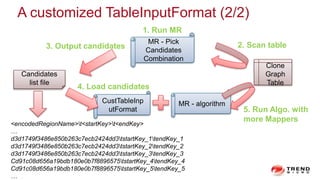
A customized TableInputFormat (2/2)
Clone
Graph
Table
MR - Pick
Candidates
Combination
Candidates
list file
<encodedRegionName>t<startKey>t<endKey>
…
d3d1749f3486e850b263c7ecb2424dd3tstartKey_1tendKey_1
d3d1749f3486e850b263c7ecb2424dd3tstartKey_2tendKey_2
d3d1749f3486e850b263c7ecb2424dd3tstartKey_3tendKey_3
Cd91c08d656a19bdb180e0b7f8896575tstartKey_4tendKey_4
Cd91c08d656a19bdb180e0b7f8896575tstartKey_5tendKey_5
…
CustTableInp
utFormat
MR - algorithm
2. Scan table3. Output candidates
4. Load candidates
5. Run Algo. with
more Mappers
1. Run MR
HGraph
• A project is open and put on github
– https://github.com/trendmicro/HGraph
• A partial impl. released from our internal project
– Follow HBase schema design
– Read data via Blueprints API
– Process data with our pagerank default impl.
• Download or ‘git clone’ it
– Use ‘mvn clean package’
– Run on unix-like OS
• Use windows may encounter some errors
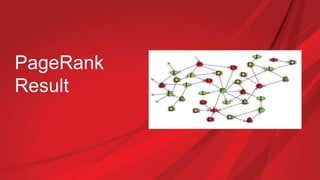
PageRank
Result
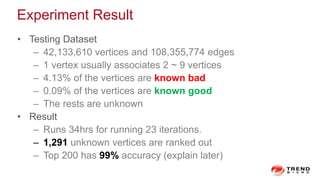
Experiment Result
• Testing Dataset
– 42,133,610 vertices and 108,355,774 edges
– 1 vertex usually associates 2 ~ 9 vertices
– 4.13% of the vertices are known bad
– 0.09% of the vertices are known good
– The rests are unknown
• Result
– Runs 34hrs for running 23 iterations.
– 1,291 unknown vertices are ranked out
– Top 200 has 99% accuracy (explain later)
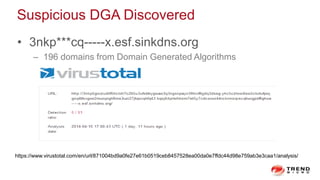
Suspicious DGA Discovered
• 3nkp***cq-----x.esf.sinkdns.org
– 196 domains from Domain Generated Algorithms
https://www.virustotal.com/en/url/871004bd9a0fe27e61b0519ceb8457528ea00da0e7ffdc44d98e759ab3e3caa1/analysis/
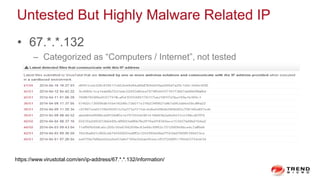
Untested But Highly Malware Related IP
• 67.*.*.132
– Categorized as “Computers / Internet”, not tested
https://www.virustotal.com/en/ip-address/67.*.*.132/information/
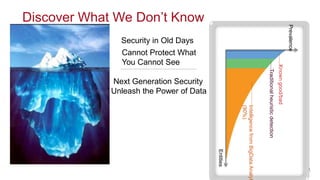
Prevalence
Entities
Knowngood/bad
Traditionalheuristicdetection
IntelligencefromBigDataAnalyt
(90%)
Security in Old Days
Cannot Protect What
You Cannot See
Next Generation Security
Unleash the Power of Data
Discover What We Don’t Know
Q&A
Backups
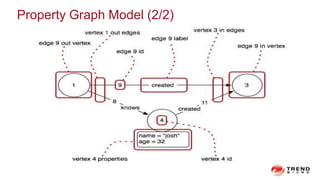
Property Graph Model (2/2)
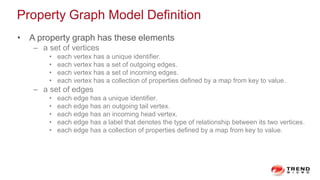
Property Graph Model Definition
• A property graph has these elements
– a set of vertices
• each vertex has a unique identifier.
• each vertex has a set of outgoing edges.
• each vertex has a set of incoming edges.
• each vertex has a collection of properties defined by a map from key to value.
– a set of edges
• each edge has a unique identifier.
• each edge has an outgoing tail vertex.
• each edge has an incoming head vertex.
• each edge has a label that denotes the type of relationship between its two vertices.
• each edge has a collection of properties defined by a map from key to value.
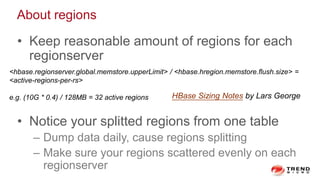
About regions
• Keep reasonable amount of regions for each
regionserver
• Notice your splitted regions from one table
– Dump data daily, cause regions splitting
– Make sure your regions scattered evenly on each
regionserver
<hbase.regionserver.global.memstore.upperLimit> / <hbase.hregion.memstore.flush.size> =
<active-regions-per-rs>
e.g. (10G * 0.4) / 128MB = 32 active regions HBase Sizing Notes by Lars George

A Graph Service for Global Web Entities Traversal and Reputation Evaluation Based on HBase

  • 1.
    A Graph Servicefor Global Web Entities Traversal and Reputation Evaluation Based on HBase Chris Huang, Scott Miao 2014/5/5
  • 2.
    Who are we •Scott Miao • Developer, SPN, Trend Micro • Worked on hadoop ecosystem since 2011 • Expertise in HDFS/MR/HBase • Contributor for HBase/HDFS • @takeshi.miao • Chris Huang • RD Manager, SPN, Trend Micro • Hadoop Architect • Worked on hadoop ecosystem since 2009 • Contributor for Bigtop • @chenhsiu48 Our blog ‘Dumbo in TW’: http://dumbointaiwan.blogspot.tw/
  • 3.
  • 4.
    New Unique MalwareDiscovered http://www.av-test.org/en/statistics/malware/
  • 5.
  • 6.
  • 7.
    Layer of Protection Exposure Infection Dynamic Web,Emails File Signatures File Behaviors
  • 8.
    See The ThreatEntity Connectivity
  • 9.
    Connectivity From DifferentData Sources Threat Connect Sand- box File Detecti on Threat Web Web Reputa tionFamily Write- up TE Virus DB APT KB
  • 10.
  • 11.
    Threat Entities RelationGraph F D I DD D I I D DF F D I I I E E E E E E I I ID D D D F D D F I I F D E File IP Domain Email
  • 12.
    Most Entity Reputationsare Unknown F D I DD D I I D DF F D I I I E E E E E E I I ID D D D F D D F I I F D E File IP Domain Email
  • 13.
    Security Solution Dilemma– Long Tail Prevalence Entities Known good/bad Traditional heuristic detection Big Datacan help! How can we detect the rest effectively?
  • 14.
    Inspired by PageRank •Too many un-visited pages! • Users browse pages through links • Let users’ clicks (BIG DATA) tell us the rankings of those un- visited pages!
  • 15.
    Revised PageRank Algorithm •Too many un-rated threat entities! • Malware activities interact with threat entitles • Let malware’s behaviors (BIG DATA) tell us the reputations of those un-rated threat entities! F D I DD D I I D DF F D II I E E E E E E I I ID D D D F D D F I
  • 16.
  • 17.
    The Problems • Storelarge size of Graph data • Access large size of Graph data • Process large size of Graph data
  • 18.
    Data volume • Dump~450MB (150 bytes * 3,000,000 records) data into Graph per day – Extract from 3GB of data • Keep it for 3 month – ~450MB * 90 = ~40,500MB = ~39GB – With Snappy compression – ~20 - 22GB • Dataset – ~40,000,000 vertices and ~100,000,000 edges • Data query volume about hundreds of thousands per day
  • 19.
  • 20.
  • 21.
    Property Graph Model Name:Jack Sex: Male Marriage: true Name: Merry Sex: Female Marriage: true marries Name: Vivian Sex: Female Marriage: false Name: John Sex: Male Marriage: true Date: 2010/5/5 Name: Emily Sex: Female Marriage: true From a soap opera… https://github.com/tinkerpop/blueprints/wiki/Property-Graph- Model
  • 22.
    • We useHBase as a Graph Storage – Google BigTable and PageRank – HBaseCon2012 • Storing and manipulating graphs in HBase The winner is… Massive scalable ? Active community ? Analyzable ?
  • 23.
    Use HBase tostore Graph data (1/3) • Tables – create 'vertex', {NAME => 'property', BLOOMFILTER => 'ROW', COMPRESSION => ‘SNAPPY', TTL => '7776000'} – create 'edge', {NAME => 'property', BLOOMFILTER => 'ROW', COMPRESSION => ‘SNAPPY', TTL => '7776000'}
  • 24.
    Use HBase tostore Graph data (2/3) • Schema design – Table: vertex – Table: edge ‘<vertex-id>||<entity-type>’, ‘property:<property-key>@<property-value-type>’, <property-value> ‘<vertex1-row-key>--><label>--><vertex2-row-key>’, ‘property:<property-key>@<property-value-type>’, <property-value>
  • 25.
    Use HBase tostore Graph data (3/3) • Sample – Table: vertex – Table: edge ‘myapps-ups.com||domain’, ‘property:ip@String’, ‘…’ ‘myapps-ups.com||domain’, ‘property:asn@String’, ‘…’ … ‘track.muapps-ups.com/InvoiceA1423AC.JPG.exe||url’, ‘property:path@String’, ‘…’ ‘track.muapps-ups.com/InvoiceA1423AC.JPG.exe||url’, ‘property:parameter@String’, ‘…’ ‘myapps-ups.com||domain-->host-->track.muapps-ups.com/InvoiceA1423AC.JPG.exe||url’, ‘property:property1’, ‘…’ ‘myapps-ups.com||domain-->host-->track.muapps-ups.com/InvoiceA1423AC.JPG.exe||url’, ‘property:property2’, ‘…’
  • 26.
    Keep your rowkeylength short • With long rowkey length – It does not impact your query performance – But it does impact your algorithm MR • OutOfMemoryException • Use something like HASH function to keep your rowkey length short – Use the hash value as rowkey – Put the original value into a property
  • 27.
  • 28.
  • 29.
    Preprocess and DumpData • HBase schema design is simple and human- readable • It is easy to write your dumping tool if needed – MR/Pig/Completebulkload – Can write cron-job to clean up the broken-edge data – TTL can also help to retire old data • We already have a lot practices for these tasks
  • 30.
  • 31.
  • 32.
    Get Data (1/2) •A Graph API • A better semantic for manipulating Graph data – As a wrapper for HBase Client API – Rather than use HBase Client API directly • A malware exploring sample Vertex vertex = this.graph.getVertex(“malware"); Vertex subVertex = null; Iterable<Edge> edges = vertex.getEdges(Direction.OUT, “connect", “infect", “trigger"); for(Edge edge : edges) { subVertex = edge.getVertex(Direction.OUT); ... }
  • 33.
    Get Data (2/2) •We implement blueprints API – It provides interfaces as spec. for users to impl. • 824 stars, 173 forks on github – We can get more benefits from it • plug-and-play different Blueprints-enabled graph backends – Traversal language, RESTful server, dataflow, etc – http://www.tinkerpop.com/ – Currently basic query methods are implemented
  • 34.
    Clients • Real timeClient – Client systems • they need associated Graph data for a specific entity via RESTful API – Usually retrieve two levels of graph data – Quick responsiveness supported by HBase • With rowkey random access and appropriate schema design • HTable.get(),Scan.setStartRow(), Scan.setStopRow() • Batch client – Threat experts – Pick one entity and how many levels interested in, generate a graph file format used by tools • To visualize and navigate what whether users interested in • Graph Exploring Tools – Threat experts – Find out sub-graphs by given criteria • E.g. How many levels or associated vertices
  • 35.
    Malware Exploring Performance(1/3) • one request – Use Malware exploring sample again – 1 vertex with 2 levels associated instances (2 ~ 9 vertices) • Dataset – 42,133,610 vertices and 108,355,774 edges • Total requests – 31,764 requests * 100 clients = 3,176,400 Vertex vertex = this.graph.getVertex(“malware"); Vertex subVertex = null; Iterable<Edge> edges = vertex.getEdges(Direction.OUT, “connect", “infect", “trigger"); for(Edge edge : edges) { subVertex = edge.getVertex(Direction.OUT); ... }
  • 36.
  • 37.
    Malware Exploring Performance(3/3) • Some statistics – Mean: 51.61 ms – Standard Deviation: 653.57 ms – Empirical rule: 68%, 95%, 99.7% • 99.7% of requests below 2.1 seconds • But response time variances still happen – Use Cache layer between client and HBase – Warm-up after new data come in
  • 38.
  • 39.
  • 40.
    • Human-readable HBaseschema design – Write your own MR – Write your own Pig/UDFs • So we can write the algorithms to further process our graph data – To predict unknown reputation by known threats – E.g. a revised PageRank algorithm
  • 41.
    Data process flow Src table snapshot Clone tableData on HDFS Algorithms (MR, Pig UDF) Clone table Processed completed Graph table snapshot Clone table Clone table Intermediate data on HDFS HBase 1. Dump daily data 2. Take snapshot 3. Clone snapshot 4. Process data iteratively (takes hours) 4.1 generate Intermediate data 5. Process complete 6. Dump processed data with timerange
  • 42.
    A customized TableInputFormat(1/2) • One Mapper for one region by default – Each Mapper process too much data • OutOfMemoryException • Too long to process – Use small split region size ? • Will overload your HBase cluster !! • Before: about ~40 Mappers • After: about ~500 Mappers
  • 43.
    A customized TableInputFormat(2/2) Clone Graph Table MR - Pick Candidates Combination Candidates list file <encodedRegionName>t<startKey>t<endKey> … d3d1749f3486e850b263c7ecb2424dd3tstartKey_1tendKey_1 d3d1749f3486e850b263c7ecb2424dd3tstartKey_2tendKey_2 d3d1749f3486e850b263c7ecb2424dd3tstartKey_3tendKey_3 Cd91c08d656a19bdb180e0b7f8896575tstartKey_4tendKey_4 Cd91c08d656a19bdb180e0b7f8896575tstartKey_5tendKey_5 … CustTableInp utFormat MR - algorithm 2. Scan table3. Output candidates 4. Load candidates 5. Run Algo. with more Mappers 1. Run MR
  • 44.
    HGraph • A projectis open and put on github – https://github.com/trendmicro/HGraph • A partial impl. released from our internal project – Follow HBase schema design – Read data via Blueprints API – Process data with our pagerank default impl. • Download or ‘git clone’ it – Use ‘mvn clean package’ – Run on unix-like OS • Use windows may encounter some errors
  • 45.
  • 46.
    Experiment Result • TestingDataset – 42,133,610 vertices and 108,355,774 edges – 1 vertex usually associates 2 ~ 9 vertices – 4.13% of the vertices are known bad – 0.09% of the vertices are known good – The rests are unknown • Result – Runs 34hrs for running 23 iterations. – 1,291 unknown vertices are ranked out – Top 200 has 99% accuracy (explain later)
  • 47.
    Suspicious DGA Discovered •3nkp***cq-----x.esf.sinkdns.org – 196 domains from Domain Generated Algorithms https://www.virustotal.com/en/url/871004bd9a0fe27e61b0519ceb8457528ea00da0e7ffdc44d98e759ab3e3caa1/analysis/
  • 48.
    Untested But HighlyMalware Related IP • 67.*.*.132 – Categorized as “Computers / Internet”, not tested https://www.virustotal.com/en/ip-address/67.*.*.132/information/
  • 49.
    Prevalence Entities Knowngood/bad Traditionalheuristicdetection IntelligencefromBigDataAnalyt (90%) Security in OldDays Cannot Protect What You Cannot See Next Generation Security Unleash the Power of Data Discover What We Don’t Know
  • 50.
  • 51.
  • 52.
  • 53.
    Property Graph ModelDefinition • A property graph has these elements – a set of vertices • each vertex has a unique identifier. • each vertex has a set of outgoing edges. • each vertex has a set of incoming edges. • each vertex has a collection of properties defined by a map from key to value. – a set of edges • each edge has a unique identifier. • each edge has an outgoing tail vertex. • each edge has an incoming head vertex. • each edge has a label that denotes the type of relationship between its two vertices. • each edge has a collection of properties defined by a map from key to value.
  • 54.
    About regions • Keepreasonable amount of regions for each regionserver • Notice your splitted regions from one table – Dump data daily, cause regions splitting – Make sure your regions scattered evenly on each regionserver <hbase.regionserver.global.memstore.upperLimit> / <hbase.hregion.memstore.flush.size> = <active-regions-per-rs> e.g. (10G * 0.4) / 128MB = 32 active regions HBase Sizing Notes by Lars George