1
HBase Data Modeling and Access Patterns with Kite SDK
Adam Warrington
Sr. Manager Customer Ops Tools Team
2
Developing on top of Apache Hadoop
Š2014 Cloudera, Inc. All rights reserved.2
• Apache Hadoop is an incredibly powerful platform on which to
develop data applications.
• Scale
• it provides the infrastructure needed to process big data at scale.
• Flexibility
• General purpose platform on top of which one can build almost any type of
big data application.
• Diverse Ecosystem
• Multitude of storage engines, tools for ETL, machine learning, analysis, and
data science.
• This comes at a cost…
3
Developing on top of Apache Hadoop: The Cost
Š2014 Cloudera, Inc. All rights reserved.3
• The API is very basic and low level.
• Developers are required to build plumbing and
infrastructure to create even a basic system.
• Repeat process for every system you create.
• Have to understand the quirks of each system.
• The barrier to entry is high for many enterprise Java
developers in the industry.
4
What is Kite SDK?
Š2014 Cloudera, Inc. All rights reserved.
• Kite SDK aims to solve this problem by building a higher level
API on top of the Hadoop ecosystem
• Kite exists as a client-side library for writing Hadoop Data
Applications
• Modular
• Datasets: standard storage
• Morphlines: ETL as configuration
• Data Management Tools
5
What is Kite SDK?
Š2014 Cloudera, Inc. All rights reserved.
• Kite SDK aims to solve this problem by building a higher level
API on top of the Hadoop ecosystem
• Kite exists as a client-side library for writing Hadoop Data
Applications
• Modular
• Datasets: standard storage
• Morphlines: ETL as configuration
• Data Management Tools
• Today’s talk will focus on the Datasets Module
6
Kite Datasets
Š2014 Cloudera, Inc. All rights reserved.
• Motivation
• Focus on your data, not managing it
• Goals
• Think in terms of data, not files
• Describe your data and Kite does the right thing
• Consistency - should work across the platform
• Reliability
7
Kite Datasets
Š2014 Cloudera, Inc. All rights reserved.
At the heart of the Kite Datasets module is a unified storage
interface.
• Dataset – a collection of entities
• DatasetRepository – physical storage location for datasets
• DatasetDescriptor – holds dataset metadata (schema, format)
• DatasetWriter – write entities to a dataset in a stream
• DatasetReader – read entities from a dataset
8
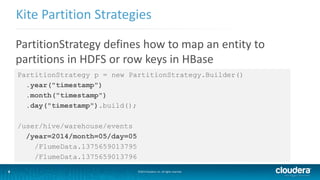
Kite Partition Strategies
Š2014 Cloudera, Inc. All rights reserved.8
PartitionStrategy defines how to map an entity to
partitions in HDFS or row keys in HBase
PartitionStrategy p = new PartitionStrategy.Builder()
.year("timestamp")
.month("timestamp")
.day("timestamp").build();
/user/hive/warehouse/events
/year=2014/month=05/day=05
/FlumeData.1375659013795
/FlumeData.1375659013796
9
Kite Datasets Example
Š2014 Cloudera, Inc. All rights reserved.
Event.avsc
{
"type" : "record",
"name" : ”Event",
"namespace" : "com.example”,
"fields" : [
{ "name”: ”id", "type”: ”long” },
{ “name”: “timestamp”, “type”: “long” },
{ “name”: “source”, “type”: “string” }
]
}
Log4j Configuration
log4j.appender.flume = org.kitesdk.data.flume.Log4jAppender
log4j.appender.flume.Hostname = localhost
log4j.appender.flume.Port = 41415
log4j.appender.flume.DatasetRepositoryUri = repo:hive
log4j.appender.flume.DatasetName = events
10
Kite Datasets Example Continued
Š2014 Cloudera, Inc. All rights reserved.
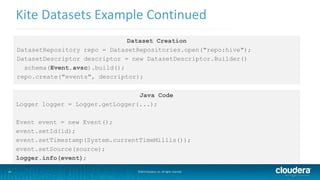
Dataset Creation
DatasetRepository repo = DatasetRepositories.open("repo:hive");
DatasetDescriptor descriptor = new DatasetDescriptor.Builder()
schema(Event.avsc).build();
repo.create("events", descriptor);
Java Code
Logger logger = Logger.getLogger(...);
Event event = new Event();
event.setId(id);
event.setTimestamp(System.currentTimeMillis());
event.setSource(source);
logger.info(event);
11
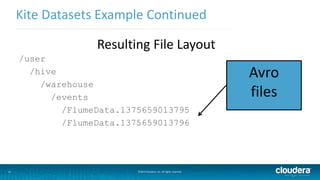
Kite Datasets Example Continued
Š2014 Cloudera, Inc. All rights reserved.
/user
/hive
/warehouse
/events
/FlumeData.1375659013795
/FlumeData.1375659013796
Avro
files
Resulting File Layout
12
Kite HBase Module
Overview
13
HBase Storage Format
Š2014 Cloudera, Inc. All rights reserved.13
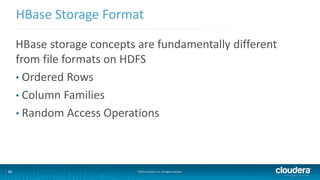
HBase storage concepts are fundamentally different
from file formats on HDFS
• Ordered Rows
• Column Families
• Random Access Operations
14
HBase Storage Format
Š2014 Cloudera, Inc. All rights reserved.14
New concepts added to the Dataset API:
• Composite Keys – support for entity ordering with
composite keys
• Column mapping – define how data is split across
column families and columns in a table
• Random Access Dataset Methods– support for Get,
Put, and Delete operations on the Dataset interface
15
Composite Key Engineering
Š2014 Cloudera, Inc. All rights reserved.15
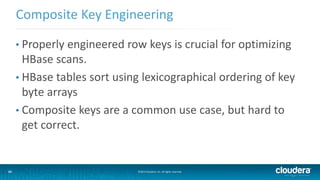
• Properly engineered row keys is crucial for optimizing
HBase scans.
• HBase tables sort using lexicographical ordering of key
byte arrays
• Composite keys are a common use case, but hard to
get correct.
16
Composite Key Engineering With Partition Strategies
Š2014 Cloudera, Inc. All rights reserved.16
• We already have a way to split records across storage buckets with a PartitionStrategy.
• Let’s re-use that concept.
• Example: Define a PartitionStrategy optimized for historical web page scans
Website.avsc
{
"type" : "record",
"name" : ”Website",
"namespace" : "com.example”,
"fields" : [
{ "name”: ”url", "type”: ”string” },
{ “name”: “timestamp”, “type”: “long” },
{ "name”: ”content", "type" : ”string” }
]
}
Partition Strategy Builder
PartitionStrategy p =
new PartitionStrategy.Builder()
.identity(”url")
.identity(”timestamp")
.build();
17
Composite Key Engineering With Partition Strategies
Š2014 Cloudera, Inc. All rights reserved.17
Or with the Partition Strategy JSON format
Website.avsc
{
"type" : "record",
"name" : ”Website",
"namespace" : "com.example”,
"fields" : [
{ "name”: ”url", "type”: ”string” },
{ “name”: “timestamp”, “type”: “long” },
{ "name”: ”content", "type" : ”string” }
]
}
WebsitePartitionStrat.json
[
{ “source”: “url”, “type”: “id” },
{ “source”: “timestamp”, “type”: “id” }
]
18
Key Memcmp Encoding
Š2014 Cloudera, Inc. All rights reserved.18
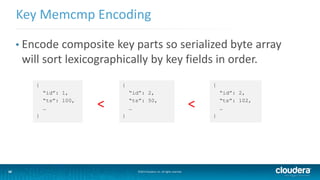
• Encode composite key parts so serialized byte array
will sort lexicographically by key fields in order.
{
“id”: 1,
“ts”: 100,
…
}
{
“id”: 2,
“ts”: 50,
…
}
{
“id”: 2,
“ts”: 102,
…
}
< <
19
Key Memcmp Encoding (Integer and Long)
Š2014 Cloudera, Inc. All rights reserved.19
Value Bytes
1 0x00000001
0 0x00000000
-1 0xFFFFFFFFF
-2 0xFFFFFFFFE
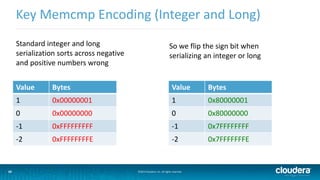
Standard integer and long
serialization sorts across negative
and positive numbers wrong
So we flip the sign bit when
serializing an integer or long
Value Bytes
1 0x80000001
0 0x80000000
-1 0x7FFFFFFFF
-2 0x7FFFFFFFE
20
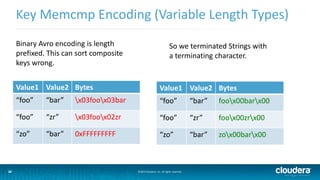
Key Memcmp Encoding (Variable Length Types)
Š2014 Cloudera, Inc. All rights reserved.20
Value1 Value2 Bytes
“foo” “bar” x03foox03bar
“foo” “zr” x03foox02zr
“zo” “bar” 0xFFFFFFFFF
Binary Avro encoding is length
prefixed. This can sort composite
keys wrong.
So we terminated Strings with
a terminating character.
Value1 Value2 Bytes
“foo” “bar” foox00barx00
“foo” “zr” foox00zrx00
“zo” “bar” zox00barx00
21
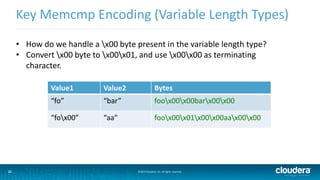
Key Memcmp Encoding (Variable Length Types)
Š2014 Cloudera, Inc. All rights reserved.21
• How do we handle a x00 byte present in the variable length type?
• Convert x00 byte to x00x01, and use x00x00 as terminating
character.
Value1 Value2 Bytes
“fo” “bar” foox00x00barx00x00
“fox00” “aa” foox00x01x00x00aax00x00
22
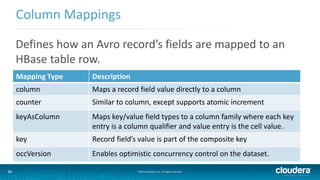
Column Mappings
Š2014 Cloudera, Inc. All rights reserved.22
Defines how an Avro record’s fields are mapped to an
HBase table row.
Mapping Type Description
column Maps a record field value directly to a column
counter Similar to column, except supports atomic increment
keyAsColumn Maps key/value field types to a column family where each key
entry is a column qualifier and value entry is the cell value.
key Record field’s value is part of the composite key
occVersion Enables optimistic concurrency control on the dataset.
23
Column Mappings: Header Definition
Š2014 Cloudera, Inc. All rights reserved.23
Event.avsc
{
"type" : "record",
"name" : "Event",
"namespace" : "com.example”,
“mapping”: [
{ “source”: “id”, “type”: “key” },
{ “source”: “ts”, “type”: “key” },
{ “source”: “source”, “type”: “column”, “value”: “meta:source”},
{ “source”: “atts”, “type”: keyAsColumn”, “value”: “atts:” }
],
"fields" : [
{ "name" : "id", "type" : "long” },
{ "name" : "ts", "type" : "long” },
{ "name" : "source", "type" : "string" },
{ “name” : “atts”,
“type”: { “type”: “map”, “value”: “string” } }
]
}
• Mapping definition attribute
can be added right to the Avro
record schema
• Still a valid Avro schema –
Avro’s schema parser will
ignore unknown attributes in
record header.
24
Column Mappings: Field Definition
Š2014 Cloudera, Inc. All rights reserved.24
Event.avsc
{
"type" : "record",
"name" : "Event",
"namespace" : "com.example”,
"fields" : [
{ "name”: "id", "type”: "long”, “mapping”: { “type”: “key” }},
{ "name”: "ts", "type" : "long”, “mapping”: { “type”: “key” }},
{ "name”: "source", "type”: "string”,
“mapping”: { “type”: “column”, “value”: “meta:source” }},
{ “name” : “atts”,
“type”: { “type”: “map”, “value”: “string” },
“mapping”: { “type”: “keyAsColumn”, “value”: “atts:” }}
]
}
• Mapping definition attributes
can be defined directly on the
Avro schema fields.
• Still a valid Avro schema –
Avro’s schema parser will
ignore unknown attributes on
fields.
25
Column Mappings: External Definition
Š2014 Cloudera, Inc. All rights reserved.25
Event.avsc
{
"type" : "record",
"name" : "Event",
"namespace" : "com.example”,
"fields" : [
{ "name”: "id", "type”: "long” },
{ "name”: "ts", "type" : "long” },
{ "name”: "source", "type”: "string” },
{ “name” : “atts”,
“type”: { “type”: “map”, “value”: “string” }}
]
}
• Mapping definition attributes
can be defined in an external
file.
• Perfect if you don’t want to
update existing Avro schemas.
EventMapping.json
[
{ “source”: “id”, “type”: “key” },
{ “source”: “ts”, “type”: “key” },
{ “source”: “source”, “type”: “column”, “value”: “meta:source”},
{ “source”: “atts”, “type”: keyAsColumn”, “value”: “atts:” }
]
26
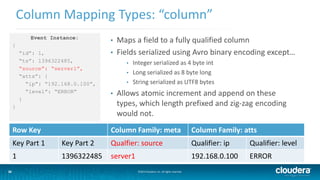
Column Mapping Types: “column”
Š2014 Cloudera, Inc. All rights reserved.26
• Maps a field to a fully qualified column
• Fields serialized using Avro binary encoding except…
• Integer serialized as 4 byte int
• Long serialized as 8 byte long
• String serialized as UTF8 bytes
• Allows atomic increment and append on these
types, which length prefixed and zig-zag encoding
would not.
Row Key Column Family: meta Column Family: atts
Key Part 1 Key Part 2 Qualfier: source Qualifier: ip Qualifier: level
1 1396322485 server1 192.168.0.100 ERROR
Event Instance:
{
“id”: 1,
“ts”: 1396322485,
“source”: “server1”,
“atts”: {
“ip”: “192.168.0.100”,
“level”: “ERROR”
}
}
27
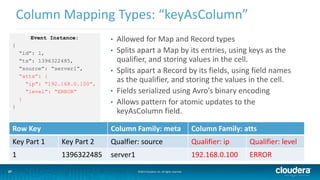
Column Mapping Types: “keyAsColumn”
Š2014 Cloudera, Inc. All rights reserved.27
• Allowed for Map and Record types
• Splits apart a Map by its entries, using keys as the
qualifier, and storing values in the cell.
• Splits apart a Record by its fields, using field names
as the qualifier, and storing the values in the cell.
• Fields serialized using Avro’s binary encoding
• Allows pattern for atomic updates to the
keyAsColumn field.
Row Key Column Family: meta Column Family: atts
Key Part 1 Key Part 2 Qualfier: source Qualifier: ip Qualifier: level
1 1396322485 server1 192.168.0.100 ERROR
Event Instance:
{
“id”: 1,
“ts”: 1396322485,
“source”: “server1”,
“atts”: {
“ip”: “192.168.0.100”,
“level”: “ERROR”
}
}
28
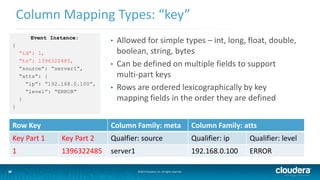
Column Mapping Types: “key”
Š2014 Cloudera, Inc. All rights reserved.28
• Allowed for simple types – int, long, float, double,
boolean, string, bytes
• Can be defined on multiple fields to support
multi-part keys
• Rows are ordered lexicographically by key
mapping fields in the order they are defined
Row Key Column Family: meta Column Family: atts
Key Part 1 Key Part 2 Qualfier: source Qualifier: ip Qualifier: level
1 1396322485 server1 192.168.0.100 ERROR
Event Instance:
{
“id”: 1,
“ts”: 1396322485,
“source”: “server1”,
“atts”: {
“ip”: “192.168.0.100”,
“level”: “ERROR”
}
}
29
1
2
3
4
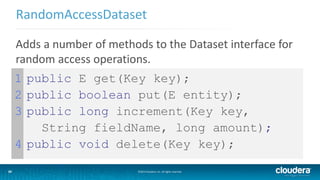
public E get(Key key);
public boolean put(E entity);
public long increment(Key key,
String fieldName, long amount);
public void delete(Key key);
RandomAccessDataset
Š2014 Cloudera, Inc. All rights reserved.29
Adds a number of methods to the Dataset interface for
random access operations.
30
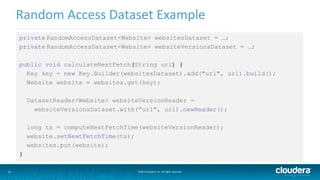
Random Access Dataset Example
Š2014 Cloudera, Inc. All rights reserved.
Website.avsc
{
"type" : "record",
"name" : ”Website",
"namespace" : "com.example”,
"fields" : [
{ "name”: ”url", "type”: ”string” },
{ “name”: “timestamp”, “type”: “long” },
{ “name”: “size”, “type”: “int” },
{ "name”: ”content", "type" : ”string” }
]
}
WebsitesPartitionStrat.json
[
{ “source”: “url”, “type”: “id” }
]
WebsiteVersionsPartitionStrat.json
[
{ “source”: “url”, “type”: “id” },
{ “source”: “timestamp”, “type”: “id” }
]
WebsiteColumnMapping.json
[
{ “source”: “url”, “type”: “column”,
“value”: “meta:url” },
{ “source”: “timestamp”, “type”: “column”,
“value”: “meta:timestamp” },
{ “source”: “size”, “type”: “column”,
“value”: “meta:size” },
{ “source”: “content”, “type”: “column”,
“value”: “content:content” }
]
31
Random Access Dataset Example
Š2014 Cloudera, Inc. All rights reserved.
private RandomAccessDataset<Website> websitesDataset = …;
private RandomAccessDataset<Website> websiteVersionsDataset = …;
public void calculateNextFetch(String url) {
Key key = new Key.Builder(websitesDataset).add("url", url).build();
Website website = websites.get(key);
DatasetReader<Website> websiteVersionReader =
websiteVersionsDataset.with("url", url).newReader();
long ts = computeNextFetchTime(websiteVersionReader);
website.setNextFetchTime(ts);
websites.put(website);
}
32
Kite HBase Module
Advanced Features
33
Concurrency Control
Š2014 Cloudera, Inc. All rights reserved.33
• HBase doesn’t have native support for transactions.
• This missing feature can be problematic to newbies.
• Single Row Puts are atomic, so best practice is to prefer de-
normalizing data into wide rows.
• This doesn’t help for Get-Update-Put operations though…
34
Optimistic Concurrency Control
Š2014 Cloudera, Inc. All rights reserved.34
• Prevents multiple
processes performing
row updates from
colliding
• Enabled with an
“occVersion” column
mapping type.
{
"type" : "record",
"name" : "Event",
"namespace" : "com.example”,
“mapping”: [
{ “source”: “id”, “type”: “key” },
{ “source”: “ts”, “type”: “key” },
{ “source”: “source”, “type”: “column”, “value”: “meta:source”},
{ “source”: “version”, “type”: occVersion” }
],
"fields" : [
{ "name" : "id", "type" : "long” },
{ "name" : "ts", "type" : "long” },
{ "name" : "source", "type" : "string" },
{ “name” : “version”, “type” : “long” }
]
}
35
Optimistic Concurrency Control Continued…
Š2014 Cloudera, Inc. All rights reserved.35
• The version field is used to track the version in the row.
• Uses checkAndPut under the hood to ensure the row hasn’t been updated.
• Can’t put to an existing row without first fetching it.
• If conflict occurs, put() on RandomAccessDataset will return false.
• Successful put() increments the version.
• Up to the developer how to handle a conflict.
• Enables data protection for long running edits, like shared editing in a web
application.
36
Other Notable Advanced Features
Š2014 Cloudera, Inc. All rights reserved.36
• Schema Migrations
• Users have the ability to add or remove fields from the Avro record
schemas.
• Kite SDK keeps the historical set of Avro schemas in a specially designated
HBase table.
• Kite SDK will verify that only valid schema migrations can occur.
• Composite Datasets
• Users can create multiple datasets for a single HBase table.
• This allows developers to atomically Get and Put multiple types of Avro
records to a single row.
• Kite SDK will verify that dataset column mappings don’t clash.
37 Š2014 Cloudera, Inc. All rights reserved.
Adam Warrington
@adamwar

HBase Data Modeling and Access Patterns with Kite SDK

  • 1.
    1 HBase Data Modelingand Access Patterns with Kite SDK Adam Warrington Sr. Manager Customer Ops Tools Team
  • 2.
    2 Developing on topof Apache Hadoop ©2014 Cloudera, Inc. All rights reserved.2 • Apache Hadoop is an incredibly powerful platform on which to develop data applications. • Scale • it provides the infrastructure needed to process big data at scale. • Flexibility • General purpose platform on top of which one can build almost any type of big data application. • Diverse Ecosystem • Multitude of storage engines, tools for ETL, machine learning, analysis, and data science. • This comes at a cost…
  • 3.
    3 Developing on topof Apache Hadoop: The Cost ©2014 Cloudera, Inc. All rights reserved.3 • The API is very basic and low level. • Developers are required to build plumbing and infrastructure to create even a basic system. • Repeat process for every system you create. • Have to understand the quirks of each system. • The barrier to entry is high for many enterprise Java developers in the industry.
  • 4.
    4 What is KiteSDK? ©2014 Cloudera, Inc. All rights reserved. • Kite SDK aims to solve this problem by building a higher level API on top of the Hadoop ecosystem • Kite exists as a client-side library for writing Hadoop Data Applications • Modular • Datasets: standard storage • Morphlines: ETL as configuration • Data Management Tools
  • 5.
    5 What is KiteSDK? ©2014 Cloudera, Inc. All rights reserved. • Kite SDK aims to solve this problem by building a higher level API on top of the Hadoop ecosystem • Kite exists as a client-side library for writing Hadoop Data Applications • Modular • Datasets: standard storage • Morphlines: ETL as configuration • Data Management Tools • Today’s talk will focus on the Datasets Module
  • 6.
    6 Kite Datasets ©2014 Cloudera,Inc. All rights reserved. • Motivation • Focus on your data, not managing it • Goals • Think in terms of data, not files • Describe your data and Kite does the right thing • Consistency - should work across the platform • Reliability
  • 7.
    7 Kite Datasets ©2014 Cloudera,Inc. All rights reserved. At the heart of the Kite Datasets module is a unified storage interface. • Dataset – a collection of entities • DatasetRepository – physical storage location for datasets • DatasetDescriptor – holds dataset metadata (schema, format) • DatasetWriter – write entities to a dataset in a stream • DatasetReader – read entities from a dataset
  • 8.
    8 Kite Partition Strategies Š2014Cloudera, Inc. All rights reserved.8 PartitionStrategy defines how to map an entity to partitions in HDFS or row keys in HBase PartitionStrategy p = new PartitionStrategy.Builder() .year("timestamp") .month("timestamp") .day("timestamp").build(); /user/hive/warehouse/events /year=2014/month=05/day=05 /FlumeData.1375659013795 /FlumeData.1375659013796
  • 9.
    9 Kite Datasets Example ©2014Cloudera, Inc. All rights reserved. Event.avsc { "type" : "record", "name" : ”Event", "namespace" : "com.example”, "fields" : [ { "name”: ”id", "type”: ”long” }, { “name”: “timestamp”, “type”: “long” }, { “name”: “source”, “type”: “string” } ] } Log4j Configuration log4j.appender.flume = org.kitesdk.data.flume.Log4jAppender log4j.appender.flume.Hostname = localhost log4j.appender.flume.Port = 41415 log4j.appender.flume.DatasetRepositoryUri = repo:hive log4j.appender.flume.DatasetName = events
  • 10.
    10 Kite Datasets ExampleContinued Š2014 Cloudera, Inc. All rights reserved. Dataset Creation DatasetRepository repo = DatasetRepositories.open("repo:hive"); DatasetDescriptor descriptor = new DatasetDescriptor.Builder() schema(Event.avsc).build(); repo.create("events", descriptor); Java Code Logger logger = Logger.getLogger(...); Event event = new Event(); event.setId(id); event.setTimestamp(System.currentTimeMillis()); event.setSource(source); logger.info(event);
  • 11.
    11 Kite Datasets ExampleContinued Š2014 Cloudera, Inc. All rights reserved. /user /hive /warehouse /events /FlumeData.1375659013795 /FlumeData.1375659013796 Avro files Resulting File Layout
  • 12.
  • 13.
    13 HBase Storage Format ©2014Cloudera, Inc. All rights reserved.13 HBase storage concepts are fundamentally different from file formats on HDFS • Ordered Rows • Column Families • Random Access Operations
  • 14.
    14 HBase Storage Format ©2014Cloudera, Inc. All rights reserved.14 New concepts added to the Dataset API: • Composite Keys – support for entity ordering with composite keys • Column mapping – define how data is split across column families and columns in a table • Random Access Dataset Methods– support for Get, Put, and Delete operations on the Dataset interface
  • 15.
    15 Composite Key Engineering ©2014Cloudera, Inc. All rights reserved.15 • Properly engineered row keys is crucial for optimizing HBase scans. • HBase tables sort using lexicographical ordering of key byte arrays • Composite keys are a common use case, but hard to get correct.
  • 16.
    16 Composite Key EngineeringWith Partition Strategies ©2014 Cloudera, Inc. All rights reserved.16 • We already have a way to split records across storage buckets with a PartitionStrategy. • Let’s re-use that concept. • Example: Define a PartitionStrategy optimized for historical web page scans Website.avsc { "type" : "record", "name" : ”Website", "namespace" : "com.example”, "fields" : [ { "name”: ”url", "type”: ”string” }, { “name”: “timestamp”, “type”: “long” }, { "name”: ”content", "type" : ”string” } ] } Partition Strategy Builder PartitionStrategy p = new PartitionStrategy.Builder() .identity(”url") .identity(”timestamp") .build();
  • 17.
    17 Composite Key EngineeringWith Partition Strategies ©2014 Cloudera, Inc. All rights reserved.17 Or with the Partition Strategy JSON format Website.avsc { "type" : "record", "name" : ”Website", "namespace" : "com.example”, "fields" : [ { "name”: ”url", "type”: ”string” }, { “name”: “timestamp”, “type”: “long” }, { "name”: ”content", "type" : ”string” } ] } WebsitePartitionStrat.json [ { “source”: “url”, “type”: “id” }, { “source”: “timestamp”, “type”: “id” } ]
  • 18.
    18 Key Memcmp Encoding ©2014Cloudera, Inc. All rights reserved.18 • Encode composite key parts so serialized byte array will sort lexicographically by key fields in order. { “id”: 1, “ts”: 100, … } { “id”: 2, “ts”: 50, … } { “id”: 2, “ts”: 102, … } < <
  • 19.
    19 Key Memcmp Encoding(Integer and Long) Š2014 Cloudera, Inc. All rights reserved.19 Value Bytes 1 0x00000001 0 0x00000000 -1 0xFFFFFFFFF -2 0xFFFFFFFFE Standard integer and long serialization sorts across negative and positive numbers wrong So we flip the sign bit when serializing an integer or long Value Bytes 1 0x80000001 0 0x80000000 -1 0x7FFFFFFFF -2 0x7FFFFFFFE
  • 20.
    20 Key Memcmp Encoding(Variable Length Types) ©2014 Cloudera, Inc. All rights reserved.20 Value1 Value2 Bytes “foo” “bar” x03foox03bar “foo” “zr” x03foox02zr “zo” “bar” 0xFFFFFFFFF Binary Avro encoding is length prefixed. This can sort composite keys wrong. So we terminated Strings with a terminating character. Value1 Value2 Bytes “foo” “bar” foox00barx00 “foo” “zr” foox00zrx00 “zo” “bar” zox00barx00
  • 21.
    21 Key Memcmp Encoding(Variable Length Types) ©2014 Cloudera, Inc. All rights reserved.21 • How do we handle a x00 byte present in the variable length type? • Convert x00 byte to x00x01, and use x00x00 as terminating character. Value1 Value2 Bytes “fo” “bar” foox00x00barx00x00 “fox00” “aa” foox00x01x00x00aax00x00
  • 22.
    22 Column Mappings ©2014 Cloudera,Inc. All rights reserved.22 Defines how an Avro record’s fields are mapped to an HBase table row. Mapping Type Description column Maps a record field value directly to a column counter Similar to column, except supports atomic increment keyAsColumn Maps key/value field types to a column family where each key entry is a column qualifier and value entry is the cell value. key Record field’s value is part of the composite key occVersion Enables optimistic concurrency control on the dataset.
  • 23.
    23 Column Mappings: HeaderDefinition ©2014 Cloudera, Inc. All rights reserved.23 Event.avsc { "type" : "record", "name" : "Event", "namespace" : "com.example”, “mapping”: [ { “source”: “id”, “type”: “key” }, { “source”: “ts”, “type”: “key” }, { “source”: “source”, “type”: “column”, “value”: “meta:source”}, { “source”: “atts”, “type”: keyAsColumn”, “value”: “atts:” } ], "fields" : [ { "name" : "id", "type" : "long” }, { "name" : "ts", "type" : "long” }, { "name" : "source", "type" : "string" }, { “name” : “atts”, “type”: { “type”: “map”, “value”: “string” } } ] } • Mapping definition attribute can be added right to the Avro record schema • Still a valid Avro schema – Avro’s schema parser will ignore unknown attributes in record header.
  • 24.
    24 Column Mappings: FieldDefinition ©2014 Cloudera, Inc. All rights reserved.24 Event.avsc { "type" : "record", "name" : "Event", "namespace" : "com.example”, "fields" : [ { "name”: "id", "type”: "long”, “mapping”: { “type”: “key” }}, { "name”: "ts", "type" : "long”, “mapping”: { “type”: “key” }}, { "name”: "source", "type”: "string”, “mapping”: { “type”: “column”, “value”: “meta:source” }}, { “name” : “atts”, “type”: { “type”: “map”, “value”: “string” }, “mapping”: { “type”: “keyAsColumn”, “value”: “atts:” }} ] } • Mapping definition attributes can be defined directly on the Avro schema fields. • Still a valid Avro schema – Avro’s schema parser will ignore unknown attributes on fields.
  • 25.
    25 Column Mappings: ExternalDefinition ©2014 Cloudera, Inc. All rights reserved.25 Event.avsc { "type" : "record", "name" : "Event", "namespace" : "com.example”, "fields" : [ { "name”: "id", "type”: "long” }, { "name”: "ts", "type" : "long” }, { "name”: "source", "type”: "string” }, { “name” : “atts”, “type”: { “type”: “map”, “value”: “string” }} ] } • Mapping definition attributes can be defined in an external file. • Perfect if you don’t want to update existing Avro schemas. EventMapping.json [ { “source”: “id”, “type”: “key” }, { “source”: “ts”, “type”: “key” }, { “source”: “source”, “type”: “column”, “value”: “meta:source”}, { “source”: “atts”, “type”: keyAsColumn”, “value”: “atts:” } ]
  • 26.
    26 Column Mapping Types:“column” ©2014 Cloudera, Inc. All rights reserved.26 • Maps a field to a fully qualified column • Fields serialized using Avro binary encoding except… • Integer serialized as 4 byte int • Long serialized as 8 byte long • String serialized as UTF8 bytes • Allows atomic increment and append on these types, which length prefixed and zig-zag encoding would not. Row Key Column Family: meta Column Family: atts Key Part 1 Key Part 2 Qualfier: source Qualifier: ip Qualifier: level 1 1396322485 server1 192.168.0.100 ERROR Event Instance: { “id”: 1, “ts”: 1396322485, “source”: “server1”, “atts”: { “ip”: “192.168.0.100”, “level”: “ERROR” } }
  • 27.
    27 Column Mapping Types:“keyAsColumn” ©2014 Cloudera, Inc. All rights reserved.27 • Allowed for Map and Record types • Splits apart a Map by its entries, using keys as the qualifier, and storing values in the cell. • Splits apart a Record by its fields, using field names as the qualifier, and storing the values in the cell. • Fields serialized using Avro’s binary encoding • Allows pattern for atomic updates to the keyAsColumn field. Row Key Column Family: meta Column Family: atts Key Part 1 Key Part 2 Qualfier: source Qualifier: ip Qualifier: level 1 1396322485 server1 192.168.0.100 ERROR Event Instance: { “id”: 1, “ts”: 1396322485, “source”: “server1”, “atts”: { “ip”: “192.168.0.100”, “level”: “ERROR” } }
  • 28.
    28 Column Mapping Types:“key” ©2014 Cloudera, Inc. All rights reserved.28 • Allowed for simple types – int, long, float, double, boolean, string, bytes • Can be defined on multiple fields to support multi-part keys • Rows are ordered lexicographically by key mapping fields in the order they are defined Row Key Column Family: meta Column Family: atts Key Part 1 Key Part 2 Qualfier: source Qualifier: ip Qualifier: level 1 1396322485 server1 192.168.0.100 ERROR Event Instance: { “id”: 1, “ts”: 1396322485, “source”: “server1”, “atts”: { “ip”: “192.168.0.100”, “level”: “ERROR” } }
  • 29.
    29 1 2 3 4 public E get(Keykey); public boolean put(E entity); public long increment(Key key, String fieldName, long amount); public void delete(Key key); RandomAccessDataset Š2014 Cloudera, Inc. All rights reserved.29 Adds a number of methods to the Dataset interface for random access operations.
  • 30.
    30 Random Access DatasetExample ©2014 Cloudera, Inc. All rights reserved. Website.avsc { "type" : "record", "name" : ”Website", "namespace" : "com.example”, "fields" : [ { "name”: ”url", "type”: ”string” }, { “name”: “timestamp”, “type”: “long” }, { “name”: “size”, “type”: “int” }, { "name”: ”content", "type" : ”string” } ] } WebsitesPartitionStrat.json [ { “source”: “url”, “type”: “id” } ] WebsiteVersionsPartitionStrat.json [ { “source”: “url”, “type”: “id” }, { “source”: “timestamp”, “type”: “id” } ] WebsiteColumnMapping.json [ { “source”: “url”, “type”: “column”, “value”: “meta:url” }, { “source”: “timestamp”, “type”: “column”, “value”: “meta:timestamp” }, { “source”: “size”, “type”: “column”, “value”: “meta:size” }, { “source”: “content”, “type”: “column”, “value”: “content:content” } ]
  • 31.
    31 Random Access DatasetExample ©2014 Cloudera, Inc. All rights reserved. private RandomAccessDataset<Website> websitesDataset = …; private RandomAccessDataset<Website> websiteVersionsDataset = …; public void calculateNextFetch(String url) { Key key = new Key.Builder(websitesDataset).add("url", url).build(); Website website = websites.get(key); DatasetReader<Website> websiteVersionReader = websiteVersionsDataset.with("url", url).newReader(); long ts = computeNextFetchTime(websiteVersionReader); website.setNextFetchTime(ts); websites.put(website); }
  • 32.
  • 33.
    33 Concurrency Control ©2014 Cloudera,Inc. All rights reserved.33 • HBase doesn’t have native support for transactions. • This missing feature can be problematic to newbies. • Single Row Puts are atomic, so best practice is to prefer de- normalizing data into wide rows. • This doesn’t help for Get-Update-Put operations though…
  • 34.
    34 Optimistic Concurrency Control ©2014Cloudera, Inc. All rights reserved.34 • Prevents multiple processes performing row updates from colliding • Enabled with an “occVersion” column mapping type. { "type" : "record", "name" : "Event", "namespace" : "com.example”, “mapping”: [ { “source”: “id”, “type”: “key” }, { “source”: “ts”, “type”: “key” }, { “source”: “source”, “type”: “column”, “value”: “meta:source”}, { “source”: “version”, “type”: occVersion” } ], "fields" : [ { "name" : "id", "type" : "long” }, { "name" : "ts", "type" : "long” }, { "name" : "source", "type" : "string" }, { “name” : “version”, “type” : “long” } ] }
  • 35.
    35 Optimistic Concurrency ControlContinued… ©2014 Cloudera, Inc. All rights reserved.35 • The version field is used to track the version in the row. • Uses checkAndPut under the hood to ensure the row hasn’t been updated. • Can’t put to an existing row without first fetching it. • If conflict occurs, put() on RandomAccessDataset will return false. • Successful put() increments the version. • Up to the developer how to handle a conflict. • Enables data protection for long running edits, like shared editing in a web application.
  • 36.
    36 Other Notable AdvancedFeatures ©2014 Cloudera, Inc. All rights reserved.36 • Schema Migrations • Users have the ability to add or remove fields from the Avro record schemas. • Kite SDK keeps the historical set of Avro schemas in a specially designated HBase table. • Kite SDK will verify that only valid schema migrations can occur. • Composite Datasets • Users can create multiple datasets for a single HBase table. • This allows developers to atomically Get and Put multiple types of Avro records to a single row. • Kite SDK will verify that dataset column mappings don’t clash.
  • 37.
    37 Š2014 Cloudera,Inc. All rights reserved. Adam Warrington @adamwar