Randomised Controlled Trial, RCT, Experimental study
The document outlines the principles and methodologies of randomized controlled trials (RCTs), highlighting their importance in clinical research for evaluating the effectiveness of interventions. It covers the procedures for randomization, various study designs, ethical considerations, and the phases of clinical trials, along with advantages and disadvantages of RCTs. Key components such as allocation concealment, blinding, and endpoint measurements are also discussed, emphasizing their role in minimizing bias and ensuring valid results.
Randomised Controlled Trial, RCT, Experimental study
1.
RANDOMISED CONTROLLED
TRIAL (RCT)
DrLipilekha Patnaik
Professor, Community Medicine
Institute of Medical Sciences & SUM Hospital
Siksha ‘O’ A nusandhan deemed to be University
Bhubaneswar, ODISHA, INDIA
E mail– drlipilekha@yahoo.co.in
1
2.
Presentation outline
u Whydo Randomized Controlled Trials?
u Randomization why and how it is done
u RCT classification
u Study design & Steps of RCT
u Minimizing bias in intervention studies
u Allocation concealment and blinding
2
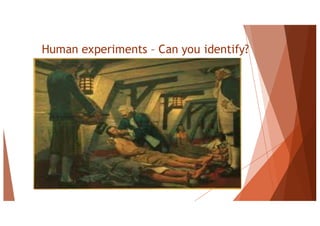
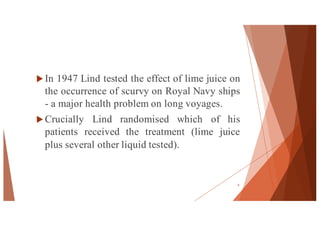
u In 1947Lind tested the effect of lime juice on
the occurrence of scurvy on Royal Navy ships
- a major health problem on long voyages.
u Crucially Lind randomised which of his
patients received the treatment (lime juice
plus several other liquid tested).
4
5.
1948:
Sir Austin BradfordHill – streptomycin for TB
u The first published RCT in medicine appeared in the
1948 paper entitled "Streptomycin treatment of
pulmonary tuberculosis", which described a Medical
Research Council investigation.
u One of the authors of that paper was Austin
Bradford Hill, who is credited as having conceived
the modern RCT.
5
6.
Definition of RCT
Anepidemiological experiment in which subjects in a
population are randomly allocated into groups, usually
called study and control groups to receive and not receive an
experimental preventive or therapetuic procedure, maneuver,
or intervention
John M.Last, 2001
RCT can be used to:
§ Evaluate the safety of a new drug in healthy human volunteers
§ Assess treatment benefits in patients with a specific disease
§ Compare a new drug against existing drugs or against dummy
medications (placebo).
6
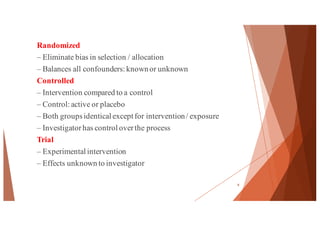
Randomized
– Eliminate biasin selection / allocation
– Balances all confounders: knownor unknown
Controlled
– Intervention compared to a control
– Control: active or placebo
– Both groupsidentical except for intervention/ exposure
– Investigatorhas control overthe process
Trial
– Experimental intervention
– Effects unknown to investigator
8
9.
Ethics in RCT
uAlthough the principle of clinical equipoise ("genuine uncertainty within the expert
medical community... about the preferred treatment") common to clinical trials
has been applied to RCTs, the ethics of RCTs have special considerations.
u almost always provide informed consent for their participation in an RCT.
Trial registration
u In 2004, the International Committee of Medical Journal Editors (ICMJE)
announced that all trials starting enrolment after July 1, 2005 must be registered.
u Clinical trial registry of India - (CTRI), hosted at the ICMR's National Institute of
Medical Statistics (http://nims-icmr.nic.in), is a free and online public record
system for registration of clinical trials being conducted in India that was launched
on 20th July 2007 (www.ctri.nic.in). in the CTRI has been made mandatory by the
Drugs Controller General (India) (DCGI)
u Clinicaltrials.gov- by U.S. National Institutes of Health
9
10.
Randomization
u Process bywhich, allocation ofsubjects to treatment groups
is left to chance (or randomness)
The major purpose of random assignment
a) Ensure that the study groupsare comparableon baseline
characteristics. It tends to balance prognosticfactors
(Balance in prognosis)
b) Reduce selection bias in allocation to groups
c) Facilitate doubleblinding
d) Facilitate measurements of outcome variables
10
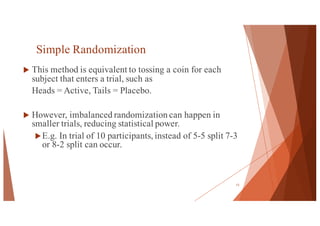
Simple Randomization
u Thismethod is equivalent to tossing a coin for each
subject that enters a trial, such as
Heads = Active, Tails = Placebo.
u However, imbalanced randomization can happen in
smaller trials, reducing statistical power.
uE.g. In trial of 10 participants, instead of 5-5 split 7-3
or 8-2 split can occur.
13
14.
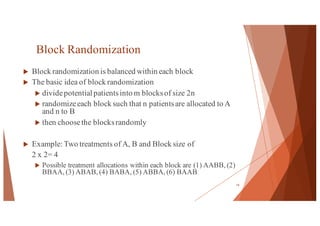
Block Randomization
u Blockrandomization is balanced within each block
u The basic idea of block randomization
u dividepotential patientsinto m blocksof size 2n
u randomizeeach block such that n patientsare allocated to A
and n to B
u then choosethe blocksrandomly
u Example: Two treatments of A, B and Block size of
2 x 2= 4
u Possible treatment allocations within each block are (1) AABB, (2)
BBAA, (3) ABAB, (4) BABA, (5) ABBA, (6) BAAB
14
15.
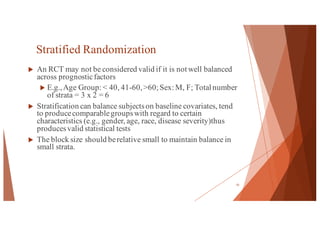
Stratified Randomization
u AnRCT may not be considered valid if it is not well balanced
across prognosticfactors
u E.g.,Age Group: < 40, 41-60,>60; Sex: M, F; Total number
of strata = 3 x 2 = 6
u Stratification can balance subjectson baseline covariates, tend
to producecomparablegroupswith regard to certain
characteristics (e.g., gender, age, race, disease severity)thus
producesvalid statistical tests
u The block size should berelative small to maintain balance in
small strata.
15
16.
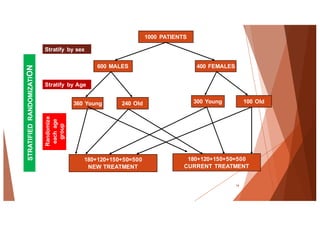
1000 PATIENTS
600 MALES400 FEMALES
360 Young 240 Old 300 Young 100 Old
180+120+150+50=500
NEW TREATMENT
180+120+150+50=500
CURRENT TREATMENT
Stratify by sex
Stratify by Age
Randomize
eachage
group
STRATIFIEDRANDOMIZATION
16
17.
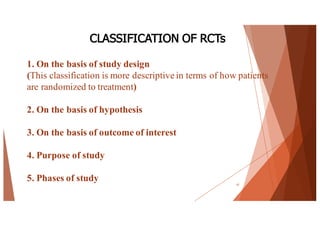
1. On thebasis of study design
(This classification is more descriptive in terms of how patients
are randomized to treatment)
2. On the basis of hypothesis
3. On the basis of outcome of interest
4. Purpose of study
5. Phases of study
17
CLASSIFICATION OF RCTs
18.
On the basisof study design
18
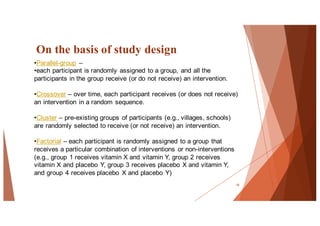
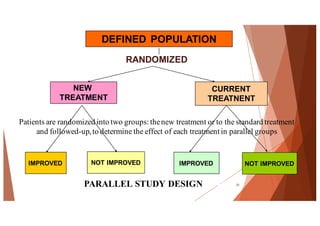
•Parallel-group –
•each participant is randomly assigned to a group, and all the
participants in the group receive (or do not receive) an intervention.
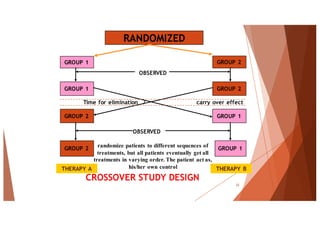
•Crossover – over time, each participant receives (or does not receive)
an intervention in a random sequence.
•Cluster – pre-existing groups of participants (e.g., villages, schools)
are randomly selected to receive (or not receive) an intervention.
•Factorial – each participant is randomly assigned to a group that
receives a particular combination of interventions or non-interventions
(e.g., group 1 receives vitamin X and vitamin Y, group 2 receives
vitamin X and placebo Y, group 3 receives placebo X and vitamin Y,
and group 4 receives placebo X and placebo Y)
DEFINED POPULATION
RANDOMIZED
NEW
TREATMENT
CURRENT
TREATNENT
IMPROVED NOTIMPROVED IMPROVED NOT IMPROVED
DESIGN OF A RANDOMISED TRIALPARALLEL STUDY DESIGN
Patients are randomized into two groups:thenew treatment or to the standard treatment
and followed-up,to determine the effect of each treatment in parallel groups
20
RANDOMIZED
GROUP 1
GROUP 1
GROUP2
GROUP 2
GROUP 2
GROUP 2
GROUP 1
GROUP 1
OBSERVED
OBSERVED
THERAPY A THERAPY B
CROSSOVER STUDY DESIGN
randomize patients to different sequences of
treatments, but all patients eventually get all
treatments in varying order. The patient act as,
his/her own control
Time for elimination / carry over effect
22
23.
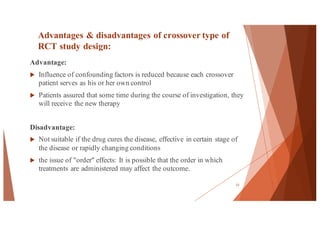
Advantages & disadvantagesof crossover type of
RCT study design:
Advantage:
u Influence of confounding factors is reduced because each crossover
patient serves as his or her own control
u Patients assured that some time during the course of investigation, they
will receive the new therapy
Disadvantage:
u Not suitable if the drug cures the disease, effective in certain stage of
the disease or rapidly changing conditions
u the issue of "order" effects: It is possible that the order in which
treatments are administered may affect the outcome.
23
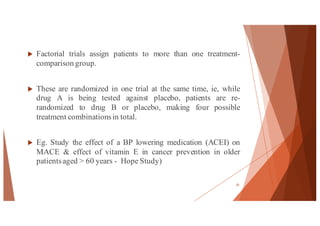
u Factorial trialsassign patients to more than one treatment-
comparison group.
u These are randomized in one trial at the same time, ie, while
drug A is being tested against placebo, patients are re-
randomized to drug B or placebo, making four possible
treatment combinationsin total.
u Eg. Study the effect of a BP lowering medication (ACEI) on
MACE & effect of vitamin E in cancer prevention in older
patientsaged > 60 years - Hope Study)
25
26.
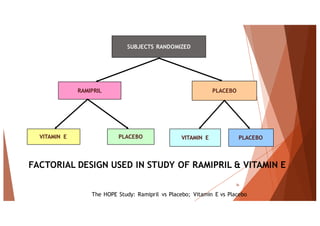
SUBJECTS RANDOMIZED
RAMIPRIL PLACEBO
VITAMINE PLACEBO VITAMIN E PLACEBO
FACTORIAL DESIGN USED IN STUDY OF RAMIPRIL & VITAMIN E
The HOPE Study: Ramipril vs Placebo; Vitamin E vs Placebo
26
27.
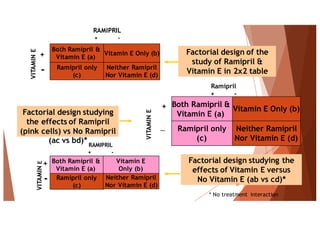
Both Ramipril &
VitaminE (a)
Vitamin E Only (b)
Ramipril only
(c)
Neither Ramipril
Nor Vitamin E (d)
Ramipril
+ -
RAMIPRIL
+ -
VITAMINE
|
+
VITAMINE
-
+
Both Ramipril &
Vitamin E (a)
Vitamin E Only (b)
Ramipril only
(c)
Neither Ramipril
Nor Vitamin E (d)
Both Ramipril &
Vitamin E (a)
Vitamin E
Only (b)
Ramipril only
(c)
Neither Ramipril
Nor Vitamin E (d)
RAMIPRIL
+ -
Factorial design of the
study of Ramipril &
Vitamin E in 2x2 table
Factorial design studying
the effects of Ramipril
(pink cells) vs No Ramipril
(ac vs bd)*
Factorial design studying the
effects of Vitamin E versus
No Vitamin E (ab vs cd)*
VITAMINE
* No treatment interaction
-
+
27
28.
Advantages:
– Two trialsfor (almost) the price of one
– Design is best if: two intervention have different mechanisms
of actions or different outcomes
Disadvantages:
– Need to test for possibility of interaction (e.g. A differs based
on the presence or absence of B)
– Need to consider gain in cost vs. increased complexity,
recruitment and adherence issues
– potential for adverse events
28
29.
Cluster randomized trials
uPerformed when larger groups (e.g. patients of a single practitioner
or hospital)are randomized instead of individual patients.
u In a rural area with an endemic disease, we might randomize whole
villages to have the intervention or not, rather than individual
people.
u To evaluate health systems interventions
Eg; educational intervention in schoolsfor prevention ofCV risk
factors
u To avoid treatment group contamination
u Administrativeconvenience
29
30.
RCT can alsobe described on the basis of hypothesis:
u Superiority studies
u Equivalence studies
u Non inferiority studies
30
31.
u A superioritystudy aims to show that a new drug is more
effective than the comparative treatment (placebo or current best
treatment)
u An equivalence study is designed to prove that two drugs have the
same clinical benefit.
u A non inferiority study aims to show that the effect of a new
treatment cannot be said to be significantly weaker than that of the
current treatment.
31
32.
By outcome ofinterest (efficacy vs.
effectiveness)
u Explanatory RCTs: test efficacy in a research setting
with highly selected participants and under highly
controlled conditions.
u Pragmatic RCTs: test effectiveness in everyday
practice with relatively unselected participants and
under flexible conditions; in this way, pragmatic RCTs
can "inform decisions about practice."
32
33.
Types of RandomizedControlled Trials
1. Clinical Trials
2. Preventive Trial
3. Risk Factor Trials
4. Cessation Experiment
5. Trial of etiological agents
6. Evaluation of health services
33
34.
Types of RandomizedControlled Trials:
1. Clinical Trial
- Concerned with evaluating therapeuticagent,mainly drugs
eg. Evaluationof beta-blockersin reducing cardiovascular
mortality
2. PreventiveTrials:
- Trial of primary preventivemeasures eg. Vaccines
- Analysis of preventivetrials must result in clear statement
about benefits to community,risk involvedand cost to health
34
35.
3. Risk FactorTrials:
- Investigator intervenes to interrupt the usual sequence in the
development of disease for those individuals who have risk factor
for developing the disease
- Primary prevention of CHD using clofibrate to lower serum
cholesterol
4. Cessation Experiment:
- An attempt is made to evaluate the termination of a habit which is
considered to be causally related to disease
- Cigarette smoking and lung cancer
35
36.
5. Trials ofEtiologicalAgents:
- To confirm or refute an etiological hypothesis
6. Evaluation of Health Services:
- Domiciliary treatment of PTB was as effective as
more costlier hospital or sanatorium treatment
36
37.
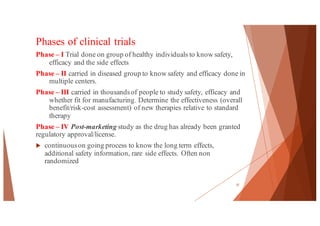
Phases of clinicaltrials
Phase – I Trial done on group of healthy individuals to know safety,
efficacy and the side effects
Phase – II carried in diseased group to know safety and efficacy done in
multiple centers.
Phase – III carried in thousandsof people to study safety, efficacy and
whether fit for manufacturing. Determine the effectiveness (overall
benefit/risk-cost assessment) of new therapies relative to standard
therapy
Phase – IV Post-marketing study as the drug has already been granted
regulatory approval/license.
u continuouson going process to know the long term effects,
additional safety information, rare side effects. Often non
randomized
37
38.
Steps of conductinga RCT
38
1.Drawing up a protocol
2.Selecting reference & experimental population
3.Randomization
4.Manipulation or intervention
5.Follow up
6.Assessment of outcome
39.
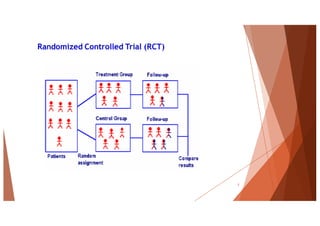
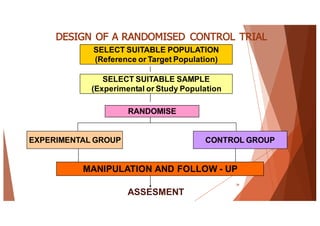
DESIGN OF ARANDOMISED CONTROL TRIAL
39
SELECT SUITABLE POPULATION
(Reference or Target Population)
SELECT SUITABLE SAMPLE
(Experimental or Study Population
RANDOMISE
EXPERIMENTAL GROUP CONTROL GROUP
MANIPULATION AND FOLLOW - UP
ASSESMENT
40.
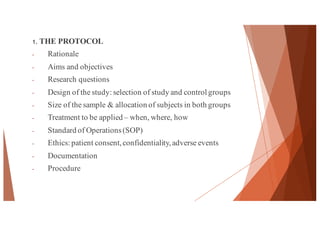
1. THE PROTOCOL
-Rationale
- Aims and objectives
- Research questions
- Design of the study: selection of study and control groups
- Size of the sample & allocation of subjects in both groups
- Treatment to be applied – when, where, how
- Standard of Operations(SOP)
- Ethics: patient consent,confidentiality,adverse events
- Documentation
- Procedure
40
41.
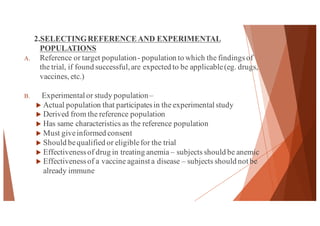
2.SELECTINGREFERENCEAND EXPERIMENTAL
POPULATIONS
A. Referenceor target population- population to which the findingsof
the trial, if found successful,are expected to be applicable(eg. drugs,
vaccines, etc.)
B. Experimental or study population–
u Actual population that participatesin the experimental study
u Derived from the reference population
u Has same characteristics as the reference population
u Must giveinformed consent
u Should bequalified or eligiblefor the trial
u Effectivenessof drug in treating anemia – subjects should be anemic
u Effectivenessof a vaccine against a disease – subjects should not be
already immune
41
42.
3. RANDOMIZATION
- Heartof the control trial
- Procedure: Participants are allocated into study
and control groups
- Eliminates bias and allows comparability
- Both groups should be alike with regards to
certain variables that might affect the outcome of
the experiment
42
43.
4. MANIPULATION /INTERVENTION
- Deliberate application or withdrawal or reduction of
a suspected causal factor
- It creates an independent variable (drugs, vaccine,
new procedure) whose effect is measured in final
outcome constituting the dependent variable
(incidence of disease, survival time, control of events
etc)
43
44.
5. FOLLOW UP
-Implies examination of the experimentaland control
group subjects
- at defined intervals of time,
- in a standard manner
- with equal intensity
- under the same given circumstances
- Attrition: Inevitable losses to follow up (death,
migration, loss of interest)
44
45.
6. ASSESSMENT
- Positiveresults:
- Reduced incidence or severity of disease
- Reduced cost to health service
- Appropriate outcome in the study
- Negative results:
- Increased severity or frequency of side effects
- Complications
- Deaths
45
46.
Approach to analysis
•Intention to treat (ITT)
– All patient analyzed in the group allocated to
Even - did not take the treatment / follow protocol
– Randomization maintained, statistical assumptions
valid
• Per Protocol
– Only those who followed the protocol
– State in advance
46
47.
Missing data inITT analysis
1. LastValue Carried Forward (LCVF)
– last observation formissing observations
– assumes this is an unbiased estimate
– variability and time-trendsNOT considered
2. MaximumLikelihood Estimation (MLE)……(Shib 1987)
– mixed-model approach
– predictorused to reflect a true relationshipwith the missing
value
• When data are largely missing at random– MLE is
statistically valid (Hogan 1996)
47
48.
Advantages & disadvantagesof RCT
u Randomization tends to balance prognostic factors
across study groups.
u Detailed information can be collected on baseline and
subsequent characteristics of participants.
u Dose levels can be predetermined by the investigator.
u Blinding of participants can reduce distortion in
assessment of outcomes.
48
Advantages:
49.
Disadvantages:
u Subject exclusionsmay limit ability to generalize
findings to other participants.
u A long period of time is often required to reach a
conclusion.
u A large number of participants usually required.
u Financial costs are typically high.
u Ethical concerns may arise.
u Compliance.
49
50.
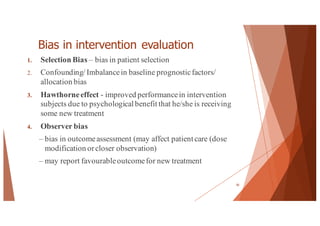
Bias in interventionevaluation
1. Selection Bias – bias in patient selection
2. Confounding/ Imbalancein baseline prognosticfactors/
allocation bias
3. Hawthorneeffect - improved performancein intervention
subjects due to psychological benefit that he/she is receiving
some new treatment
4. Observer bias
– bias in outcomeassessment (may affect patient care (dose
modification orcloser observation)
– may report favourableoutcomefor new treatment
50
51.
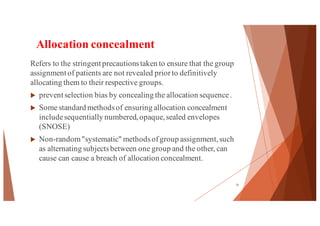
Allocation concealment
Refers tothe stringent precautionstaken to ensure that the group
assignment of patients are not revealed priorto definitively
allocating them to their respective groups.
u prevent selection bias by concealing the allocation sequence.
u Some standard methodsof ensuring allocation concealment
includesequentially numbered,opaque,sealed envelopes
(SNOSE)
u Non-random"systematic" methodsofgroup assignment,such
as alternating subjectsbetween one group and the other, can
cause can cause a breach of allocation concealment.
51
52.
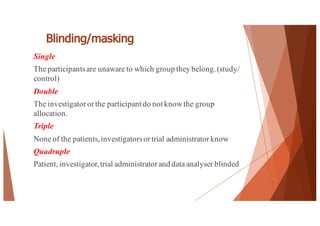
Blinding/masking
Single
The participantsare unawareto which group they belong.(study/
control)
Double
The investigatororthe participant do not knowthe group
allocation.
Triple
None of the patients,investigatorsortrial administratorknow
Quadruple
Patient, investigator,trial administratorand data analyser blinded
52
53.
Purpose of blinding
uTo remove subjective / judgmental bias in
– Reporting
– Evaluation
– Management
– Analysis of data
53
54.
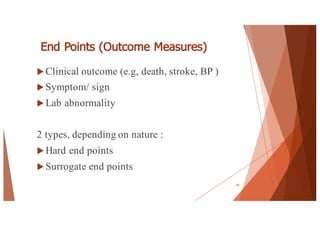
End Points (OutcomeMeasures)
u Clinical outcome (e.g, death, stroke, BP )
u Symptom/ sign
u Lab abnormality
2 types, depending on nature :
u Hard end points
u Surrogate end points
54
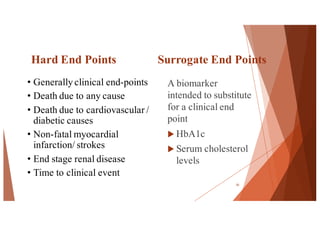
55.
Hard End PointsSurrogate End Points
A biomarker
intended to substitute
for a clinical end
point
u HbA1c
u Serum cholesterol
levels
55
• Generally clinical end-points
• Death due to any cause
• Death due to cardiovascular /
diabetic causes
• Non-fatal myocardial
infarction/ strokes
• End stage renal disease
• Time to clinical event
56.
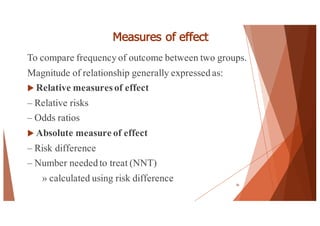
Measures of effect
Tocompare frequency of outcome between two groups.
Magnitude of relationship generally expressed as:
u Relative measuresof effect
– Relative risks
– Odds ratios
u Absolute measure of effect
– Risk difference
– Number needed to treat (NNT)
» calculated using risk difference 56
57.
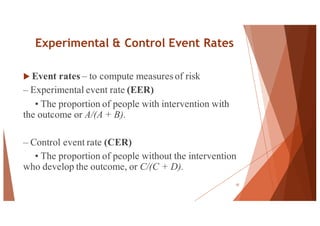
Experimental & ControlEvent Rates
u Event rates – to compute measuresof risk
– Experimental event rate (EER)
• The proportion of people with intervention with
the outcome or A/(A + B).
– Control event rate (CER)
• The proportion of people without the intervention
who develop the outcome, or C/(C + D).
57
58.
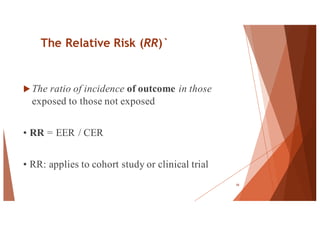
The Relative Risk(RR)`
u The ratio of incidence of outcome in those
exposed to those not exposed
• RR = EER / CER
• RR: applies to cohort study or clinical trial
58
59.
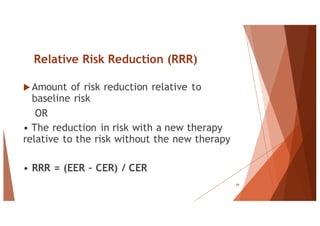
Relative Risk Reduction(RRR)
u Amount of risk reduction relative to
baseline risk
OR
• The reduction in risk with a new therapy
relative to the risk without the new therapy
• RRR = (EER – CER) / CER
59
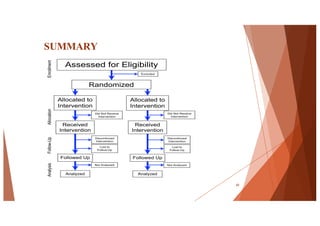
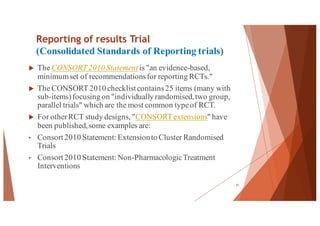
Reporting of resultsTrial
(Consolidated Standards of Reporting trials)
u The CONSORT 2010 Statement is "an evidence-based,
minimumset of recommendationsfor reporting RCTs."
u The CONSORT 2010 checklist contains25 items (many with
sub-items)focusing on "individually randomised,two group,
parallel trials" which are the most common typeof RCT.
u For otherRCT study designs, "CONSORT extensions" have
been published,some examples are:
• Consort 2010 Statement: Extensionto Cluster Randomised
Trials
• Consort 2010 Statement: Non-PharmacologicTreatment
Interventions
61