María Jesús Campos Fernández
Terrestrial Globe
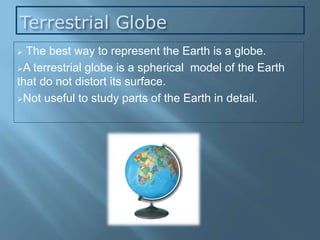
 The best way to represent the Earth is a globe.
A terrestrial globe is a spherical model of the Earth
that do not distort its surface.
Not useful to study parts of the Earth in detail.
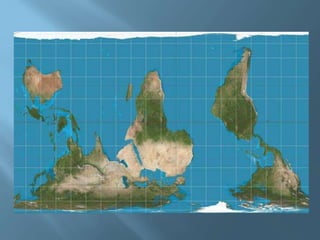
 Represent the 3-D geoid of the Earth on a
flat surface or map.
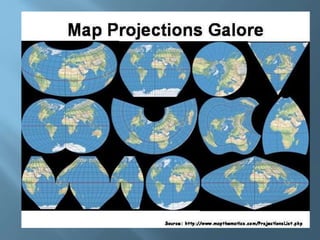
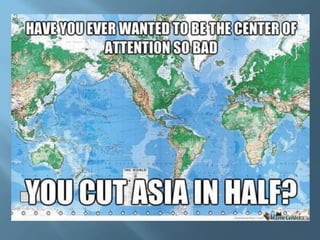
 Every projection changes the surface of the
Earth in some way. This is called distortion.
 Geographers use different types of
projection depending on the purpose of the
map they want to create and their accuracy.
 Equivalent projection: they show the
proportion of landmasses accurately. Useful
for comparing the surface area of territories.
 Equidisntant projection: they show the
distance between territories accurately.
 Conformal projection: they show the
shape of an area accurately.
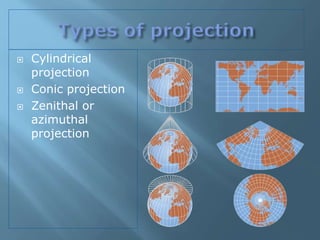
 Cylindrical
projection
 Conic projection
 Zenithal or
azimuthal
projection
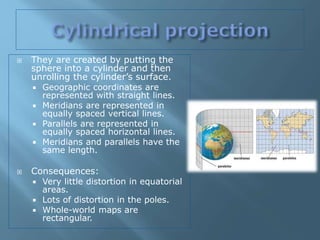
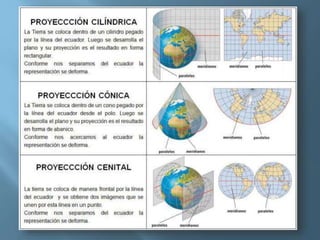
 They are created by putting the
sphere into a cylinder and then
unrolling the cylinder’s surface.
 Geographic coordinates are
represented with straight lines.
 Meridians are represented in
equally spaced vertical lines.
 Parallels are represented in
equally spaced horizontal lines.
 Meridians and parallels have the
same length.
 Consequences:
 Very little distortion in equatorial
areas.
 Lots of distortion in the poles.
 Whole-world maps are
rectangular.
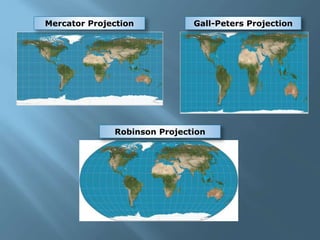
Gall-Peters ProjectionMercator Projection
Robinson Projection
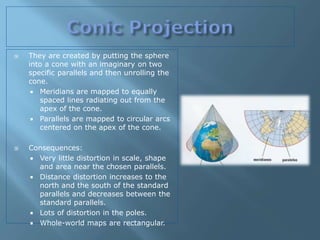
 They are created by putting the sphere
into a cone with an imaginary on two
specific parallels and then unrolling the
cone.
 Meridians are mapped to equally
spaced lines radiating out from the
apex of the cone.
 Parallels are mapped to circular arcs
centered on the apex of the cone.
 Consequences:
 Very little distortion in scale, shape
and area near the chosen parallels.
 Distance distortion increases to the
north and the south of the standard
parallels and decreases between the
standard parallels.
 Lots of distortion in the poles.
 Whole-world maps are rectangular.
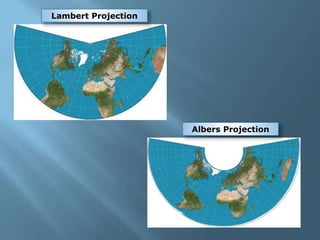
Lambert Projection
Albers Projection
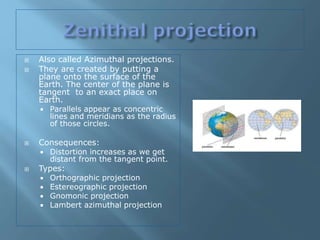
 Also called Azimuthal projections.
 They are created by putting a
plane onto the surface of the
Earth. The center of the plane is
tangent to an exact place on
Earth.
 Parallels appear as concentric
lines and meridians as the radius
of those circles.
 Consequences:
 Distortion increases as we get
distant from the tangent point.
 Types:
 Orthographic projection
 Estereographic projection
 Gnomonic projection
 Lambert azimuthal projection
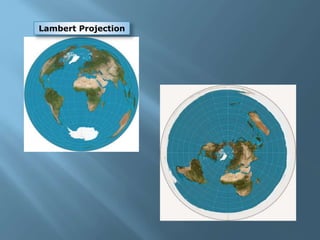
Lambert Projection
Developed by María Jesús Campos

Cartographic Projections

  • 1.
  • 2.
    Terrestrial Globe  Thebest way to represent the Earth is a globe. A terrestrial globe is a spherical model of the Earth that do not distort its surface. Not useful to study parts of the Earth in detail.
  • 3.
     Represent the3-D geoid of the Earth on a flat surface or map.  Every projection changes the surface of the Earth in some way. This is called distortion.  Geographers use different types of projection depending on the purpose of the map they want to create and their accuracy.
  • 5.
     Equivalent projection:they show the proportion of landmasses accurately. Useful for comparing the surface area of territories.  Equidisntant projection: they show the distance between territories accurately.  Conformal projection: they show the shape of an area accurately.
  • 6.
     Cylindrical projection  Conicprojection  Zenithal or azimuthal projection
  • 7.
     They arecreated by putting the sphere into a cylinder and then unrolling the cylinder’s surface.  Geographic coordinates are represented with straight lines.  Meridians are represented in equally spaced vertical lines.  Parallels are represented in equally spaced horizontal lines.  Meridians and parallels have the same length.  Consequences:  Very little distortion in equatorial areas.  Lots of distortion in the poles.  Whole-world maps are rectangular.
  • 8.
  • 9.
     They arecreated by putting the sphere into a cone with an imaginary on two specific parallels and then unrolling the cone.  Meridians are mapped to equally spaced lines radiating out from the apex of the cone.  Parallels are mapped to circular arcs centered on the apex of the cone.  Consequences:  Very little distortion in scale, shape and area near the chosen parallels.  Distance distortion increases to the north and the south of the standard parallels and decreases between the standard parallels.  Lots of distortion in the poles.  Whole-world maps are rectangular.
  • 10.
  • 11.
     Also calledAzimuthal projections.  They are created by putting a plane onto the surface of the Earth. The center of the plane is tangent to an exact place on Earth.  Parallels appear as concentric lines and meridians as the radius of those circles.  Consequences:  Distortion increases as we get distant from the tangent point.  Types:  Orthographic projection  Estereographic projection  Gnomonic projection  Lambert azimuthal projection
  • 12.
  • 16.
    Developed by MaríaJesús Campos