María Jesús Campos
Historyandgeography.org
The Earth’s Surface
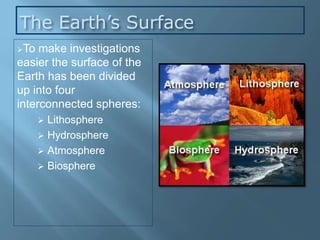
To make investigations
easier the surface of the
Earth has been divided
up into four
interconnected spheres:
 Lithosphere
 Hydrosphere
 Atmosphere
 Biosphere
HYDROSPHERE
 It comes from the
ancient Greek
“hydro” which means
water and “sphaira”
which means sphere.
 It refers to water on,
under and over the
surface of the Earth.
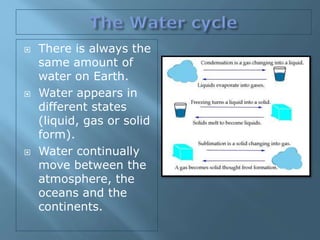
 There is always the
same amount of
water on Earth.
 Water appears in
different states
(liquid, gas or solid
form).
 Water continually
move between the
atmosphere, the
oceans and the
continents.
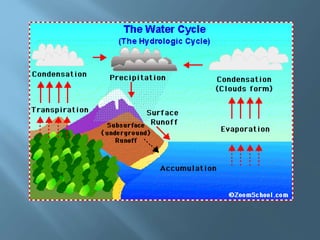
 This continual movement is called the
water cycle:
 Evaporation: water evaporates into the
atmosphere, where it cools.
 Condensation: As it get cooler on the
atmosphere, it condenses and forms clouds.
 Precipitation: when clouds cannot absorb
any more water there is precipitation in the
form of rain, snow or hail. Some
precipitation falls on the land flowing into
lakes and rivers, other water filters into the
ground becoming groundwater.
 Transportation: water in rivers or
groundwater is transported to the oceans
and seas again and the water cycle begins
again.
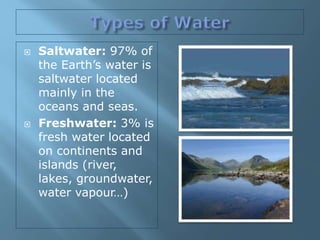
 Saltwater: 97% of
the Earth’s water is
saltwater located
mainly in the
oceans and seas.
 Freshwater: 3% is
fresh water located
on continents and
islands (river,
lakes, groundwater,
water vapour…)
 Ocean currents:
similar to rivers
moving within the
oceans. Its water does
not mix with the water
around, having a
different temperature
(warm or cold) and
salinity.
 Tides: the
gravitational forces of
the Moon causes the
rising, high tide, and
falling of sea levels,
low tide.
 Waves: bodies of
water curling into an
arched form and
breaking on the shore.
 Oceans: vast masses
of saltwater that
separate the
continents.
 Seas: oceanic waters
that are close to
continents and not as
deep as oceans.
 Rivers: continuously
flowing currents of
water that flow into
seas, lakes and other
rivers.
 Tributary: a river
that flows into
another river.
 Groundwater:
rainwater that
infiltrates rocks and
soil into the Earth’s
surface.
 Aquifers: stores of
groundwater that
accumulate
underground on top
of impermeable
layers of rock.
 Wells: holes that
men do into the
Earth’s surface to
bring underground
water to the surface.
 Glaciers: huge mass of ice, formed from
compacted snow, slowly flowing over a land
mass.
 Ice caps: huge mass of ice and snow that
permanently cover the poles of the Earth.
 Lakes: large bodies of water that
accumulate in inland basins. They receive
water from rivers, precipitation and
groundwater.
 There are 3 stages in the course of a river:
 Upper Course: from the river’s source down the
mountains water flows rapidly eroding rocks.
 Middle course: water flows less rapidly depositing
sediments.
 Lower course: the river reaches its mouth into a lake,
another river or a sea. Water flows slowly depositing
sediments.
 The flow is the amount of water in a river. It depends
on:
 The amount of rainfall.
 The type of soil
 Water is essential for
life. Humans can only
drink fresh water that
needs to be purified.
 As most fresh water is
trapped in ice and
glaciers there is not
much water for
human consumption
left.
 So we need to recycle
water to assure our
lifelihood.
 Although water is found in
a considerable amount in
temperate and tropical
regions where there is a lot
of precipitation there is an
uneven distribution of
water on the Earth.
 Floods: the inundation of
land that is normally dry
through the overflowing of
a body of water
 Droughts: a long period of
scanty or low rainfall that
normally affects growing or
living conditions.
Developed by María Jesús Campos
Chusteacher
Wikiteacher

Hydrosphere

  • 1.
  • 2.
    The Earth’s Surface Tomake investigations easier the surface of the Earth has been divided up into four interconnected spheres:  Lithosphere  Hydrosphere  Atmosphere  Biosphere
  • 3.
    HYDROSPHERE  It comesfrom the ancient Greek “hydro” which means water and “sphaira” which means sphere.  It refers to water on, under and over the surface of the Earth.
  • 4.
     There isalways the same amount of water on Earth.  Water appears in different states (liquid, gas or solid form).  Water continually move between the atmosphere, the oceans and the continents.
  • 5.
     This continualmovement is called the water cycle:  Evaporation: water evaporates into the atmosphere, where it cools.  Condensation: As it get cooler on the atmosphere, it condenses and forms clouds.  Precipitation: when clouds cannot absorb any more water there is precipitation in the form of rain, snow or hail. Some precipitation falls on the land flowing into lakes and rivers, other water filters into the ground becoming groundwater.  Transportation: water in rivers or groundwater is transported to the oceans and seas again and the water cycle begins again.
  • 8.
     Saltwater: 97%of the Earth’s water is saltwater located mainly in the oceans and seas.  Freshwater: 3% is fresh water located on continents and islands (river, lakes, groundwater, water vapour…)
  • 10.
     Ocean currents: similarto rivers moving within the oceans. Its water does not mix with the water around, having a different temperature (warm or cold) and salinity.  Tides: the gravitational forces of the Moon causes the rising, high tide, and falling of sea levels, low tide.  Waves: bodies of water curling into an arched form and breaking on the shore.
  • 12.
     Oceans: vastmasses of saltwater that separate the continents.  Seas: oceanic waters that are close to continents and not as deep as oceans.  Rivers: continuously flowing currents of water that flow into seas, lakes and other rivers.  Tributary: a river that flows into another river.  Groundwater: rainwater that infiltrates rocks and soil into the Earth’s surface.  Aquifers: stores of groundwater that accumulate underground on top of impermeable layers of rock.  Wells: holes that men do into the Earth’s surface to bring underground water to the surface.
  • 14.
     Glaciers: hugemass of ice, formed from compacted snow, slowly flowing over a land mass.  Ice caps: huge mass of ice and snow that permanently cover the poles of the Earth.  Lakes: large bodies of water that accumulate in inland basins. They receive water from rivers, precipitation and groundwater.
  • 16.
     There are3 stages in the course of a river:  Upper Course: from the river’s source down the mountains water flows rapidly eroding rocks.  Middle course: water flows less rapidly depositing sediments.  Lower course: the river reaches its mouth into a lake, another river or a sea. Water flows slowly depositing sediments.  The flow is the amount of water in a river. It depends on:  The amount of rainfall.  The type of soil
  • 18.
     Water isessential for life. Humans can only drink fresh water that needs to be purified.  As most fresh water is trapped in ice and glaciers there is not much water for human consumption left.  So we need to recycle water to assure our lifelihood.
  • 19.
     Although wateris found in a considerable amount in temperate and tropical regions where there is a lot of precipitation there is an uneven distribution of water on the Earth.  Floods: the inundation of land that is normally dry through the overflowing of a body of water  Droughts: a long period of scanty or low rainfall that normally affects growing or living conditions.
  • 21.
    Developed by MaríaJesús Campos Chusteacher Wikiteacher