ANCIENT ROME
María Jesús Campos
learningfromhistory.wikispaces.com
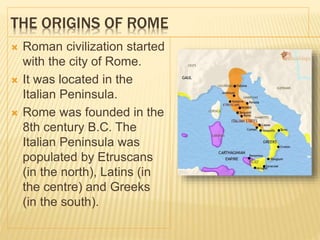
THE ORIGINS OF ROME
 Roman civilization started
with the city of Rome.
 It was located in the
Italian Peninsula.
 Rome was founded in the
8th century B.C. The
Italian Peninsula was
populated by Etruscans
(in the north), Latins (in
the centre) and Greeks
(in the south).
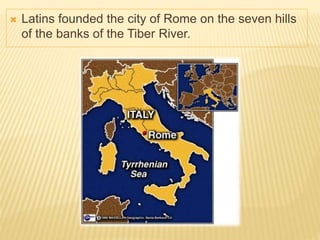
 Latins founded the city of Rome on the seven hills
of the banks of the Tiber River.
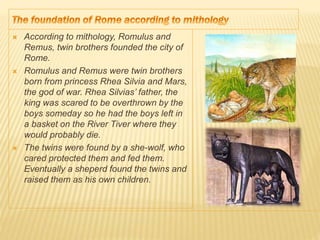
 According to mithology, Romulus and
Remus, twin brothers founded the city of
Rome.
 Romulus and Remus were twin brothers
born from princess Rhea Silvia and Mars,
the god of war. Rhea Silvias’ father, the
king was scared to be overthrown by the
boys someday so he had the boys left in
a basket on the River Tiver where they
would probably die.
 The twins were found by a she-wolf, who
cared protected them and fed them.
Eventually a sheperd found the twins and
raised them as his own children.
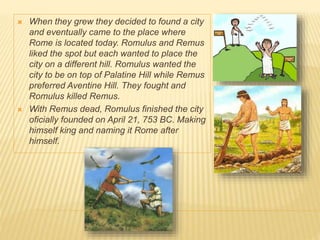
 When they grew they decided to found a city
and eventually came to the place where
Rome is located today. Romulus and Remus
liked the spot but each wanted to place the
city on a different hill. Romulus wanted the
city to be on top of Palatine Hill while Remus
preferred Aventine Hill. They fought and
Romulus killed Remus.
 With Remus dead, Romulus finished the city
oficially founded on April 21, 753 BC. Making
himself king and naming it Rome after
himself.
POLITICAL EVOLUTION
 Political stages:
 Monarchy: 753 BC. to 509 B.C.
 Republic: 509 B.C. to 27 B.C.
 Empire: 27 B.C. to 476 A.D.
MONARCHY
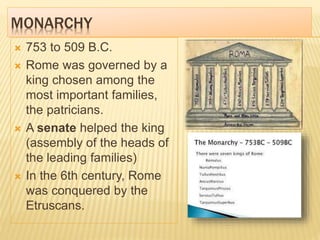
 753 to 509 B.C.
 Rome was governed by a
king chosen among the
most important families,
the patricians.
 A senate helped the king
(assembly of the heads of
the leading families)
 In the 6th century, Rome
was conquered by the
Etruscans.
THE REPUBLIC
 509 to 27 B.C.
 In 509 B.C. a revolt deposed
the Etruscan king and
established a Republic.
 Institutions:
 The Senate
 Comitias
 Magistratus
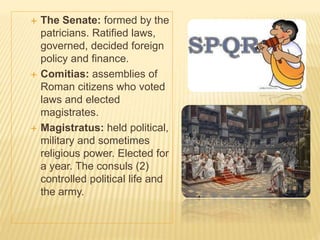
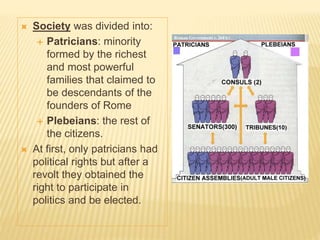
 The Senate: formed by the
patricians. Ratified laws,
governed, decided foreign
policy and finance.
 Comitias: assemblies of
Roman citizens who voted
laws and elected
magistrates.
 Magistratus: held political,
military and sometimes
religious power. Elected for
a year. The consuls (2)
controlled political life and
the army.
 Society was divided into:
 Patricians: minority
formed by the richest
and most powerful
families that claimed to
be descendants of the
founders of Rome
 Plebeians: the rest of
the citizens.
 At first, only patricians had
political rights but after a
revolt they obtained the
right to participate in
politics and be elected.
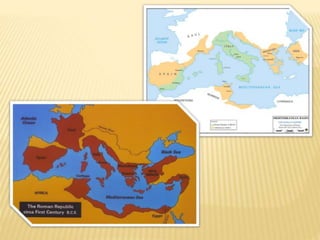
 Territorial Expansion:
 Between 500 and 250 B.C. Rome conquered
the Italian Peninsula.
 Between 264 and 146 B.C., Rome fought
against Carthage (civilization north of Africa)
for the control of the Mediterranean. Rome
defeated them and won the Punic Wars.
 Between the 2nd century BC and the 2nd
century AD, the rromans conquered Greece
and the Eastern Mediterranean. They also
completed the occupation of Hispania, Galia
and Britannia and some provinces in central
Europe.
 At the end of the 1st
century BC the
Republic suffered a
crisis because of:
 Corruption and internal
conflicts among
politicians.
 An extensive empire
difficult to defend.
 Social inequality
between the rich and
the poor citizens.
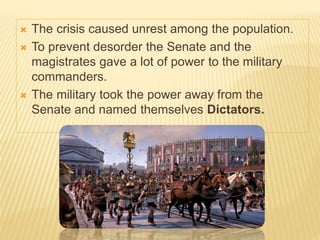
 The crisis caused unrest among the population.
 To prevent desorder the Senate and the
magistrates gave a lot of power to the military
commanders.
 The military took the power away from the
Senate and named themselves Dictators.
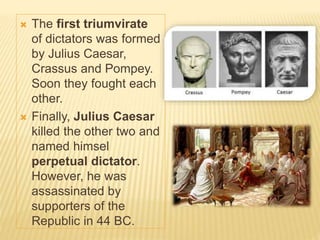
 The first triumvirate
of dictators was formed
by Julius Caesar,
Crassus and Pompey.
Soon they fought each
other.
 Finally, Julius Caesar
killed the other two and
named himsel
perpetual dictator.
However, he was
assassinated by
supporters of the
Republic in 44 BC.
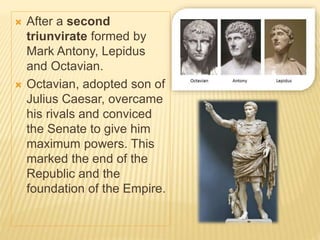
 After a second
triunvirate formed by
Mark Antony, Lepidus
and Octavian.
 Octavian, adopted son of
Julius Caesar, overcame
his rivals and conviced
the Senate to give him
maximum powers. This
marked the end of the
Republic and the
foundation of the Empire.
The Empire
 27 BC to 476 AD
 In 27 BC, Octavian
received the title of
“Augustus” (chosen by the
gods) from the Senate.
With it, Octavian was
obtaining maximum
powers.
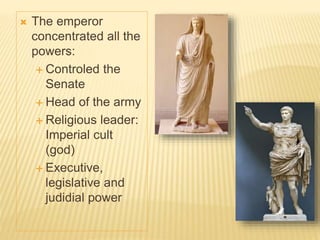
 The emperor
concentrated all the
powers:
 Controled the
Senate
 Head of the army
 Religious leader:
Imperial cult
(god)
 Executive,
legislative and
judidial power
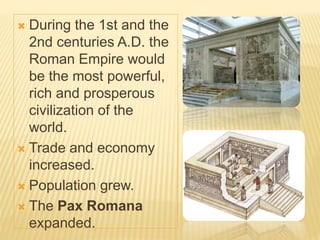
 During the 1st and the
2nd centuries A.D. the
Roman Empire would
be the most powerful,
rich and prosperous
civilization of the
world.
 Trade and economy
increased.
 Population grew.
 The Pax Romana
expanded.
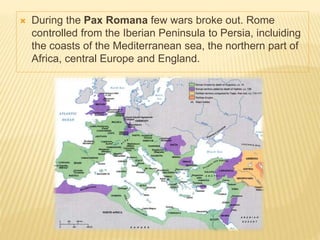
 During the Pax Romana few wars broke out. Rome
controlled from the Iberian Peninsula to Persia, incluiding
the coasts of the Mediterranean sea, the northern part of
Africa, central Europe and England.
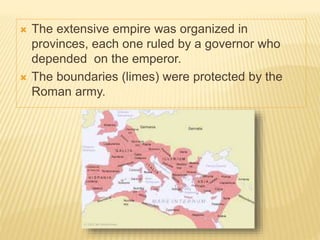
 The extensive empire was organized in
provinces, each one ruled by a governor who
depended on the emperor.
 The boundaries (limes) were protected by the
Roman army.
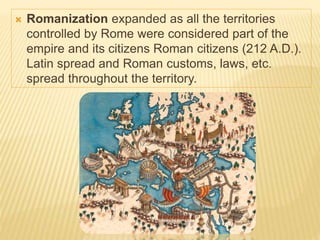
 Romanization expanded as all the territories
controlled by Rome were considered part of the
empire and its citizens Roman citizens (212 A.D.).
Latin spread and Roman customs, laws, etc.
spread throughout the territory.
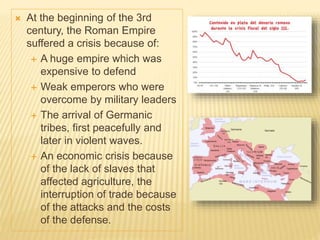
 At the beginning of the 3rd
century, the Roman Empire
suffered a crisis because of:
 A huge empire which was
expensive to defend
 Weak emperors who were
overcome by military leaders
 The arrival of Germanic
tribes, first peacefully and
later in violent waves.
 An economic crisis because
of the lack of slaves that
affected agriculture, the
interruption of trade because
of the attacks and the costs
of the defense.
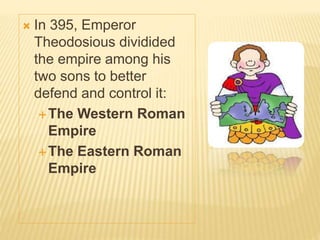
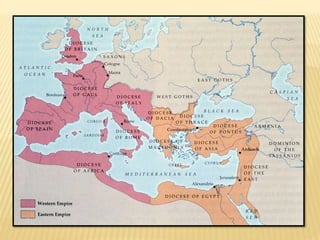
 In 395, Emperor
Theodosious dividided
the empire among his
two sons to better
defend and control it:
The Western Roman
Empire
The Eastern Roman
Empire
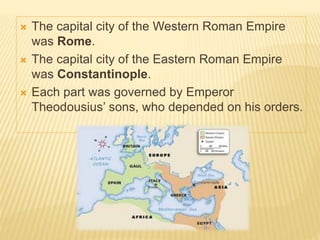
 The capital city of the Western Roman Empire
was Rome.
 The capital city of the Eastern Roman Empire
was Constantinople.
 Each part was governed by Emperor
Theodousius’ sons, who depended on his orders.
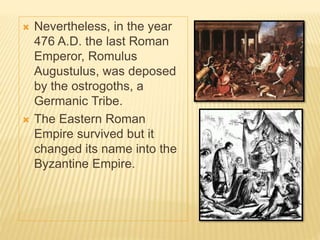
 Nevertheless, in the year
476 A.D. the last Roman
Emperor, Romulus
Augustulus, was deposed
by the ostrogoths, a
Germanic Tribe.
 The Eastern Roman
Empire survived but it
changed its name into the
Byzantine Empire.
Developed by María Jesús Campos
learningfromhistory.wikispaces.com
Chusteacher
wikiteacher

Ancient Rome: Political Evolution

  • 1.
    ANCIENT ROME María JesúsCampos learningfromhistory.wikispaces.com
  • 2.
    THE ORIGINS OFROME  Roman civilization started with the city of Rome.  It was located in the Italian Peninsula.  Rome was founded in the 8th century B.C. The Italian Peninsula was populated by Etruscans (in the north), Latins (in the centre) and Greeks (in the south).
  • 3.
     Latins foundedthe city of Rome on the seven hills of the banks of the Tiber River.
  • 4.
     According tomithology, Romulus and Remus, twin brothers founded the city of Rome.  Romulus and Remus were twin brothers born from princess Rhea Silvia and Mars, the god of war. Rhea Silvias’ father, the king was scared to be overthrown by the boys someday so he had the boys left in a basket on the River Tiver where they would probably die.  The twins were found by a she-wolf, who cared protected them and fed them. Eventually a sheperd found the twins and raised them as his own children.
  • 5.
     When theygrew they decided to found a city and eventually came to the place where Rome is located today. Romulus and Remus liked the spot but each wanted to place the city on a different hill. Romulus wanted the city to be on top of Palatine Hill while Remus preferred Aventine Hill. They fought and Romulus killed Remus.  With Remus dead, Romulus finished the city oficially founded on April 21, 753 BC. Making himself king and naming it Rome after himself.
  • 6.
    POLITICAL EVOLUTION  Politicalstages:  Monarchy: 753 BC. to 509 B.C.  Republic: 509 B.C. to 27 B.C.  Empire: 27 B.C. to 476 A.D.
  • 7.
    MONARCHY  753 to509 B.C.  Rome was governed by a king chosen among the most important families, the patricians.  A senate helped the king (assembly of the heads of the leading families)  In the 6th century, Rome was conquered by the Etruscans.
  • 8.
    THE REPUBLIC  509to 27 B.C.  In 509 B.C. a revolt deposed the Etruscan king and established a Republic.  Institutions:  The Senate  Comitias  Magistratus
  • 9.
     The Senate:formed by the patricians. Ratified laws, governed, decided foreign policy and finance.  Comitias: assemblies of Roman citizens who voted laws and elected magistrates.  Magistratus: held political, military and sometimes religious power. Elected for a year. The consuls (2) controlled political life and the army.
  • 10.
     Society wasdivided into:  Patricians: minority formed by the richest and most powerful families that claimed to be descendants of the founders of Rome  Plebeians: the rest of the citizens.  At first, only patricians had political rights but after a revolt they obtained the right to participate in politics and be elected.
  • 11.
     Territorial Expansion: Between 500 and 250 B.C. Rome conquered the Italian Peninsula.  Between 264 and 146 B.C., Rome fought against Carthage (civilization north of Africa) for the control of the Mediterranean. Rome defeated them and won the Punic Wars.  Between the 2nd century BC and the 2nd century AD, the rromans conquered Greece and the Eastern Mediterranean. They also completed the occupation of Hispania, Galia and Britannia and some provinces in central Europe.
  • 13.
     At theend of the 1st century BC the Republic suffered a crisis because of:  Corruption and internal conflicts among politicians.  An extensive empire difficult to defend.  Social inequality between the rich and the poor citizens.
  • 14.
     The crisiscaused unrest among the population.  To prevent desorder the Senate and the magistrates gave a lot of power to the military commanders.  The military took the power away from the Senate and named themselves Dictators.
  • 15.
     The firsttriumvirate of dictators was formed by Julius Caesar, Crassus and Pompey. Soon they fought each other.  Finally, Julius Caesar killed the other two and named himsel perpetual dictator. However, he was assassinated by supporters of the Republic in 44 BC.
  • 16.
     After asecond triunvirate formed by Mark Antony, Lepidus and Octavian.  Octavian, adopted son of Julius Caesar, overcame his rivals and conviced the Senate to give him maximum powers. This marked the end of the Republic and the foundation of the Empire.
  • 17.
    The Empire  27BC to 476 AD  In 27 BC, Octavian received the title of “Augustus” (chosen by the gods) from the Senate. With it, Octavian was obtaining maximum powers.
  • 18.
     The emperor concentratedall the powers:  Controled the Senate  Head of the army  Religious leader: Imperial cult (god)  Executive, legislative and judidial power
  • 19.
     During the1st and the 2nd centuries A.D. the Roman Empire would be the most powerful, rich and prosperous civilization of the world.  Trade and economy increased.  Population grew.  The Pax Romana expanded.
  • 20.
     During thePax Romana few wars broke out. Rome controlled from the Iberian Peninsula to Persia, incluiding the coasts of the Mediterranean sea, the northern part of Africa, central Europe and England.
  • 21.
     The extensiveempire was organized in provinces, each one ruled by a governor who depended on the emperor.  The boundaries (limes) were protected by the Roman army.
  • 22.
     Romanization expandedas all the territories controlled by Rome were considered part of the empire and its citizens Roman citizens (212 A.D.). Latin spread and Roman customs, laws, etc. spread throughout the territory.
  • 23.
     At thebeginning of the 3rd century, the Roman Empire suffered a crisis because of:  A huge empire which was expensive to defend  Weak emperors who were overcome by military leaders  The arrival of Germanic tribes, first peacefully and later in violent waves.  An economic crisis because of the lack of slaves that affected agriculture, the interruption of trade because of the attacks and the costs of the defense.
  • 24.
     In 395,Emperor Theodosious dividided the empire among his two sons to better defend and control it: The Western Roman Empire The Eastern Roman Empire
  • 26.
     The capitalcity of the Western Roman Empire was Rome.  The capital city of the Eastern Roman Empire was Constantinople.  Each part was governed by Emperor Theodousius’ sons, who depended on his orders.
  • 27.
     Nevertheless, inthe year 476 A.D. the last Roman Emperor, Romulus Augustulus, was deposed by the ostrogoths, a Germanic Tribe.  The Eastern Roman Empire survived but it changed its name into the Byzantine Empire.
  • 28.
    Developed by MaríaJesús Campos learningfromhistory.wikispaces.com Chusteacher wikiteacher