SGRQ QUESTIONNAIRE
SUBMITTED TO- Dr. JAMALALI MOIZ
SUBMITTED BY- SANIA TABIR
CLASS- BPT 4TH YEAR
SUBJECT- SGRQ QUESTIONNAIRE
SUBMITTED ON- 19 FEBRUARY
CENTRE FOR PHYSIOTHERAPYAND REHABILITATION
SCIENCES, JAMIA MILLIA ISLAMIA
AIM
• To measure health impairment and quality of life in patients with asthma
and COPD.
• It is also valid for use in bronchiectasis and has been used successfully in
patients with kyphoscoliosis and sarcoidosis.
INTRODUCTION
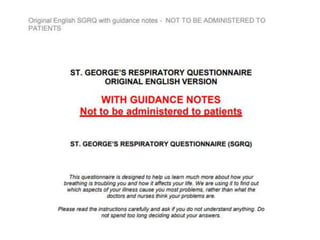
• The St Georges Respiratory Questionnaire (SGRQ) is a disease specific
quality of life assessment tool validated in both COPD and asthma.
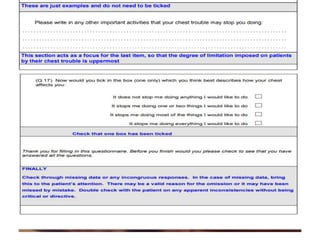
• The questionnaire consists of 76 items divided into three parts measuring
symptoms, activity limitation and social and emotional impact of disease.
• Each item is accorded a weight determined by the degree of distress
accorded to each symptom or state described.
• Overall scores range from 0 (no effect on quality of life) to a maximum
score of 100 (maximum perceived distress), thus a higher score means a
worse quality of life and the questionnaire is suitable for administration in
healthy persons.
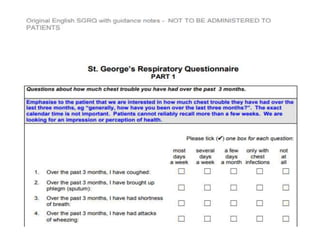
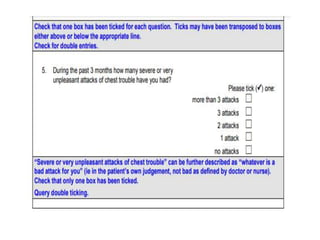
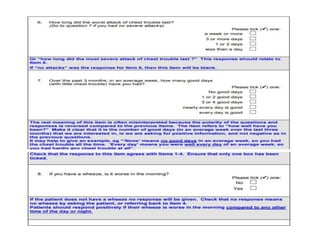
Part 1(Questions 1 to 8)
• It covers the patients recollection of their symptoms over a preceding
period that may range 1 month to 1 year.
• It is not designed to be an accurate epidemiological tool.
• Its purpose is to assess the patient’s perception of their recent respiratory
problems.
• The original version was validated using a 12-month recall period.
• More recently a 1 month recall version (appropriately worded) has been
validated.
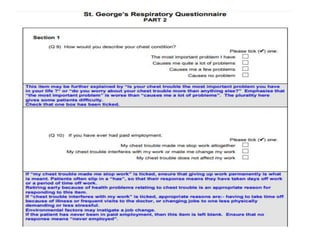
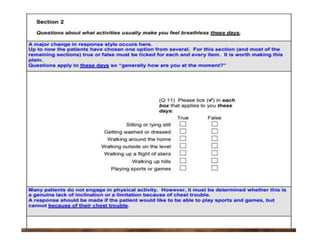
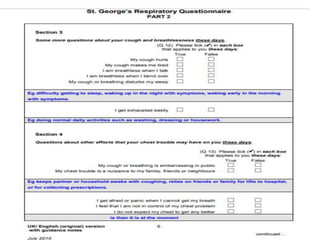
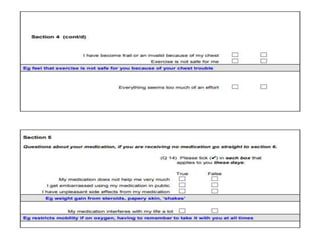
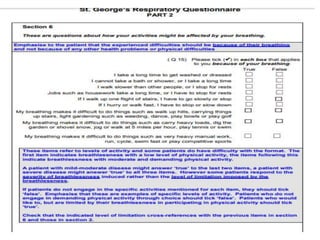
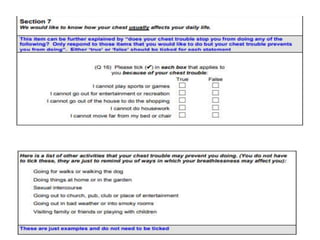
PART 2 (QUESTIONS 9 to 16)
• It addresses the patients ‘current state’(i.e. how they are these days).
• The Activity score just measures disturbances to patient’s daily physical
activity.
• The Impacts score covers a wide range of disturbances of psycho-social
function.
• Validation studies showed that this component relates in part to respiratory
symptoms, but it also correlates quite strongly with exercise performance
(6-minute walking test), breathlessness in daily life (MRC breathlessness
score) and disturbances of mood (anxiety and depression).
• The Impacts score is, therefore, the broadest component of the
questionnaires
Equipment Required
• Copy of questionnaire and Excel calculator.
• Assessment Type: Patient Reported Outcomes
• Length of Test: 06 to 30 Minutes
• Time to Administer: 10 minutes
• Type of training required: reading an article/manual
• Cost: Free
• Age Range: Adult 18-64 years; Elderly adult: 65+
• Administration Mode: Paper/Pencil
Procedure
• The questionnaire should be completed in a quiet area, free from distraction
and the patient should ideally be sitting at a desk or table.
• Explain to the patient why they are completing it, and how important it is
for clinicians and researchers to understand how their illness affects them
and their daily life.
• Ask him or her to complete the questionnaire as honestly as they can and
stress that there are no right or wrong answers, simply the answer that they
feel best applies to them.
.
Contd…
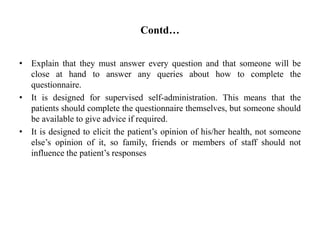
• Explain that they must answer every question and that someone will be
close at hand to answer any queries about how to complete the
questionnaire.
• It is designed for supervised self-administration. This means that the
patients should complete the questionnaire themselves, but someone should
be available to give advice if required.
• It is designed to elicit the patient’s opinion of his/her health, not someone
else’s opinion of it, so family, friends or members of staff should not
influence the patient’s responses
REFERENCES
• Jones PW, Quirk FH, Baveystock CM. The St Georges Respiratory
Questionnaire.Respir Med 1991;85(Suppl B):25-31.
• Jones PW, Quirk FH, Baveystock CM, Littlejohns P. A self-complete
measure for chronic airflow limitation - the St Georges Respiratory
Questionnaire. Am Rev Respir Dis1992;145:1321-7.
• Meguro M, Barley EA, Spencer S, Jones PW. Development and validation
of an improved COPD-specific version of the St Georges Respiratory
Questionnaire. Chest2006;132: 456-463.
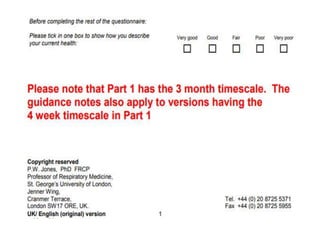
• UK/ English (original) version With guidance notes July 2010

Cardiopulmonary sgrq questionnaire

  • 1.
    SGRQ QUESTIONNAIRE SUBMITTED TO-Dr. JAMALALI MOIZ SUBMITTED BY- SANIA TABIR CLASS- BPT 4TH YEAR SUBJECT- SGRQ QUESTIONNAIRE SUBMITTED ON- 19 FEBRUARY CENTRE FOR PHYSIOTHERAPYAND REHABILITATION SCIENCES, JAMIA MILLIA ISLAMIA
  • 2.
    AIM • To measurehealth impairment and quality of life in patients with asthma and COPD. • It is also valid for use in bronchiectasis and has been used successfully in patients with kyphoscoliosis and sarcoidosis.
  • 3.
    INTRODUCTION • The StGeorges Respiratory Questionnaire (SGRQ) is a disease specific quality of life assessment tool validated in both COPD and asthma. • The questionnaire consists of 76 items divided into three parts measuring symptoms, activity limitation and social and emotional impact of disease. • Each item is accorded a weight determined by the degree of distress accorded to each symptom or state described. • Overall scores range from 0 (no effect on quality of life) to a maximum score of 100 (maximum perceived distress), thus a higher score means a worse quality of life and the questionnaire is suitable for administration in healthy persons.
  • 4.
    Part 1(Questions 1to 8) • It covers the patients recollection of their symptoms over a preceding period that may range 1 month to 1 year. • It is not designed to be an accurate epidemiological tool. • Its purpose is to assess the patient’s perception of their recent respiratory problems. • The original version was validated using a 12-month recall period. • More recently a 1 month recall version (appropriately worded) has been validated.
  • 5.
    PART 2 (QUESTIONS9 to 16) • It addresses the patients ‘current state’(i.e. how they are these days). • The Activity score just measures disturbances to patient’s daily physical activity. • The Impacts score covers a wide range of disturbances of psycho-social function. • Validation studies showed that this component relates in part to respiratory symptoms, but it also correlates quite strongly with exercise performance (6-minute walking test), breathlessness in daily life (MRC breathlessness score) and disturbances of mood (anxiety and depression). • The Impacts score is, therefore, the broadest component of the questionnaires
  • 6.
    Equipment Required • Copyof questionnaire and Excel calculator. • Assessment Type: Patient Reported Outcomes • Length of Test: 06 to 30 Minutes • Time to Administer: 10 minutes • Type of training required: reading an article/manual • Cost: Free • Age Range: Adult 18-64 years; Elderly adult: 65+ • Administration Mode: Paper/Pencil
  • 7.
    Procedure • The questionnaireshould be completed in a quiet area, free from distraction and the patient should ideally be sitting at a desk or table. • Explain to the patient why they are completing it, and how important it is for clinicians and researchers to understand how their illness affects them and their daily life. • Ask him or her to complete the questionnaire as honestly as they can and stress that there are no right or wrong answers, simply the answer that they feel best applies to them. .
  • 8.
    Contd… • Explain thatthey must answer every question and that someone will be close at hand to answer any queries about how to complete the questionnaire. • It is designed for supervised self-administration. This means that the patients should complete the questionnaire themselves, but someone should be available to give advice if required. • It is designed to elicit the patient’s opinion of his/her health, not someone else’s opinion of it, so family, friends or members of staff should not influence the patient’s responses
  • 21.
    REFERENCES • Jones PW,Quirk FH, Baveystock CM. The St Georges Respiratory Questionnaire.Respir Med 1991;85(Suppl B):25-31. • Jones PW, Quirk FH, Baveystock CM, Littlejohns P. A self-complete measure for chronic airflow limitation - the St Georges Respiratory Questionnaire. Am Rev Respir Dis1992;145:1321-7. • Meguro M, Barley EA, Spencer S, Jones PW. Development and validation of an improved COPD-specific version of the St Georges Respiratory Questionnaire. Chest2006;132: 456-463. • UK/ English (original) version With guidance notes July 2010