RESPIRATORY
ASSESSMENT
Falcons
Subjective assessment
Thomas J. Watson,
the founder of IBM,
said, “The ability to
ask the right
question is more
than half the battle
of finding the
answer.”
Demographic data
Name: For identification
Age: 1)Age related conditions(Upper respiratory tract infection
in children, COPD in middle to late adults)
2)Functional activity level
3)Treatment plan
Sex: Gender related diseases(Chronic bronchitis common in men)
Occupation: Occupation related conditions(Silicosis,asbestosis )
Address:
Assessment date:
Admission date: How long the patient has been hospitalized?(the longer
the hospitalization, the greater chance of having major medical issue or
complications)
Surgical history:
•current surgical information if any
•Date of surgery, type and site of incision
•Post operative day
Chief complaints:
•No medical terms must be used, symptoms description is
recorded in patient’s own terms
•Each symptom must be recorded with its duration
Present medical history:
•Onset of the problem(gradual/sudden) gradual-COPD sudden-
pneumothorax
•Duration, severity and progression of the disease
•First aid taken for that problem and current medications taken
•History can be collected from medical records
Subjective evaluation:
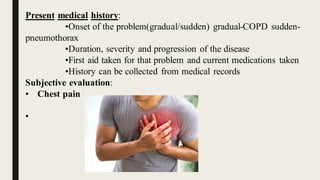
• Chest pain
•
• Side- left/right
• Type -localized/radiating
• Duration- how long the pain lasted, variation with time
• Onset- sudden/gradual
• Frequency-
• Severity-
• Modifying factors- exercise, rest, eating or medication,
changes with body position,
worsen with deep breath and coughing
• Chest pain- usually originates from musculoskeletal, pleural or
tracheal inflammation, as the lung parenchyma and small airways contain
no pain fibers
Condition Description
Pleuritis/pleurisy Severe,stabbing,rapid onset, well localized, limits
Inspiration
Tracheitis Constant, burning pain in the center of the chest
aggravated by breathing
Pneumothorax Sudden severe central chest discomfort
Pneumonia Pleuritic pain aggravated by taking deep breath/ coughing
Tumors Dull deep seated pain
It may mimic any form of chest pain based on its location
Rib fracture Localized point tenderness, often sudden onset, increases
with inspiration
Muscular Superficial, increases on inspiration and some body
movements, with or without muscle spasm
Visual analogue scale - to quantify the
intensity of pain
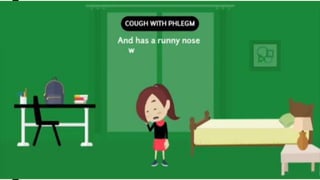
Cough
Does the patient has cough? If yes ask the following
•Description of onset
•Type of cough-productive cough(wet cough)/ non productive
cough(dry cough)
1. Productive cough-chronic bronchitis, bronchiectasis, TB,
pneumonia
2. Non productive cough-interstitial lung disease, atelectasis,
Bronchial carcinoma
3. Hacking cough-bronchitis, lung abscess, bacterial
pneumonia, asthma
Frequency and severity of cough- how often do you cough?
(occasionally/often/continuously)
Time of cough- does cough occur on any special time at day or
night? Or change of positions
■ Asthma-cough worse at night
■ Chronic bronchitis-cough worse in lying down and morning
■ Bronchiectasis- cough at change of position, first thing in
morning
■ Croup-cough predominately at night due to humidity of night
air
■ GERD- increases when lying down
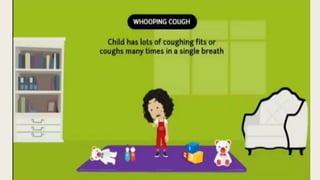
■ Whooping cough- at night
Intensity of cough-how long each cough lasts
■ Grade0-no cough
■ Grade1-cough less than 3 seconds
■ Grade2-cough more than 3 seconds
Effectiveness to clear sputum- reduced in case of post operative
conditions, weak respiratory and abdominal muscles.
Aggravating factors: position, whether, temperature, anxiety,
exercises
Relieving factors: change in position, rest, medications
■ Othertypesof cough
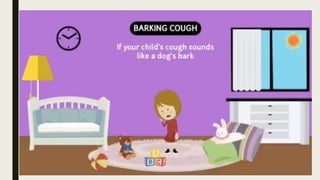
■ Loud barking cough-causedby pseudo croup
■ Bovine cough-soundlesscough
■ Brassy cough- loud metallic barking cough
■ Recurrentcoughingafter eating or drinking
■ Psychogenic cough
■ Whooping cough
■ Short cough
■ Prolonged or paroxysmal cough
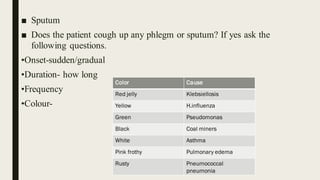
■ Sputum
■ Does the patient cough up any phlegm or sputum? If yes ask the
following questions.
•Onset-sudden/gradual
•Duration- how long
•Frequency
•Colour-
Color Cause
Red jelly Klebsiellosis
Yellow H.influenza
Green Pseudomonas
Black Coal miners
White Asthma
Pink frothy Pulmonary edema
Rusty Pneumococcal
pneumonia
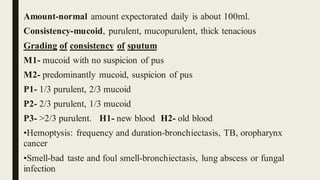
Amount-normal amount expectorated daily is about 100ml.
Consistency-mucoid, purulent, mucopurulent, thick tenacious
Grading of consistency of sputum
M1- mucoid with no suspicion of pus
M2- predominantly mucoid, suspicion of pus
P1- 1/3 purulent, 2/3 mucoid
P2- 2/3 purulent, 1/3 mucoid
P3- >2/3 purulent. H1- new blood H2- old blood
•Hemoptysis: frequency and duration-bronchiectasis, TB, oropharynx
cancer
•Smell-bad taste and foul smell-bronchiectasis, lung abscess or fungal
infection
Dyspnea
■ Dyspnea- has the patient experienced shortness of breath or
increased work of breathing
■ When does it occur-
■ Night- asthma, COPD, pulmonary edema
■ At work-occupational exposure
■ After laughing, exercise or rest
■ Duration- how long does it last?
■ Does it progressively worse-
■ Relieving and aggrevating factors
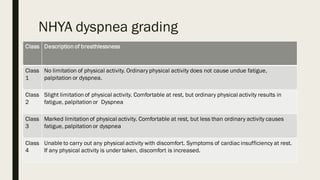
NHYA dyspnea grading
Class Description of breathlessness
Class
1
No limitation of physical activity. Ordinary physical activity does not cause undue fatigue,
palpitation or dyspnea.
Class
2
Slight limitation of physical activity. Comfortable at rest, but ordinary physical activity results in
fatigue, palpitation or Dyspnea
Class
3
Marked limitation of physical activity. Comfortable at rest, but less than ordinary activity causes
fatigue, palpitation or dyspnea
Class
4
Unable to carry out any physical activity with discomfort. Symptoms of cardiac insufficiency at rest.
If any physical activity is under taken, discomfort is increased.
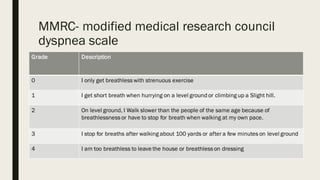
MMRC- modified medical research council
dyspnea scale
Grade Description
0 I only get breathless with strenuous exercise
1 I get short breath when hurrying on a level ground or climbing up a Slight hill.
2 On level ground, I Walk slower than the people of the same age because of
breathlessness or have to stop for breath when walking at my own pace.
3 I stop for breaths after walking about 100 yards or after a few minutes on level ground
4 I am too breathless to leave the house or breathless on dressing
Wheeze:
•Diurnal variation
•Positional variations
•Aggravating factors
■ H/o fever, chills, loss of weight
Past medical history:
Any recent illness and hospitalization(when, where)
Duration of hospitalization and treatment taken for that
Undergone any previous surgery and cause for it
Associated problems
H/O of any systemic illness and treatment taken for it. (DM, HTN, obesity,
Asthma etc)
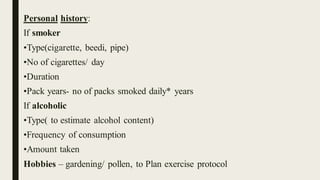
Personal history:
If smoker
•Type(cigarette, beedi, pipe)
•No of cigarettes/ day
•Duration
•Pack years- no of packs smoked daily* years
If alcoholic
•Type( to estimate alcohol content)
•Frequency of consumption
•Amount taken
Hobbies – gardening/ pollen, to Plan exercise protocol
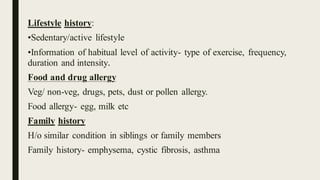
Lifestyle history:
•Sedentary/active lifestyle
•Information of habitual level of activity- type of exercise, frequency,
duration and intensity.
Food and drug allergy
Veg/ non-veg, drugs, pets, dust or pollen allergy.
Food allergy- egg, milk etc
Family history
H/o similar condition in siblings or family members
Family history- emphysema, cystic fibrosis, asthma
Work history:
Mode of job- exposure to asbestos, coal dust, wood dust, paint spray,
farm dust
Job timings
Does he have to climb floors, distance to be walked.
Socioeconomic status
Home environment
Vitals
Vitals
Pulse rate- 70-80 beats/ min ( rapid in asthma, ARDS)
Respiratory rate- 12-16 breaths/ min
B.P in lying, sitting, standing- 120/ 80 mm Hg (decreased in
asthma)
SpO2- 80%- 100% (decreased in chronic bronchitis)
Objective assessment
ON OBSERVATION:
1.level of consciousness- alert, coma, confused
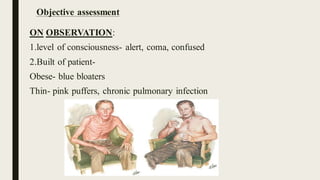
2.Built of patient-
Obese- blue bloaters
Thin- pink puffers, chronic pulmonary infection
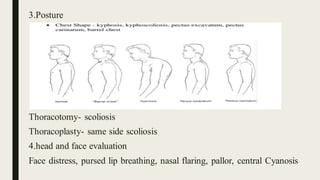
3.Posture
Thoracotomy- scoliosis
Thoracoplasty- same side scoliosis
4.head and face evaluation
Face distress, pursed lip breathing, nasal flaring, pallor, central Cyanosis
5.Neck -Use of accessory muscles
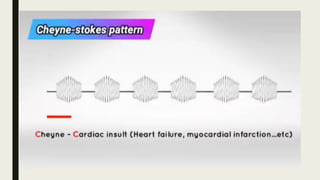
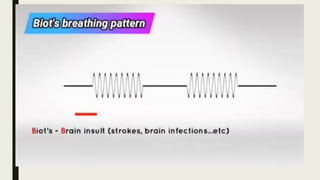
6.Pattern of breathing
■ Rate
■ Depth
■ Rhythm
Female-thoracoabdominal pattern
Male- abdominothoracic pattern
Symmetry of movement-paradoxical or not
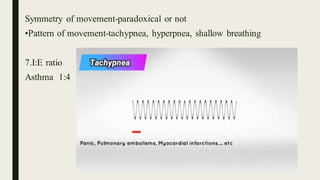
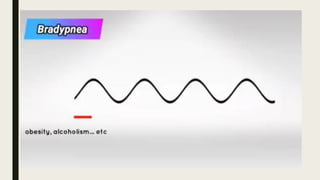
•Pattern of movement-tachypnea, hyperpnea, shallow breathing
7.I:E ratio
Asthma 1:4
8.Extremity evaluation
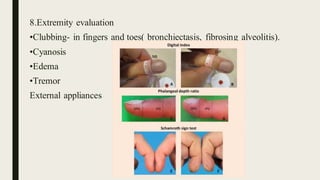
•Clubbing- in fingers and toes( bronchiectasis, fibrosing alveolitis).
•Cyanosis
•Edema
•Tremor
External appliances
On palpation
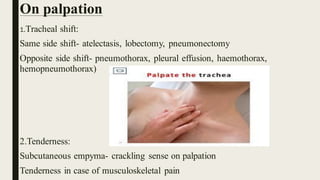
1.Tracheal shift:
Same side shift- atelectasis, lobectomy, pneumonectomy
Opposite side shift- pneumothorax, pleural effusion, haemothorax,
hemopneumothorax)
2.Tenderness:
Subcutaneous empyma- crackling sense on palpation
Tenderness in case of musculoskeletal pain
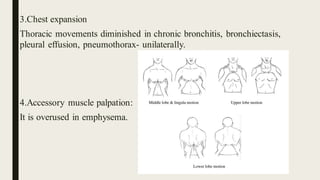
3.Chest expansion
Thoracic movements diminished in chronic bronchitis, bronchiectasis,
pleural effusion, pneumothorax- unilaterally.
4.Accessory muscle palpation:
It is overused in emphysema.
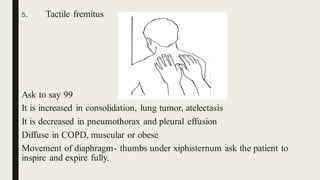
5. Tactile fremitus
Ask to say 99
It is increased in consolidation, lung tumor, atelectasis
It is decreased in pneumothorax and pleural effusion
Diffuse in COPD, muscular or obese
Movement of diaphragm- thumbs under xiphisternum ask the patient to
inspire and expire fully.
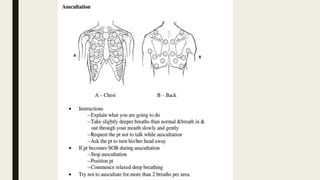
ON AUSCULTATION
1.Lung sounds
•Tracheal sounds
•Bronchial sounds ( seen in lobar pneumonia)( heard over periphery-
consolidation)
•Broncho vesicular sounds
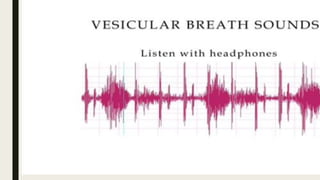
•Vesicular sounds ( vesicular sounds with prolong expiration in
chronic bronchitis, asthma
2.Added sounds
3.Voice sounds
Respiratory assessment.pdf

Respiratory assessment.pdf

  • 1.
  • 2.
    Subjective assessment Thomas J.Watson, the founder of IBM, said, “The ability to ask the right question is more than half the battle of finding the answer.”
  • 3.
    Demographic data Name: Foridentification Age: 1)Age related conditions(Upper respiratory tract infection in children, COPD in middle to late adults) 2)Functional activity level 3)Treatment plan Sex: Gender related diseases(Chronic bronchitis common in men) Occupation: Occupation related conditions(Silicosis,asbestosis ) Address: Assessment date:
  • 4.
    Admission date: Howlong the patient has been hospitalized?(the longer the hospitalization, the greater chance of having major medical issue or complications) Surgical history: •current surgical information if any •Date of surgery, type and site of incision •Post operative day Chief complaints: •No medical terms must be used, symptoms description is recorded in patient’s own terms •Each symptom must be recorded with its duration
  • 5.
    Present medical history: •Onsetof the problem(gradual/sudden) gradual-COPD sudden- pneumothorax •Duration, severity and progression of the disease •First aid taken for that problem and current medications taken •History can be collected from medical records Subjective evaluation: • Chest pain •
  • 6.
    • Side- left/right •Type -localized/radiating • Duration- how long the pain lasted, variation with time • Onset- sudden/gradual • Frequency- • Severity- • Modifying factors- exercise, rest, eating or medication, changes with body position, worsen with deep breath and coughing • Chest pain- usually originates from musculoskeletal, pleural or tracheal inflammation, as the lung parenchyma and small airways contain no pain fibers
  • 7.
    Condition Description Pleuritis/pleurisy Severe,stabbing,rapidonset, well localized, limits Inspiration Tracheitis Constant, burning pain in the center of the chest aggravated by breathing Pneumothorax Sudden severe central chest discomfort Pneumonia Pleuritic pain aggravated by taking deep breath/ coughing Tumors Dull deep seated pain It may mimic any form of chest pain based on its location Rib fracture Localized point tenderness, often sudden onset, increases with inspiration Muscular Superficial, increases on inspiration and some body movements, with or without muscle spasm Visual analogue scale - to quantify the intensity of pain
  • 8.
    Cough Does the patienthas cough? If yes ask the following •Description of onset •Type of cough-productive cough(wet cough)/ non productive cough(dry cough) 1. Productive cough-chronic bronchitis, bronchiectasis, TB, pneumonia 2. Non productive cough-interstitial lung disease, atelectasis, Bronchial carcinoma 3. Hacking cough-bronchitis, lung abscess, bacterial pneumonia, asthma
  • 10.
    Frequency and severityof cough- how often do you cough? (occasionally/often/continuously) Time of cough- does cough occur on any special time at day or night? Or change of positions ■ Asthma-cough worse at night ■ Chronic bronchitis-cough worse in lying down and morning ■ Bronchiectasis- cough at change of position, first thing in morning ■ Croup-cough predominately at night due to humidity of night air ■ GERD- increases when lying down ■ Whooping cough- at night
  • 13.
    Intensity of cough-howlong each cough lasts ■ Grade0-no cough ■ Grade1-cough less than 3 seconds ■ Grade2-cough more than 3 seconds Effectiveness to clear sputum- reduced in case of post operative conditions, weak respiratory and abdominal muscles. Aggravating factors: position, whether, temperature, anxiety, exercises Relieving factors: change in position, rest, medications
  • 14.
    ■ Othertypesof cough ■Loud barking cough-causedby pseudo croup ■ Bovine cough-soundlesscough ■ Brassy cough- loud metallic barking cough ■ Recurrentcoughingafter eating or drinking ■ Psychogenic cough ■ Whooping cough ■ Short cough ■ Prolonged or paroxysmal cough
  • 15.
    ■ Sputum ■ Doesthe patient cough up any phlegm or sputum? If yes ask the following questions. •Onset-sudden/gradual •Duration- how long •Frequency •Colour- Color Cause Red jelly Klebsiellosis Yellow H.influenza Green Pseudomonas Black Coal miners White Asthma Pink frothy Pulmonary edema Rusty Pneumococcal pneumonia
  • 16.
    Amount-normal amount expectorateddaily is about 100ml. Consistency-mucoid, purulent, mucopurulent, thick tenacious Grading of consistency of sputum M1- mucoid with no suspicion of pus M2- predominantly mucoid, suspicion of pus P1- 1/3 purulent, 2/3 mucoid P2- 2/3 purulent, 1/3 mucoid P3- >2/3 purulent. H1- new blood H2- old blood •Hemoptysis: frequency and duration-bronchiectasis, TB, oropharynx cancer •Smell-bad taste and foul smell-bronchiectasis, lung abscess or fungal infection
  • 17.
    Dyspnea ■ Dyspnea- hasthe patient experienced shortness of breath or increased work of breathing ■ When does it occur- ■ Night- asthma, COPD, pulmonary edema ■ At work-occupational exposure ■ After laughing, exercise or rest ■ Duration- how long does it last? ■ Does it progressively worse- ■ Relieving and aggrevating factors
  • 18.
    NHYA dyspnea grading ClassDescription of breathlessness Class 1 No limitation of physical activity. Ordinary physical activity does not cause undue fatigue, palpitation or dyspnea. Class 2 Slight limitation of physical activity. Comfortable at rest, but ordinary physical activity results in fatigue, palpitation or Dyspnea Class 3 Marked limitation of physical activity. Comfortable at rest, but less than ordinary activity causes fatigue, palpitation or dyspnea Class 4 Unable to carry out any physical activity with discomfort. Symptoms of cardiac insufficiency at rest. If any physical activity is under taken, discomfort is increased.
  • 19.
    MMRC- modified medicalresearch council dyspnea scale Grade Description 0 I only get breathless with strenuous exercise 1 I get short breath when hurrying on a level ground or climbing up a Slight hill. 2 On level ground, I Walk slower than the people of the same age because of breathlessness or have to stop for breath when walking at my own pace. 3 I stop for breaths after walking about 100 yards or after a few minutes on level ground 4 I am too breathless to leave the house or breathless on dressing
  • 20.
    Wheeze: •Diurnal variation •Positional variations •Aggravatingfactors ■ H/o fever, chills, loss of weight Past medical history: Any recent illness and hospitalization(when, where) Duration of hospitalization and treatment taken for that Undergone any previous surgery and cause for it Associated problems H/O of any systemic illness and treatment taken for it. (DM, HTN, obesity, Asthma etc)
  • 21.
    Personal history: If smoker •Type(cigarette,beedi, pipe) •No of cigarettes/ day •Duration •Pack years- no of packs smoked daily* years If alcoholic •Type( to estimate alcohol content) •Frequency of consumption •Amount taken Hobbies – gardening/ pollen, to Plan exercise protocol
  • 22.
    Lifestyle history: •Sedentary/active lifestyle •Informationof habitual level of activity- type of exercise, frequency, duration and intensity. Food and drug allergy Veg/ non-veg, drugs, pets, dust or pollen allergy. Food allergy- egg, milk etc Family history H/o similar condition in siblings or family members Family history- emphysema, cystic fibrosis, asthma
  • 23.
    Work history: Mode ofjob- exposure to asbestos, coal dust, wood dust, paint spray, farm dust Job timings Does he have to climb floors, distance to be walked. Socioeconomic status Home environment
  • 24.
    Vitals Vitals Pulse rate- 70-80beats/ min ( rapid in asthma, ARDS) Respiratory rate- 12-16 breaths/ min B.P in lying, sitting, standing- 120/ 80 mm Hg (decreased in asthma) SpO2- 80%- 100% (decreased in chronic bronchitis)
  • 25.
    Objective assessment ON OBSERVATION: 1.levelof consciousness- alert, coma, confused 2.Built of patient- Obese- blue bloaters Thin- pink puffers, chronic pulmonary infection
  • 26.
    3.Posture Thoracotomy- scoliosis Thoracoplasty- sameside scoliosis 4.head and face evaluation Face distress, pursed lip breathing, nasal flaring, pallor, central Cyanosis
  • 27.
    5.Neck -Use ofaccessory muscles 6.Pattern of breathing ■ Rate ■ Depth ■ Rhythm Female-thoracoabdominal pattern Male- abdominothoracic pattern
  • 28.
    Symmetry of movement-paradoxicalor not •Pattern of movement-tachypnea, hyperpnea, shallow breathing 7.I:E ratio Asthma 1:4
  • 33.
    8.Extremity evaluation •Clubbing- infingers and toes( bronchiectasis, fibrosing alveolitis). •Cyanosis •Edema •Tremor External appliances
  • 34.
    On palpation 1.Tracheal shift: Sameside shift- atelectasis, lobectomy, pneumonectomy Opposite side shift- pneumothorax, pleural effusion, haemothorax, hemopneumothorax) 2.Tenderness: Subcutaneous empyma- crackling sense on palpation Tenderness in case of musculoskeletal pain
  • 35.
    3.Chest expansion Thoracic movementsdiminished in chronic bronchitis, bronchiectasis, pleural effusion, pneumothorax- unilaterally. 4.Accessory muscle palpation: It is overused in emphysema.
  • 36.
    5. Tactile fremitus Askto say 99 It is increased in consolidation, lung tumor, atelectasis It is decreased in pneumothorax and pleural effusion Diffuse in COPD, muscular or obese Movement of diaphragm- thumbs under xiphisternum ask the patient to inspire and expire fully.
  • 37.
    ON AUSCULTATION 1.Lung sounds •Trachealsounds •Bronchial sounds ( seen in lobar pneumonia)( heard over periphery- consolidation) •Broncho vesicular sounds •Vesicular sounds ( vesicular sounds with prolong expiration in chronic bronchitis, asthma 2.Added sounds 3.Voice sounds