02/09/1702/09/17
Development of theDevelopment of the
Cardiovascular SystemCardiovascular System
Shittu LAJShittu LAJ
02/09/17
OBJECTIVEOBJECTIVE
 1.1. Able to describe the events leadingAble to describe the events leading
to the formation of the primitive heartto the formation of the primitive heart
tube.tube.
 2.2. Able to describe the terms looping,Able to describe the terms looping,
folding and partitioning of the heart, andfolding and partitioning of the heart, and
the great vessels.the great vessels.
 3. Able to define, aortic arches,3. Able to define, aortic arches,
derivatives and anomalies.derivatives and anomalies.
02/09/17
OBJECTIVEOBJECTIVE
 4.4. Able to eescribe the fetal circulation andAble to eescribe the fetal circulation and
circulation changes at birth.circulation changes at birth.
 5.5. Able to outline the embryological basis for theAble to outline the embryological basis for the
congenital abnormalities of the heart.congenital abnormalities of the heart.
02/09/17
Development of the PrimitiveDevelopment of the Primitive
HeartHeart
 TheThe
CardiovascularCardiovascular
system is the firstsystem is the first
system tosystem to
function in thefunction in the
embryo.embryo.
02/09/17
Development of the PrimitiveDevelopment of the Primitive
HeartHeart
 Occurs around middle of the 3rdOccurs around middle of the 3rd
week.week.
 In the cardiogenic areaIn the cardiogenic area
 Splanchnic mesoderm -Splanchnic mesoderm -
splanchnic mesenchymal cellssplanchnic mesenchymal cells
02/09/17
 -- Two angioblastic cordsTwo angioblastic cords
 - canalized to form 2 endothelial heart- canalized to form 2 endothelial heart
tubes.tubes.
-- The Fusion of tubes in midline - AThe Fusion of tubes in midline - A
single heart tubesingle heart tube
 -- Splanchnic mesenchymeSplanchnic mesenchyme --
Endothelial lining (endocardium)Endothelial lining (endocardium)
 - Myocardium- Myocardium
02/09/17
02/09/17
Development of HeartDevelopment of Heart
 TwoTwo endocardial heart tubesendocardial heart tubes arise fromarise from
cardiogenic mesodermcardiogenic mesoderm ..
 As lateral folding occurs, these fuse to form theAs lateral folding occurs, these fuse to form the
primitive heart tubeprimitive heart tube , which develops into the, which develops into the
endocardiumendocardium..
 TheThe myocardiummyocardium andand epicardiumepicardium develop fromdevelop from
mesodermmesoderm surrounding the primitive heart tube.surrounding the primitive heart tube.
 Several contractions and dilations soon appear inSeveral contractions and dilations soon appear in
the heart tube, all of which have adult remnants.the heart tube, all of which have adult remnants.
02/09/17
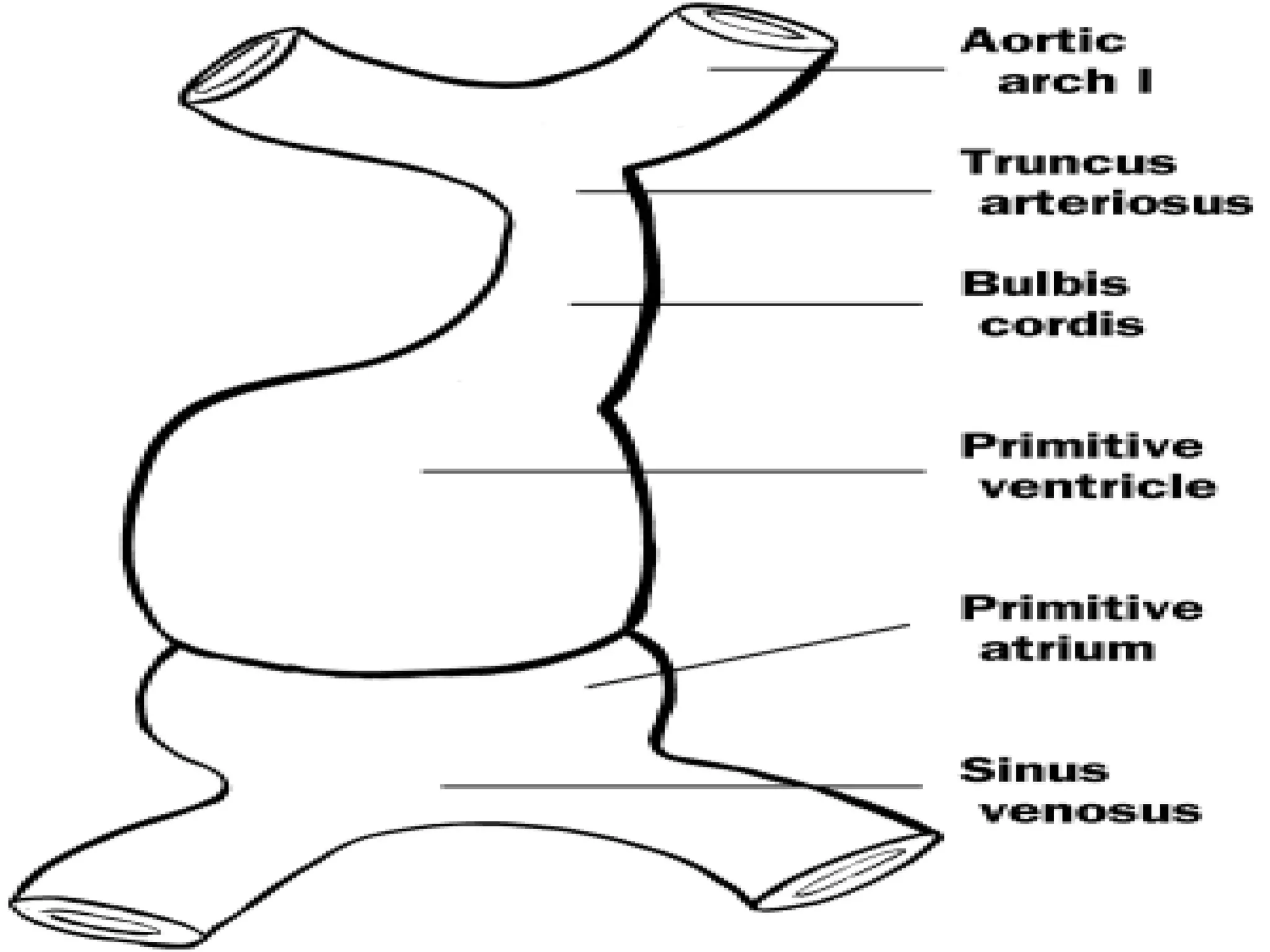
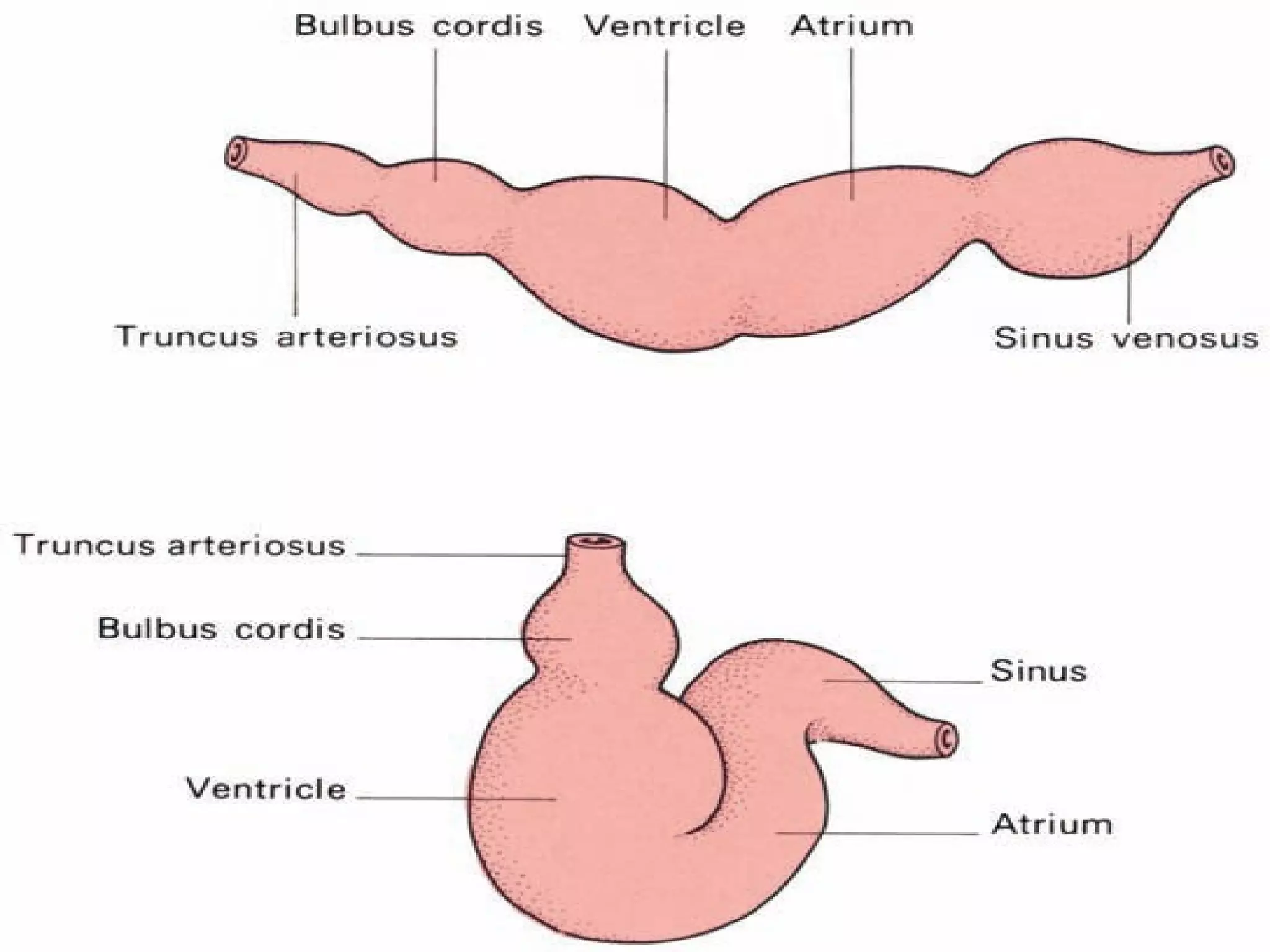
Heart developmentHeart development
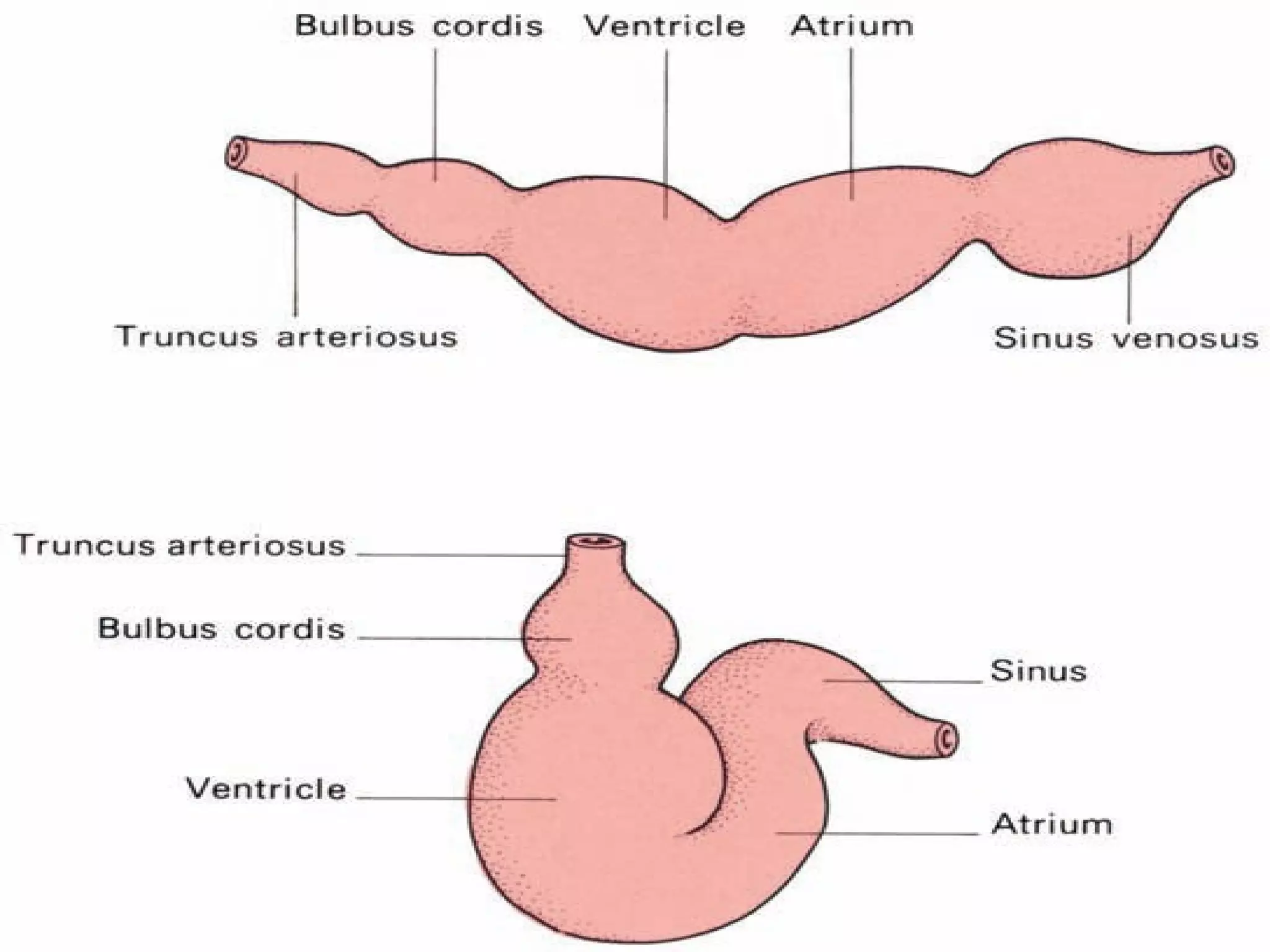
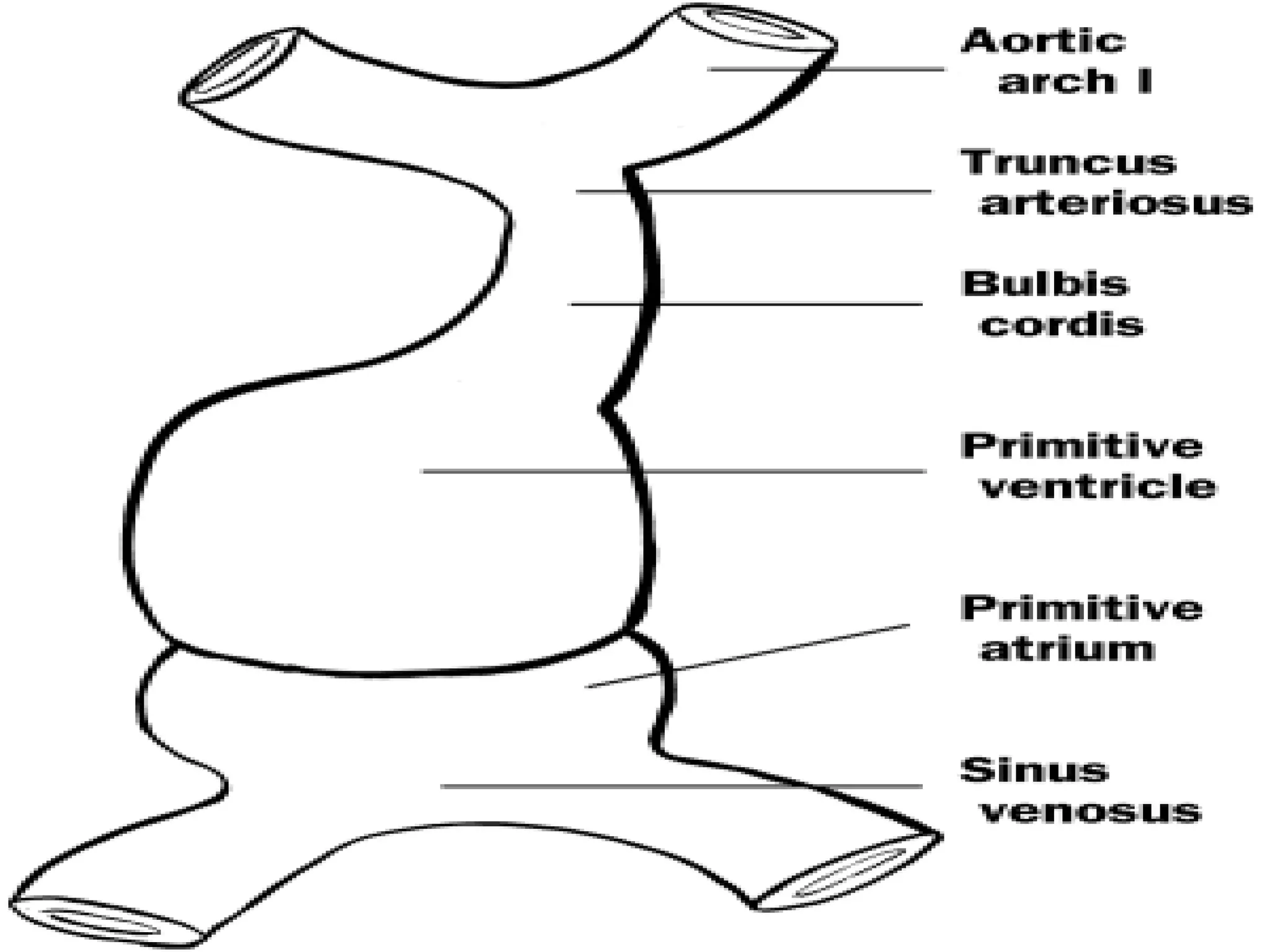
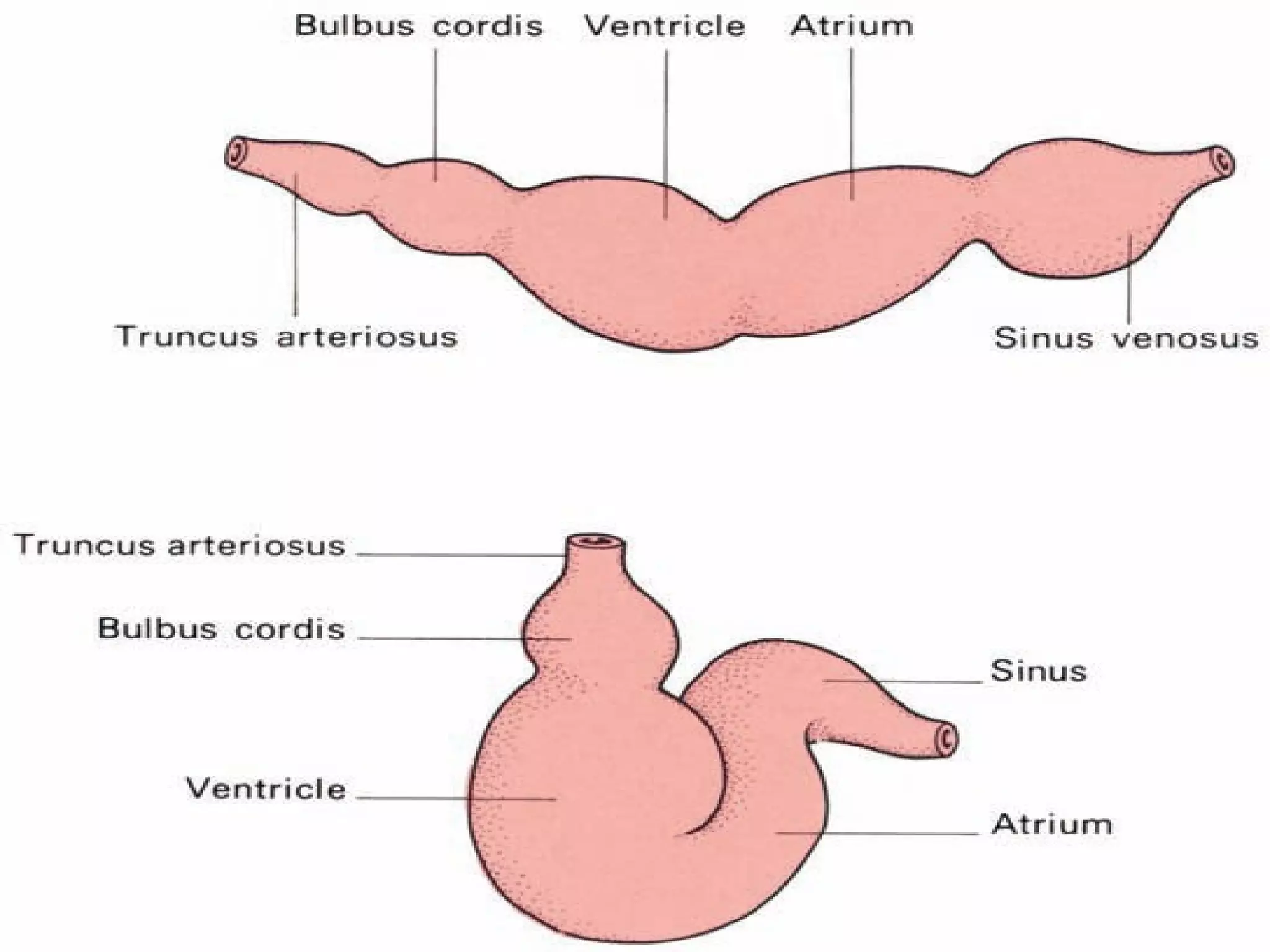
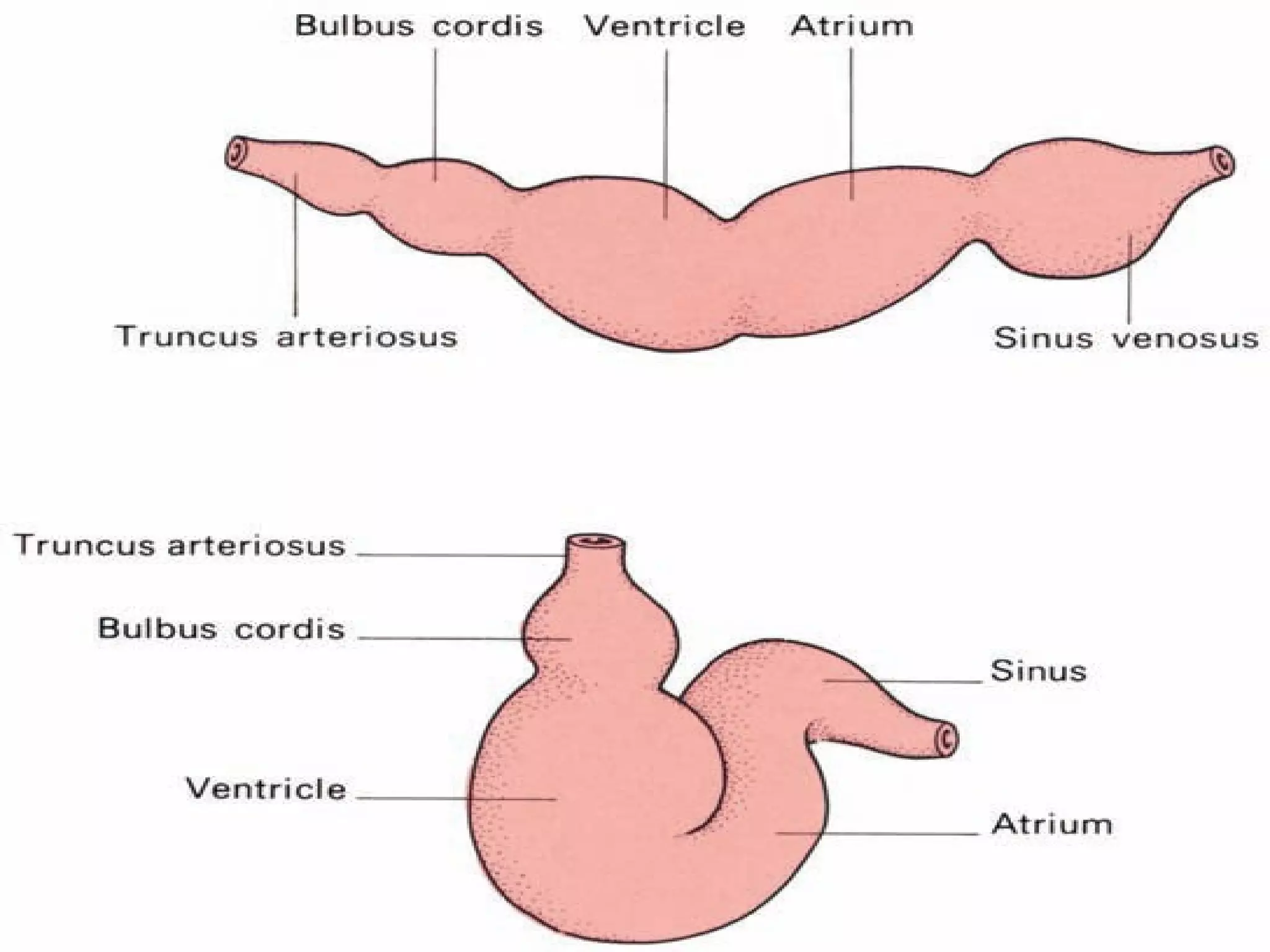
 The primitive heart is a single tube with
grooves demarcating,
 the sinus venosus, atrium, ventricle and
bulbus cordis from behind forwards.
 As this tube enlarges it kinks so that its caudal
end, receiving venous blood,
 comes to lie behind its cephalic end with its
emerging arteries
02/09/17
02/09/17
Heart Looping, and FoldingHeart Looping, and Folding
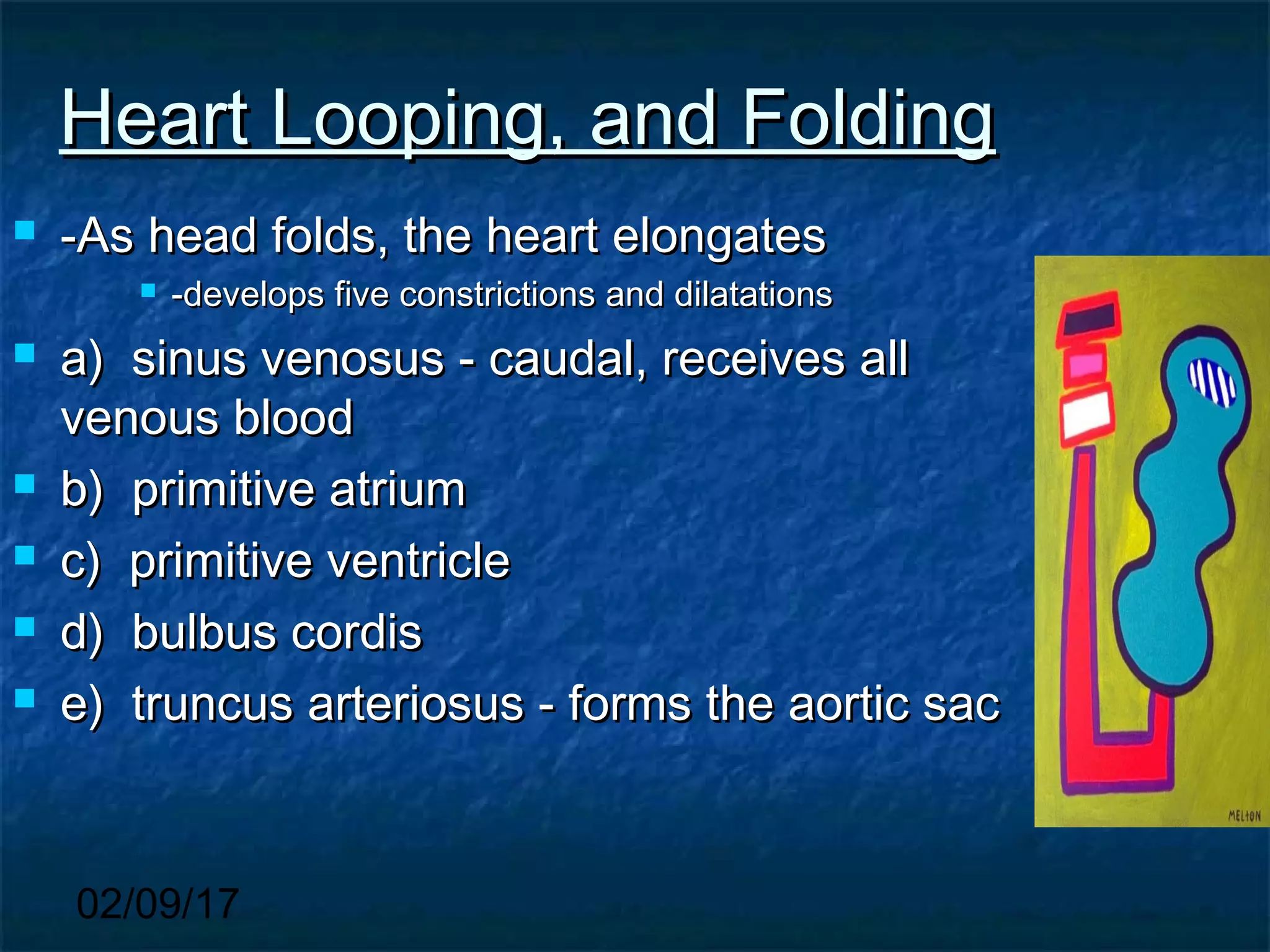
 -As head folds, the heart elongates-As head folds, the heart elongates
 -develops five constrictions and dilatations-develops five constrictions and dilatations
 a) sinus venosus - caudal, receives alla) sinus venosus - caudal, receives all
venous bloodvenous blood
 b) primitive atriumb) primitive atrium
 c) primitive ventriclec) primitive ventricle
 d) bulbus cordisd) bulbus cordis
 e) truncus arteriosus - forms the aortic sace) truncus arteriosus - forms the aortic sac
02/09/17
 The sinus venosus later absorbs into the
atrium,
 the bulbus becomes incorporated into the
ventricle so that, in the fully developed heart,
the atria and great veins come to lie posterior to
the ventricles and the roots of the great
arteries.
 The boundary tissue between the primitive
single atrial cavity and single ventricle grows
out as a dorsal and a ventral endocardial
cushion
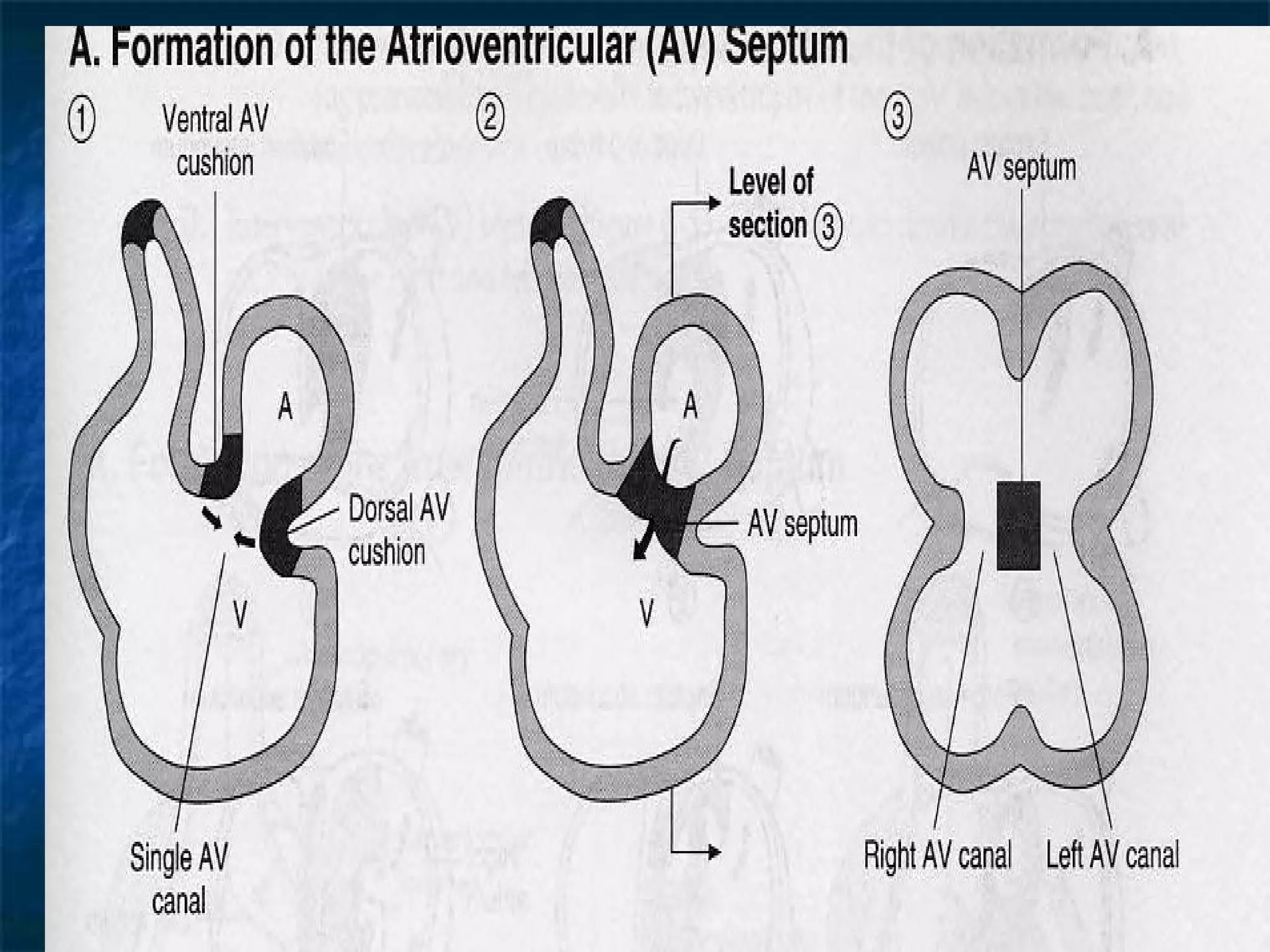
 which meet in the midline, thus dividing the
common atrio-ventricular orifice into a right
(tricuspid) and left (mitral) orifice.
02/09/17
02/09/17
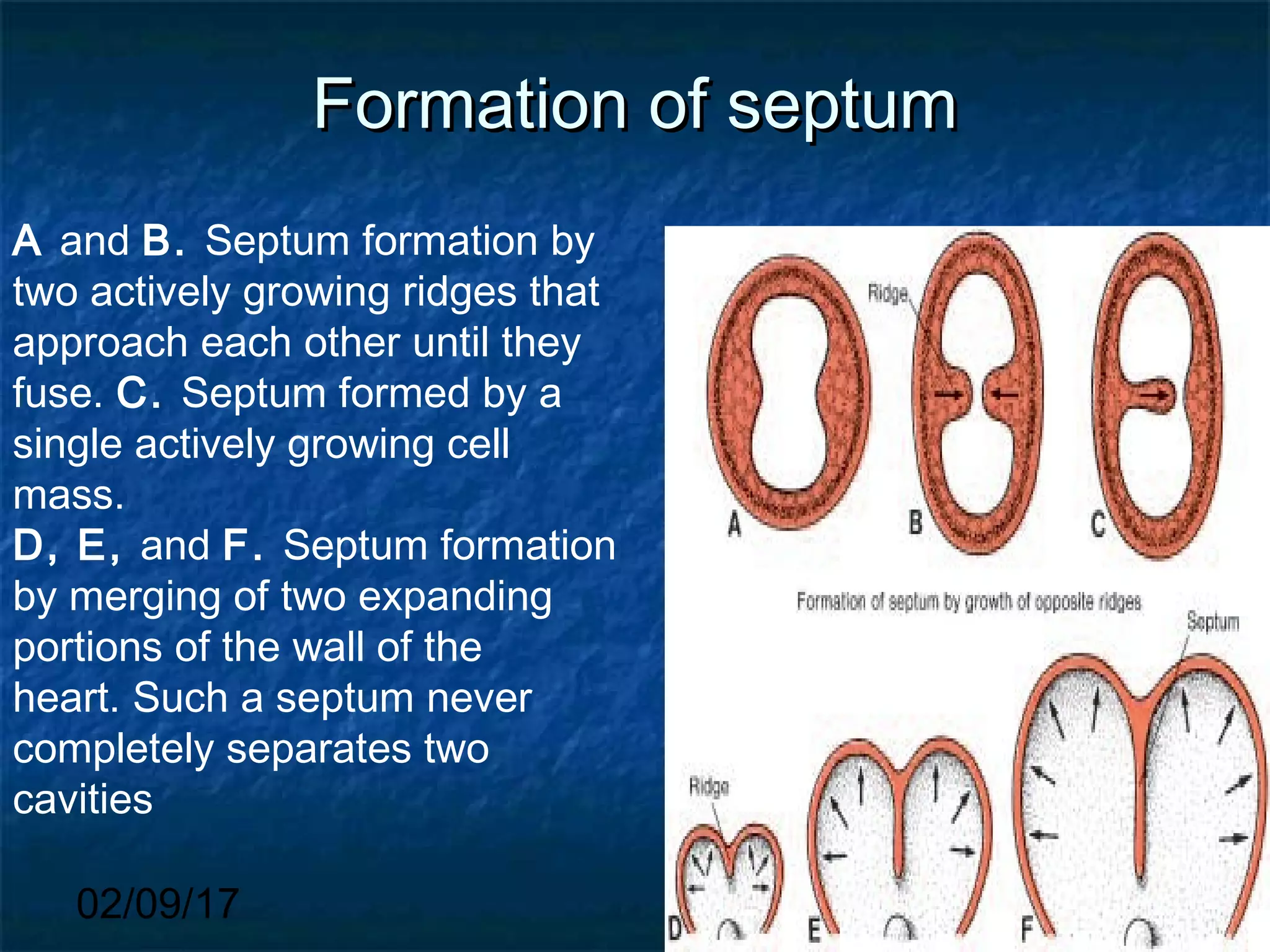
Formation of septumFormation of septum
A and B. Septum formation by
two actively growing ridges that
approach each other until they
fuse. C. Septum formed by a
single actively growing cell
mass.
D, E, and F. Septum formation
by merging of two expanding
portions of the wall of the
heart. Such a septum never
completely separates two
cavities
02/09/17
FIXATIONFIXATION
 Sinus venous is partlySinus venous is partly
embedded in septumembedded in septum
transversum.transversum.
 Truncus Arteriosus isTruncus Arteriosus is
connected to aorticconnected to aortic
arches which enterarches which enter
the branchial arches.the branchial arches.
02/09/17
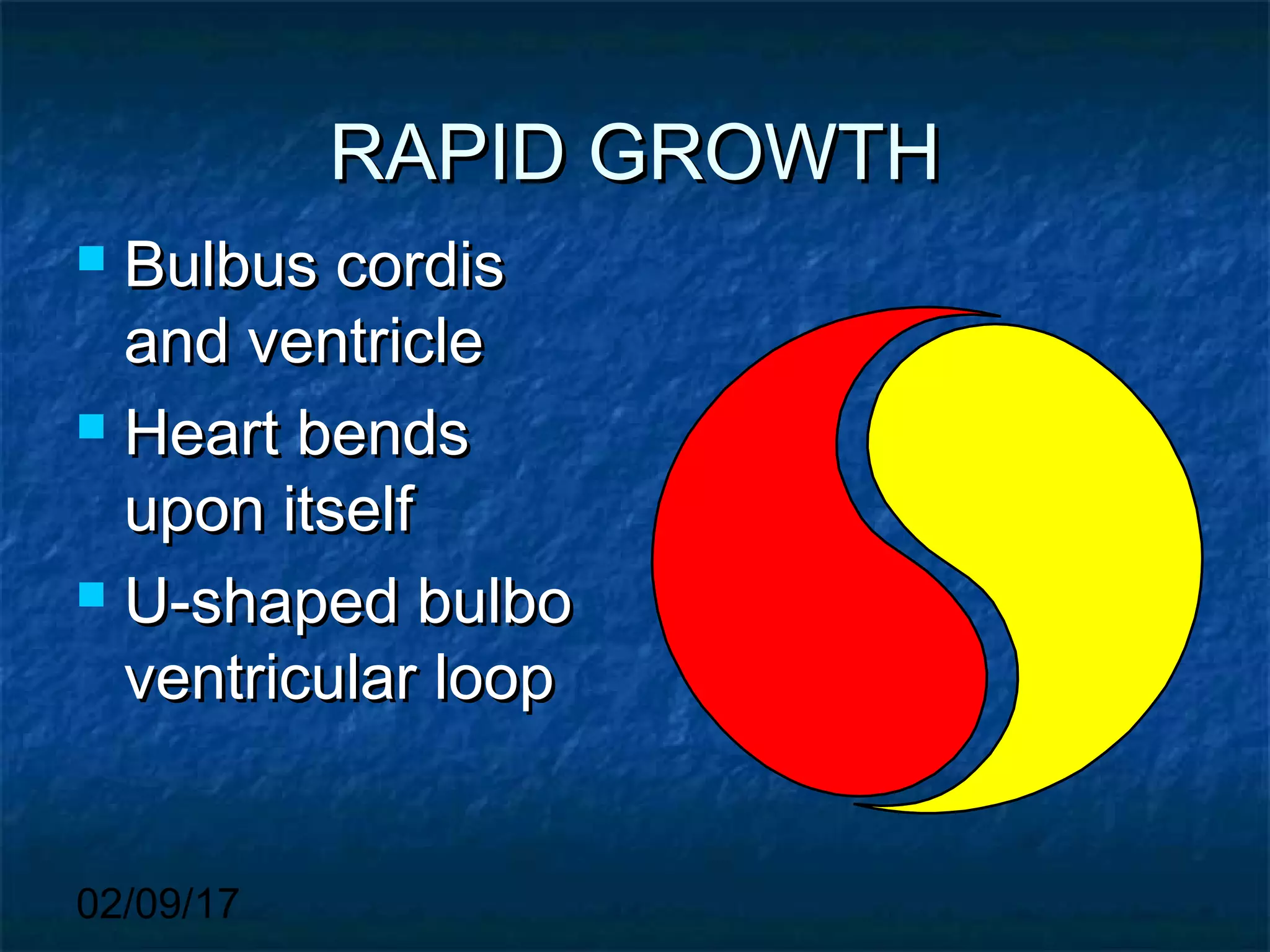
RAPID GROWTHRAPID GROWTH
 Bulbus cordisBulbus cordis
and ventricleand ventricle
 Heart bendsHeart bends
upon itselfupon itself
 U-shaped bulboU-shaped bulbo
ventricular loopventricular loop
02/09/17
02/09/17
Partitioning of the HeartPartitioning of the Heart
 During the 4th and 5thDuring the 4th and 5th
weeks the primitive heart isweeks the primitive heart is
divided into the typical 4-divided into the typical 4-
chambered human organ.chambered human organ.
02/09/17
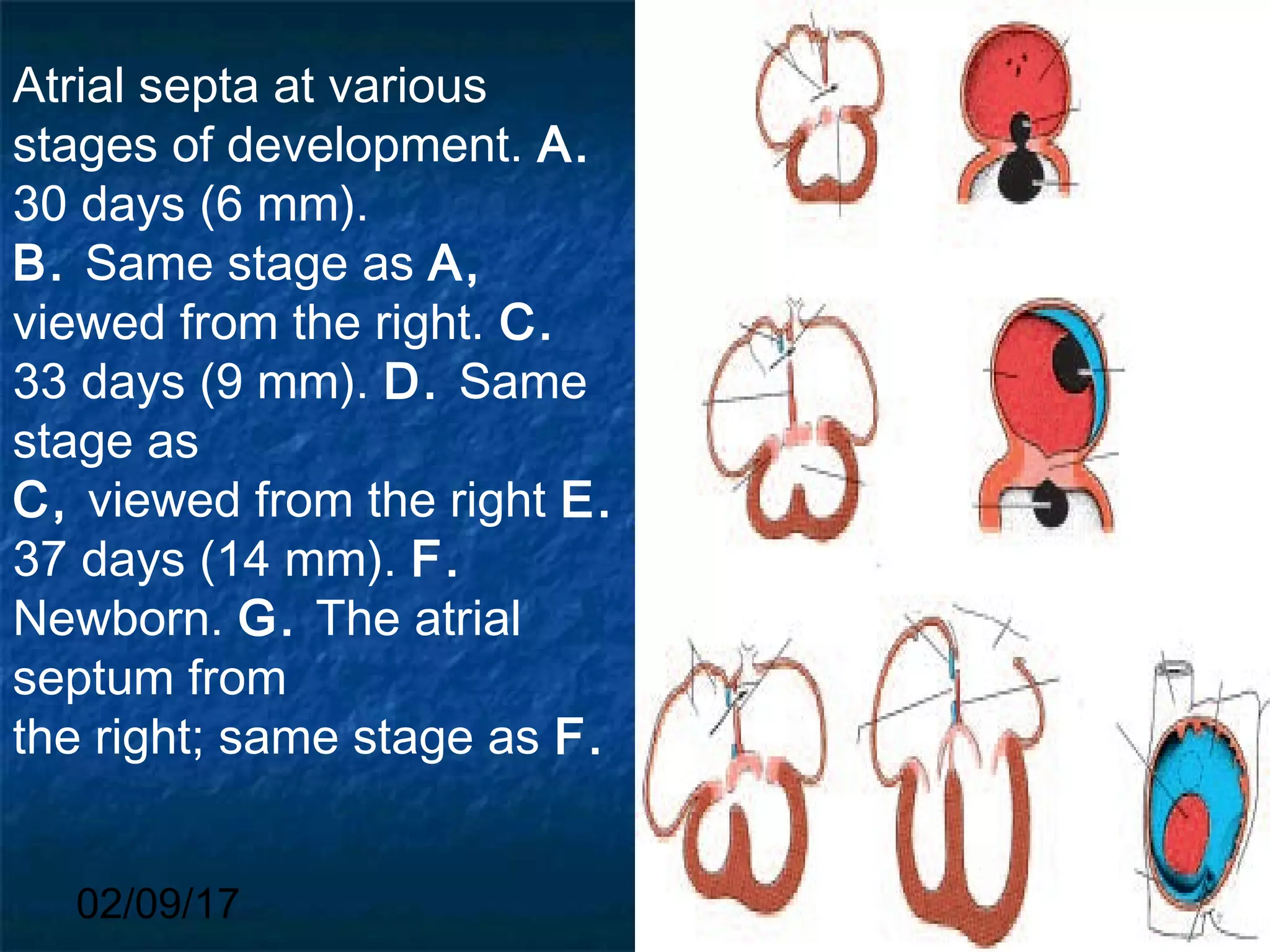
Atrial septa at various
stages of development. A.
30 days (6 mm).
B. Same stage as A,
viewed from the right. C.
33 days (9 mm). D. Same
stage as
C, viewed from the right E.
37 days (14 mm). F.
Newborn. G. The atrial
septum from
the right; same stage as F.
02/09/17
Partitioning of thePartitioning of the
Atrioventricular CanalAtrioventricular Canal
 Dorsal and Ventral EndocardialDorsal and Ventral Endocardial
cushions,cushions,
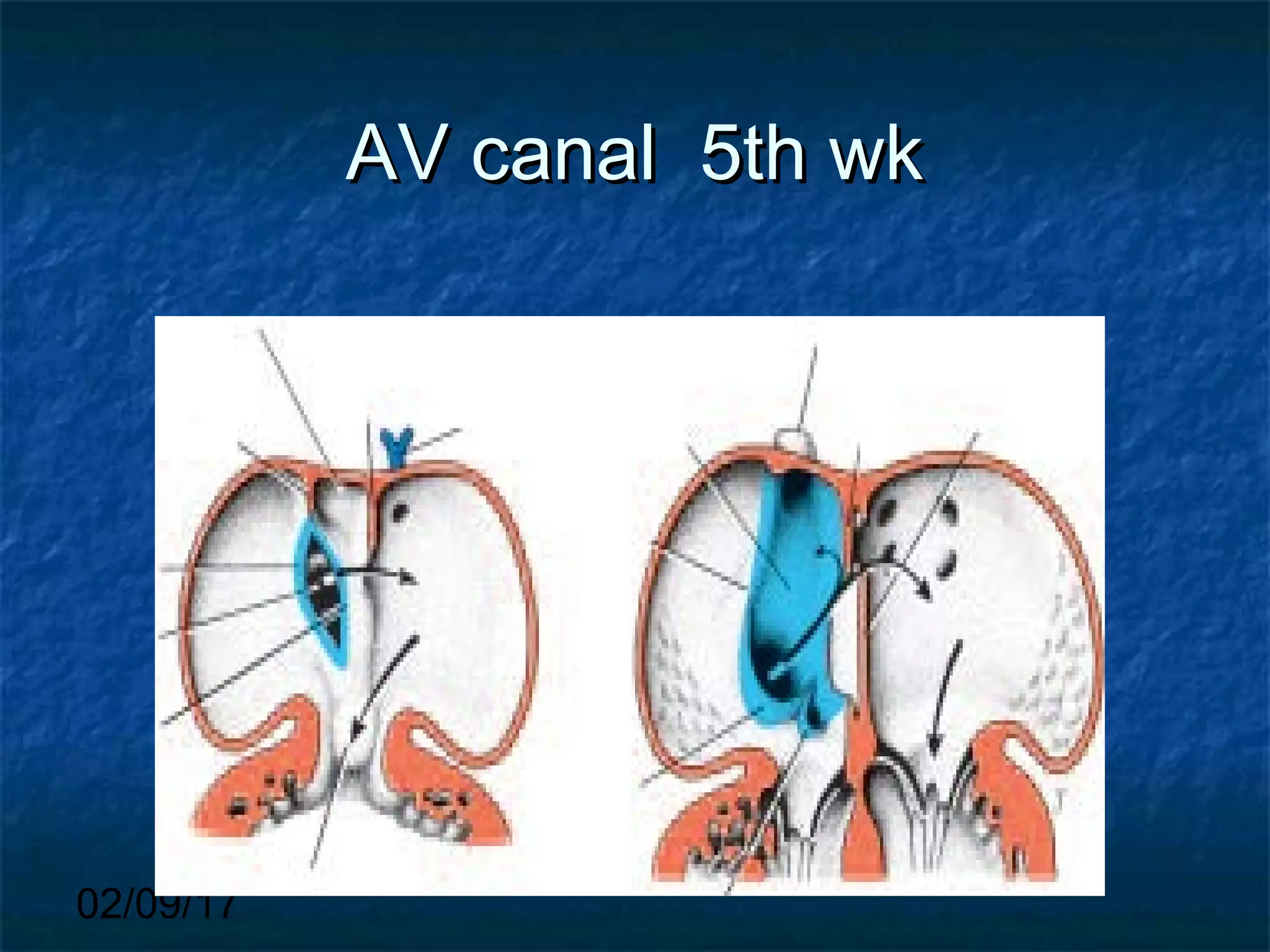
 Divides AV canal into Right and Left AVDivides AV canal into Right and Left AV
CanalsCanals
02/09/17
02/09/17
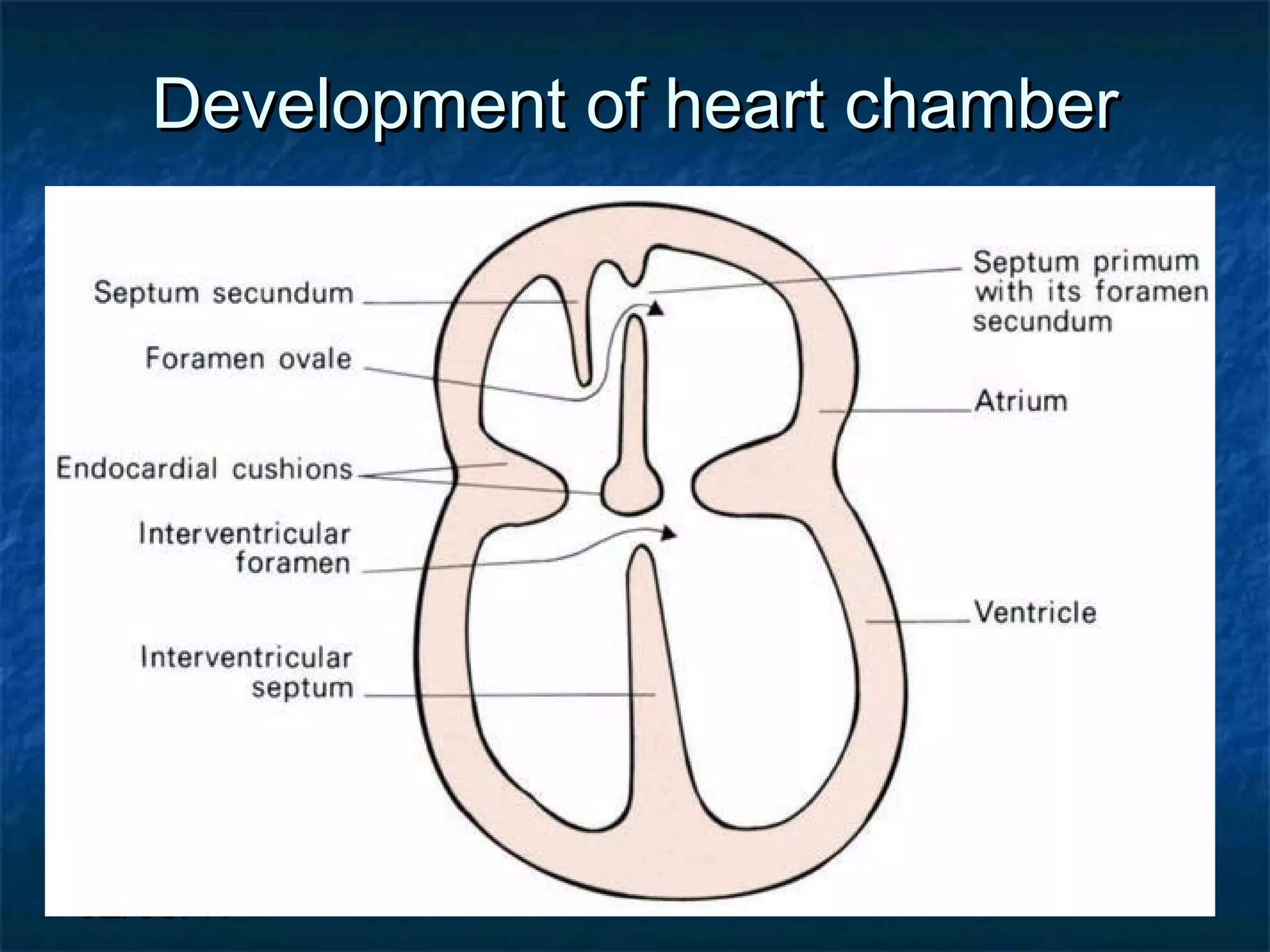
Development of heart chamberDevelopment of heart chamber
02/09/17
02/09/17
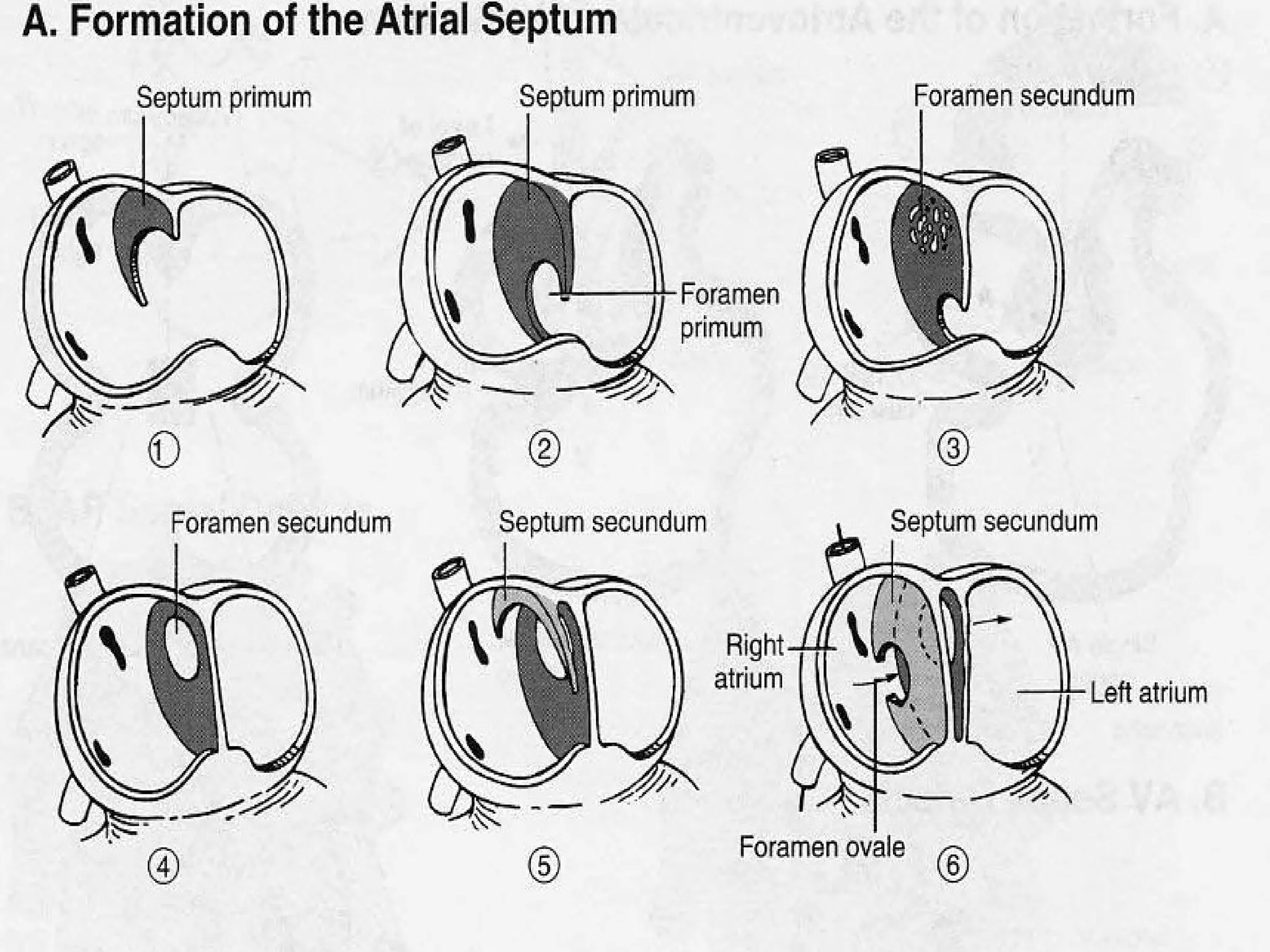
 B.B. Partitioning of the Primitive AtriumPartitioning of the Primitive Atrium
 - Septrum primum (Crescent shaped, or- Septrum primum (Crescent shaped, or
sickle shaped)sickle shaped)
 - Grows from the Dorsocranial wall- Grows from the Dorsocranial wall
 - Foramen primum (Ostium Primum)- Foramen primum (Ostium Primum)
 - Septum secundum (grows from the ventro- Septum secundum (grows from the ventro
cranial wall)cranial wall)
 - Foramen ovale- Foramen ovale
02/09/17
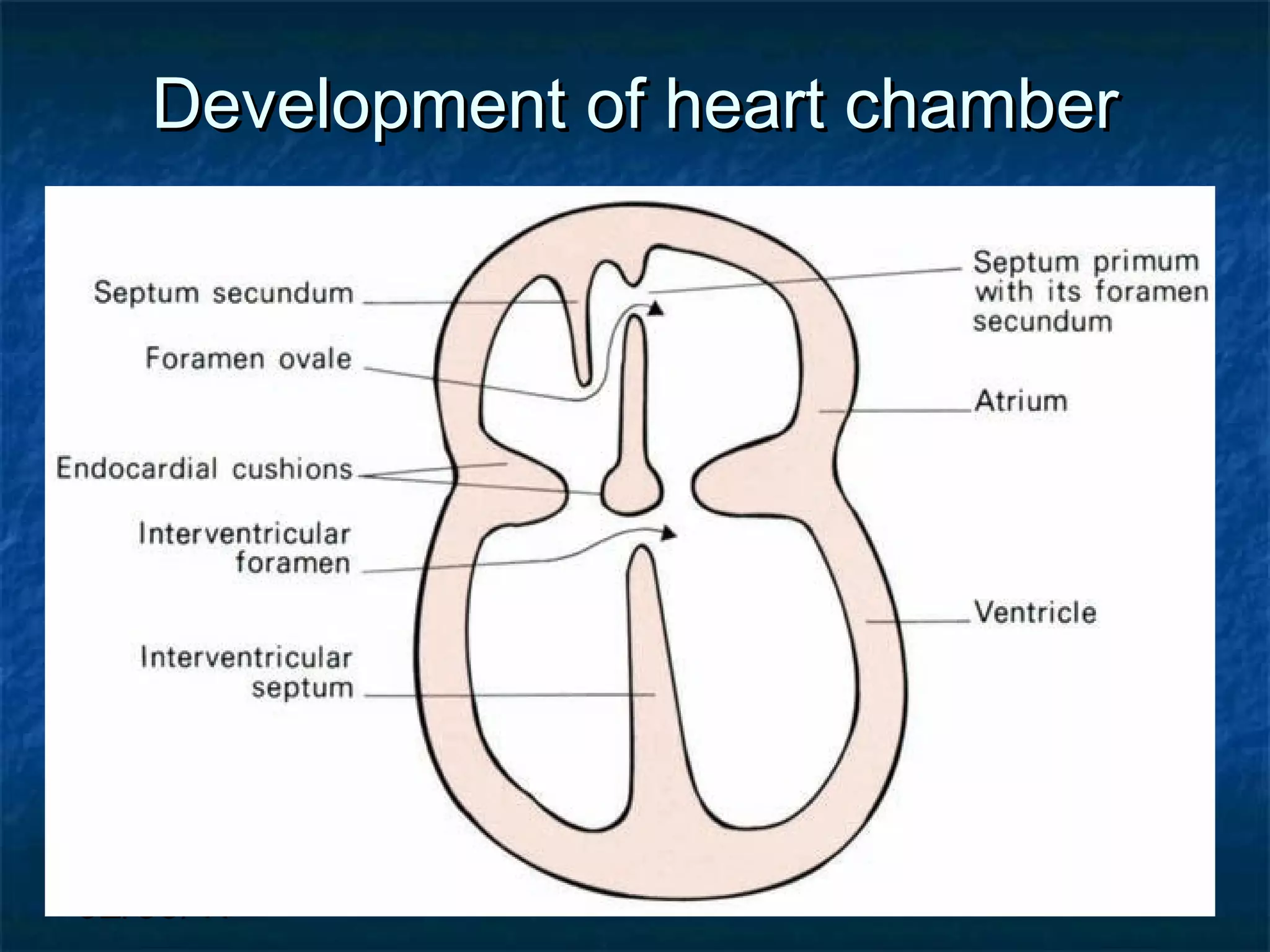
Development of heart chamberDevelopment of heart chamber
02/09/17
 A partition, the septum primum, grows downwards from the posterior
 and superior walls of the primitive common atrium to fuse with the
endocardial cushions.
 Before fusion is complete, a hole appears in the upper part of this septum
primum, which is termed the foramen secundum in the septum
primum.

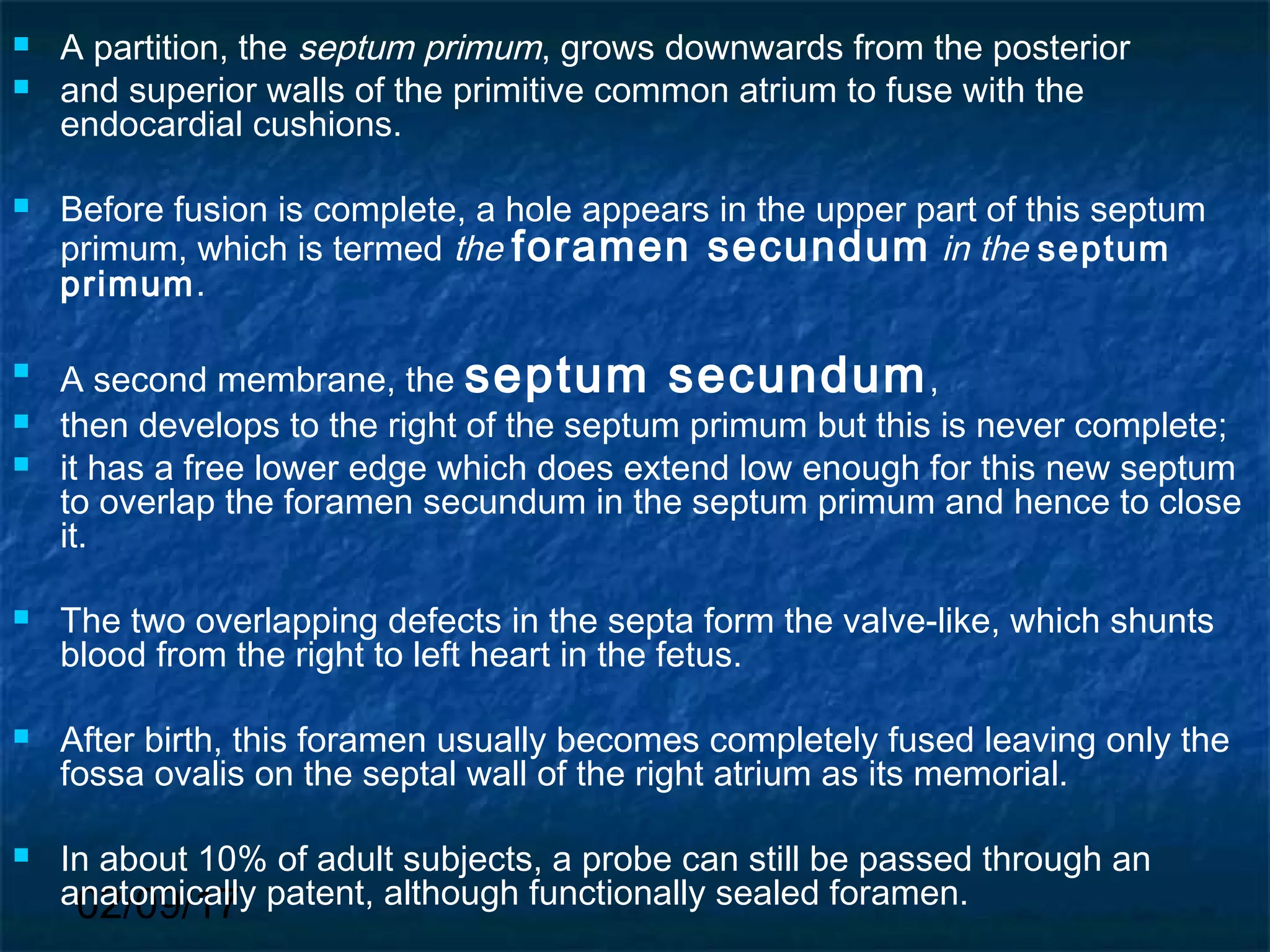
A second membrane, the septum secundum,
 then develops to the right of the septum primum but this is never complete;
 it has a free lower edge which does extend low enough for this new septum
to overlap the foramen secundum in the septum primum and hence to close
it.
 The two overlapping defects in the septa form the valve-like, which shunts
blood from the right to left heart in the fetus.
 After birth, this foramen usually becomes completely fused leaving only the
fossa ovalis on the septal wall of the right atrium as its memorial.
 In about 10% of adult subjects, a probe can still be passed through an
anatomically patent, although functionally sealed foramen.
02/09/17
02/09/17
AV canal 5th wkAV canal 5th wk
02/09/17
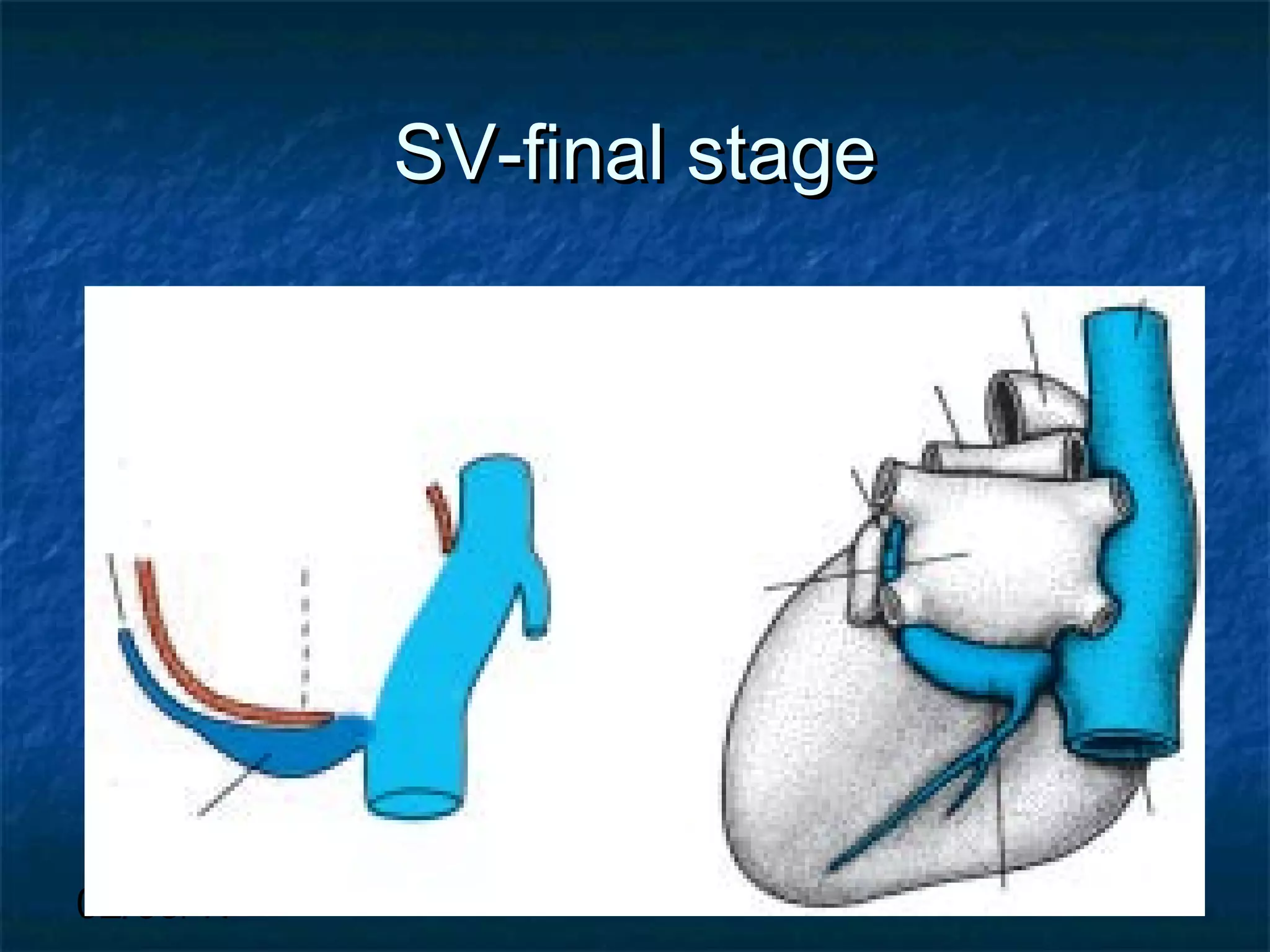
Changes in Sinus VenosusChanges in Sinus Venosus
 Right and left horn (Right and left horn (increases andincreases and
decreases in growth respectively)decreases in growth respectively)
 Right becomes incorporated into (RightRight becomes incorporated into (Right
Atrium)Atrium)
 Left becomes Coronary SinusLeft becomes Coronary Sinus
02/09/17
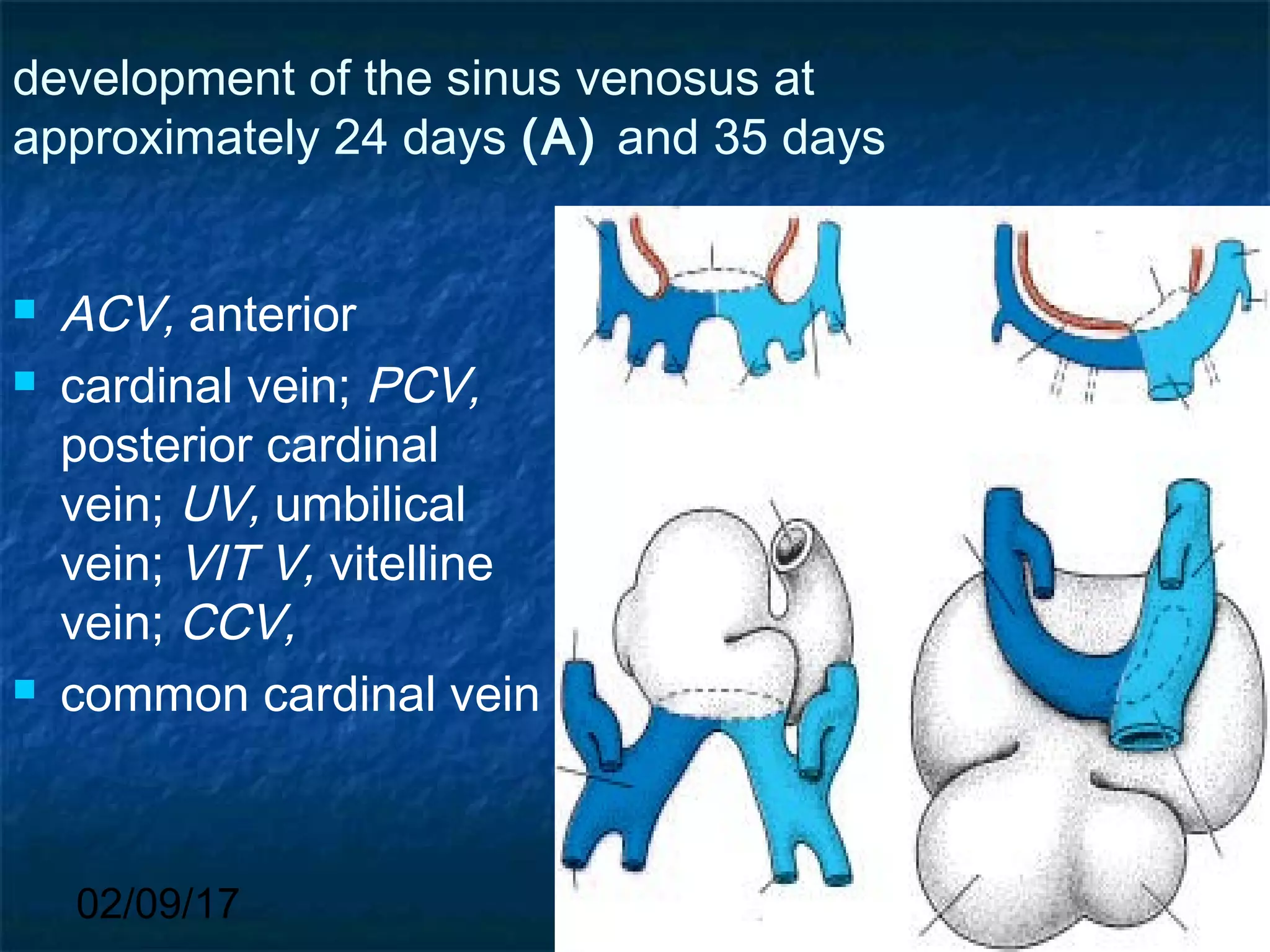
sinus venosus
 The primitive sinus venosus absorbs into the right atrium so
that the
venae cavae draining into the sinus come to open separately
into this
 atrium.
 The smooth-walled part of the adult atrium represents the
contribution
 of the sinus venosus,
 the pectinate part represents the portion derived from the
primitive atrium.
 NB: the adult left atrium has a double origin:
 originally, single pulmonary venous trunk entering the left
atrium -donates the smooth-walled part of this chamber
with the pulmonary veins entering as four separate openings;
 the trabeculated part of the definitive left atrium is the
remains of the original atrial wall.
02/09/17
development of the sinus venosus at
approximately 24 days (A) and 35 days
 ACV, anterior
 cardinal vein; PCV,
posterior cardinal
vein; UV, umbilical
vein; VIT V, vitelline
vein; CCV,
 common cardinal vein
02/09/17
SV-final stageSV-final stage
02/09/17
Partitioning of the VentriclePartitioning of the Ventricle
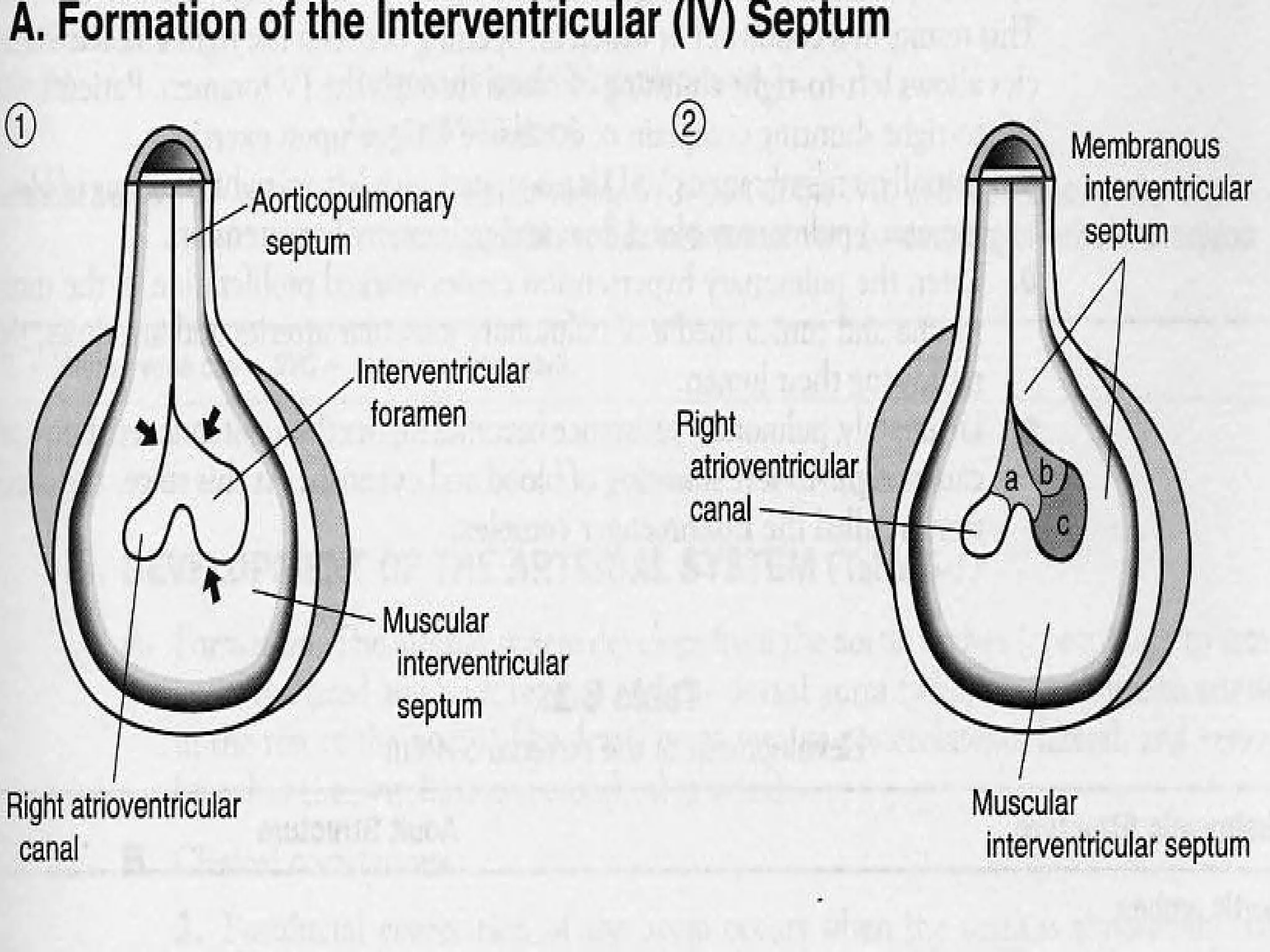
 Muscular ridge -Muscular ridge -
septumseptum
 InterventricularInterventricular
septumseptum
 InterventricularInterventricular
foramenforamen
 Membranous septumMembranous septum
02/09/17
02/09/17
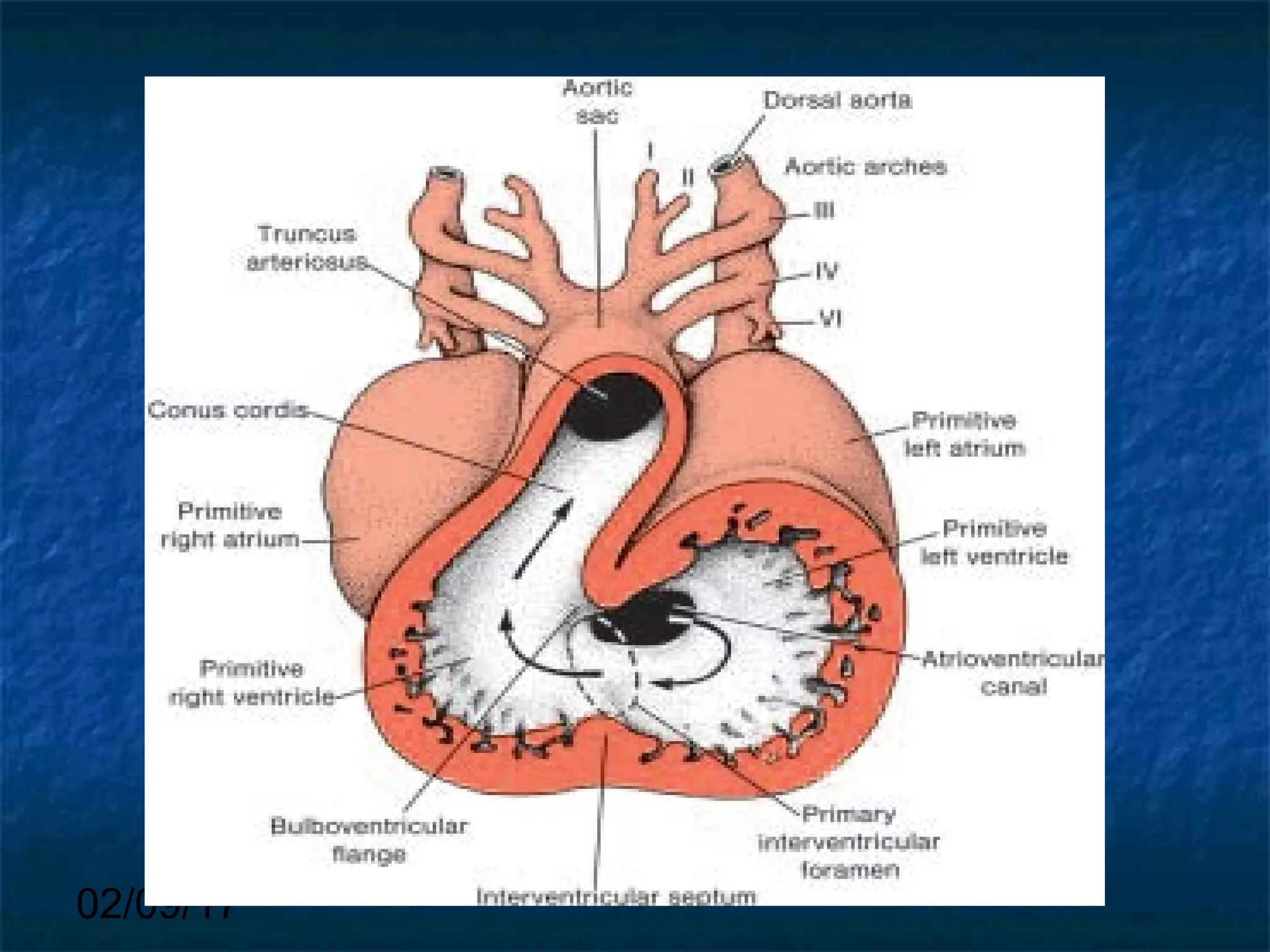
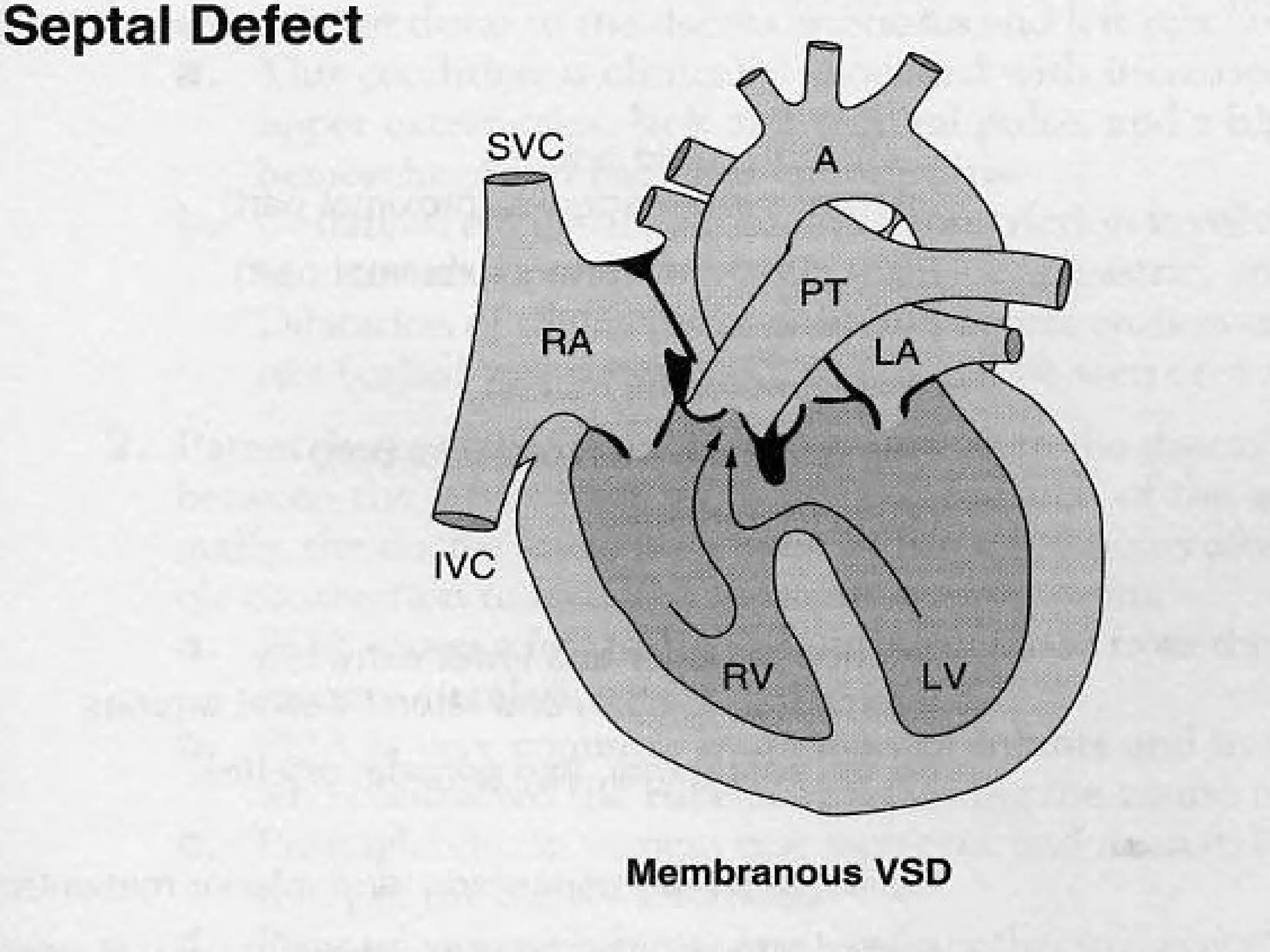
Partition of ventriclePartition of ventricle
 Division of the ventricle is commenced by the up growth of a
fleshy septum from the apex of the heart towards the
endocardial cushions.
 This stops short of dividing the ventricle completely and thus
it has an upper free border, forming a temporary
interventricular foramen.
 At the same time, the single truncus arteriosus is divided
into aorta and pulmonary trunk by a spiral septum (hence the
spiral relations of these two vessels),
 which grows downwards to the ventricle and fuses accurately
with the upper free border of the ventricular septum.
 This contributes the small pars membranacea septi,
which completes the separation of the ventricle in such a
way that blood on the left of the septum flows into the aorta
and on the right into the pulmonary trunk.
02/09/17
02/09/17
Partitioning of the Bulbus CordisPartitioning of the Bulbus Cordis
and Truncus Arteriosusand Truncus Arteriosus
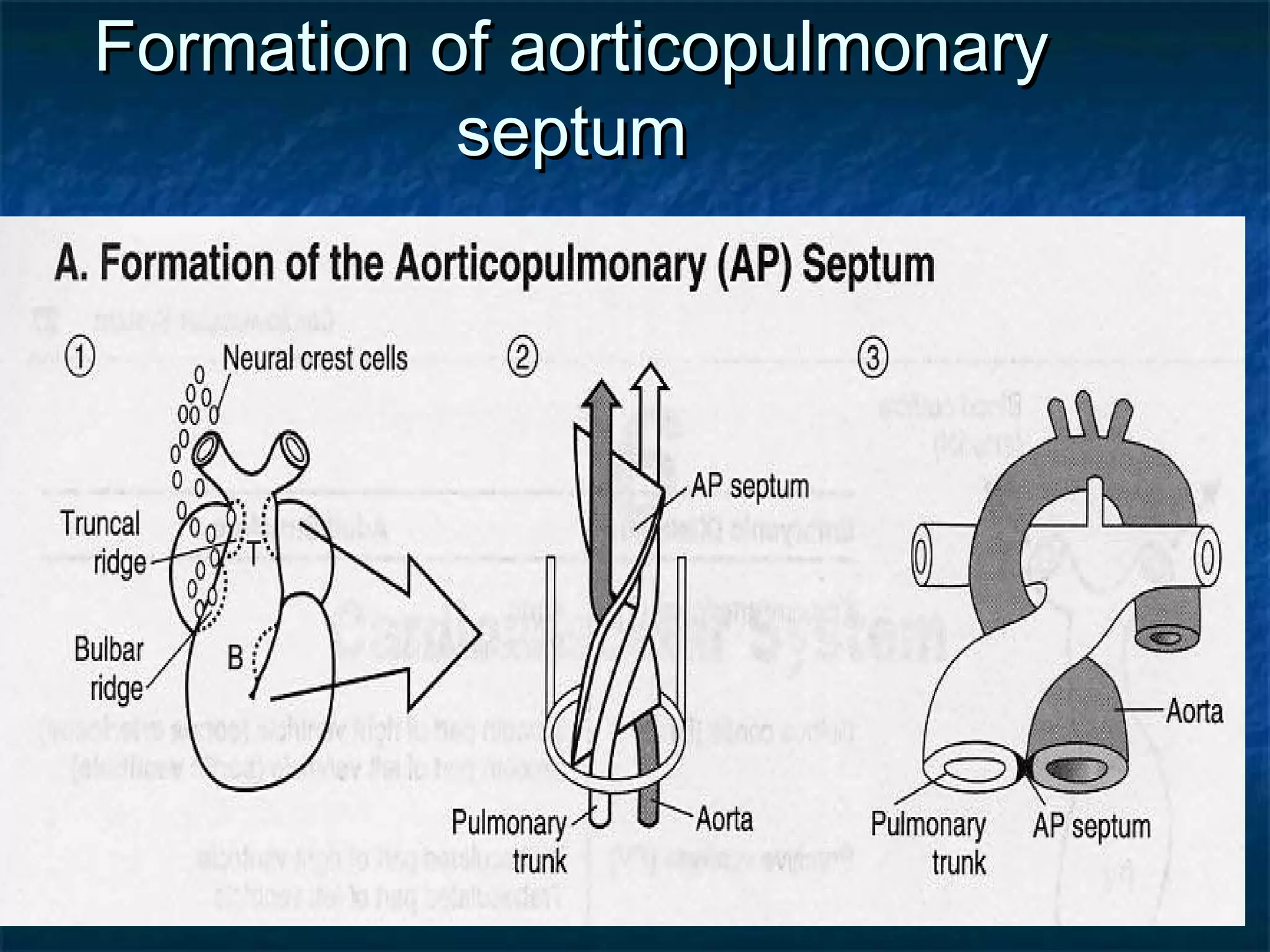
 Development and fusion ofDevelopment and fusion of
truncal and bulbar ridgestruncal and bulbar ridges
 Aorticopulmonary SeptumAorticopulmonary Septum
02/09/17
Formation of aorticopulmonaryFormation of aorticopulmonary
septumseptum
02/09/17
 Development of the Valves andDevelopment of the Valves and
Cardiac Conducting SystemCardiac Conducting System
 Endocardial cushionsEndocardial cushions
 AV (Mitral, Tricuspid), Semilunar (Aorta,AV (Mitral, Tricuspid), Semilunar (Aorta,
Pulmonary A)Pulmonary A)
 Formation of Aortic Arches andFormation of Aortic Arches and
DerivativesDerivatives
 Aortic sac gives rise to aortic archesAortic sac gives rise to aortic arches
02/09/17
02/09/17
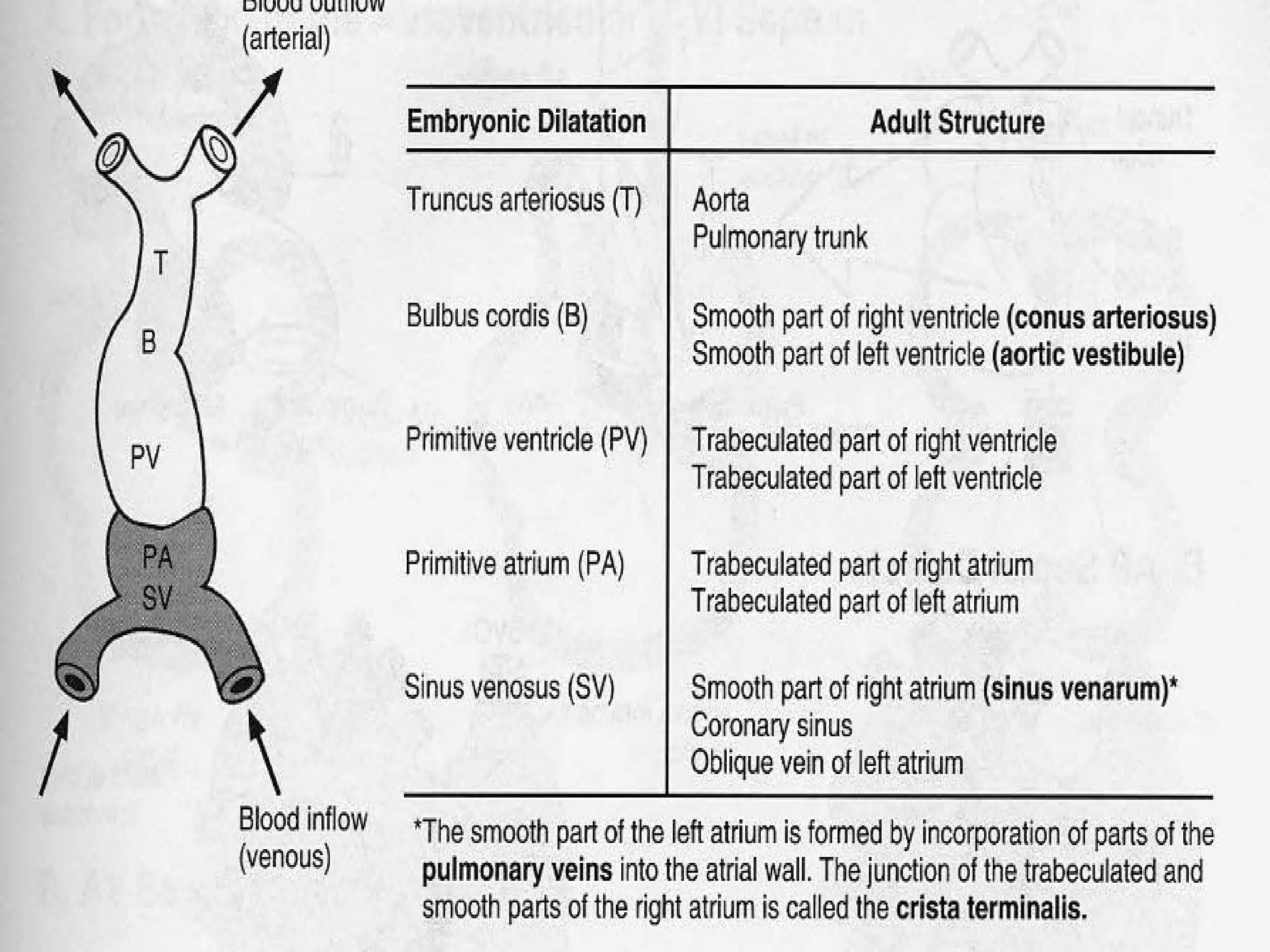
Primitive Heart Tube
Embryonic
Dilatation
Adult Structure
Sinus venosus Smooth part of right atrium (sinus venarum),
coronary sinus, oblique vein of left atrium
Primitive
atrium
Trabeculated parts of right and left atria
Primitive
ventricle
Trabeculated parts of right and left ventricles
Bulbis cordis Smooth part of right ventricle (conus
arteriosus), smooth part of left ventricle
(aortic vestibule)
Truncus
arteriosus
Aorta, pulmonary trunk
02/09/17
02/09/17
Formation of Aortic ArchesFormation of Aortic Arches
and Derivativesand Derivatives
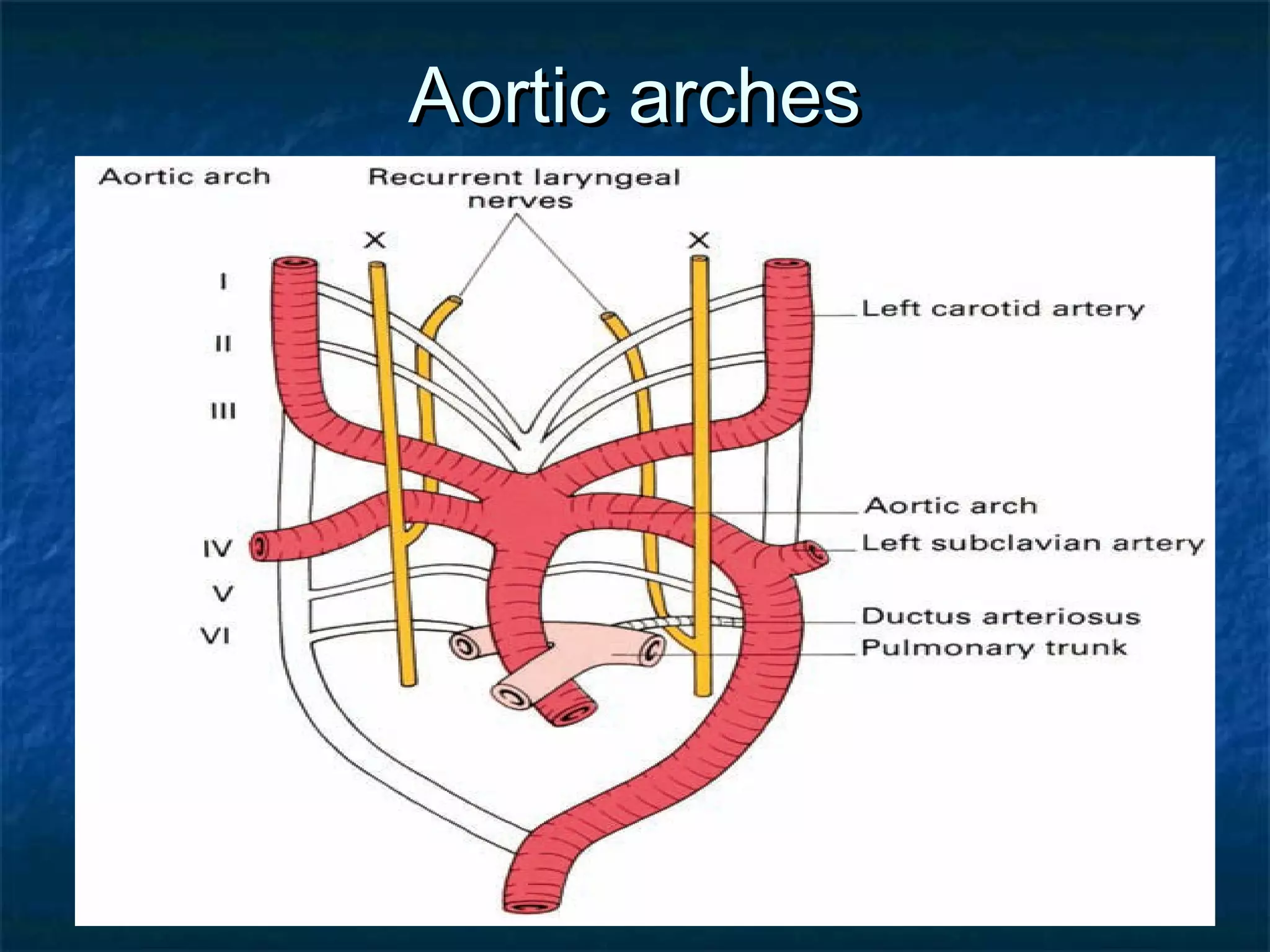
 Aortic sac gives rise to aortic archesAortic sac gives rise to aortic arches
 Six aortic arches corresponding to the 6Six aortic arches corresponding to the 6
pharyngeal arches.pharyngeal arches.
 However, one of the aortic archesHowever, one of the aortic arches
degenerate, i.e, the 5degenerate, i.e, the 5thth
arch.arch.
02/09/17
Aortic archesAortic arches
02/09/17
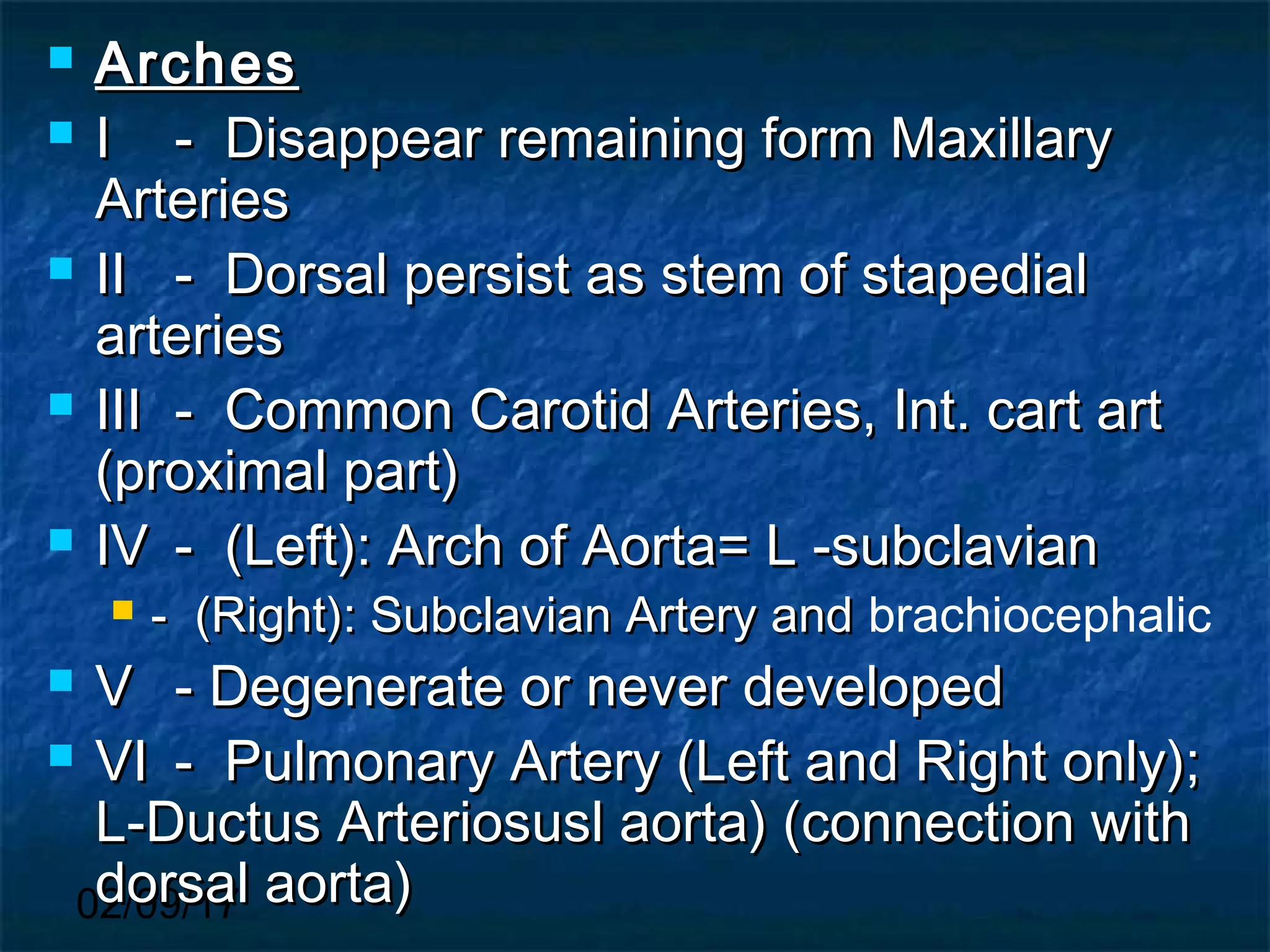
 ArchesArches
 II - Disappear remaining form Maxillary- Disappear remaining form Maxillary
ArteriesArteries
 IIII - Dorsal persist as stem of stapedial- Dorsal persist as stem of stapedial
arteriesarteries
 IIIIII - Common Carotid Arteries, Int. cart art- Common Carotid Arteries, Int. cart art
(proximal part)(proximal part)
 IVIV - (Left): Arch of Aorta= L -subclavian- (Left): Arch of Aorta= L -subclavian
 - (Right): Subclavian Artery and- (Right): Subclavian Artery and brachiocephalic
 VV - Degenerate or never developed- Degenerate or never developed
 VIVI - Pulmonary Artery (Left and Right only);- Pulmonary Artery (Left and Right only);
L-Ductus Arteriosusl aorta) (connection withL-Ductus Arteriosusl aorta) (connection with
dorsal aorta)dorsal aorta)
02/09/17
Orientation of vagus nerveOrientation of vagus nerve
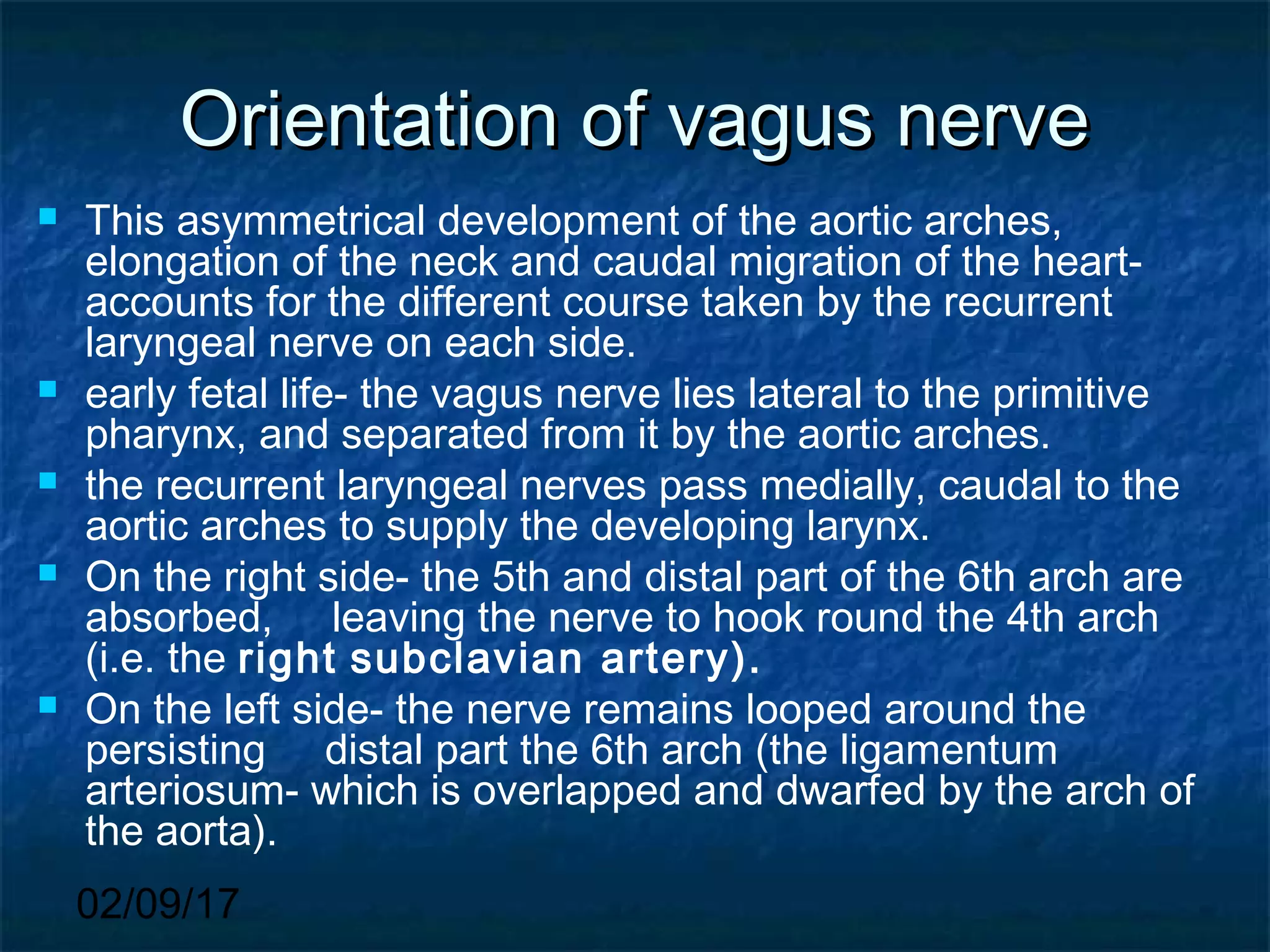
 This asymmetrical development of the aortic arches,
elongation of the neck and caudal migration of the heart-
accounts for the different course taken by the recurrent
laryngeal nerve on each side.
 early fetal life- the vagus nerve lies lateral to the primitive
pharynx, and separated from it by the aortic arches.
 the recurrent laryngeal nerves pass medially, caudal to the
aortic arches to supply the developing larynx.
 On the right side- the 5th and distal part of the 6th arch are
absorbed, leaving the nerve to hook round the 4th arch
(i.e. the right subclavian artery).
 On the left side- the nerve remains looped around the
persisting distal part the 6th arch (the ligamentum
arteriosum- which is overlapped and dwarfed by the arch of
the aorta).
02/09/17
02/09/17
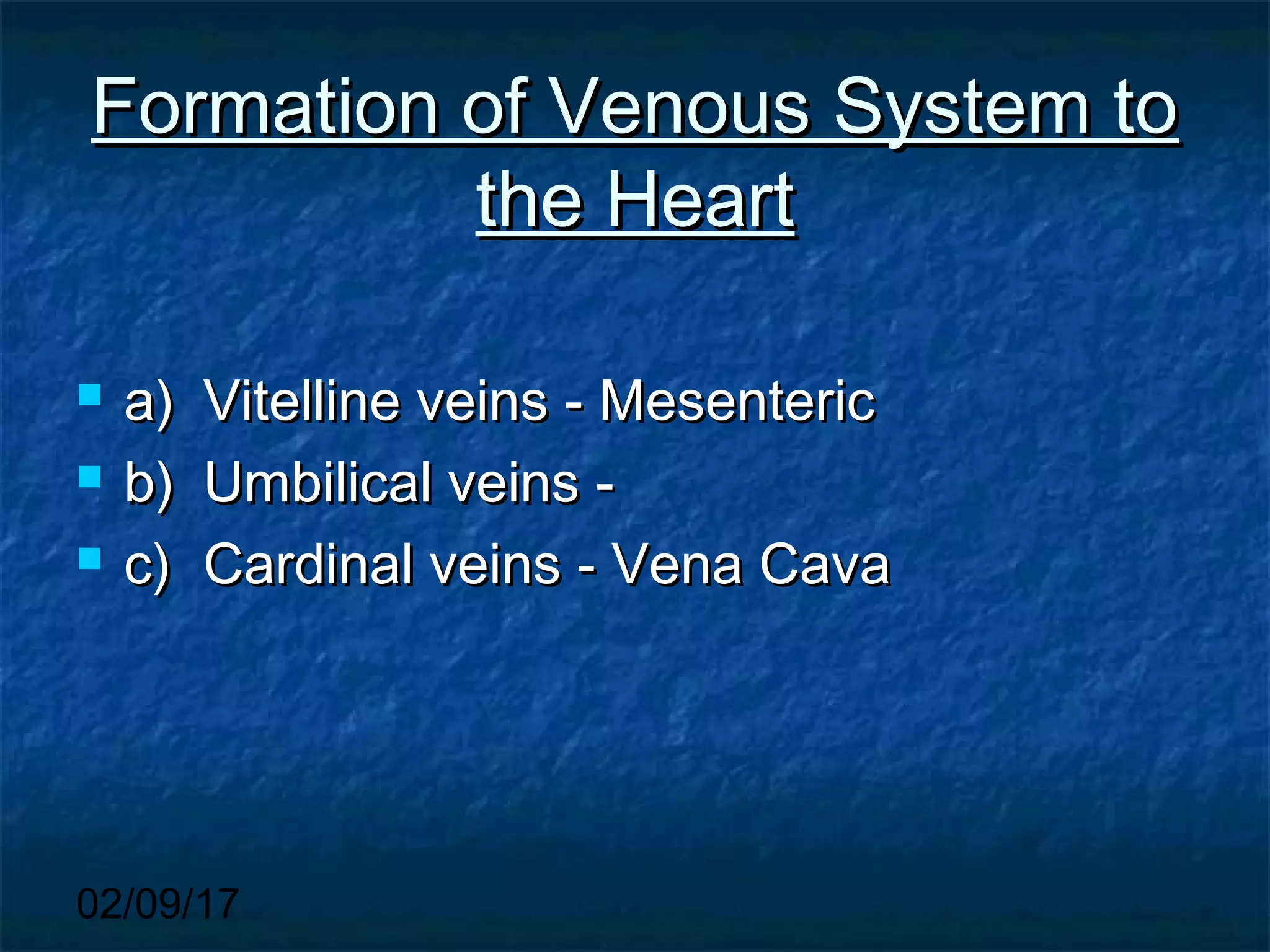
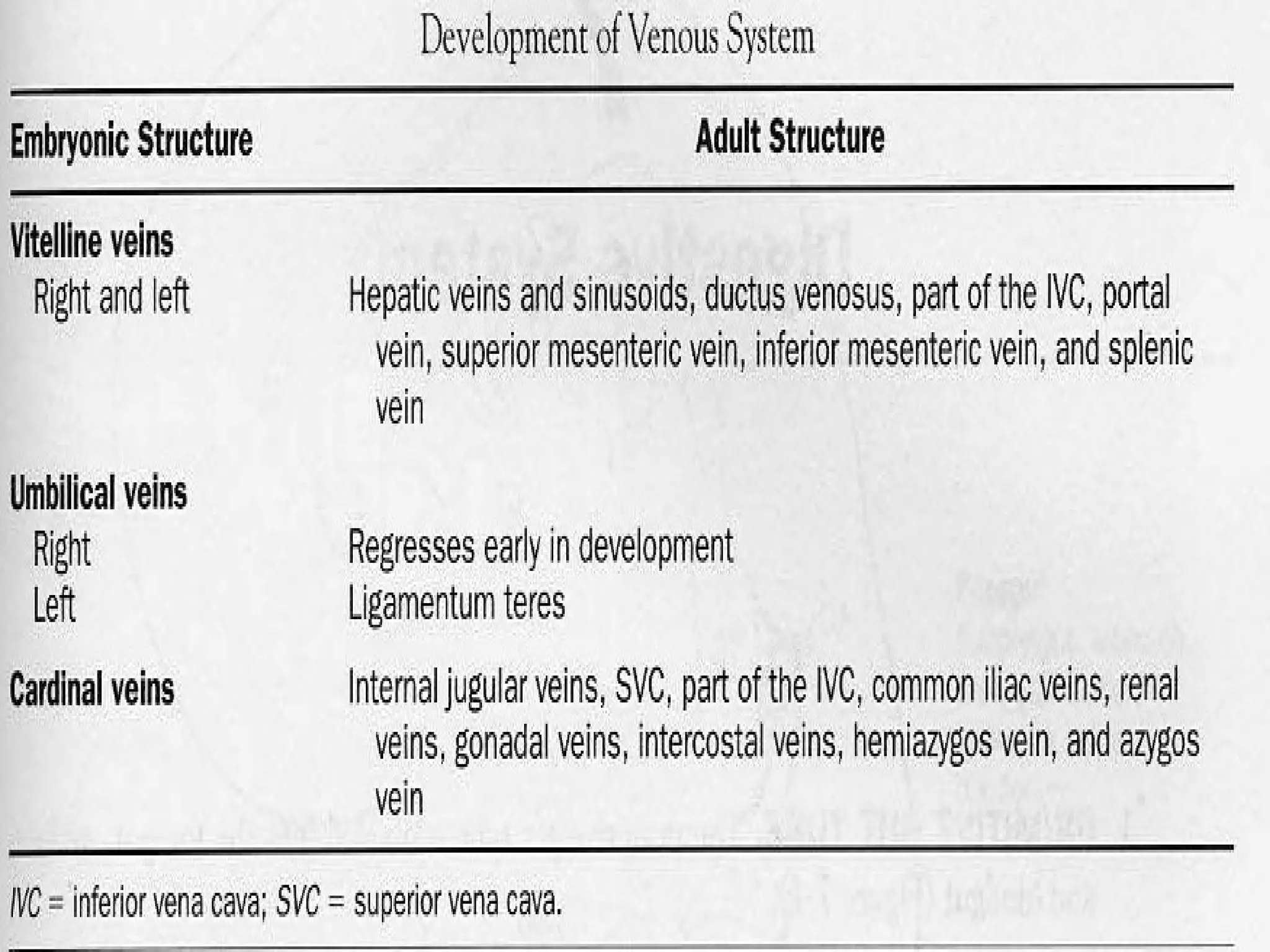
Formation of Venous System toFormation of Venous System to
the Heartthe Heart
 a)a) Vitelline veins - MesentericVitelline veins - Mesenteric
 b)b) Umbilical veins -Umbilical veins -
 c)c) Cardinal veins - Vena CavaCardinal veins - Vena Cava
02/09/17
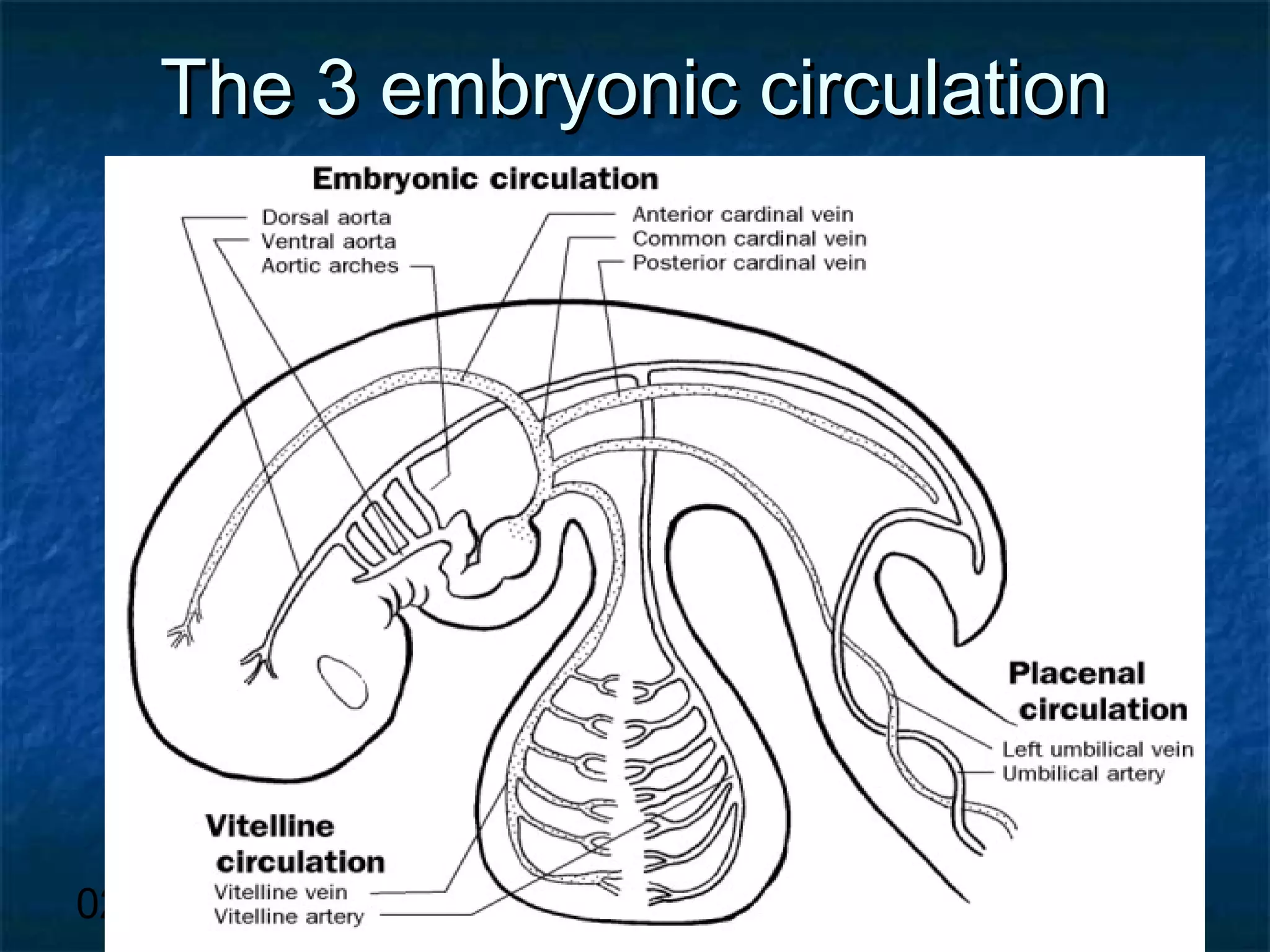
The 3 embryonic circulationThe 3 embryonic circulation
02/09/17
02/09/17
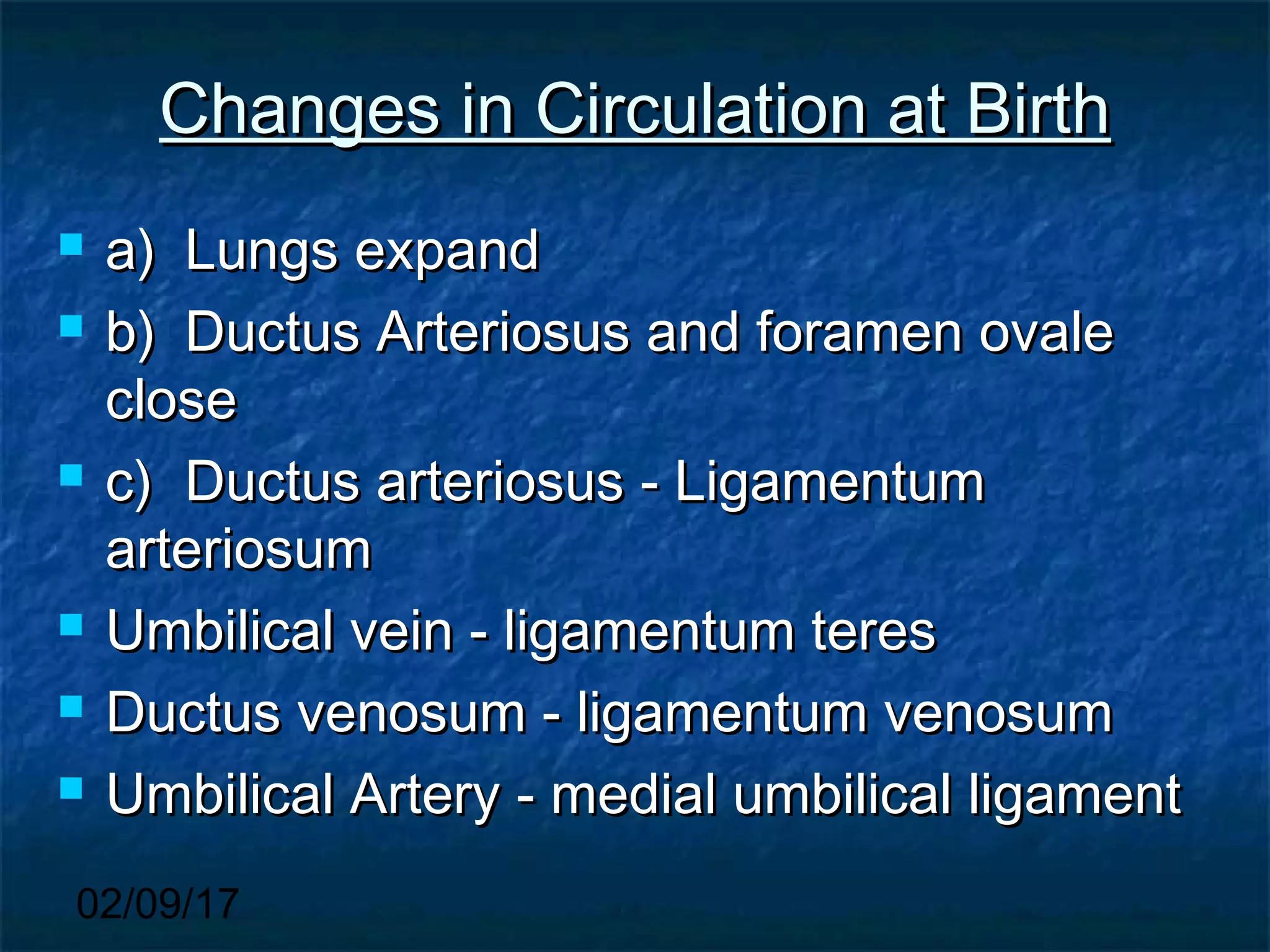
Changes in Circulation at BirthChanges in Circulation at Birth
 a)a) Lungs expandLungs expand
 b)b) Ductus Arteriosus and foramen ovaleDuctus Arteriosus and foramen ovale
closeclose
 c)c) Ductus arteriosus - LigamentumDuctus arteriosus - Ligamentum
arteriosumarteriosum
 Umbilical vein - ligamentum teresUmbilical vein - ligamentum teres
 Ductus venosum - ligamentum venosumDuctus venosum - ligamentum venosum
 Umbilical Artery - medial umbilical ligamentUmbilical Artery - medial umbilical ligament
02/09/17
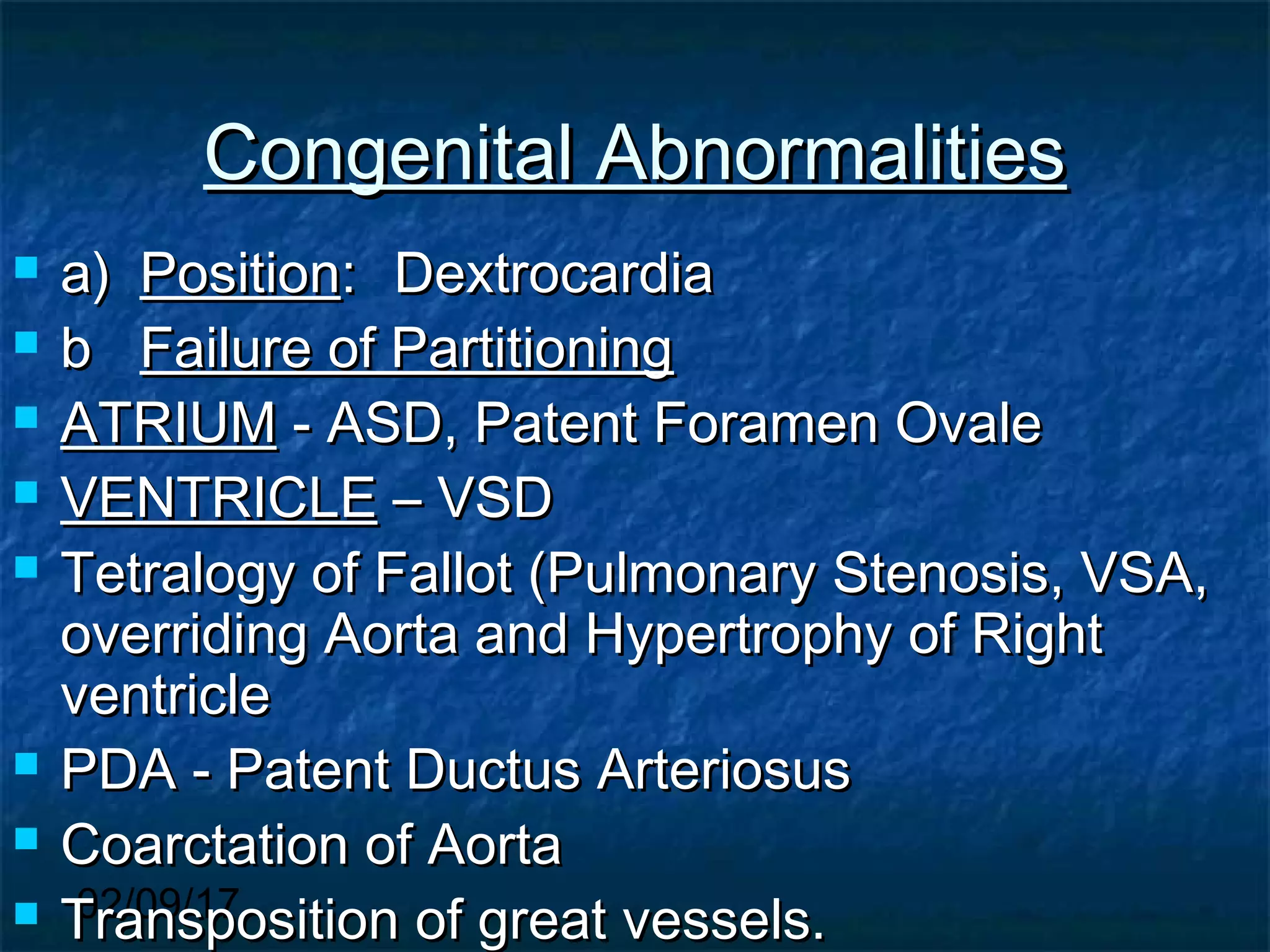
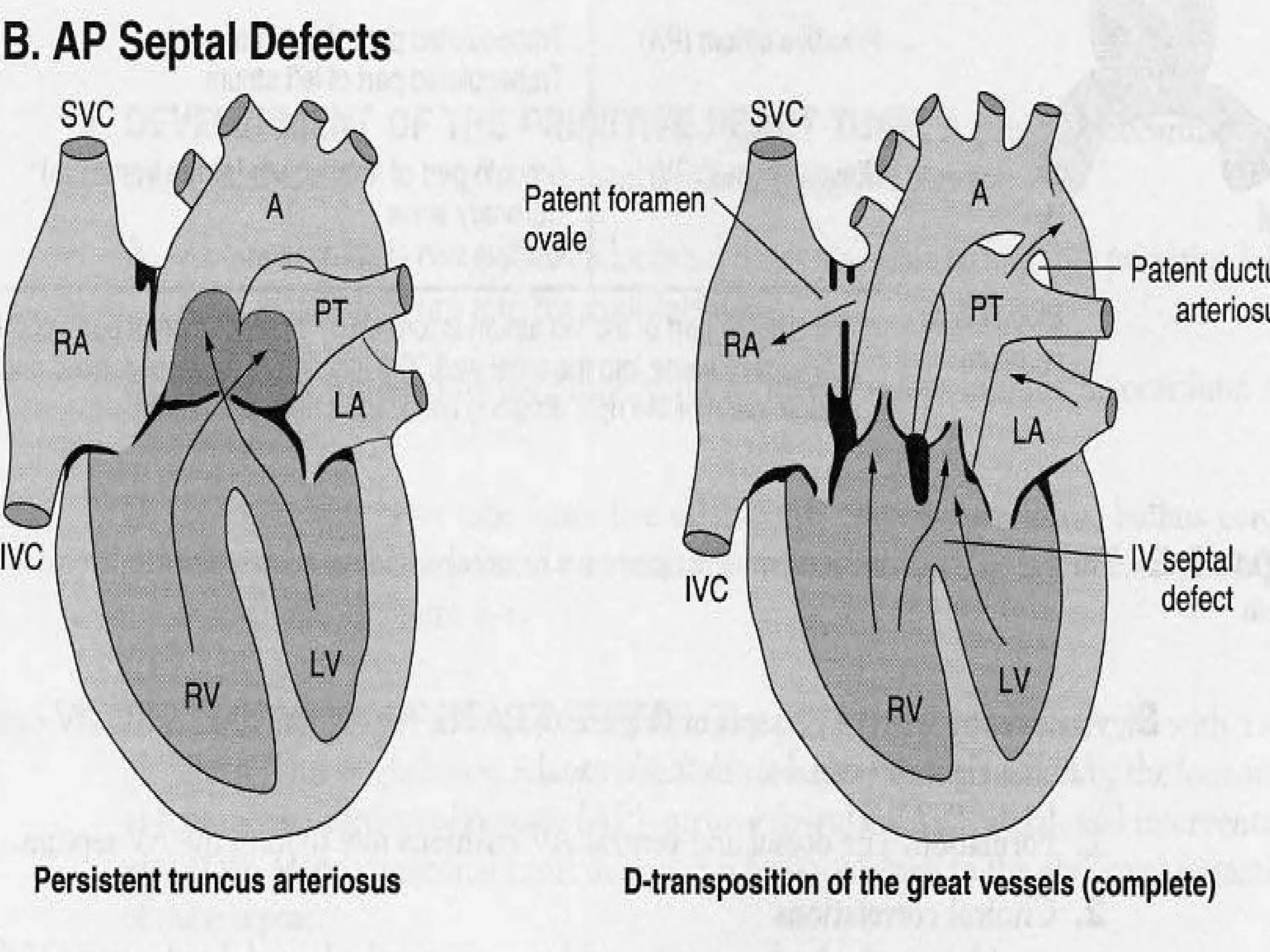
Congenital AbnormalitiesCongenital Abnormalities
 a)a) PositionPosition:: DextrocardiaDextrocardia
 bb Failure of PartitioningFailure of Partitioning
 ATRIUMATRIUM - ASD, Patent Foramen Ovale- ASD, Patent Foramen Ovale
 VENTRICLEVENTRICLE – VSD– VSD
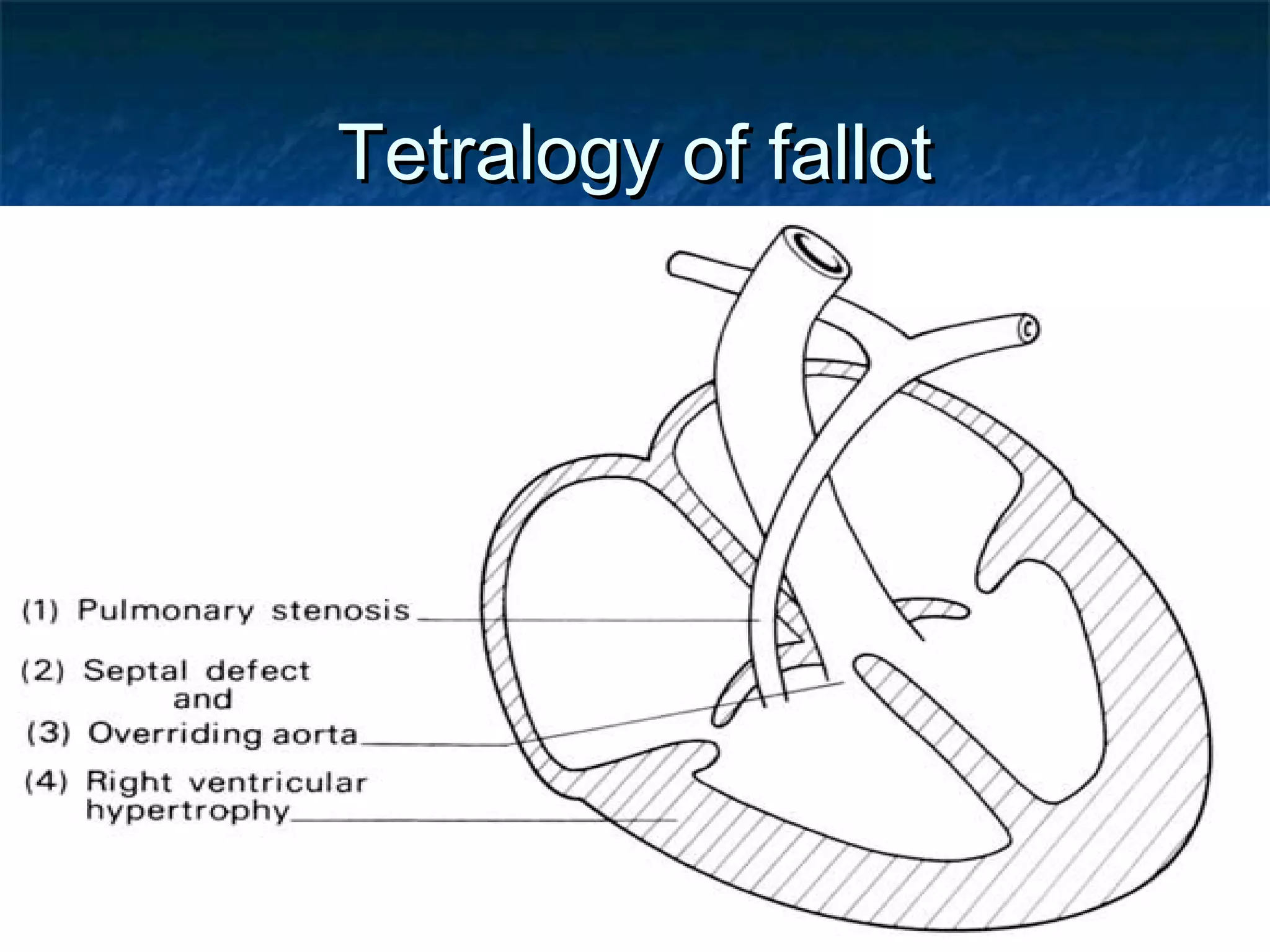
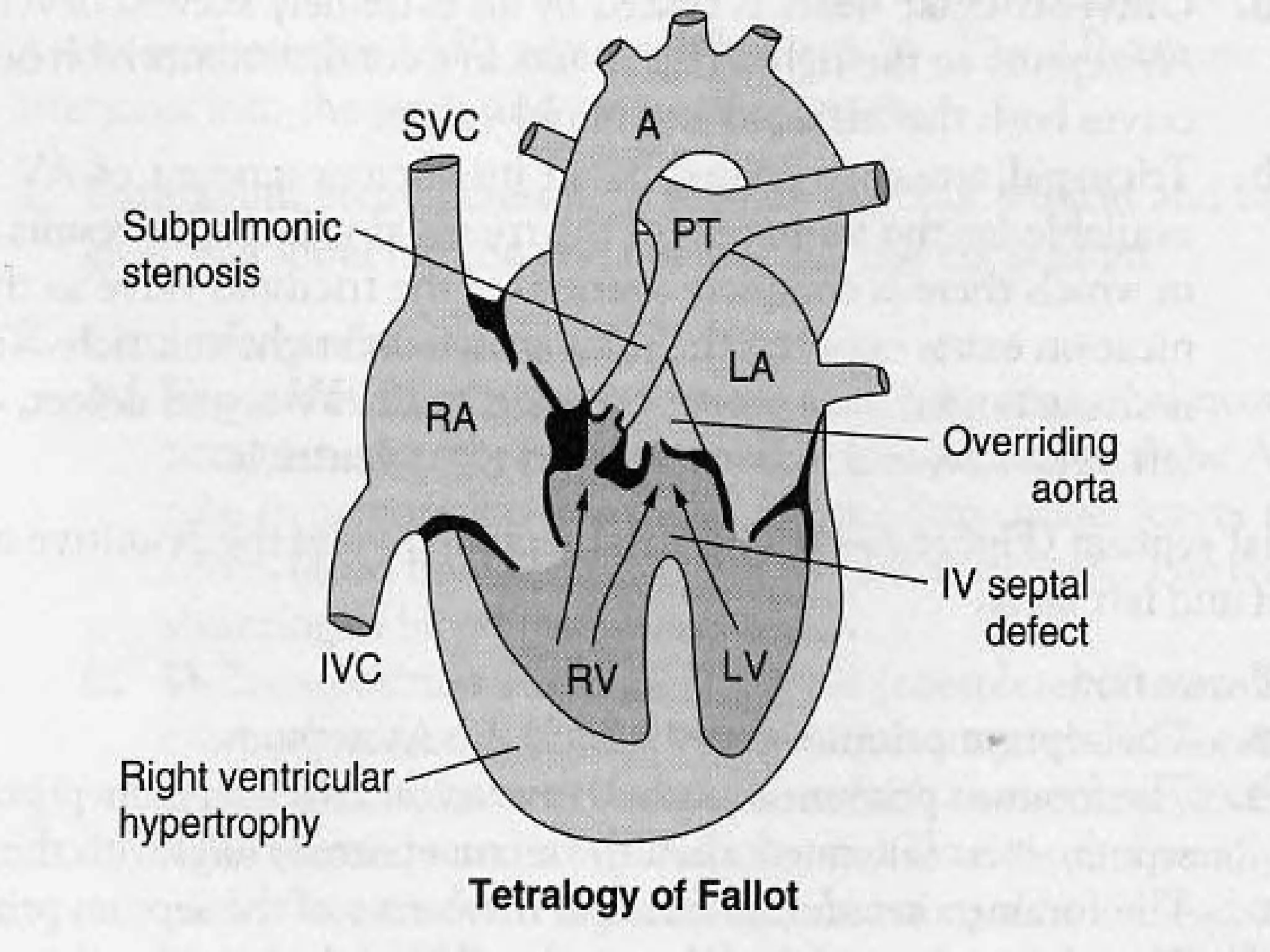
 Tetralogy of Fallot (Pulmonary Stenosis, VSA,Tetralogy of Fallot (Pulmonary Stenosis, VSA,
overriding Aorta and Hypertrophy of Rightoverriding Aorta and Hypertrophy of Right
ventricleventricle
 PDA - Patent Ductus ArteriosusPDA - Patent Ductus Arteriosus
 Coarctation of AortaCoarctation of Aorta
 Transposition of great vessels.Transposition of great vessels.
02/09/17
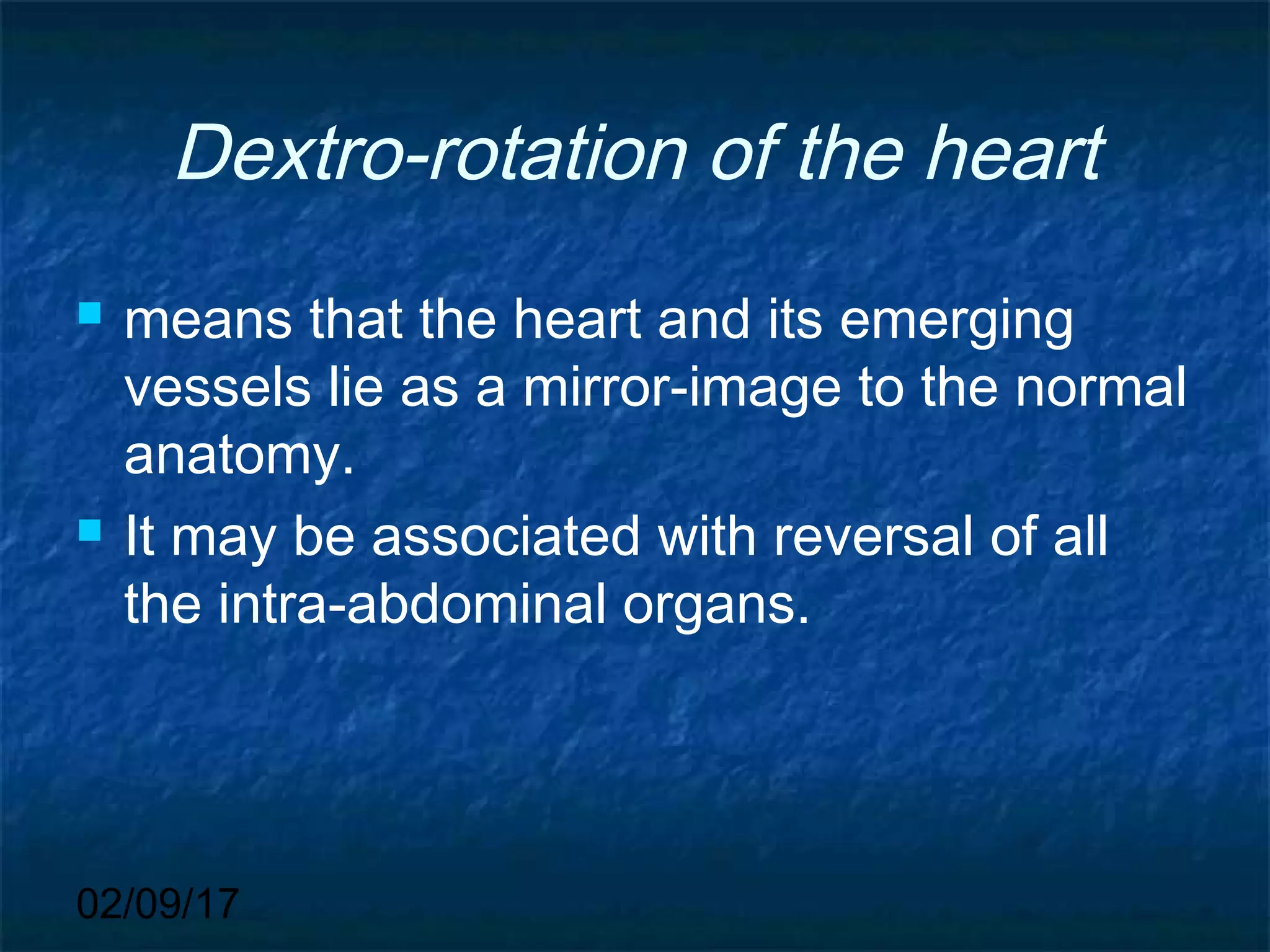
Dextro-rotation of the heart
 means that the heart and its emerging
vessels lie as a mirror-image to the normal
anatomy.
 It may be associated with reversal of all
the intra-abdominal organs.
02/09/17
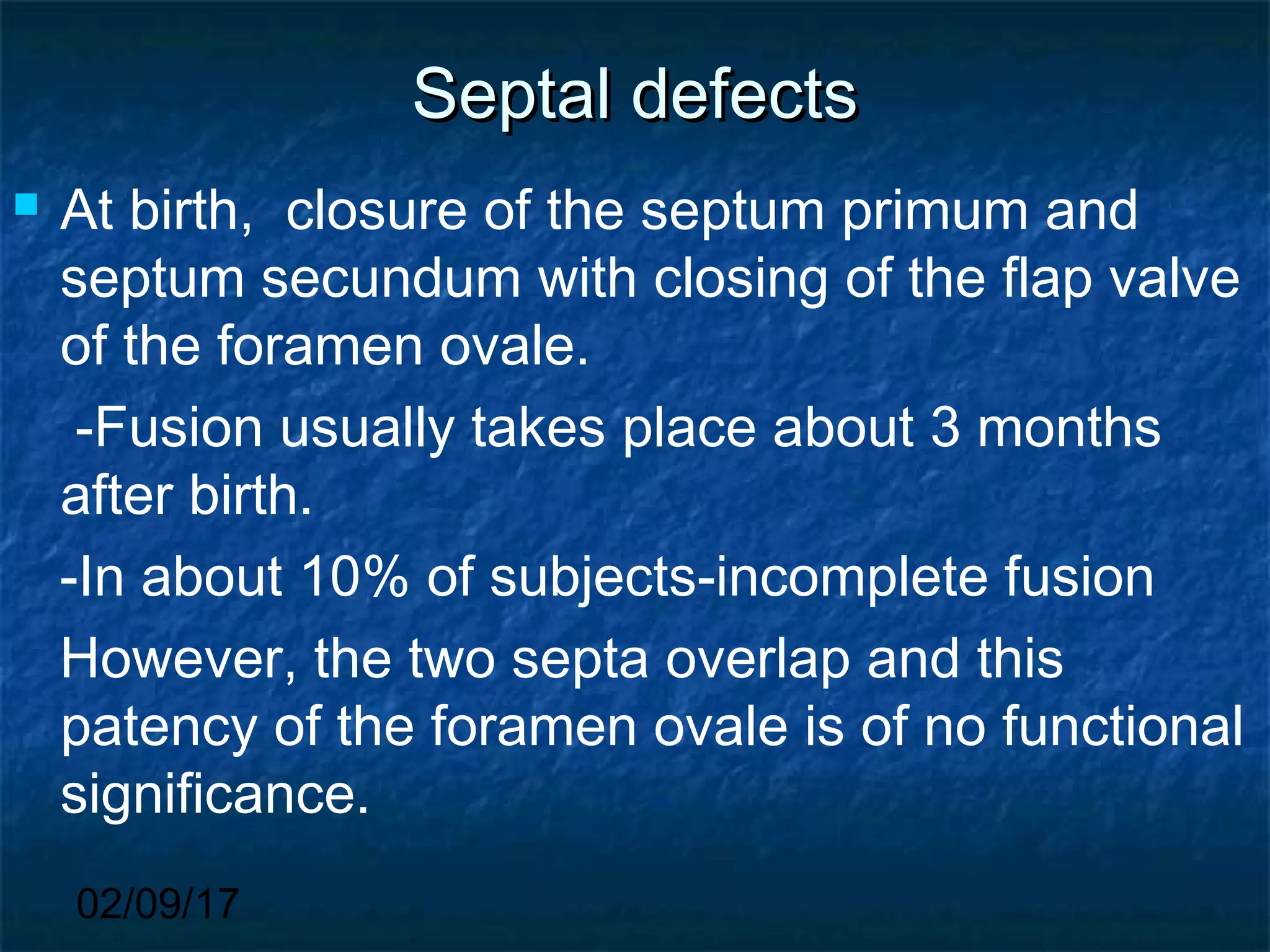
Septal defectsSeptal defects
 At birth, closure of the septum primum and
septum secundum with closing of the flap valve
of the foramen ovale.
-Fusion usually takes place about 3 months
after birth.
-In about 10% of subjects-incomplete fusion
However, the two septa overlap and this
patency of the foramen ovale is of no functional
significance.
02/09/17
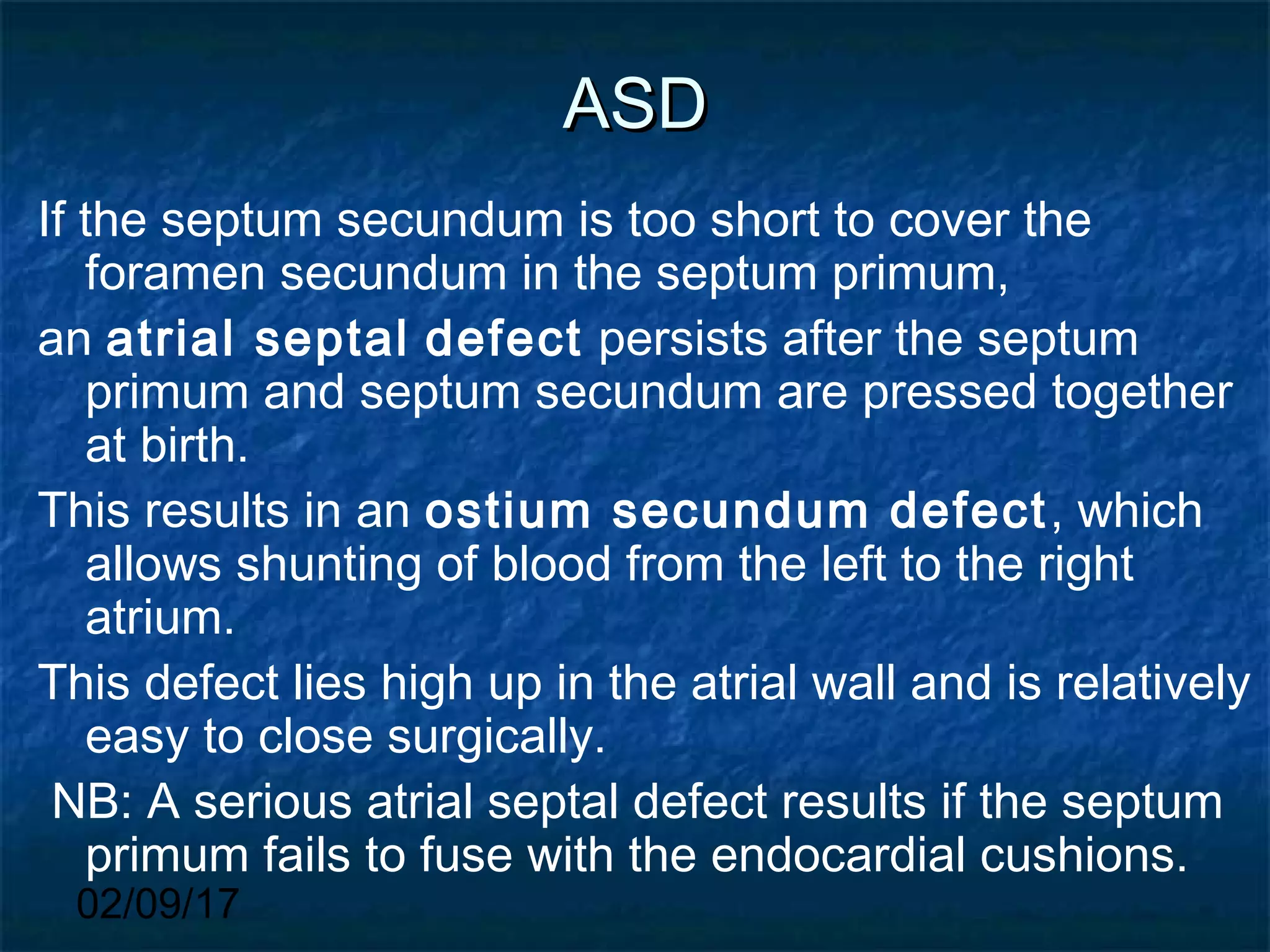
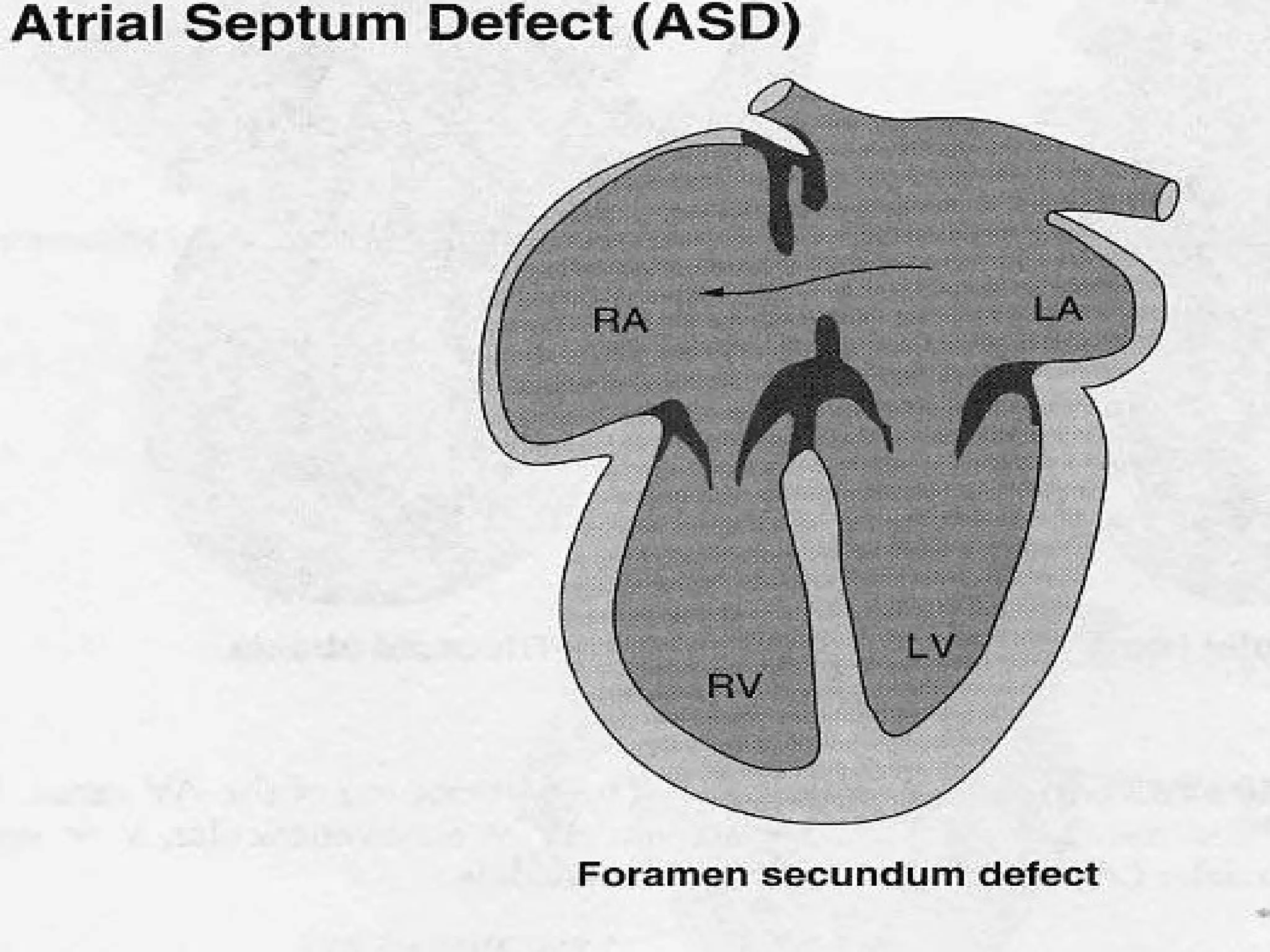
ASDASD
If the septum secundum is too short to cover the
foramen secundum in the septum primum,
an atrial septal defect persists after the septum
primum and septum secundum are pressed together
at birth.
This results in an ostium secundum defect, which
allows shunting of blood from the left to the right
atrium.
This defect lies high up in the atrial wall and is relatively
easy to close surgically.
NB: A serious atrial septal defect results if the septum
primum fails to fuse with the endocardial cushions.
02/09/17
02/09/17
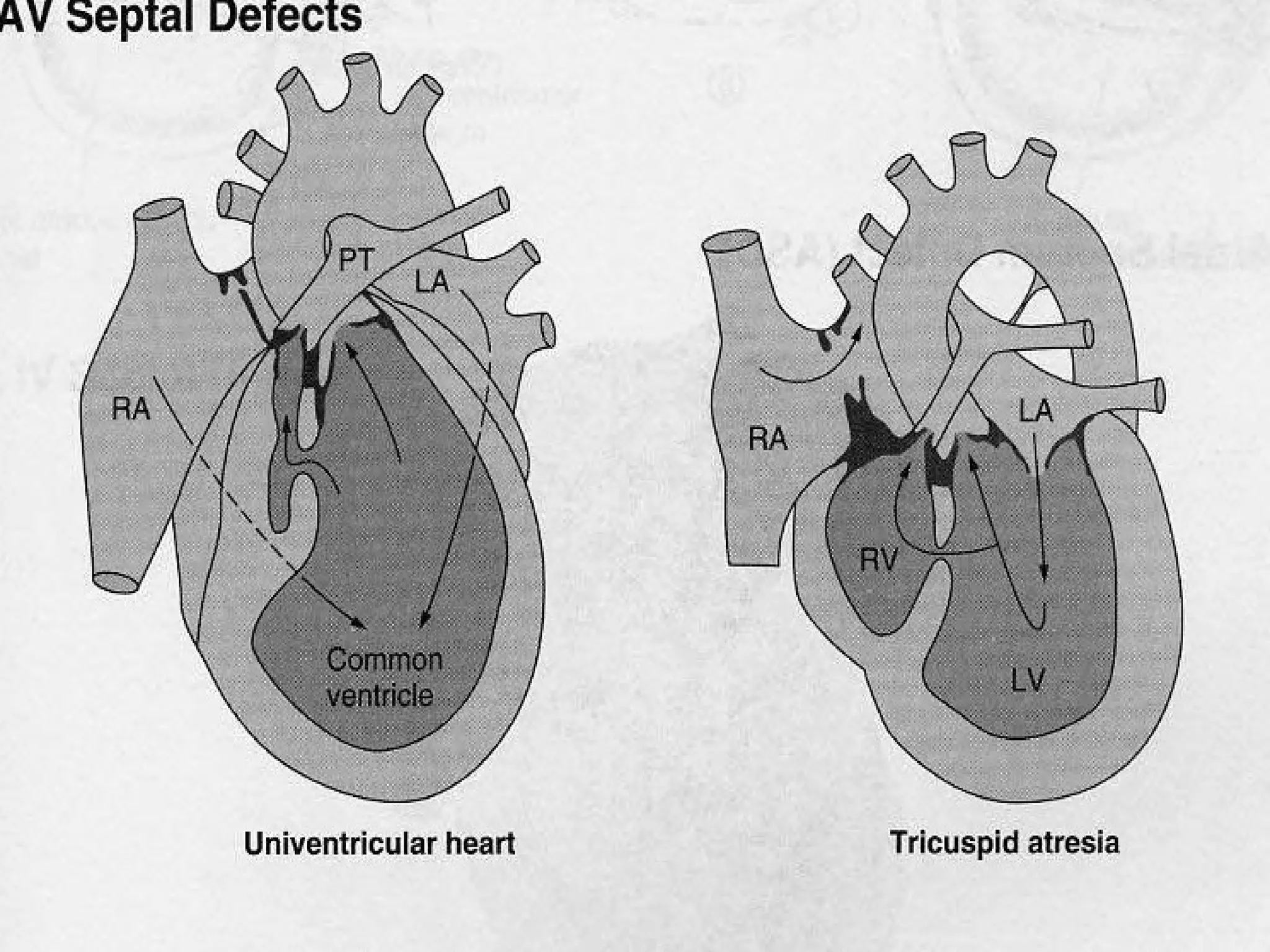
ostium primum defect
This lies immediately above the atrioventricular
boundary and may be associated with a defect
of the pars membranacea septi of the ventricular
septum.
In such a case, the child is born with both an atrial
and ventricular septal defect.
 At times, the ventricular septal defect is so large
that the ventricles form a single cavity, giving a
trilocular heart.
02/09/17
02/09/17
02/09/17
Congenital pulmonary stenosis
 may affect the trunk of the pulmonary artery, its valve
or the infundibulum of the right ventricle.
 If stenosis occurs in conjunction with a septal defect-
compensatory hypertrophy of the right ventricle
(developed to force blood through the pulmonary
obstruction),
 develops a sufficiently high pressure to shunt blood
through the defect into the left heart;
 mixing of the deoxygenated right heart blood
with the oxygenated left-sided blood results in the
child being cyanosed at birth.
02/09/17
Tetralogy of fallotTetralogy of fallot
02/09/17
02/09/17
Tetralogy of fallotTetralogy of fallot
 The commonest causes of cyanosis is Fallot’s
tetralogy. This results from unequal division of
 the truncus arteriosus by the spinal septum, resulting
in a stenosed pulmonary trunk
 a wide aorta which overrides the orifices of both the
ventricles-overriding aorta.
 The displaced septum is unable to close the
interventricular septum, which results in a ventricular
septal defect. Right ventricular hypertrophy
 Cyanosis results from the shunting of large amounts of
deoxygenated blood from the right ventricle through
the ventricular septal defect into the left ventricle and
also directly into the aorta.
02/09/17
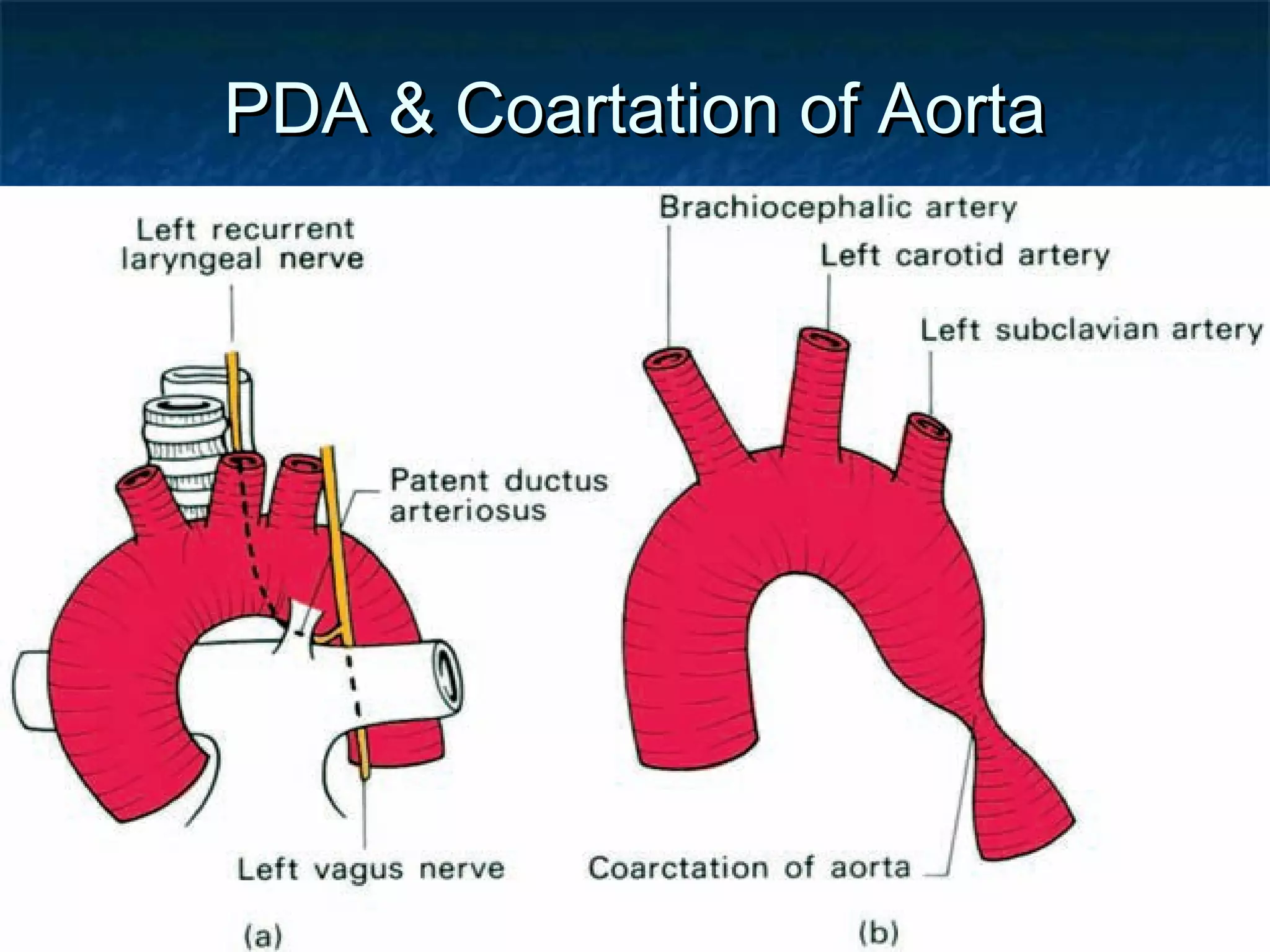
PDA & Coartation of AortaPDA & Coartation of Aorta
02/09/17
 A persistent ductus arteriosus is a relatively
common congenital defect and If uncorrected,
leads to progressive work hypertrophy of the
left heart and pulmonary hypertension.
 Aortic coarctation is assumed to be due to an
abnormality of the obliterative process, which
normally occludes the ductus arteriosus.
 may be due to an extensive obstruction of the
aorta from the left subclavian artery to the
ductus, which is widely patent and maintains
the circulation to the lower parts of the body;
NB: there are often multiple other defects
present and such infants affected die at an
early age.
02/09/17

EMBRYOLOGY OF CVS

  • 1.
    02/09/1702/09/17 Development of theDevelopmentof the Cardiovascular SystemCardiovascular System Shittu LAJShittu LAJ
  • 2.
    02/09/17 OBJECTIVEOBJECTIVE  1.1. Ableto describe the events leadingAble to describe the events leading to the formation of the primitive heartto the formation of the primitive heart tube.tube.  2.2. Able to describe the terms looping,Able to describe the terms looping, folding and partitioning of the heart, andfolding and partitioning of the heart, and the great vessels.the great vessels.  3. Able to define, aortic arches,3. Able to define, aortic arches, derivatives and anomalies.derivatives and anomalies.
  • 3.
    02/09/17 OBJECTIVEOBJECTIVE  4.4. Ableto eescribe the fetal circulation andAble to eescribe the fetal circulation and circulation changes at birth.circulation changes at birth.  5.5. Able to outline the embryological basis for theAble to outline the embryological basis for the congenital abnormalities of the heart.congenital abnormalities of the heart.
  • 4.
    02/09/17 Development of thePrimitiveDevelopment of the Primitive HeartHeart  TheThe CardiovascularCardiovascular system is the firstsystem is the first system tosystem to function in thefunction in the embryo.embryo.
  • 5.
    02/09/17 Development of thePrimitiveDevelopment of the Primitive HeartHeart  Occurs around middle of the 3rdOccurs around middle of the 3rd week.week.  In the cardiogenic areaIn the cardiogenic area  Splanchnic mesoderm -Splanchnic mesoderm - splanchnic mesenchymal cellssplanchnic mesenchymal cells
  • 6.
    02/09/17  -- Twoangioblastic cordsTwo angioblastic cords  - canalized to form 2 endothelial heart- canalized to form 2 endothelial heart tubes.tubes. -- The Fusion of tubes in midline - AThe Fusion of tubes in midline - A single heart tubesingle heart tube  -- Splanchnic mesenchymeSplanchnic mesenchyme -- Endothelial lining (endocardium)Endothelial lining (endocardium)  - Myocardium- Myocardium
  • 7.
  • 8.
    02/09/17 Development of HeartDevelopmentof Heart  TwoTwo endocardial heart tubesendocardial heart tubes arise fromarise from cardiogenic mesodermcardiogenic mesoderm ..  As lateral folding occurs, these fuse to form theAs lateral folding occurs, these fuse to form the primitive heart tubeprimitive heart tube , which develops into the, which develops into the endocardiumendocardium..  TheThe myocardiummyocardium andand epicardiumepicardium develop fromdevelop from mesodermmesoderm surrounding the primitive heart tube.surrounding the primitive heart tube.  Several contractions and dilations soon appear inSeveral contractions and dilations soon appear in the heart tube, all of which have adult remnants.the heart tube, all of which have adult remnants.
  • 9.
    02/09/17 Heart developmentHeart development The primitive heart is a single tube with grooves demarcating,  the sinus venosus, atrium, ventricle and bulbus cordis from behind forwards.  As this tube enlarges it kinks so that its caudal end, receiving venous blood,  comes to lie behind its cephalic end with its emerging arteries
  • 10.
  • 11.
    02/09/17 Heart Looping, andFoldingHeart Looping, and Folding  -As head folds, the heart elongates-As head folds, the heart elongates  -develops five constrictions and dilatations-develops five constrictions and dilatations  a) sinus venosus - caudal, receives alla) sinus venosus - caudal, receives all venous bloodvenous blood  b) primitive atriumb) primitive atrium  c) primitive ventriclec) primitive ventricle  d) bulbus cordisd) bulbus cordis  e) truncus arteriosus - forms the aortic sace) truncus arteriosus - forms the aortic sac
  • 12.
    02/09/17  The sinusvenosus later absorbs into the atrium,  the bulbus becomes incorporated into the ventricle so that, in the fully developed heart, the atria and great veins come to lie posterior to the ventricles and the roots of the great arteries.  The boundary tissue between the primitive single atrial cavity and single ventricle grows out as a dorsal and a ventral endocardial cushion  which meet in the midline, thus dividing the common atrio-ventricular orifice into a right (tricuspid) and left (mitral) orifice.
  • 13.
  • 14.
    02/09/17 Formation of septumFormationof septum A and B. Septum formation by two actively growing ridges that approach each other until they fuse. C. Septum formed by a single actively growing cell mass. D, E, and F. Septum formation by merging of two expanding portions of the wall of the heart. Such a septum never completely separates two cavities
  • 15.
    02/09/17 FIXATIONFIXATION  Sinus venousis partlySinus venous is partly embedded in septumembedded in septum transversum.transversum.  Truncus Arteriosus isTruncus Arteriosus is connected to aorticconnected to aortic arches which enterarches which enter the branchial arches.the branchial arches.
  • 16.
    02/09/17 RAPID GROWTHRAPID GROWTH Bulbus cordisBulbus cordis and ventricleand ventricle  Heart bendsHeart bends upon itselfupon itself  U-shaped bulboU-shaped bulbo ventricular loopventricular loop
  • 17.
  • 18.
    02/09/17 Partitioning of theHeartPartitioning of the Heart  During the 4th and 5thDuring the 4th and 5th weeks the primitive heart isweeks the primitive heart is divided into the typical 4-divided into the typical 4- chambered human organ.chambered human organ.
  • 19.
    02/09/17 Atrial septa atvarious stages of development. A. 30 days (6 mm). B. Same stage as A, viewed from the right. C. 33 days (9 mm). D. Same stage as C, viewed from the right E. 37 days (14 mm). F. Newborn. G. The atrial septum from the right; same stage as F.
  • 20.
    02/09/17 Partitioning of thePartitioningof the Atrioventricular CanalAtrioventricular Canal  Dorsal and Ventral EndocardialDorsal and Ventral Endocardial cushions,cushions,  Divides AV canal into Right and Left AVDivides AV canal into Right and Left AV CanalsCanals
  • 21.
  • 22.
    02/09/17 Development of heartchamberDevelopment of heart chamber
  • 23.
  • 24.
    02/09/17  B.B. Partitioningof the Primitive AtriumPartitioning of the Primitive Atrium  - Septrum primum (Crescent shaped, or- Septrum primum (Crescent shaped, or sickle shaped)sickle shaped)  - Grows from the Dorsocranial wall- Grows from the Dorsocranial wall  - Foramen primum (Ostium Primum)- Foramen primum (Ostium Primum)  - Septum secundum (grows from the ventro- Septum secundum (grows from the ventro cranial wall)cranial wall)  - Foramen ovale- Foramen ovale
  • 25.
    02/09/17 Development of heartchamberDevelopment of heart chamber
  • 26.
    02/09/17  A partition,the septum primum, grows downwards from the posterior  and superior walls of the primitive common atrium to fuse with the endocardial cushions.  Before fusion is complete, a hole appears in the upper part of this septum primum, which is termed the foramen secundum in the septum primum.  A second membrane, the septum secundum,  then develops to the right of the septum primum but this is never complete;  it has a free lower edge which does extend low enough for this new septum to overlap the foramen secundum in the septum primum and hence to close it.  The two overlapping defects in the septa form the valve-like, which shunts blood from the right to left heart in the fetus.  After birth, this foramen usually becomes completely fused leaving only the fossa ovalis on the septal wall of the right atrium as its memorial.  In about 10% of adult subjects, a probe can still be passed through an anatomically patent, although functionally sealed foramen.
  • 27.
  • 28.
    02/09/17 AV canal 5thwkAV canal 5th wk
  • 29.
    02/09/17 Changes in SinusVenosusChanges in Sinus Venosus  Right and left horn (Right and left horn (increases andincreases and decreases in growth respectively)decreases in growth respectively)  Right becomes incorporated into (RightRight becomes incorporated into (Right Atrium)Atrium)  Left becomes Coronary SinusLeft becomes Coronary Sinus
  • 30.
    02/09/17 sinus venosus  Theprimitive sinus venosus absorbs into the right atrium so that the venae cavae draining into the sinus come to open separately into this  atrium.  The smooth-walled part of the adult atrium represents the contribution  of the sinus venosus,  the pectinate part represents the portion derived from the primitive atrium.  NB: the adult left atrium has a double origin:  originally, single pulmonary venous trunk entering the left atrium -donates the smooth-walled part of this chamber with the pulmonary veins entering as four separate openings;  the trabeculated part of the definitive left atrium is the remains of the original atrial wall.
  • 31.
    02/09/17 development of thesinus venosus at approximately 24 days (A) and 35 days  ACV, anterior  cardinal vein; PCV, posterior cardinal vein; UV, umbilical vein; VIT V, vitelline vein; CCV,  common cardinal vein
  • 32.
  • 33.
    02/09/17 Partitioning of theVentriclePartitioning of the Ventricle  Muscular ridge -Muscular ridge - septumseptum  InterventricularInterventricular septumseptum  InterventricularInterventricular foramenforamen  Membranous septumMembranous septum
  • 34.
  • 35.
    02/09/17 Partition of ventriclePartitionof ventricle  Division of the ventricle is commenced by the up growth of a fleshy septum from the apex of the heart towards the endocardial cushions.  This stops short of dividing the ventricle completely and thus it has an upper free border, forming a temporary interventricular foramen.  At the same time, the single truncus arteriosus is divided into aorta and pulmonary trunk by a spiral septum (hence the spiral relations of these two vessels),  which grows downwards to the ventricle and fuses accurately with the upper free border of the ventricular septum.  This contributes the small pars membranacea septi, which completes the separation of the ventricle in such a way that blood on the left of the septum flows into the aorta and on the right into the pulmonary trunk.
  • 36.
  • 37.
    02/09/17 Partitioning of theBulbus CordisPartitioning of the Bulbus Cordis and Truncus Arteriosusand Truncus Arteriosus  Development and fusion ofDevelopment and fusion of truncal and bulbar ridgestruncal and bulbar ridges  Aorticopulmonary SeptumAorticopulmonary Septum
  • 38.
    02/09/17 Formation of aorticopulmonaryFormationof aorticopulmonary septumseptum
  • 39.
    02/09/17  Development ofthe Valves andDevelopment of the Valves and Cardiac Conducting SystemCardiac Conducting System  Endocardial cushionsEndocardial cushions  AV (Mitral, Tricuspid), Semilunar (Aorta,AV (Mitral, Tricuspid), Semilunar (Aorta, Pulmonary A)Pulmonary A)  Formation of Aortic Arches andFormation of Aortic Arches and DerivativesDerivatives  Aortic sac gives rise to aortic archesAortic sac gives rise to aortic arches
  • 40.
  • 41.
    02/09/17 Primitive Heart Tube Embryonic Dilatation AdultStructure Sinus venosus Smooth part of right atrium (sinus venarum), coronary sinus, oblique vein of left atrium Primitive atrium Trabeculated parts of right and left atria Primitive ventricle Trabeculated parts of right and left ventricles Bulbis cordis Smooth part of right ventricle (conus arteriosus), smooth part of left ventricle (aortic vestibule) Truncus arteriosus Aorta, pulmonary trunk
  • 42.
  • 43.
    02/09/17 Formation of AorticArchesFormation of Aortic Arches and Derivativesand Derivatives  Aortic sac gives rise to aortic archesAortic sac gives rise to aortic arches  Six aortic arches corresponding to the 6Six aortic arches corresponding to the 6 pharyngeal arches.pharyngeal arches.  However, one of the aortic archesHowever, one of the aortic arches degenerate, i.e, the 5degenerate, i.e, the 5thth arch.arch.
  • 44.
  • 45.
    02/09/17  ArchesArches  II- Disappear remaining form Maxillary- Disappear remaining form Maxillary ArteriesArteries  IIII - Dorsal persist as stem of stapedial- Dorsal persist as stem of stapedial arteriesarteries  IIIIII - Common Carotid Arteries, Int. cart art- Common Carotid Arteries, Int. cart art (proximal part)(proximal part)  IVIV - (Left): Arch of Aorta= L -subclavian- (Left): Arch of Aorta= L -subclavian  - (Right): Subclavian Artery and- (Right): Subclavian Artery and brachiocephalic  VV - Degenerate or never developed- Degenerate or never developed  VIVI - Pulmonary Artery (Left and Right only);- Pulmonary Artery (Left and Right only); L-Ductus Arteriosusl aorta) (connection withL-Ductus Arteriosusl aorta) (connection with dorsal aorta)dorsal aorta)
  • 46.
    02/09/17 Orientation of vagusnerveOrientation of vagus nerve  This asymmetrical development of the aortic arches, elongation of the neck and caudal migration of the heart- accounts for the different course taken by the recurrent laryngeal nerve on each side.  early fetal life- the vagus nerve lies lateral to the primitive pharynx, and separated from it by the aortic arches.  the recurrent laryngeal nerves pass medially, caudal to the aortic arches to supply the developing larynx.  On the right side- the 5th and distal part of the 6th arch are absorbed, leaving the nerve to hook round the 4th arch (i.e. the right subclavian artery).  On the left side- the nerve remains looped around the persisting distal part the 6th arch (the ligamentum arteriosum- which is overlapped and dwarfed by the arch of the aorta).
  • 47.
  • 48.
    02/09/17 Formation of VenousSystem toFormation of Venous System to the Heartthe Heart  a)a) Vitelline veins - MesentericVitelline veins - Mesenteric  b)b) Umbilical veins -Umbilical veins -  c)c) Cardinal veins - Vena CavaCardinal veins - Vena Cava
  • 49.
    02/09/17 The 3 embryoniccirculationThe 3 embryonic circulation
  • 50.
  • 51.
    02/09/17 Changes in Circulationat BirthChanges in Circulation at Birth  a)a) Lungs expandLungs expand  b)b) Ductus Arteriosus and foramen ovaleDuctus Arteriosus and foramen ovale closeclose  c)c) Ductus arteriosus - LigamentumDuctus arteriosus - Ligamentum arteriosumarteriosum  Umbilical vein - ligamentum teresUmbilical vein - ligamentum teres  Ductus venosum - ligamentum venosumDuctus venosum - ligamentum venosum  Umbilical Artery - medial umbilical ligamentUmbilical Artery - medial umbilical ligament
  • 52.
    02/09/17 Congenital AbnormalitiesCongenital Abnormalities a)a) PositionPosition:: DextrocardiaDextrocardia  bb Failure of PartitioningFailure of Partitioning  ATRIUMATRIUM - ASD, Patent Foramen Ovale- ASD, Patent Foramen Ovale  VENTRICLEVENTRICLE – VSD– VSD  Tetralogy of Fallot (Pulmonary Stenosis, VSA,Tetralogy of Fallot (Pulmonary Stenosis, VSA, overriding Aorta and Hypertrophy of Rightoverriding Aorta and Hypertrophy of Right ventricleventricle  PDA - Patent Ductus ArteriosusPDA - Patent Ductus Arteriosus  Coarctation of AortaCoarctation of Aorta  Transposition of great vessels.Transposition of great vessels.
  • 53.
    02/09/17 Dextro-rotation of theheart  means that the heart and its emerging vessels lie as a mirror-image to the normal anatomy.  It may be associated with reversal of all the intra-abdominal organs.
  • 54.
    02/09/17 Septal defectsSeptal defects At birth, closure of the septum primum and septum secundum with closing of the flap valve of the foramen ovale. -Fusion usually takes place about 3 months after birth. -In about 10% of subjects-incomplete fusion However, the two septa overlap and this patency of the foramen ovale is of no functional significance.
  • 55.
    02/09/17 ASDASD If the septumsecundum is too short to cover the foramen secundum in the septum primum, an atrial septal defect persists after the septum primum and septum secundum are pressed together at birth. This results in an ostium secundum defect, which allows shunting of blood from the left to the right atrium. This defect lies high up in the atrial wall and is relatively easy to close surgically. NB: A serious atrial septal defect results if the septum primum fails to fuse with the endocardial cushions.
  • 56.
  • 57.
    02/09/17 ostium primum defect Thislies immediately above the atrioventricular boundary and may be associated with a defect of the pars membranacea septi of the ventricular septum. In such a case, the child is born with both an atrial and ventricular septal defect.  At times, the ventricular septal defect is so large that the ventricles form a single cavity, giving a trilocular heart.
  • 58.
  • 59.
  • 60.
    02/09/17 Congenital pulmonary stenosis may affect the trunk of the pulmonary artery, its valve or the infundibulum of the right ventricle.  If stenosis occurs in conjunction with a septal defect- compensatory hypertrophy of the right ventricle (developed to force blood through the pulmonary obstruction),  develops a sufficiently high pressure to shunt blood through the defect into the left heart;  mixing of the deoxygenated right heart blood with the oxygenated left-sided blood results in the child being cyanosed at birth.
  • 61.
  • 62.
  • 63.
    02/09/17 Tetralogy of fallotTetralogyof fallot  The commonest causes of cyanosis is Fallot’s tetralogy. This results from unequal division of  the truncus arteriosus by the spinal septum, resulting in a stenosed pulmonary trunk  a wide aorta which overrides the orifices of both the ventricles-overriding aorta.  The displaced septum is unable to close the interventricular septum, which results in a ventricular septal defect. Right ventricular hypertrophy  Cyanosis results from the shunting of large amounts of deoxygenated blood from the right ventricle through the ventricular septal defect into the left ventricle and also directly into the aorta.
  • 64.
    02/09/17 PDA & Coartationof AortaPDA & Coartation of Aorta
  • 65.
    02/09/17  A persistentductus arteriosus is a relatively common congenital defect and If uncorrected, leads to progressive work hypertrophy of the left heart and pulmonary hypertension.  Aortic coarctation is assumed to be due to an abnormality of the obliterative process, which normally occludes the ductus arteriosus.  may be due to an extensive obstruction of the aorta from the left subclavian artery to the ductus, which is widely patent and maintains the circulation to the lower parts of the body; NB: there are often multiple other defects present and such infants affected die at an early age.
  • 66.