THE CARDIACTHE CARDIAC CYCLECYCLE
KashikantKashikant YadavYadav
ykashikant@gmail.comykashikant@gmail.com
The cardiac events that occurThe cardiac events that occur
from beginning of one heart beatfrom beginning of one heart beat
to the beginning other heart beatto the beginning other heart beat
is known as cardiac cycle.is known as cardiac cycle.
In cardiac cycle,the heartIn cardiac cycle,the heart
contracts i,e.systole and thencontracts i,e.systole and then
relaxes i,e,diastole.relaxes i,e,diastole.
Stage of cardiac cycleStage of cardiac cycle
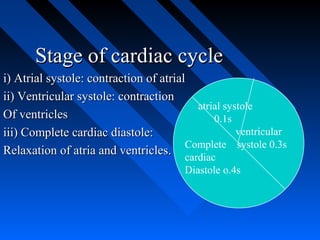
i) Atrial systole: contraction of atriali) Atrial systole: contraction of atrial
ii) Ventricular systole: contractionii) Ventricular systole: contraction
Of ventriclesOf ventricles
iii) Complete cardiac diastole:iii) Complete cardiac diastole:
Relaxation of atria and ventricles.Relaxation of atria and ventricles.
atrial systole
0.1s
ventricular
Complete systole 0.3s
cardiac
Diastole o.4s
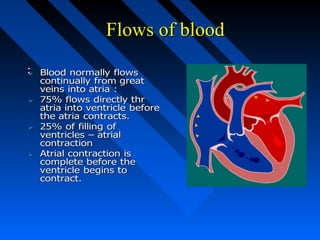
Flows of bloodFlows of blood
....
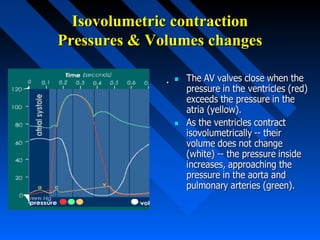
Isovolumetric contractionIsovolumetric contraction
Pressures & Volumes changesPressures & Volumes changes
..
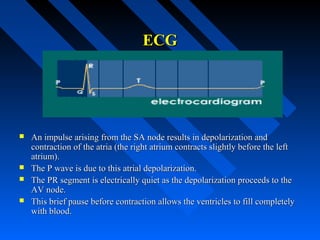
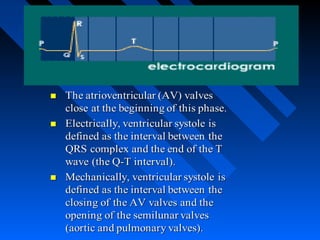
ECGECG
 An impulse arising from the SA node results in depolarization andAn impulse arising from the SA node results in depolarization and
contraction of the atria (the right atrium contracts slightly before the leftcontraction of the atria (the right atrium contracts slightly before the left
atrium).atrium).
 The P wave is due to this atrial depolarization.The P wave is due to this atrial depolarization.
 The PR segment is electrically quiet as the depolarization proceeds to theThe PR segment is electrically quiet as the depolarization proceeds to the
AV node.AV node.
 This brief pause before contraction allows the ventricles to fill completelyThis brief pause before contraction allows the ventricles to fill completely
with blood.with blood.
..
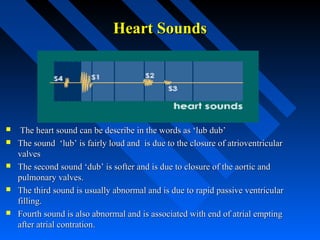
Heart SoundsHeart Sounds
 The heart sound can be describe in the words as ‘lub dub’The heart sound can be describe in the words as ‘lub dub’
 The sound ‘lub’ is fairly loud and is due to the closure of atrioventricularThe sound ‘lub’ is fairly loud and is due to the closure of atrioventricular
valvesvalves
 The second sound ‘dub’ is softer and is due to closure of the aortic andThe second sound ‘dub’ is softer and is due to closure of the aortic and
pulmonary valves.pulmonary valves.
 The third sound is usually abnormal and is due to rapid passive ventricularThe third sound is usually abnormal and is due to rapid passive ventricular
filling.filling.
 Fourth sound is also abnormal and is associated with end of atrial emptingFourth sound is also abnormal and is associated with end of atrial empting
after atrial contration.after atrial contration.
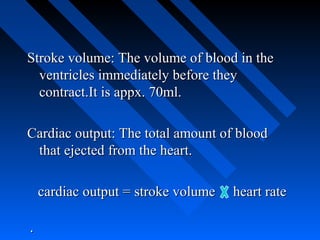
Stroke volume: The volume of blood in theStroke volume: The volume of blood in the
ventricles immediately before theyventricles immediately before they
contract.It is appx. 70ml.contract.It is appx. 70ml.
Cardiac output: The total amount of bloodCardiac output: The total amount of blood
that ejected from the heart.that ejected from the heart.
cardiac output = stroke volume heart ratecardiac output = stroke volume heart rate
..
THANK YOUTHANK YOU
Eyes are the windows of soul.Eyes are the windows of soul.

Cardiac cycle

  • 1.
    THE CARDIACTHE CARDIACCYCLECYCLE KashikantKashikant YadavYadav ykashikant@gmail.comykashikant@gmail.com
  • 2.
    The cardiac eventsthat occurThe cardiac events that occur from beginning of one heart beatfrom beginning of one heart beat to the beginning other heart beatto the beginning other heart beat is known as cardiac cycle.is known as cardiac cycle. In cardiac cycle,the heartIn cardiac cycle,the heart contracts i,e.systole and thencontracts i,e.systole and then relaxes i,e,diastole.relaxes i,e,diastole.
  • 3.
    Stage of cardiaccycleStage of cardiac cycle i) Atrial systole: contraction of atriali) Atrial systole: contraction of atrial ii) Ventricular systole: contractionii) Ventricular systole: contraction Of ventriclesOf ventricles iii) Complete cardiac diastole:iii) Complete cardiac diastole: Relaxation of atria and ventricles.Relaxation of atria and ventricles. atrial systole 0.1s ventricular Complete systole 0.3s cardiac Diastole o.4s
  • 4.
    Flows of bloodFlowsof blood ....
  • 5.
    Isovolumetric contractionIsovolumetric contraction Pressures& Volumes changesPressures & Volumes changes ..
  • 6.
    ECGECG  An impulsearising from the SA node results in depolarization andAn impulse arising from the SA node results in depolarization and contraction of the atria (the right atrium contracts slightly before the leftcontraction of the atria (the right atrium contracts slightly before the left atrium).atrium).  The P wave is due to this atrial depolarization.The P wave is due to this atrial depolarization.  The PR segment is electrically quiet as the depolarization proceeds to theThe PR segment is electrically quiet as the depolarization proceeds to the AV node.AV node.  This brief pause before contraction allows the ventricles to fill completelyThis brief pause before contraction allows the ventricles to fill completely with blood.with blood.
  • 7.
  • 8.
    Heart SoundsHeart Sounds The heart sound can be describe in the words as ‘lub dub’The heart sound can be describe in the words as ‘lub dub’  The sound ‘lub’ is fairly loud and is due to the closure of atrioventricularThe sound ‘lub’ is fairly loud and is due to the closure of atrioventricular valvesvalves  The second sound ‘dub’ is softer and is due to closure of the aortic andThe second sound ‘dub’ is softer and is due to closure of the aortic and pulmonary valves.pulmonary valves.  The third sound is usually abnormal and is due to rapid passive ventricularThe third sound is usually abnormal and is due to rapid passive ventricular filling.filling.  Fourth sound is also abnormal and is associated with end of atrial emptingFourth sound is also abnormal and is associated with end of atrial empting after atrial contration.after atrial contration.
  • 9.
    Stroke volume: Thevolume of blood in theStroke volume: The volume of blood in the ventricles immediately before theyventricles immediately before they contract.It is appx. 70ml.contract.It is appx. 70ml. Cardiac output: The total amount of bloodCardiac output: The total amount of blood that ejected from the heart.that ejected from the heart. cardiac output = stroke volume heart ratecardiac output = stroke volume heart rate ..
  • 10.
    THANK YOUTHANK YOU Eyesare the windows of soul.Eyes are the windows of soul.