1
PRESENTED BY: KASHIKANT YADAV
KARNATAKA COLLEGE OF PHARMACY
Email: ykashikant@gmail.com
Depression
Depression
 is a mental health disorder
persistently low mood
feeling of sadness
loss of interest
Causes of depression
 genetics
 biological - changes in neurotransmitter levels
 environmental
 psychological and social (psychosocial)
Symptoms of depression
Depressed mood
Loss of interest or pleasure
Significant weight or appetite alteration
Insomnia or hyposomnia
Psychomotor agitation or retardation
Fatigue or loss of energy
Feelings of worthlessness
Diminished ability to think or concentrate or
indecisiveness; and
Suicidal ideation.
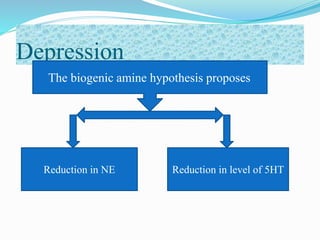
Depression
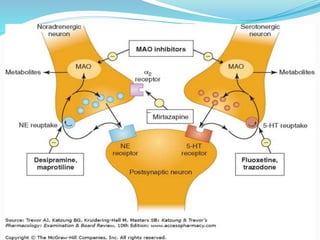
The biogenic amine hypothesis proposes
Reduction in NE Reduction in level of 5HT
Antidepressant drugs
 RIMAO-A: Moclobemide, clorgyline
 TCAs: Imipramine, Amitryptyline,
 SSRIs: Fluoxetine, Sertraline, Citalopram, Escitalopram
 SSNRIs: Duloxetine
 ATYPICAL ANTIDEPRESSANT: Buspropion,
Venalafexine, Trazodone
Screening Method’s Principles
 To see the relationship between the Clinical efficacy of known
antidepressants and their effects on various pharmacological
test models.
In vivo methods
 Water Wheel Model
 Learned Helplessness Test
 Tail Suspension Test
 Reserpine Induced Hypothermia
 Amphetamine Potentiation
 Resident Intruder Paradigm
 Muricidal Behavior in Rats
In vitro assays
 Assays based on inhibition of amine uptake
 Assays based on binding to the receptors
Though complicated but these are precise and accurate
Water Wheel Model
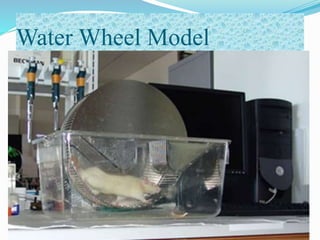
 demonstrates the antidepressant property of the test drug by use
of the `Behavioral Despair Activity`
 The animal is forced to swim without any escape in a water
tank.
 The rotating wheel poses as an option for escape but add-on to
the despair as it turns under the weight of the animal and it has
to keep rotating it in order to stay a float.
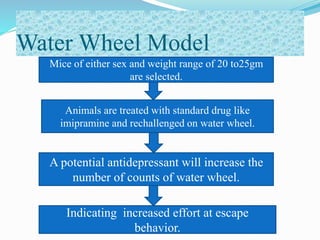
Water Wheel Model
Water Wheel Model
Mice of either sex and weight range of 20 to25gm
are selected.
Animals are treated with standard drug like
imipramine and rechallenged on water wheel.
A potential antidepressant will increase the
number of counts of water wheel.
Indicating increased effort at escape
behavior.
Water Wheel Model
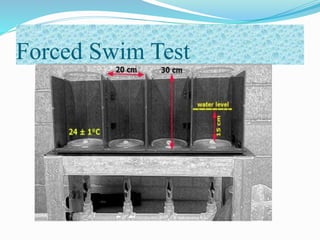
Forced Swim Test
Forced Swim Test
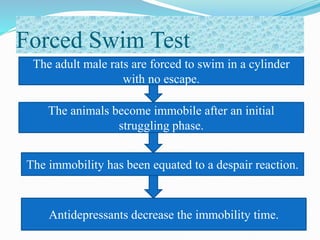
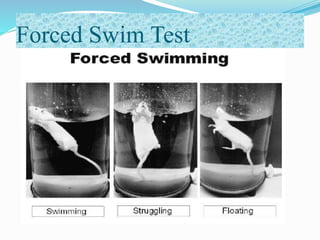
The adult male rats are forced to swim in a cylinder
with no escape.
The animals become immobile after an initial
struggling phase.
The immobility has been equated to a despair reaction.
Antidepressants decrease the immobility time.
Forced Swim Test
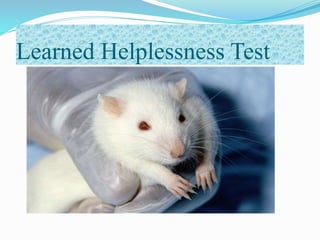
Learned Helplessness Test
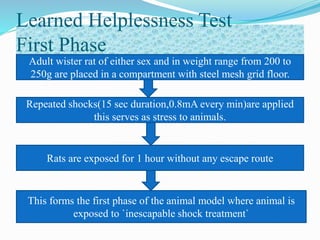
First Phase
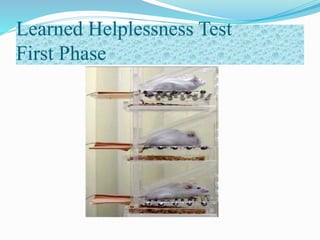
Adult wister rat of either sex and in weight range from 200 to
250g are placed in a compartment with steel mesh grid floor.
This forms the first phase of the animal model where animal is
exposed to `inescapable shock treatment`
Repeated shocks(15 sec duration,0.8mA every min)are applied
this serves as stress to animals.
Rats are exposed for 1 hour without any escape route
Learned Helplessness Test
First Phase
Learned Helplessness Test
Second Phase
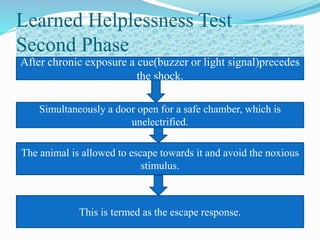
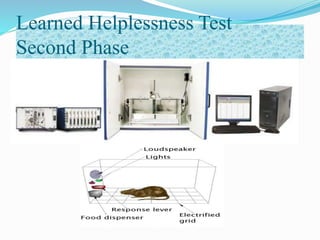
After chronic exposure a cue(buzzer or light signal)precedes
the shock.
This is termed as the escape response.
Simultaneously a door open for a safe chamber, which is
unelectrified.
The animal is allowed to escape towards it and avoid the noxious
stimulus.
Learned Helplessness Test
Second Phase
Learned Helplessness Test
 Failure to exhibit escape response by an animal is said to
be an indicative of its depressive state.
 Antidepressants reduce escape failure.
Tail suspension test
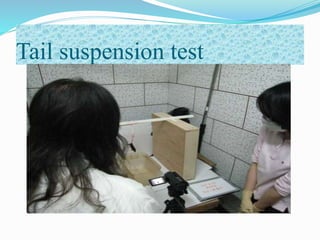
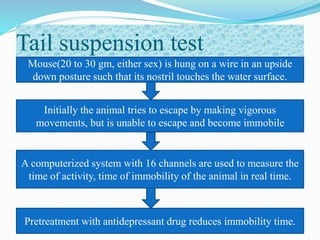
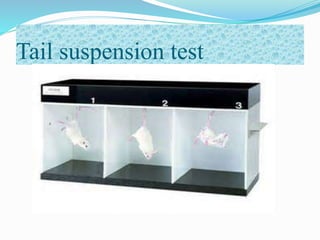
Mouse(20 to 30 gm, either sex) is hung on a wire in an upside
down posture such that its nostril touches the water surface.
Initially the animal tries to escape by making vigorous
movements, but is unable to escape and become immobile
Pretreatment with antidepressant drug reduces immobility time.
A computerized system with 16 channels are used to measure the
time of activity, time of immobility of the animal in real time.
Tail suspension test
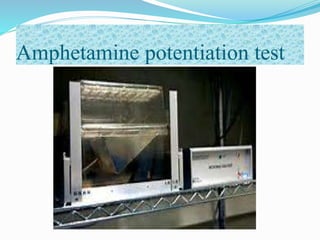
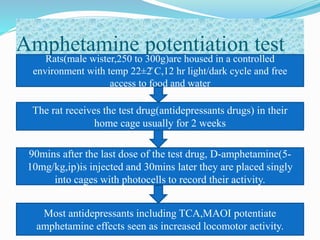
Amphetamine potentiation test
Rats(male wister,250 to 300g)are housed in a controlled
environment with temp 22±2̊ C,12 hr light/dark cycle and free
access to food and water
90mins after the last dose of the test drug, D-amphetamine(5-
10mg/kg,ip)is injected and 30mins later they are placed singly
into cages with photocells to record their activity.
The rat receives the test drug(antidepressants drugs) in their
home cage usually for 2 weeks
Most antidepressants including TCA,MAOI potentiate
amphetamine effects seen as increased locomotor activity.
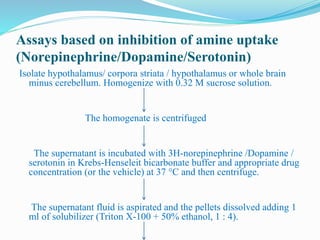
Assays based on inhibition of amine uptake
(Norepinephrine/Dopamine/Serotonin)
Isolate hypothalamus/ corpora striata / hypothalamus or whole brain
minus cerebellum. Homogenize with 0.32 M sucrose solution.
The homogenate is centrifuged
The supernatant is incubated with 3H-norepinephrine /Dopamine /
serotonin in Krebs-Henseleit bicarbonate buffer and appropriate drug
concentration (or the vehicle) at 37 °C and then centrifuge.
The supernatant fluid is aspirated and the pellets dissolved adding 1
ml of solubilizer (Triton X-100 + 50% ethanol, 1 : 4).
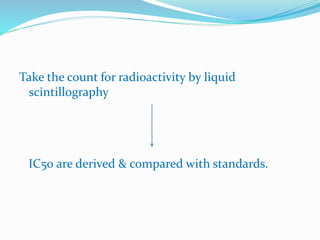
Take the count for radioactivity by liquid
scintillography
IC50 are derived & compared with standards.
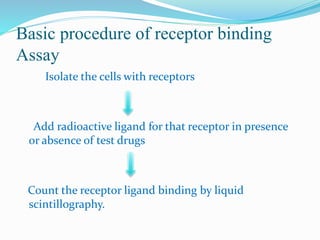
Basic procedure of receptor binding
Assay
Isolate the cells with receptors
Add radioactive ligand for that receptor in presence
or absence of test drugs
Count the receptor ligand binding by liquid
scintillography.
References
•Kessler, R.C., et al., Lifetime prevalence and age-of-onset
distributions of DSM-IV disorders in the National Comorbidity
Survey Replication. Arch Gen Psychiatry, 2005. 62(6): p. 593-
602.
•Murray, C.J. and Lopez, A.D. (1997) Alternative projections of
mortalityand disability by cause 1990–2020: Global Burden of
Disease Study. Lancet349, 1498–1504
•Hua-Cheng YAN, Xiong CAO, Manas Das, Xin-Hong ZHU,
Tian-Ming GAO. 2010. "Behavioral animal models of
depression" Neurosci Bull August 1, 2010, 26(4): 327-337
•Hasler, G. et al. (2004) Discovering endophenotypes for
major depression. Neuropsychopharmacology 29, 1765–1781
Thank you