Dr.Nitin Khajotia
1 Systole and 1 Diastole
Points we will be discussing
➢General Diagram of Heart
➢Division Of Cardiac Cycle
➢Sub division and duration of cardiac cycle
➢Systole
➢Diastole
➢Events of cardiac cycle
➢Electrocardiography
➢Summary
Blood Flow Through Heart
Definition
- Cardiac cycle is defined as the sequence of coordinated
events which take place during a heartbeat.
- Each heartbeat consists of two major periods called
systole and diastole.
- In Systole, there is contraction of the cardiac muscle
- During diastole , there is relaxation of cardiac muscle and
filling of blood.
These changes are repeated during every heartbeat in a
cyclic manner.
Divisions of cardiaccycle
- The Contraction and Relaxation of Atria are called
atrial systole and atrial diastole respectively.
- The Contraction and Relaxation of Ventricles are
called ventricular systole and ventricular diastole
respectively.
However, in clinical practice,
‘Systole’ refers to ventricular systole
‘Diastole’ refers to ventricular diastole.
Thus, the events of cardiac cycle classified in to
two divisions.
1. Systole
2. Diastole.
Subdivisionsandduration
ofcardiaccycle
When the heart beats at the normal rate of 72/minutes.
The duration if each cardiac cycle is about 0.8 second.
The duration of systole is 0.27 second and that of diastole
is 0.53 second.
Systole – 2 Sub divisions
Diastole - 5 Sub divisions.
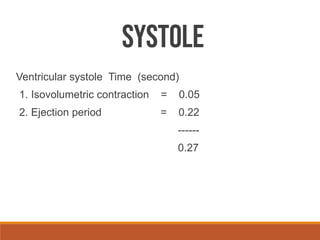
systole
Ventricular systole Time (second)
1. Isovolumetric contraction = 0.05
2. Ejection period = 0.22
------
0.27
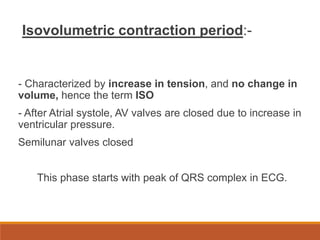
Isovolumetric contraction period:-
- Characterized by increase in tension, and no change in
volume, hence the term ISO
- After Atrial systole, AV valves are closed due to increase in
ventricular pressure.
Semilunar valves closed
This phase starts with peak of QRS complex in ECG.
Ejection phase:
Rapid ejection phase
Starts with opening of aortic valve.
Steep increase in aortic blood flow
Ventricular pressure increases.
‘c ’wave produced in jugular venous pressure.
It corresponds to St segment in ECG.
Ejection phase:
Reduced ejection phase
- Aortic blood flow reduces.
- Ventricular volume continues to decrease and reaches end-systolic
volume at the end of this phase.
- T wave in ECG.
- Phase ends with closure of aortic valve.
Diastole
Ventricular Diastole Time (second)
1. Protodiastole = 0.04
2. Isometric relaxation = 0.08
3. Rapid filling = 0.11
4. Slow filling = 0.19
5. Atrial systole/Last rapid filling = 0.11
-------
0.53
-------
Ventricular diastole:
Protodiastole :
Due to ejection of blood, pressure in aorta and pulmonary
artery increases and pressure in ventricles drops.
Intraventricular pressure becomes less than pressure in
aorta and pulmonary artery, semilunar valve close.
Second heart sound.
Isovolumetric relaxation period:-
All valves closed.
Intraventricular pressure decreases
atrial pressure continues to rise
The peak of ‘v’ wave of JVP appears at the end of this phase.
Rapid filling phase:-
- When AV valve opens, sudden rush of blood from atria into
ventricles
about 80% of filling, so ventricular volume increases.
- Third heart sound
Slow filling phase:-
- Also called diastasis.
- Ventricular volume increases slowly, 20%filling .
- P wave begins to appear towards end of this phase.
PRESSURECHANGESDURINGCARDIACCYCE
Chambers of the heart show different pressures during the various
phases of the cardiac cycle.
Left ventricle will have higher pressure than right ventricle and both
atria have lower pressures.
During Ventricular systole, LV pressure reaches a maximum of 120-
140 mm Hg and
RV pressure reaches a maximum of 25-30 mm Hg.
During Ventricular diastole, LV pressure drops to about 15-20 mm
Hg and RV pressure drops to 0 mm Hg.
Phase I: Period of filling
- 50 ml and a diastolic pressure of 2 to 3 mm Hg
As venous blood flows into the ventricle from the left atrium, the
ventricular volume normally increases to about 120 ml, called the
end-diastolic volume, an increase of 70 ml.
With the volume increasing to 120 ml and the diastolic pressure rising
to about 5 to 7 mm Hg.
Phase II: Period of isovolumic
contraction
- Volume of the ventricle does not change because all
valves are closed
- However, the Pressure inside the ventricle increases to
equal the pressure in the aorta, at a pressure value of about
80 mm Hg, as depicted by point C.
Phase III: Period of ejection
- During ejection, the systolic pressure rises even higher
because of still more contraction of the ventricle
- At the same time, the volume of the ventricle decreases
because the aortic valve has now opened and blood flows
out of the ventricle into the aorta
Phase IV: Period of isovolumic relaxation
- At the end of the period of ejection (point D), the aortic
valve closes, and the ventricular pressure falls back to the
diastolic pressure level
-The line labeled “D-A” traces this decrease in
intraventricular pressure without any change in volume
- Thus, the ventricle returns to its starting point, with about
50 ml of blood left in the ventricle and at an atrial pressure of
2 to 3 mm Hg.
END DIASTOLIC VOLUME 110 - 120 ml
STROKE VOLUME 70 ml
END SYSTOLIC VOLUME 40 - 50 ml
SV = EDV-ESV
DURATION OF CARDIAC CYCLE α 1
HR
Descriptionofevents
cardiaccycle
Forbetter understanding, the description of events of
Cardiac Cycle is commenced with Atrial Systole.
HEARTSOUNDS
First heart sound :
It is due to the Closure of AV valves ( mitral and tricuspid
valves) .
Heard as LUB
Duration is 0.09 to 0.15 seconds
It is characterized by prolonged, loud sound and best
heard at mitral and tricuspid areas
Second heart sound:
It is due to the closure of semilunar valves.
Heard as DUB
Duration is 0.10 seconds
It is characterized by short, sharp sound and best
heard at aortic and pulmonary areas.
HEARTSOUNDS
Copyright © 2011 Pearson Education, Inc.
Heart Sounds
**Heart Murmur=sounds produced by regurgitation through valves
MechanicalEventsof
CardiacCycle
1. Ventricular Filling Period [ventricular diastole, atrial systole]
2. Isovolumetric Contraction Period [ventricular systole]
3. Ventricular Ejection Period [ventricular systole]
4. Isovolumetric Relaxation Period [ventricular diastole]
CardiacCycle–ElectricalEvents
- Electrical changes in heart tissue cause mechanical, i.e. muscle
contraction, changes.
- Electrical activities are recorded before we can see the actual
contraction.
Thus, changes in electrical membrane potential of specific parts of the
heart tissue represent mechanical events in specific areas of the heart
tissue
ElectricalEvents
CardiacCycle
• Each wave or interval represents depolarization or repolarization of
myocardial tissue.
• P wave represents depolarization (Contraction) of atria which causes
atrial contraction.
• QRS complex reflects depolarization (Contraction) of ventricles which
causes contraction.
• T wave reflects repolarization (Diastole) of muscle fibers in ventricles
CONDUCTIONSYSTEMOFTHEHEART
Electrocardiography
Two common abbreviations for electrocardiogram: EKG and ECG
EKG comes from German language where cardiogram is written as
kardiogram.
The ECG records the electrical activity of the heart.
Mechanical activity of the heart is sensed by echocardiography
CONCLUSION
Cardiac cycle is a term referring to all or any of the events related to
the flow or blood pressure that occurs from the beginning of
one heartbeat to the beginning of the next.
Normal Duration - 0.8 sec
Cardiac Cycle.pdf

Cardiac Cycle.pdf

  • 1.
  • 2.
    Points we willbe discussing ➢General Diagram of Heart ➢Division Of Cardiac Cycle ➢Sub division and duration of cardiac cycle ➢Systole ➢Diastole ➢Events of cardiac cycle ➢Electrocardiography ➢Summary
  • 3.
  • 4.
    Definition - Cardiac cycleis defined as the sequence of coordinated events which take place during a heartbeat. - Each heartbeat consists of two major periods called systole and diastole. - In Systole, there is contraction of the cardiac muscle - During diastole , there is relaxation of cardiac muscle and filling of blood. These changes are repeated during every heartbeat in a cyclic manner.
  • 5.
    Divisions of cardiaccycle -The Contraction and Relaxation of Atria are called atrial systole and atrial diastole respectively. - The Contraction and Relaxation of Ventricles are called ventricular systole and ventricular diastole respectively.
  • 6.
    However, in clinicalpractice, ‘Systole’ refers to ventricular systole ‘Diastole’ refers to ventricular diastole. Thus, the events of cardiac cycle classified in to two divisions. 1. Systole 2. Diastole.
  • 7.
    Subdivisionsandduration ofcardiaccycle When the heartbeats at the normal rate of 72/minutes. The duration if each cardiac cycle is about 0.8 second. The duration of systole is 0.27 second and that of diastole is 0.53 second. Systole – 2 Sub divisions Diastole - 5 Sub divisions.
  • 9.
    systole Ventricular systole Time(second) 1. Isovolumetric contraction = 0.05 2. Ejection period = 0.22 ------ 0.27
  • 10.
    Isovolumetric contraction period:- -Characterized by increase in tension, and no change in volume, hence the term ISO - After Atrial systole, AV valves are closed due to increase in ventricular pressure. Semilunar valves closed This phase starts with peak of QRS complex in ECG.
  • 11.
    Ejection phase: Rapid ejectionphase Starts with opening of aortic valve. Steep increase in aortic blood flow Ventricular pressure increases. ‘c ’wave produced in jugular venous pressure. It corresponds to St segment in ECG.
  • 12.
    Ejection phase: Reduced ejectionphase - Aortic blood flow reduces. - Ventricular volume continues to decrease and reaches end-systolic volume at the end of this phase. - T wave in ECG. - Phase ends with closure of aortic valve.
  • 13.
    Diastole Ventricular Diastole Time(second) 1. Protodiastole = 0.04 2. Isometric relaxation = 0.08 3. Rapid filling = 0.11 4. Slow filling = 0.19 5. Atrial systole/Last rapid filling = 0.11 ------- 0.53 -------
  • 14.
    Ventricular diastole: Protodiastole : Dueto ejection of blood, pressure in aorta and pulmonary artery increases and pressure in ventricles drops. Intraventricular pressure becomes less than pressure in aorta and pulmonary artery, semilunar valve close. Second heart sound.
  • 15.
    Isovolumetric relaxation period:- Allvalves closed. Intraventricular pressure decreases atrial pressure continues to rise The peak of ‘v’ wave of JVP appears at the end of this phase.
  • 16.
    Rapid filling phase:- -When AV valve opens, sudden rush of blood from atria into ventricles about 80% of filling, so ventricular volume increases. - Third heart sound
  • 17.
    Slow filling phase:- -Also called diastasis. - Ventricular volume increases slowly, 20%filling . - P wave begins to appear towards end of this phase.
  • 18.
    PRESSURECHANGESDURINGCARDIACCYCE Chambers of theheart show different pressures during the various phases of the cardiac cycle. Left ventricle will have higher pressure than right ventricle and both atria have lower pressures. During Ventricular systole, LV pressure reaches a maximum of 120- 140 mm Hg and RV pressure reaches a maximum of 25-30 mm Hg. During Ventricular diastole, LV pressure drops to about 15-20 mm Hg and RV pressure drops to 0 mm Hg.
  • 21.
    Phase I: Periodof filling - 50 ml and a diastolic pressure of 2 to 3 mm Hg As venous blood flows into the ventricle from the left atrium, the ventricular volume normally increases to about 120 ml, called the end-diastolic volume, an increase of 70 ml. With the volume increasing to 120 ml and the diastolic pressure rising to about 5 to 7 mm Hg.
  • 22.
    Phase II: Periodof isovolumic contraction - Volume of the ventricle does not change because all valves are closed - However, the Pressure inside the ventricle increases to equal the pressure in the aorta, at a pressure value of about 80 mm Hg, as depicted by point C.
  • 23.
    Phase III: Periodof ejection - During ejection, the systolic pressure rises even higher because of still more contraction of the ventricle - At the same time, the volume of the ventricle decreases because the aortic valve has now opened and blood flows out of the ventricle into the aorta
  • 24.
    Phase IV: Periodof isovolumic relaxation - At the end of the period of ejection (point D), the aortic valve closes, and the ventricular pressure falls back to the diastolic pressure level -The line labeled “D-A” traces this decrease in intraventricular pressure without any change in volume - Thus, the ventricle returns to its starting point, with about 50 ml of blood left in the ventricle and at an atrial pressure of 2 to 3 mm Hg.
  • 25.
    END DIASTOLIC VOLUME110 - 120 ml STROKE VOLUME 70 ml END SYSTOLIC VOLUME 40 - 50 ml SV = EDV-ESV DURATION OF CARDIAC CYCLE α 1 HR
  • 27.
    Descriptionofevents cardiaccycle Forbetter understanding, thedescription of events of Cardiac Cycle is commenced with Atrial Systole.
  • 29.
    HEARTSOUNDS First heart sound: It is due to the Closure of AV valves ( mitral and tricuspid valves) . Heard as LUB Duration is 0.09 to 0.15 seconds It is characterized by prolonged, loud sound and best heard at mitral and tricuspid areas
  • 30.
    Second heart sound: Itis due to the closure of semilunar valves. Heard as DUB Duration is 0.10 seconds It is characterized by short, sharp sound and best heard at aortic and pulmonary areas. HEARTSOUNDS
  • 31.
    Copyright © 2011Pearson Education, Inc. Heart Sounds **Heart Murmur=sounds produced by regurgitation through valves
  • 32.
    MechanicalEventsof CardiacCycle 1. Ventricular FillingPeriod [ventricular diastole, atrial systole] 2. Isovolumetric Contraction Period [ventricular systole] 3. Ventricular Ejection Period [ventricular systole] 4. Isovolumetric Relaxation Period [ventricular diastole]
  • 33.
    CardiacCycle–ElectricalEvents - Electrical changesin heart tissue cause mechanical, i.e. muscle contraction, changes. - Electrical activities are recorded before we can see the actual contraction. Thus, changes in electrical membrane potential of specific parts of the heart tissue represent mechanical events in specific areas of the heart tissue
  • 34.
    ElectricalEvents CardiacCycle • Each waveor interval represents depolarization or repolarization of myocardial tissue. • P wave represents depolarization (Contraction) of atria which causes atrial contraction. • QRS complex reflects depolarization (Contraction) of ventricles which causes contraction. • T wave reflects repolarization (Diastole) of muscle fibers in ventricles
  • 35.
  • 36.
    Electrocardiography Two common abbreviationsfor electrocardiogram: EKG and ECG EKG comes from German language where cardiogram is written as kardiogram. The ECG records the electrical activity of the heart. Mechanical activity of the heart is sensed by echocardiography
  • 37.
    CONCLUSION Cardiac cycle isa term referring to all or any of the events related to the flow or blood pressure that occurs from the beginning of one heartbeat to the beginning of the next. Normal Duration - 0.8 sec