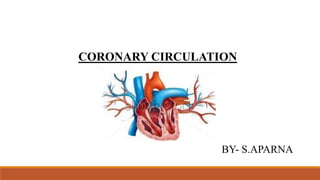
CORONARY CIRCULATION
BY- S.APARNA
CONTENTS
• INTRODUCTION
• CIRCULATION AND TYPES
• CORONARY CIRCULATION
• COMPONENTS OF CORONARY CIRCULATION
• PHASIC CHANGES
• FACTORS REGULATING C.CIRCULATON
• APPLIED ASPECTS
INTRODUCTION:
Cardiovascular system includes heart and blood vessels.Heart
pumps blood into the blood vessels, blood vessels circulate the
blood throughout the body. Blood transports nutrients and
oxygen to the tissues and removes carbon dioxide and waste
product from the tissues.
CIRCULATON
TYPES OF CIRCULATION
i) Systemic circulation
ii) Pulmonary circulation.
Systemic (greater) circulation:
The blood flows from the left ventricle, through various parts of the
body, to the right atrium, i.e. from the left to the right side of the heart
through the arteries and veins which traverse the whole body. This
circulation is responsible for keeping the body tissues alive by
supplying a continuous stream of blood to them.
Pulmonary (lesser) circulation:
The blood flows from the right ventricle, through the lungs, to the left
atrium, i.e. from the right to the left side of the heart. This circulation
is responsible for oxygenation of blood. In pulmonary circulation, the
blood passes through the lungs where Carbon dioxide is eliminated
and Oxygen is added to blood. In this way, the pulmonary circulation
makes sure that systemic circulation remains effective.
CORONARY CIRCULATION
* Coronary circulation is apart of systemic circulation.
*Coronary circulation is the circulation of blood in the blood vessels
of the heart
*The resting coronary blood flow is about 225 ml/gm ., Which is
about 0.7-0.8 ml/gm of heart muscle or 4-5% of total cardiac output
Coronary circulation consists
* Arterial drainage
* venous drainage
*lymphatic drainage
ARTERIAL SUPPLY
The cardiac muscles are supplied by the two coronary
arteries ;
i) The right coronary arteries
ii) The left coronary arteries
Both the arteries arises from the sinuses behind the cups of the aortic
valves at the root of aorta
VENOUS DRAINAGE
The venous drainage consists
i) coronary sinus
ii) anterior cardiac veins
iii) venae cordis minimae
LYMPHATIC DRAINAGE
Lymphatics of the heart accompany the coronary
arteries and form two trunks
The right trunk ends in brachiocephalic nodes and the left trunk into
the tracheobronchial lymph nodes at the bifurcation of the trachea
PHASIC CHANGES IN CORONARY BLOOD FLOW
Blood flow through coronary arteries is not cnsatnt it
decreases during systole and increases during diastole
intramural vessels or final arteries supplying myocardium are
perpendicular to cardiac muscles . so, during systole, the
intramural vessels are compressed and blood flow is reduced.
during diastole the compression is released and the blood
vessels are distended .so, the blood flow increases
* Phasic change in left ventricle
* Phasic change in right ventricle
PECULIARITIES OF CORONARY CIRCULATION
* Blood flow during systole
* End arteries
* High capillary density
* High oxygen extraction
* Regulation is mainly by metabolites
* Anatomical anastomosis
FACTORS REGULATING CORONARY BLOOD
FLOW
* Physical - Aortic blood pressure, Heart rate, Cardiac output
* Chemical -Metabolic factors , Drugs
* Neural - Direct effect, Indirect effect
* Hormonal -Thyroxin , Vasopressin
* Reflex-Anrep's reflex, Gastro-coronary reflex
APPLIED ASPECTS
• Coronary occlusion
• Myocardial ischemia
• Myocardial infarction
• Angina pectoris
Coronary occlusion – Coronary occlusion is the partial or
complete obstruction of coronary artery. coronary occlusion is
caused by atherosclerosis, a condition associated with deposition
of cholesterol on the walls of the artery .
Myocardial ischemia – Myocardial ischemia is the reaction of a
part of myocardium in response to hypoxia. hypoxia
develops when blood flow to part of myocardium
decreases severely due to occlusion of coronary artery
CORONARY OCCLUSION
MYOCARDIAL ISCHEMIA
Myocardial infarction – Myocardial infarction is the necrosis
of myocardium caused by insufficient blood flow due to
embolus, thrombus, or vascular spasm. It is also called heart
attack. in myocardial infarction, death occurs rapidly due to
ventricular fibrillation.
Angina pectoris- Cardiac pain is the chest pain that is caused
by myocardial ischemia. It is also called angina pectoris. It is
common manifestation of coronary diseases.pain starts beneath
the sternum and radiates to surfaces of left arm and left
shoulder .
MYOCARDIAL INFARCTION
ANGINA PECTORIS
REFERENCE
• ESSENTIALS OF MEDICAL PHYSIOLOGY
• GUYTON & HALL TEXTBOOK OF MEDICAL
PHYSIOLOGY
coronary circulation

coronary circulation

  • 1.
  • 2.
    CONTENTS • INTRODUCTION • CIRCULATIONAND TYPES • CORONARY CIRCULATION • COMPONENTS OF CORONARY CIRCULATION • PHASIC CHANGES • FACTORS REGULATING C.CIRCULATON • APPLIED ASPECTS
  • 3.
    INTRODUCTION: Cardiovascular system includesheart and blood vessels.Heart pumps blood into the blood vessels, blood vessels circulate the blood throughout the body. Blood transports nutrients and oxygen to the tissues and removes carbon dioxide and waste product from the tissues.
  • 4.
  • 5.
    TYPES OF CIRCULATION i)Systemic circulation ii) Pulmonary circulation.
  • 6.
    Systemic (greater) circulation: Theblood flows from the left ventricle, through various parts of the body, to the right atrium, i.e. from the left to the right side of the heart through the arteries and veins which traverse the whole body. This circulation is responsible for keeping the body tissues alive by supplying a continuous stream of blood to them.
  • 7.
    Pulmonary (lesser) circulation: Theblood flows from the right ventricle, through the lungs, to the left atrium, i.e. from the right to the left side of the heart. This circulation is responsible for oxygenation of blood. In pulmonary circulation, the blood passes through the lungs where Carbon dioxide is eliminated and Oxygen is added to blood. In this way, the pulmonary circulation makes sure that systemic circulation remains effective.
  • 8.
    CORONARY CIRCULATION * Coronarycirculation is apart of systemic circulation. *Coronary circulation is the circulation of blood in the blood vessels of the heart *The resting coronary blood flow is about 225 ml/gm ., Which is about 0.7-0.8 ml/gm of heart muscle or 4-5% of total cardiac output
  • 9.
    Coronary circulation consists *Arterial drainage * venous drainage *lymphatic drainage
  • 10.
    ARTERIAL SUPPLY The cardiacmuscles are supplied by the two coronary arteries ; i) The right coronary arteries ii) The left coronary arteries Both the arteries arises from the sinuses behind the cups of the aortic valves at the root of aorta
  • 12.
    VENOUS DRAINAGE The venousdrainage consists i) coronary sinus ii) anterior cardiac veins iii) venae cordis minimae
  • 13.
    LYMPHATIC DRAINAGE Lymphatics ofthe heart accompany the coronary arteries and form two trunks The right trunk ends in brachiocephalic nodes and the left trunk into the tracheobronchial lymph nodes at the bifurcation of the trachea
  • 14.
    PHASIC CHANGES INCORONARY BLOOD FLOW Blood flow through coronary arteries is not cnsatnt it decreases during systole and increases during diastole intramural vessels or final arteries supplying myocardium are perpendicular to cardiac muscles . so, during systole, the intramural vessels are compressed and blood flow is reduced. during diastole the compression is released and the blood vessels are distended .so, the blood flow increases * Phasic change in left ventricle * Phasic change in right ventricle
  • 15.
    PECULIARITIES OF CORONARYCIRCULATION * Blood flow during systole * End arteries * High capillary density * High oxygen extraction * Regulation is mainly by metabolites * Anatomical anastomosis
  • 16.
    FACTORS REGULATING CORONARYBLOOD FLOW * Physical - Aortic blood pressure, Heart rate, Cardiac output * Chemical -Metabolic factors , Drugs * Neural - Direct effect, Indirect effect * Hormonal -Thyroxin , Vasopressin * Reflex-Anrep's reflex, Gastro-coronary reflex
  • 17.
  • 18.
    • Coronary occlusion •Myocardial ischemia • Myocardial infarction • Angina pectoris
  • 19.
    Coronary occlusion –Coronary occlusion is the partial or complete obstruction of coronary artery. coronary occlusion is caused by atherosclerosis, a condition associated with deposition of cholesterol on the walls of the artery . Myocardial ischemia – Myocardial ischemia is the reaction of a part of myocardium in response to hypoxia. hypoxia develops when blood flow to part of myocardium decreases severely due to occlusion of coronary artery
  • 20.
  • 21.
    Myocardial infarction –Myocardial infarction is the necrosis of myocardium caused by insufficient blood flow due to embolus, thrombus, or vascular spasm. It is also called heart attack. in myocardial infarction, death occurs rapidly due to ventricular fibrillation. Angina pectoris- Cardiac pain is the chest pain that is caused by myocardial ischemia. It is also called angina pectoris. It is common manifestation of coronary diseases.pain starts beneath the sternum and radiates to surfaces of left arm and left shoulder .
  • 22.
  • 23.
    REFERENCE • ESSENTIALS OFMEDICAL PHYSIOLOGY • GUYTON & HALL TEXTBOOK OF MEDICAL PHYSIOLOGY