CARBON NANOTUBES

1
CONTENTS
• Introduction
• Classification
– SWNT
– MWNT
– Other structures

• Synthesis
• Properties
• Applications
2
INTRODUCTION
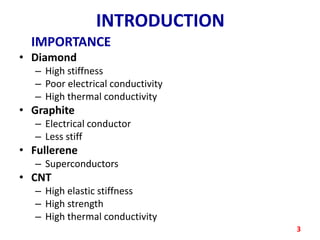
IMPORTANCE
• Diamond
– High stiffness
– Poor electrical conductivity
– High thermal conductivity

• Graphite
– Electrical conductor
– Less stiff

• Fullerene
– Superconductors

• CNT
– High elastic stiffness
– High strength
– High thermal conductivity
3
INTRODUCTION
•
•
•
•
•

Allotrope of carbon.
Cylindrical nanostructure.
Hexagonal shaped arrangements of carbon.
Rolled in tubes.
Walls made of one atom thick sheets of carbon
called graphene.
• sp2 hybridised carbon tubule rolled up into
graphene sheets giving chiral and non chiral
arrangements.
4
CLASSIFICATION
• Single Walled Nano Tubes(SWNTs).

• Multi Walled Nano Tubes(MWNTs).

5
SWNTs
• Diameter close to 1 nm.
• No restrictions on tube length.
• Exhibit electrical properties that are not shared
by MWNTs.
• Conducting properties are sensitive to degree of
graphitization, chirality and diameter.
Structure:
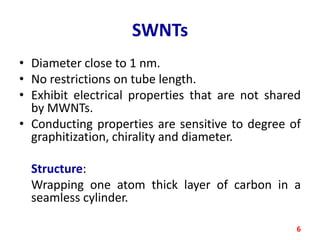
Wrapping one atom thick layer of carbon in a
seamless cylinder.
6
7
SWNT (contd.)
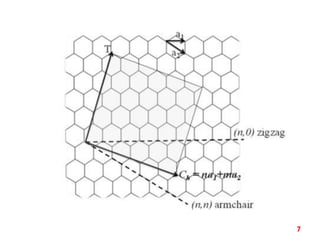
• n,m are the chiral vectors. They tell about the
way graphene sheet is wrapped.
• n and m are integers. They denote number of unit
vectors in a direction in the honeycomb crystal
lattice of graphene.
• Zigzag if m=0. C-C bonds parallel to tube axis.
• Armchair if n=m. C-C bonds on opposite side of
each hexagon are perpendicular to tube axis.
• Otherwise Chiral.
8
9
SWNTs (contd..)
These three arrangements can be metals or
semiconductors.
General rule for metallicity of SWNT:
• (n,n) tubes are metals.
• (n,m) tubes with n–m=3j are
semiconductors (j≠0, integer).
• Others, large gap semiconductors.

tiny

gap

• Phil. Trans. R. Soc. Lond. A (2004)
10
MWNTs
• Consists of multiple rolled layers of graphite
(concentric circles).
• Telescopic motion ability.
• Mechanical strength : mechanically stronger than
conventional carbon fibres.
• Movable arms in nano-mechanical devices.
Two models
1. Russian Doll Model
2. Parchment Model
11
OTHER STRUCTURES
•
•
•
•

TORUS
Called nanotori.
Have many unique properties like magnetic
moments.
Have magnetic moments 1000 times larger
than previously expected for any radii.
Properties like magnetic moment and thermal
stability depend upon the radius of the torus.
12
NANOBUD

• Combination of carbon nanotubes and
fullerenes.
• Fullerene like buds are covalently bonded
to outer side walls of underlying carbon.
• In composite materials, attached fullerene
molecules may function as molecular
anchors
preventing
slipping
of
nanotubes,
improving
composite’s
mechanical properties.
13
•
•
•

•

GRAPHENATED CARBON NANOTUBES
Combines graphitic foliates grown along the
sidewalls of multi-walled or bamboo styled
CNTs.
Use in super capacitor applications.
PEAPOD
Novel hybrid carbon material which traps
fullerene in CNT.
CUP-STACKED CNTs
Exhibit semiconducting behaviour due to
stacking microstructure of graphene layers.
14
SYNTHESIS
1. Arc Discharge
2. Laser Ablation

3. Chemical Vapour Deposition(CVD)

15
ARC Discharge
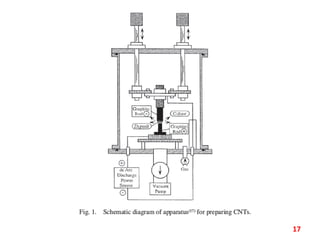
• Three main elements are required
– Carbon feed
– Metal catalyst
– Heat

• Two graphite electrodes inserted vertically. Maintained
at a constant distance of 1-2mm.
• Chamber evacuated with vacuum pump.
• Chamber filled with ambient gas (usually inert gases
like He or Ar).
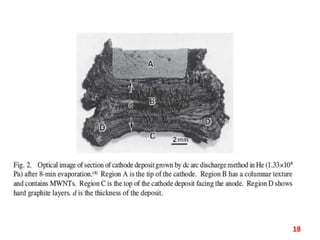
• When DC current is passed, anode is consumed and
material forms on cathode (MWNT).
• Mixed metal catalyst (Fe or Co) is inserted in anode to
get SWNT as soot in the chamber.
16
17
18
ARC DISCHARGE(contd..)
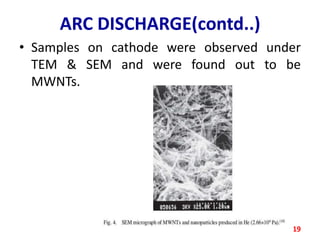
• Samples on cathode were observed under
TEM & SEM and were found out to be
MWNTs.

19
ARC DISCHARGE (contd..)
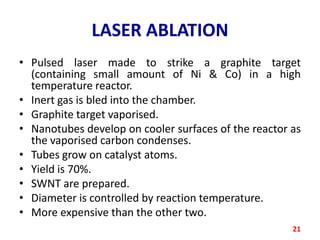
• 100 mg/min SWNIT is produced.
Drawback
High amount of undesired by-products
(fullerene, graphite & amorphous carbon).

•New Diamond and Frontier Carbon Technology, Vol 16, No.3
(2006)
20
LASER ABLATION
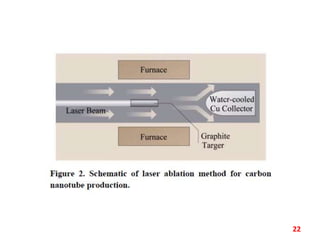
• Pulsed laser made to strike a graphite target
(containing small amount of Ni & Co) in a high
temperature reactor.
• Inert gas is bled into the chamber.
• Graphite target vaporised.
• Nanotubes develop on cooler surfaces of the reactor as
the vaporised carbon condenses.
• Tubes grow on catalyst atoms.
• Yield is 70%.
• SWNT are prepared.
• Diameter is controlled by reaction temperature.
• More expensive than the other two.
21
22
Chemical Vapour deposition (CVD)
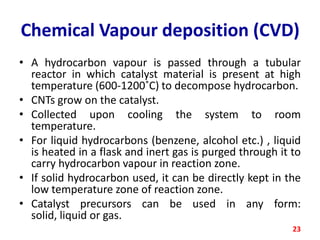
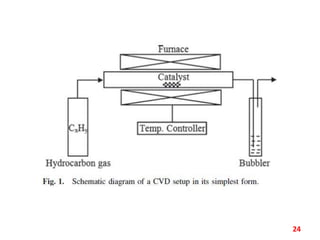
• A hydrocarbon vapour is passed through a tubular
reactor in which catalyst material is present at high
temperature (600-1200˚C) to decompose hydrocarbon.
• CNTs grow on the catalyst.
• Collected upon cooling the system to room
temperature.
• For liquid hydrocarbons (benzene, alcohol etc.) , liquid
is heated in a flask and inert gas is purged through it to
carry hydrocarbon vapour in reaction zone.
• If solid hydrocarbon used, it can be directly kept in the
low temperature zone of reaction zone.
• Catalyst precursors can be used in any form:
solid, liquid or gas.
23
24
Chemical Vapour deposition (CVD)
• Diameter of nano tube depends upon the size of metal
particle.
CNT Growth mechanism:
• When hydrocarbon vapour comes in contact with hot metal
nanoparticles, it decomposes into hydrogen and carbon
species. Hydrogen is evolved and carbon dissolves in the
metal.
• After reaching carbon solubility limit at that
temperature, carbon precipitates out and crystallizes in the
form of cylindrical tubes having no dangling bonds.
Hence, they are energetically stable.
• Hydrocarbon decomposition (exothermic process) releases
some heat and carbon crystallization (endothermic process)
absorbs heat. It keeps the process on.
25
Chemical Vapour deposition (CVD)
•
•
•
•

Advantages
Simple and economic.
CNT synthesized at low temperature and
ambient pressure.
Better yield and purity.
Control on structure and growth parameters.

•J. Nanosci. Nanotechnol. 10, 3739–3758, 2010

26
PROPERTIES
1. Strength
• Strong and flexible.
• Strength due to covalent sp2 bonds (stronger
than sp3 found in diamond).
• Not strong under compressive, torsional or
bending stress.
2. Hardness (152 GPa)
Greater than diamond (150 GPa).
27
PROPERTIES (contd.)
3. Electrical property
Electrical properties are sensitive to their
structure. Graphene is a zero gap semiconductor
and CNTs can be metals or semiconductors with
varying energy gaps depending on the diameter
and helicity of the tubes.
4. Thermal conductivity
Thermal conductivity of SWNT more than copper
at room temperature.
28
APPLICATIONS
• Desalination
– Water can be made to pass through a network of
carbon nanotubes which requires less pressure than
the conventional osmosis methods.

• Solar cells
– Nanotubes can act as transparent film in solar cells to
allow light to pass through active layers and generate
current.

• Ultracapacitors
– Can be used to charge capacitors which will increase
the surface area and hence energy storage ability.

• Light bulb filament
– Alternative to tungsten filament.
29
THANK YOU

30

Carbon nanotubes

  • 1.
  • 2.
    CONTENTS • Introduction • Classification –SWNT – MWNT – Other structures • Synthesis • Properties • Applications 2
  • 3.
    INTRODUCTION IMPORTANCE • Diamond – Highstiffness – Poor electrical conductivity – High thermal conductivity • Graphite – Electrical conductor – Less stiff • Fullerene – Superconductors • CNT – High elastic stiffness – High strength – High thermal conductivity 3
  • 4.
    INTRODUCTION • • • • • Allotrope of carbon. Cylindricalnanostructure. Hexagonal shaped arrangements of carbon. Rolled in tubes. Walls made of one atom thick sheets of carbon called graphene. • sp2 hybridised carbon tubule rolled up into graphene sheets giving chiral and non chiral arrangements. 4
  • 5.
    CLASSIFICATION • Single WalledNano Tubes(SWNTs). • Multi Walled Nano Tubes(MWNTs). 5
  • 6.
    SWNTs • Diameter closeto 1 nm. • No restrictions on tube length. • Exhibit electrical properties that are not shared by MWNTs. • Conducting properties are sensitive to degree of graphitization, chirality and diameter. Structure: Wrapping one atom thick layer of carbon in a seamless cylinder. 6
  • 7.
  • 8.
    SWNT (contd.) • n,mare the chiral vectors. They tell about the way graphene sheet is wrapped. • n and m are integers. They denote number of unit vectors in a direction in the honeycomb crystal lattice of graphene. • Zigzag if m=0. C-C bonds parallel to tube axis. • Armchair if n=m. C-C bonds on opposite side of each hexagon are perpendicular to tube axis. • Otherwise Chiral. 8
  • 9.
  • 10.
    SWNTs (contd..) These threearrangements can be metals or semiconductors. General rule for metallicity of SWNT: • (n,n) tubes are metals. • (n,m) tubes with n–m=3j are semiconductors (j≠0, integer). • Others, large gap semiconductors. tiny gap • Phil. Trans. R. Soc. Lond. A (2004) 10
  • 11.
    MWNTs • Consists ofmultiple rolled layers of graphite (concentric circles). • Telescopic motion ability. • Mechanical strength : mechanically stronger than conventional carbon fibres. • Movable arms in nano-mechanical devices. Two models 1. Russian Doll Model 2. Parchment Model 11
  • 12.
    OTHER STRUCTURES • • • • TORUS Called nanotori. Havemany unique properties like magnetic moments. Have magnetic moments 1000 times larger than previously expected for any radii. Properties like magnetic moment and thermal stability depend upon the radius of the torus. 12
  • 13.
    NANOBUD • Combination ofcarbon nanotubes and fullerenes. • Fullerene like buds are covalently bonded to outer side walls of underlying carbon. • In composite materials, attached fullerene molecules may function as molecular anchors preventing slipping of nanotubes, improving composite’s mechanical properties. 13
  • 14.
    • • • • GRAPHENATED CARBON NANOTUBES Combinesgraphitic foliates grown along the sidewalls of multi-walled or bamboo styled CNTs. Use in super capacitor applications. PEAPOD Novel hybrid carbon material which traps fullerene in CNT. CUP-STACKED CNTs Exhibit semiconducting behaviour due to stacking microstructure of graphene layers. 14
  • 15.
    SYNTHESIS 1. Arc Discharge 2.Laser Ablation 3. Chemical Vapour Deposition(CVD) 15
  • 16.
    ARC Discharge • Threemain elements are required – Carbon feed – Metal catalyst – Heat • Two graphite electrodes inserted vertically. Maintained at a constant distance of 1-2mm. • Chamber evacuated with vacuum pump. • Chamber filled with ambient gas (usually inert gases like He or Ar). • When DC current is passed, anode is consumed and material forms on cathode (MWNT). • Mixed metal catalyst (Fe or Co) is inserted in anode to get SWNT as soot in the chamber. 16
  • 17.
  • 18.
  • 19.
    ARC DISCHARGE(contd..) • Sampleson cathode were observed under TEM & SEM and were found out to be MWNTs. 19
  • 20.
    ARC DISCHARGE (contd..) •100 mg/min SWNIT is produced. Drawback High amount of undesired by-products (fullerene, graphite & amorphous carbon). •New Diamond and Frontier Carbon Technology, Vol 16, No.3 (2006) 20
  • 21.
    LASER ABLATION • Pulsedlaser made to strike a graphite target (containing small amount of Ni & Co) in a high temperature reactor. • Inert gas is bled into the chamber. • Graphite target vaporised. • Nanotubes develop on cooler surfaces of the reactor as the vaporised carbon condenses. • Tubes grow on catalyst atoms. • Yield is 70%. • SWNT are prepared. • Diameter is controlled by reaction temperature. • More expensive than the other two. 21
  • 22.
  • 23.
    Chemical Vapour deposition(CVD) • A hydrocarbon vapour is passed through a tubular reactor in which catalyst material is present at high temperature (600-1200˚C) to decompose hydrocarbon. • CNTs grow on the catalyst. • Collected upon cooling the system to room temperature. • For liquid hydrocarbons (benzene, alcohol etc.) , liquid is heated in a flask and inert gas is purged through it to carry hydrocarbon vapour in reaction zone. • If solid hydrocarbon used, it can be directly kept in the low temperature zone of reaction zone. • Catalyst precursors can be used in any form: solid, liquid or gas. 23
  • 24.
  • 25.
    Chemical Vapour deposition(CVD) • Diameter of nano tube depends upon the size of metal particle. CNT Growth mechanism: • When hydrocarbon vapour comes in contact with hot metal nanoparticles, it decomposes into hydrogen and carbon species. Hydrogen is evolved and carbon dissolves in the metal. • After reaching carbon solubility limit at that temperature, carbon precipitates out and crystallizes in the form of cylindrical tubes having no dangling bonds. Hence, they are energetically stable. • Hydrocarbon decomposition (exothermic process) releases some heat and carbon crystallization (endothermic process) absorbs heat. It keeps the process on. 25
  • 26.
    Chemical Vapour deposition(CVD) • • • • Advantages Simple and economic. CNT synthesized at low temperature and ambient pressure. Better yield and purity. Control on structure and growth parameters. •J. Nanosci. Nanotechnol. 10, 3739–3758, 2010 26
  • 27.
    PROPERTIES 1. Strength • Strongand flexible. • Strength due to covalent sp2 bonds (stronger than sp3 found in diamond). • Not strong under compressive, torsional or bending stress. 2. Hardness (152 GPa) Greater than diamond (150 GPa). 27
  • 28.
    PROPERTIES (contd.) 3. Electricalproperty Electrical properties are sensitive to their structure. Graphene is a zero gap semiconductor and CNTs can be metals or semiconductors with varying energy gaps depending on the diameter and helicity of the tubes. 4. Thermal conductivity Thermal conductivity of SWNT more than copper at room temperature. 28
  • 29.
    APPLICATIONS • Desalination – Watercan be made to pass through a network of carbon nanotubes which requires less pressure than the conventional osmosis methods. • Solar cells – Nanotubes can act as transparent film in solar cells to allow light to pass through active layers and generate current. • Ultracapacitors – Can be used to charge capacitors which will increase the surface area and hence energy storage ability. • Light bulb filament – Alternative to tungsten filament. 29
  • 30.