By Vibin Varghese 10CHE6012 SJC(PG)
Sumio Iijima  ( 飯島 澄男  Iijima Sumio , born May 2, 1939) is a  Japanese   physicist ,  often cited as the discoverer of  carbon nanotubes .
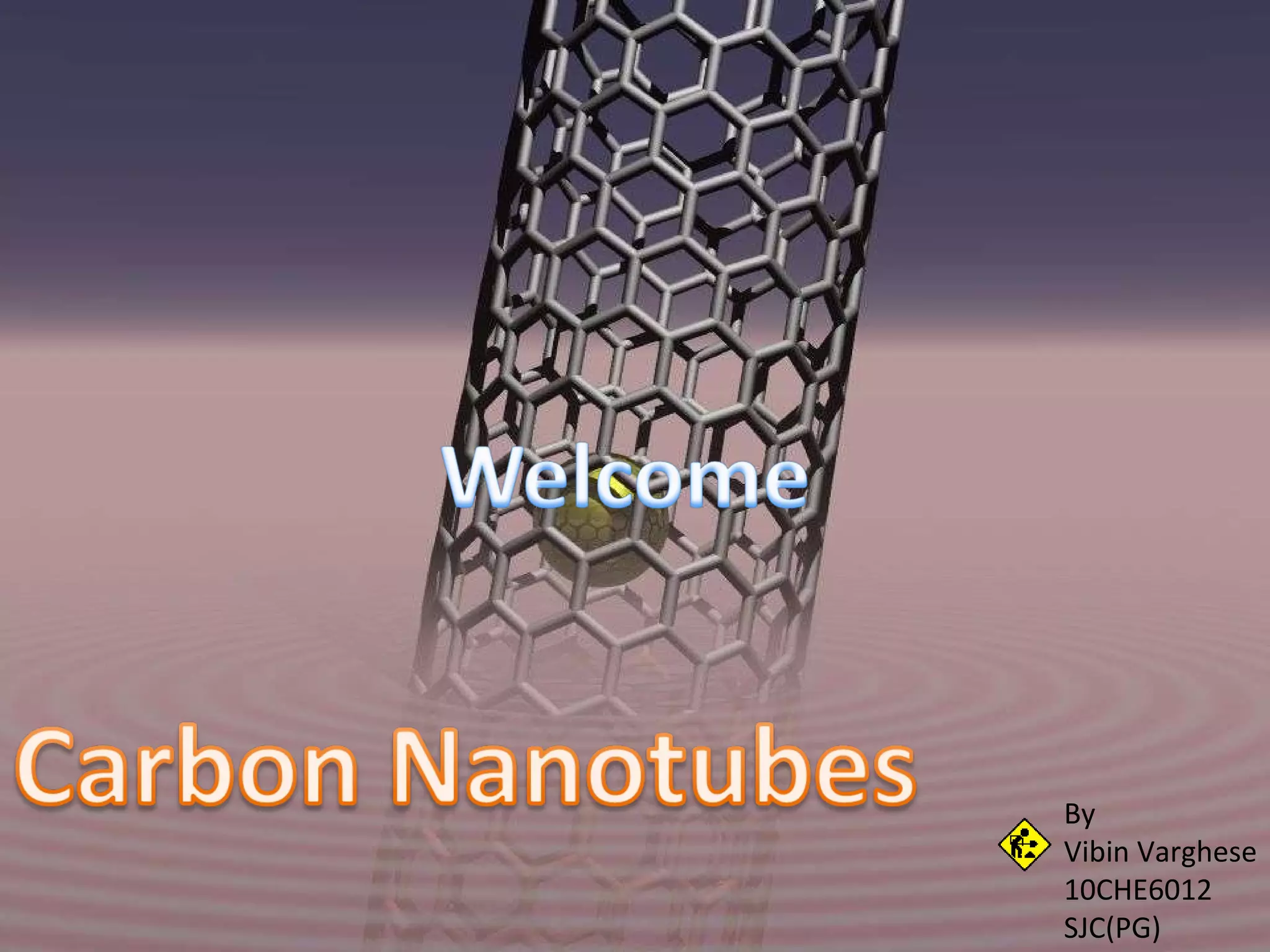
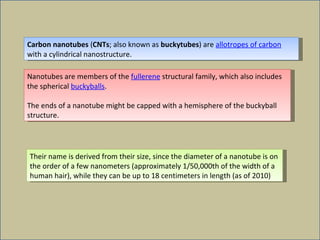
Carbon nanotubes  ( CNTs ; also known as  buckytubes ) are  allotropes of carbon  with a cylindrical nanostructure. Nanotubes are members of the  fullerene  structural family, which also includes the spherical  buckyballs .  The ends of a nanotube might be capped with a hemisphere of the buckyball structure.  Their name is derived from their size, since the diameter of a nanotube is on the order of a few nanometers (approximately 1/50,000th of the width of a human hair), while they can be up to 18 centimeters in length (as of 2010)
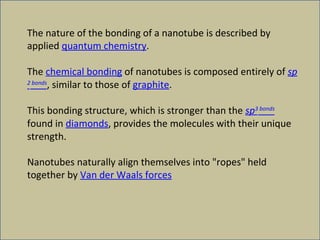
The nature of the bonding of a nanotube is described by applied  quantum chemistry .  The  chemical bonding  of nanotubes is composed entirely of  sp 2  bonds , similar to those of  graphite .  This bonding structure, which is stronger than the  sp 3  bonds  found in  diamonds , provides the molecules with their unique strength.  Nanotubes naturally align themselves into "ropes" held together by  Van der Waals forces
Types of carbon nanotubes    and  related structures Structure Nanotubes are mainly categorized as: single-walled nanotubes  (SWNTs)  And multi-walled nanotubes  (MWNTs).
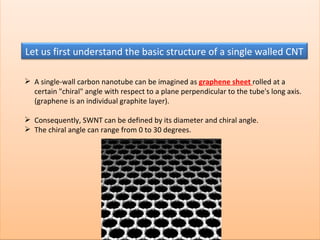
A single-wall carbon nanotube can be imagined as  graphene sheet  rolled at a certain "chiral" angle with respect to a plane perpendicular to the tube's long axis. (graphene is an individual graphite layer).  Consequently, SWNT can be defined by its diameter and chiral angle.  The chiral angle can range from 0 to 30 degrees.  Let us first understand the basic structure of a single walled CNT
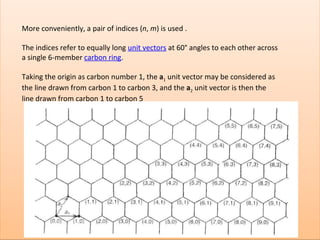
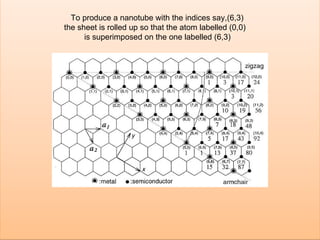
More conveniently, a pair of indices ( n ,  m ) is used .  The indices refer to equally long  unit vectors  at 60° angles to each other across a single 6-member  carbon ring .  Taking the origin as carbon number 1, the  a 1  unit vector may be considered as the line drawn from carbon 1 to carbon 3, and the  a 2  unit vector is then the line drawn from carbon 1 to carbon 5
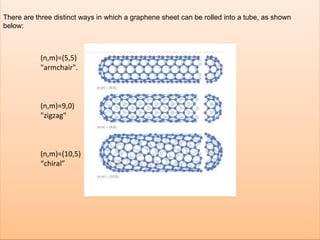
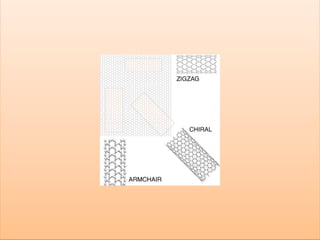
There are three distinct ways in which a graphene sheet can be rolled into a tube, as shown below: (n,m)=(5,5) "armchair". (n,m)=9,0) "zigzag" (n,m)=(10,5) “ chiral”
To produce a nanotube with the indices say,(6,3) the sheet is rolled up so that the atom labelled (0,0)  is superimposed on the one labelled (6,3)
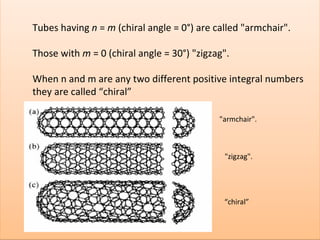
Tubes having  n  =  m  (chiral angle = 0°) are called "armchair". Those with  m  = 0 (chiral angle = 30°) "zigzag". When n and m are any two different positive integral numbers they are called “chiral”  "armchair". "zigzag". “ chiral”
 
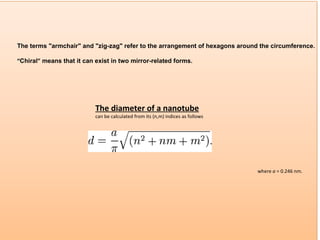
The terms "armchair" and "zig-zag" refer to the arrangement of hexagons around the circumference. “ Chiral ”  means that it can exist in two mirror-related forms. The diameter of a nanotube can be calculated from its (n,m) indices as follows where  a  = 0.246 nm.
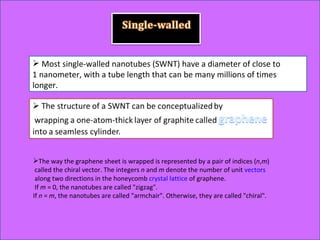
Most single-walled nanotubes (SWNT) have a diameter of close to 1 nanometer, with a tube length that can be many millions of times longer. The way the graphene sheet is wrapped is represented by a pair of indices ( n , m ) called the chiral vector. The integers  n  and  m  denote the number of unit  vectors along two directions in the honeycomb  crystal lattice  of graphene. If  m  = 0, the nanotubes are called "zigzag".  If  n  =  m , the nanotubes are called "armchair". Otherwise, they are called "chiral".
Single-walled nanotubes are an important variety of  carbon nanotube  because they exhibit electric properties that are not shared by the multi-walled carbon nanotube (MWNT) variants.
 
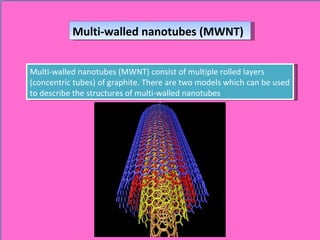
Multi-walled nanotubes (MWNT) Multi-walled nanotubes (MWNT) consist of multiple rolled layers (concentric tubes) of graphite. There are two models which can be used to describe the structures of multi-walled nanotubes
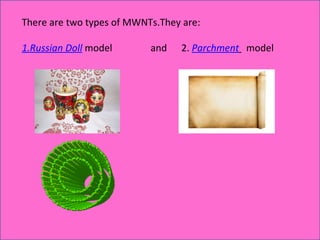
There are two types of MWNTs.They are: 1.Russian Doll  model  and  2.  Parchment   model
In the  Russian Doll  model, sheets of graphite are arranged in concentric cylinders In the  Parchment  model, a single sheet of graphite is rolled in around itself, resembling a scroll of parchment or a rolled newspaper. The  interlayer distance - approximately  3.4 Å .
The special place of  double-walled carbon nanotubes (DWNT) functionalization . In the case of SWNT, covalent functionalization will break some C=C  double bonds ,  leaving "holes"  in the structure on the nanotube and thus  modifying both its mechanical and electrical properties .  In the case of DWNT, only the outer wall is modified.
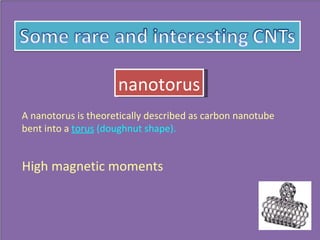
A nanotorus is theoretically described as carbon nanotube bent into a  torus  (doughnut shape).  nanotorus High magnetic moments
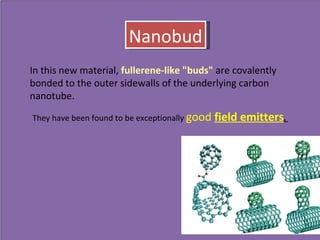
Nanobud In this new material,  fullerene-like "buds"  are covalently bonded to the outer sidewalls of the underlying carbon nanotube.  They have been found to be exceptionally  good  field emitters .
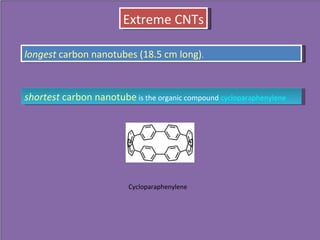
Extreme CNTs longest  carbon nanotubes (18.5 cm long) . shortest  carbon nanotube  is the organic compound  cycloparaphenylene Cycloparaphenylene
The  thinnest   carbon nanotube is armchair (2,2) CNT with a diameter of 3 Å The  thinnest freestanding   single-walled carbon nanotube is about 4.3 Å in diameter
Strength Carbon nanotubes are the  strongest and stiffest materials  yet discovered in terms of  tensile strength  and  elastic modulus  respectively. covalent sp² bonds 63  gigapascals (GPa) .  Properties
Hardness Diamond  is considered to be the hardest material.  One study succeeded in the synthesis of a super-hard material by compressing SWNTs to above 24 GPa at  room temperature .  The  bulk modulus  of compressed SWNTs was  462–546 GPa , surpassing the value of 420 GPa for diamond
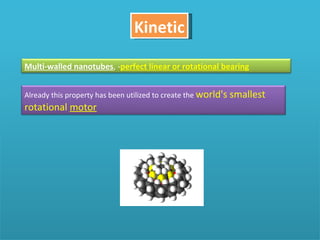
Kinetic Multi-walled nanotubes , - perfect linear or rotational bearing Already this property has been utilized to create the  world's smallest rotational  motor
Thermal All nanotubes are expected to be very good  thermal conductors  along the tube, but good insulators laterally to the tube axis.  thermal conductivity  along its axis of about  3500 W·m −1 ·K −1   compare this to copper,which transmits  385 W·m −1 ·K −1
Toxicity Unfortunately research has only just begun and the data are still fragmentary and  subject to criticism .  CNTs can enter human cells and accumulate in the  cytoplasm ,  causing cell death . Results of  rodent studies  shows that it can cause  inflammation ,  epithelioid granulomas  (microscopic nodules),  fibrosis , and biochemical/toxicological changes in the lungs For those involving chronic exposure, carbon nanotubes  can pose a serious risk to human health
Techniques have been developed to produce nanotubes in sizeable quantities, including arc discharge ,  laser ablation , and  chemical vapor deposition  (CVD) Synthesis
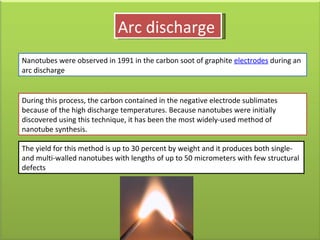
Arc discharge  Nanotubes were observed in 1991 in the carbon soot of graphite  electrodes  during an arc discharge During this process, the carbon contained in the negative electrode sublimates because of the high discharge temperatures. Because nanotubes were initially discovered using this technique, it has been the most widely-used method of nanotube synthesis. The yield for this method is up to 30 percent by weight and it produces both single- and multi-walled nanotubes with lengths of up to 50 micrometers with few structural defects
Laser ablation In the laser ablation process, a  pulsed laser  vaporizes a graphite target in a high-temperature reactor while an  inert gas  is bled into the chamber. Nanotubes develop on the cooler surfaces of the reactor as the vaporized carbon condenses.  A water-cooled surface may be included in the system to collect the nanotubes. The laser ablation method yields around 70% and produces primarily single-walled carbon nanotubes.
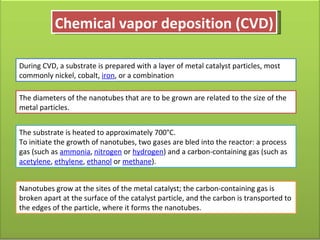
Chemical vapor deposition (CVD) During CVD, a substrate is prepared with a layer of metal catalyst particles, most commonly nickel, cobalt,  iron , or a combination The diameters of the nanotubes that are to be grown are related to the size of the metal particles.  The substrate is heated to approximately 700°C.  To initiate the growth of nanotubes, two gases are bled into the reactor: a process gas (such as  ammonia ,  nitrogen  or  hydrogen ) and a carbon-containing gas (such as  acetylene ,  ethylene ,  ethanol  or  methane ). Nanotubes grow at the sites of the metal catalyst; the carbon-containing gas is broken apart at the surface of the catalyst particle, and the carbon is transported to the edges of the particle, where it forms the nanotubes.
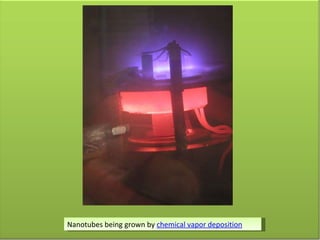
Nanotubes being grown by  chemical vapor deposition
Natural, incidental, and controlled    flame environments Fullerenes  and carbon nanotubes ---ordinary  flames , produced by burning methane, ethylene, and benzene,  found in  soot However, these naturally occurring varieties can be highly irregular in size and quality because the environment in which they are produced is often highly uncontrolled
Potential applications Structural clothes : combat jackets concrete : polyethylene : sports equipment :
synthetic muscles : high  tensile strength   fibers : bridges : ultrahigh-speed  flywheels : fire protection: ·  solar cells : superconductor transistor :
loudspeaker : replacing  piezoelectric  speakers in  greeting cards Electroacoustic
air pollution filter biotech container :  hydrogen storage :  water filter Chemical
Oscillator : Slick surface thermal radiation : Mechanical
diode , used to dissipate heat from tiny computer chips paper batteries Electrical circuits
www.nanocyl.com/CNT-Expertise.../ Carbon - Nanotubes http://iopscience.iop.org/1367-2630/5/1/117 en.wikipedia.org/wiki/ Carbon _ nanotube http://physicsworld.com/cws/article/print/1761 www.nanotech-now.com /Introduction www.nanocyl.com/CNT-Expertise.../ Carbon - Nanotubes Carbon nanotubes:  preparation and properties-  Thomas W. Ebbesen ,1997 Carbon nanotubes: basic concepts and physical properties   By Stéphanie Reich, Christian Thomsen, Janina Maultzsch
Queries?????
 

97 2003 carbon nanotubes

  • 1.
    By Vibin Varghese10CHE6012 SJC(PG)
  • 2.
    Sumio Iijima ( 飯島 澄男 Iijima Sumio , born May 2, 1939) is a Japanese physicist , often cited as the discoverer of carbon nanotubes .
  • 3.
    Carbon nanotubes ( CNTs ; also known as buckytubes ) are allotropes of carbon with a cylindrical nanostructure. Nanotubes are members of the fullerene structural family, which also includes the spherical buckyballs . The ends of a nanotube might be capped with a hemisphere of the buckyball structure. Their name is derived from their size, since the diameter of a nanotube is on the order of a few nanometers (approximately 1/50,000th of the width of a human hair), while they can be up to 18 centimeters in length (as of 2010)
  • 4.
    The nature ofthe bonding of a nanotube is described by applied quantum chemistry . The chemical bonding of nanotubes is composed entirely of sp 2 bonds , similar to those of graphite . This bonding structure, which is stronger than the sp 3 bonds found in diamonds , provides the molecules with their unique strength. Nanotubes naturally align themselves into "ropes" held together by Van der Waals forces
  • 5.
    Types of carbonnanotubes and related structures Structure Nanotubes are mainly categorized as: single-walled nanotubes (SWNTs) And multi-walled nanotubes (MWNTs).
  • 6.
    A single-wall carbonnanotube can be imagined as graphene sheet rolled at a certain "chiral" angle with respect to a plane perpendicular to the tube's long axis. (graphene is an individual graphite layer). Consequently, SWNT can be defined by its diameter and chiral angle. The chiral angle can range from 0 to 30 degrees. Let us first understand the basic structure of a single walled CNT
  • 7.
    More conveniently, apair of indices ( n ,  m ) is used . The indices refer to equally long unit vectors at 60° angles to each other across a single 6-member carbon ring . Taking the origin as carbon number 1, the a 1 unit vector may be considered as the line drawn from carbon 1 to carbon 3, and the a 2 unit vector is then the line drawn from carbon 1 to carbon 5
  • 8.
    There are threedistinct ways in which a graphene sheet can be rolled into a tube, as shown below: (n,m)=(5,5) "armchair". (n,m)=9,0) "zigzag" (n,m)=(10,5) “ chiral”
  • 9.
    To produce ananotube with the indices say,(6,3) the sheet is rolled up so that the atom labelled (0,0) is superimposed on the one labelled (6,3)
  • 10.
    Tubes having n  =  m (chiral angle = 0°) are called "armchair". Those with m  = 0 (chiral angle = 30°) "zigzag". When n and m are any two different positive integral numbers they are called “chiral” "armchair". "zigzag". “ chiral”
  • 11.
  • 12.
    The terms "armchair"and "zig-zag" refer to the arrangement of hexagons around the circumference. “ Chiral ” means that it can exist in two mirror-related forms. The diameter of a nanotube can be calculated from its (n,m) indices as follows where a = 0.246 nm.
  • 13.
    Most single-walled nanotubes(SWNT) have a diameter of close to 1 nanometer, with a tube length that can be many millions of times longer. The way the graphene sheet is wrapped is represented by a pair of indices ( n , m ) called the chiral vector. The integers n and m denote the number of unit vectors along two directions in the honeycomb crystal lattice of graphene. If m = 0, the nanotubes are called "zigzag". If n = m , the nanotubes are called "armchair". Otherwise, they are called "chiral".
  • 14.
    Single-walled nanotubes arean important variety of carbon nanotube because they exhibit electric properties that are not shared by the multi-walled carbon nanotube (MWNT) variants.
  • 15.
  • 16.
    Multi-walled nanotubes (MWNT)Multi-walled nanotubes (MWNT) consist of multiple rolled layers (concentric tubes) of graphite. There are two models which can be used to describe the structures of multi-walled nanotubes
  • 17.
    There are twotypes of MWNTs.They are: 1.Russian Doll model and 2. Parchment model
  • 18.
    In the Russian Doll model, sheets of graphite are arranged in concentric cylinders In the Parchment model, a single sheet of graphite is rolled in around itself, resembling a scroll of parchment or a rolled newspaper. The interlayer distance - approximately 3.4 Å .
  • 19.
    The special placeof double-walled carbon nanotubes (DWNT) functionalization . In the case of SWNT, covalent functionalization will break some C=C double bonds , leaving "holes" in the structure on the nanotube and thus modifying both its mechanical and electrical properties . In the case of DWNT, only the outer wall is modified.
  • 20.
    A nanotorus istheoretically described as carbon nanotube bent into a torus (doughnut shape). nanotorus High magnetic moments
  • 21.
    Nanobud In thisnew material, fullerene-like "buds" are covalently bonded to the outer sidewalls of the underlying carbon nanotube. They have been found to be exceptionally good field emitters .
  • 22.
    Extreme CNTs longest carbon nanotubes (18.5 cm long) . shortest carbon nanotube is the organic compound cycloparaphenylene Cycloparaphenylene
  • 23.
    The thinnest carbon nanotube is armchair (2,2) CNT with a diameter of 3 Å The thinnest freestanding single-walled carbon nanotube is about 4.3 Å in diameter
  • 24.
    Strength Carbon nanotubesare the strongest and stiffest materials yet discovered in terms of tensile strength and elastic modulus respectively. covalent sp² bonds 63  gigapascals (GPa) . Properties
  • 25.
    Hardness Diamond is considered to be the hardest material. One study succeeded in the synthesis of a super-hard material by compressing SWNTs to above 24 GPa at room temperature . The bulk modulus of compressed SWNTs was 462–546 GPa , surpassing the value of 420 GPa for diamond
  • 26.
    Kinetic Multi-walled nanotubes, - perfect linear or rotational bearing Already this property has been utilized to create the world's smallest rotational motor
  • 27.
    Thermal All nanotubesare expected to be very good thermal conductors along the tube, but good insulators laterally to the tube axis. thermal conductivity along its axis of about 3500 W·m −1 ·K −1 compare this to copper,which transmits 385 W·m −1 ·K −1
  • 28.
    Toxicity Unfortunately researchhas only just begun and the data are still fragmentary and subject to criticism . CNTs can enter human cells and accumulate in the cytoplasm , causing cell death . Results of rodent studies shows that it can cause inflammation , epithelioid granulomas (microscopic nodules), fibrosis , and biochemical/toxicological changes in the lungs For those involving chronic exposure, carbon nanotubes can pose a serious risk to human health
  • 29.
    Techniques have beendeveloped to produce nanotubes in sizeable quantities, including arc discharge , laser ablation , and chemical vapor deposition (CVD) Synthesis
  • 30.
    Arc discharge Nanotubes were observed in 1991 in the carbon soot of graphite electrodes during an arc discharge During this process, the carbon contained in the negative electrode sublimates because of the high discharge temperatures. Because nanotubes were initially discovered using this technique, it has been the most widely-used method of nanotube synthesis. The yield for this method is up to 30 percent by weight and it produces both single- and multi-walled nanotubes with lengths of up to 50 micrometers with few structural defects
  • 31.
    Laser ablation Inthe laser ablation process, a pulsed laser vaporizes a graphite target in a high-temperature reactor while an inert gas is bled into the chamber. Nanotubes develop on the cooler surfaces of the reactor as the vaporized carbon condenses. A water-cooled surface may be included in the system to collect the nanotubes. The laser ablation method yields around 70% and produces primarily single-walled carbon nanotubes.
  • 32.
    Chemical vapor deposition(CVD) During CVD, a substrate is prepared with a layer of metal catalyst particles, most commonly nickel, cobalt, iron , or a combination The diameters of the nanotubes that are to be grown are related to the size of the metal particles. The substrate is heated to approximately 700°C. To initiate the growth of nanotubes, two gases are bled into the reactor: a process gas (such as ammonia , nitrogen or hydrogen ) and a carbon-containing gas (such as acetylene , ethylene , ethanol or methane ). Nanotubes grow at the sites of the metal catalyst; the carbon-containing gas is broken apart at the surface of the catalyst particle, and the carbon is transported to the edges of the particle, where it forms the nanotubes.
  • 33.
    Nanotubes being grownby chemical vapor deposition
  • 34.
    Natural, incidental, andcontrolled flame environments Fullerenes and carbon nanotubes ---ordinary flames , produced by burning methane, ethylene, and benzene, found in soot However, these naturally occurring varieties can be highly irregular in size and quality because the environment in which they are produced is often highly uncontrolled
  • 35.
    Potential applications Structuralclothes : combat jackets concrete : polyethylene : sports equipment :
  • 36.
    synthetic muscles :high tensile strength fibers : bridges : ultrahigh-speed flywheels : fire protection: · solar cells : superconductor transistor :
  • 37.
    loudspeaker : replacing piezoelectric speakers in greeting cards Electroacoustic
  • 38.
    air pollution filterbiotech container : hydrogen storage : water filter Chemical
  • 39.
    Oscillator : Slicksurface thermal radiation : Mechanical
  • 40.
    diode , usedto dissipate heat from tiny computer chips paper batteries Electrical circuits
  • 41.
    www.nanocyl.com/CNT-Expertise.../ Carbon -Nanotubes http://iopscience.iop.org/1367-2630/5/1/117 en.wikipedia.org/wiki/ Carbon _ nanotube http://physicsworld.com/cws/article/print/1761 www.nanotech-now.com /Introduction www.nanocyl.com/CNT-Expertise.../ Carbon - Nanotubes Carbon nanotubes: preparation and properties- Thomas W. Ebbesen ,1997 Carbon nanotubes: basic concepts and physical properties   By Stéphanie Reich, Christian Thomsen, Janina Maultzsch
  • 42.
  • 43.