CARBON NANOTUEBS
By:
Alireza Moazzeni
Supervisor:
Prof.Z.Kordrostami
Fall 2018 1
Shiraz University
Faculty Of Elecrical Engineering
Department Of Micro And Nano Devices
CONTENTS
2
HISTORY
WHAT ARE THEY?
CLASSIFICATIONS OF CNT
PROPERTIES OF NANOTUBES
CLASSIFICATIONS OF CNT
APPLICATIONS
CONCLUSION
HISTORY
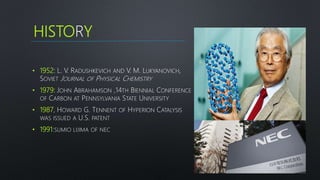
• 1952: L. V. RADUSHKEVICH AND V. M. LUKYANOVICH,
SOVIET JOURNAL OF PHYSICAL CHEMISTRY
• 1979: JOHN ABRAHAMSON ,14TH BIENNIAL CONFERENCE
OF CARBON AT PENNSYLVANIA STATE UNIVERSITY
• 1987, HOWARD G. TENNENT OF HYPERION CATALYSIS
WAS ISSUED A U.S. PATENT
• 1991:SUMIO LIJIMA OF NEC
3
What Are They?
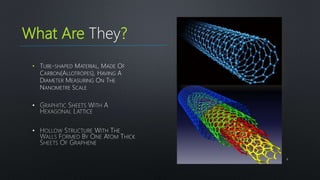
• TUBE-SHAPED MATERIAL, MADE OF
CARBON(ALLOTROPES), HAVING A
DIAMETER MEASURING ON THE
NANOMETRE SCALE
4
•
•
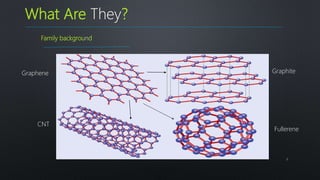
What Are They?
5
Graphene
CNT
Graphite
Fullerene
Family background
6
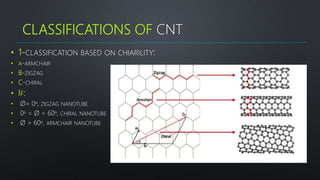
• 1-CLASSIFICATION BASED ON CHIARILITY:
• A-ARMCHAIR
• B-ZIGZAG
• C-CHIRAL
• IF:
• Ø= 0º, ZIGZAG NANOTUBE
• 0º < Ø < 60º, CHIRAL NANOTUBE
• Ø > 60º, ARMCHAIR NANOTUBE
CLASSIFICATIONS OF CNT
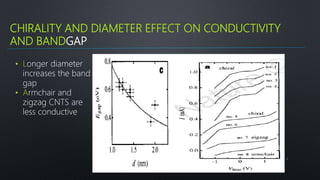
CHIRALITY AND DIAMETER EFFECT ON CONDUCTIVITY
AND BANDGAP
7
• Longer diameter
increases the band
gap
• Armchair and
zigzag CNTS are
less conductive
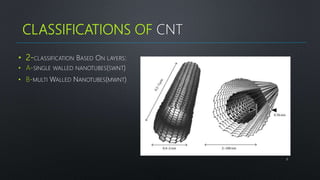
• 2-CLASSIFICATION BASED ON LAYERS:
• A-SINGLE WALLED NANOTUBES(SWNT)
• B-MULTI WALLED NANOTUBES(MWNT)
8
CLASSIFICATIONS OF CNT
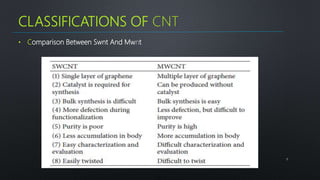
• Comparison Between Swnt And Mwnt
9
CLASSIFICATIONS OF CNT
10
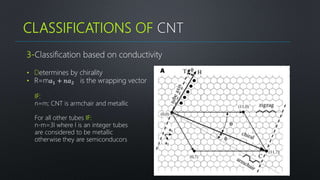
3-Classification based on conductivity
• Determines by chirality
• R=m𝑎1 + 𝑛𝑎2 is the wrapping vector
IF:
n=m; CNT is armchair and metallic
For all other tubes IF:
n-m=3l where l is an integer tubes
are considered to be metallic
otherwise they are semiconducors
PROPERTIES OF C-NANOTUBES
11
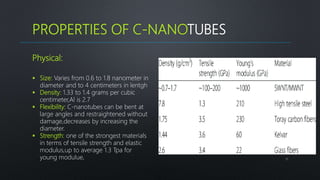
Physical:
 Size: Varies from 0.6 to 1.8 nanometer in
diameter and to 4 centimeters in lentgh
 Density: 1.33 to 1.4 grams per cubic
centimeter,Al is 2.7
 Flexibility: C-nanotubes can be bent at
large angles and restraightened without
damage,decreases by increasing the
diameter.
 Strength: one of the strongest materials
in terms of tensile strength and elastic
modulus,up to average 1.3 Tpa for
young modulue,
12
PROPERTIES OF C-NANOTUBES
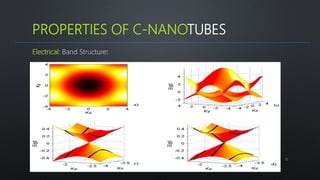
Electrical: Band Structure:
13
PROPERTIES OF C-NANOTUBES
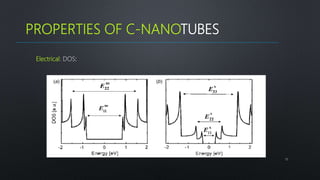
Electrical: DOS:
14
PROPERTIES OF C-NANOTUBES
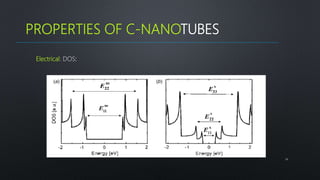
Electrical: DOS:
1515
PROPERTIES OF C-NANOTUBES
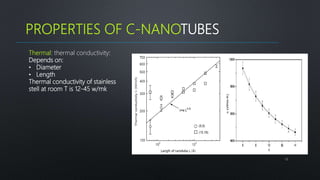
Thermal: thermal conductivity:
Depends on:
• Diameter
• Length
Thermal conductivity of stainless
stell at room T is 12-45 w/mk
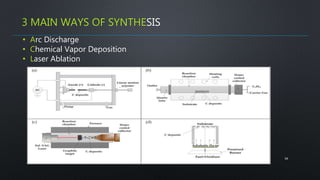
3 MAIN WAYS OF SYNTHESIS
16
• Arc Discharge
• Chemical Vapor Deposition
• Laser Ablation
17
3 MAIN WAYS OF SYNTHESIS
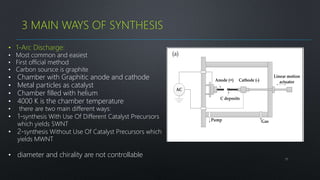
• 1-Arc Discharge:
• Most common and easiest
• First official method
• Carbon soursce is graphite
• Chamber with Graphitic anode and cathode
• Metal particles as catalyst
• Chamber filled with helium
• 4000 K is the chamber temperature
• there are two main different ways:
• 1-synthesis With Use Of Different Catalyst Precursors
which yields SWNT
• 2-synthesis Without Use Of Catalyst Precursors which
yields MWNT
• diameter and chirality are not controllable
18
3 MAIN WAYS OF SYNTHESIS
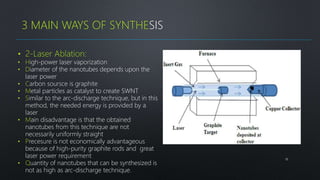
• 2-Laser Ablation:
• High-power laser vaporization
• Diameter of the nanotubes depends upon the
laser power
• Carbon soursce is graphite
• Metal particles as catalyst to create SWNT
• Similar to the arc-discharge technique, but in this
method, the needed energy is provided by a
laser
• Main disadvantage is that the obtained
nanotubes from this technique are not
necessarily uniformly straight
• Precesure is not economically advantageous
because of high-purity graphite rods and great
laser power requirement
• Quantity of nanotubes that can be synthesized is
not as high as arc-discharge technique.
19
3 MAIN WAYS OF SYNTHESIS
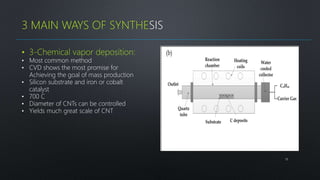
• 3-Chemical vapor deposition:
• Most common method
• CVD shows the most promise for
Achieving the goal of mass production
• Silicon substrate and iron or cobalt
catalyst
• 700 C
• Diameter of CNTs can be controlled
• Yields much great scale of CNT
APPLICATIONS:
20
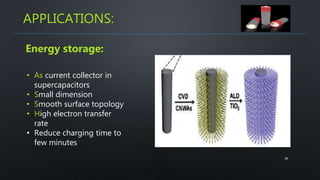
Energy storage:
• As current collector in
supercapacitors
• Small dimension
• Smooth surface topology
• High electron transfer
rate
• Reduce charging time to
few minutes
21
APPLICATIONS:
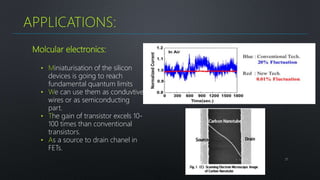
Molcular electronics:
• Miniaturisation of the silicon
devices is going to reach
fundamental quantum limits
• We can use them as conduvtive
wires or as semiconducting
part.
• The gain of transistor excels 10-
100 times than conventional
transistors.
• As a source to drain chanel in
FETs.
APPLICATIONS
22
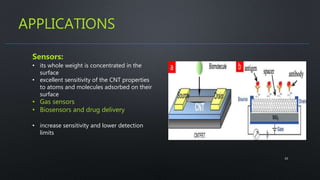
Sensors:
• its whole weight is concentrated in the
surface
• excellent sensitivity of the CNT properties
to atoms and molecules adsorbed on their
surface
• Gas sensors
• Biosensors and drug delivery
• increase sensitivity and lower detection
limits
23
APPLICATIONS
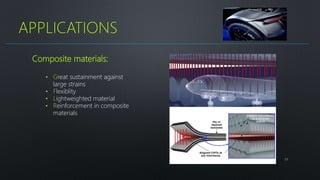
Composite materials:
• Great sustainment against
large strains
• Flexiblity
• Lightweighted material
• Reinforcement in composite
materials
24
APPLICATIONS
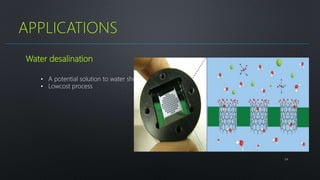
Water desalination
• A potential solution to water shortage
• Lowcost process
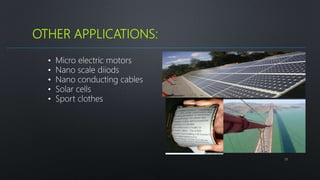
OTHER APPLICATIONS:
25
• Micro electric motors
• Nano scale diiods
• Nano conducting cables
• Solar cells
• Sport clothes
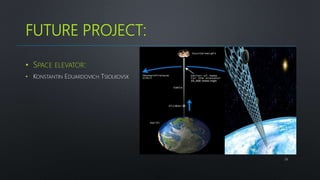
FUTURE PROJECT:
• SPACE ELEVATOR:
• KONSTANTIN EDUARDOVICH TSIOLKOVSK
26
CONCLUSION
27
• CNT opened up a host of new applications and improved our
comperhense of nano scale materials.
• Remarkable properties of CNT play an important role toward
miniaturisatoin of devices.
• Cnt is predicted to spark a seies of industrial revolutions in the
next decades as what silicon devices did in the lst decades.
• Lack of the purification method is the main reason that CNT are
not widely used nowdays and all we need are better synthesis
and pureification methods for producing large amounts.
• “The next big thing is really small”
[1]:C.H. AHN, Y. BAEK, C. LEE, S.O. KIM, S. KIM, S. LEE, S.H. KIM, S.S. BAE, J. PARK, J. YOONCARBON NANOTUBE-BASED
MEMBRANES: FABRICATION AND APPLICATION TO DESALINATION
J. IND. ENG. CHEM., 18 (5) (2012), PP. 1551-1559
28
[2]8. I. Yakobson, in Fullerenes-Recent Advances in the Chemistry and Physics of Fullerenes and Related Materials, R. S.
Ruoff and K. M. Kadish, Eds. (Electrochemical Society. Pennington. NJ. 1997). vol. 5 (97-
42). pp. 549-56
[3] S. Iijima, “Helical microtubules of graphitic carbon,” Nature, vol. 354, no. 6348, pp. 56–58, 1991.
[4] R. Hirlekar, M. Yamagar, H. Garse, M. Vij, and V. Kadam, “Carbon nanotubes and its applications: a review,” Asian
Journal of Pharmaceutical and Clinical Research, vol. 2, no. 4, pp. 17–27,
2009.
REFRENCES:
[5] B. G. P. Singh, C. Baburao, V. Pispati et al., “Carbon nanotubes. A novel drug delivery system,”International
Journal of Research in Pharmacy and Chemistry, vol. 2, no. 2, pp. 523–532, 2012.
[6] Y.Usui, H.Haniu, S. Tsuruoka, andN. Saito, “Carbon nanotubes innovate on medical technology,” Medicinal
Chemistry, vol. 2, no. 1, pp. 1–6, 2012.
[7] Y. Zhang, Y. Bai, and B.Yan, “Functionalized carbon nanotubes for potential medicinal applications,” Drug
Discovery Today, vol. 15, no. 11-12, pp. 428–435, 2010.
[8] B. Kateb, V. Yamamoto, D. Alizadeh et al., “Multi-walled carbon nanotube (MWCNT) synthesis, preparation,
labeling, and functionalization,” Methods in Molecular Biology, vol. 651, pp. 307–317, 2010.
[9] Z. Liu, X. Sun, N. Nakayama-Ratchford, and H. Dai, “Supramolecular chemistry on water-soluble carbon
nanotubes for drug loading and delivery,” ACS Nano, vol. 1, no. 1, pp.
50–56, 2007.
QUESTIONS
29
THANKS FOR YOUR ATTENTION
30

carbon nanotubes,properties and applications

  • 1.
    CARBON NANOTUEBS By: Alireza Moazzeni Supervisor: Prof.Z.Kordrostami Fall2018 1 Shiraz University Faculty Of Elecrical Engineering Department Of Micro And Nano Devices
  • 2.
    CONTENTS 2 HISTORY WHAT ARE THEY? CLASSIFICATIONSOF CNT PROPERTIES OF NANOTUBES CLASSIFICATIONS OF CNT APPLICATIONS CONCLUSION
  • 3.
    HISTORY • 1952: L.V. RADUSHKEVICH AND V. M. LUKYANOVICH, SOVIET JOURNAL OF PHYSICAL CHEMISTRY • 1979: JOHN ABRAHAMSON ,14TH BIENNIAL CONFERENCE OF CARBON AT PENNSYLVANIA STATE UNIVERSITY • 1987, HOWARD G. TENNENT OF HYPERION CATALYSIS WAS ISSUED A U.S. PATENT • 1991:SUMIO LIJIMA OF NEC 3
  • 4.
    What Are They? •TUBE-SHAPED MATERIAL, MADE OF CARBON(ALLOTROPES), HAVING A DIAMETER MEASURING ON THE NANOMETRE SCALE 4 • •
  • 5.
  • 6.
    6 • 1-CLASSIFICATION BASEDON CHIARILITY: • A-ARMCHAIR • B-ZIGZAG • C-CHIRAL • IF: • Ø= 0º, ZIGZAG NANOTUBE • 0º < Ø < 60º, CHIRAL NANOTUBE • Ø > 60º, ARMCHAIR NANOTUBE CLASSIFICATIONS OF CNT
  • 7.
    CHIRALITY AND DIAMETEREFFECT ON CONDUCTIVITY AND BANDGAP 7 • Longer diameter increases the band gap • Armchair and zigzag CNTS are less conductive
  • 8.
    • 2-CLASSIFICATION BASEDON LAYERS: • A-SINGLE WALLED NANOTUBES(SWNT) • B-MULTI WALLED NANOTUBES(MWNT) 8 CLASSIFICATIONS OF CNT
  • 9.
    • Comparison BetweenSwnt And Mwnt 9 CLASSIFICATIONS OF CNT
  • 10.
    CLASSIFICATIONS OF CNT 10 3-Classificationbased on conductivity • Determines by chirality • R=m𝑎1 + 𝑛𝑎2 is the wrapping vector IF: n=m; CNT is armchair and metallic For all other tubes IF: n-m=3l where l is an integer tubes are considered to be metallic otherwise they are semiconducors
  • 11.
    PROPERTIES OF C-NANOTUBES 11 Physical: Size: Varies from 0.6 to 1.8 nanometer in diameter and to 4 centimeters in lentgh  Density: 1.33 to 1.4 grams per cubic centimeter,Al is 2.7  Flexibility: C-nanotubes can be bent at large angles and restraightened without damage,decreases by increasing the diameter.  Strength: one of the strongest materials in terms of tensile strength and elastic modulus,up to average 1.3 Tpa for young modulue,
  • 12.
  • 13.
  • 14.
  • 15.
    1515 PROPERTIES OF C-NANOTUBES Thermal:thermal conductivity: Depends on: • Diameter • Length Thermal conductivity of stainless stell at room T is 12-45 w/mk
  • 16.
    3 MAIN WAYSOF SYNTHESIS 16 • Arc Discharge • Chemical Vapor Deposition • Laser Ablation
  • 17.
    17 3 MAIN WAYSOF SYNTHESIS • 1-Arc Discharge: • Most common and easiest • First official method • Carbon soursce is graphite • Chamber with Graphitic anode and cathode • Metal particles as catalyst • Chamber filled with helium • 4000 K is the chamber temperature • there are two main different ways: • 1-synthesis With Use Of Different Catalyst Precursors which yields SWNT • 2-synthesis Without Use Of Catalyst Precursors which yields MWNT • diameter and chirality are not controllable
  • 18.
    18 3 MAIN WAYSOF SYNTHESIS • 2-Laser Ablation: • High-power laser vaporization • Diameter of the nanotubes depends upon the laser power • Carbon soursce is graphite • Metal particles as catalyst to create SWNT • Similar to the arc-discharge technique, but in this method, the needed energy is provided by a laser • Main disadvantage is that the obtained nanotubes from this technique are not necessarily uniformly straight • Precesure is not economically advantageous because of high-purity graphite rods and great laser power requirement • Quantity of nanotubes that can be synthesized is not as high as arc-discharge technique.
  • 19.
    19 3 MAIN WAYSOF SYNTHESIS • 3-Chemical vapor deposition: • Most common method • CVD shows the most promise for Achieving the goal of mass production • Silicon substrate and iron or cobalt catalyst • 700 C • Diameter of CNTs can be controlled • Yields much great scale of CNT
  • 20.
    APPLICATIONS: 20 Energy storage: • Ascurrent collector in supercapacitors • Small dimension • Smooth surface topology • High electron transfer rate • Reduce charging time to few minutes
  • 21.
    21 APPLICATIONS: Molcular electronics: • Miniaturisationof the silicon devices is going to reach fundamental quantum limits • We can use them as conduvtive wires or as semiconducting part. • The gain of transistor excels 10- 100 times than conventional transistors. • As a source to drain chanel in FETs.
  • 22.
    APPLICATIONS 22 Sensors: • its wholeweight is concentrated in the surface • excellent sensitivity of the CNT properties to atoms and molecules adsorbed on their surface • Gas sensors • Biosensors and drug delivery • increase sensitivity and lower detection limits
  • 23.
    23 APPLICATIONS Composite materials: • Greatsustainment against large strains • Flexiblity • Lightweighted material • Reinforcement in composite materials
  • 24.
    24 APPLICATIONS Water desalination • Apotential solution to water shortage • Lowcost process
  • 25.
    OTHER APPLICATIONS: 25 • Microelectric motors • Nano scale diiods • Nano conducting cables • Solar cells • Sport clothes
  • 26.
    FUTURE PROJECT: • SPACEELEVATOR: • KONSTANTIN EDUARDOVICH TSIOLKOVSK 26
  • 27.
    CONCLUSION 27 • CNT openedup a host of new applications and improved our comperhense of nano scale materials. • Remarkable properties of CNT play an important role toward miniaturisatoin of devices. • Cnt is predicted to spark a seies of industrial revolutions in the next decades as what silicon devices did in the lst decades. • Lack of the purification method is the main reason that CNT are not widely used nowdays and all we need are better synthesis and pureification methods for producing large amounts. • “The next big thing is really small”
  • 28.
    [1]:C.H. AHN, Y.BAEK, C. LEE, S.O. KIM, S. KIM, S. LEE, S.H. KIM, S.S. BAE, J. PARK, J. YOONCARBON NANOTUBE-BASED MEMBRANES: FABRICATION AND APPLICATION TO DESALINATION J. IND. ENG. CHEM., 18 (5) (2012), PP. 1551-1559 28 [2]8. I. Yakobson, in Fullerenes-Recent Advances in the Chemistry and Physics of Fullerenes and Related Materials, R. S. Ruoff and K. M. Kadish, Eds. (Electrochemical Society. Pennington. NJ. 1997). vol. 5 (97- 42). pp. 549-56 [3] S. Iijima, “Helical microtubules of graphitic carbon,” Nature, vol. 354, no. 6348, pp. 56–58, 1991. [4] R. Hirlekar, M. Yamagar, H. Garse, M. Vij, and V. Kadam, “Carbon nanotubes and its applications: a review,” Asian Journal of Pharmaceutical and Clinical Research, vol. 2, no. 4, pp. 17–27, 2009. REFRENCES: [5] B. G. P. Singh, C. Baburao, V. Pispati et al., “Carbon nanotubes. A novel drug delivery system,”International Journal of Research in Pharmacy and Chemistry, vol. 2, no. 2, pp. 523–532, 2012. [6] Y.Usui, H.Haniu, S. Tsuruoka, andN. Saito, “Carbon nanotubes innovate on medical technology,” Medicinal Chemistry, vol. 2, no. 1, pp. 1–6, 2012. [7] Y. Zhang, Y. Bai, and B.Yan, “Functionalized carbon nanotubes for potential medicinal applications,” Drug Discovery Today, vol. 15, no. 11-12, pp. 428–435, 2010. [8] B. Kateb, V. Yamamoto, D. Alizadeh et al., “Multi-walled carbon nanotube (MWCNT) synthesis, preparation, labeling, and functionalization,” Methods in Molecular Biology, vol. 651, pp. 307–317, 2010. [9] Z. Liu, X. Sun, N. Nakayama-Ratchford, and H. Dai, “Supramolecular chemistry on water-soluble carbon nanotubes for drug loading and delivery,” ACS Nano, vol. 1, no. 1, pp. 50–56, 2007.
  • 29.
  • 30.
    THANKS FOR YOURATTENTION 30