BY: INDRANEEL MAJUMDAR & ANJANI KUMAR
(5th SEMESTER, MECHANICAL ENGG,PCE RKL).
 Introduction
 Discovery
 Carbon Nanotubes (CNTs)
 Types
 Methods of synthesis
 Properties
 Applications
 Obstacles
 Conclusion
 Reference
Carbon nanotube (CNTS) were first discovered
in 1991 by the Japanese electron
microscopist Sumio Iijima who was studying
the material deposited on the cathode during
the arc-evaporation synthesis of fullerenes.
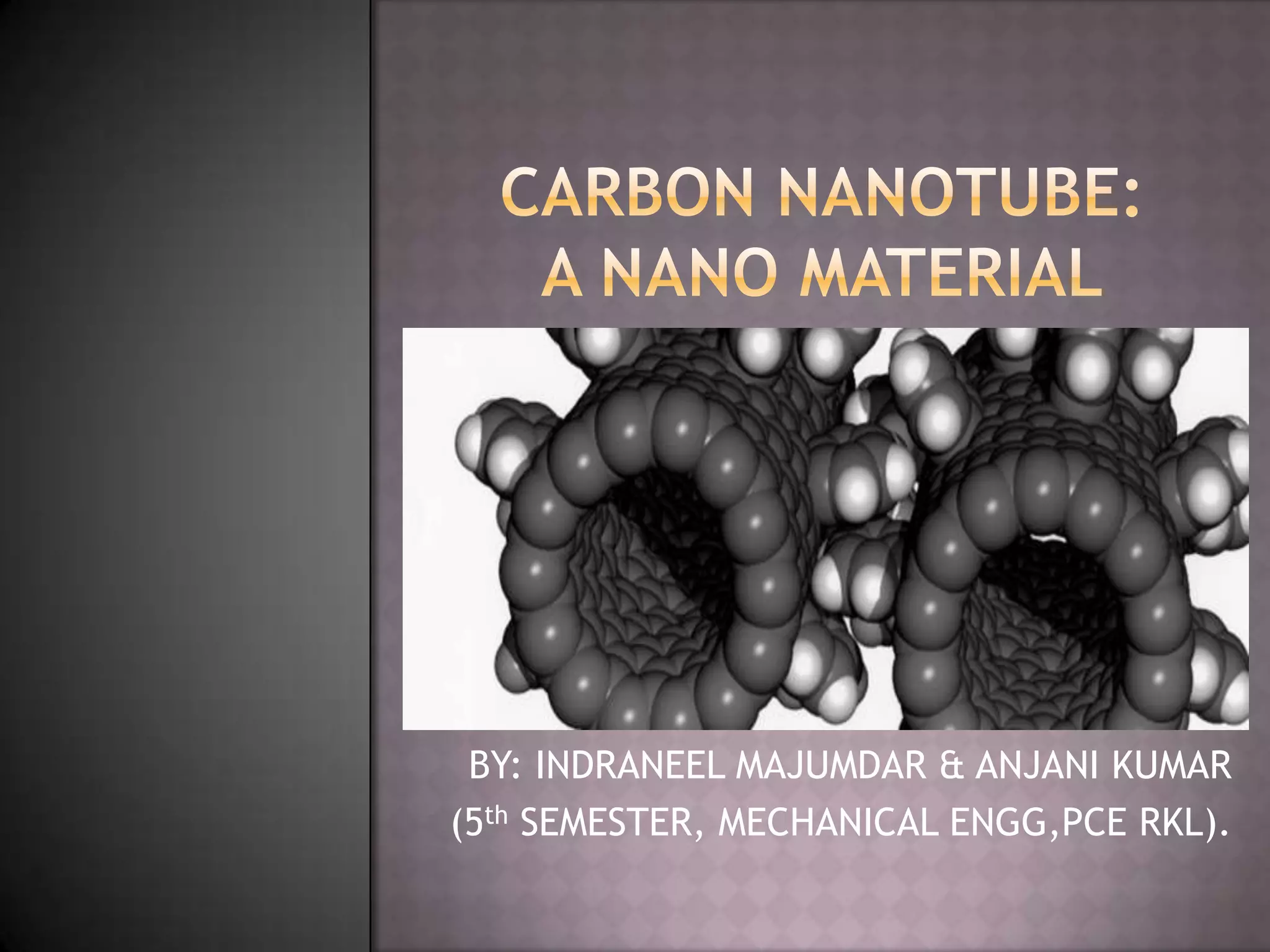
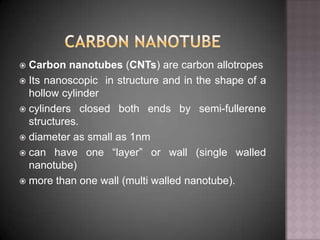
 Carbon nanotubes (CNTs) are carbon allotropes
 Its nanoscopic in structure and in the shape of a
hollow cylinder
 cylinders closed both ends by semi-fullerene
structures.
 diameter as small as 1nm
 can have one “layer” or wall (single walled
nanotube)
 more than one wall (multi walled nanotube).
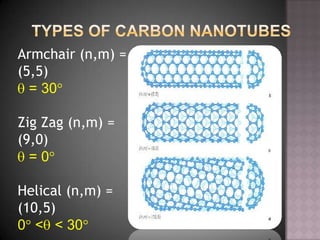
Armchair (n,m) =
(5,5)
= 30
Zig Zag (n,m) =
(9,0)
= 0
Helical (n,m) =
(10,5)
0 < < 30
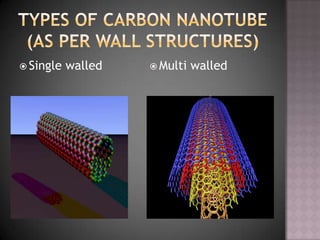
 Single walled  Multi walled
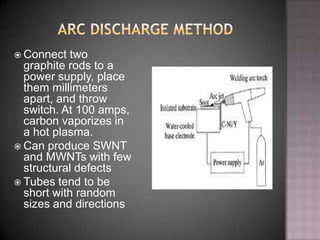
 Connect two
graphite rods to a
power supply, place
them millimeters
apart, and throw
switch. At 100 amps,
carbon vaporizes in
a hot plasma.
 Can produce SWNT
and MWNTs with few
structural defects
 Tubes tend to be
short with random
sizes and directions
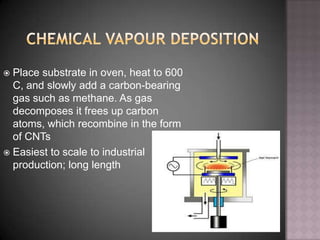
 Place substrate in oven, heat to 600
C, and slowly add a carbon-bearing
gas such as methane. As gas
decomposes it frees up carbon
atoms, which recombine in the form
of CNTs
 Easiest to scale to industrial
production; long length
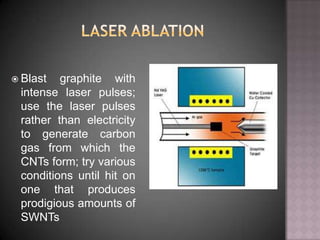
 Blast graphite with
intense laser pulses;
use the laser pulses
rather than electricity
to generate carbon
gas from which the
CNTs form; try various
conditions until hit on
one that produces
prodigious amounts of
SWNTs
 Extremely high Young’s modulus
 200x stronger than steel of the same
diameter
 The first synthetic material to have
greater strength than spider silk
 Excellent conductors of electricity and
heat
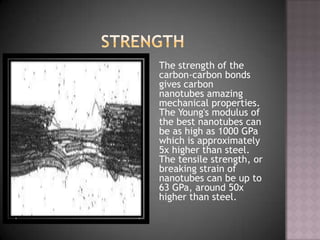
The strength of the
carbon-carbon bonds
gives carbon
nanotubes amazing
mechanical properties.
The Young's modulus of
the best nanotubes can
be as high as 1000 GPa
which is approximately
5x higher than steel.
The tensile strength, or
breaking strain of
nanotubes can be up to
63 GPa, around 50x
higher than steel.
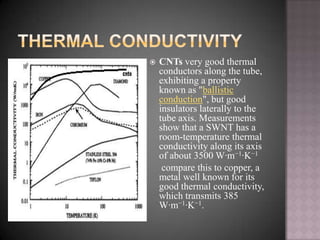
 CNTs very good thermal
conductors along the tube,
exhibiting a property
known as "ballistic
conduction", but good
insulators laterally to the
tube axis. Measurements
show that a SWNT has a
room-temperature thermal
conductivity along its axis
of about 3500 W·m−1·K−1
compare this to copper, a
metal well known for its
good thermal conductivity,
which transmits 385
W·m−1·K−1.
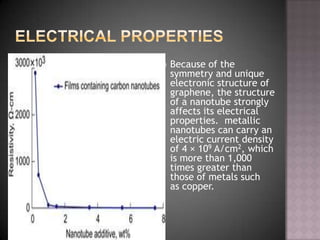
 Because of the
symmetry and unique
electronic structure of
graphene, the structure
of a nanotube strongly
affects its electrical
properties. metallic
nanotubes can carry an
electric current density
of 4 × 10⁹ A/cm2, which
is more than 1,000
times greater than
those of metals such
as copper.
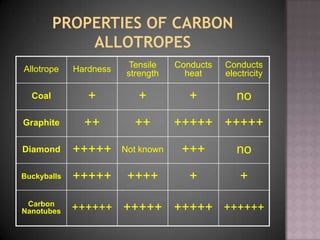
++++++
+
no
+++++
no
Conducts
electricity
++++++++++Buckyballs
++++++++++++++++Carbon
Nanotubes
+++Not known+++++Diamond
+++++++++Graphite
+++Coal
Conducts
heat
Tensile
strengthHardnessAllotrope
Water filters
Bullet proof vest
 Lack of vision to identify those aspects that
could be changed through its use.
 Lack of skilled personnel.
 Level of Investment.
Their mechanical properties, and unique
electronic properties make them both
interesting & useful in future
technologies, but growth mechanisms yet
to be fully established.
 http://www.ipt.arc.nasa.gov
 http://www.mknano.com
 www.nanohub.org
 www.wikipedia.com
 Carbon nanotubes science and
applications BY M.Meyyapan
Carbon nanotube

Carbon nanotube

  • 1.
    BY: INDRANEEL MAJUMDAR& ANJANI KUMAR (5th SEMESTER, MECHANICAL ENGG,PCE RKL).
  • 2.
     Introduction  Discovery Carbon Nanotubes (CNTs)  Types  Methods of synthesis  Properties  Applications  Obstacles  Conclusion  Reference
  • 4.
    Carbon nanotube (CNTS)were first discovered in 1991 by the Japanese electron microscopist Sumio Iijima who was studying the material deposited on the cathode during the arc-evaporation synthesis of fullerenes.
  • 5.
     Carbon nanotubes(CNTs) are carbon allotropes  Its nanoscopic in structure and in the shape of a hollow cylinder  cylinders closed both ends by semi-fullerene structures.  diameter as small as 1nm  can have one “layer” or wall (single walled nanotube)  more than one wall (multi walled nanotube).
  • 6.
    Armchair (n,m) = (5,5) =30 Zig Zag (n,m) = (9,0) = 0 Helical (n,m) = (10,5) 0 < < 30
  • 7.
     Single walled Multi walled
  • 9.
     Connect two graphiterods to a power supply, place them millimeters apart, and throw switch. At 100 amps, carbon vaporizes in a hot plasma.  Can produce SWNT and MWNTs with few structural defects  Tubes tend to be short with random sizes and directions
  • 10.
     Place substratein oven, heat to 600 C, and slowly add a carbon-bearing gas such as methane. As gas decomposes it frees up carbon atoms, which recombine in the form of CNTs  Easiest to scale to industrial production; long length
  • 11.
     Blast graphitewith intense laser pulses; use the laser pulses rather than electricity to generate carbon gas from which the CNTs form; try various conditions until hit on one that produces prodigious amounts of SWNTs
  • 12.
     Extremely highYoung’s modulus  200x stronger than steel of the same diameter  The first synthetic material to have greater strength than spider silk  Excellent conductors of electricity and heat
  • 13.
    The strength ofthe carbon-carbon bonds gives carbon nanotubes amazing mechanical properties. The Young's modulus of the best nanotubes can be as high as 1000 GPa which is approximately 5x higher than steel. The tensile strength, or breaking strain of nanotubes can be up to 63 GPa, around 50x higher than steel.
  • 14.
     CNTs verygood thermal conductors along the tube, exhibiting a property known as "ballistic conduction", but good insulators laterally to the tube axis. Measurements show that a SWNT has a room-temperature thermal conductivity along its axis of about 3500 W·m−1·K−1 compare this to copper, a metal well known for its good thermal conductivity, which transmits 385 W·m−1·K−1.
  • 15.
     Because ofthe symmetry and unique electronic structure of graphene, the structure of a nanotube strongly affects its electrical properties. metallic nanotubes can carry an electric current density of 4 × 10⁹ A/cm2, which is more than 1,000 times greater than those of metals such as copper.
  • 16.
  • 18.
  • 20.
     Lack ofvision to identify those aspects that could be changed through its use.  Lack of skilled personnel.  Level of Investment.
  • 21.
    Their mechanical properties,and unique electronic properties make them both interesting & useful in future technologies, but growth mechanisms yet to be fully established.
  • 22.
     http://www.ipt.arc.nasa.gov  http://www.mknano.com www.nanohub.org  www.wikipedia.com  Carbon nanotubes science and applications BY M.Meyyapan