THE CARBON CYCLE
What Is Carbon?
 An element
 The basis of life of earth
 Found in rocks, oceans, atmosphere
Carbon cycle is the process where carbon compounds are
interchanged among the biosphere, geosphere,
pedosphere, hydrosphere, and atmosphere of the earth.
Carbon Cycle
 Carbon cycle shows the movement of carbon
in elemental and combined states on
earth. Diamond and graphite are the
elemental forms of carbon and in a
combined state, it is found as carbonates
in minerals and as carbon dioxide gas in
the atmosphere.
Carbon Cycle
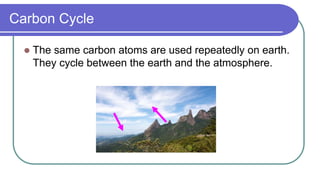
 The same carbon atoms are used repeatedly on earth.
They cycle between the earth and the atmosphere.
Plants Use Carbon Dioxide
 Plants pull carbon dioxide from the atmosphere and use
it to make food –— photosynthesis.
 The carbon becomes part of the plant (stored food).
Animals Eat Plants
 When organisms eat plants, they take in the carbon and
some of it becomes part of their own bodies.
Plants and Animals Die
 When plants and animals die, most of their bodies are
decomposed and carbon atoms are returned to the
atmosphere.
 Some are not decomposed fully and end up in deposits
underground (oil, coal, etc.).
Carbon Slowly Returns to Atmosphere
 Carbon in rocks and underground deposits is released
very slowly into the atmosphere.
 This process takes many years.
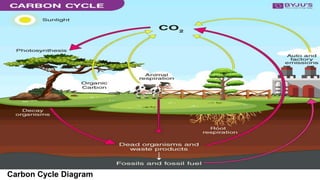
Carbon Cycle Diagram
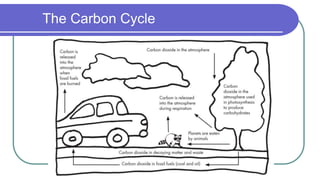
The Carbon Cycle
Carbon Cycle Steps
Following are the major steps involved in the process of
the carbon cycle:
1.Carbon present in the atmosphere is absorbed by plants
for photosynthesis.
2.These plants are then consumed by animals and carbon gets
bioaccumulated into their bodies.
3.These animals and plants eventually die, and upon
decomposing, carbon is released back into the atmosphere.
4.Some of the carbon that is not released back into the
atmosphere eventually become fossil fuels.
5.These fossil fuels are then used for man-made activities,
which pump more carbon back into the atmosphere.
Cycle – Repeats Over and Over and
Over and Over …
It’s not necessarily in a circle
but cycles throughout.
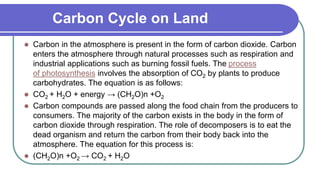
Carbon Cycle on Land
 Carbon in the atmosphere is present in the form of carbon dioxide. Carbon
enters the atmosphere through natural processes such as respiration and
industrial applications such as burning fossil fuels. The process
of photosynthesis involves the absorption of CO2 by plants to produce
carbohydrates. The equation is as follows:
 CO2 + H2O + energy → (CH2O)n +O2
 Carbon compounds are passed along the food chain from the producers to
consumers. The majority of the carbon exists in the body in the form of
carbon dioxide through respiration. The role of decomposers is to eat the
dead organism and return the carbon from their body back into the
atmosphere. The equation for this process is:
 (CH2O)n +O2 → CO2 + H2O
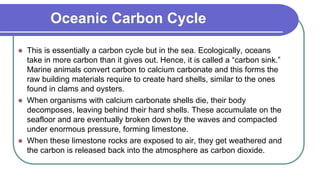
Oceanic Carbon Cycle
 This is essentially a carbon cycle but in the sea. Ecologically, oceans
take in more carbon than it gives out. Hence, it is called a “carbon sink.”
Marine animals convert carbon to calcium carbonate and this forms the
raw building materials require to create hard shells, similar to the ones
found in clams and oysters.
 When organisms with calcium carbonate shells die, their body
decomposes, leaving behind their hard shells. These accumulate on the
seafloor and are eventually broken down by the waves and compacted
under enormous pressure, forming limestone.
 When these limestone rocks are exposed to air, they get weathered and
the carbon is released back into the atmosphere as carbon dioxide.
Carbon in Oceans
 Additional carbon is stored in the ocean.
 Many animals pull carbon from water to use in
shells, etc.
 Animals die and carbon substances are
deposited at the bottom of the ocean.
 Oceans contain earth’s largest store of carbon.
Importance of Carbon Cycle
 Even though carbon dioxide is found in small traces in the
atmosphere, it plays a vital role in balancing the energy and traps
the long-wave radiations from the sun. Therefore, it acts like a
blanket over the planet. If the carbon cycle is disturbed it will result
in serious consequences such as climatic changes and global
warming.
 Carbon is an integral component of every life form on earth. From
proteins and lipids to even our DNA. Furthermore, all known life on
earth is based on carbon. Hence, the carbon cycle, along with the
nitrogen cycle and oxygen cycle, plays a vital role in the existence
of life on earth.
Human Impact
 Fossil fuels release carbon stores very slowly
 Burning anything releases more carbon into
atmosphere — especially fossil fuels
 Increased carbon dioxide in atmosphere increases
global warming
 Fewer plants mean less CO2 removed from
atmosphere

THE-CARBON-CYCLE.pptx

  • 1.
  • 2.
    What Is Carbon? An element  The basis of life of earth  Found in rocks, oceans, atmosphere Carbon cycle is the process where carbon compounds are interchanged among the biosphere, geosphere, pedosphere, hydrosphere, and atmosphere of the earth.
  • 3.
    Carbon Cycle  Carboncycle shows the movement of carbon in elemental and combined states on earth. Diamond and graphite are the elemental forms of carbon and in a combined state, it is found as carbonates in minerals and as carbon dioxide gas in the atmosphere.
  • 4.
    Carbon Cycle  Thesame carbon atoms are used repeatedly on earth. They cycle between the earth and the atmosphere.
  • 5.
    Plants Use CarbonDioxide  Plants pull carbon dioxide from the atmosphere and use it to make food –— photosynthesis.  The carbon becomes part of the plant (stored food).
  • 6.
    Animals Eat Plants When organisms eat plants, they take in the carbon and some of it becomes part of their own bodies.
  • 7.
    Plants and AnimalsDie  When plants and animals die, most of their bodies are decomposed and carbon atoms are returned to the atmosphere.  Some are not decomposed fully and end up in deposits underground (oil, coal, etc.).
  • 8.
    Carbon Slowly Returnsto Atmosphere  Carbon in rocks and underground deposits is released very slowly into the atmosphere.  This process takes many years.
  • 9.
  • 10.
  • 11.
    Carbon Cycle Steps Followingare the major steps involved in the process of the carbon cycle: 1.Carbon present in the atmosphere is absorbed by plants for photosynthesis. 2.These plants are then consumed by animals and carbon gets bioaccumulated into their bodies. 3.These animals and plants eventually die, and upon decomposing, carbon is released back into the atmosphere. 4.Some of the carbon that is not released back into the atmosphere eventually become fossil fuels. 5.These fossil fuels are then used for man-made activities, which pump more carbon back into the atmosphere.
  • 12.
    Cycle – RepeatsOver and Over and Over and Over … It’s not necessarily in a circle but cycles throughout.
  • 13.
    Carbon Cycle onLand  Carbon in the atmosphere is present in the form of carbon dioxide. Carbon enters the atmosphere through natural processes such as respiration and industrial applications such as burning fossil fuels. The process of photosynthesis involves the absorption of CO2 by plants to produce carbohydrates. The equation is as follows:  CO2 + H2O + energy → (CH2O)n +O2  Carbon compounds are passed along the food chain from the producers to consumers. The majority of the carbon exists in the body in the form of carbon dioxide through respiration. The role of decomposers is to eat the dead organism and return the carbon from their body back into the atmosphere. The equation for this process is:  (CH2O)n +O2 → CO2 + H2O
  • 14.
    Oceanic Carbon Cycle This is essentially a carbon cycle but in the sea. Ecologically, oceans take in more carbon than it gives out. Hence, it is called a “carbon sink.” Marine animals convert carbon to calcium carbonate and this forms the raw building materials require to create hard shells, similar to the ones found in clams and oysters.  When organisms with calcium carbonate shells die, their body decomposes, leaving behind their hard shells. These accumulate on the seafloor and are eventually broken down by the waves and compacted under enormous pressure, forming limestone.  When these limestone rocks are exposed to air, they get weathered and the carbon is released back into the atmosphere as carbon dioxide.
  • 15.
    Carbon in Oceans Additional carbon is stored in the ocean.  Many animals pull carbon from water to use in shells, etc.  Animals die and carbon substances are deposited at the bottom of the ocean.  Oceans contain earth’s largest store of carbon.
  • 16.
    Importance of CarbonCycle  Even though carbon dioxide is found in small traces in the atmosphere, it plays a vital role in balancing the energy and traps the long-wave radiations from the sun. Therefore, it acts like a blanket over the planet. If the carbon cycle is disturbed it will result in serious consequences such as climatic changes and global warming.  Carbon is an integral component of every life form on earth. From proteins and lipids to even our DNA. Furthermore, all known life on earth is based on carbon. Hence, the carbon cycle, along with the nitrogen cycle and oxygen cycle, plays a vital role in the existence of life on earth.
  • 17.
    Human Impact  Fossilfuels release carbon stores very slowly  Burning anything releases more carbon into atmosphere — especially fossil fuels  Increased carbon dioxide in atmosphere increases global warming  Fewer plants mean less CO2 removed from atmosphere