Water quality: Water in pure form is not found in nature. It is a best solvent and attract 
a lot of impurities. Rain water is assumed to be pure, even water vapor condensing in 
the air Contains solids, dissolved gases and salts. As it touch surface, percolating into 
the soil or runoff occurs, some contaminants may be removed while new one will be 
added. The materials found in water are living organisms, solids, dissolved organic 
and inorganic. Some of these are harmless and desired for health while others are 
harmful. Drinking water or potable water is water of sufficiently high quality that it can 
be used without risk of immediate or for long term safe for drinking , pleasant in taste 
and suitable for domestic use. Such water may be unsuitable for some industrial use. 
Contaminated or Polluted water is one which contains suspended or dissolved 
materials which makes it unsuitable for its intended use. Two types of criteria is used 
for for drinking water quality. One is the World health Organization Guidelines and 
another is the Standards adopted a number of countries. 
World Health Organization Guidelines: These are the guidelines related to human 
health and is advisable for developing as well as for developed counties for adaptation. 
There is no compulsion for a country either to adopt it or not. It help member countries 
of WHO to adopt it and provide safe water to community. 
Standards : A number of countries developed their own criteria for drinking water. 
This criteria is termed as standards. In these standards some are adoptable by the 
agency providing water and other are advisable.
Drinking water standards are of two categories. Primary standards and Secondary 
standards 
Primary Standards: The standards which are enforceable by Govt. Agency for protection 
of human health are known as primary standards. These standards specify the Maximum 
Contaminants Levels (MCLs) based on health related criteria for drinking water . In setting 
the MCLs the authorized agency is to balance the public health benefits of the standards 
against the technology available and economically feasible. The water supply authorities 
who violate these standards are to face punishment. e.g. Arsenic 0.05 mg/L; Mercury 
0.002 mg/L; Beryllium 0.001 mg/L 
• Secondary Standards. These standards are unenforceable guidelines based on aesthetic 
like color, taste and odor for drinking water. It is up to the water supply agency either to 
adopt it or not. Such sets of unenforceable levels are known as Maximum Contaminant 
Level Goals (MCLGs). These goals are set at levels that present no known health 
effects, including a margin of safety , regardless of technological feasibility or cost. Like; 
Arsenic 0 mg/L; Mercury 0.002 mg/L; Beryllium 0. mg/L
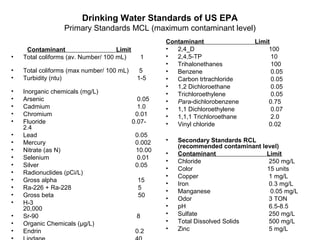
Drinking Water Standards of US EPA 
Primary Standards MCL (maximum contaminant level) 
Contaminant Limit 
• Total coliforms (av. Number/ 100 mL) 1 
• Total coliforms (max number/ 100 mL) 5 
• Turbidity (ntu) 1-5 
• Inorganic chemicals (mg/L) 
• Arsenic 0.05 
• Cadmium 1.0 
• Chromium 0.01 
• Fluoride 0.07- 
2.4 
• Lead 0.05 
• Mercury 0.002 
• Nitrate (as N) 10.00 
• Selenium 0.01 
• Silver 0.05 
• Radionuclides (pCi/L) 
• Gross alpha 15 
• Ra-226 + Ra-228 5 
• Gross beta 50 
• H-3 
20,000 
• Sr-90 8 
• Organic Chemicals (μg/L) 
• Endrin 0.2 
• Lindane 40 
Contaminant Limit 
• 2,4_D 100 
• 2,4,5-TP 10 
• Trihalonethanes 100 
• Benzene 0.05 
• Carbon trtrachloride 0.05 
• 1,2 Dichloroethane 0.05 
• Trichloroethylene 0.05 
• Para-dichlorobenzene 0.75 
• 1,1 Dichloroethylene 0.07 
• 1,1,1 Trichloroethane 2.0 
• Vinyl chloride 0.02 
• Secondary Standards RCL 
(recommended contaminant level) 
• Contaminant Limit 
• Chloride 250 mg/L 
• Color 15 units 
• Copper 1 mg/L 
• Iron 0.3 mg/L 
• Manganese 0.05 mg/L 
• Odor 3 TON 
• pH 6.5-8.5 
• Sulfate 250 mg/L 
• Total Dissolved Solids 500 mg/L 
• Zinc 5 mg/L
• Monitoring: water supply schemes are required to provide safe drinking water to community. 
There are standards and guidelines established by various countries/organizations that 
guarantee provision of safe water free of contaminants that have negative health effect when 
using such water. To minimize negative impact of impurity in drinking water regular sampling and 
analyzing of water quality is essential. The purpose of water quality monitoring is to check the 
physical, chemical and biological characteristics either they are suitable for intended purposes 
like drinking, swimming, irrigation ,industrial purposes or not. To regular analyze samples of 
water from different sources like surface or ground water and compared it with available 
standards are known water quality monitoring. Monitoring is essential for continuous record for 
department. If there is any contaminant or a group of contaminants present in drinking water 
then mitigation measures are required to eradicate or minimize these contaminants. A regular 
monitoring is required to check that water supply system meets public health standards or not. 
Monitoring requirements vary for the following reasons. 
• (i) Regulations of a country drinking water agencies specify samples locations and acceptable analytical 
methods. (ii) Identify whether the quality of water is fulfilled the requirements used for intended purpose or 
not. (iii) The frequency of monitoring for a contaminant may vary based on the type of water source. (iv) 
Surface water system need monitoring more frequently than ground water because of the occurrence of 
contaminants are more variable over time.(v) characterize waters and identify changes or trends in water 
quality over time (vi) identify specific existing or emerging water quality problems. The source of water if 
do not detect or detect at low levels can monitor less frequently.
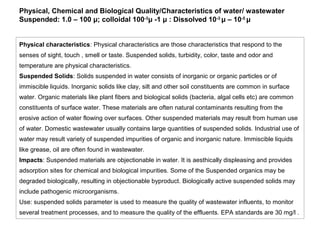
Physical, Chemical and Biological Quality/Characteristics of water/ wastewater 
Suspended: 1.0 – 100 μ; colloidal 100-3μ -1 μ : Dissolved 10-3 μ – 10-5 μ 
Physical characteristics: Physical characteristics are those characteristics that respond to the 
senses of sight, touch , smell or taste. Suspended solids, turbidity, color, taste and odor and 
temperature are physical characteristics. 
Suspended Solids: Solids suspended in water consists of inorganic or organic particles or of 
immiscible liquids. Inorganic solids like clay, silt and other soil constituents are common in surface 
water. Organic materials like plant fibers and biological solids (bacteria, algal cells etc) are common 
constituents of surface water. These materials are often natural contaminants resulting from the 
erosive action of water flowing over surfaces. Other suspended materials may result from human use 
of water. Domestic wastewater usually contains large quantities of suspended solids. Industrial use of 
water may result variety of suspended impurities of organic and inorganic nature. Immiscible liquids 
like grease, oil are often found in wastewater. 
Impacts: Suspended materials are objectionable in water. It is aesthically displeasing and provides 
adsorption sites for chemical and biological impurities. Some of the Suspended organics may be 
degraded biologically, resulting in objectionable byproduct. Biologically active suspended solids may 
include pathogenic microorganisms. 
Use: suspended solids parameter is used to measure the quality of wastewater influents, to monitor 
several treatment processes, and to measure the quality of the effluents. EPA standards are 30 mg/l .
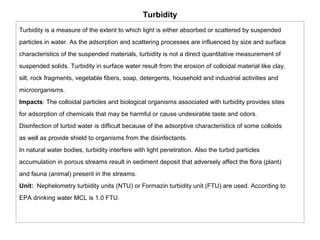
Turbidity 
Turbidity is a measure of the extent to which light is either absorbed or scattered by suspended 
particles in water. As the adsorption and scattering processes are influenced by size and surface 
characteristics of the suspended materials, turbidity is not a direct quantitative measurement of 
suspended solids. Turbidity in surface water result from the erosion of colloidal material like clay, 
silt, rock fragments, vegetable fibers, soap, detergents, household and industrial activities and 
microorganisms. 
Impacts: The colloidal particles and biological organisms associated with turbidity provides sites 
for adsorption of chemicals that may be harmful or cause undesirable taste and odors. 
Disinfection of turbid water is difficult because of the adsorptive characteristics of some colloids 
as well as provide shield to organisms from the disinfectants. 
In natural water bodies, turbidity interfere with light penetration. Also the turbid particles 
accumulation in porous streams result in sediment deposit that adversely affect the flora (plant) 
and fauna (animal) present in the streams. 
Unit: Nephelometry turbidity units (NTU) or Formazin turbidity unit (FTU) are used. According to 
EPA drinking water MCL is 1.0 FTU.
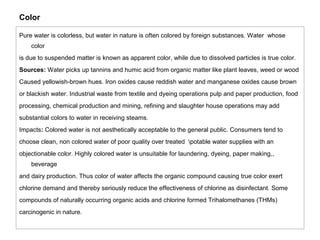
Color 
Pure water is colorless, but water in nature is often colored by foreign substances. Water whose 
color 
is due to suspended matter is known as apparent color, while due to dissolved particles is true color. 
Sources: Water picks up tannins and humic acid from organic matter like plant leaves, weed or wood 
Caused yellowish-brown hues. Iron oxides cause reddish water and manganese oxides cause brown 
or blackish water. Industrial waste from textile and dyeing operations pulp and paper production, food 
processing, chemical production and mining, refining and slaughter house operations may add 
substantial colors to water in receiving steams. 
Impacts: Colored water is not aesthetically acceptable to the general public. Consumers tend to 
choose clean, non colored water of poor quality over treated potable water supplies with an 
objectionable color. Highly colored water is unsuitable for laundering, dyeing, paper making,, 
beverage 
and dairy production. Thus color of water affects the organic compound causing true color exert 
chlorine demand and thereby seriously reduce the effectiveness of chlorine as disinfectant. Some 
compounds of naturally occurring organic acids and chlorine formed Trihalomethanes (THMs) 
carcinogenic in nature.
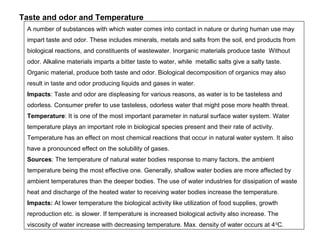
Taste and odor and Temperature 
A number of substances with which water comes into contact in nature or during human use may 
impart taste and odor. These includes minerals, metals and salts from the soil, end products from 
biological reactions, and constituents of wastewater. Inorganic materials produce taste Without 
odor. Alkaline materials imparts a bitter taste to water, while metallic salts give a salty taste. 
Organic material, produce both taste and odor. Biological decomposition of organics may also 
result in taste and odor producing liquids and gases in water. 
Impacts: Taste and odor are displeasing for various reasons, as water is to be tasteless and 
odorless. Consumer prefer to use tasteless, odorless water that might pose more health threat. 
Temperature: It is one of the most important parameter in natural surface water system. Water 
temperature plays an important role in biological species present and their rate of activity. 
Temperature has an effect on most chemical reactions that occur in natural water system. It also 
have a pronounced effect on the solubility of gases. 
Sources: The temperature of natural water bodies response to many factors, the ambient 
temperature being the most effective one. Generally, shallow water bodies are more affected by 
ambient temperatures than the deeper bodies. The use of water industries for dissipation of waste 
heat and discharge of the heated water to receiving water bodies increase the temperature. 
Impacts: At lower temperature the biological activity like utilization of food supplies, growth 
reproduction etc. is slower. If temperature is increased biological activity also increase. The 
viscosity of water increase with decreasing temperature. Max. density of water occurs at 40C.
Chemical characteristics of water 
Chemical parameters are related to the solvent capabilities of water. Total Dissolved Solids (TDS) 
alkalinity, pH, hardness, Organic and inorganic dissolved impurities are the chemical characteristics. 
TDS: The materials left in water after filtration for the suspended solids are dissolved 
solids. This materials are left as a solid residue upon evaporation of the water. TDS is expressed in 
mg/ l. The organic fraction can be measured by heating the TDS at 550± 50 C0. The organic residues 
will be evaporated while inorganic residues will be converted into ashes. TDS = Organic + inorganic 
thus organic residues = TDS - inorganic 
Sources: Dissolved solids result from solvent action of water on solids., liquid and gases. Dissolved 
solids may be either organic like decay products of vegetation, from chemicals and from organic 
gases. The inorganic dissolved in water are minerals, metals and gases which come in contact with 
these substances in atmosphere on surface and within the soil. Materials from decay products of 
vegetation, chemicals and gases are organic sources. 
Impacts:- Dissolved minerals, gases and organic constituents may be producing displeasing color, 
taste and odor. Some chemicals may be toxic and carcinogenic. 
Alkalinity: Alkalinity is the quantity of ions that will react to neutralize hydrogen ions. Thus it is a 
measure of the ability of water to neutralize acids. 
Sources: The major constituents of alkalinity are hydroxyl (OH-), Carbonate (CO3 ) and bicarbonate 
(HCO3 ). These compounds result from the dissolution mineral substances in the soil and 
atmosphere.
Inorganic and organic contaminants 
Inorganic contaminants: The sources of trace metals associated with the natural processes of 
chemical 
Weathering, soil leaching and with human activities like mining and manufacturing processes. 
These materials are generally toxic. Arsenic a by product of copper and lead smelting, also a 
component 
of some agricultural insecticides, present widely distributed in water at low concentration. Arsenic is a 
well known poison, carcinogenic in nature and can be fatal in high doses . Cadmium a metal toxic 
released to atmosphere from industries of battery producers and electroplaters. Cadmium is taken up at 
all levels of food chain from microorganisms to humans. Human consumption of leafy vegetables, fish, 
and drinking water is the usual method by which cadmium enter our bodies. Its effect on human bodies 
are in form of lungs, kidney problems and joint pains. It is possibly a carcinogenic. Fluoride is the 
naturally occurring form of fluorine, found in soil and rocks. Low concentration of fluoride caused dental 
caries in children ‘s teeth. The optimum dose makes teeth more resistant to decay, at high concentration 
cause fluorosis (discoloration) and loss of teeth. Lead and mercury are associated with chronic effects 
on nervous system. Nitrate can interfere with oxygen transfer in the blood of Infants and caused 
Methemoglobinemia or blue baby disease. Selenium a trace metal naturally occurring in soils derived 
from sedimentary rocks. Surface water and ground water having variable concentration of selenium. It 
can produce gastrointestinal and dental problems, while silver is toxic in high dose. 
Short duration problem is acute, longer is chronic and change of tissues are carcinogenic
Alkalinity 
In addition to their mineral origin, these substances can originate from CO2 present in atmosphere and 
microbial decomposition of organic materials. The reaction are 
CO2 + H2O ↔ H2 CO3 (i) H2 CO3 ↔ H+ +HCO3 (ii) (bicarbonate) HCO3 ↔ H+ +CO3 (iii) (carbonate) 
CO3 + H2O ↔ HCO3 + OH- (iv) (hydroxyl or hydroxide) 
The relative quantities of each are a function oh pH. Hydroxyl ion concentration are significant 
at pH≥ 10, the carbonate concentration below 8.3 are not significant. The bicarbonate concentration 
are usually in the range of pH values of 4.5 to 8.3. 
pH : pH is a measure of the free hydrogen ion (H+) concentration in water. Water and other chemicals 
in solution will ionized to a greater or lesser degree. The ionization reaction of water may be written 
as 
HOH ↔ H+ + OH- .The concentration of H and OH can be written as [H][OH] = Kw = 10-14 at 20 C0 
Taking log of both sides Log [H] + Log [OH] = -14 let ( – log )= p then pH + pOH = 14. pH= -log[H+]. 
In neutral condition [H] = [OH] ; hence pH = pOH = 7. Thus pH is the negative logarithm of hydrogen 
ion concentration. Increasing acidity leads to higher values of [H]; thus to lower values of pH. Low pH 
is associated with acidity, high pH with causticity (alkalinity). Acceptable value for drinking water is 6.5 
to8.5 
pH( Hydrogen ion concentration) 
1----------------------------7------------------------14 
Acidic Basic 
• Signifance:- chemical coagulation disinfection water softening corrosion control
Hardness 
The concentration of multivalent metallic cations (Ca2 +, Mn2+, Sr2 +, Al3 + ) in solution is hardness. The 
common anions are bicarbonate (HCO3, carbonate (CO3 ), Chloride (Cl - ), sulfate (SO4) and NO3) 
Hardness caused to prevents leathering (foam) still water becomes soft. Ground water usually have 
more hardness as compared to surface water. It is not necessary to remove hardness of water for 
drinking purposes, but for industrial utilization hardness removal is essential, because the hard water 
are likely to cause Scaling trouble in boilers and in hot water pipes. The other impacts are the 
precipitates formed by hard water adhere to the surfaces of tub, sink, dishwasher and other 
containers. Types of Hardness: Two types of hardness are Temporary and Permanent Hardness. 
Temporary Hardness:- If HCO3, and CO3 of Ca and Mg are present in water, such hardness is 
Carbonate or temporary hardness. It can be removed by boiling of water. 
Permanent Hardness:-The presence of sulphate, chloride and nitrates of calcium and magnesium is 
Permanent or non-carbonate hardness. It cannot be removed by boiling of water. Some chemicals 
like 
lime soda or activated carbon or ion exchange process can be used to remove permanent hardness. 
Generally surface water softer than G.W. 
Soft water = 0-75 mg/L as calcium carbonate; Moderately Hard = 75 -100 mg/L as CaCO3. 
Hard water 100 - 300 mg/L asCaCO3 and very hard water >300 mg/l as CaCO3. 
The maximum recommended standard for drinking water is 500 mg / l
Natural Process of Hardness 
. In natural process as rain water enters the 
top soil, the respiration of 
microorganisms increases the CO2 
content of the water. The CO2 reacts 
with water to form carbonic acid 
(H2CO3).The lime stone (CaCO3 and 
Mg CO3) reacts with carbonic acid 
forming calcium carbonate [Ca(HCO3)2] 
and magnesium bicarbonate 
[Mg(HCO3)2]. The Calcium and 
Magnesium carbonate are insoluble in 
water , while bicarbonate are soluble in 
water causing hardness in water. 
Similarly the Gypsum (CaSO4 ) and Mg 
SO4 may also cause hardness of water 
present in subsoil layers. 
Rain 
Top soil Bacterial Action CO2 
Sub soil CO2 + H2O H2CO3 
Lime stone CaCO3(s)+ H2CO3 Ca (HCO3)2 
MgCO3 (s) + H2CO3 Mg (HCO3)2
Inorganic contaminants 
Inorganic contaminants: The sources of trace metals associated with the natural processes of 
chemical 
Weathering, soil leaching and with human activities like mining and manufacturing processes. 
These materials are generally toxic. Arsenic a by product of copper and lead smelting, also a 
component 
of some agricultural insecticides, present widely distributed in water at low concentration. Arsenic is a 
well known poison, carcinogenic in nature and can be fatal in high doses . Cadmium a metal toxic 
released to atmosphere from industries of battery producers and electroplaters. Cadmium is taken up at 
all levels of food chain from microorganisms to humans. Human consumption of leafy vegetables, fish, 
and drinking water is the usual method by which cadmium enter our bodies. Its effect on human bodies 
are in form of lungs, kidney problems and joint pains. It is possibly a carcinogenic. Fluoride is the 
naturally occurring form of fluorine, found in soil and rocks. Low concentration of fluoride caused dental 
caries in children ‘s teeth. The optimum dose makes teeth more resistant to decay, at high concentration 
cause fluorosis (discoloration) and loss of teeth. Lead and mercury are associated with chronic effects 
on nervous system. Nitrate can interfere with oxygen transfer in the blood of Infants and caused 
Methemoglobinemia or blue baby disease. Selenium a trace metal naturally occurring in soils derived 
from sedimentary rocks. Surface water and ground water having variable concentration of selenium. It 
can produce gastrointestinal and dental problems, while silver is toxic in high dose. 
Short duration problem is acute, longer is chronic and change of tissues are carcinogenic
Organic Contaminants 
• Organic impurity in water may be either natural or synthetic. Natural contaminants are usually 
caused color, taste and odor, while synthetic are considered as a potential threat to living 
organisms including human itself. The organic materials present in water may be changed by 
treatment processes, and become dangerous or unpleasant. The three groups of organic 
contaminants are; 
• Chlorinated Hydrocarbons (Synthetic Organic Chemicals (SOCs)). SOCs are compounds used 
in the manufacture of a wide variety of agricultural and industrial products. They include 
pesticides and herbicides. These organic materials are persistent both in nature and within 
human body. The common example of these SOCs are endrin, lindane, methoxychlor and 
toxaphene as insecticides, while 2, 4-D, and 2, 4, 5-TP are herbicides. Lab. test shown its 
carcinogenic effect. 
• Volatile Organic Chemicals (VOCs): These are synthetic chemicals that readily vaporize at room 
temperature. These include degreasing agents, paints thinners, glues, dye, benzene, carbon 
tetrachloride, and vinyl chloride etc. These chemicals are widely distributed in water. These 
chemicals are expected to be carcinogenic in nature. 
• Trihalomethanes (THMs): These are the byproduct of water chlorination process or enter in water 
from industrial processes. When natural organic substances from decay vegetation, like humic 
acid and fulvic acid are treated with chlorine, bromine or iodine THMs are resulted. They include 
chloroform (CHCl3), bromodichloromethane (CHBrCl2), dibromodichloromethane(CHBr2Cl), and 
Bromoform CHBr3). THMs are carcinogenic in nature and their presence in drinking water is 
undesirable.
Biological Bacteriological water Quality 
Aquatic organisms range in size from smallest single-cell microorganism to largest fish. All these biological 
community are the water quality parameters upto certain extent, A water body having large number of aquatic 
species indicate good quality, while less number show low quality. Some organisms can be used as an indicator of 
the presence of pollutants like; Pathogens: A Pathogen is an agent that cause infection in a living host. These 
organisms are not native to aquatic system and usually require an animal host for growth and reproduction. It can 
be transported by water system and reach to human/animal causing disease. It capable of infecting or transmitting 
disease to human known as water borne disease. Following are the water borne Pathogen. 
Bacteria: Bacteria is a single cell microorganism, found in water, wastewater, soil, air and milk. Bacteria are 
reproduce by binary fission and are characterized by their shape, size and structure. The common shape of 
bacteria 
are spherical (cocci), singular (coccus) and cylindrical or rodlike (bacilli).Most bacteria range in size from 0.5 to 
5.0 μm long and 0.3 – 1.5 μm wide. The Cocci is about 0.1 μm in diameter. 
Viruses. The smallest biological structure that can be seen only by electron microscope. Its size range from 10 to 
250 nm. Viruses are unique in that they contain no internal enzymes and therefore can not grow or metabolize on 
their own. They are obligate parasites, infecting the tissues of bacteria, plants and animals, including human 
beings. Example of of pathogenic viruses are small fox, infectitis hepatitis and influenza. Viruses are not survive 
out side the host. Their reproduction or replicate take place within their specific host cells. 
Protozoa. Protozoa may be pathogenic or non pathogenic. It is a complete self-contained organisms that can be 
free living, or parasitic organism. Protozoa are widely distributed in natural water. Protozoa infections are usually 
gastrointestinal disorder of mild order.

Water properties pressure_flocculation coagulation

  • 1.
    Water quality: Waterin pure form is not found in nature. It is a best solvent and attract a lot of impurities. Rain water is assumed to be pure, even water vapor condensing in the air Contains solids, dissolved gases and salts. As it touch surface, percolating into the soil or runoff occurs, some contaminants may be removed while new one will be added. The materials found in water are living organisms, solids, dissolved organic and inorganic. Some of these are harmless and desired for health while others are harmful. Drinking water or potable water is water of sufficiently high quality that it can be used without risk of immediate or for long term safe for drinking , pleasant in taste and suitable for domestic use. Such water may be unsuitable for some industrial use. Contaminated or Polluted water is one which contains suspended or dissolved materials which makes it unsuitable for its intended use. Two types of criteria is used for for drinking water quality. One is the World health Organization Guidelines and another is the Standards adopted a number of countries. World Health Organization Guidelines: These are the guidelines related to human health and is advisable for developing as well as for developed counties for adaptation. There is no compulsion for a country either to adopt it or not. It help member countries of WHO to adopt it and provide safe water to community. Standards : A number of countries developed their own criteria for drinking water. This criteria is termed as standards. In these standards some are adoptable by the agency providing water and other are advisable.
  • 2.
    Drinking water standardsare of two categories. Primary standards and Secondary standards Primary Standards: The standards which are enforceable by Govt. Agency for protection of human health are known as primary standards. These standards specify the Maximum Contaminants Levels (MCLs) based on health related criteria for drinking water . In setting the MCLs the authorized agency is to balance the public health benefits of the standards against the technology available and economically feasible. The water supply authorities who violate these standards are to face punishment. e.g. Arsenic 0.05 mg/L; Mercury 0.002 mg/L; Beryllium 0.001 mg/L • Secondary Standards. These standards are unenforceable guidelines based on aesthetic like color, taste and odor for drinking water. It is up to the water supply agency either to adopt it or not. Such sets of unenforceable levels are known as Maximum Contaminant Level Goals (MCLGs). These goals are set at levels that present no known health effects, including a margin of safety , regardless of technological feasibility or cost. Like; Arsenic 0 mg/L; Mercury 0.002 mg/L; Beryllium 0. mg/L
  • 3.
    Drinking Water Standardsof US EPA Primary Standards MCL (maximum contaminant level) Contaminant Limit • Total coliforms (av. Number/ 100 mL) 1 • Total coliforms (max number/ 100 mL) 5 • Turbidity (ntu) 1-5 • Inorganic chemicals (mg/L) • Arsenic 0.05 • Cadmium 1.0 • Chromium 0.01 • Fluoride 0.07- 2.4 • Lead 0.05 • Mercury 0.002 • Nitrate (as N) 10.00 • Selenium 0.01 • Silver 0.05 • Radionuclides (pCi/L) • Gross alpha 15 • Ra-226 + Ra-228 5 • Gross beta 50 • H-3 20,000 • Sr-90 8 • Organic Chemicals (μg/L) • Endrin 0.2 • Lindane 40 Contaminant Limit • 2,4_D 100 • 2,4,5-TP 10 • Trihalonethanes 100 • Benzene 0.05 • Carbon trtrachloride 0.05 • 1,2 Dichloroethane 0.05 • Trichloroethylene 0.05 • Para-dichlorobenzene 0.75 • 1,1 Dichloroethylene 0.07 • 1,1,1 Trichloroethane 2.0 • Vinyl chloride 0.02 • Secondary Standards RCL (recommended contaminant level) • Contaminant Limit • Chloride 250 mg/L • Color 15 units • Copper 1 mg/L • Iron 0.3 mg/L • Manganese 0.05 mg/L • Odor 3 TON • pH 6.5-8.5 • Sulfate 250 mg/L • Total Dissolved Solids 500 mg/L • Zinc 5 mg/L
  • 4.
    • Monitoring: watersupply schemes are required to provide safe drinking water to community. There are standards and guidelines established by various countries/organizations that guarantee provision of safe water free of contaminants that have negative health effect when using such water. To minimize negative impact of impurity in drinking water regular sampling and analyzing of water quality is essential. The purpose of water quality monitoring is to check the physical, chemical and biological characteristics either they are suitable for intended purposes like drinking, swimming, irrigation ,industrial purposes or not. To regular analyze samples of water from different sources like surface or ground water and compared it with available standards are known water quality monitoring. Monitoring is essential for continuous record for department. If there is any contaminant or a group of contaminants present in drinking water then mitigation measures are required to eradicate or minimize these contaminants. A regular monitoring is required to check that water supply system meets public health standards or not. Monitoring requirements vary for the following reasons. • (i) Regulations of a country drinking water agencies specify samples locations and acceptable analytical methods. (ii) Identify whether the quality of water is fulfilled the requirements used for intended purpose or not. (iii) The frequency of monitoring for a contaminant may vary based on the type of water source. (iv) Surface water system need monitoring more frequently than ground water because of the occurrence of contaminants are more variable over time.(v) characterize waters and identify changes or trends in water quality over time (vi) identify specific existing or emerging water quality problems. The source of water if do not detect or detect at low levels can monitor less frequently.
  • 5.
    Physical, Chemical andBiological Quality/Characteristics of water/ wastewater Suspended: 1.0 – 100 μ; colloidal 100-3μ -1 μ : Dissolved 10-3 μ – 10-5 μ Physical characteristics: Physical characteristics are those characteristics that respond to the senses of sight, touch , smell or taste. Suspended solids, turbidity, color, taste and odor and temperature are physical characteristics. Suspended Solids: Solids suspended in water consists of inorganic or organic particles or of immiscible liquids. Inorganic solids like clay, silt and other soil constituents are common in surface water. Organic materials like plant fibers and biological solids (bacteria, algal cells etc) are common constituents of surface water. These materials are often natural contaminants resulting from the erosive action of water flowing over surfaces. Other suspended materials may result from human use of water. Domestic wastewater usually contains large quantities of suspended solids. Industrial use of water may result variety of suspended impurities of organic and inorganic nature. Immiscible liquids like grease, oil are often found in wastewater. Impacts: Suspended materials are objectionable in water. It is aesthically displeasing and provides adsorption sites for chemical and biological impurities. Some of the Suspended organics may be degraded biologically, resulting in objectionable byproduct. Biologically active suspended solids may include pathogenic microorganisms. Use: suspended solids parameter is used to measure the quality of wastewater influents, to monitor several treatment processes, and to measure the quality of the effluents. EPA standards are 30 mg/l .
  • 6.
    Turbidity Turbidity isa measure of the extent to which light is either absorbed or scattered by suspended particles in water. As the adsorption and scattering processes are influenced by size and surface characteristics of the suspended materials, turbidity is not a direct quantitative measurement of suspended solids. Turbidity in surface water result from the erosion of colloidal material like clay, silt, rock fragments, vegetable fibers, soap, detergents, household and industrial activities and microorganisms. Impacts: The colloidal particles and biological organisms associated with turbidity provides sites for adsorption of chemicals that may be harmful or cause undesirable taste and odors. Disinfection of turbid water is difficult because of the adsorptive characteristics of some colloids as well as provide shield to organisms from the disinfectants. In natural water bodies, turbidity interfere with light penetration. Also the turbid particles accumulation in porous streams result in sediment deposit that adversely affect the flora (plant) and fauna (animal) present in the streams. Unit: Nephelometry turbidity units (NTU) or Formazin turbidity unit (FTU) are used. According to EPA drinking water MCL is 1.0 FTU.
  • 7.
    Color Pure wateris colorless, but water in nature is often colored by foreign substances. Water whose color is due to suspended matter is known as apparent color, while due to dissolved particles is true color. Sources: Water picks up tannins and humic acid from organic matter like plant leaves, weed or wood Caused yellowish-brown hues. Iron oxides cause reddish water and manganese oxides cause brown or blackish water. Industrial waste from textile and dyeing operations pulp and paper production, food processing, chemical production and mining, refining and slaughter house operations may add substantial colors to water in receiving steams. Impacts: Colored water is not aesthetically acceptable to the general public. Consumers tend to choose clean, non colored water of poor quality over treated potable water supplies with an objectionable color. Highly colored water is unsuitable for laundering, dyeing, paper making,, beverage and dairy production. Thus color of water affects the organic compound causing true color exert chlorine demand and thereby seriously reduce the effectiveness of chlorine as disinfectant. Some compounds of naturally occurring organic acids and chlorine formed Trihalomethanes (THMs) carcinogenic in nature.
  • 8.
    Taste and odorand Temperature A number of substances with which water comes into contact in nature or during human use may impart taste and odor. These includes minerals, metals and salts from the soil, end products from biological reactions, and constituents of wastewater. Inorganic materials produce taste Without odor. Alkaline materials imparts a bitter taste to water, while metallic salts give a salty taste. Organic material, produce both taste and odor. Biological decomposition of organics may also result in taste and odor producing liquids and gases in water. Impacts: Taste and odor are displeasing for various reasons, as water is to be tasteless and odorless. Consumer prefer to use tasteless, odorless water that might pose more health threat. Temperature: It is one of the most important parameter in natural surface water system. Water temperature plays an important role in biological species present and their rate of activity. Temperature has an effect on most chemical reactions that occur in natural water system. It also have a pronounced effect on the solubility of gases. Sources: The temperature of natural water bodies response to many factors, the ambient temperature being the most effective one. Generally, shallow water bodies are more affected by ambient temperatures than the deeper bodies. The use of water industries for dissipation of waste heat and discharge of the heated water to receiving water bodies increase the temperature. Impacts: At lower temperature the biological activity like utilization of food supplies, growth reproduction etc. is slower. If temperature is increased biological activity also increase. The viscosity of water increase with decreasing temperature. Max. density of water occurs at 40C.
  • 9.
    Chemical characteristics ofwater Chemical parameters are related to the solvent capabilities of water. Total Dissolved Solids (TDS) alkalinity, pH, hardness, Organic and inorganic dissolved impurities are the chemical characteristics. TDS: The materials left in water after filtration for the suspended solids are dissolved solids. This materials are left as a solid residue upon evaporation of the water. TDS is expressed in mg/ l. The organic fraction can be measured by heating the TDS at 550± 50 C0. The organic residues will be evaporated while inorganic residues will be converted into ashes. TDS = Organic + inorganic thus organic residues = TDS - inorganic Sources: Dissolved solids result from solvent action of water on solids., liquid and gases. Dissolved solids may be either organic like decay products of vegetation, from chemicals and from organic gases. The inorganic dissolved in water are minerals, metals and gases which come in contact with these substances in atmosphere on surface and within the soil. Materials from decay products of vegetation, chemicals and gases are organic sources. Impacts:- Dissolved minerals, gases and organic constituents may be producing displeasing color, taste and odor. Some chemicals may be toxic and carcinogenic. Alkalinity: Alkalinity is the quantity of ions that will react to neutralize hydrogen ions. Thus it is a measure of the ability of water to neutralize acids. Sources: The major constituents of alkalinity are hydroxyl (OH-), Carbonate (CO3 ) and bicarbonate (HCO3 ). These compounds result from the dissolution mineral substances in the soil and atmosphere.
  • 10.
    Inorganic and organiccontaminants Inorganic contaminants: The sources of trace metals associated with the natural processes of chemical Weathering, soil leaching and with human activities like mining and manufacturing processes. These materials are generally toxic. Arsenic a by product of copper and lead smelting, also a component of some agricultural insecticides, present widely distributed in water at low concentration. Arsenic is a well known poison, carcinogenic in nature and can be fatal in high doses . Cadmium a metal toxic released to atmosphere from industries of battery producers and electroplaters. Cadmium is taken up at all levels of food chain from microorganisms to humans. Human consumption of leafy vegetables, fish, and drinking water is the usual method by which cadmium enter our bodies. Its effect on human bodies are in form of lungs, kidney problems and joint pains. It is possibly a carcinogenic. Fluoride is the naturally occurring form of fluorine, found in soil and rocks. Low concentration of fluoride caused dental caries in children ‘s teeth. The optimum dose makes teeth more resistant to decay, at high concentration cause fluorosis (discoloration) and loss of teeth. Lead and mercury are associated with chronic effects on nervous system. Nitrate can interfere with oxygen transfer in the blood of Infants and caused Methemoglobinemia or blue baby disease. Selenium a trace metal naturally occurring in soils derived from sedimentary rocks. Surface water and ground water having variable concentration of selenium. It can produce gastrointestinal and dental problems, while silver is toxic in high dose. Short duration problem is acute, longer is chronic and change of tissues are carcinogenic
  • 11.
    Alkalinity In additionto their mineral origin, these substances can originate from CO2 present in atmosphere and microbial decomposition of organic materials. The reaction are CO2 + H2O ↔ H2 CO3 (i) H2 CO3 ↔ H+ +HCO3 (ii) (bicarbonate) HCO3 ↔ H+ +CO3 (iii) (carbonate) CO3 + H2O ↔ HCO3 + OH- (iv) (hydroxyl or hydroxide) The relative quantities of each are a function oh pH. Hydroxyl ion concentration are significant at pH≥ 10, the carbonate concentration below 8.3 are not significant. The bicarbonate concentration are usually in the range of pH values of 4.5 to 8.3. pH : pH is a measure of the free hydrogen ion (H+) concentration in water. Water and other chemicals in solution will ionized to a greater or lesser degree. The ionization reaction of water may be written as HOH ↔ H+ + OH- .The concentration of H and OH can be written as [H][OH] = Kw = 10-14 at 20 C0 Taking log of both sides Log [H] + Log [OH] = -14 let ( – log )= p then pH + pOH = 14. pH= -log[H+]. In neutral condition [H] = [OH] ; hence pH = pOH = 7. Thus pH is the negative logarithm of hydrogen ion concentration. Increasing acidity leads to higher values of [H]; thus to lower values of pH. Low pH is associated with acidity, high pH with causticity (alkalinity). Acceptable value for drinking water is 6.5 to8.5 pH( Hydrogen ion concentration) 1----------------------------7------------------------14 Acidic Basic • Signifance:- chemical coagulation disinfection water softening corrosion control
  • 12.
    Hardness The concentrationof multivalent metallic cations (Ca2 +, Mn2+, Sr2 +, Al3 + ) in solution is hardness. The common anions are bicarbonate (HCO3, carbonate (CO3 ), Chloride (Cl - ), sulfate (SO4) and NO3) Hardness caused to prevents leathering (foam) still water becomes soft. Ground water usually have more hardness as compared to surface water. It is not necessary to remove hardness of water for drinking purposes, but for industrial utilization hardness removal is essential, because the hard water are likely to cause Scaling trouble in boilers and in hot water pipes. The other impacts are the precipitates formed by hard water adhere to the surfaces of tub, sink, dishwasher and other containers. Types of Hardness: Two types of hardness are Temporary and Permanent Hardness. Temporary Hardness:- If HCO3, and CO3 of Ca and Mg are present in water, such hardness is Carbonate or temporary hardness. It can be removed by boiling of water. Permanent Hardness:-The presence of sulphate, chloride and nitrates of calcium and magnesium is Permanent or non-carbonate hardness. It cannot be removed by boiling of water. Some chemicals like lime soda or activated carbon or ion exchange process can be used to remove permanent hardness. Generally surface water softer than G.W. Soft water = 0-75 mg/L as calcium carbonate; Moderately Hard = 75 -100 mg/L as CaCO3. Hard water 100 - 300 mg/L asCaCO3 and very hard water >300 mg/l as CaCO3. The maximum recommended standard for drinking water is 500 mg / l
  • 13.
    Natural Process ofHardness . In natural process as rain water enters the top soil, the respiration of microorganisms increases the CO2 content of the water. The CO2 reacts with water to form carbonic acid (H2CO3).The lime stone (CaCO3 and Mg CO3) reacts with carbonic acid forming calcium carbonate [Ca(HCO3)2] and magnesium bicarbonate [Mg(HCO3)2]. The Calcium and Magnesium carbonate are insoluble in water , while bicarbonate are soluble in water causing hardness in water. Similarly the Gypsum (CaSO4 ) and Mg SO4 may also cause hardness of water present in subsoil layers. Rain Top soil Bacterial Action CO2 Sub soil CO2 + H2O H2CO3 Lime stone CaCO3(s)+ H2CO3 Ca (HCO3)2 MgCO3 (s) + H2CO3 Mg (HCO3)2
  • 14.
    Inorganic contaminants Inorganiccontaminants: The sources of trace metals associated with the natural processes of chemical Weathering, soil leaching and with human activities like mining and manufacturing processes. These materials are generally toxic. Arsenic a by product of copper and lead smelting, also a component of some agricultural insecticides, present widely distributed in water at low concentration. Arsenic is a well known poison, carcinogenic in nature and can be fatal in high doses . Cadmium a metal toxic released to atmosphere from industries of battery producers and electroplaters. Cadmium is taken up at all levels of food chain from microorganisms to humans. Human consumption of leafy vegetables, fish, and drinking water is the usual method by which cadmium enter our bodies. Its effect on human bodies are in form of lungs, kidney problems and joint pains. It is possibly a carcinogenic. Fluoride is the naturally occurring form of fluorine, found in soil and rocks. Low concentration of fluoride caused dental caries in children ‘s teeth. The optimum dose makes teeth more resistant to decay, at high concentration cause fluorosis (discoloration) and loss of teeth. Lead and mercury are associated with chronic effects on nervous system. Nitrate can interfere with oxygen transfer in the blood of Infants and caused Methemoglobinemia or blue baby disease. Selenium a trace metal naturally occurring in soils derived from sedimentary rocks. Surface water and ground water having variable concentration of selenium. It can produce gastrointestinal and dental problems, while silver is toxic in high dose. Short duration problem is acute, longer is chronic and change of tissues are carcinogenic
  • 15.
    Organic Contaminants •Organic impurity in water may be either natural or synthetic. Natural contaminants are usually caused color, taste and odor, while synthetic are considered as a potential threat to living organisms including human itself. The organic materials present in water may be changed by treatment processes, and become dangerous or unpleasant. The three groups of organic contaminants are; • Chlorinated Hydrocarbons (Synthetic Organic Chemicals (SOCs)). SOCs are compounds used in the manufacture of a wide variety of agricultural and industrial products. They include pesticides and herbicides. These organic materials are persistent both in nature and within human body. The common example of these SOCs are endrin, lindane, methoxychlor and toxaphene as insecticides, while 2, 4-D, and 2, 4, 5-TP are herbicides. Lab. test shown its carcinogenic effect. • Volatile Organic Chemicals (VOCs): These are synthetic chemicals that readily vaporize at room temperature. These include degreasing agents, paints thinners, glues, dye, benzene, carbon tetrachloride, and vinyl chloride etc. These chemicals are widely distributed in water. These chemicals are expected to be carcinogenic in nature. • Trihalomethanes (THMs): These are the byproduct of water chlorination process or enter in water from industrial processes. When natural organic substances from decay vegetation, like humic acid and fulvic acid are treated with chlorine, bromine or iodine THMs are resulted. They include chloroform (CHCl3), bromodichloromethane (CHBrCl2), dibromodichloromethane(CHBr2Cl), and Bromoform CHBr3). THMs are carcinogenic in nature and their presence in drinking water is undesirable.
  • 16.
    Biological Bacteriological waterQuality Aquatic organisms range in size from smallest single-cell microorganism to largest fish. All these biological community are the water quality parameters upto certain extent, A water body having large number of aquatic species indicate good quality, while less number show low quality. Some organisms can be used as an indicator of the presence of pollutants like; Pathogens: A Pathogen is an agent that cause infection in a living host. These organisms are not native to aquatic system and usually require an animal host for growth and reproduction. It can be transported by water system and reach to human/animal causing disease. It capable of infecting or transmitting disease to human known as water borne disease. Following are the water borne Pathogen. Bacteria: Bacteria is a single cell microorganism, found in water, wastewater, soil, air and milk. Bacteria are reproduce by binary fission and are characterized by their shape, size and structure. The common shape of bacteria are spherical (cocci), singular (coccus) and cylindrical or rodlike (bacilli).Most bacteria range in size from 0.5 to 5.0 μm long and 0.3 – 1.5 μm wide. The Cocci is about 0.1 μm in diameter. Viruses. The smallest biological structure that can be seen only by electron microscope. Its size range from 10 to 250 nm. Viruses are unique in that they contain no internal enzymes and therefore can not grow or metabolize on their own. They are obligate parasites, infecting the tissues of bacteria, plants and animals, including human beings. Example of of pathogenic viruses are small fox, infectitis hepatitis and influenza. Viruses are not survive out side the host. Their reproduction or replicate take place within their specific host cells. Protozoa. Protozoa may be pathogenic or non pathogenic. It is a complete self-contained organisms that can be free living, or parasitic organism. Protozoa are widely distributed in natural water. Protozoa infections are usually gastrointestinal disorder of mild order.