Carbon chemistry
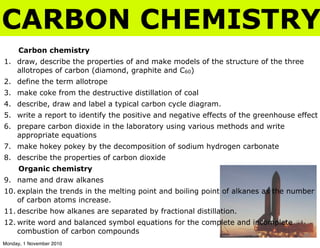
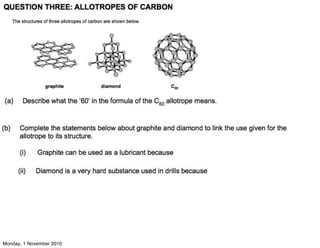
1. draw, describe the properties of and make models of the structure of the three
allotropes of carbon (diamond, graphite and C60)
2. define the term allotrope
3. make coke from the destructive distillation of coal
4. describe, draw and label a typical carbon cycle diagram.
5. write a report to identify the positive and negative effects of the greenhouse effect
6. prepare carbon dioxide in the laboratory using various methods and write
appropriate equations
7. make hokey pokey by the decomposition of sodium hydrogen carbonate
8. describe the properties of carbon dioxide
Organic chemistry
9. name and draw alkanes
10. explain the trends in the melting point and boiling point of alkanes as the number
of carbon atoms increase.
11. describe how alkanes are separated by fractional distillation.
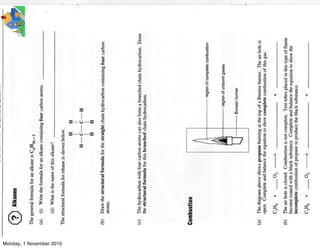
12. write word and balanced symbol equations for the complete and incomplete
combustion of carbon compounds
CARBON CHEMISTRY
Monday, 1 November 2010
Organic chemistry - cont’d
13. draw and name propene and ethene.
14. write equations for the polymerisation of propene and ethene.
15. name and draw methanol, ethanol and propanol.
16. describe and write equations for the production of ethanol from the fermentation of
sugar.
17. describe how ethanoic acid is produced and write its formula.
Monday, 1 November 2010
Describe properties and reactions of carbon and its compounds.
Monday, 1 November 2010
GLOSSARY
Monday, 1 November 2010
Term Definition Word list
Monday, 1 November 2010
NOTES
Monday, 1 November 2010
PROPERTIES
of Carbon
p191 to 194
Monday, 1 November 2010
INTRODUCTION
Monday, 1 November 2010
Uses of
Carbon
BRAIN STORM
Why?
Monday, 1 November 2010
Uses of
Carbon
BRAIN STORM
CUTTING GLASS/CONCRETE/CERAMICS (DIAMOND)
FUEL (CHARCOAL)
PENCILS (GRAPHITE)
LUBRICANTS (GRAPHITE)
JEWELLERY (DIAMOND)
ELECTRODES (GRAPHITE)
Monday, 1 November 2010
ORGANISED STRUCTURES
Monday, 1 November 2010
BRAIN STORM
CCl Cl
Cl
Cl
CH C
H
H
C H
THREE pairs are shared
Monday, 1 November 2010
DIAMOND & GRAPHITE
Allotropes are different physical forms of the same element. Allotropes have the same
chemical properties but different physical properties. Structures are based on covalent
bonding
• A colourless, solid which is very hard.
• High density, high melting point.
• Very poor electrical conductor but a very
good heat conductor
In diamond
Each carbon atom bonds
covalently to four other
carbon atoms to form a 3D
network:
Allotropes of Carbon
• A grey, shiny solid which is slippery to
the touch and soft.
• Low density, high melting point.
• Excellent electrical conductor
• The stable form of Carbon
In graphite
Covalent bonding to three other
carbon atoms to form a sheet or layer.
Same chemical properties: eg. complete & incomplete combustion
Monday, 1 November 2010
Graphite
• Weak bonds between layers allow layers to slide past each other => good lubricant
• Electrons between layers are not held strongly by the carbon atoms in the layers
=> good electrical conductivity
Diamond
• Each of the four electrons is involved in a strong covalent bond and is not free to
move => poor electrical conductivity.
• With a 3D network of strong covalent bonds the diamond structure is very hard.
LINKING STRUCTURE TO
PROPERTIES
Monday, 1 November 2010
C60
Covalent bonding to three other
carbon atoms:
Hexagonal faces
Pentagonal faces
Buckminsterfullerine
is hollow and
shaped like a soccer ball
Monday, 1 November 2010
Diamond is the ultimate gemstone, having few weaknesses and many strengths. It is well known that Diamond is
the hardest substance found in nature, but few people realize that Diamond is four times harder than the next hardest natural
mineral, corundum (sapphire and ruby). But even as hard as it is, it is not impervious. Diamond has four directions of cleavage,
meaning that if it receives a sharp blow in one of these directions it will cleave, or split. A skilled diamond setter and/or jeweler
will prevent any of these directions from being in a position to be struck while mounted in a jewelry piece.
As a gemstone, Diamond's single flaw (perfect cleavage) is far outdistanced by the sum of its positive qualities. It has a broad
color range, high refraction, high dispersion or fire, very low reactivity to chemicals, rarity, and of course, extreme hardness and
durability. Diamond is the April Birthstone.
In terms of it's physical properties, diamond is the ultimate mineral in several ways:
• Hardness: Diamond is a perfect "10", defining the top of the hardness scale, and by absolute measures four times harder
than sapphire (which is #9 on that scale).
• Clarity: Diamond is transparent over a larger range of wavelengths (from the ultraviolet into the far infrared) than is any
other solid or liquid substance - nothing else even comes close.
• Thermal Conductivity: Diamond conducts heat better than anything - five times better than the second best element,
Silver!
• Melting Point: Diamond has the highest melting point (3820 degrees Kelvin)
• Lattice Density: The atoms of Diamond are packed closer together than are the atoms of any other substance
• Tensile Strength: Diamond has the highest tensile strength of any material, at 2.8 gigapascals. However, that does not
quite translate into the strongest rope or cable, as diamond has cleavage planes which support crack propagation. The
strongest ropes can likely be made from another material, carbon nanotubes, as they should not suffer from the effects of
cracks and break. Still, if a long, thin, perfect crystal of diamond could be manufactured, it would offer the highest possible
pulling strength (in a straight line - don't try to tie it in a knot!)
• Compressive Strength: Diamond was once thought to be the material most resistant to compression (the least
compressible). It is the material that scientists use to create the greatest pressures when testing matter. However, the rare
metal Osmium has recently been shown to be even less compressible (although it is not as hard as diamond). Diamond has
a bulk modulus (reciprocal of compressibility) of 443 GigaPascals (GPa). The bulk modulus of the metal osmium has recently
been found to be 476 GPa, about 7% greater than diamond.
Diamond is a polymorph of the element carbon. Graphite is another polymorph. The two share the same chemistry, carbon, but
have very different structures and properties. Diamond is hard, Graphite is soft (the "lead" of a pencil). Diamond is an excellent
electrical insulator, Graphite is a good conductor of electricity. Diamond is the ultimate abrasive, Graphite is a very good lubricant.
Diamond is transparent, Graphite is opaque. Diamond crystallizes in the Isometric system and graphite crystallizes in the
hexagonal system. Somewhat of a surprise is that at surface temperatures and pressures, Graphite is the stable form of carbon.
In fact, all diamonds at or near the surface of the Earth are currently undergoing a transformation into Graphite. This reaction,
fortunately, is extremely slow.
Monday, 1 November 2010
CARBON: PROPERTIES & BONDING
Monday, 1 November 2010
CARBON
CYCLE
p191 to 194
Monday, 1 November 2010
GLOBAL WARMING
Monday, 1 November 2010
CARBON CYCLE
2 basic processes involved in carbon cycling:
• Photosynthesis: Carbon dioxide + water + sunlight ----> Glucose + oxygen
• Respiration: Glucose + oxygen ----> Carbon dioxide + water
Major carbon sinks:
• Plants absorb carbon dioxide through photosynthesis
• Water (in the sea) - absorb carbon dioxide because carbon dioxide is slightly
soluble in water.
Molecules
Long carbon chains are the basis of all living things - there are 4 possible types of
bond that a carbon atom can form in a chain.
USES OF CARBON
1. READ the handout provided and make a short summary in your notes of the
content provided.
2. Answer the questions (on the whiteboard) as FULL SENTENCES in your exercise
books.
p196, 197 ESA
Monday, 1 November 2010
QUESTIONS
1. For the element Carbon, name two sources of the element of commercial value
and give some indication of the abundance of the source on planet Earth, eg.
large, moderate or rare.
2. Supply the missing words to describe the following process (words may be used
more than once in the answer - the number of letters in the words is shown by
the dashes):
Coal heated in the absence of air produces _ _ _ _, gases and oils. _ _ _ _ is a
purer form of the element _ _ _ _ _ _ than coal.
3. Complete the following equations. If the equation is in words, then use words to
complete the equation. It the equation is in symbols, then use symbols to
complete the equation. The number of letters in the words or symbols is shown by
the dashes.
(a) Carbon dioxide + oxygen ---> ________________________ (two words)
(b) Carbon dioxide + water ----> __________ + ___________ (photosynthesis)
(c) __ZnO(s) + C(s) ---> __Zn + _____(g)
4. Explain the meaning of the underlined words in the following passage.
Carbon can be used as a fuel. It will combine with oxygen exothermically to
produce carbon dioxide. Coal is a mineral (naturally occurring substance that is
mined) that is mainly carbon. Other minerals of carbon that are fuels are
petroleum and natural gas.
Monday, 1 November 2010
THE CARBON CYCLE - an experimental view
Monday, 1 November 2010
Label the diagram
using the word
list (below)
1. Plant
respiration
2. Animal
respiration
3. Photosynthesis
4. Dead
organisms and
waste products
5. Root
respiration
6. Fossils and
Fossil fuels
7. Ocean uptake
8. CO2 Cycle
CARBON CYCLE
Monday, 1 November 2010
ANSWERS
Monday, 1 November 2010
CARBON
DIOXIDE
p191 to 194
Monday, 1 November 2010
PROPERTIES OF CARBON DIOXIDE
Physical
• Colourless, sweet smelling gas that is non-toxic in low concentrations
• More dense than air, will not undergo thermal decomposition and inability to
support combustion ---> use in fire extinguishers
• Poor solubility in water (that increases with pressure)
• Sublimes (does not enter the liquid state) --> dry ice for stage effects
Chemical
• turns limewater milky but if it continues to be added to limewater then limewater
will revert to being colourless
• dissolves in water to form an acidic solution (carbonic acid)
• Carbon dioxide can be released from a carbonic acid solution that has been under
pressure (for example, in a fizzy drink)
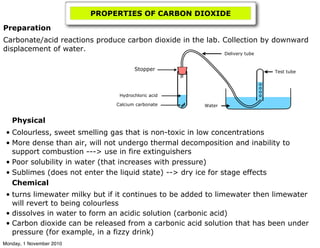
Preparation
Carbonate/acid reactions produce carbon dioxide in the lab. Collection by downward
displacement of water.
Calcium carbonate
Hydrochloric acid
Delivery tube
Stopper Test tube
Water
Monday, 1 November 2010
COMPLETE AND INCOMPLETE COMBUSTION
Monday, 1 November 2010
REACTIONS INVOLVING CARBON DIOXIDE
The limewater test
The precipitate that gives limewater
the milky appearance
Carbonic acid formation
CO2(g) + H2O(l) ---> H2CO3(aq)
Acid rain
dissolving
limestone
H2CO3(aq) + CaCO3(s) ---> Ca(HCO3)2(aq)
a reaction that occurs more readily at higher
pressures
it is reversed when the pressure is released:
H2CO3(aq) ---> CO2(g) + H2O(l)
Monday, 1 November 2010
ALKANES
Monday, 1 November 2010
INTRODUCTION
Definition
• Alkanes are part of a family of compounds called hydrocarbons because the only
elements in these compounds are Hydrogen and Carbon.
• They have the general formula:
CnH2n + 2 (which means that for every atom of carbon in an alkane molecule
there are twice as many Hydrogen atoms plus two).
• Hydrocarbons are useful to us because they can combine with oxygen during
combustion to produce energy
and
because they occur naturally in fossil fuels.
• Complete combustion of a hydrocarbon will produce carbon dioxide and water.
• Straight chain alkanes contain carbon atoms that are joined to no more than two
other carbon atoms
Monday, 1 November 2010
Melting and boiling point - butane is solid below its melting point of -139o
C and a
liquid below its boiling point of 0o
C. Therefore at room
temperature, butane is a gas.
Structural formula - a formula that in addition shows how the atoms are connected.
Molecular formula - a formula that gives the number and type of atom in a molecule.
“ 4 atoms of carbon are bonded covalently to 8
atoms of hydrogen to make up a molecule of butane”
C4H8 means:
primary carbon atom secondary carbon atom
C - C - C - CC - C - C - C
H H H H
HH
H H H H
OR
BUTANE
Monday, 1 November 2010
trivial
naming
systematic
naming
NAMING, DRAWING AND TRENDS IN
PHYSICAL PROPERTIES
Monday, 1 November 2010
EXERCISES
Use your table to graph the melting and
boiling points of alkanes against the
number of carbon atoms in the molecule.
number of
carbon atoms
Temperature
(o
C)
Monday, 1 November 2010
Questions
1. Draw lines on your graph to show how you would use your graph to find the boiling
point (in o
C) of the alkane which has 5 carbon atoms?
2. Explain the trend in melting and boiling points that is shown by your graph.
3. Explain the term “straight chain” when used to describe alkanes.
4. Explain what is meant by the terms
(i) boiling point
(ii) melting point
Monday, 1 November 2010
COMPLETE & INCOMPLETE COMBUSTION
Complete combustion
occurs when an alkane combines with oxygen in plentiful supply, to produce carbon
dioxide, water and heat according to the following general equation:
Incomplete combustion
occurs when an alkane combines with oxygen in limited supply, to produce carbon
monoxide, water and heat according to the following general equation:
alkane + oxygen ---> carbon dioxide + waterGeneral equation:
Example:
alkane + oxygen ---> carbon monoxide + waterGeneral equation:
Example:
Butane + oxygen ---> carbon dioxide + water
butane + oxygen ---> carbon monoxide + water
______ + ________ ---> _____ + _______
______ + ________ ---> _____ + _______
Monday, 1 November 2010
EXERCISES
Monday, 1 November 2010
EXERCISES ON ALKANES
Monday, 1 November 2010
FRACTIONAL
DISTILLATION
Monday, 1 November 2010
EXERCISES
1. Read the sheet provided (p210, ESA Study Guide)
2. Take notes in your book (ensuring that you have a written explanation in your
notes that allows you to understand the process)
3. You may use the sheet to help you with the “Fractional distillation matchup”
exercise that follows
Monday, 1 November 2010
FRACTIONALDISTILLATIONMATCHUP
Monday, 1 November 2010
fractions
decreasing in
density and
boiling pt
fractionating
column
crude oil
C1 to C4
gases
(20o
C)
C5 to C9
naptha
(70o
C)
C5 to C10
gasoline
(120o
C)
C10 to C16
paraffin oil
(170o
C)
C14 to C20
diesel oils
(270o
C)
C20 to C50
lubricating
oil
C20 to C70
fuel oil
(600o
C)
liquefied petroleum
gas
chemicals
petrol for
vehicles
jet fuel,
paraffin for
heating and
lighting
diesel fuels
lubricating
oil, waxes &
polishes
fuels for
ships,
factories
and
central
heating
bitumen for
roads and
roofing
Monday, 1 November 2010
ALKENES
Monday, 1 November 2010
Definition
• Alkenes are also hydrocarbons which form a series of compounds. They are
different to alkanes in that there carbon atoms that are double bonded to each
other. They are similar that they are both insoluble in water.
They have the general formula:
CnH2n (which means that for every atom of carbon in an alkane molecule there
are twice as many Hydrogen atoms).
• Alkenes also undergo combustion reactions. Complete and incomplete combustion
occur in a similar way to alkanes.
• Complete combustion of a hydrocarbon will produce carbon dioxide and water.
ALKENES: STRUCTURE & PROPERTIES
1. Use the molymods to make ethene and propene (drawn below).
2. What do you notice about how close the double bonded carbons are to each other?
3. Count the numbers of carbon and hydrogen atoms in each molecule and using the
term “n” to indicate the number of atoms in the molecule, write the general
equation for alkenes in your book.
C C CEthene Propene C C
Monday, 1 November 2010
THE DOUBLE BOND AND POLYMERISATION
• The double bond in alkenes is physically stronger than single bonds.
• It is however a point of reactivity because there is a greater concentration of
electrons between the two carbon atoms than if the carbon atoms were single
bonded.
• The double bond in an ethene can be broken to make electrons available for
bonding with other ethene molecules:
C C
+C C C C C C C C
Two single electrons that can be shared as part of a bond
C C
a monomer
a dimer
ethene
Many of these units
bonded together
makes a polymer
Monday, 1 November 2010
THE DOUBLE BOND AND REACTIVITY
• When the double bond in alkenes is broken, the carbon atoms become available for
bonding with other atoms such as bromine and chlorine. All bonds are now single
bonds and the compound is said to be saturated.
C C C C
dibromoethaneBr2
Br Br
• A hydrocarbon that contains double bonds is unsaturated.
Another example
C C
a monomerbutene
CH2CH3
C C
CH2CH3
Many of these units
bonded together
makes a polymer
Monday, 1 November 2010
EXERCISES
1. Write 3 equations for the combustion of each of ethene and butene:
(i) where carbon dioxide is a product (complete combustion)
(ii) where carbon monoxide is a product (incomplete combustion)
(iii) where carbon is a product (incomplete combustion)
Monday, 1 November 2010
ALCHOLS
Monday, 1 November 2010
METHANOL & ETHANOL
Distillation
• Methanol & ethanol are the first two alcohols in a series of carbon compounds.
• Each molecule is that of an alkane with an -OH group in place of one of the
hydrogen atoms
Solubility
Alcohols are soluble. Alkanes and alkenes are not because the -OH group is polar and
can attract polar water molecules:
C - C O HC O H
H
H
H
H
H H
H H
Methanol Ethanol
H
H
O
-
+
+
C O H
H
H
H
+
-
Monday, 1 November 2010
SYNTHETIC ALCOHOL PRODUCTION
CH4(g) + H2O(g) ---> CO(g) + H2(g)
1. Use the equations (below) to complete a
flow diagram of the process. In your
flow diagram, USE CHEMICAL NAMES
instead of formulae.
2. The equations (above) are unbalanced.
BALANCE THEM.
CO(g) + 2H2(g) ---> CH3OH(g)
Step 1
Step 2
800 - 850o
C
Nickel catalyst
800 - 850o
C
High Pressure
Monday, 1 November 2010
ALCOHOL PRODUCTION by fermentation
2(C6H10O5)n(aq) + nH2O(l) ---> nC12H22O11(aq)
Use the equations (above) to complete a flow
diagram of the process. In your flow diagram,
USE CHEMICAL NAMES instead of formulae.
Step 1
Step 3
Step 2
enzyme
amylase
C12H22O11(aq) + H2O(l) ---> 2C6H12O6(aq)
2(C6H12O6)(aq) ---> 2C2H5OH(aq) + 2CO2(g)
enzyme
amylase
starch
maltose
glucose
enzyme
zymase
maltose
glucose
glucose
Monday, 1 November 2010
EXERCISES1. READ p89 Y11 Pathfinder Science
2. Comparing physical properties (methanol, ethanol, methane and ethane)
Monday, 1 November 2010
ETHANOIC
ACID
Monday, 1 November 2010
ETHANOIC ACID
• Also called acetic acid.
• Formed by the oxidation of ethanol.
• Ethanol in beer and wine will be oxidised to ethanoic acid under certain conditions.
UV light causes this oxidation to occur more rapidly which explains the use of
coloured bottles and cardboard enclosures (beer).
Structures:
C - C O HH
H H
H H
Ethanol
C - C O HH
H
H
Ethanoic acid
O
O2
Physical properties:
• Sour taste
• Colourless solid
• soluble
Monday, 1 November 2010
PRACTICALS
Monday, 1 November 2010
CARBON
DIOXIDE
p191 to 194
Monday, 1 November 2010
SUBLIMATION for
Screen effects
Monday, 1 November 2010
250 mL
beaker candles
(of different lengths placed
into film cannisters)
baking soda
Vinegar
EXTINGUISHING FLAMES
Observation
Conclusion
Monday, 1 November 2010
Calcium carbonate
Hydrochloric acid
Delivery tube
Stopper Test tube
Water
LAB PREPARATION AND REACTION WITH LIMEWATER
Observation
Conclusion
Relevant chemical equations:
Monday, 1 November 2010
Gas jar
Deflagrating spoon
Burning Charcoal
Water with a
few drops of
UI added
INVESTIGATING THE SOLUBILITY AND THE
ACIDIC PROPERTIES
1
2
Observation
Conclusion
Swirly thoroughly
Monday, 1 November 2010
Vinegar
Baking
soda
Baking soda & vinegar
-> Allow it to stop fizzing
-> pour into 2nd gas jar and
seal with a lid
1
2
3
INVESTIGATING DENSITY
Observation
Conclusion
limewater test for CO2
glass lid
Invert a clean gas jar over
the 1st and leave for 2
minutes
Monday, 1 November 2010
CARBON
DIOXIDE
by thermal decomposition
Monday, 1 November 2010
2
Observation
Conclusion
CARBON DIOXIDE FROM DECOMPOSITION
REACTIONS
Limewater
Pour the gas into
limewater and swirl
test-tube
Bunsen burner (blue flame)
(a) Sodium Hydrogen
Carbonate
(b) Calcium Carbonate
1
Use the decomposition of two different compounds to produce CO2
and test for the gas with limewater:
Monday, 1 November 2010
DESTRUCTIVE
DISTILLATION
OF COAL
Monday, 1 November 2010
p7 ABA
Monday, 1 November 2010
MAKING
ALKANES
USING
MOLYMODS
Monday, 1 November 2010
USE THE TABLE (IN NOTES) AS A GUIDE TO MAKING THE FIRST 6
ALKANES (METHANE TO HEXANE)
Monday, 1 November 2010
ALKANE &
ALCOHOLS
Monday, 1 November 2010
_____________
_____________
_____________
_____________
Solution
(Ethanol
and water)
Word List
distillate
vapour
condenser
boils
thermometer
liquid
round bottom flask
water
cooled
We were able to separate the ethanol from the water because the ethanol
_____________ at a lower temperature than the ________. The ethanol
_________ passes into the ____________ where it is ___________ to
become a __________ .
DISTILLATION
Monday, 1 November 2010
EXAM
QUESTIONS
2003, 2004, 2005,
2009
Monday, 1 November 2010
2004
Monday, 1 November 2010
2005
Monday, 1 November 2010
2006
Monday, 1 November 2010
2007
Monday, 1 November 2010
2008
Monday, 1 November 2010
2009
Monday, 1 November 2010

Carbon chemistry

  • 1.
    Carbon chemistry 1. draw,describe the properties of and make models of the structure of the three allotropes of carbon (diamond, graphite and C60) 2. define the term allotrope 3. make coke from the destructive distillation of coal 4. describe, draw and label a typical carbon cycle diagram. 5. write a report to identify the positive and negative effects of the greenhouse effect 6. prepare carbon dioxide in the laboratory using various methods and write appropriate equations 7. make hokey pokey by the decomposition of sodium hydrogen carbonate 8. describe the properties of carbon dioxide Organic chemistry 9. name and draw alkanes 10. explain the trends in the melting point and boiling point of alkanes as the number of carbon atoms increase. 11. describe how alkanes are separated by fractional distillation. 12. write word and balanced symbol equations for the complete and incomplete combustion of carbon compounds CARBON CHEMISTRY Monday, 1 November 2010
  • 2.
    Organic chemistry -cont’d 13. draw and name propene and ethene. 14. write equations for the polymerisation of propene and ethene. 15. name and draw methanol, ethanol and propanol. 16. describe and write equations for the production of ethanol from the fermentation of sugar. 17. describe how ethanoic acid is produced and write its formula. Monday, 1 November 2010
  • 3.
    Describe properties andreactions of carbon and its compounds. Monday, 1 November 2010
  • 4.
  • 5.
  • 6.
    Term Definition Wordlist Monday, 1 November 2010
  • 7.
  • 8.
    PROPERTIES of Carbon p191 to194 Monday, 1 November 2010
  • 9.
  • 10.
  • 11.
    Uses of Carbon BRAIN STORM CUTTINGGLASS/CONCRETE/CERAMICS (DIAMOND) FUEL (CHARCOAL) PENCILS (GRAPHITE) LUBRICANTS (GRAPHITE) JEWELLERY (DIAMOND) ELECTRODES (GRAPHITE) Monday, 1 November 2010
  • 12.
  • 13.
  • 14.
    BRAIN STORM CCl Cl Cl Cl CHC H H C H THREE pairs are shared Monday, 1 November 2010
  • 15.
  • 16.
    DIAMOND & GRAPHITE Allotropesare different physical forms of the same element. Allotropes have the same chemical properties but different physical properties. Structures are based on covalent bonding • A colourless, solid which is very hard. • High density, high melting point. • Very poor electrical conductor but a very good heat conductor In diamond Each carbon atom bonds covalently to four other carbon atoms to form a 3D network: Allotropes of Carbon • A grey, shiny solid which is slippery to the touch and soft. • Low density, high melting point. • Excellent electrical conductor • The stable form of Carbon In graphite Covalent bonding to three other carbon atoms to form a sheet or layer. Same chemical properties: eg. complete & incomplete combustion Monday, 1 November 2010
  • 17.
    Graphite • Weak bondsbetween layers allow layers to slide past each other => good lubricant • Electrons between layers are not held strongly by the carbon atoms in the layers => good electrical conductivity Diamond • Each of the four electrons is involved in a strong covalent bond and is not free to move => poor electrical conductivity. • With a 3D network of strong covalent bonds the diamond structure is very hard. LINKING STRUCTURE TO PROPERTIES Monday, 1 November 2010
  • 18.
    C60 Covalent bonding tothree other carbon atoms: Hexagonal faces Pentagonal faces Buckminsterfullerine is hollow and shaped like a soccer ball Monday, 1 November 2010
  • 19.
    Diamond is theultimate gemstone, having few weaknesses and many strengths. It is well known that Diamond is the hardest substance found in nature, but few people realize that Diamond is four times harder than the next hardest natural mineral, corundum (sapphire and ruby). But even as hard as it is, it is not impervious. Diamond has four directions of cleavage, meaning that if it receives a sharp blow in one of these directions it will cleave, or split. A skilled diamond setter and/or jeweler will prevent any of these directions from being in a position to be struck while mounted in a jewelry piece. As a gemstone, Diamond's single flaw (perfect cleavage) is far outdistanced by the sum of its positive qualities. It has a broad color range, high refraction, high dispersion or fire, very low reactivity to chemicals, rarity, and of course, extreme hardness and durability. Diamond is the April Birthstone. In terms of it's physical properties, diamond is the ultimate mineral in several ways: • Hardness: Diamond is a perfect "10", defining the top of the hardness scale, and by absolute measures four times harder than sapphire (which is #9 on that scale). • Clarity: Diamond is transparent over a larger range of wavelengths (from the ultraviolet into the far infrared) than is any other solid or liquid substance - nothing else even comes close. • Thermal Conductivity: Diamond conducts heat better than anything - five times better than the second best element, Silver! • Melting Point: Diamond has the highest melting point (3820 degrees Kelvin) • Lattice Density: The atoms of Diamond are packed closer together than are the atoms of any other substance • Tensile Strength: Diamond has the highest tensile strength of any material, at 2.8 gigapascals. However, that does not quite translate into the strongest rope or cable, as diamond has cleavage planes which support crack propagation. The strongest ropes can likely be made from another material, carbon nanotubes, as they should not suffer from the effects of cracks and break. Still, if a long, thin, perfect crystal of diamond could be manufactured, it would offer the highest possible pulling strength (in a straight line - don't try to tie it in a knot!) • Compressive Strength: Diamond was once thought to be the material most resistant to compression (the least compressible). It is the material that scientists use to create the greatest pressures when testing matter. However, the rare metal Osmium has recently been shown to be even less compressible (although it is not as hard as diamond). Diamond has a bulk modulus (reciprocal of compressibility) of 443 GigaPascals (GPa). The bulk modulus of the metal osmium has recently been found to be 476 GPa, about 7% greater than diamond. Diamond is a polymorph of the element carbon. Graphite is another polymorph. The two share the same chemistry, carbon, but have very different structures and properties. Diamond is hard, Graphite is soft (the "lead" of a pencil). Diamond is an excellent electrical insulator, Graphite is a good conductor of electricity. Diamond is the ultimate abrasive, Graphite is a very good lubricant. Diamond is transparent, Graphite is opaque. Diamond crystallizes in the Isometric system and graphite crystallizes in the hexagonal system. Somewhat of a surprise is that at surface temperatures and pressures, Graphite is the stable form of carbon. In fact, all diamonds at or near the surface of the Earth are currently undergoing a transformation into Graphite. This reaction, fortunately, is extremely slow. Monday, 1 November 2010
  • 20.
    CARBON: PROPERTIES &BONDING Monday, 1 November 2010
  • 21.
  • 22.
  • 23.
  • 24.
    CARBON CYCLE 2 basicprocesses involved in carbon cycling: • Photosynthesis: Carbon dioxide + water + sunlight ----> Glucose + oxygen • Respiration: Glucose + oxygen ----> Carbon dioxide + water Major carbon sinks: • Plants absorb carbon dioxide through photosynthesis • Water (in the sea) - absorb carbon dioxide because carbon dioxide is slightly soluble in water. Molecules Long carbon chains are the basis of all living things - there are 4 possible types of bond that a carbon atom can form in a chain. USES OF CARBON 1. READ the handout provided and make a short summary in your notes of the content provided. 2. Answer the questions (on the whiteboard) as FULL SENTENCES in your exercise books. p196, 197 ESA Monday, 1 November 2010
  • 25.
    QUESTIONS 1. For theelement Carbon, name two sources of the element of commercial value and give some indication of the abundance of the source on planet Earth, eg. large, moderate or rare. 2. Supply the missing words to describe the following process (words may be used more than once in the answer - the number of letters in the words is shown by the dashes): Coal heated in the absence of air produces _ _ _ _, gases and oils. _ _ _ _ is a purer form of the element _ _ _ _ _ _ than coal. 3. Complete the following equations. If the equation is in words, then use words to complete the equation. It the equation is in symbols, then use symbols to complete the equation. The number of letters in the words or symbols is shown by the dashes. (a) Carbon dioxide + oxygen ---> ________________________ (two words) (b) Carbon dioxide + water ----> __________ + ___________ (photosynthesis) (c) __ZnO(s) + C(s) ---> __Zn + _____(g) 4. Explain the meaning of the underlined words in the following passage. Carbon can be used as a fuel. It will combine with oxygen exothermically to produce carbon dioxide. Coal is a mineral (naturally occurring substance that is mined) that is mainly carbon. Other minerals of carbon that are fuels are petroleum and natural gas. Monday, 1 November 2010
  • 26.
    THE CARBON CYCLE- an experimental view Monday, 1 November 2010
  • 27.
    Label the diagram usingthe word list (below) 1. Plant respiration 2. Animal respiration 3. Photosynthesis 4. Dead organisms and waste products 5. Root respiration 6. Fossils and Fossil fuels 7. Ocean uptake 8. CO2 Cycle CARBON CYCLE Monday, 1 November 2010
  • 28.
  • 29.
  • 30.
    PROPERTIES OF CARBONDIOXIDE Physical • Colourless, sweet smelling gas that is non-toxic in low concentrations • More dense than air, will not undergo thermal decomposition and inability to support combustion ---> use in fire extinguishers • Poor solubility in water (that increases with pressure) • Sublimes (does not enter the liquid state) --> dry ice for stage effects Chemical • turns limewater milky but if it continues to be added to limewater then limewater will revert to being colourless • dissolves in water to form an acidic solution (carbonic acid) • Carbon dioxide can be released from a carbonic acid solution that has been under pressure (for example, in a fizzy drink) Preparation Carbonate/acid reactions produce carbon dioxide in the lab. Collection by downward displacement of water. Calcium carbonate Hydrochloric acid Delivery tube Stopper Test tube Water Monday, 1 November 2010
  • 31.
    COMPLETE AND INCOMPLETECOMBUSTION Monday, 1 November 2010
  • 32.
    REACTIONS INVOLVING CARBONDIOXIDE The limewater test The precipitate that gives limewater the milky appearance Carbonic acid formation CO2(g) + H2O(l) ---> H2CO3(aq) Acid rain dissolving limestone H2CO3(aq) + CaCO3(s) ---> Ca(HCO3)2(aq) a reaction that occurs more readily at higher pressures it is reversed when the pressure is released: H2CO3(aq) ---> CO2(g) + H2O(l) Monday, 1 November 2010
  • 33.
  • 34.
    INTRODUCTION Definition • Alkanes arepart of a family of compounds called hydrocarbons because the only elements in these compounds are Hydrogen and Carbon. • They have the general formula: CnH2n + 2 (which means that for every atom of carbon in an alkane molecule there are twice as many Hydrogen atoms plus two). • Hydrocarbons are useful to us because they can combine with oxygen during combustion to produce energy and because they occur naturally in fossil fuels. • Complete combustion of a hydrocarbon will produce carbon dioxide and water. • Straight chain alkanes contain carbon atoms that are joined to no more than two other carbon atoms Monday, 1 November 2010
  • 35.
    Melting and boilingpoint - butane is solid below its melting point of -139o C and a liquid below its boiling point of 0o C. Therefore at room temperature, butane is a gas. Structural formula - a formula that in addition shows how the atoms are connected. Molecular formula - a formula that gives the number and type of atom in a molecule. “ 4 atoms of carbon are bonded covalently to 8 atoms of hydrogen to make up a molecule of butane” C4H8 means: primary carbon atom secondary carbon atom C - C - C - CC - C - C - C H H H H HH H H H H OR BUTANE Monday, 1 November 2010
  • 36.
    trivial naming systematic naming NAMING, DRAWING ANDTRENDS IN PHYSICAL PROPERTIES Monday, 1 November 2010
  • 37.
    EXERCISES Use your tableto graph the melting and boiling points of alkanes against the number of carbon atoms in the molecule. number of carbon atoms Temperature (o C) Monday, 1 November 2010
  • 38.
    Questions 1. Draw lineson your graph to show how you would use your graph to find the boiling point (in o C) of the alkane which has 5 carbon atoms? 2. Explain the trend in melting and boiling points that is shown by your graph. 3. Explain the term “straight chain” when used to describe alkanes. 4. Explain what is meant by the terms (i) boiling point (ii) melting point Monday, 1 November 2010
  • 39.
  • 40.
  • 41.
  • 42.
  • 43.
  • 44.
    COMPLETE & INCOMPLETECOMBUSTION Complete combustion occurs when an alkane combines with oxygen in plentiful supply, to produce carbon dioxide, water and heat according to the following general equation: Incomplete combustion occurs when an alkane combines with oxygen in limited supply, to produce carbon monoxide, water and heat according to the following general equation: alkane + oxygen ---> carbon dioxide + waterGeneral equation: Example: alkane + oxygen ---> carbon monoxide + waterGeneral equation: Example: Butane + oxygen ---> carbon dioxide + water butane + oxygen ---> carbon monoxide + water ______ + ________ ---> _____ + _______ ______ + ________ ---> _____ + _______ Monday, 1 November 2010
  • 45.
  • 46.
  • 47.
  • 48.
  • 49.
  • 50.
    EXERCISES 1. Read thesheet provided (p210, ESA Study Guide) 2. Take notes in your book (ensuring that you have a written explanation in your notes that allows you to understand the process) 3. You may use the sheet to help you with the “Fractional distillation matchup” exercise that follows Monday, 1 November 2010
  • 51.
  • 52.
    fractions decreasing in density and boilingpt fractionating column crude oil C1 to C4 gases (20o C) C5 to C9 naptha (70o C) C5 to C10 gasoline (120o C) C10 to C16 paraffin oil (170o C) C14 to C20 diesel oils (270o C) C20 to C50 lubricating oil C20 to C70 fuel oil (600o C) liquefied petroleum gas chemicals petrol for vehicles jet fuel, paraffin for heating and lighting diesel fuels lubricating oil, waxes & polishes fuels for ships, factories and central heating bitumen for roads and roofing Monday, 1 November 2010
  • 53.
  • 54.
  • 55.
    Definition • Alkenes arealso hydrocarbons which form a series of compounds. They are different to alkanes in that there carbon atoms that are double bonded to each other. They are similar that they are both insoluble in water. They have the general formula: CnH2n (which means that for every atom of carbon in an alkane molecule there are twice as many Hydrogen atoms). • Alkenes also undergo combustion reactions. Complete and incomplete combustion occur in a similar way to alkanes. • Complete combustion of a hydrocarbon will produce carbon dioxide and water. ALKENES: STRUCTURE & PROPERTIES 1. Use the molymods to make ethene and propene (drawn below). 2. What do you notice about how close the double bonded carbons are to each other? 3. Count the numbers of carbon and hydrogen atoms in each molecule and using the term “n” to indicate the number of atoms in the molecule, write the general equation for alkenes in your book. C C CEthene Propene C C Monday, 1 November 2010
  • 56.
    THE DOUBLE BONDAND POLYMERISATION • The double bond in alkenes is physically stronger than single bonds. • It is however a point of reactivity because there is a greater concentration of electrons between the two carbon atoms than if the carbon atoms were single bonded. • The double bond in an ethene can be broken to make electrons available for bonding with other ethene molecules: C C +C C C C C C C C Two single electrons that can be shared as part of a bond C C a monomer a dimer ethene Many of these units bonded together makes a polymer Monday, 1 November 2010
  • 57.
    THE DOUBLE BONDAND REACTIVITY • When the double bond in alkenes is broken, the carbon atoms become available for bonding with other atoms such as bromine and chlorine. All bonds are now single bonds and the compound is said to be saturated. C C C C dibromoethaneBr2 Br Br • A hydrocarbon that contains double bonds is unsaturated. Another example C C a monomerbutene CH2CH3 C C CH2CH3 Many of these units bonded together makes a polymer Monday, 1 November 2010
  • 58.
    EXERCISES 1. Write 3equations for the combustion of each of ethene and butene: (i) where carbon dioxide is a product (complete combustion) (ii) where carbon monoxide is a product (incomplete combustion) (iii) where carbon is a product (incomplete combustion) Monday, 1 November 2010
  • 59.
  • 60.
    METHANOL & ETHANOL Distillation •Methanol & ethanol are the first two alcohols in a series of carbon compounds. • Each molecule is that of an alkane with an -OH group in place of one of the hydrogen atoms Solubility Alcohols are soluble. Alkanes and alkenes are not because the -OH group is polar and can attract polar water molecules: C - C O HC O H H H H H H H H H Methanol Ethanol H H O - + + C O H H H H + - Monday, 1 November 2010
  • 61.
    SYNTHETIC ALCOHOL PRODUCTION CH4(g)+ H2O(g) ---> CO(g) + H2(g) 1. Use the equations (below) to complete a flow diagram of the process. In your flow diagram, USE CHEMICAL NAMES instead of formulae. 2. The equations (above) are unbalanced. BALANCE THEM. CO(g) + 2H2(g) ---> CH3OH(g) Step 1 Step 2 800 - 850o C Nickel catalyst 800 - 850o C High Pressure Monday, 1 November 2010
  • 62.
    ALCOHOL PRODUCTION byfermentation 2(C6H10O5)n(aq) + nH2O(l) ---> nC12H22O11(aq) Use the equations (above) to complete a flow diagram of the process. In your flow diagram, USE CHEMICAL NAMES instead of formulae. Step 1 Step 3 Step 2 enzyme amylase C12H22O11(aq) + H2O(l) ---> 2C6H12O6(aq) 2(C6H12O6)(aq) ---> 2C2H5OH(aq) + 2CO2(g) enzyme amylase starch maltose glucose enzyme zymase maltose glucose glucose Monday, 1 November 2010
  • 63.
  • 64.
    EXERCISES1. READ p89Y11 Pathfinder Science 2. Comparing physical properties (methanol, ethanol, methane and ethane) Monday, 1 November 2010
  • 65.
  • 66.
    ETHANOIC ACID • Alsocalled acetic acid. • Formed by the oxidation of ethanol. • Ethanol in beer and wine will be oxidised to ethanoic acid under certain conditions. UV light causes this oxidation to occur more rapidly which explains the use of coloured bottles and cardboard enclosures (beer). Structures: C - C O HH H H H H Ethanol C - C O HH H H Ethanoic acid O O2 Physical properties: • Sour taste • Colourless solid • soluble Monday, 1 November 2010
  • 67.
  • 68.
  • 69.
  • 70.
    250 mL beaker candles (ofdifferent lengths placed into film cannisters) baking soda Vinegar EXTINGUISHING FLAMES Observation Conclusion Monday, 1 November 2010
  • 71.
    Calcium carbonate Hydrochloric acid Deliverytube Stopper Test tube Water LAB PREPARATION AND REACTION WITH LIMEWATER Observation Conclusion Relevant chemical equations: Monday, 1 November 2010
  • 72.
    Gas jar Deflagrating spoon BurningCharcoal Water with a few drops of UI added INVESTIGATING THE SOLUBILITY AND THE ACIDIC PROPERTIES 1 2 Observation Conclusion Swirly thoroughly Monday, 1 November 2010
  • 73.
    Vinegar Baking soda Baking soda &vinegar -> Allow it to stop fizzing -> pour into 2nd gas jar and seal with a lid 1 2 3 INVESTIGATING DENSITY Observation Conclusion limewater test for CO2 glass lid Invert a clean gas jar over the 1st and leave for 2 minutes Monday, 1 November 2010
  • 74.
  • 75.
    2 Observation Conclusion CARBON DIOXIDE FROMDECOMPOSITION REACTIONS Limewater Pour the gas into limewater and swirl test-tube Bunsen burner (blue flame) (a) Sodium Hydrogen Carbonate (b) Calcium Carbonate 1 Use the decomposition of two different compounds to produce CO2 and test for the gas with limewater: Monday, 1 November 2010
  • 76.
  • 77.
    p7 ABA Monday, 1November 2010
  • 78.
  • 79.
    USE THE TABLE(IN NOTES) AS A GUIDE TO MAKING THE FIRST 6 ALKANES (METHANE TO HEXANE) Monday, 1 November 2010
  • 80.
  • 81.
    _____________ _____________ _____________ _____________ Solution (Ethanol and water) Word List distillate vapour condenser boils thermometer liquid roundbottom flask water cooled We were able to separate the ethanol from the water because the ethanol _____________ at a lower temperature than the ________. The ethanol _________ passes into the ____________ where it is ___________ to become a __________ . DISTILLATION Monday, 1 November 2010
  • 82.
  • 83.
  • 84.
  • 85.
  • 86.
  • 87.
  • 88.
  • 89.
  • 90.
  • 91.
  • 92.
  • 93.
  • 94.
  • 95.
  • 96.
  • 97.
  • 98.
  • 99.
  • 100.
  • 101.
  • 102.
  • 103.
  • 104.
  • 105.