CARBON AND ITS COMPOUNDS
CARBON
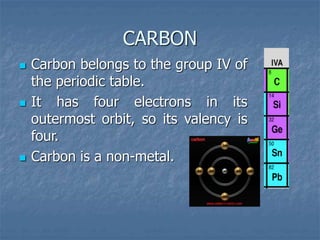
 Carbon belongs to the group IV of
the periodic table.
 It has four electrons in its
outermost orbit, so its valency is
four.
 Carbon is a non-metal.
Compounds of Carbon are Widely
Distributed in Nature
 The number of carbon compounds is
larger than that of all other elements put
together.
Why so many Carbon Compounds
in nature?
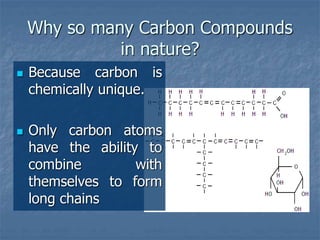
 Because carbon is
chemically unique.
 Only carbon atoms
have the ability to
combine with
themselves to form
long chains
Carbon- Long Chains
 A long chain, in turn, provides a
convenient backbone of atoms to which
other atoms can attach themselves in a
variety of ways
Allotropes of Carbon
 In nature, pure carbon occur in two forms-
 Diamond
 Graphite
What are Allotropes ?
 Allotropes are elements which are
chemically identical, but they differ
markedly in their physical properties.
 Diamond and Graphite – two allotropes of
carbon differ in their physical properties.
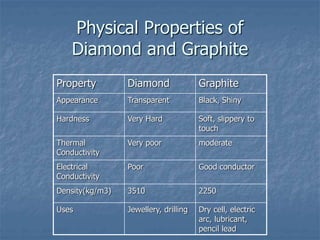
Physical Properties of
Diamond and Graphite
Property Diamond Graphite
Appearance Transparent Black, Shiny
Hardness Very Hard Soft, slippery to
touch
Thermal
Conductivity
Very poor moderate
Electrical
Conductivity
Poor Good conductor
Density(kg/m3) 3510 2250
Uses Jewellery, drilling Dry cell, electric
arc, lubricant,
pencil lead
How Diamond and Graphite are
chemically identical?
 These results of thes experiments answer this question:
 On heating diamond or graphite in the air, they burn
completely to form carbon dioxide.
 Equal quantities of diamond and graphite when burned,
produce exactly the same amount of carbon dioxide.
Why the physical properties of diamond
and graphite are so different?
 Due to the difference in the arrangement
of carbon atoms in diamond and graphite
Hydrocarbons
 Hydrocarbons are compounds of carbon
and hydrogen.
The natural source of
hydrocarbons is
petroleum (crude oil)
The Simplest Hydrocarbon
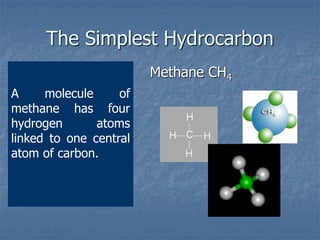
Methane CH4
A molecule of
methane has four
hydrogen atoms
linked to one central
atom of carbon.
H
y
d
r
o
c
a
r
b
o
n
s
S
a
t
u
r
a
t
e
d
A
l
k
a
n
e
s
Alkanes
 The hydrocarbons methane, ethane
propane and butane form a series of
carbon compounds known as alkanes
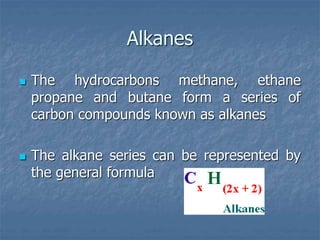
 The alkane series can be represented by
the general formula
Isomerism
 Compounds having the same molecular formulae
but different structural arrangement of atoms in
them are known as isomers, and the
phenomenon is known as isomerism
Isomers of Butane –
Obtained by rearranging
the carbon and the
hydrogen atoms
Unsaturated Hydrocarbons
 Unsaturated hydrocarbons contain a
double or triple bond between two carbon
atoms.
 The one with double bond are called
alkenes
Alkenes
Alkynes
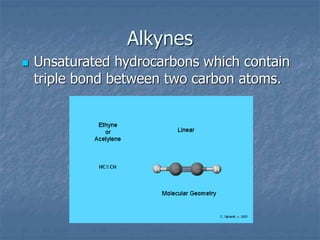
 Unsaturated hydrocarbons which contain
triple bond between two carbon atoms.
Carbon

Carbon

  • 1.
    CARBON AND ITSCOMPOUNDS
  • 2.
    CARBON  Carbon belongsto the group IV of the periodic table.  It has four electrons in its outermost orbit, so its valency is four.  Carbon is a non-metal.
  • 3.
    Compounds of Carbonare Widely Distributed in Nature  The number of carbon compounds is larger than that of all other elements put together.
  • 4.
    Why so manyCarbon Compounds in nature?  Because carbon is chemically unique.  Only carbon atoms have the ability to combine with themselves to form long chains
  • 5.
    Carbon- Long Chains A long chain, in turn, provides a convenient backbone of atoms to which other atoms can attach themselves in a variety of ways
  • 6.
    Allotropes of Carbon In nature, pure carbon occur in two forms-  Diamond  Graphite
  • 7.
    What are Allotropes?  Allotropes are elements which are chemically identical, but they differ markedly in their physical properties.  Diamond and Graphite – two allotropes of carbon differ in their physical properties.
  • 8.
    Physical Properties of Diamondand Graphite Property Diamond Graphite Appearance Transparent Black, Shiny Hardness Very Hard Soft, slippery to touch Thermal Conductivity Very poor moderate Electrical Conductivity Poor Good conductor Density(kg/m3) 3510 2250 Uses Jewellery, drilling Dry cell, electric arc, lubricant, pencil lead
  • 9.
    How Diamond andGraphite are chemically identical?  These results of thes experiments answer this question:  On heating diamond or graphite in the air, they burn completely to form carbon dioxide.  Equal quantities of diamond and graphite when burned, produce exactly the same amount of carbon dioxide.
  • 10.
    Why the physicalproperties of diamond and graphite are so different?  Due to the difference in the arrangement of carbon atoms in diamond and graphite
  • 11.
    Hydrocarbons  Hydrocarbons arecompounds of carbon and hydrogen. The natural source of hydrocarbons is petroleum (crude oil)
  • 12.
    The Simplest Hydrocarbon MethaneCH4 A molecule of methane has four hydrogen atoms linked to one central atom of carbon.
  • 13.
  • 14.
    Alkanes  The hydrocarbonsmethane, ethane propane and butane form a series of carbon compounds known as alkanes  The alkane series can be represented by the general formula
  • 15.
    Isomerism  Compounds havingthe same molecular formulae but different structural arrangement of atoms in them are known as isomers, and the phenomenon is known as isomerism Isomers of Butane – Obtained by rearranging the carbon and the hydrogen atoms
  • 16.
    Unsaturated Hydrocarbons  Unsaturatedhydrocarbons contain a double or triple bond between two carbon atoms.  The one with double bond are called alkenes
  • 17.
  • 18.
    Alkynes  Unsaturated hydrocarbonswhich contain triple bond between two carbon atoms.