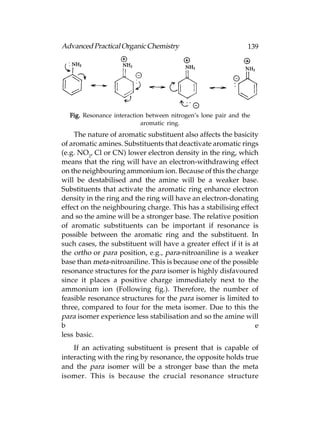
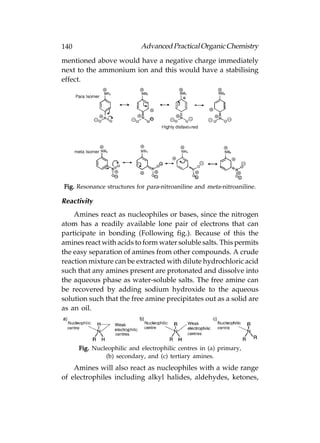
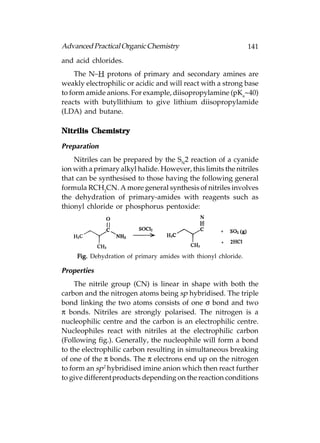
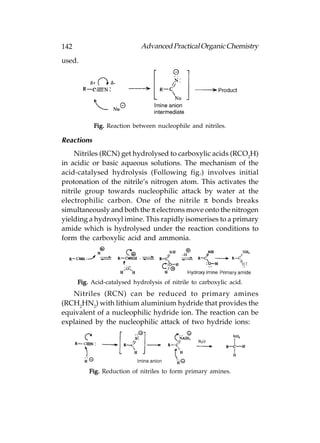
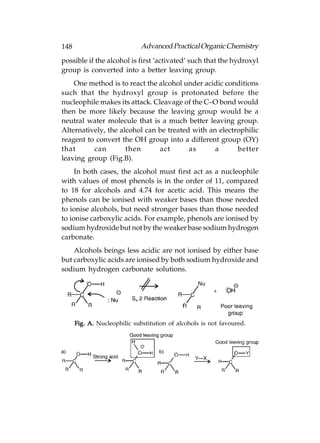
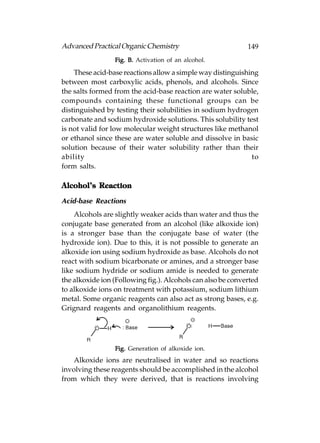
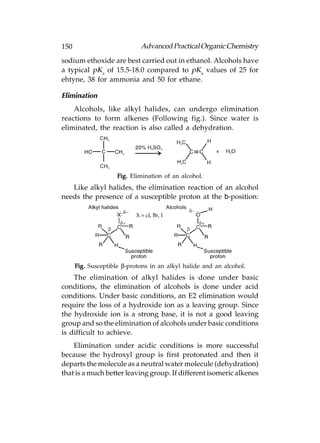
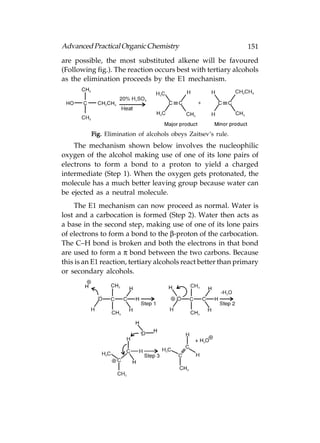
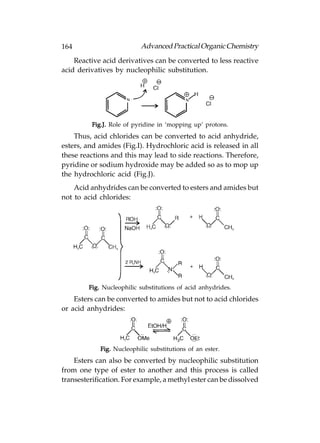
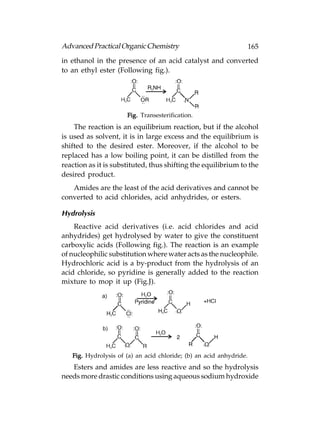
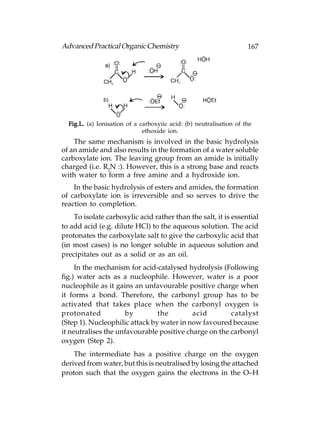
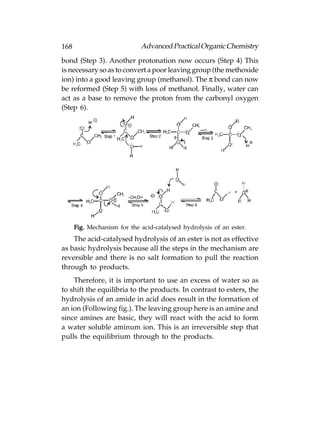
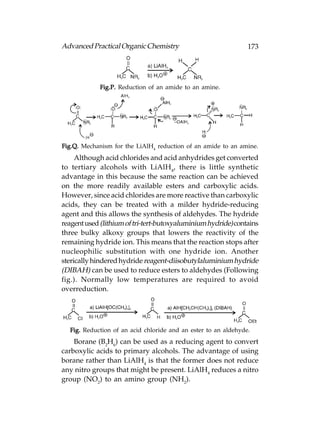
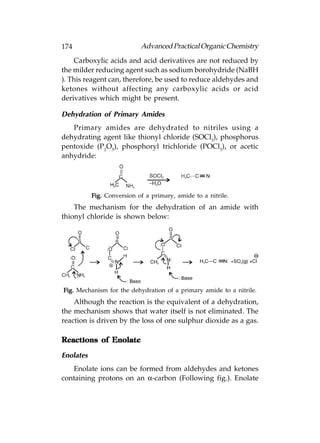
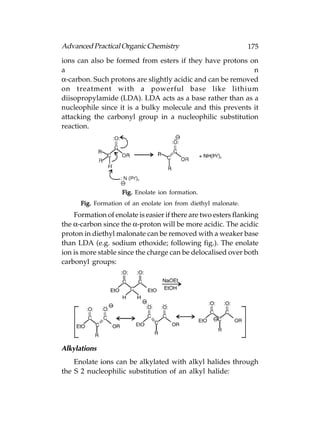
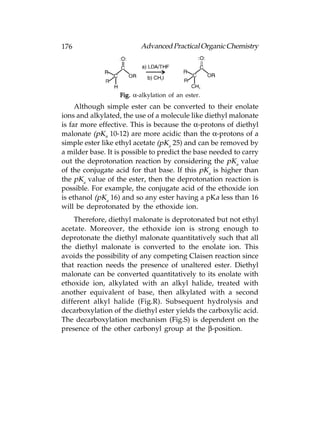
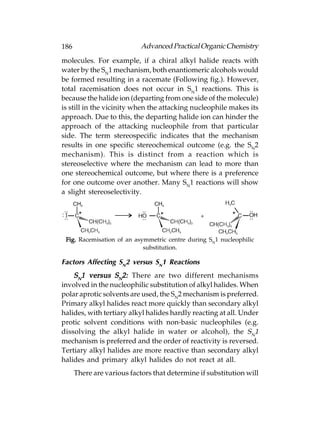
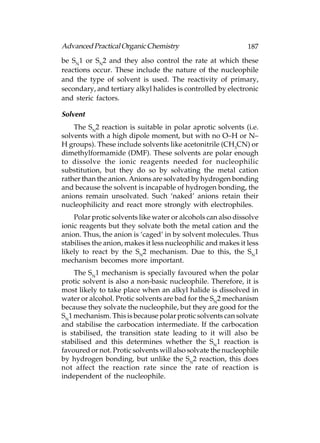
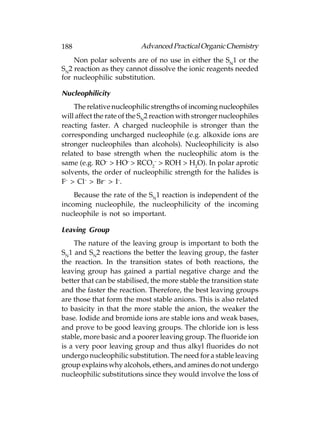
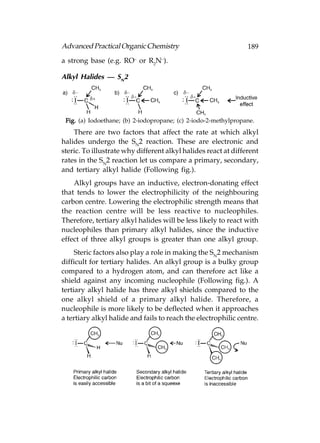
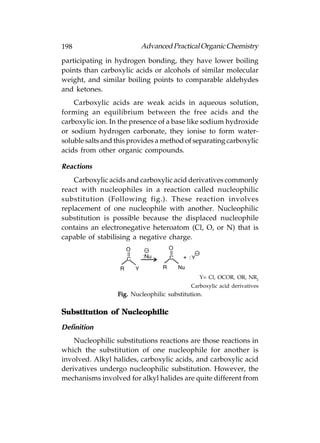
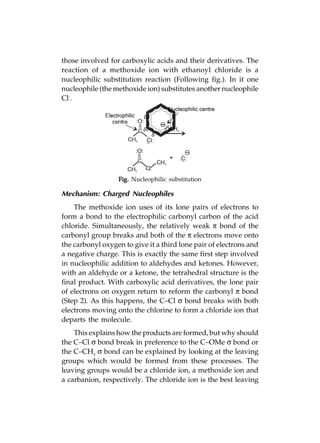
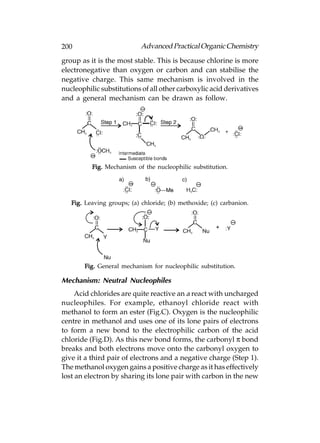
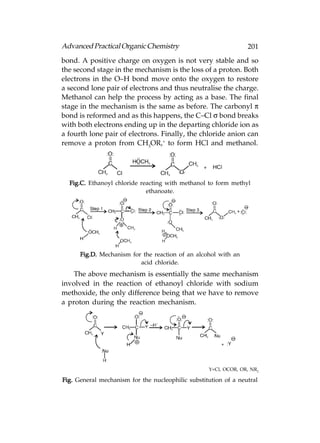
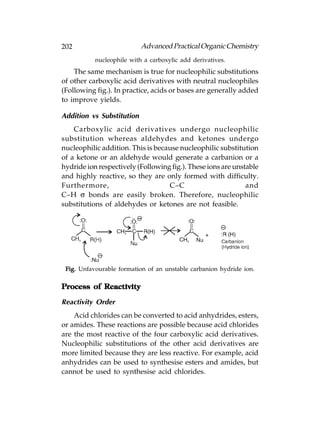
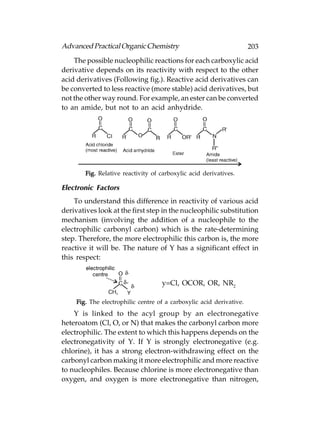
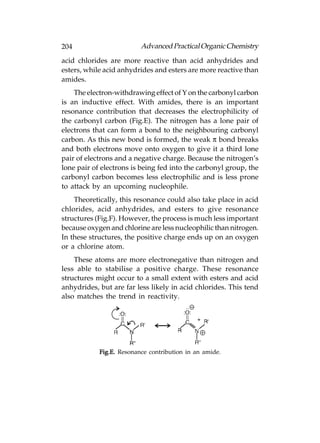
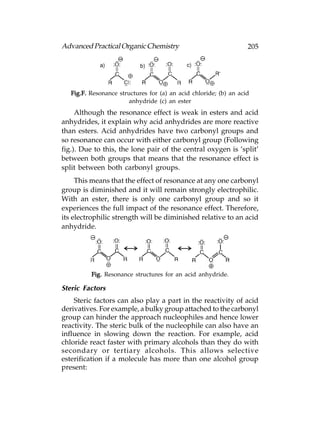
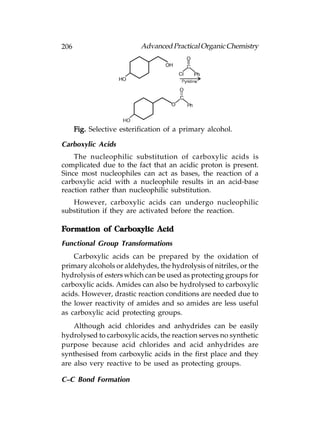
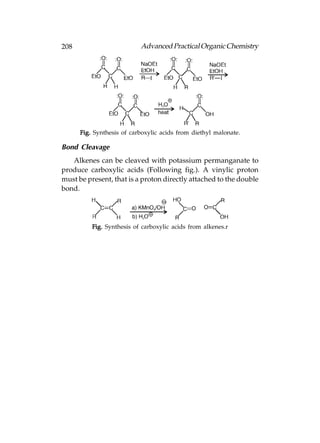
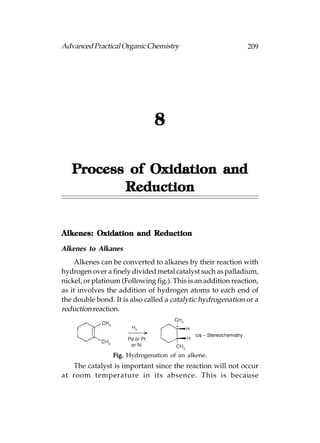
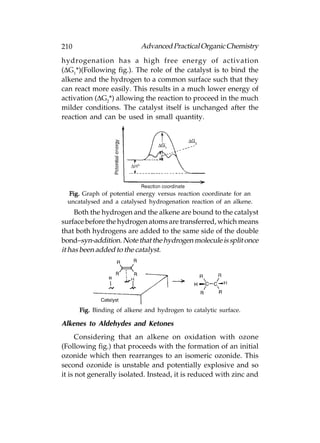
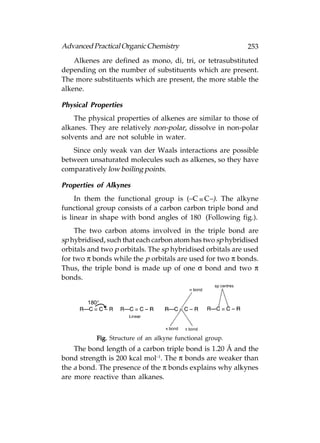
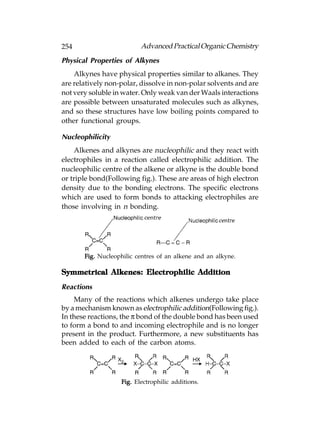
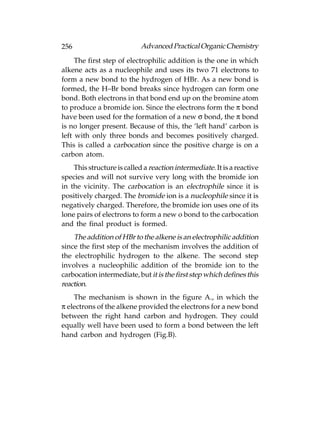
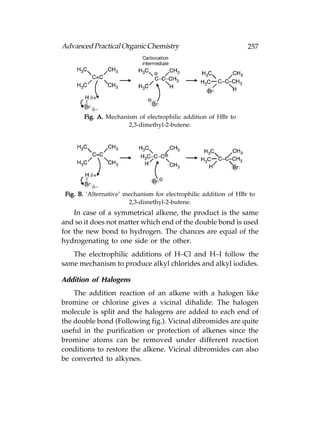
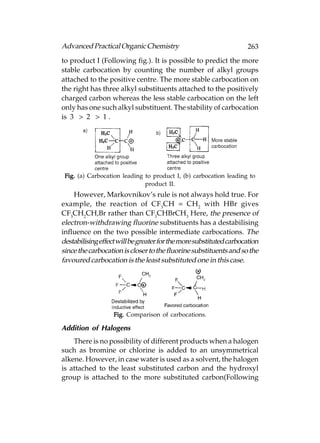
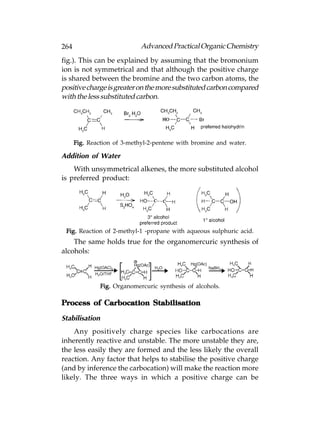
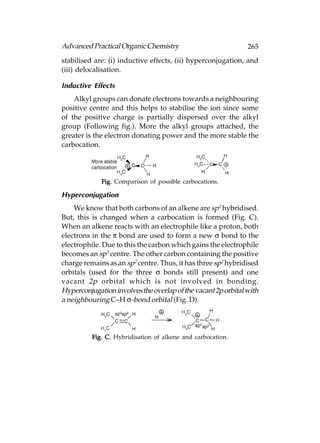
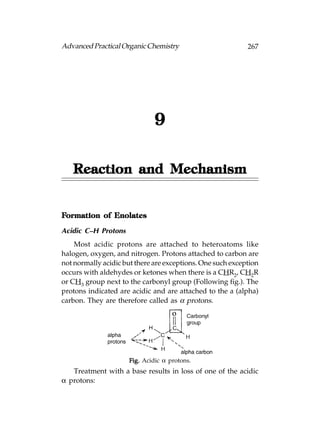
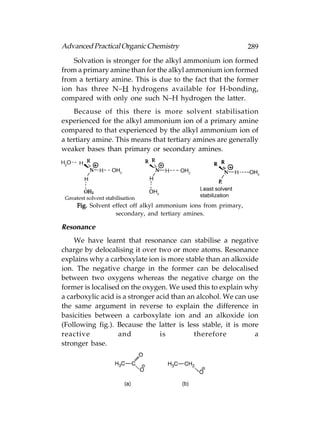
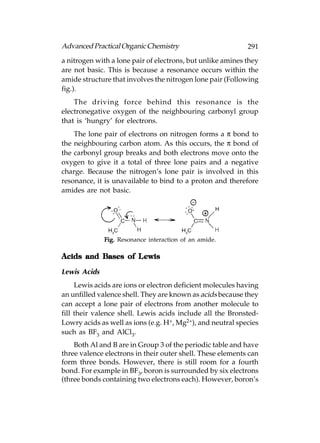
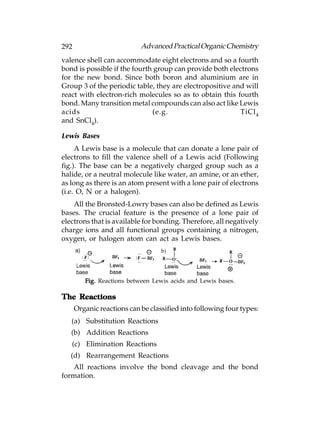
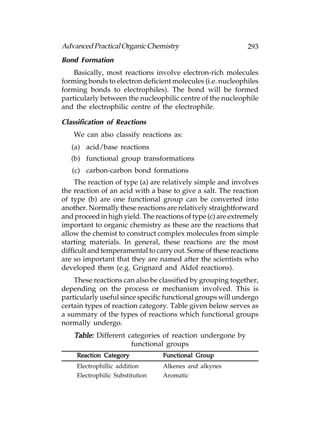
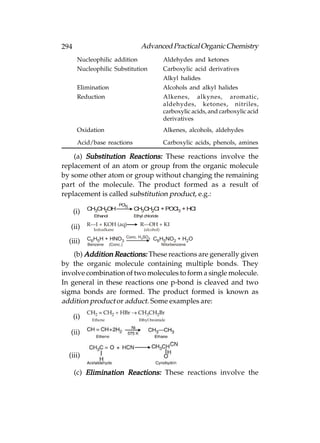
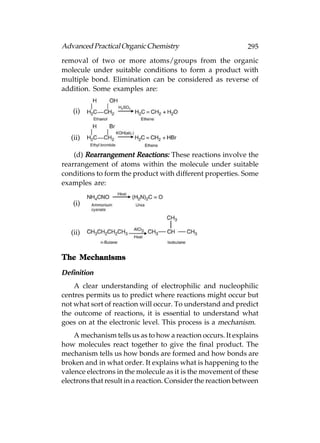
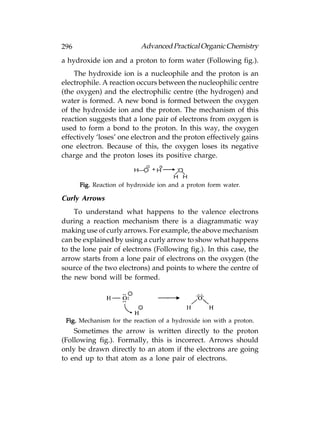
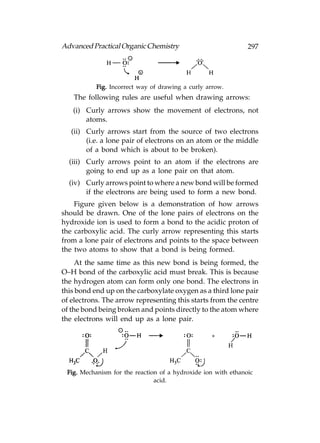
First Edition, 2009


ISBN 978 93 80168 81 4


© All rights reserved.


Published by:

Global Media
1819, Bhagirath Palace,
Chandni Chowk, Delhi-110 006
Email: globalmedia@dkpd.com
Table of Contents


1. Introduction

2. Functional Groups

3. Organic Synthesis Reagents

4. The Structure

5. Reactions of Organic Names

6. Different Elements

7. Process of Reaction

8. Process of Oxidation and Reduction

9. Reaction and Mechanism
Advanced Practical Organic Chemistry                           1


                               1


                  Introduction

    Organic chemistry is the branch of chemistry in which
covalent carbon compounds and their reactions are studied.
A wide variety of classes of compounds such as vitamins,
drugs, natural and synthetic fibres, as well as carbohydrates,
peptides, and fats consist of organic molecules. Organic
chemists determine the structures of organic molecules, study
their various reactions, and develop procedures for the synthesis
of organic substances.
    Organic chemistry is the study of the properties of the
compounds of carbon that are organic. All carbon compounds
except for a few inorganic carbon compounds are organic.
Inorganic carbon compounds include the oxides of carbon, the
bicarbonates and carbonates of metal ions, the metal cyanides,
and a few others.
   Organic chemistry is the most important branch of
chemistry — but of course it would be nothing without the
many other areas of chemistry — in fact all branches of
chemistry should not be viewed in isolation, even though they
may often be taught in isolation.
2                         Advanced Practical Organic Chemistry
    Organic chemistry is all around us, life is based on organic
chemistry, the clothes we wear, the drugs we take, the cars we
drive and the fuel that propels them, wood, paper, plastics and
paints.
    Organic chemistry is the study of compounds containing
carbon the ability of carbon to form as many as 4 strong bonds
to many other atoms, e.g., carbon, hydrogen, oxygen, nitrogen,
halogens, sulphur, phosphorus ensures a virtual infinite number
of possible compounds the constituent atoms and their exact
combination determines the chemical and physical properties
of compounds and hence, their suitability for applications.
     To understand life as we know it, we must first understand
a little bit of organic chemistry. Organic molecules contain
both carbon and hydrogen. Though many organic chemicals
also contain other elements, it is the carbon-hydrogen bond
that defines them as organic. Organic chemistry defines life.
Just as there are millions of different types of living organisms
on this planet, there are millions of different organic molecules,
each with different chemical and physical properties. There
are organic chemicals that make up your hair, your skin, your
fingernails, and so on. The diversity of organic chemicals is
due to the versatility of the carbon atom. Why is carbon such
a special element? Let’s look at its chemistry in a little more
detail.
     Carbon (C) appears in the second row of the periodic table
and has four bonding electrons in its valence shell. Similar to
other non-metals, carbon needs eight electrons to satisfy its
valence shell. Carbon, therefore, forms four bonds with other
atoms (each bond consisting of one of carbon’s electrons and
one of the bonding atom’s electrons). Every valence electron
participates in bonding, thus a carbon atom’s bonds will be
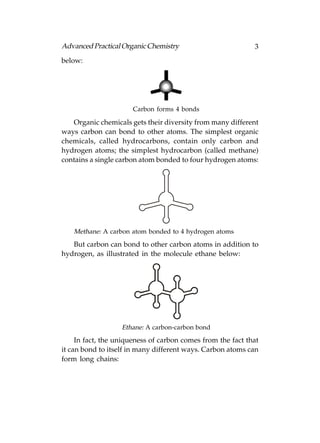
distributed evenly over the atom’s surface. These bonds form
a tetrahedron (a pyramid with a spike at the top), as illustrated
Advanced Practical Organic Chemistry                         3
below:


                      Carbon forms 4 bonds

   Organic chemicals gets their diversity from many different
ways carbon can bond to other atoms. The simplest organic
chemicals, called hydrocarbons, contain only carbon and
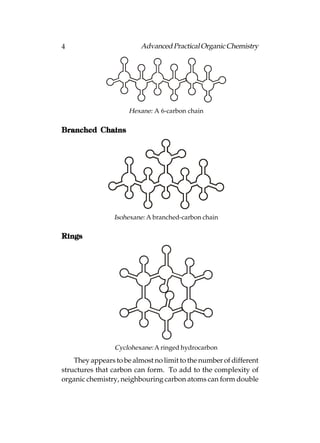
hydrogen atoms; the simplest hydrocarbon (called methane)
contains a single carbon atom bonded to four hydrogen atoms:


   Methane: A carbon atom bonded to 4 hydrogen atoms
   But carbon can bond to other carbon atoms in addition to
hydrogen, as illustrated in the molecule ethane below:


                   Ethane: A carbon-carbon bond
     In fact, the uniqueness of carbon comes from the fact that
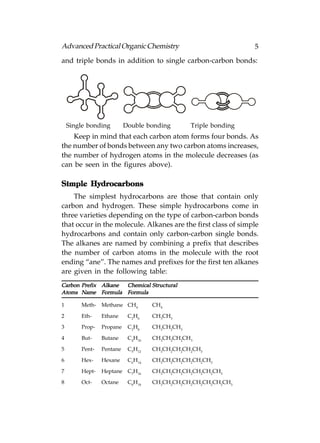
it can bond to itself in many different ways. Carbon atoms can
form long chains:
4                         Advanced Practical Organic Chemistry


                      Hexane: A 6-carbon chain

Branched Chains


                 Isohexane: A branched-carbon chain

Rings


                 Cyclohexane: A ringed hydrocarbon
    They appears to be almost no limit to the number of different
structures that carbon can form. To add to the complexity of
organic chemistry, neighbouring carbon atoms can form double
Advanced Practical Organic Chemistry                             5
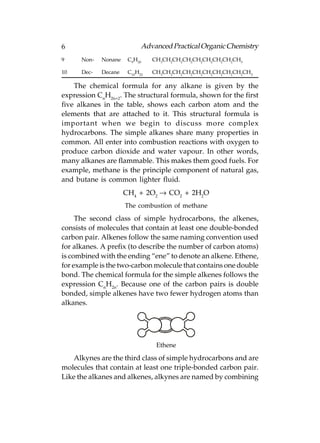
and triple bonds in addition to single carbon-carbon bonds:


    Single bonding        Double bonding        Triple bonding
    Keep in mind that each carbon atom forms four bonds. As
the number of bonds between any two carbon atoms increases,
the number of hydrogen atoms in the molecule decreases (as
can be seen in the figures above).

Simple Hydrocarbons
    The simplest hydrocarbons are those that contain only
carbon and hydrogen. These simple hydrocarbons come in
three varieties depending on the type of carbon-carbon bonds
that occur in the molecule. Alkanes are the first class of simple
hydrocarbons and contain only carbon-carbon single bonds.
The alkanes are named by combining a prefix that describes
the number of carbon atoms in the molecule with the root
ending “ane”. The names and prefixes for the first ten alkanes
are given in the following table:
Carbon Prefix Alkane Chemical Structural
Atoms Name Formula Formula

1       Meth- Methane CH4           CH4

2       Eth-    Ethane     C2H6     CH3CH3

3       Prop-   Propane    C3 H 8   CH3CH2CH3

4       But-    Butane     C4H10    CH3CH2CH2CH3

5       Pent-   Pentane    C5H12    CH3CH2CH2CH2CH3

6       Hex-    Hexane     C6H14    CH3CH2CH2CH2CH2CH3

7       Hept-   Heptane C7H16       CH3CH2CH2CH2CH2CH2CH3

8       Oct-    Octane     C8H18    CH3CH2CH2CH2CH2CH2CH2CH3
6                           Advanced Practical Organic Chemistry
9     Non-   Nonane    C9H20    CH3CH2CH2CH2CH2CH2CH2CH2CH3

10    Dec-   Decane    C10H22   CH3CH2CH2CH2CH2CH2CH2CH2CH2CH3

    The chemical formula for any alkane is given by the
expression CnH2n+2. The structural formula, shown for the first
five alkanes in the table, shows each carbon atom and the
elements that are attached to it. This structural formula is
important when we begin to discuss more complex
hydrocarbons. The simple alkanes share many properties in
common. All enter into combustion reactions with oxygen to
produce carbon dioxide and water vapour. In other words,
many alkanes are flammable. This makes them good fuels. For
example, methane is the principle component of natural gas,
and butane is common lighter fluid.
                      CH4 + 2O2 → CO2 + 2H2O
                      The combustion of methane

     The second class of simple hydrocarbons, the alkenes,
consists of molecules that contain at least one double-bonded
carbon pair. Alkenes follow the same naming convention used
for alkanes. A prefix (to describe the number of carbon atoms)
is combined with the ending “ene” to denote an alkene. Ethene,
for example is the two-carbon molecule that contains one double
bond. The chemical formula for the simple alkenes follows the
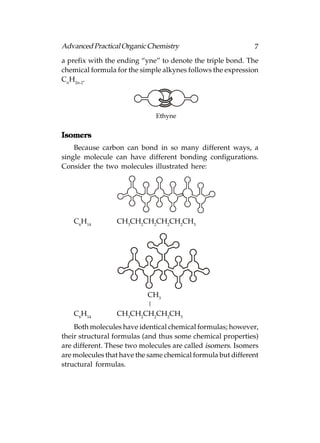
expression CnH2n. Because one of the carbon pairs is double
bonded, simple alkenes have two fewer hydrogen atoms than
alkanes.


                                 Ethene

    Alkynes are the third class of simple hydrocarbons and are
molecules that contain at least one triple-bonded carbon pair.
Like the alkanes and alkenes, alkynes are named by combining
Advanced Practical Organic Chemistry                         7
a prefix with the ending “yne” to denote the triple bond. The
chemical formula for the simple alkynes follows the expression
CnH2n-2.


                              Ethyne


Isomers
    Because carbon can bond in so many different ways, a
single molecule can have different bonding configurations.
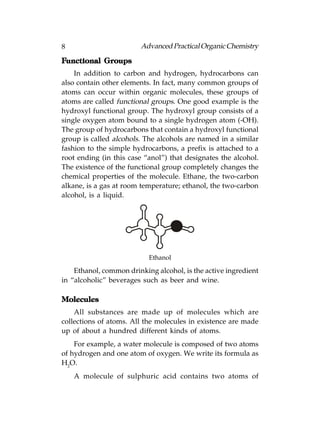
Consider the two molecules illustrated here:


   C6H14         CH3CH2CH2CH2CH2CH3


                        CH3
                        |
   C6H14         CH3CH2CH2CH2CH3
    Both molecules have identical chemical formulas; however,
their structural formulas (and thus some chemical properties)
are different. These two molecules are called isomers. Isomers
are molecules that have the same chemical formula but different
structural formulas.
8                       Advanced Practical Organic Chemistry

Functional Groups
    In addition to carbon and hydrogen, hydrocarbons can
also contain other elements. In fact, many common groups of
atoms can occur within organic molecules, these groups of
atoms are called functional groups. One good example is the
hydroxyl functional group. The hydroxyl group consists of a
single oxygen atom bound to a single hydrogen atom (-OH).
The group of hydrocarbons that contain a hydroxyl functional
group is called alcohols. The alcohols are named in a similar
fashion to the simple hydrocarbons, a prefix is attached to a
root ending (in this case “anol”) that designates the alcohol.
The existence of the functional group completely changes the
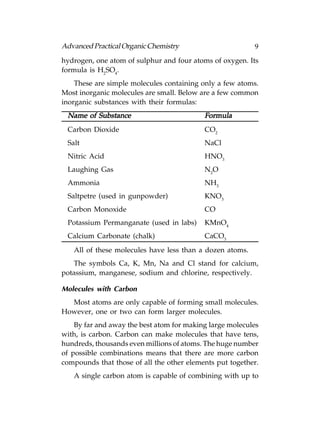
chemical properties of the molecule. Ethane, the two-carbon
alkane, is a gas at room temperature; ethanol, the two-carbon
alcohol, is a liquid.


                           Ethanol

    Ethanol, common drinking alcohol, is the active ingredient
in “alcoholic” beverages such as beer and wine.

Molecules
    All substances are made up of molecules which are
collections of atoms. All the molecules in existence are made
up of about a hundred different kinds of atoms.
    For example, a water molecule is composed of two atoms
of hydrogen and one atom of oxygen. We write its formula as
H2O.
    A molecule of sulphuric acid contains two atoms of
Advanced Practical Organic Chemistry                      9
hydrogen, one atom of sulphur and four atoms of oxygen. Its
formula is H2SO4.
    These are simple molecules containing only a few atoms.
Most inorganic molecules are small. Below are a few common
inorganic substances with their formulas:
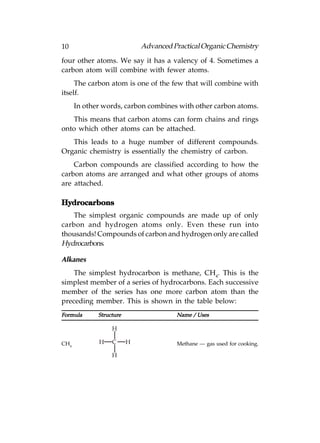
 Name of Substance                         Formula
 Carbon Dioxide                            CO2
 Salt                                      NaCl
 Nitric Acid                               HNO3
 Laughing Gas                              N2O
 Ammonia                                   NH3
 Saltpetre (used in gunpowder)             KNO3
 Carbon Monoxide                           CO
 Potassium Permanganate (used in labs)     KMnO4
 Calcium Carbonate (chalk)                 CaCO3
   All of these molecules have less than a dozen atoms.
   The symbols Ca, K, Mn, Na and Cl stand for calcium,
potassium, manganese, sodium and chlorine, respectively.

Molecules with Carbon
  Most atoms are only capable of forming small molecules.
However, one or two can form larger molecules.
    By far and away the best atom for making large molecules
with, is carbon. Carbon can make molecules that have tens,
hundreds, thousands even millions of atoms. The huge number
of possible combinations means that there are more carbon
compounds that those of all the other elements put together.
   A single carbon atom is capable of combining with up to
10                           Advanced Practical Organic Chemistry
four other atoms. We say it has a valency of 4. Sometimes a
carbon atom will combine with fewer atoms.
     The carbon atom is one of the few that will combine with
itself.
      In other words, carbon combines with other carbon atoms.
   This means that carbon atoms can form chains and rings
onto which other atoms can be attached.
   This leads to a huge number of different compounds.
Organic chemistry is essentially the chemistry of carbon.
    Carbon compounds are classified according to how the
carbon atoms are arranged and what other groups of atoms
are attached.

Hydrocarbons
   The simplest organic compounds are made up of only
carbon and hydrogen atoms only. Even these run into
thousands! Compounds of carbon and hydrogen only are called
Hydrocarbons.

Alkanes
    The simplest hydrocarbon is methane, CH4. This is the
simplest member of a series of hydrocarbons. Each successive
member of the series has one more carbon atom than the
preceding member. This is shown in the table below:
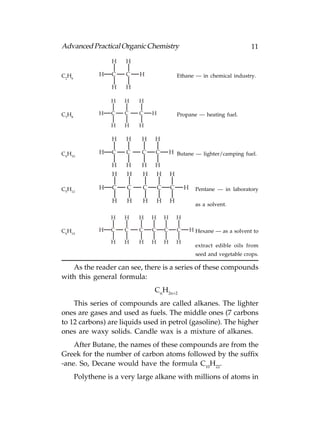
Formula      Structure                  Name / Uses

                  H

CH4          H    C      H              Methane — gas used for cooking.

                  H
Advanced Practical Organic Chemistry                                            11

                  H    H

C2H6          H   C    C   H                    Ethane — in chemical industry.

                  H    H

                  H    H   H

C3H8          H   C    C   C    H               Propane — heating fuel.
                  H    H   H

                  H    H    H   H

C4H10         H   C    C    C   C           H Butane — lighter/camping fuel.

                  H    H    H   H
                  H    H    H   H           H

C5H12         H    C   C    C       C       C       H     Pentane — in laboratory

                   H   H    H       H       H
                                                          as a solvent.

                  H    H   H    H       H       H

C6H14         H   C    C   C    C       C       C       H Hexane — as a solvent to

                  H    H   H    H       H       H
                                                          extract edible oils from
                                                          seed and vegetable crops.

   As the reader can see, there is a series of these compounds
with this general formula:
                                CnH2n+2
    This series of compounds are called alkanes. The lighter
ones are gases and used as fuels. The middle ones (7 carbons
to 12 carbons) are liquids used in petrol (gasoline). The higher
ones are waxy solids. Candle wax is a mixture of alkanes.
    After Butane, the names of these compounds are from the
Greek for the number of carbon atoms followed by the suffix
-ane. So, Decane would have the formula C10H22.
       Polythene is a very large alkane with millions of atoms in
12                           Advanced Practical Organic Chemistry
a single molecule. Apart from being flammable, alkanes are
stable compounds found underground.
    In the alkanes, all four of the carbon valency bonds are
taken up with links to different atoms. These types of bonds
are called single bonds and are generally stable and resistant
to attack by other chemicals. Alkanes contain the maximum
number of hydrogen atoms possible. They are said to be
saturated.
     The alkanes are not the only hydrocarbons.

Alkenes
   Another series of compounds is called the alkenes. These
have a general formula:
                                 CnH2n
    Alkenes have fewer hydrogen atoms than the alkanes. The
extra valencies left over occur as double bonds between a pair
of Carbon atoms. The double bonds are more reactive than
single bonds making the alkenes chemically more reactive.
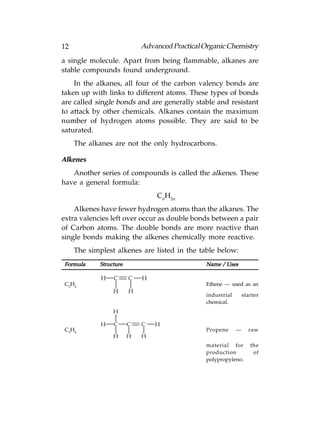
     The simplest alkenes are listed in the table below:
Formula      Structure                          Name / Uses

             H    C      C   H
C2H4                                             Ethene — used as an
                  H      H
                                                 industrial       starter
                                                 chemical.
                  H

             H    C      C   C   H
C3H6                                             Propene      —     raw
                  H      H   H
                                                 material for        the
                                                 production           of
                                                 polypropyleno.
Advanced Practical Organic Chemistry                                  13
                      H   H

C4H8          H       C   C   C   C   H             Butene — commonly

                      H   H   H   H
                                                    used as a co-polymer.

                      H   H   H

C5H10         H       C   C   C   C   C     H       Pentene — used in

                      H   H   H   H   H
                                                    making of plastics
                                                    polyethy lene.

                      H   H   H   H

C6H12         H       C   C   C   C   C     C   H   Hexene    — as a
                      H   H   H   H   H     H
                                                    comonomer         in
                                                    production        of
                                                    polyethene.

    These compounds are named in a similar manner to the
alkanes except that the suffix is -ene.

Alkynes
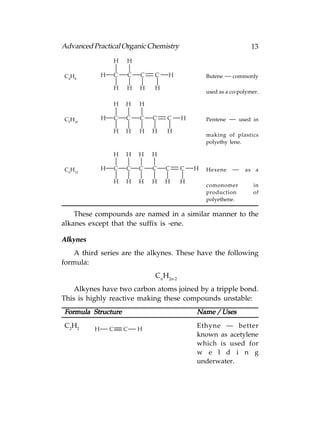
   A third series are the alkynes. These have the following
formula:
                                  CnH2n-2
    Alkynes have two carbon atoms joined by a tripple bond.
This is highly reactive making these compounds unstable:
Formula Structure                               Name / Uses
C2H2      H       C       C   H
                                                Ethyne — better
                                                known as acetylene
                                                which is used for
                                                w e l d i n g
                                                underwater.
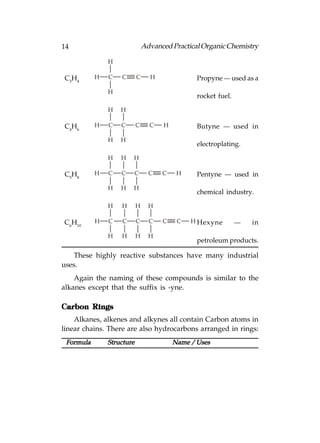
14                             Advanced Practical Organic Chemistry

               H

C3H4       H   C   C       C     H              Propyne — used as a
               H
                                                rocket fuel.
               H   H

C4H6       H   C   C       C     C   H          Butyne — used in
               H   H
                                                electroplating.

               H   H   H

C5H8       H   C   C   C         C   C    H     Pentyne — used in
               H   H   H
                                                chemical industry.

               H   H       H     H

C6H10      H   C   C       C     C   C    C   H Hexyne         —   in
               H   H       H     H
                                                petroleum products.

   These highly reactive substances have many industrial
uses.
    Again the naming of these compounds is similar to the
alkanes except that the suffix is -yne.

Carbon Rings
    Alkanes, alkenes and alkynes all contain Carbon atoms in
linear chains. There are also hydrocarbons arranged in rings:
 Formula       Structure                 Name / Uses
Advanced Practical Organic Chemistry                         15


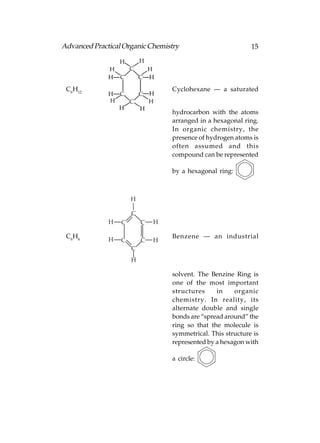
 C6H12                            Cyclohexane — a saturated


                                  hydrocarbon with the atoms
                                  arranged in a hexagonal ring.
                                  In organic chemistry, the
                                  presence of hydrogen atoms is
                                  often assumed and this
                                  compound can be represented

                                  by a hexagonal ring:


                      H

                      C
              H   C       C   H

 C6H6         H
                                  Benzene — an industrial
                  C       C   H
                      C
                      H

                                  solvent. The Benzine Ring is
                                  one of the most important
                                  structures     in    organic
                                  chemistry. In reality, its
                                  alternate double and single
                                  bonds are “spread around” the
                                  ring so that the molecule is
                                  symmetrical. This structure is
                                  represented by a hexagon with

                                  a circle:
16                                 Advanced Practical Organic Chemistry

                       H

               H       C       H

                       C
           H       C       C       H
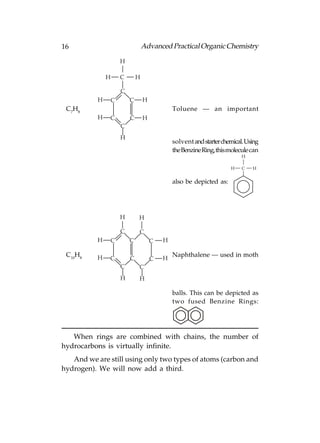
 C7H8                                          Toluene — an important
           H   C           C       H
                       C
                       H
                                               solvent and starter chemical. Using
                                               the Benzine Ring, this molecule can
                                                                           H

                                                                      H    C   H


                                               also be depicted as:


                       H       H

                       C       C
           H   C           C           C   H

 C10H8     H                                   Naphthalene — used in moth
               C           C           C   H
                       C       C
                       H       H

                                               balls. This can be depicted as
                                               two fused Benzine Rings:


   When rings are combined with chains, the number of
hydrocarbons is virtually infinite.
   And we are still using only two types of atoms (carbon and
hydrogen). We will now add a third.
Advanced Practical Organic Chemistry                                                17

Carbon, Hydrogen and Oxygen
    When oxygen atoms are added, the variety of compounds
grows enormously. In the table below, each row discusses a
series of compounds:

Formula         Name

CnH2n+1OH       Alcohols       Alcohols have the OH                C H         3
                                                                                   O H
                                   H

                               H    C      O           H
Methanol—wood, alcohol.
                                    H


                               (hydroxyl) group in the             C   2
                                                                           H   5
                                                                                   O H

                                    H          H

                               H    C          C   O       H
Ethanol—drinking alcohol.
                                   H H
                               molecule. A group of                C   6
                                                                           H   5
                                                                                   O H
Phenolcarbolic acid -

                               atoms that gives an organic         used             as
disinfectant.
       OH                      series its distinctive character


                               is called a functional group.

(CnH2n+1)2O     Ethers         Ethers have an O atom attached      ( C H 3) 2O
                                       H               H

                               H       C       O       C       H
Dimethyl Ethera—gas.

                                       H               H
                               to two hydrocarbon chains           ( C 2H 5) 2O
Diethyl Ethera—liquid.
                               (or rings).                         used as an
                    H      H       H       H

                H   C      C   O   C       C       H
anaesthetic)
                    H      H       H       H
18                                     Advanced Practical Organic Chemistry
(CnH2n+1)2CO        Ketones           Ketones have a CO group                 CH 3 COCH 3
                                          H        H

                                      H       C   C       C       H
Dimethyl Ketone
                                           H O H
                                      attached to two hydrocarbon             (also known
as acetone)—
                                      chains (or rings).                      nail-varnish
remover.

CnH2n+1CHO          Aldehydes         Aldehydes have a CHO group              H C H O
                                          H

                                      H       C   C       H
Formaldehyde — preservative
                                            H O
                                      attached to a hydrocarbon chain         in labs.
                                      (or ring).                                 CH 3CHO

                          H       H

                    H     C       C       C       H
Acetaldehyde
                          H       H       O

CnH2n+1CO2H         Fatty Acids       Fatty Acids contain the CO2H            H C O    2
                                                                                           H
                                      H       C       O       H
Formic Acidin—
                                              O

                                      (or COOH) group attached to a           ant bites and
stinging nettles.
                                           H
                                      hydrocarbon chain or ring.              C H 3C O 2H

                                      H       C       C       O       H
Acetic Acidvinegar
                                              H       O
                                                                              C 2H 5C O 2H
                                              H   H

Butyric Acidthe — rancid              H       C   C       C       O       H

                                              H   H       O
                                                                              butter smell.


RCO2R’ (R, R’           Esters        Esters are similar to Fatty             CH3CO 2CH3
Advanced Practical Organic Chemistry                            19
                    H               H

               H    C   C       O   C   H
Methyl—
                    H   O           H
are Hydrocarbon             Acids except that the H in
Methoateessence of pear drops.
chains or rings).           the COOH group is another
                            hydrocarbon chain. They are
                            usually very sweet smelling
                                liquids used in perfumes.
are Hydrocarbon
                                Methoateessence of pear drops

   In the above examples, each molecule has a single functional
group.
    It is possible to have two or more functional groups on a
molecule. These can be the same group (as in Oxalic Acid —
a poison found in rhubarb leaves — which has two fatty acid
groups) or different (as in Hydroxymethanoic Acid — which
has a hydroxyl group and a fatty acid group):
                                        H

                            H       O   C    C    O     H

                                             O
                                        2
                            (COOH) : Oxalic Acid
                                        H

                            H       O   C    C    O     H

                                        H    O
                   CH2OHCOOH: Hydroxymethanoic Acid

   The most famous compounds containing carbon, hydrogen
and oxygen are the Carbohydrates. An example is the common
sugar, Sucrose (C12H22O11).
    This shows how varied and complex even simple organic
compounds can be. Sucrose has a pair of rings: one hexagonal,
the other pentagonal. Each ring contains an oxygen atom. The
20                       Advanced Practical Organic Chemistry
rings are joined by an oxygen (Ether) link. The entire compound
contains several Hydroxyl (OH) groups.


                                Sucrose


Isomerism
    An interesting phenomenon with organic molecules is called
isomerism. Let us look at two compounds introduced earlier.
Dimethyl Ether: (CH3)2O and Ethanol: C2H5OH.
    The first is a gas which will knock you out if inhaled. The
second is common alcohol drunk in spirits. The two molecules
are shown below:
                            H             H

                       H    C     O       C   H

                            H             H
                           Dimethyl Ether
                            H     H

                       H    C     C       O   H

                            H     H
                                Ethanol

   Notice that both compounds contain 2 carbon atoms, 6
hydrogen atoms and 1 oxygen atom.
    Even though the atoms are the same, they are arranged
differently. This yields two different compounds with the same
number of atoms. These compounds are isomers and the
Advanced Practical Organic Chemistry                         21
phenomenon is called Isomerism.
    In this example, the two molecules have different functional
groups. They are structural isomers. Other types of isomers
exist.
    Isomerism increases the number of organic compounds.
The more carbon atoms in a compound, the more ways of
arranging the atoms and the larger number of isomers.

Adding Nitrogen
    Many very important organic compounds contain nitrogen.
This produces more series of compounds.
    A famous compound containing nitrogen is Trinitro
Toluene [C6H2CH3(NO2)3 — usually abbreviated to TNT]. This
is an artificially made explosive. Its structure is shown below:
                                CH 3

                         NO 2           NO2


                                 NO 2

                      Trinitro Toluene (TNT)

   There are six isomers of this compound as the three NO2
groups can be placed in six different arrangements on the ring.
These are known as positional isomers.

      Atoms
Other Atoms
    The vast majority of organic compounds contain carbon,
hydrogen, oxygen and nitrogen. Other types of atoms can be
included to form even more compounds. These can contain
atoms like phosphorus, sulphur (e.g. thiamine, vitamin B1),
magnesium (e.g. chlorophyll) and iron (e.g. haemoglobin).
   As can be imagined, these additions increase the number
22                          Advanced Practical Organic Chemistry
of compounds. Apart from the naturally occurring organic
compounds, millions more can be synthesised. These can
include atoms like Chlorine (used in pesticides). Examples of
organic compounds containing Chlorine are shown below.
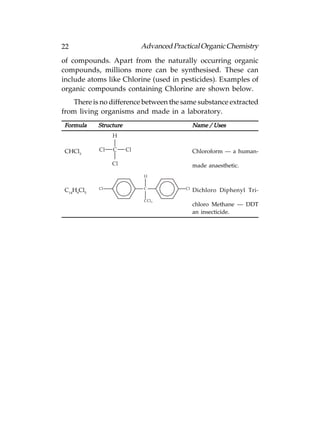
   There is no difference between the same substance extracted
from living organisms and made in a laboratory.
Formula    Structure                          Name / Uses
                H

CHCl3      Cl   C      Cl                     Chloroform — a human-

                Cl                            made anaesthetic.
                            H


           Cl               C            Cl
C14H9Cl5                                      Dichloro Diphenyl Tri-
                            CCl 3
                                              chloro Methane — DDT
                                              an insecticide.
Advanced Practical Organic Chemistry                         23


                                2

          Functional Groups


Functional Groups: Aliphatic and Aromatic
Aliphatic Functional Groups
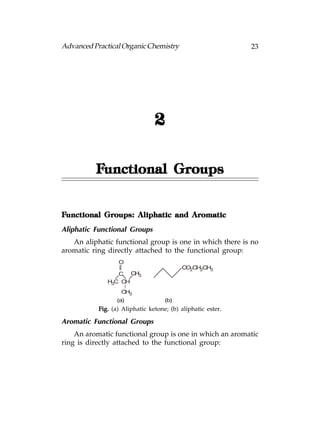
   An aliphatic functional group is one in which there is no
aromatic ring directly attached to the functional group:
                  O
                                          CO2CH2CH3
                 C CH3
              H3C CH
                   CH3
                  (a)               (b)
           Fig. (a) Aliphatic ketone; (b) aliphatic ester.

Aromatic Functional Groups
    An aromatic functional group is one in which an aromatic
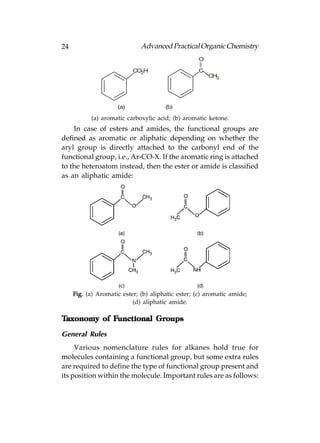
ring is directly attached to the functional group:
24                            Advanced Practical Organic Chemistry
                                                   O

                           CO2H                    C
                                                       CH3


                     (a)               (b)

           (a) aromatic carboxylic acid; (b) aromatic ketone.
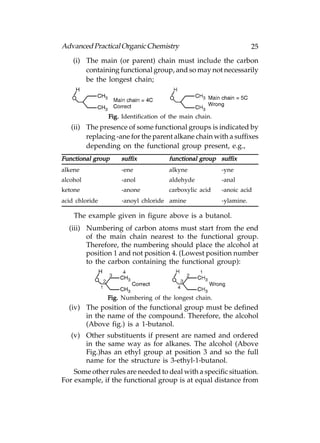
    In case of esters and amides, the functional groups are
defined as aromatic or aliphatic depending on whether the
aryl group is directly attached to the carbonyl end of the
functional group, i.e., Ar-CO-X. If the aromatic ring is attached
to the heteroatom instead, then the ester or amide is classified
as an aliphatic amide:


     Fig. (a) Aromatic ester; (b) aliphatic ester; (c) aromatic amide;
                           (d) aliphatic amide.

Taxonomy of Functional Groups
            Functional

General Rules
     Various nomenclature rules for alkanes hold true for
molecules containing a functional group, but some extra rules
are required to define the type of functional group present and
its position within the molecule. Important rules are as follows:
Advanced Practical Organic Chemistry                                 25
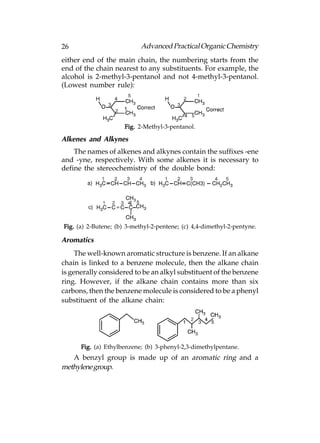
    (i) The main (or parent) chain must include the carbon
        containing functional group, and so may not necessarily
        be the longest chain;


                Fig. Identification of the main chain.
   (ii) The presence of some functional groups is indicated by
        replacing -ane for the parent alkane chain with a suffixes
        depending on the functional group present, e.g.,
Functional group    suffix            functional group suffix
alkene              -ene              alkyne             -yne
alcohol             -anol             aldehyde           -anal
ketone              -anone            carboxylic acid    -anoic acid
acid chloride       -anoyl chloride amine                -ylamine.

    The example given in figure above is a butanol.
  (iii) Numbering of carbon atoms must start from the end
        of the main chain nearest to the functional group.
        Therefore, the numbering should place the alcohol at
        position 1 and not position 4. (Lowest position number
        to the carbon containing the functional group):


                Fig. Numbering of the longest chain.
  (iv) The position of the functional group must be defined
       in the name of the compound. Therefore, the alcohol
       (Above fig.) is a 1-butanol.
   (v) Other substituents if present are named and ordered
       in the same way as for alkanes. The alcohol (Above
       Fig.)has an ethyl group at position 3 and so the full
       name for the structure is 3-ethyl-1-butanol.
    Some other rules are needed to deal with a specific situation.
For example, if the functional group is at equal distance from
26                          Advanced Practical Organic Chemistry
either end of the main chain, the numbering starts from the
end of the chain nearest to any substituents. For example, the
alcohol is 2-methyl-3-pentanol and not 4-methyl-3-pentanol.
(Lowest number rule):


                      Fig. 2-Methyl-3-pentanol.

Alkenes and Alkynes
    The names of alkenes and alkynes contain the suffixes -ene
and -yne, respectively. With some alkenes it is necessary to
define the stereochemistry of the double bond:


Fig. (a) 2-Butene; (b) 3-methyl-2-pentene; (c) 4,4-dimethyl-2-pentyne.

Aromatics
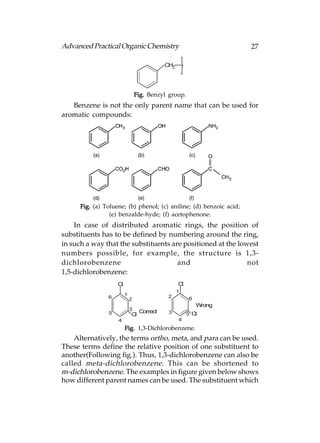
     The well-known aromatic structure is benzene. If an alkane
chain is linked to a benzene molecule, then the alkane chain
is generally considered to be an alkyl substituent of the benzene
ring. However, if the alkane chain contains more than six
carbons, then the benzene molecule is considered to be a phenyl
substituent of the alkane chain:


      Fig. (a) Ethylbenzene; (b) 3-phenyl-2,3-dimethylpentane.
   A benzyl group is made up of an aromatic ring and a
methylene group.
Advanced Practical Organic Chemistry                                 27

                                            CH2


                                 Fig. Benzyl group.
   Benzene is not the only parent name that can be used for
aromatic compounds:


      Fig. (a) Toluene; (b) phenol; (c) aniline; (d) benzoic acid;
                 (e) benzalde-hyde; (f) acetophenone.
    In case of distributed aromatic rings, the position of
substituents has to be defined by numbering around the ring,
in such a way that the substituents are positioned at the lowest
numbers possible, for example, the structure is 1,3-
dichlorobenzene                       and                    not
1,5-dichlorobenzene:
                    Cl                            Cl
                                                  1
                         1                   2
                6            2                          6
                                                            Wrong
                             3    Correct
                5            Cl              3         5 Cl
                    4                             4
                         Fig. 1,3-Dichlorobenzene.
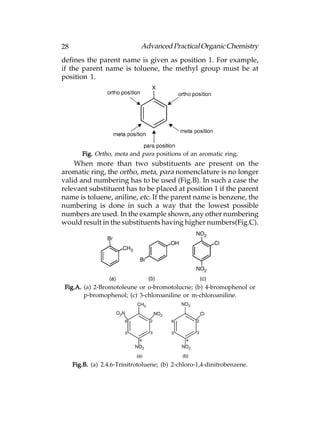
    Alternatively, the terms ortho, meta, and para can be used.
These terms define the relative position of one substituent to
another(Following fig.). Thus, 1,3-dichlorobenzene can also be
called meta-dichlorobenzene . This can be shortened to
m-dichlorobenzene. The examples in figure given below shows
how different parent names can be used. The substituent which
28                            Advanced Practical Organic Chemistry
defines the parent name is given as position 1. For example,
if the parent name is toluene, the methyl group must be at
position 1.


        Fig. Ortho, meta and para positions of an aromatic ring.
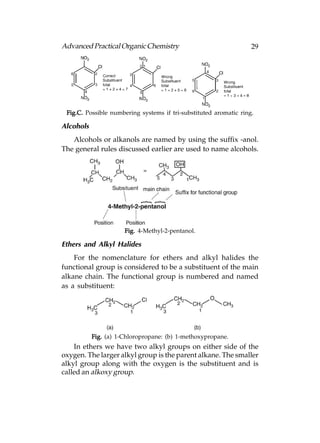
    When more than two substituents are present on the
aromatic ring, the ortho, meta, para nomenclature is no longer
valid and numbering has to be used (Fig.B). In such a case the
relevant substituent has to be placed at position 1 if the parent
name is toluene, aniline, etc. If the parent name is benzene, the
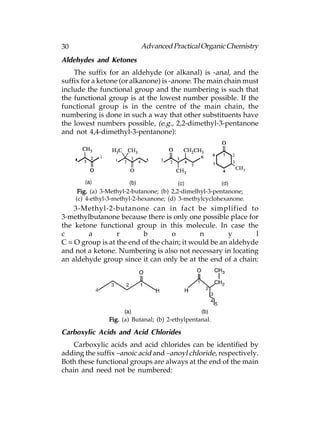
numbering is done in such a way that the lowest possible
numbers are used. In the example shown, any other numbering
would result in the substituents having higher numbers(Fig.C).


 Fig.A. (a) 2-Bromotoleune or o-bromotolucne; (b) 4-bromophenol or
        p-bromophenol; (c) 3-chloroaniline or m-chloroaniline.


     Fig.B. (a) 2.4.6-Trinitrotoluene; (b) 2-chloro-1,4-dinitrobenzene.
Advanced Practical Organic Chemistry                               29


 Fig.C. Possible numbering systems if tri-substituted aromatic ring.

Alcohols
   Alcohols or alkanols are named by using the suffix -anol.
The general rules discussed earlier are used to name alcohols.


                      Fig. 4-Methyl-2-pentanol.

Ethers and Alkyl Halides
    For the nomenclature for ethers and alkyl halides the
functional group is considered to be a substituent of the main
alkane chain. The functional group is numbered and named
as a substituent:


           Fig. (a) 1-Chloropropane: (b) 1-methoxypropane.
    In ethers we have two alkyl groups on either side of the
oxygen. The larger alkyl group is the parent alkane. The smaller
alkyl group along with the oxygen is the substituent and is
called an alkoxy group.
30                          Advanced Practical Organic Chemistry
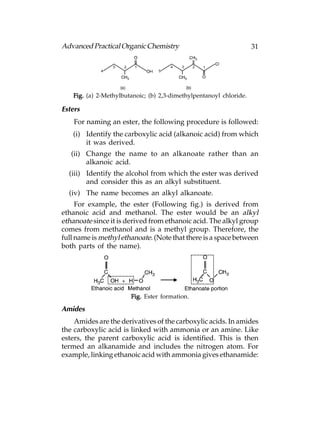
Aldehydes and Ketones
    The suffix for an aldehyde (or alkanal) is -anal, and the
suffix for a ketone (or alkanone) is -anone. The main chain must
include the functional group and the numbering is such that
the functional group is at the lowest number possible. If the
functional group is in the centre of the main chain, the
numbering is done in such a way that other substituents have
the lowest numbers possible, (e.g., 2,2-dimethyl-3-pentanone
and not 4,4-dimethyl-3-pentanone):


      Fig. (a) 3-Methyl-2-butanone; (b) 2,2-dimelhyl-3-pentanone;
     (c) 4-ethyl-3-methyl-2-hexanone; (d) 3-methylcyclohexanone.
    3-Methyl-2-butanone can in fact be simplified to
3-methylbutanone because there is only one possible place for
the ketone functional group in this molecule. In case the
c       a         r       b         o        n         y      l
C = O group is at the end of the chain; it would be an aldehyde
and not a ketone. Numbering is also not necessary in locating
an aldehyde group since it can only be at the end of a chain:


                Fig. (a) Butanal; (b) 2-ethylpentanal.

Carboxylic Acids and Acid Chlorides
    Carboxylic acids and acid chlorides can be identified by
adding the suffix –anoic acid and –anoyl chloride, respectively.
Both these functional groups are always at the end of the main
chain and need not be numbered:
Advanced Practical Organic Chemistry                                31


   Fig. (a) 2-Methylbutanoic; (b) 2,3-dimethylpentanoyl chloride.

Esters
    For naming an ester, the following procedure is followed:
   (i) Identify the carboxylic acid (alkanoic acid) from which
       it was derived.
   (ii) Change the name to an alkanoate rather than an
        alkanoic acid.
  (iii) Identify the alcohol from which the ester was derived
        and consider this as an alkyl substituent.
  (iv) The name becomes an alkyl alkanoate.
     For example, the ester (Following fig.) is derived from
ethanoic acid and methanol. The ester would be an alkyl
ethanoate since it is derived from ethanoic acid. The alkyl group
comes from methanol and is a methyl group. Therefore, the
full name is methyl ethanoate. (Note that there is a space between
both parts of the name).


                       Fig. Ester formation.

Amides
    Amides are the derivatives of the carboxylic acids. In amides
the carboxylic acid is linked with ammonia or an amine. Like
esters, the parent carboxylic acid is identified. This is then
termed an alkanamide and includes the nitrogen atom. For
example, linking ethanoic acid with ammonia gives ethanamide:
32                        Advanced Practical Organic Chemistry


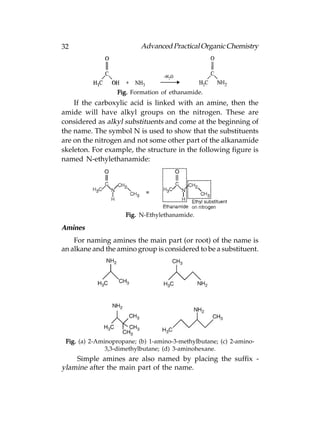
                  Fig. Formation of ethanamide.
    If the carboxylic acid is linked with an amine, then the
amide will have alkyl groups on the nitrogen. These are
considered as alkyl substituents and come at the beginning of
the name. The symbol N is used to show that the substituents
are on the nitrogen and not some other part of the alkanamide
skeleton. For example, the structure in the following figure is
named N-ethylethanamide:


                     Fig. N-Ethylethanamide.

Amines
    For naming amines the main part (or root) of the name is
an alkane and the amino group is considered to be a substituent.


 Fig. (a) 2-Aminopropane; (b) 1-amino-3-methyIbutane; (c) 2-amino-
               3,3-dimethylbutane; (d) 3-aminohexane.
    Simple amines are also named by placing the suffix -
ylamine after the main part of the name.
Advanced Practical Organic Chemistry                                33


                Fig. (a) Methylamine; (b) ethylamine.
    Amines containing more than one alkyl group attached are
named by selecting the longest carbon chain attached to the
nitrogen. In the example, that is an ethane chain and so this
molecule is an aminoethane (N,N-dimethylaminoethane):


                   Fig. N,N-Dimethylaminoethane.
   Some simple secondary and tertiary amines have common
names:


   Fig. (a) Dimethylamine; (b) trimethylamine; (c) triethylamine.

Thiols and Thioethers
    For naming thiols we add the suffix-thoil to the name of the
parent alkane [Following fig(a). Thioethers are named like
ethers using the prefix alkylthio, for example, 1 -(methylthio)
propane. Simple thioethers can be named by identifying the
thioether as a sulphide and prefixing this term with the alkyl
substituents, for example, dimethyl sulphide[Follwing fig.(b)].
   CH2CH3 — SH H3C — S — CH3 H3C — S — CH2CH2CH3
        (a)                 (b)                      (c)
              Fig. (a) Ethanethiol; (b) dimethylsulphide;
                       (c) 1–(methylthiopropane).
34                          Advanced Practical Organic Chemistry
Taxonomy: Primar y, Secondar y, Tertiar y and
            Primar Secondary Tertiar
             rimary              ertiary
Quaternary
Quaternar y
Definition
    The primary (1°), secondary (2°), tertiary (3°) and
quaternary (4°) nomenclature is used in a number of situations:
to define a carbon centre, or to define functional groups like
alcohols, halides, amines and amides. Identifying functional groups
in this way can be important because the properties and
reactivities of these groups vary depending on whether they
are primary, secondary, tertiary or quaternary.

Carbon Centres
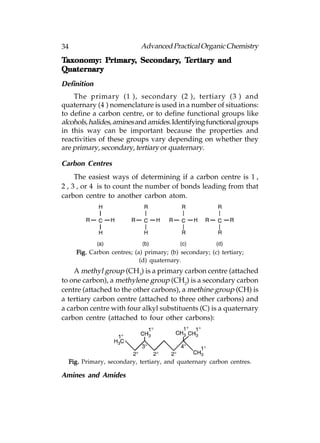
     The easiest ways of determining if a carbon centre is 1°,
2°, 3°, or 4° is to count the number of bonds leading from that
carbon centre to another carbon atom.


     Fig. Carbon centres; (a) primary; (b) secondary; (c) tertiary;
                            (d) quaternary.
    A methyl group (CH3) is a primary carbon centre (attached
to one carbon), a methylene group (CH2) is a secondary carbon
centre (attached to the other carbons), a methine group (CH) is
a tertiary carbon centre (attached to three other carbons) and
a carbon centre with four alkyl substituents (C) is a quaternary
carbon centre (attached to four other carbons):


  Fig. Primary, secondary, tertiary, and quaternary carbon centres.

Amines and Amides
Advanced Practical Organic Chemistry                               35
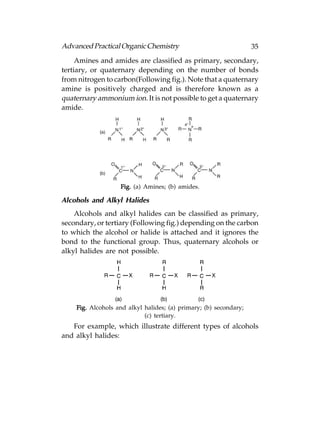
     Amines and amides are classified as primary, secondary,
tertiary, or quaternary depending on the number of bonds
from nitrogen to carbon(Following fig.). Note that a quaternary
amine is positively charged and is therefore known as a
quaternary ammonium ion. It is not possible to get a quaternary
amide.


                   Fig. (a) Amines; (b) amides.

Alcohols and Alkyl Halides
    Alcohols and alkyl halides can be classified as primary,
secondary, or tertiary (Following fig.) depending on the carbon
to which the alcohol or halide is attached and it ignores the
bond to the functional group. Thus, quaternary alcohols or
alkyl halides are not possible.


    Fig. Alcohols and alkyl halides; (a) primary; (b) secondary;
                            (c) tertiary.
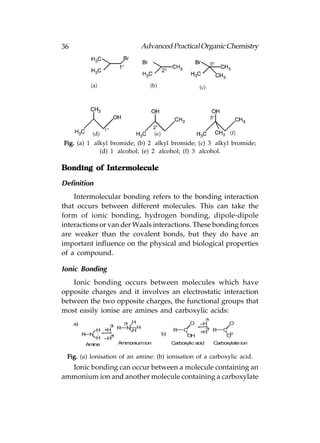
   For example, which illustrate different types of alcohols
and alkyl halides:
36                               Advanced Practical Organic Chemistry


Fig. (a) 1° alkyl bromide; (b) 2° alkyl bromide; (c) 3° alkyl bromide;
              (d) 1° alcohol; (e) 2° alcohol; (f) 3° alcohol.

Bonding of Intermolecule

Definition
    Intermolecular bonding refers to the bonding interaction
that occurs between different molecules. This can take the
form of ionic bonding, hydrogen bonding, dipole-dipole
interactions or van der Waals interactions. These bonding forces
are weaker than the covalent bonds, but they do have an
important influence on the physical and biological properties
of a compound.

Ionic Bonding
   Ionic bonding occurs between molecules which have
opposite charges and it involves an electrostatic interaction
between the two opposite charges, the functional groups that
most easily ionise are amines and carboxylic acids:
                                                              +
     a)                    + H                      O    –H             O
                   +
               H +H    R   N HH             R    C            + R     C
                                                         +H
          R N :    +                   b)         OH                   O
                                                                        –
               H –H
           Amine     Ammonium ion           Carboxylic acid       Carboxylate ion

 Fig. (a) lonisation of an amine: (b) ionisation of a carboxylic acid.
  Ionic bonding can occur between a molecule containing an
ammonium ion and another molecule containing a carboxylate
Advanced Practical Organic Chemistry                            37
ion. Some important naturally occurring molecules that contain
both groups arc the amino acids. Both these functional groups
are ionised to form a structure called zwitterion (a neutral
molecule bearing both a positive an a negative charge) and
intermolecular ionic bonding can occur:


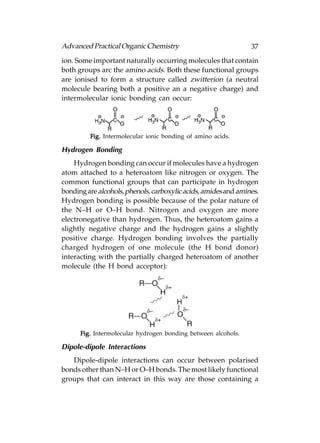
         Fig. Intermolecular ionic bonding of amino acids.

Hydrogen Bonding
    Hydrogen bonding can occur if molecules have a hydrogen
atom attached to a heteroatom like nitrogen or oxygen. The
common functional groups that can participate in hydrogen
bonding are alcohols, phenols, carboxylic acids, amides and amines.
Hydrogen bonding is possible because of the polar nature of
the N–H or O–H bond. Nitrogen and oxygen are more
electronegative than hydrogen. Thus, the heteroatom gains a
slightly negative charge and the hydrogen gains a slightly
positive charge. Hydrogen bonding involves the partially
charged hydrogen of one molecule (the H bond donor)
interacting with the partially charged heteroatom of another
molecule (the H bond acceptor):


      Fig. Intermolecular hydrogen bonding between alcohols.

Dipole-dipole Interactions
   Dipole-dipole interactions can occur between polarised
bonds other than N–H or O–H bonds. The most likely functional
groups that can interact in this way are those containing a
38                         Advanced Practical Organic Chemistry
carbonyl group (C = O), the electrons in the carbonyl bond are
polarised towards the more electronegative oxygen such that
the oxygen acquires a partial negative charge and the carbon
acquires a partial positive charge. This results in a dipole
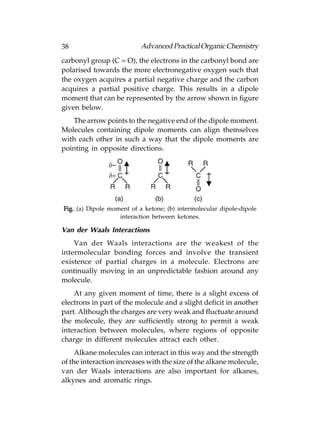
moment that can be represented by the arrow shown in figure
given below.
   The arrow points to the negative end of the dipole moment.
Molecules containing dipole moments can align themselves
with each other in such a way that the dipole moments are
pointing in opposite directions.


Fig. (a) Dipole moment of a ketone; (b) intermolecular dipole-dipole
                   interaction between ketones.

Van der Waals Interactions
    Van der Waals interactions are the weakest of the
intermolecular bonding forces and involve the transient
existence of partial charges in a molecule. Electrons are
continually moving in an unpredictable fashion around any
molecule.
    At any given moment of time, there is a slight excess of
electrons in part of the molecule and a slight deficit in another
part. Although the charges are very weak and fluctuate around
the molecule, they are sufficiently strong to permit a weak
interaction between molecules, where regions of opposite
charge in different molecules attract each other.
     Alkane molecules can interact in this way and the strength
of the interaction increases with the size of the alkane molecule,
van der Waals interactions are also important for alkanes,
alkynes and aromatic rings.
Advanced Practical Organic Chemistry                              39
    The types of molecules involved in this form of
intermolecular bonding are ‘fatty’ molecules that do not dissolve
easily in water and such molecules are called hydrophobic (water-
hating). Hydrophobic molecules can dissolve in non-polar,
hydrophobic solvents because of van der Waals interactions
and so this form of intermolecular bonding is also called a
hydrophobic interaction.

Reactions and Properties
              Properties

Properties
    The chemical and physical properties of an organic
compound depend on the sort of intermolecular bonding forces
present, which in turn depends on the functional group present.
A molecule like methane has a low boiling point and is a gas
at room temperature because its molecules are bound together
by weak van der Waals forces [Following fig(a)]. In contrast,
methanol is a liquid at room temperature because hydrogen
bonding is possible between the alcoholic functional groups
[Following fig(b)].


 Fig. (a) Intermolecular van der Waals (methane); (b) intermolecular
                    hydrogen bonding (methanol).
    The polarity of molecules depends on the functional groups
present in the molecule. A molecule will be polar and have a
dipole moment if it has a polar functional groups like an
alcohol, amine or ketone. Polarity also determines solubility in
different solvents. Polar molecules dissolve in polar solvents
like water or alcohols, whereas non-polar molecules dissolve
in non-polar solvents like ether and chloroform. Polar molecules
that can dissolve in water are called hydrophilic (water-loving)
40                         Advanced Practical Organic Chemistry
while non-polar molecules are called hydrophobic (water-hating).
    Generally, the presence of a polar functional group
determines the physical properties of the molecule. But this is
not always true. If a molecule has a polar group like a carboxylic
acid, but has a long hydrophobic alkane chain, then the molecule
will be hydrophobic.

Reactions
    Most of the organic reactions occur at functional groups
and are characteristic of that functional group. However, the
reactivity of the functional group is affected by stereoelectronic
effects. For example, a functional group may be surrounded
by bulky groups that hinder the approach of a reagent and
slow down the rate of reaction. This is called as steric shielding.
    Electronic effects can also influence the rate of a reaction.
Neighbouring groups can influence the reactivity of a functional
group if they are electron-withdrawing or electron-donating and
influence the electronic density within the functional group.
Conjugation and aromaticity also effect the reactivity of functional
groups. For example, an aromatic ketone reacts at a different
rate from an aliphatic ketone. The aromatic ring is in conjugation
with the carbonyl group and this increases the stability of the
overall system, making it less reactive.

Working Group
Recognition of Functional Groups
   Definition: A functional group refers to that portion of an
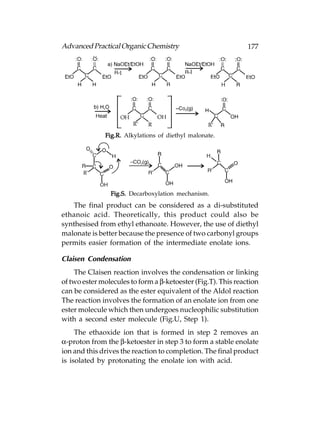
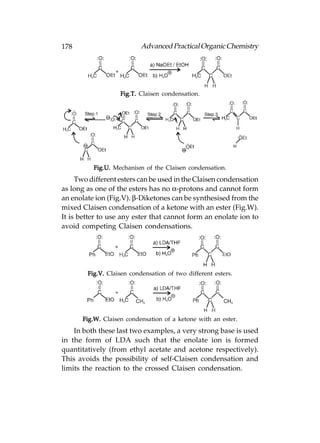
organic molecule that is made up of atoms other than carbon
and hydrogen, or which contains bonds other than C–C and
C–H bonds. For example, ethane [Following fig.(a)] is an alkane
and has no functional group. All the atoms are carbon and
hydrogen and all the bonds are C–C and C–H.
     Ethanoic acid on the other hand [Following fig(b)], has a
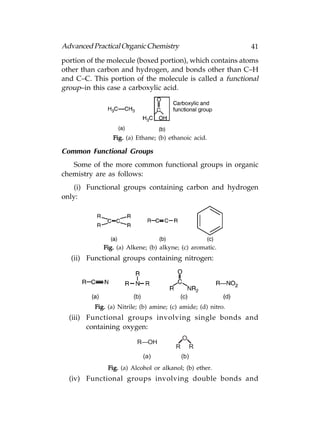
Advanced Practical Organic Chemistry                           41
portion of the molecule (boxed portion), which contains atoms
other than carbon and hydrogen, and bonds other than C–H
and C–C. This portion of the molecule is called a functional
group–in this case a carboxylic acid.


                Fig. (a) Ethane; (b) ethanoic acid.

Common Functional Groups
   Some of the more common functional groups in organic
chemistry are as follows:
    (i) Functional groups containing carbon and hydrogen
only:


             Fig. (a) Alkene; (b) alkyne; (c) aromatic.
  (ii) Functional groups containing nitrogen:


          Fig. (a) Nitrile; (b) amine; (c) amide; (d) nitro.
  (iii) Functional groups involving single bonds and
        containing oxygen:
                                             O
                          R—OH
                                         R         R
                            (a)              (b)
               Fig. (a) Alcohol or alkanol; (b) ether.
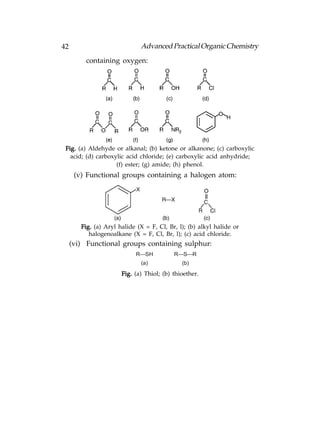
  (iv) Functional groups involving double bonds and
42                            Advanced Practical Organic Chemistry
         containing oxygen:


 Fig. (a) Aldehyde or alkanal; (b) ketone or alkanone; (c) carboxylic
   acid; (d) carboxylic acid chloride; (e) carboxylic acid anhydride;
                    (f) ester; (g) amide; (h) phenol.
      (v) Functional groups containing a halogen atom:


        Fig. (a) Aryl halide (X = F, Cl, Br, l); (b) alkyl halide or
           halogenoalkane (X = F, Cl, Br, l); (c) acid chloride.
     (vi) Functional groups containing sulphur:
                            R—SH           R—S—R
                              (a)             (b)
                       Fig. (a) Thiol; (b) thioether.
Advanced Practical Organic Chemistry                                   43


                                   3


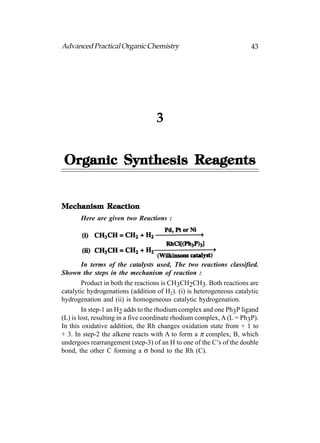
Organic Synthesis Reagents


Mechanism Reaction
       Here are given two Reactions :


        In terms of the catalysts used, The two reactions classified.
Shown the steps in the mechanism of reaction :
        Product in both the reactions is CH3CH2CH3. Both reactions are
catalytic hydrogenations (addition of H2). (i) is heterogeneous catalytic
hydrogenation and (ii) is homogeneous catalytic hydrogenation.
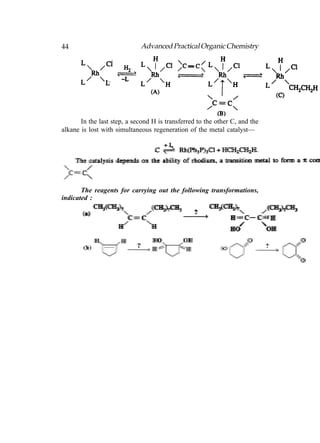
        In step-1 an H2 adds to the rhodium complex and one Ph3P ligand
(L) is lost, resulting in a five coordinate rhodium complex, A (L = Ph3P).
In this oxidative addition, the Rh changes oxidation state from + 1 to
+ 3. In step-2 the alkene reacts with A to form a π complex, B, which
undergoes rearrangement (step-3) of an H to one of the C’s of the double
bond, the other C forming a σ bond to the Rh (C).
44                           Advanced Practical Organic Chemistry


       In the last step, a second H is transferred to the other C, and the
alkane is lost with simultaneous regeneration of the metal catalyst—


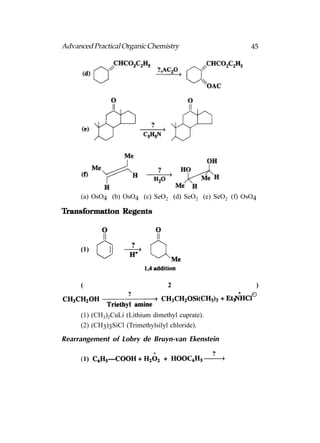
       The reagents for carrying out the following transformations,
indicated :
Advanced Practical Organic Chemistry                    45


     (a) OsO4 (b) OsO4 (c) SeO2 (d) SeO2 (e) SeO2 (f) OsO4

Transformation Regents


     (1)


     (                            2                      )


     (1) (CH3)2CuLi (Lithium dimethyl cuprate).
     (2) (CH3)3SiCl (Trimethylsilyl chloride).

Rearrangement of Lobry de Bruyn-van Ekenstein

     (1)
46                          Advanced Practical Organic Chemistry


      (2)

      (3)


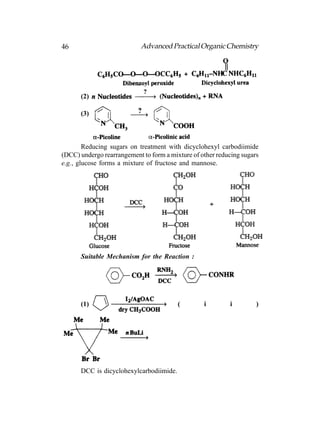
        Reducing sugars on treatment with dicyclohexyl carbodiimide
(DCC) undergo rearrangement to form a mixture of other reducing sugars
e.g., glucose forms a mixture of fructose and mannose.


      Suitable Mechanism for the Reaction :


      (1)                                (        i        i         )


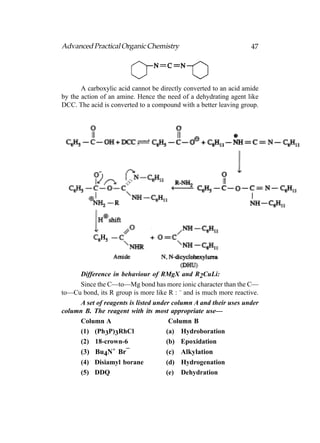
      DCC is dicyclohexylcarbodiimide.
Advanced Practical Organic Chemistry                               47


       A carboxylic acid cannot be directly converted to an acid amide
by the action of an amine. Hence the need of a dehydrating agent like
DCC. The acid is converted to a compound with a better leaving group.


     Difference in behaviour of RMgX and R2CuLi:
     Since the C—to—Mg bond has more ionic character than the C—
to—Cu bond, its R group is more like R : – and is much more reactive.
     A set of reagents is listed under column A and their uses under
column B. The reagent with its most appropriate use—
     Column A                         Column B
     (1) (Ph3P)3RhCl                 (a) Hydroboration
     (2) 18-crown-6                  (b) Epoxidation
                 +   –
     (3) Bu4N Br                     (c) Alkylation
     (4) Disiamyl borane             (d) Hydrogenation
     (5) DDQ                         (e) Dehydration
48                         Advanced Practical Organic Chemistry
      (6) DCC                       (f)   Dehydrogenation
        (7) CH3CO3H                 (g) Cation complexing
        (8) LDA                     (h) Phase transfer catalysis
        (1)—(d), (2)—(g), (3)—(h), (4)—{a), (5)—(f), (6)—(e), (7)—
(b), (8)—(c).
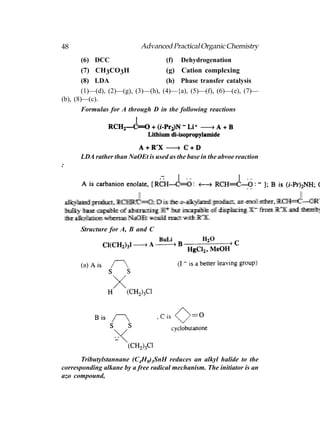
        Formulas for A through D in the following reactions


      LDA rather than NaOEt is used as the base in the abvoe reaction
:


      Structure for A, B and C


      (a)


       Tributylstannane (C4H9)3SnH reduces an alkyl halide to the
corresponding alkane by a free radical mechanism. The initiator is an
azo compound,
Advanced Practical Organic Chemistry                               49
                   (CH3)2C(CN)—N = N—C(CN)(CH3)2
which breaks down to N2 and a radical. A possible mechanism :
       The initiator gives the carbon radical (CH3)2C(CN),(Radical)
which abstracts an H from the tin compound.
         Radical + (C4H9)3Sn—H —→ (C4H9)3Sn + Radical—H
       The tributyltin radical abstracts a halogen atom from the alkyl
halide and the chain is propagated as follows—
              (C4H9)3Sn · + R—X —→ (C4H9)3Sn—X + R ·
       then
               R · + (C4H9)3Sn—H —→R—H + (C4H9)3Sn ·
       Mathced :
       (1) Wilkinsons catalyst                  (a) Cyclic polyethers


      (2) DDQ                                 (b)


      (3) Prevost reagent                      (c)


       (4) Crown ethers                       (d) RhCl[(Ph3P)3]
       (5) 1, 3-dithiane                      (e) (i-Pr)2N – Li +
       (6) disiamyl borane                    (f) 2,3-dichloro-5,6-
dicyano-1,4-benzoquinone
       (7) LDA                                (g) Mixture of silver
salt of an acid and iodine.
       (1)—(d), (2)—(f), (3)—(g), (4)—(a), (5)—(b), (6)—(c), (7)—(e).

      Transfer
Phase Transfer Catalysts' Application
      In water :
                  –             –
        Na +: CN + n-Bu4N+Cl –→ n-Bu N+: CN– + Na + Cl–
                                       4
      In non-polar solvent :
          n-C8H17Cl + n-Bu4N + : C– –→ n-Bu4N + Cl– + n-
                             C8H17CN
50                            Advanced Practical Organic Chemistry
        n-Bu4N + Cl – goes back into H2O and the two steps repeat.
       Activation of the C-terminus of an AA, followed by coupling
with a second AA, is accomplished with the reagent, DCC, C6H11—
N=C=N—C6H11. Give the structure of the product of reaction of DCC
with RCOOH :


       The Merrifield solid-phase process for synthesizing peptides :
       The solid phase is beads of polystyrene whose mer is mainly
             PH
         |
—CH 2 — CH — . However occasional benzene rings have p-CH2C1

substituents projecting out to the surface. The solid phase may be indicated
as. [P]—CH2C1 (A), where [P] is the polystyrene backbone. The peptide
chain is started at the C-terminus by bonding the BOC protected AA to
the solid phase through benzyl ester formation, followed by removal of
the BOC group.


        A second AA (BOC-protected so that it will not self couple) is
added, along with DCC. The two steps of addition of a BOC-protected
AA and regeneration of NH2 with CF3COOH are repeated as many times
as required. In between each step, the [P]-growing peptide chain is
washed with suitable solvents to remove excess reagents and undesirable
products. Thus intermediates do not have to be isolated and purified and
the yields are high. Reactant BOC-AA´s, DCC and CF3COOH are added
through an automated system. Removal of the completed peptide from
the polymer is accomplished with anhydrous HF, which also removes the
last BOC group.
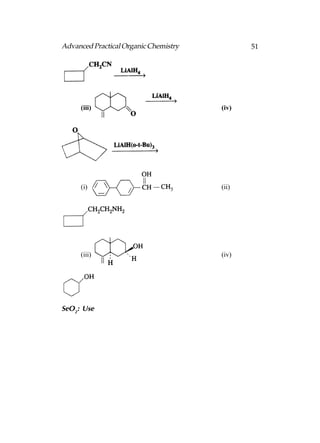
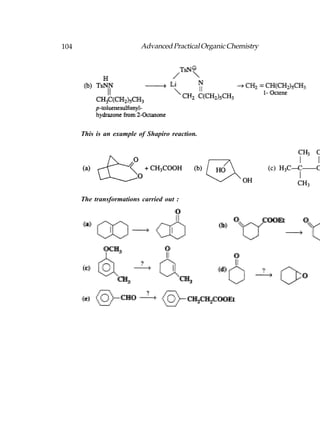
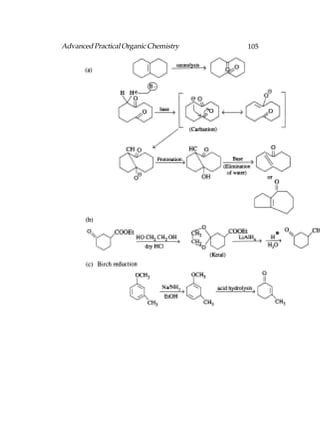
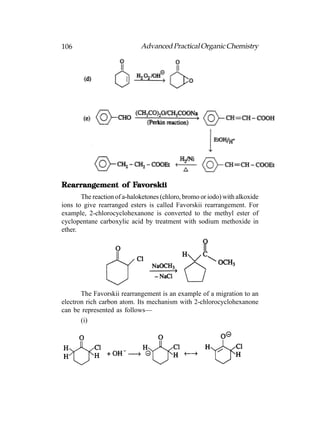
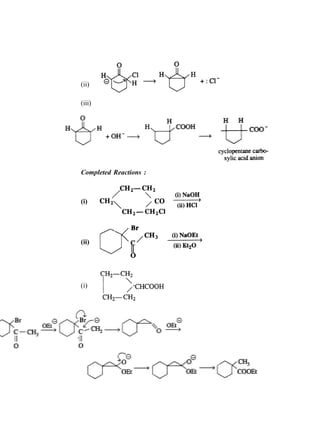
        The Reactions Completed :


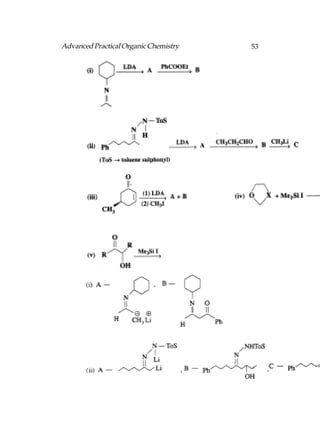
       (i)                                                   (ii)
Advanced Practical Organic Chemistry          51


     (iii)                             (iv)


     (i)                               (ii)


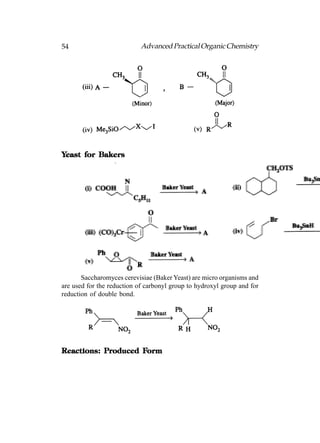
     (iii)                             (iv)


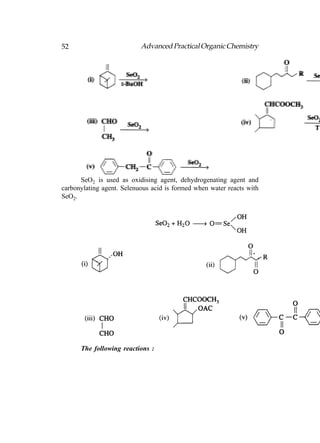
SeO2: Use
52                         Advanced Practical Organic Chemistry


      SeO2 is used as oxidising agent, dehydrogenating agent and
carbonylating agent. Selenuous acid is formed when water reacts with
SeO2.


      The following reactions :
Advanced Practical Organic Chemistry   53
54                          Advanced Practical Organic Chemistry


Yeast for Bakers


       Saccharomyces cerevisiae (Baker Yeast) are micro organisms and
are used for the reduction of carbonyl group to hydroxyl group and for
reduction of double bond.


           Produced Form
Reactions: Produced Form
Advanced Practical Organic Chemistry   55


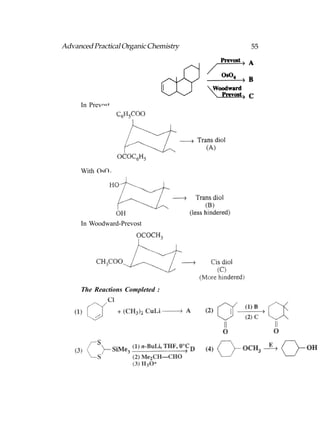
     In Prevost


     With OsO4


     In Woodward-Prevost


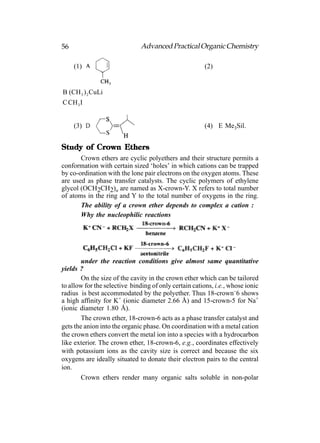
     The Reactions Completed :
56                             Advanced Practical Organic Chemistry

     (1)                                               (2)


B (CH 3 ) 2 CuLi
C CH 3 I


     (3)                                               (4) E Me3Sil.


Study of Crown Ethers
       Crown ethers are cyclic polyethers and their structure permits a
conformation with certain sized ‘holes’ in which cations can be trapped
by co-ordination with the lone pair electrons on the oxygen atoms. These
are used as phase transfer catalysts. The cyclic polymers of ethylene
glycol (OCH2CH2)n are named as X-crown-Y. X refers to total number
of atoms in the ring and Y to the total number of oxygens in the ring.
       The ability of a crown ether depends to complex a cation :
       Why the nucleophilic reactions


        under the reaction conditions give almost same quantitative
yields ?
        On the size of the cavity in the crown ether which can be tailored
to allow for the selective binding of only certain cations, i.e., whose ionic
radius is best accommodated by the polyether. Thus 18-crown–6 shows
a high affinity for K+ (ionic diameter 2.66 Å) and 15-crown-5 for Na+
(ionic diameter 1.80 Å).
        The crown ether, 18-crown-6 acts as a phase transfer catalyst and
gets the anion into the organic phase. On coordination with a metal cation
the crown ethers convert the metal ion into a species with a hydrocarbon
like exterior. The crown ether, 18-crown-6, e.g., coordinates effectively
with potassium ions as the cavity size is correct and because the six
oxygens are ideally situated to donate their electron pairs to the central
ion.
        Crown ethers render many organic salts soluble in non-polar
Advanced Practical Organic Chemistry                                       57
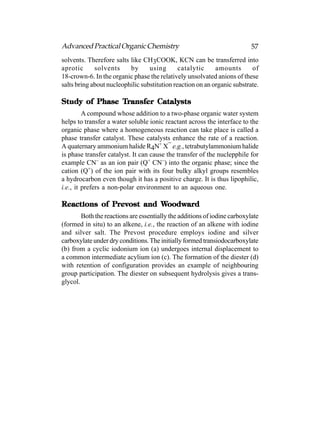
solvents. Therefore salts like CH3COOK, KCN can be transferred into
aprotic      solvents     by      using       catalytic     amounts       of
18-crown-6. In the organic phase the relatively unsolvated anions of these
salts bring about nucleophilic substitution reaction on an organic substrate.

Study of Phase Transfer Catalysts
               Transfer
         A compound whose addition to a two-phase organic water system
helps to transfer a water soluble ionic reactant across the interface to the
organic phase where a homogeneous reaction can take place is called a
phase transfer catalyst. These catalysts enhance the rate of a reaction.
                                          –
A quaternary ammonium halide R4N+ X e.g., tetrabutylammonium halide
is phase transfer catalyst. It can cause the transfer of the nuclepphile for
example CN– as an ion pair (Q+ CN–) into the organic phase; since the
cation (Q+) of the ion pair with its four bulky alkyl groups resembles
a hydrocarbon even though it has a positive charge. It is thus lipophilic,
i.e., it prefers a non-polar environment to an aqueous one.

             Prevost     Woodward
Reactions of Prevost and Woodward
        Both the reactions are essentially the additions of iodine carboxylate
(formed in situ) to an alkene, i.e., the reaction of an alkene with iodine
and silver salt. The Prevost procedure employs iodine and silver
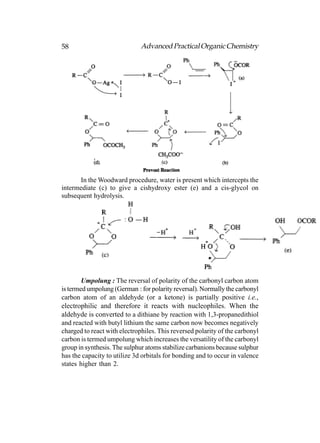
carboxylate under dry conditions. The initially formed transiodocarboxylate
(b) from a cyclic iodonium ion (a) undergoes internal displacement to
a common intermediate acylium ion (c). The formation of the diester (d)
with retention of configuration provides an example of neighbouring
group participation. The diester on subsequent hydrolysis gives a trans-
glycol.
58                            Advanced Practical Organic Chemistry


      In the Woodward procedure, water is present which intercepts the
intermediate (c) to give a cishydroxy ester (e) and a cis-glycol on
subsequent hydrolysis.


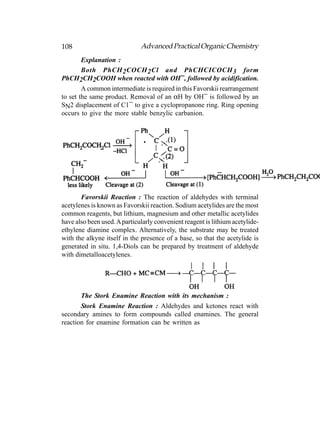
        Umpolung : The reversal of polarity of the carbonyl carbon atom
is termed umpolung (German : for polarity reversal). Normally the carbonyl
carbon atom of an aldehyde (or a ketone) is partially positive i.e.,
electrophilic and therefore it reacts with nucleophiles. When the
aldehyde is converted to a dithiane by reaction with 1,3-propanedithiol
and reacted with butyl lithium the same carbon now becomes negatively
charged to react with electrophiles. This reversed polarity of the carbonyl
carbon is termed umpolung which increases the versatility of the carbonyl
group in synthesis. The sulphur atoms stabilize carbanions because sulphur
has the capacity to utilize 3d orbitals for bonding and to occur in valence
states higher than 2.
Advanced Practical Organic Chemistry                                   59


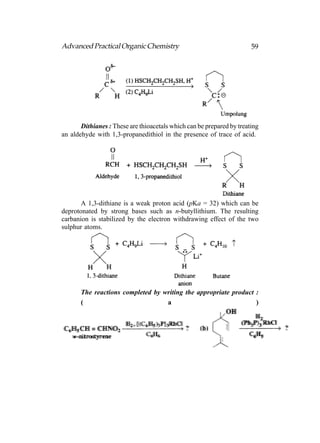
       Dithianes : These are thioacetals which can be prepared by treating
an aldehyde with 1,3-propanedithiol in the presence of trace of acid.


       A 1,3-dithiane is a weak proton acid (pKa = 32) which can be
deprotonated by strong bases such as n-butyllithium. The resulting
carbanion is stabilized by the electron withdrawing effect of the two
sulphur atoms.


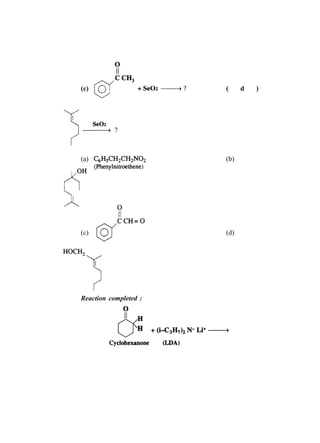
       The reactions completed by writing the appropriate product :
       (                           a                              )
(c)                    (     d   )


(a)                    (b)


(c)                    (d)


Reaction completed :
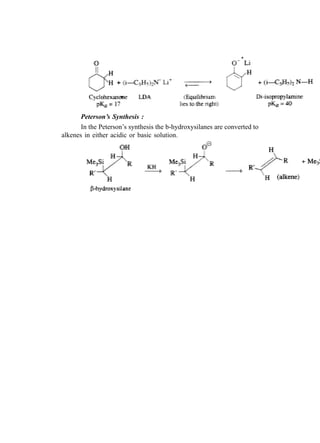
Peterson’s Synthesis :
       In the Peterson’s synthesis the b-hydroxysilanes are converted to
alkenes in either acidic or basic solution.
62   Advanced Practical Organic Chemistry
Advanced Practical Organic Chemistry                       63


                             4

               The Structure


Making Structures

C–H Bond Omission
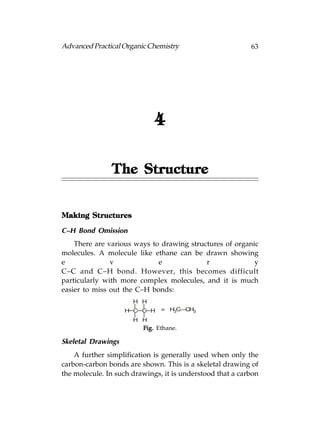
    There are various ways to drawing structures of organic
molecules. A molecule like ethane can be drawn showing
e              v             e             r              y
C–C and C–H bond. However, this becomes difficult
particularly with more complex molecules, and it is much
easier to miss out the C–H bonds:
                      H H
                    H C C H    = H3C— 3
                                     CH
                      H H
                         Fig. Ethane.

Skeletal Drawings
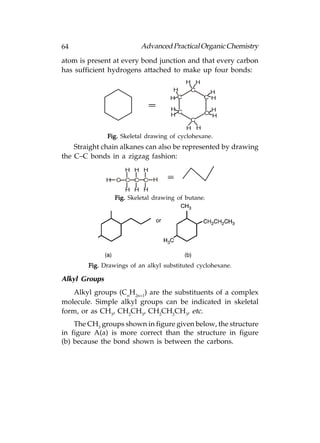
    A further simplification is generally used when only the
carbon-carbon bonds are shown. This is a skeletal drawing of
the molecule. In such drawings, it is understood that a carbon
64                        Advanced Practical Organic Chemistry
atom is present at every bond junction and that every carbon
has sufficient hydrogens attached to make up four bonds:
                                           H H
                                     H      C      H
                                     HC          C H

                                     H             H
                                       C         C H
                                     H
                                            C
                                           H H
               Fig. Skeletal drawing of cyclohexane.
    Straight chain alkanes can also be represented by drawing
the C–C bonds in a zigzag fashion:
                     H H H
               H C C C C H
                     H H H
                 Fig. Skeletal drawing of butane.


        Fig. Drawings of an alkyl substituted cyclohexane.

Alkyl Groups
   Alkyl groups (CnH2n+1) are the substituents of a complex
molecule. Simple alkyl groups can be indicated in skeletal
form, or as CH3, CH2CH3, CH2CH2CH3, etc.
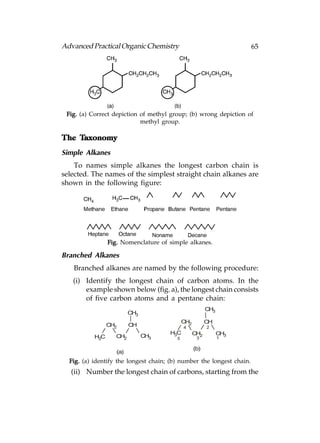
    The CH3 groups shown in figure given below, the structure
in figure A(a) is more correct than the structure in figure
(b) because the bond shown is between the carbons.
Advanced Practical Organic Chemistry                                   65


 Fig. (a) Correct depiction of methyl group; (b) wrong depiction of
                            methyl group.

    Taxonomy
The Taxonomy
Simple Alkanes
    To names simple alkanes the longest carbon chain is
selected. The names of the simplest straight chain alkanes are
shown in the following figure:


                 Fig. Nomenclature of simple alkanes.

Branched Alkanes
   Branched alkanes are named by the following procedure:
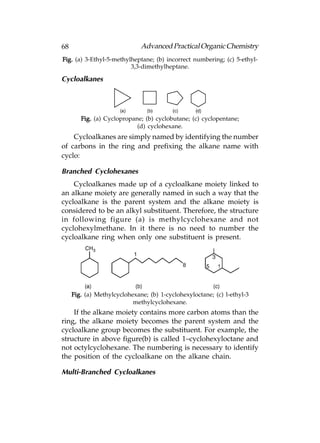
   (i) Identify the longest chain of carbon atoms. In the
       example shown below (fig. a), the longest chain consists
       of five carbon atoms and a pentane chain:
                                                         CH3
                          CH3
                                             CH2         CH
                 CH2      CH                 4           2
                                      H3C          CH2         CH3
           H3C      CH2         CH3      5          3          1

                                                   (b)
                    (a)
  Fig. (a) identify the longest chain; (b) number the longest chain.
   (ii) Number the longest chain of carbons, starting from the
66                           Advanced Practical Organic Chemistry
          end nearest the branch point [above fig.(b)].
     (iii) Identify the carbon with the branching group (number
           2 in above fig.b)
     (iv) Identify and name the branching group. (In this example
          it is CH3. Branching groups (or substituents) are referred
          to as alkyl groups (CnH2n+1) rather than alkanes (CnH2n+2).
          Therefore, CH3 is called methyl and not methane.).
     (v) Name the structure by first identifying the substituent
         and its position in the chain, then naming the longest
         chain. The structure in above fig is called 2-
         methylpentane. Notice that the substituent and the
         main chain is one complete word, that is, 2-
         methylpentane                  rather             than
         2-methly pentane.

Multi-Branched Alkanes
    In case there is more than one alkyl substituent present in
the structure then the substituents are named in alphabetical
order, numbering again from the end of the chain nearest the
substituents. The structure in following figure is 4-ethyl-3-
methyloctane and not 3-methyl-4-ethyloctane.
                                                    Methyl
                CH3
                                                                 7
        H3C                              1 2
                               CH3 =           3    4   5    6       8

                                                        Ethyl
                      CH3
                      Fig. 4-Ethyl-3methyloctane.
      If a structure has identical substituents, then the prefixes di-
, tri-, tetra-, etc. are used to represent the number of substituents.
For example, the structure in figure given below is called
2,2-dimethylpentane and not 2-methyl-2-methylpentane.


                       Fig. 2, 2-Dimethylpentane.
Advanced Practical Organic Chemistry                            67
    The prefixes di-, tri-, tetra-, etc., are used for identical
substituents, but the order in which they are written is still
dependent on the alphabetical order of the substituents
themselves (i.e. ignore the di-, tri-, tetra-, etc. ). For example,
the structure in following figure is called 5-ethyl-2,2-
dimethyldecane                         and                     not
2, 2-dimethyl-5-ehtyldecane.


                  Fig. 5-Ethyl-2,2-dimcthyldecane.


                 Fig. 5-Ethyl-2,2,6-trimethyldecane.
     Identical substituents can be in different positions on the
chain, but the same rules apply. For example, the structure in
figure given above is called 5-ethyl-2,2,6-trimethyldecane. In
some structures, it is difficult to decide which end of the chain
to number from. For example, two different substituents might
be placed at equal distances from either end of the chain. In
such a case, the group with alphabetical priority should be
given the lowest numbering. For example, the structure in
following figure(a) is 3-ethyl-5-methylheptane and not 5-ethyl-
3-methylheptane. There is another rule that might take
precedence over the above rule. The structure [Following fig.
(c)] has ethyl and methyl groups equally placed from each end
of the chain, but there are two methyl groups to one ethyl
group. Numbering should be chosen such that the smallest
total is obtained. In this example, the structure is called 5-
ethyl-3,3-dimethylheptane rather than 3-ethyl-5,5
dimethylheptane [Following fig.(b)] since 5+3+3 = 11 is less
than 3 + 5 + 5=13.
68                            Advanced Practical Organic Chemistry
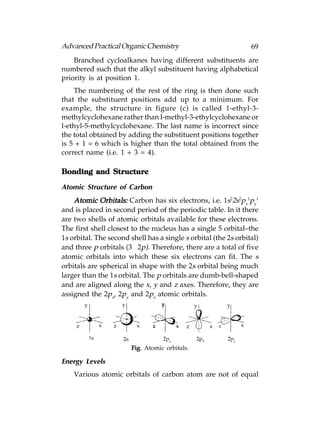
Fig. (a) 3-Ethyl-5-methylheptane; (b) incorrect numbering; (c) 5-ethyl-
                         3,3-dimethylheptane.

Cycloalkanes


        Fig. (a) Cyclopropane; (b) cyclobutane; (c) cyclopentane;
                            (d) cyclohexane.
    Cycloalkanes are simply named by identifying the number
of carbons in the ring and prefixing the alkane name with
cyclo:

Branched Cyclohexanes
    Cycloalkanes made up of a cycloalkane moiety linked to
an alkane moiety are generally named in such a way that the
cycloalkane is the parent system and the alkane moiety is
considered to be an alkyl substituent. Therefore, the structure
in following figure (a) is methylcyclohexane and not
cyclohexylmethane. In it there is no need to number the
cycloalkane ring when only one substituent is present.


     Fig. (a) Methylcyclohexane; (b) 1-cyclohexyloctane; (c) l-ethyl-3
                           methylcyclohexane.
    If the alkane moiety contains more carbon atoms than the
ring, the alkane moiety becomes the parent system and the
cycloalkane group becomes the substituent. For example, the
structure in above figure(b) is called 1–cyclohexyloctane and
not octylcyclohexane. The numbering is necessary to identify
the position of the cycloalkane on the alkane chain.

Multi-Branched Cycloalkanes
Advanced Practical Organic Chemistry                             69
    Branched cycloalkanes having different substituents are
numbered such that the alkyl substituent having alphabetical
priority is at position 1.
    The numbering of the rest of the ring is then done such
that the substituent positions add up to a minimum. For
example, the structure in figure (c) is called 1-ethyl-3-
methylcyclohexane rather than l-methyl-3-ethylcyclohexane or
l-ethyl-5-methylcyclohexane. The last name is incorrect since
the total obtained by adding the substituent positions together
is 5 + 1 = 6 which is higher than the total obtained from the
correct name (i.e. 1 + 3 = 4).

Bonding and Structure

Atomic Structure of Carbon
    Atomic Orbitals: Carbon has six electrons, i.e. 1s22s2px1py1
and is placed in second period of the periodic table. In it there
are two shells of atomic orbitals available for these electrons.
The first shell closest to the nucleus has a single 5 orbital–the
1s orbital. The second shell has a single s orbital (the 2s orbital)
and three p orbitals (3 × 2p). Therefore, there are a total of five
atomic orbitals into which these six electrons can fit. The s
orbitals are spherical in shape with the 2s orbital being much
larger than the 1s orbital. The p orbitals are dumb-bell-shaped
and are aligned along the x, y and z axes. Therefore, they are
assigned the 2px, 2py and 2pz atomic orbitals.


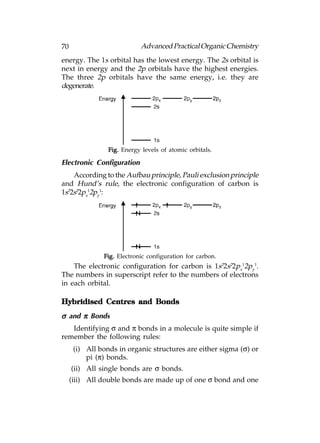
                        Fig. Atomic orbitals.

Energy Levels
    Various atomic orbitals of carbon atom are not of equal
70                          Advanced Practical Organic Chemistry
energy. The 1s orbital has the lowest energy. The 2s orbital is
next in energy and the 2p orbitals have the highest energies.
The three 2p orbitals have the same energy, i.e. they are
degenerate.


                 Fig. Energy levels of atomic orbitals.

Electronic Configuration
    According to the Aufbau principle, Pauli exclusion principle
and Hund’s rule, the electronic configuration of carbon is
1s22s22px12py1:


               Fig. Electronic configuration for carbon.
    The electronic configuration for carbon is 1s22s22px12py1.
The numbers in superscript refer to the numbers of electrons
in each orbital.

Hybridised Centres and Bonds
σ and π Bonds
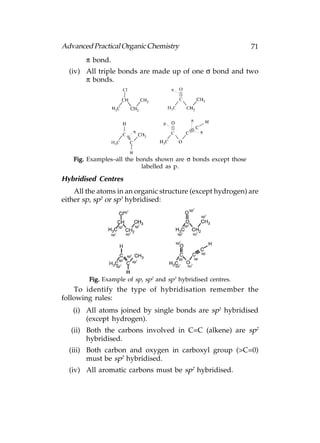
   Identifying σ and π bonds in a molecule is quite simple if
remember the following rules:
      (i) All bonds in organic structures are either sigma (σ) or
          pi (π) bonds.
     (ii) All single bonds are σ bonds.
     (iii) All double bonds are made up of one σ bond and one
Advanced Practical Organic Chemistry                            71
       π bond.
  (iv) All triple bonds are made up of one σ bond and two
       π bonds.


   Fig. Examples–all the bonds shown are σ bonds except those
                           labelled as p.

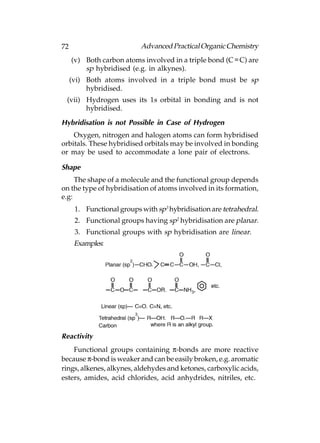
Hybridised Centres
    All the atoms in an organic structure (except hydrogen) are
either sp, sp2 or sp3 hybridised:


        Fig. Example of sp, sp2 and sp3 hybridised centres.
    To identify the type of hybridisation remember the
following rules:
   (i) All atoms joined by single bonds are sp3 hybridised
       (except hydrogen).
   (ii) Both the carbons involved in C=C (alkene) are sp2
        hybridised.
  (iii) Both carbon and oxygen in carboxyl group (>C=0)
        must be sp2 hybridised.
  (iv) All aromatic carbons must be sp2 hybridised.
72                         Advanced Practical Organic Chemistry
     (v) Both carbon atoms involved in a triple bond (C  C) are
         sp hybridised (e.g. in alkynes).
     (vi) Both atoms involved in a triple bond must be sp
          hybridised.
 (vii) Hydrogen uses its 1s orbital in bonding and is not
       hybridised.

Hybridisation is not Possible in Case of Hydrogen
    Oxygen, nitrogen and halogen atoms can form hybridised
orbitals. These hybridised orbitals may be involved in bonding
or may be used to accommodate a lone pair of electrons.

Shape
     The shape of a molecule and the functional group depends
on the type of hybridisation of atoms involved in its formation,
e.g:
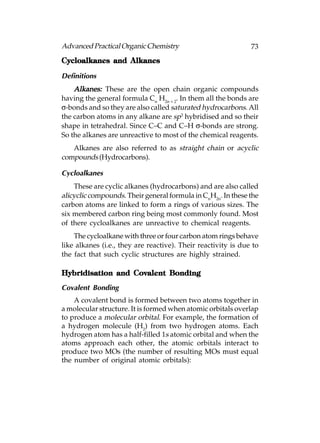
      1. Functional groups with sp3 hybridisation are tetrahedral.
      2. Functional groups having sp2 hybridisation are planar.
      3. Functional groups with sp hybridisation are linear.
      Examples:


Reactivity
    Functional groups containing π-bonds are more reactive
because π-bond is weaker and can be easily broken, e.g. aromatic
rings, alkenes, alkynes, aldehydes and ketones, carboxylic acids,
esters, amides, acid chlorides, acid anhydrides, nitriles, etc.
Advanced Practical Organic Chemistry                           73
Cycloalkanes and Alkanes

Definitions
    Alkanes: These are the open chain organic compounds
having the general formula Cn H2n + 2. In them all the bonds are
σ-bonds and so they are also called saturated hydrocarbons. All
the carbon atoms in any alkane are sp3 hybridised and so their
shape in tetrahedral. Since C–C and C–H σ-bonds are strong.
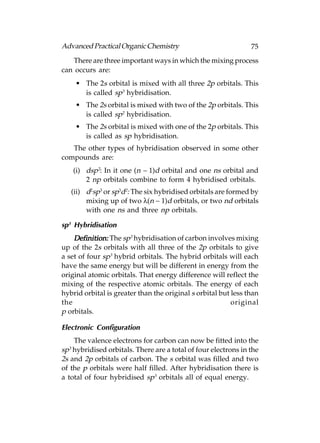
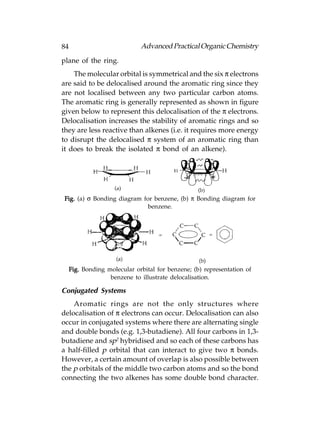
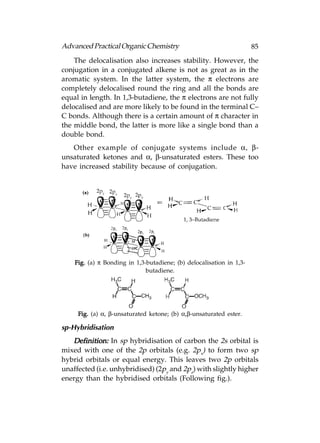
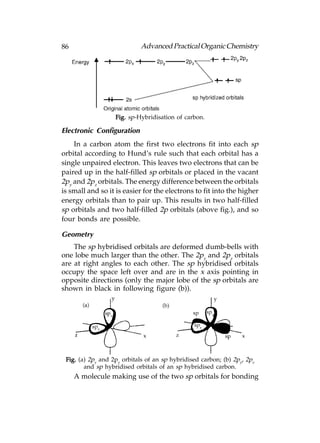
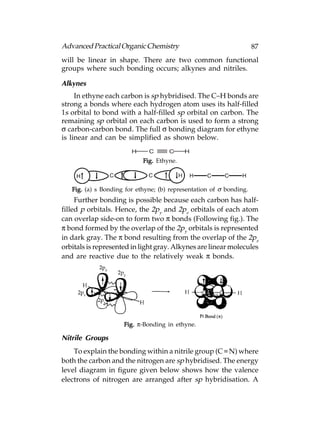
So the alkanes are unreactive to most of the chemical reagents.
   Alkanes are also referred to as straight chain or acyclic
compounds (Hydrocarbons).

Cycloalkanes
    These are cyclic alkanes (hydrocarbons) and are also called
alicyclic compounds. Their general formula in CnH2n. In these the
carbon atoms are linked to form a rings of various sizes. The
six membered carbon ring being most commonly found. Most
of there cycloalkanes are unreactive to chemical reagents.
    The cycloalkane with three or four carbon atom rings behave
like alkanes (i.e., they are reactive). Their reactivity is due to
the fact that such cyclic structures are highly strained.

Hybridisation and Covalent Bonding
Covalent Bonding
    A covalent bond is formed between two atoms together in
a molecular structure. It is formed when atomic orbitals overlap
to produce a molecular orbital. For example, the formation of
a hydrogen molecule (H2) from two hydrogen atoms. Each
hydrogen atom has a half-filled 1s atomic orbital and when the
atoms approach each other, the atomic orbitals interact to
produce two MOs (the number of resulting MOs must equal
the number of original atomic orbitals):
74                         Advanced Practical Organic Chemistry


             Fig. Molecular orbitals for hydrogen (H2).
    The MOs are of different energies. One is more stable than
the combining atomic orbitals and is known as the bonding
MO. The other is less stable and is known as antibonding MO.
The bonding MO is like a rugby ball and is formed by the
combination of the 1s atomic orbitals. As this is the more stable
MO, the valence electrons (one from each hydrogen) enter this
orbital and pair up. The antibonding MO is of higher energy
and consists of two deformed spheres. This remains empty. As
the electrons end up in a bonding MO that is more stable than
the original atomic orbitals, energy is released and bond
formation is favoured.

Sigma Bonds
    σ-bonds have a circular cross-section and are formed by
the head-on overlap of two atomic orbitals. This involves a
strong interaction and thus sigma bonds are strong bonds.

Hybridisation
    Atoms can form bonds with each other by sharing unpaired
electrons such that each bond contains two electrons. A carbon
atom has two unpaired electrons and so we expect carbon to
form two bonds. However, carbon forms four bonds. How
does a carbon atom form four bonds with only two unpaired
electrons?
    When a carbon atom forms bonds and is part of a molecular
structure, it can ‘mix’ the s and p orbitals of its second shell
(the valence shell). This is called hybridisation and it allows
carbon to form the four bonds which are observed in its
compounds.
Advanced Practical Organic Chemistry                            75
   There are three important ways in which the mixing process
can occurs are:
    • The 2s orbital is mixed with all three 2p orbitals. This
      is called sp3 hybridisation.
    • The 2s orbital is mixed with two of the 2p orbitals. This
      is called sp2 hybridisation.
    • The 2s orbital is mixed with one of the 2p orbitals. This
      is called as sp hybridisation.
   The other types of hybridisation observed in some other
compounds are:
   (i) dsp2: In it one (n – 1)d orbital and one ns orbital and
       2 np orbitals combine to form 4 hybridised orbitals.
   (ii) d2sp3 or sp3d2: The six hybridised orbitals are formed by
        mixing up of two λ(n – 1)d orbitals, or two nd orbitals
        with one ns and three np orbitals.

sp3 Hybridisation
    Definition: The sp3 hybridisation of carbon involves mixing
up of the 2s orbitals with all three of the 2p orbitals to give
a set of four sp3 hybrid orbitals. The hybrid orbitals will each
have the same energy but will be different in energy from the
original atomic orbitals. That energy difference will reflect the
mixing of the respective atomic orbitals. The energy of each
hybrid orbital is greater than the original s orbital but less than
the                                                       original
p orbitals.

Electronic Configuration
    The valence electrons for carbon can now be fitted into the
sp3 hybridised orbitals. There are a total of four electrons in the
2s and 2p orbitals of carbon. The s orbital was filled and two
of the p orbitals were half filled. After hybridisation there is
a total of four hybridised sp3 orbitals all of equal energy.
76                         Advanced Practical Organic Chemistry
    According to Hund’s rule, all the four hybridised orbitals
are half filled with electrons thus there are four unpaired
electrons. Four bonds are now possible.


                     Fig.A. sp3 Hybridisation.

Geometry
     Each of the sp3 hybridised orbitals has the same shape. This
deformed dumb-bell looks more like a p orbital than an s
orbital since more p orbitals were involved in the mixing process,
i.e. one lobe is larger as compared to other lobe:


                    Fig. sp3 Hybridised orbital.
    Each sp3 orbital occupies a space as far apart from each
other as possible by pointing to the concerns of tetrahedron.
The angle between each of these lobes is about 109.5°. This is
what is meant by the expression tetrahedral carbon.
    The three-dimensional shape of the tetrahedral carbon can
be represented by drawing a normal line for bonds in the plane
of the page. Bonds going behind the page are represented by
hatched wedge, and bonds coming out the page are represented
by a solid wedge:


        Fig. Tetrahedral shape of an sp3 hybridised carbon.
Advanced Practical Organic Chemistry                                77
Sigma Bonds
     A half-filled sp3 hybridised orbital from one carbon atom
can be used to form a bond with a half-filled sp3 hybridised
orbital from another carbon atom. In figure(a) given below the
major lobes of the two sp3 orbitals overlap directly leading to
a strong σ bond. Because of their ability to form strong a bonds
hybridisation takes place.
    The deformed dumb-bell shapes permit a better orbital
overlap than would be obtained from a pure s orbital or a pure
p orbital. A σ bond between an sp3 hybridised carbon atom and
a hydrogen atom involves the carbon atom using one of its
h      a      l    f     -     f     i     l     l     e     d
sp3 orbitals and the hydrogen atom using its half-filled 1s
orbital.


   Fig. (a) σ Bond between two sp3 hybridised carbons; (b) σ bond
            between an sp3 hybridised carbon and hydrogen.

Nitrogen, Oxygen and Chloride
     The sp3 type of hybridisation is also observed for nitrogen,
oxygen and chlorine atoms in organic structures. Nirtogen has
five valence electrons in its second shell (i.e.2s22p3). After
hybridisation, it will have three half-filled sp3 orbitals and thus
can form three bonds. Oxygen has six valence electrons (i.e.
2s22p4). After hybridisation, it will have two half-filled sp3 orbitals
and will form two bonds. Chlorine has seven valence electrons
(i.e. 2s22p5). After hybridisation, it will have one half-filled sp3
orbital and will form one bond.
78                            Advanced Practical Organic Chemistry


     Fig. (a) Geometry of sp3 hybridised nitrogen; (b) geometry of sp3
                            hybridised oxygen.
    The four sp3 orbitals for these three atoms (i.e. N, O and
Cl) form a tetrahedral arrangement having one or more of the
hybridised orbitals occupied by a lone pair of electrons. For
an isolated atom, nitrogen forms a pyramidal shape where the
bond angles are slightly less than 109.5° (c. 107°)fig.(a). This
compression of the bond angles is because of the orbital
containing the lone pair of electrons, which requires a slightly
greater amount of space than a bond. Oxygen forms an angled
or bent shape where two lone pairs of electrons compress the
bond angle from 109.5° to 104° [below fig.(b)]:
    Alcohols, amines, alkyl halides, and ethers all contain sigma
bonds that involve nitrogen, oxygen, or chlorine. Bonds between
these atoms and carbon are formed by the overlap of half-filled
sp3 hybridised orbitals from each atom. Bonds involving
hydrogen atoms (e.g. O–H and N–H) are formed by the overlap
of the half-filled 1s orbital from hydrogen and a half-filled sp3
orbital from oxygen or nitrogen.

sp2 Hybridisation
   Definition: In sp2 hybridisation, the 2s orbital is mixed with
two of the 2p orbitals (e.g. 2px and 2pz) to form three sp2
hybridised orbitals of equivalent energy. The remaining 2py
Advanced Practical Organic Chemistry                             79
orbital remains unaffected. The energy of each hybridised orbital
is greater than that of the original s orbital but less than that
of the original p orbitals. The remaining 2p orbital (in this case
the 2py orbital) remains at its original energy level:


                       Fig. sp2 Hybridisation.

Electronic Configuration
    In case of carbon, there are four valence electrons (i.e.
                          2                                        1
2            s                    2            p            x
    1  v                                         2
2p y pz ) to fit into the three hybridised sp orbitals and the
remaining 2p orbital. The first three electrons are fitted into
each of the hybridised orbitals according to Hund’s rule and
they are all half-filled this leaves one electron still to place.
There is a choice between pairing it up in a half-filled sp2 orbital
or placing it into the vacant 2py orbital. Generally, we fill up
orbitals of equal energy before moving to an orbital of higher
energy. However, if the energy difference between orbitals is
small (as here) it is easier for the electron to go into the higher
energy 2py orbital resulting in three half-filled sp2 orbitals and
one half-filled orbital. Four bonds are now possible.

Geometry
    The unhybridised 2py orbital has the usual dumb-bell shape.
Each of the sp2 hybridised orbitals has a deformed dumb-bell
shape similar to an sp3 hybridised orbital. The difference
between the sizes of the major and minor lobes is larger for
the sp2 hybridised orbital than that in case of sp3 hybridised
orbitals.
    The hybridised orbitals and the 2py orbital occupy spaces
80                          Advanced Practical Organic Chemistry
as far apart from each other as possible. The lobes of the 2py
orbital occupy the space above and below the plane of the x
and z axes. The three hybridised sp2 orbitals (major lobes shown
only) will then occupy the remaining space such that they are
as far apart from the 2py orbital and from each other as possible.
Thus, they are all placed in the x-z plane pointing towards the
corner of a triangle (trigonal planar shape). The angle between
each of these lobes is 120°. We are now ready to look at the
bonding                             of                         an
   2
sp hybridised carbon.


 Fig. (a) Geometry of the 2py orbital; (b) geometry of the 2py orbital
                  and the sp2 hybridised orbitals.

Alkenes
    In alkenes all the four bonds formed by carbon are not
σ-bonds. In this case of sp2 Hybridisation the three half-filled
sp2 hybridised orbitals form a trigonal planar shape. The use
of these three orbitals in bonding explains the shape of an
alkene, for example ethene (H2C=CH2). As far as the C–H
bonds are concerned, the hydrogen atoms uses a half-filled 1s
orbital to form a strong σ bond with a half filled sp2 orbital from
carbon. A strong σ bond is also possible between the two
carbon atoms of ethene due to the overlap of sp2 hybridised
orbitals from each carbon.
Advanced Practical Organic Chemistry                              81


Fig. (a) Formation of a C–H σ bond; (b) formation of a C–C σ bond.
     The full σ bonding diagram for ethene is shown in fig.(a)
given below and it can be simplified as shown in fig.(b) given
below. Ethene is a flat, rigid molecule where each carbon is trigonal
planar. sp2 hybridisation explains the trigonal planar carbons
but can not explained why the molecule is rigid and planar.
If the σ bonds were the only bonds present in ethene, the
molecule would not remain planar because rotation can occur
round the C–C σ bond. Therefore, there must be further bonding
which ‘locks’ the alkenes into this planar shape. This bond
involves the unhybridised half-filled 2py orbitals on each carbon
that overlap side-on to produce a pi (π) bond, with one lobe
above and one lobe below the plane of the molecule. This π
bond prevents rotation, round the C – C bond since the π bond
would have to be broken to allow rotation. A π bond is weaker
than a σ bond since the 2py orbitals overlap side-on, resulting
in a weaker overlap. The presence of a π bond can also explains
the greater reactivity of alkenes than alkanes, since a π bond
is more easily broken and is more likely to take part in reactions.


 Fig. (α) σ Bonding diagram for ethene; (b) simple representation of
                        σ bonds for ethene.


                Fig. Bond rotation around a s bond.
82                         Advanced Practical Organic Chemistry


                    Fig. Formation of a π bond.

Carbonyl Groups
    In a carbonyl group (C=O) we find that both the carbon
and oxygen atoms are sp2 hybridised. The energy level diagram
given below shows the arrangement of valence electrons of
oxygen after sp2 hybridisation. Two of the sp2 hybridised orbitals
are filled with lone pairs of electrons, that leaves two half-filled
orbitals available far bonding.


        Fig. Energy level diagram for sp2 hybridised oxygen.
                                                           .
    The sp2 orbital can be used to form a strong σ bond, while
the 2py orbital can be used for the weaker π bond. Figure E
given below shows how the σ and π bonds are formed in the
carbonyl group and it also explains why carbonyl groups are
planar with the carbon atom having a trigonal planar space.
Advanced Practical Organic Chemistry                                 83
   Fig. (a) Formation of the carbonyl σ bond; (b) formation of the
                           carbonyl π bond.
   It also explains the reactivity of carbonyl groups since the
π bond is weaker than the σ bond and is more likely to be
involved in reactions.

Aromatic Rings
    All the carbon atoms in an aromatic ring are sp2 hybridised
that means that each carbon can form three σ bonds and one
π bond. All the single bonds are σ while a double bond consists
of one σ bond and one π bond. For example, double bonds are
shorter than single bonds and if benzene had this exact structure,
the ring would be deformed with longer single bonds than
double bonds.


Fig. (a) Representation of the aromatic ring: (b) ‘deformed’ structure
                     resulting from fixed bonds.
     Actually all the C–C bonds in benzene are of the same
length. To understand this, we must look more closely at the
bonding which occurs. Figure given below shows benzene
with all its σ bonds and is drawn such that we are looking into
the plane of the benzene ring. Since all the carbons are sp2
hybridised, there is a 2py orbital left over on each carbon which
can overlap with a 2py orbital on either side of it. From this,
it is clear that each 2py orbital can overlap with its neighbours
right round the ring. This leads to a molecular orbital that
involves all the 2py orbitals where the upper and lower lobes
merge to give two doughnut-like lobes above and below the
84                            Advanced Practical Organic Chemistry
plane of the ring.
    The molecular orbital is symmetrical and the six π electrons
are said to be delocalised around the aromatic ring since they
are not localised between any two particular carbon atoms.
The aromatic ring is generally represented as shown in figure
given below to represent this delocalisation of the π electrons.
Delocalisation increases the stability of aromatic rings and so
they are less reactive than alkenes (i.e. it requires more energy
to disrupt the delocalised π system of an aromatic ring than
it does to break the isolated π bond of an alkene).


Fig. (a) σ Bonding diagram for benzene, (b) π Bonding diagram for
                             benzene.


     Fig. Bonding molecular orbital for benzene; (b) representation of
                   benzene to illustrate delocalisation.

Conjugated Systems
    Aromatic rings are not the only structures where
delocalisation of π electrons can occur. Delocalisation can also
occur in conjugated systems where there are alternating single
and double bonds (e.g. 1,3-butadiene). All four carbons in 1,3-
butadiene and sp2 hybridised and so each of these carbons has
a half-filled p orbital that can interact to give two π bonds.
However, a certain amount of overlap is also possible between
the p orbitals of the middle two carbon atoms and so the bond
connecting the two alkenes has some double bond character.
Advanced Practical Organic Chemistry                                  85
    The delocalisation also increases stability. However, the
conjugation in a conjugated alkene is not as great as in the
aromatic system. In the latter system, the π electrons are
completely delocalised round the ring and all the bonds are
equal in length. In 1,3-butadiene, the π electrons are not fully
delocalised and are more likely to be found in the terminal C–
C bonds. Although there is a certain amount of π character in
the middle bond, the latter is more like a single bond than a
double bond.
   Other example of conjugate systems include α, β-
unsaturated ketones and α, β-unsaturated esters. These too
have increased stability because of conjugation.


    Fig. (a) π Bonding in 1,3-butadiene; (b) delocalisation in 1,3-
                              butadiene.


     Fig. (a) α, β-unsaturated ketone; (b) α,β-unsaturated ester.

sp-Hybridisation
   Definition: In sp hybridisation of carbon the 2s orbital is
mixed with one of the 2p orbitals (e.g. 2px) to form two sp
hybrid orbitals or equal energy. This leaves two 2p orbitals
unaffected (i.e. unhybridised) (2py and 2pz) with slightly higher
energy than the hybridised orbitals (Following fig.).
86                          Advanced Practical Organic Chemistry


                   Fig. sp-Hybridisation of carbon.

Electronic Configuration
    In a carbon atom the first two electrons fit into each sp
orbital according to Hund’s rule such that each orbital has a
single unpaired electron. This leaves two electrons that can be
paired up in the half-filled sp orbitals or placed in the vacant
2py and 2pz orbitals. The energy difference between the orbitals
is small and so it is easier for the electrons to fit into the higher
energy orbitals than to pair up. This results in two half-filled
sp orbitals and two half-filled 2p orbitals (above fig.), and so
four bonds are possible.

Geometry
    The sp hybridised orbitals are deformed dumb-bells with
one lobe much larger than the other. The 2py and 2pz orbitals
are at right angles to each other. The sp hybridised orbitals
occupy the space left over and are in the x axis pointing in
opposite directions (only the major lobe of the sp orbitals are
shown in black in following figure (b)).


 Fig. (a) 2py and 2pz orbitals of an sp hybridised carbon; (b) 2py, 2pz
        and sp hybridised orbitals of an sp hybridised carbon.
     A molecule making use of the two sp orbitals for bonding
Advanced Practical Organic Chemistry                                 87
will be linear in shape. There are two common functional
groups where such bonding occurs; alkynes and nitriles.

Alkynes
     In ethyne each carbon is sp hybridised. The C–H bonds are
strong a bonds where each hydrogen atom uses its half-filled
1s orbital to bond with a half-filled sp orbital on carbon. The
remaining sp orbital on each carbon is used to form a strong
σ carbon-carbon bond. The full σ bonding diagram for ethyne
is linear and can be simplified as shown below.
                        H     C      C     H
                            Fig. Ethyne.


   Fig. (a) s Bonding for ethyne; (b) representation of σ bonding.
     Further bonding is possible because each carbon has half-
filled p orbitals. Hence, the 2py and 2pz orbitals of each atom
can overlap side-on to form two π bonds (Following fig.). The
π bond formed by the overlap of the 2py orbitals is represented
in dark gray. The π bond resulting from the overlap of the 2pz
orbitals is represented in light gray. Alkynes are linear molecules
and are reactive due to the relatively weak π bonds.


                     Fig. π-Bonding in ethyne.

Nitrile Groups
    To explain the bonding within a nitrile group (C  N) where
both the carbon and the nitrogen are sp hybridised. The energy
level diagram in figure given below shows how the valence
electrons of nitrogen are arranged after sp hybridisation. A
88                        Advanced Practical Organic Chemistry
lone pair of electrons occupies one of the sp orbitals, but the
o               t             h               e               r
sp orbital can be used for a strong σ bond.


                Fig. sp Hybridisation of nitrogen.


                    Fig. π-Bonding in HCN.
    The 2py and 2pz orbitals can be used for two σ bonds. Figure
given below represents the σ bonds of HCN as lines and how
the remaining 2p orbitals are used to form two π bonds.
Advanced Practical Organic Chemistry                                89


                                  5


         Reactions of Organic
                Names


Reaction of Barton
       The photolysis of nitrites which do not contain γ-hydrogen atoms
usually results in the elimination of nitric oxide and the formation of
hydroxy and carbonyl compounds. When γ-hydrogen atoms are present
than the product is an oxime or the corresponding nitroso dimer. This
reaction is known as Barton S reaction.


      The other example of Barton reaction is :
90                            Advanced Practical Organic Chemistry


        By Barton reaction a methyl group in the δ position to an OH
group can be oxidised to a CHO group. The alcohol is first converted
to the nitrite ester. Photolysis of the nitrite results in conversion of the
nitrite group to the OH group and nitrosation of the methyl group.
Hydrolysis of the oxime tautomer gives the aldehyde.
       The Hofmann-Loffler-Freytag reaction :
       Hofmann-Loffler-Freytag Reaction : It is a photochemically
initiated                      decomposition                        of
N-haloamines in acidic solution. First δ-halo-amines are formed, these
are then converted into pyrrolidines by intramolecular nucleophilic
substitution, which involves a hydrogen abstraction.
       The first step of the reaction is a rearrangement, with the halogen
migrating from the nitrogen to the 4 or 5 position of the alkyl group and
the second step, the ring closure takes place.
Advanced Practical Organic Chemistry                                 91


       A similar reaction has been carried out on N-haloamides, which
give γ-lactone.


       The Shapiro Reaction with its Mechanism :
       Shapiro Reaction : Treatment of the tosylhydrazone of an aldehyde
or a ketone with a strong base leads to the formation of an olefin, the
reaction being formally an elimination accompanied by a hydrogen shift.
This reaction is called Shapiro reaction.


       The most useful method synthetically involves treatment of the
substrate with at least two equivalent of an organolithium compound
(MeLi) in ether, hexane, or tetramethylenediamine. Tosylhydrazones of
α, β-unsaturated ketones give conjugated dienes.
       The mechanism of the reaction has been formulated as
92                           Advanced Practical Organic Chemistry


Baeyer-Villiger Oxidation
Baeyer-V
       Baeyer-Villiger Oxidation : Both aldehydes and ketones are
oxidized by peroxy acids. This reaction, called the Baeyer-Villiger
oxidation, is especially useful with ketones, because it converts them to
carboxylic esters. For example, treating acetophenone with a peroxy acid
converts it to the ester, phenyl acetate.
Advanced Practical Organic Chemistry                                   93
       The oxidation may be carried out by Caro’s acid (per monosulphuric
acid, H2SO5) or with perbenzoic, peracetic or monoperphthalic acid.
        The products of this reaction show that a phenyl group has a
greater tendency to migrate than a methyl group. Had this not been the
case, the product would have been C6H5COOCH3 and not CH3COOC6H5.
This tendency of a group to migrate is called its migratory aptitude.
Studies of the Baeyer-Villiger oxidation and other reactions have shown
that the migratory aptitude of groups is H > phenyl > 3° alkyl > 2° alkyl
> 1° alkyl > methyl. In all cases, this order is for groups migrating with
their electron pairs, that is, as anions.
       Completed Reactions :
94   Advanced Practical Organic Chemistry
Advanced Practical Organic Chemistry                                   95


Reaction of Chichibabin
        Pyridine and other heterocyclic nitrogen compounds an be aminated
with the alkali-metal amides by chichibabin reaction. The attack is always
in the 2 position unless both such positions are filled, in which case the
4 position is attacked. Substituted alkali-metal amides have also been
used.


       Completed Reactions :


       (i)
96          Advanced Practical Organic Chemistry


     (ii)
Advanced Practical Organic Chemistry                       97


     Reaction (i) and (ii) are Baeyer-Villiger reaction.
98                      Advanced Practical Organic Chemistry


     The product and name the reaction :
Advanced Practical Organic Chemistry   99


     (                          i       )
100                       Advanced Practical Organic Chemistry


      (iii)


      (iv)


      (v)


       Robinson synthesis of tropinone (example of Mannich reaction
in synthesis)
Advanced Practical Organic Chemistry                           101


      (vi)


      Completed sequence of reaction :


      (i)    A reasonable meachnism for the following reaction :


      (ii) The way one may link together, phenol, formaldehyde and
a secondary amine.
      (iii) The structure of the product
                       Indole + CH2O + (C2H5)2NH
      (iv) Starting from (I and II), one can get III (4,4-dimethyl
cyclohexanone)
102                            Advanced Practical Organic Chemistry


        (ii) This is Mannich reaction, the active hydrogen compound
being phenol (the hydrogens in the o- and p-positions are active) and the
result is amino alkylation in the ortho position which is preferred.


        (iii) Indole undergoes Mannich reaction with CH 2O and
(C 2 H 5 ) 2 NH              to           give            3-N,
N´-diethylamino-ethylindole.


        (iv) The first reaction is the Michael addition of the enolate anions
to the methyl vinyl ketone followed by intramolecular aldol condensation.
Advanced Practical Organic Chemistry                           103
     The following canverted :


     The structures of the major product in the following reactions
:


     This is an example of Barton reaction.
104                       Advanced Practical Organic Chemistry


      This is an example of Shapiro reaction.


      The transformations carried out :
Advanced Practical Organic Chemistry   105
106                          Advanced Practical Organic Chemistry


                 Favorskii
Rearrangement of Favorskii
       The reaction of a-haloketones (chloro, bromo or iodo) with alkoxide
ions to give rearranged esters is called Favorskii rearrangement. For
example, 2-chlorocyclohexanone is converted to the methyl ester of
cyclopentane carboxylic acid by treatment with sodium methoxide in
ether.


       The Favorskii rearrangement is an example of a migration to an
electron rich carbon atom. Its mechanism with 2-chlorocyclohexanone
can be represented as follows—
       (i)
Advanced Practical Organic Chemistry   107


                 (ii)

                 (iii)


                 Completed Reactions :


                 (i)


                 (ii)


                 (i)


)   i   i        (
108                           Advanced Practical Organic Chemistry
    Explanation :
    Both PhCH 2 COCH 2 Cl and PhCHCICOCH 3 form
PhCH2CH2COOH when reacted with OH−, followed by acidification.
        A common intermediate is required in this Favorskii rearrangement
to set the same product. Removal of an αH by OH− is followed by an
SN2 displacement of C1− to give a cyclopropanone ring. Ring opening
occurs to give the more stable benzylic carbanion.


       Favorskii Reaction : The reaction of aldehydes with terminal
acetylenes is known as Favorskii reaction. Sodium acetylides are the most
common reagents, but lithium, magnesium and other metallic acetylides
have also been used. A particularly convenient reagent is lithium acetylide-
ethylene diamine complex. Alternatively, the substrate may be treated
with the alkyne itself in the presence of a base, so that the acetylide is
generated in situ. 1,4-Diols can be prepared by treatment of aldehyde
with dimetalloacetylenes.


       The Stork Enamine Reaction with its mechanism :
       Stork Enamine Reaction : Aldehydes and ketones react with
secondary amines to form compounds called enamines. The general
reaction for enamine formation can be written as
Advanced Practical Organic Chemistry                             109


       Water is removed as an azeotrope or by a drying agent. Enamine
formation is also catalyzed by the presence of traces of an acid. The
secondary amines commonly used are pyrrolidine, piperidine and
morphine.


       Cyclohexanone, for example, reacts with pyrrolidine in the
following way


       Enamines are good nucleophiles and have both a nucleophilic
nitrogen and a nucleophilic carbon.
110                          Advanced Practical Organic Chemistry
       The nucleophilicity of the carbon of enamines makes them
particularly useful reagents in organic synthesis because they can be
acylated, alkylated, and used in Michael addition.
       When an enarnine reacts with an acyl halide or acid anyhydrides
the product is the C-acylated compound. The iminium ion that forms
hydrolyzes when water is added, and overall reaction provides a synthesis
of β-diketones.


      Although N-acylatinn may occur in this synthesis, the N-acyl
product is unstable and can act as an acylating agent itself.


        As a consequence, the yields of C-acylated products are generally
high.
       Alkylation of enamines may lead to the formation of N-alkylated
product, which on heating is converted to C-alkyl compound (This
rearrangement is common with allylic halide, alkyl halide or a-haloacetic
ester.
Advanced Practical Organic Chemistry                               111


Addition Reaction of Michael
       When a new carbon-carbon bond is produced by nucleophilic
addition to conjugated systems, the process is called Michael addition.
The generalised process involves an α, β-unsaturated compound and a
compound containing an active hydrogen attached to a carbon atom (e.g.,
malonic ester, acetoacetic ester, nitrocompounds, aldehydes, ketones
etc.) These are condensed in the presence of a base.
       The overall reaction and its mechanism can be represented as
follows :
       Mechanism :
       Overall reaction
112                 Advanced Practical Organic Chemistry


      Mechanism :
      Step 1


      Step 2


      Step 2
Advanced Practical Organic Chemistry   113


     Other examples are as follows :
     (                            i      )
114                       Advanced Practical Organic Chemistry


      The products of the following Michael addition, predicted :
      (i)   Ethyl     crotonate    +   Malonic      ester     —→
   B.
 OH -
       H            
          +
                heat


      (ii) Ethyl acrylate + ethylacetoacetate —→ A  B.
                                                    H 2 O,H +
                                                              
      (iii) Methyl vinyl ketone + malonic ester X.
      (iv) Benzalacetophenone + acetophenone ——→ Y.
      (v) Acrylonitrile + allyl cyanide —→ A  B + 2NH 4 .
                                                   +
                                              H 2O,H
                                                         +
Advanced Practical Organic Chemistry                           115


      The acrolein, H2C=CHCHO is epoxidised much more readily
with a basic solution of H2O2 than with a peroxyacid :
      (b) What is Robinson annelation reaction ?
      (c) Give the steps for this transformation—


     (a) Base converts H2O2 to conjugate base, HOO−, that undergoes
116                           Advanced Practical Organic Chemistry
a Michael addition with acrolein to give an α-carbanion that then displaces
HO− from the HOO− group leaving epoxide.


       The acid catalyzed epoxidation goes by the typical electrophilic
attack by HO+ (from H2O2) on C=C.
       (b) Robinson annelation reaction involves a Michael addition to
an α, β-unsaturated ketone immediately followed by an aldol addition.
For example,


        (c) The transformation can be achieved by Michael addition using
methyl vinyl ketone (Robinson annelation).
        The sequence that follows illustrates how a conjugate aldol addition
(Michael addition) followed by a simple aldol condensation may be used
to build one ring onto another. This procedure is known as the Robinson
annulation (ring forming) reaction (after the English chemist Sir Robert
Robinson, who won the Nobel Prize in Chemistry in 1947 for his research
on naturally occurring compounds).
Advanced Practical Organic Chemistry                            117


      The mechanism of the following reaction :


      The reaction is a Michael type of addition to a base-induced
dehydration product of the (4-hydroxy phenyl) methanol.


    The mechanism of addition of cyciohexanone to C6H5CH =
CHCOC6H5 :
    Conjugate addition of enolate anion to α, β-unsaturated carbonyl
118                           Advanced Practical Organic Chemistry
compounds is known as Michael addition.


        The Mannich Reaction with its Mechanism :
        Mannich Reaction : This reaction takes place between an amine,
an aldehyde (or ketone) and a highly nucleophilic carbon atom. The
reaction is the addition of a nucleophilic carbon to an imonium ion
intermediate.
        (The reaction is usually carried out in acid solution, but may also
be base catalysed. This is the condensation between aldehydes, ammonia
or a primary or secondary amine and a compound containing at least one
active hydrogen atom e.g., ketones, β-ketoesters, β-cyanoesters,
nitroalkanes, alkynes with C≡H). For example,
    C6H5—CO—CH3 + CH2O + HN(CH3)2  C6H5—CO—
                                     
                                   HCl

CH2—CH2—N(CH3)2 + H2O
    Mechanism : Step 1
Advanced Practical Organic Chemistry   119


     Step 2


     Completed reactions :

     (i)


     (ii)


     (iii)
120          Advanced Practical Organic Chemistry


      (iv)


      (v)


      (vi)
Advanced Practical Organic Chemistry                                   121


       The Sharpless Asymmetric Epoxidation with an example :
       Sharpless Asymmetric Epoxidation : This is a method of
converting allylic alcohols to chiral epoxy alcohols with very high
enantioselectivity (i.e., with preference for one enantiomer rather than
formation of racemic mixture). It involves treating the allylic alcohol with
122                          Advanced Practical Organic Chemistry
tert-butyl hydroperoxide, titanium(IV) tetra isopropoxide [Ti(O—iPr)4]
and a specific stereoisomer of tartaric ester. For example,


        The oxygen that is transferred to the allylic alcohol to form
epoxide is derived from tert-butyl hydroperoxide. The enantioselectivity
of the reaction results from a titanium complex among the reagents that
includes the enantiomerically pure tartrate ester as one of the ligands.
The choice whether to use (+) or (−) tartrate ester for stereochemical
control depends on which enantiomer of epoxide is desired. The
stereochemical preferences are such that it is possible to prepare either
enantiomer of a chiral epoxide in high enantiomeric excess, simply by
choosing the appropriate (+) or (−) tartrate stereoisomer as the chiral
ligand.


        The Ene reaction with example. How an ene reaction is related
to Diels-Alder reaction :
        Ene reaction (Hydro-allyl addition)-A reaction of an allylic
compound with an olefin which resembles both a cycloaddition and a
[1, 5]-sigmatropic shift of hydrogen. In this reaction an alkene having
an allylic hydrogen atom reacts thermally with a dienophile (enophile)
Advanced Practical Organic Chemistry                                   123
C            =             C,             C             =           O,
N = N, N = O, C = S etc. with the formation of a new σ bond to the
terminal carbon of the allyl group. The interaction of a hydrogen atom
with the HOMO of the allyl radical and the LUMO of the enophile is
a symmetry allowed process.


       As related to Diels-Alder reaction this also represents a 6π electron
electrocyclic reaction. Like Diels-Alder reaction the ene reaction is
reversible. For example, the produce) 1-pentene of the ene reaction
between ethene and propene, gives back ethene and propene on
decomposition at 400° C.


      A reaction with structure between .malefic anhydride and propene
under thermal conditions :


           Propene   Maleic anhydride
       It is an ene reaction.
124   Advanced Practical Organic Chemistry
Advanced Practical Organic Chemistry                           125


                                6


           Different Elements


       Chemistry
Thiols Chemistr y
     Thiols can be prepared by the action of alkyl halides with
an excess of KOH and hydrogen sulphide. It is an SN2 reaction
and involves the generation of a hydrogen sulphide anion (HS–
) as nucleophile. In this reaction, there is the possibility of the
product being ionised and reacting with a second molecule of
alkyl halide to produce a thioether (RSR) as a by-product. An
excess of hydrogen sulphide is normally used to avoid this
problem.
    The formation of thioether can also be avoided by using
an alternative procedure that involves thiourea. The thiourea
acts as the nucleophile in an SN2 reaction to produce an
S-alkylisothiouronium salt that is then hydrolysed with aqueous
base to give the thiol.
    Thiols can also be obtained by reducing disulphides with
zinc in the presence of acid.
126                      Advanced Practical Organic Chemistry


                    Fig. Synthesis of thiols.

Properties
    Thiols form extremely weak hydrogen bonds—much
weaker than alcohols — and so thiols have boiling points that
are similar to comparable thioethers and which are lower than
comparable alcohols, e.g. ethanethiol boils at 37°C whereas
ethanol boils at 78°C.
   Low molecular weight thiols are process disagreeable
odours.

Reactivity
    Thiols are the sulphur equivalent of alcohols (RSH). The
sulphur atom is larger and more polarisable than oxygen which
means that sulphur compounds as a whole are more powerful
nucleophiles than the corresponding oxygen compounds.
Thiolate ions (e.g. CH3CH,S–) are stronger nucleophiles and
weaker bases than corresponding alkoxides (CH3CH,O–).
Conversely, thiols are stronger acids than corresponding
alcohols.
    The relative size difference between sulphur and oxygen
also shows that sulphur’s bonding orbitals are more diffuse
than oxygen’s bonding orbitals. Due to this, there is a poorer
bonding interaction between sulphur and hydrogen, than
between oxygen and hydrogen. Because, the S–H bond of
Advanced Practical Organic Chemistry                        127
thiols is weaker than the O–H bond of alcohols (80 kcal mol–
1
  vs 100 kcal mol–1). This means that the S–H bond of thiols
is more prone to oxidation than the O–H bond of alcohols.

Reactions
   Thiols can be easily oxidised by mild oxidising agents like
bromine or iodine to give disulphides:
                  R—SH     Br2 or I2   R—S—S—R
                   Thiol               Disulphide

                     Fig. Oxidation of thiols.
    Thiois react with base to form thilate ions which can act
as powerful nucleophiles:


                 Fig. Formation of thiolate ions.

Preparation of Ethers, Epoxides and Thioethers

Preparation of Ethers, Epoxides, and Thioethers
    Ethers: For the synthesis of ether, the Williamson ether
synthesis is considered as the best method. It involves the SN2
reaction between a metal alkoxide and a primary alkyl halide
or tosylate. The alkoxide needed for the reaction is obtained
by treating an alcohol with a strong base like sodium hydride.
An alternative procedure is to treat the alcohol directly with
the alkyl halide in the presence of silver oxide, thus avoiding
the need to prepare the alkoxide beforehand.


                     Fig. Synthesis of ethers.
    For synthesis of an unsymmetrical ether, the most hindered
alkoxide should be reacted with the simplest alkyl halide rather
128                         Advanced Practical Organic Chemistry
than the other way round (Following fig.). As this is an SN2
reaction, primary alkyl halides react better then secondary or
tertiary alkyl halides.


      Fig. Choice of synthetic routes to an unsymmetrical ether.
    Alkenes can be converted to ethers by the electrophilic
addition of mercuric trifluoroacetate, followed by addition of
an alcohol. An organomercuric intermediate is obtained that
can be reduced with sodium borohydride to yield the ether:


      Fig. Synthesis of an ether from an alkene and an alcohol.

Epoxides
    Epoxides can be synthesised by the action of aldehydes or
ketones with sulphur-ylides. They can also be prepared from
alkenes by reaction with m-chloroperoxybenzoic acid.


           Fig. A. Synthesis of an epoxide via a halohydrin.
Advanced Practical Organic Chemistry                            129


    Fig. B. Mechanism of epoxide formation from a halohydrin.
    They can also be obtained from alkenes in a two-step
process (Fig. A). The first step involves electrophilic addition
of a halogen in aqueous solution to form a halohydrin.
Treatment of the halohydrin with base then ionises the alcohol
group, that can then act as a nucleophile. The oxygen uses a
lone pair of electrons to form a bond to the neighbouring
electrophilic carbon, thus displacing the halogen by an
intramolecular SN2 reaction.

Thioethers
    Thioethers (or sulphides) can be prepared by the SN2
reaction of primary or secondary alkyl halides with a thiolate
anion (RS–). The reaction is similar to the Williamson ether
synthesis.


         Fig. Synthesis of a disulphide from an alkyl halide.
    Symmetrical thioethers can be prepared by treating an
alkyl halide with KOH and an equivalent of hydrogen sulphide.
The reaction produces a thiol which is ionised again by KOH
and reacts with another molecule of alkyl halide.

Ether, Epoxides and Thioethers: Properties
Ether,                          Properties

Ethers
130                       Advanced Practical Organic Chemistry
    Ethers are made up an oxygen linked to two carbon atoms
by σ bonds. In aliphatic ethers (ROR), the three atoms involved
are sp3 hybridised and have a bond angle of 112°. In Aryl ethers
the oxygen is linked to one or two aromatic rings (ArOR or
ArOAr) and in such a case the attached carbon(s) is sp1
hybridised.
    The C—O bonds are polarised in such a way that the
oxygen is slightly negative and the carbons are slightly positive.
Because of the slightly polar C—O bonds, ethers have a small
dipole moment. However, ethers have no X—H groups
(X=heteroatom) and cannot interact by hydrogen bonding.
Therefore, they have lower boiling points than comparable
alcohols and similar boiling points to comparable alkanes.
However, hydrogen bonding is possible to protic solvents and
their solubilities are similar to alcohols of comparable molecular
weight.
    The oxygen of an ether is a nucleophilic centre and the
neighbouring carbons are electrophilic centres, but in both cases
the nucleophilicity or electrophilicity is weak (Following fig.).
Therefore, ethers are relatively unreactive.


                     Fig. Properties of ethers.

Epoxides
    Epoxides (or oxiranes) are three-membered cyclic ethers
and differ from other cyclic and acyclic ethers in that they are
reactive with different reagents. The reason for this difference
in reactivity is the strained three-membered ring.
Advanced Practical Organic Chemistry                              131
     Reactions with nucleophiles can result in ring opening and
relief of strain. Nucleophiles will attack either of the electrophilic
carbons present in an epoxide by an SN2 reaction:


                    Fig. Properties of an epoxide.

Thioethers
    Thioethers (or sulphides; RSR) are the sulphur equivalents
of ethers (ROR). Because the sulphur atoms are polarisable,
they can stabilise a negative charge on an adjacent carbon
atom. Thus hydrogens on this carbon are more acidic than
those on comparable ethers.

Study of Amines and Nitriles

Preparation of Amines
    Reduction: Nitriles and amides can be easily reduced to
alkylamines using lithium aluminium hydride (LiAlH4). In the
case of a nitrile, a primary amine is the only possible product.
Primary, secondary, and tertiary amines can be prepared from
primary, secondary and tertiary amides, respectively.

Substitution with NH2
    Primary alkyl halides and some secondary alkyl halides
can undergo SN2 nucleophilic substitution with an azide ion
(N3–) to yield an alkyl azide. The azide can then be reduced
with LiAlH4 to give a primary amine:
132                        Advanced Practical Organic Chemistry
           Fig. Synthesis of a primary amine from an alkyl
                      halide via an alkyl azide.
    The overall reaction involves replacing the halogen atom
of the alkyl halide with an NH, unit. Another method is the
Gabriel synthesis of amines. This involves treating phthalimide
with KOH to abstract the N–H proton. The N–H proton of
phthalimide is more acidic (pKa9) than the N–H proton of an
amide since the anion formed can be stabilised by resonance
with both neighbouring carbonyl groups. The phthalimide ion
can then be alkylated by treating it with an alkyl halide in
nucleophilic substitution.


                   Fig. Ionisation of phthalimide.
     Subsequent hydrolysis releases a primary amine (Following
fig.). Still other possible method is to react an alkyl halide with
ammonia, but this is less satisfactory because overalkylation
is possible. The reaction of an aldehyde with ammonia by
reductive amination is another method of obtaining primary
amines.


              Fig. Gabriel synthesis of primary amines.

Alkylation of Alkylamines
    We can convert primary and secondary amines to secondary
and tertiary amines respectively, by alkylation with alkyl halides
by the Sn2 reaction. However, overalkylation may occur and
so better methods of amine synthesis which are available are
used.
      Reductive Amination: It is a more controlled method of
Advanced Practical Organic Chemistry                         133
adding an extra alkyl group to an alkylamine (Following fig.).
Primary and secondary alkylamines can be treated with a
ketone or an aldehyde in the presence of a reducing agent
known as sodium cyanoborohydride. The alkylamine reacts
with the carbonyl compound by nucleophilic addition followed
by elimination to give an imine or an iminium ion which is
immediately reduced by sodium cyanoborohydride to yield
the final amine. This is the equivalent of adding one extra alkyl
group to the amine.
    Therefore, primary amines get converted to secondary
amines and secondary amines are converted to tertiary amine.
The reaction is suitable for the synthesis of primary amines if
ammonia is used instead of an alkylamine. The reaction goes
through an imine intermediate if ammonia or a primary amine
is used. When a secondary amine is used, an iminium ion
intermediate is involved.


        Fig. Reductive amination of an aldehyde or ketone.
   Another method of alkylating an amine is to acylate the
amine to yield an amide and then carry out a reduction with
LiAlH4. Although two steps are involved, there is no risk of
overalkylation since acylation can only occur once.


            Fig. Alkylation of an amide via an amine.
134                       Advanced Practical Organic Chemistry
Rearrangements
    The following two rearrangement reactions can be used to
convert carboxylic acid derivatives into primary amines in
which the carbon chain in the product has been shortened by
one carbon unit. These are called the Hofmann and the Curtius
rearrangements. The Hofmann rearrangement involves the
treatment of a primary amide with bromine under basic
conditions, while the Curtius rearrangement involves heating
an acyl azide. In both cases we get a primary amine with loss
of the original carbonyl group.


   Fig. Hofmann rearrangement (left) and Curtius rearrangement
                            (right).
    In both reactions, the alkyl group (R) gets transferred from
the carbonyl group to the nitrogen to form an intermediate
isocyanate (O=C=N–R). This is then hydrolysed by water to
form carbon dioxide and the primary amine. The Curtius
rearrangement has the advantage that nitrogen is lost as a gas
that helps to take the reaction to completion.

Arylamines
    The direct introduction of an amino group to an aromatic
ring is not possible. But nitro groups can be added directly by
electrophilic substitution and then reduced to the amine. The
reduction is done under acidic conditions yielding an
arylaminium ion as product. The free base can be isolated by
basifying the solution with sodium hydroxide to precipitate
the arylamine.
Advanced Practical Organic Chemistry                            135


         Fig. Introduction of an amine to an aromatic ring.
    Once an amino group has been introduced to an aromatic
ring, it can be alkylated with an alkyl halide, acylated with an
acid chloride or converted to a higher amine by reductive
animation as already described for an alkylamine.

        Properties
Amines’ Properties
Structure
    Amines are made up of an sp3 hybridised nitrogen linked
to three substituents by three σ bonds. The substituents can
be hydrogen, alkyl or aryl groups, but at least one of the
substituents must be an alkyl or aryl group. If only one such
group is present, the amine is known as primary. If two groups
are present, the amine is secondary.
    If three groups are present, the amine is tertiary. If the
substituents are all alkyl groups, the amine is referred as being
an alkylamine. If there is at least one aryl group directly attached
to the nitrogen, then the amine is known as an arylamine.
    The nitrogen atom has four sp3 Hybridised orbitals pointing
to the corners of a tetrahedron in the same way as an sp3
hybridised carbon atom. However, one of the sp3 orbitals is
occupied by the nitrogen’s lone pair of electrons.
    Therefore the atoms in an amine functional group are
pyramidal in shape. The C–N–C bond angles are approximately
109° which is consistent with a tetrahedral nitrogen. However,
the bond angle is slightly less than 109° since the lone pair of
electrons demands a slightly greater amount of space than a
σ bond.
Pyramidal Inversion
    Because amines are tetrahedral so they are chiral if they
have three different substituents. However, it is not possible
to separate the enantiomers of a chiral amine because amines
can easily undergo pyramidal inversion. This process
interconverts the enantiomers. The inversion involves a change
of hybridisation where the nitrogen becomes sp2 hybridised
rather                                                      than
sp3 hybridised. Because of this, the molecule becomes planar
and the lone pair of electrons occupy a p orbital. Once the
hybridisation reverts back to sp3, the molecule can either revert
back to its original shape or invert.
   Although the enantiomers of chiral amines cannot be
separated, such amines can be alkylated to form quaternary
ammonium salts where the enantiomers can be separated.
Once the lone pair of electrons is locked up in a σ bond,
pyramidal inversion becomes impossible and the enantiomers
can no longer interconvert.


                      Fig. Pyramidal inversion.

Physical Properties
    Amines are polar compounds and intermolecular hydrogen
bonding is possible for primary and secondary amines.
Therefore, primary and secondary amines have higher boiling
points than alkanes of similar molecular weight. Tertiary amines
also have higher boiling points than comparable alkanes, but
have slightly lower boiling points than comparable primary or
secondary amines as they cannot participate in intermolecular
hydrogen bonding.
However, all amines can participate in hydrogen bonding
with protic solvents, so amines have similar water solubilities
to comparable alcohols. Low molecular weight amines are
freely miscible with water. Low molecular weight amines have
an offensive fishlike smell.

Basicity
    Amines are weak bases but they are more basic than
alcohols, ethers, or water. Due to this, amines act as bases
when they are dissolved in water and an equilibrium is set up
between the ionised form (the ammonium ion) and the
unionised form (the free base (Following fig.)).


       Fig. Acid-base reaction between an amine and water.

    The basic strength of an amine can be measured by its pKb
value (typically 3-4). The lower the value of pKb, the stronger
the base. The pKb for ammonia is 4.74, which compares with
pKb values for methylamine, ethylamine, and propylamine of
3.36, 3.25 and 3.33, respectively. This shows that larger alkyl
groups increase base strength. This is an inductive effect by
which the ion is stabilised by dispersing some of the positive
charge over the alkyl group. This shifts the equilibrium of the
acid base reaction towards the ion, which means that the amine
is more basic. The larger the alkyl group, the more significant
this effect.


 Fig. Inductive effect of an alkyl group on an alkylammonium ion.
    Moreover alkyl substituents should have an even greater
inductive effect and we can expect secondary and tertiary amines
to be stronger bases than primary amines. This is not necessarily
138                        Advanced Practical Organic Chemistry
the case and there is no direct relationship between basicity and
the number of alkyl groups attached to nitrogen. The inductive
effect of more alkyl groups is counterbalanced by a salvation
effect.
     Once the ammonium ion is formed, it is solvated by water
molecules — a stabilising factor that involves hydrogen bonding
between the oxygen atom of water and any N–H group present
in the ammonium ion. The more hydrogen bonds that are
possible, the greater the stabilisation. Due to this, solvation
and solvent stabilisation is stronger for alkylaminium ions
formed from primary amines than for those formed from
tertiary amines. The solvent effect tends to be more important
than the inductive effect as far as tertiary amines are concerned
and so tertiary amines are generally weaker bases than primary
or secondary amines.


   Fig. Solvent effect on the stabilisation of alkylammonium ions.
    Aromatic amines (anylamines) are weaker bases than
alkylamines as the orbital containing nitrogen’s lone pair of
electrons overlaps with the π system of the aromatic ring. In
terms of resonance, the lone pair of electrons can be used to
form a double bond to the aromatic ring, resulting in the
possibility of three zwitterionic resonance structures. (A
zwitterion is a molecule containing a positive and a negative
charge). Since nitrogen’s lone pair of electrons is involved in
this interaction. It is less available to form a bond to a proton
and so the amine is less basic.
Advanced Practical Organic Chemistry                            139


  Fig. Resonance interaction between nitrogen’s lone pair and the
                           aromatic ring.
    The nature of aromatic substituent also affects the basicity
of aromatic amines. Substituents that deactivate aromatic rings
(e.g. NO2, Cl or CN) lower electron density in the ring, which
means that the ring will have an electron-withdrawing effect
on the neighbouring ammonium ion. Because of this the charge
will be destabilised and the amine will be a weaker base.
Substituents that activate the aromatic ring enhance electron
density in the ring and the ring will have an electron-donating
effect on the neighbouring charge. This has a stabilising effect
and so the amine will be a stronger base. The relative position
of aromatic substituents can be important if resonance is
possible between the aromatic ring and the substituent. In
such cases, the substituent will have a greater effect if it is at
the ortho or para position, e.g., para-nitroaniline is a weaker
base than meta-nitroaniline. This is because one of the possible
resonance structures for the para isomer is highly disfavoured
since it places a positive charge immediately next to the
ammonium ion (Following fig.). Therefore, the number of
feasible resonance structures for the para isomer is limited to
three, compared to four for the meta isomer. Due to this the
para isomer experience less stabilisation and so the amine will
b                                                                e
less basic.
    If an activating substituent is present that is capable of
interacting with the ring by resonance, the opposite holds true
and the para isomer will be a stronger base than the meta
isomer. This is because the crucial resonance structure
140                         Advanced Practical Organic Chemistry
mentioned above would have a negative charge immediately
next to the ammonium ion and this would have a stabilising
effect.


Fig. Resonance structures for para-nitroaniline and meta-nitroaniline.

Reactivity
    Amines react as nucleophiles or bases, since the nitrogen
atom has a readily available lone pair of electrons that can
participate in bonding (Following fig.). Because of this the
amines react with acids to form water soluble salts. This permits
the easy separation of amines from other compounds. A crude
reaction mixture can be extracted with dilute hydrochloric acid
such that any amines present are protonated and dissolve into
the aqueous phase as water-soluble salts. The free amine can
be recovered by adding sodium hydroxide to the aqueous
solution such that the free amine precipitates out as a solid are
as an oil.


      Fig. Nucleophilic and electrophilic centres in (a) primary,
               (b) secondary, and (c) tertiary amines.
    Amines will also react as nucleophiles with a wide range
of electrophiles including alkyl halides, aldehydes, ketones,
Advanced Practical Organic Chemistry                             141
and acid chlorides.
     The N–H protons of primary and secondary amines are
weakly electrophilic or acidic and will react with a strong base
to form amide anions. For example, diisopropylamine (pKa~40)
reacts with butyllithium to give lithium diisopropylamide
(LDA) and butane.

         Chemistry
Nitrilis Chemistr y

Preparation
    Nitriles can be prepared by the SN2 reaction of a cyanide
ion with a primary alkyl halide. However, this limits the nitriles
that can be synthesised to those having the following general
formula RCH2CN. A more general synthesis of nitriles involves
the dehydration of primary-amides with reagents such as
thionyl chloride or phosphorus pentoxide:


     Fig. Dehydration of primary amides with thionyl chloride.

Properties
     The nitrile group (CN) is linear in shape with both the
carbon and the nitrogen atoms being sp hybridised. The triple
bond linking the two atoms consists of one σ bond and two
π bonds. Nitriles are strongly polarised. The nitrogen is a
nucleophilic centre and the carbon is an electrophilic centre.
Nucleophiles react with nitriles at the electrophilic carbon
(Following fig.). Generally, the nucleophile will form a bond
to the electrophilic carbon resulting in simultaneous breaking
of one of the π bonds. The π electrons end up on the nitrogen
to form an sp2 hybridised imine anion which then react further
to give different products depending on the reaction conditions
142                          Advanced Practical Organic Chemistry
used.


            Fig. Reaction between nucleophile and nitriles.

Reactions
    Nitriles (RCN) get hydrolysed to carboxylic acids (RCO2H)
in acidic or basic aqueous solutions. The mechanism of the
acid-catalysed hydrolysis (Following fig.) involves initial
protonation of the nitrile’s nitrogen atom. This activates the
nitrile group towards nucleophilic attack by water at the
electrophilic carbon. One of the nitrile π bonds breaks
simultaneously and both the π electrons move onto the nitrogen
yielding a hydroxyl imine. This rapidly isomerises to a primary
amide which is hydrolysed under the reaction conditions to
form the carboxylic acid and ammonia.


      Fig. Acid-catalysed hydrolysis of nitrile to carboxylic acid.
   Nitriles (RCN) can be reduced to primary amines
(RCH2HN2) with lithium aluminium hydride that provides the
equivalent of a nucleophilic hydride ion. The reaction can be
explained by the nucleophilic attack of two hydride ions:


          Fig. Reduction of nitriles to form primary amines.
Advanced Practical Organic Chemistry                              143
   With a milder reducing agent like DIBAH (diisobutyl-
aluminium hydride), the reaction stops after the addition of
one hydride ion, and an aldehyde is obtained instead (RCHO).

Grignard Reaction
   Nitriles can be treated with Grignard reagents or
organolithium reagents to give ketones:


 Fig. Nitriles react with Grignard reagent or organolithium reagents
                          to produce ketones.
    Grignard reagents provide the equivalent of a nucleophilic
carbanion which can attack the electrophilic carbon of a nitrile
group (Following fig.). One of the π bonds is broken
simultaneously forming an intermediate imine anion that is
converted to a ketone on treatment with aqueous acid.


    Fig. Mechanism of the Grignard reaction on a nitrile group.

Formation of Alcohols, Phenols and Thiols

Preparation of Alcohols
    Functional Group Transformation: Alcohols can be
prepared by nucleophilic substitution of alkyl halides,
hydrolysis of esters, reduction of carboxylic acids or esters,
reduction of aldehydes or ketones, electrophilic addition of
alkenes, hydroboration of alkenes, or substitution of ethers.

C–C Bond Formation
144                       Advanced Practical Organic Chemistry
    Alcohols can also be obtained from epoxides, aldehydes,
ketones, esters, and acid chloride as a consequence of C–C
bond formation. These reactions involve the addition of
carbanion equivalents through the use of Grignard or
organolithium reagents.

Making of Phenols

Incorporation
    Phenol groups can be introduced into an aromatic ring by
sulphonation of the aromatic ring followed by reacting the
product with sodium hydroxide to convert the sulphonic acid
group to a phenol (Following fig.). The reaction conditions are
drastic and only alkyl-substituted phenols can be prepared by
this method.


           Fig. Synthesis of a phenol via sulphonation.
   Another general method of preparing phenols is to
hydrolyse a diazonium salt, prepared from an aniline group
(NH2):


          Fig. Synthesis of a phenol via diazonium salt.

Functional Group Transformation
Advanced Practical Organic Chemistry                         145
     A number of functional group can be converted to phenols,
e.g. Sulphonic acids and amino groups which have already
been mentioned. Phenyl esters can be hydrolysed (Following
fig.). Aryl ethers can be cleaved. The bond between the alkyl
group and oxygen is specifically cleaved because the Ar–OH
bond is too strong to be cleaved.


        Fig. Functional group transformations to a phenol.

Alcohols and Phenols: Properties
                      Properties

Alcohols
     The alcohol functional group (R3C–OH) has the same
geomety as water, with a C–O–H bond angle of approximately
109°. Both the carbon and the oxygen are sp3 hybridised. Due
to the presence of the O–H group intermodular hydrogen
bonding is possible that accounts for the higher boiling points
of alcohols compared with alkanes of similar molecular weight.
Due to hydrogen bonding, alcohols are more soluble in protic
solvents than alkenes of similar molecular weight. Actually,
the smaller alcohols (methanol, ethanol, propanol, and tert-
butanol) are completely miscible in water. With larger alcohols,
the hydrophobic character of the bigger alkyl chain takes
precedence over the polar alcohol group and so larger alcohols
are insoluble in water.
    The O–H and C–O bonds are both polarised because of the
electronegative oxygen, in such a way that oxygen is slightly
negative and the carbon and hydrogen atoms are slightly
positive. Due to this, the oxygen serves as a nucleophilic centre
while the hydrogen and the carbon atoms serve as weak
electrophilic centres:
146                         Advanced Practical Organic Chemistry


  Fig. Bond polarisation and nucleophilic and electrophilic centres.
    Because of the presence of the nucleophilic oxygen and
electrophilic proton, alcohols can act both as weak acids and
as weak bases when dissolved in water (Following fig.).
However, the equilibrium in both cases is virtually completely
weighted to the unionised form.


                Fig. Acid-base properties of alcohols.
     Alcohols generally react with stronger electrophiles than
water. However, they are less likely to react with nucleophiles
unless the latter are also strong bases, in that case the acidic
proton is abstracted to form an alkoxide ion (RO– ) (Following
fig.) alkoxide ions are quite the oxygen atom acting as the
nucleophilic centre. The intermediate formed can then react
more readily as an electrophile at the carbon centre.


                 Fig. Formation of an alkoxide ion.

Phenols
Advanced Practical Organic Chemistry                          147
    Phenols are compounds that have an OH group directly
attached to an aromatic ring. Therefore, the oxygen is sp3
hybridised and the aryl carbon is sp2 hybridised. Although
phenols share some characteristics with alcohols, they have
distinct properties and reactions that set them apart from that
functional group.
    Phenols can participate in intermolecular hydrogen bonding
that means that they have a moderate water solubility and
have higher boiling points than aromatic compounds lacking
the phenolic group. Phenols are weakly acidic, and in aqueous
solution an equilibrium exists between the phenol and the
phenoxide ion[Following fig(a)]. When treated with a base, the
phenol gets converted to the phenoxide ion[Following fig(b)].


                  Fig. Acidic reactions of phenol.
    The phenoxide ion is stabilised by resonance and
delocalisation of the negative charge into the ring, therefore
phenoxide ions are weaker bases than alkoxide ions. This means
that phenols are more acidic than alcohols, but less acidic than
carboxylic acids. The pKa useful reagents in organic synthesis.
However, they cannot be used if water is the solvent since the
alkoxide ion would act as a base and abstract a proton from
water to regenerate the alcohol. Therefore an alcohol would
have to be used as solvent instead of water.
    Nucleophiles that are also strong bases react with the
electrophilic hydrogen of an alcohol rather than the electrophilic
carbon. Nucleophilic attack at carbon would need the loss of
a hydroxide ion in a nucleophilic substitution reaction.
However, this is not favoured as the hydroxide ion is a strong
base and a poor leaving group (Fig. A). However, reactions
which involve the cleavage of an alcohol’s C–O bond are
148                           Advanced Practical Organic Chemistry
possible if the alcohol is first ‘activated’ such that the hydroxyl
group is converted into a better leaving group.
    One method is to react the alcohol under acidic conditions
such that the hydroxyl group is protonated before the
nucleophile makes its attack. Cleavage of the C–O bond would
then be more likely because the leaving group would be a
neutral water molecule that is a much better leaving group.
Alternatively, the alcohol can be treated with an electrophilic
reagent to convert the OH group into a different group (OY)
that      can        then       act      as      a      better
leaving group (Fig.B).
     In both cases, the alcohol must first act as a nucleophile
with values of most phenols is in the order of 11, compared
to 18 for alcohols and 4.74 for acetic acid. This means the
phenols can be ionised with weaker bases than those needed
to ionise alcohols, but need stronger bases than those needed
to ionise carboxylic acids. For example, phenols are ionised by
sodium hydroxide but not by the weaker base sodium hydrogen
carbonate.
    Alcohols beings less acidic are not ionised by either base
but carboxylic acids are ionised by both sodium hydroxide and
sodium hydrogen carbonate solutions.


      Fig. A. Nucleophilic substitution of alcohols is not favoured.
Advanced Practical Organic Chemistry                         149
                 Fig. B. Activation of an alcohol.

    These acid-base reactions allow a simple way distinguishing
between most carboxylic acids, phenols, and alcohols. Since
the salts formed from the acid-base reaction are water soluble,
compounds containing these functional groups can be
distinguished by testing their solubilities in sodium hydrogen
carbonate and sodium hydroxide solutions. This solubility test
is not valid for low molecular weight structures like methanol
or ethanol since these are water soluble and dissolve in basic
solution because of their water solubility rather than their
ability                                                      to
form salts.

Alcohol’s Reaction

Acid-base Reactions
    Alcohols are slightly weaker acids than water and thus the
conjugate base generated from an alcohol (like alkoxide ion)
is a stronger base than the conjugate base of water (the
hydroxide ion). Due to this, it is not possible to generate an
alkoxide ion using sodium hydroxide as base. Alcohols do not
react with sodium bicarbonate or amines, and a stronger base
like sodium hydride or sodium amide is needed to generate
the alkoxide ion (Following fig.). Alcohols can also be converted
to alkoxide ions on treatment with potassium, sodium lithium
metal. Some organic reagents can also act as strong bases, e.g.
Grignard reagents and organolithium reagents.


                 Fig. Generation of alkoxide ion.
    Alkoxide ions are neutralised in water and so reactions
involving these reagents should be accomplished in the alcohol
from which they were derived, that is reactions involving
150                          Advanced Practical Organic Chemistry
sodium ethoxide are best carried out in ethanol. Alcohols have
a typical pKa of 15.5-18.0 compared to pKa values of 25 for
ehtyne, 38 for ammonia and 50 for ethane.

Elimination
    Alcohols, like alkyl halides, can undergo elimination
reactions to form alkenes (Following fig.). Since water is
eliminated, the reaction is also called a dehydration.


                     Fig. Elimination of an alcohol.
   Like alkyl halides, the elimination reaction of an alcohol
needs the presence of a susceptible proton at the b-position:


      Fig. Susceptible β-protons in an alkyl halide and an alcohol.
    The elimination of alkyl halides is done under basic
conditions, the elimination of alcohols is done under acid
conditions. Under basic conditions, an E2 elimination would
require the loss of a hydroxide ion as a leaving group. Since
the hydroxide ion is a strong base, it is not a good leaving
group and so the elimination of alcohols under basic conditions
is difficult to achieve.
    Elimination under acidic conditions is more successful
because the hydroxyl group is first protonated and then it
departs the molecule as a neutral water molecule (dehydration)
that is a much better leaving group. If different isomeric alkenes
Advanced Practical Organic Chemistry                           151
are possible, the most substituted alkene will be favoured
(Following fig.). The reaction occurs best with tertiary alcohols
as the elimination proceeds by the E1 mechanism.


          Fig. Elimination of alcohols obeys Zaitsev’s rule.
    The mechanism shown below involves the nucleophilic
oxygen of the alcohol making use of one of its lone pairs of
electrons to form a bond to a proton to yield a charged
intermediate (Step 1). When the oxygen gets protonated, the
molecule has a much better leaving group because water can
be ejected as a neutral molecule.
    The E1 mechanism can now proceed as normal. Water is
lost and a carbocation is formed (Step 2). Water then acts as
a base in the second step, making use of one of its lone pairs
of electrons to form a bond to the β-proton of the carbocation.
The C–H bond is broken and both the electrons in that bond
are used to form a π bond between the two carbons. Because
this is an E1 reaction, tertiary alcohols react better than primary
or secondary alcohols.
152                       Advanced Practical Organic Chemistry
            Fig. E1 Elimination mechanism for alcohols.
    The E1 reaction is not ideal for the dehydration of primary
or secondary alcohols since vigorous heating is needed to force
the reaction and this can result in rearrangement reactions. In
alternative methods which are useful, reagents like phosphorus
oxychloride (POCl3) dehydrate secondary and tertiary alcohols
under mild basic conditions using pyridine as solvent
(Following fig.). The phosphorus oxychloride serves to activate
the alcohol, converting the hydroxyl function into a better
leaving group. The mechanism involves the alcohol acting as
a nucleophile in the first step. Oxygen uses a lone pair of
electrons to form a bond to the electrophilic phosphorus of
POCl 3      and        a     chloride       ion      is     lost
(Step 1). Pyridine then removes a proton from the structure
to form a dichlorophosphate intermediate (Step 2). The
dichlorophosphate group is a much better leaving group than
the hydroxide ion and so a normal E2 reaction can occur.
Pyridine acts as a base to remove a β-proton and as this is
happening, the electrons from the old C–H bond are used to
form a π bond and eject the leaving group (Step 3).


      Fig. Mechanism for the POCl3 dehydration of an alcohol.

Synthesis of Alkyl Halides
     Tertiary alcohols may undergo the SN1 reaction to produce
tertiary alkyl halides(Following fig.). Since the reaction needs
the loss of the hydroxide ion (a poor leaving group), so to
convert the hydroxyl moiety into a better leaving group acidic
conditions are achieved with the use of HCl or HBr. The acid
serves to protonate the hydroxyl moiety as the first step and
then a normal SN1 mechanism occurs where water is lost from
Advanced Practical Organic Chemistry                         153
the molecule to form an intermediate carbocation. A halide ion
then forms a bond to the carbocation centre in the third step.


           Fig. Conversion of alcohols to alkyl halides.
    The first two steps of this mechanism are the same as the
elimination reaction. Both reactions are carried out under acidic
conditions. The difference is that halide ion serve as good
nucleophiles and are present in high concentration. The
elimination reaction is carried out using concentrated sulphuric
acid and only weak nucleophiles are present (i.e. water) in low
concentration. Thus, some elimination may occur and although
the reaction of alcohols with HX produces mainly alkyl halide,
some alkene by-product is usually present.
    Since primary alcohols and some secondary alcohols do
not undergo the SN1 reaction, nucleophilic substitution of these
compounds must involve an SN2 mechanism. Once again,
protonation of the OH group is needed as a first step, then the
reaction involves simultaneous attack of the halide ion and
loss of water. The reaction proceeds with good nucleophiles
like the iodide or bromide ion, but fails with the weaker
nucleophilic chloride ion. In this case, a Lewis acid has to be
added to the reaction mixture. The Lewis acid forms a complex
with the oxygen of the alcohol group which results in a much
better leaving group for the subsequent SN2 reaction.
   However, the reaction of primary and secondary alcohols
with hydrogen halides can generally be a problem since
154                         Advanced Practical Organic Chemistry
unwanted rearrangement reactions generally occurs.


  Fig. Conversion of an alcohol to an alkyl halide using (a) thionyl
                chloride; (b) phosphorus tribromide.
    To avoid this, the reaction is carried out under milder basic
conditions using reagents like thionyl chloride or phosphorus
tribromide. These reagents act as electrophiles and react with
the alcoholic oxygen to form an intermediate where the OH
moiety gets converted into a better leaving group. A halide ion
is released from the reagent in this process, and this can act
as the nucleophile in the subsequent SN2 reaction.
    In the reaction with thionyl chloride, triethylamine is present
to mop up the HCl formed during the reaction. The reaction
is also helped by presence of one of the products (SO2) as a
gas which gets expelled thus driving the reaction to completion.
    Phosphorus tribromide has three bromine atoms present
and each PBr, molecule can react with three alcohol molecules
to form three molecules of alkyl bromide.

Synthesis of Mesylates and Tosylates
    Sometimes it is convenient to synthesise an activated alcohol
that can be used in nucleophic substitution reactions like an
alkyl halide. Mesylates and tosylates are such sulphonate
compounds which serve this purpose. They can be synthesised
by action of alcohols with sulphoxyl chlorides in the presence
of a base like pyridine or triethylamine (Following fig.). The
Advanced Practical Organic Chemistry                            155
base serves to ‘mop up’ the HCl that is formed and avoids acid-
catalysed rearrangement reactions.


           Fig. Synthesis of (a) tosylate and (b) mesylate.
     The reaction mechanism(Following fig.) involves the alcohol
oxygen acting as a nucleophilic centre and substituting the chloride
ion from the sulphonate. The base then removes a proton from the
intermediate to give the sulphonate product. Neither of these steps
affects the stereochemistry of the alcohol carbon and so the
stereochemistry of chiral alcohols is retained.


          Fig. Mechanism for the formation of a mesylate.
   The mesylate and tosylatc groups are excellent leaving
groups and can be considered as the equivalent of a halide.
Therefore mesylates and tosylates can undergo the SN2 reaction
156                        Advanced Practical Organic Chemistry
in the same way as alkyl halides:


            Fig. Nucleophilic substitution of a tosylate.

Oxidation
     The oxidation of alcohols is quite an important reaction in
organic synthesis. Primary alcohols can be oxidised to
aldehydes, but the reaction is difficult because there is the
danger of overoxidation to carboxylic acids. In case of volatile
aldehydes, the aldehydes can be distilled from the reaction
solution as they are formed. However, this is not possible for
less volatile aldehydes. To overcome this problem by a mild
oxidising agent like pyridinium chlorochromate (PCC) is used.
If a stronger oxidising agent is used in aqueous conditions (e.g.
CrO3 in aqueous sulphuric acid), primary alcohols are oxidised
to carboxylic acids, while secondary alcohols are oxidised to
ketones.


                    Fig. Oxidation of alcohols.

     The success of the PCC oxidation in stopping at the
aldehyde stage is solvent dependent. The reaction is done in
methylene chloride, whereas oxidation with CrO3 is done in
aqueous acid. Under aqueous conditions, the aldehyde that is
formed by oxidation of the alcohol is hydrated and this structure
is more sensitive to oxidation than the aldehyde itself (Following
fig.). In methylene chloride, hydration cannot take place and
the aldehyde is more resistant to oxidation.
Advanced Practical Organic Chemistry                          157


                 Fig. Hydration of an aldehyde.
    The mechanism of oxidation for a secondary alcohol with
CrO3 involves the nucleophilic oxygen reacting with the
oxidising agent to produce a charged chromium intermediate.
Elimination then takes place where an α-proton is lost along
with the chromium moiety to produce the carbonyl group.
    The mechanism can be considered as an E2 mechanism,
the difference being that different bonds are being created and
broken. As the mechanism needs an α-proton to be removed
from the alcoholic carbon, tertiary alcohols cannot be oxidised
because they do not contain such a proton.
    The mechanism also explains why an aldehyde product is
resistant to further oxidation when methylene chloride is the
solvent (i.e. no OH present to react with the chromium reagent).
When aqueous conditions are used the aldehyde is hydrated
and this generates two OH groups that are available to bond
to the chromium reagent and result in further oxidation.


  Fig. Mechanism of oxidation of a secondary alcohol with CrO3.

Phenol’s Reaction

Acid-base Reactions
    Phenols are stronger acids than alcohols. They react with
bases like sodium hydroxide to form phenoxide ions. However,
158                        Advanced Practical Organic Chemistry
they are weaker acids than carboxylic acids and do not react
with sodium hydrogen carbonate.
     Phenols are acidic because the oxygen’s lone pair of
electrons can participate in a resonance mechanism involving
the adjacent aromatic ring (Following fig.). Three resonance
structures are possible in which the oxygen gains a positive
charge and the ring gains a negative charge. The net result is
a slightly positive charge on the oxygen that accounts for the
acidity of its proton. There are also three aromatic carbons
with slightly negative charges.


                Fig. Resonance structures for phenol.
    The type of substiuents present on the aromatic ring can
effect the acidity of the phenol. This is because substituents can
either stabilise or destabilise the partial negative charge on the
ring. The better the partial charge is stabilised, the more effective
the resonance will be and the more acidic the phenol will be.
Electron-withdrawing groups like a nitro substituent increase
the acidity of the phenol since they stabilise the negative charge
by an inductive effect. Nitro groups that are ortho or para to
the phenolic group have an even greater effect. This is because
fourth resonance structure is possible that delocalises the partial
charge even further (Following fig.).
   Electron-donating substituents (e.g. alkyl-groups) have the
opposite effect and decrease the acidity of phenols.
Advanced Practical Organic Chemistry                             159


      Fig. Resonance effect of a para-nitro group on a phenol.

Functional Group Transformations
    Phenols can be converted into esters by reaction with acid
chlorides or acid anhydrides and into ethers by reaction with
alkyl halides in the presence of base (Following fig.). These
reactions can be done under milder conditions than those used
for alcohols due to the greater acidity of phenols. Thus phenols
can be converted to phenoxide ions with sodium hydroxide
rather than metallic sodium.


    Fig. Functional group transformations for a phenol.
    Although the above reactions are common to alcohols and
phenols, there are several reactions that can be done on alcohols
but not phenols, and vice versa. For example, unlike alcohols,
phenols cannot be converted to esters by reaction with a
carboxylic acid under acid catalysis. Reactions involving the
cleavage of the C–O bond are also not possible for phenols.
The aryl C–O bond is stronger than the alkyl C–O bond of an
alcohol.
160                       Advanced Practical Organic Chemistry
Electrophilic Substitution
    Electrophilic substitution is helped by the phenol group
that acts as an activating group and directs substitution to the
ortho and para positions. Sulphonation and nitration of phenols
are both possible to give ortho and para substitution products.
Sometimes the phenolic groups can be too powerful an
activating group and it is difficult to control the reaction to one
substitution, e.g., the bromination of phenol leads to 2,4,6-
tribromophenol even in the absence of a Lewis acid:


                    Fig. Bromination of phenol.
    The activating power of the phenolic group can be
decreased by converting the phenol to an ester that can be
removed by hydrolysis once the electrophilic substitution
reaction had been carried out (Following fig.).
    Since the ester is a weaker activating group, substitution
takes place only once. Moreover, since the ester is a bulkier
group than the phenol, para substitution is favoured over ortho
substitution.


                Fig. Synthesis of para-bromophenol.

Oxidation
      Phenols are susceptible to oxidation to quinones:
Advanced Practical Organic Chemistry                       161


                    Fig. Oxidation of phenol.

Claisen Rearrangement
    It is a useful method of introducing an alkyl substituent
to the ortho position of a phenol. The phenol gets converted
to the phenoxide ion, then treated with 3-bromopropene (an
alkyl bromide) to form an ether.
    On heating, the allyl group (–CH2–CH=CH2) is transferred
from the phenolic group to the ortho position of the aromatic
ring. The mechanism involves a concerted process of bond
formation and bond breaking known as a pericyclic reaction.
This yields a ketone structure that immediately tautomerises
to the final product. Different allylic reagents can be used in
the reaction and the double bond in the final product can be
reduced to form alkane substituent without affecting the
aromatic ring.


                 Fig. C. Claisen rearrangement.


        Fig. D. Mechanism for the Claisen rearrangement.
162   Advanced Practical Organic Chemistry
Advanced Practical Organic Chemistry                            163


                                7

         Process of Reaction

Acid-base Reactions
    Because carboxylic acids have an acidic proton (CO2H),
they form water soluble carboxylate salts when treated with
a base (e.g. sodium hydroxide or sodium bicarbonate):


                        Fig. Salt formation

Interconversion of Acid Derivatives


       Fig.I. Nucleophilic substitutions of an acid chloride.
164                        Advanced Practical Organic Chemistry
    Reactive acid derivatives can be converted to less reactive
acid derivatives by nucleophilic substitution.


          Fig.J. Role of pyridine in ‘mopping up’ protons.
    Thus, acid chlorides can be converted to acid anhydride,
esters, and amides (Fig.I). Hydrochloric acid is released in all
these reactions and this may lead to side reactions. Therefore,
pyridine or sodium hydroxide may be added so as to mop up
the hydrochloric acid (Fig.J).
    Acid anhydrides can be converted to esters and amides but
not to acid chlorides:


         Fig. Nucleophilic substitutions of acid anhydrides.
    Esters can be converted to amides but not to acid chlorides
or acid anhydrides:


             Fig. Nucleophilic substitutions of an ester.
    Esters can also be converted by nucleophilic substitution
from one type of ester to another and this process is called
transesterification. For example, a methyl ester can be dissolved
Advanced Practical Organic Chemistry                                 165
in ethanol in the presence of an acid catalyst and converted
to an ethyl ester (Following fig.).


                      Fig. Transesterification.
    The reaction is an equilibrium reaction, but if the alcohol
is used as solvent, it is in large excess and the equilibrium is
shifted to the desired ester. Moreover, if the alcohol to be
replaced has a low boiling point, it can be distilled from the
reaction as it is substituted, thus shifting the equilibrium to the
desired product.
   Amides are the least of the acid derivatives and cannot be
converted to acid chlorides, acid anhydrides, or esters.

Hydrolysis
    Reactive acid derivatives (i.e. acid chlorides and acid
anhydrides) get hydrolysed by water to give the constituent
carboxylic acids (Following fig.). The reaction is an example
of nucleophilic substitution where water acts as the nucleophile.
Hydrochloric acid is a by-product from the hydrolysis of an
acid chloride, so pyridine is generally added to the reaction
mixture to mop it up (Fig.J).


   Fig. Hydrolysis of (a) an acid chloride; (b) an acid anhydride.
   Esters and amides are less reactive and so the hydrolysis
needs more drastic conditions using aqueous sodium hydroxide
166                       Advanced Practical Organic Chemistry
or aqueous acid with heating:


             Fig. Hydrolysis of (a) esters; (b) amides.
     Under basic conditions, the hydroxide ion acts as the
nucleophile. For example, the mechanism of hydrolysis of ethyl
acetate is shown (in fig.K). However, the mechanism does not
stop here. The carboxylic acid which is formed reacts with
sodium hydroxide to form a water soluble carboxylate ion
[Fig.L (a)]. Moreover, the ethoxide ion that is lost from the
molecule is a stronger base than water and undergoes
protonation [Fig.L (b)]. The basic hydrolysis of an ester is also
called saponification and produces a water soluble carboxylate
ion.


        Fig.K. Mechanism of hydrolysis of ethyl ethanoate.
Advanced Practical Organic Chemistry                                 167


  Fig.L. (a) Ionisation of a carboxyiic acid: (b) neutralisation of the
                              ethoxide ion.
    The same mechanism is involved in the basic hydrolysis
of an amide and also results in the formation of a water soluble
carboxylate ion. The leaving group from an amide is initially
charged (i.e. R2N :). However, this is a strong base and reacts
with water to form a free amine and a hydroxide ion.
    In the basic hydrolysis of esters and amides, the formation
of carboxylate ion is irreversible and so serves to drive the
reaction to completion.
    To isolate carboxylic acid rather than the salt, it is essential
to add acid (e.g. dilute HCl) to the aqueous solution. The acid
protonates the carboxylate salt to give the carboxylic acid that
(in most cases) is no longer soluble in aqueous solution and
precipitates out as a solid or as an oil.
     In the mechanism for acid-catalysed hydrolysis (Following
fig.) water acts as a nucleophile. However, water is a poor
nucleophile as it gains an unfavourable positive charge when
it forms a bond. Therefore, the carbonyl group has to be
activated that takes place when the carbonyl oxygen is
protonated            by        the        acid        catalyst
(Step 1). Nucleophilic attack by water in now favoured because
it neutralises the unfavourable positive charge on the carbonyl
oxygen (Step 2).
    The intermediate has a positive charge on the oxygen
derived from water, but this is neutralised by losing the attached
proton such that the oxygen gains the electrons in the O–H
168                          Advanced Practical Organic Chemistry
bond (Step 3). Another protonation now occurs (Step 4) This
is necessary so as to convert a poor leaving group (the methoxide
ion) into a good leaving group (methanol). The π bond can now
be reformed (Step 5) with loss of methanol. Finally, water can
act as a base to remove the proton from the carbonyl oxygen
(Step 6).


      Fig. Mechanism for the acid-catalysed hydrolysis of an ester.
    The acid-catalysed hydrolysis of an ester is not as effective
as basic hydrolysis because all the steps in the mechanism are
reversible and there is no salt formation to pull the reaction
through to products.
    Therefore, it is important to use an excess of water so as
to shift the equilibria to the products. In contrast to esters, the
hydrolysis of an amide in acid does result in the formation of
an ion (Following fig.). The leaving group here is an amine and
since amines are basic, they will react with the acid to form
a water soluble aminum ion. This is an irreversible step that
pulls the equilibrium through to the products.
Advanced Practical Organic Chemistry                           169


        Fig. Hydrolysis of an amide under acidic conditions.
     In the acid-catalysed hydrolysis of an ester, only a catalytic
amount of acid is needed since the protons used during the
reaction mechanism are regenerated. However with an amide,
at least one equivalent of acid is required because of ionisation
of the amine.

Friedel-Crafts Acylation
     Acid chlorides can be treated with aromatic rings in the
presence of a Lewis acid to give aromatic ketones (Following
fig.). The reaction involves formation of an acylium ion from the
acid chloride, followed by electrophilic substitution of the
aromatic ring.


                    Fig. Friedel-Crafts acylation.
170                        Advanced Practical Organic Chemistry
Grignard Reaction
    Acid chlorides and esters react with two equivalents of a
Grignard reagent to produce a tertiary alcohol where two
extra alkyl groups are provided by the Grignard reagent:


Fig. Grignard reaction with (a) an acid chloride; and (b) an ester to
                     produce a tertiary alcohol.
     There are two reactions involved in this process (Following
fig.). The acid chloride reacts with one equivalent of Grignard
reagent in a nucleophilic substitution to produce an
intermediate ketone. This ketone is also reactive to Grignard
reagents and immediately reacts with a second equivalent of
Grignard reagent by the nucleophilic addition mechanism.


  Fig. Mechanism of the Grignard reaction with an acid chloride.
     Carboxylic acids reacts with Grignard reagents in an acid-
base reaction forming carboxylate ion and an alkane (Following
fig.). This has no synthetic use and it is important to protect
carboxylic acids when carrying out Grignard reactions on
another part of the molecule to avoid wastage of Grignard
reagent.


Fig. Acid-base reaction of a Grignard reagent with a carboxylic acid.
Advanced Practical Organic Chemistry                            171
Organolithium Reactions
     Esters react with two equivalents of an organolithium
reagent to yield a tertiary alcohol in which two of the alkyl
groups are derived from the organolithium reagent (Following
fig.). The mechanism of the reaction is the same as that described
in the Grignard reaction, i.e., nucleophilic substitution to a
ketone followed by nucleophilic addition.
    It is necessary to protect any carboxylic acids present when
carrying out organolithium reactions since one equivalent of
the organolithium reagent would be wasted in an acid-base
reaction with the carboxylic acid.


 Fig. Reaction of an ester with an organolithium reagent to form a
                           tertiary alcohol.

Organocuprate Reactions
    Acid chlorides react with diorganocuprate reagents to form
ketones (Following fig.). Like the Grignard reaction, an alkyl
group displaces the chloride ion to form a ketone. However,
unlike the Grignard reaction, the reaction stops at the ketone
stage. The mechanism is believed to be radical based rather
than nucleophilic substitution. The reaction does not occur
with carboxylic acids, acid anhydrides, esters, or amides.


Fig. Reaction of an acid chloride with a diorganocuprate reagent to
                         produce a ketone.

Reduction
    Carboxylic acids, acid chlorides, acid anhydrides and esters
172                        Advanced Practical Organic Chemistry
get reduced to primary alcohols when treated with lithium
aluminium hydride (LiAlH) (Fig.M). The reaction involves
nucleophilic substitution by a hydride ion to give an
intermediate aldehyde. This cannot be isolated since the
aldehyde immediately undergoes a nucleophilic addition
reaction with another hydride ion (Fig.N). The detailed
mechanism is as shown in fig.O.


Fig.M. Reduction of acid chlorides, acid anhydrides, and esters with
                    lithium aluminium hydride.


  Fig.N. Intermediate involved in the LiAlH4 reduction of an ester.


Fig.O. Mechanism for the LiAlH4 reduction of an ester to a primary
                            alcohol.
     Amides differ from carboxylic acids and other acid
derivatives in their reaction with LiAlH4. Instead of forming
primary alcohols, amides are reduced to amines (Fig.P). The
mechanism (Fig.Q) involves addition of the hydride ion to
form an intermediate that is converted to an organoaluminium
intermediate. The difference in this mechanism is the
intervention of the nitrogen’s lone pair of electrons. These are
fed into the electrophilic centre to eliminate the oxygen that
is then followed by the second hydride addition.
Advanced Practical Organic Chemistry                            173


             Fig.P. Reduction of an amide to an amine.


Fig.Q. Mechanism for the LiAlH4 reduction of an amide to an amine.
     Although acid chlorides and acid anhydrides get converted
to tertiary alcohols with LiAlH4, there is little synthetic
advantage in this because the same reaction can be achieved
on the more readily available esters and carboxylic acids.
However, since acid chlorides are more reactive than carboxylic
acids, they can be treated with a milder hydride-reducing
agent and this allows the synthesis of aldehydes. The hydride
reagent used (lithium of tri-tert-butoxyaluminium hydride) contains
three bulky alkoxy groups that lowers the reactivity of the
remaining hydride ion. This means that the reaction stops after
nucleophilic substitution with one hydride ion. Another
sterically hindered hydride reagent-diisobutylaluminium hydride
(DIBAH) can be used to reduce esters to aldehydes (Following
fig.). Normally low temperatures are required to avoid
overreduction.


  Fig. Reduction of an acid chloride and an ester to an aldehyde.
    Borane (B2H6) can be used as a reducing agent to convert
carboxylic acids to primary alcohols. The advantage of using
borane rather than LiAlH4 is that the former does not reduce
any nitro groups that might be present. LiAlH4 reduces a nitro
group (NO2) to an amino group (NH2).
174                         Advanced Practical Organic Chemistry
    Carboxylic acids and acid derivatives are not reduced by
the milder reducing agent such as sodium borohydride (NaBH
). This reagent can, therefore, be used to reduce aldehydes and
ketones without affecting any carboxylic acids or acid
derivatives which might be present.

Dehydration of Primary Amides
   Primary amides are dehydrated to nitriles using a
dehydrating agent like thionyl chloride (SOCl3), phosphorus
pentoxide (P2O5), phosphoryl trichloride (POCl3), or acetic
anhydride:


           Fig. Conversion of a primary, amide to a nitrile.
    The mechanism for the dehydration of an amide with
thionyl chloride is shown below:


Fig. Mechanism for the dehydration of a primary amide to a nitrile.
    Although the reaction is the equivalent of a dehydration,
the mechanism shows that water itself is not eliminated. The
reaction is driven by the loss of one sulphur dioxide as a gas.

Reactions of Enolate

Enolates
   Enolate ions can be formed from aldehydes and ketones
containing protons on an α-carbon (Following fig.). Enolate
Advanced Practical Organic Chemistry                            175
ions can also be formed from esters if they have protons on
a                                                           n
α-carbon. Such protons are slightly acidic and can be removed
on treatment with a powerful base like lithium
diisopropylamide (LDA). LDA acts as a base rather than as a
nucleophile since it is a bulky molecule and this prevents it
attacking the carbonyl group in a nucleophilic substitution
reaction.


                    Fig. Enolate ion formation.
      Fig. Formation of an enolate ion from diethyl malonate.
    Formation of enolate is easier if there are two esters flanking
the α-carbon since the α-proton will be more acidic. The acidic
proton in diethyl malonate can be removed with a weaker base
than LDA (e.g. sodium ethoxide; following fig.). The enolate
ion is more stable since the charge can be delocalised over both
carbonyl groups:


Alkylations
    Enolate ions can be alkylated with alkyl halides through
the S 2 nucleophilic substitution of an alkyl halide:
176                       Advanced Practical Organic Chemistry


                   Fig. α-alkylation of an ester.
     Although simple ester can be converted to their enolate
ions and alkylated, the use of a molecule like diethyl malonate
is far more effective. This is because the α-protons of diethyl
malonate (pK9 10-12) are more acidic than the α-protons of a
simple ester like ethyl acetate (pKa 25) and can be removed by
a milder base. It is possible to predict the base needed to carry
out the deprotonation reaction by considering the pKa value
of the conjugate acid for that base. If this pKa is higher than
the pKa value of the ester, then the deprotonation reaction is
possible. For example, the conjugate acid of the ethoxide ion
is ethanol (pKa 16) and so any ester having a pKa less than 16
will be deprotonated by the ethoxide ion.
    Therefore, diethyl malonate is deprotonated but not ethyl
acetate. Moreover, the ethoxide ion is strong enough to
deprotonate the diethyl malonate quantitatively such that all
the diethyl malonate is converted to the enolate ion. This
avoids the possibility of any competing Claisen reaction since
that reaction needs the presence of unaltered ester. Diethyl
malonate can be converted quantitatively to its enolate with
ethoxide ion, alkylated with an alkyl halide, treated with
another equivalent of base, then alkylated with a second
different alkyl halide (Fig.R). Subsequent hydrolysis and
decarboxylation of the diethyl ester yields the carboxylic acid.
The decarboxylation mechanism (Fig.S) is dependent on the
presence of the other carbonyl group at the β-position.
Advanced Practical Organic Chemistry                           177


              Fig.R. Alkylations of diethyl malonate.


                Fig.S. Decarboxylation mechanism.
   The final product can be considered as a di-substituted
ethanoic acid. Theoretically, this product could also be
synthesised from ethyl ethanoate. However, the use of diethyl
malonate is better because the presence of two carbonyl groups
permits easier formation of the intermediate enolate ions.

Claisen Condensation
    The Claisen reaction involves the condensation or linking
of two ester molecules to form a β-ketoester (Fig.T). This reaction
can be considered as the ester equivalent of the Aldol reaction
The reaction involves the formation of an enolate ion from one
ester molecule which then undergoes nucleophilic substitution
with a second ester molecule (Fig.U, Step 1).
     The ethaoxide ion that is formed in step 2 removes an
α-proton from the β-ketoester in step 3 to form a stable enolate
ion and this drives the reaction to completion. The final product
is isolated by protonating the enolate ion with acid.
178                        Advanced Practical Organic Chemistry


                   Fig.T. Claisen condensation.


          Fig.U. Mechanism of the Claisen condensation.
     Two different esters can be used in the Claisen condensation
as long as one of the esters has no α-protons and cannot form
an enolate ion (Fig.V). β-Diketones can be synthesised from the
mixed Claisen condensation of a ketone with an ester (Fig.W).
It is better to use any ester that cannot form an enolate ion to
avoid competing Claisen condensations.


        Fig.V. Claisen condensation of two different esters.


      Fig.W. Claisen condensation of a ketone with an ester.
    In both these last two examples, a very strong base is used
in the form of LDA such that the enolate ion is formed
quantitatively (from ethyl acetate and acetone respectively).
This avoids the possibility of self-Claisen condensation and
limits the reaction to the crossed Claisen condensation.
Advanced Practical Organic Chemistry                         179

Process of Alkyl Halides

Preparation and Physical Properties
    Preparation: Alkenes when treated with hydrogen halides
(HCl, HBr, and HI) or halogens (Cl2 and Br2) yield alkyl halides
and dihaloalkanes respectively. Another useful method of
preparing alkyl halides is by treating an alcohol with a hydrogen
halide (HX = HCl, HBr, or HI). The reaction works best for
tertiary alcohols. Primary and secondary alcohols can be
converted to alkyl halides by treating them with thionyl chloride
(SOCl2) or phosphorus tribromide (PBr3).

Structure
    Alkyl halides are made up of an alkyl group linked to a
halogen atom (F, Cl, Br, or I) by a single (σ) bond. The carbon
atom linked to the halogen atom is sp2 hybridised and it has
a tetrahedral geometry with bond angles of approximately
109°. The carbon-hydrogen bond length increases with the size
of the halogen atom and this is accompanied with a decrease
in bond strength. For example, C–F bonds are shorter and
stronger than C–Cl bonds.

Bonding
    The carbon-halogen bond is a σ bond. The bond is polar
because the halogen atom is more electronegative than carbon.
Due to this, halogen is slightly negative and the carbon is
slightly positive. Intermolecular hydrogen bonding or ionic
bonding                                                    is
not possible between alkyl halide molecules and the major
intermolecular bonding force consists of weak van der Waals
interactions.

Properties
    The polar C–X bond present in alkyl halides has a substantial
dipole moment. Alkyl halides are poorly soluble in water, but
are soluble in organic solvents. They have boiling points that
180                        Advanced Practical Organic Chemistry
are similar to alkanes of comparable molecular weight. Due
to polarity, the carbon is an electrophilic centre and the halogen
is a nucleophilic centre. Halogens are extremely weak
nucleophilic centres and therefore, alkyl halides are more likely
to react as electrophiles at the carbon centre.

Reactions
    The important reactions of alkyl halides are, (a) nucleophilic
substitution in which an attacking nucleophile replaces the
halogen [Following fig. (a), and (b) elimination in which the
alkyl halides loses HX and gets converted to an alkene
[Following fig. (b)].


                  Fig. Reactions of alkyl halides.

Substitution of Nucleophilic
Definition
     Due to the presence of a strongly electrophilic carbon centre
alkyl halides are susceptible to nucleophilic attack, a nucleophile
displaces the halogen as a nucleophilic halide ion (Following
fig.). The reaction is called nucleophilic substitution and there
are two types of mechanism, i.e. the SN1 and SN2 mechanisms.
Carboxylic acids and carboxylic acid derivatives also undergo
nucleophilic substitutions, but the mechanisms are totally
different.


                   Fig. Nucleophilic substitution.
Advanced Practical Organic Chemistry                             181
SN2 Mechanism
     The reaction between methyl iodide and a hydroxide ion
is an example of the SN2 mechanism (Fig. A). The hydroxide
ion is a nucleophile and uses one of its lone pair of electrons
to form a new bond to the electrophilic carbon of the alkyl
halide. Simultaneously, the C–I bond breaks. Both electrons in
that bond move onto the iodine to give it a fourth lone pair
of electrons and a negative charge. Since iodine is
electronegative, it can stabilise this charge, so the overall process
is favoured.
    In the transition state for this process (Fig. B), the new
bond from the incoming nucleophile is partially formed and
t                               h                             e
C–X bond is partially broken. The reaction centre itself (CH3)
is planar. This transition state helps to explain various other
features of the SN2 mechanism. First, both the alkyl halide and
the nucleophile are needed to form the transition state that
means that the reaction rate is dependent on both components.
Secondly, the hydroxide ion approaches iodomethane from
one side while the iodide leaves from the opposite side.
    The hydroxide and the iodide ions are negatively charged
and will repel each other, so they are as far apart as possible
in the transition state. Moreover, the hydroxide ion has to gain
access to the reaction centre, i.e. the electrophilic carbon. There
is more room to attack from the ‘rear’ since the large iodine
atom blocks approach from the other side. Lastly from an
orbital point of view, it is proposed that the orbital from the
incoming nucleophile starts to overlap with the empty
antibonding orbital of the C–X bond (Fig. C). As this interaction
increases, the bonding interaction between the carbon and the
halogen decreases until a transition state is reached where the
incoming and outgoing nucleophiles are both partially bonded.
The orbital geometry requires the nucleophiles to be on opposite
sides of the molecule.
182                         Advanced Practical Organic Chemistry


        Fig. A. SN2 Mechanism for nucleophilic substitution.


      Fig. B. Transition state for SN2 nucleophilic substitution.


         Fig. C. Orbital interactions in the SN2 mechanism.
    A third interesting feature about this mechanism is about
the three substituents on the carbon. Both the iodide and the
alcohol product are tetrahedral compounds with the three
hydrogens forming an ‘umbrella’ shape with the carbon (Fig.
D). However, the ‘unmbrella’ is pointing in a different direction
in the alcohol product compared to the alkyl halide. This
means that the ‘umbrella’ has been turned inside out during
the mechanism. Hence, the carbon centre has been ‘inverted’.
The transition state is the halfway house in this inversion.
    There is no way of telling whether inversion has taken
place in a molecule such as iodomethane, but proof of this
inversion can be obtained by looking at the nucleophilic
substitution of asymmetric alkyl halides with the hydroxide
ion (Fig. E). Measuring the optical activity of both alkyl halide
and the alcohol permits the configuration of each enantiomer
to be identified. This demonstrates that inversion of the
asymmetric centre occurs.
  This inversion is called the ‘Walden Inversion’ and the
mechanism called S N 2 mechanism. The S N stands for
Advanced Practical Organic Chemistry                            183
‘substitution nucleophilic’. The 2 signifies that the rate of
reaction is second order or bimolecular and depends on both
the concentration of the nucleophile and the concentration of
the alkyl halide. The SN2 mechanism is possible for the
nucleophilic substitutions of primary and secondary alkyl
halides, but is difficult for tertiary alkyl halides. We can draw
a general mechanism (Fig. F) to account for a range of alkyl
halides and charged nucleophiles.


                     Fig. D. Walden inversion
    The mechanism is almost the same with nucleophiles like
ammonia or amines with the only difference that a salt is formed
and an extra step is needed to gain the free amine. For example,
consider the reaction between ammonia and 1-iodopropane (Fig.
G). Ammonia’s nitrogen atom is the nucleophilic centre for
this reaction and uses its lone pair of electrons to form a bond
to the alkyl halide. Due to this, the nitrogen will effectively lose
an electron and will gain a positive charge. The C–I bond is
broken and an iodide ion is formed as a leaving group, which
then acts as a counterion to the alkylammonium salt.
     The free amine can be obtained by reaction with sodium
hydroxide. This neutralise the amine to the free base that
becomes insoluble in water and precipitates as a solid or as an
oil.
184                        Advanced Practical Organic Chemistry
         Fig. E. Welden inversion of an asymmetric centre.


 Fig. F. General mechanism for the SN2 nucleophilic substitution of
                          alkyl halides.


   Fig. G. SN2 mechanism for the reaction of 1-iodopropane with
                            ammonia.
    The reaction of ammonia with an alkyl halide is a
nucleophilic substitution as far as the alkyl halide is concerned.
However, the same reaction can be considered as an alkylation
from the ammonia’s point of view. This is because the ammonia
has gained an alkyl group from the reaction.
    Primary alkyl halides undergo the SN2 reaction faster than
secondary alkyl halides. Tertiary alkyl halides react extremely
slowly if at all.

SN1 Mechanism
    When an alkyl is dissolved in a protic solvent like ethanol
or water it gets exposed to a non-basic nucleophile (i.e. the
solvent molecule).
    Under these conditions, the order of reactivity to
nucleophilic substitution changes dramatically from that
observed                           in                       the
SN2 reaction, such that tertiary alkyl halides are more reactive
then secondary alkyl halides, with primary alkyl halides not
reacting at all. Thus a different mechanism must be involved.
For example, consider the reaction of 2-iodo-2-methylpropane
Advanced Practical Organic Chemistry                          185
with water. (Following fig.). In it, the rate of reaction depends
on the concentration of the alkyl halide alone and the
concentration of the attacking nucleophile has no effect. Thus,
the nucleophile must present if the reaction is to occur, but it
does not matter whether there is one equivalent of the
nucleophile or an excess. Since the reaction rate depends only
on the alkyl halide, the mechanism is called the SN1 reaction,
where SN stands for substitution nucleophilic and the 1 shows
that the reaction is first order or unimolecular, i.e. only one of
the reactants affects the reaction rate.


        Fig. Reaction of 2-iodo-2-methylpropane with water.
    There are two steps in the SN1 mechanism (Following fig.).
The first step is the rate-determining step and it involves loss
of the halide ion. The C–I bond breaks with both electrons on
the bond moving onto the iodine atom to give it a fourth lone
pair of electrons and a negative charge. The alkyl portion
becomes a planar carbocation in which all three alkyl groups
are as far apart from each other as possible. The central carbon
atom                            is                          now
sp2 hybridised with an empty 2py orbital. In the second step,
water acts as a nucleophile and reacts with the carbocation to
form an alcohol.


                       Fig. SN1Mechanism.
    In this mechanism the water molecule is coming in from
the left hand side, but as the carbocation is planar, the water
can attack equally well from the right hand side. Because the
incoming nucleophile can attack from either side of the
carbocation, so is no overall inversion of the carbon centre.
This is significant when the reaction is carried out on chiral
186                         Advanced Practical Organic Chemistry
molecules. For example, if a chiral alkyl halide reacts with
water by the SN1 mechanism, both enantiomeric alcohols would
be formed resulting in a racemate (Following fig.). However,
total racemisation does not occur in SN1 reactions. This is
because the halide ion (departing from one side of the molecule)
is still in the vicinity when the attacking nucleophile makes its
approach. Due to this, the departing halide ion can hinder the
approach of the attacking nucleophile from that particular
side. The term stereospecific indicates that the mechanism
results in one specific stereochemical outcome (e.g. the SN2
mechanism). This is distinct from a reaction which is
stereoselective where the mechanism can lead to more than
one stereochemical outcome, but where there is a preference
for one outcome over another. Many SN1 reactions will show
a slight stereoselectivity.


 Fig. Racemisation of an asymmetric centre during SN1 nucleophilic
                            substitution.

Factors Affecting SN2 versus SN1 Reactions
    SN1 versus SN2: There are two different mechanisms
involved in the nucleophilic substitution of alkyl halides. When
polar aprotic solvents are used, the SN2 mechanism is preferred.
Primary alkyl halides react more quickly than secondary alkyl
halides, with tertiary alkyl halides hardly reacting at all. Under
protic solvent conditions with non-basic nucleophiles (e.g.
dissolving the alkyl halide in water or alcohol), the SN1
mechanism is preferred and the order of reactivity is reversed.
Tertiary alkyl halides are more reactive than secondary alkyl
halides and primary alkyl halides do not react at all.
      There are various factors that determine if substitution will
Advanced Practical Organic Chemistry                          187
be SN1 or SN2 and they also control the rate at which these
reactions occur. These include the nature of the nucleophile
and the type of solvent is used. The reactivity of primary,
secondary, and tertiary alkyl halides is controlled by electronic
and steric factors.

Solvent
    The SN2 reaction is suitable in polar aprotic solvents (i.e.
solvents with a high dipole moment, but with no O–H or N–
H groups). These include solvents like acetonitrile (CH3CN) or
dimethylformamide (DMF). These solvents are polar enough
to dissolve the ionic reagents needed for nucleophilic
substitution, but they do so by solvating the metal cation
rather than the anion. Anions are solvated by hydrogen bonding
and because the solvent is incapable of hydrogen bonding, the
anions remain unsolvated. Such ‘naked’ anions retain their
nucleophilicity and react more strongly with electrophiles.
    Polar protic solvents like water or alcohols can also dissolve
ionic reagents but they solvate both the metal cation and the
anion. Thus, the anion is ‘caged’ in by solvent molecules. Thus
stabilises the anion, makes it less nucleophilic and makes it less
likely to react by the SN2 mechanism. Due to this, the SN1
mechanism becomes more important.
    The SN1 mechanism is specially favoured when the polar
protic solvent is also a non-basic nucleophile. Therefore, it is
most likely to take place when an alkyl halide is dissolved in
water or alcohol. Protic solvents are bad for the SN2 mechanism
because they solvate the nucleophile, but they are good for the
SN1 mechanism. This is because polar protic solvents can solvate
and stabilise the carbocation intermediate. If the carbocation
is stabilised, the transition state leading to it will also be
stabilised and this determines whether the SN1 reaction is
favoured or not. Protic solvents will also solvate the nucleophile
by hydrogen bonding, but unlike the SN2 reaction, this does
not affect the reaction rate since the rate of reaction is
independent of the nucleophile.
188                       Advanced Practical Organic Chemistry
    Non polar solvents are of no use in either the SN1 or the
SN2 reaction as they cannot dissolve the ionic reagents needed
for nucleophilic substitution.

Nucleophilicity
    The relative nucleophilic strengths of incoming nucleophiles
will affect the rate of the SN2 reaction with stronger nucleophiles
reacting faster. A charged nucleophile is stronger than the
corresponding uncharged nucleophile (e.g. alkoxide ions are
stronger nucleophiles than alcohols). Nucleophilicity is also
related to base strength when the nucleophilic atom is the
same (e.g. RO– > HO– > RCO2– > ROH > H2O). In polar aprotic
solvents, the order of nucleophilic strength for the halides is
F– > Cl– > Br– > I–.
    Because the rate of the SN1 reaction is independent of the
incoming nucleophile, the nucleophilicity of the incoming
nucleophile is not so important.

Leaving Group
    The nature of the leaving group is important to both the
SN1 and SN2 reactions the better the leaving group, the faster
the reaction. In the transition states of both reactions, the
leaving group has gained a partial negative charge and the
better that can be stabilised, the more stable the transition state
and the faster the reaction. Therefore, the best leaving groups
are those that form the most stable anions. This is also related
to basicity in that the more stable the anion, the weaker the
base. Iodide and bromide ions are stable ions and weak bases,
and prove to be good leaving groups. The chloride ion is less
stable, more basic and a poorer leaving group. The fluoride ion
is a very poor leaving group and thus alkyl fluorides do not
undergo nucleophilic substitution. The need for a stable leaving
group explains why alcohols, ethers, and amines do not undergo
nucleophilic substitutions since they would involve the loss of
Advanced Practical Organic Chemistry                             189
a strong base (e.g. RO– or R2N–).

Alkyl Halides — SN2


 Fig. (a) Iodoethane; (b) 2-iodopropane; (c) 2-iodo-2-methylpropane.
    There are two factors that affect the rate at which alkyl
halides undergo the SN2 reaction. These are electronic and
steric. To illustrate why different alkyl halides react at different
rates in the SN2 reaction let us compare a primary, secondary,
and tertiary alkyl halide (Following fig.).
    Alkyl groups have an inductive, electron-donating effect
that tends to lower the electrophilicity of the neighbouring
carbon centre. Lowering the electrophilic strength means that
the reaction centre will be less reactive to nucleophiles.
Therefore, tertiary alkyl halides will be less likely to react with
nucleophiles than primary alkyl halides, since the inductive
effect of three alkyl groups is greater than one alkyl group.
     Steric factors also play a role in making the SN2 mechanism
difficult for tertiary halides. An alkyl group is a bulky group
compared to a hydrogen atom, and can therefore act like a
shield against any incoming nucleophile (Following fig.). A
tertiary alkyl halide has three alkyl shields compared to the
one alkyl shield of a primary alkyl halide. Therefore, a
nucleophile is more likely to be deflected when it approaches
a tertiary alkyl halide and fails to reach the electrophilic centre.
190                         Advanced Practical Organic Chemistry
        Fig. Steric factors affecting nucleophilic substitution.

Alkyl Halider — SN1
    Steric and electronic factors also play role in the rate of the
SN1 reaction because the steric bulk of three alkyl substituents
makes it very difficult for a nucleophile to reach the electrophilic
carbon centre of tertiary alkyl halides, these structures undergo
nucleophilic substitution by the S N1 mechanism. In this
mechanism, the steric problem is relieved because loss of the
halide ion creates a planar carbocation where the alkyl groups
are much further apart and where the carbon centre is more
accessible. Formation of the carbocation also relieves steric
strain between the substituents.
    Electronic factors also help in the formation of the
carbocation because the positive charge can be stabilised by
the inductive and hyperconjugative effects of the three alkyl
groups:


           Fig. Inductive effects stabilising a carbocation.
    Both the inductive and hyperconjugation effects are greater
when there are three alkyl groups connected to the carbocation
centre than when there are only one or two. Therefore, tertiary
alkyl halides are more likely to produce a stable coarbocation
intermediate than primary or secondary alkyl halides.
    Since the reaction rate is determined by how well the
transition state of the rate determining step stabilised. In a
situation in which a high energy intermediate is formed (i.e.
the carbocation), the transition state leading to it will be closer
in character to the intermediate than the starting material.
Therefore, any factor that stabilises the intermediate carbocation
Advanced Practical Organic Chemistry                             191
also stabilises the transition state and consequently increases
the reaction rate.

Determining the Mechanism
    Generally the nucleophilic substitution of primary alkyl
halides will occur via the SN2 mechanism, whereas nucleophilic
substitution of tertiary alkyl halides will occur by the SN1
mechanism. Generally secondary alkyl halides are more likely
to react by the SN2 mechanism, but it is not possible to predict
this with certainty.
    The only way to find out for certain is to try out the
reaction and see whether the reaction rate depends on the
concentration of both reactants (SN2) or whether it depends on
the concentration of the alkyl halide alone (SN1).
    If the alkyl halide a chiral, the optical rotation of the product
could be measured to see whether it is a pure enantiomer or
not. If it is, the mechanism is SN2. If not, it is SN1.

Process of Elimination

Definition
     Alkyl halides having a proton attached to a neighbouring
β-carbon atom can undergo an elimination reaction to produce
an alkene and a hydrogen halide (Following fig.). This reaction
is the reverse of the electrophilic addition of a hydrogen halide
to an alkene. There are two mechanisms by which this
elimination can occur. These are E2 mechanism and the E1
mechanism.
    The E2 reaction is the most effective for the synthesis of
alkenes from alkyl halides and can be used on primary,
secondary, and tertiary alkyl halides. The E1 reaction is not so
useful from a synthetic point of view and occurs in competition
with the SN1 reaction of tertiary alkyl halides. Primary and
secondary alkyl halides do not generally react by this
192                          Advanced Practical Organic Chemistry
mechanism.


                  Fig. Elimination of an alkyl halide.

Susceptible B-protons
    An alkyl halide can undergo an elimination reaction if it
has a susceptible proton situated on a β-carbon, i.e. the carbon
next to the C–X group. This proton is lost during the elimination
reaction along with the halide ion. In some respects, there is
similarity here between alkyl halides and carbonyl compounds
(Following fig.). Alkyl halides can have susceptible protons at
the β-position whilst carbonyl compounds can have acidic
protons at their α-position. By comparing both structures, it
can be seen that the acidic/ susceptible proton is attached to
a carbon neighbouring an electrophilic carbon.


      Fig. Comparison of carbonyl compound and an alkyl halide.

E2 Mechanism
     The E2 mechanism is a concerted mechanism and involves
both the alkyl halide and the nucleophile. Due to this, the
reaction rate depends on the concentration of both reagents
and is called second order (E2 = Elimination second order). To
illustrate the mechanism, we shall look at the reaction of 2-
bromopropane with a hydroxide ion given below:
Advanced Practical Organic Chemistry                           193


     Fig. Reaction of 2-bromopropane with the hydroxide ion.
    The mechanism (Following fig.) involves the hydroxide
ion forming a bond to the susceptible proton. As the hydroxide
ion forms its bond, the C–H bond breaks.


                 Fig. E2 Elimination mechanism.
    Both electrons in that bond could move onto the carbon,
but there is a neighbouring electrophilic carbon that attracts
the electrons and so the electrons move in to form a π bond
between the two carbons. Simultaneously as this π bond is
formed,                                                   the
C–Br bond breaks and both electrons end up on the bromine
atom that is lost as a bromide ion.


        Fig. Relative geometry of the atoms involved in the
                     E2 elimination mechanism.
    The E2 elimination is stereospecific, with elimination taking
place in an antiperiplanar geometry. The diagrams given below
show that the four atoms involved in the reaction are in plane
with the H and Br on opposite sides of the molecule.
194                        Advanced Practical Organic Chemistry
     The reason for this stereospecificity can be explained using
orbital diagrams (Following fig.). In the transition state of this
reaction, the C–H and C–Br σ bonds are in the process of
breaking. As they do so, the sp3 hybridised orbitals which were
used for these σ bonds are changing into p orbitals that begins
to interact with each other to form the eventual π bond. For
all this to happen in the one transition state, an antiperiplanar
a      r      r   a       n     g      e     m      e     n      t
is essential.


        Fig. Orbital diagram of the E2 elimination process.

E1 Mechanism
    The E1 mechanism generally occurs when an alkyl halide
is dissolved in protic solvent where the solvent can act as a
non-basic nucleophile. These are the same conditions for the
SN1 reaction and so both these reactions generally take place
simultaneously forming a mixture of products. For example,
the E1 mechanism is the reaction of 2-iodo-2-methyl-butane
with methanol:


        Fig. Elimination reaction of 2-iodo-2-methyl-butane.
   There are two stages to the mechanism (Following fig.).
The first stage is exactly the same as described for the SN1
mechanism and that is cleavage of the C–X bond to form a
Advanced Practical Organic Chemistry                        195
planar carbocation intermediate in which the positive charge
is stabilised by the three alkyl groups surrounding it. In the
second stage, the methanol forms a bond to the susceptible
proton           on         the        β-carbon.           The
C–H bond breaks and both electrons are used to form a π bond
to neighbouring carbocation. The first step of the reaction
mechanism is the rate-determining step and as this is dependent
only on the concentration of the alkyl halides, the reaction is
first order (E1 = elimination first order). There is no
stereospecificity involved in this reaction and a mixture of
isomers can be obtained with the more stable (more substituted)
alkene being favoured.


                     Fig. The El mechanism.

E2 versus E1
    The E2 elimination occurs with a strong base (like a
hydroxide or ethoxide ion) in a protic solvent (like ethanol or
water). The E2 reaction is more common than the E1 elimination
and more useful. All types of alkyl halide can undergo the E2
elimination and the method is useful for preparing alkenes.
    The conditions that favour E1 are the same which that
favour the SN1 reaction (i.e. a protic solvent and a non-basic
nucleophile). Therefore, the E1 reaction normally only takes
place with tertiary alkyl halides and will be in competition
with the SN1 reaction.

Derivatives and Meaning of Carboxylic Acid

Structure and Properties
    Structure: The structures of derivatives of carboxylic acids
are derived from the parent carboxylic acid structure, The four
196                         Advanced Practical Organic Chemistry
common types of acid derivative are acid chlorides, acid
anhydrides, esters, and amides (Fig.A). These functional groups
contain a carbonyl group (C=O) in which both atoms are sp2
hybridised (Fig.B). The carbonyl group along with the two
neighbouring atoms is planar with bond angles of 120°. The
carbonyl group along with the attached carbon chain is known
as carboxylic acids and carboxylic acid derivatives differ in
atoms/groups attached to the acyl group (i.e. Y=Cl, OCOR,
OR, NR2, or OH). In all, these can founds the atom in Y that
is directly attached to the carbonyl group is a hetero atom (Cl,
O, or N). This distinguishes carboxylic acids and their
derivatives from aldehydes and ketones in which the
corresponding atom is hydrogen or carbon. This is important
with respect to the type of reactions that carboxylic acids and
their derivatives undergo. The carboxylic acid group (COOH)
is generally called carboxyl group.


Fig.A. (a) Acid chloride; (b) acid anhydride; (c) ester; (d) amide; (e)
                           carboxylic acid.


              Fig.B. Structure of the functional group.

Bonding
    The bonds in the carbonyl C=O group consist of a strong
σ bond and a weaker π bond (Following fig.). As oxygen is
more electronegative than carbon, the carbonyl group is
polarised in such a way that the oxygen is slightly negative
and the carbon is slightly positive, so oxygen can act as a
nucleophilic centre and carbon can act as an electrophilic centre.
Advanced Practical Organic Chemistry                        197


                  Fig. Bonding and properties.

Properties
    Carboxylic acids and their derivatives are polar molecules
because of the polar nature of carbonyl group and the presence
of a heteroatom in the group Y. Carboxylic acids can associate
with each other as dimers (Following fig.) through the formation
of two intermolecular hydrogen bonds, due to this, the
carboxylic acids have higher boiling points than alcohols of
comparable molecular weight. The low molecular weight
carboxylic acids are soluble in water because of this hydrogen
bonding.
    However, as the molecular weight of the carboxylic acid
increases, the hydrophobic character of the alkyl portion
outweighs the polar character of the functional group and thus
at higher molecular weight carboxylic acids are insoluble in
water.


                 Fig. Intermolecular H-bonding.
    Primary amides and secondary amides also have a
hydrogen that is capable of hydrogen bonding (i.e. RCONHR’,
RCONH2), due to this, these compounds also have higher
boiling points for as compared to aldehydes and ketones of
similar molecular weight.
    Acid chlorides, acid anhydrides, esters, and tertiary amides
are polar, but due to lack a hydrogen atom that is capable of
198                       Advanced Practical Organic Chemistry
participating in hydrogen bonding, they have lower boiling
points than carboxylic acids or alcohols of similar molecular
weight, and similar boiling points to comparable aldehydes
and ketones.
    Carboxylic acids are weak acids in aqueous solution,
forming an equilibrium between the free acids and the
carboxylic ion. In the presence of a base like sodium hydroxide
or sodium hydrogen carbonate, they ionise to form water-
soluble salts and this provides a method of separating carboxylic
acids from other organic compounds.
Reactions
    Carboxylic acids and carboxylic acid derivatives commonly
react with nucleophiles in a reaction called nucleophilic
substitution (Following fig.). These reaction involves
replacement of one nucleophile with another. Nucleophilic
substitution is possible because the displaced nucleophile
contains an electronegative heteroatom (Cl, O, or N) that is
capable of stabilising a negative charge.


                                               Y= Cl, OCOR, OR, NR2
                                            Carboxylic acid derivatives
                  Fig. Nucleophilic substitution.

Substitution of Nucleophilic

Definition
    Nucleophilic substitutions reactions are those reactions in
which the substitution of one nucleophile for another is
involved. Alkyl halides, carboxylic acids, and carboxylic acid
derivatives undergo nucleophilic substitution. However, the
mechanisms involved for alkyl halides are quite different from
Advanced Practical Organic Chemistry                         199
those involved for carboxylic acids and their derivatives. The
reaction of a methoxide ion with ethanoyl chloride is a
nucleophilic substitution reaction (Following fig.). In it one
nucleophile (the methoxide ion) substitutes another nucleophile
Cl-.


                  Fig. Nucleophilic substitution

Mechanism: Charged Nucleophiles
    The methoxide ion uses of its lone pairs of electrons to
form a bond to the electrophilic carbonyl carbon of the acid
chloride. Simultaneously, the relatively weak π bond of the
carbonyl group breaks and both of the π electrons move onto
the carbonyl oxygen to give it a third lone pair of electrons and
a negative charge. This is exactly the same first step involved
in nucleophilic addition to aldehydes and ketones. However,
with an aldehyde or a ketone, the tetrahedral structure is the
final product. With carboxylic acid derivatives, the lone pair
of electrons on oxygen return to reform the carbonyl π bond
(Step 2). As this happens, the C–Cl σ bond breaks with both
electrons moving onto the chlorine to form a chloride ion that
departs the molecule.
    This explains how the products are formed, but why should
the C–Cl σ bond break in preference to the C–OMe σ bond or
the C–CH3 σ bond can be explained by looking at the leaving
groups which would be formed from these processes. The
leaving groups would be a chloride ion, a methoxide ion and
a carbanion, respectively. The chloride ion is the best leaving
200                         Advanced Practical Organic Chemistry
group as it is the most stable. This is because chlorine is more
electronegative than oxygen or carbon and can stabilise the
negative charge. This same mechanism is involved in the
nucleophilic substitutions of all other carboxylic acid derivatives
and a general mechanism can be drawn as follow.


          Fig. Mechanism of the nucleophilic substitution.


   Fig. Leaving groups; (a) chloride; (b) methoxide; (c) carbanion.


       Fig. General mechanism for nucleophilic substitution.

Mechanism: Neutral Nucleophiles
     Acid chlorides are quite reactive an a react with uncharged
nucleophiles. For example, ethanoyl chloride react with
methanol to form an ester (Fig.C). Oxygen is the nucleophilic
centre in methanol and uses one of its lone pairs of electrons
to form a new bond to the electrophilic carbon of the acid
chloride (Fig.D). As this new bond forms, the carbonyl π bond
breaks and both electrons move onto the carbonyl oxygen to
give it a third pair of electrons and a negative charge (Step 1).
The methanol oxygen gains a positive charge as it has effectively
lost an electron by sharing its lone pair with carbon in the new
Advanced Practical Organic Chemistry                             201
bond. A positive charge on oxygen is not very stable and so
the second stage in the mechanism is the loss of a proton. Both
electrons in the O–H bond move onto the oxygen to restore
a second lone pair of electrons and thus neutralise the charge.
Methanol can help the process by acting as a base. The final
stage in the mechanism is the same as before. The carbonyl π
bond is reformed and as this happens, the C–Cl σ bond breaks
with both electrons ending up in the departing chloride ion as
a fourth lone pair of electrons. Finally, the chloride anion can
remove a proton from CH3OR,+ to form HCl and methanol.


  Fig.C. Ethanoyl chloride reacting with methanol to form methyl
                             ethanoate.


      Fig.D. Mechanism for the reaction of an alcohol with an
                          acid chloride.
    The above mechanism is essentially the same mechanism
involved in the reaction of ethanoyl chloride with sodium
methoxide, the only difference being that we have to remove
a proton during the reaction mechanism.


                                                   Y=Cl, OCOR, OR, NR2

Fig. General mechanism for the nucleophilic substitution of a neutral
202                        Advanced Practical Organic Chemistry
           nucleophile with a carboxylic add derivatives.
    The same mechanism is true for nucleophilic substitutions
of other carboxylic acid derivatives with neutral nucleophiles
(Following fig.). In practice, acids or bases are generally added
to improve yields.

Addition vs Substitution
    Carboxylic acid derivatives undergo nucleophilic
substitution whereas aldehydes and ketones undergo
nucleophilic addition. This is because nucleophilic substitution
of a ketone or an aldehyde would generate a carbanion or a
hydride ion respectively (Following fig.). These ions are unstable
and highly reactive, so they are only formed with difficulty.
Furthermore,                       C–C                        and
C–H σ bonds are easily broken. Therefore, nucleophilic
substitutions of aldehydes or ketones are not feasible.


 Fig. Unfavourable formation of an unstable carbanion hydride ion.

Process of Reactivity

Reactivity Order
    Acid chlorides can be converted to acid anhydrides, esters,
or amides. These reactions are possible because acid chlorides
are the most reactive of the four carboxylic acid derivatives.
Nucleophilic substitutions of the other acid derivatives are
more limited because they are less reactive. For example, acid
anhydrides can be used to synthesise esters and amides, but
cannot be used to synthesise acid chlorides.
Advanced Practical Organic Chemistry                                  203
    The possible nucleophilic reactions for each carboxylic acid
derivative depends on its reactivity with respect to the other
acid derivatives (Following fig.). Reactive acid derivatives can
be converted to less reactive (more stable) acid derivatives, but
not the other way round. For example, an ester can be converted
to an amide, but not to an acid anhydride.


        Fig. Relative reactivity of carboxylic acid derivatives.

Electronic Factors
    To understand this difference in reactivity of various acid
derivatives look at the first step in the nucleophilic substitution
mechanism (involving the addition of a nucleophile to the
electrophilic carbonyl carbon) which is the rate-determining
step. Therefore, the more electrophilic this carbon is, the more
reactive it will be. The nature of Y has a significant effect in
this respect:


                                    y=Cl, OCOR, OR, NR2

     Fig. The electrophilic centre of a carboxylic acid derivative.
    Y is linked to the acyl group by an electronegative
heteroatom (Cl, O, or N) that makes the carbonyl carbon more
electrophilic. The extent to which this happens depends on the
electronegativity of Y. If Y is strongly electronegative (e.g.
chlorine), it has a strong electron-withdrawing effect on the
carbonyl carbon making it more electrophilic and more reactive
to nucleophiles. Because chlorine is more electronegative than
oxygen, and oxygen is more electronegative than nitrogen,
204                       Advanced Practical Organic Chemistry
acid chlorides are more reactive than acid anhydrides and
esters, while acid anhydrides and esters are more reactive than
amides.
    The electron-withdrawing effect of Y on the carbonyl carbon
is an inductive effect. With amides, there is an important
resonance contribution that decreases the electrophilicity of
the carbonyl carbon (Fig.E). The nitrogen has a lone pair of
electrons that can form a bond to the neighbouring carbonyl
carbon. As this new bond is formed, the weak π bond breaks
and both electrons move onto oxygen to give it a third lone
pair of electrons and a negative charge. Because the nitrogen’s
lone pair of electrons is being fed into the carbonyl group, the
carbonyl carbon becomes less electrophilic and is less prone
to attack by an upcoming nucleophile.
    Theoretically, this resonance could also take place in acid
chlorides, acid anhydrides, and esters to give resonance
structures (Fig.F). However, the process is much less important
because oxygen and chlorine are less nucleophilic than nitrogen.
In these structures, the positive charge ends up on an oxygen
or a chlorine atom.
    These atoms are more electronegative than nitrogen and
less able to stabilise a positive charge. These resonance
structures might occur to a small extent with esters and acid
anhydrides, but are far less likely in acid chlorides. This tend
also matches the trend in reactivity.


            Fig.E. Resonance contribution in an amide.
Advanced Practical Organic Chemistry                               205


   Fig.F. Resonance structures for (a) an acid chloride; (b) an acid
                        anhydride (c) an ester
     Although the resonance effect is weak in esters and acid
anhydrides, it explain why acid anhydrides are more reactive
than esters. Acid anhydrides have two carbonyl groups and
so resonance can occur with either carbonyl group (Following
fig.). Due to this, the lone pair of the central oxygen is ‘split’
between both groups that means that the resonance effect is
split between both carbonyl groups.
     This means that the effect of resonance at any one carbonyl
group is diminished and it will remain strongly electrophilic.
With an ester, there is only one carbonyl group and so it
experiences the full impact of the resonance effect. Therefore,
its electrophilic strength will be diminished relative to an acid
anhydride.


          Fig. Resonance structures for an acid anhydride.

Steric Factors
    Steric factors can also play a part in the reactivity of acid
derivatives. For example, a bulky group attached to the carbonyl
group can hinder the approach nucleophiles and hence lower
reactivity. The steric bulk of the nucleophile can also have an
influence in slowing down the reaction. For example, acid
chloride react faster with primary alcohols than they do with
secondary or tertiary alcohols. This allows selective
esterification if a molecule has more than one alcohol group
present:
206                        Advanced Practical Organic Chemistry


      Fig. Selective esterification of a primary alcohol.

Carboxylic Acids
    The nucleophilic substitution of carboxylic acids is
complicated due to the fact that an acidic proton is present.
Since most nucleophiles can act as bases, the reaction of a
carboxylic acid with a nucleophile results in an acid-base
reaction rather than nucleophilic substitution.
   However, carboxylic acids can undergo nucleophilic
substitution if they are activated before the reaction.

Formation of Carboxylic Acid
Functional Group Transformations
    Carboxylic acids can be prepared by the oxidation of
primary alcohols or aldehydes, the hydrolysis of nitriles, or the
hydrolysis of esters which can be used as protecting groups for
carboxylic acids. Amides can also be hydrolysed to carboxylic
acids. However, drastic reaction conditions are needed due to
the lower reactivity of amides and so amides are less useful
as carboxylic acid protecting groups.
    Although acid chlorides and anhydrides can be easily
hydrolysed to carboxylic acids, the reaction serves no synthetic
purpose because acid chlorides and acid anhydrides are
synthesised from carboxylic acids in the first place and they
are also very reactive to be used as protecting groups.

C–C Bond Formation
Advanced Practical Organic Chemistry                              207
     Aromatic carboxylic acid can be obtained by oxidation
alkyl benzenes. It does not matter how large the alkyl group
is, since they are all oxidised to a benzoic acid structure.
     In both the methods by which alkyl halides can be converted
to a carboxylic acid, the carbon chain is extended by one
carbon. One method involves substituting the halogen with a
cyanide ion, then hydrolysing the cyanide group [Following
fig. (a)]. This works best with primary alkyl halides. The other
method involves the formation of a Grignard reagent which
is then treated with carbon dioxide [Following fig. (b)].


   Fig. Synthetic routes from an alkyl halide to a carboxylic acid.
    The mechanism for the Grignard reaction is similar to the
nucleophilic addition of a Grignard reagent to an aldehyde or
ketone:


    Fig. Mechanism for the Grignard reaction with carbon
dioxide.
    A range of carboxylic acids can be prepared by alkylating
diethyl malonate, then hydrolysing and decarboxylating the
product:
208                        Advanced Practical Organic Chemistry


      Fig. Synthesis of carboxylic acids from diethyl malonate.

Bond Cleavage
   Alkenes can be cleaved with potassium permanganate to
produce carboxylic acids (Following fig.). A vinylic proton
must be present, that is a proton directly attached to the double
bond.


          Fig. Synthesis of carboxylic acids from alkenes.r
Advanced Practical Organic Chemistry                           209


                               8

   Process of Oxidation and
          Reduction


Alkenes: Oxidation and Reduction

Alkenes to Alkanes
    Alkenes can be converted to alkanes by their reaction with
hydrogen over a finely divided metal catalyst such as palladium,
nickel, or platinum (Following fig.). This is an addition reaction,
as it involves the addition of hydrogen atoms to each end of
the double bond. It is also called a catalytic hydrogenation or a
reduction reaction.


                 Fig. Hydrogenation of an alkene.
   The catalyst is important since the reaction will not occur
at room temperature in its absence. This is because
210                        Advanced Practical Organic Chemistry
hydrogenation has a high free energy of activation
(ΔG1*)(Following fig.). The role of the catalyst is to bind the
alkene and the hydrogen to a common surface such that they
can react more easily. This results in a much lower energy of
activation (ΔG2*) allowing the reaction to proceed in the much
milder conditions. The catalyst itself is unchanged after the
reaction and can be used in small quantity.


 Fig. Graph of potential energy versus reaction coordinate for an
 uncatalysed and a catalysed hydrogenation reaction of an alkene.
     Both the hydrogen and the alkene are bound to the catalyst
surface before the hydrogen atoms are transferred, which means
that both hydrogens are added to the same side of the double
bond–syn-addition. Note that the hydrogen molecule is split once
it has been added to the catalyst.


      Fig. Binding of alkene and hydrogen to catalytic surface.

Alkenes to Aldehydes and Ketones
      Considering that an alkene on oxidation with ozone
(Following fig.) that proceeds with the formation of an initial
ozonide which then rearranges to an isomeric ozonide. This
second ozonide is unstable and potentially explosive and so
it is not generally isolated. Instead, it is reduced with zinc and
Advanced Practical Organic Chemistry                         211
water leading to the formation of two separate molecules:


                  Fig. Ozonolysis of an alkene.
    The alkene is split across the double bond to form two
carbonyl compounds. These will be ketones or aldehydes
depending on the substituents present. For example, 3-methyl-
2-pentene gives an aldehyde and a ketone:


              Fig. Ozonolysis of 3-methyl-2-pentene.

Alkenes to Carboxylic Acids and Ketones
    Alkenes can be oxidatively cleaved with hot permanganate
solution to give carboxylic acids and/or ketones (Fig.E). The
products obtained depend on the substituents present on the
alkene.


         Fig. E. Oxidative cleavage of 3-methyl-2-pentene.

Alkenes to 1, 2-diols
     The reaction of alkenes with osmium tetroxide (OsO4) is
an example of an oxidation reaction (Following fig.). In this
case the alkene is not split, but, a 1,2-diol is obtained which
is also called a glycol. The reaction involves the formation of
a cyclic intermediate where the osmium reagent is attached to
one face of the alkene. On treatment with sodium bisulphite,
the intermediate is cleaved such that the two oxygen atoms
linking the osmium remain attached. Due to this both the
212                       Advanced Practical Organic Chemistry
alcohols being added to the same side of the double bond, i.e.
syn-hydroxylation.


               Fig. syn-Hydroxylation of an alkene.
    The same reaction can also be carried out using cold alkaline
potassium permanganate (KMnO4) followed by treatment with
aqueous base (Following fig.). It is important to keep the reaction
cold since potassium permanganate can cleave the diol by
further oxidation (Fig. E).


               Fig. syn-Hydroxylation with KMnO4
    The reaction works better with osmium tetroxide. However,
this is a highly toxic and expensive reagent and has to be
handled with care.
    Anti-hydroxylation of the double bond can also be achieved
by forming an epoxide, then carrying out an acid-catalysed
hydrolysis.

Alkenes to Expoxides
    When an alkene is treated with a peroxyacid (RCO3H) it
forms a epoxide (Following fig.). m-Chloroperoxybenzoic acid
is one of the most commonly used peroxyacids for this reaction.
The reaction is unusual because there is no carbocation
intermediate, and it involves a one-step process without
intermediates.
Advanced Practical Organic Chemistry                           213


                  Fig. Expoxidation of an alkene.

Alkenes Hydroboration

Reaction
    Alcohols can be generated from alkenes by reaction with
diborane (B2H6 or BH3), followed by treatment with hydrogen
peroxide (Following fig.). The first part of the reaction involves
the splitting of a B–H bond in BH3 with the hydrogen joining
one end of the alkene and the boron joining the other. Each
of                                                             the
B–H bonds is split in this way such that each BH3 molecule
reacts with three alkenes to give an organoborante intermediate
where boron is liked to three alkyl groups. This can then be
oxidised with alkaline hydrogen peroxide to produce the
alcohol.


                 Fig. Hydroboration of an alkene.
    With unsymmetrical alkenes, the least substituted alcohol
is obtained (Following fig.) and so the organoborane reaction
is complementary to the electrophilic addition reaction with
aqueous acid. Steric factors appear to play a role in controlling
this preference with the boron atom preferring to approach the
least sterically hindered site. Electronic factors also play a role
as described in the mechanism below:
214                        Advanced Practical Organic Chemistry
 Fig. Hydroboration of 2-methylpropane to give a primary alcohol
            (I) The tertiary alcohol (II) is not obtained.

Mechanism
    The mechanism (Following fig.) involves the alkene π bond
interacting with the empty p orbital of boron to form a π
complex. One of BH3’s hydrogen atom is then transferred to
one end of the alkene as boron itself forms a o bond to the other
end. This takes place through a four-centred transition state
where the alkene’s π bond and the B–H bond are partially
broken, and the eventual C–H and C–B bonds are partially
formed. There is an imbalance of electrons in the transition
state which results in the boron being slightly negative and on
of the alkene carbons being slightly positive. The carbon best
able to handle this will be the most substituted carbon and so
the boron will end up on the least substituted carbon. (Note
that boron has six valence electrons and is electrophilic.
Therefore, the addition of boron to the least substituted position
actually follows Markovnikov’s rule.)


                 Fig. Mechanism of hydroboration.
    Since subsequent oxidation with hydrogen peroxide
replaces the boron with a hydroxyl group, the eventual alcohol
will be on the least substituted carbon. Furthermore, the
addition of the boron and hydrogen atoms takes place such
that they are on the same side of the alkenes. This is called syn-
addition.


          Fig. Mechanism of oxidation with hydroperoxide.
      The mechanism of oxidation (Following fig.) involves
Advanced Practical Organic Chemistry                           215
addition of the hydroperoxide to the electron deficient boron
to form an unstable intermediate which then rearranges such
that an alkyl group migrates from the boron atom to the
neighbouring oxygen and expels a hydroxide ion. This process
is then repeated for the remaining two hydrogens on boron
and the final trialkyl borate B(OR)3 can then be hydrolysed
with water to give three molecules of alcohol plus a borate ion.


           Fig. Stereochemical aspects of hydroboration.
    The mechanism of oxidation takes place with retention of
stereochemistry at the alcohol’s carbon atom and so the overall
reaction is stereospecific (Following fig.). Note that the reaction
is stereospecific such that the alcohol group is trans to the
methyl group in the product. However, it is not enantiospecific
and both enantiomers are obtained in equal amounts (a
racemate).

Alkynes: Electrophilic Addition

Additions to Symmetrical Alkynes
     Alkynes give electrophilic addition reactions with the same
reagents as in case of alkenes (e.g. halogens and hydrogen
halides). Since there are two n bonds in alkynes, it is possible
for the reaction to go once or twice depending on the amount
of reagent added. For example, reaction of 2-butyne with one
equivalent of bromine gives an (E)-dibromoalkene [Following
fig.(a)]. With two equivalents of bromine, the initially formed
(E)-dibromoalkene reacts further to give a tetrabromoalkane
[Following fig.(b)].
216                        Advanced Practical Organic Chemistry


  Fig. Reaction of 2-butyne with (a) 1 equivalent of bromine; (b) 2
                       equivalents of bromine.
    When an alkyne is treated with one equivalent of HBr
gives a bromoalkene [Following fig.(a)]. If two equivalents of
hydrogen bromide are present the reaction can go twice to
give a geminal dibromoalkane where both bromine atoms are
added to the same carbon [Following fig.(b)].


       Fig. Reaction of 2-butyne with (a) 1 equivalent of HBr;
                      (b) 2 equivalents of HBr.
     These addition reactions are similar to the addition reactions
of alkenes. However, the reaction is much slower for an alkyne,
because alkynes are less reactive. Alkynes can be expected to
be more nucleophilic, as they are more electron rich in the
vicinity of the multiple bond, that is, six electrons in a triple
bond as compared to four in a double bond. However,
electrophilic addition to an alkyne involves the formation of
a vinylic carbocation (Following fig.). This carbocation is much
less stable than the carbocation intermediate formed during
electrophilic addition to an alkene.
Advanced Practical Organic Chemistry                               217


Fig. Electrophilic addition to an alkyne via a vinylic carbocation (I).
    Because this low reactivity, alkynes react slowly with
aqueous acid and mercuric sulphate has to be added as a
catalyst. The product that might be expected from this reaction
is a diol:


Fig. Reaction of 2-butyne with aqueous acid and mercuric sulphate.
    Actually, a diol is not formed. The intermediate (an enol)
undergoes acid-catalysed rearrangement to give a ketone
(Following fig.). This process is called a keto-enol tautomerism.


                     Fig. Keto-enol tautomerism.
     Tautomerism is used to describe the rapid interconversion
of two different isomeric forms (tautomers). In this case the
keto and enol tautomers of a ketone. The keto tautomer is by
far the dominat species for a ketone and the enol tautomer is
generally present in only very small amounts (typically 0.0001
per cent). Therefore, as soon as the enol is formed in the above
reaction, it rapidly tautomerised to the keto form and further
electrophilic addition does not occur.

Additions to Terminal Alkynes
   When a terminal alkyne is treated with an excess of
hydrogen halide the halogens both end up on the more
218                       Advanced Practical Organic Chemistry
substituted                                            carbon
(Fig. F). This is in accordance with the Markovnikov’s rule
which states that the additional hydrogens end up on the
carbon which already has the most hydrogens. The same rule
applies for the reaction with acid and mercuric sulphate which
means that a ketone is formed after keto-enol tautomerism
instead of an aldehyde (Fig. G).


               Fig. F. Reaction of propyne with HBr.


        Fig. G. Reaction of propyne with aqueous acid and
                         mercuric sulphate.


Alkynes Reduction

Hydrogenation
     Alkynes react with hydrogen gas in the presence of a metal
catalyst and the process called hydrogenation. It is an example
of a reduction reaction. With a fully active catalyst like platinum
metal, two molecules of hydrogen are added to produce an
alkane.


             Fig. Reduction of an alkyne to an alkene.
    The reaction involves the addition of one molecule of
hydrogen to form na alkene intermediate which then reacts
with a second molecule of hydrogen to form the alkane. With
less active catalysts, it is possible to stop the reaction at the
alkene stage. In particular, (Z)-alkenes can be synthesised from
Advanced Practical Organic Chemistry                           219
alkynes by reaction with hydrogen gas and Lindlar‘s
catalyst(Following fig.). This catalyst consists of metallic
palladium deposited on calcium carbonate which is then treated
with lead acetate and quinoline. The later treatment ‘poisons’
the catalyst in such a way that the alkyne reacts with hydrogen
to give an alkene, but doe not react further. Since the starting
materials are absorbed onto the catalyst surface, both hydrogens
are added to the same side of the molecule to produce the (Z)
isomer.
   The same result can be achieved with nickel boride (Ni2B)
by using the P-2 catalyst.


             Fig. Reduction of alkyne to a (Z)-alkyne.

Dissolving Metal Reduction


             Fig. Reduction of an alkyne to a E-alkene.
     Reduction of an alkyne to an (E)-alkene can be achieved
by treating the alkyne with lithium or sodium metal in ammonia
at low temperatures (Following fig.). This is called dissolving
metal reduction.


  Fig. Mechanism for the dissolving metal reduction of an alkyne.
    In this reaction, the alkali metal donates its valence electron
to the alkyne to produce a radical anion (Following fig.). This
removes a proton from ammonia to produce a vinylic radical
that receives an electron from a second alkali metal to produce
220                        Advanced Practical Organic Chemistry
a trans-vinylic anion. This anion then removes a proton from
a second molecule of ammonia and forms the trans or (E)-
alkene. Only half curly arrows are used in the mechanism
because this is a radical reaction involving the movement of single
electrons.

Terminal Alkynes: Alkylation

Terminal Alkynes
    A terminal alkyne is an alkyne that has a hydrogen
substituents (Fig. H). This hydrogen substituent is acidic and
can be removed with strong base (e.g. sodium amide NaNH2)
to produce an alkynide (Fig. I). This is an acid-base reaction.


                      Fig. H. Terminal alkyne.


      Fig. I. Reaction of a terminal alkyne with a strong base.

Alkylation
    Once the alkynide is formed, it can be treated with an alkyl
halide to form more complex alkynes. This reaction is called
an alkylation and is an example of nucleophilic substitution.


       Fig. Reaction of an alkynide ion with an alkyl halide.
    This reaction works best with primary alkyl halides. When
secondary or tertiary alkyl halides are used, the alkynide reacts
like a base and this results in elimination of hydrogen halide
from the alkyl halide to produce an alkene:
Advanced Practical Organic Chemistry                           221


                     Fig. Elimination of HBr.

Dienes, Which are Conjugated

Structure
    A conjugate diene is made up of two alkene units separated
by a single bond [Following fig.(a)]. Dienes are separated by
more than one single bond known as non-conjugated dienes
[Following fig.(b)].


        Fig. (a) Conjugated diene; (b) non-conjugated diene.

Bonding
    A conjugated diene does not behave like two isolated
alkenes. For example, the length of the ‘ single’ bond connecting
the two alkene units is slightly shorter than expected for a
typical single bond (1.48Å). This shows that there is a certain
amount of double-bond character present in this bond. Two
sp2 hybridised carbons rather than two sp3 hybridised carbons.
Therefore, an sp2 hybridised orbital from each carbon is used
for the single bond. Since this hybridised orbital ha more s-
character than an sp3 hybridised orbital, the bond is expected
to be shorter. An alternative explanation is that the π orbitals
of the two alkene systems can overlap to produce the partial
double-bond character:
222                        Advanced Practical Organic Chemistry


                      Fig. π-Orbital overlap.

Electrophilic Addition
     The reactions of a conjugate diene reflect the fact that a
conjugated diene should be viewed as a functional group in
its own right, rather than as two separate alkenes. Electrophilic
addition to a conjugated diene results in a mixture of two
possible products arising from 1,2-addition and 1,4 addition:


Fig. Electrophilic addition to a conjugated diene of (a) bromine and
                               (b) HBr.
    In 1,2-addition, new atoms have been added to each end
of one of the alkene units. This is the normal electrophilic
addition of an alkene with which we are familiar. In 1,4-addition,
new atoms have been added to each end of the entire diene
system. Furthermore, the double bond remaining has shifted
position (isomerised) to the 2, 3-position.
     The mechanism of 1, 4-addition starts off in the same way
as a normal electrophilic addition. We shall consider the reaction
of a conjugated diene with hydrogen bromide as an example
(Following fig.). One of the alkene units of the diene uses its
Advanced Practical Organic Chemistry                               223
n electrons to form a bond to the electrophilic hydrogen of
HBr. The H–Br bond breaks at the same time to produce a
bromide ion. The intermediate carbocation produced has a
double bond next to the carbocation centre and is called an
allylic carbocation.


             Fig. Mechanism of 1,4-addition-first step.
    This system is now set up for resonance involving the
remaining alkene and the carbocation centre, resulting in
delocalisation of the positive charge between positions 2 and
4. Due to this delocalisation, the carbocation is stabilised and
this in turn explains two features of this reaction. First of all,
the formation of two different products is now possible since
the second stage of the mechanism involve the bromide anion
attacking either at position 2 or at position 4 (Fig.J).
    Secondly, it explains why the alternative 1, 2-addition
product is not formed(Fig.K). The intermediate carbocation
required for this 1, 2-addition cannot be stabilised by resonance.
Therefore, the reaction proceeds through the allylic carbocation
instead.


     Fig. J. Mechanism of 1, 2- and 1, 4-addition - second step.
224                       Advanced Practical Organic Chemistry


             Fig. K. Unfavoured reaction mechanism.

Diets-Alder Cycloaddition
     The diels-Alder cycloaddition reaction is an important
reaction by which six-numbered rings can be synthesised. It
involves a conjugated diene and an alkene. The alkene is called
a dienophile (diene-lover) and generally has an electron-
withdrawing group linked to it (e.g. a carbonyl group or a
nitrile). The mechanism is concerted with new bonds being formed
simultaneously as old bonds are being broken(Fig. M). No
intermediates are involved.


                Fig. L. Diels-Alder cycloaddition.


         Fig. M. Mechanism of Diels-Alder cycloaddition.

Process of Aromaticity

Definition
     Originally term aromatic was used for benzene-like
structures because of the distinctive aroma of such compounds.
Aromatic compounds undergo certain distinctive reactions that
set them apart from other functional groups. They are highly
unsaturated compounds, but unlike alkenes and alkynes, they
are relatively unreactive and tend to undergo reactions that
Advanced Practical Organic Chemistry                           225
involve a retention of their unsaturation. Benzene is a six-
numbered ring structure having three formal double bonds
[Following fig. (a) ]. However, the six π electrons involved are
not localised between any two carbon atoms. Instead, they are
delocalised around the ring that results in an increased stability.
Because of this, benzene is often written with a circle in the
centre of the ring to signify the delocalisation of the six π
electrons [Following fig. (b)]. Reactions that disrupt this
delocalisation are not favoured as it means a loss of stability,
so benzene undergoes reactions in which the aromatic ring
system is retained. All six carbon atoms in benzene are
sp2 hybridised, and the molecule itself is cyclic and planar. The
planarity is essential if the 2p atomic orbitals on each carbon
atom are to overlap and result in delocalisation.


                  Fig. Representations of benzene.

Huckel Rule
    An aromatic molecule must be cyclic and planar with
sp2 hybridised atoms (i.e. conjugated), but it must also obey the
Huckel rule. It states, that the ring system must have 4n + 2 π
electrons where n = 1, 2, 3, etc. Therefore, ring systems which
have 6, 10, 14, ... π electrons are aromatic. Benzene fits the
Huckel rule as it has six π electrons. Cyclooctatetraene has
eight π electrons and does not obey the Huckel rule. Although all
the carbon atoms in the ring are sp2 hybridised, cyclooctateraene
reacts like a conjugated alkene. It is not planar, the π electrons
are not delocalised and the molecule is made up of alternating
single and double bonds [Following fig. (a)]. However, the 18-
membered cyclic system [Following fig. (b)] obeys the Huckel
rule (n = 4) and is a planar molecule with aromatic properties
and a delocalised π system.
226                           Advanced Practical Organic Chemistry


       Fig. (a) Cyclooctatetraene; (b) 18-membered aromatic ring.
    We can also possible to get aromatic ring. The
cyclopentadienyl anion and the cycloheptatrienyl cation are both
aromatic. Both are cyclic and planar, containing six π electrons,
and all the atoms in the ring are sp2 hybridised.


      Fig. (a) Cyclopentadienyl anion; (b) cycloheptatrienyl cation.
      Bicyclic and polycyclic systems can also be aromatic.


        Fig. (a) Naphthalene; (b) anthracene; (c) benzo[a]pyrene.

                    Properties     Formation
Aromatic Compounds: Properties and Formation

Preparation
    It is difficult to synthesise aromatic compounds in the
laboratory from scratch and most aromatic compounds are
prepared from benzene or other simple aromatic compounds
(e.g. toluene and naphthalene). These in turn are isolated from
natural sources like coal or petroleum.

Properties
    Many aromatic compounds have a characteristic aroma and
they burn with a smoky flame. That are hydrophobic, non-polar
molecules and will dissolve in organic solvents. They are soluble
in water. Aromatic molecules can interact with each other through
Advanced Practical Organic Chemistry                            227
intermolecular bonding by van der Waals interactions [Following fig.
(a)]. However, induced dipole interactions are also possible
with alkyl ammonium ions or metal ions where the positive
charge of the cation induces a dipole in the aromatic ring such
that the face of the ring is slightly negative and the edges are
slightly positive [Following fig. (b)]. This results in the cation
being sandwiched between two aromatic rings.


       Fig. Intermolecular bonding involving aromatic rings.
    Aromatic compounds are generally stable and they do not
react like alkenes. They prefer to undergo reactions in which
the stable aromatic ring is retained. The most common type
of reaction for aromatic rings is electrophilic substitution, but
reduction is also possible.

Benzene’s Electrophilic Substitution

Definition
     Aromatic rings undergo electrophilic substitution, for
example the bromination of benzene (Following fig). The
reaction involves an electrophile (Br+) replacing another
electrophile (H+) with the aromatic ring remaining intact.
Therefore, one electrophile replaces another and the reaction
is called an electrophilic substitution.


             Fig. Electrophilic substitution of benzene.
228                         Advanced Practical Organic Chemistry
Mechanism
    In the mechanism of electrophilic substitution reactions
(Fig. A) the aromatic ring acts as a nucleophile and it provides
two of its π electrons to form a bond to Br+. The aromatic ring
now has lost one of its formal double bonds which results in
a positively charged carbon atom. This first step in the
mechanism is the same as that described for the electrophilic
addition to alkenes, and so the positively charged intermediate
here is equivalent to the carbocation intermediate in electrophilic
addition. However in step 2, the mechanism of electrophilic
addition and electrophilic substitution differ. Whereas the
carbocation intermediate from an alkene reacts with a
nucleophile to form an addition product, the intermediate
from the aromatic ring loses a proton. The C–H
σ bond breaks and the two electrons move into the ring to
reform the π bond, thus regenerating the aromatic ring and
neutralising the positive charge on the carbon. This is the
mechanism undergone in all electrophilic substitutions. The
only difference is the nature of the electrophile (Fig. B).


           Fig. A. Mechanism of electrophilic substitution.


 Fig. B. Examples of electrophiles used in electrophilic substitution.

Intermediate Stabilisation
     The rate-determining step in the electrophilic substitution
is the formation of the positively charged intermediate, and so the
rate of the reaction is determined by the energy level of the
transition state leading to that intermediate. The transition
Advanced Practical Organic Chemistry                              229
state resembles the intermediate in character and so any factor
stabilising the intermediate also stabilises the transition state
and lowers the activation energy needed for the reaction.
Therefore, electrophilic substitution is more likely to occur if
the positively charged intermediate can be stabilised.
Stabilisation is possible if the positive charge can be spread
amongst different atoms, i.e. by delocalisation. The process by
which this can occurs is called resonance:


      Fig. Resonance stabilisation of the charged intermediate.
    The resonance process involves two π electrons shifting
their position round the ring to provide the ‘top’ carbon with
a fourth bond and thus neutralise its positive charge. In the
process, another carbon in the ring is left short of bonds and
gains the positive charge. This process can be repeated such
that the positive charge is spread to a third carbon. The
structures drawn in figure given above are called resonance
structures (Canonical forms).

Halogenation
    The stable aromatic ring means that aromatic compounds
are less reactive than alkenes to electrophiles. For example, an
alkene will react with Br2, but an aromatic ring will not.
Therefore, we have to activate the aromatic ring (i.e. make it
a better nucleophile) or activate the Br2 (i.e. make it a better
electrophile) if we want a reaction to take place. The electron-
donating substituents on an aromatic ring increase the
nucleophilicity of the aromatic ring. A Br2 molecule can be
activated to make it a better electrophile by adding a Lewis
acid like FeCl3, FeBr3, or AlCl3 to the reaction medium.
    These compounds contain a central atom (iron or
230                            Advanced Practical Organic Chemistry
aluminium) that is strongly electrophilic and does not have a
full valence shell of electrons. Due to this, the central atom can
accept a lone pair of electrons, even from a weakly nucleophilic
atom like a halogen. For example (Following fig.) bromine uses
a lone pair of electrons to form a bond to the Fe atom in FeBr3
and becomes positively charged. Bromine is now activated to
act as an electrophile and will react more easily with a
nucleophile (the aromatic ring) by the normal mechanism for
electrophilic substitution.
   An aromatic ring can be chlorinated in a similar manner,
making use of Cl2 in the presence of FeCl3.


 Fig. Mechanism by which a Lewis acid activates bromine towards
                   electrophilic substitution.

Friedel-Crafts Alkylation and Acylation


      Fig. (a) Friedel-Crafts alkylation; (b) Friedel-Crafts acylation.
    Friedel-Crafts alkylation and acylation (Following fig.) are
two other examples of electrophilic substitution requiring the
presence of a Lewis acid.
     These are particularly important as they allow the synthesis
of larger organic molecules by adding alkyl (R) or acyl (RCO)
side chains to an aromatic ring.
Advanced Practical Organic Chemistry                             231
    The example of Friedel-Crafts alkylation is the reaction of
benzene with 2-chloropropane (Fig. C). The Lewis acid (AlCl3)
promotes the formation of the carbocation needed for the
reaction and does so by accepting a lone pair of electrons from
chlorine to form an unstable intermediate that fragments to
give a carbocation and AlCl4– (Fig. D).
   Once the carbocation is formed it reacts as an electrophile
with the aromatic ring by the electrophilic substitution
mechanism already described (Fig. E).


  Fig. C. Friedel-Crafts reaction of benzene with 2-chloropropane.


           Fig. D. Mechanism of carbocation formation.


        Fig. E. Mechanism for the Friedel-Crafts alkylation.
    Following are the limitations to the Friedel-Crafts alkylation.
For example, the reaction of 1-chlorobutane with benzene gives
two products with only 34 per cent of the desired product
(Fig. F). This is because of the fact that the primary carbocation
that is generated can rearrange to a more stable secondary
carbocation where a hydrogen (and the two sigma electrons
232                           Advanced Practical Organic Chemistry
making up the C–H bond) ‘shift’ across to the neighbouring
carbon atom (Fig. G). This is called a hydride shift and it occurs
because the secondary carbocation is more stable than the
primary carbocation. Such rearrangements limit the type of
alkylations that can be carried out by the Friedel-Crafts reaction.


      Fig. F. Friedel-Crafts reaction of 1-chlorobutane with benzene.


                          Fig. G. Hydride shift.
    Keeping this fact in mind, we can make structures such
1-butylbenzene in good yield. In the Friedel-Crafts acylation
(Following fig.) of benzene with butanoyl chloride instead of
1-chlorobutane, the necessary 4-C skeleton is linked to the
aromatic ring and no rearrangement occurs. The carbonyl group
can then be removed by reducing it with hydrogen over a
palladium catalyst to give the desired product.


  Fig. Synthesis of 1-butylbenzene by Friedel-Crafts acylation and
                             reduction.
    The mechanism of the Friedel-Crafts acylation is the same
as the Friedel-Crafts alkylation. It involves an acylium ion
instead of a carbocation. Like Friedel-Crafts alkylation, a Lewis
acid is needed to generate the acylium ion (R–C = O) but
unlike a carbocation the acylium ion does not rearrange since
Advanced Practical Organic Chemistry                              233
there is resonance stabilisation from the oxygen:


                Fig. Generation of the acylium ion.
    Friedel-Crafts alkylations can also be done using alkenes
instead of alkyl halides. A Lewis acid is not needed, but a
mineral acid is required. Treatment of the alkene with the acid
leads to a carbocation that can then react with an aromatic ring
by the electrophilic substitution mechanism already described
(Following fig.). For an alkene, this is another example of
electrophilic addition where a proton is attached to one end
of the double bond and a phenyl group is added to the other.


      Fig. Friedel-Crafts alkylation of benzene with an alkene.
    Friedel-Crafts reactions can also be done with alcohols in
the presence of mineral acid. The acid leads to the elimination
of water from the alcohol resulting in the formation of an
alkene that can then be converted to a carbocation:


     Fig. Friedel-Crafts alkylation of benzene with an alcohol.
234                         Advanced Practical Organic Chemistry
Sulphonation and Nitration
    Sulphonation and nitration are electrophilic substitutions
that involve strong electrophiles and do not need the presence
of a Lewis acid:


      Fig. (a) Sulphonation of benzene; (b) nitration of benzene.
     In Sulphonation, the electrophile is sulphur tetroxide (SO3)
that is generated under the acidic reaction conditions (Fig. H).
Protonation of an OH group generates a protonated intermediate
(I). As the oxygen gains a positive charge it becomes a good
leaving group and water is lost from the intermediate to give
sulphur trioxide. Although sulphur trioxide has no positive
charge, it is a strong electrophile. This is because the sulphur
atom is bonded to three electronegative oxygen atoms that are
all ‘pulling’ electrons from the sulphur, and making it electron
deficient (i.e. electrophilic). During electrophilic substitution
(Fig. I), the aromatic ring forms a bond to sulphur and one of
the π bonds between sulphur and oxygen is broken.
    Both electrons move to the more electronegative oxygen
top form a third lone pair and produce a negative charge on
that oxygen. This finally gets neutralised when the third lone
pair of electrons is used to form a bond to a proton.


               Fig. H. Generation of sulphur trioxide.
Advanced Practical Organic Chemistry                         235


                 Fig. I. Sulphonation of benzene.
    In nitration, sulphuric acid acts as an acid catalyst for the
formation of a nitronium ion (NO2+) that is generated from
nitric acid by a similar mechanism to that used in the generation
of sulphur trioxide from sulphuric acid:


               Fig. Generation of the nitronium ion.
    The mechanism for the nitration of benzene is similar to
sulphonation (Following fig.). As the aromatic ring forms a
bond to the electrophilic nitrogen atom, a π bond between N
and O breaks and both electrons move onto the oxygen atom.
Unlike sulphonation, this oxygen keeps its negative charge
and does not pick up a proton. This is because it acts as a
counterion to the neighbouring positive charge on nitrogen.


                    Fig. Nitration of benzene.

Formation of Mono-substituted Bonzenes

Functional Group Transformations
236                       Advanced Practical Organic Chemistry
    Some substituents cannot be introduced directly into an
aromatic ring by electrophilic substitution. These include the
following groups: –NH2, –NHR, NR2, NHCOCH3, CO2H, CN,
OH. Although these groups cannot be added directly into the
aromatic ring they can be obtained by transforming a functional
group that can be added directly by electrophilic substitution.
Some of the most important transformations are shown:


  Fig. Functional group transformations of importance in aromatic
                             chemistry.
    Nitro (–NO2), alkyl (–R) and acyl (RCO–) groups can readily
be added by electrophilic substitution and can then be converted
to amino, carboxylic acid, and alkyl groups, respectively. Once
the amino and carboxylic acid groups have been obtained,
they can be further converted to a large range of other functional
groups like secondary and tertiary amines, amides, diazonium
salts, halides, nitriles, esters, phenols, alcohols, and ethers.

Synthetic Planning
    In planning, the synthesis of an aromatic compound, it is
best to work backwards from the products and to ask what
it could have been synthesised from a process known as
retrosynthesis. To illustrate this, consider the synthesis of an
aromatic ester (Following fig.). An ester functional group cannot
be attached directly by electrophilic substitution, so the
Advanced Practical Organic Chemistry                         237
synthesis must involve various steps. The ester can be prepared
from an acid chloride which can be synthesised from a
carboxylic acid. Alternatively, the ester can able made directly
from the carboxylic acid by treating it with an alcohol and an
acid catalyst. Either way, benzoic acid is required to synthesise
the ester. Carboxylic acids cannot be added directly to aromatic
rings either, so we have to look for a different functional group
that can be added directly, then transformed to a carboxylic
acid. A carboxylic acid group can be obtained from the oxidation
of a methyl group. Methyl groups can be added directly by
Friedel-Crafts alkylation. Therefore a possible synthetic route
would be as shown in the figure given below:


            Fig. Possible synthesis of an aromatic ester.
    The problem with this route is the possibility of poly-
methylation in the first step. This is likely since the product
(toluene) will be more reactive than the starting material. This
problem can be overcome by using an excess of benzene.
    Again consider the synthesis of an aromatic amine
(Following fig.). The alkylamine group cannot be applied to
an aromatic ring directly and so must be obtained by modifying
another functional group. The alkyamine group could be
obtained by alkylation of an amino group (NH2). An amino
group cannot be directly applied to an aromatic ring either.
However, an amino group could be obtained by reduction of
a nitro group. A nitro group can be applied directly to an
aromatic ring. Thus, the overall synthesis would be nitration
followed by reduction, followed by alkylation.
238                        Advanced Practical Organic Chemistry


           Fig. Possible synthetic of an aromatic amine.
     There are two methods of converting aniline (PhNH2) to
the final product. Alkylation is the direct method, but sometimes
acylation followed by reduction gives better yields. This is
because it is sometimes difficult to control the alkylation to
only one alkyl group.


         Fig. Possible synthetic route to an aromatic ether.
    Lastly let us consider the synthesis of an aromatic ether
(Following fig.). Here an ethoxy group is attached to the
aromatic ring. The ethoxy group cannot be added directly to
an aromatic ring, so we have to find a way of obtaining it from
another functional group. Alkylation of a phenol group would
give the desired ether, but a phenol group cannot be added
directly to the ring ether. However, we can obtain the phenol
from an amino group, that in turn can be obtained from a nitro
group. The nitro group can be added directly to the ring and
so the synthesis involves a nitration, conversion of the amino
group to a diazonium salt, hydrolysis, and finally an alkylation.
Advanced Practical Organic Chemistry                              239

Mono-substituted Aromatic Rings: Electrophilic
Addition

Ortho, Meta and Para Substitution
    An aromatic compounds containing a substituent can
undergo electrophilic substitution at three different positions
relative to the substituent. For example in the bromination of
toluene (Fig.J), three different products are possible depending
on where the bromine enters the ring. These products have the
same molecular formula and are therefore constitutional
isomers. The aromatic ring is said to be di-substituted and the
three possible isomers are referred to as being ortho, meta, and
para. The mechanisms leading to these three isomers are shown
in Fig. K.


       Fig. J. Ortho, meta and para isomers of bromotoluene.


Fig. K. Mechanisms of ortho, meta and para electrophilic substitution.

Substituent Effect
240                        Advanced Practical Organic Chemistry
    Out of the three possible isomers arising from the
bromination of toluene; only two (the ortho and para) are formed
in significant quantity. Moreover, the bromination of toluene
goes at a faster rate than the bromination of benzene.
    This is so because the methyl substituent can affect the rate
and the position of further substitution. A substituent can
either activate or deactivate the aromatic ring towards
electrophilic substitution and does so through inductive or
resonance effects. A substituent can also direct the next
substitution so that it goes mainly ortho/para or mainly meta.
    The substituents can be classified into four groups
depending on the effect they have on the rate and the position
of substitution:
      (i) Activating groups which direct ortho/para by inductive
          effects.
   (ii) Deactivating groups which direct meta by inductive
        effects.
  (iii) Activating groups which direct ortho/para by resonance
        effects.
  (iv) Deactivating groups which direct meta by resonance
       effects.
   There are no substituents which activate the ring and are
meta directly.

Reaction Profile
    For explaining the reasons behind the substituent effect,
we shall have to consider the reaction profile of electrophilic
substitution with respect to the relative energies of starting
material, intermediate, and product. The energy diagram
(Following fig.) illustrates the reaction pathway for the
bromination of benzene. The first stage in this mechanism
which is also the rate-determining step is the formation of the
Advanced Practical Organic Chemistry                            241
carbocation.
    This is endothermic and proceeds through a transition
state which needs an activation energy (ΔG#). The magnitude
of ΔG# determines the rate at which the reaction will occur and
this in turn is determined by the stability of the transition state.
The transition state resembles the carbocation intermediate
and so any factor that stabilises the intermediate also stabilises
the transition state and favours the reaction. Thus, we can
consider the stability of relative carbocations to determine
which reaction is more favourable.


         Fig. Energy diagram for electrophilic substitution.

Activating Groups—Inductive ortho/para Directing
    A methyl substituent is an inductive activating group and
let us consider again the bromination of toluene. To explain
the directing properties of the methyl group, we look more
closely at the mechanisms involved in generating the ortho,
meta, and para isomers (Fig. K). The preferred reaction pathway
will be the one that goes through the most stable intermediate.
Since a methyl group directs ortho and para, the intermediate
involved in these reaction pathways are more stable than the
intermediates involved in meta substitution. The relevant
intermediates and their resonance structures are shown below:
242                         Advanced Practical Organic Chemistry


       Fig. Intermediates for ortho, meta, and para substitution.
     Now if we compare all the resonance structures, we can
spot one ortho and one para resonance structure (boxed) where
the positive charge is positioned immediately next to the methyl
substituent. An alkyl group can stabilise a neighbouring positive
charge by an inductive, electron-donating effect that results in
some of the positive charge being spread over the alkyl group.
This is an additional stabilising effect that is only possible for
the intermediates arising from ortho and para substitution. There
is no such equivalent resonance structure for the meta
intermediate and so that means that the ortho and para
intermediates experience an increased stability over the meta,
that results in a preference for these two substitution pathways.
    Similarly, toluene will be more reactive than benzene. The
electron-donating effect of the methyl group into the aromatic
ring makes the ring inherently more nucleophilic and more
reactive to electrophiles, as well as providing extra stabilisation
of the reaction intermediate. Thus, alkyl groups are activating
groups and are ortho, para directing.
Advanced Practical Organic Chemistry                          243


                     Fig. Nitration of toluene.
     Consider the nitration of toluene (Following fig.). The
amount of meta substitution is very small as expected and there
is a preference for the ortho and para products. The formation
of more ortho substitution compared to para substitution is due
to the fact that there are two ortho sites on the molecule to one
para site and so there is double the chance of ortho attack to
para attack. Based on pure statistics it would be expected that
the ratio of ortho to para attack to be 2:1. In fact, the ratio is
closer to 1.5:1. In other words, there is less ortho substitution
than expected. This is because the ortho sites are immediately
‘next door’ to the methyl substituents and the size of the
substituent tends to inference with ortho attack—a steric effect.
The significance of the steric effect will vary according to the
size of the alkyl substituent. The larger the substituent, the
more ortho attack will be hindered.

Deactivating Groups—Inductive in Directing
     Alkyl groups are activating groups and direct substitution
to the ortho, para positions. Electron withdrawing substitutions
(Following fig.) have the opposite effect. They deactivate the
ring, make the ring less nucleophilic and less likely to react
with an electrophile.
    The electron-withdrawing effects also destabilises the
reaction intermediate and makes the reaction more difficult.
This destabilisation is more pronounced in the intermediates
arising from ortho/para attack and so meta attack is favoured.
244                        Advanced Practical Organic Chemistry


          Fig. Examples of electron-withdrawing groups.
    All of these groups possess a positively charged atom or
an electron deficient atom (i.e. an electrophilic centre) directly
attached to the aromatic ring. Since this atom is electron
deficient, it has an electron-withdrawing effect on the ring.


                Fig. L. Bromination of nitrobenzene.


   Fig. M. Destabilising resonance structures for the intermediate
              arising from ortho and para substitution.
    Deactivating groups make electrophilic substitution more
difficult but the reaction will proceed under more forcing
reaction conditions. However, substitution is now directed to
the meta position. This can be explained by comparing all the
possible resonance structures arising form ortho, meta and para
attack. For example, consider the bromination of nitrotoluene
(Fig. L). Of all the possible resonance structures arising from
ortho, meta, and para attack, there are two specific resonance
structures (arising from ortho and para attack) in which the
positive charge is placed directly next to the electron-
withdrawing nitro group (Fig. M). Due to this, these resonance
structures are generally destabilised. This does not take place
Advanced Practical Organic Chemistry                            245
with any of the resonance structures arising from meta attack
and so meta attack is favoured.

Activating Groups—Resonance ortho/para Directing
    Phenol group activates the aromatic ring by resonance
effects and it directs substitution to the ortho and para positions.
In phenol, an electronegative oxygen atom is next to the
aromatic ring. As oxygen is electronegative so it should have
an electron-withdrawing inductive effect and it might be
expected to deactivate the ring. The fact that the phenolic
group is a powerful activating group is because of the fact that
oxygen is electron rich and can also act as a nucleophile,
feeding electrons into the ring through a resonance process.
For example, consider the nitration of phenol:


                      Fig. Nitration of phenol.
    There are three resonance structures for the intermediate
formed in each form of electrophilic substitution, but there are
two crucial ones to consider (Fig. N), arising from ortho and
para substitution. These resonance structures have the positive
charge next to the OH substituent. If oxygen only had an
inductive effect, these resonance structures would be highly
unstable. However, oxygen can act as a nucleophile and so can
use one of its lone pairs of electrons to form a new π bond to
the neighbouring electrophilic centre (Fig. O). This results in
a fourth resonance structure where the positive charge is moved
out of the ring and onto the oxygen atom. Delocalising the
charge like this further stabilises it and makes the reaction
proceed more easily.
246                          Advanced Practical Organic Chemistry


Fig. N. Resonance structures for the intermediates arising from ortho
                       and para substitution.


      Fig. O. Resonance interactions between the aromatic ring and
                                 oxygen.
    As none of the resonance structures arising from meta
attack places the positive charge next to the phenol group, this
fourth resonance structure is not available to the meta
intermediate and so meta attack is not favoured. Thus, the
phenol group is an activating group that is ortho, para directing
due to resonance effects. This resonance effect is more important
than any inductive effect that the oxygen might have.
   The same is true for the following substituents: alkoxy (–
OR), esters (–OCOR), amines (–NH2, –NHR, –NR2) and amides
(–NHCOR). In all these cases, there is either a nitrogen or an
oxygen next to the ring. Both these atoms are nucleophilic and
have lone pairs of electrons which can be used to form an extra
bond to the ring. The ease with which the group can do this
depends on the nucleophilicity of the attached atom and how
well it can cope with a positive charge.
    Nitrogen is more nucleophilic than oxygen since it is better
able to cope with the resulting positive charge. Therefore amine
substituents are stronger activating groups than ethers. On the
Advanced Practical Organic Chemistry                          247
other hand, an amide group is a weaker activating group since
the nitrogen atom is less nucleophilic. This is because the
nitrogen’s lone pair of electrons is pulled towards the carbonyl
group and is less likely to form a bond to the ring (Fig. P). This
property of amides can be quite useful. For example, if we
want to make para-bromoaniline by brominating aniline (Fig.
Q). Theoretically, this reaction scheme should give the desired
product. In practice, the NH2 group is such a strong activating
group that the final bromination goes three times to give the
tri-bromianted product rather than the mono-brominated
product.


                     Fig. P. Amide resonance.


                  Fig. Q. Bromination of aniline.
    To lower the activation of the amino group, we can convert
it to the less activating amide group (Following fig.). The
bromination then only goes once. We also find that the
bromination reaction is more selective for the para position
than for the ortho position.
248                       Advanced Practical Organic Chemistry
    This is because the amide group is bulkier than the NH2
group and tends to shield the ortho positions from attack. Once
the bromination has been completed the amide can be converted
back to the amino group by hydrolysis.


               Fig. Synthesis of para-bromoaniline.

Deactivating Groups—Resonance Ortho/Para Directing
    The last group of aromatic substituents are the halogen
substituents that deactivate the aromatic ring and that direct
substitution to the ortho and para positions. These are perhaps
the most difficult to understand as they deactivate the ring by
one effect, but direct substitution by a different effect. The
halogen atom is strongly electronegative and so we would
expect it to have a strong electron-withdrawing inductive effect
on the aromatic ring. This would make the aromatic ring less
nucleophilic and less reactive to electrophiles. It would also
destabilise the required intermediate for electrophilic
substitution. Halogens are also poorer nucleophiles and so any
resonance effects they might have are less important than their
conductive effects.
    However, if halogen atoms are deactivating the ring due
to inductive effects, they should not direct substitution to the
meta position like other electron-withdrawing groups. Consider
the nitration of bromobenzene. There are three resonance
Advanced Practical Organic Chemistry                               249
structures for each of the three intermediates leading to these
products, but the crucial ones to consider are those which
position a positive charge next to the substituent.
     These occur with ortho and para substitution, but not meta
substitution (Fig. R). These are the crucial resonance structures
as far as the directing properties of the substituents is concerned.
If bromine acts inductively, it will destabilise these intermediates
and direct substitution to the meta position. However, since
bromine directs ortho/para and so it must be stabilising the
ortho/para intermediates rather than destabilising them. The
bromine can stabilise the neighbouring positive charge only by
resonance in the same way as a nitrogen or oxygen atom (Fig.
S).
     Thus, the bromine acts as a nucleophile and donates one
of its lone pairs to form a new bond to the electrophilic centre
beside it. A new π bond is formed and the positive charge is
moved onto the bromine atom. This resonance effect is weak
since the halogen atom is a much weaker than oxygen or
nitrogen and is less capable of stabilising a positive charge.
However, it is significant enough to direct substitution to the
ortho and para positions.


                  Fig. Nitration of bromobenzene.


 Fig. R. Crucial resonance structures for ortho and para substitution.
In case of halogen substituents, the inductive effect is more
important than the resonance effect in deactivating the ring.
However, once electrophilic substitution does occur, resonance
effects are more important than inductive effects in directing
substitution.


          Fig. S. Resonance interactions involving bromine.

Alkynes and Alkenes
Alkenes
    Preparation of Alkenes: In the laboratory alkenes can be
obtained by
    (i) passing alcohol vapours overheated alumina (Al2O3) at about
    700K.
                         CH3CH2OHAl2O3 650K CH2 + H2O
                         Ethyl alcohol
                                           CH2

    Dehydration may also be affected by heating in the presence
of strong acids like H2SO4, H3PO4 or p-toluene sulphuric acid.
The process is called “acid-catalysed dehydration”.
    (ii) Dehydrohalogenation of alkyl halides
                 C2H5 + Alc. KOH           CH2 + KCl + H2O

                                           CH2

    (iii) Dehalogenation of vicinal dihalides


    Vincinal dihalide
The dibromide itself is usually prepared from the same
alkene and so the reaction is not particularly useful for the
synthesis of alkenes. It is useful, however, in protection strategy.
During a lengthy synthesis, it may be necessary to protect a
double bond so that it does not undergo any undesired
reactions. Bromine can be added to form the dibromide and
removed later by denomination in order to restore the functional
group.


        Fig. Synthesis of an alkene from a vicinal dibromide.
    (iv) Partial hydrogenation of alkynes
    Partial reduction of alkynes with sodium in liquid ammonia
or bycatalytic hydrogenation.


Preparation of Alkynes
    Ethyne, CH  CH commonly known as acetylenes in the first
number of this series and is prepared in the laboratory by the
action of water on calcium carbide (CaC2)


    Higher alkynes can be synthesised from alkenes through
a two-step process which involves the electrophilic addition
of bromine to form a vicinal dibromide then
dehydrohalogenation with strong base(Following fig.). The
second stage involves the loss of two molecules of hydrogen
bromide and so two equivalents of base are required.


            Fig. Synthesis of an alkyne from an alkene.
    Higher homologues of acetylene can also be obtained from
252                       Advanced Practical Organic Chemistry
acetylene itself. Acetylene is converted into acetylide and the
acetylide is reacted with alkyl halide to get a higher homologue.


Characteristics of Alkynes and Alkenes

Properties of Alkenes
    The functional group in alkenes is ( > C = C< ). The alkene
functional group (R2C = CR2) is planar in shape with bond
angles of 120°. The two carbon atoms involved in the double
bond are both sp2 hybridised. Each carbon has three sp2
hybridised orbitals which are used for a bonds while the p
orbital is used for a π bond. Thus, the double bond is made
up of one a bond and one π bond:


           Fig. Structure of an alkene functional group.

Strength of C = C Bond
    The C = C bond is stronger (152 kcal mol–1) and shorter
(1.33Å) than a C–C single bond (88 kcal mol–1 and 1.54. A
respectively). A C = C bond contains one σ bond and one π
bond,                          with                     the
π bond being weaker than the σ bond. This is important with
respect to the reactivity of alkenes.
    Bond rotation is not possible for a C = C double bond since
this would require the σ bond to be broken. Therefore, isomers
of alkenes are possible depending on the relative position of
the substituents. These can be defined as the cis or trans, but
are more properly defined as (Z) or (E).
Advanced Practical Organic Chemistry                        253
    Alkenes are defined as mono, di, tri, or tetrasubstituted
depending on the number of substituents which are present.
The more substituents which are present, the more stable the
alkene.

Physical Properties
    The physical properties of alkenes are similar to those of
alkanes. They are relatively non-polar, dissolve in non-polar
solvents and are not soluble in water.
   Since only weak van der Waals interactions are possible
between unsaturated molecules such as alkenes, so they have
comparatively low boiling points.

Properties of Alkynes
     In them the functional group is (–C  C–). The alkyne
functional group consists of a carbon carbon triple bond and
is linear in shape with bond angles of 180° (Following fig.).
     The two carbon atoms involved in the triple bond are
sp hybridised, such that each carbon atom has two sp hybridised
orbitals and two p orbitals. The sp hybridised orbitals are used
for two π bonds while the p orbitals are used for two π bonds.
Thus, the triple bond is made up of one σ bond and two π
bonds.


           Fig. Structure of an alkyne functional group.
    The bond length of a carbon triple bond is 1.20 Å and the
bond strength is 200 kcal mol–1. The π bonds are weaker than
the a bond. The presence of the π bonds explains why alkynes
are more reactive than alkanes.
254                       Advanced Practical Organic Chemistry
Physical Properties of Alkynes
    Alkynes have physical properties similar to alkanes. They
are relatively non-polar, dissolve in non-polar solvents and are
not very soluble in water. Only weak van der Waals interactions
are possible between unsaturated molecules such as alkynes,
and so these structures have low boiling points compared to
other functional groups.

Nucleophilicity
    Alkenes and alkynes are nucleophilic and they react with
electrophiles in a reaction called electrophilic addition. The
nucleophilic centre of the alkene or alkyne is the double bond
or triple bond(Following fig.). These are areas of high electron
density due to the bonding electrons. The specific electrons
which are used to form bonds to attacking electrophiles are
those involving in n bonding.


       Fig. Nucleophilic centres of an alkene and an alkyne.

Symmetrical Alkenes: Electrophilic Addition
Reactions
    Many of the reactions which alkenes undergo take place
by a mechanism known as electrophilic addition(Following fig.).
In these reactions, the π bond of the double bond has been used
to form a bond to and incoming electrophile and is no longer
present in the product. Furthermore, a new substituents has
been added to each of the carbon atoms.


                   Fig. Electrophilic additions.
Advanced Practical Organic Chemistry                             255
Symmetrical and Unsymmetrical Alkenes
    Now we shall look at the electrophilic addition of
symmetrical alkenes. A symmetrical alkene is an alkene that
has the same substituents at each end of the double bond
[Following fig.(a)]. Unsymmetrical alkenes have different
substituents at each end of the double bond [Following fig.(b)].


      Fig. (a) Symmetrical alkenes; (b) unsymmetrical alkenes.

Hydrogen Halide
     Alkenes react with hydrogen halides (HCl, HBr, and HI)
to produce an alkyl halide. The hydrogen halide molecule gets
split and the hydrogen atom adds to one end of the double
bond while the halogen atom adds to the other, e.g. the addition
of HBr with 2,3-dimethyl-2-butene(Following fig.). In this
reaction, the alkene acts as a nucleophile. It has an electron-
rich double bond containing four electrons, two of which make
up a strong a bond and two of which make up a weaker π
bond. The double bond can be considered as a nucleophilic centre.
Hydrogen bromide has a polar H-Br bond and so the hydrogen
is an electrophilic centre and the bromine is a nucleophilic centre.
Since, halogen atoms are extremely weak nucleophilic centre.
So this molecule is a more likely to react as an electrophile
through its electrophilic hydrogen.


          Fig. Reaction of HBr with 2,3-dimethyl-2-butene.

Various Steps Involved in Electrophilic Addition Reactions
256                         Advanced Practical Organic Chemistry
     The first step of electrophilic addition is the one in which
alkene acts as a nucleophile and uses its two 71 electrons to
form a new bond to the hydrogen of HBr. As a new bond is
formed, the H–Br bond breaks since hydrogen can form one
bond. Both electrons in that bond end up on the bromine atom
to produce a bromide ion. Since the electrons form the π bond
have been used for the formation of a new σ bond, the π bond
is no longer present. Because of this, the ‘left hand’ carbon is
left with only three bonds and becomes positively charged.
This is called a carbocation since the positive charge is on a
carbon atom.
    This structure is called a reaction intermediate. It is a reactive
species and will not survive very long with the bromide ion
in the vicinity. The carbocation is an electrophile since it is
positively charged. The bromide ion is a nucleophile since it is
negatively charged. Therefore, the bromide ion uses one of its
lone pairs of electrons to form a new o bond to the carbocation
and the final product is formed.
    The addition of HBr to the alkene is an electrophilic addition
since the first step of the mechanism involves the addition of
the electrophilic hydrogen to the alkene. The second step
involves a nucleophilic addition of the bromide ion to the
carbocation intermediate, but it is the first step which defines this
reaction.
    The mechanism is shown in the figure A., in which the
π electrons of the alkene provided the electrons for a new bond
between the right hand carbon and hydrogen. They could
equally well have been used to form a bond between the left
hand carbon and hydrogen (Fig.B).
Advanced Practical Organic Chemistry                              257


       Fig. A. Mechanism of electrophilic addition of HBr to
                      2,3-dimethyl-2-butene.


 Fig. B. ‘Alternative’ mechanism for electrophilic addition of HBr to
                        2,3-dimethyl-2-butene.
    In case of a symmetrical alkene, the product is the same
and so it does not matter which end of the double bond is used
for the new bond to hydrogen. The chances are equal of the
hydrogenating to one side or the other.
   The electrophilic additions of H–Cl and H–I follow the
same mechanism to produce alkyl chlorides and alkyl iodides.

Addition of Halogens
    The addition reaction of an alkene with a halogen like
bromine or chlorine gives a vicinal dihalide. The halogen
molecule is split and the halogens are added to each end of
the double bond (Following fig.). Vicinal dibromides are quite
useful in the purification or protection of alkenes since the
bromine atoms can be removed under different reaction
conditions to restore the alkene. Vicinal dibromides can also
be converted to alkynes.
258                         Advanced Practical Organic Chemistry


   Fig. Electrophilic addition of bromine to 2,3-dimethyl-2-butene.
     The mechanism followed in this reaction is similar to that
discussed for alkenes with HBr. However, the first stage of the
mechanism involves the nucleophilic alkene reacting with an
electrophilic centre, and yet there is no obvious electrophilic
centre in bromine. The bond between the two bromine atoms
is a covalent a bond with both electrons equally shared between
the bromine atoms.
     When the bromine molecule approaches end-on to the
alkene double bond and an electrophilic centre is included
(Following fig.). Since the alkene double bond is electron rich,
it repels the electrons in the bromine molecule and this results
in a polarisation of the Br–Br bond in such a way that the
nearer bromine becomes electron deficient (electrophilic). In
this way, when an electrophilic centre has been generated, the
mechanism is the same as before.


      Fig. Mechanism for the electrophilic addition of Br2 with
                      2.3-dimethyl-2-butene.
    The carbocation intermediate can be stabilised by
neighbouring alkyl groups through inductive and
hyperconjugation effects. However, it can also be stabilised by
sharing the positive charge with the bromine atom and a
second carbon atom.


               Fig. Formation of the bromonium ion.
Advanced Practical Organic Chemistry                             259
    The positively charged carbon is an electrophilic centre.
The bromine is a weak nucleophilic centre. A neutral halogen
does not normally act as a nucleophile, but in this case the
halogen is held close to the carbocation making reaction more
likely. Once the lone pair of electrons on bromine is used to
form a bond to the carbocation, a bromonium ion is formed
in which the bromine gains a positive charge. The mechanism
can go in reverse to regenerate the original carbocation.
Alternatively, the other carbon-bromine bond can break with
both electrons moving onto the bromine. This gives a second
carbocation where the other carbon bears the positive charge.
Thus, the positive charge is shared between three different
atoms and is further stabilised.
    Evidence for the existence of the bromonium ion is provided
from the observation that bromine adds to cyclic alkenes (e.g.
cyclopentene) in an anti-stereochemistry (Following fig.). Thus,
each bromine adds to opposite faces of the alkene to produce
only the trans isomer. None of the cis isomer is formed. If the
intermediate was a carbocation, a mixture of cis and trans
isomers would be expected as the second bromine could add
form either side. With a bromonium ion, the second bromine
must approach from the opposite side.


  Fig. Anti-stereochemistry of bromine addition to a cyclic alkene.
    The reaction of an alkene with a halogen like bromine and
chlorine generally gives a vicinal dihalide. However, if the
reaction is carried out in water as solvent, the product obtained
is a halohydrin where the halogen adds to one end of the
double bond and a hydroxyl group from water adds to the
other.
260                          Advanced Practical Organic Chemistry


      Fig. Formation of a bromohydrin from 2,3-dimethyl-2-butene.
    In this reaction, the first stage of the mechanism proceeds
as normal, but then water acts as a nucleophile and ‘intercepts’
the carbocation intermediate (Following fig.). Because water is
the solvent, there are far more molecules of it present compared
to the number of bromide ions generated from the first stage
of the mechanism.


              Fig. Mechanism of bromohydrin formation.
    Water makes use of its a lone pair of electrons on oxygen
to form a bond to the carbocation. Because of this, the oxygen
effectively ‘loses’ an electron and gains a positive charge. This
charge is lost and the oxygen regains its second lone pair when
one of the O–H bonds breaks and both electrons move onto
the oxygen.

Addition of H2O
    Alkenes get converted to alcohols by treatment with
aqueous acid (sulphuric or phosphoric acid;(Following fig.)).
This electrophilic addition reaction involves the addition of water
across the double bond. The hydrogen adds to one carbon while
a hydroxyl group adds to the other carbon.


              Fig. Synthesis of an alcohol from an alkene.
Advanced Practical Organic Chemistry                             261
Alkenes to Alcohols
    Sometimes the reaction conditions used in this reaction are
too harsh since heating is involved and rearrangement reactions
can occur. A milder method that gives better results is to treat
the alkene with mercuric acetate [Hg(OAc)2] then sodium
borohydride. The reaction involves electrophilic addition of
the mercury reagent to form an intermediate mercuronium
ion. This reacts with water to give an organomercury
intermediate. Reduction with sodium borohydride replaces
the mercury substituents with hydrogen and gives the final
product(Following fig.).
    Alkenes can also be converted to alcohols by hydroboration.


 Fig. Synthesis of an alcohol from an alkene using mercuric acetate.

Alkenes to Ethers
    A similar reaction to the mercuric acetate/sodium
borohydride synthesis of alcohols allows the conversion of
alkenes to ethers. In this case, mercuric trifluoracetate is used:


      Fig. Synthesis of an ether from an alkene using mercuric
                           trifluoroacetate.

Alkenes to Arylalkanes
    The reaction of an aromatic ring such as benzene with an
alkene under acid conditions results in the formation of an
arylalkane (Following fig.). As far as the alkene is concerned
this is another example of electrophilic addition involving the
addition of a proton to one end of the double bond and the
addition of the aromatic ring to the other. As far as the aromatic
262                        Advanced Practical Organic Chemistry
ring is concerned this is an example of an electrophilic
substitution reaction called the Friedel-Crafts alkylation.


            Fig. Synthesis of arylalkanes from alkenes.

Unsymmetrical Alkenes: Electrophilic Addition

Addition of Hydrogen Halides
    The reaction of a symmetrical alkene with hydrogen
bromide produces the same product irrespective of whether
the hydrogen of HBr is added to one end of the double bond
or the other. However, this is not the case with unsymmetrical
alkenes (Following fig.). In this case, two different products are
possible. These are not formed to an equal extent and the more
substituted alkyl halide (II) is preferred. The reaction proceeds
according to Markovnikov rule with hydrogen ending up on
the least substituted position and the halogen ending up on
the most substituted position. Markovnikovs rule states that ‘in
the addition of HX to an alkene, the hydrogen atom adds to
the carbon atom that already has the greater number of
hydrogen atoms’. This produces the more substituted alkyl
halide.


   Fig. Electrophilic addition of HBr to an unsymmetrical alkene.

Carbocation Stabilities
    This reaction can be understood by assuming that in it the
carbocation intermediate is formed which leads to product II,
which is more stable than the carbocation intermediate leading
Advanced Practical Organic Chemistry                                 263
to product I (Following fig.). It is possible to predict the more
stable carbocation by counting the number of alkyl groups
attached to the positive centre. The more stable carbocation on
the right has three alkyl substituents attached to the positively
charged carbon whereas the less stable carbocation on the left
only has one such alkyl substituent. The stability of carbocation
is 3° > 2° > 1°.


 Fig. (a) Carbocation leading to product I, (b) carbocation leading to
                              product II.
    However, Markovnikov’s rule is not always hold true. For
example, the reaction of CF3CH = CH2 with HBr gives
CF3CH2CH,Br rather than CF3CHBrCH3 Here, the presence of
electron-withdrawing fluorine substituents has a destabilising
influence on the two possible intermediate carbocations. The
destabilising effect will be greater for the more substituted carbocation
since the carbocation is closer to the fluorine substituents and so the
favoured carbocation is the least substituted one in this case.


                   Fig. Comparison of carbocations.

Addition of Halogens
    There is no possibility of different products when a halogen
such as bromine or chlorine is added to an unsymmetrical
alkene. However, in case water is used as a solvent, the halogen
is attached to the least substituted carbon and the hydroxyl
group is attached to the more substituted carbon(Following
264                           Advanced Practical Organic Chemistry
fig.). This can be explained by assuming that the bromonium
ion is not symmetrical and that although the positive charge
is shared between the bromine and the two carbon atoms, the
positive charge is greater on the more substituted carbon compared
with the less substituted carbon.


      Fig. Reaction of 3-methyl-2-pentene with bromine and water.

Addition of Water
    With unsymmetrical alkenes, the more substituted alcohol
is preferred product:


 Fig. Reaction of 2-methyl-1 -propane with aqueous sulphuric acid.
    The same holds true for the organomercuric synthesis of
alcohols:


                Fig. Organomercuric synthesis of alcohols.

Process of Carbocation Stabilisation

Stabilisation
    Any positively charge species like carbocations are
inherently reactive and unstable. The more unstable they are,
the less easily they are formed and the less likely the overall
reaction. Any factor that helps to stabilise the positive charge
(and by inference the carbocation) will make the reaction more
likely. The three ways in which a positive charge can be
Advanced Practical Organic Chemistry                           265
stabilised are: (i) inductive effects, (ii) hyperconjugation, and
(iii) delocalisation.

Inductive Effects
    Alkyl groups can donate electrons towards a neighbouring
positive centre and this helps to stabilise the ion since some
of the positive charge is partially dispersed over the alkyl
group (Following fig.). More the alkyl groups attached, the
greater is the electron donating power and the more stable the
carbocation.


             Fig. Comparison of possible carbocations.

Hyperconjugation
    We know that both carbons of an alkene are sp2 hybridised.
But, this is changed when a carbocation is formed (Fig. C).
When an alkene reacts with an electrophile like a proton, both
electrons in the π bond are used to form a new σ bond to the
electrophile. Due to this the carbon which gains the electrophile
becomes an sp3 centre. The other carbon containing the positive
charge remains as an sp2 centre. Thus, it has three sp2 hybridised
orbitals (used for the three σ bonds still present) and one
vacant 2p orbital which is not involved in bonding.
Hyperconjugation involves the overlap of the vacant 2p orbital with
a neighbouring C–H σ-bond orbital (Fig. D).


          Fig. C. Hybridisation of alkene and carbocation.
266                         Advanced Practical Organic Chemistry


                      Fig. D. Hyperconjugation.
    This interaction means that the 2p orbital is not completely
vacant as the σ electrons of the C–H bond can spend a small
amount of time entering the space occupied by the 2p orbital.
Thus the C–H bond becomes slightly electron deficient. Due
to this, the positive charge is delocalised and hence stabilised.
The more alkyl groups attached to the carbocation, the more
possibilities there are for hyperconjugation and the more stable
the carbocation. For example, the more substituted carbocation
[Following fig.(a)] can be stabilised by hyperconjugation to
nine C–H bonds, whereas the less substituted carbocation
[Following fig.(b)] can only be stabilised by hyperconjugation
to one C–H bond.


Fig. (a) More substituted carbocation; (b) less substituted carbocation.
Advanced Practical Organic Chemistry                        267


                              9

   Reaction and Mechanism


Formation of Enolates

Acidic C–H Protons
    Most acidic protons are attached to heteroatoms like
halogen, oxygen, and nitrogen. Protons attached to carbon are
not normally acidic but there are exceptions. One such exception
occurs with aldehydes or ketones when there is a CHR2, CH2R
or CH3 group next to the carbonyl group (Following fig.). The
protons indicated are acidic and are attached to the a (alpha)
carbon. They are therefore called as α protons.


                     Fig. Acidic α protons.
   Treatment with a base results in loss of one of the acidic
α protons:
268                        Advanced Practical Organic Chemistry


       Fig. Loss of an a proton and formation of a carbanion.
    A lone pair on the hydroxide oxygen forms a new bond
to an α proton. Simultaneously, the C–H bond breaks. Both
electrons of that bond end up on the carbon atom and give it
a lone pair of electrons and a negative charge (a carbanion).
However, carbanions are generally very reactive, unstable
species that are not easily formed. Therefore, some form of
stabilisation is involved here.

Stabilisation
    As carbon is not electronegative so it cannot stabilise the
charge. However, stabilisation is possible through resonance
(Following fig.). The lone pair of electrons on the carbanion
form a new π bond to the carbonyl carbon. As this bond is
formed, the weak π bond of the carbonyl group breaks and
both these electrons move onto the oxygen.
     This results in the negative charge ending up on the
electronegative oxygen where it is more stable. This mechanism
is exactly the same as the one for the carboxylate ion. However,
whereas both resonance structures are equally stable in the
carboxylate ion but this is not the case here.
    The resonance structure having the charge on the oxygen
atom (an enolate ion) is more stable than the original carbanion
resonance structure. Therefore, the enolate ion will predominate
over the carbanion.
Advanced Practical Organic Chemistry                           269


   Fig. Resonance interaction between carbanion and enolate ion.

Mechanism
     Because the enolate ion is the preferred resonance structure
so a better mechanism for the acid base reaction shows the
enolate ion being formed simultaneously as the acidic proton
is lost (Following fig.). As the hydroxide ion forms its bond
to the acidic proton, the C–H bond breaks, and the electrons
in that bond form a π bond to the carbonyl carbon atom.
Simultaneously, the carbonyl π bond breaks in such a way that
both electrons move onto the oxygen. The electronegative
oxygen is responsible for making the α proton acidic.


       Fig. Mechanism for the formation of the enolate ion.

Enolate Ion
    Resonance structures represent the extreme possibilities
for a particular molecule and the true structure is really a
hybrid of both (Fig.A). The ‘hybrid’ structure shows that the
negative charge is ‘smeared’ or delocalised between three sp2
hybridised atoms. Since these atoms are sp2 hybridised, they
are planar and have a 2p orbital that can interact with its
neighbours to form one molecular orbital, thus spreading the
charge between the three atoms (Fig.B). Keeping this in mind,
we can state which of the methyl hydrogens is most likely to
270                           Advanced Practical Organic Chemistry
be lost in the formation of an enolate ion. The hydrogen circled
[Fig.C(a)] is the one which will be lost since the σ C–H bond
is correctly orientated to interact with the π orbital of the
carbonyl bond. The orbital diagram [Fig.C(b)] illustrates this
interaction. A Newman diagram can also be drawn by looking
along the C–C bond to indicate the relative orientation of the
α hydrogen which will be lost [Fig.C(c)]. In this example, there
is no difficulty in the proton being in the correct orientation
since there is free rotation around the C–C single bond.
However, in cyclic systems, the hydrogen atoms are locked in
space and the relative stereochemistry becomes important if
the α proton is to be acidic.


Fig.A. Resonance structures and ‘hybrid’ structure for the enolate ion.


      Fig.B. Interaction of 2p orbitals to form a molecular orbital.


       Fig.C. (a) a proton; (b) orbital diagram illustrating orbital
                   interactions; (c) Newman projection.
    Enolate ions formed from, ketones or aldehydes are
extremely important in the synthesis of more complex organic
molecules. The ease with which an enolate ion is formed is
related to the acidity of the α proton. The pKa of propane
(acetone) is  19.3 that means that it is α stronger acid compared
to                                                          ethane
(pKa  60) and a much weaker acid than acetic acid (pKa 4.7),
Advanced Practical Organic Chemistry                              271
i.e. strong bases like sodium hydride, sodium amide, and
lithium diisopropylamide LiN(i–C3H7)2 are needed to form an
enolate ion.
     However, the acidity of the a proton gets increased if it is
flanked by two carbonyl groups rather than one, for example,
1, 3-diketones (β-diketones) or 1,3-diesters (β-keto esters). This
is due to the fact that the negative charge of the enolate ion
can be stabilised by both carbonyl groups which results in
three resonance structures (Following fig.). For example, the
pKa of 2, 4-pentanedione is 9.


 Fig. Resonance structures for the conjugate base of a 1, 3-dikctone.

Reaction between Acid and Base

Bronsted-Lowry Acids and Bases
     Definition: According to Bronsted-Lowry concept an acid
is a molecule that can donate a proton and a base is a molecule
that can accept that proton.
    An example of a simple acid/base reaction is the reaction
of ammonia with water (Following fig.). In it, water loses a
proton and acts as an acid. Ammonia accepts the proton and
acts as the base.
                                          +


               Fig. Reaction of ammonia with water.
    In it, the ammonia uses its lone pair of electrons to form
272                       Advanced Practical Organic Chemistry
a new bond to the proton and so it is acting as a nucleophile,
thus, the water is acting as an electrophile.
    As the nitrogen uses its lone pair of electrons to form the
new bond, the bond between hydrogen and oxygen must break
because hydrogen can form only one bond. The electrons
making up the O–H bond will move onto oxygen to produce
a third lone pair of electrons, thus giving the oxygen a negative
charge (Following fig.). Since the nitrogen atom or ammonia
has used its lone pair of electrons to form a new bond, it now
has to share the electrons with hydrogen and so nitrogen gains
a positive charge.


      Fig. Mechanism for the reaction of ammonia with water.

Bronsted-Lowry Acids
     According to this concept an acid is a molecule that contains
an acidic hydrogen. In order to be acidic, the hydrogen must
be slightly positive or electrophilic. This is possible if hydrogen
is attached to an electronegative atom like a halogen, oxygen,
or nitrogen. The following mineral acids and functional groups
contain hydrogen’s that are potentially acidic:
Advanced Practical Organic Chemistry                          273
Fig. Acidic protons in mineral acids and common functional groups.
    Hydrogens attached to carbon are not normally acidic. However,
in some special cases hydrogens attached to carbon are acidic.

Bronsted-Lowry Bases
    According to Bronsted-Lowry concept a base is a molecule
that can form a bond to a proton. They may be negatively
charged ions with a lone pair of electrons:


              Fig. Examples of Bronsted-Lowry bases.
    Neutral molecules can also act as bases if they contain an
oxygen or nitrogen atom. The most common examples are
amines. However, water, ethers and alcohols are also capable
of acting as bases:


          Fig. Examples of neutral Bronsted-Lowry bases.

Strength of Acid

Electronegativity
    The acidic protons of various molecules depends on various
factors, such as the electronegativity of the atom to which they
are attached. For example, if we consider hydrofluoric acid,
ethanoic acid, and methylamine (Following fig.). Hydrofluoric
274                           Advanced Practical Organic Chemistry
acid has the most acidic proton because the hydrogen is attached
to a strongly electronegative fluorine. The fluorine strongly
polarises the H-F bond such that the hydrogen becomes highly
electron deficient and can be easily lost. Once the proton is lost,
the fluoride ion can stabilise the resulting negative charge.


      Fig. (a) Hydrofluoric acid; (b) ethanoic acid; (c) methylamine.
    The acidic protons on methylamine are attached to nitrogen
that is less electronegative than fluorine. Therefore, the N–H
bonds are less polarised, and the protons are less electron
deficient. If one of the protons is lost, the nitrogen is left with
a negative charge, which it cannot stabilise as efficiently as a
halide ion. Thus, methylamine is a much weaker acid than
hydrogen fluoride. Ethanoic acid is more acidic than
methylamine but less acidic than hydrofluoric acid. This is
because the electronegativity of oxygen lies between that of a
halogen and that of a nitrogen atom.
   These differences in acid strength can be shown if the three
molecules above are placed in water. Mineral acids like HF,
HCl, HBr, and HI are strong acids and dissociate or ionise
completely when dissolved in water:


                   Fig. Ionisation of hydrochloric acid.
    Ethanoic acid (acetic acid) partially dissociates in water and
an equilibrium is set up between the carboxylic acid (called the
free acid) and the carboxylate ion (Following fig.). An acid that
only partially ionises in this way is called a weak acid.
Advanced Practical Organic Chemistry                                 275
                 Fig. Partial ionisation of ethanoic acid.
    When methylamine is dissolved in water, none of the acidic
protons are lost at all and so the amine behaves as a weak base
instead of an acid, and is in equilibrium with its protonated
form:


  Fig. Equilibrium acid-base reaction of methylamine with water.
    Methylamine can act as an acid when it is treated as a
strong base like butyl lithium (Following fig.).
    The hydrogen atoms attached to carbon are not generally
acidic because carbon atoms are not electronegative. There are
some exceptions to this rule.


      Fig. Methylamine acting as an acid with a strong base (butyl
                               lithium).

pKa
     Acids can be called as being weak or strong comparing by
their pKa values. Dissolving acetic acid in water, results in an
equilibrium between the carboxylic acid and the carboxylate
ion:


  Fig. Equilibrium acid-base reaction of ethanoic acid with water.
    Ethanoic acid on the left hand of the equation is called the
free acid, whereas the carboxylate ion formed on the right hand
side is called its conjugate base. The extent of ionisation or
dissociation is given by the equilibrium constant (Keq):
                                                     
                      Products  CH3CO 2   H3O 
                                                 
              Keq =
                     Reactants CH3CO2  H 2 O
276                          Advanced Practical Organic Chemistry
    Keq is generally measured in a dilute aqueous solution of
the acid and therefore the concentration of water is high and
assumed to be constant. Hence, we can rewrite the equilibrium
equation in a simpler form where Ka is the acidity constant and
includes the concentration of pure water (55.5M).

                                    CH 3CO 2   H 3O  
                                            

             Ka = K eq  H 2 O                      
                                        CH3CO 2 H 
    The acidity constant can also be a measure of dissociation
and of how much acidic a particular acid is. The stronger be
acid, is more ionised and therefore the greater the concentration
of products in the above equation. Hence, a strong acid has
a high Ka value. The Ka values for the following ethanoic acid
are in brackets and these show that the strongest acid in the
series in trichloroacetic acid.
   Cl3CCO2H (23200 × 10–5) > Cl2CHCO2H(5530 × 10–5 ) >
ClCH2CO2H (136 × 10–5) > CH3CO2H (1.75 × 10⁻⁵).
    Ka values are less commonly used and it is more usual to
measure the acidic strength as a pKa value rather than Ka. The
pKa is the negative logarithm of Ka (pKa = –log10 Ka and results
in more manageable numbers. The pKa values for each of the
above ethanoic acids is shown in brackets below. The strongest
acid (trichloroacetic acid) has the lowest pKa value.
   Cl3CCO2H (0.63) < Cl2CHCO2H (1.26) < ClCH2CO2H (2.87)
< CH3CO2H(4.76)
    Thus the stronger the acid, the higher the value of Ka, and
the lower the value of pK a. An amine like ethylamine
(CH3CH2NH2) is a very weak acid (pKa = 40) compared to
ethanol (pK a = 16). This is because of the relative
electronegativities of oxygen and nitrogen. However, the
electronegativity of neighbouring atoms is not the only influence
on acidic strength. For example, the pKa values of ethanoic
acid (4.76), ethanol (16), and phenol (10) show that ethanoic
Advanced Practical Organic Chemistry                         277
acid is more acidic than phenol, and that phenol is more acidic
than ethanol. The difference in acidity is quite marked, yet
hydrogen is attached to oxygen in all three structures.
     Similarly, the ethanoic acids Cl3CCO2H (0.63), Cl2CHCO2H
(1.26), ClCH 2 CO 2 H (2.87), and CH 3 CO 2 H (4.76) have
significantly different pKa values and yet the acidic hydrogen
is attached to an oxygen in each of these structures. Therefore,
factors other than electronegativity also play a role in
determining acidic strength.

Inductive Effect
    Permanent displacement of electrons along a certain chain
when some atom or group of atoms with different
electronegativity than carbon is attached to carbon chain is
called inductive effect. For illustration consider a carbon chain
which has a chlorine atom attached to one end.


     Since chlorine atom has higher electronegativity than carbon
so the shared pair of electrons between C1 and chlorine atom
lies closer to chlorine atom as a result of which chlorine atom
acquires a small negative charge and carbon atom C1 acquires
small +ve charge. As C1 is now somewhat positively charged
it attracts towards itself the shared pair of electrons between
C1 and C2. This results in a small positive charge on C2 also,
but this charge is less than on C1. In this way electrons are
displaced towards chlorine in the carbon chain. This type of
displacement of electrons along a carbon chain is known as
Electron Withdrawing Inductive Effect or (–I) Effect.
    If the electronegativity of the atom or group of atoms
attached to the carbon chain is less than the electronegativity
of the carbon then the displacement of electrons takes place
away from group along the C-chain and this effect is called
278                         Advanced Practical Organic Chemistry
the Electron Releasing Inductive Effect or (+I)-Effect. This inductive
effect can be represented as shown below:


    Inductive effect is a permanent effect and decreases rapidly
as the distance from the source increases. Some of the groups
which show Inductive effect are shown below:
      – I effect: –NO2 > –F > –Cl > –Br > –I > –OCH3 > –C6H5
      + I effect: –C(CH3)3 > –C(CH3)2 > –C2H5 > –CH3
    Any effect that stabilises the negative charge of the
conjugate base will increase the acid strength. Substituents can
stabilise a negative charge and they do so by an inductive
effect. This can be illustrated by comparing the pKa values of
the alcohols CF3CH 2OH and CH 3CH 2OH (12.4 and 16,
respectively) where CF 3 CH 2 OH is more acidic than
CH3CH2OH. This means that the anion CF3CH2O- is more
stable than CH3CH2O-:


            Fig. (a) 2,2,2-Trifluorocthoxy; (b) ethoxy ion.
    Fluorine atoms are strongly electronegative and therefore
each C–F bond is strongly polarised. In such a way that the
carbon bearing the fluorine atoms becomes strongly
electropositive. As this carbon atom is now electron deficient,
so it will ‘demand’ a greater share of the electrons in the
neighbouring C–C bond. Due to this the electrons are being
withdrawn from the neighbouring carbon, making it electron
deficient too. This inductive effect will continue to be felt
through the various bonds of the structure. It will decrease
through the bonds but it is still significant enough to be felt
at the negatively charged oxygen. As the inductive effect is
electron withdrawing it will decrease the negative charge on
the oxygen and help to stabilise it. Therefore, the original
Advanced Practical Organic Chemistry                            279
fluorinated alcohol will lose its proton more readily and will
be a stronger acid.
    The inductive effect can also explain the relative acidities
of the chlorinated ethanoic acids Cl3CCO2H (0.63), Cl2CHCO2
(1.26), ClCH 2 ,CO 2 H (2.87), and CH 3CO 2 H (4.76).
Trichloroethanoic acid is the strongest acid as its conjugate
base (the carboxylate ion) is stabilised by the inductive effect
created by three electronegative chlorine atoms. As the number
of chlorine atoms decrease, the inductive effect also decreases.
     Inductive effect can also explain the difference between the
acid strengths of ethylamine (pKa ~ 40) and ammonia (pKa ~
33). The pKa values show that ammonia is a stronger acid than
ethylamine. In this case, the inductive effect is electron donating.
The alkyl group of ethylamine increases the negative charge
of the conjugate base and so destabilises it thus, making
ethylamine a weaker acid than ammonia:


       Fig. Conjugate bases (a) ammonia and (b) ethylamine.

Resonance
     Sometimes it is not possible to assign a single electronic
structure to a molecule that may account for all its properties.
In such a case the molecule is represented by two or more
electronic structures but none of these represents the actual
structure of the molecule. The actual structure of the molecule
lies somewhere in between these structures but can not be
expressed on paper. Such a molecule is said to exhibit resonance.
The various structures assigned to the molecule are called
contributing structures or canonical structures where as the
intermediate structures is called the resonance hybrid. For
example benzene (C6H6) may be assigned the following two
structures:
280                     Advanced Practical Organic Chemistry


    Any of these structures alone cannot account for all the
properties of benzene. According to these structures there
should be three single bonds (1.54Å) and three double bonds
(1.34Å) between carbon atoms. But actually it has been found
that all the six carbon-carbon bonds in benzene have same
bond length (1.39Å). The actual structure of benzene is
resonance hybrid of the above two structures and may be
represented as under:


     The resonance hybrid is more stable than any of the
contributing structures and the difference between the energy
of the most stable contributing structure and resonance hybrid
is called resonance energy.
    Carboxylic acids and carboxylate ions also exhibit
resonance.
      Carboxylic acid


      Carboxylate Ion
Advanced Practical Organic Chemistry                          281


    Some important features of resonance are:
    1. The various contributing structures may differently in
       electronic arrangement but should have same
       arrangement of atoms.
    2. The number of unpaired electrons should be same in
       all the contributing structures.
    3. All contributing structures should have almost same
       energy.
    4. The more stable contributing structure makes more
       contribution.
    5. The bond distances of hybrid structure are intermediate
       of those of resonating forms.

Resonance Effect
     It may be noted that in conjugated systems (having alternate
single and double bonds) resonance causes displacement of
electrons from one part of the system to another part creating
centres of high and low electron density. This is called resonance
effect.
    The negative charge on some conjugate bases can be
stabilised by resonance. Resonance involves the movement of
valence electrons around a structure, which results in the
sharing of charge between different atoms. This process is
called delocalisation. The effects of resonance can be shown by
comparing the acidities of ethanoic acid (pKa 4.76), phenol
(pKa 10.0) and ethanol (pKa 12.4). The pKa values show that
ethanoic acid is a stronger acid than phenol, and that phenol
is a stronger acid than ethanol.
282                         Advanced Practical Organic Chemistry
    The varying acidic strengths of ethanoic acid, phenol and
ethanol can be explained by considering the relative stabilities
of their conjugate bases:


  Fig. Conjugate bases of (a) ethanoic acid; (b) phenol; (c) ethanol.
    The charge of the carboxylate ion is on an oxygen atom,
and because oxygen is electronegative so the charge is stabilised.
However, the charge can be shared with the other oxygen
leading to delocalisation of the charge. This arises by a resonance
interaction between a lone pair of electrons on the negatively
charged oxygen and the π electrons of the carbonyl group
(Following fig.). A lone pair of electrons on the ‘bottom’ oxygen
forms a new π bond to the neighbouring carbon.
Simultaneously, the weak π bond of the carbonyl group breaks.
This is essential or else the carbonyl carbon would end up with
five bonds and that is not allowed. Both electrons in the original
π bond now end up on the ‘top’ oxygen that means that this
oxygen ends up with three lone pairs and gains a negative
charge. Please note that the π bond and the charge have
effectively ‘swapped places’. Both the structures involved are
referred to as resonance structures and are easily
interconvertible. The negative charge is now shared or
delocalised equally between both oxygens and is stabilised.
Hence, ethanoic acid is a stronger acid than one would expect
based on the electronegativity of oxygen alone.


          Fig. Resonance interaction for the carboxylate ion.
      Phenol is less acidic than ethanoic acid but is more acidic
Advanced Practical Organic Chemistry                          283
than ethanol. Once again the resonance concept can explain
the differences. The conjugate base of phenol is known as the
phenolate ion. In this case, the resonance process can be carried
out several times to place the negative charge on four separate
atoms, i.e. the oxygen atom and three of the aromatic carbon
atoms (Following fig.). Since the negative charge can be spread
over four atoms might suggest that all the phenolate anion
should be more stable than the carboxylate anion, since the
charge is spread over more atoms. However, with the phenolate
ion, three of the resonance structures place the charge on a
carbon atom that is much less electronegative than an oxygen
atom. These resonance structures will therefore be far less
important than the resonance structure having the charge on
oxygen. Because of this, delocalisation is weaker for the
phenolate ion than for the ethanoate ion. However, a certain
amount of delocalisation still occurs that is why a phenolate
ion is more stable than an ethoxide ion.


         Fig. Resonance interactions for the phenolate ion.
    In case of ethanol, the conjugate base is the ethoxide ion
that cannot be stabilised by delocalising the charge, because
resonance is not possible. There is no π bond available to
participate in resonance. Thus, the negative charge is localised
on the oxygen. Moreover, the inductive donating effect of the
neighbouring alkyl group (ethyl) increases the charge and
destabilises it (Following fig.). This makes the ethoxide ion the
least stable (or most reactive) of the three anions that we have
studied. Due to this, ethanol is the weakest acid.
284                         Advanced Practical Organic Chemistry


       Fig. Destabilising inductive effect of the ethoxide ion.

Amines and Amides
    Amines and amides are very weak acids and they only
react with very strong bases. The pKa values for ethanamide
and ethylamine are 15 and 40, respectively, which means that
ethanamide has the more acidic proton (Fig.A). This can be
explained by making use of resonance and inductive effects
(Fig.B).


               Fig.A. (a) Ethanamide; (b) ethylamine.


     Fig.B. (a) Resonance stabilisation for the conjugate base of
 ethanamide: (b) inductive destabilisation for the conjugate bases of
                             ethylamine.

Strength of Base

Electronegativity
    Electronegativity influences the basic strength of the
compound. If we compare the fluoride ion, hydroxide ion,
amide ion and the methyl carbanion, then the order of basicity
is as shown in the following figure:


                 Fig. Comparison of basic strength.
Advanced Practical Organic Chemistry                               285
    The strongest base is the carbanion as this has the negative
charge situated on the least electronegative atom, i.e. the carbon
atom. The weakest base is the fluoride ion which has the
negative charge situated on the most electronegative atom, i.e.
the fluorine atom. Strongly electronegative atoms like fluorine
are able to stabilise a negative charge making the ion less
reactive and less basic. The order of basicity of the anions
formed from alkanes, amines, and alcohols follows a similar
order because of the same reason:


Fig. Comparison of basic strengths: (a) a Carbanion; (b) an amide ion;
                        (c) an alkoxide ion.
   Electronegativity can also explain the order of basicity for
neutral molecules like amines, alcohols, and alkyl halides:


  Fig. Comparison of basic strengths: (a) an amine; (b) an alcohol;
                       (c) an alkyl fluoride.
    These neutral molecules are much weaker bases than their
corresponding anions, but the order of basicity is still the same
and can be explained by considering the relative stability of
the cations that are formed when these molecules bind a proton:


  Fig. Relative stability of the carbons formed form (a) an amine;
                 (b) an alcohol: (c) an alkyl fluoride.
    A nitrogen can stabilise a positive charge better than a
fluorine atom because the former is less electronegative.
Electronegative atoms prefer to have a negative charge rather
than a positive charge. Fluorine is so electronegative that its
286                         Advanced Practical Organic Chemistry
basicity is negligible. Therefore, amines act as weak bases in
aqueous solution and are partially ionised. Alcohols only act
as weak bases in acidic solution. Alkyl halides are essentially
non-basic even in acidic solutions.

pKb Values
   pKb value is a measure of basic strength of a compound.
When methylamine is dissolved in water, the following
equilibrium is set up:


       Fig. Acid-base equilibrium of methylamine and water.
    Methylamine on the left hand side of the equation is called
the free base, whereas the methyl ammonium ion formed on the
right hand side is called the conjugate acid. The extent of
ionisation or dissociation in the equilibrium reaction is defined
by the equilibrium constant (Keq):
                                             
                    Pr oducts  CH3 NH3   HO 
                                                     
                                                
             Keq =
                    Reactants CH3 NH 2  H 2O

                                   CH3 NH3   HO  
             Kb = K eq  H 2 O                   
                                      CH3 NH 2 
    Keq is generally measured in a dilute aqueous solution of
the base and so the concentration of water is high and assumed
to be constant. Therefore, we can rewrite the equilibrium
equation in a simpler form where Kb is the basicity constant
and includes the concentration of pure water (55.5M). pKb is
the negative logarithm of Kb and is used as a measure of basic
s        t        r       e        n         g        t      h
(pKb = –Log10Kb).
   A large pKb indicates a weak base. For example, the pKb
values of ammonia and methylamine are 4.74 and 3.36,
Advanced Practical Organic Chemistry                                287
respectively, which indicates that ammonia is a weaker base
than methylamine.
   pKb and pKa are related by the equation pKa + pKb = 14.
Therefore, if we know the pKa of an acid, the pKb of its conjugate
base can be calculated and vice versa.

Inductive Effects
    Inductive effects affect the strength of a charged base by
influencing the negative charge. For example, an electron-
withdrawing group helps to stabilise a negative charge, which
results in a weaker base. An electron-donating group will
destabilise a negative charge, which results in a stronger base.
Amongst Cl 3 CCO 2 H, Cl 2 CHCO 2 H, ClCH 2 CO 2 H, and
CH3CO2H, trichloroacetic acid is a strong acid as its conjugate
b                    a                     s                   e
(the carboxylate ion) is stabilised by the three electronegative
chlorine groups.


  Fig. Inductive effect on the conjugate base of trichloroacetic acid.
    The chlorine atoms possesses electron-withdrawing effect
that helps to stabilise it. If the negative charge is stabilised, it
makes the conjugate base less reactive and a weaker base. We
know that the conjugate base of a strong acid is weak, whereas
the conjugate base of a weak acid is strong. Therefore, the
order of basicity for the ethanoate ions Cl3CCO2–, Cl2CHCO2–
, ClCH2CO2–, and CH3CO2– is the opposite to the order of
acidity for the corresponding carboxylic acids, i.e. the ethanoate
ion is the strongest base, while the trichlorinated ethanoate ion
is the weakest base.
    Inductive effects can also influence the basic strength of
288                        Advanced Practical Organic Chemistry
neutral molecules (e.g. amines). The pKb for ammonia is 4.74,
which compares with pKb values for methylamine, ethylamine,
and propylamine of 3.36, 3.25 and 3.33 respectively.
    The alkylamines are stronger bases than ammonia due to
the inductive effect of an alkyl group on the alkyl ammonium
ion (RNH3–) (Following fig.). Alkyl groups donate electrons
towards a neighbouring positive centre gets partially dispersed
over the alkyl group. If the ion is stabilised, the equilibrium
of the acid-base reaction will shift to the ion, that means that
the amine is more basic. The larger the alkyl group, the more
s      i     g     n      i     f      i     c     a     n     t
this effect.


Fig. Inductive effects of an alkyl group on the alkyl ammonium ion.
    If one alkyl group can influence the basicity of an amine,
then further alkyl groups should have an even greater inductive
effect. Therefore, one might expect secondary and tertiary
amine is to be stronger bases than primary amines. In fact, this
is not necessarily the case. There is no easy relationship between
basicity and the number of alkyl groups attached to nitrogen.
Although the inductive effect of more alkyl groups is certainly
greater, this effect is counterbalanced by a solvation effect.

Solvation Effects
     After the formation of an alkyl ammonium ion, it is solvated
by water molecules. This process involves hydrogen bonding
between the oxygen atom of water and any N–H. group present
in the alkyl ammonium ion (Following fig.). Water solvation
is a stabilising factor that is as important as the inductive effect
of the alkyl substituents and the more hydrogen bonds that
are possible, the greater the stabilisation.
Advanced Practical Organic Chemistry                             289
    Solvation is stronger for the alkyl ammonium ion formed
from a primary amine than for the alkyl ammonium ion formed
from a tertiary amine. This is due to the fact that the former
ion has three N–H hydrogens available for H-bonding,
compared with only one such N–H hydrogen the latter.
    Because of this there is more solvent stabilisation
experienced for the alkyl ammonium ion of a primary amine
compared to that experienced by the alkyl ammonium ion of
a tertiary amine. This means that tertiary amines are generally
weaker bases than primary or secondary amines.


     Fig. Solvent effect off alkyl ammonium ions from primary,
                   secondary, and tertiary amines.

Resonance
    We have learnt that resonance can stabilise a negative
charge by delocalising it over two or more atoms. Resonance
explains why a carboxylate ion is more stable than an alkoxide
ion. The negative charge in the former can be delocalised
between two oxygens whereas the negative charge on the
former is localised on the oxygen. We used this to explain why
a carboxylic acid is a stronger acid than an alcohol. We can use
the same argument in reverse to explain the difference in
basicities between a carboxylate ion and an alkoxide ion
(Following fig.). Because the latter is less stable, it is more
reactive           and           is         therefore          a
stronger base.
290                        Advanced Practical Organic Chemistry
             Fig. (a) Carboxylate ion; (b) alkoxide ion.
      Resonance effects can also explain why aromatic amines
(arylamines) are weaker bases than alkylamines. The lone pair
of electrons on nitrogen can interact with the π system of the
aromatic ring resulting in the possibility of three zwitterionic
resonance structures (Following fig.). (A zwitterion is a neutral
molecule containing a positive and a negative charge). Since
nitrogen’s lone pair of electrons is involved in this interaction,
it is less available to form a bond to a proton and so the amine
is less basic.


               Fig. Resonance structures for aniline.

Amines and Amides
    Amines are weak bases. They form water soluble slats in
acidic solutions [Fig.(a)] and in aqueous solution they are in
equilibrium with their conjugate acid [Fig.(b)].


         Fig. (a) Salt formation; (b) acid-base equilibrium.
    Amines are the basic because they have a lone pair of
electrons that can form a bond to a proton. Amides also have
Advanced Practical Organic Chemistry                        291
a nitrogen with a lone pair of electrons, but unlike amines they
are not basic. This is because a resonance occurs within the
amide structure that involves the nitrogen lone pair (Following
fig.).
    The driving force behind this resonance is the
electronegative oxygen of the neighbouring carbonyl group
that is ‘hungry’ for electrons.
    The lone pair of electrons on nitrogen forms a π bond to
the neighbouring carbon atom. As this occurs, the π bond of
the carbonyl group breaks and both electrons move onto the
oxygen to give it a total of three lone pairs and a negative
charge. Because the nitrogen’s lone pair is involved in this
resonance, it is unavailable to bind to a proton and therefore
amides are not basic.


              Fig. Resonance interaction of an amide.

                   Lewis
Acids and Bases of L ewis

Lewis Acids
     Lewis acids are ions or electron deficient molecules having
an unfilled valence shell. They are known as acids because they
can accept a lone pair of electrons from another molecule to
fill their valence shell. Lewis acids include all the Bronsted-
Lowry acids as well as ions (e.g. H+, Mg2+), and neutral species
such as BF3 and AlCl3.
    Both Al and B are in Group 3 of the periodic table and have
three valence electrons in their outer shell. These elements can
form three bonds. However, there is still room for a fourth
bond. For example in BF3, boron is surrounded by six electrons
(three bonds containing two electrons each). However, boron’s
292                         Advanced Practical Organic Chemistry
valence shell can accommodate eight electrons and so a fourth
bond is possible if the fourth group can provide both electrons
for the new bond. Since both boron and aluminium are in
Group 3 of the periodic table, they are electropositive and will
react with electron-rich molecules so as to obtain this fourth
bond. Many transition metal compounds can also act like Lewis
acids                         (e.g.                       TiCl 4
and SnCl4).

Lewis Bases
     A Lewis base is a molecule that can donate a lone pair of
electrons to fill the valence shell of a Lewis acid (Following
fig.). The base can be a negatively charged group such as a
halide, or a neutral molecule like water, an amine, or an ether,
as long as there is an atom present with a lone pair of electrons
(i.e. O, N or a halogen).
    All the Bronsted-Lowry bases can also be defined as Lewis
bases. The crucial feature is the presence of a lone pair of
electrons that is available for bonding. Therefore, all negatively
charge ions and all functional groups containing a nitrogen,
oxygen, or halogen atom can act as Lewis bases.


         Fig. Reactions between Lewis acids and Lewis bases.

The Reactions
      Organic reactions can be classified into following four types:
   (a) Substitution Reactions
   (b) Addition Reactions
   (c) Elimination Reactions
   (d) Rearrangement Reactions
   All reactions involve the bond cleavage and the bond
formation.
Advanced Practical Organic Chemistry                          293
Bond Formation
    Basically, most reactions involve electron-rich molecules
forming bonds to electron deficient molecules (i.e. nucleophiles
forming bonds to electrophiles). The bond will be formed
particularly between the nucleophilic centre of the nucleophile
and the electrophilic centre of the electrophile.

Classification of Reactions
    We can also classify reactions as:
   (a) acid/base reactions
   (b) functional group transformations
   (c) carbon-carbon bond formations
     The reaction of type (a) are relatively simple and involves
the reaction of an acid with a base to give a salt. The reaction
of type (b) are one functional group can be converted into
another. Normally these reactions are relatively straightforward
and proceed in high yield. The reactions of type (c) are extremely
important to organic chemistry as these are the reactions that
allow the chemist to construct complex molecules from simple
starting materials. In general, these reactions are the most
difficult and temperamental to carry out. Some of these reactions
are so important that they are named after the scientists who
developed them (e.g. Grignard and Aldol reactions).
    These reactions can also be classified by grouping together,
depending on the process or mechanism involved. This is
particularly useful since specific functional groups will undergo
certain types of reaction category. Table given below serves as
a summary of the types of reactions which functional groups
normally undergo.
    Table: Different categories of reaction undergone by
                      functional groups
     Reaction Category            Functional Group
     Electrophillic addition      Alkenes and alkynes
     Electrophilic Substitution   Aromatic
294                                      Advanced Practical Organic Chemistry
       Nucleophilic addition                          Aldehydes and ketones
       Nucleophilic Substitution                      Carboxylic acid derivatives
                                                      Alkyl halides
       Elimination                                    Alcohols and alkyl halides
       Reduction                                      Alkenes, alkynes, aromatic,
                                                      aldehydes, ketones, nitriles,
                                                      carboxylic acids, and carboxylic acid
                                                      derivatives
       Oxidation                                      Alkenes, alcohols, aldehydes

       Acid/base reactions                            Carboxylic acids, phenols, amines

    (a) Substitution Reactions: These reactions involve the
replacement of an atom or group from the organic molecule
by some other atom or group without changing the remaining
part of the molecule. The product formed as a result of
replacement is called substitution product, e.g.:
                             PCl5
            CH3CH2OH                 CH3CH2Cl         + POCl3 + HCl
      (i)
              Ethanol                Ethyl chloride

            R—I + KOH (aq)              R—OH + KI
   (ii)       Iodoalkane                  (alcohol)
                                  Conc. H 2SO4
            C6H5H + HNO3                         C6H5NO2 + H2O
  (iii)     Benzene     (Conc.)                       Nitorbenzene

    (b) Addition Reactions: These reactions are generally given
by the organic molecule containing multiple bonds. They
involve combination of two molecules to form a single molecule.
In general in these reactions one p-bond is cleaved and two
sigma bonds are formed. The product formed is known as
addition product or adduct. Some examples are:

      (i)

   (ii)


  (iii)

      (c) Elimination Reactions: These reactions involve the
Advanced Practical Organic Chemistry                          295
removal of two or more atoms/groups from the organic
molecule under suitable conditions to form a product with
multiple bond. Elimination can be considered as reverse of
addition. Some examples are:


   (i)


   (ii)

    (d) Rearrangement Reactions: These reactions involve the
rearrangement of atoms within the molecule under suitable
conditions to form the product with different properties. Some
examples are:

   (i)


   (ii)


The Mechanisms

Definition
    A clear understanding of electrophilic and nucleophilic
centres permits us to predict where reactions might occur but
not what sort of reaction will occur. To understand and predict
the outcome of reactions, it is essential to understand what
goes on at the electronic level. This process is a mechanism.
    A mechanism tells us as to how a reaction occurs. It explains
how molecules react together to give the final product. The
mechanism tells us how bonds are formed and how bonds are
broken and in what order. It explains what is happening to the
valence electrons in the molecule as it is the movement of these
electrons that result in a reaction. Consider the reaction between
296                       Advanced Practical Organic Chemistry
a hydroxide ion and a proton to form water (Following fig.).
    The hydroxide ion is a nucleophile and the proton is an
electrophile. A reaction occurs between the nucleophilic centre
(the oxygen) and the electrophilic centre (the hydrogen) and
water is formed. A new bond is formed between the oxygen
of the hydroxide ion and the proton. The mechanism of this
reaction suggests that a lone pair of electrons from oxygen is
used to form a bond to the proton. In this way, the oxygen
effectively ‘loses’ one electron and the proton effectively gains
one electron. Because of this, the oxygen loses its negative
charge and the proton loses its positive charge.
                             –   +
                        H—O + H        O
                                      H H
      Fig. Reaction of hydroxide ion and a proton form water.

Curly Arrows
    To understand what happens to the valence electrons
during a reaction mechanism there is a diagrammatic way
making use of curly arrows. For example, the above mechanism
can be explained by using a curly arrow to show what happens
to the lone pair of electrons (Following fig.). In this case, the
arrow starts from a lone pair of electrons on the oxygen (the
source of the two electrons) and points to where the centre of
the new bond will be formed.


 Fig. Mechanism for the reaction of a hydroxide ion with a proton.
    Sometimes the arrow is written directly to the proton
(Following fig.). Formally, this is incorrect. Arrows should
only be drawn directly to an atom if the electrons are going
to end up to that atom as a lone pair of electrons.
Advanced Practical Organic Chemistry                           297


           Fig. Incorrect way of drawing a curly arrow.
   The following rules are useful when drawing arrows:
   (i) Curly arrows show the movement of electrons, not
       atoms.
   (ii) Curly arrows start from the source of two electrons
        (i.e. a lone pair of electrons on an atom or the middle
        of a bond which is about to be broken).
  (iii) Curly arrows point to an atom if the electrons are
        going to end up as a lone pair on that atom.
  (iv) Curly arrows point to where a new bond will be formed
       if the electrons are being used to form a new bond.
    Figure given below is a demonstration of how arrows
should be drawn. One of the lone pairs of electrons on the
hydroxide ion is used to form a bond to the acidic proton of
the carboxylic acid. The curly arrow representing this starts
from a lone pair of electrons and points to the space between
the two atoms to show that a bond is being formed.
     At the same time as this new bond is being formed, the
O–H bond of the carboxylic acid must break. This is because
the hydrogen atom can form only one bond. The electrons in
this bond end up on the carboxylate oxygen as a third lone pair
of electrons. The arrow representing this starts from the centre
of the bond being broken and points directly to the atom where
the electrons will end up as a lone pair.


 Fig. Mechanism for the reaction of a hydroxide ion with ethanoic
                               acid.
298                        Advanced Practical Organic Chemistry
    In the process, the negatively charged oxygen of the
hydroxide ion ends up as a neutral oxygen in water, because
one of the oxygen’s lone pairs is used to form the new bond.
Both electrons are now shared between two atoms and so the
oxygen effectively loses one electron and its negative charge.
The oxygen in the carboxylate ion (which was originally neutral
in the carboxylic acid) becomes negatively charged since it
now has three lone pairs of electrons and has effectively gained
an extra electron.

Half Curly Arrows
     Sometimes reactions take place that involve the movement
of single electrons rather than pairs of electrons. Such reactions
are called radical reactions. For example, a chlorine molecule
can be split into two chlorine radicals on treatment with light.
One of the original bonding electrons ends up on one chlorine
radical and the second bonding electrons ends up on the other
chlorine radical. The movement of these single electrons can
be illustrated by using half curry arrows rather than full curly
arrows:


 Fig. Use of half curly arrows in a mechanism (homolytic cleavage).
    This form of bond breaking is a homolytic cleavage. The
radical atoms obtained are neutral but highly reactive species
as they have an unpaired valence electron.
    There are some important radical reaction in organic
chemistry, but the majority of organic reactions involves the
heterolytic cleavage of covalent bonds where electrons move
together                                                   as
a pair:


                Fig. Heterolytic cleavage of a bond.
   Free Radicals: These are the neutral species having an
unpaired electron, e.g. Cl, Br, OR, R CH3.

Advanced practical organic chemistry

  • 2.
    First Edition, 2009 ISBN978 93 80168 81 4 © All rights reserved. Published by: Global Media 1819, Bhagirath Palace, Chandni Chowk, Delhi-110 006 Email: globalmedia@dkpd.com
  • 3.
    Table of Contents 1.Introduction 2. Functional Groups 3. Organic Synthesis Reagents 4. The Structure 5. Reactions of Organic Names 6. Different Elements 7. Process of Reaction 8. Process of Oxidation and Reduction 9. Reaction and Mechanism
  • 4.
    Advanced Practical OrganicChemistry 1 1 Introduction Organic chemistry is the branch of chemistry in which covalent carbon compounds and their reactions are studied. A wide variety of classes of compounds such as vitamins, drugs, natural and synthetic fibres, as well as carbohydrates, peptides, and fats consist of organic molecules. Organic chemists determine the structures of organic molecules, study their various reactions, and develop procedures for the synthesis of organic substances. Organic chemistry is the study of the properties of the compounds of carbon that are organic. All carbon compounds except for a few inorganic carbon compounds are organic. Inorganic carbon compounds include the oxides of carbon, the bicarbonates and carbonates of metal ions, the metal cyanides, and a few others. Organic chemistry is the most important branch of chemistry — but of course it would be nothing without the many other areas of chemistry — in fact all branches of chemistry should not be viewed in isolation, even though they may often be taught in isolation.
  • 5.
    2 Advanced Practical Organic Chemistry Organic chemistry is all around us, life is based on organic chemistry, the clothes we wear, the drugs we take, the cars we drive and the fuel that propels them, wood, paper, plastics and paints. Organic chemistry is the study of compounds containing carbon the ability of carbon to form as many as 4 strong bonds to many other atoms, e.g., carbon, hydrogen, oxygen, nitrogen, halogens, sulphur, phosphorus ensures a virtual infinite number of possible compounds the constituent atoms and their exact combination determines the chemical and physical properties of compounds and hence, their suitability for applications. To understand life as we know it, we must first understand a little bit of organic chemistry. Organic molecules contain both carbon and hydrogen. Though many organic chemicals also contain other elements, it is the carbon-hydrogen bond that defines them as organic. Organic chemistry defines life. Just as there are millions of different types of living organisms on this planet, there are millions of different organic molecules, each with different chemical and physical properties. There are organic chemicals that make up your hair, your skin, your fingernails, and so on. The diversity of organic chemicals is due to the versatility of the carbon atom. Why is carbon such a special element? Let’s look at its chemistry in a little more detail. Carbon (C) appears in the second row of the periodic table and has four bonding electrons in its valence shell. Similar to other non-metals, carbon needs eight electrons to satisfy its valence shell. Carbon, therefore, forms four bonds with other atoms (each bond consisting of one of carbon’s electrons and one of the bonding atom’s electrons). Every valence electron participates in bonding, thus a carbon atom’s bonds will be distributed evenly over the atom’s surface. These bonds form a tetrahedron (a pyramid with a spike at the top), as illustrated
  • 6.
    Advanced Practical OrganicChemistry 3 below: Carbon forms 4 bonds Organic chemicals gets their diversity from many different ways carbon can bond to other atoms. The simplest organic chemicals, called hydrocarbons, contain only carbon and hydrogen atoms; the simplest hydrocarbon (called methane) contains a single carbon atom bonded to four hydrogen atoms: Methane: A carbon atom bonded to 4 hydrogen atoms But carbon can bond to other carbon atoms in addition to hydrogen, as illustrated in the molecule ethane below: Ethane: A carbon-carbon bond In fact, the uniqueness of carbon comes from the fact that it can bond to itself in many different ways. Carbon atoms can form long chains:
  • 7.
    4 Advanced Practical Organic Chemistry Hexane: A 6-carbon chain Branched Chains Isohexane: A branched-carbon chain Rings Cyclohexane: A ringed hydrocarbon They appears to be almost no limit to the number of different structures that carbon can form. To add to the complexity of organic chemistry, neighbouring carbon atoms can form double
  • 8.
    Advanced Practical OrganicChemistry 5 and triple bonds in addition to single carbon-carbon bonds: Single bonding Double bonding Triple bonding Keep in mind that each carbon atom forms four bonds. As the number of bonds between any two carbon atoms increases, the number of hydrogen atoms in the molecule decreases (as can be seen in the figures above). Simple Hydrocarbons The simplest hydrocarbons are those that contain only carbon and hydrogen. These simple hydrocarbons come in three varieties depending on the type of carbon-carbon bonds that occur in the molecule. Alkanes are the first class of simple hydrocarbons and contain only carbon-carbon single bonds. The alkanes are named by combining a prefix that describes the number of carbon atoms in the molecule with the root ending “ane”. The names and prefixes for the first ten alkanes are given in the following table: Carbon Prefix Alkane Chemical Structural Atoms Name Formula Formula 1 Meth- Methane CH4 CH4 2 Eth- Ethane C2H6 CH3CH3 3 Prop- Propane C3 H 8 CH3CH2CH3 4 But- Butane C4H10 CH3CH2CH2CH3 5 Pent- Pentane C5H12 CH3CH2CH2CH2CH3 6 Hex- Hexane C6H14 CH3CH2CH2CH2CH2CH3 7 Hept- Heptane C7H16 CH3CH2CH2CH2CH2CH2CH3 8 Oct- Octane C8H18 CH3CH2CH2CH2CH2CH2CH2CH3
  • 9.
    6 Advanced Practical Organic Chemistry 9 Non- Nonane C9H20 CH3CH2CH2CH2CH2CH2CH2CH2CH3 10 Dec- Decane C10H22 CH3CH2CH2CH2CH2CH2CH2CH2CH2CH3 The chemical formula for any alkane is given by the expression CnH2n+2. The structural formula, shown for the first five alkanes in the table, shows each carbon atom and the elements that are attached to it. This structural formula is important when we begin to discuss more complex hydrocarbons. The simple alkanes share many properties in common. All enter into combustion reactions with oxygen to produce carbon dioxide and water vapour. In other words, many alkanes are flammable. This makes them good fuels. For example, methane is the principle component of natural gas, and butane is common lighter fluid. CH4 + 2O2 → CO2 + 2H2O The combustion of methane The second class of simple hydrocarbons, the alkenes, consists of molecules that contain at least one double-bonded carbon pair. Alkenes follow the same naming convention used for alkanes. A prefix (to describe the number of carbon atoms) is combined with the ending “ene” to denote an alkene. Ethene, for example is the two-carbon molecule that contains one double bond. The chemical formula for the simple alkenes follows the expression CnH2n. Because one of the carbon pairs is double bonded, simple alkenes have two fewer hydrogen atoms than alkanes. Ethene Alkynes are the third class of simple hydrocarbons and are molecules that contain at least one triple-bonded carbon pair. Like the alkanes and alkenes, alkynes are named by combining
  • 10.
    Advanced Practical OrganicChemistry 7 a prefix with the ending “yne” to denote the triple bond. The chemical formula for the simple alkynes follows the expression CnH2n-2. Ethyne Isomers Because carbon can bond in so many different ways, a single molecule can have different bonding configurations. Consider the two molecules illustrated here: C6H14 CH3CH2CH2CH2CH2CH3 CH3 | C6H14 CH3CH2CH2CH2CH3 Both molecules have identical chemical formulas; however, their structural formulas (and thus some chemical properties) are different. These two molecules are called isomers. Isomers are molecules that have the same chemical formula but different structural formulas.
  • 11.
    8 Advanced Practical Organic Chemistry Functional Groups In addition to carbon and hydrogen, hydrocarbons can also contain other elements. In fact, many common groups of atoms can occur within organic molecules, these groups of atoms are called functional groups. One good example is the hydroxyl functional group. The hydroxyl group consists of a single oxygen atom bound to a single hydrogen atom (-OH). The group of hydrocarbons that contain a hydroxyl functional group is called alcohols. The alcohols are named in a similar fashion to the simple hydrocarbons, a prefix is attached to a root ending (in this case “anol”) that designates the alcohol. The existence of the functional group completely changes the chemical properties of the molecule. Ethane, the two-carbon alkane, is a gas at room temperature; ethanol, the two-carbon alcohol, is a liquid. Ethanol Ethanol, common drinking alcohol, is the active ingredient in “alcoholic” beverages such as beer and wine. Molecules All substances are made up of molecules which are collections of atoms. All the molecules in existence are made up of about a hundred different kinds of atoms. For example, a water molecule is composed of two atoms of hydrogen and one atom of oxygen. We write its formula as H2O. A molecule of sulphuric acid contains two atoms of
  • 12.
    Advanced Practical OrganicChemistry 9 hydrogen, one atom of sulphur and four atoms of oxygen. Its formula is H2SO4. These are simple molecules containing only a few atoms. Most inorganic molecules are small. Below are a few common inorganic substances with their formulas: Name of Substance Formula Carbon Dioxide CO2 Salt NaCl Nitric Acid HNO3 Laughing Gas N2O Ammonia NH3 Saltpetre (used in gunpowder) KNO3 Carbon Monoxide CO Potassium Permanganate (used in labs) KMnO4 Calcium Carbonate (chalk) CaCO3 All of these molecules have less than a dozen atoms. The symbols Ca, K, Mn, Na and Cl stand for calcium, potassium, manganese, sodium and chlorine, respectively. Molecules with Carbon Most atoms are only capable of forming small molecules. However, one or two can form larger molecules. By far and away the best atom for making large molecules with, is carbon. Carbon can make molecules that have tens, hundreds, thousands even millions of atoms. The huge number of possible combinations means that there are more carbon compounds that those of all the other elements put together. A single carbon atom is capable of combining with up to
  • 13.
    10 Advanced Practical Organic Chemistry four other atoms. We say it has a valency of 4. Sometimes a carbon atom will combine with fewer atoms. The carbon atom is one of the few that will combine with itself. In other words, carbon combines with other carbon atoms. This means that carbon atoms can form chains and rings onto which other atoms can be attached. This leads to a huge number of different compounds. Organic chemistry is essentially the chemistry of carbon. Carbon compounds are classified according to how the carbon atoms are arranged and what other groups of atoms are attached. Hydrocarbons The simplest organic compounds are made up of only carbon and hydrogen atoms only. Even these run into thousands! Compounds of carbon and hydrogen only are called Hydrocarbons. Alkanes The simplest hydrocarbon is methane, CH4. This is the simplest member of a series of hydrocarbons. Each successive member of the series has one more carbon atom than the preceding member. This is shown in the table below: Formula Structure Name / Uses H CH4 H C H Methane — gas used for cooking. H
  • 14.
    Advanced Practical OrganicChemistry 11 H H C2H6 H C C H Ethane — in chemical industry. H H H H H C3H8 H C C C H Propane — heating fuel. H H H H H H H C4H10 H C C C C H Butane — lighter/camping fuel. H H H H H H H H H C5H12 H C C C C C H Pentane — in laboratory H H H H H as a solvent. H H H H H H C6H14 H C C C C C C H Hexane — as a solvent to H H H H H H extract edible oils from seed and vegetable crops. As the reader can see, there is a series of these compounds with this general formula: CnH2n+2 This series of compounds are called alkanes. The lighter ones are gases and used as fuels. The middle ones (7 carbons to 12 carbons) are liquids used in petrol (gasoline). The higher ones are waxy solids. Candle wax is a mixture of alkanes. After Butane, the names of these compounds are from the Greek for the number of carbon atoms followed by the suffix -ane. So, Decane would have the formula C10H22. Polythene is a very large alkane with millions of atoms in
  • 15.
    12 Advanced Practical Organic Chemistry a single molecule. Apart from being flammable, alkanes are stable compounds found underground. In the alkanes, all four of the carbon valency bonds are taken up with links to different atoms. These types of bonds are called single bonds and are generally stable and resistant to attack by other chemicals. Alkanes contain the maximum number of hydrogen atoms possible. They are said to be saturated. The alkanes are not the only hydrocarbons. Alkenes Another series of compounds is called the alkenes. These have a general formula: CnH2n Alkenes have fewer hydrogen atoms than the alkanes. The extra valencies left over occur as double bonds between a pair of Carbon atoms. The double bonds are more reactive than single bonds making the alkenes chemically more reactive. The simplest alkenes are listed in the table below: Formula Structure Name / Uses H C C H C2H4 Ethene — used as an H H industrial starter chemical. H H C C C H C3H6 Propene — raw H H H material for the production of polypropyleno.
  • 16.
    Advanced Practical OrganicChemistry 13 H H C4H8 H C C C C H Butene — commonly H H H H used as a co-polymer. H H H C5H10 H C C C C C H Pentene — used in H H H H H making of plastics polyethy lene. H H H H C6H12 H C C C C C C H Hexene — as a H H H H H H comonomer in production of polyethene. These compounds are named in a similar manner to the alkanes except that the suffix is -ene. Alkynes A third series are the alkynes. These have the following formula: CnH2n-2 Alkynes have two carbon atoms joined by a tripple bond. This is highly reactive making these compounds unstable: Formula Structure Name / Uses C2H2 H C C H Ethyne — better known as acetylene which is used for w e l d i n g underwater.
  • 17.
    14 Advanced Practical Organic Chemistry H C3H4 H C C C H Propyne — used as a H rocket fuel. H H C4H6 H C C C C H Butyne — used in H H electroplating. H H H C5H8 H C C C C C H Pentyne — used in H H H chemical industry. H H H H C6H10 H C C C C C C H Hexyne — in H H H H petroleum products. These highly reactive substances have many industrial uses. Again the naming of these compounds is similar to the alkanes except that the suffix is -yne. Carbon Rings Alkanes, alkenes and alkynes all contain Carbon atoms in linear chains. There are also hydrocarbons arranged in rings: Formula Structure Name / Uses
  • 18.
    Advanced Practical OrganicChemistry 15 C6H12 Cyclohexane — a saturated hydrocarbon with the atoms arranged in a hexagonal ring. In organic chemistry, the presence of hydrogen atoms is often assumed and this compound can be represented by a hexagonal ring: H C H C C H C6H6 H Benzene — an industrial C C H C H solvent. The Benzine Ring is one of the most important structures in organic chemistry. In reality, its alternate double and single bonds are “spread around” the ring so that the molecule is symmetrical. This structure is represented by a hexagon with a circle:
  • 19.
    16 Advanced Practical Organic Chemistry H H C H C H C C H C7H8 Toluene — an important H C C H C H solvent and starter chemical. Using the Benzine Ring, this molecule can H H C H also be depicted as: H H C C H C C C H C10H8 H Naphthalene — used in moth C C C H C C H H balls. This can be depicted as two fused Benzine Rings: When rings are combined with chains, the number of hydrocarbons is virtually infinite. And we are still using only two types of atoms (carbon and hydrogen). We will now add a third.
  • 20.
    Advanced Practical OrganicChemistry 17 Carbon, Hydrogen and Oxygen When oxygen atoms are added, the variety of compounds grows enormously. In the table below, each row discusses a series of compounds: Formula Name CnH2n+1OH Alcohols Alcohols have the OH C H 3 O H H H C O H Methanol—wood, alcohol. H (hydroxyl) group in the C 2 H 5 O H H H H C C O H Ethanol—drinking alcohol. H H molecule. A group of C 6 H 5 O H Phenolcarbolic acid - atoms that gives an organic used as disinfectant. OH series its distinctive character is called a functional group. (CnH2n+1)2O Ethers Ethers have an O atom attached ( C H 3) 2O H H H C O C H Dimethyl Ethera—gas. H H to two hydrocarbon chains ( C 2H 5) 2O Diethyl Ethera—liquid. (or rings). used as an H H H H H C C O C C H anaesthetic) H H H H
  • 21.
    18 Advanced Practical Organic Chemistry (CnH2n+1)2CO Ketones Ketones have a CO group CH 3 COCH 3 H H H C C C H Dimethyl Ketone H O H attached to two hydrocarbon (also known as acetone)— chains (or rings). nail-varnish remover. CnH2n+1CHO Aldehydes Aldehydes have a CHO group H C H O H H C C H Formaldehyde — preservative H O attached to a hydrocarbon chain in labs. (or ring). CH 3CHO H H H C C C H Acetaldehyde H H O CnH2n+1CO2H Fatty Acids Fatty Acids contain the CO2H H C O 2 H H C O H Formic Acidin— O (or COOH) group attached to a ant bites and stinging nettles. H hydrocarbon chain or ring. C H 3C O 2H H C C O H Acetic Acidvinegar H O C 2H 5C O 2H H H Butyric Acidthe — rancid H C C C O H H H O butter smell. RCO2R’ (R, R’ Esters Esters are similar to Fatty CH3CO 2CH3
  • 22.
    Advanced Practical OrganicChemistry 19 H H H C C O C H Methyl— H O H are Hydrocarbon Acids except that the H in Methoateessence of pear drops. chains or rings). the COOH group is another hydrocarbon chain. They are usually very sweet smelling liquids used in perfumes. are Hydrocarbon Methoateessence of pear drops In the above examples, each molecule has a single functional group. It is possible to have two or more functional groups on a molecule. These can be the same group (as in Oxalic Acid — a poison found in rhubarb leaves — which has two fatty acid groups) or different (as in Hydroxymethanoic Acid — which has a hydroxyl group and a fatty acid group): H H O C C O H O 2 (COOH) : Oxalic Acid H H O C C O H H O CH2OHCOOH: Hydroxymethanoic Acid The most famous compounds containing carbon, hydrogen and oxygen are the Carbohydrates. An example is the common sugar, Sucrose (C12H22O11). This shows how varied and complex even simple organic compounds can be. Sucrose has a pair of rings: one hexagonal, the other pentagonal. Each ring contains an oxygen atom. The
  • 23.
    20 Advanced Practical Organic Chemistry rings are joined by an oxygen (Ether) link. The entire compound contains several Hydroxyl (OH) groups. Sucrose Isomerism An interesting phenomenon with organic molecules is called isomerism. Let us look at two compounds introduced earlier. Dimethyl Ether: (CH3)2O and Ethanol: C2H5OH. The first is a gas which will knock you out if inhaled. The second is common alcohol drunk in spirits. The two molecules are shown below: H H H C O C H H H Dimethyl Ether H H H C C O H H H Ethanol Notice that both compounds contain 2 carbon atoms, 6 hydrogen atoms and 1 oxygen atom. Even though the atoms are the same, they are arranged differently. This yields two different compounds with the same number of atoms. These compounds are isomers and the
  • 24.
    Advanced Practical OrganicChemistry 21 phenomenon is called Isomerism. In this example, the two molecules have different functional groups. They are structural isomers. Other types of isomers exist. Isomerism increases the number of organic compounds. The more carbon atoms in a compound, the more ways of arranging the atoms and the larger number of isomers. Adding Nitrogen Many very important organic compounds contain nitrogen. This produces more series of compounds. A famous compound containing nitrogen is Trinitro Toluene [C6H2CH3(NO2)3 — usually abbreviated to TNT]. This is an artificially made explosive. Its structure is shown below: CH 3 NO 2 NO2 NO 2 Trinitro Toluene (TNT) There are six isomers of this compound as the three NO2 groups can be placed in six different arrangements on the ring. These are known as positional isomers. Atoms Other Atoms The vast majority of organic compounds contain carbon, hydrogen, oxygen and nitrogen. Other types of atoms can be included to form even more compounds. These can contain atoms like phosphorus, sulphur (e.g. thiamine, vitamin B1), magnesium (e.g. chlorophyll) and iron (e.g. haemoglobin). As can be imagined, these additions increase the number
  • 25.
    22 Advanced Practical Organic Chemistry of compounds. Apart from the naturally occurring organic compounds, millions more can be synthesised. These can include atoms like Chlorine (used in pesticides). Examples of organic compounds containing Chlorine are shown below. There is no difference between the same substance extracted from living organisms and made in a laboratory. Formula Structure Name / Uses H CHCl3 Cl C Cl Chloroform — a human- Cl made anaesthetic. H Cl C Cl C14H9Cl5 Dichloro Diphenyl Tri- CCl 3 chloro Methane — DDT an insecticide.
  • 26.
    Advanced Practical OrganicChemistry 23 2 Functional Groups Functional Groups: Aliphatic and Aromatic Aliphatic Functional Groups An aliphatic functional group is one in which there is no aromatic ring directly attached to the functional group: O CO2CH2CH3 C CH3 H3C CH CH3 (a) (b) Fig. (a) Aliphatic ketone; (b) aliphatic ester. Aromatic Functional Groups An aromatic functional group is one in which an aromatic ring is directly attached to the functional group:
  • 27.
    24 Advanced Practical Organic Chemistry O CO2H C CH3 (a) (b) (a) aromatic carboxylic acid; (b) aromatic ketone. In case of esters and amides, the functional groups are defined as aromatic or aliphatic depending on whether the aryl group is directly attached to the carbonyl end of the functional group, i.e., Ar-CO-X. If the aromatic ring is attached to the heteroatom instead, then the ester or amide is classified as an aliphatic amide: Fig. (a) Aromatic ester; (b) aliphatic ester; (c) aromatic amide; (d) aliphatic amide. Taxonomy of Functional Groups Functional General Rules Various nomenclature rules for alkanes hold true for molecules containing a functional group, but some extra rules are required to define the type of functional group present and its position within the molecule. Important rules are as follows:
  • 28.
    Advanced Practical OrganicChemistry 25 (i) The main (or parent) chain must include the carbon containing functional group, and so may not necessarily be the longest chain; Fig. Identification of the main chain. (ii) The presence of some functional groups is indicated by replacing -ane for the parent alkane chain with a suffixes depending on the functional group present, e.g., Functional group suffix functional group suffix alkene -ene alkyne -yne alcohol -anol aldehyde -anal ketone -anone carboxylic acid -anoic acid acid chloride -anoyl chloride amine -ylamine. The example given in figure above is a butanol. (iii) Numbering of carbon atoms must start from the end of the main chain nearest to the functional group. Therefore, the numbering should place the alcohol at position 1 and not position 4. (Lowest position number to the carbon containing the functional group): Fig. Numbering of the longest chain. (iv) The position of the functional group must be defined in the name of the compound. Therefore, the alcohol (Above fig.) is a 1-butanol. (v) Other substituents if present are named and ordered in the same way as for alkanes. The alcohol (Above Fig.)has an ethyl group at position 3 and so the full name for the structure is 3-ethyl-1-butanol. Some other rules are needed to deal with a specific situation. For example, if the functional group is at equal distance from
  • 29.
    26 Advanced Practical Organic Chemistry either end of the main chain, the numbering starts from the end of the chain nearest to any substituents. For example, the alcohol is 2-methyl-3-pentanol and not 4-methyl-3-pentanol. (Lowest number rule): Fig. 2-Methyl-3-pentanol. Alkenes and Alkynes The names of alkenes and alkynes contain the suffixes -ene and -yne, respectively. With some alkenes it is necessary to define the stereochemistry of the double bond: Fig. (a) 2-Butene; (b) 3-methyl-2-pentene; (c) 4,4-dimethyl-2-pentyne. Aromatics The well-known aromatic structure is benzene. If an alkane chain is linked to a benzene molecule, then the alkane chain is generally considered to be an alkyl substituent of the benzene ring. However, if the alkane chain contains more than six carbons, then the benzene molecule is considered to be a phenyl substituent of the alkane chain: Fig. (a) Ethylbenzene; (b) 3-phenyl-2,3-dimethylpentane. A benzyl group is made up of an aromatic ring and a methylene group.
  • 30.
    Advanced Practical OrganicChemistry 27 CH2 Fig. Benzyl group. Benzene is not the only parent name that can be used for aromatic compounds: Fig. (a) Toluene; (b) phenol; (c) aniline; (d) benzoic acid; (e) benzalde-hyde; (f) acetophenone. In case of distributed aromatic rings, the position of substituents has to be defined by numbering around the ring, in such a way that the substituents are positioned at the lowest numbers possible, for example, the structure is 1,3- dichlorobenzene and not 1,5-dichlorobenzene: Cl Cl 1 1 2 6 2 6 Wrong 3 Correct 5 Cl 3 5 Cl 4 4 Fig. 1,3-Dichlorobenzene. Alternatively, the terms ortho, meta, and para can be used. These terms define the relative position of one substituent to another(Following fig.). Thus, 1,3-dichlorobenzene can also be called meta-dichlorobenzene . This can be shortened to m-dichlorobenzene. The examples in figure given below shows how different parent names can be used. The substituent which
  • 31.
    28 Advanced Practical Organic Chemistry defines the parent name is given as position 1. For example, if the parent name is toluene, the methyl group must be at position 1. Fig. Ortho, meta and para positions of an aromatic ring. When more than two substituents are present on the aromatic ring, the ortho, meta, para nomenclature is no longer valid and numbering has to be used (Fig.B). In such a case the relevant substituent has to be placed at position 1 if the parent name is toluene, aniline, etc. If the parent name is benzene, the numbering is done in such a way that the lowest possible numbers are used. In the example shown, any other numbering would result in the substituents having higher numbers(Fig.C). Fig.A. (a) 2-Bromotoleune or o-bromotolucne; (b) 4-bromophenol or p-bromophenol; (c) 3-chloroaniline or m-chloroaniline. Fig.B. (a) 2.4.6-Trinitrotoluene; (b) 2-chloro-1,4-dinitrobenzene.
  • 32.
    Advanced Practical OrganicChemistry 29 Fig.C. Possible numbering systems if tri-substituted aromatic ring. Alcohols Alcohols or alkanols are named by using the suffix -anol. The general rules discussed earlier are used to name alcohols. Fig. 4-Methyl-2-pentanol. Ethers and Alkyl Halides For the nomenclature for ethers and alkyl halides the functional group is considered to be a substituent of the main alkane chain. The functional group is numbered and named as a substituent: Fig. (a) 1-Chloropropane: (b) 1-methoxypropane. In ethers we have two alkyl groups on either side of the oxygen. The larger alkyl group is the parent alkane. The smaller alkyl group along with the oxygen is the substituent and is called an alkoxy group.
  • 33.
    30 Advanced Practical Organic Chemistry Aldehydes and Ketones The suffix for an aldehyde (or alkanal) is -anal, and the suffix for a ketone (or alkanone) is -anone. The main chain must include the functional group and the numbering is such that the functional group is at the lowest number possible. If the functional group is in the centre of the main chain, the numbering is done in such a way that other substituents have the lowest numbers possible, (e.g., 2,2-dimethyl-3-pentanone and not 4,4-dimethyl-3-pentanone): Fig. (a) 3-Methyl-2-butanone; (b) 2,2-dimelhyl-3-pentanone; (c) 4-ethyl-3-methyl-2-hexanone; (d) 3-methylcyclohexanone. 3-Methyl-2-butanone can in fact be simplified to 3-methylbutanone because there is only one possible place for the ketone functional group in this molecule. In case the c a r b o n y l C = O group is at the end of the chain; it would be an aldehyde and not a ketone. Numbering is also not necessary in locating an aldehyde group since it can only be at the end of a chain: Fig. (a) Butanal; (b) 2-ethylpentanal. Carboxylic Acids and Acid Chlorides Carboxylic acids and acid chlorides can be identified by adding the suffix –anoic acid and –anoyl chloride, respectively. Both these functional groups are always at the end of the main chain and need not be numbered:
  • 34.
    Advanced Practical OrganicChemistry 31 Fig. (a) 2-Methylbutanoic; (b) 2,3-dimethylpentanoyl chloride. Esters For naming an ester, the following procedure is followed: (i) Identify the carboxylic acid (alkanoic acid) from which it was derived. (ii) Change the name to an alkanoate rather than an alkanoic acid. (iii) Identify the alcohol from which the ester was derived and consider this as an alkyl substituent. (iv) The name becomes an alkyl alkanoate. For example, the ester (Following fig.) is derived from ethanoic acid and methanol. The ester would be an alkyl ethanoate since it is derived from ethanoic acid. The alkyl group comes from methanol and is a methyl group. Therefore, the full name is methyl ethanoate. (Note that there is a space between both parts of the name). Fig. Ester formation. Amides Amides are the derivatives of the carboxylic acids. In amides the carboxylic acid is linked with ammonia or an amine. Like esters, the parent carboxylic acid is identified. This is then termed an alkanamide and includes the nitrogen atom. For example, linking ethanoic acid with ammonia gives ethanamide:
  • 35.
    32 Advanced Practical Organic Chemistry Fig. Formation of ethanamide. If the carboxylic acid is linked with an amine, then the amide will have alkyl groups on the nitrogen. These are considered as alkyl substituents and come at the beginning of the name. The symbol N is used to show that the substituents are on the nitrogen and not some other part of the alkanamide skeleton. For example, the structure in the following figure is named N-ethylethanamide: Fig. N-Ethylethanamide. Amines For naming amines the main part (or root) of the name is an alkane and the amino group is considered to be a substituent. Fig. (a) 2-Aminopropane; (b) 1-amino-3-methyIbutane; (c) 2-amino- 3,3-dimethylbutane; (d) 3-aminohexane. Simple amines are also named by placing the suffix - ylamine after the main part of the name.
  • 36.
    Advanced Practical OrganicChemistry 33 Fig. (a) Methylamine; (b) ethylamine. Amines containing more than one alkyl group attached are named by selecting the longest carbon chain attached to the nitrogen. In the example, that is an ethane chain and so this molecule is an aminoethane (N,N-dimethylaminoethane): Fig. N,N-Dimethylaminoethane. Some simple secondary and tertiary amines have common names: Fig. (a) Dimethylamine; (b) trimethylamine; (c) triethylamine. Thiols and Thioethers For naming thiols we add the suffix-thoil to the name of the parent alkane [Following fig(a). Thioethers are named like ethers using the prefix alkylthio, for example, 1 -(methylthio) propane. Simple thioethers can be named by identifying the thioether as a sulphide and prefixing this term with the alkyl substituents, for example, dimethyl sulphide[Follwing fig.(b)]. CH2CH3 — SH H3C — S — CH3 H3C — S — CH2CH2CH3 (a) (b) (c) Fig. (a) Ethanethiol; (b) dimethylsulphide; (c) 1–(methylthiopropane).
  • 37.
    34 Advanced Practical Organic Chemistry Taxonomy: Primar y, Secondar y, Tertiar y and Primar Secondary Tertiar rimary ertiary Quaternary Quaternar y Definition The primary (1°), secondary (2°), tertiary (3°) and quaternary (4°) nomenclature is used in a number of situations: to define a carbon centre, or to define functional groups like alcohols, halides, amines and amides. Identifying functional groups in this way can be important because the properties and reactivities of these groups vary depending on whether they are primary, secondary, tertiary or quaternary. Carbon Centres The easiest ways of determining if a carbon centre is 1°, 2°, 3°, or 4° is to count the number of bonds leading from that carbon centre to another carbon atom. Fig. Carbon centres; (a) primary; (b) secondary; (c) tertiary; (d) quaternary. A methyl group (CH3) is a primary carbon centre (attached to one carbon), a methylene group (CH2) is a secondary carbon centre (attached to the other carbons), a methine group (CH) is a tertiary carbon centre (attached to three other carbons) and a carbon centre with four alkyl substituents (C) is a quaternary carbon centre (attached to four other carbons): Fig. Primary, secondary, tertiary, and quaternary carbon centres. Amines and Amides
  • 38.
    Advanced Practical OrganicChemistry 35 Amines and amides are classified as primary, secondary, tertiary, or quaternary depending on the number of bonds from nitrogen to carbon(Following fig.). Note that a quaternary amine is positively charged and is therefore known as a quaternary ammonium ion. It is not possible to get a quaternary amide. Fig. (a) Amines; (b) amides. Alcohols and Alkyl Halides Alcohols and alkyl halides can be classified as primary, secondary, or tertiary (Following fig.) depending on the carbon to which the alcohol or halide is attached and it ignores the bond to the functional group. Thus, quaternary alcohols or alkyl halides are not possible. Fig. Alcohols and alkyl halides; (a) primary; (b) secondary; (c) tertiary. For example, which illustrate different types of alcohols and alkyl halides:
  • 39.
    36 Advanced Practical Organic Chemistry Fig. (a) 1° alkyl bromide; (b) 2° alkyl bromide; (c) 3° alkyl bromide; (d) 1° alcohol; (e) 2° alcohol; (f) 3° alcohol. Bonding of Intermolecule Definition Intermolecular bonding refers to the bonding interaction that occurs between different molecules. This can take the form of ionic bonding, hydrogen bonding, dipole-dipole interactions or van der Waals interactions. These bonding forces are weaker than the covalent bonds, but they do have an important influence on the physical and biological properties of a compound. Ionic Bonding Ionic bonding occurs between molecules which have opposite charges and it involves an electrostatic interaction between the two opposite charges, the functional groups that most easily ionise are amines and carboxylic acids: + a) + H O –H O + H +H R N HH R C + R C +H R N : + b) OH O – H –H Amine Ammonium ion Carboxylic acid Carboxylate ion Fig. (a) lonisation of an amine: (b) ionisation of a carboxylic acid. Ionic bonding can occur between a molecule containing an ammonium ion and another molecule containing a carboxylate
  • 40.
    Advanced Practical OrganicChemistry 37 ion. Some important naturally occurring molecules that contain both groups arc the amino acids. Both these functional groups are ionised to form a structure called zwitterion (a neutral molecule bearing both a positive an a negative charge) and intermolecular ionic bonding can occur: Fig. Intermolecular ionic bonding of amino acids. Hydrogen Bonding Hydrogen bonding can occur if molecules have a hydrogen atom attached to a heteroatom like nitrogen or oxygen. The common functional groups that can participate in hydrogen bonding are alcohols, phenols, carboxylic acids, amides and amines. Hydrogen bonding is possible because of the polar nature of the N–H or O–H bond. Nitrogen and oxygen are more electronegative than hydrogen. Thus, the heteroatom gains a slightly negative charge and the hydrogen gains a slightly positive charge. Hydrogen bonding involves the partially charged hydrogen of one molecule (the H bond donor) interacting with the partially charged heteroatom of another molecule (the H bond acceptor): Fig. Intermolecular hydrogen bonding between alcohols. Dipole-dipole Interactions Dipole-dipole interactions can occur between polarised bonds other than N–H or O–H bonds. The most likely functional groups that can interact in this way are those containing a
  • 41.
    38 Advanced Practical Organic Chemistry carbonyl group (C = O), the electrons in the carbonyl bond are polarised towards the more electronegative oxygen such that the oxygen acquires a partial negative charge and the carbon acquires a partial positive charge. This results in a dipole moment that can be represented by the arrow shown in figure given below. The arrow points to the negative end of the dipole moment. Molecules containing dipole moments can align themselves with each other in such a way that the dipole moments are pointing in opposite directions. Fig. (a) Dipole moment of a ketone; (b) intermolecular dipole-dipole interaction between ketones. Van der Waals Interactions Van der Waals interactions are the weakest of the intermolecular bonding forces and involve the transient existence of partial charges in a molecule. Electrons are continually moving in an unpredictable fashion around any molecule. At any given moment of time, there is a slight excess of electrons in part of the molecule and a slight deficit in another part. Although the charges are very weak and fluctuate around the molecule, they are sufficiently strong to permit a weak interaction between molecules, where regions of opposite charge in different molecules attract each other. Alkane molecules can interact in this way and the strength of the interaction increases with the size of the alkane molecule, van der Waals interactions are also important for alkanes, alkynes and aromatic rings.
  • 42.
    Advanced Practical OrganicChemistry 39 The types of molecules involved in this form of intermolecular bonding are ‘fatty’ molecules that do not dissolve easily in water and such molecules are called hydrophobic (water- hating). Hydrophobic molecules can dissolve in non-polar, hydrophobic solvents because of van der Waals interactions and so this form of intermolecular bonding is also called a hydrophobic interaction. Reactions and Properties Properties Properties The chemical and physical properties of an organic compound depend on the sort of intermolecular bonding forces present, which in turn depends on the functional group present. A molecule like methane has a low boiling point and is a gas at room temperature because its molecules are bound together by weak van der Waals forces [Following fig(a)]. In contrast, methanol is a liquid at room temperature because hydrogen bonding is possible between the alcoholic functional groups [Following fig(b)]. Fig. (a) Intermolecular van der Waals (methane); (b) intermolecular hydrogen bonding (methanol). The polarity of molecules depends on the functional groups present in the molecule. A molecule will be polar and have a dipole moment if it has a polar functional groups like an alcohol, amine or ketone. Polarity also determines solubility in different solvents. Polar molecules dissolve in polar solvents like water or alcohols, whereas non-polar molecules dissolve in non-polar solvents like ether and chloroform. Polar molecules that can dissolve in water are called hydrophilic (water-loving)
  • 43.
    40 Advanced Practical Organic Chemistry while non-polar molecules are called hydrophobic (water-hating). Generally, the presence of a polar functional group determines the physical properties of the molecule. But this is not always true. If a molecule has a polar group like a carboxylic acid, but has a long hydrophobic alkane chain, then the molecule will be hydrophobic. Reactions Most of the organic reactions occur at functional groups and are characteristic of that functional group. However, the reactivity of the functional group is affected by stereoelectronic effects. For example, a functional group may be surrounded by bulky groups that hinder the approach of a reagent and slow down the rate of reaction. This is called as steric shielding. Electronic effects can also influence the rate of a reaction. Neighbouring groups can influence the reactivity of a functional group if they are electron-withdrawing or electron-donating and influence the electronic density within the functional group. Conjugation and aromaticity also effect the reactivity of functional groups. For example, an aromatic ketone reacts at a different rate from an aliphatic ketone. The aromatic ring is in conjugation with the carbonyl group and this increases the stability of the overall system, making it less reactive. Working Group Recognition of Functional Groups Definition: A functional group refers to that portion of an organic molecule that is made up of atoms other than carbon and hydrogen, or which contains bonds other than C–C and C–H bonds. For example, ethane [Following fig.(a)] is an alkane and has no functional group. All the atoms are carbon and hydrogen and all the bonds are C–C and C–H. Ethanoic acid on the other hand [Following fig(b)], has a
  • 44.
    Advanced Practical OrganicChemistry 41 portion of the molecule (boxed portion), which contains atoms other than carbon and hydrogen, and bonds other than C–H and C–C. This portion of the molecule is called a functional group–in this case a carboxylic acid. Fig. (a) Ethane; (b) ethanoic acid. Common Functional Groups Some of the more common functional groups in organic chemistry are as follows: (i) Functional groups containing carbon and hydrogen only: Fig. (a) Alkene; (b) alkyne; (c) aromatic. (ii) Functional groups containing nitrogen: Fig. (a) Nitrile; (b) amine; (c) amide; (d) nitro. (iii) Functional groups involving single bonds and containing oxygen: O R—OH R R (a) (b) Fig. (a) Alcohol or alkanol; (b) ether. (iv) Functional groups involving double bonds and
  • 45.
    42 Advanced Practical Organic Chemistry containing oxygen: Fig. (a) Aldehyde or alkanal; (b) ketone or alkanone; (c) carboxylic acid; (d) carboxylic acid chloride; (e) carboxylic acid anhydride; (f) ester; (g) amide; (h) phenol. (v) Functional groups containing a halogen atom: Fig. (a) Aryl halide (X = F, Cl, Br, l); (b) alkyl halide or halogenoalkane (X = F, Cl, Br, l); (c) acid chloride. (vi) Functional groups containing sulphur: R—SH R—S—R (a) (b) Fig. (a) Thiol; (b) thioether.
  • 46.
    Advanced Practical OrganicChemistry 43 3 Organic Synthesis Reagents Mechanism Reaction Here are given two Reactions : In terms of the catalysts used, The two reactions classified. Shown the steps in the mechanism of reaction : Product in both the reactions is CH3CH2CH3. Both reactions are catalytic hydrogenations (addition of H2). (i) is heterogeneous catalytic hydrogenation and (ii) is homogeneous catalytic hydrogenation. In step-1 an H2 adds to the rhodium complex and one Ph3P ligand (L) is lost, resulting in a five coordinate rhodium complex, A (L = Ph3P). In this oxidative addition, the Rh changes oxidation state from + 1 to + 3. In step-2 the alkene reacts with A to form a π complex, B, which undergoes rearrangement (step-3) of an H to one of the C’s of the double bond, the other C forming a σ bond to the Rh (C).
  • 47.
    44 Advanced Practical Organic Chemistry In the last step, a second H is transferred to the other C, and the alkane is lost with simultaneous regeneration of the metal catalyst— The reagents for carrying out the following transformations, indicated :
  • 48.
    Advanced Practical OrganicChemistry 45 (a) OsO4 (b) OsO4 (c) SeO2 (d) SeO2 (e) SeO2 (f) OsO4 Transformation Regents (1) ( 2 ) (1) (CH3)2CuLi (Lithium dimethyl cuprate). (2) (CH3)3SiCl (Trimethylsilyl chloride). Rearrangement of Lobry de Bruyn-van Ekenstein (1)
  • 49.
    46 Advanced Practical Organic Chemistry (2) (3) Reducing sugars on treatment with dicyclohexyl carbodiimide (DCC) undergo rearrangement to form a mixture of other reducing sugars e.g., glucose forms a mixture of fructose and mannose. Suitable Mechanism for the Reaction : (1) ( i i ) DCC is dicyclohexylcarbodiimide.
  • 50.
    Advanced Practical OrganicChemistry 47 A carboxylic acid cannot be directly converted to an acid amide by the action of an amine. Hence the need of a dehydrating agent like DCC. The acid is converted to a compound with a better leaving group. Difference in behaviour of RMgX and R2CuLi: Since the C—to—Mg bond has more ionic character than the C— to—Cu bond, its R group is more like R : – and is much more reactive. A set of reagents is listed under column A and their uses under column B. The reagent with its most appropriate use— Column A Column B (1) (Ph3P)3RhCl (a) Hydroboration (2) 18-crown-6 (b) Epoxidation + – (3) Bu4N Br (c) Alkylation (4) Disiamyl borane (d) Hydrogenation (5) DDQ (e) Dehydration
  • 51.
    48 Advanced Practical Organic Chemistry (6) DCC (f) Dehydrogenation (7) CH3CO3H (g) Cation complexing (8) LDA (h) Phase transfer catalysis (1)—(d), (2)—(g), (3)—(h), (4)—{a), (5)—(f), (6)—(e), (7)— (b), (8)—(c). Formulas for A through D in the following reactions LDA rather than NaOEt is used as the base in the abvoe reaction : Structure for A, B and C (a) Tributylstannane (C4H9)3SnH reduces an alkyl halide to the corresponding alkane by a free radical mechanism. The initiator is an azo compound,
  • 52.
    Advanced Practical OrganicChemistry 49 (CH3)2C(CN)—N = N—C(CN)(CH3)2 which breaks down to N2 and a radical. A possible mechanism : The initiator gives the carbon radical (CH3)2C(CN),(Radical) which abstracts an H from the tin compound. Radical + (C4H9)3Sn—H —→ (C4H9)3Sn + Radical—H The tributyltin radical abstracts a halogen atom from the alkyl halide and the chain is propagated as follows— (C4H9)3Sn · + R—X —→ (C4H9)3Sn—X + R · then R · + (C4H9)3Sn—H —→R—H + (C4H9)3Sn · Mathced : (1) Wilkinsons catalyst (a) Cyclic polyethers (2) DDQ (b) (3) Prevost reagent (c) (4) Crown ethers (d) RhCl[(Ph3P)3] (5) 1, 3-dithiane (e) (i-Pr)2N – Li + (6) disiamyl borane (f) 2,3-dichloro-5,6- dicyano-1,4-benzoquinone (7) LDA (g) Mixture of silver salt of an acid and iodine. (1)—(d), (2)—(f), (3)—(g), (4)—(a), (5)—(b), (6)—(c), (7)—(e). Transfer Phase Transfer Catalysts' Application In water : – – Na +: CN + n-Bu4N+Cl –→ n-Bu N+: CN– + Na + Cl– 4 In non-polar solvent : n-C8H17Cl + n-Bu4N + : C– –→ n-Bu4N + Cl– + n- C8H17CN
  • 53.
    50 Advanced Practical Organic Chemistry n-Bu4N + Cl – goes back into H2O and the two steps repeat. Activation of the C-terminus of an AA, followed by coupling with a second AA, is accomplished with the reagent, DCC, C6H11— N=C=N—C6H11. Give the structure of the product of reaction of DCC with RCOOH : The Merrifield solid-phase process for synthesizing peptides : The solid phase is beads of polystyrene whose mer is mainly PH | —CH 2 — CH — . However occasional benzene rings have p-CH2C1 substituents projecting out to the surface. The solid phase may be indicated as. [P]—CH2C1 (A), where [P] is the polystyrene backbone. The peptide chain is started at the C-terminus by bonding the BOC protected AA to the solid phase through benzyl ester formation, followed by removal of the BOC group. A second AA (BOC-protected so that it will not self couple) is added, along with DCC. The two steps of addition of a BOC-protected AA and regeneration of NH2 with CF3COOH are repeated as many times as required. In between each step, the [P]-growing peptide chain is washed with suitable solvents to remove excess reagents and undesirable products. Thus intermediates do not have to be isolated and purified and the yields are high. Reactant BOC-AA´s, DCC and CF3COOH are added through an automated system. Removal of the completed peptide from the polymer is accomplished with anhydrous HF, which also removes the last BOC group. The Reactions Completed : (i) (ii)
  • 54.
    Advanced Practical OrganicChemistry 51 (iii) (iv) (i) (ii) (iii) (iv) SeO2: Use
  • 55.
    52 Advanced Practical Organic Chemistry SeO2 is used as oxidising agent, dehydrogenating agent and carbonylating agent. Selenuous acid is formed when water reacts with SeO2. The following reactions :
  • 56.
  • 57.
    54 Advanced Practical Organic Chemistry Yeast for Bakers Saccharomyces cerevisiae (Baker Yeast) are micro organisms and are used for the reduction of carbonyl group to hydroxyl group and for reduction of double bond. Produced Form Reactions: Produced Form
  • 58.
    Advanced Practical OrganicChemistry 55 In Prevost With OsO4 In Woodward-Prevost The Reactions Completed :
  • 59.
    56 Advanced Practical Organic Chemistry (1) (2) B (CH 3 ) 2 CuLi C CH 3 I (3) (4) E Me3Sil. Study of Crown Ethers Crown ethers are cyclic polyethers and their structure permits a conformation with certain sized ‘holes’ in which cations can be trapped by co-ordination with the lone pair electrons on the oxygen atoms. These are used as phase transfer catalysts. The cyclic polymers of ethylene glycol (OCH2CH2)n are named as X-crown-Y. X refers to total number of atoms in the ring and Y to the total number of oxygens in the ring. The ability of a crown ether depends to complex a cation : Why the nucleophilic reactions under the reaction conditions give almost same quantitative yields ? On the size of the cavity in the crown ether which can be tailored to allow for the selective binding of only certain cations, i.e., whose ionic radius is best accommodated by the polyether. Thus 18-crown–6 shows a high affinity for K+ (ionic diameter 2.66 Å) and 15-crown-5 for Na+ (ionic diameter 1.80 Å). The crown ether, 18-crown-6 acts as a phase transfer catalyst and gets the anion into the organic phase. On coordination with a metal cation the crown ethers convert the metal ion into a species with a hydrocarbon like exterior. The crown ether, 18-crown-6, e.g., coordinates effectively with potassium ions as the cavity size is correct and because the six oxygens are ideally situated to donate their electron pairs to the central ion. Crown ethers render many organic salts soluble in non-polar
  • 60.
    Advanced Practical OrganicChemistry 57 solvents. Therefore salts like CH3COOK, KCN can be transferred into aprotic solvents by using catalytic amounts of 18-crown-6. In the organic phase the relatively unsolvated anions of these salts bring about nucleophilic substitution reaction on an organic substrate. Study of Phase Transfer Catalysts Transfer A compound whose addition to a two-phase organic water system helps to transfer a water soluble ionic reactant across the interface to the organic phase where a homogeneous reaction can take place is called a phase transfer catalyst. These catalysts enhance the rate of a reaction. – A quaternary ammonium halide R4N+ X e.g., tetrabutylammonium halide is phase transfer catalyst. It can cause the transfer of the nuclepphile for example CN– as an ion pair (Q+ CN–) into the organic phase; since the cation (Q+) of the ion pair with its four bulky alkyl groups resembles a hydrocarbon even though it has a positive charge. It is thus lipophilic, i.e., it prefers a non-polar environment to an aqueous one. Prevost Woodward Reactions of Prevost and Woodward Both the reactions are essentially the additions of iodine carboxylate (formed in situ) to an alkene, i.e., the reaction of an alkene with iodine and silver salt. The Prevost procedure employs iodine and silver carboxylate under dry conditions. The initially formed transiodocarboxylate (b) from a cyclic iodonium ion (a) undergoes internal displacement to a common intermediate acylium ion (c). The formation of the diester (d) with retention of configuration provides an example of neighbouring group participation. The diester on subsequent hydrolysis gives a trans- glycol.
  • 61.
    58 Advanced Practical Organic Chemistry In the Woodward procedure, water is present which intercepts the intermediate (c) to give a cishydroxy ester (e) and a cis-glycol on subsequent hydrolysis. Umpolung : The reversal of polarity of the carbonyl carbon atom is termed umpolung (German : for polarity reversal). Normally the carbonyl carbon atom of an aldehyde (or a ketone) is partially positive i.e., electrophilic and therefore it reacts with nucleophiles. When the aldehyde is converted to a dithiane by reaction with 1,3-propanedithiol and reacted with butyl lithium the same carbon now becomes negatively charged to react with electrophiles. This reversed polarity of the carbonyl carbon is termed umpolung which increases the versatility of the carbonyl group in synthesis. The sulphur atoms stabilize carbanions because sulphur has the capacity to utilize 3d orbitals for bonding and to occur in valence states higher than 2.
  • 62.
    Advanced Practical OrganicChemistry 59 Dithianes : These are thioacetals which can be prepared by treating an aldehyde with 1,3-propanedithiol in the presence of trace of acid. A 1,3-dithiane is a weak proton acid (pKa = 32) which can be deprotonated by strong bases such as n-butyllithium. The resulting carbanion is stabilized by the electron withdrawing effect of the two sulphur atoms. The reactions completed by writing the appropriate product : ( a )
  • 63.
    (c) ( d ) (a) (b) (c) (d) Reaction completed :
  • 64.
    Peterson’s Synthesis : In the Peterson’s synthesis the b-hydroxysilanes are converted to alkenes in either acidic or basic solution.
  • 65.
    62 Advanced Practical Organic Chemistry
  • 66.
    Advanced Practical OrganicChemistry 63 4 The Structure Making Structures C–H Bond Omission There are various ways to drawing structures of organic molecules. A molecule like ethane can be drawn showing e v e r y C–C and C–H bond. However, this becomes difficult particularly with more complex molecules, and it is much easier to miss out the C–H bonds: H H H C C H = H3C— 3 CH H H Fig. Ethane. Skeletal Drawings A further simplification is generally used when only the carbon-carbon bonds are shown. This is a skeletal drawing of the molecule. In such drawings, it is understood that a carbon
  • 67.
    64 Advanced Practical Organic Chemistry atom is present at every bond junction and that every carbon has sufficient hydrogens attached to make up four bonds: H H H C H HC C H H H C C H H C H H Fig. Skeletal drawing of cyclohexane. Straight chain alkanes can also be represented by drawing the C–C bonds in a zigzag fashion: H H H H C C C C H H H H Fig. Skeletal drawing of butane. Fig. Drawings of an alkyl substituted cyclohexane. Alkyl Groups Alkyl groups (CnH2n+1) are the substituents of a complex molecule. Simple alkyl groups can be indicated in skeletal form, or as CH3, CH2CH3, CH2CH2CH3, etc. The CH3 groups shown in figure given below, the structure in figure A(a) is more correct than the structure in figure (b) because the bond shown is between the carbons.
  • 68.
    Advanced Practical OrganicChemistry 65 Fig. (a) Correct depiction of methyl group; (b) wrong depiction of methyl group. Taxonomy The Taxonomy Simple Alkanes To names simple alkanes the longest carbon chain is selected. The names of the simplest straight chain alkanes are shown in the following figure: Fig. Nomenclature of simple alkanes. Branched Alkanes Branched alkanes are named by the following procedure: (i) Identify the longest chain of carbon atoms. In the example shown below (fig. a), the longest chain consists of five carbon atoms and a pentane chain: CH3 CH3 CH2 CH CH2 CH 4 2 H3C CH2 CH3 H3C CH2 CH3 5 3 1 (b) (a) Fig. (a) identify the longest chain; (b) number the longest chain. (ii) Number the longest chain of carbons, starting from the
  • 69.
    66 Advanced Practical Organic Chemistry end nearest the branch point [above fig.(b)]. (iii) Identify the carbon with the branching group (number 2 in above fig.b) (iv) Identify and name the branching group. (In this example it is CH3. Branching groups (or substituents) are referred to as alkyl groups (CnH2n+1) rather than alkanes (CnH2n+2). Therefore, CH3 is called methyl and not methane.). (v) Name the structure by first identifying the substituent and its position in the chain, then naming the longest chain. The structure in above fig is called 2- methylpentane. Notice that the substituent and the main chain is one complete word, that is, 2- methylpentane rather than 2-methly pentane. Multi-Branched Alkanes In case there is more than one alkyl substituent present in the structure then the substituents are named in alphabetical order, numbering again from the end of the chain nearest the substituents. The structure in following figure is 4-ethyl-3- methyloctane and not 3-methyl-4-ethyloctane. Methyl CH3 7 H3C 1 2 CH3 = 3 4 5 6 8 Ethyl CH3 Fig. 4-Ethyl-3methyloctane. If a structure has identical substituents, then the prefixes di- , tri-, tetra-, etc. are used to represent the number of substituents. For example, the structure in figure given below is called 2,2-dimethylpentane and not 2-methyl-2-methylpentane. Fig. 2, 2-Dimethylpentane.
  • 70.
    Advanced Practical OrganicChemistry 67 The prefixes di-, tri-, tetra-, etc., are used for identical substituents, but the order in which they are written is still dependent on the alphabetical order of the substituents themselves (i.e. ignore the di-, tri-, tetra-, etc. ). For example, the structure in following figure is called 5-ethyl-2,2- dimethyldecane and not 2, 2-dimethyl-5-ehtyldecane. Fig. 5-Ethyl-2,2-dimcthyldecane. Fig. 5-Ethyl-2,2,6-trimethyldecane. Identical substituents can be in different positions on the chain, but the same rules apply. For example, the structure in figure given above is called 5-ethyl-2,2,6-trimethyldecane. In some structures, it is difficult to decide which end of the chain to number from. For example, two different substituents might be placed at equal distances from either end of the chain. In such a case, the group with alphabetical priority should be given the lowest numbering. For example, the structure in following figure(a) is 3-ethyl-5-methylheptane and not 5-ethyl- 3-methylheptane. There is another rule that might take precedence over the above rule. The structure [Following fig. (c)] has ethyl and methyl groups equally placed from each end of the chain, but there are two methyl groups to one ethyl group. Numbering should be chosen such that the smallest total is obtained. In this example, the structure is called 5- ethyl-3,3-dimethylheptane rather than 3-ethyl-5,5 dimethylheptane [Following fig.(b)] since 5+3+3 = 11 is less than 3 + 5 + 5=13.
  • 71.
    68 Advanced Practical Organic Chemistry Fig. (a) 3-Ethyl-5-methylheptane; (b) incorrect numbering; (c) 5-ethyl- 3,3-dimethylheptane. Cycloalkanes Fig. (a) Cyclopropane; (b) cyclobutane; (c) cyclopentane; (d) cyclohexane. Cycloalkanes are simply named by identifying the number of carbons in the ring and prefixing the alkane name with cyclo: Branched Cyclohexanes Cycloalkanes made up of a cycloalkane moiety linked to an alkane moiety are generally named in such a way that the cycloalkane is the parent system and the alkane moiety is considered to be an alkyl substituent. Therefore, the structure in following figure (a) is methylcyclohexane and not cyclohexylmethane. In it there is no need to number the cycloalkane ring when only one substituent is present. Fig. (a) Methylcyclohexane; (b) 1-cyclohexyloctane; (c) l-ethyl-3 methylcyclohexane. If the alkane moiety contains more carbon atoms than the ring, the alkane moiety becomes the parent system and the cycloalkane group becomes the substituent. For example, the structure in above figure(b) is called 1–cyclohexyloctane and not octylcyclohexane. The numbering is necessary to identify the position of the cycloalkane on the alkane chain. Multi-Branched Cycloalkanes
  • 72.
    Advanced Practical OrganicChemistry 69 Branched cycloalkanes having different substituents are numbered such that the alkyl substituent having alphabetical priority is at position 1. The numbering of the rest of the ring is then done such that the substituent positions add up to a minimum. For example, the structure in figure (c) is called 1-ethyl-3- methylcyclohexane rather than l-methyl-3-ethylcyclohexane or l-ethyl-5-methylcyclohexane. The last name is incorrect since the total obtained by adding the substituent positions together is 5 + 1 = 6 which is higher than the total obtained from the correct name (i.e. 1 + 3 = 4). Bonding and Structure Atomic Structure of Carbon Atomic Orbitals: Carbon has six electrons, i.e. 1s22s2px1py1 and is placed in second period of the periodic table. In it there are two shells of atomic orbitals available for these electrons. The first shell closest to the nucleus has a single 5 orbital–the 1s orbital. The second shell has a single s orbital (the 2s orbital) and three p orbitals (3 × 2p). Therefore, there are a total of five atomic orbitals into which these six electrons can fit. The s orbitals are spherical in shape with the 2s orbital being much larger than the 1s orbital. The p orbitals are dumb-bell-shaped and are aligned along the x, y and z axes. Therefore, they are assigned the 2px, 2py and 2pz atomic orbitals. Fig. Atomic orbitals. Energy Levels Various atomic orbitals of carbon atom are not of equal
  • 73.
    70 Advanced Practical Organic Chemistry energy. The 1s orbital has the lowest energy. The 2s orbital is next in energy and the 2p orbitals have the highest energies. The three 2p orbitals have the same energy, i.e. they are degenerate. Fig. Energy levels of atomic orbitals. Electronic Configuration According to the Aufbau principle, Pauli exclusion principle and Hund’s rule, the electronic configuration of carbon is 1s22s22px12py1: Fig. Electronic configuration for carbon. The electronic configuration for carbon is 1s22s22px12py1. The numbers in superscript refer to the numbers of electrons in each orbital. Hybridised Centres and Bonds σ and π Bonds Identifying σ and π bonds in a molecule is quite simple if remember the following rules: (i) All bonds in organic structures are either sigma (σ) or pi (π) bonds. (ii) All single bonds are σ bonds. (iii) All double bonds are made up of one σ bond and one
  • 74.
    Advanced Practical OrganicChemistry 71 π bond. (iv) All triple bonds are made up of one σ bond and two π bonds. Fig. Examples–all the bonds shown are σ bonds except those labelled as p. Hybridised Centres All the atoms in an organic structure (except hydrogen) are either sp, sp2 or sp3 hybridised: Fig. Example of sp, sp2 and sp3 hybridised centres. To identify the type of hybridisation remember the following rules: (i) All atoms joined by single bonds are sp3 hybridised (except hydrogen). (ii) Both the carbons involved in C=C (alkene) are sp2 hybridised. (iii) Both carbon and oxygen in carboxyl group (>C=0) must be sp2 hybridised. (iv) All aromatic carbons must be sp2 hybridised.
  • 75.
    72 Advanced Practical Organic Chemistry (v) Both carbon atoms involved in a triple bond (C  C) are sp hybridised (e.g. in alkynes). (vi) Both atoms involved in a triple bond must be sp hybridised. (vii) Hydrogen uses its 1s orbital in bonding and is not hybridised. Hybridisation is not Possible in Case of Hydrogen Oxygen, nitrogen and halogen atoms can form hybridised orbitals. These hybridised orbitals may be involved in bonding or may be used to accommodate a lone pair of electrons. Shape The shape of a molecule and the functional group depends on the type of hybridisation of atoms involved in its formation, e.g: 1. Functional groups with sp3 hybridisation are tetrahedral. 2. Functional groups having sp2 hybridisation are planar. 3. Functional groups with sp hybridisation are linear. Examples: Reactivity Functional groups containing π-bonds are more reactive because π-bond is weaker and can be easily broken, e.g. aromatic rings, alkenes, alkynes, aldehydes and ketones, carboxylic acids, esters, amides, acid chlorides, acid anhydrides, nitriles, etc.
  • 76.
    Advanced Practical OrganicChemistry 73 Cycloalkanes and Alkanes Definitions Alkanes: These are the open chain organic compounds having the general formula Cn H2n + 2. In them all the bonds are σ-bonds and so they are also called saturated hydrocarbons. All the carbon atoms in any alkane are sp3 hybridised and so their shape in tetrahedral. Since C–C and C–H σ-bonds are strong. So the alkanes are unreactive to most of the chemical reagents. Alkanes are also referred to as straight chain or acyclic compounds (Hydrocarbons). Cycloalkanes These are cyclic alkanes (hydrocarbons) and are also called alicyclic compounds. Their general formula in CnH2n. In these the carbon atoms are linked to form a rings of various sizes. The six membered carbon ring being most commonly found. Most of there cycloalkanes are unreactive to chemical reagents. The cycloalkane with three or four carbon atom rings behave like alkanes (i.e., they are reactive). Their reactivity is due to the fact that such cyclic structures are highly strained. Hybridisation and Covalent Bonding Covalent Bonding A covalent bond is formed between two atoms together in a molecular structure. It is formed when atomic orbitals overlap to produce a molecular orbital. For example, the formation of a hydrogen molecule (H2) from two hydrogen atoms. Each hydrogen atom has a half-filled 1s atomic orbital and when the atoms approach each other, the atomic orbitals interact to produce two MOs (the number of resulting MOs must equal the number of original atomic orbitals):
  • 77.
    74 Advanced Practical Organic Chemistry Fig. Molecular orbitals for hydrogen (H2). The MOs are of different energies. One is more stable than the combining atomic orbitals and is known as the bonding MO. The other is less stable and is known as antibonding MO. The bonding MO is like a rugby ball and is formed by the combination of the 1s atomic orbitals. As this is the more stable MO, the valence electrons (one from each hydrogen) enter this orbital and pair up. The antibonding MO is of higher energy and consists of two deformed spheres. This remains empty. As the electrons end up in a bonding MO that is more stable than the original atomic orbitals, energy is released and bond formation is favoured. Sigma Bonds σ-bonds have a circular cross-section and are formed by the head-on overlap of two atomic orbitals. This involves a strong interaction and thus sigma bonds are strong bonds. Hybridisation Atoms can form bonds with each other by sharing unpaired electrons such that each bond contains two electrons. A carbon atom has two unpaired electrons and so we expect carbon to form two bonds. However, carbon forms four bonds. How does a carbon atom form four bonds with only two unpaired electrons? When a carbon atom forms bonds and is part of a molecular structure, it can ‘mix’ the s and p orbitals of its second shell (the valence shell). This is called hybridisation and it allows carbon to form the four bonds which are observed in its compounds.
  • 78.
    Advanced Practical OrganicChemistry 75 There are three important ways in which the mixing process can occurs are: • The 2s orbital is mixed with all three 2p orbitals. This is called sp3 hybridisation. • The 2s orbital is mixed with two of the 2p orbitals. This is called sp2 hybridisation. • The 2s orbital is mixed with one of the 2p orbitals. This is called as sp hybridisation. The other types of hybridisation observed in some other compounds are: (i) dsp2: In it one (n – 1)d orbital and one ns orbital and 2 np orbitals combine to form 4 hybridised orbitals. (ii) d2sp3 or sp3d2: The six hybridised orbitals are formed by mixing up of two λ(n – 1)d orbitals, or two nd orbitals with one ns and three np orbitals. sp3 Hybridisation Definition: The sp3 hybridisation of carbon involves mixing up of the 2s orbitals with all three of the 2p orbitals to give a set of four sp3 hybrid orbitals. The hybrid orbitals will each have the same energy but will be different in energy from the original atomic orbitals. That energy difference will reflect the mixing of the respective atomic orbitals. The energy of each hybrid orbital is greater than the original s orbital but less than the original p orbitals. Electronic Configuration The valence electrons for carbon can now be fitted into the sp3 hybridised orbitals. There are a total of four electrons in the 2s and 2p orbitals of carbon. The s orbital was filled and two of the p orbitals were half filled. After hybridisation there is a total of four hybridised sp3 orbitals all of equal energy.
  • 79.
    76 Advanced Practical Organic Chemistry According to Hund’s rule, all the four hybridised orbitals are half filled with electrons thus there are four unpaired electrons. Four bonds are now possible. Fig.A. sp3 Hybridisation. Geometry Each of the sp3 hybridised orbitals has the same shape. This deformed dumb-bell looks more like a p orbital than an s orbital since more p orbitals were involved in the mixing process, i.e. one lobe is larger as compared to other lobe: Fig. sp3 Hybridised orbital. Each sp3 orbital occupies a space as far apart from each other as possible by pointing to the concerns of tetrahedron. The angle between each of these lobes is about 109.5°. This is what is meant by the expression tetrahedral carbon. The three-dimensional shape of the tetrahedral carbon can be represented by drawing a normal line for bonds in the plane of the page. Bonds going behind the page are represented by hatched wedge, and bonds coming out the page are represented by a solid wedge: Fig. Tetrahedral shape of an sp3 hybridised carbon.
  • 80.
    Advanced Practical OrganicChemistry 77 Sigma Bonds A half-filled sp3 hybridised orbital from one carbon atom can be used to form a bond with a half-filled sp3 hybridised orbital from another carbon atom. In figure(a) given below the major lobes of the two sp3 orbitals overlap directly leading to a strong σ bond. Because of their ability to form strong a bonds hybridisation takes place. The deformed dumb-bell shapes permit a better orbital overlap than would be obtained from a pure s orbital or a pure p orbital. A σ bond between an sp3 hybridised carbon atom and a hydrogen atom involves the carbon atom using one of its h a l f - f i l l e d sp3 orbitals and the hydrogen atom using its half-filled 1s orbital. Fig. (a) σ Bond between two sp3 hybridised carbons; (b) σ bond between an sp3 hybridised carbon and hydrogen. Nitrogen, Oxygen and Chloride The sp3 type of hybridisation is also observed for nitrogen, oxygen and chlorine atoms in organic structures. Nirtogen has five valence electrons in its second shell (i.e.2s22p3). After hybridisation, it will have three half-filled sp3 orbitals and thus can form three bonds. Oxygen has six valence electrons (i.e. 2s22p4). After hybridisation, it will have two half-filled sp3 orbitals and will form two bonds. Chlorine has seven valence electrons (i.e. 2s22p5). After hybridisation, it will have one half-filled sp3 orbital and will form one bond.
  • 81.
    78 Advanced Practical Organic Chemistry Fig. (a) Geometry of sp3 hybridised nitrogen; (b) geometry of sp3 hybridised oxygen. The four sp3 orbitals for these three atoms (i.e. N, O and Cl) form a tetrahedral arrangement having one or more of the hybridised orbitals occupied by a lone pair of electrons. For an isolated atom, nitrogen forms a pyramidal shape where the bond angles are slightly less than 109.5° (c. 107°)fig.(a). This compression of the bond angles is because of the orbital containing the lone pair of electrons, which requires a slightly greater amount of space than a bond. Oxygen forms an angled or bent shape where two lone pairs of electrons compress the bond angle from 109.5° to 104° [below fig.(b)]: Alcohols, amines, alkyl halides, and ethers all contain sigma bonds that involve nitrogen, oxygen, or chlorine. Bonds between these atoms and carbon are formed by the overlap of half-filled sp3 hybridised orbitals from each atom. Bonds involving hydrogen atoms (e.g. O–H and N–H) are formed by the overlap of the half-filled 1s orbital from hydrogen and a half-filled sp3 orbital from oxygen or nitrogen. sp2 Hybridisation Definition: In sp2 hybridisation, the 2s orbital is mixed with two of the 2p orbitals (e.g. 2px and 2pz) to form three sp2 hybridised orbitals of equivalent energy. The remaining 2py
  • 82.
    Advanced Practical OrganicChemistry 79 orbital remains unaffected. The energy of each hybridised orbital is greater than that of the original s orbital but less than that of the original p orbitals. The remaining 2p orbital (in this case the 2py orbital) remains at its original energy level: Fig. sp2 Hybridisation. Electronic Configuration In case of carbon, there are four valence electrons (i.e. 2 1 2 s 2 p x 1 v 2 2p y pz ) to fit into the three hybridised sp orbitals and the remaining 2p orbital. The first three electrons are fitted into each of the hybridised orbitals according to Hund’s rule and they are all half-filled this leaves one electron still to place. There is a choice between pairing it up in a half-filled sp2 orbital or placing it into the vacant 2py orbital. Generally, we fill up orbitals of equal energy before moving to an orbital of higher energy. However, if the energy difference between orbitals is small (as here) it is easier for the electron to go into the higher energy 2py orbital resulting in three half-filled sp2 orbitals and one half-filled orbital. Four bonds are now possible. Geometry The unhybridised 2py orbital has the usual dumb-bell shape. Each of the sp2 hybridised orbitals has a deformed dumb-bell shape similar to an sp3 hybridised orbital. The difference between the sizes of the major and minor lobes is larger for the sp2 hybridised orbital than that in case of sp3 hybridised orbitals. The hybridised orbitals and the 2py orbital occupy spaces
  • 83.
    80 Advanced Practical Organic Chemistry as far apart from each other as possible. The lobes of the 2py orbital occupy the space above and below the plane of the x and z axes. The three hybridised sp2 orbitals (major lobes shown only) will then occupy the remaining space such that they are as far apart from the 2py orbital and from each other as possible. Thus, they are all placed in the x-z plane pointing towards the corner of a triangle (trigonal planar shape). The angle between each of these lobes is 120°. We are now ready to look at the bonding of an 2 sp hybridised carbon. Fig. (a) Geometry of the 2py orbital; (b) geometry of the 2py orbital and the sp2 hybridised orbitals. Alkenes In alkenes all the four bonds formed by carbon are not σ-bonds. In this case of sp2 Hybridisation the three half-filled sp2 hybridised orbitals form a trigonal planar shape. The use of these three orbitals in bonding explains the shape of an alkene, for example ethene (H2C=CH2). As far as the C–H bonds are concerned, the hydrogen atoms uses a half-filled 1s orbital to form a strong σ bond with a half filled sp2 orbital from carbon. A strong σ bond is also possible between the two carbon atoms of ethene due to the overlap of sp2 hybridised orbitals from each carbon.
  • 84.
    Advanced Practical OrganicChemistry 81 Fig. (a) Formation of a C–H σ bond; (b) formation of a C–C σ bond. The full σ bonding diagram for ethene is shown in fig.(a) given below and it can be simplified as shown in fig.(b) given below. Ethene is a flat, rigid molecule where each carbon is trigonal planar. sp2 hybridisation explains the trigonal planar carbons but can not explained why the molecule is rigid and planar. If the σ bonds were the only bonds present in ethene, the molecule would not remain planar because rotation can occur round the C–C σ bond. Therefore, there must be further bonding which ‘locks’ the alkenes into this planar shape. This bond involves the unhybridised half-filled 2py orbitals on each carbon that overlap side-on to produce a pi (π) bond, with one lobe above and one lobe below the plane of the molecule. This π bond prevents rotation, round the C – C bond since the π bond would have to be broken to allow rotation. A π bond is weaker than a σ bond since the 2py orbitals overlap side-on, resulting in a weaker overlap. The presence of a π bond can also explains the greater reactivity of alkenes than alkanes, since a π bond is more easily broken and is more likely to take part in reactions. Fig. (α) σ Bonding diagram for ethene; (b) simple representation of σ bonds for ethene. Fig. Bond rotation around a s bond.
  • 85.
    82 Advanced Practical Organic Chemistry Fig. Formation of a π bond. Carbonyl Groups In a carbonyl group (C=O) we find that both the carbon and oxygen atoms are sp2 hybridised. The energy level diagram given below shows the arrangement of valence electrons of oxygen after sp2 hybridisation. Two of the sp2 hybridised orbitals are filled with lone pairs of electrons, that leaves two half-filled orbitals available far bonding. Fig. Energy level diagram for sp2 hybridised oxygen. . The sp2 orbital can be used to form a strong σ bond, while the 2py orbital can be used for the weaker π bond. Figure E given below shows how the σ and π bonds are formed in the carbonyl group and it also explains why carbonyl groups are planar with the carbon atom having a trigonal planar space.
  • 86.
    Advanced Practical OrganicChemistry 83 Fig. (a) Formation of the carbonyl σ bond; (b) formation of the carbonyl π bond. It also explains the reactivity of carbonyl groups since the π bond is weaker than the σ bond and is more likely to be involved in reactions. Aromatic Rings All the carbon atoms in an aromatic ring are sp2 hybridised that means that each carbon can form three σ bonds and one π bond. All the single bonds are σ while a double bond consists of one σ bond and one π bond. For example, double bonds are shorter than single bonds and if benzene had this exact structure, the ring would be deformed with longer single bonds than double bonds. Fig. (a) Representation of the aromatic ring: (b) ‘deformed’ structure resulting from fixed bonds. Actually all the C–C bonds in benzene are of the same length. To understand this, we must look more closely at the bonding which occurs. Figure given below shows benzene with all its σ bonds and is drawn such that we are looking into the plane of the benzene ring. Since all the carbons are sp2 hybridised, there is a 2py orbital left over on each carbon which can overlap with a 2py orbital on either side of it. From this, it is clear that each 2py orbital can overlap with its neighbours right round the ring. This leads to a molecular orbital that involves all the 2py orbitals where the upper and lower lobes merge to give two doughnut-like lobes above and below the
  • 87.
    84 Advanced Practical Organic Chemistry plane of the ring. The molecular orbital is symmetrical and the six π electrons are said to be delocalised around the aromatic ring since they are not localised between any two particular carbon atoms. The aromatic ring is generally represented as shown in figure given below to represent this delocalisation of the π electrons. Delocalisation increases the stability of aromatic rings and so they are less reactive than alkenes (i.e. it requires more energy to disrupt the delocalised π system of an aromatic ring than it does to break the isolated π bond of an alkene). Fig. (a) σ Bonding diagram for benzene, (b) π Bonding diagram for benzene. Fig. Bonding molecular orbital for benzene; (b) representation of benzene to illustrate delocalisation. Conjugated Systems Aromatic rings are not the only structures where delocalisation of π electrons can occur. Delocalisation can also occur in conjugated systems where there are alternating single and double bonds (e.g. 1,3-butadiene). All four carbons in 1,3- butadiene and sp2 hybridised and so each of these carbons has a half-filled p orbital that can interact to give two π bonds. However, a certain amount of overlap is also possible between the p orbitals of the middle two carbon atoms and so the bond connecting the two alkenes has some double bond character.
  • 88.
    Advanced Practical OrganicChemistry 85 The delocalisation also increases stability. However, the conjugation in a conjugated alkene is not as great as in the aromatic system. In the latter system, the π electrons are completely delocalised round the ring and all the bonds are equal in length. In 1,3-butadiene, the π electrons are not fully delocalised and are more likely to be found in the terminal C– C bonds. Although there is a certain amount of π character in the middle bond, the latter is more like a single bond than a double bond. Other example of conjugate systems include α, β- unsaturated ketones and α, β-unsaturated esters. These too have increased stability because of conjugation. Fig. (a) π Bonding in 1,3-butadiene; (b) delocalisation in 1,3- butadiene. Fig. (a) α, β-unsaturated ketone; (b) α,β-unsaturated ester. sp-Hybridisation Definition: In sp hybridisation of carbon the 2s orbital is mixed with one of the 2p orbitals (e.g. 2px) to form two sp hybrid orbitals or equal energy. This leaves two 2p orbitals unaffected (i.e. unhybridised) (2py and 2pz) with slightly higher energy than the hybridised orbitals (Following fig.).
  • 89.
    86 Advanced Practical Organic Chemistry Fig. sp-Hybridisation of carbon. Electronic Configuration In a carbon atom the first two electrons fit into each sp orbital according to Hund’s rule such that each orbital has a single unpaired electron. This leaves two electrons that can be paired up in the half-filled sp orbitals or placed in the vacant 2py and 2pz orbitals. The energy difference between the orbitals is small and so it is easier for the electrons to fit into the higher energy orbitals than to pair up. This results in two half-filled sp orbitals and two half-filled 2p orbitals (above fig.), and so four bonds are possible. Geometry The sp hybridised orbitals are deformed dumb-bells with one lobe much larger than the other. The 2py and 2pz orbitals are at right angles to each other. The sp hybridised orbitals occupy the space left over and are in the x axis pointing in opposite directions (only the major lobe of the sp orbitals are shown in black in following figure (b)). Fig. (a) 2py and 2pz orbitals of an sp hybridised carbon; (b) 2py, 2pz and sp hybridised orbitals of an sp hybridised carbon. A molecule making use of the two sp orbitals for bonding
  • 90.
    Advanced Practical OrganicChemistry 87 will be linear in shape. There are two common functional groups where such bonding occurs; alkynes and nitriles. Alkynes In ethyne each carbon is sp hybridised. The C–H bonds are strong a bonds where each hydrogen atom uses its half-filled 1s orbital to bond with a half-filled sp orbital on carbon. The remaining sp orbital on each carbon is used to form a strong σ carbon-carbon bond. The full σ bonding diagram for ethyne is linear and can be simplified as shown below. H C C H Fig. Ethyne. Fig. (a) s Bonding for ethyne; (b) representation of σ bonding. Further bonding is possible because each carbon has half- filled p orbitals. Hence, the 2py and 2pz orbitals of each atom can overlap side-on to form two π bonds (Following fig.). The π bond formed by the overlap of the 2py orbitals is represented in dark gray. The π bond resulting from the overlap of the 2pz orbitals is represented in light gray. Alkynes are linear molecules and are reactive due to the relatively weak π bonds. Fig. π-Bonding in ethyne. Nitrile Groups To explain the bonding within a nitrile group (C  N) where both the carbon and the nitrogen are sp hybridised. The energy level diagram in figure given below shows how the valence electrons of nitrogen are arranged after sp hybridisation. A
  • 91.
    88 Advanced Practical Organic Chemistry lone pair of electrons occupies one of the sp orbitals, but the o t h e r sp orbital can be used for a strong σ bond. Fig. sp Hybridisation of nitrogen. Fig. π-Bonding in HCN. The 2py and 2pz orbitals can be used for two σ bonds. Figure given below represents the σ bonds of HCN as lines and how the remaining 2p orbitals are used to form two π bonds.
  • 92.
    Advanced Practical OrganicChemistry 89 5 Reactions of Organic Names Reaction of Barton The photolysis of nitrites which do not contain γ-hydrogen atoms usually results in the elimination of nitric oxide and the formation of hydroxy and carbonyl compounds. When γ-hydrogen atoms are present than the product is an oxime or the corresponding nitroso dimer. This reaction is known as Barton S reaction. The other example of Barton reaction is :
  • 93.
    90 Advanced Practical Organic Chemistry By Barton reaction a methyl group in the δ position to an OH group can be oxidised to a CHO group. The alcohol is first converted to the nitrite ester. Photolysis of the nitrite results in conversion of the nitrite group to the OH group and nitrosation of the methyl group. Hydrolysis of the oxime tautomer gives the aldehyde. The Hofmann-Loffler-Freytag reaction : Hofmann-Loffler-Freytag Reaction : It is a photochemically initiated decomposition of N-haloamines in acidic solution. First δ-halo-amines are formed, these are then converted into pyrrolidines by intramolecular nucleophilic substitution, which involves a hydrogen abstraction. The first step of the reaction is a rearrangement, with the halogen migrating from the nitrogen to the 4 or 5 position of the alkyl group and the second step, the ring closure takes place.
  • 94.
    Advanced Practical OrganicChemistry 91 A similar reaction has been carried out on N-haloamides, which give γ-lactone. The Shapiro Reaction with its Mechanism : Shapiro Reaction : Treatment of the tosylhydrazone of an aldehyde or a ketone with a strong base leads to the formation of an olefin, the reaction being formally an elimination accompanied by a hydrogen shift. This reaction is called Shapiro reaction. The most useful method synthetically involves treatment of the substrate with at least two equivalent of an organolithium compound (MeLi) in ether, hexane, or tetramethylenediamine. Tosylhydrazones of α, β-unsaturated ketones give conjugated dienes. The mechanism of the reaction has been formulated as
  • 95.
    92 Advanced Practical Organic Chemistry Baeyer-Villiger Oxidation Baeyer-V Baeyer-Villiger Oxidation : Both aldehydes and ketones are oxidized by peroxy acids. This reaction, called the Baeyer-Villiger oxidation, is especially useful with ketones, because it converts them to carboxylic esters. For example, treating acetophenone with a peroxy acid converts it to the ester, phenyl acetate.
  • 96.
    Advanced Practical OrganicChemistry 93 The oxidation may be carried out by Caro’s acid (per monosulphuric acid, H2SO5) or with perbenzoic, peracetic or monoperphthalic acid. The products of this reaction show that a phenyl group has a greater tendency to migrate than a methyl group. Had this not been the case, the product would have been C6H5COOCH3 and not CH3COOC6H5. This tendency of a group to migrate is called its migratory aptitude. Studies of the Baeyer-Villiger oxidation and other reactions have shown that the migratory aptitude of groups is H > phenyl > 3° alkyl > 2° alkyl > 1° alkyl > methyl. In all cases, this order is for groups migrating with their electron pairs, that is, as anions. Completed Reactions :
  • 97.
    94 Advanced Practical Organic Chemistry
  • 98.
    Advanced Practical OrganicChemistry 95 Reaction of Chichibabin Pyridine and other heterocyclic nitrogen compounds an be aminated with the alkali-metal amides by chichibabin reaction. The attack is always in the 2 position unless both such positions are filled, in which case the 4 position is attacked. Substituted alkali-metal amides have also been used. Completed Reactions : (i)
  • 99.
    96 Advanced Practical Organic Chemistry (ii)
  • 100.
    Advanced Practical OrganicChemistry 97 Reaction (i) and (ii) are Baeyer-Villiger reaction.
  • 101.
    98 Advanced Practical Organic Chemistry The product and name the reaction :
  • 102.
    Advanced Practical OrganicChemistry 99 ( i )
  • 103.
    100 Advanced Practical Organic Chemistry (iii) (iv) (v) Robinson synthesis of tropinone (example of Mannich reaction in synthesis)
  • 104.
    Advanced Practical OrganicChemistry 101 (vi) Completed sequence of reaction : (i) A reasonable meachnism for the following reaction : (ii) The way one may link together, phenol, formaldehyde and a secondary amine. (iii) The structure of the product Indole + CH2O + (C2H5)2NH (iv) Starting from (I and II), one can get III (4,4-dimethyl cyclohexanone)
  • 105.
    102 Advanced Practical Organic Chemistry (ii) This is Mannich reaction, the active hydrogen compound being phenol (the hydrogens in the o- and p-positions are active) and the result is amino alkylation in the ortho position which is preferred. (iii) Indole undergoes Mannich reaction with CH 2O and (C 2 H 5 ) 2 NH to give 3-N, N´-diethylamino-ethylindole. (iv) The first reaction is the Michael addition of the enolate anions to the methyl vinyl ketone followed by intramolecular aldol condensation.
  • 106.
    Advanced Practical OrganicChemistry 103 The following canverted : The structures of the major product in the following reactions : This is an example of Barton reaction.
  • 107.
    104 Advanced Practical Organic Chemistry This is an example of Shapiro reaction. The transformations carried out :
  • 108.
  • 109.
    106 Advanced Practical Organic Chemistry Favorskii Rearrangement of Favorskii The reaction of a-haloketones (chloro, bromo or iodo) with alkoxide ions to give rearranged esters is called Favorskii rearrangement. For example, 2-chlorocyclohexanone is converted to the methyl ester of cyclopentane carboxylic acid by treatment with sodium methoxide in ether. The Favorskii rearrangement is an example of a migration to an electron rich carbon atom. Its mechanism with 2-chlorocyclohexanone can be represented as follows— (i)
  • 110.
    Advanced Practical OrganicChemistry 107 (ii) (iii) Completed Reactions : (i) (ii) (i) ) i i (
  • 111.
    108 Advanced Practical Organic Chemistry Explanation : Both PhCH 2 COCH 2 Cl and PhCHCICOCH 3 form PhCH2CH2COOH when reacted with OH−, followed by acidification. A common intermediate is required in this Favorskii rearrangement to set the same product. Removal of an αH by OH− is followed by an SN2 displacement of C1− to give a cyclopropanone ring. Ring opening occurs to give the more stable benzylic carbanion. Favorskii Reaction : The reaction of aldehydes with terminal acetylenes is known as Favorskii reaction. Sodium acetylides are the most common reagents, but lithium, magnesium and other metallic acetylides have also been used. A particularly convenient reagent is lithium acetylide- ethylene diamine complex. Alternatively, the substrate may be treated with the alkyne itself in the presence of a base, so that the acetylide is generated in situ. 1,4-Diols can be prepared by treatment of aldehyde with dimetalloacetylenes. The Stork Enamine Reaction with its mechanism : Stork Enamine Reaction : Aldehydes and ketones react with secondary amines to form compounds called enamines. The general reaction for enamine formation can be written as
  • 112.
    Advanced Practical OrganicChemistry 109 Water is removed as an azeotrope or by a drying agent. Enamine formation is also catalyzed by the presence of traces of an acid. The secondary amines commonly used are pyrrolidine, piperidine and morphine. Cyclohexanone, for example, reacts with pyrrolidine in the following way Enamines are good nucleophiles and have both a nucleophilic nitrogen and a nucleophilic carbon.
  • 113.
    110 Advanced Practical Organic Chemistry The nucleophilicity of the carbon of enamines makes them particularly useful reagents in organic synthesis because they can be acylated, alkylated, and used in Michael addition. When an enarnine reacts with an acyl halide or acid anyhydrides the product is the C-acylated compound. The iminium ion that forms hydrolyzes when water is added, and overall reaction provides a synthesis of β-diketones. Although N-acylatinn may occur in this synthesis, the N-acyl product is unstable and can act as an acylating agent itself. As a consequence, the yields of C-acylated products are generally high. Alkylation of enamines may lead to the formation of N-alkylated product, which on heating is converted to C-alkyl compound (This rearrangement is common with allylic halide, alkyl halide or a-haloacetic ester.
  • 114.
    Advanced Practical OrganicChemistry 111 Addition Reaction of Michael When a new carbon-carbon bond is produced by nucleophilic addition to conjugated systems, the process is called Michael addition. The generalised process involves an α, β-unsaturated compound and a compound containing an active hydrogen attached to a carbon atom (e.g., malonic ester, acetoacetic ester, nitrocompounds, aldehydes, ketones etc.) These are condensed in the presence of a base. The overall reaction and its mechanism can be represented as follows : Mechanism : Overall reaction
  • 115.
    112 Advanced Practical Organic Chemistry Mechanism : Step 1 Step 2 Step 2
  • 116.
    Advanced Practical OrganicChemistry 113 Other examples are as follows : ( i )
  • 117.
    114 Advanced Practical Organic Chemistry The products of the following Michael addition, predicted : (i) Ethyl crotonate + Malonic ester —→    B. OH -  H  + heat (ii) Ethyl acrylate + ethylacetoacetate —→ A  B. H 2 O,H +  (iii) Methyl vinyl ketone + malonic ester X. (iv) Benzalacetophenone + acetophenone ——→ Y. (v) Acrylonitrile + allyl cyanide —→ A  B + 2NH 4 . + H 2O,H  +
  • 118.
    Advanced Practical OrganicChemistry 115 The acrolein, H2C=CHCHO is epoxidised much more readily with a basic solution of H2O2 than with a peroxyacid : (b) What is Robinson annelation reaction ? (c) Give the steps for this transformation— (a) Base converts H2O2 to conjugate base, HOO−, that undergoes
  • 119.
    116 Advanced Practical Organic Chemistry a Michael addition with acrolein to give an α-carbanion that then displaces HO− from the HOO− group leaving epoxide. The acid catalyzed epoxidation goes by the typical electrophilic attack by HO+ (from H2O2) on C=C. (b) Robinson annelation reaction involves a Michael addition to an α, β-unsaturated ketone immediately followed by an aldol addition. For example, (c) The transformation can be achieved by Michael addition using methyl vinyl ketone (Robinson annelation). The sequence that follows illustrates how a conjugate aldol addition (Michael addition) followed by a simple aldol condensation may be used to build one ring onto another. This procedure is known as the Robinson annulation (ring forming) reaction (after the English chemist Sir Robert Robinson, who won the Nobel Prize in Chemistry in 1947 for his research on naturally occurring compounds).
  • 120.
    Advanced Practical OrganicChemistry 117 The mechanism of the following reaction : The reaction is a Michael type of addition to a base-induced dehydration product of the (4-hydroxy phenyl) methanol. The mechanism of addition of cyciohexanone to C6H5CH = CHCOC6H5 : Conjugate addition of enolate anion to α, β-unsaturated carbonyl
  • 121.
    118 Advanced Practical Organic Chemistry compounds is known as Michael addition. The Mannich Reaction with its Mechanism : Mannich Reaction : This reaction takes place between an amine, an aldehyde (or ketone) and a highly nucleophilic carbon atom. The reaction is the addition of a nucleophilic carbon to an imonium ion intermediate. (The reaction is usually carried out in acid solution, but may also be base catalysed. This is the condensation between aldehydes, ammonia or a primary or secondary amine and a compound containing at least one active hydrogen atom e.g., ketones, β-ketoesters, β-cyanoesters, nitroalkanes, alkynes with C≡H). For example, C6H5—CO—CH3 + CH2O + HN(CH3)2  C6H5—CO—  HCl CH2—CH2—N(CH3)2 + H2O Mechanism : Step 1
  • 122.
    Advanced Practical OrganicChemistry 119 Step 2 Completed reactions : (i) (ii) (iii)
  • 123.
    120 Advanced Practical Organic Chemistry (iv) (v) (vi)
  • 124.
    Advanced Practical OrganicChemistry 121 The Sharpless Asymmetric Epoxidation with an example : Sharpless Asymmetric Epoxidation : This is a method of converting allylic alcohols to chiral epoxy alcohols with very high enantioselectivity (i.e., with preference for one enantiomer rather than formation of racemic mixture). It involves treating the allylic alcohol with
  • 125.
    122 Advanced Practical Organic Chemistry tert-butyl hydroperoxide, titanium(IV) tetra isopropoxide [Ti(O—iPr)4] and a specific stereoisomer of tartaric ester. For example, The oxygen that is transferred to the allylic alcohol to form epoxide is derived from tert-butyl hydroperoxide. The enantioselectivity of the reaction results from a titanium complex among the reagents that includes the enantiomerically pure tartrate ester as one of the ligands. The choice whether to use (+) or (−) tartrate ester for stereochemical control depends on which enantiomer of epoxide is desired. The stereochemical preferences are such that it is possible to prepare either enantiomer of a chiral epoxide in high enantiomeric excess, simply by choosing the appropriate (+) or (−) tartrate stereoisomer as the chiral ligand. The Ene reaction with example. How an ene reaction is related to Diels-Alder reaction : Ene reaction (Hydro-allyl addition)-A reaction of an allylic compound with an olefin which resembles both a cycloaddition and a [1, 5]-sigmatropic shift of hydrogen. In this reaction an alkene having an allylic hydrogen atom reacts thermally with a dienophile (enophile)
  • 126.
    Advanced Practical OrganicChemistry 123 C = C, C = O, N = N, N = O, C = S etc. with the formation of a new σ bond to the terminal carbon of the allyl group. The interaction of a hydrogen atom with the HOMO of the allyl radical and the LUMO of the enophile is a symmetry allowed process. As related to Diels-Alder reaction this also represents a 6π electron electrocyclic reaction. Like Diels-Alder reaction the ene reaction is reversible. For example, the produce) 1-pentene of the ene reaction between ethene and propene, gives back ethene and propene on decomposition at 400° C. A reaction with structure between .malefic anhydride and propene under thermal conditions : Propene Maleic anhydride It is an ene reaction.
  • 127.
    124 Advanced Practical Organic Chemistry
  • 128.
    Advanced Practical OrganicChemistry 125 6 Different Elements Chemistry Thiols Chemistr y Thiols can be prepared by the action of alkyl halides with an excess of KOH and hydrogen sulphide. It is an SN2 reaction and involves the generation of a hydrogen sulphide anion (HS– ) as nucleophile. In this reaction, there is the possibility of the product being ionised and reacting with a second molecule of alkyl halide to produce a thioether (RSR) as a by-product. An excess of hydrogen sulphide is normally used to avoid this problem. The formation of thioether can also be avoided by using an alternative procedure that involves thiourea. The thiourea acts as the nucleophile in an SN2 reaction to produce an S-alkylisothiouronium salt that is then hydrolysed with aqueous base to give the thiol. Thiols can also be obtained by reducing disulphides with zinc in the presence of acid.
  • 129.
    126 Advanced Practical Organic Chemistry Fig. Synthesis of thiols. Properties Thiols form extremely weak hydrogen bonds—much weaker than alcohols — and so thiols have boiling points that are similar to comparable thioethers and which are lower than comparable alcohols, e.g. ethanethiol boils at 37°C whereas ethanol boils at 78°C. Low molecular weight thiols are process disagreeable odours. Reactivity Thiols are the sulphur equivalent of alcohols (RSH). The sulphur atom is larger and more polarisable than oxygen which means that sulphur compounds as a whole are more powerful nucleophiles than the corresponding oxygen compounds. Thiolate ions (e.g. CH3CH,S–) are stronger nucleophiles and weaker bases than corresponding alkoxides (CH3CH,O–). Conversely, thiols are stronger acids than corresponding alcohols. The relative size difference between sulphur and oxygen also shows that sulphur’s bonding orbitals are more diffuse than oxygen’s bonding orbitals. Due to this, there is a poorer bonding interaction between sulphur and hydrogen, than between oxygen and hydrogen. Because, the S–H bond of
  • 130.
    Advanced Practical OrganicChemistry 127 thiols is weaker than the O–H bond of alcohols (80 kcal mol– 1 vs 100 kcal mol–1). This means that the S–H bond of thiols is more prone to oxidation than the O–H bond of alcohols. Reactions Thiols can be easily oxidised by mild oxidising agents like bromine or iodine to give disulphides: R—SH Br2 or I2 R—S—S—R Thiol Disulphide Fig. Oxidation of thiols. Thiois react with base to form thilate ions which can act as powerful nucleophiles: Fig. Formation of thiolate ions. Preparation of Ethers, Epoxides and Thioethers Preparation of Ethers, Epoxides, and Thioethers Ethers: For the synthesis of ether, the Williamson ether synthesis is considered as the best method. It involves the SN2 reaction between a metal alkoxide and a primary alkyl halide or tosylate. The alkoxide needed for the reaction is obtained by treating an alcohol with a strong base like sodium hydride. An alternative procedure is to treat the alcohol directly with the alkyl halide in the presence of silver oxide, thus avoiding the need to prepare the alkoxide beforehand. Fig. Synthesis of ethers. For synthesis of an unsymmetrical ether, the most hindered alkoxide should be reacted with the simplest alkyl halide rather
  • 131.
    128 Advanced Practical Organic Chemistry than the other way round (Following fig.). As this is an SN2 reaction, primary alkyl halides react better then secondary or tertiary alkyl halides. Fig. Choice of synthetic routes to an unsymmetrical ether. Alkenes can be converted to ethers by the electrophilic addition of mercuric trifluoroacetate, followed by addition of an alcohol. An organomercuric intermediate is obtained that can be reduced with sodium borohydride to yield the ether: Fig. Synthesis of an ether from an alkene and an alcohol. Epoxides Epoxides can be synthesised by the action of aldehydes or ketones with sulphur-ylides. They can also be prepared from alkenes by reaction with m-chloroperoxybenzoic acid. Fig. A. Synthesis of an epoxide via a halohydrin.
  • 132.
    Advanced Practical OrganicChemistry 129 Fig. B. Mechanism of epoxide formation from a halohydrin. They can also be obtained from alkenes in a two-step process (Fig. A). The first step involves electrophilic addition of a halogen in aqueous solution to form a halohydrin. Treatment of the halohydrin with base then ionises the alcohol group, that can then act as a nucleophile. The oxygen uses a lone pair of electrons to form a bond to the neighbouring electrophilic carbon, thus displacing the halogen by an intramolecular SN2 reaction. Thioethers Thioethers (or sulphides) can be prepared by the SN2 reaction of primary or secondary alkyl halides with a thiolate anion (RS–). The reaction is similar to the Williamson ether synthesis. Fig. Synthesis of a disulphide from an alkyl halide. Symmetrical thioethers can be prepared by treating an alkyl halide with KOH and an equivalent of hydrogen sulphide. The reaction produces a thiol which is ionised again by KOH and reacts with another molecule of alkyl halide. Ether, Epoxides and Thioethers: Properties Ether, Properties Ethers
  • 133.
    130 Advanced Practical Organic Chemistry Ethers are made up an oxygen linked to two carbon atoms by σ bonds. In aliphatic ethers (ROR), the three atoms involved are sp3 hybridised and have a bond angle of 112°. In Aryl ethers the oxygen is linked to one or two aromatic rings (ArOR or ArOAr) and in such a case the attached carbon(s) is sp1 hybridised. The C—O bonds are polarised in such a way that the oxygen is slightly negative and the carbons are slightly positive. Because of the slightly polar C—O bonds, ethers have a small dipole moment. However, ethers have no X—H groups (X=heteroatom) and cannot interact by hydrogen bonding. Therefore, they have lower boiling points than comparable alcohols and similar boiling points to comparable alkanes. However, hydrogen bonding is possible to protic solvents and their solubilities are similar to alcohols of comparable molecular weight. The oxygen of an ether is a nucleophilic centre and the neighbouring carbons are electrophilic centres, but in both cases the nucleophilicity or electrophilicity is weak (Following fig.). Therefore, ethers are relatively unreactive. Fig. Properties of ethers. Epoxides Epoxides (or oxiranes) are three-membered cyclic ethers and differ from other cyclic and acyclic ethers in that they are reactive with different reagents. The reason for this difference in reactivity is the strained three-membered ring.
  • 134.
    Advanced Practical OrganicChemistry 131 Reactions with nucleophiles can result in ring opening and relief of strain. Nucleophiles will attack either of the electrophilic carbons present in an epoxide by an SN2 reaction: Fig. Properties of an epoxide. Thioethers Thioethers (or sulphides; RSR) are the sulphur equivalents of ethers (ROR). Because the sulphur atoms are polarisable, they can stabilise a negative charge on an adjacent carbon atom. Thus hydrogens on this carbon are more acidic than those on comparable ethers. Study of Amines and Nitriles Preparation of Amines Reduction: Nitriles and amides can be easily reduced to alkylamines using lithium aluminium hydride (LiAlH4). In the case of a nitrile, a primary amine is the only possible product. Primary, secondary, and tertiary amines can be prepared from primary, secondary and tertiary amides, respectively. Substitution with NH2 Primary alkyl halides and some secondary alkyl halides can undergo SN2 nucleophilic substitution with an azide ion (N3–) to yield an alkyl azide. The azide can then be reduced with LiAlH4 to give a primary amine:
  • 135.
    132 Advanced Practical Organic Chemistry Fig. Synthesis of a primary amine from an alkyl halide via an alkyl azide. The overall reaction involves replacing the halogen atom of the alkyl halide with an NH, unit. Another method is the Gabriel synthesis of amines. This involves treating phthalimide with KOH to abstract the N–H proton. The N–H proton of phthalimide is more acidic (pKa9) than the N–H proton of an amide since the anion formed can be stabilised by resonance with both neighbouring carbonyl groups. The phthalimide ion can then be alkylated by treating it with an alkyl halide in nucleophilic substitution. Fig. Ionisation of phthalimide. Subsequent hydrolysis releases a primary amine (Following fig.). Still other possible method is to react an alkyl halide with ammonia, but this is less satisfactory because overalkylation is possible. The reaction of an aldehyde with ammonia by reductive amination is another method of obtaining primary amines. Fig. Gabriel synthesis of primary amines. Alkylation of Alkylamines We can convert primary and secondary amines to secondary and tertiary amines respectively, by alkylation with alkyl halides by the Sn2 reaction. However, overalkylation may occur and so better methods of amine synthesis which are available are used. Reductive Amination: It is a more controlled method of
  • 136.
    Advanced Practical OrganicChemistry 133 adding an extra alkyl group to an alkylamine (Following fig.). Primary and secondary alkylamines can be treated with a ketone or an aldehyde in the presence of a reducing agent known as sodium cyanoborohydride. The alkylamine reacts with the carbonyl compound by nucleophilic addition followed by elimination to give an imine or an iminium ion which is immediately reduced by sodium cyanoborohydride to yield the final amine. This is the equivalent of adding one extra alkyl group to the amine. Therefore, primary amines get converted to secondary amines and secondary amines are converted to tertiary amine. The reaction is suitable for the synthesis of primary amines if ammonia is used instead of an alkylamine. The reaction goes through an imine intermediate if ammonia or a primary amine is used. When a secondary amine is used, an iminium ion intermediate is involved. Fig. Reductive amination of an aldehyde or ketone. Another method of alkylating an amine is to acylate the amine to yield an amide and then carry out a reduction with LiAlH4. Although two steps are involved, there is no risk of overalkylation since acylation can only occur once. Fig. Alkylation of an amide via an amine.
  • 137.
    134 Advanced Practical Organic Chemistry Rearrangements The following two rearrangement reactions can be used to convert carboxylic acid derivatives into primary amines in which the carbon chain in the product has been shortened by one carbon unit. These are called the Hofmann and the Curtius rearrangements. The Hofmann rearrangement involves the treatment of a primary amide with bromine under basic conditions, while the Curtius rearrangement involves heating an acyl azide. In both cases we get a primary amine with loss of the original carbonyl group. Fig. Hofmann rearrangement (left) and Curtius rearrangement (right). In both reactions, the alkyl group (R) gets transferred from the carbonyl group to the nitrogen to form an intermediate isocyanate (O=C=N–R). This is then hydrolysed by water to form carbon dioxide and the primary amine. The Curtius rearrangement has the advantage that nitrogen is lost as a gas that helps to take the reaction to completion. Arylamines The direct introduction of an amino group to an aromatic ring is not possible. But nitro groups can be added directly by electrophilic substitution and then reduced to the amine. The reduction is done under acidic conditions yielding an arylaminium ion as product. The free base can be isolated by basifying the solution with sodium hydroxide to precipitate the arylamine.
  • 138.
    Advanced Practical OrganicChemistry 135 Fig. Introduction of an amine to an aromatic ring. Once an amino group has been introduced to an aromatic ring, it can be alkylated with an alkyl halide, acylated with an acid chloride or converted to a higher amine by reductive animation as already described for an alkylamine. Properties Amines’ Properties Structure Amines are made up of an sp3 hybridised nitrogen linked to three substituents by three σ bonds. The substituents can be hydrogen, alkyl or aryl groups, but at least one of the substituents must be an alkyl or aryl group. If only one such group is present, the amine is known as primary. If two groups are present, the amine is secondary. If three groups are present, the amine is tertiary. If the substituents are all alkyl groups, the amine is referred as being an alkylamine. If there is at least one aryl group directly attached to the nitrogen, then the amine is known as an arylamine. The nitrogen atom has four sp3 Hybridised orbitals pointing to the corners of a tetrahedron in the same way as an sp3 hybridised carbon atom. However, one of the sp3 orbitals is occupied by the nitrogen’s lone pair of electrons. Therefore the atoms in an amine functional group are pyramidal in shape. The C–N–C bond angles are approximately 109° which is consistent with a tetrahedral nitrogen. However, the bond angle is slightly less than 109° since the lone pair of electrons demands a slightly greater amount of space than a σ bond.
  • 139.
    Pyramidal Inversion Because amines are tetrahedral so they are chiral if they have three different substituents. However, it is not possible to separate the enantiomers of a chiral amine because amines can easily undergo pyramidal inversion. This process interconverts the enantiomers. The inversion involves a change of hybridisation where the nitrogen becomes sp2 hybridised rather than sp3 hybridised. Because of this, the molecule becomes planar and the lone pair of electrons occupy a p orbital. Once the hybridisation reverts back to sp3, the molecule can either revert back to its original shape or invert. Although the enantiomers of chiral amines cannot be separated, such amines can be alkylated to form quaternary ammonium salts where the enantiomers can be separated. Once the lone pair of electrons is locked up in a σ bond, pyramidal inversion becomes impossible and the enantiomers can no longer interconvert. Fig. Pyramidal inversion. Physical Properties Amines are polar compounds and intermolecular hydrogen bonding is possible for primary and secondary amines. Therefore, primary and secondary amines have higher boiling points than alkanes of similar molecular weight. Tertiary amines also have higher boiling points than comparable alkanes, but have slightly lower boiling points than comparable primary or secondary amines as they cannot participate in intermolecular hydrogen bonding.
  • 140.
    However, all aminescan participate in hydrogen bonding with protic solvents, so amines have similar water solubilities to comparable alcohols. Low molecular weight amines are freely miscible with water. Low molecular weight amines have an offensive fishlike smell. Basicity Amines are weak bases but they are more basic than alcohols, ethers, or water. Due to this, amines act as bases when they are dissolved in water and an equilibrium is set up between the ionised form (the ammonium ion) and the unionised form (the free base (Following fig.)). Fig. Acid-base reaction between an amine and water. The basic strength of an amine can be measured by its pKb value (typically 3-4). The lower the value of pKb, the stronger the base. The pKb for ammonia is 4.74, which compares with pKb values for methylamine, ethylamine, and propylamine of 3.36, 3.25 and 3.33, respectively. This shows that larger alkyl groups increase base strength. This is an inductive effect by which the ion is stabilised by dispersing some of the positive charge over the alkyl group. This shifts the equilibrium of the acid base reaction towards the ion, which means that the amine is more basic. The larger the alkyl group, the more significant this effect. Fig. Inductive effect of an alkyl group on an alkylammonium ion. Moreover alkyl substituents should have an even greater inductive effect and we can expect secondary and tertiary amines to be stronger bases than primary amines. This is not necessarily
  • 141.
    138 Advanced Practical Organic Chemistry the case and there is no direct relationship between basicity and the number of alkyl groups attached to nitrogen. The inductive effect of more alkyl groups is counterbalanced by a salvation effect. Once the ammonium ion is formed, it is solvated by water molecules — a stabilising factor that involves hydrogen bonding between the oxygen atom of water and any N–H group present in the ammonium ion. The more hydrogen bonds that are possible, the greater the stabilisation. Due to this, solvation and solvent stabilisation is stronger for alkylaminium ions formed from primary amines than for those formed from tertiary amines. The solvent effect tends to be more important than the inductive effect as far as tertiary amines are concerned and so tertiary amines are generally weaker bases than primary or secondary amines. Fig. Solvent effect on the stabilisation of alkylammonium ions. Aromatic amines (anylamines) are weaker bases than alkylamines as the orbital containing nitrogen’s lone pair of electrons overlaps with the π system of the aromatic ring. In terms of resonance, the lone pair of electrons can be used to form a double bond to the aromatic ring, resulting in the possibility of three zwitterionic resonance structures. (A zwitterion is a molecule containing a positive and a negative charge). Since nitrogen’s lone pair of electrons is involved in this interaction. It is less available to form a bond to a proton and so the amine is less basic.
  • 142.
    Advanced Practical OrganicChemistry 139 Fig. Resonance interaction between nitrogen’s lone pair and the aromatic ring. The nature of aromatic substituent also affects the basicity of aromatic amines. Substituents that deactivate aromatic rings (e.g. NO2, Cl or CN) lower electron density in the ring, which means that the ring will have an electron-withdrawing effect on the neighbouring ammonium ion. Because of this the charge will be destabilised and the amine will be a weaker base. Substituents that activate the aromatic ring enhance electron density in the ring and the ring will have an electron-donating effect on the neighbouring charge. This has a stabilising effect and so the amine will be a stronger base. The relative position of aromatic substituents can be important if resonance is possible between the aromatic ring and the substituent. In such cases, the substituent will have a greater effect if it is at the ortho or para position, e.g., para-nitroaniline is a weaker base than meta-nitroaniline. This is because one of the possible resonance structures for the para isomer is highly disfavoured since it places a positive charge immediately next to the ammonium ion (Following fig.). Therefore, the number of feasible resonance structures for the para isomer is limited to three, compared to four for the meta isomer. Due to this the para isomer experience less stabilisation and so the amine will b e less basic. If an activating substituent is present that is capable of interacting with the ring by resonance, the opposite holds true and the para isomer will be a stronger base than the meta isomer. This is because the crucial resonance structure
  • 143.
    140 Advanced Practical Organic Chemistry mentioned above would have a negative charge immediately next to the ammonium ion and this would have a stabilising effect. Fig. Resonance structures for para-nitroaniline and meta-nitroaniline. Reactivity Amines react as nucleophiles or bases, since the nitrogen atom has a readily available lone pair of electrons that can participate in bonding (Following fig.). Because of this the amines react with acids to form water soluble salts. This permits the easy separation of amines from other compounds. A crude reaction mixture can be extracted with dilute hydrochloric acid such that any amines present are protonated and dissolve into the aqueous phase as water-soluble salts. The free amine can be recovered by adding sodium hydroxide to the aqueous solution such that the free amine precipitates out as a solid are as an oil. Fig. Nucleophilic and electrophilic centres in (a) primary, (b) secondary, and (c) tertiary amines. Amines will also react as nucleophiles with a wide range of electrophiles including alkyl halides, aldehydes, ketones,
  • 144.
    Advanced Practical OrganicChemistry 141 and acid chlorides. The N–H protons of primary and secondary amines are weakly electrophilic or acidic and will react with a strong base to form amide anions. For example, diisopropylamine (pKa~40) reacts with butyllithium to give lithium diisopropylamide (LDA) and butane. Chemistry Nitrilis Chemistr y Preparation Nitriles can be prepared by the SN2 reaction of a cyanide ion with a primary alkyl halide. However, this limits the nitriles that can be synthesised to those having the following general formula RCH2CN. A more general synthesis of nitriles involves the dehydration of primary-amides with reagents such as thionyl chloride or phosphorus pentoxide: Fig. Dehydration of primary amides with thionyl chloride. Properties The nitrile group (CN) is linear in shape with both the carbon and the nitrogen atoms being sp hybridised. The triple bond linking the two atoms consists of one σ bond and two π bonds. Nitriles are strongly polarised. The nitrogen is a nucleophilic centre and the carbon is an electrophilic centre. Nucleophiles react with nitriles at the electrophilic carbon (Following fig.). Generally, the nucleophile will form a bond to the electrophilic carbon resulting in simultaneous breaking of one of the π bonds. The π electrons end up on the nitrogen to form an sp2 hybridised imine anion which then react further to give different products depending on the reaction conditions
  • 145.
    142 Advanced Practical Organic Chemistry used. Fig. Reaction between nucleophile and nitriles. Reactions Nitriles (RCN) get hydrolysed to carboxylic acids (RCO2H) in acidic or basic aqueous solutions. The mechanism of the acid-catalysed hydrolysis (Following fig.) involves initial protonation of the nitrile’s nitrogen atom. This activates the nitrile group towards nucleophilic attack by water at the electrophilic carbon. One of the nitrile π bonds breaks simultaneously and both the π electrons move onto the nitrogen yielding a hydroxyl imine. This rapidly isomerises to a primary amide which is hydrolysed under the reaction conditions to form the carboxylic acid and ammonia. Fig. Acid-catalysed hydrolysis of nitrile to carboxylic acid. Nitriles (RCN) can be reduced to primary amines (RCH2HN2) with lithium aluminium hydride that provides the equivalent of a nucleophilic hydride ion. The reaction can be explained by the nucleophilic attack of two hydride ions: Fig. Reduction of nitriles to form primary amines.
  • 146.
    Advanced Practical OrganicChemistry 143 With a milder reducing agent like DIBAH (diisobutyl- aluminium hydride), the reaction stops after the addition of one hydride ion, and an aldehyde is obtained instead (RCHO). Grignard Reaction Nitriles can be treated with Grignard reagents or organolithium reagents to give ketones: Fig. Nitriles react with Grignard reagent or organolithium reagents to produce ketones. Grignard reagents provide the equivalent of a nucleophilic carbanion which can attack the electrophilic carbon of a nitrile group (Following fig.). One of the π bonds is broken simultaneously forming an intermediate imine anion that is converted to a ketone on treatment with aqueous acid. Fig. Mechanism of the Grignard reaction on a nitrile group. Formation of Alcohols, Phenols and Thiols Preparation of Alcohols Functional Group Transformation: Alcohols can be prepared by nucleophilic substitution of alkyl halides, hydrolysis of esters, reduction of carboxylic acids or esters, reduction of aldehydes or ketones, electrophilic addition of alkenes, hydroboration of alkenes, or substitution of ethers. C–C Bond Formation
  • 147.
    144 Advanced Practical Organic Chemistry Alcohols can also be obtained from epoxides, aldehydes, ketones, esters, and acid chloride as a consequence of C–C bond formation. These reactions involve the addition of carbanion equivalents through the use of Grignard or organolithium reagents. Making of Phenols Incorporation Phenol groups can be introduced into an aromatic ring by sulphonation of the aromatic ring followed by reacting the product with sodium hydroxide to convert the sulphonic acid group to a phenol (Following fig.). The reaction conditions are drastic and only alkyl-substituted phenols can be prepared by this method. Fig. Synthesis of a phenol via sulphonation. Another general method of preparing phenols is to hydrolyse a diazonium salt, prepared from an aniline group (NH2): Fig. Synthesis of a phenol via diazonium salt. Functional Group Transformation
  • 148.
    Advanced Practical OrganicChemistry 145 A number of functional group can be converted to phenols, e.g. Sulphonic acids and amino groups which have already been mentioned. Phenyl esters can be hydrolysed (Following fig.). Aryl ethers can be cleaved. The bond between the alkyl group and oxygen is specifically cleaved because the Ar–OH bond is too strong to be cleaved. Fig. Functional group transformations to a phenol. Alcohols and Phenols: Properties Properties Alcohols The alcohol functional group (R3C–OH) has the same geomety as water, with a C–O–H bond angle of approximately 109°. Both the carbon and the oxygen are sp3 hybridised. Due to the presence of the O–H group intermodular hydrogen bonding is possible that accounts for the higher boiling points of alcohols compared with alkanes of similar molecular weight. Due to hydrogen bonding, alcohols are more soluble in protic solvents than alkenes of similar molecular weight. Actually, the smaller alcohols (methanol, ethanol, propanol, and tert- butanol) are completely miscible in water. With larger alcohols, the hydrophobic character of the bigger alkyl chain takes precedence over the polar alcohol group and so larger alcohols are insoluble in water. The O–H and C–O bonds are both polarised because of the electronegative oxygen, in such a way that oxygen is slightly negative and the carbon and hydrogen atoms are slightly positive. Due to this, the oxygen serves as a nucleophilic centre while the hydrogen and the carbon atoms serve as weak electrophilic centres:
  • 149.
    146 Advanced Practical Organic Chemistry Fig. Bond polarisation and nucleophilic and electrophilic centres. Because of the presence of the nucleophilic oxygen and electrophilic proton, alcohols can act both as weak acids and as weak bases when dissolved in water (Following fig.). However, the equilibrium in both cases is virtually completely weighted to the unionised form. Fig. Acid-base properties of alcohols. Alcohols generally react with stronger electrophiles than water. However, they are less likely to react with nucleophiles unless the latter are also strong bases, in that case the acidic proton is abstracted to form an alkoxide ion (RO– ) (Following fig.) alkoxide ions are quite the oxygen atom acting as the nucleophilic centre. The intermediate formed can then react more readily as an electrophile at the carbon centre. Fig. Formation of an alkoxide ion. Phenols
  • 150.
    Advanced Practical OrganicChemistry 147 Phenols are compounds that have an OH group directly attached to an aromatic ring. Therefore, the oxygen is sp3 hybridised and the aryl carbon is sp2 hybridised. Although phenols share some characteristics with alcohols, they have distinct properties and reactions that set them apart from that functional group. Phenols can participate in intermolecular hydrogen bonding that means that they have a moderate water solubility and have higher boiling points than aromatic compounds lacking the phenolic group. Phenols are weakly acidic, and in aqueous solution an equilibrium exists between the phenol and the phenoxide ion[Following fig(a)]. When treated with a base, the phenol gets converted to the phenoxide ion[Following fig(b)]. Fig. Acidic reactions of phenol. The phenoxide ion is stabilised by resonance and delocalisation of the negative charge into the ring, therefore phenoxide ions are weaker bases than alkoxide ions. This means that phenols are more acidic than alcohols, but less acidic than carboxylic acids. The pKa useful reagents in organic synthesis. However, they cannot be used if water is the solvent since the alkoxide ion would act as a base and abstract a proton from water to regenerate the alcohol. Therefore an alcohol would have to be used as solvent instead of water. Nucleophiles that are also strong bases react with the electrophilic hydrogen of an alcohol rather than the electrophilic carbon. Nucleophilic attack at carbon would need the loss of a hydroxide ion in a nucleophilic substitution reaction. However, this is not favoured as the hydroxide ion is a strong base and a poor leaving group (Fig. A). However, reactions which involve the cleavage of an alcohol’s C–O bond are
  • 151.
    148 Advanced Practical Organic Chemistry possible if the alcohol is first ‘activated’ such that the hydroxyl group is converted into a better leaving group. One method is to react the alcohol under acidic conditions such that the hydroxyl group is protonated before the nucleophile makes its attack. Cleavage of the C–O bond would then be more likely because the leaving group would be a neutral water molecule that is a much better leaving group. Alternatively, the alcohol can be treated with an electrophilic reagent to convert the OH group into a different group (OY) that can then act as a better leaving group (Fig.B). In both cases, the alcohol must first act as a nucleophile with values of most phenols is in the order of 11, compared to 18 for alcohols and 4.74 for acetic acid. This means the phenols can be ionised with weaker bases than those needed to ionise alcohols, but need stronger bases than those needed to ionise carboxylic acids. For example, phenols are ionised by sodium hydroxide but not by the weaker base sodium hydrogen carbonate. Alcohols beings less acidic are not ionised by either base but carboxylic acids are ionised by both sodium hydroxide and sodium hydrogen carbonate solutions. Fig. A. Nucleophilic substitution of alcohols is not favoured.
  • 152.
    Advanced Practical OrganicChemistry 149 Fig. B. Activation of an alcohol. These acid-base reactions allow a simple way distinguishing between most carboxylic acids, phenols, and alcohols. Since the salts formed from the acid-base reaction are water soluble, compounds containing these functional groups can be distinguished by testing their solubilities in sodium hydrogen carbonate and sodium hydroxide solutions. This solubility test is not valid for low molecular weight structures like methanol or ethanol since these are water soluble and dissolve in basic solution because of their water solubility rather than their ability to form salts. Alcohol’s Reaction Acid-base Reactions Alcohols are slightly weaker acids than water and thus the conjugate base generated from an alcohol (like alkoxide ion) is a stronger base than the conjugate base of water (the hydroxide ion). Due to this, it is not possible to generate an alkoxide ion using sodium hydroxide as base. Alcohols do not react with sodium bicarbonate or amines, and a stronger base like sodium hydride or sodium amide is needed to generate the alkoxide ion (Following fig.). Alcohols can also be converted to alkoxide ions on treatment with potassium, sodium lithium metal. Some organic reagents can also act as strong bases, e.g. Grignard reagents and organolithium reagents. Fig. Generation of alkoxide ion. Alkoxide ions are neutralised in water and so reactions involving these reagents should be accomplished in the alcohol from which they were derived, that is reactions involving
  • 153.
    150 Advanced Practical Organic Chemistry sodium ethoxide are best carried out in ethanol. Alcohols have a typical pKa of 15.5-18.0 compared to pKa values of 25 for ehtyne, 38 for ammonia and 50 for ethane. Elimination Alcohols, like alkyl halides, can undergo elimination reactions to form alkenes (Following fig.). Since water is eliminated, the reaction is also called a dehydration. Fig. Elimination of an alcohol. Like alkyl halides, the elimination reaction of an alcohol needs the presence of a susceptible proton at the b-position: Fig. Susceptible β-protons in an alkyl halide and an alcohol. The elimination of alkyl halides is done under basic conditions, the elimination of alcohols is done under acid conditions. Under basic conditions, an E2 elimination would require the loss of a hydroxide ion as a leaving group. Since the hydroxide ion is a strong base, it is not a good leaving group and so the elimination of alcohols under basic conditions is difficult to achieve. Elimination under acidic conditions is more successful because the hydroxyl group is first protonated and then it departs the molecule as a neutral water molecule (dehydration) that is a much better leaving group. If different isomeric alkenes
  • 154.
    Advanced Practical OrganicChemistry 151 are possible, the most substituted alkene will be favoured (Following fig.). The reaction occurs best with tertiary alcohols as the elimination proceeds by the E1 mechanism. Fig. Elimination of alcohols obeys Zaitsev’s rule. The mechanism shown below involves the nucleophilic oxygen of the alcohol making use of one of its lone pairs of electrons to form a bond to a proton to yield a charged intermediate (Step 1). When the oxygen gets protonated, the molecule has a much better leaving group because water can be ejected as a neutral molecule. The E1 mechanism can now proceed as normal. Water is lost and a carbocation is formed (Step 2). Water then acts as a base in the second step, making use of one of its lone pairs of electrons to form a bond to the β-proton of the carbocation. The C–H bond is broken and both the electrons in that bond are used to form a π bond between the two carbons. Because this is an E1 reaction, tertiary alcohols react better than primary or secondary alcohols.
  • 155.
    152 Advanced Practical Organic Chemistry Fig. E1 Elimination mechanism for alcohols. The E1 reaction is not ideal for the dehydration of primary or secondary alcohols since vigorous heating is needed to force the reaction and this can result in rearrangement reactions. In alternative methods which are useful, reagents like phosphorus oxychloride (POCl3) dehydrate secondary and tertiary alcohols under mild basic conditions using pyridine as solvent (Following fig.). The phosphorus oxychloride serves to activate the alcohol, converting the hydroxyl function into a better leaving group. The mechanism involves the alcohol acting as a nucleophile in the first step. Oxygen uses a lone pair of electrons to form a bond to the electrophilic phosphorus of POCl 3 and a chloride ion is lost (Step 1). Pyridine then removes a proton from the structure to form a dichlorophosphate intermediate (Step 2). The dichlorophosphate group is a much better leaving group than the hydroxide ion and so a normal E2 reaction can occur. Pyridine acts as a base to remove a β-proton and as this is happening, the electrons from the old C–H bond are used to form a π bond and eject the leaving group (Step 3). Fig. Mechanism for the POCl3 dehydration of an alcohol. Synthesis of Alkyl Halides Tertiary alcohols may undergo the SN1 reaction to produce tertiary alkyl halides(Following fig.). Since the reaction needs the loss of the hydroxide ion (a poor leaving group), so to convert the hydroxyl moiety into a better leaving group acidic conditions are achieved with the use of HCl or HBr. The acid serves to protonate the hydroxyl moiety as the first step and then a normal SN1 mechanism occurs where water is lost from
  • 156.
    Advanced Practical OrganicChemistry 153 the molecule to form an intermediate carbocation. A halide ion then forms a bond to the carbocation centre in the third step. Fig. Conversion of alcohols to alkyl halides. The first two steps of this mechanism are the same as the elimination reaction. Both reactions are carried out under acidic conditions. The difference is that halide ion serve as good nucleophiles and are present in high concentration. The elimination reaction is carried out using concentrated sulphuric acid and only weak nucleophiles are present (i.e. water) in low concentration. Thus, some elimination may occur and although the reaction of alcohols with HX produces mainly alkyl halide, some alkene by-product is usually present. Since primary alcohols and some secondary alcohols do not undergo the SN1 reaction, nucleophilic substitution of these compounds must involve an SN2 mechanism. Once again, protonation of the OH group is needed as a first step, then the reaction involves simultaneous attack of the halide ion and loss of water. The reaction proceeds with good nucleophiles like the iodide or bromide ion, but fails with the weaker nucleophilic chloride ion. In this case, a Lewis acid has to be added to the reaction mixture. The Lewis acid forms a complex with the oxygen of the alcohol group which results in a much better leaving group for the subsequent SN2 reaction. However, the reaction of primary and secondary alcohols with hydrogen halides can generally be a problem since
  • 157.
    154 Advanced Practical Organic Chemistry unwanted rearrangement reactions generally occurs. Fig. Conversion of an alcohol to an alkyl halide using (a) thionyl chloride; (b) phosphorus tribromide. To avoid this, the reaction is carried out under milder basic conditions using reagents like thionyl chloride or phosphorus tribromide. These reagents act as electrophiles and react with the alcoholic oxygen to form an intermediate where the OH moiety gets converted into a better leaving group. A halide ion is released from the reagent in this process, and this can act as the nucleophile in the subsequent SN2 reaction. In the reaction with thionyl chloride, triethylamine is present to mop up the HCl formed during the reaction. The reaction is also helped by presence of one of the products (SO2) as a gas which gets expelled thus driving the reaction to completion. Phosphorus tribromide has three bromine atoms present and each PBr, molecule can react with three alcohol molecules to form three molecules of alkyl bromide. Synthesis of Mesylates and Tosylates Sometimes it is convenient to synthesise an activated alcohol that can be used in nucleophic substitution reactions like an alkyl halide. Mesylates and tosylates are such sulphonate compounds which serve this purpose. They can be synthesised by action of alcohols with sulphoxyl chlorides in the presence of a base like pyridine or triethylamine (Following fig.). The
  • 158.
    Advanced Practical OrganicChemistry 155 base serves to ‘mop up’ the HCl that is formed and avoids acid- catalysed rearrangement reactions. Fig. Synthesis of (a) tosylate and (b) mesylate. The reaction mechanism(Following fig.) involves the alcohol oxygen acting as a nucleophilic centre and substituting the chloride ion from the sulphonate. The base then removes a proton from the intermediate to give the sulphonate product. Neither of these steps affects the stereochemistry of the alcohol carbon and so the stereochemistry of chiral alcohols is retained. Fig. Mechanism for the formation of a mesylate. The mesylate and tosylatc groups are excellent leaving groups and can be considered as the equivalent of a halide. Therefore mesylates and tosylates can undergo the SN2 reaction
  • 159.
    156 Advanced Practical Organic Chemistry in the same way as alkyl halides: Fig. Nucleophilic substitution of a tosylate. Oxidation The oxidation of alcohols is quite an important reaction in organic synthesis. Primary alcohols can be oxidised to aldehydes, but the reaction is difficult because there is the danger of overoxidation to carboxylic acids. In case of volatile aldehydes, the aldehydes can be distilled from the reaction solution as they are formed. However, this is not possible for less volatile aldehydes. To overcome this problem by a mild oxidising agent like pyridinium chlorochromate (PCC) is used. If a stronger oxidising agent is used in aqueous conditions (e.g. CrO3 in aqueous sulphuric acid), primary alcohols are oxidised to carboxylic acids, while secondary alcohols are oxidised to ketones. Fig. Oxidation of alcohols. The success of the PCC oxidation in stopping at the aldehyde stage is solvent dependent. The reaction is done in methylene chloride, whereas oxidation with CrO3 is done in aqueous acid. Under aqueous conditions, the aldehyde that is formed by oxidation of the alcohol is hydrated and this structure is more sensitive to oxidation than the aldehyde itself (Following fig.). In methylene chloride, hydration cannot take place and the aldehyde is more resistant to oxidation.
  • 160.
    Advanced Practical OrganicChemistry 157 Fig. Hydration of an aldehyde. The mechanism of oxidation for a secondary alcohol with CrO3 involves the nucleophilic oxygen reacting with the oxidising agent to produce a charged chromium intermediate. Elimination then takes place where an α-proton is lost along with the chromium moiety to produce the carbonyl group. The mechanism can be considered as an E2 mechanism, the difference being that different bonds are being created and broken. As the mechanism needs an α-proton to be removed from the alcoholic carbon, tertiary alcohols cannot be oxidised because they do not contain such a proton. The mechanism also explains why an aldehyde product is resistant to further oxidation when methylene chloride is the solvent (i.e. no OH present to react with the chromium reagent). When aqueous conditions are used the aldehyde is hydrated and this generates two OH groups that are available to bond to the chromium reagent and result in further oxidation. Fig. Mechanism of oxidation of a secondary alcohol with CrO3. Phenol’s Reaction Acid-base Reactions Phenols are stronger acids than alcohols. They react with bases like sodium hydroxide to form phenoxide ions. However,
  • 161.
    158 Advanced Practical Organic Chemistry they are weaker acids than carboxylic acids and do not react with sodium hydrogen carbonate. Phenols are acidic because the oxygen’s lone pair of electrons can participate in a resonance mechanism involving the adjacent aromatic ring (Following fig.). Three resonance structures are possible in which the oxygen gains a positive charge and the ring gains a negative charge. The net result is a slightly positive charge on the oxygen that accounts for the acidity of its proton. There are also three aromatic carbons with slightly negative charges. Fig. Resonance structures for phenol. The type of substiuents present on the aromatic ring can effect the acidity of the phenol. This is because substituents can either stabilise or destabilise the partial negative charge on the ring. The better the partial charge is stabilised, the more effective the resonance will be and the more acidic the phenol will be. Electron-withdrawing groups like a nitro substituent increase the acidity of the phenol since they stabilise the negative charge by an inductive effect. Nitro groups that are ortho or para to the phenolic group have an even greater effect. This is because fourth resonance structure is possible that delocalises the partial charge even further (Following fig.). Electron-donating substituents (e.g. alkyl-groups) have the opposite effect and decrease the acidity of phenols.
  • 162.
    Advanced Practical OrganicChemistry 159 Fig. Resonance effect of a para-nitro group on a phenol. Functional Group Transformations Phenols can be converted into esters by reaction with acid chlorides or acid anhydrides and into ethers by reaction with alkyl halides in the presence of base (Following fig.). These reactions can be done under milder conditions than those used for alcohols due to the greater acidity of phenols. Thus phenols can be converted to phenoxide ions with sodium hydroxide rather than metallic sodium. Fig. Functional group transformations for a phenol. Although the above reactions are common to alcohols and phenols, there are several reactions that can be done on alcohols but not phenols, and vice versa. For example, unlike alcohols, phenols cannot be converted to esters by reaction with a carboxylic acid under acid catalysis. Reactions involving the cleavage of the C–O bond are also not possible for phenols. The aryl C–O bond is stronger than the alkyl C–O bond of an alcohol.
  • 163.
    160 Advanced Practical Organic Chemistry Electrophilic Substitution Electrophilic substitution is helped by the phenol group that acts as an activating group and directs substitution to the ortho and para positions. Sulphonation and nitration of phenols are both possible to give ortho and para substitution products. Sometimes the phenolic groups can be too powerful an activating group and it is difficult to control the reaction to one substitution, e.g., the bromination of phenol leads to 2,4,6- tribromophenol even in the absence of a Lewis acid: Fig. Bromination of phenol. The activating power of the phenolic group can be decreased by converting the phenol to an ester that can be removed by hydrolysis once the electrophilic substitution reaction had been carried out (Following fig.). Since the ester is a weaker activating group, substitution takes place only once. Moreover, since the ester is a bulkier group than the phenol, para substitution is favoured over ortho substitution. Fig. Synthesis of para-bromophenol. Oxidation Phenols are susceptible to oxidation to quinones:
  • 164.
    Advanced Practical OrganicChemistry 161 Fig. Oxidation of phenol. Claisen Rearrangement It is a useful method of introducing an alkyl substituent to the ortho position of a phenol. The phenol gets converted to the phenoxide ion, then treated with 3-bromopropene (an alkyl bromide) to form an ether. On heating, the allyl group (–CH2–CH=CH2) is transferred from the phenolic group to the ortho position of the aromatic ring. The mechanism involves a concerted process of bond formation and bond breaking known as a pericyclic reaction. This yields a ketone structure that immediately tautomerises to the final product. Different allylic reagents can be used in the reaction and the double bond in the final product can be reduced to form alkane substituent without affecting the aromatic ring. Fig. C. Claisen rearrangement. Fig. D. Mechanism for the Claisen rearrangement.
  • 165.
    162 Advanced Practical Organic Chemistry
  • 166.
    Advanced Practical OrganicChemistry 163 7 Process of Reaction Acid-base Reactions Because carboxylic acids have an acidic proton (CO2H), they form water soluble carboxylate salts when treated with a base (e.g. sodium hydroxide or sodium bicarbonate): Fig. Salt formation Interconversion of Acid Derivatives Fig.I. Nucleophilic substitutions of an acid chloride.
  • 167.
    164 Advanced Practical Organic Chemistry Reactive acid derivatives can be converted to less reactive acid derivatives by nucleophilic substitution. Fig.J. Role of pyridine in ‘mopping up’ protons. Thus, acid chlorides can be converted to acid anhydride, esters, and amides (Fig.I). Hydrochloric acid is released in all these reactions and this may lead to side reactions. Therefore, pyridine or sodium hydroxide may be added so as to mop up the hydrochloric acid (Fig.J). Acid anhydrides can be converted to esters and amides but not to acid chlorides: Fig. Nucleophilic substitutions of acid anhydrides. Esters can be converted to amides but not to acid chlorides or acid anhydrides: Fig. Nucleophilic substitutions of an ester. Esters can also be converted by nucleophilic substitution from one type of ester to another and this process is called transesterification. For example, a methyl ester can be dissolved
  • 168.
    Advanced Practical OrganicChemistry 165 in ethanol in the presence of an acid catalyst and converted to an ethyl ester (Following fig.). Fig. Transesterification. The reaction is an equilibrium reaction, but if the alcohol is used as solvent, it is in large excess and the equilibrium is shifted to the desired ester. Moreover, if the alcohol to be replaced has a low boiling point, it can be distilled from the reaction as it is substituted, thus shifting the equilibrium to the desired product. Amides are the least of the acid derivatives and cannot be converted to acid chlorides, acid anhydrides, or esters. Hydrolysis Reactive acid derivatives (i.e. acid chlorides and acid anhydrides) get hydrolysed by water to give the constituent carboxylic acids (Following fig.). The reaction is an example of nucleophilic substitution where water acts as the nucleophile. Hydrochloric acid is a by-product from the hydrolysis of an acid chloride, so pyridine is generally added to the reaction mixture to mop it up (Fig.J). Fig. Hydrolysis of (a) an acid chloride; (b) an acid anhydride. Esters and amides are less reactive and so the hydrolysis needs more drastic conditions using aqueous sodium hydroxide
  • 169.
    166 Advanced Practical Organic Chemistry or aqueous acid with heating: Fig. Hydrolysis of (a) esters; (b) amides. Under basic conditions, the hydroxide ion acts as the nucleophile. For example, the mechanism of hydrolysis of ethyl acetate is shown (in fig.K). However, the mechanism does not stop here. The carboxylic acid which is formed reacts with sodium hydroxide to form a water soluble carboxylate ion [Fig.L (a)]. Moreover, the ethoxide ion that is lost from the molecule is a stronger base than water and undergoes protonation [Fig.L (b)]. The basic hydrolysis of an ester is also called saponification and produces a water soluble carboxylate ion. Fig.K. Mechanism of hydrolysis of ethyl ethanoate.
  • 170.
    Advanced Practical OrganicChemistry 167 Fig.L. (a) Ionisation of a carboxyiic acid: (b) neutralisation of the ethoxide ion. The same mechanism is involved in the basic hydrolysis of an amide and also results in the formation of a water soluble carboxylate ion. The leaving group from an amide is initially charged (i.e. R2N :). However, this is a strong base and reacts with water to form a free amine and a hydroxide ion. In the basic hydrolysis of esters and amides, the formation of carboxylate ion is irreversible and so serves to drive the reaction to completion. To isolate carboxylic acid rather than the salt, it is essential to add acid (e.g. dilute HCl) to the aqueous solution. The acid protonates the carboxylate salt to give the carboxylic acid that (in most cases) is no longer soluble in aqueous solution and precipitates out as a solid or as an oil. In the mechanism for acid-catalysed hydrolysis (Following fig.) water acts as a nucleophile. However, water is a poor nucleophile as it gains an unfavourable positive charge when it forms a bond. Therefore, the carbonyl group has to be activated that takes place when the carbonyl oxygen is protonated by the acid catalyst (Step 1). Nucleophilic attack by water in now favoured because it neutralises the unfavourable positive charge on the carbonyl oxygen (Step 2). The intermediate has a positive charge on the oxygen derived from water, but this is neutralised by losing the attached proton such that the oxygen gains the electrons in the O–H
  • 171.
    168 Advanced Practical Organic Chemistry bond (Step 3). Another protonation now occurs (Step 4) This is necessary so as to convert a poor leaving group (the methoxide ion) into a good leaving group (methanol). The π bond can now be reformed (Step 5) with loss of methanol. Finally, water can act as a base to remove the proton from the carbonyl oxygen (Step 6). Fig. Mechanism for the acid-catalysed hydrolysis of an ester. The acid-catalysed hydrolysis of an ester is not as effective as basic hydrolysis because all the steps in the mechanism are reversible and there is no salt formation to pull the reaction through to products. Therefore, it is important to use an excess of water so as to shift the equilibria to the products. In contrast to esters, the hydrolysis of an amide in acid does result in the formation of an ion (Following fig.). The leaving group here is an amine and since amines are basic, they will react with the acid to form a water soluble aminum ion. This is an irreversible step that pulls the equilibrium through to the products.
  • 172.
    Advanced Practical OrganicChemistry 169 Fig. Hydrolysis of an amide under acidic conditions. In the acid-catalysed hydrolysis of an ester, only a catalytic amount of acid is needed since the protons used during the reaction mechanism are regenerated. However with an amide, at least one equivalent of acid is required because of ionisation of the amine. Friedel-Crafts Acylation Acid chlorides can be treated with aromatic rings in the presence of a Lewis acid to give aromatic ketones (Following fig.). The reaction involves formation of an acylium ion from the acid chloride, followed by electrophilic substitution of the aromatic ring. Fig. Friedel-Crafts acylation.
  • 173.
    170 Advanced Practical Organic Chemistry Grignard Reaction Acid chlorides and esters react with two equivalents of a Grignard reagent to produce a tertiary alcohol where two extra alkyl groups are provided by the Grignard reagent: Fig. Grignard reaction with (a) an acid chloride; and (b) an ester to produce a tertiary alcohol. There are two reactions involved in this process (Following fig.). The acid chloride reacts with one equivalent of Grignard reagent in a nucleophilic substitution to produce an intermediate ketone. This ketone is also reactive to Grignard reagents and immediately reacts with a second equivalent of Grignard reagent by the nucleophilic addition mechanism. Fig. Mechanism of the Grignard reaction with an acid chloride. Carboxylic acids reacts with Grignard reagents in an acid- base reaction forming carboxylate ion and an alkane (Following fig.). This has no synthetic use and it is important to protect carboxylic acids when carrying out Grignard reactions on another part of the molecule to avoid wastage of Grignard reagent. Fig. Acid-base reaction of a Grignard reagent with a carboxylic acid.
  • 174.
    Advanced Practical OrganicChemistry 171 Organolithium Reactions Esters react with two equivalents of an organolithium reagent to yield a tertiary alcohol in which two of the alkyl groups are derived from the organolithium reagent (Following fig.). The mechanism of the reaction is the same as that described in the Grignard reaction, i.e., nucleophilic substitution to a ketone followed by nucleophilic addition. It is necessary to protect any carboxylic acids present when carrying out organolithium reactions since one equivalent of the organolithium reagent would be wasted in an acid-base reaction with the carboxylic acid. Fig. Reaction of an ester with an organolithium reagent to form a tertiary alcohol. Organocuprate Reactions Acid chlorides react with diorganocuprate reagents to form ketones (Following fig.). Like the Grignard reaction, an alkyl group displaces the chloride ion to form a ketone. However, unlike the Grignard reaction, the reaction stops at the ketone stage. The mechanism is believed to be radical based rather than nucleophilic substitution. The reaction does not occur with carboxylic acids, acid anhydrides, esters, or amides. Fig. Reaction of an acid chloride with a diorganocuprate reagent to produce a ketone. Reduction Carboxylic acids, acid chlorides, acid anhydrides and esters
  • 175.
    172 Advanced Practical Organic Chemistry get reduced to primary alcohols when treated with lithium aluminium hydride (LiAlH) (Fig.M). The reaction involves nucleophilic substitution by a hydride ion to give an intermediate aldehyde. This cannot be isolated since the aldehyde immediately undergoes a nucleophilic addition reaction with another hydride ion (Fig.N). The detailed mechanism is as shown in fig.O. Fig.M. Reduction of acid chlorides, acid anhydrides, and esters with lithium aluminium hydride. Fig.N. Intermediate involved in the LiAlH4 reduction of an ester. Fig.O. Mechanism for the LiAlH4 reduction of an ester to a primary alcohol. Amides differ from carboxylic acids and other acid derivatives in their reaction with LiAlH4. Instead of forming primary alcohols, amides are reduced to amines (Fig.P). The mechanism (Fig.Q) involves addition of the hydride ion to form an intermediate that is converted to an organoaluminium intermediate. The difference in this mechanism is the intervention of the nitrogen’s lone pair of electrons. These are fed into the electrophilic centre to eliminate the oxygen that is then followed by the second hydride addition.
  • 176.
    Advanced Practical OrganicChemistry 173 Fig.P. Reduction of an amide to an amine. Fig.Q. Mechanism for the LiAlH4 reduction of an amide to an amine. Although acid chlorides and acid anhydrides get converted to tertiary alcohols with LiAlH4, there is little synthetic advantage in this because the same reaction can be achieved on the more readily available esters and carboxylic acids. However, since acid chlorides are more reactive than carboxylic acids, they can be treated with a milder hydride-reducing agent and this allows the synthesis of aldehydes. The hydride reagent used (lithium of tri-tert-butoxyaluminium hydride) contains three bulky alkoxy groups that lowers the reactivity of the remaining hydride ion. This means that the reaction stops after nucleophilic substitution with one hydride ion. Another sterically hindered hydride reagent-diisobutylaluminium hydride (DIBAH) can be used to reduce esters to aldehydes (Following fig.). Normally low temperatures are required to avoid overreduction. Fig. Reduction of an acid chloride and an ester to an aldehyde. Borane (B2H6) can be used as a reducing agent to convert carboxylic acids to primary alcohols. The advantage of using borane rather than LiAlH4 is that the former does not reduce any nitro groups that might be present. LiAlH4 reduces a nitro group (NO2) to an amino group (NH2).
  • 177.
    174 Advanced Practical Organic Chemistry Carboxylic acids and acid derivatives are not reduced by the milder reducing agent such as sodium borohydride (NaBH ). This reagent can, therefore, be used to reduce aldehydes and ketones without affecting any carboxylic acids or acid derivatives which might be present. Dehydration of Primary Amides Primary amides are dehydrated to nitriles using a dehydrating agent like thionyl chloride (SOCl3), phosphorus pentoxide (P2O5), phosphoryl trichloride (POCl3), or acetic anhydride: Fig. Conversion of a primary, amide to a nitrile. The mechanism for the dehydration of an amide with thionyl chloride is shown below: Fig. Mechanism for the dehydration of a primary amide to a nitrile. Although the reaction is the equivalent of a dehydration, the mechanism shows that water itself is not eliminated. The reaction is driven by the loss of one sulphur dioxide as a gas. Reactions of Enolate Enolates Enolate ions can be formed from aldehydes and ketones containing protons on an α-carbon (Following fig.). Enolate
  • 178.
    Advanced Practical OrganicChemistry 175 ions can also be formed from esters if they have protons on a n α-carbon. Such protons are slightly acidic and can be removed on treatment with a powerful base like lithium diisopropylamide (LDA). LDA acts as a base rather than as a nucleophile since it is a bulky molecule and this prevents it attacking the carbonyl group in a nucleophilic substitution reaction. Fig. Enolate ion formation. Fig. Formation of an enolate ion from diethyl malonate. Formation of enolate is easier if there are two esters flanking the α-carbon since the α-proton will be more acidic. The acidic proton in diethyl malonate can be removed with a weaker base than LDA (e.g. sodium ethoxide; following fig.). The enolate ion is more stable since the charge can be delocalised over both carbonyl groups: Alkylations Enolate ions can be alkylated with alkyl halides through the S 2 nucleophilic substitution of an alkyl halide:
  • 179.
    176 Advanced Practical Organic Chemistry Fig. α-alkylation of an ester. Although simple ester can be converted to their enolate ions and alkylated, the use of a molecule like diethyl malonate is far more effective. This is because the α-protons of diethyl malonate (pK9 10-12) are more acidic than the α-protons of a simple ester like ethyl acetate (pKa 25) and can be removed by a milder base. It is possible to predict the base needed to carry out the deprotonation reaction by considering the pKa value of the conjugate acid for that base. If this pKa is higher than the pKa value of the ester, then the deprotonation reaction is possible. For example, the conjugate acid of the ethoxide ion is ethanol (pKa 16) and so any ester having a pKa less than 16 will be deprotonated by the ethoxide ion. Therefore, diethyl malonate is deprotonated but not ethyl acetate. Moreover, the ethoxide ion is strong enough to deprotonate the diethyl malonate quantitatively such that all the diethyl malonate is converted to the enolate ion. This avoids the possibility of any competing Claisen reaction since that reaction needs the presence of unaltered ester. Diethyl malonate can be converted quantitatively to its enolate with ethoxide ion, alkylated with an alkyl halide, treated with another equivalent of base, then alkylated with a second different alkyl halide (Fig.R). Subsequent hydrolysis and decarboxylation of the diethyl ester yields the carboxylic acid. The decarboxylation mechanism (Fig.S) is dependent on the presence of the other carbonyl group at the β-position.
  • 180.
    Advanced Practical OrganicChemistry 177 Fig.R. Alkylations of diethyl malonate. Fig.S. Decarboxylation mechanism. The final product can be considered as a di-substituted ethanoic acid. Theoretically, this product could also be synthesised from ethyl ethanoate. However, the use of diethyl malonate is better because the presence of two carbonyl groups permits easier formation of the intermediate enolate ions. Claisen Condensation The Claisen reaction involves the condensation or linking of two ester molecules to form a β-ketoester (Fig.T). This reaction can be considered as the ester equivalent of the Aldol reaction The reaction involves the formation of an enolate ion from one ester molecule which then undergoes nucleophilic substitution with a second ester molecule (Fig.U, Step 1). The ethaoxide ion that is formed in step 2 removes an α-proton from the β-ketoester in step 3 to form a stable enolate ion and this drives the reaction to completion. The final product is isolated by protonating the enolate ion with acid.
  • 181.
    178 Advanced Practical Organic Chemistry Fig.T. Claisen condensation. Fig.U. Mechanism of the Claisen condensation. Two different esters can be used in the Claisen condensation as long as one of the esters has no α-protons and cannot form an enolate ion (Fig.V). β-Diketones can be synthesised from the mixed Claisen condensation of a ketone with an ester (Fig.W). It is better to use any ester that cannot form an enolate ion to avoid competing Claisen condensations. Fig.V. Claisen condensation of two different esters. Fig.W. Claisen condensation of a ketone with an ester. In both these last two examples, a very strong base is used in the form of LDA such that the enolate ion is formed quantitatively (from ethyl acetate and acetone respectively). This avoids the possibility of self-Claisen condensation and limits the reaction to the crossed Claisen condensation.
  • 182.
    Advanced Practical OrganicChemistry 179 Process of Alkyl Halides Preparation and Physical Properties Preparation: Alkenes when treated with hydrogen halides (HCl, HBr, and HI) or halogens (Cl2 and Br2) yield alkyl halides and dihaloalkanes respectively. Another useful method of preparing alkyl halides is by treating an alcohol with a hydrogen halide (HX = HCl, HBr, or HI). The reaction works best for tertiary alcohols. Primary and secondary alcohols can be converted to alkyl halides by treating them with thionyl chloride (SOCl2) or phosphorus tribromide (PBr3). Structure Alkyl halides are made up of an alkyl group linked to a halogen atom (F, Cl, Br, or I) by a single (σ) bond. The carbon atom linked to the halogen atom is sp2 hybridised and it has a tetrahedral geometry with bond angles of approximately 109°. The carbon-hydrogen bond length increases with the size of the halogen atom and this is accompanied with a decrease in bond strength. For example, C–F bonds are shorter and stronger than C–Cl bonds. Bonding The carbon-halogen bond is a σ bond. The bond is polar because the halogen atom is more electronegative than carbon. Due to this, halogen is slightly negative and the carbon is slightly positive. Intermolecular hydrogen bonding or ionic bonding is not possible between alkyl halide molecules and the major intermolecular bonding force consists of weak van der Waals interactions. Properties The polar C–X bond present in alkyl halides has a substantial dipole moment. Alkyl halides are poorly soluble in water, but are soluble in organic solvents. They have boiling points that
  • 183.
    180 Advanced Practical Organic Chemistry are similar to alkanes of comparable molecular weight. Due to polarity, the carbon is an electrophilic centre and the halogen is a nucleophilic centre. Halogens are extremely weak nucleophilic centres and therefore, alkyl halides are more likely to react as electrophiles at the carbon centre. Reactions The important reactions of alkyl halides are, (a) nucleophilic substitution in which an attacking nucleophile replaces the halogen [Following fig. (a), and (b) elimination in which the alkyl halides loses HX and gets converted to an alkene [Following fig. (b)]. Fig. Reactions of alkyl halides. Substitution of Nucleophilic Definition Due to the presence of a strongly electrophilic carbon centre alkyl halides are susceptible to nucleophilic attack, a nucleophile displaces the halogen as a nucleophilic halide ion (Following fig.). The reaction is called nucleophilic substitution and there are two types of mechanism, i.e. the SN1 and SN2 mechanisms. Carboxylic acids and carboxylic acid derivatives also undergo nucleophilic substitutions, but the mechanisms are totally different. Fig. Nucleophilic substitution.
  • 184.
    Advanced Practical OrganicChemistry 181 SN2 Mechanism The reaction between methyl iodide and a hydroxide ion is an example of the SN2 mechanism (Fig. A). The hydroxide ion is a nucleophile and uses one of its lone pair of electrons to form a new bond to the electrophilic carbon of the alkyl halide. Simultaneously, the C–I bond breaks. Both electrons in that bond move onto the iodine to give it a fourth lone pair of electrons and a negative charge. Since iodine is electronegative, it can stabilise this charge, so the overall process is favoured. In the transition state for this process (Fig. B), the new bond from the incoming nucleophile is partially formed and t h e C–X bond is partially broken. The reaction centre itself (CH3) is planar. This transition state helps to explain various other features of the SN2 mechanism. First, both the alkyl halide and the nucleophile are needed to form the transition state that means that the reaction rate is dependent on both components. Secondly, the hydroxide ion approaches iodomethane from one side while the iodide leaves from the opposite side. The hydroxide and the iodide ions are negatively charged and will repel each other, so they are as far apart as possible in the transition state. Moreover, the hydroxide ion has to gain access to the reaction centre, i.e. the electrophilic carbon. There is more room to attack from the ‘rear’ since the large iodine atom blocks approach from the other side. Lastly from an orbital point of view, it is proposed that the orbital from the incoming nucleophile starts to overlap with the empty antibonding orbital of the C–X bond (Fig. C). As this interaction increases, the bonding interaction between the carbon and the halogen decreases until a transition state is reached where the incoming and outgoing nucleophiles are both partially bonded. The orbital geometry requires the nucleophiles to be on opposite sides of the molecule.
  • 185.
    182 Advanced Practical Organic Chemistry Fig. A. SN2 Mechanism for nucleophilic substitution. Fig. B. Transition state for SN2 nucleophilic substitution. Fig. C. Orbital interactions in the SN2 mechanism. A third interesting feature about this mechanism is about the three substituents on the carbon. Both the iodide and the alcohol product are tetrahedral compounds with the three hydrogens forming an ‘umbrella’ shape with the carbon (Fig. D). However, the ‘unmbrella’ is pointing in a different direction in the alcohol product compared to the alkyl halide. This means that the ‘umbrella’ has been turned inside out during the mechanism. Hence, the carbon centre has been ‘inverted’. The transition state is the halfway house in this inversion. There is no way of telling whether inversion has taken place in a molecule such as iodomethane, but proof of this inversion can be obtained by looking at the nucleophilic substitution of asymmetric alkyl halides with the hydroxide ion (Fig. E). Measuring the optical activity of both alkyl halide and the alcohol permits the configuration of each enantiomer to be identified. This demonstrates that inversion of the asymmetric centre occurs. This inversion is called the ‘Walden Inversion’ and the mechanism called S N 2 mechanism. The S N stands for
  • 186.
    Advanced Practical OrganicChemistry 183 ‘substitution nucleophilic’. The 2 signifies that the rate of reaction is second order or bimolecular and depends on both the concentration of the nucleophile and the concentration of the alkyl halide. The SN2 mechanism is possible for the nucleophilic substitutions of primary and secondary alkyl halides, but is difficult for tertiary alkyl halides. We can draw a general mechanism (Fig. F) to account for a range of alkyl halides and charged nucleophiles. Fig. D. Walden inversion The mechanism is almost the same with nucleophiles like ammonia or amines with the only difference that a salt is formed and an extra step is needed to gain the free amine. For example, consider the reaction between ammonia and 1-iodopropane (Fig. G). Ammonia’s nitrogen atom is the nucleophilic centre for this reaction and uses its lone pair of electrons to form a bond to the alkyl halide. Due to this, the nitrogen will effectively lose an electron and will gain a positive charge. The C–I bond is broken and an iodide ion is formed as a leaving group, which then acts as a counterion to the alkylammonium salt. The free amine can be obtained by reaction with sodium hydroxide. This neutralise the amine to the free base that becomes insoluble in water and precipitates as a solid or as an oil.
  • 187.
    184 Advanced Practical Organic Chemistry Fig. E. Welden inversion of an asymmetric centre. Fig. F. General mechanism for the SN2 nucleophilic substitution of alkyl halides. Fig. G. SN2 mechanism for the reaction of 1-iodopropane with ammonia. The reaction of ammonia with an alkyl halide is a nucleophilic substitution as far as the alkyl halide is concerned. However, the same reaction can be considered as an alkylation from the ammonia’s point of view. This is because the ammonia has gained an alkyl group from the reaction. Primary alkyl halides undergo the SN2 reaction faster than secondary alkyl halides. Tertiary alkyl halides react extremely slowly if at all. SN1 Mechanism When an alkyl is dissolved in a protic solvent like ethanol or water it gets exposed to a non-basic nucleophile (i.e. the solvent molecule). Under these conditions, the order of reactivity to nucleophilic substitution changes dramatically from that observed in the SN2 reaction, such that tertiary alkyl halides are more reactive then secondary alkyl halides, with primary alkyl halides not reacting at all. Thus a different mechanism must be involved. For example, consider the reaction of 2-iodo-2-methylpropane
  • 188.
    Advanced Practical OrganicChemistry 185 with water. (Following fig.). In it, the rate of reaction depends on the concentration of the alkyl halide alone and the concentration of the attacking nucleophile has no effect. Thus, the nucleophile must present if the reaction is to occur, but it does not matter whether there is one equivalent of the nucleophile or an excess. Since the reaction rate depends only on the alkyl halide, the mechanism is called the SN1 reaction, where SN stands for substitution nucleophilic and the 1 shows that the reaction is first order or unimolecular, i.e. only one of the reactants affects the reaction rate. Fig. Reaction of 2-iodo-2-methylpropane with water. There are two steps in the SN1 mechanism (Following fig.). The first step is the rate-determining step and it involves loss of the halide ion. The C–I bond breaks with both electrons on the bond moving onto the iodine atom to give it a fourth lone pair of electrons and a negative charge. The alkyl portion becomes a planar carbocation in which all three alkyl groups are as far apart from each other as possible. The central carbon atom is now sp2 hybridised with an empty 2py orbital. In the second step, water acts as a nucleophile and reacts with the carbocation to form an alcohol. Fig. SN1Mechanism. In this mechanism the water molecule is coming in from the left hand side, but as the carbocation is planar, the water can attack equally well from the right hand side. Because the incoming nucleophile can attack from either side of the carbocation, so is no overall inversion of the carbon centre. This is significant when the reaction is carried out on chiral
  • 189.
    186 Advanced Practical Organic Chemistry molecules. For example, if a chiral alkyl halide reacts with water by the SN1 mechanism, both enantiomeric alcohols would be formed resulting in a racemate (Following fig.). However, total racemisation does not occur in SN1 reactions. This is because the halide ion (departing from one side of the molecule) is still in the vicinity when the attacking nucleophile makes its approach. Due to this, the departing halide ion can hinder the approach of the attacking nucleophile from that particular side. The term stereospecific indicates that the mechanism results in one specific stereochemical outcome (e.g. the SN2 mechanism). This is distinct from a reaction which is stereoselective where the mechanism can lead to more than one stereochemical outcome, but where there is a preference for one outcome over another. Many SN1 reactions will show a slight stereoselectivity. Fig. Racemisation of an asymmetric centre during SN1 nucleophilic substitution. Factors Affecting SN2 versus SN1 Reactions SN1 versus SN2: There are two different mechanisms involved in the nucleophilic substitution of alkyl halides. When polar aprotic solvents are used, the SN2 mechanism is preferred. Primary alkyl halides react more quickly than secondary alkyl halides, with tertiary alkyl halides hardly reacting at all. Under protic solvent conditions with non-basic nucleophiles (e.g. dissolving the alkyl halide in water or alcohol), the SN1 mechanism is preferred and the order of reactivity is reversed. Tertiary alkyl halides are more reactive than secondary alkyl halides and primary alkyl halides do not react at all. There are various factors that determine if substitution will
  • 190.
    Advanced Practical OrganicChemistry 187 be SN1 or SN2 and they also control the rate at which these reactions occur. These include the nature of the nucleophile and the type of solvent is used. The reactivity of primary, secondary, and tertiary alkyl halides is controlled by electronic and steric factors. Solvent The SN2 reaction is suitable in polar aprotic solvents (i.e. solvents with a high dipole moment, but with no O–H or N– H groups). These include solvents like acetonitrile (CH3CN) or dimethylformamide (DMF). These solvents are polar enough to dissolve the ionic reagents needed for nucleophilic substitution, but they do so by solvating the metal cation rather than the anion. Anions are solvated by hydrogen bonding and because the solvent is incapable of hydrogen bonding, the anions remain unsolvated. Such ‘naked’ anions retain their nucleophilicity and react more strongly with electrophiles. Polar protic solvents like water or alcohols can also dissolve ionic reagents but they solvate both the metal cation and the anion. Thus, the anion is ‘caged’ in by solvent molecules. Thus stabilises the anion, makes it less nucleophilic and makes it less likely to react by the SN2 mechanism. Due to this, the SN1 mechanism becomes more important. The SN1 mechanism is specially favoured when the polar protic solvent is also a non-basic nucleophile. Therefore, it is most likely to take place when an alkyl halide is dissolved in water or alcohol. Protic solvents are bad for the SN2 mechanism because they solvate the nucleophile, but they are good for the SN1 mechanism. This is because polar protic solvents can solvate and stabilise the carbocation intermediate. If the carbocation is stabilised, the transition state leading to it will also be stabilised and this determines whether the SN1 reaction is favoured or not. Protic solvents will also solvate the nucleophile by hydrogen bonding, but unlike the SN2 reaction, this does not affect the reaction rate since the rate of reaction is independent of the nucleophile.
  • 191.
    188 Advanced Practical Organic Chemistry Non polar solvents are of no use in either the SN1 or the SN2 reaction as they cannot dissolve the ionic reagents needed for nucleophilic substitution. Nucleophilicity The relative nucleophilic strengths of incoming nucleophiles will affect the rate of the SN2 reaction with stronger nucleophiles reacting faster. A charged nucleophile is stronger than the corresponding uncharged nucleophile (e.g. alkoxide ions are stronger nucleophiles than alcohols). Nucleophilicity is also related to base strength when the nucleophilic atom is the same (e.g. RO– > HO– > RCO2– > ROH > H2O). In polar aprotic solvents, the order of nucleophilic strength for the halides is F– > Cl– > Br– > I–. Because the rate of the SN1 reaction is independent of the incoming nucleophile, the nucleophilicity of the incoming nucleophile is not so important. Leaving Group The nature of the leaving group is important to both the SN1 and SN2 reactions the better the leaving group, the faster the reaction. In the transition states of both reactions, the leaving group has gained a partial negative charge and the better that can be stabilised, the more stable the transition state and the faster the reaction. Therefore, the best leaving groups are those that form the most stable anions. This is also related to basicity in that the more stable the anion, the weaker the base. Iodide and bromide ions are stable ions and weak bases, and prove to be good leaving groups. The chloride ion is less stable, more basic and a poorer leaving group. The fluoride ion is a very poor leaving group and thus alkyl fluorides do not undergo nucleophilic substitution. The need for a stable leaving group explains why alcohols, ethers, and amines do not undergo nucleophilic substitutions since they would involve the loss of
  • 192.
    Advanced Practical OrganicChemistry 189 a strong base (e.g. RO– or R2N–). Alkyl Halides — SN2 Fig. (a) Iodoethane; (b) 2-iodopropane; (c) 2-iodo-2-methylpropane. There are two factors that affect the rate at which alkyl halides undergo the SN2 reaction. These are electronic and steric. To illustrate why different alkyl halides react at different rates in the SN2 reaction let us compare a primary, secondary, and tertiary alkyl halide (Following fig.). Alkyl groups have an inductive, electron-donating effect that tends to lower the electrophilicity of the neighbouring carbon centre. Lowering the electrophilic strength means that the reaction centre will be less reactive to nucleophiles. Therefore, tertiary alkyl halides will be less likely to react with nucleophiles than primary alkyl halides, since the inductive effect of three alkyl groups is greater than one alkyl group. Steric factors also play a role in making the SN2 mechanism difficult for tertiary halides. An alkyl group is a bulky group compared to a hydrogen atom, and can therefore act like a shield against any incoming nucleophile (Following fig.). A tertiary alkyl halide has three alkyl shields compared to the one alkyl shield of a primary alkyl halide. Therefore, a nucleophile is more likely to be deflected when it approaches a tertiary alkyl halide and fails to reach the electrophilic centre.
  • 193.
    190 Advanced Practical Organic Chemistry Fig. Steric factors affecting nucleophilic substitution. Alkyl Halider — SN1 Steric and electronic factors also play role in the rate of the SN1 reaction because the steric bulk of three alkyl substituents makes it very difficult for a nucleophile to reach the electrophilic carbon centre of tertiary alkyl halides, these structures undergo nucleophilic substitution by the S N1 mechanism. In this mechanism, the steric problem is relieved because loss of the halide ion creates a planar carbocation where the alkyl groups are much further apart and where the carbon centre is more accessible. Formation of the carbocation also relieves steric strain between the substituents. Electronic factors also help in the formation of the carbocation because the positive charge can be stabilised by the inductive and hyperconjugative effects of the three alkyl groups: Fig. Inductive effects stabilising a carbocation. Both the inductive and hyperconjugation effects are greater when there are three alkyl groups connected to the carbocation centre than when there are only one or two. Therefore, tertiary alkyl halides are more likely to produce a stable coarbocation intermediate than primary or secondary alkyl halides. Since the reaction rate is determined by how well the transition state of the rate determining step stabilised. In a situation in which a high energy intermediate is formed (i.e. the carbocation), the transition state leading to it will be closer in character to the intermediate than the starting material. Therefore, any factor that stabilises the intermediate carbocation
  • 194.
    Advanced Practical OrganicChemistry 191 also stabilises the transition state and consequently increases the reaction rate. Determining the Mechanism Generally the nucleophilic substitution of primary alkyl halides will occur via the SN2 mechanism, whereas nucleophilic substitution of tertiary alkyl halides will occur by the SN1 mechanism. Generally secondary alkyl halides are more likely to react by the SN2 mechanism, but it is not possible to predict this with certainty. The only way to find out for certain is to try out the reaction and see whether the reaction rate depends on the concentration of both reactants (SN2) or whether it depends on the concentration of the alkyl halide alone (SN1). If the alkyl halide a chiral, the optical rotation of the product could be measured to see whether it is a pure enantiomer or not. If it is, the mechanism is SN2. If not, it is SN1. Process of Elimination Definition Alkyl halides having a proton attached to a neighbouring β-carbon atom can undergo an elimination reaction to produce an alkene and a hydrogen halide (Following fig.). This reaction is the reverse of the electrophilic addition of a hydrogen halide to an alkene. There are two mechanisms by which this elimination can occur. These are E2 mechanism and the E1 mechanism. The E2 reaction is the most effective for the synthesis of alkenes from alkyl halides and can be used on primary, secondary, and tertiary alkyl halides. The E1 reaction is not so useful from a synthetic point of view and occurs in competition with the SN1 reaction of tertiary alkyl halides. Primary and secondary alkyl halides do not generally react by this
  • 195.
    192 Advanced Practical Organic Chemistry mechanism. Fig. Elimination of an alkyl halide. Susceptible B-protons An alkyl halide can undergo an elimination reaction if it has a susceptible proton situated on a β-carbon, i.e. the carbon next to the C–X group. This proton is lost during the elimination reaction along with the halide ion. In some respects, there is similarity here between alkyl halides and carbonyl compounds (Following fig.). Alkyl halides can have susceptible protons at the β-position whilst carbonyl compounds can have acidic protons at their α-position. By comparing both structures, it can be seen that the acidic/ susceptible proton is attached to a carbon neighbouring an electrophilic carbon. Fig. Comparison of carbonyl compound and an alkyl halide. E2 Mechanism The E2 mechanism is a concerted mechanism and involves both the alkyl halide and the nucleophile. Due to this, the reaction rate depends on the concentration of both reagents and is called second order (E2 = Elimination second order). To illustrate the mechanism, we shall look at the reaction of 2- bromopropane with a hydroxide ion given below:
  • 196.
    Advanced Practical OrganicChemistry 193 Fig. Reaction of 2-bromopropane with the hydroxide ion. The mechanism (Following fig.) involves the hydroxide ion forming a bond to the susceptible proton. As the hydroxide ion forms its bond, the C–H bond breaks. Fig. E2 Elimination mechanism. Both electrons in that bond could move onto the carbon, but there is a neighbouring electrophilic carbon that attracts the electrons and so the electrons move in to form a π bond between the two carbons. Simultaneously as this π bond is formed, the C–Br bond breaks and both electrons end up on the bromine atom that is lost as a bromide ion. Fig. Relative geometry of the atoms involved in the E2 elimination mechanism. The E2 elimination is stereospecific, with elimination taking place in an antiperiplanar geometry. The diagrams given below show that the four atoms involved in the reaction are in plane with the H and Br on opposite sides of the molecule.
  • 197.
    194 Advanced Practical Organic Chemistry The reason for this stereospecificity can be explained using orbital diagrams (Following fig.). In the transition state of this reaction, the C–H and C–Br σ bonds are in the process of breaking. As they do so, the sp3 hybridised orbitals which were used for these σ bonds are changing into p orbitals that begins to interact with each other to form the eventual π bond. For all this to happen in the one transition state, an antiperiplanar a r r a n g e m e n t is essential. Fig. Orbital diagram of the E2 elimination process. E1 Mechanism The E1 mechanism generally occurs when an alkyl halide is dissolved in protic solvent where the solvent can act as a non-basic nucleophile. These are the same conditions for the SN1 reaction and so both these reactions generally take place simultaneously forming a mixture of products. For example, the E1 mechanism is the reaction of 2-iodo-2-methyl-butane with methanol: Fig. Elimination reaction of 2-iodo-2-methyl-butane. There are two stages to the mechanism (Following fig.). The first stage is exactly the same as described for the SN1 mechanism and that is cleavage of the C–X bond to form a
  • 198.
    Advanced Practical OrganicChemistry 195 planar carbocation intermediate in which the positive charge is stabilised by the three alkyl groups surrounding it. In the second stage, the methanol forms a bond to the susceptible proton on the β-carbon. The C–H bond breaks and both electrons are used to form a π bond to neighbouring carbocation. The first step of the reaction mechanism is the rate-determining step and as this is dependent only on the concentration of the alkyl halides, the reaction is first order (E1 = elimination first order). There is no stereospecificity involved in this reaction and a mixture of isomers can be obtained with the more stable (more substituted) alkene being favoured. Fig. The El mechanism. E2 versus E1 The E2 elimination occurs with a strong base (like a hydroxide or ethoxide ion) in a protic solvent (like ethanol or water). The E2 reaction is more common than the E1 elimination and more useful. All types of alkyl halide can undergo the E2 elimination and the method is useful for preparing alkenes. The conditions that favour E1 are the same which that favour the SN1 reaction (i.e. a protic solvent and a non-basic nucleophile). Therefore, the E1 reaction normally only takes place with tertiary alkyl halides and will be in competition with the SN1 reaction. Derivatives and Meaning of Carboxylic Acid Structure and Properties Structure: The structures of derivatives of carboxylic acids are derived from the parent carboxylic acid structure, The four
  • 199.
    196 Advanced Practical Organic Chemistry common types of acid derivative are acid chlorides, acid anhydrides, esters, and amides (Fig.A). These functional groups contain a carbonyl group (C=O) in which both atoms are sp2 hybridised (Fig.B). The carbonyl group along with the two neighbouring atoms is planar with bond angles of 120°. The carbonyl group along with the attached carbon chain is known as carboxylic acids and carboxylic acid derivatives differ in atoms/groups attached to the acyl group (i.e. Y=Cl, OCOR, OR, NR2, or OH). In all, these can founds the atom in Y that is directly attached to the carbonyl group is a hetero atom (Cl, O, or N). This distinguishes carboxylic acids and their derivatives from aldehydes and ketones in which the corresponding atom is hydrogen or carbon. This is important with respect to the type of reactions that carboxylic acids and their derivatives undergo. The carboxylic acid group (COOH) is generally called carboxyl group. Fig.A. (a) Acid chloride; (b) acid anhydride; (c) ester; (d) amide; (e) carboxylic acid. Fig.B. Structure of the functional group. Bonding The bonds in the carbonyl C=O group consist of a strong σ bond and a weaker π bond (Following fig.). As oxygen is more electronegative than carbon, the carbonyl group is polarised in such a way that the oxygen is slightly negative and the carbon is slightly positive, so oxygen can act as a nucleophilic centre and carbon can act as an electrophilic centre.
  • 200.
    Advanced Practical OrganicChemistry 197 Fig. Bonding and properties. Properties Carboxylic acids and their derivatives are polar molecules because of the polar nature of carbonyl group and the presence of a heteroatom in the group Y. Carboxylic acids can associate with each other as dimers (Following fig.) through the formation of two intermolecular hydrogen bonds, due to this, the carboxylic acids have higher boiling points than alcohols of comparable molecular weight. The low molecular weight carboxylic acids are soluble in water because of this hydrogen bonding. However, as the molecular weight of the carboxylic acid increases, the hydrophobic character of the alkyl portion outweighs the polar character of the functional group and thus at higher molecular weight carboxylic acids are insoluble in water. Fig. Intermolecular H-bonding. Primary amides and secondary amides also have a hydrogen that is capable of hydrogen bonding (i.e. RCONHR’, RCONH2), due to this, these compounds also have higher boiling points for as compared to aldehydes and ketones of similar molecular weight. Acid chlorides, acid anhydrides, esters, and tertiary amides are polar, but due to lack a hydrogen atom that is capable of
  • 201.
    198 Advanced Practical Organic Chemistry participating in hydrogen bonding, they have lower boiling points than carboxylic acids or alcohols of similar molecular weight, and similar boiling points to comparable aldehydes and ketones. Carboxylic acids are weak acids in aqueous solution, forming an equilibrium between the free acids and the carboxylic ion. In the presence of a base like sodium hydroxide or sodium hydrogen carbonate, they ionise to form water- soluble salts and this provides a method of separating carboxylic acids from other organic compounds. Reactions Carboxylic acids and carboxylic acid derivatives commonly react with nucleophiles in a reaction called nucleophilic substitution (Following fig.). These reaction involves replacement of one nucleophile with another. Nucleophilic substitution is possible because the displaced nucleophile contains an electronegative heteroatom (Cl, O, or N) that is capable of stabilising a negative charge. Y= Cl, OCOR, OR, NR2 Carboxylic acid derivatives Fig. Nucleophilic substitution. Substitution of Nucleophilic Definition Nucleophilic substitutions reactions are those reactions in which the substitution of one nucleophile for another is involved. Alkyl halides, carboxylic acids, and carboxylic acid derivatives undergo nucleophilic substitution. However, the mechanisms involved for alkyl halides are quite different from
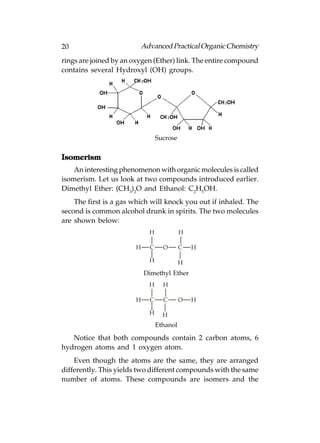
  • 202.
    Advanced Practical OrganicChemistry 199 those involved for carboxylic acids and their derivatives. The reaction of a methoxide ion with ethanoyl chloride is a nucleophilic substitution reaction (Following fig.). In it one nucleophile (the methoxide ion) substitutes another nucleophile Cl-. Fig. Nucleophilic substitution Mechanism: Charged Nucleophiles The methoxide ion uses of its lone pairs of electrons to form a bond to the electrophilic carbonyl carbon of the acid chloride. Simultaneously, the relatively weak π bond of the carbonyl group breaks and both of the π electrons move onto the carbonyl oxygen to give it a third lone pair of electrons and a negative charge. This is exactly the same first step involved in nucleophilic addition to aldehydes and ketones. However, with an aldehyde or a ketone, the tetrahedral structure is the final product. With carboxylic acid derivatives, the lone pair of electrons on oxygen return to reform the carbonyl π bond (Step 2). As this happens, the C–Cl σ bond breaks with both electrons moving onto the chlorine to form a chloride ion that departs the molecule. This explains how the products are formed, but why should the C–Cl σ bond break in preference to the C–OMe σ bond or the C–CH3 σ bond can be explained by looking at the leaving groups which would be formed from these processes. The leaving groups would be a chloride ion, a methoxide ion and a carbanion, respectively. The chloride ion is the best leaving
  • 203.
    200 Advanced Practical Organic Chemistry group as it is the most stable. This is because chlorine is more electronegative than oxygen or carbon and can stabilise the negative charge. This same mechanism is involved in the nucleophilic substitutions of all other carboxylic acid derivatives and a general mechanism can be drawn as follow. Fig. Mechanism of the nucleophilic substitution. Fig. Leaving groups; (a) chloride; (b) methoxide; (c) carbanion. Fig. General mechanism for nucleophilic substitution. Mechanism: Neutral Nucleophiles Acid chlorides are quite reactive an a react with uncharged nucleophiles. For example, ethanoyl chloride react with methanol to form an ester (Fig.C). Oxygen is the nucleophilic centre in methanol and uses one of its lone pairs of electrons to form a new bond to the electrophilic carbon of the acid chloride (Fig.D). As this new bond forms, the carbonyl π bond breaks and both electrons move onto the carbonyl oxygen to give it a third pair of electrons and a negative charge (Step 1). The methanol oxygen gains a positive charge as it has effectively lost an electron by sharing its lone pair with carbon in the new
  • 204.
    Advanced Practical OrganicChemistry 201 bond. A positive charge on oxygen is not very stable and so the second stage in the mechanism is the loss of a proton. Both electrons in the O–H bond move onto the oxygen to restore a second lone pair of electrons and thus neutralise the charge. Methanol can help the process by acting as a base. The final stage in the mechanism is the same as before. The carbonyl π bond is reformed and as this happens, the C–Cl σ bond breaks with both electrons ending up in the departing chloride ion as a fourth lone pair of electrons. Finally, the chloride anion can remove a proton from CH3OR,+ to form HCl and methanol. Fig.C. Ethanoyl chloride reacting with methanol to form methyl ethanoate. Fig.D. Mechanism for the reaction of an alcohol with an acid chloride. The above mechanism is essentially the same mechanism involved in the reaction of ethanoyl chloride with sodium methoxide, the only difference being that we have to remove a proton during the reaction mechanism. Y=Cl, OCOR, OR, NR2 Fig. General mechanism for the nucleophilic substitution of a neutral
  • 205.
    202 Advanced Practical Organic Chemistry nucleophile with a carboxylic add derivatives. The same mechanism is true for nucleophilic substitutions of other carboxylic acid derivatives with neutral nucleophiles (Following fig.). In practice, acids or bases are generally added to improve yields. Addition vs Substitution Carboxylic acid derivatives undergo nucleophilic substitution whereas aldehydes and ketones undergo nucleophilic addition. This is because nucleophilic substitution of a ketone or an aldehyde would generate a carbanion or a hydride ion respectively (Following fig.). These ions are unstable and highly reactive, so they are only formed with difficulty. Furthermore, C–C and C–H σ bonds are easily broken. Therefore, nucleophilic substitutions of aldehydes or ketones are not feasible. Fig. Unfavourable formation of an unstable carbanion hydride ion. Process of Reactivity Reactivity Order Acid chlorides can be converted to acid anhydrides, esters, or amides. These reactions are possible because acid chlorides are the most reactive of the four carboxylic acid derivatives. Nucleophilic substitutions of the other acid derivatives are more limited because they are less reactive. For example, acid anhydrides can be used to synthesise esters and amides, but cannot be used to synthesise acid chlorides.
  • 206.
    Advanced Practical OrganicChemistry 203 The possible nucleophilic reactions for each carboxylic acid derivative depends on its reactivity with respect to the other acid derivatives (Following fig.). Reactive acid derivatives can be converted to less reactive (more stable) acid derivatives, but not the other way round. For example, an ester can be converted to an amide, but not to an acid anhydride. Fig. Relative reactivity of carboxylic acid derivatives. Electronic Factors To understand this difference in reactivity of various acid derivatives look at the first step in the nucleophilic substitution mechanism (involving the addition of a nucleophile to the electrophilic carbonyl carbon) which is the rate-determining step. Therefore, the more electrophilic this carbon is, the more reactive it will be. The nature of Y has a significant effect in this respect: y=Cl, OCOR, OR, NR2 Fig. The electrophilic centre of a carboxylic acid derivative. Y is linked to the acyl group by an electronegative heteroatom (Cl, O, or N) that makes the carbonyl carbon more electrophilic. The extent to which this happens depends on the electronegativity of Y. If Y is strongly electronegative (e.g. chlorine), it has a strong electron-withdrawing effect on the carbonyl carbon making it more electrophilic and more reactive to nucleophiles. Because chlorine is more electronegative than oxygen, and oxygen is more electronegative than nitrogen,
  • 207.
    204 Advanced Practical Organic Chemistry acid chlorides are more reactive than acid anhydrides and esters, while acid anhydrides and esters are more reactive than amides. The electron-withdrawing effect of Y on the carbonyl carbon is an inductive effect. With amides, there is an important resonance contribution that decreases the electrophilicity of the carbonyl carbon (Fig.E). The nitrogen has a lone pair of electrons that can form a bond to the neighbouring carbonyl carbon. As this new bond is formed, the weak π bond breaks and both electrons move onto oxygen to give it a third lone pair of electrons and a negative charge. Because the nitrogen’s lone pair of electrons is being fed into the carbonyl group, the carbonyl carbon becomes less electrophilic and is less prone to attack by an upcoming nucleophile. Theoretically, this resonance could also take place in acid chlorides, acid anhydrides, and esters to give resonance structures (Fig.F). However, the process is much less important because oxygen and chlorine are less nucleophilic than nitrogen. In these structures, the positive charge ends up on an oxygen or a chlorine atom. These atoms are more electronegative than nitrogen and less able to stabilise a positive charge. These resonance structures might occur to a small extent with esters and acid anhydrides, but are far less likely in acid chlorides. This tend also matches the trend in reactivity. Fig.E. Resonance contribution in an amide.
  • 208.
    Advanced Practical OrganicChemistry 205 Fig.F. Resonance structures for (a) an acid chloride; (b) an acid anhydride (c) an ester Although the resonance effect is weak in esters and acid anhydrides, it explain why acid anhydrides are more reactive than esters. Acid anhydrides have two carbonyl groups and so resonance can occur with either carbonyl group (Following fig.). Due to this, the lone pair of the central oxygen is ‘split’ between both groups that means that the resonance effect is split between both carbonyl groups. This means that the effect of resonance at any one carbonyl group is diminished and it will remain strongly electrophilic. With an ester, there is only one carbonyl group and so it experiences the full impact of the resonance effect. Therefore, its electrophilic strength will be diminished relative to an acid anhydride. Fig. Resonance structures for an acid anhydride. Steric Factors Steric factors can also play a part in the reactivity of acid derivatives. For example, a bulky group attached to the carbonyl group can hinder the approach nucleophiles and hence lower reactivity. The steric bulk of the nucleophile can also have an influence in slowing down the reaction. For example, acid chloride react faster with primary alcohols than they do with secondary or tertiary alcohols. This allows selective esterification if a molecule has more than one alcohol group present:
  • 209.
    206 Advanced Practical Organic Chemistry Fig. Selective esterification of a primary alcohol. Carboxylic Acids The nucleophilic substitution of carboxylic acids is complicated due to the fact that an acidic proton is present. Since most nucleophiles can act as bases, the reaction of a carboxylic acid with a nucleophile results in an acid-base reaction rather than nucleophilic substitution. However, carboxylic acids can undergo nucleophilic substitution if they are activated before the reaction. Formation of Carboxylic Acid Functional Group Transformations Carboxylic acids can be prepared by the oxidation of primary alcohols or aldehydes, the hydrolysis of nitriles, or the hydrolysis of esters which can be used as protecting groups for carboxylic acids. Amides can also be hydrolysed to carboxylic acids. However, drastic reaction conditions are needed due to the lower reactivity of amides and so amides are less useful as carboxylic acid protecting groups. Although acid chlorides and anhydrides can be easily hydrolysed to carboxylic acids, the reaction serves no synthetic purpose because acid chlorides and acid anhydrides are synthesised from carboxylic acids in the first place and they are also very reactive to be used as protecting groups. C–C Bond Formation
  • 210.
    Advanced Practical OrganicChemistry 207 Aromatic carboxylic acid can be obtained by oxidation alkyl benzenes. It does not matter how large the alkyl group is, since they are all oxidised to a benzoic acid structure. In both the methods by which alkyl halides can be converted to a carboxylic acid, the carbon chain is extended by one carbon. One method involves substituting the halogen with a cyanide ion, then hydrolysing the cyanide group [Following fig. (a)]. This works best with primary alkyl halides. The other method involves the formation of a Grignard reagent which is then treated with carbon dioxide [Following fig. (b)]. Fig. Synthetic routes from an alkyl halide to a carboxylic acid. The mechanism for the Grignard reaction is similar to the nucleophilic addition of a Grignard reagent to an aldehyde or ketone: Fig. Mechanism for the Grignard reaction with carbon dioxide. A range of carboxylic acids can be prepared by alkylating diethyl malonate, then hydrolysing and decarboxylating the product:
  • 211.
    208 Advanced Practical Organic Chemistry Fig. Synthesis of carboxylic acids from diethyl malonate. Bond Cleavage Alkenes can be cleaved with potassium permanganate to produce carboxylic acids (Following fig.). A vinylic proton must be present, that is a proton directly attached to the double bond. Fig. Synthesis of carboxylic acids from alkenes.r
  • 212.
    Advanced Practical OrganicChemistry 209 8 Process of Oxidation and Reduction Alkenes: Oxidation and Reduction Alkenes to Alkanes Alkenes can be converted to alkanes by their reaction with hydrogen over a finely divided metal catalyst such as palladium, nickel, or platinum (Following fig.). This is an addition reaction, as it involves the addition of hydrogen atoms to each end of the double bond. It is also called a catalytic hydrogenation or a reduction reaction. Fig. Hydrogenation of an alkene. The catalyst is important since the reaction will not occur at room temperature in its absence. This is because
  • 213.
    210 Advanced Practical Organic Chemistry hydrogenation has a high free energy of activation (ΔG1*)(Following fig.). The role of the catalyst is to bind the alkene and the hydrogen to a common surface such that they can react more easily. This results in a much lower energy of activation (ΔG2*) allowing the reaction to proceed in the much milder conditions. The catalyst itself is unchanged after the reaction and can be used in small quantity. Fig. Graph of potential energy versus reaction coordinate for an uncatalysed and a catalysed hydrogenation reaction of an alkene. Both the hydrogen and the alkene are bound to the catalyst surface before the hydrogen atoms are transferred, which means that both hydrogens are added to the same side of the double bond–syn-addition. Note that the hydrogen molecule is split once it has been added to the catalyst. Fig. Binding of alkene and hydrogen to catalytic surface. Alkenes to Aldehydes and Ketones Considering that an alkene on oxidation with ozone (Following fig.) that proceeds with the formation of an initial ozonide which then rearranges to an isomeric ozonide. This second ozonide is unstable and potentially explosive and so it is not generally isolated. Instead, it is reduced with zinc and
  • 214.
    Advanced Practical OrganicChemistry 211 water leading to the formation of two separate molecules: Fig. Ozonolysis of an alkene. The alkene is split across the double bond to form two carbonyl compounds. These will be ketones or aldehydes depending on the substituents present. For example, 3-methyl- 2-pentene gives an aldehyde and a ketone: Fig. Ozonolysis of 3-methyl-2-pentene. Alkenes to Carboxylic Acids and Ketones Alkenes can be oxidatively cleaved with hot permanganate solution to give carboxylic acids and/or ketones (Fig.E). The products obtained depend on the substituents present on the alkene. Fig. E. Oxidative cleavage of 3-methyl-2-pentene. Alkenes to 1, 2-diols The reaction of alkenes with osmium tetroxide (OsO4) is an example of an oxidation reaction (Following fig.). In this case the alkene is not split, but, a 1,2-diol is obtained which is also called a glycol. The reaction involves the formation of a cyclic intermediate where the osmium reagent is attached to one face of the alkene. On treatment with sodium bisulphite, the intermediate is cleaved such that the two oxygen atoms linking the osmium remain attached. Due to this both the
  • 215.
    212 Advanced Practical Organic Chemistry alcohols being added to the same side of the double bond, i.e. syn-hydroxylation. Fig. syn-Hydroxylation of an alkene. The same reaction can also be carried out using cold alkaline potassium permanganate (KMnO4) followed by treatment with aqueous base (Following fig.). It is important to keep the reaction cold since potassium permanganate can cleave the diol by further oxidation (Fig. E). Fig. syn-Hydroxylation with KMnO4 The reaction works better with osmium tetroxide. However, this is a highly toxic and expensive reagent and has to be handled with care. Anti-hydroxylation of the double bond can also be achieved by forming an epoxide, then carrying out an acid-catalysed hydrolysis. Alkenes to Expoxides When an alkene is treated with a peroxyacid (RCO3H) it forms a epoxide (Following fig.). m-Chloroperoxybenzoic acid is one of the most commonly used peroxyacids for this reaction. The reaction is unusual because there is no carbocation intermediate, and it involves a one-step process without intermediates.
  • 216.
    Advanced Practical OrganicChemistry 213 Fig. Expoxidation of an alkene. Alkenes Hydroboration Reaction Alcohols can be generated from alkenes by reaction with diborane (B2H6 or BH3), followed by treatment with hydrogen peroxide (Following fig.). The first part of the reaction involves the splitting of a B–H bond in BH3 with the hydrogen joining one end of the alkene and the boron joining the other. Each of the B–H bonds is split in this way such that each BH3 molecule reacts with three alkenes to give an organoborante intermediate where boron is liked to three alkyl groups. This can then be oxidised with alkaline hydrogen peroxide to produce the alcohol. Fig. Hydroboration of an alkene. With unsymmetrical alkenes, the least substituted alcohol is obtained (Following fig.) and so the organoborane reaction is complementary to the electrophilic addition reaction with aqueous acid. Steric factors appear to play a role in controlling this preference with the boron atom preferring to approach the least sterically hindered site. Electronic factors also play a role as described in the mechanism below:
  • 217.
    214 Advanced Practical Organic Chemistry Fig. Hydroboration of 2-methylpropane to give a primary alcohol (I) The tertiary alcohol (II) is not obtained. Mechanism The mechanism (Following fig.) involves the alkene π bond interacting with the empty p orbital of boron to form a π complex. One of BH3’s hydrogen atom is then transferred to one end of the alkene as boron itself forms a o bond to the other end. This takes place through a four-centred transition state where the alkene’s π bond and the B–H bond are partially broken, and the eventual C–H and C–B bonds are partially formed. There is an imbalance of electrons in the transition state which results in the boron being slightly negative and on of the alkene carbons being slightly positive. The carbon best able to handle this will be the most substituted carbon and so the boron will end up on the least substituted carbon. (Note that boron has six valence electrons and is electrophilic. Therefore, the addition of boron to the least substituted position actually follows Markovnikov’s rule.) Fig. Mechanism of hydroboration. Since subsequent oxidation with hydrogen peroxide replaces the boron with a hydroxyl group, the eventual alcohol will be on the least substituted carbon. Furthermore, the addition of the boron and hydrogen atoms takes place such that they are on the same side of the alkenes. This is called syn- addition. Fig. Mechanism of oxidation with hydroperoxide. The mechanism of oxidation (Following fig.) involves
  • 218.
    Advanced Practical OrganicChemistry 215 addition of the hydroperoxide to the electron deficient boron to form an unstable intermediate which then rearranges such that an alkyl group migrates from the boron atom to the neighbouring oxygen and expels a hydroxide ion. This process is then repeated for the remaining two hydrogens on boron and the final trialkyl borate B(OR)3 can then be hydrolysed with water to give three molecules of alcohol plus a borate ion. Fig. Stereochemical aspects of hydroboration. The mechanism of oxidation takes place with retention of stereochemistry at the alcohol’s carbon atom and so the overall reaction is stereospecific (Following fig.). Note that the reaction is stereospecific such that the alcohol group is trans to the methyl group in the product. However, it is not enantiospecific and both enantiomers are obtained in equal amounts (a racemate). Alkynes: Electrophilic Addition Additions to Symmetrical Alkynes Alkynes give electrophilic addition reactions with the same reagents as in case of alkenes (e.g. halogens and hydrogen halides). Since there are two n bonds in alkynes, it is possible for the reaction to go once or twice depending on the amount of reagent added. For example, reaction of 2-butyne with one equivalent of bromine gives an (E)-dibromoalkene [Following fig.(a)]. With two equivalents of bromine, the initially formed (E)-dibromoalkene reacts further to give a tetrabromoalkane [Following fig.(b)].
  • 219.
    216 Advanced Practical Organic Chemistry Fig. Reaction of 2-butyne with (a) 1 equivalent of bromine; (b) 2 equivalents of bromine. When an alkyne is treated with one equivalent of HBr gives a bromoalkene [Following fig.(a)]. If two equivalents of hydrogen bromide are present the reaction can go twice to give a geminal dibromoalkane where both bromine atoms are added to the same carbon [Following fig.(b)]. Fig. Reaction of 2-butyne with (a) 1 equivalent of HBr; (b) 2 equivalents of HBr. These addition reactions are similar to the addition reactions of alkenes. However, the reaction is much slower for an alkyne, because alkynes are less reactive. Alkynes can be expected to be more nucleophilic, as they are more electron rich in the vicinity of the multiple bond, that is, six electrons in a triple bond as compared to four in a double bond. However, electrophilic addition to an alkyne involves the formation of a vinylic carbocation (Following fig.). This carbocation is much less stable than the carbocation intermediate formed during electrophilic addition to an alkene.
  • 220.
    Advanced Practical OrganicChemistry 217 Fig. Electrophilic addition to an alkyne via a vinylic carbocation (I). Because this low reactivity, alkynes react slowly with aqueous acid and mercuric sulphate has to be added as a catalyst. The product that might be expected from this reaction is a diol: Fig. Reaction of 2-butyne with aqueous acid and mercuric sulphate. Actually, a diol is not formed. The intermediate (an enol) undergoes acid-catalysed rearrangement to give a ketone (Following fig.). This process is called a keto-enol tautomerism. Fig. Keto-enol tautomerism. Tautomerism is used to describe the rapid interconversion of two different isomeric forms (tautomers). In this case the keto and enol tautomers of a ketone. The keto tautomer is by far the dominat species for a ketone and the enol tautomer is generally present in only very small amounts (typically 0.0001 per cent). Therefore, as soon as the enol is formed in the above reaction, it rapidly tautomerised to the keto form and further electrophilic addition does not occur. Additions to Terminal Alkynes When a terminal alkyne is treated with an excess of hydrogen halide the halogens both end up on the more
  • 221.
    218 Advanced Practical Organic Chemistry substituted carbon (Fig. F). This is in accordance with the Markovnikov’s rule which states that the additional hydrogens end up on the carbon which already has the most hydrogens. The same rule applies for the reaction with acid and mercuric sulphate which means that a ketone is formed after keto-enol tautomerism instead of an aldehyde (Fig. G). Fig. F. Reaction of propyne with HBr. Fig. G. Reaction of propyne with aqueous acid and mercuric sulphate. Alkynes Reduction Hydrogenation Alkynes react with hydrogen gas in the presence of a metal catalyst and the process called hydrogenation. It is an example of a reduction reaction. With a fully active catalyst like platinum metal, two molecules of hydrogen are added to produce an alkane. Fig. Reduction of an alkyne to an alkene. The reaction involves the addition of one molecule of hydrogen to form na alkene intermediate which then reacts with a second molecule of hydrogen to form the alkane. With less active catalysts, it is possible to stop the reaction at the alkene stage. In particular, (Z)-alkenes can be synthesised from
  • 222.
    Advanced Practical OrganicChemistry 219 alkynes by reaction with hydrogen gas and Lindlar‘s catalyst(Following fig.). This catalyst consists of metallic palladium deposited on calcium carbonate which is then treated with lead acetate and quinoline. The later treatment ‘poisons’ the catalyst in such a way that the alkyne reacts with hydrogen to give an alkene, but doe not react further. Since the starting materials are absorbed onto the catalyst surface, both hydrogens are added to the same side of the molecule to produce the (Z) isomer. The same result can be achieved with nickel boride (Ni2B) by using the P-2 catalyst. Fig. Reduction of alkyne to a (Z)-alkyne. Dissolving Metal Reduction Fig. Reduction of an alkyne to a E-alkene. Reduction of an alkyne to an (E)-alkene can be achieved by treating the alkyne with lithium or sodium metal in ammonia at low temperatures (Following fig.). This is called dissolving metal reduction. Fig. Mechanism for the dissolving metal reduction of an alkyne. In this reaction, the alkali metal donates its valence electron to the alkyne to produce a radical anion (Following fig.). This removes a proton from ammonia to produce a vinylic radical that receives an electron from a second alkali metal to produce
  • 223.
    220 Advanced Practical Organic Chemistry a trans-vinylic anion. This anion then removes a proton from a second molecule of ammonia and forms the trans or (E)- alkene. Only half curly arrows are used in the mechanism because this is a radical reaction involving the movement of single electrons. Terminal Alkynes: Alkylation Terminal Alkynes A terminal alkyne is an alkyne that has a hydrogen substituents (Fig. H). This hydrogen substituent is acidic and can be removed with strong base (e.g. sodium amide NaNH2) to produce an alkynide (Fig. I). This is an acid-base reaction. Fig. H. Terminal alkyne. Fig. I. Reaction of a terminal alkyne with a strong base. Alkylation Once the alkynide is formed, it can be treated with an alkyl halide to form more complex alkynes. This reaction is called an alkylation and is an example of nucleophilic substitution. Fig. Reaction of an alkynide ion with an alkyl halide. This reaction works best with primary alkyl halides. When secondary or tertiary alkyl halides are used, the alkynide reacts like a base and this results in elimination of hydrogen halide from the alkyl halide to produce an alkene:
  • 224.
    Advanced Practical OrganicChemistry 221 Fig. Elimination of HBr. Dienes, Which are Conjugated Structure A conjugate diene is made up of two alkene units separated by a single bond [Following fig.(a)]. Dienes are separated by more than one single bond known as non-conjugated dienes [Following fig.(b)]. Fig. (a) Conjugated diene; (b) non-conjugated diene. Bonding A conjugated diene does not behave like two isolated alkenes. For example, the length of the ‘ single’ bond connecting the two alkene units is slightly shorter than expected for a typical single bond (1.48Å). This shows that there is a certain amount of double-bond character present in this bond. Two sp2 hybridised carbons rather than two sp3 hybridised carbons. Therefore, an sp2 hybridised orbital from each carbon is used for the single bond. Since this hybridised orbital ha more s- character than an sp3 hybridised orbital, the bond is expected to be shorter. An alternative explanation is that the π orbitals of the two alkene systems can overlap to produce the partial double-bond character:
  • 225.
    222 Advanced Practical Organic Chemistry Fig. π-Orbital overlap. Electrophilic Addition The reactions of a conjugate diene reflect the fact that a conjugated diene should be viewed as a functional group in its own right, rather than as two separate alkenes. Electrophilic addition to a conjugated diene results in a mixture of two possible products arising from 1,2-addition and 1,4 addition: Fig. Electrophilic addition to a conjugated diene of (a) bromine and (b) HBr. In 1,2-addition, new atoms have been added to each end of one of the alkene units. This is the normal electrophilic addition of an alkene with which we are familiar. In 1,4-addition, new atoms have been added to each end of the entire diene system. Furthermore, the double bond remaining has shifted position (isomerised) to the 2, 3-position. The mechanism of 1, 4-addition starts off in the same way as a normal electrophilic addition. We shall consider the reaction of a conjugated diene with hydrogen bromide as an example (Following fig.). One of the alkene units of the diene uses its
  • 226.
    Advanced Practical OrganicChemistry 223 n electrons to form a bond to the electrophilic hydrogen of HBr. The H–Br bond breaks at the same time to produce a bromide ion. The intermediate carbocation produced has a double bond next to the carbocation centre and is called an allylic carbocation. Fig. Mechanism of 1,4-addition-first step. This system is now set up for resonance involving the remaining alkene and the carbocation centre, resulting in delocalisation of the positive charge between positions 2 and 4. Due to this delocalisation, the carbocation is stabilised and this in turn explains two features of this reaction. First of all, the formation of two different products is now possible since the second stage of the mechanism involve the bromide anion attacking either at position 2 or at position 4 (Fig.J). Secondly, it explains why the alternative 1, 2-addition product is not formed(Fig.K). The intermediate carbocation required for this 1, 2-addition cannot be stabilised by resonance. Therefore, the reaction proceeds through the allylic carbocation instead. Fig. J. Mechanism of 1, 2- and 1, 4-addition - second step.
  • 227.
    224 Advanced Practical Organic Chemistry Fig. K. Unfavoured reaction mechanism. Diets-Alder Cycloaddition The diels-Alder cycloaddition reaction is an important reaction by which six-numbered rings can be synthesised. It involves a conjugated diene and an alkene. The alkene is called a dienophile (diene-lover) and generally has an electron- withdrawing group linked to it (e.g. a carbonyl group or a nitrile). The mechanism is concerted with new bonds being formed simultaneously as old bonds are being broken(Fig. M). No intermediates are involved. Fig. L. Diels-Alder cycloaddition. Fig. M. Mechanism of Diels-Alder cycloaddition. Process of Aromaticity Definition Originally term aromatic was used for benzene-like structures because of the distinctive aroma of such compounds. Aromatic compounds undergo certain distinctive reactions that set them apart from other functional groups. They are highly unsaturated compounds, but unlike alkenes and alkynes, they are relatively unreactive and tend to undergo reactions that
  • 228.
    Advanced Practical OrganicChemistry 225 involve a retention of their unsaturation. Benzene is a six- numbered ring structure having three formal double bonds [Following fig. (a) ]. However, the six π electrons involved are not localised between any two carbon atoms. Instead, they are delocalised around the ring that results in an increased stability. Because of this, benzene is often written with a circle in the centre of the ring to signify the delocalisation of the six π electrons [Following fig. (b)]. Reactions that disrupt this delocalisation are not favoured as it means a loss of stability, so benzene undergoes reactions in which the aromatic ring system is retained. All six carbon atoms in benzene are sp2 hybridised, and the molecule itself is cyclic and planar. The planarity is essential if the 2p atomic orbitals on each carbon atom are to overlap and result in delocalisation. Fig. Representations of benzene. Huckel Rule An aromatic molecule must be cyclic and planar with sp2 hybridised atoms (i.e. conjugated), but it must also obey the Huckel rule. It states, that the ring system must have 4n + 2 π electrons where n = 1, 2, 3, etc. Therefore, ring systems which have 6, 10, 14, ... π electrons are aromatic. Benzene fits the Huckel rule as it has six π electrons. Cyclooctatetraene has eight π electrons and does not obey the Huckel rule. Although all the carbon atoms in the ring are sp2 hybridised, cyclooctateraene reacts like a conjugated alkene. It is not planar, the π electrons are not delocalised and the molecule is made up of alternating single and double bonds [Following fig. (a)]. However, the 18- membered cyclic system [Following fig. (b)] obeys the Huckel rule (n = 4) and is a planar molecule with aromatic properties and a delocalised π system.
  • 229.
    226 Advanced Practical Organic Chemistry Fig. (a) Cyclooctatetraene; (b) 18-membered aromatic ring. We can also possible to get aromatic ring. The cyclopentadienyl anion and the cycloheptatrienyl cation are both aromatic. Both are cyclic and planar, containing six π electrons, and all the atoms in the ring are sp2 hybridised. Fig. (a) Cyclopentadienyl anion; (b) cycloheptatrienyl cation. Bicyclic and polycyclic systems can also be aromatic. Fig. (a) Naphthalene; (b) anthracene; (c) benzo[a]pyrene. Properties Formation Aromatic Compounds: Properties and Formation Preparation It is difficult to synthesise aromatic compounds in the laboratory from scratch and most aromatic compounds are prepared from benzene or other simple aromatic compounds (e.g. toluene and naphthalene). These in turn are isolated from natural sources like coal or petroleum. Properties Many aromatic compounds have a characteristic aroma and they burn with a smoky flame. That are hydrophobic, non-polar molecules and will dissolve in organic solvents. They are soluble in water. Aromatic molecules can interact with each other through
  • 230.
    Advanced Practical OrganicChemistry 227 intermolecular bonding by van der Waals interactions [Following fig. (a)]. However, induced dipole interactions are also possible with alkyl ammonium ions or metal ions where the positive charge of the cation induces a dipole in the aromatic ring such that the face of the ring is slightly negative and the edges are slightly positive [Following fig. (b)]. This results in the cation being sandwiched between two aromatic rings. Fig. Intermolecular bonding involving aromatic rings. Aromatic compounds are generally stable and they do not react like alkenes. They prefer to undergo reactions in which the stable aromatic ring is retained. The most common type of reaction for aromatic rings is electrophilic substitution, but reduction is also possible. Benzene’s Electrophilic Substitution Definition Aromatic rings undergo electrophilic substitution, for example the bromination of benzene (Following fig). The reaction involves an electrophile (Br+) replacing another electrophile (H+) with the aromatic ring remaining intact. Therefore, one electrophile replaces another and the reaction is called an electrophilic substitution. Fig. Electrophilic substitution of benzene.
  • 231.
    228 Advanced Practical Organic Chemistry Mechanism In the mechanism of electrophilic substitution reactions (Fig. A) the aromatic ring acts as a nucleophile and it provides two of its π electrons to form a bond to Br+. The aromatic ring now has lost one of its formal double bonds which results in a positively charged carbon atom. This first step in the mechanism is the same as that described for the electrophilic addition to alkenes, and so the positively charged intermediate here is equivalent to the carbocation intermediate in electrophilic addition. However in step 2, the mechanism of electrophilic addition and electrophilic substitution differ. Whereas the carbocation intermediate from an alkene reacts with a nucleophile to form an addition product, the intermediate from the aromatic ring loses a proton. The C–H σ bond breaks and the two electrons move into the ring to reform the π bond, thus regenerating the aromatic ring and neutralising the positive charge on the carbon. This is the mechanism undergone in all electrophilic substitutions. The only difference is the nature of the electrophile (Fig. B). Fig. A. Mechanism of electrophilic substitution. Fig. B. Examples of electrophiles used in electrophilic substitution. Intermediate Stabilisation The rate-determining step in the electrophilic substitution is the formation of the positively charged intermediate, and so the rate of the reaction is determined by the energy level of the transition state leading to that intermediate. The transition
  • 232.
    Advanced Practical OrganicChemistry 229 state resembles the intermediate in character and so any factor stabilising the intermediate also stabilises the transition state and lowers the activation energy needed for the reaction. Therefore, electrophilic substitution is more likely to occur if the positively charged intermediate can be stabilised. Stabilisation is possible if the positive charge can be spread amongst different atoms, i.e. by delocalisation. The process by which this can occurs is called resonance: Fig. Resonance stabilisation of the charged intermediate. The resonance process involves two π electrons shifting their position round the ring to provide the ‘top’ carbon with a fourth bond and thus neutralise its positive charge. In the process, another carbon in the ring is left short of bonds and gains the positive charge. This process can be repeated such that the positive charge is spread to a third carbon. The structures drawn in figure given above are called resonance structures (Canonical forms). Halogenation The stable aromatic ring means that aromatic compounds are less reactive than alkenes to electrophiles. For example, an alkene will react with Br2, but an aromatic ring will not. Therefore, we have to activate the aromatic ring (i.e. make it a better nucleophile) or activate the Br2 (i.e. make it a better electrophile) if we want a reaction to take place. The electron- donating substituents on an aromatic ring increase the nucleophilicity of the aromatic ring. A Br2 molecule can be activated to make it a better electrophile by adding a Lewis acid like FeCl3, FeBr3, or AlCl3 to the reaction medium. These compounds contain a central atom (iron or
  • 233.
    230 Advanced Practical Organic Chemistry aluminium) that is strongly electrophilic and does not have a full valence shell of electrons. Due to this, the central atom can accept a lone pair of electrons, even from a weakly nucleophilic atom like a halogen. For example (Following fig.) bromine uses a lone pair of electrons to form a bond to the Fe atom in FeBr3 and becomes positively charged. Bromine is now activated to act as an electrophile and will react more easily with a nucleophile (the aromatic ring) by the normal mechanism for electrophilic substitution. An aromatic ring can be chlorinated in a similar manner, making use of Cl2 in the presence of FeCl3. Fig. Mechanism by which a Lewis acid activates bromine towards electrophilic substitution. Friedel-Crafts Alkylation and Acylation Fig. (a) Friedel-Crafts alkylation; (b) Friedel-Crafts acylation. Friedel-Crafts alkylation and acylation (Following fig.) are two other examples of electrophilic substitution requiring the presence of a Lewis acid. These are particularly important as they allow the synthesis of larger organic molecules by adding alkyl (R) or acyl (RCO) side chains to an aromatic ring.
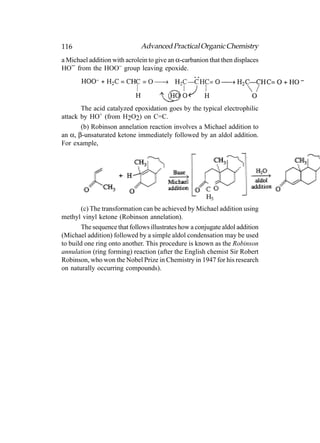
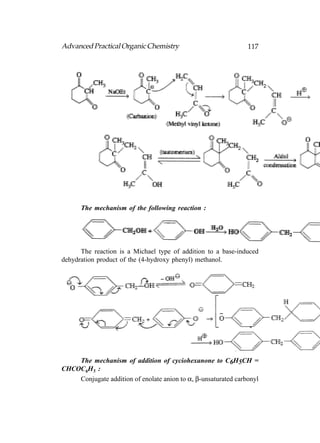
  • 234.
    Advanced Practical OrganicChemistry 231 The example of Friedel-Crafts alkylation is the reaction of benzene with 2-chloropropane (Fig. C). The Lewis acid (AlCl3) promotes the formation of the carbocation needed for the reaction and does so by accepting a lone pair of electrons from chlorine to form an unstable intermediate that fragments to give a carbocation and AlCl4– (Fig. D). Once the carbocation is formed it reacts as an electrophile with the aromatic ring by the electrophilic substitution mechanism already described (Fig. E). Fig. C. Friedel-Crafts reaction of benzene with 2-chloropropane. Fig. D. Mechanism of carbocation formation. Fig. E. Mechanism for the Friedel-Crafts alkylation. Following are the limitations to the Friedel-Crafts alkylation. For example, the reaction of 1-chlorobutane with benzene gives two products with only 34 per cent of the desired product (Fig. F). This is because of the fact that the primary carbocation that is generated can rearrange to a more stable secondary carbocation where a hydrogen (and the two sigma electrons
  • 235.
    232 Advanced Practical Organic Chemistry making up the C–H bond) ‘shift’ across to the neighbouring carbon atom (Fig. G). This is called a hydride shift and it occurs because the secondary carbocation is more stable than the primary carbocation. Such rearrangements limit the type of alkylations that can be carried out by the Friedel-Crafts reaction. Fig. F. Friedel-Crafts reaction of 1-chlorobutane with benzene. Fig. G. Hydride shift. Keeping this fact in mind, we can make structures such 1-butylbenzene in good yield. In the Friedel-Crafts acylation (Following fig.) of benzene with butanoyl chloride instead of 1-chlorobutane, the necessary 4-C skeleton is linked to the aromatic ring and no rearrangement occurs. The carbonyl group can then be removed by reducing it with hydrogen over a palladium catalyst to give the desired product. Fig. Synthesis of 1-butylbenzene by Friedel-Crafts acylation and reduction. The mechanism of the Friedel-Crafts acylation is the same as the Friedel-Crafts alkylation. It involves an acylium ion instead of a carbocation. Like Friedel-Crafts alkylation, a Lewis acid is needed to generate the acylium ion (R–C = O) but unlike a carbocation the acylium ion does not rearrange since
  • 236.
    Advanced Practical OrganicChemistry 233 there is resonance stabilisation from the oxygen: Fig. Generation of the acylium ion. Friedel-Crafts alkylations can also be done using alkenes instead of alkyl halides. A Lewis acid is not needed, but a mineral acid is required. Treatment of the alkene with the acid leads to a carbocation that can then react with an aromatic ring by the electrophilic substitution mechanism already described (Following fig.). For an alkene, this is another example of electrophilic addition where a proton is attached to one end of the double bond and a phenyl group is added to the other. Fig. Friedel-Crafts alkylation of benzene with an alkene. Friedel-Crafts reactions can also be done with alcohols in the presence of mineral acid. The acid leads to the elimination of water from the alcohol resulting in the formation of an alkene that can then be converted to a carbocation: Fig. Friedel-Crafts alkylation of benzene with an alcohol.
  • 237.
    234 Advanced Practical Organic Chemistry Sulphonation and Nitration Sulphonation and nitration are electrophilic substitutions that involve strong electrophiles and do not need the presence of a Lewis acid: Fig. (a) Sulphonation of benzene; (b) nitration of benzene. In Sulphonation, the electrophile is sulphur tetroxide (SO3) that is generated under the acidic reaction conditions (Fig. H). Protonation of an OH group generates a protonated intermediate (I). As the oxygen gains a positive charge it becomes a good leaving group and water is lost from the intermediate to give sulphur trioxide. Although sulphur trioxide has no positive charge, it is a strong electrophile. This is because the sulphur atom is bonded to three electronegative oxygen atoms that are all ‘pulling’ electrons from the sulphur, and making it electron deficient (i.e. electrophilic). During electrophilic substitution (Fig. I), the aromatic ring forms a bond to sulphur and one of the π bonds between sulphur and oxygen is broken. Both electrons move to the more electronegative oxygen top form a third lone pair and produce a negative charge on that oxygen. This finally gets neutralised when the third lone pair of electrons is used to form a bond to a proton. Fig. H. Generation of sulphur trioxide.
  • 238.
    Advanced Practical OrganicChemistry 235 Fig. I. Sulphonation of benzene. In nitration, sulphuric acid acts as an acid catalyst for the formation of a nitronium ion (NO2+) that is generated from nitric acid by a similar mechanism to that used in the generation of sulphur trioxide from sulphuric acid: Fig. Generation of the nitronium ion. The mechanism for the nitration of benzene is similar to sulphonation (Following fig.). As the aromatic ring forms a bond to the electrophilic nitrogen atom, a π bond between N and O breaks and both electrons move onto the oxygen atom. Unlike sulphonation, this oxygen keeps its negative charge and does not pick up a proton. This is because it acts as a counterion to the neighbouring positive charge on nitrogen. Fig. Nitration of benzene. Formation of Mono-substituted Bonzenes Functional Group Transformations
  • 239.
    236 Advanced Practical Organic Chemistry Some substituents cannot be introduced directly into an aromatic ring by electrophilic substitution. These include the following groups: –NH2, –NHR, NR2, NHCOCH3, CO2H, CN, OH. Although these groups cannot be added directly into the aromatic ring they can be obtained by transforming a functional group that can be added directly by electrophilic substitution. Some of the most important transformations are shown: Fig. Functional group transformations of importance in aromatic chemistry. Nitro (–NO2), alkyl (–R) and acyl (RCO–) groups can readily be added by electrophilic substitution and can then be converted to amino, carboxylic acid, and alkyl groups, respectively. Once the amino and carboxylic acid groups have been obtained, they can be further converted to a large range of other functional groups like secondary and tertiary amines, amides, diazonium salts, halides, nitriles, esters, phenols, alcohols, and ethers. Synthetic Planning In planning, the synthesis of an aromatic compound, it is best to work backwards from the products and to ask what it could have been synthesised from a process known as retrosynthesis. To illustrate this, consider the synthesis of an aromatic ester (Following fig.). An ester functional group cannot be attached directly by electrophilic substitution, so the
  • 240.
    Advanced Practical OrganicChemistry 237 synthesis must involve various steps. The ester can be prepared from an acid chloride which can be synthesised from a carboxylic acid. Alternatively, the ester can able made directly from the carboxylic acid by treating it with an alcohol and an acid catalyst. Either way, benzoic acid is required to synthesise the ester. Carboxylic acids cannot be added directly to aromatic rings either, so we have to look for a different functional group that can be added directly, then transformed to a carboxylic acid. A carboxylic acid group can be obtained from the oxidation of a methyl group. Methyl groups can be added directly by Friedel-Crafts alkylation. Therefore a possible synthetic route would be as shown in the figure given below: Fig. Possible synthesis of an aromatic ester. The problem with this route is the possibility of poly- methylation in the first step. This is likely since the product (toluene) will be more reactive than the starting material. This problem can be overcome by using an excess of benzene. Again consider the synthesis of an aromatic amine (Following fig.). The alkylamine group cannot be applied to an aromatic ring directly and so must be obtained by modifying another functional group. The alkyamine group could be obtained by alkylation of an amino group (NH2). An amino group cannot be directly applied to an aromatic ring either. However, an amino group could be obtained by reduction of a nitro group. A nitro group can be applied directly to an aromatic ring. Thus, the overall synthesis would be nitration followed by reduction, followed by alkylation.
  • 241.
    238 Advanced Practical Organic Chemistry Fig. Possible synthetic of an aromatic amine. There are two methods of converting aniline (PhNH2) to the final product. Alkylation is the direct method, but sometimes acylation followed by reduction gives better yields. This is because it is sometimes difficult to control the alkylation to only one alkyl group. Fig. Possible synthetic route to an aromatic ether. Lastly let us consider the synthesis of an aromatic ether (Following fig.). Here an ethoxy group is attached to the aromatic ring. The ethoxy group cannot be added directly to an aromatic ring, so we have to find a way of obtaining it from another functional group. Alkylation of a phenol group would give the desired ether, but a phenol group cannot be added directly to the ring ether. However, we can obtain the phenol from an amino group, that in turn can be obtained from a nitro group. The nitro group can be added directly to the ring and so the synthesis involves a nitration, conversion of the amino group to a diazonium salt, hydrolysis, and finally an alkylation.
  • 242.
    Advanced Practical OrganicChemistry 239 Mono-substituted Aromatic Rings: Electrophilic Addition Ortho, Meta and Para Substitution An aromatic compounds containing a substituent can undergo electrophilic substitution at three different positions relative to the substituent. For example in the bromination of toluene (Fig.J), three different products are possible depending on where the bromine enters the ring. These products have the same molecular formula and are therefore constitutional isomers. The aromatic ring is said to be di-substituted and the three possible isomers are referred to as being ortho, meta, and para. The mechanisms leading to these three isomers are shown in Fig. K. Fig. J. Ortho, meta and para isomers of bromotoluene. Fig. K. Mechanisms of ortho, meta and para electrophilic substitution. Substituent Effect
  • 243.
    240 Advanced Practical Organic Chemistry Out of the three possible isomers arising from the bromination of toluene; only two (the ortho and para) are formed in significant quantity. Moreover, the bromination of toluene goes at a faster rate than the bromination of benzene. This is so because the methyl substituent can affect the rate and the position of further substitution. A substituent can either activate or deactivate the aromatic ring towards electrophilic substitution and does so through inductive or resonance effects. A substituent can also direct the next substitution so that it goes mainly ortho/para or mainly meta. The substituents can be classified into four groups depending on the effect they have on the rate and the position of substitution: (i) Activating groups which direct ortho/para by inductive effects. (ii) Deactivating groups which direct meta by inductive effects. (iii) Activating groups which direct ortho/para by resonance effects. (iv) Deactivating groups which direct meta by resonance effects. There are no substituents which activate the ring and are meta directly. Reaction Profile For explaining the reasons behind the substituent effect, we shall have to consider the reaction profile of electrophilic substitution with respect to the relative energies of starting material, intermediate, and product. The energy diagram (Following fig.) illustrates the reaction pathway for the bromination of benzene. The first stage in this mechanism which is also the rate-determining step is the formation of the
  • 244.
    Advanced Practical OrganicChemistry 241 carbocation. This is endothermic and proceeds through a transition state which needs an activation energy (ΔG#). The magnitude of ΔG# determines the rate at which the reaction will occur and this in turn is determined by the stability of the transition state. The transition state resembles the carbocation intermediate and so any factor that stabilises the intermediate also stabilises the transition state and favours the reaction. Thus, we can consider the stability of relative carbocations to determine which reaction is more favourable. Fig. Energy diagram for electrophilic substitution. Activating Groups—Inductive ortho/para Directing A methyl substituent is an inductive activating group and let us consider again the bromination of toluene. To explain the directing properties of the methyl group, we look more closely at the mechanisms involved in generating the ortho, meta, and para isomers (Fig. K). The preferred reaction pathway will be the one that goes through the most stable intermediate. Since a methyl group directs ortho and para, the intermediate involved in these reaction pathways are more stable than the intermediates involved in meta substitution. The relevant intermediates and their resonance structures are shown below:
  • 245.
    242 Advanced Practical Organic Chemistry Fig. Intermediates for ortho, meta, and para substitution. Now if we compare all the resonance structures, we can spot one ortho and one para resonance structure (boxed) where the positive charge is positioned immediately next to the methyl substituent. An alkyl group can stabilise a neighbouring positive charge by an inductive, electron-donating effect that results in some of the positive charge being spread over the alkyl group. This is an additional stabilising effect that is only possible for the intermediates arising from ortho and para substitution. There is no such equivalent resonance structure for the meta intermediate and so that means that the ortho and para intermediates experience an increased stability over the meta, that results in a preference for these two substitution pathways. Similarly, toluene will be more reactive than benzene. The electron-donating effect of the methyl group into the aromatic ring makes the ring inherently more nucleophilic and more reactive to electrophiles, as well as providing extra stabilisation of the reaction intermediate. Thus, alkyl groups are activating groups and are ortho, para directing.
  • 246.
    Advanced Practical OrganicChemistry 243 Fig. Nitration of toluene. Consider the nitration of toluene (Following fig.). The amount of meta substitution is very small as expected and there is a preference for the ortho and para products. The formation of more ortho substitution compared to para substitution is due to the fact that there are two ortho sites on the molecule to one para site and so there is double the chance of ortho attack to para attack. Based on pure statistics it would be expected that the ratio of ortho to para attack to be 2:1. In fact, the ratio is closer to 1.5:1. In other words, there is less ortho substitution than expected. This is because the ortho sites are immediately ‘next door’ to the methyl substituents and the size of the substituent tends to inference with ortho attack—a steric effect. The significance of the steric effect will vary according to the size of the alkyl substituent. The larger the substituent, the more ortho attack will be hindered. Deactivating Groups—Inductive in Directing Alkyl groups are activating groups and direct substitution to the ortho, para positions. Electron withdrawing substitutions (Following fig.) have the opposite effect. They deactivate the ring, make the ring less nucleophilic and less likely to react with an electrophile. The electron-withdrawing effects also destabilises the reaction intermediate and makes the reaction more difficult. This destabilisation is more pronounced in the intermediates arising from ortho/para attack and so meta attack is favoured.
  • 247.
    244 Advanced Practical Organic Chemistry Fig. Examples of electron-withdrawing groups. All of these groups possess a positively charged atom or an electron deficient atom (i.e. an electrophilic centre) directly attached to the aromatic ring. Since this atom is electron deficient, it has an electron-withdrawing effect on the ring. Fig. L. Bromination of nitrobenzene. Fig. M. Destabilising resonance structures for the intermediate arising from ortho and para substitution. Deactivating groups make electrophilic substitution more difficult but the reaction will proceed under more forcing reaction conditions. However, substitution is now directed to the meta position. This can be explained by comparing all the possible resonance structures arising form ortho, meta and para attack. For example, consider the bromination of nitrotoluene (Fig. L). Of all the possible resonance structures arising from ortho, meta, and para attack, there are two specific resonance structures (arising from ortho and para attack) in which the positive charge is placed directly next to the electron- withdrawing nitro group (Fig. M). Due to this, these resonance structures are generally destabilised. This does not take place
  • 248.
    Advanced Practical OrganicChemistry 245 with any of the resonance structures arising from meta attack and so meta attack is favoured. Activating Groups—Resonance ortho/para Directing Phenol group activates the aromatic ring by resonance effects and it directs substitution to the ortho and para positions. In phenol, an electronegative oxygen atom is next to the aromatic ring. As oxygen is electronegative so it should have an electron-withdrawing inductive effect and it might be expected to deactivate the ring. The fact that the phenolic group is a powerful activating group is because of the fact that oxygen is electron rich and can also act as a nucleophile, feeding electrons into the ring through a resonance process. For example, consider the nitration of phenol: Fig. Nitration of phenol. There are three resonance structures for the intermediate formed in each form of electrophilic substitution, but there are two crucial ones to consider (Fig. N), arising from ortho and para substitution. These resonance structures have the positive charge next to the OH substituent. If oxygen only had an inductive effect, these resonance structures would be highly unstable. However, oxygen can act as a nucleophile and so can use one of its lone pairs of electrons to form a new π bond to the neighbouring electrophilic centre (Fig. O). This results in a fourth resonance structure where the positive charge is moved out of the ring and onto the oxygen atom. Delocalising the charge like this further stabilises it and makes the reaction proceed more easily.
  • 249.
    246 Advanced Practical Organic Chemistry Fig. N. Resonance structures for the intermediates arising from ortho and para substitution. Fig. O. Resonance interactions between the aromatic ring and oxygen. As none of the resonance structures arising from meta attack places the positive charge next to the phenol group, this fourth resonance structure is not available to the meta intermediate and so meta attack is not favoured. Thus, the phenol group is an activating group that is ortho, para directing due to resonance effects. This resonance effect is more important than any inductive effect that the oxygen might have. The same is true for the following substituents: alkoxy (– OR), esters (–OCOR), amines (–NH2, –NHR, –NR2) and amides (–NHCOR). In all these cases, there is either a nitrogen or an oxygen next to the ring. Both these atoms are nucleophilic and have lone pairs of electrons which can be used to form an extra bond to the ring. The ease with which the group can do this depends on the nucleophilicity of the attached atom and how well it can cope with a positive charge. Nitrogen is more nucleophilic than oxygen since it is better able to cope with the resulting positive charge. Therefore amine substituents are stronger activating groups than ethers. On the
  • 250.
    Advanced Practical OrganicChemistry 247 other hand, an amide group is a weaker activating group since the nitrogen atom is less nucleophilic. This is because the nitrogen’s lone pair of electrons is pulled towards the carbonyl group and is less likely to form a bond to the ring (Fig. P). This property of amides can be quite useful. For example, if we want to make para-bromoaniline by brominating aniline (Fig. Q). Theoretically, this reaction scheme should give the desired product. In practice, the NH2 group is such a strong activating group that the final bromination goes three times to give the tri-bromianted product rather than the mono-brominated product. Fig. P. Amide resonance. Fig. Q. Bromination of aniline. To lower the activation of the amino group, we can convert it to the less activating amide group (Following fig.). The bromination then only goes once. We also find that the bromination reaction is more selective for the para position than for the ortho position.
  • 251.
    248 Advanced Practical Organic Chemistry This is because the amide group is bulkier than the NH2 group and tends to shield the ortho positions from attack. Once the bromination has been completed the amide can be converted back to the amino group by hydrolysis. Fig. Synthesis of para-bromoaniline. Deactivating Groups—Resonance Ortho/Para Directing The last group of aromatic substituents are the halogen substituents that deactivate the aromatic ring and that direct substitution to the ortho and para positions. These are perhaps the most difficult to understand as they deactivate the ring by one effect, but direct substitution by a different effect. The halogen atom is strongly electronegative and so we would expect it to have a strong electron-withdrawing inductive effect on the aromatic ring. This would make the aromatic ring less nucleophilic and less reactive to electrophiles. It would also destabilise the required intermediate for electrophilic substitution. Halogens are also poorer nucleophiles and so any resonance effects they might have are less important than their conductive effects. However, if halogen atoms are deactivating the ring due to inductive effects, they should not direct substitution to the meta position like other electron-withdrawing groups. Consider the nitration of bromobenzene. There are three resonance
  • 252.
    Advanced Practical OrganicChemistry 249 structures for each of the three intermediates leading to these products, but the crucial ones to consider are those which position a positive charge next to the substituent. These occur with ortho and para substitution, but not meta substitution (Fig. R). These are the crucial resonance structures as far as the directing properties of the substituents is concerned. If bromine acts inductively, it will destabilise these intermediates and direct substitution to the meta position. However, since bromine directs ortho/para and so it must be stabilising the ortho/para intermediates rather than destabilising them. The bromine can stabilise the neighbouring positive charge only by resonance in the same way as a nitrogen or oxygen atom (Fig. S). Thus, the bromine acts as a nucleophile and donates one of its lone pairs to form a new bond to the electrophilic centre beside it. A new π bond is formed and the positive charge is moved onto the bromine atom. This resonance effect is weak since the halogen atom is a much weaker than oxygen or nitrogen and is less capable of stabilising a positive charge. However, it is significant enough to direct substitution to the ortho and para positions. Fig. Nitration of bromobenzene. Fig. R. Crucial resonance structures for ortho and para substitution.
  • 253.
    In case ofhalogen substituents, the inductive effect is more important than the resonance effect in deactivating the ring. However, once electrophilic substitution does occur, resonance effects are more important than inductive effects in directing substitution. Fig. S. Resonance interactions involving bromine. Alkynes and Alkenes Alkenes Preparation of Alkenes: In the laboratory alkenes can be obtained by (i) passing alcohol vapours overheated alumina (Al2O3) at about 700K. CH3CH2OHAl2O3 650K CH2 + H2O Ethyl alcohol CH2 Dehydration may also be affected by heating in the presence of strong acids like H2SO4, H3PO4 or p-toluene sulphuric acid. The process is called “acid-catalysed dehydration”. (ii) Dehydrohalogenation of alkyl halides C2H5 + Alc. KOH CH2 + KCl + H2O CH2 (iii) Dehalogenation of vicinal dihalides Vincinal dihalide
  • 254.
    The dibromide itselfis usually prepared from the same alkene and so the reaction is not particularly useful for the synthesis of alkenes. It is useful, however, in protection strategy. During a lengthy synthesis, it may be necessary to protect a double bond so that it does not undergo any undesired reactions. Bromine can be added to form the dibromide and removed later by denomination in order to restore the functional group. Fig. Synthesis of an alkene from a vicinal dibromide. (iv) Partial hydrogenation of alkynes Partial reduction of alkynes with sodium in liquid ammonia or bycatalytic hydrogenation. Preparation of Alkynes Ethyne, CH  CH commonly known as acetylenes in the first number of this series and is prepared in the laboratory by the action of water on calcium carbide (CaC2) Higher alkynes can be synthesised from alkenes through a two-step process which involves the electrophilic addition of bromine to form a vicinal dibromide then dehydrohalogenation with strong base(Following fig.). The second stage involves the loss of two molecules of hydrogen bromide and so two equivalents of base are required. Fig. Synthesis of an alkyne from an alkene. Higher homologues of acetylene can also be obtained from
  • 255.
    252 Advanced Practical Organic Chemistry acetylene itself. Acetylene is converted into acetylide and the acetylide is reacted with alkyl halide to get a higher homologue. Characteristics of Alkynes and Alkenes Properties of Alkenes The functional group in alkenes is ( > C = C< ). The alkene functional group (R2C = CR2) is planar in shape with bond angles of 120°. The two carbon atoms involved in the double bond are both sp2 hybridised. Each carbon has three sp2 hybridised orbitals which are used for a bonds while the p orbital is used for a π bond. Thus, the double bond is made up of one a bond and one π bond: Fig. Structure of an alkene functional group. Strength of C = C Bond The C = C bond is stronger (152 kcal mol–1) and shorter (1.33Å) than a C–C single bond (88 kcal mol–1 and 1.54. A respectively). A C = C bond contains one σ bond and one π bond, with the π bond being weaker than the σ bond. This is important with respect to the reactivity of alkenes. Bond rotation is not possible for a C = C double bond since this would require the σ bond to be broken. Therefore, isomers of alkenes are possible depending on the relative position of the substituents. These can be defined as the cis or trans, but are more properly defined as (Z) or (E).
  • 256.
    Advanced Practical OrganicChemistry 253 Alkenes are defined as mono, di, tri, or tetrasubstituted depending on the number of substituents which are present. The more substituents which are present, the more stable the alkene. Physical Properties The physical properties of alkenes are similar to those of alkanes. They are relatively non-polar, dissolve in non-polar solvents and are not soluble in water. Since only weak van der Waals interactions are possible between unsaturated molecules such as alkenes, so they have comparatively low boiling points. Properties of Alkynes In them the functional group is (–C  C–). The alkyne functional group consists of a carbon carbon triple bond and is linear in shape with bond angles of 180° (Following fig.). The two carbon atoms involved in the triple bond are sp hybridised, such that each carbon atom has two sp hybridised orbitals and two p orbitals. The sp hybridised orbitals are used for two π bonds while the p orbitals are used for two π bonds. Thus, the triple bond is made up of one σ bond and two π bonds. Fig. Structure of an alkyne functional group. The bond length of a carbon triple bond is 1.20 Å and the bond strength is 200 kcal mol–1. The π bonds are weaker than the a bond. The presence of the π bonds explains why alkynes are more reactive than alkanes.
  • 257.
    254 Advanced Practical Organic Chemistry Physical Properties of Alkynes Alkynes have physical properties similar to alkanes. They are relatively non-polar, dissolve in non-polar solvents and are not very soluble in water. Only weak van der Waals interactions are possible between unsaturated molecules such as alkynes, and so these structures have low boiling points compared to other functional groups. Nucleophilicity Alkenes and alkynes are nucleophilic and they react with electrophiles in a reaction called electrophilic addition. The nucleophilic centre of the alkene or alkyne is the double bond or triple bond(Following fig.). These are areas of high electron density due to the bonding electrons. The specific electrons which are used to form bonds to attacking electrophiles are those involving in n bonding. Fig. Nucleophilic centres of an alkene and an alkyne. Symmetrical Alkenes: Electrophilic Addition Reactions Many of the reactions which alkenes undergo take place by a mechanism known as electrophilic addition(Following fig.). In these reactions, the π bond of the double bond has been used to form a bond to and incoming electrophile and is no longer present in the product. Furthermore, a new substituents has been added to each of the carbon atoms. Fig. Electrophilic additions.
  • 258.
    Advanced Practical OrganicChemistry 255 Symmetrical and Unsymmetrical Alkenes Now we shall look at the electrophilic addition of symmetrical alkenes. A symmetrical alkene is an alkene that has the same substituents at each end of the double bond [Following fig.(a)]. Unsymmetrical alkenes have different substituents at each end of the double bond [Following fig.(b)]. Fig. (a) Symmetrical alkenes; (b) unsymmetrical alkenes. Hydrogen Halide Alkenes react with hydrogen halides (HCl, HBr, and HI) to produce an alkyl halide. The hydrogen halide molecule gets split and the hydrogen atom adds to one end of the double bond while the halogen atom adds to the other, e.g. the addition of HBr with 2,3-dimethyl-2-butene(Following fig.). In this reaction, the alkene acts as a nucleophile. It has an electron- rich double bond containing four electrons, two of which make up a strong a bond and two of which make up a weaker π bond. The double bond can be considered as a nucleophilic centre. Hydrogen bromide has a polar H-Br bond and so the hydrogen is an electrophilic centre and the bromine is a nucleophilic centre. Since, halogen atoms are extremely weak nucleophilic centre. So this molecule is a more likely to react as an electrophile through its electrophilic hydrogen. Fig. Reaction of HBr with 2,3-dimethyl-2-butene. Various Steps Involved in Electrophilic Addition Reactions
  • 259.
    256 Advanced Practical Organic Chemistry The first step of electrophilic addition is the one in which alkene acts as a nucleophile and uses its two 71 electrons to form a new bond to the hydrogen of HBr. As a new bond is formed, the H–Br bond breaks since hydrogen can form one bond. Both electrons in that bond end up on the bromine atom to produce a bromide ion. Since the electrons form the π bond have been used for the formation of a new σ bond, the π bond is no longer present. Because of this, the ‘left hand’ carbon is left with only three bonds and becomes positively charged. This is called a carbocation since the positive charge is on a carbon atom. This structure is called a reaction intermediate. It is a reactive species and will not survive very long with the bromide ion in the vicinity. The carbocation is an electrophile since it is positively charged. The bromide ion is a nucleophile since it is negatively charged. Therefore, the bromide ion uses one of its lone pairs of electrons to form a new o bond to the carbocation and the final product is formed. The addition of HBr to the alkene is an electrophilic addition since the first step of the mechanism involves the addition of the electrophilic hydrogen to the alkene. The second step involves a nucleophilic addition of the bromide ion to the carbocation intermediate, but it is the first step which defines this reaction. The mechanism is shown in the figure A., in which the π electrons of the alkene provided the electrons for a new bond between the right hand carbon and hydrogen. They could equally well have been used to form a bond between the left hand carbon and hydrogen (Fig.B).
  • 260.
    Advanced Practical OrganicChemistry 257 Fig. A. Mechanism of electrophilic addition of HBr to 2,3-dimethyl-2-butene. Fig. B. ‘Alternative’ mechanism for electrophilic addition of HBr to 2,3-dimethyl-2-butene. In case of a symmetrical alkene, the product is the same and so it does not matter which end of the double bond is used for the new bond to hydrogen. The chances are equal of the hydrogenating to one side or the other. The electrophilic additions of H–Cl and H–I follow the same mechanism to produce alkyl chlorides and alkyl iodides. Addition of Halogens The addition reaction of an alkene with a halogen like bromine or chlorine gives a vicinal dihalide. The halogen molecule is split and the halogens are added to each end of the double bond (Following fig.). Vicinal dibromides are quite useful in the purification or protection of alkenes since the bromine atoms can be removed under different reaction conditions to restore the alkene. Vicinal dibromides can also be converted to alkynes.
  • 261.
    258 Advanced Practical Organic Chemistry Fig. Electrophilic addition of bromine to 2,3-dimethyl-2-butene. The mechanism followed in this reaction is similar to that discussed for alkenes with HBr. However, the first stage of the mechanism involves the nucleophilic alkene reacting with an electrophilic centre, and yet there is no obvious electrophilic centre in bromine. The bond between the two bromine atoms is a covalent a bond with both electrons equally shared between the bromine atoms. When the bromine molecule approaches end-on to the alkene double bond and an electrophilic centre is included (Following fig.). Since the alkene double bond is electron rich, it repels the electrons in the bromine molecule and this results in a polarisation of the Br–Br bond in such a way that the nearer bromine becomes electron deficient (electrophilic). In this way, when an electrophilic centre has been generated, the mechanism is the same as before. Fig. Mechanism for the electrophilic addition of Br2 with 2.3-dimethyl-2-butene. The carbocation intermediate can be stabilised by neighbouring alkyl groups through inductive and hyperconjugation effects. However, it can also be stabilised by sharing the positive charge with the bromine atom and a second carbon atom. Fig. Formation of the bromonium ion.
  • 262.
    Advanced Practical OrganicChemistry 259 The positively charged carbon is an electrophilic centre. The bromine is a weak nucleophilic centre. A neutral halogen does not normally act as a nucleophile, but in this case the halogen is held close to the carbocation making reaction more likely. Once the lone pair of electrons on bromine is used to form a bond to the carbocation, a bromonium ion is formed in which the bromine gains a positive charge. The mechanism can go in reverse to regenerate the original carbocation. Alternatively, the other carbon-bromine bond can break with both electrons moving onto the bromine. This gives a second carbocation where the other carbon bears the positive charge. Thus, the positive charge is shared between three different atoms and is further stabilised. Evidence for the existence of the bromonium ion is provided from the observation that bromine adds to cyclic alkenes (e.g. cyclopentene) in an anti-stereochemistry (Following fig.). Thus, each bromine adds to opposite faces of the alkene to produce only the trans isomer. None of the cis isomer is formed. If the intermediate was a carbocation, a mixture of cis and trans isomers would be expected as the second bromine could add form either side. With a bromonium ion, the second bromine must approach from the opposite side. Fig. Anti-stereochemistry of bromine addition to a cyclic alkene. The reaction of an alkene with a halogen like bromine and chlorine generally gives a vicinal dihalide. However, if the reaction is carried out in water as solvent, the product obtained is a halohydrin where the halogen adds to one end of the double bond and a hydroxyl group from water adds to the other.
  • 263.
    260 Advanced Practical Organic Chemistry Fig. Formation of a bromohydrin from 2,3-dimethyl-2-butene. In this reaction, the first stage of the mechanism proceeds as normal, but then water acts as a nucleophile and ‘intercepts’ the carbocation intermediate (Following fig.). Because water is the solvent, there are far more molecules of it present compared to the number of bromide ions generated from the first stage of the mechanism. Fig. Mechanism of bromohydrin formation. Water makes use of its a lone pair of electrons on oxygen to form a bond to the carbocation. Because of this, the oxygen effectively ‘loses’ an electron and gains a positive charge. This charge is lost and the oxygen regains its second lone pair when one of the O–H bonds breaks and both electrons move onto the oxygen. Addition of H2O Alkenes get converted to alcohols by treatment with aqueous acid (sulphuric or phosphoric acid;(Following fig.)). This electrophilic addition reaction involves the addition of water across the double bond. The hydrogen adds to one carbon while a hydroxyl group adds to the other carbon. Fig. Synthesis of an alcohol from an alkene.
  • 264.
    Advanced Practical OrganicChemistry 261 Alkenes to Alcohols Sometimes the reaction conditions used in this reaction are too harsh since heating is involved and rearrangement reactions can occur. A milder method that gives better results is to treat the alkene with mercuric acetate [Hg(OAc)2] then sodium borohydride. The reaction involves electrophilic addition of the mercury reagent to form an intermediate mercuronium ion. This reacts with water to give an organomercury intermediate. Reduction with sodium borohydride replaces the mercury substituents with hydrogen and gives the final product(Following fig.). Alkenes can also be converted to alcohols by hydroboration. Fig. Synthesis of an alcohol from an alkene using mercuric acetate. Alkenes to Ethers A similar reaction to the mercuric acetate/sodium borohydride synthesis of alcohols allows the conversion of alkenes to ethers. In this case, mercuric trifluoracetate is used: Fig. Synthesis of an ether from an alkene using mercuric trifluoroacetate. Alkenes to Arylalkanes The reaction of an aromatic ring such as benzene with an alkene under acid conditions results in the formation of an arylalkane (Following fig.). As far as the alkene is concerned this is another example of electrophilic addition involving the addition of a proton to one end of the double bond and the addition of the aromatic ring to the other. As far as the aromatic
  • 265.
    262 Advanced Practical Organic Chemistry ring is concerned this is an example of an electrophilic substitution reaction called the Friedel-Crafts alkylation. Fig. Synthesis of arylalkanes from alkenes. Unsymmetrical Alkenes: Electrophilic Addition Addition of Hydrogen Halides The reaction of a symmetrical alkene with hydrogen bromide produces the same product irrespective of whether the hydrogen of HBr is added to one end of the double bond or the other. However, this is not the case with unsymmetrical alkenes (Following fig.). In this case, two different products are possible. These are not formed to an equal extent and the more substituted alkyl halide (II) is preferred. The reaction proceeds according to Markovnikov rule with hydrogen ending up on the least substituted position and the halogen ending up on the most substituted position. Markovnikovs rule states that ‘in the addition of HX to an alkene, the hydrogen atom adds to the carbon atom that already has the greater number of hydrogen atoms’. This produces the more substituted alkyl halide. Fig. Electrophilic addition of HBr to an unsymmetrical alkene. Carbocation Stabilities This reaction can be understood by assuming that in it the carbocation intermediate is formed which leads to product II, which is more stable than the carbocation intermediate leading
  • 266.
    Advanced Practical OrganicChemistry 263 to product I (Following fig.). It is possible to predict the more stable carbocation by counting the number of alkyl groups attached to the positive centre. The more stable carbocation on the right has three alkyl substituents attached to the positively charged carbon whereas the less stable carbocation on the left only has one such alkyl substituent. The stability of carbocation is 3° > 2° > 1°. Fig. (a) Carbocation leading to product I, (b) carbocation leading to product II. However, Markovnikov’s rule is not always hold true. For example, the reaction of CF3CH = CH2 with HBr gives CF3CH2CH,Br rather than CF3CHBrCH3 Here, the presence of electron-withdrawing fluorine substituents has a destabilising influence on the two possible intermediate carbocations. The destabilising effect will be greater for the more substituted carbocation since the carbocation is closer to the fluorine substituents and so the favoured carbocation is the least substituted one in this case. Fig. Comparison of carbocations. Addition of Halogens There is no possibility of different products when a halogen such as bromine or chlorine is added to an unsymmetrical alkene. However, in case water is used as a solvent, the halogen is attached to the least substituted carbon and the hydroxyl group is attached to the more substituted carbon(Following
  • 267.
    264 Advanced Practical Organic Chemistry fig.). This can be explained by assuming that the bromonium ion is not symmetrical and that although the positive charge is shared between the bromine and the two carbon atoms, the positive charge is greater on the more substituted carbon compared with the less substituted carbon. Fig. Reaction of 3-methyl-2-pentene with bromine and water. Addition of Water With unsymmetrical alkenes, the more substituted alcohol is preferred product: Fig. Reaction of 2-methyl-1 -propane with aqueous sulphuric acid. The same holds true for the organomercuric synthesis of alcohols: Fig. Organomercuric synthesis of alcohols. Process of Carbocation Stabilisation Stabilisation Any positively charge species like carbocations are inherently reactive and unstable. The more unstable they are, the less easily they are formed and the less likely the overall reaction. Any factor that helps to stabilise the positive charge (and by inference the carbocation) will make the reaction more likely. The three ways in which a positive charge can be
  • 268.
    Advanced Practical OrganicChemistry 265 stabilised are: (i) inductive effects, (ii) hyperconjugation, and (iii) delocalisation. Inductive Effects Alkyl groups can donate electrons towards a neighbouring positive centre and this helps to stabilise the ion since some of the positive charge is partially dispersed over the alkyl group (Following fig.). More the alkyl groups attached, the greater is the electron donating power and the more stable the carbocation. Fig. Comparison of possible carbocations. Hyperconjugation We know that both carbons of an alkene are sp2 hybridised. But, this is changed when a carbocation is formed (Fig. C). When an alkene reacts with an electrophile like a proton, both electrons in the π bond are used to form a new σ bond to the electrophile. Due to this the carbon which gains the electrophile becomes an sp3 centre. The other carbon containing the positive charge remains as an sp2 centre. Thus, it has three sp2 hybridised orbitals (used for the three σ bonds still present) and one vacant 2p orbital which is not involved in bonding. Hyperconjugation involves the overlap of the vacant 2p orbital with a neighbouring C–H σ-bond orbital (Fig. D). Fig. C. Hybridisation of alkene and carbocation.
  • 269.
    266 Advanced Practical Organic Chemistry Fig. D. Hyperconjugation. This interaction means that the 2p orbital is not completely vacant as the σ electrons of the C–H bond can spend a small amount of time entering the space occupied by the 2p orbital. Thus the C–H bond becomes slightly electron deficient. Due to this, the positive charge is delocalised and hence stabilised. The more alkyl groups attached to the carbocation, the more possibilities there are for hyperconjugation and the more stable the carbocation. For example, the more substituted carbocation [Following fig.(a)] can be stabilised by hyperconjugation to nine C–H bonds, whereas the less substituted carbocation [Following fig.(b)] can only be stabilised by hyperconjugation to one C–H bond. Fig. (a) More substituted carbocation; (b) less substituted carbocation.
  • 270.
    Advanced Practical OrganicChemistry 267 9 Reaction and Mechanism Formation of Enolates Acidic C–H Protons Most acidic protons are attached to heteroatoms like halogen, oxygen, and nitrogen. Protons attached to carbon are not normally acidic but there are exceptions. One such exception occurs with aldehydes or ketones when there is a CHR2, CH2R or CH3 group next to the carbonyl group (Following fig.). The protons indicated are acidic and are attached to the a (alpha) carbon. They are therefore called as α protons. Fig. Acidic α protons. Treatment with a base results in loss of one of the acidic α protons:
  • 271.
    268 Advanced Practical Organic Chemistry Fig. Loss of an a proton and formation of a carbanion. A lone pair on the hydroxide oxygen forms a new bond to an α proton. Simultaneously, the C–H bond breaks. Both electrons of that bond end up on the carbon atom and give it a lone pair of electrons and a negative charge (a carbanion). However, carbanions are generally very reactive, unstable species that are not easily formed. Therefore, some form of stabilisation is involved here. Stabilisation As carbon is not electronegative so it cannot stabilise the charge. However, stabilisation is possible through resonance (Following fig.). The lone pair of electrons on the carbanion form a new π bond to the carbonyl carbon. As this bond is formed, the weak π bond of the carbonyl group breaks and both these electrons move onto the oxygen. This results in the negative charge ending up on the electronegative oxygen where it is more stable. This mechanism is exactly the same as the one for the carboxylate ion. However, whereas both resonance structures are equally stable in the carboxylate ion but this is not the case here. The resonance structure having the charge on the oxygen atom (an enolate ion) is more stable than the original carbanion resonance structure. Therefore, the enolate ion will predominate over the carbanion.
  • 272.
    Advanced Practical OrganicChemistry 269 Fig. Resonance interaction between carbanion and enolate ion. Mechanism Because the enolate ion is the preferred resonance structure so a better mechanism for the acid base reaction shows the enolate ion being formed simultaneously as the acidic proton is lost (Following fig.). As the hydroxide ion forms its bond to the acidic proton, the C–H bond breaks, and the electrons in that bond form a π bond to the carbonyl carbon atom. Simultaneously, the carbonyl π bond breaks in such a way that both electrons move onto the oxygen. The electronegative oxygen is responsible for making the α proton acidic. Fig. Mechanism for the formation of the enolate ion. Enolate Ion Resonance structures represent the extreme possibilities for a particular molecule and the true structure is really a hybrid of both (Fig.A). The ‘hybrid’ structure shows that the negative charge is ‘smeared’ or delocalised between three sp2 hybridised atoms. Since these atoms are sp2 hybridised, they are planar and have a 2p orbital that can interact with its neighbours to form one molecular orbital, thus spreading the charge between the three atoms (Fig.B). Keeping this in mind, we can state which of the methyl hydrogens is most likely to
  • 273.
    270 Advanced Practical Organic Chemistry be lost in the formation of an enolate ion. The hydrogen circled [Fig.C(a)] is the one which will be lost since the σ C–H bond is correctly orientated to interact with the π orbital of the carbonyl bond. The orbital diagram [Fig.C(b)] illustrates this interaction. A Newman diagram can also be drawn by looking along the C–C bond to indicate the relative orientation of the α hydrogen which will be lost [Fig.C(c)]. In this example, there is no difficulty in the proton being in the correct orientation since there is free rotation around the C–C single bond. However, in cyclic systems, the hydrogen atoms are locked in space and the relative stereochemistry becomes important if the α proton is to be acidic. Fig.A. Resonance structures and ‘hybrid’ structure for the enolate ion. Fig.B. Interaction of 2p orbitals to form a molecular orbital. Fig.C. (a) a proton; (b) orbital diagram illustrating orbital interactions; (c) Newman projection. Enolate ions formed from, ketones or aldehydes are extremely important in the synthesis of more complex organic molecules. The ease with which an enolate ion is formed is related to the acidity of the α proton. The pKa of propane (acetone) is  19.3 that means that it is α stronger acid compared to ethane (pKa  60) and a much weaker acid than acetic acid (pKa 4.7),
  • 274.
    Advanced Practical OrganicChemistry 271 i.e. strong bases like sodium hydride, sodium amide, and lithium diisopropylamide LiN(i–C3H7)2 are needed to form an enolate ion. However, the acidity of the a proton gets increased if it is flanked by two carbonyl groups rather than one, for example, 1, 3-diketones (β-diketones) or 1,3-diesters (β-keto esters). This is due to the fact that the negative charge of the enolate ion can be stabilised by both carbonyl groups which results in three resonance structures (Following fig.). For example, the pKa of 2, 4-pentanedione is 9. Fig. Resonance structures for the conjugate base of a 1, 3-dikctone. Reaction between Acid and Base Bronsted-Lowry Acids and Bases Definition: According to Bronsted-Lowry concept an acid is a molecule that can donate a proton and a base is a molecule that can accept that proton. An example of a simple acid/base reaction is the reaction of ammonia with water (Following fig.). In it, water loses a proton and acts as an acid. Ammonia accepts the proton and acts as the base. + Fig. Reaction of ammonia with water. In it, the ammonia uses its lone pair of electrons to form
  • 275.
    272 Advanced Practical Organic Chemistry a new bond to the proton and so it is acting as a nucleophile, thus, the water is acting as an electrophile. As the nitrogen uses its lone pair of electrons to form the new bond, the bond between hydrogen and oxygen must break because hydrogen can form only one bond. The electrons making up the O–H bond will move onto oxygen to produce a third lone pair of electrons, thus giving the oxygen a negative charge (Following fig.). Since the nitrogen atom or ammonia has used its lone pair of electrons to form a new bond, it now has to share the electrons with hydrogen and so nitrogen gains a positive charge. Fig. Mechanism for the reaction of ammonia with water. Bronsted-Lowry Acids According to this concept an acid is a molecule that contains an acidic hydrogen. In order to be acidic, the hydrogen must be slightly positive or electrophilic. This is possible if hydrogen is attached to an electronegative atom like a halogen, oxygen, or nitrogen. The following mineral acids and functional groups contain hydrogen’s that are potentially acidic:
  • 276.
    Advanced Practical OrganicChemistry 273 Fig. Acidic protons in mineral acids and common functional groups. Hydrogens attached to carbon are not normally acidic. However, in some special cases hydrogens attached to carbon are acidic. Bronsted-Lowry Bases According to Bronsted-Lowry concept a base is a molecule that can form a bond to a proton. They may be negatively charged ions with a lone pair of electrons: Fig. Examples of Bronsted-Lowry bases. Neutral molecules can also act as bases if they contain an oxygen or nitrogen atom. The most common examples are amines. However, water, ethers and alcohols are also capable of acting as bases: Fig. Examples of neutral Bronsted-Lowry bases. Strength of Acid Electronegativity The acidic protons of various molecules depends on various factors, such as the electronegativity of the atom to which they are attached. For example, if we consider hydrofluoric acid, ethanoic acid, and methylamine (Following fig.). Hydrofluoric
  • 277.
    274 Advanced Practical Organic Chemistry acid has the most acidic proton because the hydrogen is attached to a strongly electronegative fluorine. The fluorine strongly polarises the H-F bond such that the hydrogen becomes highly electron deficient and can be easily lost. Once the proton is lost, the fluoride ion can stabilise the resulting negative charge. Fig. (a) Hydrofluoric acid; (b) ethanoic acid; (c) methylamine. The acidic protons on methylamine are attached to nitrogen that is less electronegative than fluorine. Therefore, the N–H bonds are less polarised, and the protons are less electron deficient. If one of the protons is lost, the nitrogen is left with a negative charge, which it cannot stabilise as efficiently as a halide ion. Thus, methylamine is a much weaker acid than hydrogen fluoride. Ethanoic acid is more acidic than methylamine but less acidic than hydrofluoric acid. This is because the electronegativity of oxygen lies between that of a halogen and that of a nitrogen atom. These differences in acid strength can be shown if the three molecules above are placed in water. Mineral acids like HF, HCl, HBr, and HI are strong acids and dissociate or ionise completely when dissolved in water: Fig. Ionisation of hydrochloric acid. Ethanoic acid (acetic acid) partially dissociates in water and an equilibrium is set up between the carboxylic acid (called the free acid) and the carboxylate ion (Following fig.). An acid that only partially ionises in this way is called a weak acid.
  • 278.
    Advanced Practical OrganicChemistry 275 Fig. Partial ionisation of ethanoic acid. When methylamine is dissolved in water, none of the acidic protons are lost at all and so the amine behaves as a weak base instead of an acid, and is in equilibrium with its protonated form: Fig. Equilibrium acid-base reaction of methylamine with water. Methylamine can act as an acid when it is treated as a strong base like butyl lithium (Following fig.). The hydrogen atoms attached to carbon are not generally acidic because carbon atoms are not electronegative. There are some exceptions to this rule. Fig. Methylamine acting as an acid with a strong base (butyl lithium). pKa Acids can be called as being weak or strong comparing by their pKa values. Dissolving acetic acid in water, results in an equilibrium between the carboxylic acid and the carboxylate ion: Fig. Equilibrium acid-base reaction of ethanoic acid with water. Ethanoic acid on the left hand of the equation is called the free acid, whereas the carboxylate ion formed on the right hand side is called its conjugate base. The extent of ionisation or dissociation is given by the equilibrium constant (Keq):    Products  CH3CO 2   H3O     Keq =  Reactants CH3CO2  H 2 O
  • 279.
    276 Advanced Practical Organic Chemistry Keq is generally measured in a dilute aqueous solution of the acid and therefore the concentration of water is high and assumed to be constant. Hence, we can rewrite the equilibrium equation in a simpler form where Ka is the acidity constant and includes the concentration of pure water (55.5M).  CH 3CO 2   H 3O    Ka = K eq  H 2 O       CH3CO 2 H  The acidity constant can also be a measure of dissociation and of how much acidic a particular acid is. The stronger be acid, is more ionised and therefore the greater the concentration of products in the above equation. Hence, a strong acid has a high Ka value. The Ka values for the following ethanoic acid are in brackets and these show that the strongest acid in the series in trichloroacetic acid. Cl3CCO2H (23200 × 10–5) > Cl2CHCO2H(5530 × 10–5 ) > ClCH2CO2H (136 × 10–5) > CH3CO2H (1.75 × 10⁻⁵). Ka values are less commonly used and it is more usual to measure the acidic strength as a pKa value rather than Ka. The pKa is the negative logarithm of Ka (pKa = –log10 Ka and results in more manageable numbers. The pKa values for each of the above ethanoic acids is shown in brackets below. The strongest acid (trichloroacetic acid) has the lowest pKa value. Cl3CCO2H (0.63) < Cl2CHCO2H (1.26) < ClCH2CO2H (2.87) < CH3CO2H(4.76) Thus the stronger the acid, the higher the value of Ka, and the lower the value of pK a. An amine like ethylamine (CH3CH2NH2) is a very weak acid (pKa = 40) compared to ethanol (pK a = 16). This is because of the relative electronegativities of oxygen and nitrogen. However, the electronegativity of neighbouring atoms is not the only influence on acidic strength. For example, the pKa values of ethanoic acid (4.76), ethanol (16), and phenol (10) show that ethanoic
  • 280.
    Advanced Practical OrganicChemistry 277 acid is more acidic than phenol, and that phenol is more acidic than ethanol. The difference in acidity is quite marked, yet hydrogen is attached to oxygen in all three structures. Similarly, the ethanoic acids Cl3CCO2H (0.63), Cl2CHCO2H (1.26), ClCH 2 CO 2 H (2.87), and CH 3 CO 2 H (4.76) have significantly different pKa values and yet the acidic hydrogen is attached to an oxygen in each of these structures. Therefore, factors other than electronegativity also play a role in determining acidic strength. Inductive Effect Permanent displacement of electrons along a certain chain when some atom or group of atoms with different electronegativity than carbon is attached to carbon chain is called inductive effect. For illustration consider a carbon chain which has a chlorine atom attached to one end. Since chlorine atom has higher electronegativity than carbon so the shared pair of electrons between C1 and chlorine atom lies closer to chlorine atom as a result of which chlorine atom acquires a small negative charge and carbon atom C1 acquires small +ve charge. As C1 is now somewhat positively charged it attracts towards itself the shared pair of electrons between C1 and C2. This results in a small positive charge on C2 also, but this charge is less than on C1. In this way electrons are displaced towards chlorine in the carbon chain. This type of displacement of electrons along a carbon chain is known as Electron Withdrawing Inductive Effect or (–I) Effect. If the electronegativity of the atom or group of atoms attached to the carbon chain is less than the electronegativity of the carbon then the displacement of electrons takes place away from group along the C-chain and this effect is called
  • 281.
    278 Advanced Practical Organic Chemistry the Electron Releasing Inductive Effect or (+I)-Effect. This inductive effect can be represented as shown below: Inductive effect is a permanent effect and decreases rapidly as the distance from the source increases. Some of the groups which show Inductive effect are shown below: – I effect: –NO2 > –F > –Cl > –Br > –I > –OCH3 > –C6H5 + I effect: –C(CH3)3 > –C(CH3)2 > –C2H5 > –CH3 Any effect that stabilises the negative charge of the conjugate base will increase the acid strength. Substituents can stabilise a negative charge and they do so by an inductive effect. This can be illustrated by comparing the pKa values of the alcohols CF3CH 2OH and CH 3CH 2OH (12.4 and 16, respectively) where CF 3 CH 2 OH is more acidic than CH3CH2OH. This means that the anion CF3CH2O- is more stable than CH3CH2O-: Fig. (a) 2,2,2-Trifluorocthoxy; (b) ethoxy ion. Fluorine atoms are strongly electronegative and therefore each C–F bond is strongly polarised. In such a way that the carbon bearing the fluorine atoms becomes strongly electropositive. As this carbon atom is now electron deficient, so it will ‘demand’ a greater share of the electrons in the neighbouring C–C bond. Due to this the electrons are being withdrawn from the neighbouring carbon, making it electron deficient too. This inductive effect will continue to be felt through the various bonds of the structure. It will decrease through the bonds but it is still significant enough to be felt at the negatively charged oxygen. As the inductive effect is electron withdrawing it will decrease the negative charge on the oxygen and help to stabilise it. Therefore, the original
  • 282.
    Advanced Practical OrganicChemistry 279 fluorinated alcohol will lose its proton more readily and will be a stronger acid. The inductive effect can also explain the relative acidities of the chlorinated ethanoic acids Cl3CCO2H (0.63), Cl2CHCO2 (1.26), ClCH 2 ,CO 2 H (2.87), and CH 3CO 2 H (4.76). Trichloroethanoic acid is the strongest acid as its conjugate base (the carboxylate ion) is stabilised by the inductive effect created by three electronegative chlorine atoms. As the number of chlorine atoms decrease, the inductive effect also decreases. Inductive effect can also explain the difference between the acid strengths of ethylamine (pKa ~ 40) and ammonia (pKa ~ 33). The pKa values show that ammonia is a stronger acid than ethylamine. In this case, the inductive effect is electron donating. The alkyl group of ethylamine increases the negative charge of the conjugate base and so destabilises it thus, making ethylamine a weaker acid than ammonia: Fig. Conjugate bases (a) ammonia and (b) ethylamine. Resonance Sometimes it is not possible to assign a single electronic structure to a molecule that may account for all its properties. In such a case the molecule is represented by two or more electronic structures but none of these represents the actual structure of the molecule. The actual structure of the molecule lies somewhere in between these structures but can not be expressed on paper. Such a molecule is said to exhibit resonance. The various structures assigned to the molecule are called contributing structures or canonical structures where as the intermediate structures is called the resonance hybrid. For example benzene (C6H6) may be assigned the following two structures:
  • 283.
    280 Advanced Practical Organic Chemistry Any of these structures alone cannot account for all the properties of benzene. According to these structures there should be three single bonds (1.54Å) and three double bonds (1.34Å) between carbon atoms. But actually it has been found that all the six carbon-carbon bonds in benzene have same bond length (1.39Å). The actual structure of benzene is resonance hybrid of the above two structures and may be represented as under: The resonance hybrid is more stable than any of the contributing structures and the difference between the energy of the most stable contributing structure and resonance hybrid is called resonance energy. Carboxylic acids and carboxylate ions also exhibit resonance. Carboxylic acid Carboxylate Ion
  • 284.
    Advanced Practical OrganicChemistry 281 Some important features of resonance are: 1. The various contributing structures may differently in electronic arrangement but should have same arrangement of atoms. 2. The number of unpaired electrons should be same in all the contributing structures. 3. All contributing structures should have almost same energy. 4. The more stable contributing structure makes more contribution. 5. The bond distances of hybrid structure are intermediate of those of resonating forms. Resonance Effect It may be noted that in conjugated systems (having alternate single and double bonds) resonance causes displacement of electrons from one part of the system to another part creating centres of high and low electron density. This is called resonance effect. The negative charge on some conjugate bases can be stabilised by resonance. Resonance involves the movement of valence electrons around a structure, which results in the sharing of charge between different atoms. This process is called delocalisation. The effects of resonance can be shown by comparing the acidities of ethanoic acid (pKa 4.76), phenol (pKa 10.0) and ethanol (pKa 12.4). The pKa values show that ethanoic acid is a stronger acid than phenol, and that phenol is a stronger acid than ethanol.
  • 285.
    282 Advanced Practical Organic Chemistry The varying acidic strengths of ethanoic acid, phenol and ethanol can be explained by considering the relative stabilities of their conjugate bases: Fig. Conjugate bases of (a) ethanoic acid; (b) phenol; (c) ethanol. The charge of the carboxylate ion is on an oxygen atom, and because oxygen is electronegative so the charge is stabilised. However, the charge can be shared with the other oxygen leading to delocalisation of the charge. This arises by a resonance interaction between a lone pair of electrons on the negatively charged oxygen and the π electrons of the carbonyl group (Following fig.). A lone pair of electrons on the ‘bottom’ oxygen forms a new π bond to the neighbouring carbon. Simultaneously, the weak π bond of the carbonyl group breaks. This is essential or else the carbonyl carbon would end up with five bonds and that is not allowed. Both electrons in the original π bond now end up on the ‘top’ oxygen that means that this oxygen ends up with three lone pairs and gains a negative charge. Please note that the π bond and the charge have effectively ‘swapped places’. Both the structures involved are referred to as resonance structures and are easily interconvertible. The negative charge is now shared or delocalised equally between both oxygens and is stabilised. Hence, ethanoic acid is a stronger acid than one would expect based on the electronegativity of oxygen alone. Fig. Resonance interaction for the carboxylate ion. Phenol is less acidic than ethanoic acid but is more acidic
  • 286.
    Advanced Practical OrganicChemistry 283 than ethanol. Once again the resonance concept can explain the differences. The conjugate base of phenol is known as the phenolate ion. In this case, the resonance process can be carried out several times to place the negative charge on four separate atoms, i.e. the oxygen atom and three of the aromatic carbon atoms (Following fig.). Since the negative charge can be spread over four atoms might suggest that all the phenolate anion should be more stable than the carboxylate anion, since the charge is spread over more atoms. However, with the phenolate ion, three of the resonance structures place the charge on a carbon atom that is much less electronegative than an oxygen atom. These resonance structures will therefore be far less important than the resonance structure having the charge on oxygen. Because of this, delocalisation is weaker for the phenolate ion than for the ethanoate ion. However, a certain amount of delocalisation still occurs that is why a phenolate ion is more stable than an ethoxide ion. Fig. Resonance interactions for the phenolate ion. In case of ethanol, the conjugate base is the ethoxide ion that cannot be stabilised by delocalising the charge, because resonance is not possible. There is no π bond available to participate in resonance. Thus, the negative charge is localised on the oxygen. Moreover, the inductive donating effect of the neighbouring alkyl group (ethyl) increases the charge and destabilises it (Following fig.). This makes the ethoxide ion the least stable (or most reactive) of the three anions that we have studied. Due to this, ethanol is the weakest acid.
  • 287.
    284 Advanced Practical Organic Chemistry Fig. Destabilising inductive effect of the ethoxide ion. Amines and Amides Amines and amides are very weak acids and they only react with very strong bases. The pKa values for ethanamide and ethylamine are 15 and 40, respectively, which means that ethanamide has the more acidic proton (Fig.A). This can be explained by making use of resonance and inductive effects (Fig.B). Fig.A. (a) Ethanamide; (b) ethylamine. Fig.B. (a) Resonance stabilisation for the conjugate base of ethanamide: (b) inductive destabilisation for the conjugate bases of ethylamine. Strength of Base Electronegativity Electronegativity influences the basic strength of the compound. If we compare the fluoride ion, hydroxide ion, amide ion and the methyl carbanion, then the order of basicity is as shown in the following figure: Fig. Comparison of basic strength.
  • 288.
    Advanced Practical OrganicChemistry 285 The strongest base is the carbanion as this has the negative charge situated on the least electronegative atom, i.e. the carbon atom. The weakest base is the fluoride ion which has the negative charge situated on the most electronegative atom, i.e. the fluorine atom. Strongly electronegative atoms like fluorine are able to stabilise a negative charge making the ion less reactive and less basic. The order of basicity of the anions formed from alkanes, amines, and alcohols follows a similar order because of the same reason: Fig. Comparison of basic strengths: (a) a Carbanion; (b) an amide ion; (c) an alkoxide ion. Electronegativity can also explain the order of basicity for neutral molecules like amines, alcohols, and alkyl halides: Fig. Comparison of basic strengths: (a) an amine; (b) an alcohol; (c) an alkyl fluoride. These neutral molecules are much weaker bases than their corresponding anions, but the order of basicity is still the same and can be explained by considering the relative stability of the cations that are formed when these molecules bind a proton: Fig. Relative stability of the carbons formed form (a) an amine; (b) an alcohol: (c) an alkyl fluoride. A nitrogen can stabilise a positive charge better than a fluorine atom because the former is less electronegative. Electronegative atoms prefer to have a negative charge rather than a positive charge. Fluorine is so electronegative that its
  • 289.
    286 Advanced Practical Organic Chemistry basicity is negligible. Therefore, amines act as weak bases in aqueous solution and are partially ionised. Alcohols only act as weak bases in acidic solution. Alkyl halides are essentially non-basic even in acidic solutions. pKb Values pKb value is a measure of basic strength of a compound. When methylamine is dissolved in water, the following equilibrium is set up: Fig. Acid-base equilibrium of methylamine and water. Methylamine on the left hand side of the equation is called the free base, whereas the methyl ammonium ion formed on the right hand side is called the conjugate acid. The extent of ionisation or dissociation in the equilibrium reaction is defined by the equilibrium constant (Keq):   Pr oducts  CH3 NH3   HO      Keq =  Reactants CH3 NH 2  H 2O  CH3 NH3   HO   Kb = K eq  H 2 O     CH3 NH 2  Keq is generally measured in a dilute aqueous solution of the base and so the concentration of water is high and assumed to be constant. Therefore, we can rewrite the equilibrium equation in a simpler form where Kb is the basicity constant and includes the concentration of pure water (55.5M). pKb is the negative logarithm of Kb and is used as a measure of basic s t r e n g t h (pKb = –Log10Kb). A large pKb indicates a weak base. For example, the pKb values of ammonia and methylamine are 4.74 and 3.36,
  • 290.
    Advanced Practical OrganicChemistry 287 respectively, which indicates that ammonia is a weaker base than methylamine. pKb and pKa are related by the equation pKa + pKb = 14. Therefore, if we know the pKa of an acid, the pKb of its conjugate base can be calculated and vice versa. Inductive Effects Inductive effects affect the strength of a charged base by influencing the negative charge. For example, an electron- withdrawing group helps to stabilise a negative charge, which results in a weaker base. An electron-donating group will destabilise a negative charge, which results in a stronger base. Amongst Cl 3 CCO 2 H, Cl 2 CHCO 2 H, ClCH 2 CO 2 H, and CH3CO2H, trichloroacetic acid is a strong acid as its conjugate b a s e (the carboxylate ion) is stabilised by the three electronegative chlorine groups. Fig. Inductive effect on the conjugate base of trichloroacetic acid. The chlorine atoms possesses electron-withdrawing effect that helps to stabilise it. If the negative charge is stabilised, it makes the conjugate base less reactive and a weaker base. We know that the conjugate base of a strong acid is weak, whereas the conjugate base of a weak acid is strong. Therefore, the order of basicity for the ethanoate ions Cl3CCO2–, Cl2CHCO2– , ClCH2CO2–, and CH3CO2– is the opposite to the order of acidity for the corresponding carboxylic acids, i.e. the ethanoate ion is the strongest base, while the trichlorinated ethanoate ion is the weakest base. Inductive effects can also influence the basic strength of
  • 291.
    288 Advanced Practical Organic Chemistry neutral molecules (e.g. amines). The pKb for ammonia is 4.74, which compares with pKb values for methylamine, ethylamine, and propylamine of 3.36, 3.25 and 3.33 respectively. The alkylamines are stronger bases than ammonia due to the inductive effect of an alkyl group on the alkyl ammonium ion (RNH3–) (Following fig.). Alkyl groups donate electrons towards a neighbouring positive centre gets partially dispersed over the alkyl group. If the ion is stabilised, the equilibrium of the acid-base reaction will shift to the ion, that means that the amine is more basic. The larger the alkyl group, the more s i g n i f i c a n t this effect. Fig. Inductive effects of an alkyl group on the alkyl ammonium ion. If one alkyl group can influence the basicity of an amine, then further alkyl groups should have an even greater inductive effect. Therefore, one might expect secondary and tertiary amine is to be stronger bases than primary amines. In fact, this is not necessarily the case. There is no easy relationship between basicity and the number of alkyl groups attached to nitrogen. Although the inductive effect of more alkyl groups is certainly greater, this effect is counterbalanced by a solvation effect. Solvation Effects After the formation of an alkyl ammonium ion, it is solvated by water molecules. This process involves hydrogen bonding between the oxygen atom of water and any N–H. group present in the alkyl ammonium ion (Following fig.). Water solvation is a stabilising factor that is as important as the inductive effect of the alkyl substituents and the more hydrogen bonds that are possible, the greater the stabilisation.
  • 292.
    Advanced Practical OrganicChemistry 289 Solvation is stronger for the alkyl ammonium ion formed from a primary amine than for the alkyl ammonium ion formed from a tertiary amine. This is due to the fact that the former ion has three N–H hydrogens available for H-bonding, compared with only one such N–H hydrogen the latter. Because of this there is more solvent stabilisation experienced for the alkyl ammonium ion of a primary amine compared to that experienced by the alkyl ammonium ion of a tertiary amine. This means that tertiary amines are generally weaker bases than primary or secondary amines. Fig. Solvent effect off alkyl ammonium ions from primary, secondary, and tertiary amines. Resonance We have learnt that resonance can stabilise a negative charge by delocalising it over two or more atoms. Resonance explains why a carboxylate ion is more stable than an alkoxide ion. The negative charge in the former can be delocalised between two oxygens whereas the negative charge on the former is localised on the oxygen. We used this to explain why a carboxylic acid is a stronger acid than an alcohol. We can use the same argument in reverse to explain the difference in basicities between a carboxylate ion and an alkoxide ion (Following fig.). Because the latter is less stable, it is more reactive and is therefore a stronger base.
  • 293.
    290 Advanced Practical Organic Chemistry Fig. (a) Carboxylate ion; (b) alkoxide ion. Resonance effects can also explain why aromatic amines (arylamines) are weaker bases than alkylamines. The lone pair of electrons on nitrogen can interact with the π system of the aromatic ring resulting in the possibility of three zwitterionic resonance structures (Following fig.). (A zwitterion is a neutral molecule containing a positive and a negative charge). Since nitrogen’s lone pair of electrons is involved in this interaction, it is less available to form a bond to a proton and so the amine is less basic. Fig. Resonance structures for aniline. Amines and Amides Amines are weak bases. They form water soluble slats in acidic solutions [Fig.(a)] and in aqueous solution they are in equilibrium with their conjugate acid [Fig.(b)]. Fig. (a) Salt formation; (b) acid-base equilibrium. Amines are the basic because they have a lone pair of electrons that can form a bond to a proton. Amides also have
  • 294.
    Advanced Practical OrganicChemistry 291 a nitrogen with a lone pair of electrons, but unlike amines they are not basic. This is because a resonance occurs within the amide structure that involves the nitrogen lone pair (Following fig.). The driving force behind this resonance is the electronegative oxygen of the neighbouring carbonyl group that is ‘hungry’ for electrons. The lone pair of electrons on nitrogen forms a π bond to the neighbouring carbon atom. As this occurs, the π bond of the carbonyl group breaks and both electrons move onto the oxygen to give it a total of three lone pairs and a negative charge. Because the nitrogen’s lone pair is involved in this resonance, it is unavailable to bind to a proton and therefore amides are not basic. Fig. Resonance interaction of an amide. Lewis Acids and Bases of L ewis Lewis Acids Lewis acids are ions or electron deficient molecules having an unfilled valence shell. They are known as acids because they can accept a lone pair of electrons from another molecule to fill their valence shell. Lewis acids include all the Bronsted- Lowry acids as well as ions (e.g. H+, Mg2+), and neutral species such as BF3 and AlCl3. Both Al and B are in Group 3 of the periodic table and have three valence electrons in their outer shell. These elements can form three bonds. However, there is still room for a fourth bond. For example in BF3, boron is surrounded by six electrons (three bonds containing two electrons each). However, boron’s
  • 295.
    292 Advanced Practical Organic Chemistry valence shell can accommodate eight electrons and so a fourth bond is possible if the fourth group can provide both electrons for the new bond. Since both boron and aluminium are in Group 3 of the periodic table, they are electropositive and will react with electron-rich molecules so as to obtain this fourth bond. Many transition metal compounds can also act like Lewis acids (e.g. TiCl 4 and SnCl4). Lewis Bases A Lewis base is a molecule that can donate a lone pair of electrons to fill the valence shell of a Lewis acid (Following fig.). The base can be a negatively charged group such as a halide, or a neutral molecule like water, an amine, or an ether, as long as there is an atom present with a lone pair of electrons (i.e. O, N or a halogen). All the Bronsted-Lowry bases can also be defined as Lewis bases. The crucial feature is the presence of a lone pair of electrons that is available for bonding. Therefore, all negatively charge ions and all functional groups containing a nitrogen, oxygen, or halogen atom can act as Lewis bases. Fig. Reactions between Lewis acids and Lewis bases. The Reactions Organic reactions can be classified into following four types: (a) Substitution Reactions (b) Addition Reactions (c) Elimination Reactions (d) Rearrangement Reactions All reactions involve the bond cleavage and the bond formation.
  • 296.
    Advanced Practical OrganicChemistry 293 Bond Formation Basically, most reactions involve electron-rich molecules forming bonds to electron deficient molecules (i.e. nucleophiles forming bonds to electrophiles). The bond will be formed particularly between the nucleophilic centre of the nucleophile and the electrophilic centre of the electrophile. Classification of Reactions We can also classify reactions as: (a) acid/base reactions (b) functional group transformations (c) carbon-carbon bond formations The reaction of type (a) are relatively simple and involves the reaction of an acid with a base to give a salt. The reaction of type (b) are one functional group can be converted into another. Normally these reactions are relatively straightforward and proceed in high yield. The reactions of type (c) are extremely important to organic chemistry as these are the reactions that allow the chemist to construct complex molecules from simple starting materials. In general, these reactions are the most difficult and temperamental to carry out. Some of these reactions are so important that they are named after the scientists who developed them (e.g. Grignard and Aldol reactions). These reactions can also be classified by grouping together, depending on the process or mechanism involved. This is particularly useful since specific functional groups will undergo certain types of reaction category. Table given below serves as a summary of the types of reactions which functional groups normally undergo. Table: Different categories of reaction undergone by functional groups Reaction Category Functional Group Electrophillic addition Alkenes and alkynes Electrophilic Substitution Aromatic
  • 297.
    294 Advanced Practical Organic Chemistry Nucleophilic addition Aldehydes and ketones Nucleophilic Substitution Carboxylic acid derivatives Alkyl halides Elimination Alcohols and alkyl halides Reduction Alkenes, alkynes, aromatic, aldehydes, ketones, nitriles, carboxylic acids, and carboxylic acid derivatives Oxidation Alkenes, alcohols, aldehydes Acid/base reactions Carboxylic acids, phenols, amines (a) Substitution Reactions: These reactions involve the replacement of an atom or group from the organic molecule by some other atom or group without changing the remaining part of the molecule. The product formed as a result of replacement is called substitution product, e.g.: PCl5 CH3CH2OH CH3CH2Cl + POCl3 + HCl (i) Ethanol Ethyl chloride R—I + KOH (aq) R—OH + KI (ii) Iodoalkane (alcohol) Conc. H 2SO4 C6H5H + HNO3 C6H5NO2 + H2O (iii) Benzene (Conc.) Nitorbenzene (b) Addition Reactions: These reactions are generally given by the organic molecule containing multiple bonds. They involve combination of two molecules to form a single molecule. In general in these reactions one p-bond is cleaved and two sigma bonds are formed. The product formed is known as addition product or adduct. Some examples are: (i) (ii) (iii) (c) Elimination Reactions: These reactions involve the
  • 298.
    Advanced Practical OrganicChemistry 295 removal of two or more atoms/groups from the organic molecule under suitable conditions to form a product with multiple bond. Elimination can be considered as reverse of addition. Some examples are: (i) (ii) (d) Rearrangement Reactions: These reactions involve the rearrangement of atoms within the molecule under suitable conditions to form the product with different properties. Some examples are: (i) (ii) The Mechanisms Definition A clear understanding of electrophilic and nucleophilic centres permits us to predict where reactions might occur but not what sort of reaction will occur. To understand and predict the outcome of reactions, it is essential to understand what goes on at the electronic level. This process is a mechanism. A mechanism tells us as to how a reaction occurs. It explains how molecules react together to give the final product. The mechanism tells us how bonds are formed and how bonds are broken and in what order. It explains what is happening to the valence electrons in the molecule as it is the movement of these electrons that result in a reaction. Consider the reaction between
  • 299.
    296 Advanced Practical Organic Chemistry a hydroxide ion and a proton to form water (Following fig.). The hydroxide ion is a nucleophile and the proton is an electrophile. A reaction occurs between the nucleophilic centre (the oxygen) and the electrophilic centre (the hydrogen) and water is formed. A new bond is formed between the oxygen of the hydroxide ion and the proton. The mechanism of this reaction suggests that a lone pair of electrons from oxygen is used to form a bond to the proton. In this way, the oxygen effectively ‘loses’ one electron and the proton effectively gains one electron. Because of this, the oxygen loses its negative charge and the proton loses its positive charge. – + H—O + H O H H Fig. Reaction of hydroxide ion and a proton form water. Curly Arrows To understand what happens to the valence electrons during a reaction mechanism there is a diagrammatic way making use of curly arrows. For example, the above mechanism can be explained by using a curly arrow to show what happens to the lone pair of electrons (Following fig.). In this case, the arrow starts from a lone pair of electrons on the oxygen (the source of the two electrons) and points to where the centre of the new bond will be formed. Fig. Mechanism for the reaction of a hydroxide ion with a proton. Sometimes the arrow is written directly to the proton (Following fig.). Formally, this is incorrect. Arrows should only be drawn directly to an atom if the electrons are going to end up to that atom as a lone pair of electrons.
  • 300.
    Advanced Practical OrganicChemistry 297 Fig. Incorrect way of drawing a curly arrow. The following rules are useful when drawing arrows: (i) Curly arrows show the movement of electrons, not atoms. (ii) Curly arrows start from the source of two electrons (i.e. a lone pair of electrons on an atom or the middle of a bond which is about to be broken). (iii) Curly arrows point to an atom if the electrons are going to end up as a lone pair on that atom. (iv) Curly arrows point to where a new bond will be formed if the electrons are being used to form a new bond. Figure given below is a demonstration of how arrows should be drawn. One of the lone pairs of electrons on the hydroxide ion is used to form a bond to the acidic proton of the carboxylic acid. The curly arrow representing this starts from a lone pair of electrons and points to the space between the two atoms to show that a bond is being formed. At the same time as this new bond is being formed, the O–H bond of the carboxylic acid must break. This is because the hydrogen atom can form only one bond. The electrons in this bond end up on the carboxylate oxygen as a third lone pair of electrons. The arrow representing this starts from the centre of the bond being broken and points directly to the atom where the electrons will end up as a lone pair. Fig. Mechanism for the reaction of a hydroxide ion with ethanoic acid.
  • 301.
    298 Advanced Practical Organic Chemistry In the process, the negatively charged oxygen of the hydroxide ion ends up as a neutral oxygen in water, because one of the oxygen’s lone pairs is used to form the new bond. Both electrons are now shared between two atoms and so the oxygen effectively loses one electron and its negative charge. The oxygen in the carboxylate ion (which was originally neutral in the carboxylic acid) becomes negatively charged since it now has three lone pairs of electrons and has effectively gained an extra electron. Half Curly Arrows Sometimes reactions take place that involve the movement of single electrons rather than pairs of electrons. Such reactions are called radical reactions. For example, a chlorine molecule can be split into two chlorine radicals on treatment with light. One of the original bonding electrons ends up on one chlorine radical and the second bonding electrons ends up on the other chlorine radical. The movement of these single electrons can be illustrated by using half curry arrows rather than full curly arrows: Fig. Use of half curly arrows in a mechanism (homolytic cleavage). This form of bond breaking is a homolytic cleavage. The radical atoms obtained are neutral but highly reactive species as they have an unpaired valence electron. There are some important radical reaction in organic chemistry, but the majority of organic reactions involves the heterolytic cleavage of covalent bonds where electrons move together as a pair: Fig. Heterolytic cleavage of a bond. Free Radicals: These are the neutral species having an unpaired electron, e.g. Cl, Br, OR, R CH3.