1
V.MANIMARAN
LECTURER
DEPARTMENT OF PHARMACEUTICS
SRM COLLEGE OF PHARMACY
UNIT III
2
• DEFINITION:-
These are solid dosage form of medicaments, in which
drug is enclosed within the shells made up of gelatin.
These capsules are made up of gelatin blends, small
amount of certified dyes, opaquants, plasticizers and
preservatives.
HARD GELATIN CAPSULE
3
Certified Dyes
Colour approved by D & C act.
Opacifiers
Tio2
Plasticizers
Sorbitol, Glycerin.
Preservatives
Propyl and Methyl Parabens
4
GELATIN
´ Gelatin is heterogeneous product derived by
hydrolytic extraction of animal's collagen.
´ The sources of gelatins including animal bones,
hide portions and frozen pork skin.
TYPES OF GELATIN
Type A
Type B
5
There are two basic types of gelatin
TYPE A
Derived from acid treated precursor that exhibits an iso
electric point at pH-9. It is manufactured mainly from
pork skin.
TYPE B
Derived from alkali treated precursor that exhibits an iso
electric point at pH-4.7. It is manufactured mainly from
animal bones
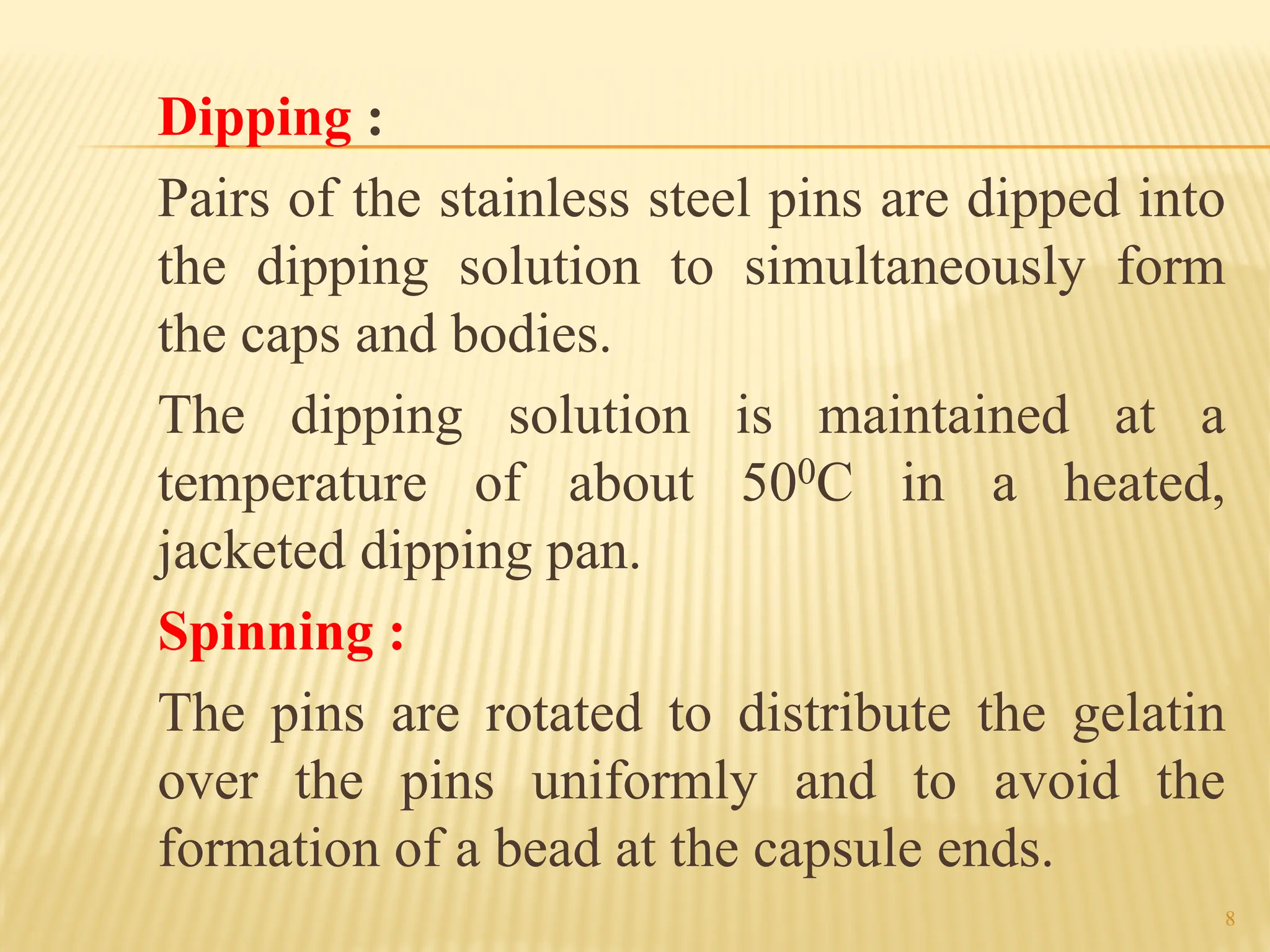
PARTS OF CAPSULE
6
CAP
BODY
7
MANUFACTURE OF EMPTY GELATIN CAPSULES
Steps involved in making empty gelatin
capsules…
´ Dipping
´ Spinning
´ Drying
´ Stripping
´ Trimming and Joining
´ Polishing
8
Dipping :
Pairs of the stainless steel pins are dipped into
the dipping solution to simultaneously form
the caps and bodies.
The dipping solution is maintained at a
temperature of about 500C in a heated,
jacketed dipping pan.
Spinning :
The pins are rotated to distribute the gelatin
over the pins uniformly and to avoid the
formation of a bead at the capsule ends.
9
Drying :
The gelatin is dried by a blast of cool air to
form a hard shells.
The pins are moved through a series of air
drying kilns to remove water
Stripping :
A series of bronze jaws strip the cap and body
portions of the capsules from the pins.
10
Trimming and joining
The stripped cap and body portions are
trimmed to the required length by stationary
knives.
After trimming to the right length, the cap and
body portion are joined and ejected from the
machine.
11
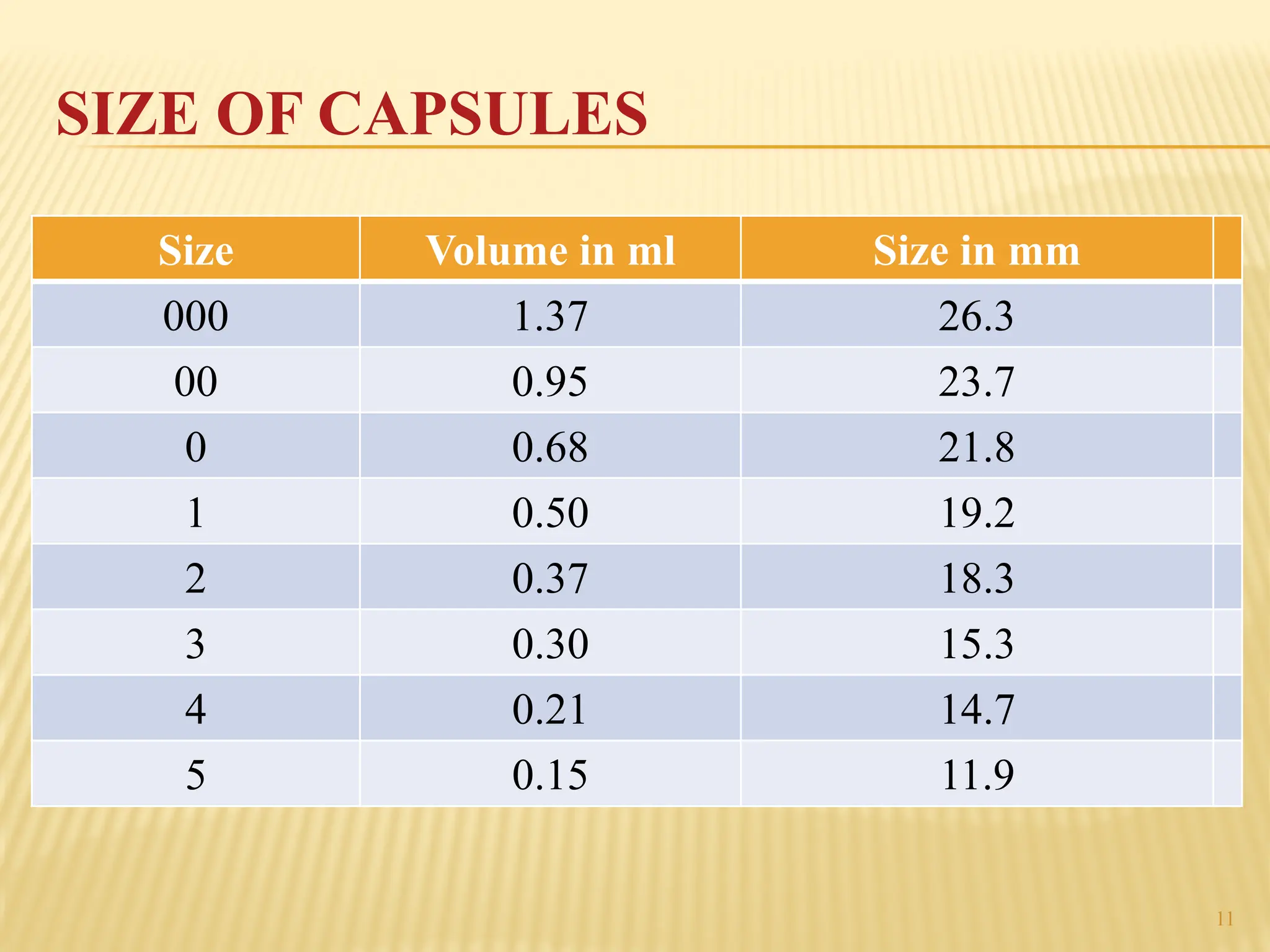
SIZE OF CAPSULES
Size Volume in ml Size in mm
000 1.37 26.3
00 0.95 23.7
0 0.68 21.8
1 0.50 19.2
2 0.37 18.3
3 0.30 15.3
4 0.21 14.7
5 0.15 11.9
12
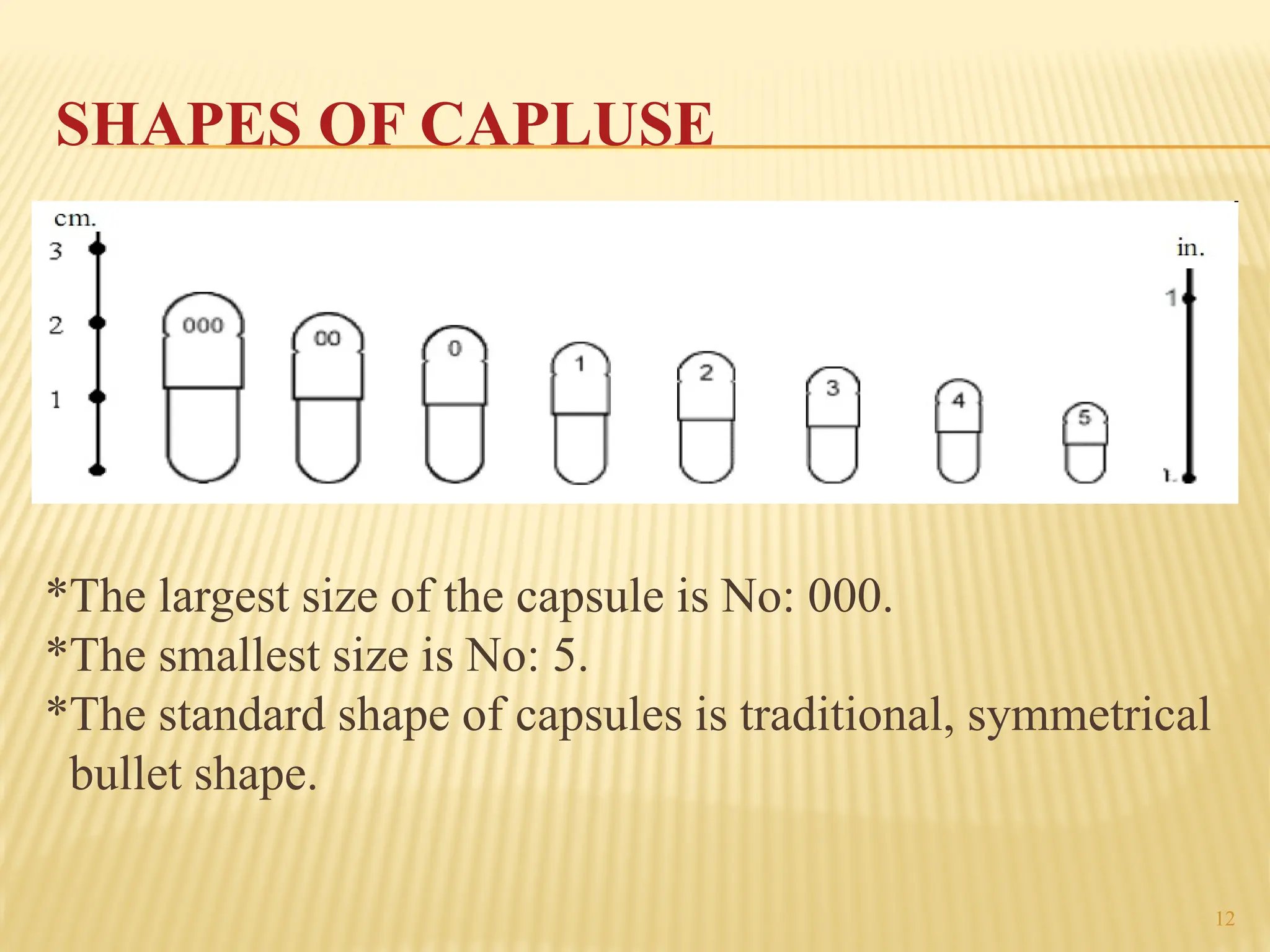
SHAPES OF CAPLUSE
*The largest size of the capsule is No: 000.
*The smallest size is No: 5.
*The standard shape of capsules is traditional, symmetrical
bullet shape.
13
FILLING OF HARD GELATIN CAPSULES
Various Filling Machine Available…
´ Eli-lily and Co
´ Farmatic
´ Hofliger and Karg
´ Zanasi
´ Parke-Davis.
´ These machine differ in there design and output
14
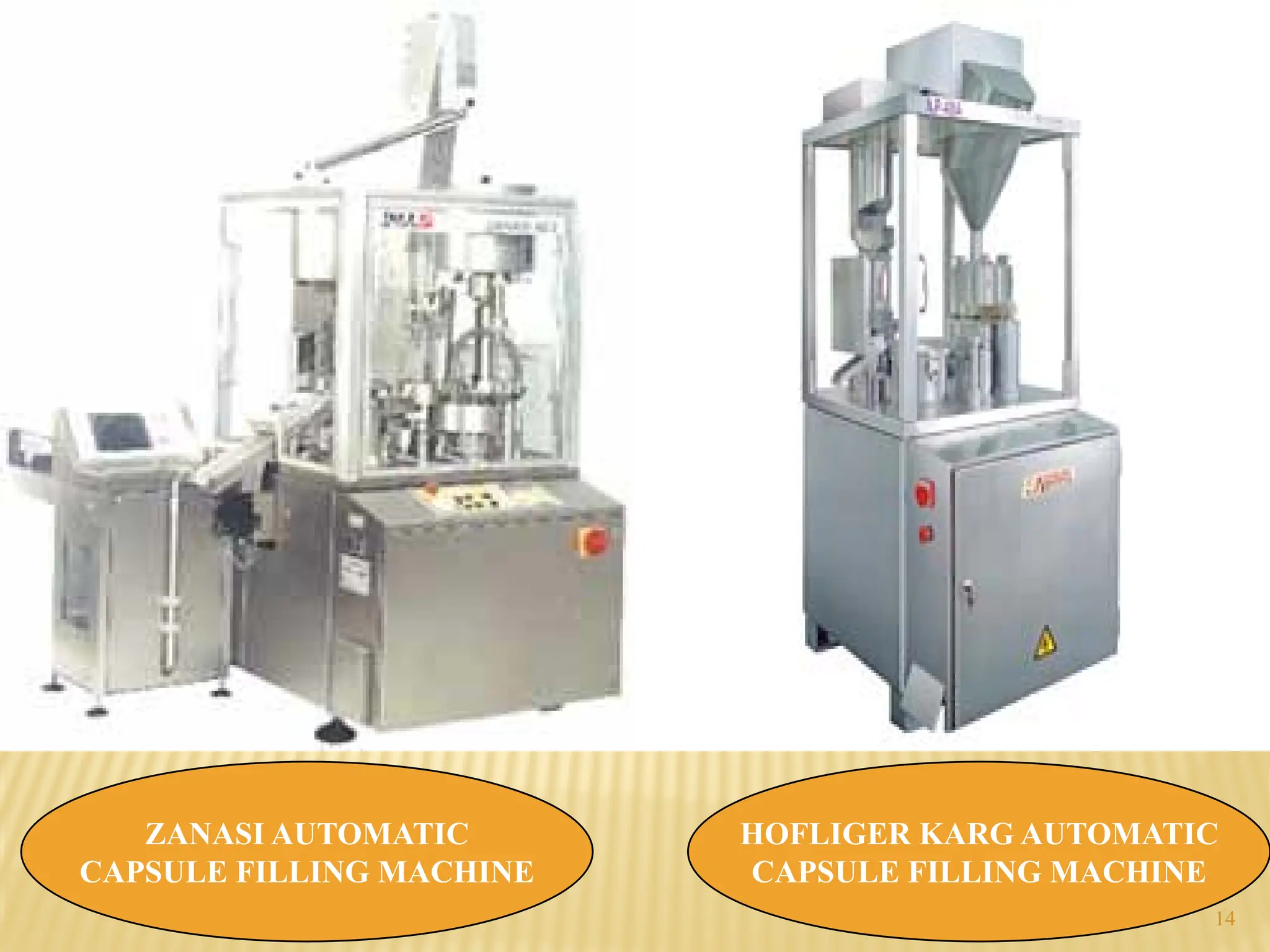
ZANASI AUTOMATIC
CAPSULE FILLING MACHINE
HOFLIGER KARG AUTOMATIC
CAPSULE FILLING MACHINE
15
Polishing
Pan Polishing : Acela-cota pan is used to dust and polish.
Cloth Dusting : Capsule are rubbed with cloth.
Brushing : Capsule are feed under soft rotating brush.
Storage
Finished capsules normally contain an equilibrium
moisture content of 13-16%.
To maintain a relative humidity of 40-60% when
handling and storing capsules
16
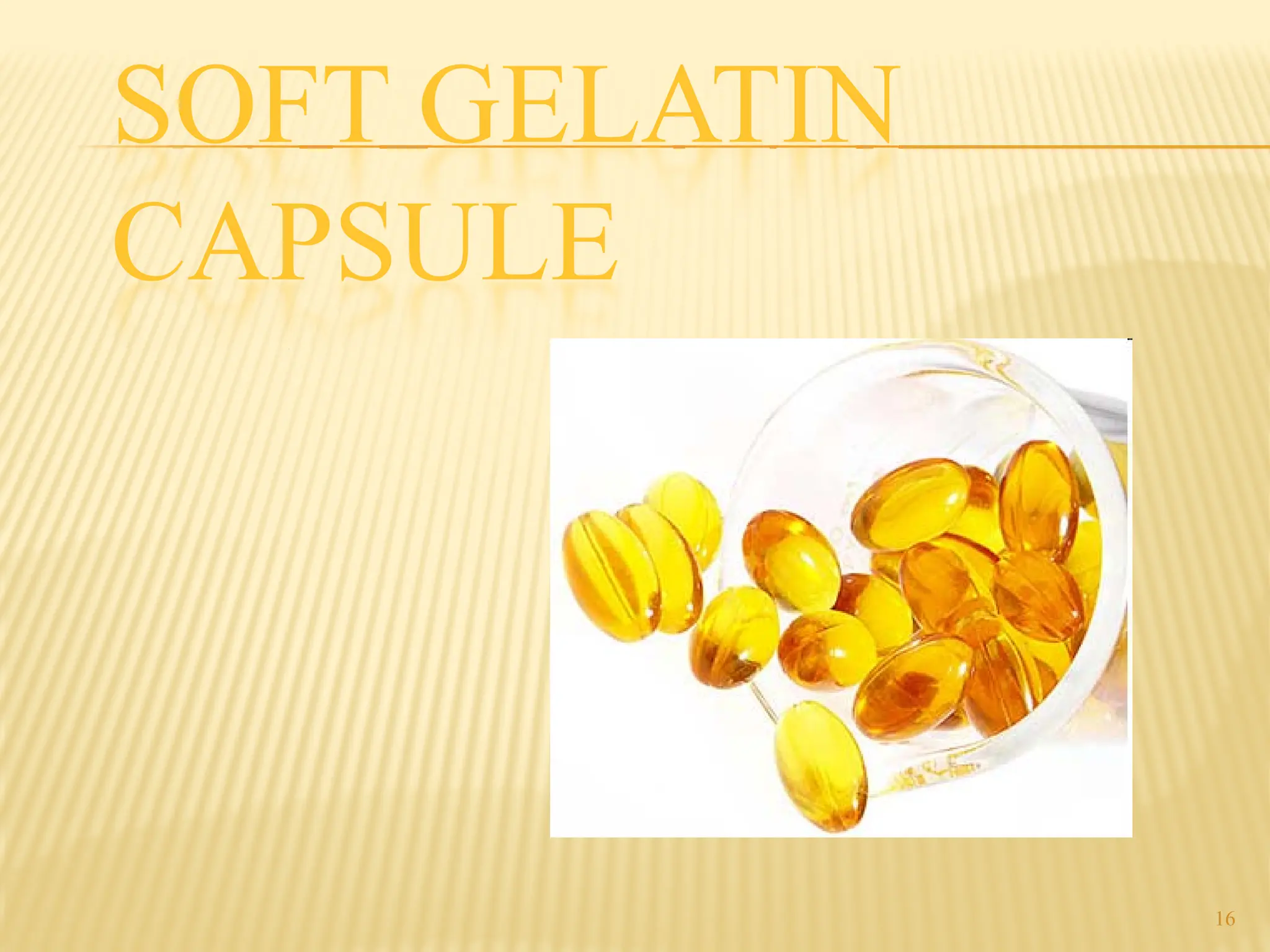
SOFT GELATIN
CAPSULE
17
SOFT GELATIN CAPSULE
Definition:-
Soft Gelatin capsules are one piece, hermetically
sealed, soft gelatin shells containing a liquid, a
suspension, or a semisolid.
Soft gelatin is mainly composed of gelatin,
plasticizers, preservative, colouring and
opacifying agents, flavoring agents and sugars.
APPLICATION OF SOFT GELATIN CAPSULE:
The pharmaceutical applications of soft gelatin
capsules are:
as an oral dosage form
as a suppository dosage form
as a specialty package in tube form, for human
and veterinary use, single dose application for
topical, ophthalmic, and rectal ointments.
18
19
Plasticizer and Gelatin ratio
In soft gelatin capsule the amount of plasticizers used is
more
In soft gelatin capsule the plasticizer and gelatin ratio is
0.8 : 1
In hard gelatin capsule the plasticizer and gelatin ratio is
0.4 : 1
20
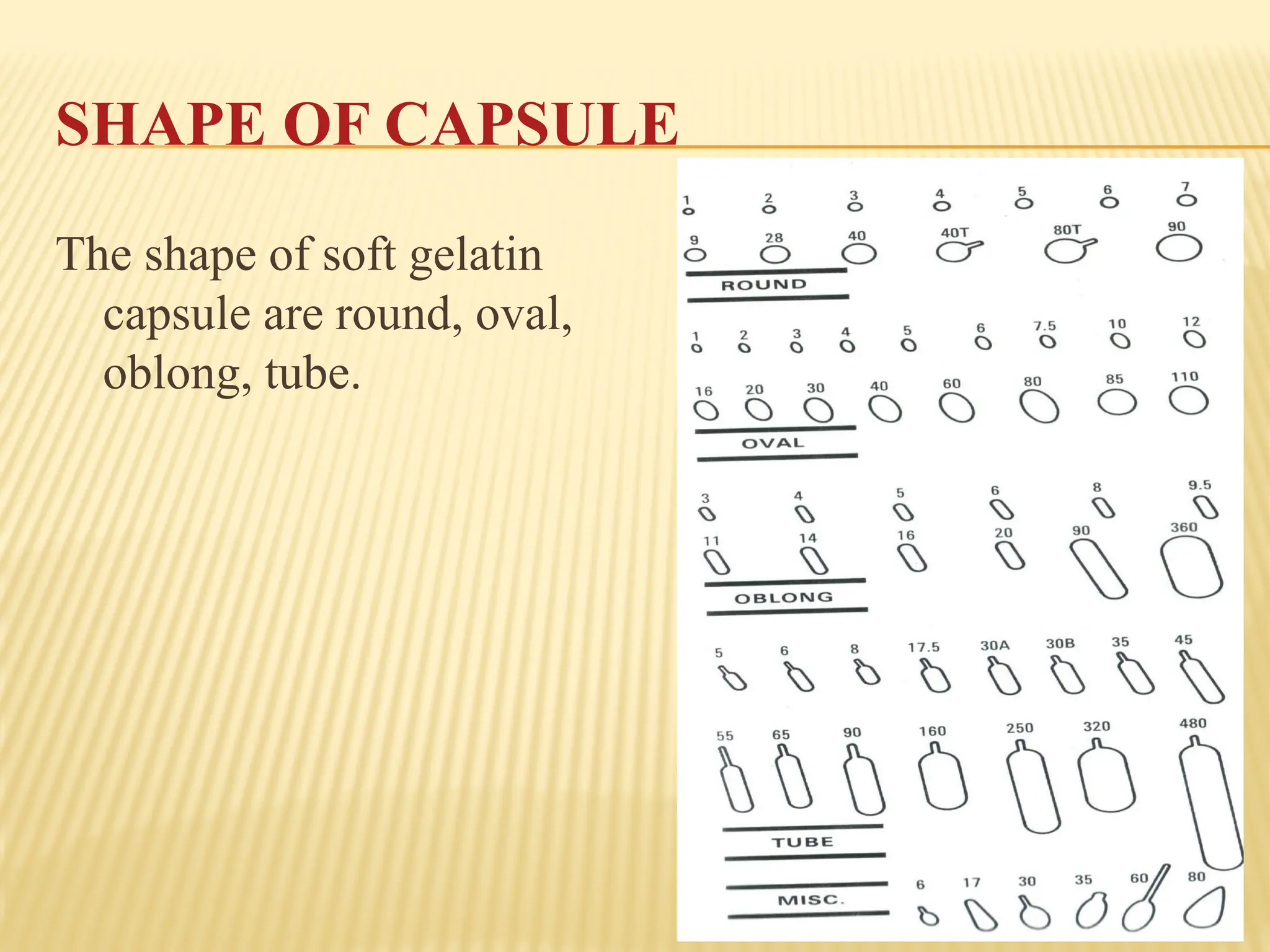
SHAPE OF CAPSULE
The shape of soft gelatin
capsule are round, oval,
oblong, tube.
21
MANUFACTURE OF SOFT GELATIN CAPSULES
Is manufactured by four methods
´ Plate process
´ Rotary die process
´ Reciprocating die
´ Accogel machine
22
Plate process:
•Place the gelatin sheet over a die plate
containing numerous die pockets,
•Application of vacuum to draw the sheet
in to the die pockets,
•Fill the pockets with liquid or paste,
•Place another gelatin sheet over the filled
pockets, and
•Sandwich under a die press where the
capsules are formed and cut out.
23
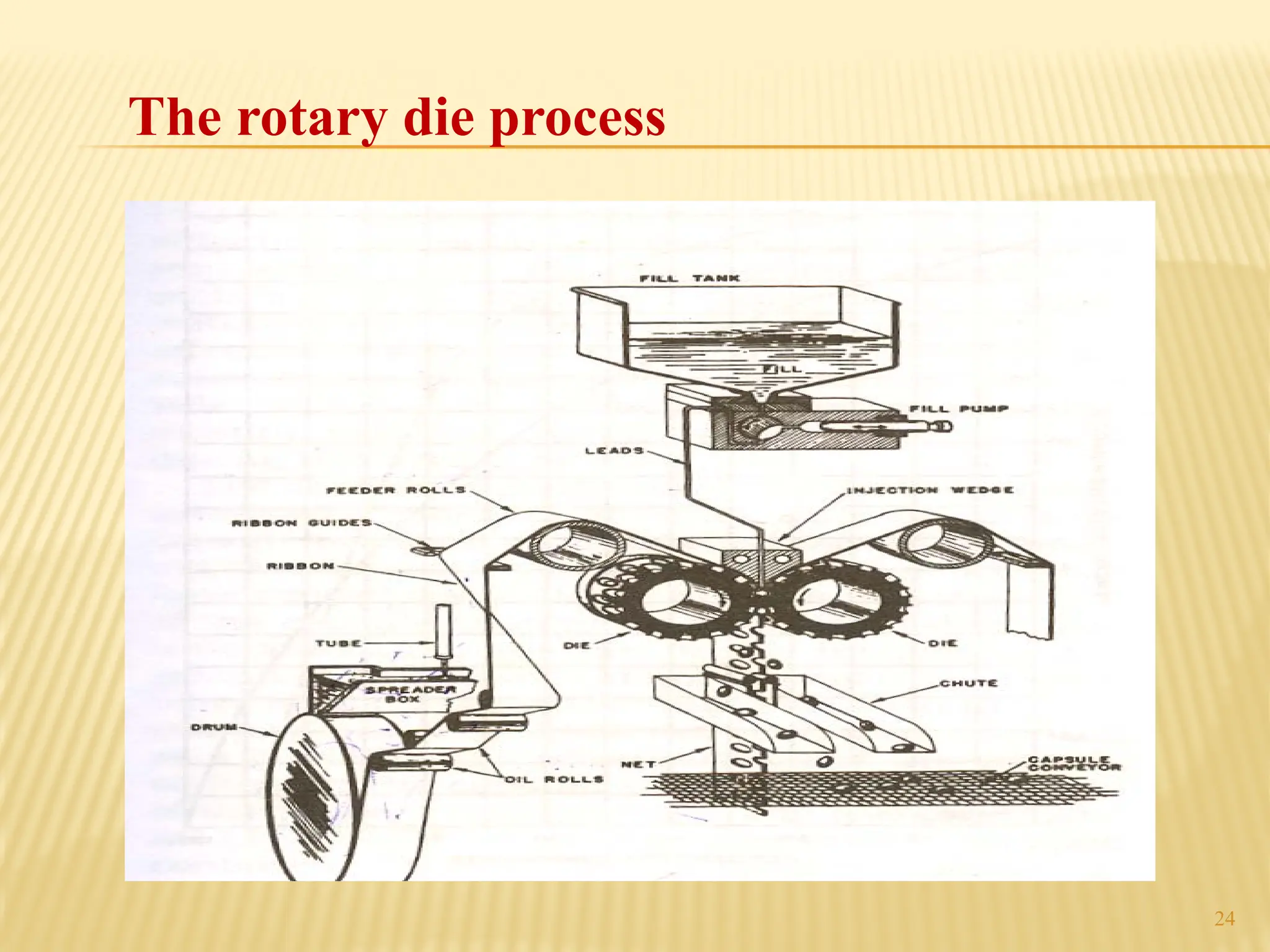
Rotary die process:
The material to be encapsulated flows by gravity. the
gelatin sheets are feed on rolls contain small orifice
lined up with the die pocket of the die roll.
Two plasticized gelatin ribbons are continuously and
simultaneously fed with the liquid or paste fill between
the rollers of the rotary die mechanism where the
capsule are simultaneously filled, shaped, hermetically
sealed and cut from the gelatin ribbon.
The sealing of the capsule is achieved by mechanical
pressure on the die rolls and the heating(37-40 C) of the
ribbons by the wedge.
24
The rotary die process
25
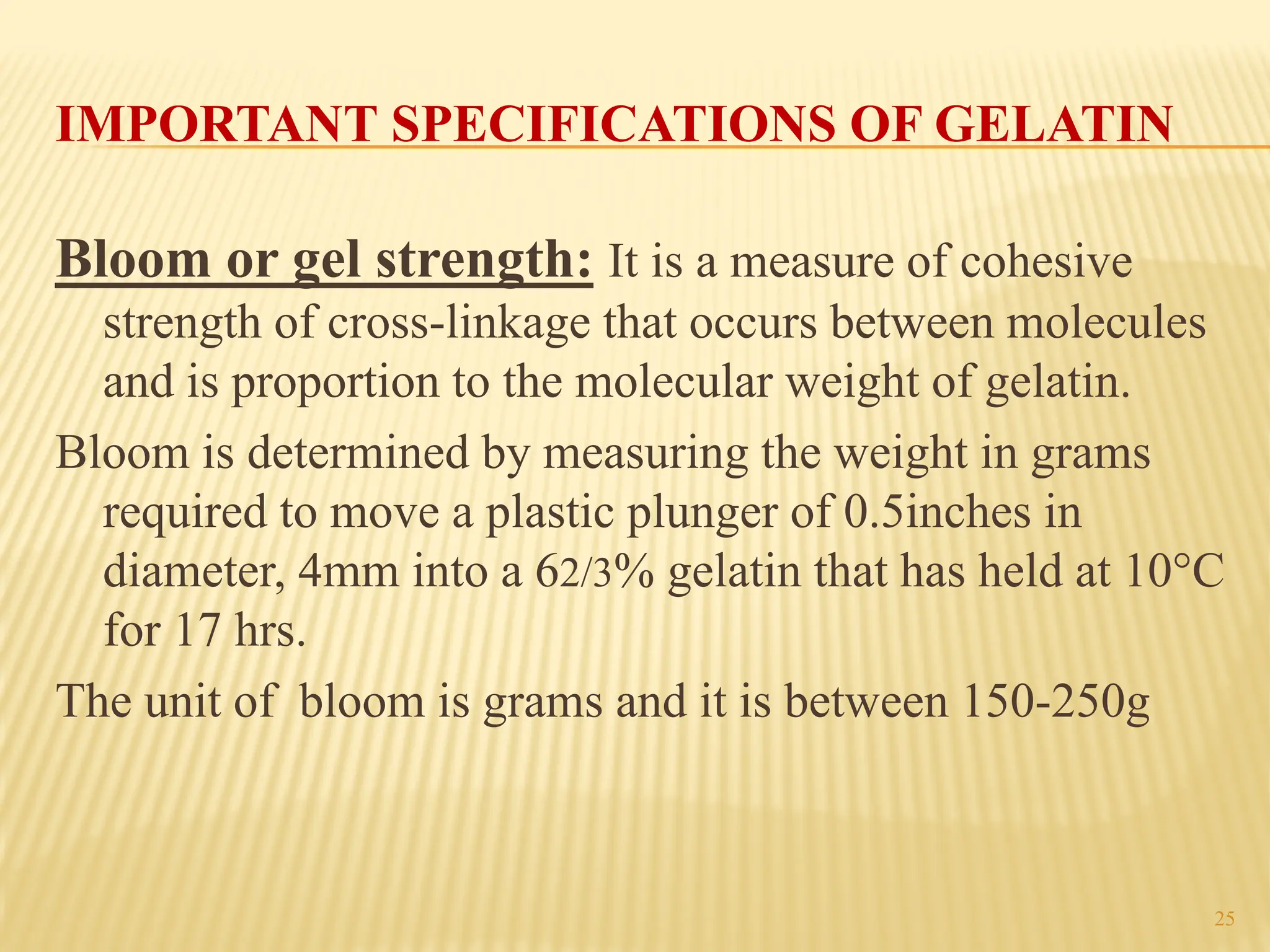
IMPORTANT SPECIFICATIONS OF GELATIN
Bloom or gel strength: It is a measure of cohesive
strength of cross-linkage that occurs between molecules
and is proportion to the molecular weight of gelatin.
Bloom is determined by measuring the weight in grams
required to move a plastic plunger of 0.5inches in
diameter, 4mm into a 62/3% gelatin that has held at 10°C
for 17 hrs.
The unit of bloom is grams and it is between 150-250g
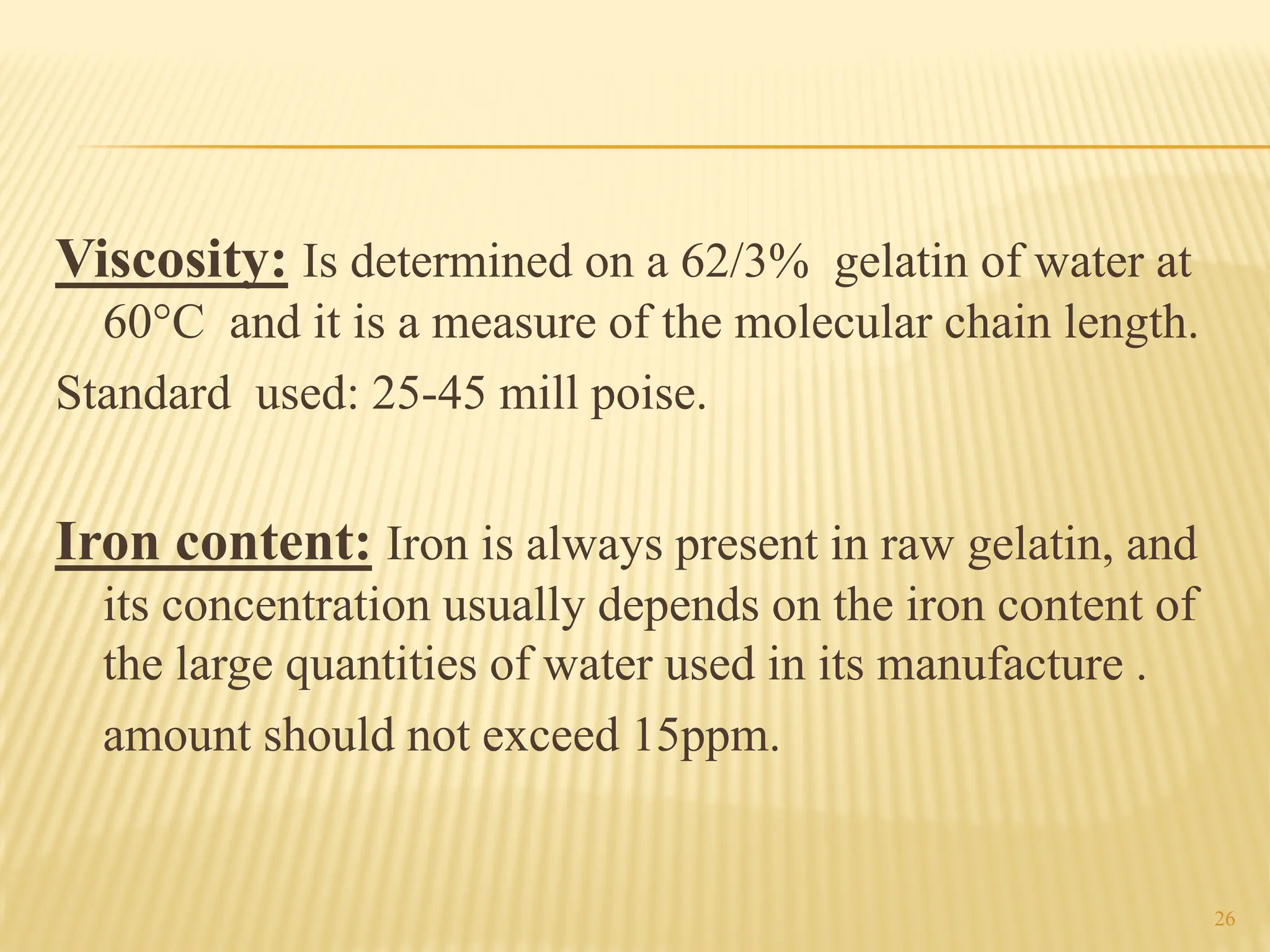
Viscosity: Is determined on a 62/3% gelatin of water at
60°C and it is a measure of the molecular chain length.
Standard used: 25-45 mill poise.
Iron content: Iron is always present in raw gelatin, and
its concentration usually depends on the iron content of
the large quantities of water used in its manufacture .
amount should not exceed 15ppm.
26
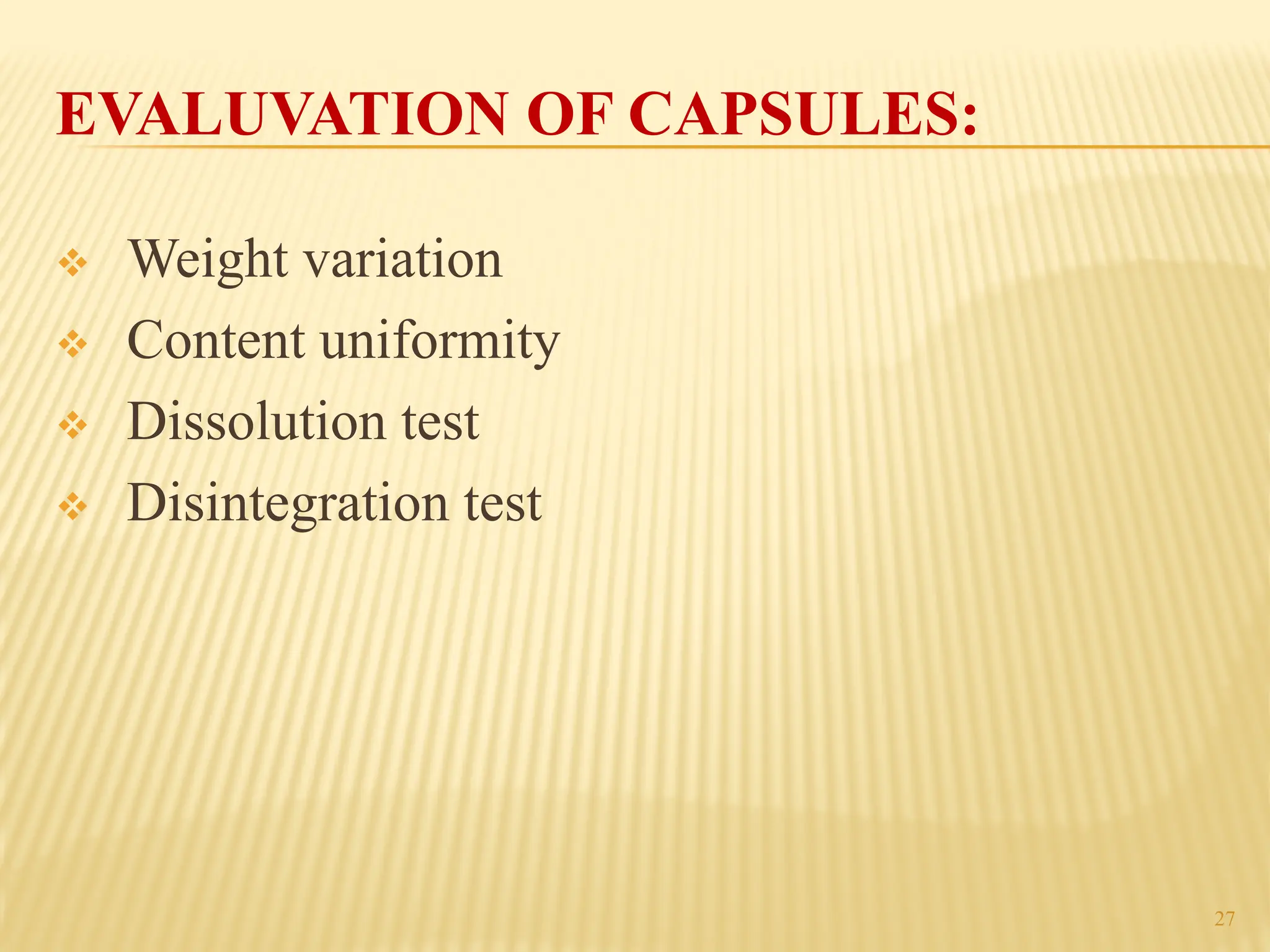
EVALUVATION OF CAPSULES:
™ Weight variation
™ Content uniformity
™ Dissolution test
™ Disintegration test
27
28

UNIT III- CAPSULES.pdf methods of preparation, types and components

  • 1.
  • 2.
    2 • DEFINITION:- These aresolid dosage form of medicaments, in which drug is enclosed within the shells made up of gelatin. These capsules are made up of gelatin blends, small amount of certified dyes, opaquants, plasticizers and preservatives. HARD GELATIN CAPSULE
  • 3.
    3 Certified Dyes Colour approvedby D & C act. Opacifiers Tio2 Plasticizers Sorbitol, Glycerin. Preservatives Propyl and Methyl Parabens
  • 4.
    4 GELATIN ´ Gelatin isheterogeneous product derived by hydrolytic extraction of animal's collagen. ´ The sources of gelatins including animal bones, hide portions and frozen pork skin. TYPES OF GELATIN Type A Type B
  • 5.
    5 There are twobasic types of gelatin TYPE A Derived from acid treated precursor that exhibits an iso electric point at pH-9. It is manufactured mainly from pork skin. TYPE B Derived from alkali treated precursor that exhibits an iso electric point at pH-4.7. It is manufactured mainly from animal bones
  • 6.
  • 7.
    7 MANUFACTURE OF EMPTYGELATIN CAPSULES Steps involved in making empty gelatin capsules… ´ Dipping ´ Spinning ´ Drying ´ Stripping ´ Trimming and Joining ´ Polishing
  • 8.
    8 Dipping : Pairs ofthe stainless steel pins are dipped into the dipping solution to simultaneously form the caps and bodies. The dipping solution is maintained at a temperature of about 500C in a heated, jacketed dipping pan. Spinning : The pins are rotated to distribute the gelatin over the pins uniformly and to avoid the formation of a bead at the capsule ends.
  • 9.
    9 Drying : The gelatinis dried by a blast of cool air to form a hard shells. The pins are moved through a series of air drying kilns to remove water Stripping : A series of bronze jaws strip the cap and body portions of the capsules from the pins.
  • 10.
    10 Trimming and joining Thestripped cap and body portions are trimmed to the required length by stationary knives. After trimming to the right length, the cap and body portion are joined and ejected from the machine.
  • 11.
    11 SIZE OF CAPSULES SizeVolume in ml Size in mm 000 1.37 26.3 00 0.95 23.7 0 0.68 21.8 1 0.50 19.2 2 0.37 18.3 3 0.30 15.3 4 0.21 14.7 5 0.15 11.9
  • 12.
    12 SHAPES OF CAPLUSE *Thelargest size of the capsule is No: 000. *The smallest size is No: 5. *The standard shape of capsules is traditional, symmetrical bullet shape.
  • 13.
    13 FILLING OF HARDGELATIN CAPSULES Various Filling Machine Available… ´ Eli-lily and Co ´ Farmatic ´ Hofliger and Karg ´ Zanasi ´ Parke-Davis. ´ These machine differ in there design and output
  • 14.
    14 ZANASI AUTOMATIC CAPSULE FILLINGMACHINE HOFLIGER KARG AUTOMATIC CAPSULE FILLING MACHINE
  • 15.
    15 Polishing Pan Polishing :Acela-cota pan is used to dust and polish. Cloth Dusting : Capsule are rubbed with cloth. Brushing : Capsule are feed under soft rotating brush. Storage Finished capsules normally contain an equilibrium moisture content of 13-16%. To maintain a relative humidity of 40-60% when handling and storing capsules
  • 16.
  • 17.
    17 SOFT GELATIN CAPSULE Definition:- SoftGelatin capsules are one piece, hermetically sealed, soft gelatin shells containing a liquid, a suspension, or a semisolid. Soft gelatin is mainly composed of gelatin, plasticizers, preservative, colouring and opacifying agents, flavoring agents and sugars.
  • 18.
    APPLICATION OF SOFTGELATIN CAPSULE: The pharmaceutical applications of soft gelatin capsules are: as an oral dosage form as a suppository dosage form as a specialty package in tube form, for human and veterinary use, single dose application for topical, ophthalmic, and rectal ointments. 18
  • 19.
    19 Plasticizer and Gelatinratio In soft gelatin capsule the amount of plasticizers used is more In soft gelatin capsule the plasticizer and gelatin ratio is 0.8 : 1 In hard gelatin capsule the plasticizer and gelatin ratio is 0.4 : 1
  • 20.
    20 SHAPE OF CAPSULE Theshape of soft gelatin capsule are round, oval, oblong, tube.
  • 21.
    21 MANUFACTURE OF SOFTGELATIN CAPSULES Is manufactured by four methods ´ Plate process ´ Rotary die process ´ Reciprocating die ´ Accogel machine
  • 22.
    22 Plate process: •Place thegelatin sheet over a die plate containing numerous die pockets, •Application of vacuum to draw the sheet in to the die pockets, •Fill the pockets with liquid or paste, •Place another gelatin sheet over the filled pockets, and •Sandwich under a die press where the capsules are formed and cut out.
  • 23.
    23 Rotary die process: Thematerial to be encapsulated flows by gravity. the gelatin sheets are feed on rolls contain small orifice lined up with the die pocket of the die roll. Two plasticized gelatin ribbons are continuously and simultaneously fed with the liquid or paste fill between the rollers of the rotary die mechanism where the capsule are simultaneously filled, shaped, hermetically sealed and cut from the gelatin ribbon. The sealing of the capsule is achieved by mechanical pressure on the die rolls and the heating(37-40 C) of the ribbons by the wedge.
  • 24.
  • 25.
    25 IMPORTANT SPECIFICATIONS OFGELATIN Bloom or gel strength: It is a measure of cohesive strength of cross-linkage that occurs between molecules and is proportion to the molecular weight of gelatin. Bloom is determined by measuring the weight in grams required to move a plastic plunger of 0.5inches in diameter, 4mm into a 62/3% gelatin that has held at 10°C for 17 hrs. The unit of bloom is grams and it is between 150-250g
  • 26.
    Viscosity: Is determinedon a 62/3% gelatin of water at 60°C and it is a measure of the molecular chain length. Standard used: 25-45 mill poise. Iron content: Iron is always present in raw gelatin, and its concentration usually depends on the iron content of the large quantities of water used in its manufacture . amount should not exceed 15ppm. 26
  • 27.
    EVALUVATION OF CAPSULES: ™Weight variation ™ Content uniformity ™ Dissolution test ™ Disintegration test 27
  • 28.