
Capital budgeting
(Summary of formula and structure)
 Net present value (NPV)
 Internal rate of return (IRR)
 Payback period (PBP)
 Discounted payback period (DPBP)
 Profitability index (PI)
Ibrahim A Ganiyu
2Ibrahim Ganiyu/FM//CB
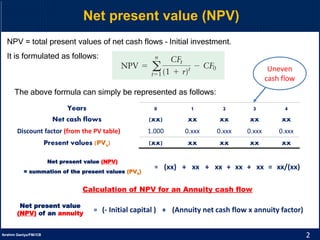
Net present value (NPV)
NPV = total present values of net cash flows – Initial investment.
It is formulated as follows:
Years 0 1 2 3 4
Net cash flows (xx) xx xx xx xx
Discount factor (from the PV table) 1.000 0.xxx 0.xxx 0.xxx 0.xxx
Present values (PVs) (xx) xx xx xx xx
Net present value (NPV)
= summation of the present values (PVs)
= (xx) + xx + xx + xx + xx = xx/(xx)
The above formula can simply be represented as follows:
Net present value
(NPV) of an annuity
= (- Initial capital ) + (Annuity net cash flow x annuity factor)
Uneven
cash flow
Calculation of NPV for an Annuity cash flow
3Ibrahim Ganiyu/FM//CB
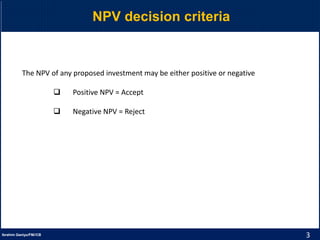
NPV decision criteria
The NPV of any proposed investment may be either positive or negative
 Positive NPV = Accept
 Negative NPV = Reject
4Ibrahim Ganiyu/FM//CB
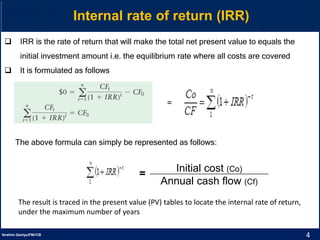
Internal rate of return (IRR)
= Initial cost (Co)
Annual cash flow (Cf)
The result is traced in the present value (PV) tables to locate the internal rate of return,
under the maximum number of years
 IRR is the rate of return that will make the total net present value to equals the
initial investment amount i.e. the equilibrium rate where all costs are covered
 It is formulated as follows
=
The above formula can simply be represented as follows:
5Ibrahim Ganiyu/FM//CB
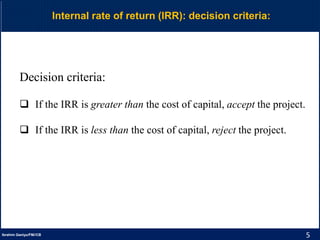
Internal rate of return (IRR): decision criteria:
Decision criteria:
 If the IRR is greater than the cost of capital, accept the project.
 If the IRR is less than the cost of capital, reject the project.
6Ibrahim Ganiyu/FM//CB
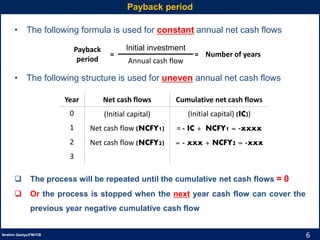
Payback period
• The following formula is used for constant annual net cash flows
• The following structure is used for uneven annual net cash flows
 The process will be repeated until the cumulative net cash flows = 0
 Or the process is stopped when the next year cash flow can cover the
previous year negative cumulative cash flow
Payback
period
=
Initial investment
= Number of years
Annual cash flow
Year Net cash flows Cumulative net cash flows
0 (Initial capital) (Initial capital) (IC))
1 Net cash flow (NCFY1) = - IC + NCFY1 = -xxxx
2 Net cash flow (NCFY2) = - xxx + NCFY2 = -xxx
3
7Ibrahim Ganiyu/FM//CB
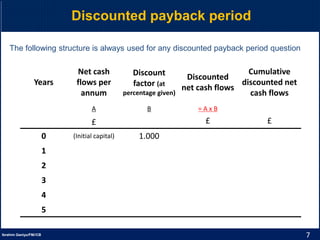
Discounted payback period
Years
Net cash
flows per
annum
Discount
factor (at
percentage given)
Discounted
net cash flows
Cumulative
discounted net
cash flows
A B = A x B
£ £ £
0 (Initial capital) 1.000
1
2
3
4
5
The following structure is always used for any discounted payback period question
8Ibrahim Ganiyu/FM//CB
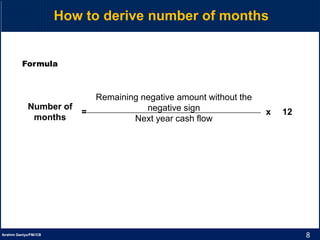
How to derive number of months
Number of
months
=
Remaining negative amount without the
negative sign x 12
Next year cash flow
Formula
9Ibrahim Ganiyu/FM//CB
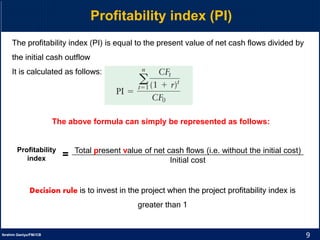
Profitability index (PI)
Profitability
index = Total present value of net cash flows (i.e. without the initial cost)
Initial cost
The above formula can simply be represented as follows:
The profitability index (PI) is equal to the present value of net cash flows divided by
the initial cash outflow
It is calculated as follows:
Decision rule is to invest in the project when the project profitability index is
greater than 1
10Ibrahim Ganiyu/FM//CB
Thank You
10

Capital budgeting Summary 1

  • 1.
    Capital budgeting (Summary offormula and structure)  Net present value (NPV)  Internal rate of return (IRR)  Payback period (PBP)  Discounted payback period (DPBP)  Profitability index (PI) Ibrahim A Ganiyu
  • 2.
    2Ibrahim Ganiyu/FM//CB Net presentvalue (NPV) NPV = total present values of net cash flows – Initial investment. It is formulated as follows: Years 0 1 2 3 4 Net cash flows (xx) xx xx xx xx Discount factor (from the PV table) 1.000 0.xxx 0.xxx 0.xxx 0.xxx Present values (PVs) (xx) xx xx xx xx Net present value (NPV) = summation of the present values (PVs) = (xx) + xx + xx + xx + xx = xx/(xx) The above formula can simply be represented as follows: Net present value (NPV) of an annuity = (- Initial capital ) + (Annuity net cash flow x annuity factor) Uneven cash flow Calculation of NPV for an Annuity cash flow
  • 3.
    3Ibrahim Ganiyu/FM//CB NPV decisioncriteria The NPV of any proposed investment may be either positive or negative  Positive NPV = Accept  Negative NPV = Reject
  • 4.
    4Ibrahim Ganiyu/FM//CB Internal rateof return (IRR) = Initial cost (Co) Annual cash flow (Cf) The result is traced in the present value (PV) tables to locate the internal rate of return, under the maximum number of years  IRR is the rate of return that will make the total net present value to equals the initial investment amount i.e. the equilibrium rate where all costs are covered  It is formulated as follows = The above formula can simply be represented as follows:
  • 5.
    5Ibrahim Ganiyu/FM//CB Internal rateof return (IRR): decision criteria: Decision criteria:  If the IRR is greater than the cost of capital, accept the project.  If the IRR is less than the cost of capital, reject the project.
  • 6.
    6Ibrahim Ganiyu/FM//CB Payback period •The following formula is used for constant annual net cash flows • The following structure is used for uneven annual net cash flows  The process will be repeated until the cumulative net cash flows = 0  Or the process is stopped when the next year cash flow can cover the previous year negative cumulative cash flow Payback period = Initial investment = Number of years Annual cash flow Year Net cash flows Cumulative net cash flows 0 (Initial capital) (Initial capital) (IC)) 1 Net cash flow (NCFY1) = - IC + NCFY1 = -xxxx 2 Net cash flow (NCFY2) = - xxx + NCFY2 = -xxx 3
  • 7.
    7Ibrahim Ganiyu/FM//CB Discounted paybackperiod Years Net cash flows per annum Discount factor (at percentage given) Discounted net cash flows Cumulative discounted net cash flows A B = A x B £ £ £ 0 (Initial capital) 1.000 1 2 3 4 5 The following structure is always used for any discounted payback period question
  • 8.
    8Ibrahim Ganiyu/FM//CB How toderive number of months Number of months = Remaining negative amount without the negative sign x 12 Next year cash flow Formula
  • 9.
    9Ibrahim Ganiyu/FM//CB Profitability index(PI) Profitability index = Total present value of net cash flows (i.e. without the initial cost) Initial cost The above formula can simply be represented as follows: The profitability index (PI) is equal to the present value of net cash flows divided by the initial cash outflow It is calculated as follows: Decision rule is to invest in the project when the project profitability index is greater than 1
  • 10.