CAPITAL BUDGETING
 It is a process of making investment decisions in
capital expenditures
 The benefits of which is expected over a period of
time exceeding one year
 Expn is incurred at one point and benefits are
realized at different points of time in future
 Examples of capital expn are: acquisition of assets,
expansion, alteration, replacement, research and
development
 It is a process of deciding whether or not to commit
resources to a long term project
IMPT FEATURES OF CAPITAL BUDGETING
DECISION ARE
 Exchange of current funds for future benefits
 Benefits are realized over a series of years
 Funds are invested in non-flexible activities
 They have long term effect on profitability of co
 They involve huge funds
 Decisions are irreversible
 Long term decision is difficult because 1. it extends
over future years 2. uncertainty about future 3.
higher degree of risk
 The investment decisions will be of national
importance
CAPITAL BUDGETING PROCESS - PROCEDURE
 Identifying investment proposals
 Screening the proposals – suitable for corporate
strategy
 Evaluating of various proposals - profitability wise – use
difft methods viz., pay back method IRR, NPV methods
 Fixing priorities : reject uneconomic proposals – rank the
proposals
 Preparation of capital budget – for approval
 Implement the proposal: spending money – avoid delay
 Performance review : comparison of the actual expen
with the projected expn
METHODS OF CAPITAL BUDGETING
 Co may have many alternatives for investment
 The task is to select the various competing
proposals
 Select those which give higher benefit
 The following are the commonly used methods:
 1. pay back period method
 2. improvement of pay back method
 3. Rate of return method
 4. net present value method
 5.Internal rate of return method (IRR)
 6.Profitability index method
PAY BACK METHOD CASH FLOWS
DIVIDE THE INITIAL COST OF THE PROJECT
 It represents the period in which the total investment in
permanent assets pays back itself
 Under this method , the investments are ranked
according to the length of the pay-back period
 Shorter pay back period is preferred
 Method of ascertainment :
 Calculate annual net profits before depn and after taxes
- these are called annual by the annual cash flows
 Formula for Pay back period :
 Original cost of asset
 annual cash inflows
 Note : solve a problem on pay-back method
ADVANTAGES OF PAY BACK METHOD
1. Simple to understand and easy to calculate
2. Saves cost – involves lesser time and labour
3. It reduces the loss due to obsolescence – more the no. of
years – more chances of obsolescence
4. This method is suited where the firm has shortage of cash
 Disadvantages:
1. It does not consider the cash inflows earned after the pay
back period – hence true profitability cannot be ascertained
– if project is more profitable after pay back period
2. Ignores time value of money – does not consider magnitude
and timing of the cash flows - treats all cash flows as equal
– ignores cash recd today is more impt than otherwise
3. It does not consider cost of capital for sound investment
RATE OF RETURN METHOD OR ACCOUNTING
RATE OF RETURN METHOD
 This method takes into account the earnings expected from
the investment over the whole life
 Here accounting concept of profit is used , rather than cash
inflows ie., PAT will be considered
 Projects are ranked in the order of rate of earnings
 Project with higher rate of return is selected
 If the rate of return is more than cut off rate it will be accepted
 Formula : average rate of return: =
 Total Profits after depn and taxes X100
 Net investments in project x No of years of profits
 Or Average annual profits x100
 Net investment in project
ADVANTAGES OF RATE OF RETURN METHOD
1. Simple to understand and easy to operate
2. It is based on the entire earnings of the project -
not just earnings upto pay-back period
3. It is based on accounting profit – fig readily
available from balance sheet
 Disadvantages:
1. It ignores time value of money
2. It does not consider cash flows , which is more
impt than PAT
3. This method cannot be used where investment
has to be done in parts
4. NET PRESENT VALUE METHOD
 This method takes into account the time value of
money
 It recognizes the fact that the rupee earned today is
worth more than the same rupee earned tomorrow
 Method of calculation:
STEPS FOR FINDING NPV
 1.Inflows ( Profit before depn and after tax) determined separately for
each year and
 2. Select cut off rate: they are discounted by firm’s cost of capital or a
predetermined rate (cutoff rate )
 Note: i. It should be minimum rate below which the
investors will not be interested
 ii. It can be actual rate of interest in the market on long term
loans or it should reflect opportunity cost of capital of the investor
 3. Compute the present value of total investment outlay ( cash outflows)
 4. calculate the net present value – deduct PV of out flows from PV of
inflows
 5. if PV of inflow s are more than the PV of out flows - NPV is positive -
project is acceptable - otherwise the proposal should be rejected
 6. ranking: in the order of NPVs – prefer project having maximum
positive NPV
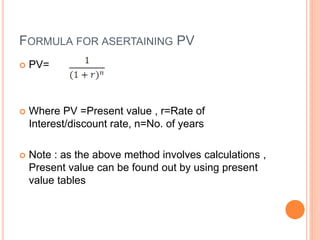
FORMULA FOR ASERTAINING PV
 PV=
 Where PV =Present value , r=Rate of
Interest/discount rate, n=No. of years
 Note : as the above method involves calculations ,
Present value can be found out by using present
value tables
ADVANTAGES OF NPV METHOD
 It recognizes the time value of money - suitable for
uniform and uneven cash flows - at difft periods of time
 It takes into account the earnings of the entire life of the
project
 Disadvantages:
 It is more difficult to understand and operate –
compared to traditional methods
 Projects with unequal lives cannot give correct results
under this system
 It may not give correct results while comparing projects
with unequal investments
 It is difficult to find an appropriate discount rate
INTERNAL RATE OF RETURN(IRR) METHOD /
TRIAL AND ERROR YIELD METHOD
 This method also takes into account the time value
of money
 Here also cash inflow means - profit before depn
but after tax
 Under NPV method the cash flows are discounted
at a specified rate called cutoff rate
 But under IRR method the cash flows are
discounted at a rate by hit and trial method
 This rate should equate the net present value
 The internal rate of return can be defined as the
rate of discount at which the present value of cash
inflows is equal to the present value of cash
outflows
STEPS REQUIRED TO ASSERTAIN IRR
 Find the future cash flows for the entire life of the
project – cash inflow means Profit before depn but
after tax
 Determine the rate of discount at which the value of
cash inflows is equal to the present value of cash
outflows
 Accept the proposal if the internal rate of return is
higher than or equal to the minimum required rate
of return (or cut off rate ) - reject the proposal if the
internal rate of return is lower than the cut off rate.
DETERMINATION OF THE INTERNAL RATE OF
RETURN (IRR)
 1. prepare the cash flow table using an arbitrary
assumed discount rate to discount the net cash flows to
the present value
 2. find out the net present value by deducting from the
present value of total cash flows calculated in (1) above
from the initial investment
 3. If Net present value is Positive , apply higher rate of
discount
 4. if the higher discount rate still gives a positive Net
present value , increase the discount rate further until
the NPV becomes negative
 5. if the NPV is negative at this higher rate IRR must be
between these two rates
ADVANTAGES OF IRR
 It takes into account the time value of money
 It considers the profitability of the project for its entire
economic life
 Determination of cost of capital is not a prerequisite
 Disadvantages :
 It is difficult to understand and difficult method of
evaluation of investment proposals
 It is based on the assumption that the earnings are
reinvested at the internal rate of return – which is not
true when the average rate of return earned by the firm
is not close to IRR
 The results of NPV and IRR methods may differ when
projects under evaluation differ in size, life and timings
of cash flows
PROFITABILITY INDEX METHOD
 It is also called as benefit-cost ratio
 Formula for Profitability index (gross )is :
 PV ( present value)of cash inflows
Initial cash outlay
 Formula for calculating Profitability index(net ) is:
 NPV (net present value)
Initial cash outlay
 The proposal is accepted if the profitability index is more than
one and rejected in case the profitability index is less than one
 The various projects are ranked under this method in the
order of their profitability index
 The project with higher profitability index is ranked higher than
the other with lower profitability index
 Note : Material on ARR, MIRR, Utilit method , EVA
method, APV method, Capital rationing has to be
added
Capital Budgeting.pptx

Capital Budgeting.pptx

  • 1.
    CAPITAL BUDGETING  Itis a process of making investment decisions in capital expenditures  The benefits of which is expected over a period of time exceeding one year  Expn is incurred at one point and benefits are realized at different points of time in future  Examples of capital expn are: acquisition of assets, expansion, alteration, replacement, research and development  It is a process of deciding whether or not to commit resources to a long term project
  • 2.
    IMPT FEATURES OFCAPITAL BUDGETING DECISION ARE  Exchange of current funds for future benefits  Benefits are realized over a series of years  Funds are invested in non-flexible activities  They have long term effect on profitability of co  They involve huge funds  Decisions are irreversible  Long term decision is difficult because 1. it extends over future years 2. uncertainty about future 3. higher degree of risk  The investment decisions will be of national importance
  • 3.
    CAPITAL BUDGETING PROCESS- PROCEDURE  Identifying investment proposals  Screening the proposals – suitable for corporate strategy  Evaluating of various proposals - profitability wise – use difft methods viz., pay back method IRR, NPV methods  Fixing priorities : reject uneconomic proposals – rank the proposals  Preparation of capital budget – for approval  Implement the proposal: spending money – avoid delay  Performance review : comparison of the actual expen with the projected expn
  • 4.
    METHODS OF CAPITALBUDGETING  Co may have many alternatives for investment  The task is to select the various competing proposals  Select those which give higher benefit  The following are the commonly used methods:  1. pay back period method  2. improvement of pay back method  3. Rate of return method  4. net present value method  5.Internal rate of return method (IRR)  6.Profitability index method
  • 5.
    PAY BACK METHODCASH FLOWS DIVIDE THE INITIAL COST OF THE PROJECT  It represents the period in which the total investment in permanent assets pays back itself  Under this method , the investments are ranked according to the length of the pay-back period  Shorter pay back period is preferred  Method of ascertainment :  Calculate annual net profits before depn and after taxes - these are called annual by the annual cash flows  Formula for Pay back period :  Original cost of asset  annual cash inflows  Note : solve a problem on pay-back method
  • 6.
    ADVANTAGES OF PAYBACK METHOD 1. Simple to understand and easy to calculate 2. Saves cost – involves lesser time and labour 3. It reduces the loss due to obsolescence – more the no. of years – more chances of obsolescence 4. This method is suited where the firm has shortage of cash  Disadvantages: 1. It does not consider the cash inflows earned after the pay back period – hence true profitability cannot be ascertained – if project is more profitable after pay back period 2. Ignores time value of money – does not consider magnitude and timing of the cash flows - treats all cash flows as equal – ignores cash recd today is more impt than otherwise 3. It does not consider cost of capital for sound investment
  • 7.
    RATE OF RETURNMETHOD OR ACCOUNTING RATE OF RETURN METHOD  This method takes into account the earnings expected from the investment over the whole life  Here accounting concept of profit is used , rather than cash inflows ie., PAT will be considered  Projects are ranked in the order of rate of earnings  Project with higher rate of return is selected  If the rate of return is more than cut off rate it will be accepted  Formula : average rate of return: =  Total Profits after depn and taxes X100  Net investments in project x No of years of profits  Or Average annual profits x100  Net investment in project
  • 8.
    ADVANTAGES OF RATEOF RETURN METHOD 1. Simple to understand and easy to operate 2. It is based on the entire earnings of the project - not just earnings upto pay-back period 3. It is based on accounting profit – fig readily available from balance sheet  Disadvantages: 1. It ignores time value of money 2. It does not consider cash flows , which is more impt than PAT 3. This method cannot be used where investment has to be done in parts
  • 9.
    4. NET PRESENTVALUE METHOD  This method takes into account the time value of money  It recognizes the fact that the rupee earned today is worth more than the same rupee earned tomorrow  Method of calculation:
  • 10.
    STEPS FOR FINDINGNPV  1.Inflows ( Profit before depn and after tax) determined separately for each year and  2. Select cut off rate: they are discounted by firm’s cost of capital or a predetermined rate (cutoff rate )  Note: i. It should be minimum rate below which the investors will not be interested  ii. It can be actual rate of interest in the market on long term loans or it should reflect opportunity cost of capital of the investor  3. Compute the present value of total investment outlay ( cash outflows)  4. calculate the net present value – deduct PV of out flows from PV of inflows  5. if PV of inflow s are more than the PV of out flows - NPV is positive - project is acceptable - otherwise the proposal should be rejected  6. ranking: in the order of NPVs – prefer project having maximum positive NPV
  • 11.
    FORMULA FOR ASERTAININGPV  PV=  Where PV =Present value , r=Rate of Interest/discount rate, n=No. of years  Note : as the above method involves calculations , Present value can be found out by using present value tables
  • 12.
    ADVANTAGES OF NPVMETHOD  It recognizes the time value of money - suitable for uniform and uneven cash flows - at difft periods of time  It takes into account the earnings of the entire life of the project  Disadvantages:  It is more difficult to understand and operate – compared to traditional methods  Projects with unequal lives cannot give correct results under this system  It may not give correct results while comparing projects with unequal investments  It is difficult to find an appropriate discount rate
  • 13.
    INTERNAL RATE OFRETURN(IRR) METHOD / TRIAL AND ERROR YIELD METHOD  This method also takes into account the time value of money  Here also cash inflow means - profit before depn but after tax  Under NPV method the cash flows are discounted at a specified rate called cutoff rate  But under IRR method the cash flows are discounted at a rate by hit and trial method  This rate should equate the net present value  The internal rate of return can be defined as the rate of discount at which the present value of cash inflows is equal to the present value of cash outflows
  • 14.
    STEPS REQUIRED TOASSERTAIN IRR  Find the future cash flows for the entire life of the project – cash inflow means Profit before depn but after tax  Determine the rate of discount at which the value of cash inflows is equal to the present value of cash outflows  Accept the proposal if the internal rate of return is higher than or equal to the minimum required rate of return (or cut off rate ) - reject the proposal if the internal rate of return is lower than the cut off rate.
  • 15.
    DETERMINATION OF THEINTERNAL RATE OF RETURN (IRR)  1. prepare the cash flow table using an arbitrary assumed discount rate to discount the net cash flows to the present value  2. find out the net present value by deducting from the present value of total cash flows calculated in (1) above from the initial investment  3. If Net present value is Positive , apply higher rate of discount  4. if the higher discount rate still gives a positive Net present value , increase the discount rate further until the NPV becomes negative  5. if the NPV is negative at this higher rate IRR must be between these two rates
  • 16.
    ADVANTAGES OF IRR It takes into account the time value of money  It considers the profitability of the project for its entire economic life  Determination of cost of capital is not a prerequisite  Disadvantages :  It is difficult to understand and difficult method of evaluation of investment proposals  It is based on the assumption that the earnings are reinvested at the internal rate of return – which is not true when the average rate of return earned by the firm is not close to IRR  The results of NPV and IRR methods may differ when projects under evaluation differ in size, life and timings of cash flows
  • 17.
    PROFITABILITY INDEX METHOD It is also called as benefit-cost ratio  Formula for Profitability index (gross )is :  PV ( present value)of cash inflows Initial cash outlay  Formula for calculating Profitability index(net ) is:  NPV (net present value) Initial cash outlay  The proposal is accepted if the profitability index is more than one and rejected in case the profitability index is less than one  The various projects are ranked under this method in the order of their profitability index  The project with higher profitability index is ranked higher than the other with lower profitability index
  • 18.
     Note :Material on ARR, MIRR, Utilit method , EVA method, APV method, Capital rationing has to be added