Capital Budgeting Techniques and Practice
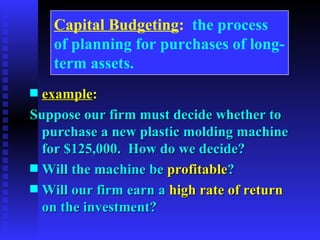
Capital Budgeting :   the process of planning for purchases of long-term assets. example :  Suppose our firm must decide whether to purchase a new plastic molding machine for $125,000.  How do we decide? Will the machine be  profitable ? Will our firm earn a  high rate of return  on the investment?
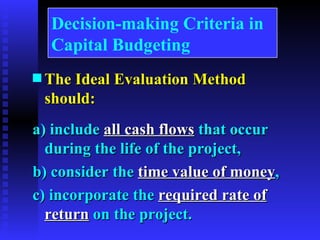
The Ideal Evaluation Method should: a) include  all cash flows  that occur during the life of the project, b) consider the  time value of money , c) incorporate the  required rate of return  on the project.  Decision-making Criteria in Capital Budgeting
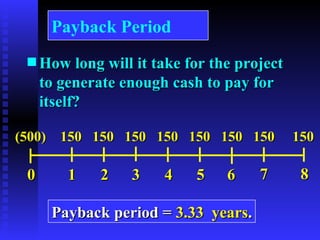
Payback Period How long will it take for the project to generate enough cash to pay for itself? Payback period =  3.33  years . 0 1 2 3 4 5 8 6 7 (500)  150  150  150  150  150  150  150  150
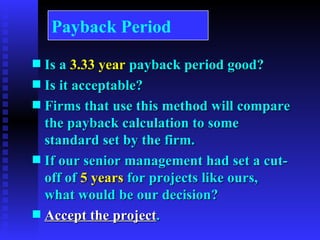
Is a  3.33 year  payback period good? Is it acceptable? Firms that use this method will compare the payback calculation to some standard set by the firm. If our senior management had set a cut-off of  5 years  for projects like ours, what would be our decision? Accept the project . Payback Period
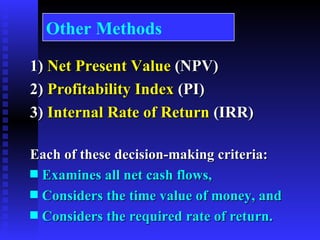
Other Methods 1)  Net Present Value  (NPV) 2)  Profitability Index  (PI) 3)  Internal Rate of Return  (IRR) Each of these decision-making criteria: Examines all net cash flows, Considers the time value of money, and Considers the required rate of return.
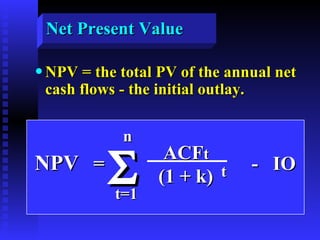
Net Present Value NPV = the total PV of the annual net cash flows - the initial outlay. NPV   =  -  IO  ACF t (1 + k) t n t=1 
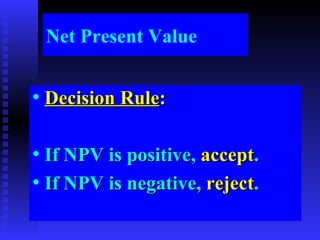
Net Present Value Decision Rule : If NPV is positive,  accept . If NPV is negative,  reject .
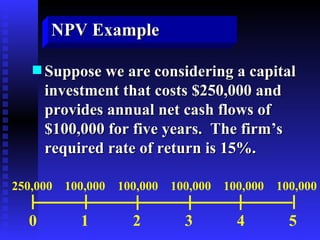
Suppose we are considering a capital investment that costs  $250,000  and provides annual net cash flows of  $100,000  for five years.  The firm’s required rate of return is  15% . NPV Example 0  1  2  3  4  5 250,000  100,000  100,000  100,000  100,000  100,000
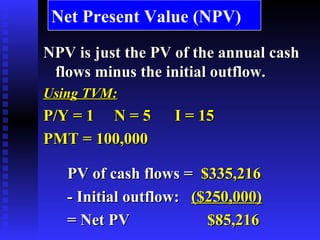
Net Present Value (NPV) NPV is just the PV of the annual cash flows minus the initial outflow. Using TVM: P/Y = 1  N = 5  I = 15  PMT = 100,000 PV of cash flows =   $335,216 - Initial outflow:   ($250,000) = Net PV   $85,216
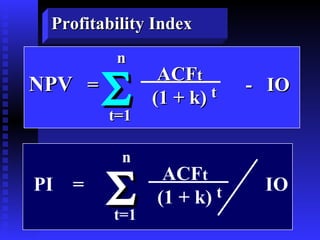
Profitability Index PI  =  IO  ACF t (1 + k) n t=1  t NPV   =  -  IO  ACF t (1 + k) t n t=1 
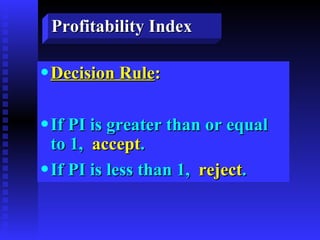
Decision Rule : If PI is greater than or equal to 1,  accept . If PI is less than 1,  reject . Profitability Index
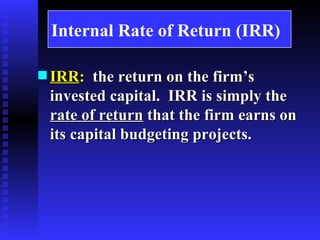
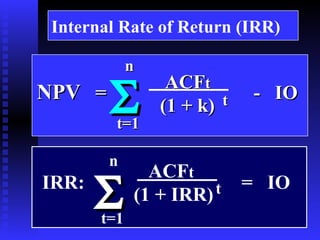
Internal Rate of Return (IRR) IRR :   the return on the firm’s invested capital.  IRR is simply the  rate of return  that the firm earns on its capital budgeting projects.
Internal Rate of Return (IRR) NPV   =  -  IO  ACF t (1 + k) t n t=1  n t=1  IRR:  =  IO  ACF t (1 + IRR) t
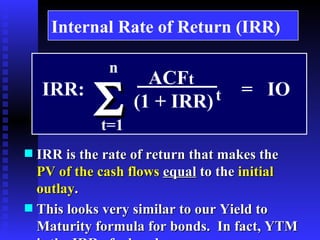
Internal Rate of Return (IRR) IRR is the  rate of return  that makes the   PV of the cash flows   equal  to the  initial outlay . This looks very similar to our Yield to Maturity formula for bonds.  In fact, YTM  is  the IRR of a bond. n t=1  IRR:  =  IO  ACF t (1 + IRR) t
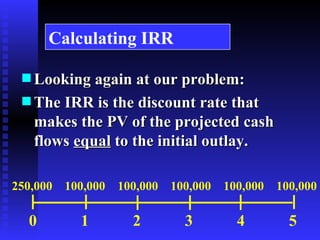
Calculating IRR Looking again at our problem: The IRR is the discount rate that makes the PV of the projected cash flows  equal  to the initial outlay. 0  1  2  3  4  5 250,000  100,000  100,000  100,000  100,000  100,000
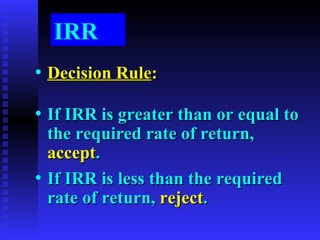
IRR Decision Rule : If IRR is greater than or equal to the required rate of return,  accept . If IRR is less than the required rate of return,  reject .

Npv Irr

  • 1.
  • 2.
    Capital Budgeting : the process of planning for purchases of long-term assets. example : Suppose our firm must decide whether to purchase a new plastic molding machine for $125,000. How do we decide? Will the machine be profitable ? Will our firm earn a high rate of return on the investment?
  • 3.
    The Ideal EvaluationMethod should: a) include all cash flows that occur during the life of the project, b) consider the time value of money , c) incorporate the required rate of return on the project. Decision-making Criteria in Capital Budgeting
  • 4.
    Payback Period Howlong will it take for the project to generate enough cash to pay for itself? Payback period = 3.33 years . 0 1 2 3 4 5 8 6 7 (500) 150 150 150 150 150 150 150 150
  • 5.
    Is a 3.33 year payback period good? Is it acceptable? Firms that use this method will compare the payback calculation to some standard set by the firm. If our senior management had set a cut-off of 5 years for projects like ours, what would be our decision? Accept the project . Payback Period
  • 6.
    Other Methods 1) Net Present Value (NPV) 2) Profitability Index (PI) 3) Internal Rate of Return (IRR) Each of these decision-making criteria: Examines all net cash flows, Considers the time value of money, and Considers the required rate of return.
  • 7.
    Net Present ValueNPV = the total PV of the annual net cash flows - the initial outlay. NPV = - IO ACF t (1 + k) t n t=1 
  • 8.
    Net Present ValueDecision Rule : If NPV is positive, accept . If NPV is negative, reject .
  • 9.
    Suppose we areconsidering a capital investment that costs $250,000 and provides annual net cash flows of $100,000 for five years. The firm’s required rate of return is 15% . NPV Example 0 1 2 3 4 5 250,000 100,000 100,000 100,000 100,000 100,000
  • 10.
    Net Present Value(NPV) NPV is just the PV of the annual cash flows minus the initial outflow. Using TVM: P/Y = 1 N = 5 I = 15 PMT = 100,000 PV of cash flows = $335,216 - Initial outflow: ($250,000) = Net PV $85,216
  • 11.
    Profitability Index PI = IO ACF t (1 + k) n t=1  t NPV = - IO ACF t (1 + k) t n t=1 
  • 12.
    Decision Rule :If PI is greater than or equal to 1, accept . If PI is less than 1, reject . Profitability Index
  • 13.
    Internal Rate ofReturn (IRR) IRR : the return on the firm’s invested capital. IRR is simply the rate of return that the firm earns on its capital budgeting projects.
  • 14.
    Internal Rate ofReturn (IRR) NPV = - IO ACF t (1 + k) t n t=1  n t=1  IRR: = IO ACF t (1 + IRR) t
  • 15.
    Internal Rate ofReturn (IRR) IRR is the rate of return that makes the PV of the cash flows equal to the initial outlay . This looks very similar to our Yield to Maturity formula for bonds. In fact, YTM is the IRR of a bond. n t=1  IRR: = IO ACF t (1 + IRR) t
  • 16.
    Calculating IRR Lookingagain at our problem: The IRR is the discount rate that makes the PV of the projected cash flows equal to the initial outlay. 0 1 2 3 4 5 250,000 100,000 100,000 100,000 100,000 100,000
  • 17.
    IRR Decision Rule: If IRR is greater than or equal to the required rate of return, accept . If IRR is less than the required rate of return, reject .