Shri. K.M. Savjani & Smt. K.K. Savjani
B.B.A./B.C.A College,Veraval
A
Presentation on
Aggregate Planning and Maintenance Management
Subject:
Production and Operation Management
Presented By
Dimple Baraiya
l Introduction
As a part of operation Management, to achieve performance and operational excellence, companies
have to be managed across a range of time frame.There is a need to build confidence in their own
capabilities in order to achieve long term strategies and short term results. Planning for such different
time periods is termed as aggregate planning.
Aggregate Planning is a 'Big Picture' (Vision) approach to planning for the intermediate time period. It
deals with developing ways to utilise facilities and resources at a regional/ plant level in order to address
the demand and supply side of the firm's activities for its different product groups. It reflects decisions
on —
 Output rates
 Employment levels and changes
 Inventory levels and changes
 Sub-contracting
 Outsourcing
 Backorders(Order for a good that can't be filled at current time due to lack of available supply)
l Introduction
 The term aggregate plan signifies that plans are developed for product lines or product
families rather than individual products. eg. aggregate plan in a firm producing
refrigerators specifies how many refrigerators need to be produced without any
classification by model, design or size. Resource capacity is also calculated in aggregate
terms like labour hours, machine hours without any classification or specification of type
of labour or machines.

 Aggregate Planning begins with a forecast of aggregate demand for a product like
refrigerators or television sets or mobile handsets etc. over the intermediate time
horizon (3 to 18 Months).Then, a general plan is made to meet the demand requirement
by determining output, workforce, finished goods inventory levels.To increase capacity is
not feasible in the intermediate time horizon. Hence, building new facilities or Purchasing
new equipment is not considered. However, it is Possible to hire new workers or lay off
some, reduce or increase the working hours or build or lower inventory levels.
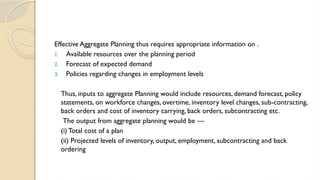
Effective Aggregate Planning thus requires appropriate information on .
1. Available resources over the planning period
2. Forecast of expected demand
3. Policies regarding changes in employment levels
Thus, inputs to aggregate Planning would include resources, demand forecast, policy
statements, on workforce changes, overtime, inventory level changes, sub-contracting,
back orders and cost of inventory carrying, back orders, subcontracting etc.
The output from aggregate planning would be —
(i) Total cost of a plan
(ii) Projected levels of inventory, output, employment, subcontracting and back
ordering
2 Definitions
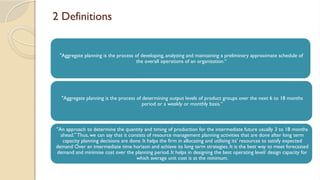
"Aggregate planning is the process of developing, analyzing and maintaining a preliminary approximate schedule of
the overall operations of an organisation.“
"Aggregate planning is the process of determining output levels of product groups over the next 6 to 18 months
period or a weekly or monthly basis.“
"An approach to determine the quantity and timing of production for the intermediate future usually 3 to 18 months
ahead." Thus, we can say that it consists of resource management planning activities that are done after long term
capacity planning decisions are done. It helps the firm in allocating and utilising its' resources to satisfy expected
demand Over an intermediate time horizon and achieve its long term strategies. It is the best way to meet forecasted
demand and minimise cost over the planning period. It helps in designing the best operating level/ design capacity for
which average unit cost is at the minimum.
[3] Importance of Aggregate Plan
1) It helps in minimising costs and maximising profit.
2) It helps to maximise customer service by providing on time deliveries. It helps to adjust workforce
requirements, inventory requirements, machine capacity utilisation and thereby improving delivery
time.
3) It minimises investment in inventory. Excessive inventory leads to blockage of capital. However by
determining demand and summing up the demand for individual product, inventory levels could be
adjusted as per the aggregate demand for each time period.
4) It helps in maximising utilisation of plant and equipment by facilitating fully loaded facilities and
minimising over loading and under loading.
5) It helps in minimising changes in work force levels. Due to fluctuating workforce levels there might be
loss of labour productivity, increasing cost and time needed for training new employees. But, aggregate
planning helps in appropriate utilisation of workforce by determining overtime or undertime hiring or
lay off or subcontracting or outsourcing.
6) It helps in minimizing changes in production rates by orderly and systematic transition of production
capacity to meet peaks and valleys of expected customer demand. Frequent changes in production
rates may cause difficulty in coordinating material procurement and may require rebalancing of line.
Approaches to Aggregate Planning
An aggregate plan takes into consideration two factors, the overall level of output and the capacity
required to produce that output.There are. 2 approaches to estimating the capacity required to
produce an aggregation (total) of a company's products.
 Top Down Approach
 A bottom-up approach or Sub plan consolidation Approach
 Top Down Approach :
Top down Approach involves developing an entire plan by working at highest level of consolidation of
products. It consolidates the products into an average product and then develops an overall plan. In
this approach the desirable overall plan is developed for the period in the planning horizon, with the
plan for the first few periods being relatively firm.This approach is based on the assumption that if
the proper amount of total capacity is available, the right amount of capacity for all parts will be
available. It is based in terms of a pseudo product (fictitious product) which represents the average
characteristics of the entire product line to be planned.The I plan is then disintegrated /
disaggregated to allocate capacity to product families and individual products. However, if the product
mix varies with time there could be difficulties in disaggregation.
Approaches to Aggregate Planning
 A Bottom up Approach / Sub plan Consolidation Approach / Resource
Requirement Planning / Rough cut capacity Planning :
It involves developing plans for major products or product families at some lower level
within the product line.These sub plans are then consolidated to arrive at the aggregate
plan which gives the overall output and the capacity needed to produce it. It is also called
Resource Requirement Planning which is usually used along with Material Requirement
Planning (MRP). Both Materials and Capacity must be available for products to be made
and hence material plans need to be coordinated with a more detailed production plan.
Resource Requirement Planning which is also known as Rough cut Capacity Planning is
done with tentative master production schedule (MPS) to test feasibility in terms of
capacity before finalising MPS. It ensures that a proposed MPS does not overload any key
department or machine or workstation making it feasible.This is a quick and cost
effective method of finding out discrepancies between capacity requirement of MPS and
available capacity.
CONCEPT OF CAPACITY PLANNING
After selection of production process, an operations manager is faced with the problem of determining
capacity. Capacity in general means the maximum production rate of a facility or plant. It indicates volume
of output per period of time. In a service organisation it indicates the number of units, a facility can hold,
receive or store in a period of time.
This decision is very important for an operations manager since it helps in determining capital
requirement which involves a fixed cost element. Capacity also helps in determining whether the facility
would be sufficient to meet customer demand in a timely manner or whether facilities would remain idle
if it's too large and thereby add to existing cost of production or operation. Hence, determining an
appropriate facility size/ capacity is important for earning a high rate on investment as well as for fulfilling
the objective of high capacity utilisation.
Capacity Planning can be done in 3 time horizons :
1) LongTerm Capacity (more than 1 year) : It is a function of adding facilities and equipment that have long
lead (waiting) time.
2) Intermediate/ Medium Term (3 to 18 months) :When we can add equipment, personnel and shifts.We
can subcontract or build or use inventory.This is Aggregate Planning task.
3) Short Run Capacity (upto 3 months) :Where we schedule jobs and people and allocate machinery.We
use capacity that is already existing and modifying capacity is difficult.
Capacity can also be explained as follows :
1) Fixed capacity :The total capital assets of a company at a particular time is known as fixed
capacity. It represents upper limit to the internal capacity that a company can use to meet its
demand. It can't be easily changed in intermediate range time horizon.
2) Adjustable capacity : It is the size of workforce, number of hours per week they work,
number of shifts and extent of subcontracting.
3) Design capacity or Installed capacity v : It is the planned rate of output of goods/ services
under normal or full scale operating conditions. It sets maximum limit and helps in
determining actual utilisation of capacity.
4) System capacity : It is less than or equal to the design capacity. It is the maximum output of a
specific product or product mix that the system (machines, workers) is capable of producing.
5) Potential capacity is that which can be made available within the decision horizon of' top
management.
CONCEPT OF CAPACITY PLANNING
6) Immediate capacity is the capacity that can be made available within the current budgeted period.
7) Effective capacity is thé operating/ practical capacity. It usually ranges from 75% to 85% of maximum
theoretical / installed or designed capacity.This is due to loss of capacity due to machine breakdown,
preventive maintenance or delays due to scheduling.Thus, the efficiency attained is always less than
100%. Moreover, there would also be loss of output due to rejections and scrap.
8) Normal/ Rated capacity/ Average capacity of a plant is the estimated quantity of output or production
that should be achieved as per the estimation done by Industrial Engineering department. eg.A
steel plant may have a rated capacity of 1 lakh tonnes of steel per month.
9) Actual or Utilised capacity :This is expressed as a percentage of rated capacity. It is the actual output
achieved during a particular time period.The actual output may be less than rated output due to
factors like employee absenteeism, low productivity level, actual demand for the product or any other
inefficiencies.
System efficiency is the ratio of actual measured output of goods and services to the system capacity.
System efficiency = Actual output
___________
System capacity
CONCEPT OF CAPACITY PLANNING
 Thus, capacity of a plant can be expressed as the rate of
output or units per day or per week or per month, tonnes
per month, gallons per hour,- labour hours per day.
 In case of companies with more diverse product lines,
capacity is measured in terms of value of output per
day/week / month. For instance, capacity measured in
automobile industry is by the number of vehicles and in a
job shop is by labour hours worked. However, in a
warehouse, it is by the cubic counts.
CONCEPT OF CAPACITY PLANNING
Capacity Requirement Planning (CRP)
 CRP is a technique for determining what labour and equipment capacities are required for meeting the
production objectives depicted in Master Production Schedule(MPS) and Material Requirement Planning (MRP-I).
MRP-I and CRP clearly specify what materials and capacities are needed and when they are needed so that
objectives can be met.
The major inputs for CRP process are .
1) Planned orders and released orders from MRP system.
2) Loading information from work centre status file
3) Routing information from the shop routing file
4) Changes which modify capacity, give alternative routing or altered planned order.
The above inputs when given in time will lead to effective functioning of the system.
The CRP process begins with aggregate planning followed by MPS based on rough cut capacity planning and then
the order for components are exploded by MRP.The CRP system then converts those orders into standard labour
and machine hours of load on appropriate workers and machines as identified from work Centre status and shop
routing files.This results in a load projection report work centrewise. If the work centre capacities are adequate,
the planned order releases are verified for MRP system and released orders become purchase and shop orders.
Workload reports are also used for controlling inputs and outputs. If the initial load projection report reveals
inadequacy of capacity in any work centre, either capacity would have to be increased using overtime or sub-
contracting or master production schedule has to be revised.
Maintenance Management
13.1 Concept :
Every industrial organisation has various processes for production of goods and services and every service
organisation also uses various equipments for supporting the provision of routine services.Thereby, these
equipments and assets need to be protected and maintained in order to keep them in proper working condition
and ensure that repairs can be done regularly to bring them back into working condition if any breakdown occurs.
Thus, maintenance is the function of production management which is concerned with the day to day problem of
keeping the physical plant in good working condition. It is essential for ensuring the availability of machines,
buildings and services for performing their function effectively, so that the investment done in these assets or
equipments yields a good return.
There are two categories of activities related to maintenance in an organisation.
1) Maintaining the assets like building, parking lots, lawns, fences, services and utilities.
2) Maintaining equipments, machinery, vehicles, waste disposal systems, inspection tools, testing instruments,
conveyors and other material handling equipments, office equipments like computers, printers, telephones,
photocopiers, fax machines etc.
Thus, Maintenance Management is concerned with the planning, organising and directing of resources in order to
control the availability and performance of the industrial plants to some specified level. It is a function that supports
production function and involves maintenance planning, scheduling and execution of maintenance activities along
with controlling costs of maintenance.
Importance of Maintenance Management
1) In order to provide good customer service, companies must have equipments that are reliable and help in fulfilling customer
demand when needed.Thus, there is a need to create dependability of service in order to establish a competitive edge.
Equipments must be kept •in reliable condition without costly stoppage of work and down time due to repairs in order to
remain competitive and productive.
2) Equipments or machines that involve heavy investment also need appropriate maintenance to keep them in good working
condition. Such companies like oil refineries, iron and steel industries need proper and effective maintenance for their
smooth functioning.
3) Good maintenance is crucial for cost control in any company. Companies that adopt automation heavily rely on machinery
and equipment for a better competitive position and improved productivity.The cost of breakdown and thereby idle time is
very high with more technically advanced and expensive machines. Hence, it is necessary that these equipments like CNC
machines, robots, pressure gauges work reliably with specifications making maintenance a key function.
4) Companies that wish to attain a competitive edge need to focus on keeping the equipments consistent and operating within
specifications (process capability) so that, they produce high quality products.Thus, maintenance is essential aspect of 'Quality
Assurance'.Any inconsistency in equipment would bring variability in product features and specifications and result in
defective parts which do not meet the established specification especially in industries like auto parts, casting, moulding
processes etc.
5) Organisations practising JIT (Just in Time) programs operate with low inventories and hence can not afford to have a lengthy
period of equipment failure.They would be at a risk of losing market share to their competing companies which could be
more reliable. Hence, not just reducing the cost of idle equipment or labour cost would be a danger but there would be loss
of sale due to inappropriate maintenance and no safety/ buffer stock due to JIT.
Types of Maintenance:
(1) Breakdown / Corrective Maintenance : This takes place when there is stoppage of work
because of machine breakdown.Thus repairs are done after the equipment stops working and
maintenance takes the form of repair work. eg.A conveyor belt broken-down.The role of
maintenance department is to check into the difficulty and make necessary repairs.
It ensures,
1) Controlling cost of repair staff, including regular and overtime labour cost.
2) Controlling cost of operation of repair shop.
3) Putting back equipment into operation as quickly as possible to minimise interruption in
production.
4) Controlling investment involved in replacing spare parts.
5) Controlling investment involved in stand up or back up machines like spare wheel in a car.
6) Performing appropriate amount of repair at each malfunction along with certain decisions
about repair like making easier and small solutions or overhauling/ changing the entire
equipment/ machine.
(2) Preventive Maintenance : This is undertaken before the need arises and aims at minimising the
possibility of unexpected interruptions in production or major breakdowns. Preventive maintenance
comprises of
1) Periodic inspection of plant and equipment to avoid breakdown.
2) Proper design of equipment and appropriate installation.
3) Repetitive servicing and maintenance of equipment.
4) Proper and adequate lubrication, cleaning and painting of building and equipment.
This maintenance is contrast to break down maintenance and inspection is the key to good preventive
maintenance and must cover everything from production machinery, material handling tools and
equipments, lighting, motors, controls, plant services and building. Suitable statistical techniques have
been developed to decide the frequency of inspection.Although some companies and organisations
focus only on inspecting expensive items, it should be noted that if a failure in up keep leads to
employee harm, stoppage of production or wasting assets of the plant then, it should be included in
preventive maintenance programme. Preventive maintenance provides greater safety for workers,
reduced downtime in production, fewer repairs, repairs before breakdown, reduced cost of repairs,
less stand by equipment, less cost of manufacture and identification of high maintenance cost items.
Types of Maintenance:
Preventive maintenance includes —
1) Proper identification of items to be included.
2) Proper records covering volume of work and cost.
3) Inspections on a fixed schedule with standing orders on specific
requirements.
4) Use of checklist by inspectors.
5) Use of repair budgets for major items of equipment. (vi) Inspection
frequency schedule once a year or once a quarter etc.
6) Well qualified inspectors capable of making simple repairs and familiar
with items being inspected.
7) Administrative procedures and follow up on maintenance programme.
Types of Maintenance:
(3) Routine Maintenance : This includes activities like
periodic inspection cleaning, lubrication and repair of
equipments used in production after completion of free
service period. Routine maintenance is divided into
1) Running maintenance which is done while the equipment is
in operation like greasing or lubricating bearings while
machine is running.
2) Shutdown Maintenance which is carried out when the
machine is not in use.After it is shut down, its maintenance
work is carried out like repairing boiler tubes of a boiler.
Types of Maintenance:
Planned Maintenance : This maintenance is carried
out as per a planned/ predetermined schedule and is also
known as Scheduled Maintenance or Productive
maintenance. It involves inspection of all plant and
equipments, buildings, machinery in order to lubricate,
repair or overhaul to avoid breakdown or deterioration
in its functioning. It aims at reducing machine stoppage
due to sudden breakdown demanding emergency
maintenance.
Types of Maintenance:
Predictive maintenance / continuous maintenance :
In case of sensitive instruments like optical tools,
temperature and resistance gauges, amplitude meters,
vibration analysers, problems can occur frequently.
Hence, conditions can be measured periodically or on a
continuous basis and •enables the maintenance team to
plan for overhaul.This will allow an extension to the
service life without fear of failure.
Types of Maintenance:
Total Productive Maintenance (TPM) is a new approach
which brings total quality management in the practice of
preventive maintenance. It involves the concept of reducing
variability through employee involvement and excellent
maintenance records. It is designed to eliminate losses
caused due to breakdown of machines and equipment by
identifying and attacking all the causes of equipment
breakdowns and system down time. It places high value on
team work, consensus building and continuous improvement.
It aims at 'Zero breakdown' or 'Zero down time'.
Types of Maintenance:
QUESTIONS ???

UNIT-3 AGGREGATE PLANNING AND MAINTENANCE MANAGEMENT.pptx

  • 1.
    Shri. K.M. Savjani& Smt. K.K. Savjani B.B.A./B.C.A College,Veraval A Presentation on Aggregate Planning and Maintenance Management Subject: Production and Operation Management Presented By Dimple Baraiya
  • 2.
    l Introduction As apart of operation Management, to achieve performance and operational excellence, companies have to be managed across a range of time frame.There is a need to build confidence in their own capabilities in order to achieve long term strategies and short term results. Planning for such different time periods is termed as aggregate planning. Aggregate Planning is a 'Big Picture' (Vision) approach to planning for the intermediate time period. It deals with developing ways to utilise facilities and resources at a regional/ plant level in order to address the demand and supply side of the firm's activities for its different product groups. It reflects decisions on —  Output rates  Employment levels and changes  Inventory levels and changes  Sub-contracting  Outsourcing  Backorders(Order for a good that can't be filled at current time due to lack of available supply)
  • 3.
    l Introduction  Theterm aggregate plan signifies that plans are developed for product lines or product families rather than individual products. eg. aggregate plan in a firm producing refrigerators specifies how many refrigerators need to be produced without any classification by model, design or size. Resource capacity is also calculated in aggregate terms like labour hours, machine hours without any classification or specification of type of labour or machines.   Aggregate Planning begins with a forecast of aggregate demand for a product like refrigerators or television sets or mobile handsets etc. over the intermediate time horizon (3 to 18 Months).Then, a general plan is made to meet the demand requirement by determining output, workforce, finished goods inventory levels.To increase capacity is not feasible in the intermediate time horizon. Hence, building new facilities or Purchasing new equipment is not considered. However, it is Possible to hire new workers or lay off some, reduce or increase the working hours or build or lower inventory levels.
  • 4.
    Effective Aggregate Planningthus requires appropriate information on . 1. Available resources over the planning period 2. Forecast of expected demand 3. Policies regarding changes in employment levels Thus, inputs to aggregate Planning would include resources, demand forecast, policy statements, on workforce changes, overtime, inventory level changes, sub-contracting, back orders and cost of inventory carrying, back orders, subcontracting etc. The output from aggregate planning would be — (i) Total cost of a plan (ii) Projected levels of inventory, output, employment, subcontracting and back ordering
  • 5.
    2 Definitions "Aggregate planningis the process of developing, analyzing and maintaining a preliminary approximate schedule of the overall operations of an organisation.“ "Aggregate planning is the process of determining output levels of product groups over the next 6 to 18 months period or a weekly or monthly basis.“ "An approach to determine the quantity and timing of production for the intermediate future usually 3 to 18 months ahead." Thus, we can say that it consists of resource management planning activities that are done after long term capacity planning decisions are done. It helps the firm in allocating and utilising its' resources to satisfy expected demand Over an intermediate time horizon and achieve its long term strategies. It is the best way to meet forecasted demand and minimise cost over the planning period. It helps in designing the best operating level/ design capacity for which average unit cost is at the minimum.
  • 6.
    [3] Importance ofAggregate Plan 1) It helps in minimising costs and maximising profit. 2) It helps to maximise customer service by providing on time deliveries. It helps to adjust workforce requirements, inventory requirements, machine capacity utilisation and thereby improving delivery time. 3) It minimises investment in inventory. Excessive inventory leads to blockage of capital. However by determining demand and summing up the demand for individual product, inventory levels could be adjusted as per the aggregate demand for each time period. 4) It helps in maximising utilisation of plant and equipment by facilitating fully loaded facilities and minimising over loading and under loading. 5) It helps in minimising changes in work force levels. Due to fluctuating workforce levels there might be loss of labour productivity, increasing cost and time needed for training new employees. But, aggregate planning helps in appropriate utilisation of workforce by determining overtime or undertime hiring or lay off or subcontracting or outsourcing. 6) It helps in minimizing changes in production rates by orderly and systematic transition of production capacity to meet peaks and valleys of expected customer demand. Frequent changes in production rates may cause difficulty in coordinating material procurement and may require rebalancing of line.
  • 7.
    Approaches to AggregatePlanning An aggregate plan takes into consideration two factors, the overall level of output and the capacity required to produce that output.There are. 2 approaches to estimating the capacity required to produce an aggregation (total) of a company's products.  Top Down Approach  A bottom-up approach or Sub plan consolidation Approach  Top Down Approach : Top down Approach involves developing an entire plan by working at highest level of consolidation of products. It consolidates the products into an average product and then develops an overall plan. In this approach the desirable overall plan is developed for the period in the planning horizon, with the plan for the first few periods being relatively firm.This approach is based on the assumption that if the proper amount of total capacity is available, the right amount of capacity for all parts will be available. It is based in terms of a pseudo product (fictitious product) which represents the average characteristics of the entire product line to be planned.The I plan is then disintegrated / disaggregated to allocate capacity to product families and individual products. However, if the product mix varies with time there could be difficulties in disaggregation.
  • 8.
    Approaches to AggregatePlanning  A Bottom up Approach / Sub plan Consolidation Approach / Resource Requirement Planning / Rough cut capacity Planning : It involves developing plans for major products or product families at some lower level within the product line.These sub plans are then consolidated to arrive at the aggregate plan which gives the overall output and the capacity needed to produce it. It is also called Resource Requirement Planning which is usually used along with Material Requirement Planning (MRP). Both Materials and Capacity must be available for products to be made and hence material plans need to be coordinated with a more detailed production plan. Resource Requirement Planning which is also known as Rough cut Capacity Planning is done with tentative master production schedule (MPS) to test feasibility in terms of capacity before finalising MPS. It ensures that a proposed MPS does not overload any key department or machine or workstation making it feasible.This is a quick and cost effective method of finding out discrepancies between capacity requirement of MPS and available capacity.
  • 9.
    CONCEPT OF CAPACITYPLANNING After selection of production process, an operations manager is faced with the problem of determining capacity. Capacity in general means the maximum production rate of a facility or plant. It indicates volume of output per period of time. In a service organisation it indicates the number of units, a facility can hold, receive or store in a period of time. This decision is very important for an operations manager since it helps in determining capital requirement which involves a fixed cost element. Capacity also helps in determining whether the facility would be sufficient to meet customer demand in a timely manner or whether facilities would remain idle if it's too large and thereby add to existing cost of production or operation. Hence, determining an appropriate facility size/ capacity is important for earning a high rate on investment as well as for fulfilling the objective of high capacity utilisation. Capacity Planning can be done in 3 time horizons : 1) LongTerm Capacity (more than 1 year) : It is a function of adding facilities and equipment that have long lead (waiting) time. 2) Intermediate/ Medium Term (3 to 18 months) :When we can add equipment, personnel and shifts.We can subcontract or build or use inventory.This is Aggregate Planning task. 3) Short Run Capacity (upto 3 months) :Where we schedule jobs and people and allocate machinery.We use capacity that is already existing and modifying capacity is difficult.
  • 10.
    Capacity can alsobe explained as follows : 1) Fixed capacity :The total capital assets of a company at a particular time is known as fixed capacity. It represents upper limit to the internal capacity that a company can use to meet its demand. It can't be easily changed in intermediate range time horizon. 2) Adjustable capacity : It is the size of workforce, number of hours per week they work, number of shifts and extent of subcontracting. 3) Design capacity or Installed capacity v : It is the planned rate of output of goods/ services under normal or full scale operating conditions. It sets maximum limit and helps in determining actual utilisation of capacity. 4) System capacity : It is less than or equal to the design capacity. It is the maximum output of a specific product or product mix that the system (machines, workers) is capable of producing. 5) Potential capacity is that which can be made available within the decision horizon of' top management. CONCEPT OF CAPACITY PLANNING
  • 11.
    6) Immediate capacityis the capacity that can be made available within the current budgeted period. 7) Effective capacity is thé operating/ practical capacity. It usually ranges from 75% to 85% of maximum theoretical / installed or designed capacity.This is due to loss of capacity due to machine breakdown, preventive maintenance or delays due to scheduling.Thus, the efficiency attained is always less than 100%. Moreover, there would also be loss of output due to rejections and scrap. 8) Normal/ Rated capacity/ Average capacity of a plant is the estimated quantity of output or production that should be achieved as per the estimation done by Industrial Engineering department. eg.A steel plant may have a rated capacity of 1 lakh tonnes of steel per month. 9) Actual or Utilised capacity :This is expressed as a percentage of rated capacity. It is the actual output achieved during a particular time period.The actual output may be less than rated output due to factors like employee absenteeism, low productivity level, actual demand for the product or any other inefficiencies. System efficiency is the ratio of actual measured output of goods and services to the system capacity. System efficiency = Actual output ___________ System capacity CONCEPT OF CAPACITY PLANNING
  • 12.
     Thus, capacityof a plant can be expressed as the rate of output or units per day or per week or per month, tonnes per month, gallons per hour,- labour hours per day.  In case of companies with more diverse product lines, capacity is measured in terms of value of output per day/week / month. For instance, capacity measured in automobile industry is by the number of vehicles and in a job shop is by labour hours worked. However, in a warehouse, it is by the cubic counts. CONCEPT OF CAPACITY PLANNING
  • 13.
    Capacity Requirement Planning(CRP)  CRP is a technique for determining what labour and equipment capacities are required for meeting the production objectives depicted in Master Production Schedule(MPS) and Material Requirement Planning (MRP-I). MRP-I and CRP clearly specify what materials and capacities are needed and when they are needed so that objectives can be met. The major inputs for CRP process are . 1) Planned orders and released orders from MRP system. 2) Loading information from work centre status file 3) Routing information from the shop routing file 4) Changes which modify capacity, give alternative routing or altered planned order. The above inputs when given in time will lead to effective functioning of the system. The CRP process begins with aggregate planning followed by MPS based on rough cut capacity planning and then the order for components are exploded by MRP.The CRP system then converts those orders into standard labour and machine hours of load on appropriate workers and machines as identified from work Centre status and shop routing files.This results in a load projection report work centrewise. If the work centre capacities are adequate, the planned order releases are verified for MRP system and released orders become purchase and shop orders. Workload reports are also used for controlling inputs and outputs. If the initial load projection report reveals inadequacy of capacity in any work centre, either capacity would have to be increased using overtime or sub- contracting or master production schedule has to be revised.
  • 14.
    Maintenance Management 13.1 Concept: Every industrial organisation has various processes for production of goods and services and every service organisation also uses various equipments for supporting the provision of routine services.Thereby, these equipments and assets need to be protected and maintained in order to keep them in proper working condition and ensure that repairs can be done regularly to bring them back into working condition if any breakdown occurs. Thus, maintenance is the function of production management which is concerned with the day to day problem of keeping the physical plant in good working condition. It is essential for ensuring the availability of machines, buildings and services for performing their function effectively, so that the investment done in these assets or equipments yields a good return. There are two categories of activities related to maintenance in an organisation. 1) Maintaining the assets like building, parking lots, lawns, fences, services and utilities. 2) Maintaining equipments, machinery, vehicles, waste disposal systems, inspection tools, testing instruments, conveyors and other material handling equipments, office equipments like computers, printers, telephones, photocopiers, fax machines etc. Thus, Maintenance Management is concerned with the planning, organising and directing of resources in order to control the availability and performance of the industrial plants to some specified level. It is a function that supports production function and involves maintenance planning, scheduling and execution of maintenance activities along with controlling costs of maintenance.
  • 15.
    Importance of MaintenanceManagement 1) In order to provide good customer service, companies must have equipments that are reliable and help in fulfilling customer demand when needed.Thus, there is a need to create dependability of service in order to establish a competitive edge. Equipments must be kept •in reliable condition without costly stoppage of work and down time due to repairs in order to remain competitive and productive. 2) Equipments or machines that involve heavy investment also need appropriate maintenance to keep them in good working condition. Such companies like oil refineries, iron and steel industries need proper and effective maintenance for their smooth functioning. 3) Good maintenance is crucial for cost control in any company. Companies that adopt automation heavily rely on machinery and equipment for a better competitive position and improved productivity.The cost of breakdown and thereby idle time is very high with more technically advanced and expensive machines. Hence, it is necessary that these equipments like CNC machines, robots, pressure gauges work reliably with specifications making maintenance a key function. 4) Companies that wish to attain a competitive edge need to focus on keeping the equipments consistent and operating within specifications (process capability) so that, they produce high quality products.Thus, maintenance is essential aspect of 'Quality Assurance'.Any inconsistency in equipment would bring variability in product features and specifications and result in defective parts which do not meet the established specification especially in industries like auto parts, casting, moulding processes etc. 5) Organisations practising JIT (Just in Time) programs operate with low inventories and hence can not afford to have a lengthy period of equipment failure.They would be at a risk of losing market share to their competing companies which could be more reliable. Hence, not just reducing the cost of idle equipment or labour cost would be a danger but there would be loss of sale due to inappropriate maintenance and no safety/ buffer stock due to JIT.
  • 16.
    Types of Maintenance: (1)Breakdown / Corrective Maintenance : This takes place when there is stoppage of work because of machine breakdown.Thus repairs are done after the equipment stops working and maintenance takes the form of repair work. eg.A conveyor belt broken-down.The role of maintenance department is to check into the difficulty and make necessary repairs. It ensures, 1) Controlling cost of repair staff, including regular and overtime labour cost. 2) Controlling cost of operation of repair shop. 3) Putting back equipment into operation as quickly as possible to minimise interruption in production. 4) Controlling investment involved in replacing spare parts. 5) Controlling investment involved in stand up or back up machines like spare wheel in a car. 6) Performing appropriate amount of repair at each malfunction along with certain decisions about repair like making easier and small solutions or overhauling/ changing the entire equipment/ machine.
  • 17.
    (2) Preventive Maintenance: This is undertaken before the need arises and aims at minimising the possibility of unexpected interruptions in production or major breakdowns. Preventive maintenance comprises of 1) Periodic inspection of plant and equipment to avoid breakdown. 2) Proper design of equipment and appropriate installation. 3) Repetitive servicing and maintenance of equipment. 4) Proper and adequate lubrication, cleaning and painting of building and equipment. This maintenance is contrast to break down maintenance and inspection is the key to good preventive maintenance and must cover everything from production machinery, material handling tools and equipments, lighting, motors, controls, plant services and building. Suitable statistical techniques have been developed to decide the frequency of inspection.Although some companies and organisations focus only on inspecting expensive items, it should be noted that if a failure in up keep leads to employee harm, stoppage of production or wasting assets of the plant then, it should be included in preventive maintenance programme. Preventive maintenance provides greater safety for workers, reduced downtime in production, fewer repairs, repairs before breakdown, reduced cost of repairs, less stand by equipment, less cost of manufacture and identification of high maintenance cost items. Types of Maintenance:
  • 18.
    Preventive maintenance includes— 1) Proper identification of items to be included. 2) Proper records covering volume of work and cost. 3) Inspections on a fixed schedule with standing orders on specific requirements. 4) Use of checklist by inspectors. 5) Use of repair budgets for major items of equipment. (vi) Inspection frequency schedule once a year or once a quarter etc. 6) Well qualified inspectors capable of making simple repairs and familiar with items being inspected. 7) Administrative procedures and follow up on maintenance programme. Types of Maintenance:
  • 19.
    (3) Routine Maintenance: This includes activities like periodic inspection cleaning, lubrication and repair of equipments used in production after completion of free service period. Routine maintenance is divided into 1) Running maintenance which is done while the equipment is in operation like greasing or lubricating bearings while machine is running. 2) Shutdown Maintenance which is carried out when the machine is not in use.After it is shut down, its maintenance work is carried out like repairing boiler tubes of a boiler. Types of Maintenance:
  • 20.
    Planned Maintenance :This maintenance is carried out as per a planned/ predetermined schedule and is also known as Scheduled Maintenance or Productive maintenance. It involves inspection of all plant and equipments, buildings, machinery in order to lubricate, repair or overhaul to avoid breakdown or deterioration in its functioning. It aims at reducing machine stoppage due to sudden breakdown demanding emergency maintenance. Types of Maintenance:
  • 21.
    Predictive maintenance /continuous maintenance : In case of sensitive instruments like optical tools, temperature and resistance gauges, amplitude meters, vibration analysers, problems can occur frequently. Hence, conditions can be measured periodically or on a continuous basis and •enables the maintenance team to plan for overhaul.This will allow an extension to the service life without fear of failure. Types of Maintenance:
  • 22.
    Total Productive Maintenance(TPM) is a new approach which brings total quality management in the practice of preventive maintenance. It involves the concept of reducing variability through employee involvement and excellent maintenance records. It is designed to eliminate losses caused due to breakdown of machines and equipment by identifying and attacking all the causes of equipment breakdowns and system down time. It places high value on team work, consensus building and continuous improvement. It aims at 'Zero breakdown' or 'Zero down time'. Types of Maintenance:
  • 23.