OPERATIONS MANAGEMENT
K. Mohanasundaram
Mohanasundaram.k@alliance.edu.in
mohanstat@yahoo.com
OPERATIONS MANAGEMENT
William J. Stevenson, 9th
Edition, Tata Mcgraw Hill
Reference books:
1. Operations Management, Theory and Practice - B.
Mahadevan
2. Operations Management for competitive advantage –
Chase, Jacobs
3. Production and Operations Management –
Paneerselvam
4. Operations Management
Russel & Taylor
5. Operations Management- Jay Heizer, Barry Render,
Jagadeesh Rajashekhar
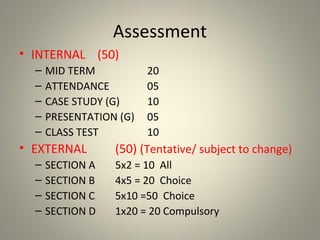
Assessment
• INTERNAL (50)
– MID TERM 20
– ATTENDANCE 05
– CASE STUDY (G) 10
– PRESENTATION (G) 05
– CLASS TEST 10
• EXTERNAL (50) (Tentative/ subject to change)
– SECTION A 5x2 = 10 All
– SECTION B 4x5 = 20 Choice
– SECTION C 5x10 =50 Choice
– SECTION D 1x20 = 20 Compulsory
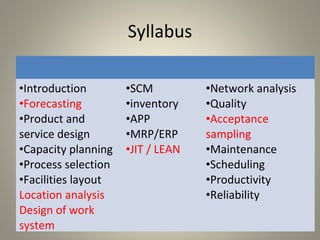
Syllabus
•Introduction
•Forecasting
•Product and
service design
•Capacity planning
•Process selection
•Facilities layout
Location analysis
Design of work
system
•SCM
•inventory
•APP
•MRP/ERP
•JIT / LEAN
•Network analysis
•Quality
•Acceptance
sampling
•Maintenance
•Scheduling
•Productivity
•Reliability
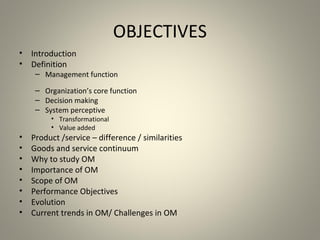
OBJECTIVES
• Introduction
• Definition
– Management function
– Organization’s core function
– Decision making
– System perceptive
• Transformational
• Value added
• Product /service – difference / similarities
• Goods and service continuum
• Why to study OM
• Importance of OM
• Scope of OM
• Performance Objectives
• Evolution
• Current trends in OM/ Challenges in OM
Introduction
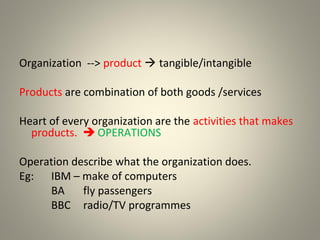
Organization --> product  tangible/intangible
Products are combination of both goods /services
Heart of every organization are the activities that makes
products.  OPERATIONS
Operation describe what the organization does.
Eg: IBM – make of computers
BA fly passengers
BBC radio/TV programmes
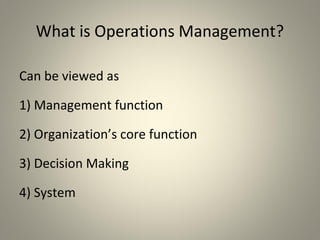
What is Operations Management?
Can be viewed as
1) Management function
2) Organization’s core function
3) Decision Making
4) System
OM- Management function
Operations management (OM) is defined as
the design, operation, and improvement of
the systems that create and deliver the
firm’s primary products and services
The business function responsible for
planning, coordinating, and controlling the
resources needed to produce a company’s
products and services
OM Across the Organization- core
function
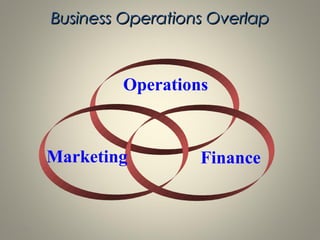
• Most businesses are supported by the
functions of operations, marketing, and
finance
• The major functional areas must interact to
achieve the organization goals
OM Across the Organization -
continued
• Marketing is not fully capable of meeting customer needs if
they do not understand what operations can produce
• Finance cannot judge the need for capital investments if they
do not understand operations concepts and needs
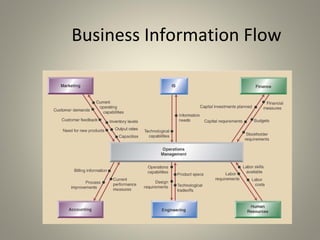
• Information systems enables the information flow throughout
the organization
• Human resources must understand job requirements and
worker skills
• Accounting needs to consider inventory management,
capacity information, and labor standards
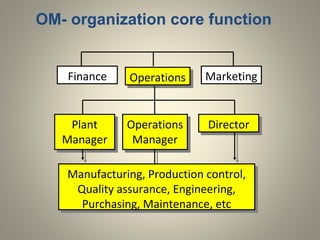
OM- organization core function
OperationsOperations
Plant
Manager
Plant
Manager
Operations
Manager
Operations
Manager
DirectorDirector
Manufacturing, Production control,
Quality assurance, Engineering,
Purchasing, Maintenance, etc
Manufacturing, Production control,
Quality assurance, Engineering,
Purchasing, Maintenance, etc
Finance Marketing
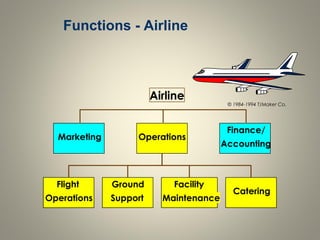
Functions - Airline
Operations
Finance/
Accounting
Marketing
Ground
Support
Flight
Operations
Facility
Maintenance
Catering
Airline
© 1984-1994 T/Maker Co.
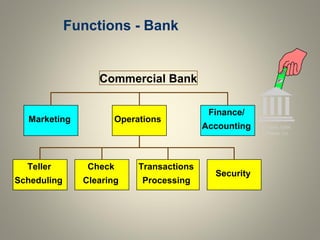
Functions - Bank
Operations
Finance/
Accounting
Marketing
Check
Clearing
Teller
Scheduling
Transactions
Processing
Security
Commercial Bank
© 1984-1994
T/Maker Co.
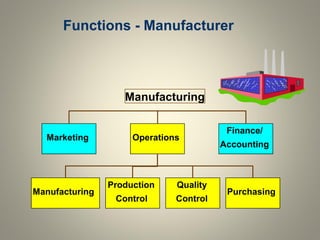
Functions - Manufacturer
Operations
Finance/
Accounting
Marketing
Production
Control
Manufacturing
Quality
Control
Purchasing
Manufacturing
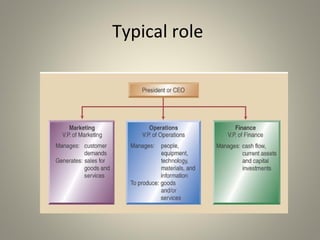
Typical role
1-17
Business Operations OverlapBusiness Operations Overlap
Operations
FinanceMarketing
1-18
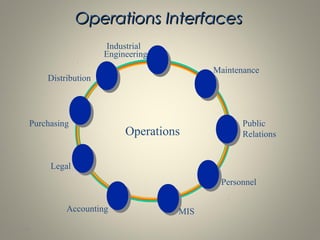
Operations InterfacesOperations Interfaces
Public
Relations
Accounting
Industrial
Engineering
Operations
Maintenance
Personnel
Purchasing
Distribution
MIS
Legal
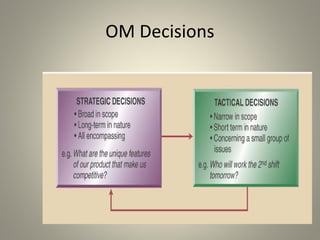
OM Decisions
• All organizations are based on decisions
• Decisions follow a similar path
– First decisions very broad – Strategic decisions
• Strategic Decisions – set the direction for the entire
company; they are broad in scope and long-term in
nature
– Following decisions focus on specifics - Tactical
decision and operational
OM Decisions
• Tactical decisions focus on
– Specific day-to-day issues
• Resource needs, schedules, & quantities to produce
– Tactical decisions are very frequent
– Strategic decisions less frequent
– Tactical decisions must align with strategic
decisions
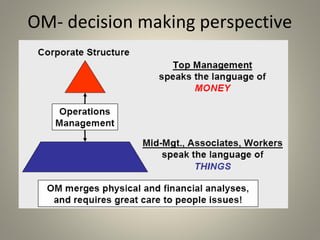
OM- decision making perspective
Classification of operations management
decision/production management functions
• Periodic/Continual Decision
• Planning and designing of production systems/Operations and
control of production system
• Planning, organising and control decisions
• Strategic ( long term) and operational ( Short term) Decision
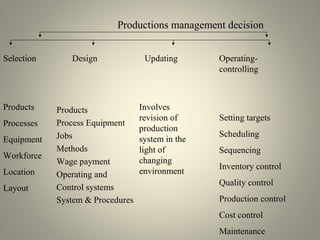
Productions management decision
Selection
Products
Processes
Equipment
Workforce
Location
Layout
Design
Products
Process Equipment
Jobs
Methods
Wage payment
Operating and
Control systems
System & Procedures
Updating
Involves
revision of
production
system in the
light of
changing
environment
Operating-
controlling
Setting targets
Scheduling
Sequencing
Inventory control
Quality control
Production control
Cost control
Maintenance
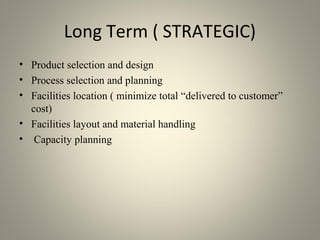
Long Term ( STRATEGIC)
• Product selection and design
• Process selection and planning
• Facilities location ( minimize total “delivered to customer”
cost)
• Facilities layout and material handling
• Capacity planning
SHORT TERM (OPERATIONAL)
• Production planning, Scheduling and control
• Inventory planning and control
• Quality Assurance
• Work and Job Design
• Maintenance and replacement
• Cost reduction and control
OM Decisions
Operations Management – system based
• OM Transforms inputs to outputs
– Inputs are resources such as
• People, Material, and Money
– Outputs are goods and services
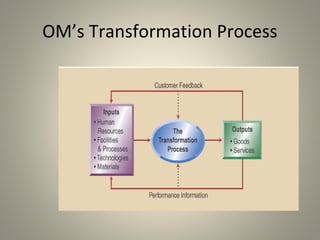
OM’s Transformation Process
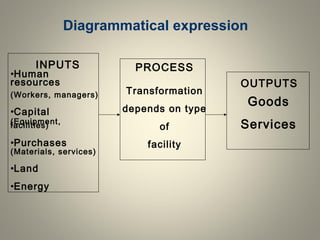
Diagrammatical expression
INPUTS PROCESS
OUTPUTS
•Human
resources
(Workers, managers)
•Capital
(Equipment,facilities)
•Purchases
(Materials, services)
•Land
•Energy
Goods
Services
Transformation
depends on type
of
facility
1-30
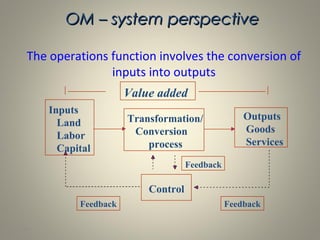
OM – system perspectiveOM – system perspective
The operations function involves the conversion of
inputs into outputs
Inputs
Land
Labor
Capital
Transformation/
Conversion
process
Outputs
Goods
Services
Control
Feedback
FeedbackFeedback
Value added
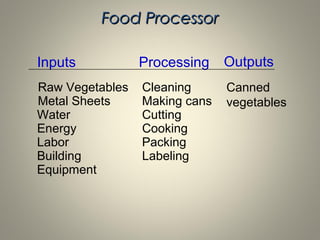
Food ProcessorFood Processor
Inputs Processing Outputs
Raw Vegetables Cleaning Canned
vegetablesMetal Sheets Making cans
Water Cutting
Energy Cooking
Labor Packing
Building Labeling
Equipment
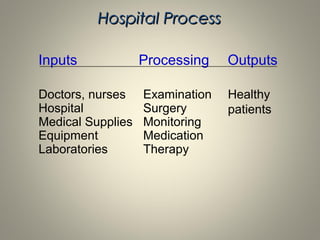
Hospital ProcessHospital Process
Inputs Processing Outputs
Doctors, nurses Examination Healthy
patientsHospital Surgery
Medical Supplies Monitoring
Equipment Medication
Laboratories Therapy
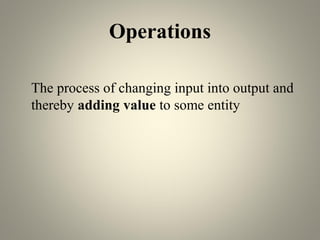
Operations
The process of changing input into output and
thereby adding value to some entity
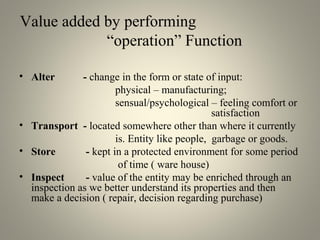
Value added by performing
“operation” Function
• Alter - change in the form or state of input:
physical – manufacturing;
sensual/psychological – feeling comfort or
satisfaction
• Transport - located somewhere other than where it currently
is. Entity like people, garbage or goods.
• Store - kept in a protected environment for some period
of time ( ware house)
• Inspect - value of the entity may be enriched through an
inspection as we better understand its properties and then
make a decision ( repair, decision regarding purchase)
OM’s Transformation Role
• To add value
– Increase product value at each stage
– Value added is the net increase between output product value and
input material value
• Provide an efficient transformation
– Efficiency – perform activities well at lowest possible cost
What is a Transformation Process?
Defined
A transformation process is defined as a
use of resources to transform inputs into
some desired outputs
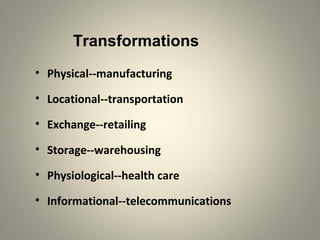
Transformations
• Physical--manufacturing
• Locational--transportation
• Exchange--retailing
• Storage--warehousing
• Physiological--health care
• Informational--telecommunications
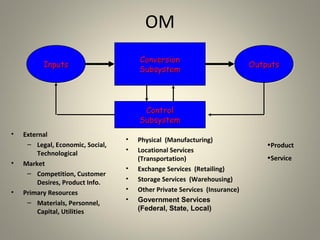
OM
InputsInputsInputsInputs OutputsOutputsOutputsOutputsConversionConversion
SubsystemSubsystem
ConversionConversion
SubsystemSubsystem
ControlControl
SubsystemSubsystem
ControlControl
SubsystemSubsystem
•Product
•Service
• External
– Legal, Economic, Social,
Technological
• Market
– Competition, Customer
Desires, Product Info.
• Primary Resources
– Materials, Personnel,
Capital, Utilities
• Physical (Manufacturing)
• Locational Services
(Transportation)
• Exchange Services (Retailing)
• Storage Services (Warehousing)
• Other Private Services (Insurance)
• Government Services
(Federal, State, Local)
Monitoring and feedback control
• Establish standards of performing or outputs
• Measures actual performance
• Compare the difference between the actual and planned
• Take appropriate remedial actions by changing inputs revising
plans, Changing priorities, Expediting the progress etc.,
Hybrid organizations
• Some organizations are a blend of
service/manufacturing/quasi-
manufacturing (QM) organizations
• QM characteristics include
– Low customer contact & Capital Intensive
1-41
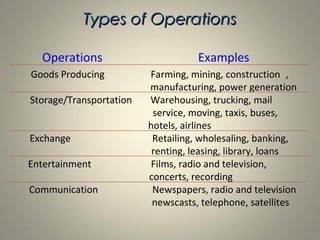
Types of OperationsTypes of Operations
Operations Examples
Goods Producing Farming, mining, construction ,
manufacturing, power generation
Storage/Transportation Warehousing, trucking, mail
service, moving, taxis, buses,
hotels, airlines
Exchange Retailing, wholesaling, banking,
renting, leasing, library, loans
Entertainment Films, radio and television,
concerts, recording
Communication Newspapers, radio and television
newscasts, telephone, satellites
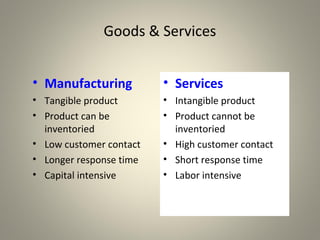
Goods & Services
• Services
• Intangible product
• Product cannot be
inventoried
• High customer contact
• Short response time
• Labor intensive
• Manufacturing
• Tangible product
• Product can be
inventoried
• Low customer contact
• Longer response time
• Capital intensive
1-43
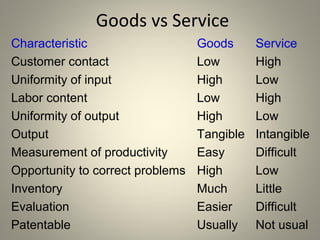
Goods vs Service
Characteristic Goods Service
Customer contact Low High
Uniformity of input High Low
Labor content Low High
Uniformity of output High Low
Output Tangible Intangible
Measurement of productivity Easy Difficult
Opportunity to correct problems High Low
Inventory Much Little
Evaluation Easier Difficult
Patentable Usually Not usual
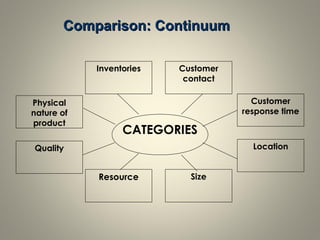
Comparison: ContinuumComparison: Continuum
Physical
nature of
product
Inventories Customer
contact
Customer
response time
Quality
Resource Size
Location
CATEGORIES
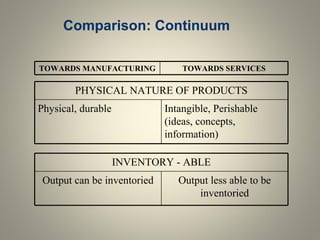
Comparison: Continuum
Intangible, Perishable
(ideas, concepts,
information)
Physical, durable
PHYSICAL NATURE OF PRODUCTS
TOWARDS SERVICESTOWARDS MANUFACTURING
Output less able to be
inventoried
Output can be inventoried
INVENTORY - ABLE
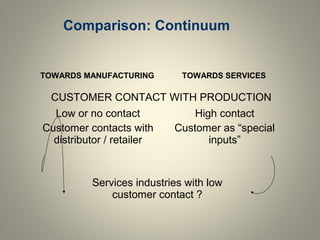
Comparison: Continuum
CUSTOMER CONTACT WITH PRODUCTION
Low or no contact
Customer contacts with
distributor / retailer
High contact
Customer as “special
inputs”
TOWARDS MANUFACTURING TOWARDS SERVICES
Services industries with low
customer contact ?
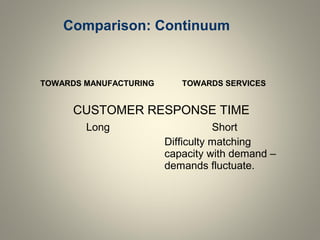
CUSTOMER RESPONSE TIME
Long Short
Difficulty matching
capacity with demand –
demands fluctuate.
TOWARDS MANUFACTURING TOWARDS SERVICES
Comparison: Continuum
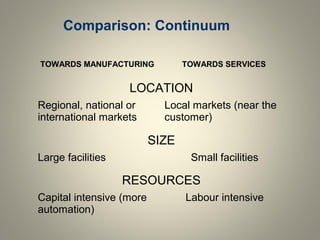
LOCATION
Regional, national or
international markets
Local markets (near the
customer)
TOWARDS MANUFACTURING TOWARDS SERVICES
SIZE
Large facilities Small facilities
RESOURCES
Capital intensive (more
automation)
Labour intensive
Comparison: Continuum
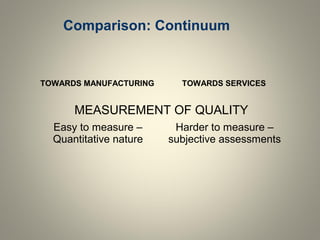
MEASUREMENT OF QUALITY
Easy to measure –
Quantitative nature
Harder to measure –
subjective assessments
TOWARDS MANUFACTURING TOWARDS SERVICES
1-50
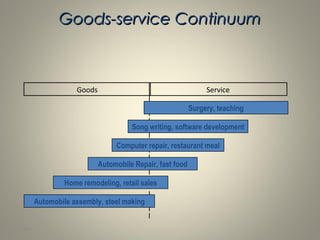
Automobile assembly, steel making
Home remodeling, retail sales
Automobile Repair, fast food
Goods-service ContinuumGoods-service Continuum
Computer repair, restaurant meal
Song writing, software development
Goods Service
Surgery, teaching
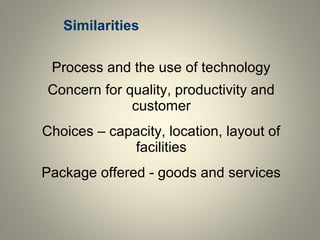
Similarities
Process and the use of technology
Concern for quality, productivity and
customer
Choices – capacity, location, layout of
facilities
Package offered - goods and services
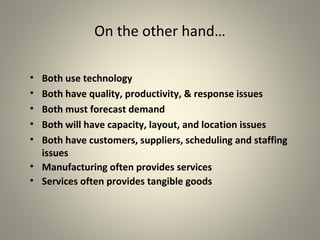
On the other hand…
• Both use technology
• Both have quality, productivity, & response issues
• Both must forecast demand
• Both will have capacity, layout, and location issues
• Both have customers, suppliers, scheduling and staffing
issues
• Manufacturing often provides services
• Services often provides tangible goods
Core services are basic things
that customers want from
products they purchase
Core Services
Defined
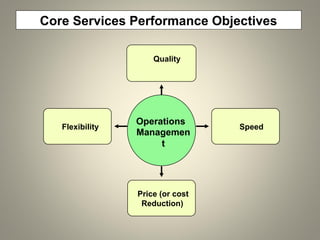
Core Services Performance Objectives
Operations
Managemen
t
Flexibility
Quality
Speed
Price (or cost
Reduction)
Value-added services
differentiate the organization
from competitors and build
relationships that bind
customers to the firm in a
positive way
Value-Added Services
Defined
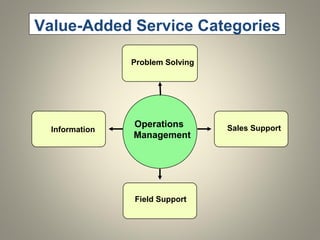
Value-Added Service Categories
Operations
Management
Information
Problem Solving
Sales Support
Field Support
Definition : OM
57
Operations management is an area of business that is
concerned with the production of goods and services, and
involves the responsibility of ensuring that business operations
are efficient and effective.
APICS The Association for Operations Management defines operations
management as "the field of study that focuses on the effective
planning, scheduling, use, and control of a manufacturing or service
organization through the study of concepts from design engineering,
industrial engineering, management information systems, quality
management, production management, inventory management,
accounting, and other functions as they affect the organization"
Operations refers to the production of goods and services, the set
of value-added activities that transform inputs into many outputs
MANUFACTURING AND SERVICES
Manufacturing Organizations
Use operations management in the
transformation process of turning raw
materials into physical goods.
Service Organizations
Use operations management in creating
nonphysical outputs in the form of
services (the activities of employees
interacting with customers).
IMPORTANCE OF OM
- It encompasses both services and manufacturing.
- It is important in effectively and efficiently managing
productivity.
- It plays a strategic role in an organization’s
competitive success.
- Synergies must exist with other functional areas of the
organization
Operations account for 60-80% of the direct expenses that
burden a firms profit.
Objective of OM
• Produces the goods/service in required quantity and of quality as
per schedule at a minimum cost that determine the extent of
customer satisfaction.
Performing objective
• Efficiency “doing things right”
• Effectiveness “doing the right things”
• Quality conform to quality specification
• Lead time time elapsed in the conversion
process (minimize) - Q, Inventory
• Capacity Utilization manpower/ machines etc.
• Flexibility flexibility of producing a
combination of o/p, satisfy the
customers needs
objective of Production Management
• to produce the desired product or specified product by
specified methods so that the optimal utilization of
available resources is met with.
• production management is responsible to produce the
desired product, which has marketability at the
cheapest price by proper planning, the manpower,
material and processes.
• Production management must see that it will deliver
right goods of right quantity at right place and at right
price.
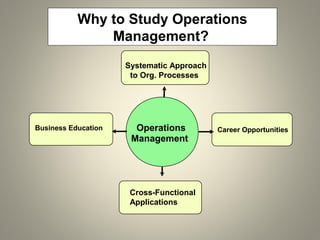
Why to Study Operations
Management?
Business Education
Systematic Approach
to Org. Processes
Career Opportunities
Cross-Functional
Applications
Operations
Management
1-63
• Operations Management includes:
– Forecasting
– Capacity planning
– Scheduling
– Managing inventories
– Assuring quality
– Motivating employees
– Deciding where to locate facilities
– Supply chain management
– And more . . .
Scope of Operations ManagementScope of Operations Management
HIGHLIGHTS
• Management technology
• Ethical issues
• OM in practice
• Evolution/ History
1-66
Management Technology
• Technology: The application of scientific
discoveries to the development and
improvement of goods and services
• Product and service technology
• Process technology
• Information technology
1-67
Ethical Issues
• Financial statements
• Worker safety
• Product safety
• Quality
• Environment
• Community
• Hiring/firing workers
• Closing facilities
• Worker’s rights
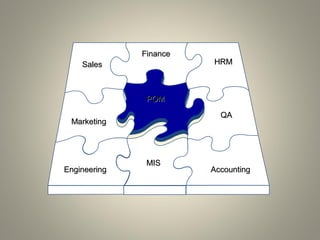
POMPOM
MarketingMarketing
MISMIS
EngineeringEngineering
HRMHRM
QAQA
AccountingAccounting
SalesSales
FinanceFinance
OM in Practice
• OM has the most diverse organizational function
• Manages the transformation process
• OM has many faces and names such as;
– V. P. operations, Director of supply chains, Manufacturing
manager
– Plant manger, Quality specialists, etc.
• All business functions need information from OM in
order to perform their tasks
• OM is the business function that is responsible for managing
and coordinating the resources needed to produce a
company’s products and services.
• Its role of OM is to transform organizational inputs into
company’s products or services outputs
• OM is responsible for a wide range of decisions, ranging from
strategic to tactical.
• Organizations can be divided into manufacturing and service
organizations, which differ in the tangibility of the product or
service
• A number of historical milestones have shaped OM. Some of
the more significant of these are the Industrial Revolution,
scientific management, the human relations movement,
management science, and the computer age
• OM is highly important function in today’s dynamic business
environment. Among the trends with significant impact are
just-in-time, TQM, reengineering, flexibility, time-based
competition, SCM, global marketplace, and environmental
issues
• OM works closely with all other business functions
Business Information Flow
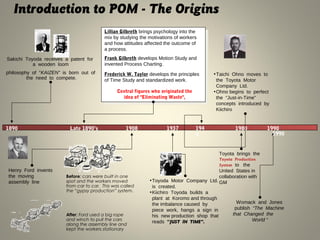
Introduction to POM - The Origins
Sakichi Toyoda receives a patent for
a wooden loom
philosophy of “KAIZEN” is born out of
the need to compete.
Henry Ford invents
the moving
assembly line •Toyoda Motor Company Ltd.
is created.
•Kiichiro Toyoda builds a
plant at Koromo and through
the imbalance caused by
piece work, hangs a sign in
his new production shop that
reads “JUST IN TIME”.
•Taichi Ohno moves to
the Toyota Motor
Company Ltd.
•Ohno begins to perfect
the “Just-in-Time”
concepts introduced by
Kiichiro
Toyota brings the
Toyota Production
System to the
United States in
collaboration with
GM
Womack and Jones
publish “The Machine
that Changed the
World “
1890 Late 1890’s
Central figures who originated the
idea of "Eliminating Waste",
Lillian Gilbreth brings psychology into the
mix by studying the motivations of workers
and how attitudes affected the outcome of
a process.
Frank Gilbreth develops Motion Study and
invented Process Charting.
Frederick W. Taylor develops the principles
of Time Study and standardized work.
1937 194
3
1908 1980 1990
Before: cars were built in one
spot and the workers moved
from car to car. This was called
the “gypsy production” system.
After: Ford used a big rope
and winch to pull the cars
along the assembly line and
kept the workers stationary
1990
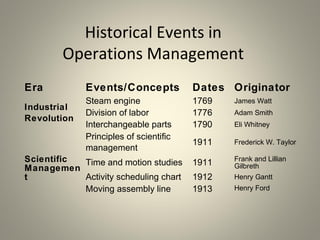
Historical Events in
Operations Management
Era Events/Concepts Dates Originator
Industrial
Revolution
Steam engine 1769 James Watt
Division of labor 1776 Adam Smith
Interchangeable parts 1790 Eli Whitney
Scientific
Managemen
t
Principles of scientific
management
1911 Frederick W. Taylor
Time and motion studies 1911 Frank and Lillian
Gilbreth
Activity scheduling chart 1912 Henry Gantt
Moving assembly line 1913 Henry Ford
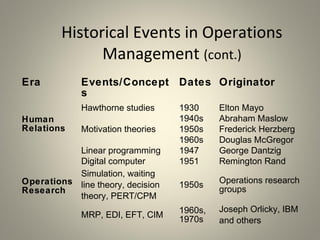
Historical Events in Operations
Management (cont.)
Era Events/Concept
s
Dates Originator
Human
Relations
Hawthorne studies 1930 Elton Mayo
Motivation theories
1940s Abraham Maslow
1950s Frederick Herzberg
1960s Douglas McGregor
Operations
Research
Linear programming 1947 George Dantzig
Digital computer 1951 Remington Rand
Simulation, waiting
line theory, decision
theory, PERT/CPM
1950s
Operations research
groups
MRP, EDI, EFT, CIM
1960s,
1970s
Joseph Orlicky, IBM
and others
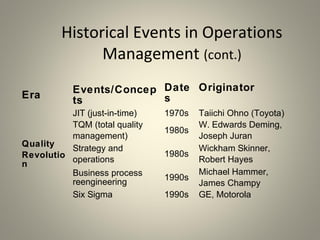
Historical Events in Operations
Management (cont.)
Era
Events/Concep
ts
Date
s
Originator
Quality
Revolutio
n
JIT (just-in-time) 1970s Taiichi Ohno (Toyota)
TQM (total quality
management)
1980s
W. Edwards Deming,
Joseph Juran
Strategy and
operations
1980s
Wickham Skinner,
Robert Hayes
Business process
reengineering
1990s
Michael Hammer,
James Champy
Six Sigma 1990s GE, Motorola
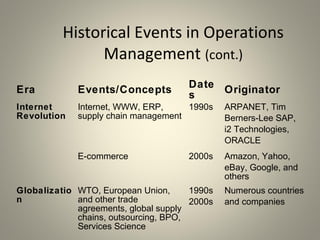
Historical Events in Operations
Management (cont.)
Era Events/Concepts
Date
s
Originator
Internet
Revolution
Internet, WWW, ERP,
supply chain management
1990s ARPANET, Tim
Berners-Lee SAP,
i2 Technologies,
ORACLE
E-commerce 2000s Amazon, Yahoo,
eBay, Google, and
others
Globalizatio
n
WTO, European Union,
and other trade
agreements, global supply
chains, outsourcing, BPO,
Services Science
1990s
2000s
Numerous countries
and companies
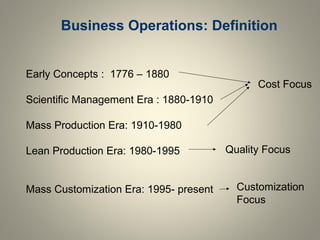
Business Operations: Definition
Early Concepts : 1776 – 1880
Scientific Management Era : 1880-1910
Mass Production Era: 1910-1980
Lean Production Era: 1980-1995
Mass Customization Era: 1995- present
Cost Focus
Quality Focus
Customization
Focus
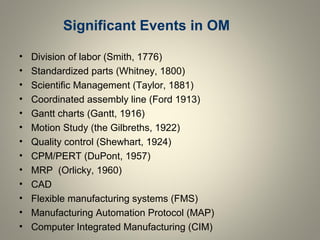
Significant Events in OM
• Division of labor (Smith, 1776)
• Standardized parts (Whitney, 1800)
• Scientific Management (Taylor, 1881)
• Coordinated assembly line (Ford 1913)
• Gantt charts (Gantt, 1916)
• Motion Study (the Gilbreths, 1922)
• Quality control (Shewhart, 1924)
• CPM/PERT (DuPont, 1957)
• MRP (Orlicky, 1960)
• CAD
• Flexible manufacturing systems (FMS)
• Manufacturing Automation Protocol (MAP)
• Computer Integrated Manufacturing (CIM)
Current Issues in OM
• Coordinate the relationships between
mutually supportive but separate
organizations.
• Optimizing global supplier, production, and
distribution networks.
• Increased co-production of goods and
services
Current Issues in OM (cont’d)
• Managing the customers experience
during the service encounter
• Raising the awareness of operations as a
significant competitive weapon
POM in Global economy
82
• Product Architecture
• Service Design – Current Vs Future
• Industry Verticals
• Centers of Excellence
1-83
Challenges of Managing Services
• Service jobs are often less structured than
manufacturing jobs
• Customer contact is higher
• Worker skill levels are lower
• Services hire many low-skill, entry-level workers
• Employee turnover is higher
• Input variability is higher
• Service performance can be affected by worker’s
personal factors
1-84
Trends in Business
• Major trends
– The Internet, e-commerce, e-business
– Management technology
– Globalization
– Management of supply chains
– Outsourcing
– Agility
– Ethical behavior
Discussion
• With regard to the type of businesses below,
detail the:
– Input, processes, output
– Extent of client/customer participation
– Nature and source of information
• Types of business:
– Educational institution
– Factory manufacturing iron pipes
– Jewellery store
ASSIGNMENT
• TRENDS IN OM
• CHALLENGES OF OM
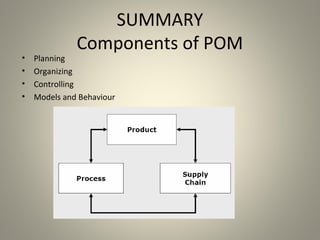
SUMMARY
Components of POM
• Planning
• Organizing
• Controlling
• Models and Behaviour
Summary
• It is a management function
• Organization’s core function
• Every organization has OM function
– Service or Manufacturing
– For profit or Not for profit

Ch 1 introduction_om

  • 1.
  • 2.
    OPERATIONS MANAGEMENT William J.Stevenson, 9th Edition, Tata Mcgraw Hill Reference books: 1. Operations Management, Theory and Practice - B. Mahadevan 2. Operations Management for competitive advantage – Chase, Jacobs 3. Production and Operations Management – Paneerselvam 4. Operations Management Russel & Taylor 5. Operations Management- Jay Heizer, Barry Render, Jagadeesh Rajashekhar
  • 3.
    Assessment • INTERNAL (50) –MID TERM 20 – ATTENDANCE 05 – CASE STUDY (G) 10 – PRESENTATION (G) 05 – CLASS TEST 10 • EXTERNAL (50) (Tentative/ subject to change) – SECTION A 5x2 = 10 All – SECTION B 4x5 = 20 Choice – SECTION C 5x10 =50 Choice – SECTION D 1x20 = 20 Compulsory
  • 4.
    Syllabus •Introduction •Forecasting •Product and service design •Capacityplanning •Process selection •Facilities layout Location analysis Design of work system •SCM •inventory •APP •MRP/ERP •JIT / LEAN •Network analysis •Quality •Acceptance sampling •Maintenance •Scheduling •Productivity •Reliability
  • 5.
    OBJECTIVES • Introduction • Definition –Management function – Organization’s core function – Decision making – System perceptive • Transformational • Value added • Product /service – difference / similarities • Goods and service continuum • Why to study OM • Importance of OM • Scope of OM • Performance Objectives • Evolution • Current trends in OM/ Challenges in OM
  • 6.
  • 7.
    Organization --> product tangible/intangible Products are combination of both goods /services Heart of every organization are the activities that makes products.  OPERATIONS Operation describe what the organization does. Eg: IBM – make of computers BA fly passengers BBC radio/TV programmes
  • 8.
    What is OperationsManagement? Can be viewed as 1) Management function 2) Organization’s core function 3) Decision Making 4) System
  • 9.
    OM- Management function Operationsmanagement (OM) is defined as the design, operation, and improvement of the systems that create and deliver the firm’s primary products and services The business function responsible for planning, coordinating, and controlling the resources needed to produce a company’s products and services
  • 10.
    OM Across theOrganization- core function • Most businesses are supported by the functions of operations, marketing, and finance • The major functional areas must interact to achieve the organization goals
  • 11.
    OM Across theOrganization - continued • Marketing is not fully capable of meeting customer needs if they do not understand what operations can produce • Finance cannot judge the need for capital investments if they do not understand operations concepts and needs • Information systems enables the information flow throughout the organization • Human resources must understand job requirements and worker skills • Accounting needs to consider inventory management, capacity information, and labor standards
  • 12.
    OM- organization corefunction OperationsOperations Plant Manager Plant Manager Operations Manager Operations Manager DirectorDirector Manufacturing, Production control, Quality assurance, Engineering, Purchasing, Maintenance, etc Manufacturing, Production control, Quality assurance, Engineering, Purchasing, Maintenance, etc Finance Marketing
  • 13.
  • 14.
  • 15.
  • 16.
  • 17.
    1-17 Business Operations OverlapBusinessOperations Overlap Operations FinanceMarketing
  • 18.
  • 19.
    OM Decisions • Allorganizations are based on decisions • Decisions follow a similar path – First decisions very broad – Strategic decisions • Strategic Decisions – set the direction for the entire company; they are broad in scope and long-term in nature – Following decisions focus on specifics - Tactical decision and operational
  • 20.
    OM Decisions • Tacticaldecisions focus on – Specific day-to-day issues • Resource needs, schedules, & quantities to produce – Tactical decisions are very frequent – Strategic decisions less frequent – Tactical decisions must align with strategic decisions
  • 21.
  • 22.
    Classification of operationsmanagement decision/production management functions • Periodic/Continual Decision • Planning and designing of production systems/Operations and control of production system • Planning, organising and control decisions • Strategic ( long term) and operational ( Short term) Decision
  • 23.
    Productions management decision Selection Products Processes Equipment Workforce Location Layout Design Products ProcessEquipment Jobs Methods Wage payment Operating and Control systems System & Procedures Updating Involves revision of production system in the light of changing environment Operating- controlling Setting targets Scheduling Sequencing Inventory control Quality control Production control Cost control Maintenance
  • 24.
    Long Term (STRATEGIC) • Product selection and design • Process selection and planning • Facilities location ( minimize total “delivered to customer” cost) • Facilities layout and material handling • Capacity planning
  • 25.
    SHORT TERM (OPERATIONAL) •Production planning, Scheduling and control • Inventory planning and control • Quality Assurance • Work and Job Design • Maintenance and replacement • Cost reduction and control
  • 26.
  • 27.
    Operations Management –system based • OM Transforms inputs to outputs – Inputs are resources such as • People, Material, and Money – Outputs are goods and services
  • 28.
  • 29.
    Diagrammatical expression INPUTS PROCESS OUTPUTS •Human resources (Workers,managers) •Capital (Equipment,facilities) •Purchases (Materials, services) •Land •Energy Goods Services Transformation depends on type of facility
  • 30.
    1-30 OM – systemperspectiveOM – system perspective The operations function involves the conversion of inputs into outputs Inputs Land Labor Capital Transformation/ Conversion process Outputs Goods Services Control Feedback FeedbackFeedback Value added
  • 31.
    Food ProcessorFood Processor InputsProcessing Outputs Raw Vegetables Cleaning Canned vegetablesMetal Sheets Making cans Water Cutting Energy Cooking Labor Packing Building Labeling Equipment
  • 32.
    Hospital ProcessHospital Process InputsProcessing Outputs Doctors, nurses Examination Healthy patientsHospital Surgery Medical Supplies Monitoring Equipment Medication Laboratories Therapy
  • 33.
    Operations The process ofchanging input into output and thereby adding value to some entity
  • 34.
    Value added byperforming “operation” Function • Alter - change in the form or state of input: physical – manufacturing; sensual/psychological – feeling comfort or satisfaction • Transport - located somewhere other than where it currently is. Entity like people, garbage or goods. • Store - kept in a protected environment for some period of time ( ware house) • Inspect - value of the entity may be enriched through an inspection as we better understand its properties and then make a decision ( repair, decision regarding purchase)
  • 35.
    OM’s Transformation Role •To add value – Increase product value at each stage – Value added is the net increase between output product value and input material value • Provide an efficient transformation – Efficiency – perform activities well at lowest possible cost
  • 36.
    What is aTransformation Process? Defined A transformation process is defined as a use of resources to transform inputs into some desired outputs
  • 37.
    Transformations • Physical--manufacturing • Locational--transportation •Exchange--retailing • Storage--warehousing • Physiological--health care • Informational--telecommunications
  • 38.
    OM InputsInputsInputsInputs OutputsOutputsOutputsOutputsConversionConversion SubsystemSubsystem ConversionConversion SubsystemSubsystem ControlControl SubsystemSubsystem ControlControl SubsystemSubsystem •Product •Service • External –Legal, Economic, Social, Technological • Market – Competition, Customer Desires, Product Info. • Primary Resources – Materials, Personnel, Capital, Utilities • Physical (Manufacturing) • Locational Services (Transportation) • Exchange Services (Retailing) • Storage Services (Warehousing) • Other Private Services (Insurance) • Government Services (Federal, State, Local)
  • 39.
    Monitoring and feedbackcontrol • Establish standards of performing or outputs • Measures actual performance • Compare the difference between the actual and planned • Take appropriate remedial actions by changing inputs revising plans, Changing priorities, Expediting the progress etc.,
  • 40.
    Hybrid organizations • Someorganizations are a blend of service/manufacturing/quasi- manufacturing (QM) organizations • QM characteristics include – Low customer contact & Capital Intensive
  • 41.
    1-41 Types of OperationsTypesof Operations Operations Examples Goods Producing Farming, mining, construction , manufacturing, power generation Storage/Transportation Warehousing, trucking, mail service, moving, taxis, buses, hotels, airlines Exchange Retailing, wholesaling, banking, renting, leasing, library, loans Entertainment Films, radio and television, concerts, recording Communication Newspapers, radio and television newscasts, telephone, satellites
  • 42.
    Goods & Services •Services • Intangible product • Product cannot be inventoried • High customer contact • Short response time • Labor intensive • Manufacturing • Tangible product • Product can be inventoried • Low customer contact • Longer response time • Capital intensive
  • 43.
    1-43 Goods vs Service CharacteristicGoods Service Customer contact Low High Uniformity of input High Low Labor content Low High Uniformity of output High Low Output Tangible Intangible Measurement of productivity Easy Difficult Opportunity to correct problems High Low Inventory Much Little Evaluation Easier Difficult Patentable Usually Not usual
  • 44.
    Comparison: ContinuumComparison: Continuum Physical natureof product Inventories Customer contact Customer response time Quality Resource Size Location CATEGORIES
  • 45.
    Comparison: Continuum Intangible, Perishable (ideas,concepts, information) Physical, durable PHYSICAL NATURE OF PRODUCTS TOWARDS SERVICESTOWARDS MANUFACTURING Output less able to be inventoried Output can be inventoried INVENTORY - ABLE
  • 46.
    Comparison: Continuum CUSTOMER CONTACTWITH PRODUCTION Low or no contact Customer contacts with distributor / retailer High contact Customer as “special inputs” TOWARDS MANUFACTURING TOWARDS SERVICES Services industries with low customer contact ?
  • 47.
    CUSTOMER RESPONSE TIME LongShort Difficulty matching capacity with demand – demands fluctuate. TOWARDS MANUFACTURING TOWARDS SERVICES Comparison: Continuum
  • 48.
    Comparison: Continuum LOCATION Regional, nationalor international markets Local markets (near the customer) TOWARDS MANUFACTURING TOWARDS SERVICES SIZE Large facilities Small facilities RESOURCES Capital intensive (more automation) Labour intensive
  • 49.
    Comparison: Continuum MEASUREMENT OFQUALITY Easy to measure – Quantitative nature Harder to measure – subjective assessments TOWARDS MANUFACTURING TOWARDS SERVICES
  • 50.
    1-50 Automobile assembly, steelmaking Home remodeling, retail sales Automobile Repair, fast food Goods-service ContinuumGoods-service Continuum Computer repair, restaurant meal Song writing, software development Goods Service Surgery, teaching
  • 51.
    Similarities Process and theuse of technology Concern for quality, productivity and customer Choices – capacity, location, layout of facilities Package offered - goods and services
  • 52.
    On the otherhand… • Both use technology • Both have quality, productivity, & response issues • Both must forecast demand • Both will have capacity, layout, and location issues • Both have customers, suppliers, scheduling and staffing issues • Manufacturing often provides services • Services often provides tangible goods
  • 53.
    Core services arebasic things that customers want from products they purchase Core Services Defined
  • 54.
    Core Services PerformanceObjectives Operations Managemen t Flexibility Quality Speed Price (or cost Reduction)
  • 55.
    Value-added services differentiate theorganization from competitors and build relationships that bind customers to the firm in a positive way Value-Added Services Defined
  • 56.
  • 57.
    Definition : OM 57 Operationsmanagement is an area of business that is concerned with the production of goods and services, and involves the responsibility of ensuring that business operations are efficient and effective. APICS The Association for Operations Management defines operations management as "the field of study that focuses on the effective planning, scheduling, use, and control of a manufacturing or service organization through the study of concepts from design engineering, industrial engineering, management information systems, quality management, production management, inventory management, accounting, and other functions as they affect the organization" Operations refers to the production of goods and services, the set of value-added activities that transform inputs into many outputs
  • 58.
    MANUFACTURING AND SERVICES ManufacturingOrganizations Use operations management in the transformation process of turning raw materials into physical goods. Service Organizations Use operations management in creating nonphysical outputs in the form of services (the activities of employees interacting with customers).
  • 59.
    IMPORTANCE OF OM -It encompasses both services and manufacturing. - It is important in effectively and efficiently managing productivity. - It plays a strategic role in an organization’s competitive success. - Synergies must exist with other functional areas of the organization Operations account for 60-80% of the direct expenses that burden a firms profit.
  • 60.
    Objective of OM •Produces the goods/service in required quantity and of quality as per schedule at a minimum cost that determine the extent of customer satisfaction. Performing objective • Efficiency “doing things right” • Effectiveness “doing the right things” • Quality conform to quality specification • Lead time time elapsed in the conversion process (minimize) - Q, Inventory • Capacity Utilization manpower/ machines etc. • Flexibility flexibility of producing a combination of o/p, satisfy the customers needs
  • 61.
    objective of ProductionManagement • to produce the desired product or specified product by specified methods so that the optimal utilization of available resources is met with. • production management is responsible to produce the desired product, which has marketability at the cheapest price by proper planning, the manpower, material and processes. • Production management must see that it will deliver right goods of right quantity at right place and at right price.
  • 62.
    Why to StudyOperations Management? Business Education Systematic Approach to Org. Processes Career Opportunities Cross-Functional Applications Operations Management
  • 63.
    1-63 • Operations Managementincludes: – Forecasting – Capacity planning – Scheduling – Managing inventories – Assuring quality – Motivating employees – Deciding where to locate facilities – Supply chain management – And more . . . Scope of Operations ManagementScope of Operations Management
  • 64.
  • 65.
    • Management technology •Ethical issues • OM in practice • Evolution/ History
  • 66.
    1-66 Management Technology • Technology:The application of scientific discoveries to the development and improvement of goods and services • Product and service technology • Process technology • Information technology
  • 67.
    1-67 Ethical Issues • Financialstatements • Worker safety • Product safety • Quality • Environment • Community • Hiring/firing workers • Closing facilities • Worker’s rights
  • 68.
  • 69.
    OM in Practice •OM has the most diverse organizational function • Manages the transformation process • OM has many faces and names such as; – V. P. operations, Director of supply chains, Manufacturing manager – Plant manger, Quality specialists, etc. • All business functions need information from OM in order to perform their tasks
  • 70.
    • OM isthe business function that is responsible for managing and coordinating the resources needed to produce a company’s products and services. • Its role of OM is to transform organizational inputs into company’s products or services outputs • OM is responsible for a wide range of decisions, ranging from strategic to tactical. • Organizations can be divided into manufacturing and service organizations, which differ in the tangibility of the product or service
  • 71.
    • A numberof historical milestones have shaped OM. Some of the more significant of these are the Industrial Revolution, scientific management, the human relations movement, management science, and the computer age • OM is highly important function in today’s dynamic business environment. Among the trends with significant impact are just-in-time, TQM, reengineering, flexibility, time-based competition, SCM, global marketplace, and environmental issues • OM works closely with all other business functions
  • 72.
  • 73.
    Introduction to POM- The Origins Sakichi Toyoda receives a patent for a wooden loom philosophy of “KAIZEN” is born out of the need to compete. Henry Ford invents the moving assembly line •Toyoda Motor Company Ltd. is created. •Kiichiro Toyoda builds a plant at Koromo and through the imbalance caused by piece work, hangs a sign in his new production shop that reads “JUST IN TIME”. •Taichi Ohno moves to the Toyota Motor Company Ltd. •Ohno begins to perfect the “Just-in-Time” concepts introduced by Kiichiro Toyota brings the Toyota Production System to the United States in collaboration with GM Womack and Jones publish “The Machine that Changed the World “ 1890 Late 1890’s Central figures who originated the idea of "Eliminating Waste", Lillian Gilbreth brings psychology into the mix by studying the motivations of workers and how attitudes affected the outcome of a process. Frank Gilbreth develops Motion Study and invented Process Charting. Frederick W. Taylor develops the principles of Time Study and standardized work. 1937 194 3 1908 1980 1990 Before: cars were built in one spot and the workers moved from car to car. This was called the “gypsy production” system. After: Ford used a big rope and winch to pull the cars along the assembly line and kept the workers stationary 1990
  • 74.
    Historical Events in OperationsManagement Era Events/Concepts Dates Originator Industrial Revolution Steam engine 1769 James Watt Division of labor 1776 Adam Smith Interchangeable parts 1790 Eli Whitney Scientific Managemen t Principles of scientific management 1911 Frederick W. Taylor Time and motion studies 1911 Frank and Lillian Gilbreth Activity scheduling chart 1912 Henry Gantt Moving assembly line 1913 Henry Ford
  • 75.
    Historical Events inOperations Management (cont.) Era Events/Concept s Dates Originator Human Relations Hawthorne studies 1930 Elton Mayo Motivation theories 1940s Abraham Maslow 1950s Frederick Herzberg 1960s Douglas McGregor Operations Research Linear programming 1947 George Dantzig Digital computer 1951 Remington Rand Simulation, waiting line theory, decision theory, PERT/CPM 1950s Operations research groups MRP, EDI, EFT, CIM 1960s, 1970s Joseph Orlicky, IBM and others
  • 76.
    Historical Events inOperations Management (cont.) Era Events/Concep ts Date s Originator Quality Revolutio n JIT (just-in-time) 1970s Taiichi Ohno (Toyota) TQM (total quality management) 1980s W. Edwards Deming, Joseph Juran Strategy and operations 1980s Wickham Skinner, Robert Hayes Business process reengineering 1990s Michael Hammer, James Champy Six Sigma 1990s GE, Motorola
  • 77.
    Historical Events inOperations Management (cont.) Era Events/Concepts Date s Originator Internet Revolution Internet, WWW, ERP, supply chain management 1990s ARPANET, Tim Berners-Lee SAP, i2 Technologies, ORACLE E-commerce 2000s Amazon, Yahoo, eBay, Google, and others Globalizatio n WTO, European Union, and other trade agreements, global supply chains, outsourcing, BPO, Services Science 1990s 2000s Numerous countries and companies
  • 78.
    Business Operations: Definition EarlyConcepts : 1776 – 1880 Scientific Management Era : 1880-1910 Mass Production Era: 1910-1980 Lean Production Era: 1980-1995 Mass Customization Era: 1995- present Cost Focus Quality Focus Customization Focus
  • 79.
    Significant Events inOM • Division of labor (Smith, 1776) • Standardized parts (Whitney, 1800) • Scientific Management (Taylor, 1881) • Coordinated assembly line (Ford 1913) • Gantt charts (Gantt, 1916) • Motion Study (the Gilbreths, 1922) • Quality control (Shewhart, 1924) • CPM/PERT (DuPont, 1957) • MRP (Orlicky, 1960) • CAD • Flexible manufacturing systems (FMS) • Manufacturing Automation Protocol (MAP) • Computer Integrated Manufacturing (CIM)
  • 80.
    Current Issues inOM • Coordinate the relationships between mutually supportive but separate organizations. • Optimizing global supplier, production, and distribution networks. • Increased co-production of goods and services
  • 81.
    Current Issues inOM (cont’d) • Managing the customers experience during the service encounter • Raising the awareness of operations as a significant competitive weapon
  • 82.
    POM in Globaleconomy 82 • Product Architecture • Service Design – Current Vs Future • Industry Verticals • Centers of Excellence
  • 83.
    1-83 Challenges of ManagingServices • Service jobs are often less structured than manufacturing jobs • Customer contact is higher • Worker skill levels are lower • Services hire many low-skill, entry-level workers • Employee turnover is higher • Input variability is higher • Service performance can be affected by worker’s personal factors
  • 84.
    1-84 Trends in Business •Major trends – The Internet, e-commerce, e-business – Management technology – Globalization – Management of supply chains – Outsourcing – Agility – Ethical behavior
  • 85.
    Discussion • With regardto the type of businesses below, detail the: – Input, processes, output – Extent of client/customer participation – Nature and source of information • Types of business: – Educational institution – Factory manufacturing iron pipes – Jewellery store
  • 86.
    ASSIGNMENT • TRENDS INOM • CHALLENGES OF OM
  • 87.
    SUMMARY Components of POM •Planning • Organizing • Controlling • Models and Behaviour
  • 88.
    Summary • It isa management function • Organization’s core function • Every organization has OM function – Service or Manufacturing – For profit or Not for profit

Editor's Notes