• The motion of stars, the Moon, and the
planets are always wonderful.
• From Aristotle to Stephen Hawking, great
minds have tried to understand the
movement of celestial objects in space and
what causes their motion.
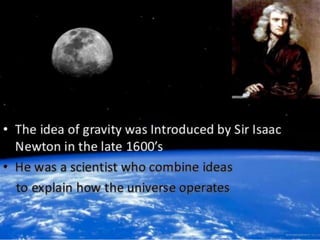
• The ‘Theory of Gravitation’ was developed by
Newton in the late 17th century to explain the
motion of celestial objects and terrestrial
objects
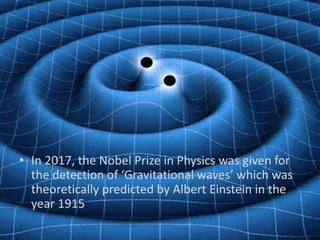
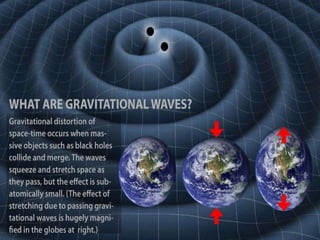
• In 2017, the Nobel Prize in Physics was given for
the detection of ‘Gravitational waves’ which was
theoretically predicted by Albert Einstein in the
year 1915.
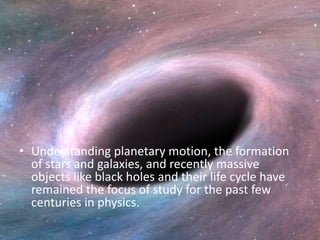
• Understanding planetary motion, the formation
of stars and galaxies, and recently massive
objects like black holes and their life cycle have
remained the focus of study for the past few
centuries in physics.
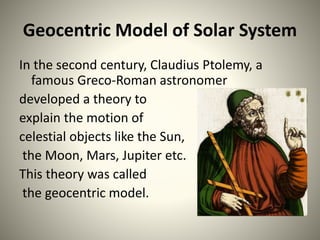
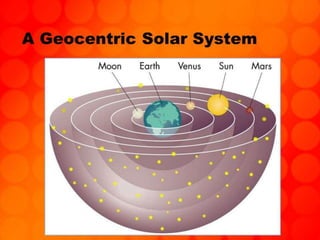
Geocentric Model of Solar System
In the second century, Claudius Ptolemy, a
famous Greco-Roman astronomer
developed a theory to
explain the motion of
celestial objects like the Sun,
the Moon, Mars, Jupiter etc.
This theory was called
the geocentric model.
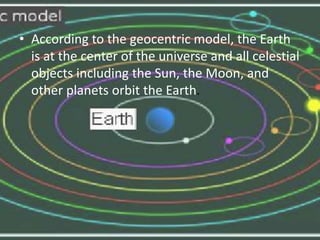
• According to the geocentric model, the Earth
is at the center of the universe and all celestial
objects including the Sun, the Moon, and
other planets orbit the Earth.
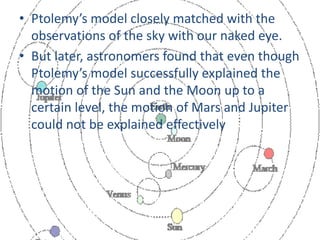
• Ptolemy’s model closely matched with the
observations of the sky with our naked eye.
• But later, astronomers found that even though
Ptolemy’s model successfully explained the
motion of the Sun and the Moon up to a
certain level, the motion of Mars and Jupiter
could not be explained effectively
Heliocentric Model of Nicholas
Copernicus
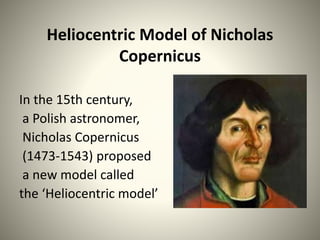
In the 15th century,
a Polish astronomer,
Nicholas Copernicus
(1473-1543) proposed
a new model called
the ‘Heliocentric model’
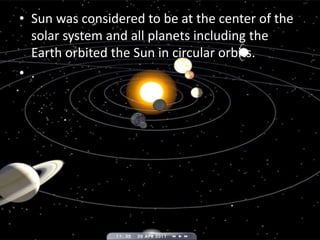
• Sun was considered to be at the center of the
solar system and all planets including the
Earth orbited the Sun in circular orbits.
• .
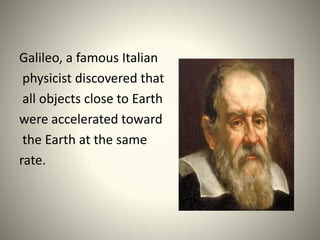
Galileo, a famous Italian
physicist discovered that
all objects close to Earth
were accelerated toward
the Earth at the same
rate.
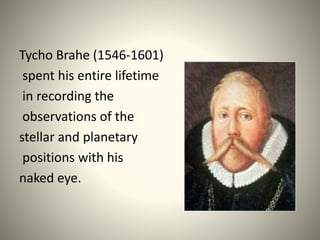
Tycho Brahe (1546-1601)
spent his entire lifetime
in recording the
observations of the
stellar and planetary
positions with his
naked eye.
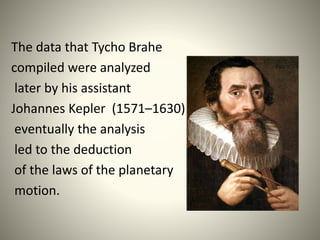
The data that Tycho Brahe
compiled were analyzed
later by his assistant
Johannes Kepler (1571–1630) and
eventually the analysis
led to the deduction
of the laws of the planetary
motion.
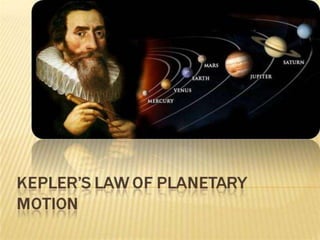
Kepler’s Laws of Planetary Motion
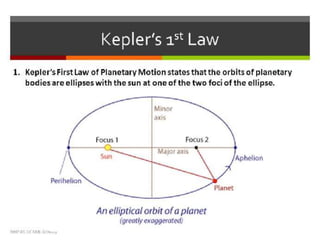
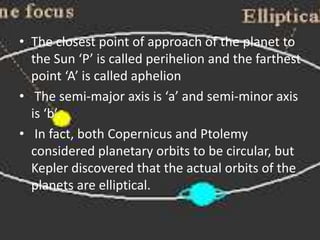
• The closest point of approach of the planet to
the Sun ‘P’ is called perihelion and the farthest
point ‘A’ is called aphelion
• The semi-major axis is ‘a’ and semi-minor axis
is ‘b’.
• In fact, both Copernicus and Ptolemy
considered planetary orbits to be circular, but
Kepler discovered that the actual orbits of the
planets are elliptical.
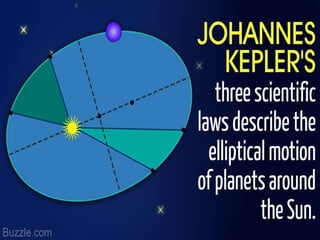
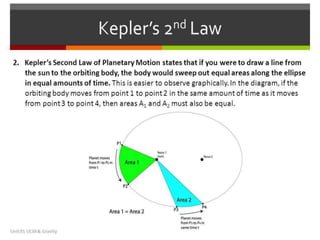
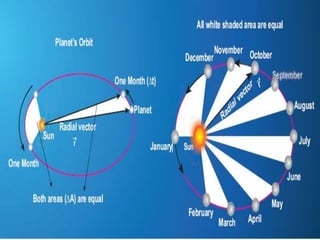
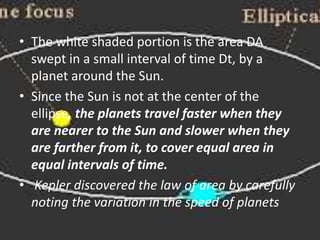
• The white shaded portion is the area DA
swept in a small interval of time Dt, by a
planet around the Sun.
• Since the Sun is not at the center of the
ellipse, the planets travel faster when they
are nearer to the Sun and slower when they
are farther from it, to cover equal area in
equal intervals of time.
• Kepler discovered the law of area by carefully
noting the variation in the speed of planets
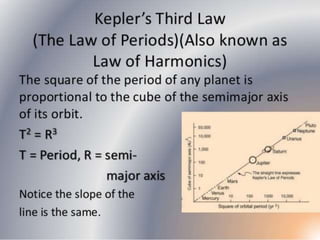
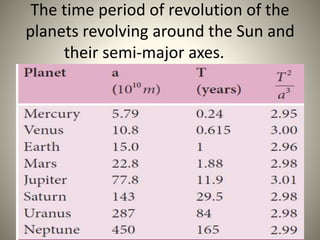
The time period of revolution of the
planets revolving around the Sun and
their semi-major axes.
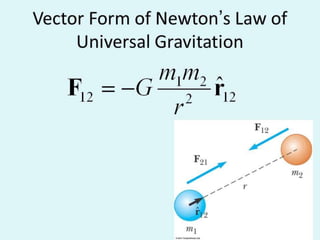
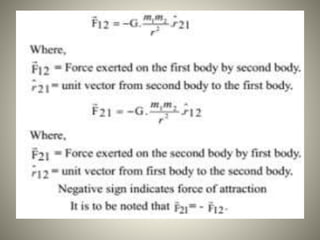
Law of Gravitation
Universal Law of Gravitation
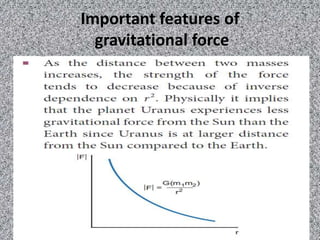
Important features of
gravitational force
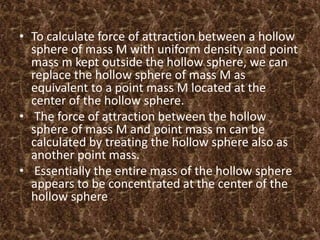
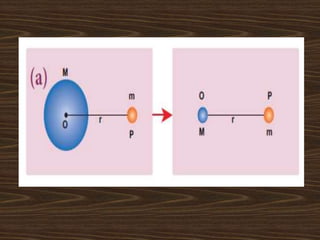
• To calculate force of attraction between a hollow
sphere of mass M with uniform density and point
mass m kept outside the hollow sphere, we can
replace the hollow sphere of mass M as
equivalent to a point mass M located at the
center of the hollow sphere.
• The force of attraction between the hollow
sphere of mass M and point mass m can be
calculated by treating the hollow sphere also as
another point mass.
• Essentially the entire mass of the hollow sphere
appears to be concentrated at the center of the
hollow sphere
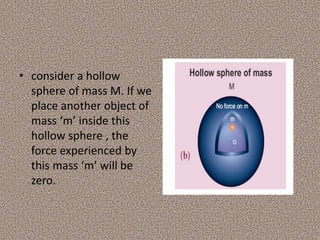
• consider a hollow
sphere of mass M. If we
place another object of
mass ‘m’ inside this
hollow sphere , the
force experienced by
this mass ‘m’ will be
zero.
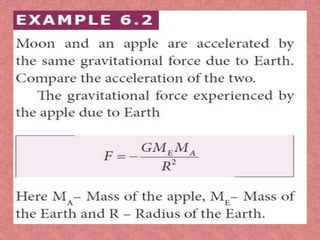
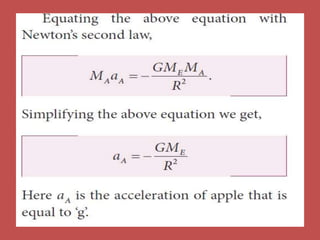
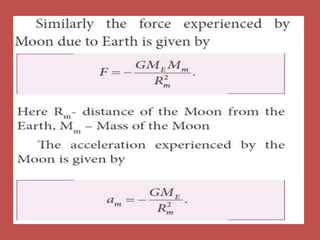
• The triumph of the law of gravitation is
that it concludes that the mango that is
falling down and the Moon orbiting the
Earth are due to the same gravitational
force.
Newton’s inverse
square Law
Newton’s inverse square Law
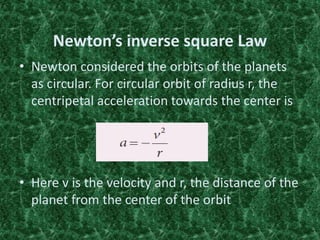
• Newton considered the orbits of the planets
as circular. For circular orbit of radius r, the
centripetal acceleration towards the center is
• Here v is the velocity and r, the distance of the
planet from the center of the orbit
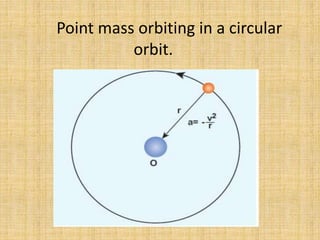
Point mass orbiting in a circular
orbit.
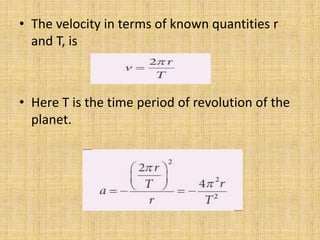
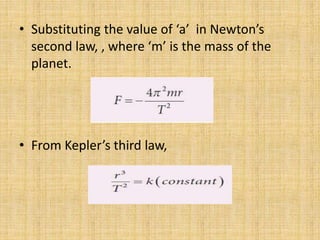
• The velocity in terms of known quantities r
and T, is
• Here T is the time period of revolution of the
planet.
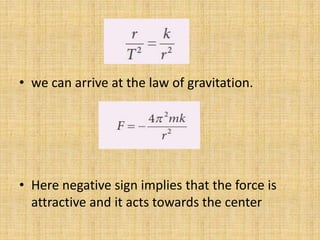
• Substituting the value of ‘a’ in Newton’s
second law, , where ‘m’ is the mass of the
planet.
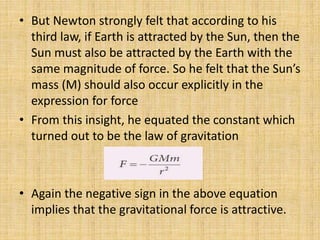
• From Kepler’s third law,
• we can arrive at the law of gravitation.
• Here negative sign implies that the force is
attractive and it acts towards the center
• But Newton strongly felt that according to his
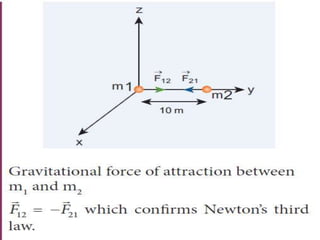
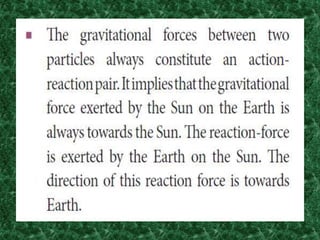
third law, if Earth is attracted by the Sun, then the
Sun must also be attracted by the Earth with the
same magnitude of force. So he felt that the Sun’s
mass (M) should also occur explicitly in the
expression for force
• From this insight, he equated the constant which
turned out to be the law of gravitation
• Again the negative sign in the above equation
implies that the gravitational force is attractive.
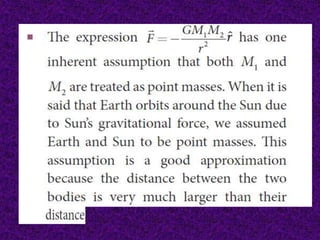
• we assumed that the orbit of the
planet to be circular which is not true
as the orbit of the planet around the
Sun is elliptical.
• But this circular orbit assumption is
justifiable because planet’s orbit is
very close to being circular and there
is only a very small deviation from the
circular shape.
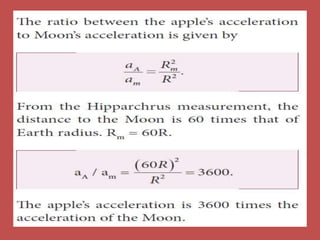
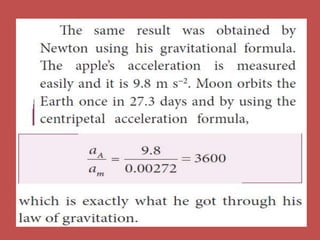
• Th e above calculation depends on knowing
the distance between the Earth and the
Moon and the radius of the Earth.
• Th e radius of the Earth was measured by
Greek librarian Eratosthenes and distance
between the Earth and the Moon was
measured by Greek astronomer
Hipparchrus 2400 years ago.
• It is very interesting to note that in order
to measure these distances he used only
high school geometry and trigonometry.
Gravitational Constant
Gravitation 1
Gravitation 1
Gravitation 1
Gravitation 1

Gravitation 1

  • 3.
    • The motionof stars, the Moon, and the planets are always wonderful. • From Aristotle to Stephen Hawking, great minds have tried to understand the movement of celestial objects in space and what causes their motion. • The ‘Theory of Gravitation’ was developed by Newton in the late 17th century to explain the motion of celestial objects and terrestrial objects
  • 5.
    • In 2017,the Nobel Prize in Physics was given for the detection of ‘Gravitational waves’ which was theoretically predicted by Albert Einstein in the year 1915.
  • 7.
    • Understanding planetarymotion, the formation of stars and galaxies, and recently massive objects like black holes and their life cycle have remained the focus of study for the past few centuries in physics.
  • 8.
    Geocentric Model ofSolar System In the second century, Claudius Ptolemy, a famous Greco-Roman astronomer developed a theory to explain the motion of celestial objects like the Sun, the Moon, Mars, Jupiter etc. This theory was called the geocentric model.
  • 9.
    • According tothe geocentric model, the Earth is at the center of the universe and all celestial objects including the Sun, the Moon, and other planets orbit the Earth.
  • 11.
    • Ptolemy’s modelclosely matched with the observations of the sky with our naked eye. • But later, astronomers found that even though Ptolemy’s model successfully explained the motion of the Sun and the Moon up to a certain level, the motion of Mars and Jupiter could not be explained effectively
  • 12.
    Heliocentric Model ofNicholas Copernicus In the 15th century, a Polish astronomer, Nicholas Copernicus (1473-1543) proposed a new model called the ‘Heliocentric model’
  • 13.
    • Sun wasconsidered to be at the center of the solar system and all planets including the Earth orbited the Sun in circular orbits. • .
  • 14.
    Galileo, a famousItalian physicist discovered that all objects close to Earth were accelerated toward the Earth at the same rate.
  • 15.
    Tycho Brahe (1546-1601) spenthis entire lifetime in recording the observations of the stellar and planetary positions with his naked eye.
  • 16.
    The data thatTycho Brahe compiled were analyzed later by his assistant Johannes Kepler (1571–1630) and eventually the analysis led to the deduction of the laws of the planetary motion.
  • 19.
    Kepler’s Laws ofPlanetary Motion
  • 20.
    • The closestpoint of approach of the planet to the Sun ‘P’ is called perihelion and the farthest point ‘A’ is called aphelion • The semi-major axis is ‘a’ and semi-minor axis is ‘b’. • In fact, both Copernicus and Ptolemy considered planetary orbits to be circular, but Kepler discovered that the actual orbits of the planets are elliptical.
  • 23.
    • The whiteshaded portion is the area DA swept in a small interval of time Dt, by a planet around the Sun. • Since the Sun is not at the center of the ellipse, the planets travel faster when they are nearer to the Sun and slower when they are farther from it, to cover equal area in equal intervals of time. • Kepler discovered the law of area by carefully noting the variation in the speed of planets
  • 25.
    The time periodof revolution of the planets revolving around the Sun and their semi-major axes.
  • 26.
    Law of Gravitation UniversalLaw of Gravitation
  • 43.
  • 47.
    • To calculateforce of attraction between a hollow sphere of mass M with uniform density and point mass m kept outside the hollow sphere, we can replace the hollow sphere of mass M as equivalent to a point mass M located at the center of the hollow sphere. • The force of attraction between the hollow sphere of mass M and point mass m can be calculated by treating the hollow sphere also as another point mass. • Essentially the entire mass of the hollow sphere appears to be concentrated at the center of the hollow sphere
  • 49.
    • consider ahollow sphere of mass M. If we place another object of mass ‘m’ inside this hollow sphere , the force experienced by this mass ‘m’ will be zero.
  • 50.
    • The triumphof the law of gravitation is that it concludes that the mango that is falling down and the Moon orbiting the Earth are due to the same gravitational force.
  • 51.
  • 52.
    Newton’s inverse squareLaw • Newton considered the orbits of the planets as circular. For circular orbit of radius r, the centripetal acceleration towards the center is • Here v is the velocity and r, the distance of the planet from the center of the orbit
  • 53.
    Point mass orbitingin a circular orbit.
  • 54.
    • The velocityin terms of known quantities r and T, is • Here T is the time period of revolution of the planet.
  • 55.
    • Substituting thevalue of ‘a’ in Newton’s second law, , where ‘m’ is the mass of the planet. • From Kepler’s third law,
  • 56.
    • we canarrive at the law of gravitation. • Here negative sign implies that the force is attractive and it acts towards the center
  • 57.
    • But Newtonstrongly felt that according to his third law, if Earth is attracted by the Sun, then the Sun must also be attracted by the Earth with the same magnitude of force. So he felt that the Sun’s mass (M) should also occur explicitly in the expression for force • From this insight, he equated the constant which turned out to be the law of gravitation • Again the negative sign in the above equation implies that the gravitational force is attractive.
  • 58.
    • we assumedthat the orbit of the planet to be circular which is not true as the orbit of the planet around the Sun is elliptical. • But this circular orbit assumption is justifiable because planet’s orbit is very close to being circular and there is only a very small deviation from the circular shape.
  • 64.
    • Th eabove calculation depends on knowing the distance between the Earth and the Moon and the radius of the Earth. • Th e radius of the Earth was measured by Greek librarian Eratosthenes and distance between the Earth and the Moon was measured by Greek astronomer Hipparchrus 2400 years ago. • It is very interesting to note that in order to measure these distances he used only high school geometry and trigonometry.
  • 65.