Downloaded 19 times

![REFERENCES [1] R. Steele, C. Secombe and W. Brookes, "Using Wireless Sensor Networks for Aged Care: The Patient's Perspective," Pervasive Health Conference and Workshops, 2006, pp. 1-10, 2006. [2] D. Foley, S. Ancoli-Israel, P. Britz and J. Walsh, "Sleep disturbances and chronic disease in older adults: results of the 2003 National Sleep Foundation Sleep in America Survey," J. Psychosom. Res., vol. 56, pp. 497-502, May. 2004. [3] P. Varady, S. Bongar and Z. Benyo, "Detection of airway obstructions and sleep apnea by analyzing the phase relation of respiration movement signals," Instrumentation and Measurement, IEEE Transactions on, vol. 52, pp. 2-6, Feb. 2003. [4] K. P. Cohen, W. M. Ladd, D. M. Beams, W. S. Sheers, R. G. Radwin, W. J. Tompkins and J. G. Webster, "Comparison of impedance and inductance ventilation sensors on adults during breathing, motion, and simulated airway obstruction," Biomedical Engineering, IEEE Transactions on, vol. 44, pp. 555-566, July. 1997.](https://image.slidesharecdn.com/ppt0000000-111010204908-phpapp01/85/Measuring-Chest-Movement-19-320.jpg)


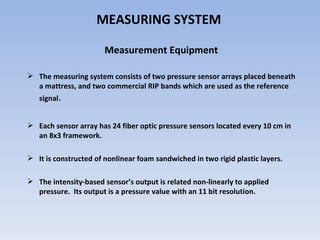
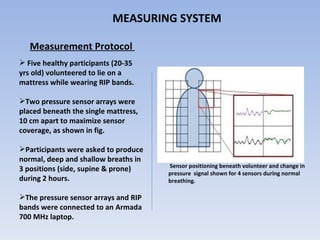
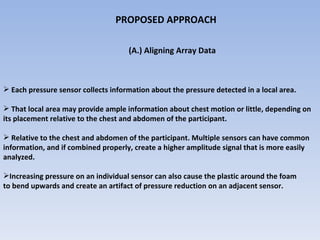
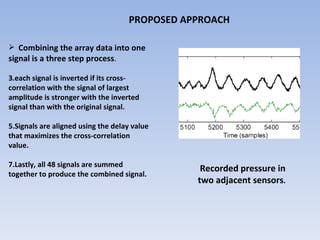
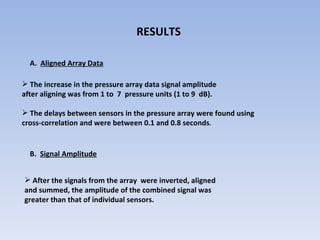
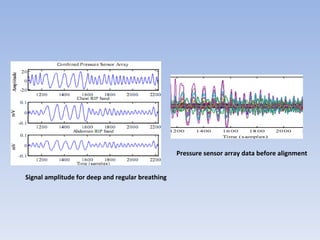
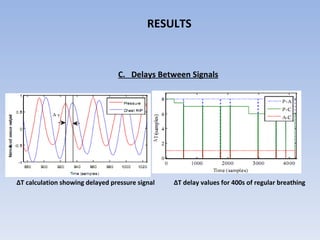
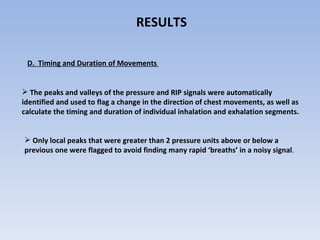
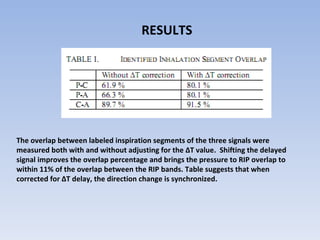
This study aimed to detect and measure chest wall motion using an array of unobtrusive pressure sensors placed beneath a mattress. The pressure sensor data was compared to measurements from respiratory inductance plethysmography bands. Five participants performed different breathing patterns in various positions while sensor data was recorded. The pressure sensor signals were aligned using cross-correlation and summed to increase signal amplitude. Inspiration and expiration segments were identified and delays between signals were calculated. When corrected for delays, the pressure sensor data showed similar chest movement detection to the reference plethysmography bands, suggesting this method could enable long-term respiratory monitoring.


![Ultrasonography ppt[1]](https://cdn.slidesharecdn.com/ss_thumbnails/ultrasonographyppt1-201003093539-thumbnail.jpg?width=640&height=640&fit=bounds)


