Guided By:        Presented By:
Asif Ali             Shamil. C
Lecturer in E.I    Roll no: 68
                            E.I
   Introduction
   Speech measurement with LDV
   Principe of LDV
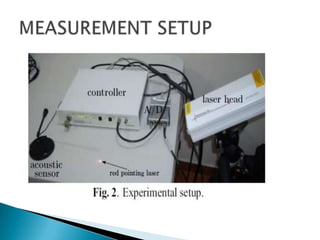
   Measurement Setup
   Problem formulation
   Speech Enhancement Algorithm
   Speckle noise suppression
   LDV-Based time frequency VAD
   Spectral gain modification
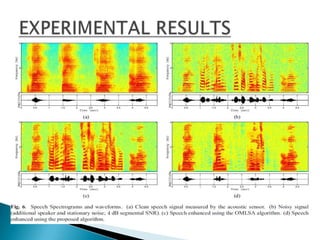
   Experimental Results
   Conclusion
   Achieving high speech intelligibility in noisy
    environments is one of the most challenging and
    important problems for existing speech-
    enhancement and speech-recognition systems.
   Recently, several approaches have been
    proposed that make use of auxiliary non acoustic
    sensors, such as bone and throat- microphones.
   Major drawback of most existing sensors is the
    requirement for a physical contact between the
    sensor and the speaker.
   Here present an alternative approach that
    enables a remote measurement of speech, using
    an auxiliary laser Doppler vibrometer (LDV)
    sensor.
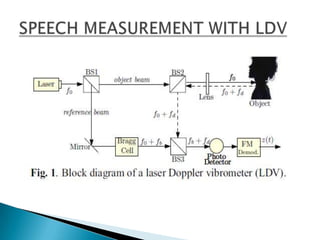
   fd(t) = 2ν(t) cos(α)/λ

ν(t)=> instantaneous throat-vibrational
  velocity
α => Angle between the object beam and the
  velocity vector
λ =>laser wavelength.

   LDV-output signal after an FM-demodulator
    is
       Z(t) = fb + [2Av cos(α)/λ].cos(2πfvt). (1)









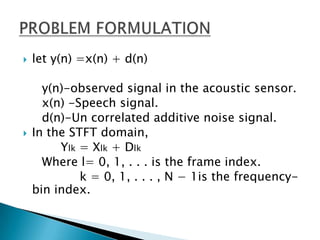
   let y(n) =x(n) + d(n)

      y(n)-observed signal in the acoustic sensor.
      x(n) -Speech signal.
      d(n)-Un correlated additive noise signal.
   In the STFT domain,
         Ylk = Xlk + Dlk
      Where l= 0, 1, . . . is the frame index.
             k = 0, 1, . . . , N − 1is the frequency-
    bin index.
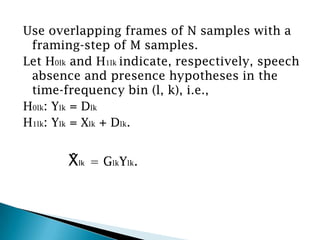
Use overlapping frames of N samples with a
 framing-step of M samples.
Let H0lk and H1lk indicate, respectively, speech
 absence and presence hypotheses in the
 time-frequency bin (l, k), i.e.,
H0lk: Ylk = Dlk
H1lk: Ylk = Xlk + Dlk.


       X̂lk   = GlkYlk.
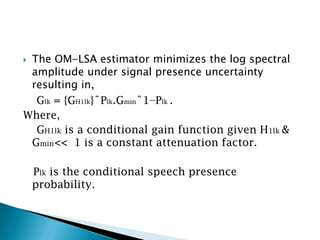
The OM-LSA estimator minimizes the log spectral
 amplitude under signal presence uncertainty
 resulting in,
  Glk = {GH1lk}ˆPlk.Gminˆ1−Plk .
Where,
  GH1lk is a conditional gain function given H1lk &
 Gmin<< 1 is a constant attenuation factor.

    Plk is the conditional speech presence
    probability.
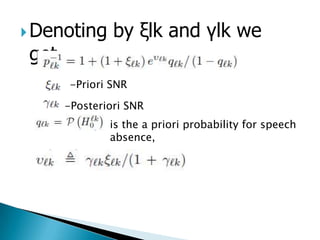
 Denoting       by ξlk and γlk we
 get,
         -Priori SNR
        -Posteriori SNR
                is the a priori probability for speech
                absence,
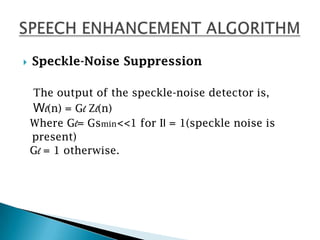
   Speckle-Noise Suppression

    The output of the speckle-noise detector is,
    Wl(n) = Gl Zl(n)
    Where Gl= Gsmin<<1 for Il = 1(speckle noise is
    present)
    Gl = 1 otherwise.
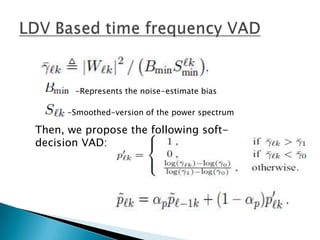
-Represents the noise-estimate bias

     -Smoothed-version of the power spectrum

Then, we propose the following soft-
decision VAD:
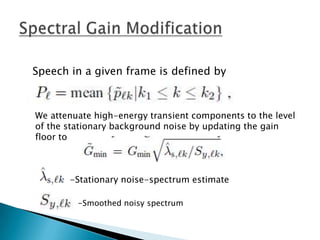
Speech in a given frame is defined by


We attenuate high-energy transient components to the level
of the stationary background noise by updating the gain
floor to


       -Stationary noise-spectrum estimate

         -Smoothed noisy spectrum
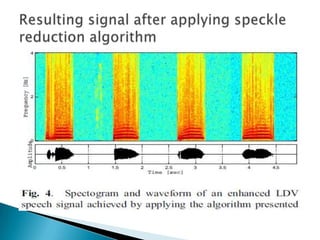
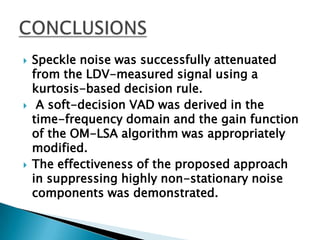
   Speckle noise was successfully attenuated
    from the LDV-measured signal using a
    kurtosis-based decision rule.
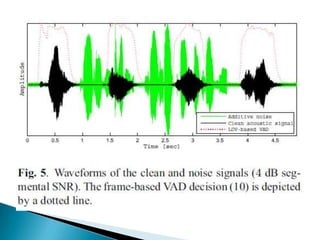
    A soft-decision VAD was derived in the
    time-frequency domain and the gain function
    of the OM-LSA algorithm was appropriately
    modified.
   The effectiveness of the proposed approach
    in suppressing highly non-stationary noise
    components was demonstrated.
   I. Cohen and B. Berdugo, “Speech enhancement for nonstationary noise
    environment,” Signal Process., vol. 81
   T. F. Quatieri, K. Brady, D. Messing, J. P. Campbell, W. M. Campbell, M. S.
    Brandstein, C. J.Weinstein, J. D. Tardelli, and P. D. Gatewood, “Exploiting
    nonacoustic sensors for speech encoding,”
   T. Dekens, W. Verhelst, F. Capman, and F. Beaugendre, “Improved speech
    recognition in noisy environments by using a throat microphone for accurate
    voicing detection,” in 18th European Signal Processing Conf. (EUSIPCO),
    Aallborg, Denmark, Aug. 2010, pp. 23–27
   M. Johansmann, G. Siegmund, and M. Pineda, “Targeting the limits of laser
    doppler vibrometry,”
   http://www.metrolaserinc.com
Speech measurement using laser doppler vibrometer

Speech measurement using laser doppler vibrometer

  • 1.
    Guided By: Presented By: Asif Ali Shamil. C Lecturer in E.I Roll no: 68 E.I
  • 2.
    Introduction  Speech measurement with LDV  Principe of LDV  Measurement Setup  Problem formulation  Speech Enhancement Algorithm  Speckle noise suppression  LDV-Based time frequency VAD  Spectral gain modification  Experimental Results  Conclusion
  • 3.
    Achieving high speech intelligibility in noisy environments is one of the most challenging and important problems for existing speech- enhancement and speech-recognition systems.  Recently, several approaches have been proposed that make use of auxiliary non acoustic sensors, such as bone and throat- microphones.  Major drawback of most existing sensors is the requirement for a physical contact between the sensor and the speaker.  Here present an alternative approach that enables a remote measurement of speech, using an auxiliary laser Doppler vibrometer (LDV) sensor.
  • 5.
    fd(t) = 2ν(t) cos(α)/λ ν(t)=> instantaneous throat-vibrational velocity α => Angle between the object beam and the velocity vector λ =>laser wavelength.  LDV-output signal after an FM-demodulator is Z(t) = fb + [2Av cos(α)/λ].cos(2πfvt). (1)
  • 7.
  • 9.
    let y(n) =x(n) + d(n) y(n)-observed signal in the acoustic sensor. x(n) -Speech signal. d(n)-Un correlated additive noise signal.  In the STFT domain, Ylk = Xlk + Dlk Where l= 0, 1, . . . is the frame index. k = 0, 1, . . . , N − 1is the frequency- bin index.
  • 10.
    Use overlapping framesof N samples with a framing-step of M samples. Let H0lk and H1lk indicate, respectively, speech absence and presence hypotheses in the time-frequency bin (l, k), i.e., H0lk: Ylk = Dlk H1lk: Ylk = Xlk + Dlk. X̂lk = GlkYlk.
  • 11.
    The OM-LSA estimatorminimizes the log spectral amplitude under signal presence uncertainty resulting in, Glk = {GH1lk}ˆPlk.Gminˆ1−Plk . Where, GH1lk is a conditional gain function given H1lk & Gmin<< 1 is a constant attenuation factor. Plk is the conditional speech presence probability.
  • 12.
     Denoting by ξlk and γlk we get, -Priori SNR -Posteriori SNR is the a priori probability for speech absence,
  • 13.
    Speckle-Noise Suppression The output of the speckle-noise detector is, Wl(n) = Gl Zl(n) Where Gl= Gsmin<<1 for Il = 1(speckle noise is present) Gl = 1 otherwise.
  • 15.
    -Represents the noise-estimatebias -Smoothed-version of the power spectrum Then, we propose the following soft- decision VAD:
  • 17.
    Speech in agiven frame is defined by We attenuate high-energy transient components to the level of the stationary background noise by updating the gain floor to -Stationary noise-spectrum estimate -Smoothed noisy spectrum
  • 19.
    Speckle noise was successfully attenuated from the LDV-measured signal using a kurtosis-based decision rule.  A soft-decision VAD was derived in the time-frequency domain and the gain function of the OM-LSA algorithm was appropriately modified.  The effectiveness of the proposed approach in suppressing highly non-stationary noise components was demonstrated.
  • 20.
    I. Cohen and B. Berdugo, “Speech enhancement for nonstationary noise environment,” Signal Process., vol. 81  T. F. Quatieri, K. Brady, D. Messing, J. P. Campbell, W. M. Campbell, M. S. Brandstein, C. J.Weinstein, J. D. Tardelli, and P. D. Gatewood, “Exploiting nonacoustic sensors for speech encoding,”  T. Dekens, W. Verhelst, F. Capman, and F. Beaugendre, “Improved speech recognition in noisy environments by using a throat microphone for accurate voicing detection,” in 18th European Signal Processing Conf. (EUSIPCO), Aallborg, Denmark, Aug. 2010, pp. 23–27  M. Johansmann, G. Siegmund, and M. Pineda, “Targeting the limits of laser doppler vibrometry,”  http://www.metrolaserinc.com