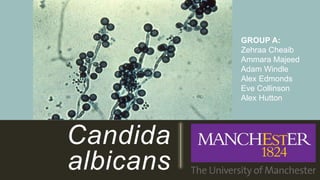
Candida
albicans
GROUP A:
Zehraa Cheaib
Ammara Majeed
Adam Windle
Alex Edmonds
Eve Collinson
Alex Hutton
CONTENTS
……………………………………………
1.Biographical Details
2.Main Address
3.Occupation
4.Strengths
5.Weaknesses
6.Notable Achievements
1. BIOGRAPHICAL
DETAILS
Alex Edmonds
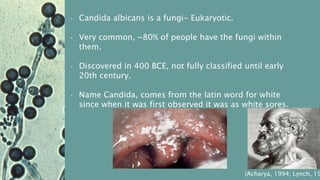
• Candida albicans is a fungi- Eukaryotic.
• Very common, ~80% of people have the fungi within
them.
• Discovered in 400 BCE, not fully classified until early
20th century.
• Name Candida, comes from the latin word for white
since when it was first observed it was as white sores.
(Acharya, 1994; Lynch, 19
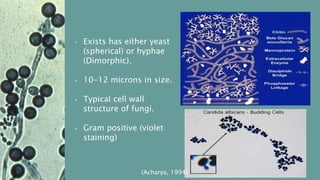
• Exists has either yeast
(spherical) or hyphae
(Dimorphic).
• 10-12 microns in size.
• Typical cell wall
structure of fungi.
• Gram positive (violet
staining)
(Acharya, 1994)
2. MAIN ADDRESS Eve Collinson
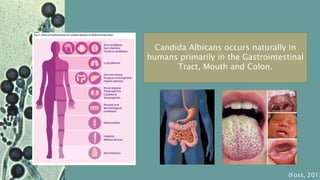
Candida Albicans occurs naturally in
humans primarily in the Gastrointestinal
Tract, Mouth and Colon.
(Foss, 2013
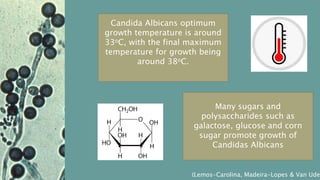
Candida Albicans optimum
growth temperature is around
33oC, with the final maximum
temperature for growth being
around 38oC.
Many sugars and
polysaccharides such as
galactose, glucose and corn
sugar promote growth of
Candidas Albicans
(Lemos-Carolina, Madeira-Lopes & Van Uden
3. OCCUPATION Alex Hutton
DISEASE STATES
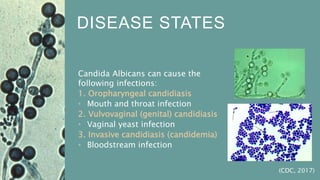
Candida Albicans can cause the
following infections:
1. Oropharyngeal candidiasis
• Mouth and throat infection
2. Vulvovaginal (genital) candidiasis
• Vaginal yeast infection
3. Invasive candidiasis (candidemia)
• Bloodstream infection
(CDC, 2017)
DISEASE
SYMPTOMSCandida Albicans infection affects
moist areas in the body such as:
• Vagina, mouth, rectum
(Kluwer, 2017)
Thrush White patches in
the mouth
Esophagitis Chest pain
Difficulty
Swallowing
Cutaneous
Candidiasis
Soreness of the
skin
Moist, red patches
on skin
Vaginal Yeast
Infection
Vaginal itchiness,
Vaginal discharge,
Pain & discomfort
during intercourse
Deep Candidiasis Fever
• Candidemia can be either long
lasting or short term.
• The longer the infection has
been in the body, the more
entrenched it is within the gut.
• A more advanced infection will
require a longer time to cure
the disease.
• Therefore….
• The severity of the Candida
overgrowth before treatment
determines how long the
disease will last.
DISEASE
CHARACTERISTICS
Other symptoms include:
• Fatigue
• Itchy eyes
• Bloating
• Constipation/ diarrhoea
(Perfect Health, 201
TRANSMISSION
(VelocityEHS, 2017; Sánchez, 2
• The main mode of transmission is Endogenous spread.
• This is caused by an overgrowth of Candida Albicans in
the human flora due to changes in the body’s
homeostasis such as:
• Changes in acidity levels.
• Reduction of ‘good bacteria’ in the body.
• A weakened immune system.
• Such changes may arise due to use of central venous
catheters in hospitals, kidney dialysis and major surgery.
TRANSMISSION (CONT.)
“Vertical Transmission of Candida and its
consequences”
25-30% of women with C.Albicans found
in vaginal secretions after pregnancy.
70-85% of these women spread the
infection to their child.
22-24% of all infants acquire this infection
via vertical transmission.
Horizontal Transmission
• via contact with excretions of mouth,
skin, and faeces from patients or
carriers.
(VelocityEHS, 2017; Blaschke-Hellmessen, 1997)
5. STRENGTHS Adam Windle
• Present in 40% of healthy adults GIT
• Is optimistically pathogenic and reacts to
environmental cues to become filamentous
form and cause infection
• Becomes pathogenic in the immuno-
compromised and critically ill
• Has incidence rate of 40% in The immuno-
compromised in hospitals
• Tongue piercings drastically increases
susceptibility
• Can be potentially fatal if invasive candidiasis
occurs whereby the infection enters the
bloodstream
(CDC, 2017; Kurzai et al., 200
• Once infected, can cause malnutrition in
patients and can affect the absorption of
drugs
• Becoming increasingly resistant to both
first and second line antifungals
• Its resistance to azoles is described as a
significant problem
• Can adapt to pH conditions
• Virulence factors include biofilm formation,
adhesins and invasins
• No vaccination against it
(Foss, 2013; Ford et al.,
4. WEAKNESSES Zehraa Cheaib
DRUG SUSCEPTIBILITY……………………………………………
Infection Treatment
Thrush Topical Nystatin & Clotrimazole
Esophagitis Oral Fluconazole
Cutaneous candidiasis Antifungal Powders & creams
Vaginal Yeast Infection Butoconazole, Clotrimazole,
Miconazole, Nystatin, Tioconazole,
or Single-dose Oral Fluconazole
Deep candidiasis IV Voriconazole, Fluconazole,
Caspogungin or Micafungin
SUSCEPTIBILITY TO
DISINFECTANTS, PHYSICAL
INACTIVATION &
SURVEILLANCE
…………………………
• 1% sodium hypchlorite
• 2% glutaraldehyde
• Formaldehyde
• 70% ethanol
• Inactivated at 121°C
• Monitor for symptoms
• Microscopic demonstration
in fluid / tissue
(VelocityEHS, 201
ANTI-
CANDIDAL
VACCINATI
ON
………………
Als Vaccine
SAP
Vaccine
• Recently, vaccines
targeting Candida ha
ve been described in
preclinical trials.
(Wang et al., 2015; Spellberg, 20
6. NOTABLE
ACHIEVEMENTS
Ammara Majeed
(Ballou et al., 201
MENTAL HEALTH
CONDITIONS
ADDICTI
ON
Acetylaldehyde Tetrahydroisoquin
olone
Opiate Poppy Plants
(Perkins, 201
46000
CASES
OF
INVASI
VE
CANDI
DA
EVERY
YEAR
IN THE
(CDC, 2017
REFERENCES
Acharya, T. (2016). Candida albicans: pathogenesis, diseases and laboratory diagnosis. In Microbe Online. Retrieved March 12, 2017, from
http://microbeonline.com/candida-albicans-pathogenesis-diagnosis/
Ballou, E. R., Avelar, G. M., Childers, D. S., Mackie, J., Bain, J. M., Wagener, J., ... & Erwig, L. P. (2016). Lactate signalling regulates fungal β-
glucan masking and immune evasion. Nature Microbiology, 2, 16238.
CDC. (2017). Invasive Candidiasis Statistics. In Centers for disease control and prevention. Retrieved March 12, 2017, from
https://www.cdc.gov/fungal/diseases/candidiasis/invasive/statistics.html
DrAxe. (2017). 9 Candida Symptoms & 3 Steps to Treat Them. In DrAxe. Retrieved March 12, 2017, from https://draxe.com/candida-
symptoms/
Evans, E. G. V., Odds, F. C., Richardson, M. D., & Holland, K. T. (1975). Optimum conditions for initiation of filamentation in Candida
albicans. Canadian journal of microbiology, 21(3), 338-342.
Ford, C. B., Funt, J. M., Abbey, D., Issi, L., Guiducci, C., Martinez, D. A., ... & Rao, R. P. (2015). The evolution of drug resistance in clinical
isolates of Candida albicans. Elife, 4, e00662.
Foss, S. (2013). Candida albicans. In Microbe Wiki. Retrieved March 12, 2017, from
https://microbewiki.kenyon.edu/index.php/Candida_albicans
Hidalgo, J. A. (2016). Candidiasis. In Medscape. Retrieved March 13, 2017, from http://emedicine.medscape.com/article/213853-overview
Kluwer, W. (2017). Candidiasis. In Drugs.com. Retrieved March 12, 2017, from https://www.drugs.com/health-guide/candidiasis.html
Kurzai, O., Schmitt, C., Bröcker, E. B., Frosch, M., & Kolb-Mäurer, A. (2005). Polymorphism of Candida albicans is a major factor in the
interaction with human dendritic cells. International journal of medical microbiology, 295(2), 121-127.
Lemos‐Carolino, M., Madeira‐Lopes, A., & Van Uden, N. (1982). The temperature profile of the pathogenic yeast Candida albicans. Journal of
Basic Microbiology, 22(10), 705-709.
Lynch, D. P. (1994). Oral candidiasis: history, classification, and clinical presentation. Oral surgery, oral medicine, oral pathology, 78(2), 189-
193.
McCourtie, J. A. N. E., & Douglas, L. J. (1981). Relationship between cell surface composition of Candida albicans and adherence to acrylic after
growth on different carbon sources. Infection and Immunity, 32(3), 1234-1241.
Perkins, C. (2015). 15 Fascinating Facts About Candida You May Not Know. In Holistic Help. Retrieved March 12, 2017, from
http://www.holistichelp.net/blog/15-fascinating-facts-about-candida-you-may-not-know/
Spellberg, B., 2011. Vaccines for invasive fungal infections. F1000 Med Rep, 3(13), pp.10-3410.
University of Minnesota. (2013). Discovery of sexual mating in Candida albicans could provide insights into infections. In ScienceDaily.
Retrieved March 12, 2017, from https://www.sciencedaily.com/releases/2013/01/130130143632.htm
VelocityEHS. (2017). Free Safety Data Sheet Index. In MSDS Online. Retrieved March 12, 2017, from

Microbial CV on Candida albicans

  • 1.
    Candida albicans GROUP A: Zehraa Cheaib AmmaraMajeed Adam Windle Alex Edmonds Eve Collinson Alex Hutton
  • 2.
  • 3.
  • 4.
    • Candida albicansis a fungi- Eukaryotic. • Very common, ~80% of people have the fungi within them. • Discovered in 400 BCE, not fully classified until early 20th century. • Name Candida, comes from the latin word for white since when it was first observed it was as white sores. (Acharya, 1994; Lynch, 19
  • 5.
    • Exists haseither yeast (spherical) or hyphae (Dimorphic). • 10-12 microns in size. • Typical cell wall structure of fungi. • Gram positive (violet staining) (Acharya, 1994)
  • 6.
    2. MAIN ADDRESSEve Collinson
  • 7.
    Candida Albicans occursnaturally in humans primarily in the Gastrointestinal Tract, Mouth and Colon. (Foss, 2013
  • 8.
    Candida Albicans optimum growthtemperature is around 33oC, with the final maximum temperature for growth being around 38oC. Many sugars and polysaccharides such as galactose, glucose and corn sugar promote growth of Candidas Albicans (Lemos-Carolina, Madeira-Lopes & Van Uden
  • 9.
  • 10.
    DISEASE STATES Candida Albicanscan cause the following infections: 1. Oropharyngeal candidiasis • Mouth and throat infection 2. Vulvovaginal (genital) candidiasis • Vaginal yeast infection 3. Invasive candidiasis (candidemia) • Bloodstream infection (CDC, 2017)
  • 11.
    DISEASE SYMPTOMSCandida Albicans infectionaffects moist areas in the body such as: • Vagina, mouth, rectum (Kluwer, 2017) Thrush White patches in the mouth Esophagitis Chest pain Difficulty Swallowing Cutaneous Candidiasis Soreness of the skin Moist, red patches on skin Vaginal Yeast Infection Vaginal itchiness, Vaginal discharge, Pain & discomfort during intercourse Deep Candidiasis Fever
  • 12.
    • Candidemia canbe either long lasting or short term. • The longer the infection has been in the body, the more entrenched it is within the gut. • A more advanced infection will require a longer time to cure the disease. • Therefore…. • The severity of the Candida overgrowth before treatment determines how long the disease will last. DISEASE CHARACTERISTICS Other symptoms include: • Fatigue • Itchy eyes • Bloating • Constipation/ diarrhoea (Perfect Health, 201
  • 13.
    TRANSMISSION (VelocityEHS, 2017; Sánchez,2 • The main mode of transmission is Endogenous spread. • This is caused by an overgrowth of Candida Albicans in the human flora due to changes in the body’s homeostasis such as: • Changes in acidity levels. • Reduction of ‘good bacteria’ in the body. • A weakened immune system. • Such changes may arise due to use of central venous catheters in hospitals, kidney dialysis and major surgery.
  • 14.
    TRANSMISSION (CONT.) “Vertical Transmissionof Candida and its consequences” 25-30% of women with C.Albicans found in vaginal secretions after pregnancy. 70-85% of these women spread the infection to their child. 22-24% of all infants acquire this infection via vertical transmission. Horizontal Transmission • via contact with excretions of mouth, skin, and faeces from patients or carriers. (VelocityEHS, 2017; Blaschke-Hellmessen, 1997)
  • 15.
  • 16.
    • Present in40% of healthy adults GIT • Is optimistically pathogenic and reacts to environmental cues to become filamentous form and cause infection • Becomes pathogenic in the immuno- compromised and critically ill • Has incidence rate of 40% in The immuno- compromised in hospitals • Tongue piercings drastically increases susceptibility • Can be potentially fatal if invasive candidiasis occurs whereby the infection enters the bloodstream (CDC, 2017; Kurzai et al., 200
  • 17.
    • Once infected,can cause malnutrition in patients and can affect the absorption of drugs • Becoming increasingly resistant to both first and second line antifungals • Its resistance to azoles is described as a significant problem • Can adapt to pH conditions • Virulence factors include biofilm formation, adhesins and invasins • No vaccination against it (Foss, 2013; Ford et al.,
  • 18.
  • 19.
    DRUG SUSCEPTIBILITY…………………………………………… Infection Treatment ThrushTopical Nystatin & Clotrimazole Esophagitis Oral Fluconazole Cutaneous candidiasis Antifungal Powders & creams Vaginal Yeast Infection Butoconazole, Clotrimazole, Miconazole, Nystatin, Tioconazole, or Single-dose Oral Fluconazole Deep candidiasis IV Voriconazole, Fluconazole, Caspogungin or Micafungin
  • 20.
    SUSCEPTIBILITY TO DISINFECTANTS, PHYSICAL INACTIVATION& SURVEILLANCE ………………………… • 1% sodium hypchlorite • 2% glutaraldehyde • Formaldehyde • 70% ethanol • Inactivated at 121°C • Monitor for symptoms • Microscopic demonstration in fluid / tissue (VelocityEHS, 201
  • 21.
    ANTI- CANDIDAL VACCINATI ON ……………… Als Vaccine SAP Vaccine • Recently,vaccines targeting Candida ha ve been described in preclinical trials. (Wang et al., 2015; Spellberg, 20
  • 22.
  • 23.
  • 24.
  • 25.
  • 26.
    REFERENCES Acharya, T. (2016).Candida albicans: pathogenesis, diseases and laboratory diagnosis. In Microbe Online. Retrieved March 12, 2017, from http://microbeonline.com/candida-albicans-pathogenesis-diagnosis/ Ballou, E. R., Avelar, G. M., Childers, D. S., Mackie, J., Bain, J. M., Wagener, J., ... & Erwig, L. P. (2016). Lactate signalling regulates fungal β- glucan masking and immune evasion. Nature Microbiology, 2, 16238. CDC. (2017). Invasive Candidiasis Statistics. In Centers for disease control and prevention. Retrieved March 12, 2017, from https://www.cdc.gov/fungal/diseases/candidiasis/invasive/statistics.html DrAxe. (2017). 9 Candida Symptoms & 3 Steps to Treat Them. In DrAxe. Retrieved March 12, 2017, from https://draxe.com/candida- symptoms/ Evans, E. G. V., Odds, F. C., Richardson, M. D., & Holland, K. T. (1975). Optimum conditions for initiation of filamentation in Candida albicans. Canadian journal of microbiology, 21(3), 338-342. Ford, C. B., Funt, J. M., Abbey, D., Issi, L., Guiducci, C., Martinez, D. A., ... & Rao, R. P. (2015). The evolution of drug resistance in clinical isolates of Candida albicans. Elife, 4, e00662. Foss, S. (2013). Candida albicans. In Microbe Wiki. Retrieved March 12, 2017, from https://microbewiki.kenyon.edu/index.php/Candida_albicans Hidalgo, J. A. (2016). Candidiasis. In Medscape. Retrieved March 13, 2017, from http://emedicine.medscape.com/article/213853-overview Kluwer, W. (2017). Candidiasis. In Drugs.com. Retrieved March 12, 2017, from https://www.drugs.com/health-guide/candidiasis.html Kurzai, O., Schmitt, C., Bröcker, E. B., Frosch, M., & Kolb-Mäurer, A. (2005). Polymorphism of Candida albicans is a major factor in the interaction with human dendritic cells. International journal of medical microbiology, 295(2), 121-127. Lemos‐Carolino, M., Madeira‐Lopes, A., & Van Uden, N. (1982). The temperature profile of the pathogenic yeast Candida albicans. Journal of Basic Microbiology, 22(10), 705-709. Lynch, D. P. (1994). Oral candidiasis: history, classification, and clinical presentation. Oral surgery, oral medicine, oral pathology, 78(2), 189- 193. McCourtie, J. A. N. E., & Douglas, L. J. (1981). Relationship between cell surface composition of Candida albicans and adherence to acrylic after growth on different carbon sources. Infection and Immunity, 32(3), 1234-1241. Perkins, C. (2015). 15 Fascinating Facts About Candida You May Not Know. In Holistic Help. Retrieved March 12, 2017, from http://www.holistichelp.net/blog/15-fascinating-facts-about-candida-you-may-not-know/ Spellberg, B., 2011. Vaccines for invasive fungal infections. F1000 Med Rep, 3(13), pp.10-3410. University of Minnesota. (2013). Discovery of sexual mating in Candida albicans could provide insights into infections. In ScienceDaily. Retrieved March 12, 2017, from https://www.sciencedaily.com/releases/2013/01/130130143632.htm VelocityEHS. (2017). Free Safety Data Sheet Index. In MSDS Online. Retrieved March 12, 2017, from

Editor's Notes

  • #5 Lynch, D. P. (1994). Oral candidiasis: history, classification, and clinical presentation. Oral surgery, oral medicine, oral pathology, 78(2), 189-193. Acharya, T. (2016). Candida albicans: pathogenesis, diseases and laboratory diagnosis. In Microbe Online. Retrieved March 12, 2017, from http://microbeonline.com/candida-albicans-pathogenesis-diagnosis/
  • #6 Lynch, D. P. (1994). Oral candidiasis: history, classification, and clinical presentation. Oral surgery, oral medicine, oral pathology, 78(2), 189-193. Acharya, T. (2016). Candida albicans: pathogenesis, diseases and laboratory diagnosis. In Microbe Online. Retrieved March 12, 2017, from http://microbeonline.com/candida-albicans-pathogenesis-diagnosis/
  • #13 Perfect Health. (2017). How Long Should Each Stage Last?. In The Candida Diet. Retrieved March 12, 2017, from https://www.thecandidadiet.com/how-long-should-each-stage-last/
  • #14 Sánchez, G. M. (2006). Clinical spectrum of invasive candidiasis in critically ill non-neutropenic patients. Revista iberoamericana de micologia, 23(1), 8-11.
  • #15 Blaschke-Hellmessen, R. (1997). Vertical transmission of Candida and its consequences. Mycoses, 41, 31-36.
  • #19 Candidas albicans has many weaknesses, one of which its susceptibility to antifungal medications
  • #20 Its susceptibility to medical drugs makes it treatable Depending on the disease state & affected area, the type of treatment & formulation will vary For examples, Esophagitis can be treated with an oral anti-fungal drug such as oral fluconazole once a day. Sensitive to nystatin, clotrimazole, ketoconazole,, & amphotericin B in various formulationsl like ointments, creams, capsules and even IV For example, doctors treat thrush with topical, antifungal such as nystatin and clotrimazole. For mild cases, a liquid version of nystatin can be swished in the mouth and swallowed, or a clotrimazole lozenge can be dissolved in the mouth. For more severe cases, fluconazole can be taken once a day by mouth. - For Cutaneous candidiasis —The affected area must be kept clean and dry and protected from chafing. -Vaginal yeast infections —applied directly into the vagina as tablets, creams, ointments or suppositories. Sex partners usually do not need to be treated. - For Deep candidiasis — This infection usually starts with IV (Voriconazole, Fluconazole). People with very low white blood cell counts may need an alternative IV drug, such as caspofungin or micafungin
  • #21 Regarding Infection Control: - Discuss disinfectants in relation to fungal infections Sensitive to 1% sodium hypochlorite (when dissolved in water, known as bleach), 2% glutaraldehyde (used to sanitze surgical & dental equipment), formaldehyde; only moderately sensitive to 70% ethanol
  • #22 Current: No approved antifungal vaccination for clinical use Recently, vaccines targeting Candida have been described in preclinical trials. SAP (secreted aspartyl proteinase): Analyzed gene expression 130 subjects with oral and vaginal C. albicans infections Resulted in significant fungal clearance in vagina: No C. albicans detected in the vaccination group compared to the control Tested in rats and humans A Sap2p vaccine is one of the more promising candidates and has gone through Phase I clinical trials against C. albicans infection. This active vaccine, which is now in development by Pevion Biotech, prevents vaginitis caused by C. albicans and shows both tolerability and efficacy in humans. Als (agglutinin-like sequence) Vaccine: Tested in mice Vaccination with candidal surface adhesins Als1p or Als3p protected mice from lethal candidiasis Reduced fungal infection (vaginitis & oropharyngeal candidiasis)
  • #24 Ballou, E. R., Avelar, G. M., Childers, D. S., Mackie, J., Bain, J. M., Wagener, J., ... & Erwig, L. P. (2016). Lactate signalling regulates fungal β-glucan masking and immune evasion. Nature Microbiology, 2, 16238.
  • #25 Perkins, C. (2015). 15 Fascinating Facts About Candida You May Not Know. In Holistic Help. Retrieved March 12, 2017, from http://www.holistichelp.net/blog/15-fascinating-facts-about-candida-you-may-not-know/
  • #26 CDC. (2017). Invasive Candidiasis Statistics. In Centers for disease control and prevention. Retrieved March 12, 2017, from https://www.cdc.gov/fungal/diseases/candidiasis/invasive/statistics.html