Prof.Dr. Fhim Shaltout
Professor of Meat Hygiene
Faculty of Veterinary Medicne
Benha University
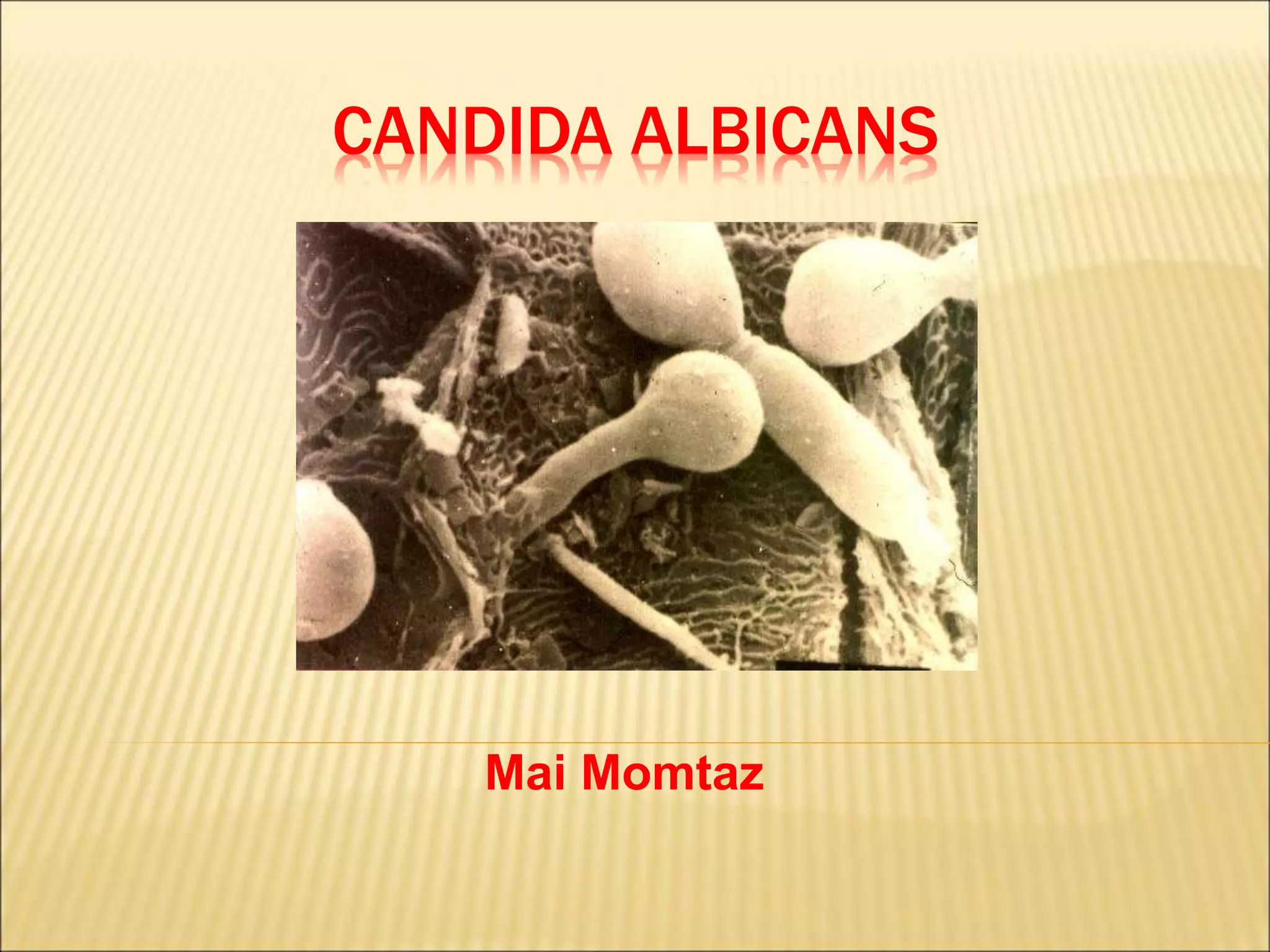
CANDIDA ALBICANS
Mai Momtaz
GENERAL INFORMATION
 Classification:
Dimorphic fungus- can
exist in yeast and fungal
form (virulence factor)
 Genus: Candida
 Species: albicans
 Shape: spores and
hyphae(branching tubes
that make up the body of
a multicellular fungus)
 Size: 10-12 µm in
diameter
 Gram +
 Growth: reproduces by
budding
 pH: Needs a slightly
alkaline environment to
thrive , a pH about 7.4
 Temperature: 37°C,
warm and damp
environments
 Oxygen: Facultative
anaerobes
SPORES / HYPHAE
DIAGNOSIS
 Complete medical evaluation and history, with physical
exam that focuses on the area of the body with
symptoms
 Diagnosis is made based on signs and symptoms, and
clusters of budding yeast
 Generally, a doctor takes a sample of the vaginal
discharge or swabs an area of oral or skin lesions,
urine, feces, and nail clippings
 Fungal blood and stool cultures for detection of
Candida should be taken for patients suspected of
having deep organ candidiasis
 Tissue biopsy may be needed for invasive systemic
disease.
ROUTE OF TRANSMISSION/PORTAL OF ENTRY
 C. Albicans is normally present on the skin and in
mucous membranes such as the vagina, mouth,
rectum, and digestive tract
 The fungus also can travel through the blood stream in
immunocompromised individuals
 Candida can enter newborn infants during or shortly
after birth
 This organism is OPPORTUNISTIC- for example,
antibiotics kill the good bacteria leaving Candida free to
grow
HOW CANDIDA CAUSES AN INFECTION:
 The infections caused by all species of Candida
are called Candidiasis-most commonly Candida
albicans
 Candida is known to impair immune functioning
by directly and negatively impacting the helper-
suppresser ratio of T lymphocytes
 Organism causes disease by invading human
tissue by means of pseudohyphae (long
filaments) which can penetrate intracellular cracks
 The overgrowth of Candida is complex and a
difficult condition to overcome once it enters the
body. It is one of the most highly adaptive
organisms, and has the ability to mutate and
develop stronger forms of itself
HOW IT AFFECTS THE IMMUNE SYSTEM
 T-cell efficiency can be influenced to a useful extent by
nutrition.
 It is largely the suppressors which are involved in fighting
Candida
 It’s adaptability allows it to produce disguising anitgens
which deter the immune system from recognizing it as
foreign and harmful.
 In this way the immune system may eventually become
non-responsive to the presence of Candida albicans.
 Impaired production and function of the T-cell
lymphocytes cannot effectively regulate B-cell
immunoglobulin production. As a result the body cannot
discriminate between harmless and potentially toxic
agents.
TOXINS
 Produces toxins
-Gliotoxin: inactivates important enzymes, and is
cytotoxic
-Acetaldehyde: normal by-product of metabolism,
however excess production of this by Candida can
cause impaired neuro-transmission in the brain
 Candida Albicans and its toxins can infiltrate and
effect any organ or system in the body and can be
responsible for a large variety of physical and mental
health conditions that we see so commonly in people
today
 Toxic waste can also be absorbed into the blood
stream
DEMOGRAPHICS:
 Candidiasis is an extremely common infection.
Thrush occurs in approximately 2–5 percent of
healthy newborns and occurs in a slightly higher
percentage of infants during their first year of
life.
 Over 1 million adult women and adolescent girls
in the United States develop vaginal yeast
infections each year. It is not life-threatening,
but the condition can be uncomfortable and
frustrating.
COMMON FACTORS THAT CAN CAUSE
INFECTION:
 A common cause of Candida albicans fungus
is the overuse of antibiotics or oral
contraceptives
 Steroid hormone medication, ex. Cortisone,
or corticosteroids often prescribed for skin
conditions such as rashes, eczema
 Suppressed immune systems, ex. Patients
with diabetes, HIV/AIDS, and that receive
radiation or chemotherapy
 High sugar and starch diet (yeasts live on
sugar, and starches are converted into sugar
very quickly during our digestion process)
AREAS AFFECTED:
 Candida species can infect tissues in essentially
every body system, producing a wide range of
clinical manifestations
 is called thrush when it grows in the mouth,
especially in infants
 shows up on skin as a red, inflamed, and sometimes
scaly rash, ex: diaper rash
 causes vaginitis, commonly known as a yeast
infection
 causes candidal onchomycosis in the nails
 can affect the esophagus and the digestive tract
 Candidal infection of the penis may result from
sexual intercourse with an infected partner
C. ALBICANS IN AIDS PATIENTS
 In immunocompromised patients, when body
resistance is low as in leukemia or HIV/AIDS,
Candida albicans can enter the bloodstream
and causes systemic infection
 The more debilitated the host the more invasive
the disease
 Candida albicans is one of several mycoses
(fungal disease) that account for most deaths
associated with AIDS
 So common in HIV+ individuals that their
mycoses are part of what defines end-stage
AIDS
OROPHARYNGEAL CANDIDIASIS (THRUSH)
 Yeast infection that develops in
the mouth
 White plaques in mouth,
tongue, gums, palate, and/or
pharynx
 Preventable by practicing good
oral hygiene
 To prevent from spreading to
infants: treat vaginal yeast
infections during last 3 months
of pregnancy, wash bottles and
pacifiers, and do not reuse
bottles more than an hour after
a baby has drank from it
ONYCHOMYCOSIS (NAIL INFECTION)
 Also categorized under
cutaneous candidiasis
 Characterized by red swelling
around the nails, destruction
of nail tissue, and loss of nail
 Occurs more often in toenails
than fingernails because
toenails are often confined to
warm and moist environments
 Difficult to treat; OTC creams
and ointments available, but
not very effective; Oral
antifungal medications work
best, ex: Lamisil
OCULAR CANDIDIASIS
 Characterized by cloudy
vision, and lesions within
the eye
 Caused through the spread
of Candida in the blood
stream, indwelling
catheters, IV drug abuse,
ocular trauma/surgery
 Prevention: avoid IV drug
abuse
 Treatment: Amphotericin B
SYMPTOMS OF INFECTION:
 Oxygen-carrying red blood cells are rigid and stiff when compared to
patients without candida
 Fatigue
 Carbohydrate craving
 Topical infections of fingernails, vaginal infections, underarm
infections
 White coated tongue
 Increased allergic symptoms
 Reduced thyroid function
 Lowered immune system and increased susceptibility to viral
infections
 T-cell helper/suppressor ratios radically lowered
 Up to 3/4 of the lymphocytes become paralyzed
 Candida seems to upset the function of organs as opposed to
damaging them
TREATMENT:
 Antifungal medications -- these include oral rinses and
tablets, vaginal tablets and suppositories, and creams.
For vaginal yeast infections, medications that are
available over the counter include creams and
suppositories such as Monistat, Vagistat, and Gyne-
Lotrimin. Your doctor may prescribe a pill, Diflucan
 Creams combined with low-strength corticosteroids --
reduce inflammation and itching.
 The “Candida diet”- detox, probiotics, improve what you
eat
 Most treatments last from 2 - 3 days to 2 weeks. Be sure
to take all medicine exactly as prescribed. If you do not,
the same infection could come back, or you could
become infected with a new strain of candida.
 For severe candidiasis that could be life threatening to
someone with a comprised immune system, your doctor
may prescribe an IV medication, amphotericin B.
VACCINE/CURE?
 Recently researchers used recombinant DNA
to create a live vaccine, and have conjugated
fungal antigens with diphtheria toxoid to
create a vaccine against Candida
PREVENTION:
 Good personal hygiene
 Keeping skin clean, dry, and free from
abrasions or cuts
 Avoid high sugar, starch, and carbohydrates
in your diet
 Taking sufficient amounts of probiotics, to
repopulate normal flora
REFERENCES
 Bauman, R. W. (2011). Microbiology With Diseases by Taxonomy (Third ed. , pp.
635-636). San Francisco: Pearson Education, Inc.
 Hunt, R. (2010, October 27). Mycology-Chapter 3 Yeasts. In Microbiology and
Immunology On-line. Retrieved October 28, 2010, from
http://pathmicro.med.sc.edu/mycology/mycology-3.htm
 The Chronic Candidiasis Syndrome. (n.d.). In Candida-Shmeeda Beating the
Fungus. Retrieved November 15, 2010, from
http://overcomingcandida.com/index.htm
 Candida General Information. (2003). In Fungus Focus. Retrieved October 28,
2010, from http://www.fungusfocus.com/html/candida_info.htm
 Web MD Health Senior Staff and Editorial Team. (2008, March 10). Thrush-
Prevention. In Web MD. Retrieved November 18, 2010, from
http://www.webmd.com/oral-health/tc/thrush-prevention
 Candida Albicans Fungus. (2010). In Candida Cure Zone. Retrieved October 28,
2010, from http://www.candidacurezone.com/candida-albicans-fungus.html
REFERENCES CON’T
 W.L. and Suzi Wolcott. (n.d.). In C ANDIDA A LBICANS . . . Are You Winning
Battles But Losing the War? . Retrieved November 12, 2010, from
http://www.healthexcel.com/docs/_cand1.html
 Iwata, K.; Yamamoto, . (1977, June). Candida and the Immune System. In
Immune System. Retrieved November 14, 2010, from
http://overcomingcandida.com/candida_and_the_immune_system.htm
 Bauman, Ph.D, R. W., & MAchunis-Masuoka, Ph.D, E. (2004). Microbiology with
Diseases by Taxonomy (Third ed. , pp. 626-640). San Francisco: Benjamin
Cummings.

Candida Albicans.ppt

  • 1.
    Prof.Dr. Fhim Shaltout Professorof Meat Hygiene Faculty of Veterinary Medicne Benha University
  • 2.
  • 3.
    GENERAL INFORMATION  Classification: Dimorphicfungus- can exist in yeast and fungal form (virulence factor)  Genus: Candida  Species: albicans  Shape: spores and hyphae(branching tubes that make up the body of a multicellular fungus)  Size: 10-12 µm in diameter  Gram +  Growth: reproduces by budding  pH: Needs a slightly alkaline environment to thrive , a pH about 7.4  Temperature: 37°C, warm and damp environments  Oxygen: Facultative anaerobes
  • 4.
  • 5.
    DIAGNOSIS  Complete medicalevaluation and history, with physical exam that focuses on the area of the body with symptoms  Diagnosis is made based on signs and symptoms, and clusters of budding yeast  Generally, a doctor takes a sample of the vaginal discharge or swabs an area of oral or skin lesions, urine, feces, and nail clippings  Fungal blood and stool cultures for detection of Candida should be taken for patients suspected of having deep organ candidiasis  Tissue biopsy may be needed for invasive systemic disease.
  • 6.
    ROUTE OF TRANSMISSION/PORTALOF ENTRY  C. Albicans is normally present on the skin and in mucous membranes such as the vagina, mouth, rectum, and digestive tract  The fungus also can travel through the blood stream in immunocompromised individuals  Candida can enter newborn infants during or shortly after birth  This organism is OPPORTUNISTIC- for example, antibiotics kill the good bacteria leaving Candida free to grow
  • 7.
    HOW CANDIDA CAUSESAN INFECTION:  The infections caused by all species of Candida are called Candidiasis-most commonly Candida albicans  Candida is known to impair immune functioning by directly and negatively impacting the helper- suppresser ratio of T lymphocytes  Organism causes disease by invading human tissue by means of pseudohyphae (long filaments) which can penetrate intracellular cracks  The overgrowth of Candida is complex and a difficult condition to overcome once it enters the body. It is one of the most highly adaptive organisms, and has the ability to mutate and develop stronger forms of itself
  • 8.
    HOW IT AFFECTSTHE IMMUNE SYSTEM  T-cell efficiency can be influenced to a useful extent by nutrition.  It is largely the suppressors which are involved in fighting Candida  It’s adaptability allows it to produce disguising anitgens which deter the immune system from recognizing it as foreign and harmful.  In this way the immune system may eventually become non-responsive to the presence of Candida albicans.  Impaired production and function of the T-cell lymphocytes cannot effectively regulate B-cell immunoglobulin production. As a result the body cannot discriminate between harmless and potentially toxic agents.
  • 9.
    TOXINS  Produces toxins -Gliotoxin:inactivates important enzymes, and is cytotoxic -Acetaldehyde: normal by-product of metabolism, however excess production of this by Candida can cause impaired neuro-transmission in the brain  Candida Albicans and its toxins can infiltrate and effect any organ or system in the body and can be responsible for a large variety of physical and mental health conditions that we see so commonly in people today  Toxic waste can also be absorbed into the blood stream
  • 10.
    DEMOGRAPHICS:  Candidiasis isan extremely common infection. Thrush occurs in approximately 2–5 percent of healthy newborns and occurs in a slightly higher percentage of infants during their first year of life.  Over 1 million adult women and adolescent girls in the United States develop vaginal yeast infections each year. It is not life-threatening, but the condition can be uncomfortable and frustrating.
  • 11.
    COMMON FACTORS THATCAN CAUSE INFECTION:  A common cause of Candida albicans fungus is the overuse of antibiotics or oral contraceptives  Steroid hormone medication, ex. Cortisone, or corticosteroids often prescribed for skin conditions such as rashes, eczema  Suppressed immune systems, ex. Patients with diabetes, HIV/AIDS, and that receive radiation or chemotherapy  High sugar and starch diet (yeasts live on sugar, and starches are converted into sugar very quickly during our digestion process)
  • 12.
    AREAS AFFECTED:  Candidaspecies can infect tissues in essentially every body system, producing a wide range of clinical manifestations  is called thrush when it grows in the mouth, especially in infants  shows up on skin as a red, inflamed, and sometimes scaly rash, ex: diaper rash  causes vaginitis, commonly known as a yeast infection  causes candidal onchomycosis in the nails  can affect the esophagus and the digestive tract  Candidal infection of the penis may result from sexual intercourse with an infected partner
  • 13.
    C. ALBICANS INAIDS PATIENTS  In immunocompromised patients, when body resistance is low as in leukemia or HIV/AIDS, Candida albicans can enter the bloodstream and causes systemic infection  The more debilitated the host the more invasive the disease  Candida albicans is one of several mycoses (fungal disease) that account for most deaths associated with AIDS  So common in HIV+ individuals that their mycoses are part of what defines end-stage AIDS
  • 15.
    OROPHARYNGEAL CANDIDIASIS (THRUSH) Yeast infection that develops in the mouth  White plaques in mouth, tongue, gums, palate, and/or pharynx  Preventable by practicing good oral hygiene  To prevent from spreading to infants: treat vaginal yeast infections during last 3 months of pregnancy, wash bottles and pacifiers, and do not reuse bottles more than an hour after a baby has drank from it
  • 16.
    ONYCHOMYCOSIS (NAIL INFECTION) Also categorized under cutaneous candidiasis  Characterized by red swelling around the nails, destruction of nail tissue, and loss of nail  Occurs more often in toenails than fingernails because toenails are often confined to warm and moist environments  Difficult to treat; OTC creams and ointments available, but not very effective; Oral antifungal medications work best, ex: Lamisil
  • 17.
    OCULAR CANDIDIASIS  Characterizedby cloudy vision, and lesions within the eye  Caused through the spread of Candida in the blood stream, indwelling catheters, IV drug abuse, ocular trauma/surgery  Prevention: avoid IV drug abuse  Treatment: Amphotericin B
  • 18.
    SYMPTOMS OF INFECTION: Oxygen-carrying red blood cells are rigid and stiff when compared to patients without candida  Fatigue  Carbohydrate craving  Topical infections of fingernails, vaginal infections, underarm infections  White coated tongue  Increased allergic symptoms  Reduced thyroid function  Lowered immune system and increased susceptibility to viral infections  T-cell helper/suppressor ratios radically lowered  Up to 3/4 of the lymphocytes become paralyzed  Candida seems to upset the function of organs as opposed to damaging them
  • 19.
    TREATMENT:  Antifungal medications-- these include oral rinses and tablets, vaginal tablets and suppositories, and creams. For vaginal yeast infections, medications that are available over the counter include creams and suppositories such as Monistat, Vagistat, and Gyne- Lotrimin. Your doctor may prescribe a pill, Diflucan  Creams combined with low-strength corticosteroids -- reduce inflammation and itching.  The “Candida diet”- detox, probiotics, improve what you eat  Most treatments last from 2 - 3 days to 2 weeks. Be sure to take all medicine exactly as prescribed. If you do not, the same infection could come back, or you could become infected with a new strain of candida.  For severe candidiasis that could be life threatening to someone with a comprised immune system, your doctor may prescribe an IV medication, amphotericin B.
  • 20.
    VACCINE/CURE?  Recently researchersused recombinant DNA to create a live vaccine, and have conjugated fungal antigens with diphtheria toxoid to create a vaccine against Candida
  • 21.
    PREVENTION:  Good personalhygiene  Keeping skin clean, dry, and free from abrasions or cuts  Avoid high sugar, starch, and carbohydrates in your diet  Taking sufficient amounts of probiotics, to repopulate normal flora
  • 22.
    REFERENCES  Bauman, R.W. (2011). Microbiology With Diseases by Taxonomy (Third ed. , pp. 635-636). San Francisco: Pearson Education, Inc.  Hunt, R. (2010, October 27). Mycology-Chapter 3 Yeasts. In Microbiology and Immunology On-line. Retrieved October 28, 2010, from http://pathmicro.med.sc.edu/mycology/mycology-3.htm  The Chronic Candidiasis Syndrome. (n.d.). In Candida-Shmeeda Beating the Fungus. Retrieved November 15, 2010, from http://overcomingcandida.com/index.htm  Candida General Information. (2003). In Fungus Focus. Retrieved October 28, 2010, from http://www.fungusfocus.com/html/candida_info.htm  Web MD Health Senior Staff and Editorial Team. (2008, March 10). Thrush- Prevention. In Web MD. Retrieved November 18, 2010, from http://www.webmd.com/oral-health/tc/thrush-prevention  Candida Albicans Fungus. (2010). In Candida Cure Zone. Retrieved October 28, 2010, from http://www.candidacurezone.com/candida-albicans-fungus.html
  • 23.
    REFERENCES CON’T  W.L.and Suzi Wolcott. (n.d.). In C ANDIDA A LBICANS . . . Are You Winning Battles But Losing the War? . Retrieved November 12, 2010, from http://www.healthexcel.com/docs/_cand1.html  Iwata, K.; Yamamoto, . (1977, June). Candida and the Immune System. In Immune System. Retrieved November 14, 2010, from http://overcomingcandida.com/candida_and_the_immune_system.htm  Bauman, Ph.D, R. W., & MAchunis-Masuoka, Ph.D, E. (2004). Microbiology with Diseases by Taxonomy (Third ed. , pp. 626-640). San Francisco: Benjamin Cummings.