EXTREMA ON AN
INTERVAL
Section 3.1
When you are done with your
homework, you should be able
to…
• Understand the definition of
extrema of a function on an interval
• Understand the definition of relative
extrema of a function on an open
interval
• Find extrema on a closed interval
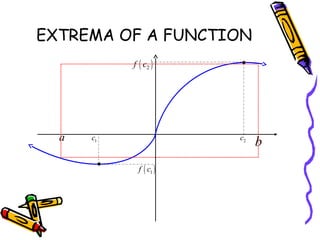
EXTREMA OF A FUNCTION
f ( c2 )

a

c1

•

c2

•

f ( c1 )

b
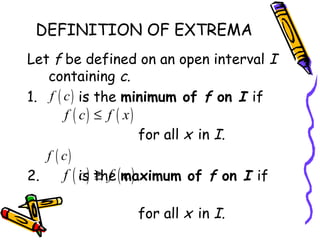
DEFINITION OF EXTREMA
Let f be defined on an open interval I
containing c.
1. f ( c ) is the minimum of f on I if
f ( c) ≤ f ( x)
for all x in I.
f ( c)
f ( is) the (maximum of f on I if
c ≥ f c)
2.
for all x in I.
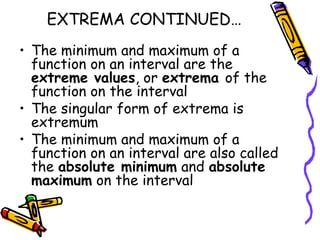
EXTREMA CONTINUED…
• The minimum and maximum of a
function on an interval are the
extreme values, or extrema of the
function on the interval
• The singular form of extrema is
extremum
• The minimum and maximum of a
function on an interval are also called
the absolute minimum and absolute
maximum on the interval
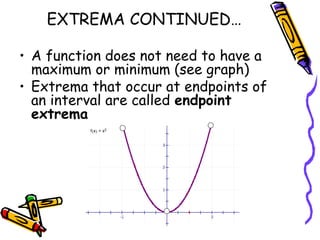
EXTREMA CONTINUED…
• A function does not need to have a
maximum or minimum (see graph)
• Extrema that occur at endpoints of
an interval are called endpoint
extrema
f (x) = x2
3

2

1

-2

2
THE EXTREME VALUE
THEOREM
If f is continuous on a closed interval
[ a, b] , then f has both a minimum
and a maximum on the interval.
DEFINITION OF RELATIVE
EXTREMA
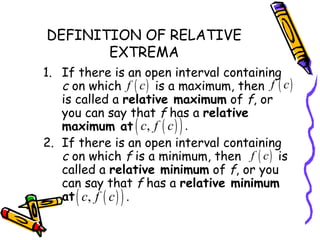
1. If there is an open interval containing
c on which f ( c ) is a maximum, then f ( c )
is called a relative maximum of f, or
you can say that f has a relative
maximum at c, f ( c ) .
2. If there is an open interval containing
c on which f is a minimum, then f ( c ) is
called a relative minimum of f, or you
can say that f has a relative minimum
at c, f ( c ) .

(

(

)

)
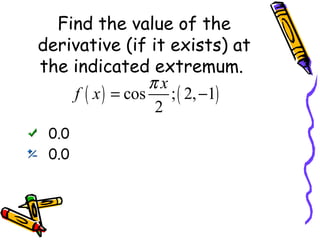
Find the value of the
derivative (if it exists) at
the indicated extremum.
πx
f ( x ) = cos ; ( 2, −1)
2
0.0
0.0
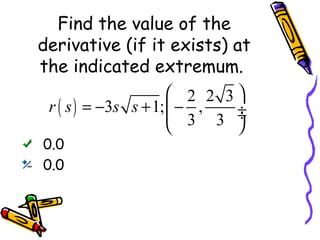
Find the value of the
derivative (if it exists) at
the indicated extremum.
 2 2 3
r ( s ) = −3s s + 1;  − ,
 3 3 ÷
÷


0.0
0.0
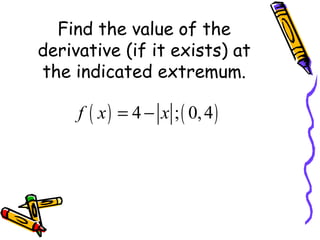
Find the value of the
derivative (if it exists) at
the indicated extremum.

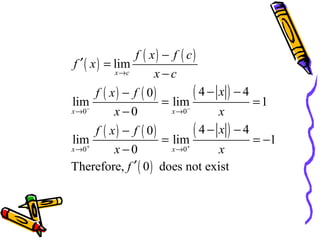
f ( x ) = 4 − x ; ( 0, 4 )
f ( x) − f ( c)
f ′ ( x ) = lim
x →c
x−c

f ( x ) − f ( 0)
( 4 − x ) − 4 =1
lim
= lim−
−
x →0
x →0
x−0
x
f ( x ) − f ( 0)
( 4 − x ) − 4 = −1
lim
= lim+
+
x →0
x →0
x−0
x
Therefore, f ′ ( 0 ) does not exist
DEFINITION OF A CRITICAL
NUMBER
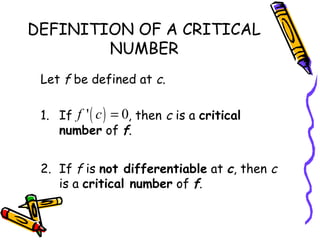
Let f be defined at c.
1. If f ' ( c ) = 0, then c is a critical
number of f.
2. If f is not differentiable at c, then c
is a critical number of f.
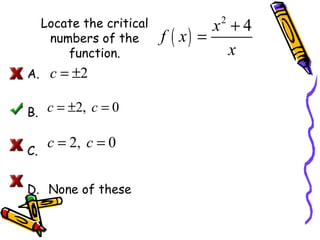
Locate the critical
numbers of the
function.
A.

c = ±2

B. c = ±2, c = 0
C.

c = 2, c = 0

D. None of these

x +4
f ( x) =
x
2
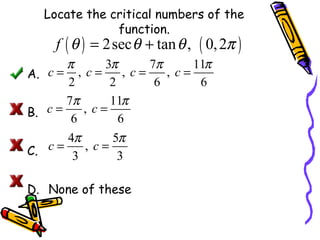
Locate the critical numbers of the
function.

f ( θ ) = 2sec θ + tan θ , ( 0, 2π )

π
3π
7π
11π
, c=
, c=
A. c = , c =
2
2
6
6
7π
11π
B. c = 6 , c = 6
4π
5π
C. c = 3 , c = 3
D. None of these
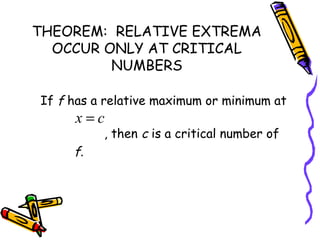
THEOREM: RELATIVE EXTREMA
OCCUR ONLY AT CRITICAL
NUMBERS
If f has a relative maximum or minimum at

x=c

, then c is a critical number of

f.
GUIDELINES FOR FINDING
EXTREMA ON A CLOSED
INTERVAL
To find the extrema of a continuous function
f on a closed interval [ a, b ] , use the
following steps.
1. Find the critical numbers of in .
2. Evaluate f at each critical number in ( a, b ).
3. Evaluate f at each endpoint of [ a, b] .
4. The least of these outputs is the
minimum. The greatest is the maximum.
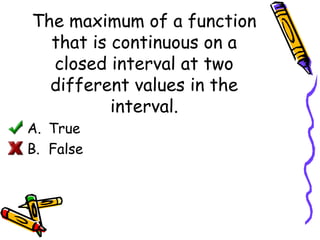
The maximum of a function
that is continuous on a
closed interval at two
different values in the
interval.
A. True
B. False

3.1 extrema on an interval

  • 1.
  • 2.
    When you aredone with your homework, you should be able to… • Understand the definition of extrema of a function on an interval • Understand the definition of relative extrema of a function on an open interval • Find extrema on a closed interval
  • 3.
    EXTREMA OF AFUNCTION f ( c2 ) a c1 • c2 • f ( c1 ) b
  • 4.
    DEFINITION OF EXTREMA Letf be defined on an open interval I containing c. 1. f ( c ) is the minimum of f on I if f ( c) ≤ f ( x) for all x in I. f ( c) f ( is) the (maximum of f on I if c ≥ f c) 2. for all x in I.
  • 5.
    EXTREMA CONTINUED… • Theminimum and maximum of a function on an interval are the extreme values, or extrema of the function on the interval • The singular form of extrema is extremum • The minimum and maximum of a function on an interval are also called the absolute minimum and absolute maximum on the interval
  • 6.
    EXTREMA CONTINUED… • Afunction does not need to have a maximum or minimum (see graph) • Extrema that occur at endpoints of an interval are called endpoint extrema f (x) = x2 3 2 1 -2 2
  • 7.
    THE EXTREME VALUE THEOREM Iff is continuous on a closed interval [ a, b] , then f has both a minimum and a maximum on the interval.
  • 8.
    DEFINITION OF RELATIVE EXTREMA 1.If there is an open interval containing c on which f ( c ) is a maximum, then f ( c ) is called a relative maximum of f, or you can say that f has a relative maximum at c, f ( c ) . 2. If there is an open interval containing c on which f is a minimum, then f ( c ) is called a relative minimum of f, or you can say that f has a relative minimum at c, f ( c ) . ( ( ) )
  • 9.
    Find the valueof the derivative (if it exists) at the indicated extremum. πx f ( x ) = cos ; ( 2, −1) 2 0.0 0.0
  • 10.
    Find the valueof the derivative (if it exists) at the indicated extremum.  2 2 3 r ( s ) = −3s s + 1;  − ,  3 3 ÷ ÷   0.0 0.0
  • 11.
    Find the valueof the derivative (if it exists) at the indicated extremum. f ( x ) = 4 − x ; ( 0, 4 )
  • 12.
    f ( x)− f ( c) f ′ ( x ) = lim x →c x−c f ( x ) − f ( 0) ( 4 − x ) − 4 =1 lim = lim− − x →0 x →0 x−0 x f ( x ) − f ( 0) ( 4 − x ) − 4 = −1 lim = lim+ + x →0 x →0 x−0 x Therefore, f ′ ( 0 ) does not exist
  • 13.
    DEFINITION OF ACRITICAL NUMBER Let f be defined at c. 1. If f ' ( c ) = 0, then c is a critical number of f. 2. If f is not differentiable at c, then c is a critical number of f.
  • 14.
    Locate the critical numbersof the function. A. c = ±2 B. c = ±2, c = 0 C. c = 2, c = 0 D. None of these x +4 f ( x) = x 2
  • 15.
    Locate the criticalnumbers of the function. f ( θ ) = 2sec θ + tan θ , ( 0, 2π ) π 3π 7π 11π , c= , c= A. c = , c = 2 2 6 6 7π 11π B. c = 6 , c = 6 4π 5π C. c = 3 , c = 3 D. None of these
  • 16.
    THEOREM: RELATIVE EXTREMA OCCURONLY AT CRITICAL NUMBERS If f has a relative maximum or minimum at x=c , then c is a critical number of f.
  • 17.
    GUIDELINES FOR FINDING EXTREMAON A CLOSED INTERVAL To find the extrema of a continuous function f on a closed interval [ a, b ] , use the following steps. 1. Find the critical numbers of in . 2. Evaluate f at each critical number in ( a, b ). 3. Evaluate f at each endpoint of [ a, b] . 4. The least of these outputs is the minimum. The greatest is the maximum.
  • 18.
    The maximum ofa function that is continuous on a closed interval at two different values in the interval. A. True B. False