For any Homework related queries, Call us at : - +1 678 648 4277
You can mail us at : -support@mathhomeworksolver.com, or
reach us at : - https://www.mathhomeworksolver.com/
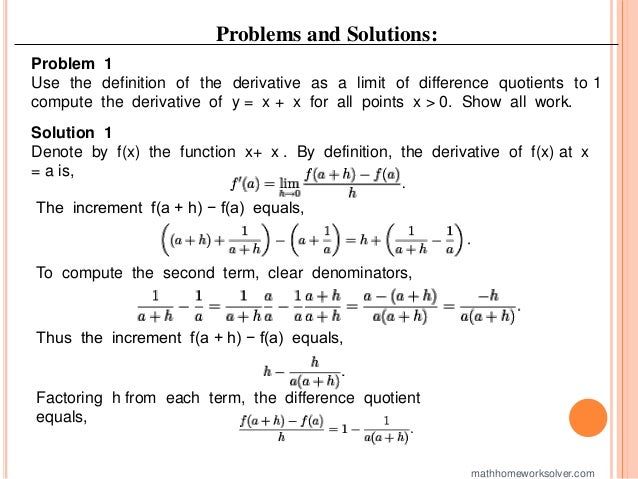
Problem 1
Use the definition of the derivative as a limit of difference quotients to 1
compute the derivative of y = x + x for all points x > 0. Show all work.
Problems and Solutions:
Solution 1
Denote by f(x) the function x+ x . By definition, the derivative of f(x) at x
= a is,
The increment f(a + h) − f(a) equals,
To compute the second term, clear denominators,
Thus the increment f(a + h) − f(a) equals,
Factoring h from each term, the difference quotient
equals,
mathhomeworksolver.com
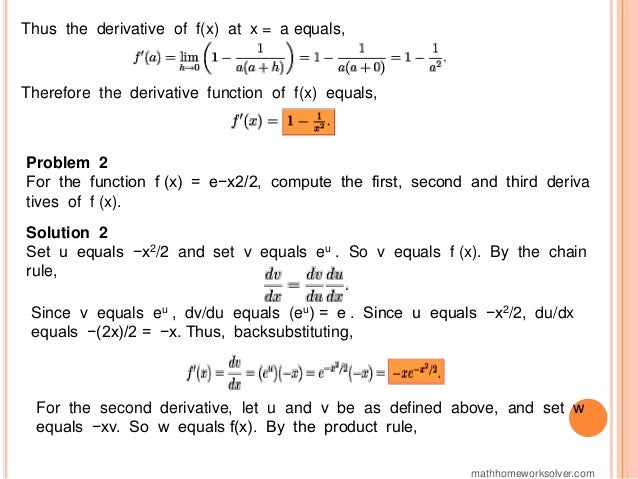
Thus the derivative of f(x) at x = a equals,
Therefore the derivative function of f(x) equals,
Problem 2
For the function f (x) = e−x2/2, compute the first, second and third deriva
tives of f (x).
Solution 2
Set u equals −x2/2 and set v equals eu . So v equals f (x). By the chain
rule,
Since v equals eu , dv/du equals (eu) = e . Since u equals −x2/2, du/dx
equals −(2x)/2 = −x. Thus, backsubstituting,
For the second derivative, let u and v be as defined above, and set w
equals −xv. So w equals f(x). By the product rule,
mathhomeworksolver.com
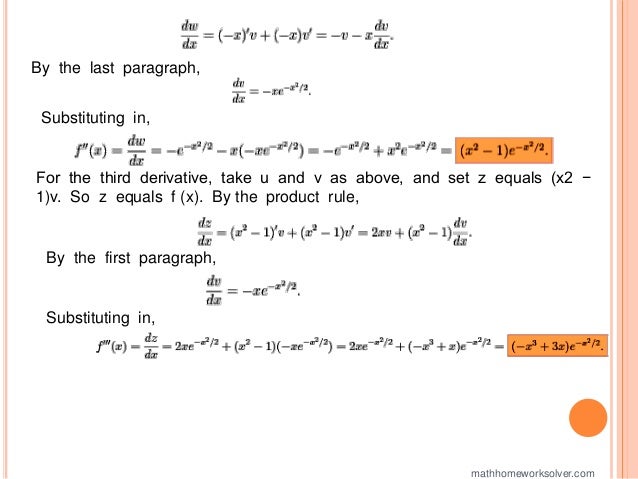
By the last paragraph,
Substituting in,
For the third derivative, take u and v as above, and set z equals (x2 −
1)v. So z equals f (x). By the product rule,
By the first paragraph,
Substituting in,
mathhomeworksolver.com
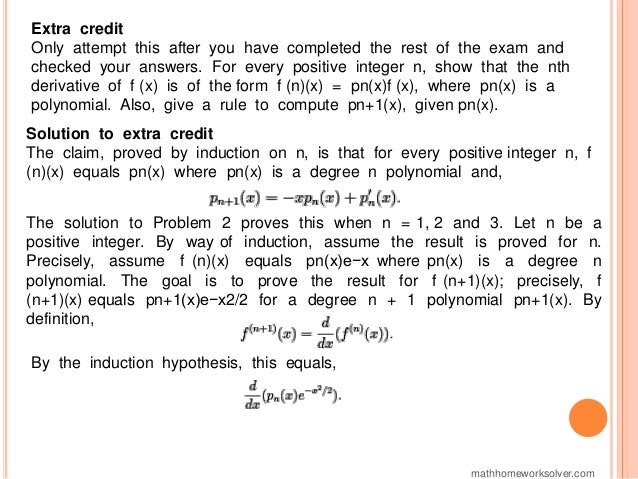
Extra credit
Only attempt this after you have completed the rest of the exam and
checked your answers. For every positive integer n, show that the nth
derivative of f (x) is of the form f (n)(x) = pn(x)f (x), where pn(x) is a
polynomial. Also, give a rule to compute pn+1(x), given pn(x).
Solution to extra credit
The claim, proved by induction on n, is that for every positive integer n, f
(n)(x) equals pn(x) where pn(x) is a degree n polynomial and,
The solution to Problem 2 proves this when n = 1, 2 and 3. Let n be a
positive integer. By way of induction, assume the result is proved for n.
Precisely, assume f (n)(x) equals pn(x)e−x where pn(x) is a degree n
polynomial. The goal is to prove the result for f (n+1)(x); precisely, f
(n+1)(x) equals pn+1(x)e−x2/2 for a degree n + 1 polynomial pn+1(x). By
definition,
By the induction hypothesis, this equals,
mathhomeworksolver.com
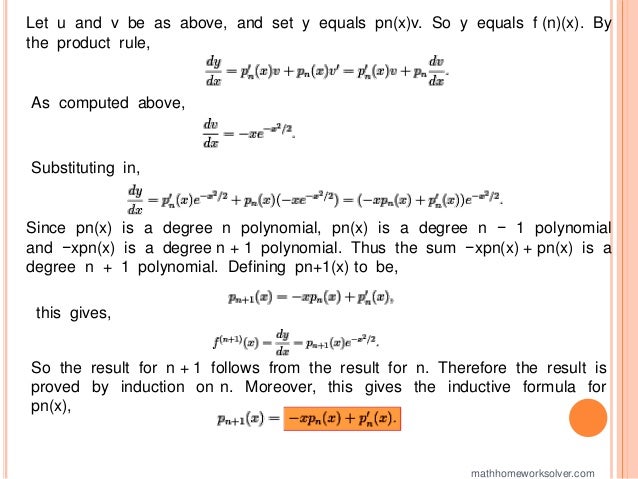
Let u and v be as above, and set y equals pn(x)v. So y equals f (n)(x). By
the product rule,
As computed above,
Substituting in,
Since pn(x) is a degree n polynomial, pn(x) is a degree n − 1 polynomial
and −xpn(x) is a degree n + 1 polynomial. Thus the sum −xpn(x) + pn(x) is a
degree n + 1 polynomial. Defining pn+1(x) to be,
this gives,
So the result for n + 1 follows from the result for n. Therefore the result is
proved by induction on n. Moreover, this gives the inductive formula for
pn(x),
mathhomeworksolver.com
Problem 3
A function y = f (x) satisfies the implicit equation,
The graph contains the point (1, 2). Find the equation of the tangent line to the
graph of y = f (x) at (1, 2).
Solution 3
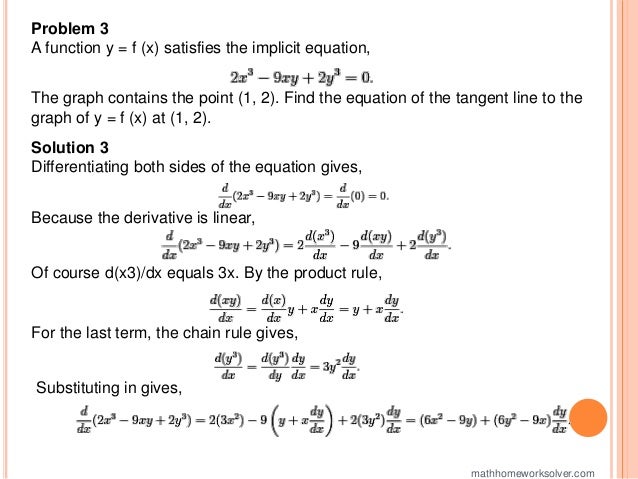
Differentiating both sides of the equation gives,
Because the derivative is linear,
Of course d(x3)/dx equals 3x. By the product rule,
For the last term, the chain rule gives,
Substituting in gives,
mathhomeworksolver.com
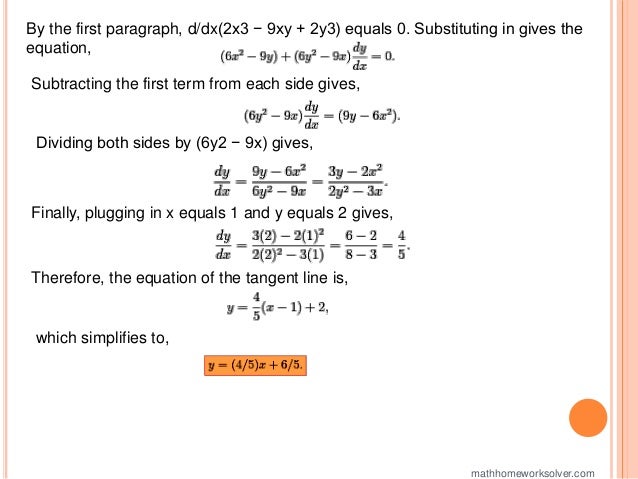
By the first paragraph, d/dx(2x3 − 9xy + 2y3) equals 0. Substituting in gives the
equation,
Subtracting the first term from each side gives,
Dividing both sides by (6y2 − 9x) gives,
Finally, plugging in x equals 1 and y equals 2 gives,
Therefore, the equation of the tangent line is,
which simplifies to,
mathhomeworksolver.com
Problem 4
The point (0, 4) is not on the graph of y = x + 1/x, but it is contained inexactly one
tangent line to the graph.
(a) Find the one value of a for which the tangent line to the graph of y = x + 1/x at(a,
a + 1/a) contains (0, 4).
Hint: You do not need to solve a quadratic equation to find a.
Solution
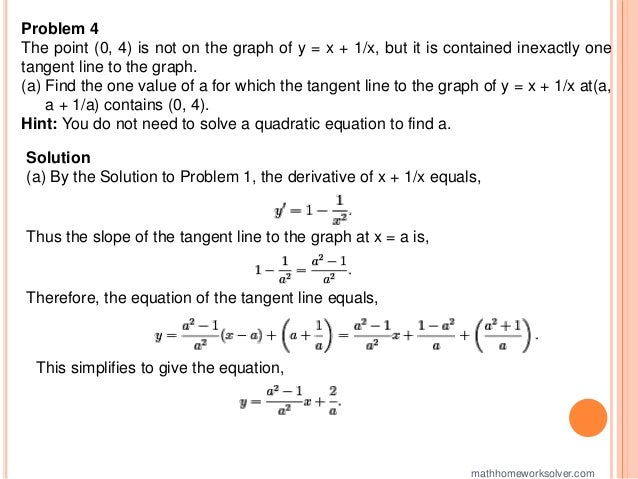
(a) By the Solution to Problem 1, the derivative of x + 1/x equals,
Thus the slope of the tangent line to the graph at x = a is,
Therefore, the equation of the tangent line equals,
This simplifies to give the equation,
mathhomeworksolver.com
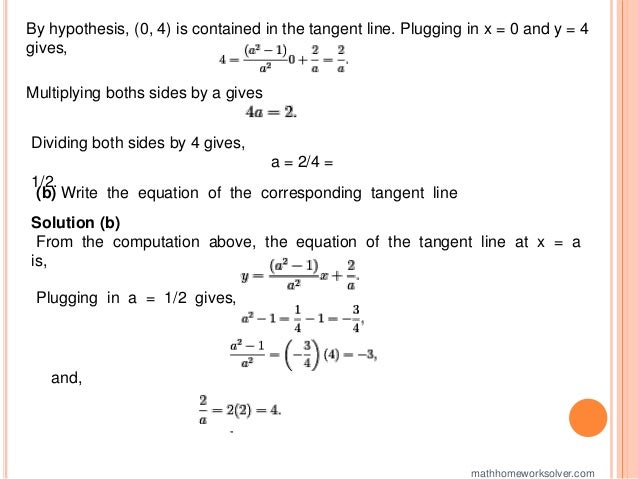
By hypothesis, (0, 4) is contained in the tangent line. Plugging in x = 0 and y = 4
gives,
Multiplying boths sides by a gives
Dividing both sides by 4 gives,
a = 2/4 =
1/2.
(b) Write the equation of the corresponding tangent line
Solution (b)
From the computation above, the equation of the tangent line at x = a
is,
Plugging in a = 1/2 gives,
and,
mathhomeworksolver.com
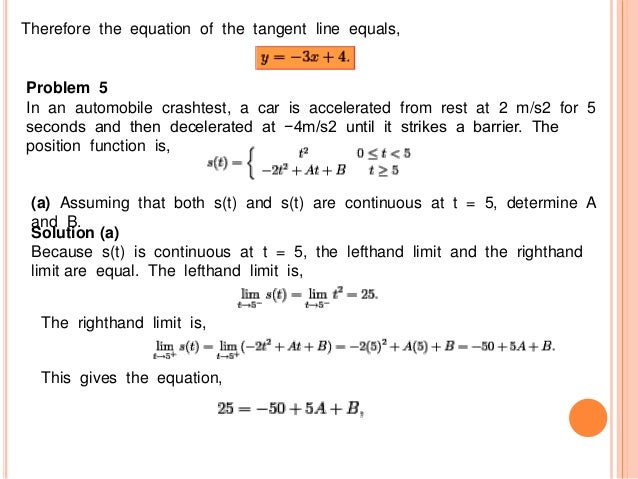
Therefore the equation of the tangent line equals,
Problem 5
In an automobile crashtest, a car is accelerated from rest at 2 m/s2 for 5
seconds and then decelerated at −4m/s2 until it strikes a barrier. The
position function is,
(a) Assuming that both s(t) and s(t) are continuous at t = 5, determine A
and B.
Solution (a)
Because s(t) is continuous at t = 5, the lefthand limit and the righthand
limit are equal. The lefthand limit is,
The righthand limit is,
This gives the equation,
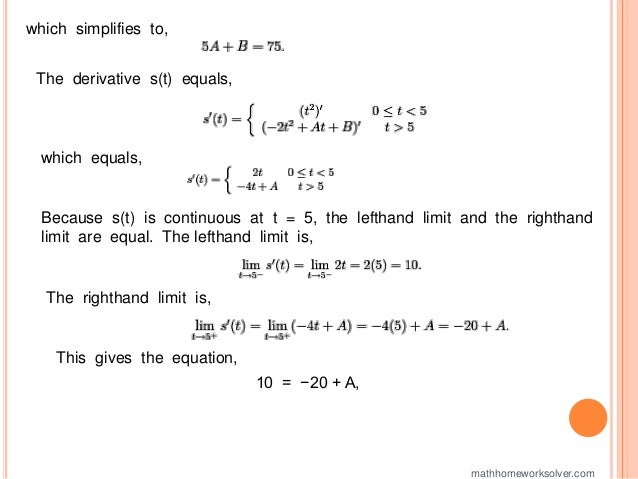
which simplifies to,
The derivative s(t) equals,
which equals,
Because s(t) is continuous at t = 5, the lefthand limit and the righthand
limit are equal. The lefthand limit is,
The righthand limit is,
This gives the equation,
10 = −20 + A,
mathhomeworksolver.com
which simplfies to,
A= 30.
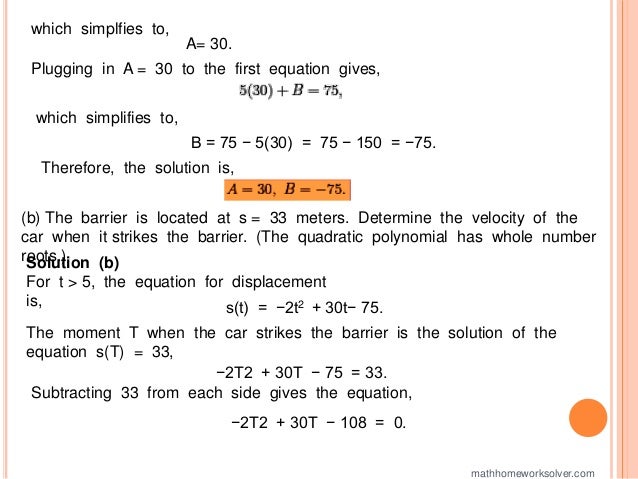
Plugging in A = 30 to the first equation gives,
which simplifies to,
B = 75 − 5(30) = 75 − 150 = −75.
Therefore, the solution is,
(b) The barrier is located at s = 33 meters. Determine the velocity of the
car when it strikes the barrier. (The quadratic polynomial has whole number
roots.)
Solution (b)
For t > 5, the equation for displacement
is, s(t) = −2t2 + 30t− 75.
The moment T when the car strikes the barrier is the solution of the
equation s(T) = 33,
−2T2 + 30T − 75 = 33.
Subtracting 33 from each side gives the equation,
−2T2 + 30T − 108 = 0.
mathhomeworksolver.com
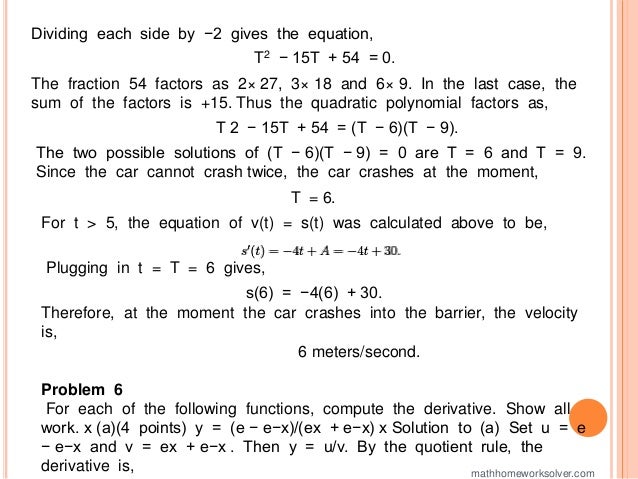
Dividing each side by −2 gives the equation,
T2 − 15T + 54 = 0.
The fraction 54 factors as 2× 27, 3× 18 and 6× 9. In the last case, the
sum of the factors is +15. Thus the quadratic polynomial factors as,
T 2 − 15T + 54 = (T − 6)(T − 9).
The two possible solutions of (T − 6)(T − 9) = 0 are T = 6 and T = 9.
Since the car cannot crash twice, the car crashes at the moment,
T = 6.
For t > 5, the equation of v(t) = s(t) was calculated above to be,
Plugging in t = T = 6 gives,
s(6) = −4(6) + 30.
Therefore, at the moment the car crashes into the barrier, the velocity
is,
6 meters/second.
Problem 6
For each of the following functions, compute the derivative. Show all
work. x (a)(4 points) y = (e − e−x)/(ex + e−x) x Solution to (a) Set u = e
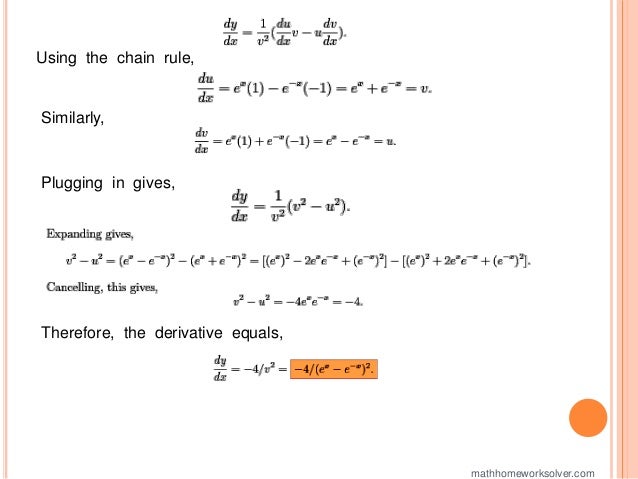
− e−x and v = ex + e−x . Then y = u/v. By the quotient rule, the
derivative is, mathhomeworksolver.com
Using the chain rule,
Similarly,
Plugging in gives,
Therefore, the derivative equals,
mathhomeworksolver.com
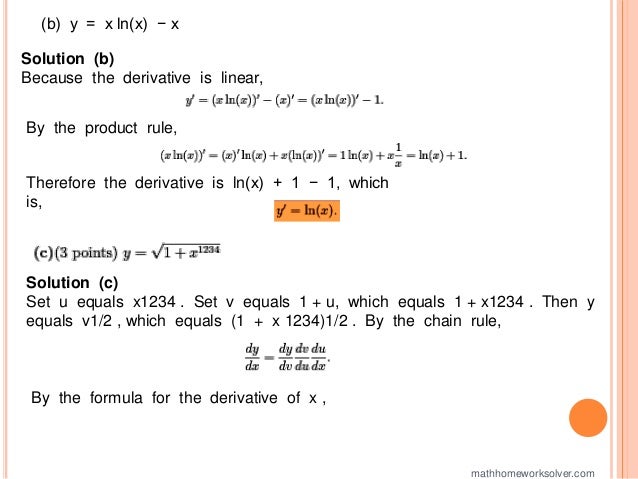
(b) y = x ln(x) − x
Solution (b)
Because the derivative is linear,
By the product rule,
Therefore the derivative is ln(x) + 1 − 1, which
is,
Solution (c)
Set u equals x1234 . Set v equals 1 + u, which equals 1 + x1234 . Then y
equals v1/2 , which equals (1 + x 1234)1/2 . By the chain rule,
By the formula for the derivative of x ,
mathhomeworksolver.com
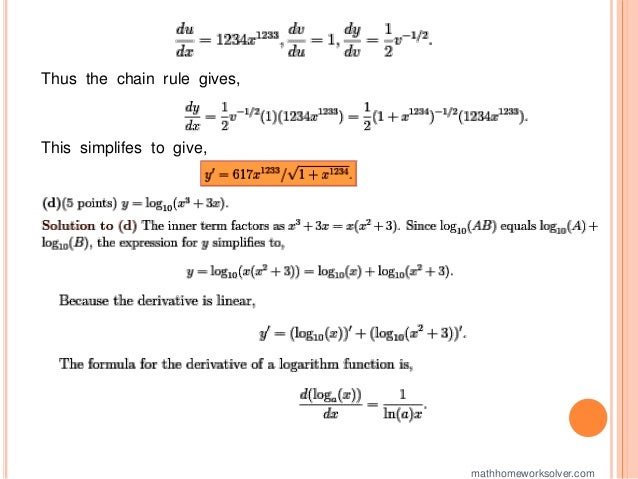
Thus the chain rule gives,
This simplifes to give,
mathhomeworksolver.com

Calculus Homework Help

  • 1.
    For any Homeworkrelated queries, Call us at : - +1 678 648 4277 You can mail us at : -support@mathhomeworksolver.com, or reach us at : - https://www.mathhomeworksolver.com/
  • 2.
    Problem 1 Use thedefinition of the derivative as a limit of difference quotients to 1 compute the derivative of y = x + x for all points x > 0. Show all work. Problems and Solutions: Solution 1 Denote by f(x) the function x+ x . By definition, the derivative of f(x) at x = a is, The increment f(a + h) − f(a) equals, To compute the second term, clear denominators, Thus the increment f(a + h) − f(a) equals, Factoring h from each term, the difference quotient equals, mathhomeworksolver.com
  • 3.
    Thus the derivativeof f(x) at x = a equals, Therefore the derivative function of f(x) equals, Problem 2 For the function f (x) = e−x2/2, compute the first, second and third deriva tives of f (x). Solution 2 Set u equals −x2/2 and set v equals eu . So v equals f (x). By the chain rule, Since v equals eu , dv/du equals (eu) = e . Since u equals −x2/2, du/dx equals −(2x)/2 = −x. Thus, backsubstituting, For the second derivative, let u and v be as defined above, and set w equals −xv. So w equals f(x). By the product rule, mathhomeworksolver.com
  • 4.
    By the lastparagraph, Substituting in, For the third derivative, take u and v as above, and set z equals (x2 − 1)v. So z equals f (x). By the product rule, By the first paragraph, Substituting in, mathhomeworksolver.com
  • 5.
    Extra credit Only attemptthis after you have completed the rest of the exam and checked your answers. For every positive integer n, show that the nth derivative of f (x) is of the form f (n)(x) = pn(x)f (x), where pn(x) is a polynomial. Also, give a rule to compute pn+1(x), given pn(x). Solution to extra credit The claim, proved by induction on n, is that for every positive integer n, f (n)(x) equals pn(x) where pn(x) is a degree n polynomial and, The solution to Problem 2 proves this when n = 1, 2 and 3. Let n be a positive integer. By way of induction, assume the result is proved for n. Precisely, assume f (n)(x) equals pn(x)e−x where pn(x) is a degree n polynomial. The goal is to prove the result for f (n+1)(x); precisely, f (n+1)(x) equals pn+1(x)e−x2/2 for a degree n + 1 polynomial pn+1(x). By definition, By the induction hypothesis, this equals, mathhomeworksolver.com
  • 6.
    Let u andv be as above, and set y equals pn(x)v. So y equals f (n)(x). By the product rule, As computed above, Substituting in, Since pn(x) is a degree n polynomial, pn(x) is a degree n − 1 polynomial and −xpn(x) is a degree n + 1 polynomial. Thus the sum −xpn(x) + pn(x) is a degree n + 1 polynomial. Defining pn+1(x) to be, this gives, So the result for n + 1 follows from the result for n. Therefore the result is proved by induction on n. Moreover, this gives the inductive formula for pn(x), mathhomeworksolver.com
  • 7.
    Problem 3 A functiony = f (x) satisfies the implicit equation, The graph contains the point (1, 2). Find the equation of the tangent line to the graph of y = f (x) at (1, 2). Solution 3 Differentiating both sides of the equation gives, Because the derivative is linear, Of course d(x3)/dx equals 3x. By the product rule, For the last term, the chain rule gives, Substituting in gives, mathhomeworksolver.com
  • 8.
    By the firstparagraph, d/dx(2x3 − 9xy + 2y3) equals 0. Substituting in gives the equation, Subtracting the first term from each side gives, Dividing both sides by (6y2 − 9x) gives, Finally, plugging in x equals 1 and y equals 2 gives, Therefore, the equation of the tangent line is, which simplifies to, mathhomeworksolver.com
  • 9.
    Problem 4 The point(0, 4) is not on the graph of y = x + 1/x, but it is contained inexactly one tangent line to the graph. (a) Find the one value of a for which the tangent line to the graph of y = x + 1/x at(a, a + 1/a) contains (0, 4). Hint: You do not need to solve a quadratic equation to find a. Solution (a) By the Solution to Problem 1, the derivative of x + 1/x equals, Thus the slope of the tangent line to the graph at x = a is, Therefore, the equation of the tangent line equals, This simplifies to give the equation, mathhomeworksolver.com
  • 10.
    By hypothesis, (0,4) is contained in the tangent line. Plugging in x = 0 and y = 4 gives, Multiplying boths sides by a gives Dividing both sides by 4 gives, a = 2/4 = 1/2. (b) Write the equation of the corresponding tangent line Solution (b) From the computation above, the equation of the tangent line at x = a is, Plugging in a = 1/2 gives, and, mathhomeworksolver.com
  • 11.
    Therefore the equationof the tangent line equals, Problem 5 In an automobile crashtest, a car is accelerated from rest at 2 m/s2 for 5 seconds and then decelerated at −4m/s2 until it strikes a barrier. The position function is, (a) Assuming that both s(t) and s(t) are continuous at t = 5, determine A and B. Solution (a) Because s(t) is continuous at t = 5, the lefthand limit and the righthand limit are equal. The lefthand limit is, The righthand limit is, This gives the equation,
  • 12.
    which simplifies to, Thederivative s(t) equals, which equals, Because s(t) is continuous at t = 5, the lefthand limit and the righthand limit are equal. The lefthand limit is, The righthand limit is, This gives the equation, 10 = −20 + A, mathhomeworksolver.com
  • 13.
    which simplfies to, A=30. Plugging in A = 30 to the first equation gives, which simplifies to, B = 75 − 5(30) = 75 − 150 = −75. Therefore, the solution is, (b) The barrier is located at s = 33 meters. Determine the velocity of the car when it strikes the barrier. (The quadratic polynomial has whole number roots.) Solution (b) For t > 5, the equation for displacement is, s(t) = −2t2 + 30t− 75. The moment T when the car strikes the barrier is the solution of the equation s(T) = 33, −2T2 + 30T − 75 = 33. Subtracting 33 from each side gives the equation, −2T2 + 30T − 108 = 0. mathhomeworksolver.com
  • 14.
    Dividing each sideby −2 gives the equation, T2 − 15T + 54 = 0. The fraction 54 factors as 2× 27, 3× 18 and 6× 9. In the last case, the sum of the factors is +15. Thus the quadratic polynomial factors as, T 2 − 15T + 54 = (T − 6)(T − 9). The two possible solutions of (T − 6)(T − 9) = 0 are T = 6 and T = 9. Since the car cannot crash twice, the car crashes at the moment, T = 6. For t > 5, the equation of v(t) = s(t) was calculated above to be, Plugging in t = T = 6 gives, s(6) = −4(6) + 30. Therefore, at the moment the car crashes into the barrier, the velocity is, 6 meters/second. Problem 6 For each of the following functions, compute the derivative. Show all work. x (a)(4 points) y = (e − e−x)/(ex + e−x) x Solution to (a) Set u = e − e−x and v = ex + e−x . Then y = u/v. By the quotient rule, the derivative is, mathhomeworksolver.com
  • 15.
    Using the chainrule, Similarly, Plugging in gives, Therefore, the derivative equals, mathhomeworksolver.com
  • 16.
    (b) y =x ln(x) − x Solution (b) Because the derivative is linear, By the product rule, Therefore the derivative is ln(x) + 1 − 1, which is, Solution (c) Set u equals x1234 . Set v equals 1 + u, which equals 1 + x1234 . Then y equals v1/2 , which equals (1 + x 1234)1/2 . By the chain rule, By the formula for the derivative of x , mathhomeworksolver.com
  • 17.
    Thus the chainrule gives, This simplifes to give, mathhomeworksolver.com
  • 18.