INTRODUCTION
Computer Assisted Instruction
(CAI) & Computer-assisted
learning (CAL)
1ANANDA.S ASST. PROFESSOR YNC
INTRODUCTION
• In advanced countries computers are being used
widely for classroom interaction and a beginning
has been made in our country too. For
classroom instruction, the computer can be used
as a substitute as well as aid to the teachers.
• The classroom uses of computers includes
individualization of instruction, display of
information, evaluation of student and
illustration of abstract idea by computer graphic
and diagram.
2ANANDA.S ASST. PROFESSOR YNC
Use of computers in education is
referred by many names such as:
• Computer Assisted Instruction(C.A.I.)
• Computer Assisted Learning(C.A.L.)
• Computer Based Education(C.B.E.)
• Computer Based Instruction(C.B.I.)
• Computer Enriched Instruction (C.E.I.)
• Computer Managed Instruction (C.M.I.)
3ANANDA.S ASST. PROFESSOR YNC
NEW TERMINOLOGY:
• Web Based Training
• Web Based Learning
• Web Based Instruction
4ANANDA.S ASST. PROFESSOR YNC
Computer Assisted Instruction (CAI) is
a term that refers to interactive
instructional strategies that use
computers to convey and teach
instructional material to students, as
well as monitor their learning.
5ANANDA.S ASST. PROFESSOR YNC
• “Computer-assisted learning (CAL) is to
convey a vast amount of information in
a very short period of time. It is a
powerful method of reinforcing concepts
and topics first introduced to you
through your textbook, and discussion
in the classroom. Computer- assisted
learning enables you in a powerful way
to comprehend complex concepts.”
6ANANDA.S ASST. PROFESSOR YNC
Self-Paced
This unique characteristic enables learners to
move as slowly or as quickly as they like.
Material included in the program can be
reviewed again and again, as many times as the
students require, without any consequences or
set backs from the program. This also helps
eliminate the negative reinforcement of students’
possible lack of mastery of previously taught
instructional material.
7ANANDA.S ASST. PROFESSOR YNC
Self-Directed
This describes the ability of earners to decide
what they want to learn, and in what order
they want to learn it, based on their unique
learning abilities and characteristics, in order to
benefit, enhance, and individualize the
learning process for students
8ANANDA.S ASST. PROFESSOR YNC
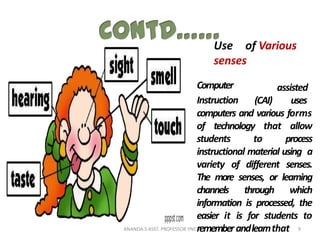
Use of Various
senses
Computer
Instruction (CAI)
assisted
uses
computers and various forms
of technology that allow
students to process
instructional material using a
variety of different senses.
The more senses, or learning
channels through which
information is processed, the
easier it is for students to
rememberandlearnthat 9ANANDA.S ASST. PROFESSOR YNC
Variety of
Media
The utilization of technology and
computers by this strategy
encourages student learning by
providing a constantly stimulating
environment and promotes
enthusiasm by presenting academic
content in a way that is
interactive, enjoyable and relatable
for students. Students are exposed
to different types of media that
they otherwise may not have
experienced orinteractedwith.
10ANANDA.S ASST. PROFESSOR YNC
Learning Rate- It is found that CAI enhances student
learning rate. Student learning rate has proven to be as
much as forty percent faster with CAI than with
traditional instruction.
Retention of Learning-According to
researchers, student scores on initial tests and delayed
tests indicate that students instructed using CAI retain
more content than if they had been instructed using
traditional instruction only.
Attitudes- A lot of the research examining CAI strategies
and their effects on student achievement and learning
outcomes simultaneously observes how student
attitudes are effected by this instructional strategy. This
has led many researchers to the consensus that using
CAI strategies will lead to more positive student attitudes
than conventional instruction.
11ANANDA.S ASST. PROFESSOR YNC
Locus of Control-Students instructed using
CAI strategies have more of an internal sense of
self-efficacy and ability to control their own
learning.
Attendance- Students had better attendance
when instructed using CAI strategies.
Motivation and Time on Task-Studies show
that students instructed by the use of CAI
strategies have higher rates of time spent on
task in class than students instructed using
traditional instruction only.
Cooperation and Collaboration-Cooperative
and positive social behaviors are greater among
students instructed using CAI strategies.
12ANANDA.S ASST. PROFESSOR YNC
MODES OF DELIVERY
OF CAI:
13ANANDA.S ASST. PROFESSOR YNC
Drill-and-Practice:-
Drill and practice provide opportunities
to the students to repeatedly practice
the skills that have previously been
presented and that further practice is
necessary for mastery. In this, the
students learn facts and memorize them
by d r i l l method
e.g. using an MCQ bank fo r d r i l l and
practice. This method is useful for
slow learners.
14ANANDA.S ASST. PROFESSOR YNC
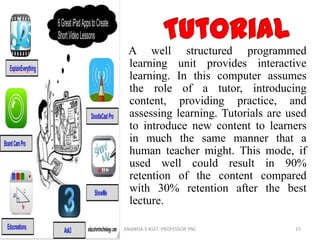
A well structured programmed
learning unit provides interactive
learning. In this computer assumes
the role of a tutor, introducing
content, providing practice, and
assessing learning. Tutorials are used
to introduce new content to learners
in much the same manner that a
human teacher might. This mode, if
used well could result in 90%
retention of the content compared
with 30% retention after the best
lecture.
15ANANDA.S ASST. PROFESSOR YNC
In tutorial method, a module lesson consists of:
 Presentation of content in a structured way
 Task prescription to elicit the learner’s response
 Instant feedback and reinforcement to the learner
 Can be effectively used by individuals or groups of 2-3
students.
Contd....
16ANANDA.S ASST. PROFESSOR YNC
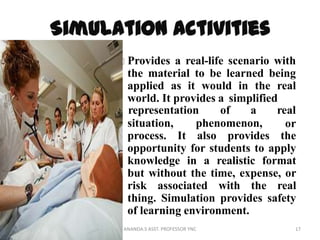
Provides a real-life scenario with
the material to be learned being
applied as it would in the real
world. It provides a simplified
situation, phenomenon,
representation of a real
or
process. It also provides the
opportunity for students to apply
knowledge in a realistic format
but without the time, expense, or
risk associated with the real
thing. Simulation provides safety
of learning environment.
17ANANDA.S ASST. PROFESSOR YNC
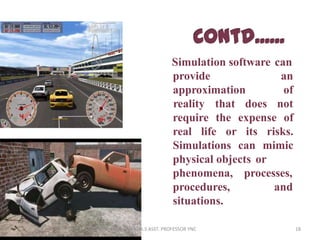
Simulation software can
provide
approximation
an
of
reality that does not
require the expense of
real life or its risks.
Simulations can mimic
physical objects or
processes,
and
phenomena,
procedures,
situations.
18ANANDA.S ASST. PROFESSOR YNC
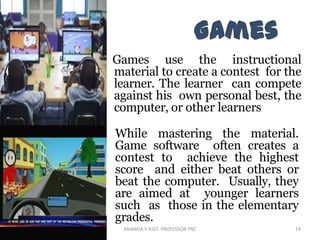
Games use the instructional
material to create a contest for the
learner. The learner can compete
against his own personal best, the
computer, or other learners
While mastering the material.
Game software often creates a
contest to achieve the highest
score and either beat others or
beat the computer. Usually, they
are aimed at younger learners
such as those in the elementary
grades.
19ANANDA.S ASST. PROFESSOR YNC
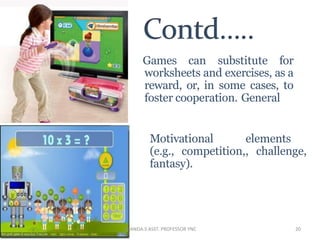
Games can substitute for
• features are:-
An end goal an.
Sensory appeal.
•
worksheets and exercises, as a
reward, or, in some cases, to
foster cooperation. General
Motivational elements
(e.g., competition,, challenge,
fantasy).
20ANANDA.S ASST. PROFESSOR YNC
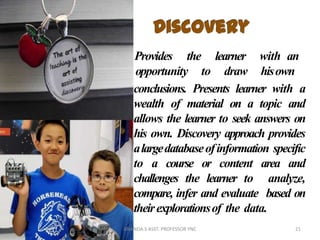
Provides the
opportunity to
learner
draw
with an
hisown
conclusions. Presents learner with a
wealth of material on a topic and
allows the learner to seek answers on
his own. Discovery approach provides
alargedatabaseofinformation specific
to a course or content area and
challenges the learner to analyze,
compare, infer and evaluate based on
theirexplorationsof the data.
21ANANDA.S ASST. PROFESSOR YNC
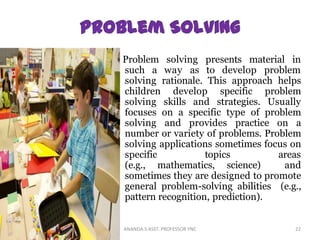
Problem solving presents material in
such a way as to develop problem
solving rationale. This approach helps
children develop specific problem
solving skills and strategies. Usually
focuses on a specific type of problem
solving and provides practice on a
number or variety of problems. Problem
solving applications sometimes focus on
specific topics areas
(e.g., mathematics, science) and
sometimes they are designed to promote
general problem-solving abilities (e.g.,
pattern recognition, prediction).
22ANANDA.S ASST. PROFESSOR YNC
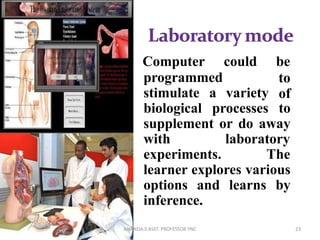
programmed
stimulate a variety
Computer could be
to
of
biological processes to
supplement or do away
with laboratory
experiments. The
learner explores various
options and learns by
inference.
23ANANDA.S ASST. PROFESSOR YNC
Choose a relevant topic.
Decide the cognitive level of the students, aimed by the
module i.e knowledge, understanding, or problem-solving.
Decide the computer assisted learning mode to be used.
Develop CAL sequence in the forms of frames.
 Introductory frame gives directions to the learner.
 Learning frame presents the matter to the learner.
 Test frame tests the learners and gives appropriate
feedback.
24ANANDA.S ASST. PROFESSOR YNC
Pre-validate the CAL by sharing them with
peers and students and get feedback.
Too easy, rigid, difficult parts need to be
revised.
Get the written CAL module converted to a
computer program.
Do post-validation of the CAL program
and make corrections if needed.
Release CAL unit for learners to use and learn.
25ANANDA.S ASST. PROFESSOR YNC
1)Interesting and
motivating
2) Compatible learningstyle
3) Promote enthusiasm
4)Helps shy and slow
learner
5) Immediate feedback
6) Error analysis
7) Critical thinking ability
8) Process design ability
9) Team work
10)Outcome oriented
process
11)Communication skills
26ANANDA.S ASST. PROFESSOR YNC
Learners with low motivation or bad study
habits may fall behind.
Without the routine structures of a traditional
class, students may get lost or confused about
course activities and deadlines.
Students may feel isolated from the instructor
and classmates.
Instructor may not always be available when
students are studying or need help.
Slow internet connections or older computers
may make accessing course materials
frustrating.
27ANANDA.S ASST. PROFESSOR YNC
Managing computer files and online
learning software can sometimes seem
complex for students with beginner-level
computer skills.
Hands-on or lab work is difficult to simulate
in a virtual classroom.
Learner may feel overwhelmed at the
volume of material presented.
28ANANDA.S ASST. PROFESSOR YNC
• Overuse of multimedia can detract from
intended learning objectives.
• Inability to ask a “person” a question when
material is not understood.
• Equipment can malfunction can occur.
• Lack of good CAI packages or lack of
infrastructure to deliver CAI.
29ANANDA.S ASST. PROFESSOR YNC
Finance problems
Poor training opportunities
Time and teacher workload
Government
Teachers’ belief
Content
Program development
30ANANDA.S ASST. PROFESSOR YNC
SudhaR. Nursingeducationprinciplesandconcepts.1sted.New Delhi:Jaypee
BrothersMedicalPublisher;2013.p. 104-105.
NeerjaKP. TextbookofNusingeducation.7thed.New Delhi:JaypeeBrothers
MedicalPublisher;2009.p. 270-272.
Sharma MC. Textbook of nursing education. 1st ed. New Delhi: Jaypee
BrothersMedicalPublisher; 2013.p.163-165.
http://www.britannica.com/EBchecked /topic/130589/computer-assisted-
instruction-CAI.
http://wikieducator.org/Computer_Assisted_Instruction_%28CAI%29
http://www.slideshare.net/nancyd 0703/computer-assisted-instruction-
2470994
http://www.slideshare.net/ryhelcan onicato/lect1-csse81
http://www.wisegeek.org/what-is-computer-assisted-instruction.htm
31ANANDA.S ASST. PROFESSOR YNC
THANKS ANY QUIRY
32ANANDA.S ASST. PROFESSOR YNC

Cai and cal anand ync

  • 1.
    INTRODUCTION Computer Assisted Instruction (CAI)& Computer-assisted learning (CAL) 1ANANDA.S ASST. PROFESSOR YNC
  • 2.
    INTRODUCTION • In advancedcountries computers are being used widely for classroom interaction and a beginning has been made in our country too. For classroom instruction, the computer can be used as a substitute as well as aid to the teachers. • The classroom uses of computers includes individualization of instruction, display of information, evaluation of student and illustration of abstract idea by computer graphic and diagram. 2ANANDA.S ASST. PROFESSOR YNC
  • 3.
    Use of computersin education is referred by many names such as: • Computer Assisted Instruction(C.A.I.) • Computer Assisted Learning(C.A.L.) • Computer Based Education(C.B.E.) • Computer Based Instruction(C.B.I.) • Computer Enriched Instruction (C.E.I.) • Computer Managed Instruction (C.M.I.) 3ANANDA.S ASST. PROFESSOR YNC
  • 4.
    NEW TERMINOLOGY: • WebBased Training • Web Based Learning • Web Based Instruction 4ANANDA.S ASST. PROFESSOR YNC
  • 5.
    Computer Assisted Instruction(CAI) is a term that refers to interactive instructional strategies that use computers to convey and teach instructional material to students, as well as monitor their learning. 5ANANDA.S ASST. PROFESSOR YNC
  • 6.
    • “Computer-assisted learning(CAL) is to convey a vast amount of information in a very short period of time. It is a powerful method of reinforcing concepts and topics first introduced to you through your textbook, and discussion in the classroom. Computer- assisted learning enables you in a powerful way to comprehend complex concepts.” 6ANANDA.S ASST. PROFESSOR YNC
  • 7.
    Self-Paced This unique characteristicenables learners to move as slowly or as quickly as they like. Material included in the program can be reviewed again and again, as many times as the students require, without any consequences or set backs from the program. This also helps eliminate the negative reinforcement of students’ possible lack of mastery of previously taught instructional material. 7ANANDA.S ASST. PROFESSOR YNC
  • 8.
    Self-Directed This describes theability of earners to decide what they want to learn, and in what order they want to learn it, based on their unique learning abilities and characteristics, in order to benefit, enhance, and individualize the learning process for students 8ANANDA.S ASST. PROFESSOR YNC
  • 9.
    Use of Various senses Computer Instruction(CAI) assisted uses computers and various forms of technology that allow students to process instructional material using a variety of different senses. The more senses, or learning channels through which information is processed, the easier it is for students to rememberandlearnthat 9ANANDA.S ASST. PROFESSOR YNC
  • 10.
    Variety of Media The utilizationof technology and computers by this strategy encourages student learning by providing a constantly stimulating environment and promotes enthusiasm by presenting academic content in a way that is interactive, enjoyable and relatable for students. Students are exposed to different types of media that they otherwise may not have experienced orinteractedwith. 10ANANDA.S ASST. PROFESSOR YNC
  • 11.
    Learning Rate- Itis found that CAI enhances student learning rate. Student learning rate has proven to be as much as forty percent faster with CAI than with traditional instruction. Retention of Learning-According to researchers, student scores on initial tests and delayed tests indicate that students instructed using CAI retain more content than if they had been instructed using traditional instruction only. Attitudes- A lot of the research examining CAI strategies and their effects on student achievement and learning outcomes simultaneously observes how student attitudes are effected by this instructional strategy. This has led many researchers to the consensus that using CAI strategies will lead to more positive student attitudes than conventional instruction. 11ANANDA.S ASST. PROFESSOR YNC
  • 12.
    Locus of Control-Studentsinstructed using CAI strategies have more of an internal sense of self-efficacy and ability to control their own learning. Attendance- Students had better attendance when instructed using CAI strategies. Motivation and Time on Task-Studies show that students instructed by the use of CAI strategies have higher rates of time spent on task in class than students instructed using traditional instruction only. Cooperation and Collaboration-Cooperative and positive social behaviors are greater among students instructed using CAI strategies. 12ANANDA.S ASST. PROFESSOR YNC
  • 13.
    MODES OF DELIVERY OFCAI: 13ANANDA.S ASST. PROFESSOR YNC
  • 14.
    Drill-and-Practice:- Drill and practiceprovide opportunities to the students to repeatedly practice the skills that have previously been presented and that further practice is necessary for mastery. In this, the students learn facts and memorize them by d r i l l method e.g. using an MCQ bank fo r d r i l l and practice. This method is useful for slow learners. 14ANANDA.S ASST. PROFESSOR YNC
  • 15.
    A well structuredprogrammed learning unit provides interactive learning. In this computer assumes the role of a tutor, introducing content, providing practice, and assessing learning. Tutorials are used to introduce new content to learners in much the same manner that a human teacher might. This mode, if used well could result in 90% retention of the content compared with 30% retention after the best lecture. 15ANANDA.S ASST. PROFESSOR YNC
  • 16.
    In tutorial method,a module lesson consists of:  Presentation of content in a structured way  Task prescription to elicit the learner’s response  Instant feedback and reinforcement to the learner  Can be effectively used by individuals or groups of 2-3 students. Contd.... 16ANANDA.S ASST. PROFESSOR YNC
  • 17.
    Provides a real-lifescenario with the material to be learned being applied as it would in the real world. It provides a simplified situation, phenomenon, representation of a real or process. It also provides the opportunity for students to apply knowledge in a realistic format but without the time, expense, or risk associated with the real thing. Simulation provides safety of learning environment. 17ANANDA.S ASST. PROFESSOR YNC
  • 18.
    Simulation software can provide approximation an of realitythat does not require the expense of real life or its risks. Simulations can mimic physical objects or processes, and phenomena, procedures, situations. 18ANANDA.S ASST. PROFESSOR YNC
  • 19.
    Games use theinstructional material to create a contest for the learner. The learner can compete against his own personal best, the computer, or other learners While mastering the material. Game software often creates a contest to achieve the highest score and either beat others or beat the computer. Usually, they are aimed at younger learners such as those in the elementary grades. 19ANANDA.S ASST. PROFESSOR YNC
  • 20.
    Games can substitutefor • features are:- An end goal an. Sensory appeal. • worksheets and exercises, as a reward, or, in some cases, to foster cooperation. General Motivational elements (e.g., competition,, challenge, fantasy). 20ANANDA.S ASST. PROFESSOR YNC
  • 21.
    Provides the opportunity to learner draw withan hisown conclusions. Presents learner with a wealth of material on a topic and allows the learner to seek answers on his own. Discovery approach provides alargedatabaseofinformation specific to a course or content area and challenges the learner to analyze, compare, infer and evaluate based on theirexplorationsof the data. 21ANANDA.S ASST. PROFESSOR YNC
  • 22.
    Problem solving presentsmaterial in such a way as to develop problem solving rationale. This approach helps children develop specific problem solving skills and strategies. Usually focuses on a specific type of problem solving and provides practice on a number or variety of problems. Problem solving applications sometimes focus on specific topics areas (e.g., mathematics, science) and sometimes they are designed to promote general problem-solving abilities (e.g., pattern recognition, prediction). 22ANANDA.S ASST. PROFESSOR YNC
  • 23.
    programmed stimulate a variety Computercould be to of biological processes to supplement or do away with laboratory experiments. The learner explores various options and learns by inference. 23ANANDA.S ASST. PROFESSOR YNC
  • 24.
    Choose a relevanttopic. Decide the cognitive level of the students, aimed by the module i.e knowledge, understanding, or problem-solving. Decide the computer assisted learning mode to be used. Develop CAL sequence in the forms of frames.  Introductory frame gives directions to the learner.  Learning frame presents the matter to the learner.  Test frame tests the learners and gives appropriate feedback. 24ANANDA.S ASST. PROFESSOR YNC
  • 25.
    Pre-validate the CALby sharing them with peers and students and get feedback. Too easy, rigid, difficult parts need to be revised. Get the written CAL module converted to a computer program. Do post-validation of the CAL program and make corrections if needed. Release CAL unit for learners to use and learn. 25ANANDA.S ASST. PROFESSOR YNC
  • 26.
    1)Interesting and motivating 2) Compatiblelearningstyle 3) Promote enthusiasm 4)Helps shy and slow learner 5) Immediate feedback 6) Error analysis 7) Critical thinking ability 8) Process design ability 9) Team work 10)Outcome oriented process 11)Communication skills 26ANANDA.S ASST. PROFESSOR YNC
  • 27.
    Learners with lowmotivation or bad study habits may fall behind. Without the routine structures of a traditional class, students may get lost or confused about course activities and deadlines. Students may feel isolated from the instructor and classmates. Instructor may not always be available when students are studying or need help. Slow internet connections or older computers may make accessing course materials frustrating. 27ANANDA.S ASST. PROFESSOR YNC
  • 28.
    Managing computer filesand online learning software can sometimes seem complex for students with beginner-level computer skills. Hands-on or lab work is difficult to simulate in a virtual classroom. Learner may feel overwhelmed at the volume of material presented. 28ANANDA.S ASST. PROFESSOR YNC
  • 29.
    • Overuse ofmultimedia can detract from intended learning objectives. • Inability to ask a “person” a question when material is not understood. • Equipment can malfunction can occur. • Lack of good CAI packages or lack of infrastructure to deliver CAI. 29ANANDA.S ASST. PROFESSOR YNC
  • 30.
    Finance problems Poor trainingopportunities Time and teacher workload Government Teachers’ belief Content Program development 30ANANDA.S ASST. PROFESSOR YNC
  • 31.
    SudhaR. Nursingeducationprinciplesandconcepts.1sted.New Delhi:Jaypee BrothersMedicalPublisher;2013.p.104-105. NeerjaKP. TextbookofNusingeducation.7thed.New Delhi:JaypeeBrothers MedicalPublisher;2009.p. 270-272. Sharma MC. Textbook of nursing education. 1st ed. New Delhi: Jaypee BrothersMedicalPublisher; 2013.p.163-165. http://www.britannica.com/EBchecked /topic/130589/computer-assisted- instruction-CAI. http://wikieducator.org/Computer_Assisted_Instruction_%28CAI%29 http://www.slideshare.net/nancyd 0703/computer-assisted-instruction- 2470994 http://www.slideshare.net/ryhelcan onicato/lect1-csse81 http://www.wisegeek.org/what-is-computer-assisted-instruction.htm 31ANANDA.S ASST. PROFESSOR YNC
  • 32.
    THANKS ANY QUIRY 32ANANDA.SASST. PROFESSOR YNC