COMPUTER ASSISTED INSTRUCTION
 Computer assisted instruction are the broadcast terms and can
virtually refer to any kind of computer use in education setting.
 CAI is commonly referred by use of computer for teaching –
learning activites.
 Computer influence every sphere of human activity and bring
many changes in education, health care, scientific research,
social sciences, law, music and painting.
INTRODUCTION-
DEFINITIONS
Computer Assisted Instruction (CAI) is defined as the use
of computers and software applications to teach concepts or
skills.
OR
A self-learning technique, usually offline/online, involving
the interaction of students with programmed instructional
materials.
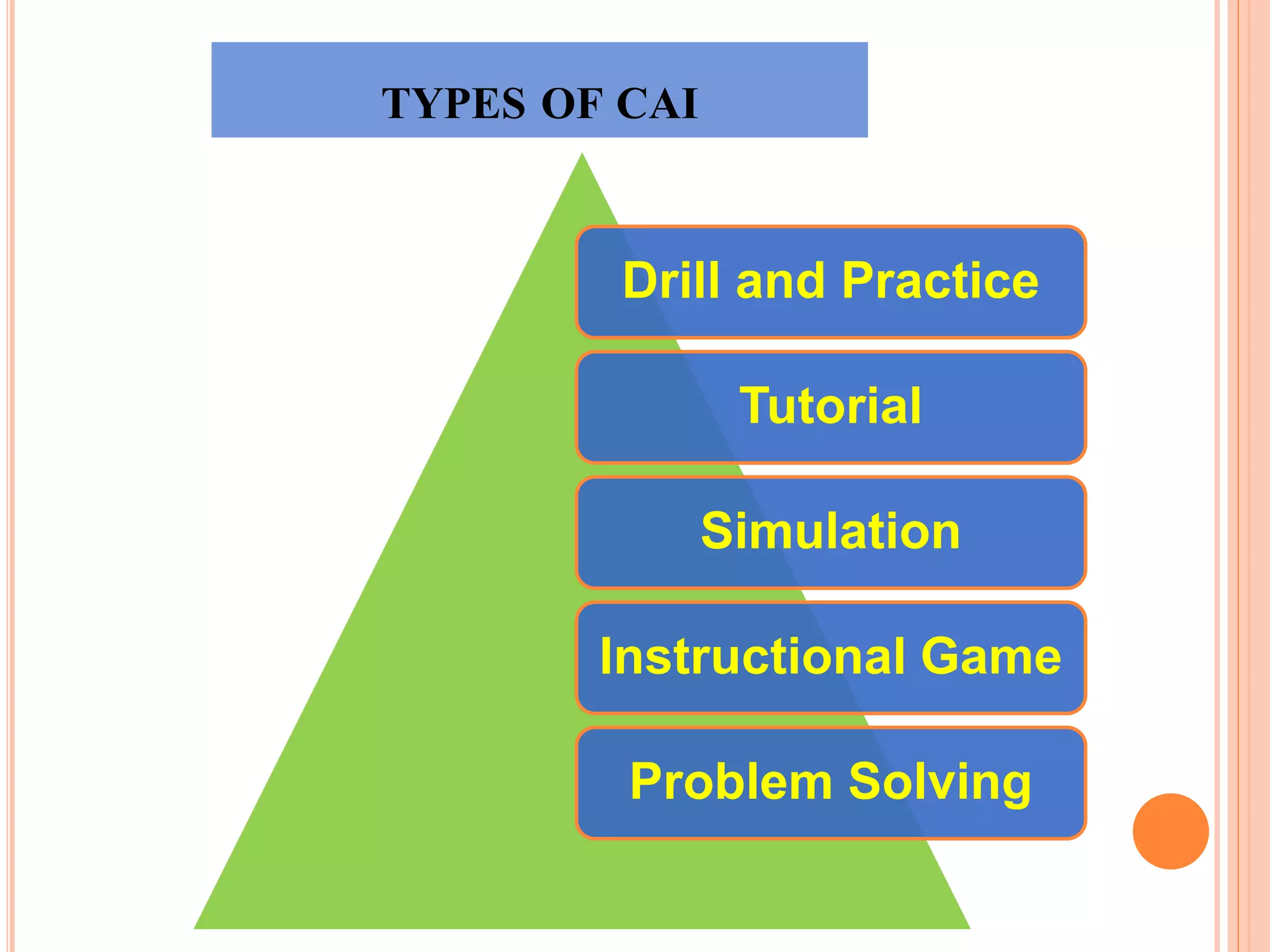
TYPES OF CAI
Drill and Practice
Tutorial
Simulation
Instructional Game
Problem Solving
DRILLAND PRACTICE METHOD
 In this format, the students have already learned certain
information, either through computer programmes or other
teaching methods.
 This mode particularly lends itself to teaching mathematical
calculations.
 The computer programme tells students whether the
answers are correct & may go so far as to diagnose the
problem if the answers are incorrect.
 Provide opportunities for students to repeatedly practice the
skills that they have previously learned and further practice
necessary for mastery .
TUTORIAL MODE
 combines presentation of material with
drill-and –practice, games or a simulation
to emphasize material and assist in learning.
 Most popular method of computer assisted instruction.
 At the same time the students may find the tutorials more
interesting and fun than the instructor’s lecture.
SIMULATION
 Realistic situation for role playing
 High level of interest is maintained throughout
 Provides a real life scenario with the material to be
learned being applied as it would in the real world
 Simulation provides safety of learning environment.
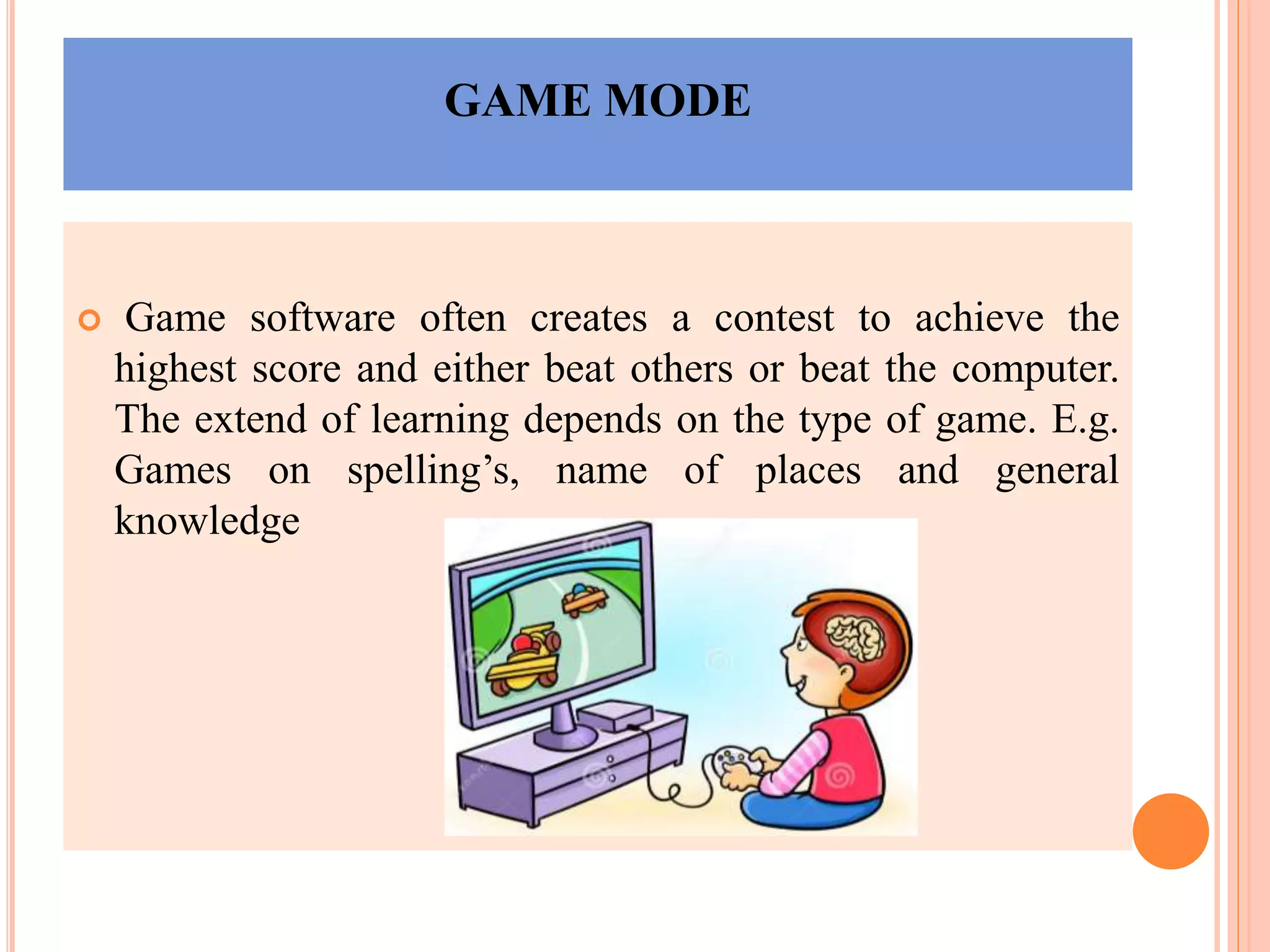
GAME MODE
 Game software often creates a contest to achieve the
highest score and either beat others or beat the computer.
The extend of learning depends on the type of game. E.g.
Games on spelling’s, name of places and general
knowledge
PROBLEM SOLVING
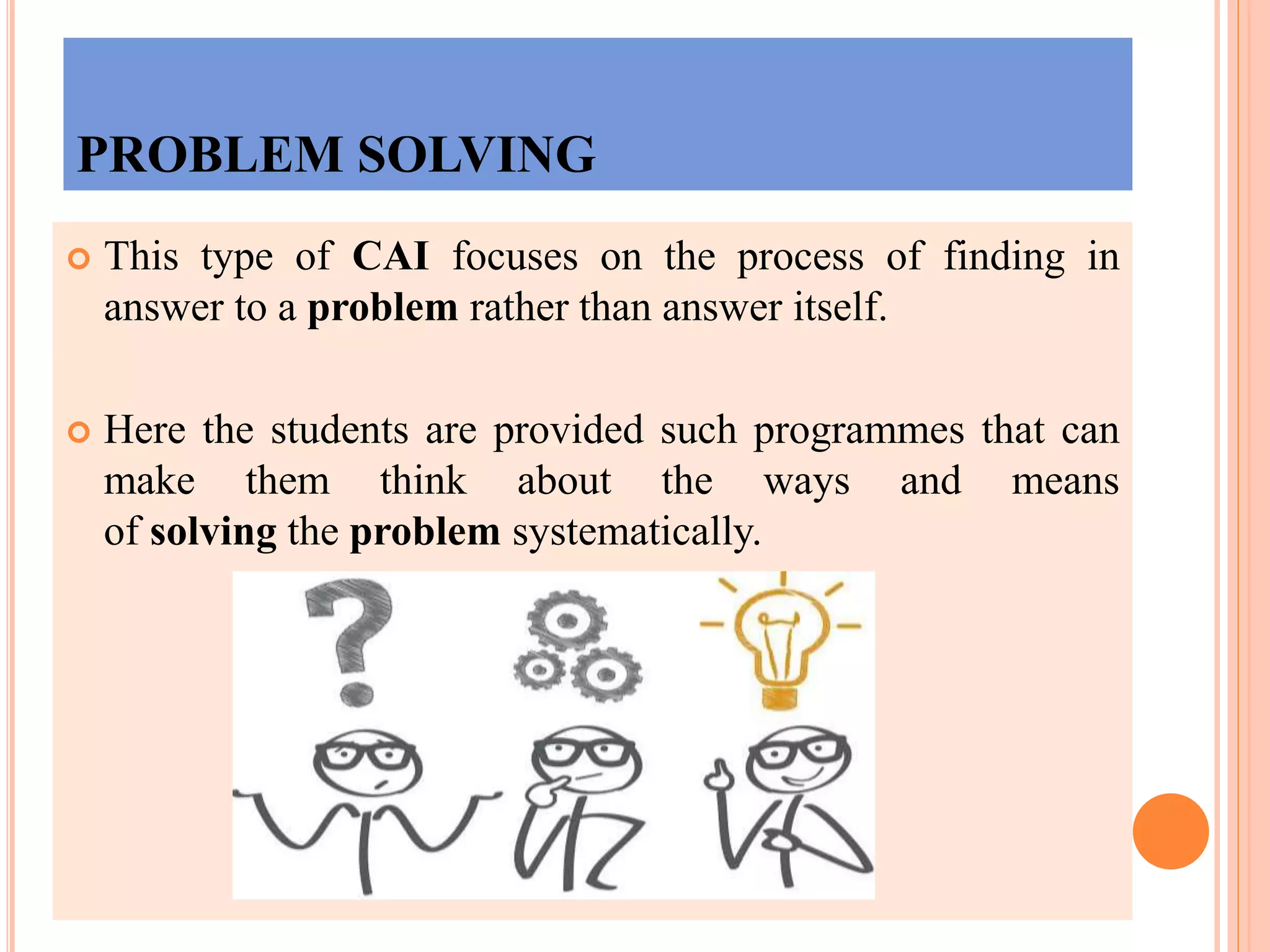
 This type of CAI focuses on the process of finding in
answer to a problem rather than answer itself.
 Here the students are provided such programmes that can
make them think about the ways and means
of solving the problem systematically.
ADVANTAGES OF CAI
 One-to-one interaction
 Great motivator
 Freedom to experiment with different options
 Instantaneous response/immediate feedback
 Self pacing - allow students to proceed at their own pace
 Self-directed learning – students can decide when, where, and
what to learn
 Multimedia helps to understand difficult concepts through
multi-sensory approach
LIMITATIONS OF CAI
 May feel overwhelmed by the information and resources
available
 Over use of multimedia may divert the attention from the
content
 Learning becomes too mechanical
 Equipments and software can be costly
 Development takes time and money
 Produce mental and physical fatigue
SUMMARY
ASSIGNMENT
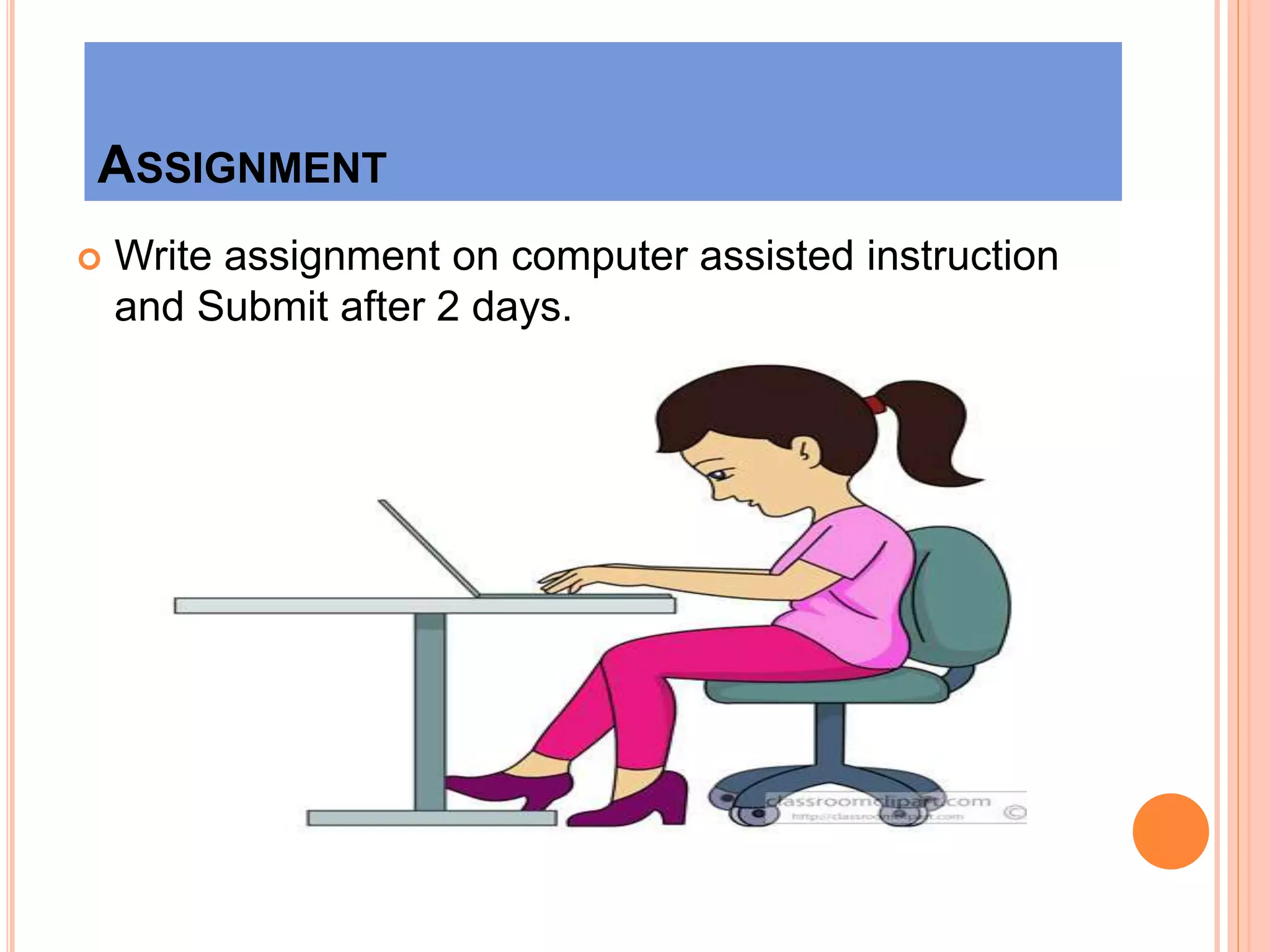
 Write assignment on computer assisted instruction
and Submit after 2 days.
REFRENCES
 Jaspreet Kaur Sodhi “Comprehensive Textbook of
Nursing Education” First edition 2017, published by
jaypee brothers medical publishers.
 Nima Bhasker, “Textbook of Nursing Education”,
2nd Edition, 2017, EMMESS Medical Publishers
 Shebeer P.Basheer; “Textbook of Nursing
Education”; First Edition (2015), EMMESS Medical
Publishers.
computer assissted instruction

computer assissted instruction

  • 2.
    COMPUTER ASSISTED INSTRUCTION Computer assisted instruction are the broadcast terms and can virtually refer to any kind of computer use in education setting.  CAI is commonly referred by use of computer for teaching – learning activites.  Computer influence every sphere of human activity and bring many changes in education, health care, scientific research, social sciences, law, music and painting. INTRODUCTION-
  • 3.
    DEFINITIONS Computer Assisted Instruction(CAI) is defined as the use of computers and software applications to teach concepts or skills. OR A self-learning technique, usually offline/online, involving the interaction of students with programmed instructional materials.
  • 4.
    TYPES OF CAI Drilland Practice Tutorial Simulation Instructional Game Problem Solving
  • 5.
    DRILLAND PRACTICE METHOD In this format, the students have already learned certain information, either through computer programmes or other teaching methods.  This mode particularly lends itself to teaching mathematical calculations.  The computer programme tells students whether the answers are correct & may go so far as to diagnose the problem if the answers are incorrect.  Provide opportunities for students to repeatedly practice the skills that they have previously learned and further practice necessary for mastery .
  • 6.
    TUTORIAL MODE  combinespresentation of material with drill-and –practice, games or a simulation to emphasize material and assist in learning.  Most popular method of computer assisted instruction.  At the same time the students may find the tutorials more interesting and fun than the instructor’s lecture.
  • 7.
    SIMULATION  Realistic situationfor role playing  High level of interest is maintained throughout  Provides a real life scenario with the material to be learned being applied as it would in the real world  Simulation provides safety of learning environment.
  • 8.
    GAME MODE  Gamesoftware often creates a contest to achieve the highest score and either beat others or beat the computer. The extend of learning depends on the type of game. E.g. Games on spelling’s, name of places and general knowledge
  • 9.
    PROBLEM SOLVING  Thistype of CAI focuses on the process of finding in answer to a problem rather than answer itself.  Here the students are provided such programmes that can make them think about the ways and means of solving the problem systematically.
  • 10.
    ADVANTAGES OF CAI One-to-one interaction  Great motivator  Freedom to experiment with different options  Instantaneous response/immediate feedback  Self pacing - allow students to proceed at their own pace  Self-directed learning – students can decide when, where, and what to learn  Multimedia helps to understand difficult concepts through multi-sensory approach
  • 11.
    LIMITATIONS OF CAI May feel overwhelmed by the information and resources available  Over use of multimedia may divert the attention from the content  Learning becomes too mechanical  Equipments and software can be costly  Development takes time and money  Produce mental and physical fatigue
  • 12.
  • 13.
    ASSIGNMENT  Write assignmenton computer assisted instruction and Submit after 2 days.
  • 14.
    REFRENCES  Jaspreet KaurSodhi “Comprehensive Textbook of Nursing Education” First edition 2017, published by jaypee brothers medical publishers.  Nima Bhasker, “Textbook of Nursing Education”, 2nd Edition, 2017, EMMESS Medical Publishers  Shebeer P.Basheer; “Textbook of Nursing Education”; First Edition (2015), EMMESS Medical Publishers.