Machine Tool And Error
Compensation
By:
ARPIT AGARWAL
120929146
7-B-16
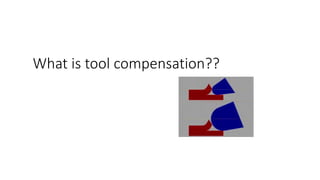
What is tool compensation??
And, why do we really need it?
• Ability to manufacture accurate parts
• Dimensional errors can be immediately detected and avoided
• The world market for machine tools in 2007 is estimated to be 71
billion US dollars, which represents a growth of 18% compared to
2006.
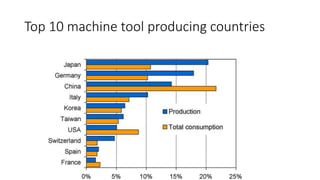
Top 10 machine tool producing countries
Types of tool compensation
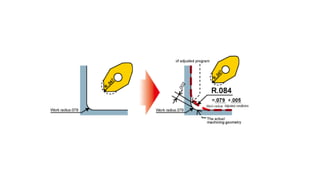
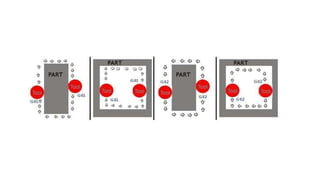
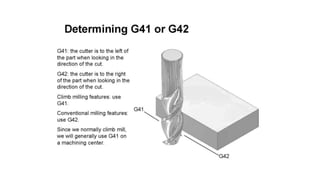
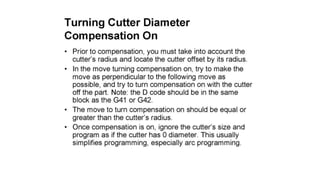
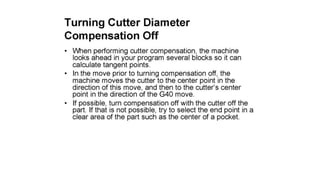
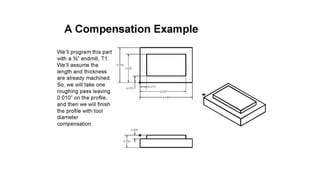
• Cutter Radius(or Diameter) Compensation
• Tool Nose Radius Compensation
• Tool Length Compensation
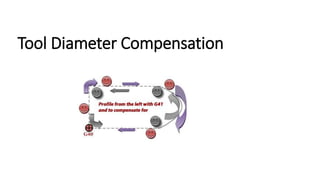
Tool Diameter Compensation
Cutter radius compensation video
https://www.youtube.com/watch?v=MW0WfKkre
Hs
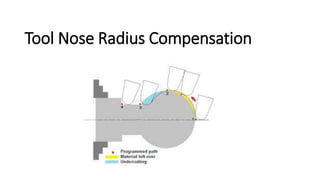
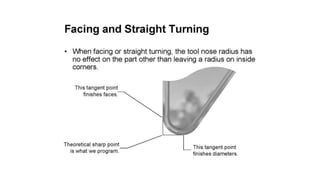
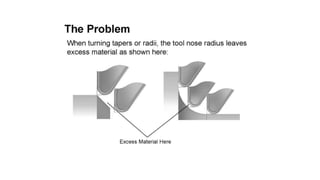
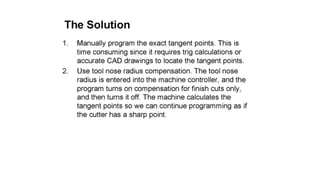
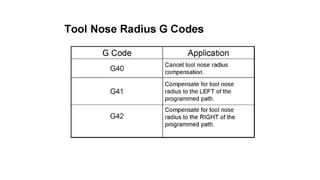
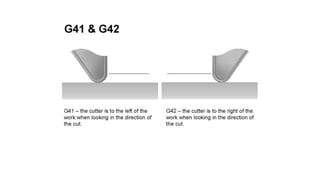
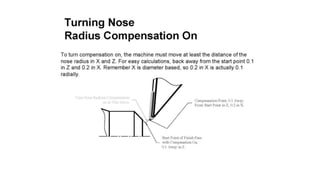
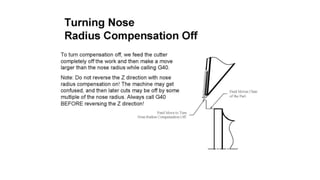
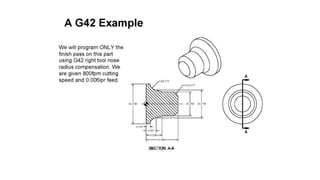
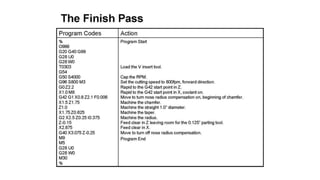
Tool Nose Radius Compensation
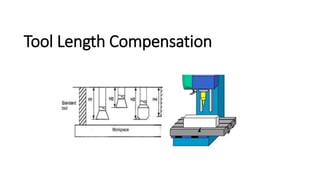
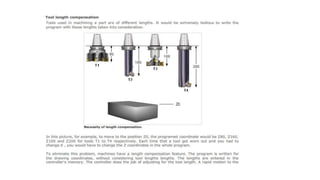
Tool Length Compensation
Why Tool Length Compensation is Needed
• No Two Tools Will Have Exactly the Same Length
• Tool’s Length Will Vary from Each Time it is Assembled
• Tool Data is Entered Separately from the Program
• Sizing and Trial Machining Must Often be Done
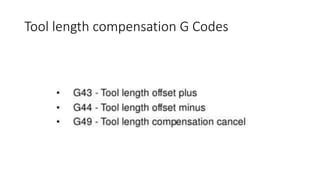
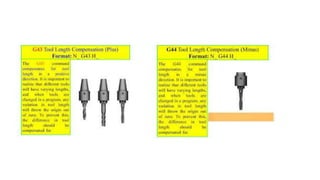
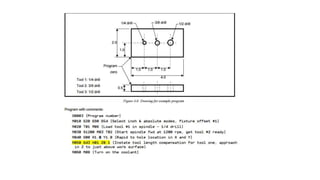
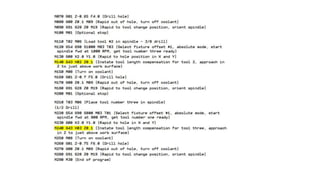
Tool length compensation G Codes
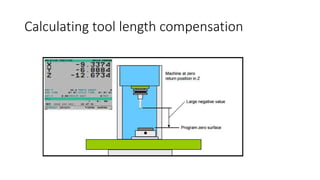
Calculating tool length compensation
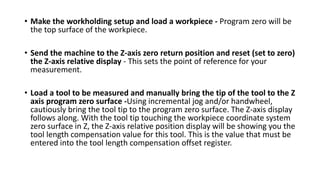
• Make the workholding setup and load a workpiece - Program zero will be
the top surface of the workpiece.
• Send the machine to the Z-axis zero return position and reset (set to zero)
the Z-axis relative display - This sets the point of reference for your
measurement.
• Load a tool to be measured and manually bring the tip of the tool to the Z
axis program zero surface -Using incremental jog and/or handwheel,
cautiously bring the tool tip to the program zero surface. The Z-axis display
follows along. With the tool tip touching the workpiece coordinate system
zero surface in Z, the Z-axis relative position display will be showing you the
tool length compensation value for this tool. This is the value that must be
entered into the tool length compensation offset register.
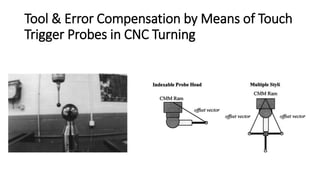
Tool & Error Compensation by Means of Touch
Trigger Probes in CNC Turning
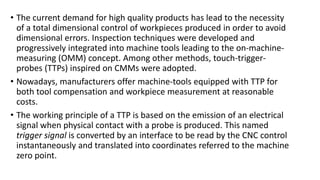
• The current demand for high quality products has lead to the necessity
of a total dimensional control of workpieces produced in order to avoid
dimensional errors. Inspection techniques were developed and
progressively integrated into machine tools leading to the on-machine-
measuring (OMM) concept. Among other methods, touch-trigger-
probes (TTPs) inspired on CMMs were adopted.
• Nowadays, manufacturers offer machine-tools equipped with TTP for
both tool compensation and workpiece measurement at reasonable
costs.
• The working principle of a TTP is based on the emission of an electrical
signal when physical contact with a probe is produced. This named
trigger signal is converted by an interface to be read by the CNC control
instantaneously and translated into coordinates referred to the machine
zero point.
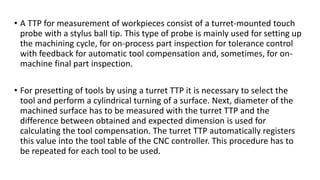
• A TTP for measurement of workpieces consist of a turret-mounted touch
probe with a stylus ball tip. This type of probe is mainly used for setting up
the machining cycle, for on-process part inspection for tolerance control
with feedback for automatic tool compensation and, sometimes, for on-
machine final part inspection.
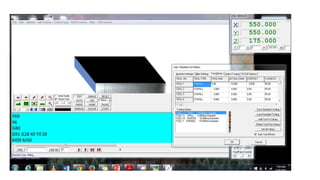
• For presetting of tools by using a turret TTP it is necessary to select the
tool and perform a cylindrical turning of a surface. Next, diameter of the
machined surface has to be measured with the turret TTP and the
difference between obtained and expected dimension is used for
calculating the tool compensation. The turret TTP automatically registers
this value into the tool table of the CNC controller. This procedure has to
be repeated for each tool to be used.
Factors affecting TTPs
• Geometric lathe misalignments
• Thermal drift
• Repeatability of TTPs
A video on TTP
•
https://www.youtube.com/watch?v=QB_Noh6M0m8
(second last slide)
Thanks for bearing with me!
• And, congrats to all my TCS buddies ^_^

Tool compensationCNC

  • 1.
    Machine Tool AndError Compensation By: ARPIT AGARWAL 120929146 7-B-16
  • 2.
    What is toolcompensation??
  • 4.
    And, why dowe really need it? • Ability to manufacture accurate parts • Dimensional errors can be immediately detected and avoided • The world market for machine tools in 2007 is estimated to be 71 billion US dollars, which represents a growth of 18% compared to 2006.
  • 5.
    Top 10 machinetool producing countries
  • 6.
    Types of toolcompensation • Cutter Radius(or Diameter) Compensation • Tool Nose Radius Compensation • Tool Length Compensation
  • 7.
  • 17.
    Cutter radius compensationvideo https://www.youtube.com/watch?v=MW0WfKkre Hs
  • 18.
    Tool Nose RadiusCompensation
  • 28.
  • 29.
    Why Tool LengthCompensation is Needed • No Two Tools Will Have Exactly the Same Length • Tool’s Length Will Vary from Each Time it is Assembled • Tool Data is Entered Separately from the Program • Sizing and Trial Machining Must Often be Done
  • 31.
  • 33.
  • 34.
    • Make theworkholding setup and load a workpiece - Program zero will be the top surface of the workpiece. • Send the machine to the Z-axis zero return position and reset (set to zero) the Z-axis relative display - This sets the point of reference for your measurement. • Load a tool to be measured and manually bring the tip of the tool to the Z axis program zero surface -Using incremental jog and/or handwheel, cautiously bring the tool tip to the program zero surface. The Z-axis display follows along. With the tool tip touching the workpiece coordinate system zero surface in Z, the Z-axis relative position display will be showing you the tool length compensation value for this tool. This is the value that must be entered into the tool length compensation offset register.
  • 38.
    Tool & ErrorCompensation by Means of Touch Trigger Probes in CNC Turning
  • 39.
    • The currentdemand for high quality products has lead to the necessity of a total dimensional control of workpieces produced in order to avoid dimensional errors. Inspection techniques were developed and progressively integrated into machine tools leading to the on-machine- measuring (OMM) concept. Among other methods, touch-trigger- probes (TTPs) inspired on CMMs were adopted. • Nowadays, manufacturers offer machine-tools equipped with TTP for both tool compensation and workpiece measurement at reasonable costs. • The working principle of a TTP is based on the emission of an electrical signal when physical contact with a probe is produced. This named trigger signal is converted by an interface to be read by the CNC control instantaneously and translated into coordinates referred to the machine zero point.
  • 40.
    • A TTPfor measurement of workpieces consist of a turret-mounted touch probe with a stylus ball tip. This type of probe is mainly used for setting up the machining cycle, for on-process part inspection for tolerance control with feedback for automatic tool compensation and, sometimes, for on- machine final part inspection. • For presetting of tools by using a turret TTP it is necessary to select the tool and perform a cylindrical turning of a surface. Next, diameter of the machined surface has to be measured with the turret TTP and the difference between obtained and expected dimension is used for calculating the tool compensation. The turret TTP automatically registers this value into the tool table of the CNC controller. This procedure has to be repeated for each tool to be used.
  • 41.
    Factors affecting TTPs •Geometric lathe misalignments • Thermal drift • Repeatability of TTPs
  • 42.
    A video onTTP • https://www.youtube.com/watch?v=QB_Noh6M0m8 (second last slide)
  • 43.
    Thanks for bearingwith me! • And, congrats to all my TCS buddies ^_^