International Research Journal of Engineering and Technology (IRJET) e-ISSN: 2395 -0056
Volume: 04 Issue: 06 | June -2017 www.irjet.net p-ISSN: 2395-0072
© 2017, IRJET | Impact Factor value: 5.181 | ISO 9001:2008 Certified Journal | Page 1873
Analysis of fault detection and its location using microcontroller for
underground cables
1 Sahana S ,2Harish Kumar B M, 3Anu S M 4 Vani H V, 5Sudha T, 6Prashanth Kumar H K
1,2,3 U.G Student, Department of EEE, SJMIT, Chitradurga, Karnataka, INDIA
4,5,6 Associate Professor, Department of EEE, SJMIT, Chitradurga, Karnataka, INDIA
---------------------------------------------------------------------***---------------------------------------------------------------------
Abstract - Underground cables are prone to a wide variety
of faults due to underground conditions, wear and tear,
rodents etc. Also detecting fault source is difficult and entire
line is to be dug in order to check entire line and fix faults. So
here we propose cable fault detectionoverIOTthatdetectsthe
exact fault position over IOT that makes repairing work very
easy. The repairmen know exactly which part has fault and
only that area is to be dug to detect the fault source. Thissaves
a lot of time, money and efforts and also allows to service
underground cables faster. We use IOT technology that
updates the monitored fault information to internet. The
system detects fault with the help of potential divider network
laid across the cable. Whenever a fault gets created at a point
shorting two lines together, a specific voltage gets generated
as per the resistors network combination. This voltage is
sensed by the microcontroller and is updated to the user. The
information conveyed to the user is the informationregarding
faults detection. The microcontroller retrieves the fault line
data and displays over LCD display, also it transfers this data
over internet to display on Gmail server.
Key Words: IOT technology, LCD, microcontroller.
Potential divider
1. INTRODUCTION
The paper uses the standard concept of Ohms law i.e., when
a low DC voltage is applied at the feeder end througha series
resistor (Cable lines), then current would vary depending
upon the location of fault in the cable. In case there is a short
circuit (Line to Ground), the voltage across series resistors
changes accordingly, which is then fed to an ADC to develop
precise digital data which the programmed microcontroller
of 8051 family would display in kilometers. The project is
assembled with a set ofresistorsrepresentingcablelengthin
KM’s and fault creation is made by a set of switches at every
known KM to cross check the accuracy of the same. Thefault
occurring at a particular distance and the respectivephaseis
displayed on a LCD interfaced to the microcontroller.
Till last decades cablesweremadetolayoverhead&
currently it is lay to underground cable which is superior to
earlier method. Because the underground cable are not
affected by any adverse weather condition such as storm,
snow, heavy rainfall as well as pollution. But when any fault
occur in cable, then it is difficult to locate fault. So we will
move to find the exact location of fault. Now the world is
become digitalized so the project is intended to detect the
location of fault in digital way.
The underground cable system is more common practice
followed in many urban areas. While fault occurs for some
reason, at that time the repairing process related to that
particular cable is difficult due to not knowing the exact
location of cable fault.
Fault in cable is represented as:
• Any defect,
• Inconsistency,
• Weakness or non-homogeneity that affects
performance of cable
• Current is diverted from the intended path,
For most of the worldwide operated low voltage and
medium voltage distribution lines underground cables have
been used from many decades. To reduce the sensitivity of
distribution networks to environmental influences
underground high voltage cables are used more and more.
Underground cables have been widely used in power
distribution networks due totheadvantagesofunderground
connection, involving more security than overhead lines in
bad weather, less liable to damage by storms or lightning. It
is less expensive for shorter distance, eco- friendly and low
maintenance.
But if any fault occur in cable, then it is difficult to locate
fault. So this project is used to detect the location of fault in
digital way. The requirement of locating the faulty point in
an underground cable in order is to facilitate quicker repair,
improve the system reliability and reduced outage period.
The underground cable system isveryuseful fordistribution
mainly in metropolitan cities, airport and defense
services. More than 3 million miles of electrical cables are
strung overhead across the country. Add to that at least 180
International Research Journal of Engineering and Technology (IRJET) e-ISSN: 2395 -0056
Volume: 04 Issue: 06 | June -2017 www.irjet.net p-ISSN: 2395-0072
© 2017, IRJET | Impact Factor value: 5.181 | ISO 9001:2008 Certified Journal | Page 1874
million telephone and cable TV lines, and it’s no wonder
hurricanes, tornadoes, fires and ice storms are wreaking
havoc on the electrical systems each year.
This causus the utility outages that last days, weeks and
longer. Power outages over extended periods present major
health and safety concerns and economic losses.
Concerns about the reliability of overhead lines, increases in
their maintenance and operating costs, and issues of public
safety and quality-of-life are leading more and more utilities
and municipalities to the realization that converting
overhead distribution lines to underground is the best way
to provide high-quality service to theircustomers.Forutility
companies, undergrounding provides potential benefits
through reduced operations and maintenance (O&M) costs,
reduced tree trimming costs,lessstormdamageand reduced
loss of day-to-day electricity sales when customers lose
power after storms.
Creative funding options are often availabletomakethegoal
of undergrounding a reality. The underground cable system
is very important for distribution especially in metropolitan
cities, airports and defense service.
Types of Faults
A fault in a cable can be classified into different types such
as
 Open Circuit Fault: This type of fault is better
than short circuit fault, because when the open
circuit fault occurs, then the flow of current
through an underground cable becomes zero. This
fault can be occurred by disruption in conducting
path. Such faults occur when one or more phase
conductors break
 Short Circuit Fault: Short circuit fault can be
divided into two types, namely symmetrical and
unsymmetrical faults
In symmetrical fault, three phases are short circuited in this
type of fault. This type of fault is also called as three phase
fault due to this reason.
In unsymmetrical fault, the magnitude of the current is not
equal and displaced by 120 degrees. Temperature. Most
environmental sensors were developed from sensors
designed for industrial applications such as process control
refining, milling, distilling, etc. Therefore many
environmental sensors are designed with the same
characteristics as industrial sensors such as 4-20 mA output
& 12 VDC power supply.
2 LITERATURE SURVEY
[1] Jitendra pal singh, sanjana singh, toshika singh & mohd.
Shahrukh. ‘underground cable fault distance locator’.
In this paper, a way for sleuthing underground cable fault
distance locator is done by using microcontroller.Thetarget
of this project is to work out the gap of underground cable
fault through base station in kilometers. It uses the straight
forward conception of ohm’s law, voltage drop can vary
counting on the length of fault in cable, since the current
varies. A group of resistors are used to represent the length
of cable in kilometers and a dc voltage is fed at one end and
the fault is detected the change in voltage using analog to
voltage converter. The fault occurring at what distance is
shown on LCD which is interfaced with the microcontroller
that is used to make the necessary calculations.
[2] Priyanka.R and B.Priya. "Underground Cable Fault
Detection".
In this paper to detect a fault in an underground cable is still
a challenging task in power system. In order to detect an
underground cable fault, the standard concept of OHM’S
LAW is used. This idea is used to determine resistive
variation, short circuit fault, open circuit fault .This project
provides accuracy in determining the exact location of fault,
when a low DC voltage is applied at the feeder end througha
series resistor (Cable lines), then current would vary
depending upon the location of fault in the cable from the
base station. This project provides detectionoffaultandalso
indication of cable’s temperature at varying voltage using a
developed prototype from a microcontroller family. In the
hardware setup we use the ARM11MSP430microcontroller
launch pad and a low cost low power 2.4Ghz transceiverand
a readable current sensor. We can use X-CTU and MATLAB
coding for detecting.
[3] B. Clegg, Underground Cable Fault Location. New York:
McGrawHill, 1993.
The author has presented the studies of finding the failure
location on a sample cable by using the multiple pulse
reflection method and the fault on the results of the
measurement. A pulse generator with amplitude of 12Vand
pulse width from 20 ns to 2 us has been designed as a
multiple pulse reflection meter. The velocity of reflection
pulse is calibrated in embedded system. The SOPC system
detects the reflection pulse and measuresthetimeofN times
reflection pulses, then judge the fault type and compute the
fault distance with corrected speed of pulse developed for
measurement of pulse reflection by means of pulse velocity
correction and have been examined here.
International Research Journal of Engineering and Technology (IRJET) e-ISSN: 2395 -0056
Volume: 04 Issue: 06 | June -2017 www.irjet.net p-ISSN: 2395-0072
© 2017, IRJET | Impact Factor value: 5.181 | ISO 9001:2008 Certified Journal | Page 1875
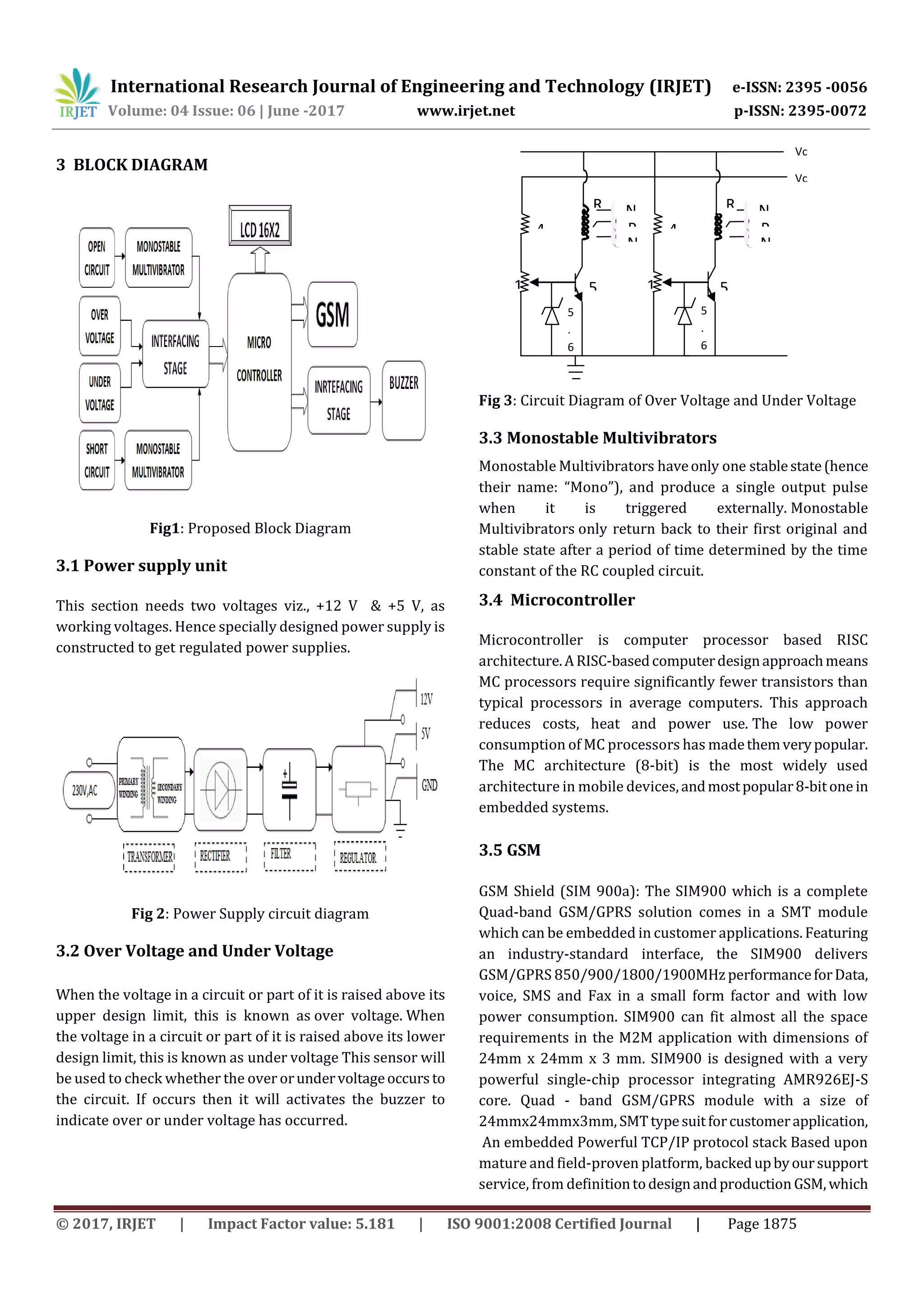
3 BLOCK DIAGRAM
Fig1: Proposed Block Diagram
3.1 Power supply unit
This section needs two voltages viz., +12 V & +5 V, as
working voltages. Hence specially designed power supply is
constructed to get regulated power supplies.
Fig 2: Power Supply circuit diagram
3.2 Over Voltage and Under Voltage
When the voltage in a circuit or part of it is raised above its
upper design limit, this is known as over voltage. When
the voltage in a circuit or part of it is raised above its lower
design limit, this is known as under voltage This sensor will
be used to check whether the over orundervoltageoccursto
the circuit. If occurs then it will activates the buzzer to
indicate over or under voltage has occurred.
Fig 3: Circuit Diagram of Over Voltage and Under Voltage
3.3 Monostable Multivibrators
Monostable Multivibrators haveonly one stablestate(hence
their name: “Mono”), and produce a single output pulse
when it is triggered externally. Monostable
Multivibrators only return back to their first original and
stable state after a period of time determined by the time
constant of the RC coupled circuit.
3.4 Microcontroller
Microcontroller is computer processor based RISC
architecture.ARISC-basedcomputerdesignapproachmeans
MC processors require significantly fewer transistors than
typical processors in average computers. This approach
reduces costs, heat and power use. The low power
consumption of MC processors has madethemverypopular.
The MC architecture (8-bit) is the most widely used
architecture in mobile devices,andmostpopular8-bitone in
embedded systems.
3.5 GSM
GSM Shield (SIM 900a): The SIM900 which is a complete
Quad-band GSM/GPRS solution comes in a SMT module
which can be embedded in customer applications. Featuring
an industry-standard interface, the SIM900 delivers
GSM/GPRS 850/900/1800/1900MHzperformanceforData,
voice, SMS and Fax in a small form factor and with low
power consumption. SIM900 can fit almost all the space
requirements in the M2M application with dimensions of
24mm x 24mm x 3 mm. SIM900 is designed with a very
powerful single-chip processor integrating AMR926EJ-S
core. Quad - band GSM/GPRS module with a size of
24mmx24mmx3mm, SMTtypesuitforcustomerapplication,
An embedded Powerful TCP/IP protocol stack Based upon
mature and field-proven platform, backedupbyoursupport
service, from definitiontodesignandproductionGSM,which
1
0
K
4
.
7
K
1
0
K
4
.
7
K
R
L
5
.
6
v
Z
e
n
e
r
d
i
o
d
e
5
.
6
v
Z
e
n
e
r
d
i
o
d
e
5
4
7
5
4
7
Vc
c
5v
Vc
c
12
v
N
/
O
P
o
l
e
N
/
C
R
L
N
/
O
P
o
l
e
N
/
C
International Research Journal of Engineering and Technology (IRJET) e-ISSN: 2395 -0056
Volume: 04 Issue: 06 | June -2017 www.irjet.net p-ISSN: 2395-0072
© 2017, IRJET | Impact Factor value: 5.181 | ISO 9001:2008 Certified Journal | Page 1876
stands for Global System for Mobile communications,reigns
as the world’s most widely used cell phone technology. Cell
phones use a cell phone service carrier’s GSM network by
searching for cell phone towers in the nearby area.
4 METHODOLOGY
This paper is designed to achieve monitoring of
underground cable and to provide information about
detected fault. Over voltage, under voltage, short circuit and
open circuit conditions will be monitored by respective
sensors.
If any faults occurs that will be detected by respective
sensors and sends that signal to controller via Monostable
Multivibrators and interfacing stage i.e buffer, driver and
relay unit. buffer is used for temporary storage, driver is
used to drive the relay and relay for switching. Controller
analyses the received signal and activates the GSM modules
to send information about monitored parameter to concern
person. Controller as well activates the alerting system via
interfacing stage i.e buffer, driver and relay unit. In the
transmitting section, the corresponding voltage drop is fed
into the controller MSP430 launch pad. The launch pad
consists of a 12bit Analogto Digital converter.Thisconverter
provides precise accuracy forabout3.3V.The12bitAnalogto
digital converter converts the voltage into digital signal
which is received from the current sensor. The controller
MSP430 launch pad makes necessary calculationsregarding
the fault location. This data is then transmitted to the
receiving section. The receiving sectionconsistsofa lowcost
low power wireless controller,transceiveranda display.The
data’s are fed from the transmitting section to the
transceiver. The transceiver is interfaced with thedisplayi.e
PC. The display shows the status of the cable at each phase.
Also the distance of the cable at particularphaseisdisplayed
in case of any fault. The corresponding changes in the
voltage and current help us to determine the type of fault in
the cable. The data’s are displayed using MAT LAB coding.
The resistive variation, current reading can be obtained.
5 DESIGN AND DEVELOPMENT OF HARDWARE
The 230V supply is first stepped down to 12V AC using a
stepdown transformer. This is then converted to DC using
centre tap full wave rectifier. The AC ripplesisfilteredoutby
using a capacitor and given to the input pin of this regulator.
At output pin of this regulator we get a constant5vDCwhich
is used for microcontroller and other ICs in this project.
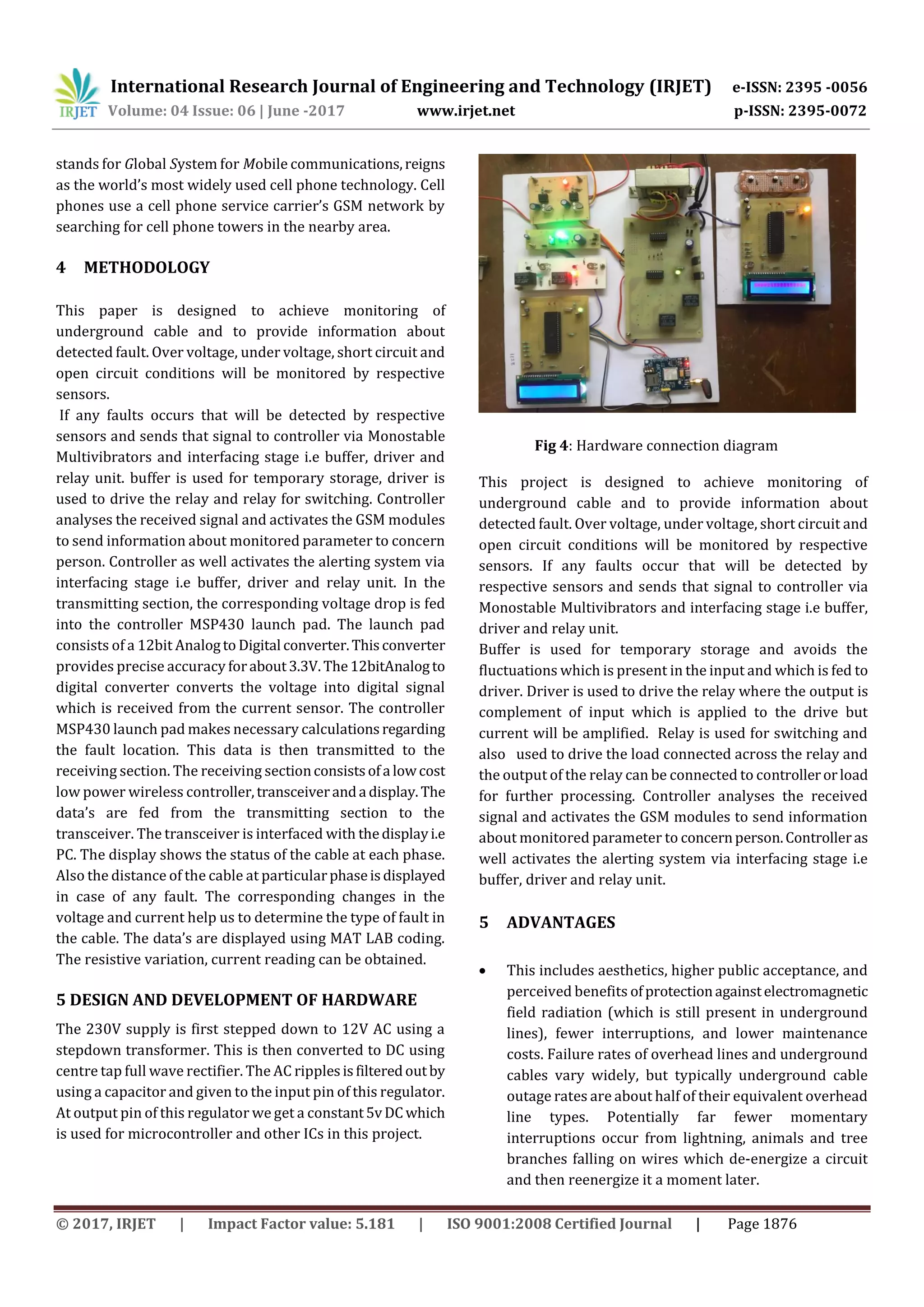
Fig 4: Hardware connection diagram
This project is designed to achieve monitoring of
underground cable and to provide information about
detected fault. Over voltage, under voltage, short circuit and
open circuit conditions will be monitored by respective
sensors. If any faults occur that will be detected by
respective sensors and sends that signal to controller via
Monostable Multivibrators and interfacing stage i.e buffer,
driver and relay unit.
Buffer is used for temporary storage and avoids the
fluctuations which is present in the input and which is fed to
driver. Driver is used to drive the relay where the output is
complement of input which is applied to the drive but
current will be amplified. Relay is used for switching and
also used to drive the load connected across the relay and
the output of the relay can be connected to controllerorload
for further processing. Controller analyses the received
signal and activates the GSM modules to send information
about monitored parameter to concernperson.Controlleras
well activates the alerting system via interfacing stage i.e
buffer, driver and relay unit.
5 ADVANTAGES
 This includes aesthetics, higher public acceptance, and
perceived benefits ofprotectionagainstelectromagnetic
field radiation (which is still present in underground
lines), fewer interruptions, and lower maintenance
costs. Failure rates of overhead lines and underground
cables vary widely, but typically underground cable
outage rates are about half of their equivalent overhead
line types. Potentially far fewer momentary
interruptions occur from lightning, animals and tree
branches falling on wires which de-energize a circuit
and then reenergize it a moment later.
International Research Journal of Engineering and Technology (IRJET) e-ISSN: 2395 -0056
Volume: 04 Issue: 06 | June -2017 www.irjet.net p-ISSN: 2395-0072
© 2017, IRJET | Impact Factor value: 5.181 | ISO 9001:2008 Certified Journal | Page 1877
 Primary benefits most often cited can be divided into
four areas:
 Potentially-Reduced Maintenance and Operating Costs:
 Lower storm restoration cost
 Lower tree-trimming cost
 Improved Reliability: Increasedreliabilityduringsevere
weather wind related storm damage will be greatly
reduced for an underground system, and areas not
subjected to flooding and storm surges experience
minimal damage and interruption of electric service.
 Less damage during severe weather
 Far fewer momentary interruptions
 Improved utility relations regarding tree trimming
 Improved Public Safety:
 Fewer motor vehicle accidents
 Reduced live-wire contact injuries
 Fewer Fires
6 DISADVANTAGES
The main disadvantage is that the underground cables have
higher initial cost and insulation problems at high voltages.
Another main drawback is that, if a fault does occur, it is
difficult to locate and repair the fault because the fault is
invisible.
7 APPLICATIONS
Its main application is the detection of underground cable
fault which is very hard to detect as it is not possible to see
such faults which are quite possible in the case of overhead
transmission line. So for such cases our project is very
helpful as the distance at which the fault has occurredcanbe
calculated and then further action regarding the fault can be
taken to overcome them.
8 CONCLUSION
The hardware model of Underground Cable Fault Locator is
implemented and favorable results were brought forward.
This hardware model can locate the exact faultlocationinan
underground cable. Further this project can be enhanced by
using capacitor in an AC circuit to measure the impedance
which can even locate the open circuited cable, unlike the
short circuited fault only using resistors in DC circuit as
followed in the above proposed project.Undergroundcables
are prone to a wide variety of faults due to underground
conditions, wear and tear, rodents etc. Also detecting fault
source is difficult and entire line is to be dug in order to
check entire line and fix faults. So here we propose cable
fault detection over IOT that detects the exact fault position
over IOT that makes repairing work very easy. The
repairmen know exactly which part has fault and only that
area is to be dug to detect the fault source. This saves a lot of
time, money and efforts and also allows to service
underground cables faster. We use IOT technology that
updates the monitored fault information to internet. The
system detects fault with the help of potential divider
network laid across the cable. Whenever a fault gets created
at a point shorting two lines together, a specific voltage gets
generated as per the resistors network combination. This
voltage is sensed by the microcontroller and is updated to
the user. The information conveyed to the user is the
information regarding faults detection.
REFERENCES
[1] Jitendra pal singh, sanjana singh, toshika singh & mohd.
Shahrukh―underground cable fault distance locator.
International Journal ofScientificResearchandManagement
Studies (IJSRMS) Vol 3 , pg: 21-26
[2] Priyanka R, Priya B "UndergroundCableFaultDetection"
Published in International Journal of Trend in Research and
Development (IJTRD), ISSN: 2394-9333,Volume-3|Issue-3,
June 2016, URL:
[3] M.-S. Choi, D.-S. Lee, and X. Yang, ―A line to ground fault
location algorithm for underground cable system,‖ KIEE
Trans. Power Eng., pp. 267–273, Jun. 2005.
[4] E. C. Bascom, ―Computerized underground cable fault
location expertise, ‖in Proc. IEEE Power Eng. Soc. General
Meeting, Apr. 10–15,1994, pp. 376–382.J. Clerk Maxwell, A
Treatise on Electricity and Magnetism, 3rded., vol. 2. Oxford:
Clarendon, 1892, pp.68–73.
[5] K.K. Kuna, Prof. K. Warwick, ―Real-time expert system
for fault location on high voltage underground distribution
cables‖, IEEE PROCEEDINGS-C, Vol. 139, No. 3, MAY 1992.
[6] J.Densely, ―Ageing mechanisms and diagnostics for
power cables—an overview,‖ IEEE Electr. Insul. Mag., vol.
17, no. 1, pp. 14–22, Jan./Feb. 2001.
[7] T. S. Sidhu and Z. Xu, ―Detection of incipient faults in
distribution underground cables‖, IEEE Trans. Power Del.,
vol. 25, no. 3, pp. 1363–1371, Jul. 2010.
[8] Tarlochan S. Sidhu, ZhihanXu, ―Detection of Incipient
Faults in Distribution Underground Cables‖, IEEE
Transactions on Power Delivery, Vol. 25, NO. 3, JULY 2010.
International Research Journal of Engineering and Technology (IRJET) e-ISSN: 2395 -0056
Volume: 04 Issue: 06 | June -2017 www.irjet.net p-ISSN: 2395-0072
© 2017, IRJET | Impact Factor value: 5.181 | ISO 9001:2008 Certified Journal | Page 1878
[9] Md. Fakhrul Islam, Amanullah M T Oo, Salahuddin. A.
Azad1 , ―Locating Underground Cable Faults: A Review a
nd Guideline for New Development‖ , 2013 IEEE
[10] Sawatpipat, P., Tayjasanant, T., “Fault classification for
Thailand’s transmission lines based on discrete wavelet
transform”, International Conference on Electrical
Engineering/ElectronicsComputerTelecommunications and
Information Technology (ECTI-CON), Page(s): 636 – 640,
2010.
[11] M. Jaya Bharata Reddy, D. Venkata Rajesh, D.K.
Mohanta,"Robust transmission line fault classificationusing
wavelet multi-resolution analysis.", Computers & Electrical
Engineering, Volume 39, Issue 4, Pages 1219-1247. , May
2013
[12] Ali Rafinia, Jamal Moshtagh, " A new approach to fault
location in three-phase underground distribution system
using combination of wavelet analysis with ANN and FLS ",
International Journal of Electrical Power & Energy Systems,
Volume 55, Pages 261-274 , February 2014.
BIOGRAPHIES
Vani H V
Associate Professor,
Dept. of EEE, SJMIT, Chitradurga-
Karnataka, INDIA
Prashanth Kumar H K
Assistant Professor,
Dept. of EEE, SJMIT, Chitradurga,
Karnataka, INDIA
Sudha T
Assistant Professor,
Dept. of EEE, SJMIT, Chitradurga,
Karnataka, INDIA
Sahana S
U.G Student,
Dept. of EEE, SJMIT, Chitradurga,
Karnataka, INDIA
Anu S M
U.G Student,
Dept. of EEE, SJMIT, Chitradurga,
Karnataka, INDIA
Harish Kumar B M
U.G Student,
Dept. of EEE, SJMIT, Chitradurga,
Karnataka, INDIA

Analysis of Fault Detection and its Location using Microcontroller for Underground Cables

  • 1.
    International Research Journalof Engineering and Technology (IRJET) e-ISSN: 2395 -0056 Volume: 04 Issue: 06 | June -2017 www.irjet.net p-ISSN: 2395-0072 © 2017, IRJET | Impact Factor value: 5.181 | ISO 9001:2008 Certified Journal | Page 1873 Analysis of fault detection and its location using microcontroller for underground cables 1 Sahana S ,2Harish Kumar B M, 3Anu S M 4 Vani H V, 5Sudha T, 6Prashanth Kumar H K 1,2,3 U.G Student, Department of EEE, SJMIT, Chitradurga, Karnataka, INDIA 4,5,6 Associate Professor, Department of EEE, SJMIT, Chitradurga, Karnataka, INDIA ---------------------------------------------------------------------***--------------------------------------------------------------------- Abstract - Underground cables are prone to a wide variety of faults due to underground conditions, wear and tear, rodents etc. Also detecting fault source is difficult and entire line is to be dug in order to check entire line and fix faults. So here we propose cable fault detectionoverIOTthatdetectsthe exact fault position over IOT that makes repairing work very easy. The repairmen know exactly which part has fault and only that area is to be dug to detect the fault source. Thissaves a lot of time, money and efforts and also allows to service underground cables faster. We use IOT technology that updates the monitored fault information to internet. The system detects fault with the help of potential divider network laid across the cable. Whenever a fault gets created at a point shorting two lines together, a specific voltage gets generated as per the resistors network combination. This voltage is sensed by the microcontroller and is updated to the user. The information conveyed to the user is the informationregarding faults detection. The microcontroller retrieves the fault line data and displays over LCD display, also it transfers this data over internet to display on Gmail server. Key Words: IOT technology, LCD, microcontroller. Potential divider 1. INTRODUCTION The paper uses the standard concept of Ohms law i.e., when a low DC voltage is applied at the feeder end througha series resistor (Cable lines), then current would vary depending upon the location of fault in the cable. In case there is a short circuit (Line to Ground), the voltage across series resistors changes accordingly, which is then fed to an ADC to develop precise digital data which the programmed microcontroller of 8051 family would display in kilometers. The project is assembled with a set ofresistorsrepresentingcablelengthin KM’s and fault creation is made by a set of switches at every known KM to cross check the accuracy of the same. Thefault occurring at a particular distance and the respectivephaseis displayed on a LCD interfaced to the microcontroller. Till last decades cablesweremadetolayoverhead& currently it is lay to underground cable which is superior to earlier method. Because the underground cable are not affected by any adverse weather condition such as storm, snow, heavy rainfall as well as pollution. But when any fault occur in cable, then it is difficult to locate fault. So we will move to find the exact location of fault. Now the world is become digitalized so the project is intended to detect the location of fault in digital way. The underground cable system is more common practice followed in many urban areas. While fault occurs for some reason, at that time the repairing process related to that particular cable is difficult due to not knowing the exact location of cable fault. Fault in cable is represented as: • Any defect, • Inconsistency, • Weakness or non-homogeneity that affects performance of cable • Current is diverted from the intended path, For most of the worldwide operated low voltage and medium voltage distribution lines underground cables have been used from many decades. To reduce the sensitivity of distribution networks to environmental influences underground high voltage cables are used more and more. Underground cables have been widely used in power distribution networks due totheadvantagesofunderground connection, involving more security than overhead lines in bad weather, less liable to damage by storms or lightning. It is less expensive for shorter distance, eco- friendly and low maintenance. But if any fault occur in cable, then it is difficult to locate fault. So this project is used to detect the location of fault in digital way. The requirement of locating the faulty point in an underground cable in order is to facilitate quicker repair, improve the system reliability and reduced outage period. The underground cable system isveryuseful fordistribution mainly in metropolitan cities, airport and defense services. More than 3 million miles of electrical cables are strung overhead across the country. Add to that at least 180
  • 2.
    International Research Journalof Engineering and Technology (IRJET) e-ISSN: 2395 -0056 Volume: 04 Issue: 06 | June -2017 www.irjet.net p-ISSN: 2395-0072 © 2017, IRJET | Impact Factor value: 5.181 | ISO 9001:2008 Certified Journal | Page 1874 million telephone and cable TV lines, and it’s no wonder hurricanes, tornadoes, fires and ice storms are wreaking havoc on the electrical systems each year. This causus the utility outages that last days, weeks and longer. Power outages over extended periods present major health and safety concerns and economic losses. Concerns about the reliability of overhead lines, increases in their maintenance and operating costs, and issues of public safety and quality-of-life are leading more and more utilities and municipalities to the realization that converting overhead distribution lines to underground is the best way to provide high-quality service to theircustomers.Forutility companies, undergrounding provides potential benefits through reduced operations and maintenance (O&M) costs, reduced tree trimming costs,lessstormdamageand reduced loss of day-to-day electricity sales when customers lose power after storms. Creative funding options are often availabletomakethegoal of undergrounding a reality. The underground cable system is very important for distribution especially in metropolitan cities, airports and defense service. Types of Faults A fault in a cable can be classified into different types such as  Open Circuit Fault: This type of fault is better than short circuit fault, because when the open circuit fault occurs, then the flow of current through an underground cable becomes zero. This fault can be occurred by disruption in conducting path. Such faults occur when one or more phase conductors break  Short Circuit Fault: Short circuit fault can be divided into two types, namely symmetrical and unsymmetrical faults In symmetrical fault, three phases are short circuited in this type of fault. This type of fault is also called as three phase fault due to this reason. In unsymmetrical fault, the magnitude of the current is not equal and displaced by 120 degrees. Temperature. Most environmental sensors were developed from sensors designed for industrial applications such as process control refining, milling, distilling, etc. Therefore many environmental sensors are designed with the same characteristics as industrial sensors such as 4-20 mA output & 12 VDC power supply. 2 LITERATURE SURVEY [1] Jitendra pal singh, sanjana singh, toshika singh & mohd. Shahrukh. ‘underground cable fault distance locator’. In this paper, a way for sleuthing underground cable fault distance locator is done by using microcontroller.Thetarget of this project is to work out the gap of underground cable fault through base station in kilometers. It uses the straight forward conception of ohm’s law, voltage drop can vary counting on the length of fault in cable, since the current varies. A group of resistors are used to represent the length of cable in kilometers and a dc voltage is fed at one end and the fault is detected the change in voltage using analog to voltage converter. The fault occurring at what distance is shown on LCD which is interfaced with the microcontroller that is used to make the necessary calculations. [2] Priyanka.R and B.Priya. "Underground Cable Fault Detection". In this paper to detect a fault in an underground cable is still a challenging task in power system. In order to detect an underground cable fault, the standard concept of OHM’S LAW is used. This idea is used to determine resistive variation, short circuit fault, open circuit fault .This project provides accuracy in determining the exact location of fault, when a low DC voltage is applied at the feeder end througha series resistor (Cable lines), then current would vary depending upon the location of fault in the cable from the base station. This project provides detectionoffaultandalso indication of cable’s temperature at varying voltage using a developed prototype from a microcontroller family. In the hardware setup we use the ARM11MSP430microcontroller launch pad and a low cost low power 2.4Ghz transceiverand a readable current sensor. We can use X-CTU and MATLAB coding for detecting. [3] B. Clegg, Underground Cable Fault Location. New York: McGrawHill, 1993. The author has presented the studies of finding the failure location on a sample cable by using the multiple pulse reflection method and the fault on the results of the measurement. A pulse generator with amplitude of 12Vand pulse width from 20 ns to 2 us has been designed as a multiple pulse reflection meter. The velocity of reflection pulse is calibrated in embedded system. The SOPC system detects the reflection pulse and measuresthetimeofN times reflection pulses, then judge the fault type and compute the fault distance with corrected speed of pulse developed for measurement of pulse reflection by means of pulse velocity correction and have been examined here.
  • 3.
    International Research Journalof Engineering and Technology (IRJET) e-ISSN: 2395 -0056 Volume: 04 Issue: 06 | June -2017 www.irjet.net p-ISSN: 2395-0072 © 2017, IRJET | Impact Factor value: 5.181 | ISO 9001:2008 Certified Journal | Page 1875 3 BLOCK DIAGRAM Fig1: Proposed Block Diagram 3.1 Power supply unit This section needs two voltages viz., +12 V & +5 V, as working voltages. Hence specially designed power supply is constructed to get regulated power supplies. Fig 2: Power Supply circuit diagram 3.2 Over Voltage and Under Voltage When the voltage in a circuit or part of it is raised above its upper design limit, this is known as over voltage. When the voltage in a circuit or part of it is raised above its lower design limit, this is known as under voltage This sensor will be used to check whether the over orundervoltageoccursto the circuit. If occurs then it will activates the buzzer to indicate over or under voltage has occurred. Fig 3: Circuit Diagram of Over Voltage and Under Voltage 3.3 Monostable Multivibrators Monostable Multivibrators haveonly one stablestate(hence their name: “Mono”), and produce a single output pulse when it is triggered externally. Monostable Multivibrators only return back to their first original and stable state after a period of time determined by the time constant of the RC coupled circuit. 3.4 Microcontroller Microcontroller is computer processor based RISC architecture.ARISC-basedcomputerdesignapproachmeans MC processors require significantly fewer transistors than typical processors in average computers. This approach reduces costs, heat and power use. The low power consumption of MC processors has madethemverypopular. The MC architecture (8-bit) is the most widely used architecture in mobile devices,andmostpopular8-bitone in embedded systems. 3.5 GSM GSM Shield (SIM 900a): The SIM900 which is a complete Quad-band GSM/GPRS solution comes in a SMT module which can be embedded in customer applications. Featuring an industry-standard interface, the SIM900 delivers GSM/GPRS 850/900/1800/1900MHzperformanceforData, voice, SMS and Fax in a small form factor and with low power consumption. SIM900 can fit almost all the space requirements in the M2M application with dimensions of 24mm x 24mm x 3 mm. SIM900 is designed with a very powerful single-chip processor integrating AMR926EJ-S core. Quad - band GSM/GPRS module with a size of 24mmx24mmx3mm, SMTtypesuitforcustomerapplication, An embedded Powerful TCP/IP protocol stack Based upon mature and field-proven platform, backedupbyoursupport service, from definitiontodesignandproductionGSM,which 1 0 K 4 . 7 K 1 0 K 4 . 7 K R L 5 . 6 v Z e n e r d i o d e 5 . 6 v Z e n e r d i o d e 5 4 7 5 4 7 Vc c 5v Vc c 12 v N / O P o l e N / C R L N / O P o l e N / C
  • 4.
    International Research Journalof Engineering and Technology (IRJET) e-ISSN: 2395 -0056 Volume: 04 Issue: 06 | June -2017 www.irjet.net p-ISSN: 2395-0072 © 2017, IRJET | Impact Factor value: 5.181 | ISO 9001:2008 Certified Journal | Page 1876 stands for Global System for Mobile communications,reigns as the world’s most widely used cell phone technology. Cell phones use a cell phone service carrier’s GSM network by searching for cell phone towers in the nearby area. 4 METHODOLOGY This paper is designed to achieve monitoring of underground cable and to provide information about detected fault. Over voltage, under voltage, short circuit and open circuit conditions will be monitored by respective sensors. If any faults occurs that will be detected by respective sensors and sends that signal to controller via Monostable Multivibrators and interfacing stage i.e buffer, driver and relay unit. buffer is used for temporary storage, driver is used to drive the relay and relay for switching. Controller analyses the received signal and activates the GSM modules to send information about monitored parameter to concern person. Controller as well activates the alerting system via interfacing stage i.e buffer, driver and relay unit. In the transmitting section, the corresponding voltage drop is fed into the controller MSP430 launch pad. The launch pad consists of a 12bit Analogto Digital converter.Thisconverter provides precise accuracy forabout3.3V.The12bitAnalogto digital converter converts the voltage into digital signal which is received from the current sensor. The controller MSP430 launch pad makes necessary calculationsregarding the fault location. This data is then transmitted to the receiving section. The receiving sectionconsistsofa lowcost low power wireless controller,transceiveranda display.The data’s are fed from the transmitting section to the transceiver. The transceiver is interfaced with thedisplayi.e PC. The display shows the status of the cable at each phase. Also the distance of the cable at particularphaseisdisplayed in case of any fault. The corresponding changes in the voltage and current help us to determine the type of fault in the cable. The data’s are displayed using MAT LAB coding. The resistive variation, current reading can be obtained. 5 DESIGN AND DEVELOPMENT OF HARDWARE The 230V supply is first stepped down to 12V AC using a stepdown transformer. This is then converted to DC using centre tap full wave rectifier. The AC ripplesisfilteredoutby using a capacitor and given to the input pin of this regulator. At output pin of this regulator we get a constant5vDCwhich is used for microcontroller and other ICs in this project. Fig 4: Hardware connection diagram This project is designed to achieve monitoring of underground cable and to provide information about detected fault. Over voltage, under voltage, short circuit and open circuit conditions will be monitored by respective sensors. If any faults occur that will be detected by respective sensors and sends that signal to controller via Monostable Multivibrators and interfacing stage i.e buffer, driver and relay unit. Buffer is used for temporary storage and avoids the fluctuations which is present in the input and which is fed to driver. Driver is used to drive the relay where the output is complement of input which is applied to the drive but current will be amplified. Relay is used for switching and also used to drive the load connected across the relay and the output of the relay can be connected to controllerorload for further processing. Controller analyses the received signal and activates the GSM modules to send information about monitored parameter to concernperson.Controlleras well activates the alerting system via interfacing stage i.e buffer, driver and relay unit. 5 ADVANTAGES  This includes aesthetics, higher public acceptance, and perceived benefits ofprotectionagainstelectromagnetic field radiation (which is still present in underground lines), fewer interruptions, and lower maintenance costs. Failure rates of overhead lines and underground cables vary widely, but typically underground cable outage rates are about half of their equivalent overhead line types. Potentially far fewer momentary interruptions occur from lightning, animals and tree branches falling on wires which de-energize a circuit and then reenergize it a moment later.
  • 5.
    International Research Journalof Engineering and Technology (IRJET) e-ISSN: 2395 -0056 Volume: 04 Issue: 06 | June -2017 www.irjet.net p-ISSN: 2395-0072 © 2017, IRJET | Impact Factor value: 5.181 | ISO 9001:2008 Certified Journal | Page 1877  Primary benefits most often cited can be divided into four areas:  Potentially-Reduced Maintenance and Operating Costs:  Lower storm restoration cost  Lower tree-trimming cost  Improved Reliability: Increasedreliabilityduringsevere weather wind related storm damage will be greatly reduced for an underground system, and areas not subjected to flooding and storm surges experience minimal damage and interruption of electric service.  Less damage during severe weather  Far fewer momentary interruptions  Improved utility relations regarding tree trimming  Improved Public Safety:  Fewer motor vehicle accidents  Reduced live-wire contact injuries  Fewer Fires 6 DISADVANTAGES The main disadvantage is that the underground cables have higher initial cost and insulation problems at high voltages. Another main drawback is that, if a fault does occur, it is difficult to locate and repair the fault because the fault is invisible. 7 APPLICATIONS Its main application is the detection of underground cable fault which is very hard to detect as it is not possible to see such faults which are quite possible in the case of overhead transmission line. So for such cases our project is very helpful as the distance at which the fault has occurredcanbe calculated and then further action regarding the fault can be taken to overcome them. 8 CONCLUSION The hardware model of Underground Cable Fault Locator is implemented and favorable results were brought forward. This hardware model can locate the exact faultlocationinan underground cable. Further this project can be enhanced by using capacitor in an AC circuit to measure the impedance which can even locate the open circuited cable, unlike the short circuited fault only using resistors in DC circuit as followed in the above proposed project.Undergroundcables are prone to a wide variety of faults due to underground conditions, wear and tear, rodents etc. Also detecting fault source is difficult and entire line is to be dug in order to check entire line and fix faults. So here we propose cable fault detection over IOT that detects the exact fault position over IOT that makes repairing work very easy. The repairmen know exactly which part has fault and only that area is to be dug to detect the fault source. This saves a lot of time, money and efforts and also allows to service underground cables faster. We use IOT technology that updates the monitored fault information to internet. The system detects fault with the help of potential divider network laid across the cable. Whenever a fault gets created at a point shorting two lines together, a specific voltage gets generated as per the resistors network combination. This voltage is sensed by the microcontroller and is updated to the user. The information conveyed to the user is the information regarding faults detection. REFERENCES [1] Jitendra pal singh, sanjana singh, toshika singh & mohd. Shahrukh―underground cable fault distance locator. International Journal ofScientificResearchandManagement Studies (IJSRMS) Vol 3 , pg: 21-26 [2] Priyanka R, Priya B "UndergroundCableFaultDetection" Published in International Journal of Trend in Research and Development (IJTRD), ISSN: 2394-9333,Volume-3|Issue-3, June 2016, URL: [3] M.-S. Choi, D.-S. Lee, and X. Yang, ―A line to ground fault location algorithm for underground cable system,‖ KIEE Trans. Power Eng., pp. 267–273, Jun. 2005. [4] E. C. Bascom, ―Computerized underground cable fault location expertise, ‖in Proc. IEEE Power Eng. Soc. General Meeting, Apr. 10–15,1994, pp. 376–382.J. Clerk Maxwell, A Treatise on Electricity and Magnetism, 3rded., vol. 2. Oxford: Clarendon, 1892, pp.68–73. [5] K.K. Kuna, Prof. K. Warwick, ―Real-time expert system for fault location on high voltage underground distribution cables‖, IEEE PROCEEDINGS-C, Vol. 139, No. 3, MAY 1992. [6] J.Densely, ―Ageing mechanisms and diagnostics for power cables—an overview,‖ IEEE Electr. Insul. Mag., vol. 17, no. 1, pp. 14–22, Jan./Feb. 2001. [7] T. S. Sidhu and Z. Xu, ―Detection of incipient faults in distribution underground cables‖, IEEE Trans. Power Del., vol. 25, no. 3, pp. 1363–1371, Jul. 2010. [8] Tarlochan S. Sidhu, ZhihanXu, ―Detection of Incipient Faults in Distribution Underground Cables‖, IEEE Transactions on Power Delivery, Vol. 25, NO. 3, JULY 2010.
  • 6.
    International Research Journalof Engineering and Technology (IRJET) e-ISSN: 2395 -0056 Volume: 04 Issue: 06 | June -2017 www.irjet.net p-ISSN: 2395-0072 © 2017, IRJET | Impact Factor value: 5.181 | ISO 9001:2008 Certified Journal | Page 1878 [9] Md. Fakhrul Islam, Amanullah M T Oo, Salahuddin. A. Azad1 , ―Locating Underground Cable Faults: A Review a nd Guideline for New Development‖ , 2013 IEEE [10] Sawatpipat, P., Tayjasanant, T., “Fault classification for Thailand’s transmission lines based on discrete wavelet transform”, International Conference on Electrical Engineering/ElectronicsComputerTelecommunications and Information Technology (ECTI-CON), Page(s): 636 – 640, 2010. [11] M. Jaya Bharata Reddy, D. Venkata Rajesh, D.K. Mohanta,"Robust transmission line fault classificationusing wavelet multi-resolution analysis.", Computers & Electrical Engineering, Volume 39, Issue 4, Pages 1219-1247. , May 2013 [12] Ali Rafinia, Jamal Moshtagh, " A new approach to fault location in three-phase underground distribution system using combination of wavelet analysis with ANN and FLS ", International Journal of Electrical Power & Energy Systems, Volume 55, Pages 261-274 , February 2014. BIOGRAPHIES Vani H V Associate Professor, Dept. of EEE, SJMIT, Chitradurga- Karnataka, INDIA Prashanth Kumar H K Assistant Professor, Dept. of EEE, SJMIT, Chitradurga, Karnataka, INDIA Sudha T Assistant Professor, Dept. of EEE, SJMIT, Chitradurga, Karnataka, INDIA Sahana S U.G Student, Dept. of EEE, SJMIT, Chitradurga, Karnataka, INDIA Anu S M U.G Student, Dept. of EEE, SJMIT, Chitradurga, Karnataka, INDIA Harish Kumar B M U.G Student, Dept. of EEE, SJMIT, Chitradurga, Karnataka, INDIA