Angelo Baggini, angelo.baggini@unibg.it, Bergamo University - Engineering Department
Via Marconi 5, 24044 Dalmine (BG) – Italy
Earthing and bonding
1. Definitions
2. Electrical system types
3. Earthing and Bonding arrangements
4. General requirements
• Protective conductor
• Earthing conductor
• Equipotential bonding
5. Earthing and bonding of electronic devices
• Safety
• Low noise
Earthing and bonding
Definitions
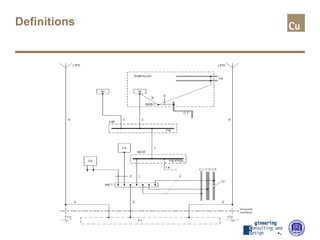
Definitions
Definitions
EXPOSED-CONDUCTIVE-PART
conductive part of equipment which
can be touched and which is not
normally live, but which can become
live when basic insulation fails
[IEV 195-06-10]
Definitions
PROTECTIVE CONDUCTOR
conductor provided for
purposes of safety, for
example protection against
electric shock
[IEV 195-02-09]
Definitions
MAIN EARTHING TERMINAL
(main earthing busbar)
terminal or busbar which is part
of the earthing arrangement of
an installation enabling the
electric connection of a number
of conductors for earthing
purposes
[IEV 195-02-33]
Definitions
EARTHING CONDUCTOR
conductor which provides a
conductive path, or part of the
conductive path, between a
given point in a system or in
an installation or in equipment
and an earth electrode
[IEV 195-02-03]
Definitions
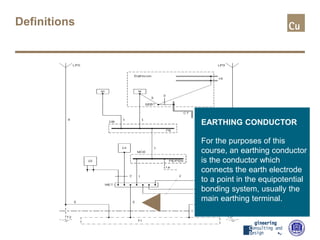
EARTHING CONDUCTOR
For the purposes of this
course, an earthing conductor
is the conductor which
connects the earth electrode
to a point in the equipotential
bonding system, usually the
main earthing terminal.
Definitions
EARTH ELECTRODE
conductive part, which may be
embedded in a specific
conductive medium, e.g.
concrete, in electric contact
with the earth
[IEV 195-02-01]
Definitions
EXTRANEOUS-
CONDUCTIVE-PART
conductive part not forming
part of the electrical
installation and liable to
introduce an electric potential,
generally the electric potential
of a local earth
[IEV 195-06-11]
Definitions
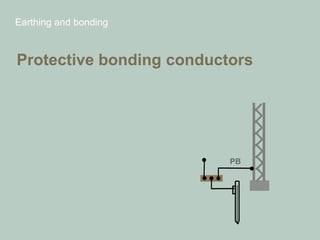
PROTECTIVE BONDING
CONDUCTOR
protective conductor provided
for protective-equipotential-
bonding
[IEV 195-02-10]
Earthing and bonding
Types
of electrical systems
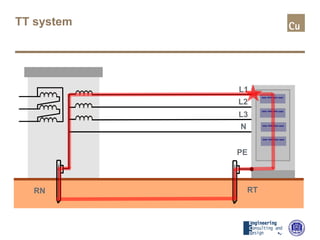
TT system
RTRN
PE
L1
L2
L3
N
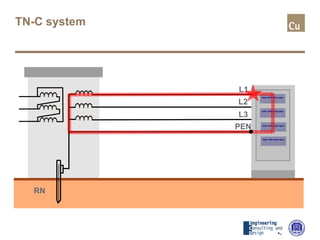
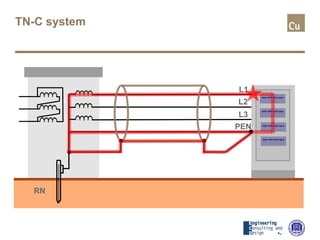
TN-C system
RN
PEN
L1
L2
L3
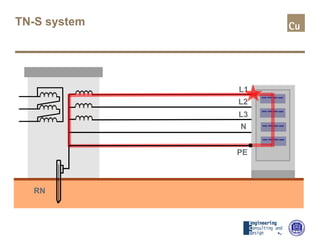
TN-S system
RN
PE
L1
L2
L3
N
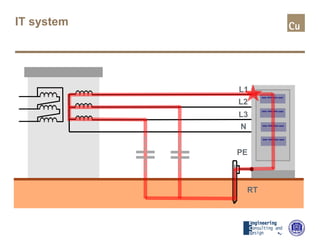
IT system
RT
PE
L1
L2
L3
N
Earthing and bonding
Earthing
arrangements
Earthing arrangements
General requirements
Intendendent to provide a connection to earth:
• Reliable
• Suitable to carry earth fault currents and protective
conductors currents to earth without danger from thermal,
thermo-mechanical, chemical and electromechanical
stresses and from electric shock arising from these
currents
• With an appropriate robustness against corrosion and
mechanical stresses
• suitable for functional requirements
IEC60364-5-54art.542.1
Earthing and bonding
General requirements
Earthing and bonding
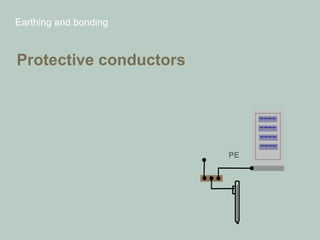
Protective conductors
PE
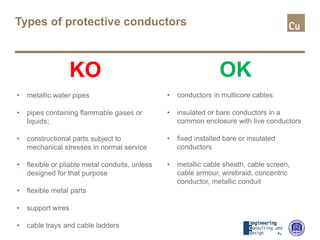
Types of protective conductors
OK
• conductors in multicore cables
• insulated or bare conductors in a
common enclosure with live conductors
• fixed installed bare or insulated
conductors
• metallic cable sheath, cable screen,
cable armour, wirebraid, concentric
conductor, metallic conduit
KO
• metallic water pipes
• pipes containing flammable gases or
liquids;
• constructional parts subject to
mechanical stresses in normal service
• flexible or pliable metal conduits, unless
designed for that purpose
• flexible metal parts
• support wires
• cable trays and cable ladders
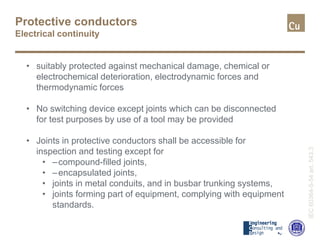
Protective conductors
Electrical continuity
IEC60364-5-54art.543.3
• suitably protected against mechanical damage, chemical or
electrochemical deterioration, electrodynamic forces and
thermodynamic forces
• No switching device except joints which can be disconnected
for test purposes by use of a tool may be provided
• Joints in protective conductors shall be accessible for
inspection and testing except for
• –compound-filled joints,
• –encapsulated joints,
• joints in metal conduits, and in busbar trunking systems,
• joints forming part of equipment, complying with equipment
standards.
Protective conductors
Minimum cross-sectional areas
IEC60364-5-54art.543.1
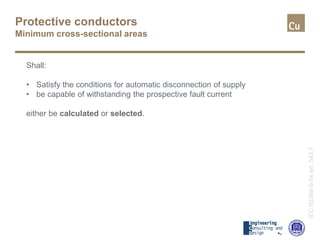
Shall:
• Satisfy the conditions for automatic disconnection of supply
• be capable of withstanding the prospective fault current
either be calculated or selected.
Protective conductors
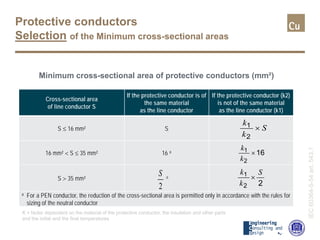
Selection of the Minimum cross-sectional areas
IEC60364-5-54art.543.1
Minimum cross-sectional area of protective conductors (mm²)
Cross-sectional area
of line conductor S
If the protective conductor is of
the same material
as the line conductor
If the protective conductor (k2)
is not of the same material
as the line conductor (k1)
S ≤ 16 mm² S
16 mm² < S ≤ 35 mm² 16 a
S > 35 mm² a
a For a PEN conductor, the reduction of the cross-sectional area is permitted only in accordance with the rules for
sizing of the neutral conductor
S
k
k
Ɨ
2
1
16
2
1 Ɨ
k
k
2
S
22
1 S
k
k
Ɨ
K = factor dependent on the material of the protective conductor, the insulation and other parts
and the initial and the final temperatures
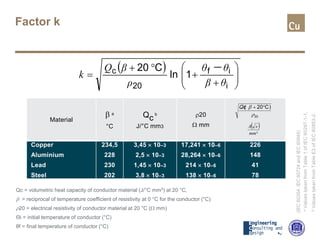
Factor k
Qc = volumetric heat capacity of conductor material (J/°C mm3) at 20 °C,
β = reciprocal of temperature coefficient of resistivity at 0 °C for the conductor (°C)
ρ20 = electrical resistivity of conductor material at 20 °C (Ω mm)
Θi = initial temperature of conductor (°C)
θf = final temperature of conductor (°C)
( )






+
+
°+
=
āˆ’
i
if
20
c
1ln
C20
θβ
ĪøĪø
ρ
βQ
k
(IEC60354,IEC60724andIEC60949)
aValuestakenfromTable1ofIEC60287-1-1,
bValuestakenfromTableE2ofIEC60853-2.
Material
β a
°C
Qc
b
J/°C mm3
ρ20
Ω mm
Copper
Aluminium
Lead
Steel
234,5
228
230
202
3,45 Ɨ 10–3
2,5 Ɨ 10–3
1,45 Ɨ 10–3
3,8 Ɨ 10–3
17,241 Ɨ 10–6
28,264 Ɨ 10–6
214 Ɨ 10–6
138 Ɨ 10–6
226
148
41
78
20
)C20(
ρ
β °+Qc
( )
²mm
sA
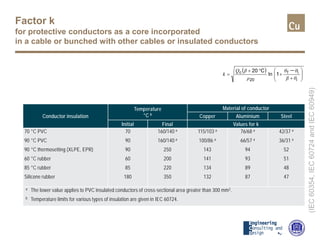
Factor k
for protective conductors as a core incorporated
in a cable or bunched with other cables or insulated conductors
( )






+
+
°+
=
āˆ’
i
if
20
c
1ln
C20
θβ
ĪøĪø
ρ
βQ
k
(IEC60354,IEC60724andIEC60949)
Conductor insulation
Temperature
°C b
Material of conductor
Copper Aluminium Steel
Initial Final Values for k
70 °C PVC
90 °C PVC
90 °C thermosetting (XLPE, EPR)
60 °C rubber
85 °C rubber
Silicone rubber
70
90
90
60
85
180
160/140 a
160/140 a
250
200
220
350
115/103 a
100/86 a
143
141
134
132
76/68 a
66/57 a
94
93
89
87
42/37 a
36/31 a
52
51
48
47
a The lower value applies to PVC insulated conductors of cross-sectional area greater than 300 mm2.
b Temperature limits for various types of insulation are given in IEC 60724.
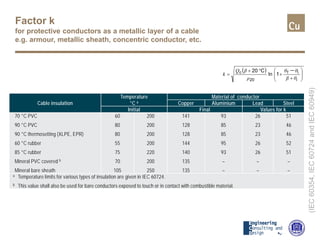
Factor k
for protective conductors as a metallic layer of a cable
e.g. armour, metallic sheath, concentric conductor, etc.
( )






+
+
°+
=
āˆ’
i
if
20
c
1ln
C20
θβ
ĪøĪø
ρ
βQ
k
(IEC60354,IEC60724andIEC60949)
Cable insulation
Temperature
°C a
Material of conductor
Copper Aluminium Lead Steel
Initial Final Values for k
70 °C PVC
90 °C PVC
90 °C thermosetting (XLPE, EPR)
60 °C rubber
85 °C rubber
Mineral PVC covered b
Mineral bare sheath
60
80
80
55
75
70
105
200
200
200
200
220
200
250
141
128
128
144
140
135
135
93
85
85
95
93
–
–
26
23
23
26
26
–
–
51
46
46
52
51
–
–
a Temperature limits for various types of insulation are given in IEC 60724.
b This value shall also be used for bare conductors exposed to touch or in contact with combustible material.
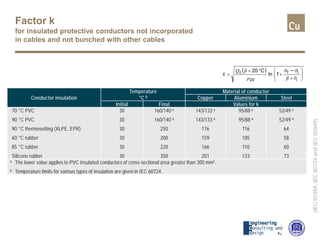
Factor k
for insulated protective conductors not incorporated
in cables and not bunched with other cables
( )






+
+
°+
=
āˆ’
i
if
20
c
1ln
C20
θβ
ĪøĪø
ρ
βQ
k
(IEC60354,IEC60724andIEC60949)
Conductor insulation
Temperature
°C b
Material of conductor
Copper Aluminium Steel
Initial Final Values for k
70 °C PVC
90 °C PVC
90 °C thermosetting (XLPE, EPR)
60 °C rubber
85 °C rubber
Silicone rubber
30
30
30
30
30
30
160/140 a
160/140 a
250
200
220
350
143/133 a
143/133 a
176
159
166
201
95/88 a
95/88 a
116
105
110
133
52/49 a
52/49 a
64
58
60
73
a The lower value applies to PVC insulated conductors of cross-sectional area greater than 300 mm2.
b Temperature limits for various types of insulation are given in IEC 60724.
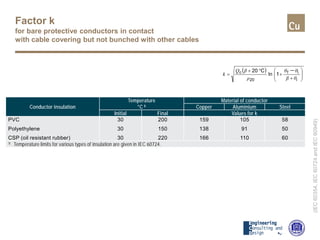
Factor k
for bare protective conductors in contact
with cable covering but not bunched with other cables
( )






+
+
°+
=
āˆ’
i
if
20
c
1ln
C20
θβ
ĪøĪø
ρ
βQ
k
(IEC60354,IEC60724andIEC60949)
Conductor insulation
Temperature
°C b
Material of conductor
Copper Aluminium Steel
Initial Final Values for k
PVC
Polyethylene
CSP (oil resistant rubber)
30
30
30
200
150
220
159
138
166
105
91
110
58
50
60
b Temperature limits for various types of insulation are given in IEC 60724.
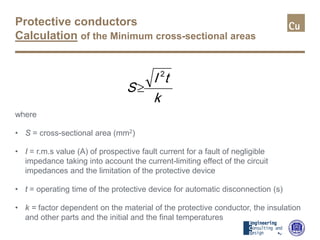
Protective conductors
Calculation of the Minimum cross-sectional areas
where
• S = cross-sectional area (mm2)
• I = r.m.s value (A) of prospective fault current for a fault of negligible
impedance taking into account the current-limiting effect of the circuit
impedances and the limitation of the protective device
• t = operating time of the protective device for automatic disconnection (s)
• k = factor dependent on the material of the protective conductor, the insulation
and other parts and the initial and the final temperatures
k
tI
S
2
≄
Prospective fault current calculation
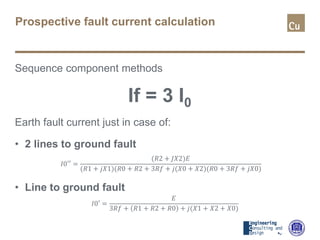
Sequence component methods
If = 3 I0
Earth fault current just in case of:
• 2 lines to ground fault
• Line to ground fault
š¼š¼ š¼š¼ =
šøšø
3š‘…š‘…š‘…š‘… + š‘…š‘…š‘… + š‘…š‘…š‘… + š‘…š‘…š‘… + š‘—š‘—(š‘‹š‘‹š‘‹ + š‘‹š‘‹š‘‹ + š‘‹š‘‹š‘‹)
š¼š¼ š¼š¼š¼ =
(š‘…š‘…š‘… + š½š½ š½š½š½)šøšø
(š‘…š‘…š‘… + š‘—š‘— š‘—š‘—š‘—)(š‘…š‘…š‘… + š‘…š‘…š‘… + 3š‘…š‘…š‘…š‘… + š‘—š‘—(š‘‹š‘‹š‘‹ + š‘‹š‘‹š‘‹)(š‘…š‘…š‘… + 3š‘…š‘…š‘…š‘… + š‘—š‘— š‘—š‘—š‘—)
Prospective fault current calculation
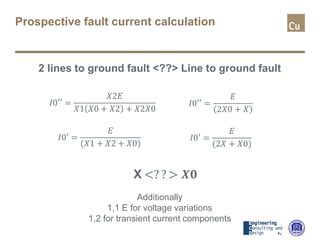
2 lines to ground fault <??> Line to ground fault
Additionally
1,1 E for voltage variations
1,2 for transient current components
š¼š¼ š¼š¼ =
šøšø
(š‘‹š‘‹š‘‹ + š‘‹š‘‹š‘‹ + š‘‹š‘‹š‘‹)
š¼š¼ š¼š¼š¼ =
š‘‹š‘‹š‘‹š‘‹š‘‹
š‘‹š‘‹š‘‹ š‘‹š‘‹š‘‹ + š‘‹š‘‹š‘‹ + š‘‹š‘‹š‘‹š‘‹š‘‹š‘‹
š¼š¼ š¼š¼ =
šøšø
(2š‘‹š‘‹ + š‘‹š‘‹š‘‹)
š¼š¼ š¼š¼š¼ =
šøšø
2š‘‹š‘‹š‘‹ + š‘‹š‘‹
X <? ? > š‘æš‘æš‘æš‘æ
Prospective fault current calculation
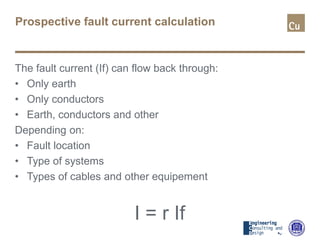
The fault current (If) can flow back through:
• Only earth
• Only conductors
• Earth, conductors and other
Depending on:
• Fault location
• Type of systems
• Types of cables and other equipement
I = r If
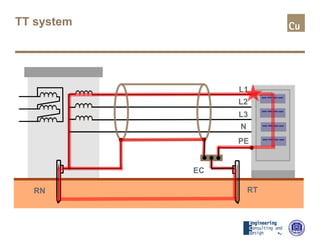
TT system
RTRN
PE
L1
L2
L3
N
EC
TN-C system
RN
PEN
L1
L2
L3
Prospective fault current calculation
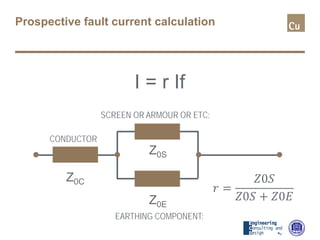
I = r If
Z0S
Z0E
Z0C
CONDUCTOR
SCREEN OR ARMOUR OR ETC:
EARTHING COMPONENT:
š‘Ÿš‘Ÿ =
š‘š‘š‘š‘š‘
š‘š‘š‘š‘š‘ + š‘š‘š‘š‘š‘
Protective conductors
Other requirements for the Minimum cross-sectional areas
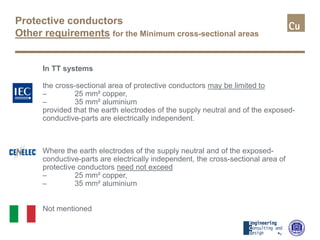
In TT systems
the cross-sectional area of protective conductors may be limited to
– 25 mm² copper,
– 35 mm² aluminium
provided that the earth electrodes of the supply neutral and of the exposed-
conductive-parts are electrically independent.
Where the earth electrodes of the supply neutral and of the exposed-
conductive-parts are electrically independent, the cross-sectional area of
protective conductors need not exceed
– 25 mm² copper,
– 35 mm² aluminium
Not mentioned
Protective conductors
Other requirements for the Minimum cross-sectional areas
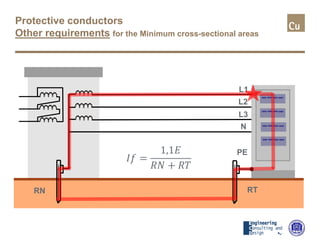
RTRN
PE
L1
L2
L3
N
š¼š¼š¼š¼ =
1,1šøšø
š‘…š‘…š‘…š‘… + š‘…š‘…š‘…š‘…
Protective conductors
Other requirements for the Minimum cross-sectional areas
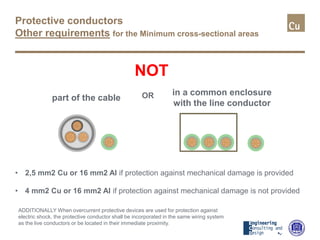
• 2,5 mm2 Cu or 16 mm2 Al if protection against mechanical damage is provided
• 4 mm2 Cu or 16 mm2 Al if protection against mechanical damage is not provided
part of the cable
in a common enclosure
with the line conductor
OR
NOT
ADDITIONALLY When overcurrent protective devices are used for protection against
electric shock, the protective conductor shall be incorporated in the same wiring system
as the live conductors or be located in their immediate proximity.
Protective conductors
Other requirements for the Minimum cross-sectional areas
The protective conductor is common to two or more circuits
• calculated for the most onerous prospective fault current and operating time
encountered in these circuits
or
• selected in accordance so as to correspond to the cross-sectional area of the
largest line conductor of the circuit.
Earthing and bonding
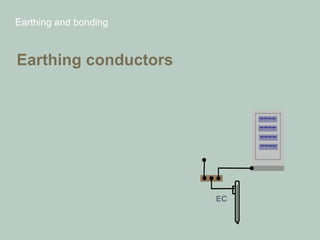
Earthing conductors
EC
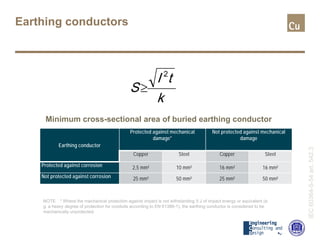
Earthing conductors
IEC60364-5-54art.542.3
Minimum cross-sectional area of buried earthing conductor
Earthing conductor
Protected against mechanical
damage*
Not protected against mechanical
damage
Copper Steel Copper Steel
Protected against corrosion 2,5 mm² 10 mm² 16 mm² 16 mm²
Not protected against corrosion 25 mm² 50 mm² 25 mm² 50 mm²
NOTE * Where the mechanical protection against impact is not withstanding 5 J of impact energy or equivalent (e.
g. a heavy degree of protection for conduits according to EN 61386-1), the earthing conductor is considered to be
mechanically unprotected.
k
tI
S
2
≄
Earthing and bonding
Protective bonding conductors
PB
Protective bonding conductors
Minimum cross-sectional areas
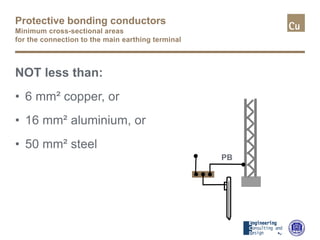
for the connection to the main earthing terminal
NOT less than:
• 6 mm² copper, or
• 16 mm² aluminium, or
• 50 mm² steel
PB
Protective bonding conductors
Minimum cross-sectional areas
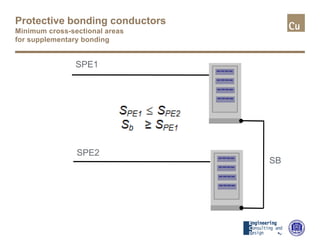
for supplementary bonding
SPE1
SPE2
SB
Protective bonding conductors
Minimum cross-sectional areas
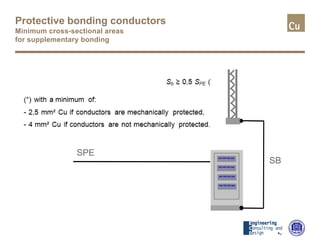
for supplementary bonding
SPE
SB
Earthing and bonding
Of electronic devices
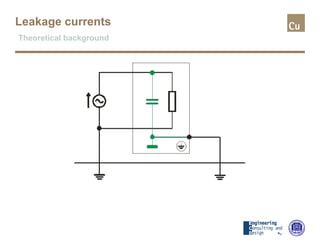
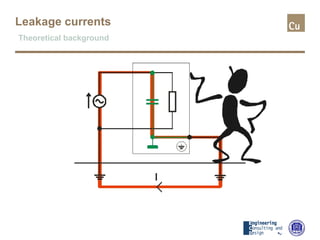
Leakage currents
Theoretical background
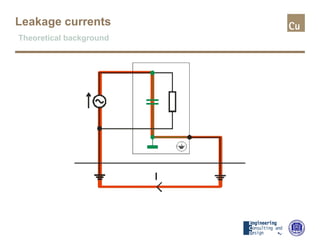
Leakage currents
Theoretical background
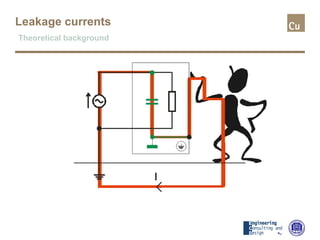
Leakage currents
Theoretical background
Leakage currents
Theoretical background
Standard requirements
IEC 60364 - 7 - 707
Earthing requirements for
the installation of data processing equipments
ļ‚§ Leakage current > 3,5 mA (EN 60950)
ļ‚§ Also non data processing equipments
Safety clause 707.4
Low noise clause 707.5
IEC 60364 - 7 - 707 requirements
Leakage currents < 10 mA
• particular requirements of reliability of protective conductor
Leakage currents > 10 mA
• additional requirements of reliability of protective conductor i.e.
• High integrity connection
• Earth continuity monitoring
• Use of transformers
Additional requirements for TT and IT systems
Single earthing system
• simultaneously accessible exposed conductive parts
IEC 60364 - 7 - 707
Requirements < 10 mA TN(-S)
Equipment shall be:
• stationary and
• either permanently connected to the building wiring installation or
connected via industrial plugs and sockets (IEC Pubblication
309-1)
Clause 707.471.3.2
IEC 60364 - 7 - 707
Requirements > 10mA
High integrity protective circuits
• High integrity connection
• Earth continuity monitoring
Use of transformers
IEC 60364 - 7 - 707
Requirements > 10mA
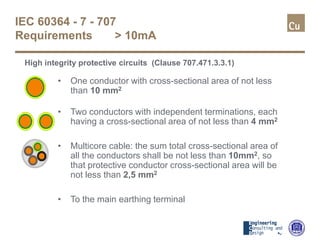
High integrity protective circuits (Clause 707.471.3.3.1)
• One conductor with cross-sectional area of not less
than 10 mm2
• Two conductors with independent terminations, each
having a cross-sectional area of not less than 4 mm2
• Multicore cable: the sum total cross-sectional area of
all the conductors shall be not less than 10mm2, so
that protective conductor cross-sectional area will be
not less than 2,5 mm2
• To the main earthing terminal
IEC 60364 - 7 - 707
Requirements > 10mA
Earth continuity monitoring
(Clause 707.471.3.3.2)
• A device or devices shall be provided which will disconnect the
equipment in the event of a discontinuity occurring in the
protective conductor
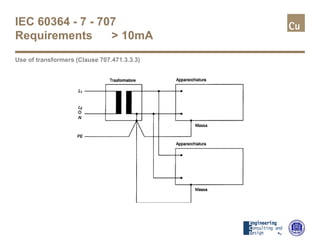
Use of transformers (Clause 707.471.3.3.3)
IEC 60364 - 7 - 707
Requirements > 10mA
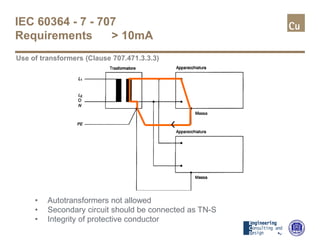
Use of transformers (Clause 707.471.3.3.3)
• Autotransformers not allowed
• Secondary circuit should be connected as TN-S
• Integrity of protective conductor
IEC 60364 - 7 - 707
Requirements > 10mA
Low noise equipotential bonding
IEC 60364 Comments on Clause 707.5
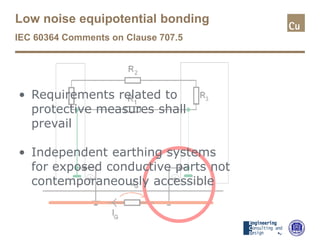
• Requirements related to
protective measures shall
prevail
• Independent earthing systems
for exposed conductive parts not
contemporaneously accessible
IEC 60364 - 7 – 707 requirements
• Separation of sensitive and disturbing
circuits
• Avoid parallelisms
• Line balance
• Shields and double shields
• Differentiated conductors
Low noise equipotential bonding
(comments on Clause 707.5)
IEC 60364 - 7 – 707 requirements
Low noise equipotential bonding
(comments on Clause 707.5)
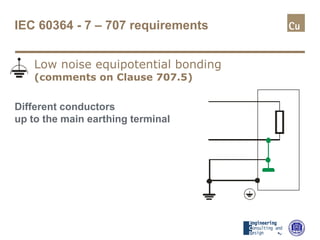
Different conductors
up to the main earthing terminal
Earthing and bonding
1. Definitions
2. Electrical system types
3. Earthing and Bonding arrangements
4. General requirements
• Protective conductor
• Earthing conductor
• Equipotential bonding
5. Earthing and bonding of electronic devices
• Safety
• Low noise
Thank you
| Presentation title and date
For more information please contact
Angelo Baggini
UniversitĆ  di Bergamo
Dipartimento di Ingegneria
Viale Marconi 5,
24044 Dalmine (BG) Italy
email: angelo.baggini@unibg.it
ECD Engineering Consulting and Design
Via Maffi 21 27100 PAVIA Italy

Earthing and bonding - Power cables

  • 1.
    Angelo Baggini, angelo.baggini@unibg.it,Bergamo University - Engineering Department Via Marconi 5, 24044 Dalmine (BG) – Italy Earthing and bonding
  • 2.
    Earthing and bonding 1.Definitions 2. Electrical system types 3. Earthing and Bonding arrangements 4. General requirements • Protective conductor • Earthing conductor • Equipotential bonding 5. Earthing and bonding of electronic devices • Safety • Low noise
  • 3.
  • 4.
  • 5.
    Definitions EXPOSED-CONDUCTIVE-PART conductive part ofequipment which can be touched and which is not normally live, but which can become live when basic insulation fails [IEV 195-06-10]
  • 6.
    Definitions PROTECTIVE CONDUCTOR conductor providedfor purposes of safety, for example protection against electric shock [IEV 195-02-09]
  • 7.
    Definitions MAIN EARTHING TERMINAL (mainearthing busbar) terminal or busbar which is part of the earthing arrangement of an installation enabling the electric connection of a number of conductors for earthing purposes [IEV 195-02-33]
  • 8.
    Definitions EARTHING CONDUCTOR conductor whichprovides a conductive path, or part of the conductive path, between a given point in a system or in an installation or in equipment and an earth electrode [IEV 195-02-03]
  • 9.
    Definitions EARTHING CONDUCTOR For thepurposes of this course, an earthing conductor is the conductor which connects the earth electrode to a point in the equipotential bonding system, usually the main earthing terminal.
  • 10.
    Definitions EARTH ELECTRODE conductive part,which may be embedded in a specific conductive medium, e.g. concrete, in electric contact with the earth [IEV 195-02-01]
  • 11.
    Definitions EXTRANEOUS- CONDUCTIVE-PART conductive part notforming part of the electrical installation and liable to introduce an electric potential, generally the electric potential of a local earth [IEV 195-06-11]
  • 12.
    Definitions PROTECTIVE BONDING CONDUCTOR protective conductorprovided for protective-equipotential- bonding [IEV 195-02-10]
  • 13.
  • 14.
  • 15.
  • 16.
  • 17.
  • 18.
  • 19.
    Earthing arrangements General requirements Intendendentto provide a connection to earth: • Reliable • Suitable to carry earth fault currents and protective conductors currents to earth without danger from thermal, thermo-mechanical, chemical and electromechanical stresses and from electric shock arising from these currents • With an appropriate robustness against corrosion and mechanical stresses • suitable for functional requirements IEC60364-5-54art.542.1
  • 20.
  • 21.
  • 22.
    Types of protectiveconductors OK • conductors in multicore cables • insulated or bare conductors in a common enclosure with live conductors • fixed installed bare or insulated conductors • metallic cable sheath, cable screen, cable armour, wirebraid, concentric conductor, metallic conduit KO • metallic water pipes • pipes containing flammable gases or liquids; • constructional parts subject to mechanical stresses in normal service • flexible or pliable metal conduits, unless designed for that purpose • flexible metal parts • support wires • cable trays and cable ladders
  • 23.
    Protective conductors Electrical continuity IEC60364-5-54art.543.3 •suitably protected against mechanical damage, chemical or electrochemical deterioration, electrodynamic forces and thermodynamic forces • No switching device except joints which can be disconnected for test purposes by use of a tool may be provided • Joints in protective conductors shall be accessible for inspection and testing except for • –compound-filled joints, • –encapsulated joints, • joints in metal conduits, and in busbar trunking systems, • joints forming part of equipment, complying with equipment standards.
  • 24.
    Protective conductors Minimum cross-sectionalareas IEC60364-5-54art.543.1 Shall: • Satisfy the conditions for automatic disconnection of supply • be capable of withstanding the prospective fault current either be calculated or selected.
  • 25.
    Protective conductors Selection ofthe Minimum cross-sectional areas IEC60364-5-54art.543.1 Minimum cross-sectional area of protective conductors (mm²) Cross-sectional area of line conductor S If the protective conductor is of the same material as the line conductor If the protective conductor (k2) is not of the same material as the line conductor (k1) S ≤ 16 mm² S 16 mm² < S ≤ 35 mm² 16 a S > 35 mm² a a For a PEN conductor, the reduction of the cross-sectional area is permitted only in accordance with the rules for sizing of the neutral conductor S k k Ɨ 2 1 16 2 1 Ɨ k k 2 S 22 1 S k k Ɨ K = factor dependent on the material of the protective conductor, the insulation and other parts and the initial and the final temperatures
  • 26.
    Factor k Qc =volumetric heat capacity of conductor material (J/°C mm3) at 20 °C, β = reciprocal of temperature coefficient of resistivity at 0 °C for the conductor (°C) ρ20 = electrical resistivity of conductor material at 20 °C (Ω mm) Θi = initial temperature of conductor (°C) Īøf = final temperature of conductor (°C) ( )       + + °+ = āˆ’ i if 20 c 1ln C20 θβ ĪøĪø ρ βQ k (IEC60354,IEC60724andIEC60949) aValuestakenfromTable1ofIEC60287-1-1, bValuestakenfromTableE2ofIEC60853-2. Material β a °C Qc b J/°C mm3 ρ20 Ω mm Copper Aluminium Lead Steel 234,5 228 230 202 3,45 Ɨ 10–3 2,5 Ɨ 10–3 1,45 Ɨ 10–3 3,8 Ɨ 10–3 17,241 Ɨ 10–6 28,264 Ɨ 10–6 214 Ɨ 10–6 138 Ɨ 10–6 226 148 41 78 20 )C20( ρ β °+Qc ( ) ²mm sA
  • 27.
    Factor k for protectiveconductors as a core incorporated in a cable or bunched with other cables or insulated conductors ( )       + + °+ = āˆ’ i if 20 c 1ln C20 θβ ĪøĪø ρ βQ k (IEC60354,IEC60724andIEC60949) Conductor insulation Temperature °C b Material of conductor Copper Aluminium Steel Initial Final Values for k 70 °C PVC 90 °C PVC 90 °C thermosetting (XLPE, EPR) 60 °C rubber 85 °C rubber Silicone rubber 70 90 90 60 85 180 160/140 a 160/140 a 250 200 220 350 115/103 a 100/86 a 143 141 134 132 76/68 a 66/57 a 94 93 89 87 42/37 a 36/31 a 52 51 48 47 a The lower value applies to PVC insulated conductors of cross-sectional area greater than 300 mm2. b Temperature limits for various types of insulation are given in IEC 60724.
  • 28.
    Factor k for protectiveconductors as a metallic layer of a cable e.g. armour, metallic sheath, concentric conductor, etc. ( )       + + °+ = āˆ’ i if 20 c 1ln C20 θβ ĪøĪø ρ βQ k (IEC60354,IEC60724andIEC60949) Cable insulation Temperature °C a Material of conductor Copper Aluminium Lead Steel Initial Final Values for k 70 °C PVC 90 °C PVC 90 °C thermosetting (XLPE, EPR) 60 °C rubber 85 °C rubber Mineral PVC covered b Mineral bare sheath 60 80 80 55 75 70 105 200 200 200 200 220 200 250 141 128 128 144 140 135 135 93 85 85 95 93 – – 26 23 23 26 26 – – 51 46 46 52 51 – – a Temperature limits for various types of insulation are given in IEC 60724. b This value shall also be used for bare conductors exposed to touch or in contact with combustible material.
  • 29.
    Factor k for insulatedprotective conductors not incorporated in cables and not bunched with other cables ( )       + + °+ = āˆ’ i if 20 c 1ln C20 θβ ĪøĪø ρ βQ k (IEC60354,IEC60724andIEC60949) Conductor insulation Temperature °C b Material of conductor Copper Aluminium Steel Initial Final Values for k 70 °C PVC 90 °C PVC 90 °C thermosetting (XLPE, EPR) 60 °C rubber 85 °C rubber Silicone rubber 30 30 30 30 30 30 160/140 a 160/140 a 250 200 220 350 143/133 a 143/133 a 176 159 166 201 95/88 a 95/88 a 116 105 110 133 52/49 a 52/49 a 64 58 60 73 a The lower value applies to PVC insulated conductors of cross-sectional area greater than 300 mm2. b Temperature limits for various types of insulation are given in IEC 60724.
  • 30.
    Factor k for bareprotective conductors in contact with cable covering but not bunched with other cables ( )       + + °+ = āˆ’ i if 20 c 1ln C20 θβ ĪøĪø ρ βQ k (IEC60354,IEC60724andIEC60949) Conductor insulation Temperature °C b Material of conductor Copper Aluminium Steel Initial Final Values for k PVC Polyethylene CSP (oil resistant rubber) 30 30 30 200 150 220 159 138 166 105 91 110 58 50 60 b Temperature limits for various types of insulation are given in IEC 60724.
  • 31.
    Protective conductors Calculation ofthe Minimum cross-sectional areas where • S = cross-sectional area (mm2) • I = r.m.s value (A) of prospective fault current for a fault of negligible impedance taking into account the current-limiting effect of the circuit impedances and the limitation of the protective device • t = operating time of the protective device for automatic disconnection (s) • k = factor dependent on the material of the protective conductor, the insulation and other parts and the initial and the final temperatures k tI S 2 ≄
  • 32.
    Prospective fault currentcalculation Sequence component methods If = 3 I0 Earth fault current just in case of: • 2 lines to ground fault • Line to ground fault š¼š¼ š¼š¼ = šøšø 3š‘…š‘…š‘…š‘… + š‘…š‘…š‘… + š‘…š‘…š‘… + š‘…š‘…š‘… + š‘—š‘—(š‘‹š‘‹š‘‹ + š‘‹š‘‹š‘‹ + š‘‹š‘‹š‘‹) š¼š¼ š¼š¼š¼ = (š‘…š‘…š‘… + š½š½ š½š½š½)šøšø (š‘…š‘…š‘… + š‘—š‘— š‘—š‘—š‘—)(š‘…š‘…š‘… + š‘…š‘…š‘… + 3š‘…š‘…š‘…š‘… + š‘—š‘—(š‘‹š‘‹š‘‹ + š‘‹š‘‹š‘‹)(š‘…š‘…š‘… + 3š‘…š‘…š‘…š‘… + š‘—š‘— š‘—š‘—š‘—)
  • 33.
    Prospective fault currentcalculation 2 lines to ground fault <??> Line to ground fault Additionally 1,1 E for voltage variations 1,2 for transient current components š¼š¼ š¼š¼ = šøšø (š‘‹š‘‹š‘‹ + š‘‹š‘‹š‘‹ + š‘‹š‘‹š‘‹) š¼š¼ š¼š¼š¼ = š‘‹š‘‹š‘‹š‘‹š‘‹ š‘‹š‘‹š‘‹ š‘‹š‘‹š‘‹ + š‘‹š‘‹š‘‹ + š‘‹š‘‹š‘‹š‘‹š‘‹š‘‹ š¼š¼ š¼š¼ = šøšø (2š‘‹š‘‹ + š‘‹š‘‹š‘‹) š¼š¼ š¼š¼š¼ = šøšø 2š‘‹š‘‹š‘‹ + š‘‹š‘‹ X <? ? > š‘æš‘æš‘æš‘æ
  • 34.
    Prospective fault currentcalculation The fault current (If) can flow back through: • Only earth • Only conductors • Earth, conductors and other Depending on: • Fault location • Type of systems • Types of cables and other equipement I = r If
  • 35.
  • 36.
  • 37.
    Prospective fault currentcalculation I = r If Z0S Z0E Z0C CONDUCTOR SCREEN OR ARMOUR OR ETC: EARTHING COMPONENT: š‘Ÿš‘Ÿ = š‘š‘š‘š‘š‘ š‘š‘š‘š‘š‘ + š‘š‘š‘š‘š‘
  • 38.
    Protective conductors Other requirementsfor the Minimum cross-sectional areas In TT systems the cross-sectional area of protective conductors may be limited to – 25 mm² copper, – 35 mm² aluminium provided that the earth electrodes of the supply neutral and of the exposed- conductive-parts are electrically independent. Where the earth electrodes of the supply neutral and of the exposed- conductive-parts are electrically independent, the cross-sectional area of protective conductors need not exceed – 25 mm² copper, – 35 mm² aluminium Not mentioned
  • 39.
    Protective conductors Other requirementsfor the Minimum cross-sectional areas RTRN PE L1 L2 L3 N š¼š¼š¼š¼ = 1,1šøšø š‘…š‘…š‘…š‘… + š‘…š‘…š‘…š‘…
  • 40.
    Protective conductors Other requirementsfor the Minimum cross-sectional areas • 2,5 mm2 Cu or 16 mm2 Al if protection against mechanical damage is provided • 4 mm2 Cu or 16 mm2 Al if protection against mechanical damage is not provided part of the cable in a common enclosure with the line conductor OR NOT ADDITIONALLY When overcurrent protective devices are used for protection against electric shock, the protective conductor shall be incorporated in the same wiring system as the live conductors or be located in their immediate proximity.
  • 41.
    Protective conductors Other requirementsfor the Minimum cross-sectional areas The protective conductor is common to two or more circuits • calculated for the most onerous prospective fault current and operating time encountered in these circuits or • selected in accordance so as to correspond to the cross-sectional area of the largest line conductor of the circuit.
  • 42.
  • 43.
    Earthing conductors IEC60364-5-54art.542.3 Minimum cross-sectionalarea of buried earthing conductor Earthing conductor Protected against mechanical damage* Not protected against mechanical damage Copper Steel Copper Steel Protected against corrosion 2,5 mm² 10 mm² 16 mm² 16 mm² Not protected against corrosion 25 mm² 50 mm² 25 mm² 50 mm² NOTE * Where the mechanical protection against impact is not withstanding 5 J of impact energy or equivalent (e. g. a heavy degree of protection for conduits according to EN 61386-1), the earthing conductor is considered to be mechanically unprotected. k tI S 2 ≄
  • 44.
    Earthing and bonding Protectivebonding conductors PB
  • 45.
    Protective bonding conductors Minimumcross-sectional areas for the connection to the main earthing terminal NOT less than: • 6 mm² copper, or • 16 mm² aluminium, or • 50 mm² steel PB
  • 46.
    Protective bonding conductors Minimumcross-sectional areas for supplementary bonding SPE1 SPE2 SB
  • 47.
    Protective bonding conductors Minimumcross-sectional areas for supplementary bonding SPE SB
  • 48.
    Earthing and bonding Earthingand bonding Of electronic devices
  • 49.
  • 50.
  • 51.
  • 52.
  • 53.
    Standard requirements IEC 60364- 7 - 707 Earthing requirements for the installation of data processing equipments ļ‚§ Leakage current > 3,5 mA (EN 60950) ļ‚§ Also non data processing equipments Safety clause 707.4 Low noise clause 707.5
  • 54.
    IEC 60364 -7 - 707 requirements Leakage currents < 10 mA • particular requirements of reliability of protective conductor Leakage currents > 10 mA • additional requirements of reliability of protective conductor i.e. • High integrity connection • Earth continuity monitoring • Use of transformers Additional requirements for TT and IT systems Single earthing system • simultaneously accessible exposed conductive parts
  • 55.
    IEC 60364 -7 - 707 Requirements < 10 mA TN(-S) Equipment shall be: • stationary and • either permanently connected to the building wiring installation or connected via industrial plugs and sockets (IEC Pubblication 309-1) Clause 707.471.3.2
  • 56.
    IEC 60364 -7 - 707 Requirements > 10mA High integrity protective circuits • High integrity connection • Earth continuity monitoring Use of transformers
  • 57.
    IEC 60364 -7 - 707 Requirements > 10mA High integrity protective circuits (Clause 707.471.3.3.1) • One conductor with cross-sectional area of not less than 10 mm2 • Two conductors with independent terminations, each having a cross-sectional area of not less than 4 mm2 • Multicore cable: the sum total cross-sectional area of all the conductors shall be not less than 10mm2, so that protective conductor cross-sectional area will be not less than 2,5 mm2 • To the main earthing terminal
  • 58.
    IEC 60364 -7 - 707 Requirements > 10mA Earth continuity monitoring (Clause 707.471.3.3.2) • A device or devices shall be provided which will disconnect the equipment in the event of a discontinuity occurring in the protective conductor
  • 59.
    Use of transformers(Clause 707.471.3.3.3) IEC 60364 - 7 - 707 Requirements > 10mA
  • 60.
    Use of transformers(Clause 707.471.3.3.3) • Autotransformers not allowed • Secondary circuit should be connected as TN-S • Integrity of protective conductor IEC 60364 - 7 - 707 Requirements > 10mA
  • 61.
    Low noise equipotentialbonding IEC 60364 Comments on Clause 707.5 • Requirements related to protective measures shall prevail • Independent earthing systems for exposed conductive parts not contemporaneously accessible
  • 62.
    IEC 60364 -7 – 707 requirements • Separation of sensitive and disturbing circuits • Avoid parallelisms • Line balance • Shields and double shields • Differentiated conductors Low noise equipotential bonding (comments on Clause 707.5)
  • 63.
    IEC 60364 -7 – 707 requirements Low noise equipotential bonding (comments on Clause 707.5) Different conductors up to the main earthing terminal
  • 64.
    Earthing and bonding 1.Definitions 2. Electrical system types 3. Earthing and Bonding arrangements 4. General requirements • Protective conductor • Earthing conductor • Equipotential bonding 5. Earthing and bonding of electronic devices • Safety • Low noise
  • 65.
    Thank you | Presentationtitle and date For more information please contact Angelo Baggini UniversitĆ  di Bergamo Dipartimento di Ingegneria Viale Marconi 5, 24044 Dalmine (BG) Italy email: angelo.baggini@unibg.it ECD Engineering Consulting and Design Via Maffi 21 27100 PAVIA Italy