Switchgear and its component
DIVYA SWITCHGEAR
Presented by:
RAVI PRAKASH
14EJIEE041
(IV B.Tech., VII Sem.)
11/4/2017 17EETR: PT & IV
Table of Contents
11/4/2017 27EETR: PT & IV
 Switchgear
 Switchgear equipment
 MCB
 MCCB
 Relay
 CT
 Bus bar
 Fuse
 Switch
Switchgear
11/4/2017 7EETR: PT & IV 3
 Switchgear
Switchgear is also a combination of switching devices such as :-
- protection devices
- switching devices
- Control and sensing devices
 The apparatus used for switching, controlling & protecting the electrical
circuits & equipments are known as switchgear.
 The switchgear equipments is essentially used with switching &
interrupting currents either under normal or abnormal operating
condition.
 It consists of devices such as switches, fuses, circuit breakers, relays
etc.
 Basically every electric circuit needs a switching device & a protecting
device.
Switchgear
11/4/2017 7EETR: PT & IV 4
 All equipment associated with the fault clearing process are converted
by the term ‘switchgear’.
 Switchgear is an essential part of a power system & also that of an
electric circuit.
 Switchgears are used in Generation, Transmission and Distribution
Systems, whereas, Control Gears are used in Consumer Circuits.
Switchgear
11/4/2017 7EETR: PT & IV 5
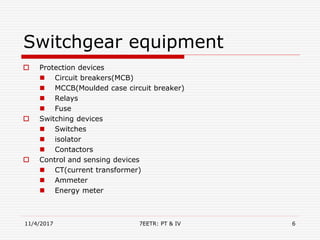
Switchgear equipment
 Protection devices
 Circuit breakers(MCB)
 MCCB(Moulded case circuit breaker)
 Relays
 Fuse
 Switching devices
 Switches
 isolator
 Contactors
 Control and sensing devices
 CT(current transformer)
 Ammeter
 Energy meter
11/4/2017 7EETR: PT & IV 6
CIRCUIT BREAKER
11/4/2017 77EETR: PT & IV
 definition
 A circuit breaker is a device which can make
or break a circuit either manually or
automatically under normal or abnormal
condition.
 functions
 A CB is a switching and current interrupting
device.
CIRCUIT BREAKER(MCB)
 As the name implies it is the miniature form of circuit
breaker.
 It is easy to handle and provide complete safety to
human beings.
 Operating principle
 Two contacts called electrode remains closed under
normal operating conditions. When fault occurs on
any part of the system, the trip coil of the circuit
breaker get energized and contacts are separated.
 A circuit breaker essentially consists of fixed and
moving contacts.
11/4/2017 7EETR: PT & IV 8
MCB(MINIATURE CIRCUIT BREAKER)
11/4/2017 7EETR: PT & IV 9
MCB(MINIATURE CIRCUIT BREAKER)
 Miniature Circuit Breakers are electromechanical devices
which protect an electric circuit from an over current.
 The over current, in an electrical circuit, may result
from short circuit, overload or faulty design.
 Miniature Circuit Breakers are used to protect lower
current circuits and have the following Specifications :-
Current rating - Amperes
Short Circuit Rating - Kilo Amperes (kA)
 rated current not more than 100A.
 Trip characteristics normally not adjustable.
11/4/2017 7EETR: PT & IV 10
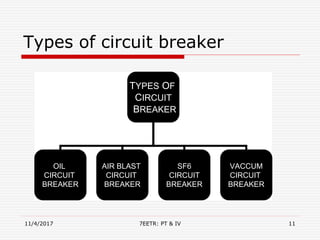
Types of circuit breaker
11/4/2017 7EETR: PT & IV 11
TYPES OF
CIRCUIT
BREAKER
OIL
CIRCUIT
BREAKER
AIR BLAST
CIRCUIT
BREAKER
SF6
CIRCUIT
BREAKER
VACCUM
CIRCUIT
BREAKER
MCCB
11/4/2017 127EETR: PT & IV
 MCCB is moulded case circuit breaker.
 MCB means miniature circuit breaker –it is used for upto 100
amp. MCCB means Molded case circuit breaker –it is used for
250 amp.
 An MCCB provides protection by combining a temperature
sensitive device with a current sensitive electromagnetic
device.
 The traditional molded-case circuit breaker uses
electromechanical (thermal magnetic) trip units that may be
fixed or interchangeable.
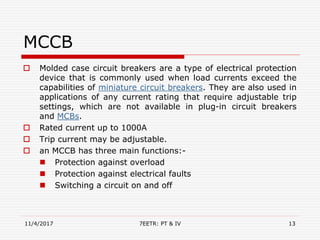
MCCB
 Molded case circuit breakers are a type of electrical protection
device that is commonly used when load currents exceed the
capabilities of miniature circuit breakers. They are also used in
applications of any current rating that require adjustable trip
settings, which are not available in plug-in circuit breakers
and MCBs.
 Rated current up to 1000A
 Trip current may be adjustable.
 an MCCB has three main functions:-
 Protection against overload
 Protection against electrical faults
 Switching a circuit on and off
11/4/2017 7EETR: PT & IV 13
MCCB
11/4/2017 7EETR: PT & IV 14
RELAY
11/4/2017 157EETR: PT & IV
 A relay may also be called an “electromagnetic switch”
 Protective relay is a device designed to trip a circuit
breaker when fault is detected.
 Protective relay were electromagnetic device.
 It is operating on moving parts to provide detection of
abnormal condition.
 Definition
A relay is a automatic device which senses an abnormal
condition of electric circuit and closes its contacts.
 There are two basic classifications of relays:-
 Electromechanical Relays
 Solid State Relays
RELAY
 One main difference between them is electromechanical
relays have moving parts, whereas solid state relays
have no moving parts.
 in conventional electromagnetic relay the measurement
of quantities is done by comparing operating
torque/force with restraining torque/force. the
electromagnetic relay operates when the operating
torque/force is greater than the restraining torque/force.
in electromagnetic relays the pick up is obtain by the
movement of movable element in the relay.
 A static relay is the relay which uses solid state
components like transistors, diodes etc. for the
measurement or comparison of electrical quantities.
11/4/2017 7EETR: PT & IV 16
RELAY
 classification of relay:-
 over current relay
 differential relay
 auxiliary relay
11/4/2017 7EETR: PT & IV 17
RELAY
11/4/2017 7EETR: PT & IV 18
Current transformer
11/4/2017 197EETR: PT & IV
 The transformer which is used for the measurement of
current is known as current transformer.
 Current transformer are used in electrical power system
for stepping down currents of the system for metering
and protection purpose.
 The current transformer has primary coil of one or less
no. of turns of thick wire which is connected in series with
the transmission line.
 The secondary consist of large number of turns of fine
wire.
 A CT(current transformer) functions with the same basic
working principle of electrical power transformer.
Current transformer
 The current transformer gives the value of current upto
5A.
 The secondary and primary winding are insulated to each
other.
 classification of current transformer :-
 On the basis of primary winding
 Wound type
 Bar type
11/4/2017 7EETR: PT & IV 20
Current transformer
11/4/2017 7EETR: PT & IV 21
Current transformer
11/4/2017 7EETR: PT & IV 22
BUS BAR
11/4/2017 237EETR: PT & IV
 Bus is derived from Latin word “OMNIBUS” (common for all).
 Electrical bus bar is collector which collect the electrical energy
at one location.
 Definition
Bus bars are conducting bars to which a number of incoming or
out going circuits are connected.
 Bus-bar is Used to interconnect the loads and sources of
electrical power.
 Bus bar is a strip or bar of copper, brass or aluminium that
conducts electricity within a switchboard, distribution
board, substation.
 The cross-sectional size of the bus bar determines the
maximum amount of current.
BUS BAR
 Various bus bar schemes
 Single bus bar scheme
 Single bus bar scheme with bus sectionalisation
 Double bus bar scheme
11/4/2017 7EETR: PT & IV 24
BUS BAR
11/4/2017 7EETR: PT & IV 25
BUS BAR
11/4/2017 7EETR: PT & IV 26
FUSE
11/4/2017 277EETR: PT & IV
 Fuse is a device used in circuit for protecting electrical
equipments against overloads and /or short circuits.
 Fuse element or fuse wire is that part of the fuse device
which melts when an excessive current flows in the
circuit and thus isolates the faulty device from the supply
circuit.
 A fuse is a short piece of wire or thin strip which melts
when excessive current flows through it for a sufficient
time.
 it is inserted in series with the circuit to be protected.
FUSE
 Desirable qualities of fuse elements
 Low melting point
 Low ohmic losses
 High conductivity
 Low cost
11/4/2017 7EETR: PT & IV 28
FUSE
11/4/2017 7EETR: PT & IV 29
SWITCH
11/4/2017 307EETR: PT & IV
 definition
a switch is a device which is used to open or
close an electrical circuit in a convenient way.
 it can be used under full-load or no load
condition but it cannot interrupt the fault
current.
 The switches are classified are as follow:-
 Air-break switches
 oil switches
SWITCH
 There are wide variety of switches available
differ mechanically, electrically, and in the
arrangement of switch contacts.
 Single-pole single throw switch(SPST)
 Single-pole double throw switch(SPDT)
 Double-pole single throw switch(DPST)
 Double-pole double throw switch(DPDT)
11/4/2017 7EETR: PT & IV 31
Switch
11/4/2017 7EETR: PT & IV 32
Switch
11/4/2017 7EETR: PT & IV 33
Conclusion
11/4/2017 347EETR: PT & IV
 One of the basic function of switchgear is to control supply of
electric power and to protect the equipment in the event of
abnormal conditions.
 Uninterrupted supply of electric power is the need of today’s
industry.
 Switchgear also provides isolation of circuit from power
supplies.
 switchgear is the combination of electrical disconnect
switches, fuses or circuit breakers used to control, protect and
isolate electrical equipment.
 Switchgear is used both to de-energize equipment to allow
work to be done and to clear faults downstream.
References
11/4/2017 357EETR: PT & IV
 principles of power system by v.k.mehta
from unit “introduction to switchgear”.
from website slide share
 https://divyaswitchgear.co.in/
 https://www.slideshare.net/biswajitcet13/circuit-breaker-15347293
11/4/2017 36
Thank You……
7EETR: PT & IV

SWITCHGEAR

  • 1.
    Switchgear and itscomponent DIVYA SWITCHGEAR Presented by: RAVI PRAKASH 14EJIEE041 (IV B.Tech., VII Sem.) 11/4/2017 17EETR: PT & IV
  • 2.
    Table of Contents 11/4/201727EETR: PT & IV  Switchgear  Switchgear equipment  MCB  MCCB  Relay  CT  Bus bar  Fuse  Switch
  • 3.
    Switchgear 11/4/2017 7EETR: PT& IV 3  Switchgear Switchgear is also a combination of switching devices such as :- - protection devices - switching devices - Control and sensing devices  The apparatus used for switching, controlling & protecting the electrical circuits & equipments are known as switchgear.  The switchgear equipments is essentially used with switching & interrupting currents either under normal or abnormal operating condition.  It consists of devices such as switches, fuses, circuit breakers, relays etc.  Basically every electric circuit needs a switching device & a protecting device.
  • 4.
    Switchgear 11/4/2017 7EETR: PT& IV 4  All equipment associated with the fault clearing process are converted by the term ‘switchgear’.  Switchgear is an essential part of a power system & also that of an electric circuit.  Switchgears are used in Generation, Transmission and Distribution Systems, whereas, Control Gears are used in Consumer Circuits.
  • 5.
  • 6.
    Switchgear equipment  Protectiondevices  Circuit breakers(MCB)  MCCB(Moulded case circuit breaker)  Relays  Fuse  Switching devices  Switches  isolator  Contactors  Control and sensing devices  CT(current transformer)  Ammeter  Energy meter 11/4/2017 7EETR: PT & IV 6
  • 7.
    CIRCUIT BREAKER 11/4/2017 77EETR:PT & IV  definition  A circuit breaker is a device which can make or break a circuit either manually or automatically under normal or abnormal condition.  functions  A CB is a switching and current interrupting device.
  • 8.
    CIRCUIT BREAKER(MCB)  Asthe name implies it is the miniature form of circuit breaker.  It is easy to handle and provide complete safety to human beings.  Operating principle  Two contacts called electrode remains closed under normal operating conditions. When fault occurs on any part of the system, the trip coil of the circuit breaker get energized and contacts are separated.  A circuit breaker essentially consists of fixed and moving contacts. 11/4/2017 7EETR: PT & IV 8
  • 9.
  • 10.
    MCB(MINIATURE CIRCUIT BREAKER) Miniature Circuit Breakers are electromechanical devices which protect an electric circuit from an over current.  The over current, in an electrical circuit, may result from short circuit, overload or faulty design.  Miniature Circuit Breakers are used to protect lower current circuits and have the following Specifications :- Current rating - Amperes Short Circuit Rating - Kilo Amperes (kA)  rated current not more than 100A.  Trip characteristics normally not adjustable. 11/4/2017 7EETR: PT & IV 10
  • 11.
    Types of circuitbreaker 11/4/2017 7EETR: PT & IV 11 TYPES OF CIRCUIT BREAKER OIL CIRCUIT BREAKER AIR BLAST CIRCUIT BREAKER SF6 CIRCUIT BREAKER VACCUM CIRCUIT BREAKER
  • 12.
    MCCB 11/4/2017 127EETR: PT& IV  MCCB is moulded case circuit breaker.  MCB means miniature circuit breaker –it is used for upto 100 amp. MCCB means Molded case circuit breaker –it is used for 250 amp.  An MCCB provides protection by combining a temperature sensitive device with a current sensitive electromagnetic device.  The traditional molded-case circuit breaker uses electromechanical (thermal magnetic) trip units that may be fixed or interchangeable.
  • 13.
    MCCB  Molded casecircuit breakers are a type of electrical protection device that is commonly used when load currents exceed the capabilities of miniature circuit breakers. They are also used in applications of any current rating that require adjustable trip settings, which are not available in plug-in circuit breakers and MCBs.  Rated current up to 1000A  Trip current may be adjustable.  an MCCB has three main functions:-  Protection against overload  Protection against electrical faults  Switching a circuit on and off 11/4/2017 7EETR: PT & IV 13
  • 14.
  • 15.
    RELAY 11/4/2017 157EETR: PT& IV  A relay may also be called an “electromagnetic switch”  Protective relay is a device designed to trip a circuit breaker when fault is detected.  Protective relay were electromagnetic device.  It is operating on moving parts to provide detection of abnormal condition.  Definition A relay is a automatic device which senses an abnormal condition of electric circuit and closes its contacts.  There are two basic classifications of relays:-  Electromechanical Relays  Solid State Relays
  • 16.
    RELAY  One maindifference between them is electromechanical relays have moving parts, whereas solid state relays have no moving parts.  in conventional electromagnetic relay the measurement of quantities is done by comparing operating torque/force with restraining torque/force. the electromagnetic relay operates when the operating torque/force is greater than the restraining torque/force. in electromagnetic relays the pick up is obtain by the movement of movable element in the relay.  A static relay is the relay which uses solid state components like transistors, diodes etc. for the measurement or comparison of electrical quantities. 11/4/2017 7EETR: PT & IV 16
  • 17.
    RELAY  classification ofrelay:-  over current relay  differential relay  auxiliary relay 11/4/2017 7EETR: PT & IV 17
  • 18.
  • 19.
    Current transformer 11/4/2017 197EETR:PT & IV  The transformer which is used for the measurement of current is known as current transformer.  Current transformer are used in electrical power system for stepping down currents of the system for metering and protection purpose.  The current transformer has primary coil of one or less no. of turns of thick wire which is connected in series with the transmission line.  The secondary consist of large number of turns of fine wire.  A CT(current transformer) functions with the same basic working principle of electrical power transformer.
  • 20.
    Current transformer  Thecurrent transformer gives the value of current upto 5A.  The secondary and primary winding are insulated to each other.  classification of current transformer :-  On the basis of primary winding  Wound type  Bar type 11/4/2017 7EETR: PT & IV 20
  • 21.
  • 22.
  • 23.
    BUS BAR 11/4/2017 237EETR:PT & IV  Bus is derived from Latin word “OMNIBUS” (common for all).  Electrical bus bar is collector which collect the electrical energy at one location.  Definition Bus bars are conducting bars to which a number of incoming or out going circuits are connected.  Bus-bar is Used to interconnect the loads and sources of electrical power.  Bus bar is a strip or bar of copper, brass or aluminium that conducts electricity within a switchboard, distribution board, substation.  The cross-sectional size of the bus bar determines the maximum amount of current.
  • 24.
    BUS BAR  Variousbus bar schemes  Single bus bar scheme  Single bus bar scheme with bus sectionalisation  Double bus bar scheme 11/4/2017 7EETR: PT & IV 24
  • 25.
  • 26.
  • 27.
    FUSE 11/4/2017 277EETR: PT& IV  Fuse is a device used in circuit for protecting electrical equipments against overloads and /or short circuits.  Fuse element or fuse wire is that part of the fuse device which melts when an excessive current flows in the circuit and thus isolates the faulty device from the supply circuit.  A fuse is a short piece of wire or thin strip which melts when excessive current flows through it for a sufficient time.  it is inserted in series with the circuit to be protected.
  • 28.
    FUSE  Desirable qualitiesof fuse elements  Low melting point  Low ohmic losses  High conductivity  Low cost 11/4/2017 7EETR: PT & IV 28
  • 29.
  • 30.
    SWITCH 11/4/2017 307EETR: PT& IV  definition a switch is a device which is used to open or close an electrical circuit in a convenient way.  it can be used under full-load or no load condition but it cannot interrupt the fault current.  The switches are classified are as follow:-  Air-break switches  oil switches
  • 31.
    SWITCH  There arewide variety of switches available differ mechanically, electrically, and in the arrangement of switch contacts.  Single-pole single throw switch(SPST)  Single-pole double throw switch(SPDT)  Double-pole single throw switch(DPST)  Double-pole double throw switch(DPDT) 11/4/2017 7EETR: PT & IV 31
  • 32.
  • 33.
  • 34.
    Conclusion 11/4/2017 347EETR: PT& IV  One of the basic function of switchgear is to control supply of electric power and to protect the equipment in the event of abnormal conditions.  Uninterrupted supply of electric power is the need of today’s industry.  Switchgear also provides isolation of circuit from power supplies.  switchgear is the combination of electrical disconnect switches, fuses or circuit breakers used to control, protect and isolate electrical equipment.  Switchgear is used both to de-energize equipment to allow work to be done and to clear faults downstream.
  • 35.
    References 11/4/2017 357EETR: PT& IV  principles of power system by v.k.mehta from unit “introduction to switchgear”. from website slide share  https://divyaswitchgear.co.in/  https://www.slideshare.net/biswajitcet13/circuit-breaker-15347293
  • 36.