International Journal of Innovative Technology and Exploring Engineering (IJITEE)
ISSN: 2278-3075, Volume-4 Issue-3, August 2014
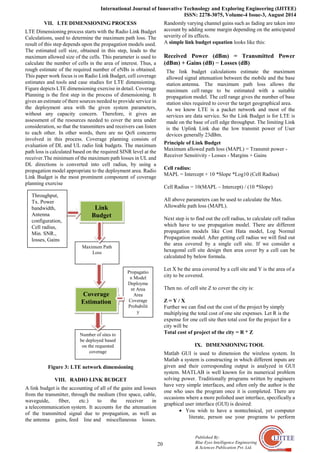
18
Published By:
Blue Eyes Intelligence Engineering
& Sciences Publication Pvt. Ltd.
Abstract—The Long Term Evolution (LTE) is the latest step
in an advancing series of mobile telecommunications systems.
In this paper, authors show interest on the link budgeting the
information presented here will help readers understand how
the budgeting will be done in LTE. This paper provides
dimensioning of LTE for particular city. This will provides the
number of cell count. Here we tell about a GUI MATLAB
System for calculation of no. of resources required to provide
services in particular area with optimum cost and better
quality.
Index Terms—LTE, Throughput, Radio link Budget Time
Division Duplexing, MAPL, Cell count
I. INTRODUCTION
Driving the evolution of wireless broadband technology is
user’s increasing expectations for speed, bandwidth, and
global access. For wireless carriers to achieve greater speeds
and pervasive connectedness, their networks need to start
behaving more like landline IP-based networks. This line of
thinking represents a fundamental shift in perspective from
mobile services to broadband connections for users and
service providers alike to enter the fourth-generation
(4G).Unlike earlier wireless standards, 4G technology is
based on TCP/IP, the core protocol of the Internet. TCP/IP
enables wireless networks to deliver higher-level services,
such as video and multimedia, while supporting the devices
and applications of the future. This point of time, there are
two technologies which can provides such user experience
IEEE’s WiMAX and 3GPP LTE. The service provider
believes that make LTE offers a number of significant
technological and business advantages over WiMAX that
make it a superior networking standard. Long Term Evolution
(LTE) has been designed to support only packet-switched
services. It aims to provide seamless Internet Protocol (IP)
connectivity between User Equipment (UE) and the packet
data network (PDN), without any disruption to the end user’s
applications during mobility
The term “Long Term Evolution” encompasses the evolution
of the Universal Mobile Telecommunications System
(UMTS) radio access through the Evolved UTRAN
(E-UTRAN) it is accompanied by an evolution of the
Manuscript received on August 2014.
Nisha Malik, M.tech, B.Tech in Electronics and communications
Engineering , Sonepat , Haryana India
Asst. Professor Rohit Khattar, M.tech, B.Tech in Electronics and
communications engineering, lecturer at BPRCE Gohana Sonepat, Haryana
India
Asst. Professor Amit Vatsh, M.tech, B.Tech in Electronics and
communications Engineering, Lecturer at IIT&M Sonepat, Haryana, India.
Sukhvinder Malik Bachelors of Engineering in Electronics and
Communications Engineering , Member of Technical Staff in IT/Telecom
Company, Bengaluru, India
non-radio (Core Network) aspects under the term “System
Architecture Evolution” (SAE), which includes the Evolved
Packet Core (EPC) network.
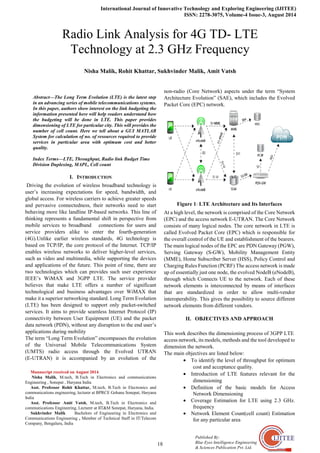
Figure 1: LTE Architecture and Its Interfaces
At a high level, the network is comprised of the Core Network
(EPC) and the access network E-UTRAN. The Core Network
consists of many logical nodes. The core network in LTE is
called Evolved Packet Core (EPC) which is responsible for
the overall control of the UE and establishment of the bearers.
The main logical nodes of the EPC are PDN Gateway (PGW),
Serving Gateway (S-GW), Mobility Management Entity
(MME), Home Subscriber Server (HSS), Policy Control and
Charging Rules Function (PCRF) The access network is made
up of essentially just one node, the evolved NodeB (eNodeB),
through which Connects UE to the network. Each of these
network elements is interconnected by means of interfaces
that are standardized in order to allow multi-vendor
interoperability. This gives the possibility to source different
network elements from different vendors.
II. OBJECTIVES AND APPROACH
This work describes the dimensioning process of 3GPP LTE
access network, its models, methods and the tool developed to
dimension the network.
The main objectives are listed below:
• To identify the level of throughput for optimum
cost and acceptance quality.
• Introduction of LTE features relevant for the
dimensioning
• Definition of the basic models for Access
Network Dimensioning
• Coverage Estimation for LTE using 2.3 GHz.
frequency
• Network Element Count(cell count) Estimation
for any particular area
Radio Link Analysis for 4G TD- LTE
Technology at 2.3 GHz Frequency
Nisha Malik, Rohit Khattar, Sukhvinder Malik, Amit Vatsh
Radio Link Analysis for 4G TD- LTE Technology at 2.3 GHz Frequency
19
Published By:
Blue Eyes Intelligence Engineering
& Sciences Publication Pvt. Ltd.
• Development and description of dimensioning
tool.
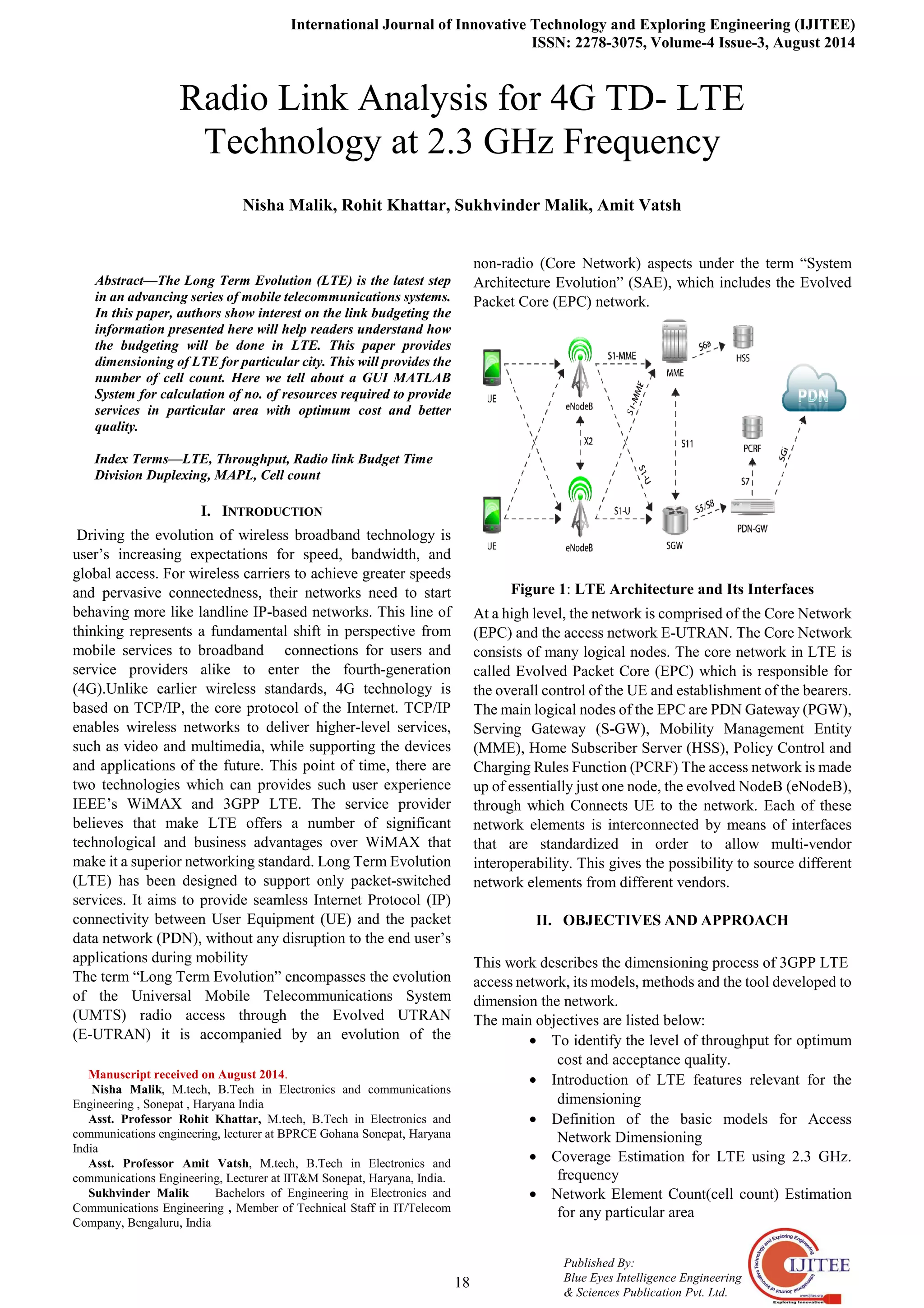
III. EVOLUTION: 1G AMPS TO 4G LTE
The various communications systems looking in the past
revolutionized the way people Communicate, joining together
communications and mobility. Evolution of wireless access
technologies is about to reach its fourth generation (4G).
Looking past, wireless access technologies have followed
different evolutionary paths aimed at unified target:
performance and efficiency in high mobile environment. The
first generation (1G) AMPS has fulfilled the basic mobile
voice, while the second generation (2G) GSM (3GPP),
CDMA one (3GPP2) has introduced capacity and coverage.
This is followed by the third generation (3G), UMTS,
WCDMA (3GPP) and EV-DO (3GPP2) which has quest for
data at higher speeds to open the gates for truly “mobile
broadband” experience, which will be further realized by the
fourth generation (4G).
Figure 2: Evolution: 1G AMPS to 4G LTE
IV. KEY FEATURES OF LTE
The 4 G Long Term Evolution has following key feature
which make this technology superior than other
technologies.
1. Peak Through put: -Peak download rates up to
300 Mbps and upload rates up to 75.Mbps depending on the
user equipment category (with 4x4 antennas using 20 MHz
of spectrum).
2. Low Latency: -Low data transfer latencies (sub-5ms
latency for small IP packets in optimal conditions), lower
latencies for handover and connection setup time than with
previous radio access technologies.
3. Mobility Support:-Improved support for mobility,
exemplified by support for terminals moving at up to
350 km/h (220 mph) or 500 km/h (310 mph) depending on
the frequency band.
4. Access Technologies:-OFDMA for the downlink,
SC-FDMA for the uplink to conserve power.
5. Duplexing Support:-Support for both FDD and TDD
communication systems as well as half-duplex FDD with the
same radio access technology
6. Flexible Bandwidths: - 1.4 MHz, 3 MHz, 5 MHz,
10 MHz, 15 MHz and 20 MHz
7. Large Cell Size Support:-Support for cell sizes from tens
of meters radius (Femto and Pico cells) up to 100 km radius
microcells. In the lower frequency bands to be used in rural
areas, 5 km is the optimal cell size, 30 km having reasonable
performance, and up to 100 km cell sizes supported.
8. Simplified architecture: LTE architecture is FLAT IP
Based. The access side of LTE is composed only of eNodeB.
Support for inter-operation and co-existence with legacy
standards like GSM/EDGE, UMTS and CDMA2000.
V. BENEFITS OF LTE
• Provides a global ecosystem with inherent mobility
• Offers easier access and use with greater security and
privacy
• Dramatically improves speed and latency
• Delivers enhanced real-time video and multimedia for
a better overall experience
• Enables high-performance mobile computing
• Supports real-time applications due to its low latency
• Creates a platform upon which to build and deploy the
products and services of today and those of
tomorrow
• Reduces cost per bit through improved spectral
efficiency.
VI. TECHNICAL DIFFERENCES BETWEEN LTE
AND WiMAX
There are so many number of technical differences exists
between LTE and WiMAX. These differences shows that
LTE have so many advantages over WiMAX.
Table 1: Differences between LTE and WiMAX
Parameter LTE WiMAX
Parameters MIMO MIMO
Technology UL- SC-FDMA
DL- OFDM
UL-OFDMA
DL- OFDM
Peak speeds DL: 100 Mbps (20
MHz, 2x2 MIMO)
UL: 50 Mbps (20
MHz, 1x2)
DL: 46 Mbps
UL: 7 Mbps
Average user
throughput
5 Mbps–12 Mbps
–DL
2 Mbps–5 Mbps -
UL
2Mbps–4Mb
ps –DL
500kbps–1.5
Mbps - UL
One-way air link
latency
15ms 50ms
Bandwidth 20 MHz, 15 MHz,
10 MHz, 5 MHz,
and <5 MHz
3.5 MHz, 5
MHz, 7 MHz,
8.75 MHz, 10
MHz
Spectrum various
frequencies,
700Mhz
2.3, 2.5, 3.5,
5.8 GHz
Mobility 350 Kmph 120Kmph
Interoperability Global roaming Limited
international
roaming
Backwards
compatibility
Connects to legacy
3GPP networks
None; new
build out
International Journal of Innovative Technology and Exploring Engineering (IJITEE)
ISSN: 2278-3075, Volume-4 Issue-3, August 2014
20
Published By:
Blue Eyes Intelligence Engineering
& Sciences Publication Pvt. Ltd.
VII. LTE DIMENSIONING PROCESS
LTE Dimensioning process starts with the Radio Link Budget
Calculations, used to determine the maximum path loss. The
result of this step depends upon the propagation models used.
The estimated cell size, obtained in this step, leads to the
maximum allowed size of the cells. This parameter is used to
calculate the number of cells in the area of interest. Thus, a
rough estimate of the required number of eNBs is obtained.
This paper work focus is on Radio Link Budget, cell coverage
estimates and tools and case studies for LTE dimensioning.
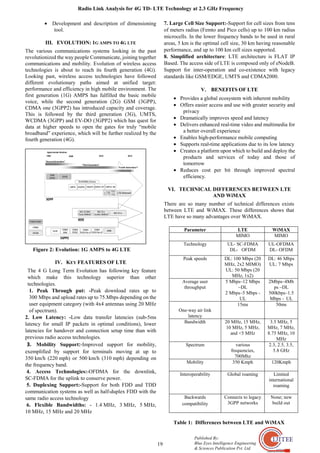
Figure depicts LTE dimensioning exercise in detail. Coverage
Planning is the first step in the process of dimensioning. It
gives an estimate of there sources needed to provide service in
the deployment area with the given system parameters,
without any capacity concern. Therefore, it gives an
assessment of the resources needed to cover the area under
consideration, so that the transmitters and receivers can listen
to each other. In other words, there are no QoS concerns
involved in this process. Coverage planning consists of
evaluation of DL and UL radio link budgets. The maximum
path loss is calculated based on the required SINR level at the
receiver.The minimum of the maximum path losses in UL and
DL directions is converted into cell radius, by using a
propagation model appropriate to the deployment area. Radio
Link Budget is the most prominent component of coverage
planning exercise
Figure 3: LTE network dimensioning
VIII. RADIO LINK BUDGET
A link budget is the accounting of all of the gains and losses
from the transmitter, through the medium (free space, cable,
waveguide, fiber, etc.) to the receiver in
a telecommunication system. It accounts for the attenuation
of the transmitted signal due to propagation, as well as
the antenna gains, feed line and miscellaneous losses.
Randomly varying channel gains such as fading are taken into
account by adding some margin depending on the anticipated
severity of its effects.
A simple link budget equation looks like this:
Received Power (dBm) = Transmitted Power
(dBm) + Gains (dB) − Losses (dB)
The link budget calculations estimate the maximum
allowed signal attenuation between the mobile and the base
station antenna. The maximum path loss allows the
maximum cell range to be estimated with a suitable
propagation model. The cell range gives the number of base
station sites required to cover the target geographical area.
As we know LTE is a packet network and most of the
services are data service. So the Link Budget is for LTE is
made on the base of cell edge throughput. The limiting Link
is the Uplink Link due the low transmit power of User
devices generally 23dBm.
Principle of Link Budget
Maximum allowed path loss (MAPL) = Transmit power -
Receiver Sensitivity - Losses - Margins + Gains
Cell radius:
MAPL = Intercept + 10 *Slope *Log10 (Cell Radius)
Cell Radius = 10(MAPL – Intercept) / (10 *Slope)
All above parameters can be used to calculate the Max.
Allowable path loss (MAPL).
Next step is to find out the cell radius, to calculate cell radius
which have to use propagation model. There are different
propagation models like Cost Hata model, Log Normal
Propagation model. After getting cell radius we will find out
the area covered by a single cell site. If we consider a
hexagonal cell site design then area cover by a cell can be
calculated by below formula.
Let X be the area covered by a cell site and Y is the area of a
city to be covered.
Then no. of cell site Z to cover the city is:
Z = Y / X
Further we can find out the cost of the project by simply
multiplying the total cost of one site expenses. Let R is the
expense for one cell site then total cost for the project for a
city will be
Total cost of project of the city = R * Z
IX. DIMENSIONING TOOL
Matlab GUI is used to dimension the wireless system. In
Matlab a system is constructing in which different inputs are
given and their corresponding output is analyzed in GUI
system. MATLAB is well known for its numerical problem
solving power. Traditionally programs written by engineers
have very simple interfaces, and often only the author is the
one who uses the program once it is completed. There are
occasions where a more polished user interface, specifically a
graphical user interface (GUI) is desired:
• You wish to have a nontechnical, yet computer
literate, person use your programs to perform
Link
Budget
Coverage
Estimation
Maximum Path
Loss
Number of sites to
be deployed based
on the requested
coverage
Propagatio
n Model
Deployme
nt Area
Area
Coverage
Probabilit
y
Throughput,
Tx. Power
bandwidth,
Antenna
configuration,
Cell radius,
Min. SNR.,
losses, Gains
Radio Link Analysis for 4G TD- LTE Technology at 2.3 GHz Frequency
21
Published By:
Blue Eyes Intelligence Engineering
& Sciences Publication Pvt. Ltd.
some ongoing data analysis task, etc.
• You wish to share your tool (program(s)) with other
members of your work group, but want the
interface to be friendly.
• You are writing a utility function for your own use
and would like it to be easy to use
• You wish to build an interactive demonstration to
best show off a concept or idea to others, e.g.,
others students etc.
• You or your company is a third-party developer of
tools for the MATLAB user community
MATLAB flagship software in scientific
computing, is extensively used all over the world.
• Particular factors that support the selection of
MATLAB are:
• A flexible software structure of MATLAB
comprising libraries, models, and programs
enables one to integrate different model
components in one package conveniently.
• Fast development with MATLAB using powerful
calculation and visualization means of the
package enables one to expand the software
quickly and efficiently without developing any
extra programming tools.
• A wide selection of TOOL Boxes, comprehensive
collections of predefined functions for solving
application‐specific problems, is already
available with MATLAB and is likely to grow
even faster in the future.
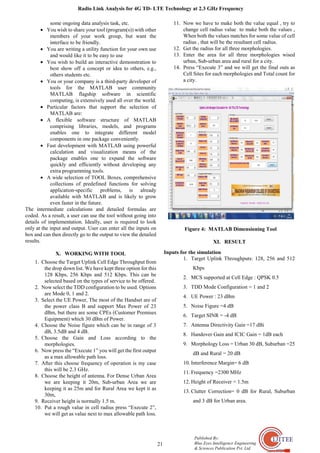
The intermediate calculations and detailed formulas are
coded. As a result, a user can use the tool without going into
details of implementation. Ideally, user is required to look
only at the input and output. User can enter all the inputs on
box and can then directly go to the output to view the detailed
results.
X. WORKING WITH TOOL
1. Choose the Target Uplink Cell Edge Throughput from
the drop down list. We have kept three option for this
128 Kbps, 256 Kbps and 512 Kbps. This can be
selected based on the types of service to be offered.
2. Now select the TDD configuration to be used. Options
are Mode 0, 1 and 2.
3. Select the UE Power, The most of the Handset are of
the power class B and support Max Power of 23
dBm, but there are some CPEs (Customer Premises
Equipment) which 30 dBm of Power.
4. Choose the Noise figure which can be in range of 3
dB, 3.5dB and 4 dB.
5. Choose the Gain and Loss according to the
morphologies.
6. Now press the “Execute 1” you will get the first output
as a max allowable path loss.
7. After this choose frequency of operation is my case
this will be 2.3 GHz.
8. Choose the height of antenna. For Dense Urban Area
we are keeping it 20m, Sub-urban Area we are
keeping it as 25m and for Rural Area we kept it as
30m,
9. Receiver height is normally 1.5 m.
10. Put a rough value in cell radius press “Execute 2”,
we will get as value next to max allowable path loss.
11. Now we have to make both the value equal , try to
change cell radius value to make both the values ,
When both the values matches for some value of cell
radius , that will be the resultant cell radius.
12. Get the radius for all three morphologies.
13. Enter the area for all three morphologies wised
urban, Sub-urban area and rural for a city.
14. Press “Execute 3” and we will get the final outs as
Cell Sites for each morphologies and Total count for
a city.
Figure 4: MATLAB Dimensioning Tool
XI. RESULT
Inputs for the simulation
1. Target Uplink Throughputs: 128, 256 and 512
Kbps
2. MCS supported at Cell Edge : QPSK 0.5
3. TDD Mode Configuration = 1 and 2
4. UE Power : 23 dBm
5. Noise Figure =4 dB
6. Target SINR = -4 dB
7. Antenna Directivity Gain =17 dBi
8. Handover Gain and ICIC Gain = 1dB each
9. Morphology Loss = Urban 30 dB, Suburban =25
dB and Rural = 20 dB
10. Interference Margin= 6 dB
11. Frequency =2300 MHz
12. Height of Receiver = 1.5m
13. Clutter Correction= 0 dB for Rural, Suburban
and 3 dB for Urban area.
International Journal of Innovative Technology and Exploring Engineering (IJITEE)
ISSN: 2278-3075, Volume-4 Issue-3, August 2014
22
Published By:
Blue Eyes Intelligence Engineering
& Sciences Publication Pvt. Ltd.
Result Tables
Target UL
Throughput
128 Kbps 256 Kbps 512
Kbps
MAPL (dB) 121-U
126-S
131-R
118-U
123-S
128-R
115-U
120-S
125-R
Cell Radius (km) .38-U
.47-S
.59-R
.34-U
.47-S
.59-R
.3 –U
.41-S
.52-R
Urban Area in city
sq.km
600 600 600
Sub-Urban Area in city
in sq.km
900 900 900
Rural Area in city in
sq.km
1500 1500 1500
Cell count for urban
area
810 906 1026
Cell count for sub
urban area
983 983 1127
Cell count for rural
area
1305 1305 1480
Total cell count in city 3098 3194 3633
Table 2: Cell Count for TDD Mode 1 configuration
Target UL
Throughput
128 Kbps 256 Kbps 512
Kbps
MAPL 118-U
123-S
128-R
115-U
120-S
125-R
112-U
117-S
122-R
Cell Radius .34-U
.44-S
.55-R
.3-U
.41-S
.52-R
.27 –U
.36-S
.45-R
Urban Area in city
sq.km
600 600 600
Sub-Urban Area in city
in sq.km
900 900 900
Rural Area in city in
sq.km
1500 1500 1500
Cell count for urban
area
906 1026 1140
Cell count for sub
urban area
983 1127 1283
Cell count for rural
area
1305 1480 1711
Total cell count in city 3194 3633 4134
Table 3: Cell count for TDD Mode 2 Configuration
Result Graphs
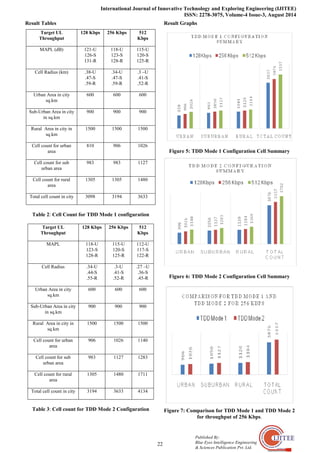
Figure 5: TDD Mode 1 Configuration Cell Summary
Figure 6: TDD Mode 2 Configuration Cell Summary
Figure 7: Comparison for TDD Mode 1 and TDD Mode 2
for throughput of 256 Kbps.
Radio Link Analysis for 4G TD- LTE Technology at 2.3 GHz Frequency
23
Published By:
Blue Eyes Intelligence Engineering
& Sciences Publication Pvt. Ltd.
XII. CONCLUSION
We have captured the result for 128 Kbps, 256 Kbps and 512
Kbps for TDD Mode 1 Configuration and TDD Mode 2.
From the results we can conclude the if we use 128 Kbps of
cell Target throughput then a city be planned for minimum no
of cell sites and for 512 Kbps cell Target throughput then we
can plan the maximum cell sites.The choice of cell throughput
depend on the operator what is cell throughput they want
which is directly impact the quality of network which come
with some cost. While making a choice of the Cell target
throughput the keep in mind Cost of network as well as the
quality of the services. If we decide the 512 Kbps cell Target
throughput then we need more cell cite which increase
COPEX and well as OPEX for the network. But when we use
128 Kbps Target Cell Edge throughput then we need less
number of cell sites, but the quality of the network will be less.
So there is a trade-off between the network service quality and
network Cost. Then we have a one more choice where we
have change scarifies some money and increase the network
quality up to some extent, the choice is 256 Kbps in which is
lies between both 128 Kbps and 512 Kbps which provides
moderate service quality and moderate Network Cost. So
network Operator can choose 256 Kbps Cell Target
Throughput. Now we have other choice of choosing the TDD
mode configuration which can be decided based on the types
of services. If a network Operator want to deploy service like
VOIP which have need same data rates in both direction i.e.
uplink and downlink. So it will better that one can choose a
TDD mode configuration which have same percentage of
uplink and downlink time and TDD mode will provide this
facility which is 50 % downlink and 50 % uplink timing. But
in Country like India where most of the services are heavy
download where most of the people do movie download song
download. If an operator choose TDD mode 1 for heavy
download service type network the uplink resources will be
wasted. So better to choose the TDD mode 2 which provide
more downlink sub frame 60% percentage. If we compare the
TDD mode 1 and TDD mode 2 Configuration Cell count for
256 Kbps Cell Target throughput , need more cell sites in
TDD mode 2 to cover the same area because the cell radius
will be less in TDD mode 2 as compare two TDD mode 1
configuration. So from all the result we can conclude that
TDD mode 2 is a better choice for a network operator in a
country like India if he want to provide the more download
services like web browsing, unlimited download types of
services. But this will cost an operator for some cost. An
operator can also think on TDD mode configuration 1 if his
service profile is symmetric for both uplink and downlink
traffic.
REFERENCES
[1] Lte - The Umts Long Term Evolution from Theory To Practice 2nd
Edition by Stefania Sesia , Issam Toufik, Matthew Baker
[2] 3GPP TS 36.300 “Evolved Universal Terrestrial Radio Access
(E-UTRA), Evolved Universal Terrestrial Radio Access Network
(E-UTRAN).
[3] LTE the Future of Mobile Broadband Technology by Verizon Wireless
[4] “Long Term Evolution (LTE): an introduction,” Ericsson White paper,
October 2007.
[5] Introduction to Graphical User Interface (GUI) MATLAB
“http://ewh.ieee.org/r8/uae/GUI.pdf”.
[6] Dimensioning of LTE Network, Description of Models and Tool,
Coverage and Capacity Estimation of 3GPP Long Term Evolution
radio interface by Abdul Basit, Syed. February, 2009
[7] 3GPP TS 24.302: “Access to the 3GPP Evolved Packet Core (EPC) via
Non-3GPP Access Networks”.
[8] 3GPP TS 36.331: “Evolved Universal Terrestrial Radio Access
(E-UTRAN); Radio Resource Control (RRC) Protocol Specification”
[9] 3GPP TS 36.401: “Evolved Universal Terrestrial Radio Access
Network (E-UTRAN); Architecture Description”
[10] LTE, The UMTS long Terms Evolution: From Theory to Practice
[11] “Long Term Evolution (LTE) Technical Overview’’, Motorola.
Retrieved July 3, 2010.
Author’s Biographies
Nisha Malik B.Tech in Electronics &
Communication Engineering from School of science
and Engineering Khanpur Kalan , BPS Mahila
University in 2012. She is pursing M.tech degree in
Electronics & Communication Engineering from
Bhagwan Parshuram College of
Engineering,Deenbandhu Chhotu Ram University of
Science & Technology Murthal University in 2014.
Rohit Khattar, B.Tech is Electronics and
Communication Engineering from KUK University
and M.tech from Deenbandhu Chhotu Ram
University of Science & Technology Murthal
University and Working as Assistant Professor in
Electronics & Communication Engineering
department at Bhagwan Parshuram College of
Engineering and research include next generation
telecommunication technologies.
Amit Vatsh M.Tech , B.Tech in Electronics &
Communication Engineering from School of
science and Engineering MDU Rohtak and
Working as Assistant Professor in Electronics and
Communications Depts. at Innovative Institute of
Technology and Management , Sonepat and
research in Wireless Field.
Sukhvinder Malik B.E. in Electronics and
Communication Engineering from MDU Rohtak in
2010 with Honours. Having more than 4 years of
experience in LTE development industry in
different fields i.e. Radio, Protocol testing, Quality
Assurance etc.

Radio Link Analysis for 4G TD- LTE Technology at 2.3 GHz Frequency

  • 1.
    International Journal ofInnovative Technology and Exploring Engineering (IJITEE) ISSN: 2278-3075, Volume-4 Issue-3, August 2014 18 Published By: Blue Eyes Intelligence Engineering & Sciences Publication Pvt. Ltd. Abstract—The Long Term Evolution (LTE) is the latest step in an advancing series of mobile telecommunications systems. In this paper, authors show interest on the link budgeting the information presented here will help readers understand how the budgeting will be done in LTE. This paper provides dimensioning of LTE for particular city. This will provides the number of cell count. Here we tell about a GUI MATLAB System for calculation of no. of resources required to provide services in particular area with optimum cost and better quality. Index Terms—LTE, Throughput, Radio link Budget Time Division Duplexing, MAPL, Cell count I. INTRODUCTION Driving the evolution of wireless broadband technology is user’s increasing expectations for speed, bandwidth, and global access. For wireless carriers to achieve greater speeds and pervasive connectedness, their networks need to start behaving more like landline IP-based networks. This line of thinking represents a fundamental shift in perspective from mobile services to broadband connections for users and service providers alike to enter the fourth-generation (4G).Unlike earlier wireless standards, 4G technology is based on TCP/IP, the core protocol of the Internet. TCP/IP enables wireless networks to deliver higher-level services, such as video and multimedia, while supporting the devices and applications of the future. This point of time, there are two technologies which can provides such user experience IEEE’s WiMAX and 3GPP LTE. The service provider believes that make LTE offers a number of significant technological and business advantages over WiMAX that make it a superior networking standard. Long Term Evolution (LTE) has been designed to support only packet-switched services. It aims to provide seamless Internet Protocol (IP) connectivity between User Equipment (UE) and the packet data network (PDN), without any disruption to the end user’s applications during mobility The term “Long Term Evolution” encompasses the evolution of the Universal Mobile Telecommunications System (UMTS) radio access through the Evolved UTRAN (E-UTRAN) it is accompanied by an evolution of the Manuscript received on August 2014. Nisha Malik, M.tech, B.Tech in Electronics and communications Engineering , Sonepat , Haryana India Asst. Professor Rohit Khattar, M.tech, B.Tech in Electronics and communications engineering, lecturer at BPRCE Gohana Sonepat, Haryana India Asst. Professor Amit Vatsh, M.tech, B.Tech in Electronics and communications Engineering, Lecturer at IIT&M Sonepat, Haryana, India. Sukhvinder Malik Bachelors of Engineering in Electronics and Communications Engineering , Member of Technical Staff in IT/Telecom Company, Bengaluru, India non-radio (Core Network) aspects under the term “System Architecture Evolution” (SAE), which includes the Evolved Packet Core (EPC) network. Figure 1: LTE Architecture and Its Interfaces At a high level, the network is comprised of the Core Network (EPC) and the access network E-UTRAN. The Core Network consists of many logical nodes. The core network in LTE is called Evolved Packet Core (EPC) which is responsible for the overall control of the UE and establishment of the bearers. The main logical nodes of the EPC are PDN Gateway (PGW), Serving Gateway (S-GW), Mobility Management Entity (MME), Home Subscriber Server (HSS), Policy Control and Charging Rules Function (PCRF) The access network is made up of essentially just one node, the evolved NodeB (eNodeB), through which Connects UE to the network. Each of these network elements is interconnected by means of interfaces that are standardized in order to allow multi-vendor interoperability. This gives the possibility to source different network elements from different vendors. II. OBJECTIVES AND APPROACH This work describes the dimensioning process of 3GPP LTE access network, its models, methods and the tool developed to dimension the network. The main objectives are listed below: • To identify the level of throughput for optimum cost and acceptance quality. • Introduction of LTE features relevant for the dimensioning • Definition of the basic models for Access Network Dimensioning • Coverage Estimation for LTE using 2.3 GHz. frequency • Network Element Count(cell count) Estimation for any particular area Radio Link Analysis for 4G TD- LTE Technology at 2.3 GHz Frequency Nisha Malik, Rohit Khattar, Sukhvinder Malik, Amit Vatsh
  • 2.
    Radio Link Analysisfor 4G TD- LTE Technology at 2.3 GHz Frequency 19 Published By: Blue Eyes Intelligence Engineering & Sciences Publication Pvt. Ltd. • Development and description of dimensioning tool. III. EVOLUTION: 1G AMPS TO 4G LTE The various communications systems looking in the past revolutionized the way people Communicate, joining together communications and mobility. Evolution of wireless access technologies is about to reach its fourth generation (4G). Looking past, wireless access technologies have followed different evolutionary paths aimed at unified target: performance and efficiency in high mobile environment. The first generation (1G) AMPS has fulfilled the basic mobile voice, while the second generation (2G) GSM (3GPP), CDMA one (3GPP2) has introduced capacity and coverage. This is followed by the third generation (3G), UMTS, WCDMA (3GPP) and EV-DO (3GPP2) which has quest for data at higher speeds to open the gates for truly “mobile broadband” experience, which will be further realized by the fourth generation (4G). Figure 2: Evolution: 1G AMPS to 4G LTE IV. KEY FEATURES OF LTE The 4 G Long Term Evolution has following key feature which make this technology superior than other technologies. 1. Peak Through put: -Peak download rates up to 300 Mbps and upload rates up to 75.Mbps depending on the user equipment category (with 4x4 antennas using 20 MHz of spectrum). 2. Low Latency: -Low data transfer latencies (sub-5ms latency for small IP packets in optimal conditions), lower latencies for handover and connection setup time than with previous radio access technologies. 3. Mobility Support:-Improved support for mobility, exemplified by support for terminals moving at up to 350 km/h (220 mph) or 500 km/h (310 mph) depending on the frequency band. 4. Access Technologies:-OFDMA for the downlink, SC-FDMA for the uplink to conserve power. 5. Duplexing Support:-Support for both FDD and TDD communication systems as well as half-duplex FDD with the same radio access technology 6. Flexible Bandwidths: - 1.4 MHz, 3 MHz, 5 MHz, 10 MHz, 15 MHz and 20 MHz 7. Large Cell Size Support:-Support for cell sizes from tens of meters radius (Femto and Pico cells) up to 100 km radius microcells. In the lower frequency bands to be used in rural areas, 5 km is the optimal cell size, 30 km having reasonable performance, and up to 100 km cell sizes supported. 8. Simplified architecture: LTE architecture is FLAT IP Based. The access side of LTE is composed only of eNodeB. Support for inter-operation and co-existence with legacy standards like GSM/EDGE, UMTS and CDMA2000. V. BENEFITS OF LTE • Provides a global ecosystem with inherent mobility • Offers easier access and use with greater security and privacy • Dramatically improves speed and latency • Delivers enhanced real-time video and multimedia for a better overall experience • Enables high-performance mobile computing • Supports real-time applications due to its low latency • Creates a platform upon which to build and deploy the products and services of today and those of tomorrow • Reduces cost per bit through improved spectral efficiency. VI. TECHNICAL DIFFERENCES BETWEEN LTE AND WiMAX There are so many number of technical differences exists between LTE and WiMAX. These differences shows that LTE have so many advantages over WiMAX. Table 1: Differences between LTE and WiMAX Parameter LTE WiMAX Parameters MIMO MIMO Technology UL- SC-FDMA DL- OFDM UL-OFDMA DL- OFDM Peak speeds DL: 100 Mbps (20 MHz, 2x2 MIMO) UL: 50 Mbps (20 MHz, 1x2) DL: 46 Mbps UL: 7 Mbps Average user throughput 5 Mbps–12 Mbps –DL 2 Mbps–5 Mbps - UL 2Mbps–4Mb ps –DL 500kbps–1.5 Mbps - UL One-way air link latency 15ms 50ms Bandwidth 20 MHz, 15 MHz, 10 MHz, 5 MHz, and <5 MHz 3.5 MHz, 5 MHz, 7 MHz, 8.75 MHz, 10 MHz Spectrum various frequencies, 700Mhz 2.3, 2.5, 3.5, 5.8 GHz Mobility 350 Kmph 120Kmph Interoperability Global roaming Limited international roaming Backwards compatibility Connects to legacy 3GPP networks None; new build out
  • 3.
    International Journal ofInnovative Technology and Exploring Engineering (IJITEE) ISSN: 2278-3075, Volume-4 Issue-3, August 2014 20 Published By: Blue Eyes Intelligence Engineering & Sciences Publication Pvt. Ltd. VII. LTE DIMENSIONING PROCESS LTE Dimensioning process starts with the Radio Link Budget Calculations, used to determine the maximum path loss. The result of this step depends upon the propagation models used. The estimated cell size, obtained in this step, leads to the maximum allowed size of the cells. This parameter is used to calculate the number of cells in the area of interest. Thus, a rough estimate of the required number of eNBs is obtained. This paper work focus is on Radio Link Budget, cell coverage estimates and tools and case studies for LTE dimensioning. Figure depicts LTE dimensioning exercise in detail. Coverage Planning is the first step in the process of dimensioning. It gives an estimate of there sources needed to provide service in the deployment area with the given system parameters, without any capacity concern. Therefore, it gives an assessment of the resources needed to cover the area under consideration, so that the transmitters and receivers can listen to each other. In other words, there are no QoS concerns involved in this process. Coverage planning consists of evaluation of DL and UL radio link budgets. The maximum path loss is calculated based on the required SINR level at the receiver.The minimum of the maximum path losses in UL and DL directions is converted into cell radius, by using a propagation model appropriate to the deployment area. Radio Link Budget is the most prominent component of coverage planning exercise Figure 3: LTE network dimensioning VIII. RADIO LINK BUDGET A link budget is the accounting of all of the gains and losses from the transmitter, through the medium (free space, cable, waveguide, fiber, etc.) to the receiver in a telecommunication system. It accounts for the attenuation of the transmitted signal due to propagation, as well as the antenna gains, feed line and miscellaneous losses. Randomly varying channel gains such as fading are taken into account by adding some margin depending on the anticipated severity of its effects. A simple link budget equation looks like this: Received Power (dBm) = Transmitted Power (dBm) + Gains (dB) − Losses (dB) The link budget calculations estimate the maximum allowed signal attenuation between the mobile and the base station antenna. The maximum path loss allows the maximum cell range to be estimated with a suitable propagation model. The cell range gives the number of base station sites required to cover the target geographical area. As we know LTE is a packet network and most of the services are data service. So the Link Budget is for LTE is made on the base of cell edge throughput. The limiting Link is the Uplink Link due the low transmit power of User devices generally 23dBm. Principle of Link Budget Maximum allowed path loss (MAPL) = Transmit power - Receiver Sensitivity - Losses - Margins + Gains Cell radius: MAPL = Intercept + 10 *Slope *Log10 (Cell Radius) Cell Radius = 10(MAPL – Intercept) / (10 *Slope) All above parameters can be used to calculate the Max. Allowable path loss (MAPL). Next step is to find out the cell radius, to calculate cell radius which have to use propagation model. There are different propagation models like Cost Hata model, Log Normal Propagation model. After getting cell radius we will find out the area covered by a single cell site. If we consider a hexagonal cell site design then area cover by a cell can be calculated by below formula. Let X be the area covered by a cell site and Y is the area of a city to be covered. Then no. of cell site Z to cover the city is: Z = Y / X Further we can find out the cost of the project by simply multiplying the total cost of one site expenses. Let R is the expense for one cell site then total cost for the project for a city will be Total cost of project of the city = R * Z IX. DIMENSIONING TOOL Matlab GUI is used to dimension the wireless system. In Matlab a system is constructing in which different inputs are given and their corresponding output is analyzed in GUI system. MATLAB is well known for its numerical problem solving power. Traditionally programs written by engineers have very simple interfaces, and often only the author is the one who uses the program once it is completed. There are occasions where a more polished user interface, specifically a graphical user interface (GUI) is desired: • You wish to have a nontechnical, yet computer literate, person use your programs to perform Link Budget Coverage Estimation Maximum Path Loss Number of sites to be deployed based on the requested coverage Propagatio n Model Deployme nt Area Area Coverage Probabilit y Throughput, Tx. Power bandwidth, Antenna configuration, Cell radius, Min. SNR., losses, Gains
  • 4.
    Radio Link Analysisfor 4G TD- LTE Technology at 2.3 GHz Frequency 21 Published By: Blue Eyes Intelligence Engineering & Sciences Publication Pvt. Ltd. some ongoing data analysis task, etc. • You wish to share your tool (program(s)) with other members of your work group, but want the interface to be friendly. • You are writing a utility function for your own use and would like it to be easy to use • You wish to build an interactive demonstration to best show off a concept or idea to others, e.g., others students etc. • You or your company is a third-party developer of tools for the MATLAB user community MATLAB flagship software in scientific computing, is extensively used all over the world. • Particular factors that support the selection of MATLAB are: • A flexible software structure of MATLAB comprising libraries, models, and programs enables one to integrate different model components in one package conveniently. • Fast development with MATLAB using powerful calculation and visualization means of the package enables one to expand the software quickly and efficiently without developing any extra programming tools. • A wide selection of TOOL Boxes, comprehensive collections of predefined functions for solving application‐specific problems, is already available with MATLAB and is likely to grow even faster in the future. The intermediate calculations and detailed formulas are coded. As a result, a user can use the tool without going into details of implementation. Ideally, user is required to look only at the input and output. User can enter all the inputs on box and can then directly go to the output to view the detailed results. X. WORKING WITH TOOL 1. Choose the Target Uplink Cell Edge Throughput from the drop down list. We have kept three option for this 128 Kbps, 256 Kbps and 512 Kbps. This can be selected based on the types of service to be offered. 2. Now select the TDD configuration to be used. Options are Mode 0, 1 and 2. 3. Select the UE Power, The most of the Handset are of the power class B and support Max Power of 23 dBm, but there are some CPEs (Customer Premises Equipment) which 30 dBm of Power. 4. Choose the Noise figure which can be in range of 3 dB, 3.5dB and 4 dB. 5. Choose the Gain and Loss according to the morphologies. 6. Now press the “Execute 1” you will get the first output as a max allowable path loss. 7. After this choose frequency of operation is my case this will be 2.3 GHz. 8. Choose the height of antenna. For Dense Urban Area we are keeping it 20m, Sub-urban Area we are keeping it as 25m and for Rural Area we kept it as 30m, 9. Receiver height is normally 1.5 m. 10. Put a rough value in cell radius press “Execute 2”, we will get as value next to max allowable path loss. 11. Now we have to make both the value equal , try to change cell radius value to make both the values , When both the values matches for some value of cell radius , that will be the resultant cell radius. 12. Get the radius for all three morphologies. 13. Enter the area for all three morphologies wised urban, Sub-urban area and rural for a city. 14. Press “Execute 3” and we will get the final outs as Cell Sites for each morphologies and Total count for a city. Figure 4: MATLAB Dimensioning Tool XI. RESULT Inputs for the simulation 1. Target Uplink Throughputs: 128, 256 and 512 Kbps 2. MCS supported at Cell Edge : QPSK 0.5 3. TDD Mode Configuration = 1 and 2 4. UE Power : 23 dBm 5. Noise Figure =4 dB 6. Target SINR = -4 dB 7. Antenna Directivity Gain =17 dBi 8. Handover Gain and ICIC Gain = 1dB each 9. Morphology Loss = Urban 30 dB, Suburban =25 dB and Rural = 20 dB 10. Interference Margin= 6 dB 11. Frequency =2300 MHz 12. Height of Receiver = 1.5m 13. Clutter Correction= 0 dB for Rural, Suburban and 3 dB for Urban area.
  • 5.
    International Journal ofInnovative Technology and Exploring Engineering (IJITEE) ISSN: 2278-3075, Volume-4 Issue-3, August 2014 22 Published By: Blue Eyes Intelligence Engineering & Sciences Publication Pvt. Ltd. Result Tables Target UL Throughput 128 Kbps 256 Kbps 512 Kbps MAPL (dB) 121-U 126-S 131-R 118-U 123-S 128-R 115-U 120-S 125-R Cell Radius (km) .38-U .47-S .59-R .34-U .47-S .59-R .3 –U .41-S .52-R Urban Area in city sq.km 600 600 600 Sub-Urban Area in city in sq.km 900 900 900 Rural Area in city in sq.km 1500 1500 1500 Cell count for urban area 810 906 1026 Cell count for sub urban area 983 983 1127 Cell count for rural area 1305 1305 1480 Total cell count in city 3098 3194 3633 Table 2: Cell Count for TDD Mode 1 configuration Target UL Throughput 128 Kbps 256 Kbps 512 Kbps MAPL 118-U 123-S 128-R 115-U 120-S 125-R 112-U 117-S 122-R Cell Radius .34-U .44-S .55-R .3-U .41-S .52-R .27 –U .36-S .45-R Urban Area in city sq.km 600 600 600 Sub-Urban Area in city in sq.km 900 900 900 Rural Area in city in sq.km 1500 1500 1500 Cell count for urban area 906 1026 1140 Cell count for sub urban area 983 1127 1283 Cell count for rural area 1305 1480 1711 Total cell count in city 3194 3633 4134 Table 3: Cell count for TDD Mode 2 Configuration Result Graphs Figure 5: TDD Mode 1 Configuration Cell Summary Figure 6: TDD Mode 2 Configuration Cell Summary Figure 7: Comparison for TDD Mode 1 and TDD Mode 2 for throughput of 256 Kbps.
  • 6.
    Radio Link Analysisfor 4G TD- LTE Technology at 2.3 GHz Frequency 23 Published By: Blue Eyes Intelligence Engineering & Sciences Publication Pvt. Ltd. XII. CONCLUSION We have captured the result for 128 Kbps, 256 Kbps and 512 Kbps for TDD Mode 1 Configuration and TDD Mode 2. From the results we can conclude the if we use 128 Kbps of cell Target throughput then a city be planned for minimum no of cell sites and for 512 Kbps cell Target throughput then we can plan the maximum cell sites.The choice of cell throughput depend on the operator what is cell throughput they want which is directly impact the quality of network which come with some cost. While making a choice of the Cell target throughput the keep in mind Cost of network as well as the quality of the services. If we decide the 512 Kbps cell Target throughput then we need more cell cite which increase COPEX and well as OPEX for the network. But when we use 128 Kbps Target Cell Edge throughput then we need less number of cell sites, but the quality of the network will be less. So there is a trade-off between the network service quality and network Cost. Then we have a one more choice where we have change scarifies some money and increase the network quality up to some extent, the choice is 256 Kbps in which is lies between both 128 Kbps and 512 Kbps which provides moderate service quality and moderate Network Cost. So network Operator can choose 256 Kbps Cell Target Throughput. Now we have other choice of choosing the TDD mode configuration which can be decided based on the types of services. If a network Operator want to deploy service like VOIP which have need same data rates in both direction i.e. uplink and downlink. So it will better that one can choose a TDD mode configuration which have same percentage of uplink and downlink time and TDD mode will provide this facility which is 50 % downlink and 50 % uplink timing. But in Country like India where most of the services are heavy download where most of the people do movie download song download. If an operator choose TDD mode 1 for heavy download service type network the uplink resources will be wasted. So better to choose the TDD mode 2 which provide more downlink sub frame 60% percentage. If we compare the TDD mode 1 and TDD mode 2 Configuration Cell count for 256 Kbps Cell Target throughput , need more cell sites in TDD mode 2 to cover the same area because the cell radius will be less in TDD mode 2 as compare two TDD mode 1 configuration. So from all the result we can conclude that TDD mode 2 is a better choice for a network operator in a country like India if he want to provide the more download services like web browsing, unlimited download types of services. But this will cost an operator for some cost. An operator can also think on TDD mode configuration 1 if his service profile is symmetric for both uplink and downlink traffic. REFERENCES [1] Lte - The Umts Long Term Evolution from Theory To Practice 2nd Edition by Stefania Sesia , Issam Toufik, Matthew Baker [2] 3GPP TS 36.300 “Evolved Universal Terrestrial Radio Access (E-UTRA), Evolved Universal Terrestrial Radio Access Network (E-UTRAN). [3] LTE the Future of Mobile Broadband Technology by Verizon Wireless [4] “Long Term Evolution (LTE): an introduction,” Ericsson White paper, October 2007. [5] Introduction to Graphical User Interface (GUI) MATLAB “http://ewh.ieee.org/r8/uae/GUI.pdf”. [6] Dimensioning of LTE Network, Description of Models and Tool, Coverage and Capacity Estimation of 3GPP Long Term Evolution radio interface by Abdul Basit, Syed. February, 2009 [7] 3GPP TS 24.302: “Access to the 3GPP Evolved Packet Core (EPC) via Non-3GPP Access Networks”. [8] 3GPP TS 36.331: “Evolved Universal Terrestrial Radio Access (E-UTRAN); Radio Resource Control (RRC) Protocol Specification” [9] 3GPP TS 36.401: “Evolved Universal Terrestrial Radio Access Network (E-UTRAN); Architecture Description” [10] LTE, The UMTS long Terms Evolution: From Theory to Practice [11] “Long Term Evolution (LTE) Technical Overview’’, Motorola. Retrieved July 3, 2010. Author’s Biographies Nisha Malik B.Tech in Electronics & Communication Engineering from School of science and Engineering Khanpur Kalan , BPS Mahila University in 2012. She is pursing M.tech degree in Electronics & Communication Engineering from Bhagwan Parshuram College of Engineering,Deenbandhu Chhotu Ram University of Science & Technology Murthal University in 2014. Rohit Khattar, B.Tech is Electronics and Communication Engineering from KUK University and M.tech from Deenbandhu Chhotu Ram University of Science & Technology Murthal University and Working as Assistant Professor in Electronics & Communication Engineering department at Bhagwan Parshuram College of Engineering and research include next generation telecommunication technologies. Amit Vatsh M.Tech , B.Tech in Electronics & Communication Engineering from School of science and Engineering MDU Rohtak and Working as Assistant Professor in Electronics and Communications Depts. at Innovative Institute of Technology and Management , Sonepat and research in Wireless Field. Sukhvinder Malik B.E. in Electronics and Communication Engineering from MDU Rohtak in 2010 with Honours. Having more than 4 years of experience in LTE development industry in different fields i.e. Radio, Protocol testing, Quality Assurance etc.