SUBMITTED BY:
( PATNA CAMPUS)
Under the Guidance of
Mr. Sushil Singh
(Senior Manager, JIO)
Project Guide
Mr. Siddhartha Tyagi
(Deputy Manager, JIO)
I am very thankful from core of heart to “Senior Manager
Reliance JIO”, sushil Singh for providing me Training
opportunity and acquiring theoretical and practical knowledge as
well in the field of telecommunication sector.
I also want to express my gratitude to “Deputy Manager -
Network Operations Reliance JIO”, SIDDHARTHA TYAGI
for his consideration and supervision. I sincerely thank him for his
guidance and information during the course of training.
I would also like to thank SeniorExecutive Reliance JIO NITISH
KUMAR for the positive attitude that he showed towards me and
my work allowing me to question and giving prompt replies for my
better understanding.
Finally, I would like to thank all the concerned for their precious
time and encouragement because of which I have successfully
completed my training and also learned a lot from them.
Kamal
Kant
ACKNOWLEDGEMENT
Long Term Evolution (LTE) is a significant project of 3rd Generation
Partnership Project (3GPP), initially proposed on the Toronto conference of
3GPP in 2004 and officially started as LTE work item in 2006. LTE, as a
transition from the 3rd generation (3G) to the 4th generation (4G), has
achieved great capacity and high speed of mobile telephone networks
without doubt. It defines a new packet-only wideband radio with flat
architecture and assumes a full Internet Protocol (IP) network architecture in
order to assure voice supported in packet domain in design. In addition, it is
combined with top-of-the-line radio techniques in order to gain better
performance than Code Division Multiple Access (CDMA) approaches.
LTE provides scalable carrier bandwidths from 1.4 MHz to 20 MHz and
frequency division duplexing (FDD), as well as time division duple-
ABSTRACT
-xing (TDD). In this paper, it presents an overall description of LTE
technology separately in different aspects of LTE architecture and technical
principles to clarify how LTE as a radio technology achieves a high
performance for cellular mobile communication systems.
TABLE OF CONTENT
 History
 Introduction
 LTE Overview
o LTE Background
o LTE Technology
o LTE Specification
 LTE Technology Theory
o LTE Architecture
o LTE Multiple Access Principles
 OFDMA in LTE
 SC-FDMA in LTE
o MIMO in LTE
o IP
o SDH
o LTE TDD and FDD Duplex Schemes
 4 LTE Performance
 5 Summary
 6.Conclusion
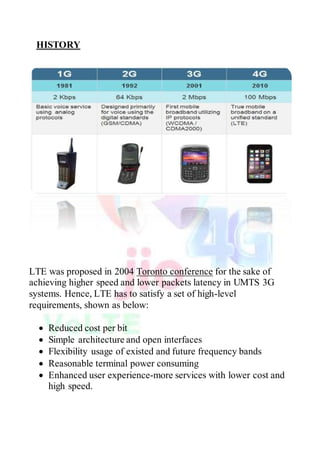
HISTORY
LTE was proposed in 2004 Toronto conference for the sake of
achieving higher speed and lower packets latency in UMTS 3G
systems. Hence, LTE has to satisfy a set of high-level
requirements, shown as below:
 Reduced cost per bit
 Simple architecture and open interfaces
 Flexibility usage of existed and future frequency bands
 Reasonable terminal power consuming
 Enhanced user experience-more services with lower cost and
high speed.
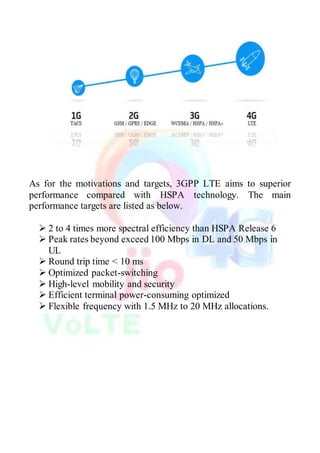
As for the motivations and targets, 3GPP LTE aims to superior
performance compared with HSPA technology. The main
performance targets are listed as below.
 2 to 4 times more spectral efficiency than HSPA Release 6
 Peak rates beyond exceed 100 Mbps in DL and 50 Mbps in
UL
 Round trip time < 10 ms
 Optimized packet-switching
 High-level mobility and security
 Efficient terminal power-consuming optimized
 Flexible frequency with 1.5 MHz to 20 MHz allocations.
INTRODUCTION
As Internet generation accustomed to access broadband where-
ever they go, mobile broadband, instead of only at home and in the
office, has become a reality. Therefore, the Global System for
Mobile Communications family constantly develops new mobile
technologies to achieve better performance, such as higher speed,
larger capacity and so forth. LTE is a step beyond 3G and towards
the 4G, evolved after EDGE, UMTS, HSPA and HSPA Evolution.
The contributions of LTE make sure that the users are able to request
more mobile applications like interactive TV, mobile video
blogging, advanced games or professional services.
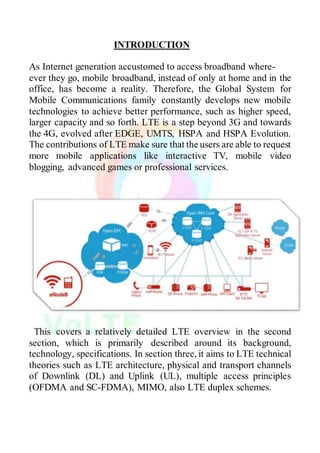
This covers a relatively detailed LTE overview in the second
section, which is primarily described around its background,
technology, specifications. In section three, it aims to LTE technical
theories such as LTE architecture, physical and transport channels
of Downlink (DL) and Uplink (UL), multiple access principles
(OFDMA and SC-FDMA), MIMO, also LTE duplex schemes.
LTE OVERVIEW
LTE enhanced the Universal Mobile Telecommunication Services
(UMTS) in a set of points on account of the future generation
cellular technology needs and growing mobile communication
services requirements. Such enhancementsare generated due to LTE
background requirements, motivations and targets. The brief
description about LTE technology and specifications is also covered
in this subsection.
LTE Advanced key features
With work starting on LTE Advanced, a number of key requirements
and key features are coming to light. Although not fixed yet in the
specifications, there are many high level aims for the new LTE
Advanced specification. These will need to be verified and much
work remains to be undertaken in the specifications before these are
all fixed. Currently some of the main headline aims for LTE
Advanced can be seen below:
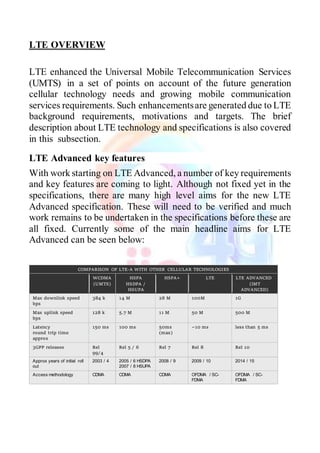
COMPARISON OF LTE-A WITH OTHER CELLULAR TECHNOLOGIES
WCDMA
(UMTS)
HSPA
HSDPA /
HSUPA
HSPA+ LTE LTE ADVANCED
(IMT
ADVANCED)
Max downlink speed
bps
384 k 14 M 28 M 100M 1G
Max uplink speed
bps
128 k 5.7 M 11 M 50 M 500 M
Latency
round trip time
approx
150 ms 100 ms 50ms
(max)
~10 ms less than 5 ms
3GPP releases Rel
99/4
Rel 5 / 6 Rel 7 Rel 8 Rel 10
Approx years of initial roll
out
2003 / 4 2005 / 6 HSDPA
2007 / 8 HSUPA
2008 / 9 2009 / 10 2014 / 15
Access methodology CDMA CDMA CDMA OFDMA / SC-
FDMA
OFDMA / SC-
FDMA
 Peak data rates: downlink - 1 Gbps; uplink - 500 Mbps.
 Spectrum efficiency: 3 times greater than LTE.
 Peak spectrum efficiency: downlink - 30 bps/Hz; uplink - 15
bps/Hz.
 Spectrum use: the ability to support scalable bandwidth use and
spectrum aggregation where non-contiguous spectrum needs to
be used.
 Latency: from Idle to Connected in less than 50 ms and then
shorter than 5 ms one way for individual packet transmission.
 Cell edge user throughput to be twice that of LTE.
 Average user throughput to be 3 times that of LTE.
 Mobility: Same as that in LTE.
LTE TECHNOLOGY
LTE is composed of many new technologies compared with the
previous generation of cellular systems. These new technologies are
used to generate more efficiency with regards to spectrum and
higher data rates as expected by designers. Here are only snapshots
of the technologies and they will be clarified in detail in the third
section. OFDM (Orthogonal Frequency Division Multiplex). In
order to gain high data bandwidth when transmitting packets, LTE
integrates OFDM technology which can provide high-degree
resilience to reflections and interference at the same time.
Furthermore, the access schemes can be divided into two access
approaches used in the DL and UL respectively. The first one for the
DL is OFDMA (Orthogonal Frequency Division Multiplex Access);
the second one for the UL is SC-FDMA (Single Carrier- Frequency
Division Multiplex Access), which has the advantages of smaller
peak to average power ratio and more constant power able to get
high RF power amplifier efficiency in the mobile handsets
LTE TECHNOLOGY THEORY
This section presents UMTS LTE technology theory, such as LTE
architecture, physical and transport channels for DL and UL,
multiple access principles (OFDMA, and SC-FDMA), MIMO and
TDD/FDD duplex schemes.
LTE ARCHITECTURE
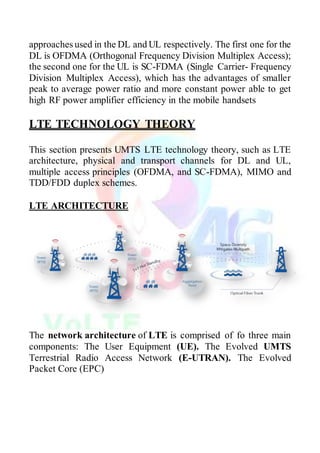
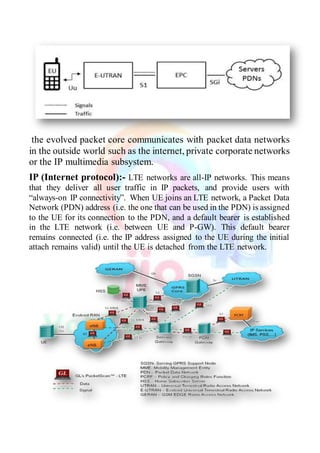
The network architecture of LTE is comprised of fo three main
components: The User Equipment (UE). The Evolved UMTS
Terrestrial Radio Access Network (E-UTRAN). The Evolved
Packet Core (EPC)
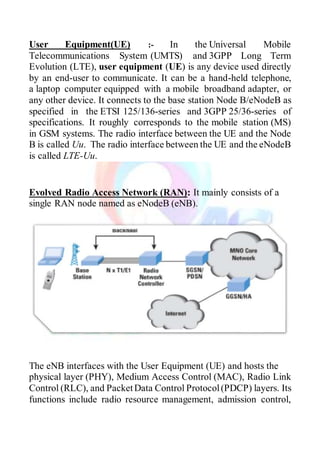
User Equipment(UE) :- In the Universal Mobile
Telecommunications System (UMTS) and 3GPP Long Term
Evolution (LTE), user equipment (UE) is any device used directly
by an end-user to communicate. It can be a hand-held telephone,
a laptop computer equipped with a mobile broadband adapter, or
any other device. It connects to the base station Node B/eNodeB as
specified in the ETSI 125/136-series and 3GPP 25/36-series of
specifications. It roughly corresponds to the mobile station (MS)
in GSM systems. The radio interface between the UE and the Node
B is called Uu. The radio interface between the UE and the eNodeB
is called LTE-Uu.
Evolved Radio Access Network (RAN): It mainly consists of a
single RAN node named as eNodeB (eNB).
The eNB interfaces with the User Equipment (UE) and hosts the
physical layer (PHY), Medium Access Control (MAC), Radio Link
Control (RLC), and PacketData Control Protocol(PDCP) layers. Its
functions include radio resource management, admission control,
scheduling, enforcement of negotiated UL QoS and
compression/decompression of DL/UL user plane packet headers.
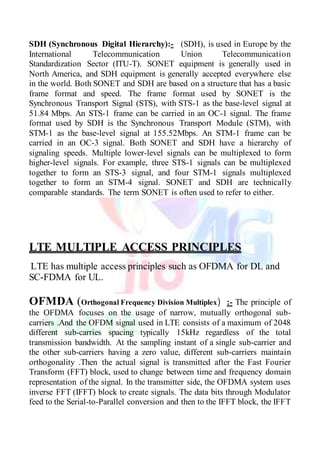
Serving Gateway (SGW): It performs as the mobility anchor for the
user plane during inter-Enb handovers and as the anchor for mobility
between LTE and other 3GPP technologies. At the same time, it
routes and forwards user data packets. The SGW controls the
termination of the DL data path and paging while DL data comes to
UE and replicates the user traffic when lawful and rational
interception. It also manages and stores UE information, for
instance, parameters of the IP bearer service, network internal
routing information.
Mobility Management Entity (MME): The key control-node for
the LTE access network. It tracks andpages the idle mode UE, even
retransmission. MME selects the SGW for a UE at initial attach and
at time of intra-LTE handover involving Core Network (CN) node
relocation. When authenticating the user, it interacts with the HSS
(a master user database supporting IP Multimedia Subsystem and
including subscriber information) [WiKi HSS]through the specified
interface.
Packet Data Network Gateway (PDN GW): It has two key roles
in terms of functionality. First, the PDN GW supports the
connectivity to the UE and to the external packet data networks via
the entry and exit of UE traffic. The other key role of the PDN GW
is acting as the anchor for mobility between 3GPP and non-3GPP
technologies such as WiMAX and 3GPP2.
the evolved packet core communicates with packet data networks
in the outside world such as the internet, private corporate networks
or the IP multimedia subsystem.
IP (Internet protocol):- LTE networks are all-IP networks. This means
that they deliver all user traffic in IP packets, and provide users with
“always-on IP connectivity”. When UE joins an LTE network, a Packet Data
Network (PDN) address (i.e. the one that can be used in the PDN) is assigned
to the UE for its connection to the PDN, and a default bearer is established
in the LTE network (i.e. between UE and P-GW). This default bearer
remains connected (i.e. the IP address assigned to the UE during the initial
attach remains valid) until the UE is detached from the LTE network.
SDH (Synchronous Digital Hierarchy):- (SDH), is used in Europe by the
International Telecommunication Union Telecommunication
Standardization Sector (ITU-T). SONET equipment is generally used in
North America, and SDH equipment is generally accepted everywhere else
in the world. Both SONET and SDH are based on a structure that has a basic
frame format and speed. The frame format used by SONET is the
Synchronous Transport Signal (STS), with STS-1 as the base-level signal at
51.84 Mbps. An STS-1 frame can be carried in an OC-1 signal. The frame
format used by SDH is the Synchronous Transport Module (STM), with
STM-1 as the base-level signal at 155.52Mbps. An STM-1 frame can be
carried in an OC-3 signal. Both SONET and SDH have a hierarchy of
signaling speeds. Multiple lower-level signals can be multiplexed to form
higher-level signals. For example, three STS-1 signals can be multiplexed
together to form an STS-3 signal, and four STM-1 signals multiplexed
together to form an STM-4 signal. SONET and SDH are technically
comparable standards. The term SONET is often used to refer to either.
LTE MULTIPLE ACCESS PRINCIPLES
LTE has multiple access principles such as OFDMA for DL and
SC-FDMA for UL.
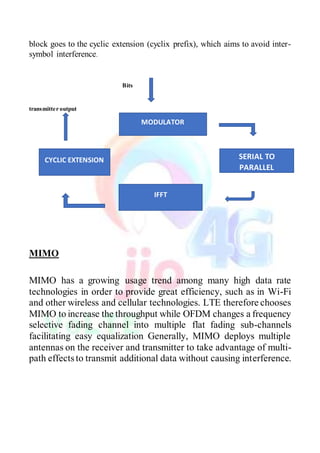
OFMDA (Orthogonal Frequency Division Multiplex) :- The principle of
the OFDMA focuses on the usage of narrow, mutually orthogonal sub-
carriers .And the OFDM signal used in LTE consists of a maximum of 2048
different sub-carries spacing typically 15kHz regardless of the total
transmission bandwidth. At the sampling instant of a single sub-carrier and
the other sub-carriers having a zero value, different sub-carriers maintain
orthogonality .Then the actual signal is transmitted after the Fast Fourier
Transform (FFT) block, used to change between time and frequency domain
representation of the signal. In the transmitter side, the OFDMA system uses
inverse FFT (IFFT) block to create signals. The data bits through Modulator
feed to the Serial-to-Parallel conversion and then to the IFFT block, the IFFT
block goes to the cyclic extension (cyclix prefix), which aims to avoid inter-
symbol interference.
Bits
transmitter output
MIMO
MIMO has a growing usage trend among many high data rate
technologies in order to provide great efficiency, such as in Wi-Fi
and other wireless and cellular technologies. LTE therefore chooses
MIMO to increase the throughput while OFDM changes a frequency
selective fading channel into multiple flat fading sub-channels
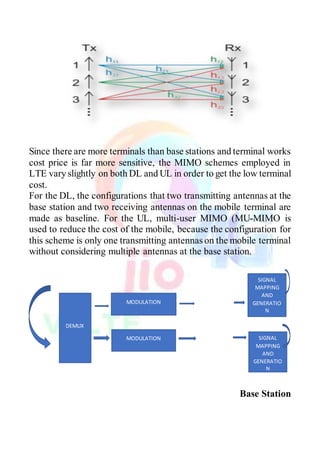
facilitating easy equalization Generally, MIMO deploys multiple
antennas on the receiver and transmitter to take advantage of multi-
path effects to transmit additional data without causing interference.
MODULATOR
SERIAL TO
PARALLEL
IFFT
CYCLIC EXTENSION
Since there are more terminals than base stations and terminal works
cost price is far more sensitive, the MIMO schemes employed in
LTE vary slightly on both DL and UL in order to get the low terminal
cost.
For the DL, the configurations that two transmitting antennas at the
base station and two receiving antennas on the mobile terminal are
made as baseline. For the UL, multi-user MIMO (MU-MIMO is
used to reduce the cost of the mobile, because the configuration for
this scheme is only one transmitting antennas on the mobile terminal
without considering multiple antennas at the base station.
Base Station
DEMUX
MODULATION
MODULATION
SIGNAL
MAPPING
AND
GENERATIO
N
SIGNAL
MAPPING
AND
GENERATIO
N
Furthermore, multiple mobile terminals may transmit
simultaneously on the same channel or channels, and they cause no
interference with each other for the reason to use mutually
orthogonal pilot patterns.
TDD:-
It is essential that any cellular communications system must be able
to transmit in both directions simultaneously. This enables
conversations to be made, with either end being able to talk and
listen as required. Additionally when exchanging data it is necessary
to be able to undertake virtually simultaneous or completely
simultaneous communications in both directions.
It is necessary to be able to specify the different direction of
transmission so that it is possible to easily identify in which direction
the transmission is being made. There are a variety of differences
between the two links ranging from the amount of data carried to the
transmission format, and the channels implemented. The two links
are defined:
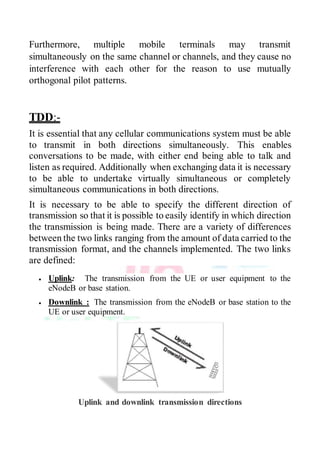
 Uplink: The transmission from the UE or user equipment to the
eNodeB or base station.
 Downlink : The transmission from the eNodeB or base station to the
UE or user equipment.
Uplink and downlink transmission directions
In order to be able to be able to transmit in both directions, a user equipment
or base station must have a duplex scheme. There are two forms of duplex
that are commonly used, namely FDD, frequency division duplex and TDD
time division duplex.
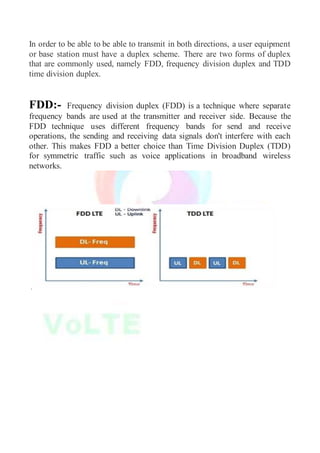
FDD:- Frequency division duplex (FDD) is a technique where separate
frequency bands are used at the transmitter and receiver side. Because the
FDD technique uses different frequency bands for send and receive
operations, the sending and receiving data signals don't interfere with each
other. This makes FDD a better choice than Time Division Duplex (TDD)
for symmetric traffic such as voice applications in broadband wireless
networks.
.
SUMMARY
In this paper, we have taken a glance at LTE background
motivations, primary adopted technologies and DL/UL
specifications in order to gain a general knowledge of LTE in the
first stage. Then, we have taken a close look at the major technical
parts of LTE, for instance, LTE architecture, OFDMA, SC-FDMA,
MIMO, TDD and FDD so that we could further understand the
detailed contents, i.e. what consists of LTE flat architecture, what
principles of LTE OFDMA and SC-FDMA schemes are, the
similarities and differences between OFDMA and SC-FDMA as
well as FDD/TDD duplex schemes. Finally, we also have examined
the main end user application performance such as DL/UL peak data
rates and low latency in real world. It is obvious that LTE makes a
lot of innovations in terms of technology for the purposes of data
rates and other performances as discussed above. Its peak
throughputs have already exceeded what can be achieved by
HSPA+. Moreover, LTE has obtained low cost per bit for a
competitive service, enlarged the UL range and fulfilled the need for
power-efficient device transmission.
CONCLUSION
With the cooperation of all the members, I have been able to learn
technical experience and engineering aspects and also many new
things related to telecommunication sector, LTE basics and its
workings.
JIO is good organization for a person for his long term carrier
workings. Overall workings and environment here is very
comfortable and friendly in maintaining a professional environment.
In this sort of time I observed how different departments of telecom
sector communicates with each other and how the employs of the
company works to complete daily targets or objectives of the
company. From this I have also learnt the teamwork spirit.
In last concluding 1 month of my internship, that along with
technical aspects I have also been taught how telecom company
runs, how system works, how to expose the professionalism and
technical skills with discipline and dedication.
zz
LTE (4G) PROJECT REPORT

LTE (4G) PROJECT REPORT

  • 2.
    SUBMITTED BY: ( PATNACAMPUS) Under the Guidance of Mr. Sushil Singh (Senior Manager, JIO) Project Guide Mr. Siddhartha Tyagi (Deputy Manager, JIO)
  • 3.
    I am verythankful from core of heart to “Senior Manager Reliance JIO”, sushil Singh for providing me Training opportunity and acquiring theoretical and practical knowledge as well in the field of telecommunication sector. I also want to express my gratitude to “Deputy Manager - Network Operations Reliance JIO”, SIDDHARTHA TYAGI for his consideration and supervision. I sincerely thank him for his guidance and information during the course of training. I would also like to thank SeniorExecutive Reliance JIO NITISH KUMAR for the positive attitude that he showed towards me and my work allowing me to question and giving prompt replies for my better understanding. Finally, I would like to thank all the concerned for their precious time and encouragement because of which I have successfully completed my training and also learned a lot from them. Kamal Kant ACKNOWLEDGEMENT
  • 4.
    Long Term Evolution(LTE) is a significant project of 3rd Generation Partnership Project (3GPP), initially proposed on the Toronto conference of 3GPP in 2004 and officially started as LTE work item in 2006. LTE, as a transition from the 3rd generation (3G) to the 4th generation (4G), has achieved great capacity and high speed of mobile telephone networks without doubt. It defines a new packet-only wideband radio with flat architecture and assumes a full Internet Protocol (IP) network architecture in order to assure voice supported in packet domain in design. In addition, it is combined with top-of-the-line radio techniques in order to gain better performance than Code Division Multiple Access (CDMA) approaches. LTE provides scalable carrier bandwidths from 1.4 MHz to 20 MHz and frequency division duplexing (FDD), as well as time division duple- ABSTRACT
  • 5.
    -xing (TDD). Inthis paper, it presents an overall description of LTE technology separately in different aspects of LTE architecture and technical principles to clarify how LTE as a radio technology achieves a high performance for cellular mobile communication systems. TABLE OF CONTENT  History  Introduction  LTE Overview o LTE Background o LTE Technology o LTE Specification  LTE Technology Theory o LTE Architecture o LTE Multiple Access Principles  OFDMA in LTE  SC-FDMA in LTE o MIMO in LTE o IP o SDH o LTE TDD and FDD Duplex Schemes  4 LTE Performance  5 Summary  6.Conclusion
  • 7.
    HISTORY LTE was proposedin 2004 Toronto conference for the sake of achieving higher speed and lower packets latency in UMTS 3G systems. Hence, LTE has to satisfy a set of high-level requirements, shown as below:  Reduced cost per bit  Simple architecture and open interfaces  Flexibility usage of existed and future frequency bands  Reasonable terminal power consuming  Enhanced user experience-more services with lower cost and high speed.
  • 8.
    As for themotivations and targets, 3GPP LTE aims to superior performance compared with HSPA technology. The main performance targets are listed as below.  2 to 4 times more spectral efficiency than HSPA Release 6  Peak rates beyond exceed 100 Mbps in DL and 50 Mbps in UL  Round trip time < 10 ms  Optimized packet-switching  High-level mobility and security  Efficient terminal power-consuming optimized  Flexible frequency with 1.5 MHz to 20 MHz allocations.
  • 9.
    INTRODUCTION As Internet generationaccustomed to access broadband where- ever they go, mobile broadband, instead of only at home and in the office, has become a reality. Therefore, the Global System for Mobile Communications family constantly develops new mobile technologies to achieve better performance, such as higher speed, larger capacity and so forth. LTE is a step beyond 3G and towards the 4G, evolved after EDGE, UMTS, HSPA and HSPA Evolution. The contributions of LTE make sure that the users are able to request more mobile applications like interactive TV, mobile video blogging, advanced games or professional services. This covers a relatively detailed LTE overview in the second section, which is primarily described around its background, technology, specifications. In section three, it aims to LTE technical theories such as LTE architecture, physical and transport channels of Downlink (DL) and Uplink (UL), multiple access principles (OFDMA and SC-FDMA), MIMO, also LTE duplex schemes.
  • 10.
    LTE OVERVIEW LTE enhancedthe Universal Mobile Telecommunication Services (UMTS) in a set of points on account of the future generation cellular technology needs and growing mobile communication services requirements. Such enhancementsare generated due to LTE background requirements, motivations and targets. The brief description about LTE technology and specifications is also covered in this subsection. LTE Advanced key features With work starting on LTE Advanced, a number of key requirements and key features are coming to light. Although not fixed yet in the specifications, there are many high level aims for the new LTE Advanced specification. These will need to be verified and much work remains to be undertaken in the specifications before these are all fixed. Currently some of the main headline aims for LTE Advanced can be seen below: COMPARISON OF LTE-A WITH OTHER CELLULAR TECHNOLOGIES WCDMA (UMTS) HSPA HSDPA / HSUPA HSPA+ LTE LTE ADVANCED (IMT ADVANCED) Max downlink speed bps 384 k 14 M 28 M 100M 1G Max uplink speed bps 128 k 5.7 M 11 M 50 M 500 M Latency round trip time approx 150 ms 100 ms 50ms (max) ~10 ms less than 5 ms 3GPP releases Rel 99/4 Rel 5 / 6 Rel 7 Rel 8 Rel 10 Approx years of initial roll out 2003 / 4 2005 / 6 HSDPA 2007 / 8 HSUPA 2008 / 9 2009 / 10 2014 / 15 Access methodology CDMA CDMA CDMA OFDMA / SC- FDMA OFDMA / SC- FDMA
  • 11.
     Peak datarates: downlink - 1 Gbps; uplink - 500 Mbps.  Spectrum efficiency: 3 times greater than LTE.  Peak spectrum efficiency: downlink - 30 bps/Hz; uplink - 15 bps/Hz.  Spectrum use: the ability to support scalable bandwidth use and spectrum aggregation where non-contiguous spectrum needs to be used.  Latency: from Idle to Connected in less than 50 ms and then shorter than 5 ms one way for individual packet transmission.  Cell edge user throughput to be twice that of LTE.  Average user throughput to be 3 times that of LTE.  Mobility: Same as that in LTE. LTE TECHNOLOGY LTE is composed of many new technologies compared with the previous generation of cellular systems. These new technologies are used to generate more efficiency with regards to spectrum and higher data rates as expected by designers. Here are only snapshots of the technologies and they will be clarified in detail in the third section. OFDM (Orthogonal Frequency Division Multiplex). In order to gain high data bandwidth when transmitting packets, LTE integrates OFDM technology which can provide high-degree resilience to reflections and interference at the same time. Furthermore, the access schemes can be divided into two access
  • 12.
    approaches used inthe DL and UL respectively. The first one for the DL is OFDMA (Orthogonal Frequency Division Multiplex Access); the second one for the UL is SC-FDMA (Single Carrier- Frequency Division Multiplex Access), which has the advantages of smaller peak to average power ratio and more constant power able to get high RF power amplifier efficiency in the mobile handsets LTE TECHNOLOGY THEORY This section presents UMTS LTE technology theory, such as LTE architecture, physical and transport channels for DL and UL, multiple access principles (OFDMA, and SC-FDMA), MIMO and TDD/FDD duplex schemes. LTE ARCHITECTURE The network architecture of LTE is comprised of fo three main components: The User Equipment (UE). The Evolved UMTS Terrestrial Radio Access Network (E-UTRAN). The Evolved Packet Core (EPC)
  • 13.
    User Equipment(UE) :-In the Universal Mobile Telecommunications System (UMTS) and 3GPP Long Term Evolution (LTE), user equipment (UE) is any device used directly by an end-user to communicate. It can be a hand-held telephone, a laptop computer equipped with a mobile broadband adapter, or any other device. It connects to the base station Node B/eNodeB as specified in the ETSI 125/136-series and 3GPP 25/36-series of specifications. It roughly corresponds to the mobile station (MS) in GSM systems. The radio interface between the UE and the Node B is called Uu. The radio interface between the UE and the eNodeB is called LTE-Uu. Evolved Radio Access Network (RAN): It mainly consists of a single RAN node named as eNodeB (eNB). The eNB interfaces with the User Equipment (UE) and hosts the physical layer (PHY), Medium Access Control (MAC), Radio Link Control (RLC), and PacketData Control Protocol(PDCP) layers. Its functions include radio resource management, admission control,
  • 14.
    scheduling, enforcement ofnegotiated UL QoS and compression/decompression of DL/UL user plane packet headers. Serving Gateway (SGW): It performs as the mobility anchor for the user plane during inter-Enb handovers and as the anchor for mobility between LTE and other 3GPP technologies. At the same time, it routes and forwards user data packets. The SGW controls the termination of the DL data path and paging while DL data comes to UE and replicates the user traffic when lawful and rational interception. It also manages and stores UE information, for instance, parameters of the IP bearer service, network internal routing information. Mobility Management Entity (MME): The key control-node for the LTE access network. It tracks andpages the idle mode UE, even retransmission. MME selects the SGW for a UE at initial attach and at time of intra-LTE handover involving Core Network (CN) node relocation. When authenticating the user, it interacts with the HSS (a master user database supporting IP Multimedia Subsystem and including subscriber information) [WiKi HSS]through the specified interface. Packet Data Network Gateway (PDN GW): It has two key roles in terms of functionality. First, the PDN GW supports the connectivity to the UE and to the external packet data networks via the entry and exit of UE traffic. The other key role of the PDN GW is acting as the anchor for mobility between 3GPP and non-3GPP technologies such as WiMAX and 3GPP2.
  • 15.
    the evolved packetcore communicates with packet data networks in the outside world such as the internet, private corporate networks or the IP multimedia subsystem. IP (Internet protocol):- LTE networks are all-IP networks. This means that they deliver all user traffic in IP packets, and provide users with “always-on IP connectivity”. When UE joins an LTE network, a Packet Data Network (PDN) address (i.e. the one that can be used in the PDN) is assigned to the UE for its connection to the PDN, and a default bearer is established in the LTE network (i.e. between UE and P-GW). This default bearer remains connected (i.e. the IP address assigned to the UE during the initial attach remains valid) until the UE is detached from the LTE network.
  • 16.
    SDH (Synchronous DigitalHierarchy):- (SDH), is used in Europe by the International Telecommunication Union Telecommunication Standardization Sector (ITU-T). SONET equipment is generally used in North America, and SDH equipment is generally accepted everywhere else in the world. Both SONET and SDH are based on a structure that has a basic frame format and speed. The frame format used by SONET is the Synchronous Transport Signal (STS), with STS-1 as the base-level signal at 51.84 Mbps. An STS-1 frame can be carried in an OC-1 signal. The frame format used by SDH is the Synchronous Transport Module (STM), with STM-1 as the base-level signal at 155.52Mbps. An STM-1 frame can be carried in an OC-3 signal. Both SONET and SDH have a hierarchy of signaling speeds. Multiple lower-level signals can be multiplexed to form higher-level signals. For example, three STS-1 signals can be multiplexed together to form an STS-3 signal, and four STM-1 signals multiplexed together to form an STM-4 signal. SONET and SDH are technically comparable standards. The term SONET is often used to refer to either. LTE MULTIPLE ACCESS PRINCIPLES LTE has multiple access principles such as OFDMA for DL and SC-FDMA for UL. OFMDA (Orthogonal Frequency Division Multiplex) :- The principle of the OFDMA focuses on the usage of narrow, mutually orthogonal sub- carriers .And the OFDM signal used in LTE consists of a maximum of 2048 different sub-carries spacing typically 15kHz regardless of the total transmission bandwidth. At the sampling instant of a single sub-carrier and the other sub-carriers having a zero value, different sub-carriers maintain orthogonality .Then the actual signal is transmitted after the Fast Fourier Transform (FFT) block, used to change between time and frequency domain representation of the signal. In the transmitter side, the OFDMA system uses inverse FFT (IFFT) block to create signals. The data bits through Modulator feed to the Serial-to-Parallel conversion and then to the IFFT block, the IFFT
  • 17.
    block goes tothe cyclic extension (cyclix prefix), which aims to avoid inter- symbol interference. Bits transmitter output MIMO MIMO has a growing usage trend among many high data rate technologies in order to provide great efficiency, such as in Wi-Fi and other wireless and cellular technologies. LTE therefore chooses MIMO to increase the throughput while OFDM changes a frequency selective fading channel into multiple flat fading sub-channels facilitating easy equalization Generally, MIMO deploys multiple antennas on the receiver and transmitter to take advantage of multi- path effects to transmit additional data without causing interference. MODULATOR SERIAL TO PARALLEL IFFT CYCLIC EXTENSION
  • 18.
    Since there aremore terminals than base stations and terminal works cost price is far more sensitive, the MIMO schemes employed in LTE vary slightly on both DL and UL in order to get the low terminal cost. For the DL, the configurations that two transmitting antennas at the base station and two receiving antennas on the mobile terminal are made as baseline. For the UL, multi-user MIMO (MU-MIMO is used to reduce the cost of the mobile, because the configuration for this scheme is only one transmitting antennas on the mobile terminal without considering multiple antennas at the base station. Base Station DEMUX MODULATION MODULATION SIGNAL MAPPING AND GENERATIO N SIGNAL MAPPING AND GENERATIO N
  • 19.
    Furthermore, multiple mobileterminals may transmit simultaneously on the same channel or channels, and they cause no interference with each other for the reason to use mutually orthogonal pilot patterns. TDD:- It is essential that any cellular communications system must be able to transmit in both directions simultaneously. This enables conversations to be made, with either end being able to talk and listen as required. Additionally when exchanging data it is necessary to be able to undertake virtually simultaneous or completely simultaneous communications in both directions. It is necessary to be able to specify the different direction of transmission so that it is possible to easily identify in which direction the transmission is being made. There are a variety of differences between the two links ranging from the amount of data carried to the transmission format, and the channels implemented. The two links are defined:  Uplink: The transmission from the UE or user equipment to the eNodeB or base station.  Downlink : The transmission from the eNodeB or base station to the UE or user equipment. Uplink and downlink transmission directions
  • 20.
    In order tobe able to be able to transmit in both directions, a user equipment or base station must have a duplex scheme. There are two forms of duplex that are commonly used, namely FDD, frequency division duplex and TDD time division duplex. FDD:- Frequency division duplex (FDD) is a technique where separate frequency bands are used at the transmitter and receiver side. Because the FDD technique uses different frequency bands for send and receive operations, the sending and receiving data signals don't interfere with each other. This makes FDD a better choice than Time Division Duplex (TDD) for symmetric traffic such as voice applications in broadband wireless networks. .
  • 21.
    SUMMARY In this paper,we have taken a glance at LTE background motivations, primary adopted technologies and DL/UL specifications in order to gain a general knowledge of LTE in the first stage. Then, we have taken a close look at the major technical parts of LTE, for instance, LTE architecture, OFDMA, SC-FDMA, MIMO, TDD and FDD so that we could further understand the detailed contents, i.e. what consists of LTE flat architecture, what principles of LTE OFDMA and SC-FDMA schemes are, the similarities and differences between OFDMA and SC-FDMA as well as FDD/TDD duplex schemes. Finally, we also have examined the main end user application performance such as DL/UL peak data rates and low latency in real world. It is obvious that LTE makes a lot of innovations in terms of technology for the purposes of data rates and other performances as discussed above. Its peak throughputs have already exceeded what can be achieved by HSPA+. Moreover, LTE has obtained low cost per bit for a competitive service, enlarged the UL range and fulfilled the need for power-efficient device transmission.
  • 22.
    CONCLUSION With the cooperationof all the members, I have been able to learn technical experience and engineering aspects and also many new things related to telecommunication sector, LTE basics and its workings. JIO is good organization for a person for his long term carrier workings. Overall workings and environment here is very comfortable and friendly in maintaining a professional environment. In this sort of time I observed how different departments of telecom sector communicates with each other and how the employs of the company works to complete daily targets or objectives of the company. From this I have also learnt the teamwork spirit. In last concluding 1 month of my internship, that along with technical aspects I have also been taught how telecom company runs, how system works, how to expose the professionalism and technical skills with discipline and dedication.
  • 26.