Downloaded 1,709 times
![2
Frequency bands
The TDD duplex mode is used for transmissions in unpaired frequency bands. This means that
the TDD bands already defined for UMTS can also be used for LTE TDD. The TDD bands
defined by 3GPP are presented in Table 1, although it is possible that more bands will be added.
E-UTRA Band Frequency
33 1900 MHz to 1920 MHz
34 2010 MHz to 2025 MHz
35 1850 MHz to 1910 MHz
36 1930 MHz to 1990 MHz
37 1910 MHz to 1930 MHz
38 2570 MHz to 2620 MHz
39 1880 MHz to 1920 MHz
40 2300 MHz to 2400 MHz
Table 1: LTE TDD frequency bands [2]
LTE TDD physical layer
Frame structure
Both the uplink and downlink for LTE are divided into radio ames, each 10 ms in length. Figure
1 shows the frame structure for LTE TDD.
One radio frame Tf =10 ms
One half-frame Thf = 5 ms
T = 1 ms
Subframe #0 Subframe #2 Subframe #3 Subframe #4 Subframe #5 Subframe #7 Subframe #8 Subframe #9
One slot, One subframe,
Tslot = 0.5 ms Tsf = 1 ms
DwPTS GP UpPTS DwPTS GP UpPTS
Figure 1: TDD frame structure [2]](https://image.slidesharecdn.com/ltetddtechnologyoverview-091202110905-phpapp01/85/LTE-TDD-Technology-Overview-2-320.jpg)

![4
TSlot
Slot
Nsymb UL/DL symbols
…
Resource block
N sc × N symb Resource elements
NRB Resource blocks
Nsc subcarriers
Resource element
…
Figure 2: Slot structure [2]
Configuration Subcarrier spacing )f Nsc Nsymb
Normal cyclic prefix )f = 15 kHz 12 7
Downlink )f = 15 kHz 12 6
Extended cyclic prefix
)f = 7 kHz 24 3
Normal cyclic prefix )f = 15 kHz 12 7
Uplink
Extended cyclic prefix )f = 15 kHz 12 6
Table 2: Uplink/downlink parameterization of LTE [2]](https://image.slidesharecdn.com/ltetddtechnologyoverview-091202110905-phpapp01/85/LTE-TDD-Technology-Overview-4-320.jpg)
![5
In contrast to UMTS WCDMA/HSPA, various different bandwidths are supported for LTE,
making it compatible with existing mobile radio networks. The channel bandwidth is defined by
the number of available resource blocks NRB and is scalable. This scalability allows radio
resources to be used efficiently. Table 3 lists the bandwidths supported by LTE and the
associated number of resource blocks NRB. These parameters are defined the same for LTE TDD
and LTE FDD.
Channel
1.4 3 5 10 15 20
bandwidth [MHz]
NRB 6 15 25 50 75 100
Table 3: LTE bandwidths [2]
Uplink/downlink configurations
LTE TDD uses the same frequency bands for the uplink and the downlink. The transmission
directions are separated by carrying the UL and DL data in different subframes. The distribution
of subframes between the transmission directions can be adapted to the data traffic and is done
either symmetrically (equal number of DL and UL subframes) or asymmetrically. Table 4 shows
the UL/DL configurations that are defined for LTE TDD. In this table, "D" means that DL data is
transmitted in this subframe. Similarly, "U" indicates uplink data transmission and "S" specifies
that the special fields DwPTS, GP and UpPTS are transmitted in this subframe.
Uplink/downlink Downlink-to-Uplink Subframe number
configuration Switch-point periodicity 0 1 2 3 4 5 6 7 8 9
0 5 ms D S U U U D S U U U
1 5 ms D S U U D D S U U D
2 5 ms D S U D D D S U D D
3 10 ms D S U U U D D D D D
4 10 ms D S U U D D D D D D
5 10ms D S U D D D D D D D
6 5 ms D S U U U D S U U D
Table 4: Uplink/downlink configurations [2]](https://image.slidesharecdn.com/ltetddtechnologyoverview-091202110905-phpapp01/85/LTE-TDD-Technology-Overview-5-320.jpg)
![6
Table 4 shows that subframes 0 and 5 are always used for the downlink and that the subframe
that immediately follows the special fields always transmits UL data.
DwPTS, GP, UpPTS
Within a radio frame, LTE TDD switches multiple times between downlink and uplink
transmission and vice versa. In the process, the different signal transit times between the base
station and the various mobile stations must be taken into consideration in order to prevent
conflicts with the neighboring subframe. The timing advance process prevents conflicts when
switching from the uplink to the downlink. Every mobile station (MS) is informed by the base
station (BS) as to when it must start transmitting. The greater the distance between the BS and
the MS, the earlier the MS starts transmitting. This helps ensure that all signals reach the BS in a
synchronized manner. When switching from the downlink to the uplink, a guard period (GP) is
inserted between the DwPTS and the UpPTS field. The duration of the GP depends on the signal
propagation time from the BS to the MS and back as well as on the time the MS requires to
switch from receiving to sending. The duration of the GP is configured by the network based on
the cell size.
Because the overall length of the special subframe remains constant and the GP length varies
based on cell size, the lengths of the DwPTS and UpPTS also have to be adjusted. Nine different
special subframe configurations are provided for LTE TDD as shown in Table 5.
Special Extended cyclic prefix length in Normal cyclic prefix length in
subframe OFDM symbols OFDM symbols
configuration DwPTS GP UpPTS DwPTS GP UpPTS
0 3 8 3 10
1 8 3 9 4
1
2 9 2 10 3 1
3 10 1 11 2
4 3 7 12 1
5 8 2 2 3 9
6 9 1 9 3
2
7 - - - 10 2
8 - - - 11 1
Table 5: Special subframe configurations [2]
While the GP separates between the UL and the DL, the other special fields are used for data
transmission. The DwPTS field carries synchronization and user data as well as the downlink
control channel for transmitting scheduling and control information. The UpPTS field is used for](https://image.slidesharecdn.com/ltetddtechnologyoverview-091202110905-phpapp01/85/LTE-TDD-Technology-Overview-6-320.jpg)
![8
scheduling requests and ACK/NACK responses for downlink packets, are also transmitted
via this channel. Like for PDSCH, a bundled ACK/NACK response can be sent for multiple
PUSCH transmissions from the base station in LTE TDD mode.
- Physical uplink control channel (PUCCH): If a mobile station does not have any packets
to be transmitted on the PUSCH, the control information is sent via the PUCCH. The
PUCCH is therefore never sent simultaneously with the PUSCH from the same mobile
station. LTE TDD does not use the UpPTS fields for PUCCH transmission.
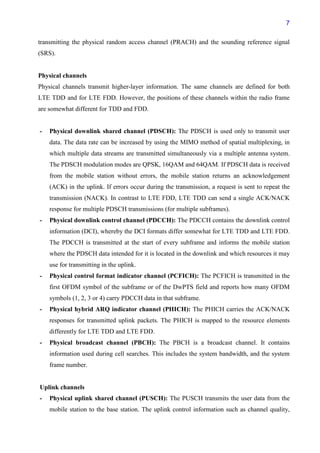
- Physical random access channel (PRACH): The PRACH contains the "random access
preamble". The random access preamble is configured by the physical layer as well as by the
higher layers. The format of the random access preamble is shown in Figure 3. The
preamble consists of the sequence of length TSEQ and the cyclic prefix of length TCP. LTE
supports five preamble formats for various access configurations. Formats 0 to 3 are used for
TDD as well as for FDD; however format 4 is used only for TDD. The random access
preambles are generated as Zadoff-Chu sequences. There are 64 random access preambles
per cell. As a result of the differences in the radio frame structure between LTE TDD and
LTE FDD, the resource elements are also configured differently.
-
CP Sequence
TCP TSEQ
Figure 3: Random access preamble format [2]](https://image.slidesharecdn.com/ltetddtechnologyoverview-091202110905-phpapp01/85/LTE-TDD-Technology-Overview-8-320.jpg)

![11
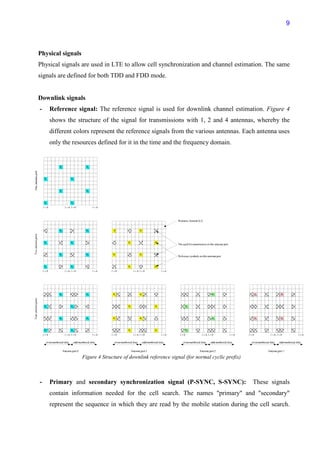
Figure 5: 3GPP SAE network architecture
The base station (eNB) handles functions such as uplink and downlink scheduling, mobility
control, radio bearer and admission control. It is connected to the evolved packet core (EPC) via
the S1 interface. The EPC consists of a serving gateway ( S-GW), a mobility management entity
(MME) and a packet data network gateway (P-GW).
The network and protocol architecture described above applies to both LTE FDD and LTE TDD.
The protocol functions are also essentially the same for LTE TDD and LTE FDD. However, the
control information for the radio resource control (RRC) protocol will differ as a result of the
previously described differences in the physical layer between LTE FDD and LTE TDD. The
RRC configures the lower layers and is also responsible for selecting the parameters for
transmitting user data and control data.
The MAC protocol is responsible for assigning resources (scheduling). Here, too, the differences
in the physical layer between TDD and FDD must be taken into account.
References
[1] 3GPP TS 36.104; Base Station (BS) radio transmission and reception (Release 8)
[2] 3GPP TS 36.211; Physical channels and modulation (Release 8)
[3] 3GPP TS 36.212; Multiplexing and channel coding (Release 8)
[4] 3GPP TS 36.213; Physical layer procedures (Release 8)](https://image.slidesharecdn.com/ltetddtechnologyoverview-091202110905-phpapp01/85/LTE-TDD-Technology-Overview-11-320.jpg)
![12
[5] 3GPP TS 36.300; Overall description; Stage 2 (Release 8)
[6] Peter W .C. Chan, Ernest S. Lo, Ray R.Wang: "The Evolution Path of 4G Networks:
FDD or TDD?" IEEE, December 2006
[7] Harri Holma, Sanna Heikkinen, Otto-Aleksanteri Lehtinen: "Interference Considerations
for the Time Division Duplex Mode of the UMTS Terrestrial Radio Access", IEEE 2000
Abbreviations
3GPP 3rd Generation Partnership Project
ACK Acknowledgement
ARQ Automatic repeat request
BS Base station
DCI Downlink control information
DL Downlink
DwPTS Downlink pilot time slot
eNB E-UTRAN NodeB
EPC Evolved packet core
E-UTRA Evolved UTRA
FDD Frequency division duplex
GP Guard period
HSPA High speed packet access
LTE Long term evolution
MAC Medium access control
MIMO Multiple input multiple output
MME Mobility management entity
MS Mobile station
NACK Negative acknowledgement
OFDM Orthogonal frequency division multiplexing
OFDMA Orthogonal frequency division multiple access
PAPR Peak-to-average power ratio
PBCH Physical broadcast channel
PCFICH Physical control format indicator channel
PDCCH Physical downlink control channel
PDSCH Physical downlink shared channel
P-GW PDN gateway](https://image.slidesharecdn.com/ltetddtechnologyoverview-091202110905-phpapp01/85/LTE-TDD-Technology-Overview-12-320.jpg)

LTE TDD uses time division duplexing to separate uplink and downlink transmissions on the same frequency band. It divides each 10ms frame into uplink and downlink timeslots. Key aspects of LTE TDD include its frame structure with special subframes containing DwPTS, GP and UpPTS fields, supported frequency bands and bandwidths, and physical channels such as PDSCH, PDCCH, and PRACH that operate differently than in LTE FDD. Network planning requires consideration of uplink/downlink configuration and propagation delays between base stations and mobile stations.


![Getting Started with Apache Spark: Big Data Made Simple [Free Meetup]](https://cdn.slidesharecdn.com/ss_thumbnails/apachesparkgettingstarted-260203175547-8361bcc3-thumbnail.jpg?width=640&height=640&fit=bounds)


