Downloaded 137 times
![Reference : [11] 2](https://image.slidesharecdn.com/introductionto3-terminalcapacitor-160524165800/75/Introduction-to-3-terminal-capacitor-2-2048.jpg)
![With decoupling capacitors, the voltage ripple and noise emission can
be reduced [10].
3](https://image.slidesharecdn.com/introductionto3-terminalcapacitor-160524165800/75/Introduction-to-3-terminal-capacitor-3-2048.jpg)
![The lower ESL is, the wider capacitive range will be.
The lower ESR is, the better noise suppression will be [12].
4](https://image.slidesharecdn.com/introductionto3-terminalcapacitor-160524165800/75/Introduction-to-3-terminal-capacitor-4-2048.jpg)
![The path the noise flows inside 3-terminal capacitor is shorter than
which inside 2-terminal capacitor. That’s to say, the 3-terminal
capacitor has lower ESL and ESR [12,13].
C = 10 uF 5](https://image.slidesharecdn.com/introductionto3-terminalcapacitor-160524165800/75/Introduction-to-3-terminal-capacitor-5-2048.jpg)
![With lower ESL and ESR, the 3-
terminal capacitor has wider
capacitive range and better noise
suppression than 2-terminal one [7,9]
6](https://image.slidesharecdn.com/introductionto3-terminalcapacitor-160524165800/75/Introduction-to-3-terminal-capacitor-6-2048.jpg)
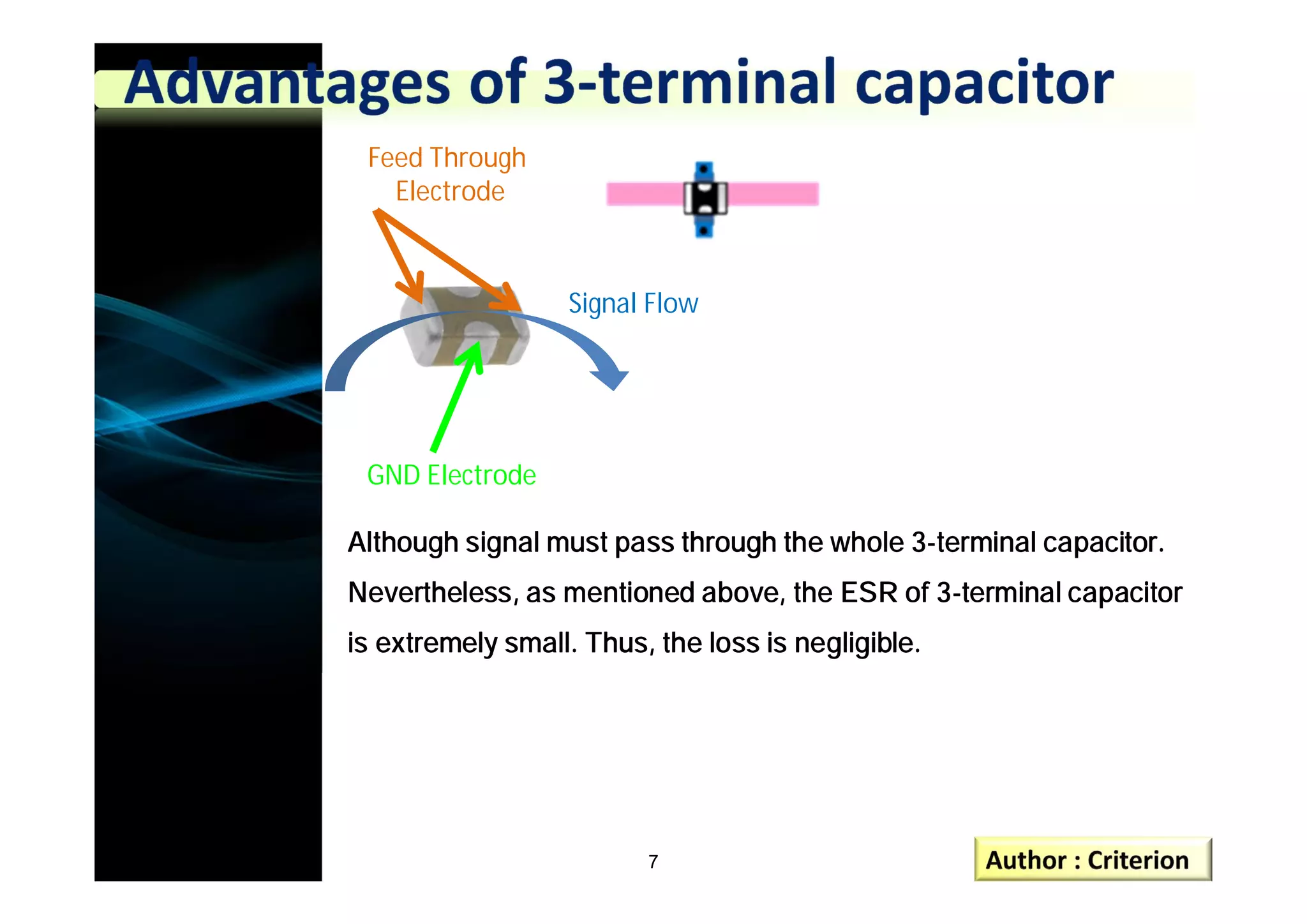
![Lower ESR => Lower Voltage Ripple.
Lower ESL => Smaller loop area =>
lower Noise Emission [10].
8](https://image.slidesharecdn.com/introductionto3-terminalcapacitor-160524165800/75/Introduction-to-3-terminal-capacitor-8-2048.jpg)
![For noise reduction,
one 3-terminal capacitor is even better than
(1 bead + 2 * 2-terminal capacitor )[1].
9](https://image.slidesharecdn.com/introductionto3-terminalcapacitor-160524165800/75/Introduction-to-3-terminal-capacitor-9-2048.jpg)
![For noise reduction,
one 1uF 3-terminal capacitor is even better than
(4 * 0.22 uF 2-terminal capacitor )[6].
10](https://image.slidesharecdn.com/introductionto3-terminalcapacitor-160524165800/75/Introduction-to-3-terminal-capacitor-10-2048.jpg)
![For noise reduction,
one 10uF 3-terminal capacitor is even better than
(22uF + 10 nF x 5pcs + 100 pF x 5pcs)[4].11](https://image.slidesharecdn.com/introductionto3-terminalcapacitor-160524165800/75/Introduction-to-3-terminal-capacitor-11-2048.jpg)
![Compared to multiple capacitors, the 3-terminal capacitor
doesn’t have anti-resonance issue. Besides, the 3-terminal
capacitor can save PCB area due to less components[5,12].
12](https://image.slidesharecdn.com/introductionto3-terminalcapacitor-160524165800/75/Introduction-to-3-terminal-capacitor-12-2048.jpg)
![In addition, the number of GND via is the more the better. By
doing this, the impedance of noise path can be reduced further,
which can lead to better noise suppression[7,8].
13](https://image.slidesharecdn.com/introductionto3-terminalcapacitor-160524165800/75/Introduction-to-3-terminal-capacitor-13-2048.jpg)

1. Three-terminal capacitors have lower equivalent series inductance (ESL) and equivalent series resistance (ESR) than two-terminal capacitors, allowing for wider capacitive range and better noise suppression. 2. A single three-terminal capacitor provides better noise reduction than multiple two-terminal capacitors or combinations of different capacitor types due to avoiding issues like anti-resonance. 3. Three-terminal capacitors save space on printed circuit boards compared to multiple discrete capacitors since fewer components are required.


