Dar es Salam, January 2015
What comes after 4G?
5G of course
JyriHämäläinen
AaltoUniversity
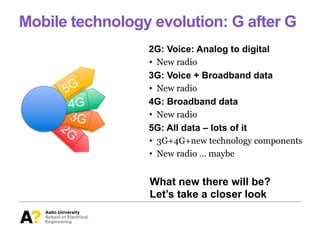
Mobile technology evolution: G after G
2G: Voice: Analog to digital
•  New radio
3G: Voice + Broadband data
•  New radio
4G: Broadband data
•  New radio
5G: All data – lots of it
•  3G+4G+new technology components
•  New radio … maybe
3G
4G
What new there will be?
Let’s take a closer look
Why? Drivers for 5G
Why 5G: Let’s make it simple
1) Massive growth in traffic volume
2) Massive growth in connected devices/things
3) Wide range of requirements and characteristics
1) Traffic volume
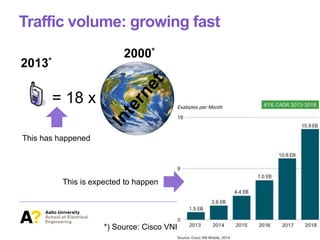
Traffic volume: growing fast
= 18 x
2013*
2000*
*) Source: Cisco VNI
This has happened
This is expected to happen
Voice and mobile broadband
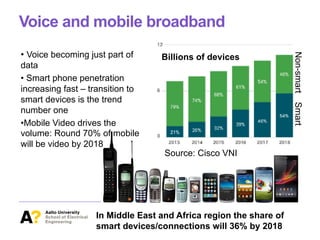
• Voice becoming just part of
data
• Smart phone penetration
increasing fast – transition to
smart devices is the trend
number one
• Mobile Video drives the
volume: Round 70% of mobile
will be video by 2018
In Middle East and Africa region the share of
smart devices/connections will 36% by 2018
Billions of devices
Source: Cisco VNI
Non-smartSmart
2) Connected … everything
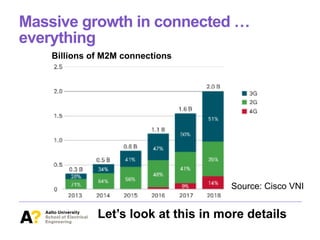
Massive growth in connected …
everything
Let’s look at this in more details
Billions of M2M connections
Source: Cisco VNI
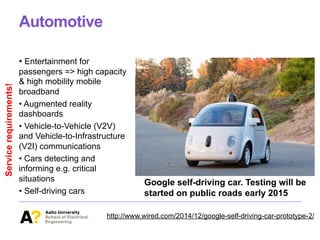
Automotive
• Entertainment for
passengers => high capacity
& high mobility mobile
broadband
• Augmented reality
dashboards
• Vehicle-to-Vehicle (V2V)
and Vehicle-to-Infrastructure
(V2I) communications
• Cars detecting and
informing e.g. critical
situations
• Self-driving cars
Google self-driving car. Testing will be
started on public roads early 2015
http://www.wired.com/2014/12/google-self-driving-car-prototype-2/
Servicerequirements!
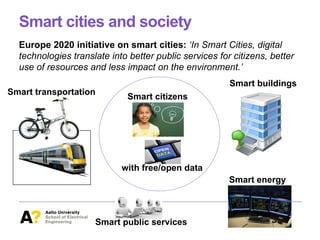
Smart cities and society
Europe 2020 initiative on smart cities: ‘In Smart Cities, digital
technologies translate into better public services for citizens, better
use of resources and less impact on the environment.’
Smart buildings
Smart transportation
Smart energy
with free/open data
Smart citizens
Smart public services
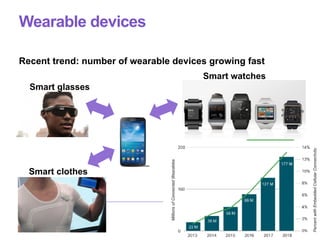
Wearable devices
Recent trend: number of wearable devices growing fast
Strategy Dialogue ELEC Spring
2014
Smart glasses
Smart watches
Smart clothes
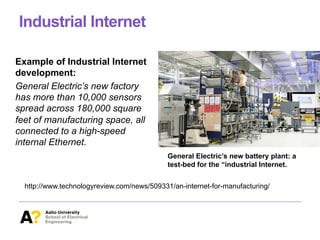
Industrial Internet
Example of Industrial Internet
development:
General Electric’s new factory
has more than 10,000 sensors
spread across 180,000 square
feet of manufacturing space, all
connected to a high-speed
internal Ethernet.
http://www.technologyreview.com/news/509331/an-internet-for-manufacturing/
General Electric’s new battery plant: a
test-bed for the “industrial Internet.
3) Service characteristics
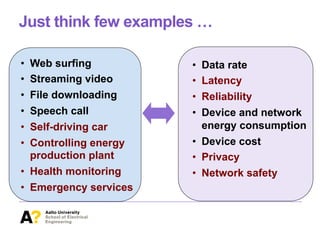
Just think few examples …
•  Web surfing
•  Streaming video
•  File downloading
•  Speech call
•  Self-driving car
•  Controlling energy
production plant
•  Health monitoring
•  Emergency services
•  Data rate
•  Latency
•  Reliability
•  Device and network
energy consumption
•  Device cost
•  Privacy
•  Network safety
How? What are 5G technologies?
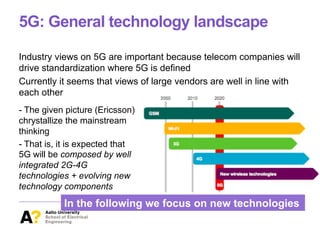
5G: General technology landscape
Industry views on 5G are important because telecom companies will
drive standardization where 5G is defined
Currently it seems that views of large vendors are well in line with
each other
- The given picture (Ericsson)
chrystallize the mainstream
thinking
- That is, it is expected that
5G will be composed by well
integrated 2G-4G
technologies + evolving new
technology components
In the following we focus on new technologies
Basics: Transfer more
data … but how?
More bandwidth?
Less users?
Stronger signal?
Better efficiency?
Less interference?
User data rate ≅
BW
K
⋅ A⋅log2 1+
P
N + I
#
$
%
&
'
( [Mbit/s]
Bandwidth
Number of
users
System
efficiency
Signal power
vs noise and
interference
Interference
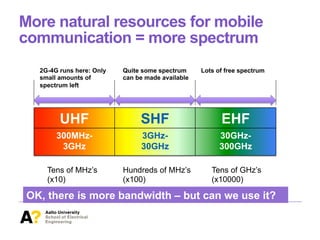
More natural resources for mobile
communication = more spectrum
UHF SHF EHF
300MHz-
3GHz
3GHz-
30GHz
30GHz-
300GHz
2G-4G runs here: Only
small amounts of
spectrum left
Quite some spectrum
can be made available
Lots of free spectrum
Tens of MHz’s
(x10)
Hundreds of MHz’s
(x100)
Tens of GHz’s
(x10000)
OK, there is more bandwidth – but can we use it?
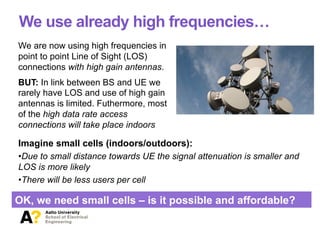
We use already high frequencies…
Imagine small cells (indoors/outdoors):
• Due to small distance towards UE the signal attenuation is smaller and
LOS is more likely
• There will be less users per cell
OK, we need small cells – is it possible and affordable?
We are now using high frequencies in
point to point Line of Sight (LOS)
connections with high gain antennas.
BUT: In link between BS and UE we
rarely have LOS and use of high gain
antennas is limited. Futhermore, most
of the high data rate access
connections will take place indoors
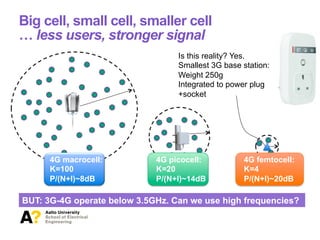
Big cell, small cell, smaller cell
… less users, stronger signal
4G macrocell:
K=100
P/(N+I)~8dB
4G picocell:
K=20
P/(N+I)~14dB
4G femtocell:
K=4
P/(N+I)~20dB
Is this reality? Yes.
Smallest 3G base station:
Weight 250g
Integrated to power plug
+socket
BUT: 3G-4G operate below 3.5GHz. Can we use high frequencies?
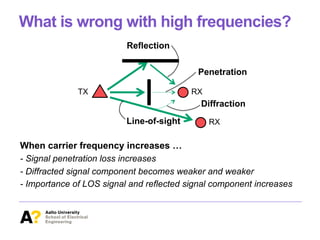
What is wrong with high frequencies?
TX RX
RX
Reflection
Penetration
Diffraction
Line-of-sight
When carrier frequency increases …
- Signal penetration loss increases
- Diffracted signal component becomes weaker and weaker
- Importance of LOS signal and reflected signal component increases
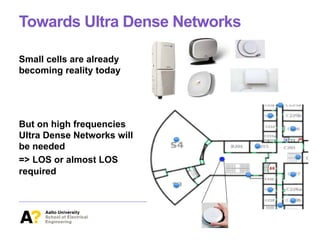
Towards Ultra Dense Networks
Small cells are already
becoming reality today
But on high frequencies
Ultra Dense Networks will
be needed
=> LOS or almost LOS
required
PRESS RELEASE
SEPTEMBER 25, 2013
Johan Wibergh, head of Ericsson Business Unit Networks, says: “With the Radio Dot
System we lower the threshold to building indoor coverage. The dot is the most cost-
effective, no-compromise solution to the indoor coverage challenges expressed by our
customers. It is ultra-small but can scale to virtually unlimited capacity; it is easy to install,
future proof and it is 100 percent integrated with existing mobile networks.”
The product has already been gaining interest from mobile operators in the United States.
Kris Rinne, Senior Vice President, Network and Product Planning, AT&T Services, Inc.,
says: “Small cells are a key component of AT&T's Project VIP network enhancement
program as we seek to constantly improve our customers’ mobile Internet experience.
Delivering a great wireless experience indoors can present both technical and logistical
challenges. A solution like the Ericsson Radio Dot System gives AT&T another tool to
choose from in its next-generation toolkit."
Ken Rehbehn, Principal Analyst, Yankee Group, says: “Sleek form factors that focus radio
capability to solve the indoor deployment challenge in a fresh and compelling way will be
welcomed into a wide variety of business and office venues. Ericsson Radio Dot System
leverages existing indoor wire facilities to reduce installation hurdles and cost, and because
it builds on Ericsson standard radio architecture, it provides an extensive feature set without
compromising future evolution.”
The product is expected to be commercially available in late 2014.
Webcast
Ericsson will webcast the announcement in conjunction with its Analyst Forum in North
America on Sept 25 at 3pm PT/11pm UK time/Sept 26 at 12am CET. Access the webcast
on: www.ericsson.com/press.
An on-demand version will be available shortly afterwards.
NOTES TO EDITORS
Indoor coverage video
Photos of Ericsson Radio Dot System:
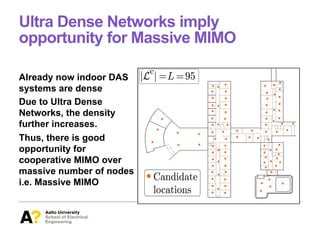
Ultra Dense Networks imply
opportunity for Massive MIMO
Already now indoor DAS
systems are dense
Due to Ultra Dense
Networks, the density
further increases.
Thus, there is good
opportunity for
cooperative MIMO over
massive number of nodes
i.e. Massive MIMO
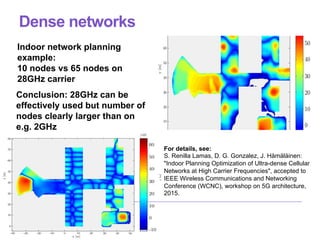
Dense networks
(c) 28 GHz. 65 nodes ON
(e) 28 GHz. 10 nodes ON
Figure 23: Spatial distribution of
Finally, Figure 22d shows the CDF of t
topologies with 65 active nodes featuring f
(a) 28 GHz. All nodes ON (b) 2.6 GHz. All nodes ON
Indoor network planning
example:
10 nodes vs 65 nodes on
28GHz carrier
Conclusion: 28GHz can be
effectively used but number of
nodes clearly larger than on
e.g. 2GHz
For details, see:
S. Renilla Lamas, D. G. Gonzalez, J. Hämäläinen:
"Indoor Planning Optimization of Ultra-dense Cellular
Networks at High Carrier Frequencies", accepted to
IEEE Wireless Communications and Networking
Conference (WCNC), workshop on 5G architecture,
2015.
Increasing data rates: Summary
Strategy Dialogue ELEC Spring
2014
User data rate ≅
BW
K
⋅ A⋅log2 1+
P
N + I
#
$
%
&
'
( [Mbit/s]
Bandwidth
Number of
users System
efficiency
Signal power vs
noise and
interference
Interference
High carrier frequencies with large
(GHz) bands + ultra dense networks
with very small cells
OK
OK
OK
Interference of shot noise
type, effective mitigation
methods exists
Can be compensated
using large spectrum
chunks
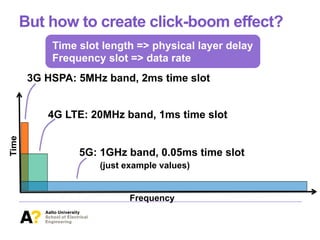
But how to create click-boom effect?
3G HSPA: 5MHz band, 2ms time slot
4G LTE: 20MHz band, 1ms time slot
5G: 1GHz band, 0.05ms time slot
(just example values)
Time
Frequency
Time slot length => physical layer delay
Frequency slot => data rate
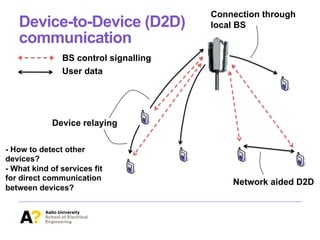
Device-to-Device (D2D)
communication
Network aided D2D
Connection through
local BS
Device relaying
BS control signalling
User data
- How to detect other
devices?
- What kind of services fit
for direct communication
between devices?
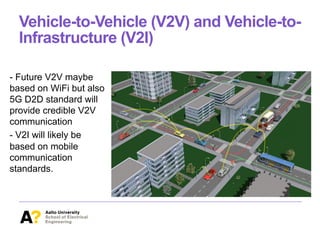
Vehicle-to-Vehicle (V2V) and Vehicle-to-
Infrastructure (V2I)
- Future V2V maybe
based on WiFi but also
5G D2D standard will
provide credible V2V
communication
- V2I will likely be
based on mobile
communication
standards.
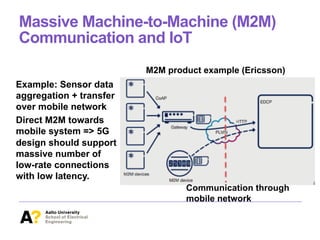
Massive Machine-to-Machine (M2M)
Communication and IoT
Example: Sensor data
aggregation + transfer
over mobile network
Direct M2M towards
mobile system => 5G
design should support
massive number of
low-rate connections
with low latency.
M2M product example (Ericsson)
Communication through
mobile network
Some other technology components
related to 5G
Ultra Reliable Communication (URC)
Centralized baseband/baseband pooling
Self-backhauling
Beamforming on mmWave
Soft cell concepts
Device centric system architecture
Licenced Shared Access (LSA)
Authorized Shared Access (ASA)
Local caching
Mobile cloud
Moving Networks
Before closing: Where we stand now?
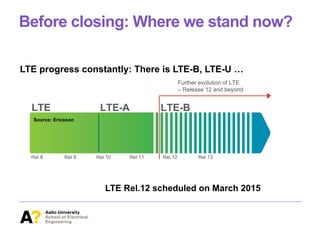
LTE progress constantly: There is LTE-B, LTE-U …
will take place mainly within the following areas:
e to a wide range of scenarios and use cases.
ng small-cell/local-area deployments.
ng new use cases, such as machine-type communication
public safety services (NSPS).
within
band
now
th 55
2 and
2018
ments
lease
e LTE
on of
LTE-
art of
ed in
hanced LTE RAT in several dimensions. For example, the
ssion bandwidth beyond 20MHz and improved spectrum
n, and enhanced multi-antenna transmission based on an
-signal structure. Another extension was the introduction of
ossibility of using LTE radio access not only for the access
a solution for wireless backhauling.
LTE LTE-A LTE-B
Rel 8Rel 8 Rel 9Rel 9 Rel 10Rel 10 Rel 11Rel 11 Rel 12Rel 12 Rel 13Rel 13
Further evolution of LTE
– Release 12 and beyond
Further evolution of LTE
– Release 12 and beyond
Figure 1: The evolution of LTE beyond LTE-A.
Source: Ericsson
LTE Rel.12 scheduled on March 2015
Before closing: Where we stand now?
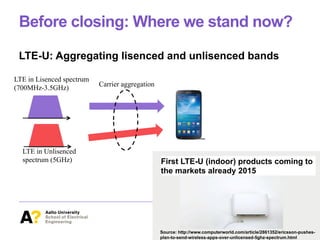
LTE-U: Aggregating lisenced and unlisenced bands
LTE in Lisenced spectrum
(700MHz-3.5GHz)
LTE in Unlisenced
spectrum (5GHz)
Carrier aggregation
Source: http://www.computerworld.com/article/2861352/ericsson-pushes-
plan-to-send-wireless-apps-over-unlicensed-5ghz-spectrum.html
First LTE-U (indoor) products coming to
the markets already 2015
Summary of expected developments
Strategy Dialogue ELEC Spring
2014
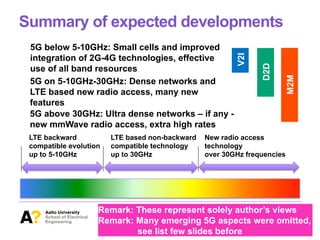
LTE backward
compatible evolution
up to 5-10GHz
LTE based non-backward
compatible technology
up to 30GHz
New radio access
technology
over 30GHz frequencies
5G below 5-10GHz: Small cells and improved
integration of 2G-4G technologies, effective
use of all band resources
5G on 5-10GHz-30GHz: Dense networks and
LTE based new radio access, many new
features
5G above 30GHz: Ultra dense networks – if any -
new mmWave radio access, extra high rates
D2D
M2M
V2I
Remark: These represent solely author’s views
Remark: Many emerging 5G aspects were omitted,
see list few slides before

Prof. Jyri Hämäläinen_What comes after 4G? 5G of Course_ENhANCE Telecom Forum 13/01/2015

  • 1.
    Dar es Salam,January 2015 What comes after 4G? 5G of course JyriHämäläinen AaltoUniversity
  • 2.
    Mobile technology evolution:G after G 2G: Voice: Analog to digital •  New radio 3G: Voice + Broadband data •  New radio 4G: Broadband data •  New radio 5G: All data – lots of it •  3G+4G+new technology components •  New radio … maybe 3G 4G What new there will be? Let’s take a closer look
  • 3.
  • 4.
    Why 5G: Let’smake it simple 1) Massive growth in traffic volume 2) Massive growth in connected devices/things 3) Wide range of requirements and characteristics
  • 5.
  • 6.
    Traffic volume: growingfast = 18 x 2013* 2000* *) Source: Cisco VNI This has happened This is expected to happen
  • 7.
    Voice and mobilebroadband • Voice becoming just part of data • Smart phone penetration increasing fast – transition to smart devices is the trend number one • Mobile Video drives the volume: Round 70% of mobile will be video by 2018 In Middle East and Africa region the share of smart devices/connections will 36% by 2018 Billions of devices Source: Cisco VNI Non-smartSmart
  • 8.
    2) Connected …everything
  • 9.
    Massive growth inconnected … everything Let’s look at this in more details Billions of M2M connections Source: Cisco VNI
  • 10.
    Automotive • Entertainment for passengers =>high capacity & high mobility mobile broadband • Augmented reality dashboards • Vehicle-to-Vehicle (V2V) and Vehicle-to-Infrastructure (V2I) communications • Cars detecting and informing e.g. critical situations • Self-driving cars Google self-driving car. Testing will be started on public roads early 2015 http://www.wired.com/2014/12/google-self-driving-car-prototype-2/ Servicerequirements!
  • 11.
    Smart cities andsociety Europe 2020 initiative on smart cities: ‘In Smart Cities, digital technologies translate into better public services for citizens, better use of resources and less impact on the environment.’ Smart buildings Smart transportation Smart energy with free/open data Smart citizens Smart public services
  • 12.
    Wearable devices Recent trend:number of wearable devices growing fast Strategy Dialogue ELEC Spring 2014 Smart glasses Smart watches Smart clothes
  • 13.
    Industrial Internet Example ofIndustrial Internet development: General Electric’s new factory has more than 10,000 sensors spread across 180,000 square feet of manufacturing space, all connected to a high-speed internal Ethernet. http://www.technologyreview.com/news/509331/an-internet-for-manufacturing/ General Electric’s new battery plant: a test-bed for the “industrial Internet.
  • 14.
  • 15.
    Just think fewexamples … •  Web surfing •  Streaming video •  File downloading •  Speech call •  Self-driving car •  Controlling energy production plant •  Health monitoring •  Emergency services •  Data rate •  Latency •  Reliability •  Device and network energy consumption •  Device cost •  Privacy •  Network safety
  • 16.
    How? What are5G technologies?
  • 17.
    5G: General technologylandscape Industry views on 5G are important because telecom companies will drive standardization where 5G is defined Currently it seems that views of large vendors are well in line with each other - The given picture (Ericsson) chrystallize the mainstream thinking - That is, it is expected that 5G will be composed by well integrated 2G-4G technologies + evolving new technology components In the following we focus on new technologies
  • 18.
    Basics: Transfer more data… but how? More bandwidth? Less users? Stronger signal? Better efficiency? Less interference? User data rate ≅ BW K ⋅ A⋅log2 1+ P N + I # $ % & ' ( [Mbit/s] Bandwidth Number of users System efficiency Signal power vs noise and interference Interference
  • 19.
    More natural resourcesfor mobile communication = more spectrum UHF SHF EHF 300MHz- 3GHz 3GHz- 30GHz 30GHz- 300GHz 2G-4G runs here: Only small amounts of spectrum left Quite some spectrum can be made available Lots of free spectrum Tens of MHz’s (x10) Hundreds of MHz’s (x100) Tens of GHz’s (x10000) OK, there is more bandwidth – but can we use it?
  • 20.
    We use alreadyhigh frequencies… Imagine small cells (indoors/outdoors): • Due to small distance towards UE the signal attenuation is smaller and LOS is more likely • There will be less users per cell OK, we need small cells – is it possible and affordable? We are now using high frequencies in point to point Line of Sight (LOS) connections with high gain antennas. BUT: In link between BS and UE we rarely have LOS and use of high gain antennas is limited. Futhermore, most of the high data rate access connections will take place indoors
  • 21.
    Big cell, smallcell, smaller cell … less users, stronger signal 4G macrocell: K=100 P/(N+I)~8dB 4G picocell: K=20 P/(N+I)~14dB 4G femtocell: K=4 P/(N+I)~20dB Is this reality? Yes. Smallest 3G base station: Weight 250g Integrated to power plug +socket BUT: 3G-4G operate below 3.5GHz. Can we use high frequencies?
  • 22.
    What is wrongwith high frequencies? TX RX RX Reflection Penetration Diffraction Line-of-sight When carrier frequency increases … - Signal penetration loss increases - Diffracted signal component becomes weaker and weaker - Importance of LOS signal and reflected signal component increases
  • 23.
    Towards Ultra DenseNetworks Small cells are already becoming reality today But on high frequencies Ultra Dense Networks will be needed => LOS or almost LOS required PRESS RELEASE SEPTEMBER 25, 2013 Johan Wibergh, head of Ericsson Business Unit Networks, says: “With the Radio Dot System we lower the threshold to building indoor coverage. The dot is the most cost- effective, no-compromise solution to the indoor coverage challenges expressed by our customers. It is ultra-small but can scale to virtually unlimited capacity; it is easy to install, future proof and it is 100 percent integrated with existing mobile networks.” The product has already been gaining interest from mobile operators in the United States. Kris Rinne, Senior Vice President, Network and Product Planning, AT&T Services, Inc., says: “Small cells are a key component of AT&T's Project VIP network enhancement program as we seek to constantly improve our customers’ mobile Internet experience. Delivering a great wireless experience indoors can present both technical and logistical challenges. A solution like the Ericsson Radio Dot System gives AT&T another tool to choose from in its next-generation toolkit." Ken Rehbehn, Principal Analyst, Yankee Group, says: “Sleek form factors that focus radio capability to solve the indoor deployment challenge in a fresh and compelling way will be welcomed into a wide variety of business and office venues. Ericsson Radio Dot System leverages existing indoor wire facilities to reduce installation hurdles and cost, and because it builds on Ericsson standard radio architecture, it provides an extensive feature set without compromising future evolution.” The product is expected to be commercially available in late 2014. Webcast Ericsson will webcast the announcement in conjunction with its Analyst Forum in North America on Sept 25 at 3pm PT/11pm UK time/Sept 26 at 12am CET. Access the webcast on: www.ericsson.com/press. An on-demand version will be available shortly afterwards. NOTES TO EDITORS Indoor coverage video Photos of Ericsson Radio Dot System:
  • 24.
    Ultra Dense Networksimply opportunity for Massive MIMO Already now indoor DAS systems are dense Due to Ultra Dense Networks, the density further increases. Thus, there is good opportunity for cooperative MIMO over massive number of nodes i.e. Massive MIMO
  • 25.
    Dense networks (c) 28GHz. 65 nodes ON (e) 28 GHz. 10 nodes ON Figure 23: Spatial distribution of Finally, Figure 22d shows the CDF of t topologies with 65 active nodes featuring f (a) 28 GHz. All nodes ON (b) 2.6 GHz. All nodes ON Indoor network planning example: 10 nodes vs 65 nodes on 28GHz carrier Conclusion: 28GHz can be effectively used but number of nodes clearly larger than on e.g. 2GHz For details, see: S. Renilla Lamas, D. G. Gonzalez, J. Hämäläinen: "Indoor Planning Optimization of Ultra-dense Cellular Networks at High Carrier Frequencies", accepted to IEEE Wireless Communications and Networking Conference (WCNC), workshop on 5G architecture, 2015.
  • 26.
    Increasing data rates:Summary Strategy Dialogue ELEC Spring 2014 User data rate ≅ BW K ⋅ A⋅log2 1+ P N + I # $ % & ' ( [Mbit/s] Bandwidth Number of users System efficiency Signal power vs noise and interference Interference High carrier frequencies with large (GHz) bands + ultra dense networks with very small cells OK OK OK Interference of shot noise type, effective mitigation methods exists Can be compensated using large spectrum chunks
  • 27.
    But how tocreate click-boom effect? 3G HSPA: 5MHz band, 2ms time slot 4G LTE: 20MHz band, 1ms time slot 5G: 1GHz band, 0.05ms time slot (just example values) Time Frequency Time slot length => physical layer delay Frequency slot => data rate
  • 28.
    Device-to-Device (D2D) communication Network aidedD2D Connection through local BS Device relaying BS control signalling User data - How to detect other devices? - What kind of services fit for direct communication between devices?
  • 29.
    Vehicle-to-Vehicle (V2V) andVehicle-to- Infrastructure (V2I) - Future V2V maybe based on WiFi but also 5G D2D standard will provide credible V2V communication - V2I will likely be based on mobile communication standards.
  • 30.
    Massive Machine-to-Machine (M2M) Communicationand IoT Example: Sensor data aggregation + transfer over mobile network Direct M2M towards mobile system => 5G design should support massive number of low-rate connections with low latency. M2M product example (Ericsson) Communication through mobile network
  • 31.
    Some other technologycomponents related to 5G Ultra Reliable Communication (URC) Centralized baseband/baseband pooling Self-backhauling Beamforming on mmWave Soft cell concepts Device centric system architecture Licenced Shared Access (LSA) Authorized Shared Access (ASA) Local caching Mobile cloud Moving Networks
  • 32.
    Before closing: Wherewe stand now? LTE progress constantly: There is LTE-B, LTE-U … will take place mainly within the following areas: e to a wide range of scenarios and use cases. ng small-cell/local-area deployments. ng new use cases, such as machine-type communication public safety services (NSPS). within band now th 55 2 and 2018 ments lease e LTE on of LTE- art of ed in hanced LTE RAT in several dimensions. For example, the ssion bandwidth beyond 20MHz and improved spectrum n, and enhanced multi-antenna transmission based on an -signal structure. Another extension was the introduction of ossibility of using LTE radio access not only for the access a solution for wireless backhauling. LTE LTE-A LTE-B Rel 8Rel 8 Rel 9Rel 9 Rel 10Rel 10 Rel 11Rel 11 Rel 12Rel 12 Rel 13Rel 13 Further evolution of LTE – Release 12 and beyond Further evolution of LTE – Release 12 and beyond Figure 1: The evolution of LTE beyond LTE-A. Source: Ericsson LTE Rel.12 scheduled on March 2015
  • 33.
    Before closing: Wherewe stand now? LTE-U: Aggregating lisenced and unlisenced bands LTE in Lisenced spectrum (700MHz-3.5GHz) LTE in Unlisenced spectrum (5GHz) Carrier aggregation Source: http://www.computerworld.com/article/2861352/ericsson-pushes- plan-to-send-wireless-apps-over-unlicensed-5ghz-spectrum.html First LTE-U (indoor) products coming to the markets already 2015
  • 34.
    Summary of expecteddevelopments Strategy Dialogue ELEC Spring 2014 LTE backward compatible evolution up to 5-10GHz LTE based non-backward compatible technology up to 30GHz New radio access technology over 30GHz frequencies 5G below 5-10GHz: Small cells and improved integration of 2G-4G technologies, effective use of all band resources 5G on 5-10GHz-30GHz: Dense networks and LTE based new radio access, many new features 5G above 30GHz: Ultra dense networks – if any - new mmWave radio access, extra high rates D2D M2M V2I Remark: These represent solely author’s views Remark: Many emerging 5G aspects were omitted, see list few slides before