Download to read offline
![IOSR Journal of Electrical and Electronics Engineering (IOSR-JEEE)
e-ISSN: 2278-1676,p-ISSN: 2320-3331, Volume 11, Issue 2 Ver. I (Mar. – Apr. 2016), PP 13-17
www.iosrjournals.org
DOI: 10.9790/1676-1102011317 www.iosrjournals.org 13 | Page
Automatic Load Frequency Control of Two Area Power System
Using Proportional Integral Derivative Tuning Through Internal
Model Control
Aibangbee J. O
(D Department of Electrical and Computer Engineering, BELLs University of Technology, Ota, Ogun State-
Nigeria.
Abstract: The main purpose of operating Load Frequency Control (LFC) is to keep uniformly the frequency
changes during the load changes. In this paper, Automatic Load Frequency control of two area power systems
using Proportional Integral Derivative (PID) tuning through internal model control (IMC) technique. Two main
objectives of LFC are to maintain the real frequency and the desired power output in the interconnected power
system and, to control the change in tie line power between control areas. The PID-IMC controller have the
ability to provide high adaption for changing conditions and the ability for making quick decisions. The
controller are used to improve the dynamic response as well as to reduce or eliminate the steady-state error. It
is much faster, applicable under different nonlinearities and give better stability response as compared to the
conventional integral Load Frequency controllers for a two area power system.
Keywords: Proportional Integral Derivative, Load Frequency Control, internal model control, Tie-line,
Twoarea power systemso
I. Introduction
The main purpose of operating the load frequency control is to keep uniformly the frequency changes
during the load changes. During the power system operation rotor angle, frequency and active power are the
main parameters to change [1]. The interconnection of more than one control areas through tie lines is call
power systems. Generating plants in a control area always vary their speed together for maintenance of
frequency and the relative power angles to the predefined values in both static and dynamic conditions. When
there is any sudden load change occurs in a control area of an interconnected power system there will be
frequency deviation as well as tie line power deviation. Two main objective of Load Frequency Control (LFC)
are, to maintain the real frequency and the desired power output in the interconnected power system and, to
control the change in tie line power between control areas [2]. When there is a small change in load power in a
single area power system operating at set value of frequency it creates mismatch in power both for generation
and demand. Nowadays there are more complex power systems which required operation in less structured and
uncertain environment. Similarly innovative and improved control is required for economic, secure and stable
operation. The conventional Proportional Integral (PI) controller [3,4] has the following drawback a) Inherent
nonlinearity of different power system components; b) There is continuous load changes occurrence during
daily cycle, this changes the operating point accordingly and c) very slow in operation [5]. In this paper, a
proposed advance control techniques having the ability to provide high adaption for changing conditions and the
ability for making quick decisions is the Proportional Integral Derivative (PID) controller. The PID controller is
used to improve the dynamic response as well as to reduce or eliminate the steady-state error [6]
Two Area Power Systems
A two area system consists of two single area systems, connected through a power line called tie-line.
Figure 1 shows a two area power system where each area supplies to its own area and the power flow between
the areas are allowed by the tie line. For two area power system, the individual areas are strong, the tie line
which connects the two area is weak and a single frequency is characterized throughout. A block diagram model
of two area power system with integral controller is shown in Figure 2. The block diagram model contained two
control inputs named u1 and u2. The block diagram representing a two area power system model is having two
control areas connected to each other through a line having its own dynamics (block 7) called tie line. From the
figure it is clearly seen that the control areas are made-up with three block each with an integral controller
block. The three blocks are namely governor block, turbine block, and the power system block which is actually
the load block.](https://image.slidesharecdn.com/c1102011317-160709084948/85/C1102011317-1-320.jpg)
![IOSR Journal of Electrical and Electronics Engineering (IOSR-JEEE)
e-ISSN: 2278-1676,p-ISSN: 2320-3331, Volume 11, Issue 2 Ver. I (Mar. – Apr. 2016), PP 13-17
www.iosrjournals.org
DOI: 10.9790/1676-1102011317 www.iosrjournals.org 13 | Page
Automatic Load Frequency Control of Two Area Power System
Using Proportional Integral Derivative Tuning Through Internal
Model Control
Aibangbee J. O
(D Department of Electrical and Computer Engineering, BELLs University of Technology, Ota, Ogun State-
Nigeria.
Abstract: The main purpose of operating Load Frequency Control (LFC) is to keep uniformly the frequency
changes during the load changes. In this paper, Automatic Load Frequency control of two area power systems
using Proportional Integral Derivative (PID) tuning through internal model control (IMC) technique. Two main
objectives of LFC are to maintain the real frequency and the desired power output in the interconnected power
system and, to control the change in tie line power between control areas. The PID-IMC controller have the
ability to provide high adaption for changing conditions and the ability for making quick decisions. The
controller are used to improve the dynamic response as well as to reduce or eliminate the steady-state error. It
is much faster, applicable under different nonlinearities and give better stability response as compared to the
conventional integral Load Frequency controllers for a two area power system.
Keywords: Proportional Integral Derivative, Load Frequency Control, internal model control, Tie-line,
Twoarea power systemso
I. Introduction
The main purpose of operating the load frequency control is to keep uniformly the frequency changes
during the load changes. During the power system operation rotor angle, frequency and active power are the
main parameters to change [1]. The interconnection of more than one control areas through tie lines is call
power systems. Generating plants in a control area always vary their speed together for maintenance of
frequency and the relative power angles to the predefined values in both static and dynamic conditions. When
there is any sudden load change occurs in a control area of an interconnected power system there will be
frequency deviation as well as tie line power deviation. Two main objective of Load Frequency Control (LFC)
are, to maintain the real frequency and the desired power output in the interconnected power system and, to
control the change in tie line power between control areas [2]. When there is a small change in load power in a
single area power system operating at set value of frequency it creates mismatch in power both for generation
and demand. Nowadays there are more complex power systems which required operation in less structured and
uncertain environment. Similarly innovative and improved control is required for economic, secure and stable
operation. The conventional Proportional Integral (PI) controller [3,4] has the following drawback a) Inherent
nonlinearity of different power system components; b) There is continuous load changes occurrence during
daily cycle, this changes the operating point accordingly and c) very slow in operation [5]. In this paper, a
proposed advance control techniques having the ability to provide high adaption for changing conditions and the
ability for making quick decisions is the Proportional Integral Derivative (PID) controller. The PID controller is
used to improve the dynamic response as well as to reduce or eliminate the steady-state error [6]
Two Area Power Systems
A two area system consists of two single area systems, connected through a power line called tie-line.
Figure 1 shows a two area power system where each area supplies to its own area and the power flow between
the areas are allowed by the tie line. For two area power system, the individual areas are strong, the tie line
which connects the two area is weak and a single frequency is characterized throughout. A block diagram model
of two area power system with integral controller is shown in Figure 2. The block diagram model contained two
control inputs named u1 and u2. The block diagram representing a two area power system model is having two
control areas connected to each other through a line having its own dynamics (block 7) called tie line. From the
figure it is clearly seen that the control areas are made-up with three block each with an integral controller
block. The three blocks are namely governor block, turbine block, and the power system block which is actually
the load block.](https://image.slidesharecdn.com/c1102011317-160709084948/75/C1102011317-1-2048.jpg)
![Automatic Load Frequency Control Of Two Area Power System Using Proportional Integral Derivative..
DOI: 10.9790/1676-1102011317 www.iosrjournals.org 14 | Page
Figure1: Two area interconnected power system
Model of a Two Area Thermal Non-Reheat Power System
Both areas consist of four blocks each and another one block represents the tie line power. Therefore
total 9 blocks are present for the whole system [7,8].
The control input equations can be written as below:
For area 1 (at block 8)
= ( ) ( ) (1)
For area 2 (at block 9)
= ( ) ( ) (2)
Where ACE1 and ACE2 are the Area Control Errors of area-1 and area-2 respectively. KT is the integral gain
for both the areas.
Figure 2: Two area thermal (non-reheat) power system with integral controller
II. Materials And Methods
Tuning of PID controllers proposed for LFC via Internal model control (IMC) considering the
simplicity of their execution [8,9,10,11] in load frequency controller PID tuning method for two area power
system.
A. Design of Internal model control (IMC)
An internal model control (IMC) method is adapted for load frequency controller design. In Process
control IMC is a very popular controller [7]. Figure 3 show the IMC structure where the plant to be controlled is
‗P‘, and the plant model is ‗Ṗ‘.
Figure 3: IMC structure
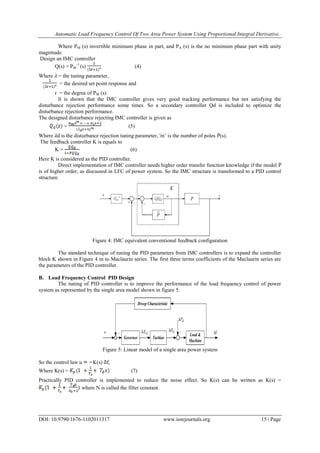
IMC design procedure is given in equation 3 as
Ṗ (s) = PM (s) PA (s) (3)](https://image.slidesharecdn.com/c1102011317-160709084948/85/C1102011317-2-320.jpg)
![Automatic Load Frequency Control Of Two Area Power System Using Proportional Integral Derivative..
DOI: 10.9790/1676-1102011317 www.iosrjournals.org 16 | Page
III. Analysis And Results
The performance of IMC-PID controller are shown in figures 6 to 8. The responses shown are in form
of dynamic responses of each area frequencies and the power of tie line, for the two area power system model.
Results of IMC-PID Controller for LFC of Two Area Power System
Figures 6, 7, and 8 are showing the dynamic responses of deviation in frequency for both the areas ( f1,
f2 ) and the power deviation in tie line ( tie( ) for a power system having two control areas with
thermal non-reheat turbines. The figures show the performances of a PID controller for LFC of power system,
tuned via IMC. Figures shows that the responses are stable with very less overshoot and less settling time. So
PID - IMC controller is a powerful controller which gives better stability for LFC of a two area power system.
Figure 6: change in frequency V/S time in area-1 for 0.01 step load change in area-1
Figure 7: change in frequency V/S time in area-2 for 0.01 step load change in area-1
The figures show that the IMC-PID controller gives better response than the conventional integral
controller for LFC of power system.
Figure 8: change in tie line power V/S time for 0.01 step load change in area-1
IV. Conclusions
Model of a two area interconnected power system has been developed with different area
characteristics for optimal and conventional control strategies. The control equations have successfully been
derived in continuous time for a two area power system. The model developed has been examined for the
stability before and after the application of state feedback control.
An IMC-PID controller is designed for LFC of the proposed power system via Internal Model Control
(IMC) and its results are compared with conventional integral Load Frequency Controller for a two area power
system. So PID controller is designed on the basis of IMC controller and applied for LFC of a two area power
system and well stabilized responses are obtained.
References
[1] S. Sivanagaraju, G. Sreenivasan. Power System Operation and Control, 2008.
[2] Jawat, T. and Fadel, A, B. ―Adaptive Fuzzy Gain Scheduling for load frequency control‖ IEEE Trans. On PAS, vol,14, No1
February1999.](https://image.slidesharecdn.com/c1102011317-160709084948/85/C1102011317-4-320.jpg)
![Automatic Load Frequency Control Of Two Area Power System Using Proportional Integral Derivative..
DOI: 10.9790/1676-1102011317 www.iosrjournals.org 17 | Page
[3] N. Cohn, ‗Some aspects of tie-line bias control on interconnected power systems,‘ Amer. Inst. Elect. Eng. Trans., Vol. 75, pp. 1415-
1436, Feb. 1957.
[4] B. Oni, H. Graham, and L. Walker, ‗nonlinear tie-line bias control of Interconnected power systems,‘ IEEE Trans. Power App.Syst.,
vol. PAS-100 no. 5 pp. 2350–2356.
[5] E. C. Tacker, T. W. Reddoch, O. T. Pan, and T. D. Linton, ‗Automatic generation Control of electric energy systems—A simulation
study,‘ IEEE Trans. Syst. Man Cybern., vol. SMC-3, no. 4, pp. 403–5, Jul. 1973.
[6] A. Khodabakhshian and M. Edrisi, ―A new robust PID load frequency controller,‖ Control Eng. Pract., vol. 16, no. 9, pp. 1069–
1080, 2008.
[7] M. Morari and E. Zafiriou, Robust Process Control. Englewood Cliffs, NJ: Prentice- Hall, 1989.
[8] Niranjan et al. ―load frequency control of power system,‖ 2013.
[9] J. Talaq and F. Al-Basri, ―Adaptive fuzzy gain scheduling for load frequency control,‖ IEEE Trans. Power Syst., vol. 14, no. 1,
pp. 145–150, Feb. 1999.
[10] M. F. Hossain, T. Takahashi, M. G. Rabbani, M. R. I. Sheikh, and M. Anower, ―Fuzzy proportional integral controller for an AGC
in a single area power system,‖ in Proc. 4th
Int. Conf. Electrical and Computer Engineering (ICECE), Dhaka, Bangladesh, pp. 120–
123, Dec. 2006.
[11] Y. H. Moon, H. S. Ryu, J. G. Lee, and S. Kim, ―Power system load frequency control using noise-tolerable PID feedback,‖ in Proc.
IEEE Int. Symp. Industrial Electronics (ISIE), vol. 3, pp. 1714–1718, Jun. 2001.
[12] A. Khodabakhshian and N. Golbon, ―Unified PID design for load frequency control,‖ in Proc. 2004 IEEE Int. Conf. Control
Applications (CCA), Taipei, Taiwan, pp. 1627–1632,Sep. 2004.](https://image.slidesharecdn.com/c1102011317-160709084948/85/C1102011317-5-320.jpg)

The document describes using a Proportional Integral Derivative (PID) controller tuned with Internal Model Control (IMC) technique for Automatic Load Frequency Control (LFC) of a two area power system. It presents the system model of a two area power system and derives the control equations. It then discusses designing an IMC-PID controller for LFC by first designing an IMC controller and transforming it into an equivalent PID structure. Simulation results show the IMC-PID controller provides better stability and dynamic response for LFC compared to a conventional integral controller.


