Indonesian Journal of Electrical Engineering and Informatics (IJEEI)
Vol. 2, No. 4, December 2014, pp. 170~179
ISSN: 2089-3272  170
Received May 13, 2014; Revised July 24, 2014; Accepted August 20, 2014
NARMA-L2 Controller for Five-Area Load Frequency
Control
Priyanka Sharma
Department of Electrical Engineering, Maharishi Dayanand University, Rohtak, Haryana, India
Email: priyanka.ganaur@gmail.com
Abstract
This paper investigates the load-frequency control (LFC) based on neural network for improving
power system dynamic performance. In this paper an Artificial Neural Network (ANN) based controller is
presented for the Load Frequency Control (LFC) of a five area interconnected power system. The
controller is adaptive and is based on a nonlinear auto regressive moving average (NARMA-L2) algorithm.
The working of the conventional controller and ANN based NARMA L2 controllers is simulated using
MATLAB/SIMULINK package.. The Simulink link results of both the controllers are compared.
Keywords: Area Control Error (ACE), Artificial Neural Network (ANN), Genetic Algorithm (GA), Load
Frequency Control (LFC), Artificial Neural Network (ANN)
1. Introduction
The organizations are responsible for providing electrical power with great reliability,
availability and efficiency. In present time the demand for electrical power and load is not
constant but kept on changing. It becomes necessary to change power generations according
to load perturbations. A power system consists of a number of interconnected subsystems. For
each subsystem it becomes compulsory to fulfill the requirements usually include matching
system generation to system load and the associated system losses and then regulating system
frequency and tie line power exchanges. This is usually known as load frequency control, also
called Automatic Generation Control (AGC) problem and is very important in the operation of
power systems [1, 2]. The main function of AGC is to maintain the real frequency and the
desired power output (megawatt) in the interconnected power system and to control the change
in tie line power between control areas.
To maintain the system at normal operating state different types of controllers based on
classical and modern control theories have been developed [3-5]. The conventional controller
used for Load Frequency Control is integral controller. The integrator gain is set to a level such
that relation between fast transient recovery and low overshoot in the dynamic response of the
overall system can be maintained [6-7]. But the main disadvantage of this type of controller is
slow and does not give desired performance to the designer corresponding to non-linarites in
the generator unit.
In recent years, modern control techniques, especially adaptive control configurations,
are applied to load-frequency control. The applications of artificial neural networks, genetic
algorithms, fuzzy logic and optimal control to LFC have been reported in [8-15]. In the paper,
artificial neural network (ANN) based controller is used, which is an adaptive control
configuration because this controller provides faster and desired control as compared to others.
The beginning of artificial intelligence (AI) techniques leads to many problems. This technology
mainly used systems which are operating nonlinearly over the operating range. ANN has also
been used in frequency controller design for Multi area AGC scheme in deregulated electricity
market. These networks are also applicable for pattern recognition, function approximation, time
series prediction and classification problems for quite some time. .
Nonlinear autoregressive moving average (NARMA) model is an exact representation of
input-output behavior of a finite-dimensional and nonlinear discrete time dynamic plant in
neighborhood of the equilibrium state [16,17]. This non-linearity, its implementation for real time
control systems makes difficult. To overcome computational complexity related to use of this
type of ANN, two classes of NARMA are introduced in [16]: NARMA-L1 and NARMA-L2. The
latter is more convenient to be practically implemented using multilayer neural networks.
 ISSN: 2089-3272
IJEEI Vol. 2, No. 4, December 2014: 170 – 179
171
2. FIVE-area Load-Frequency Control Model
The configuration of the investigated power system is given in Figure 1. The directions
of power transfer between areas have been considered as follow:
- from area 1 to area 2 - from area 1 to area 3
- from area 1 to area 4 - from area 1 to area 5
- from area 2 to area 3 - from area 2 to area 4
- from area 2 to area 5 - from area 3 to area 4
- from area 3 to area 5 - from area 4 to area 5
Figure 1. Basic Block Diagram of FIVE area interconnected system
A five area interconnected power system [18] is selected and load frequency control of
this system is made primarily by integral controller and then by an ANN controller [19], [20], [21].
The five areas are interconnected to each other by tie-lines. It is seen that each area needs its
system frequency to be controlled [22], [23], [24] to give desired performance. The reason for
using the proposed controller is due to the fact that it firstly adapts to changing operating points
and calculates optimal control commands, it can also perform effectively with nonlinearities and
even if system inputs are temporarily lost or errors are introduced. The main characteristics of
ANN controller is that it continues to function without needing any decision support software in
case of a failure. For comparison, the AGC of considered power system is accomplished using:
(i) Conventional Integral controller
(ii) ANN based NARMA L2 Controller
3. Modelling and Simulation with Conventional Integral Controller
In five area system, five single area systems are interconnected via tie-line. The
interconnection of power systems increases the overall system reliability. In this case if some
generating units in one area fail, the generating units in the other area can compensate to meet
the load demand. The basic block diagram of five area interconnected power system is shown
in Figure 1.
The power transfer through tie line for the model is given by:
0 01 2
, 1 1 2
12
| || |
sin( )tie
V V
P
X
  
1, 2 = power angles (angle between rotating magnetic flux & rotor) of equivalent machines of
the two areas
IJEEI ISSN: 2089-3272 
NARMA-L2 Controller for Five-Area Load Frequency Control (Priyanka Sharma)
172
 Ptie, 1(pu) = T12 (1 - 2)
Where
0 01 2
12 1 2
1 12
| || |
cos( )
r
V V
T
P X
  
= synchronizing coefficient
Figure 2. Turbine model
A conventional integral controller is used on five area power system model. The integral
controller improves steady state error and allows a transient response with little or no overshoot.
As long as error remains, the integral output will increase and the speed changer position
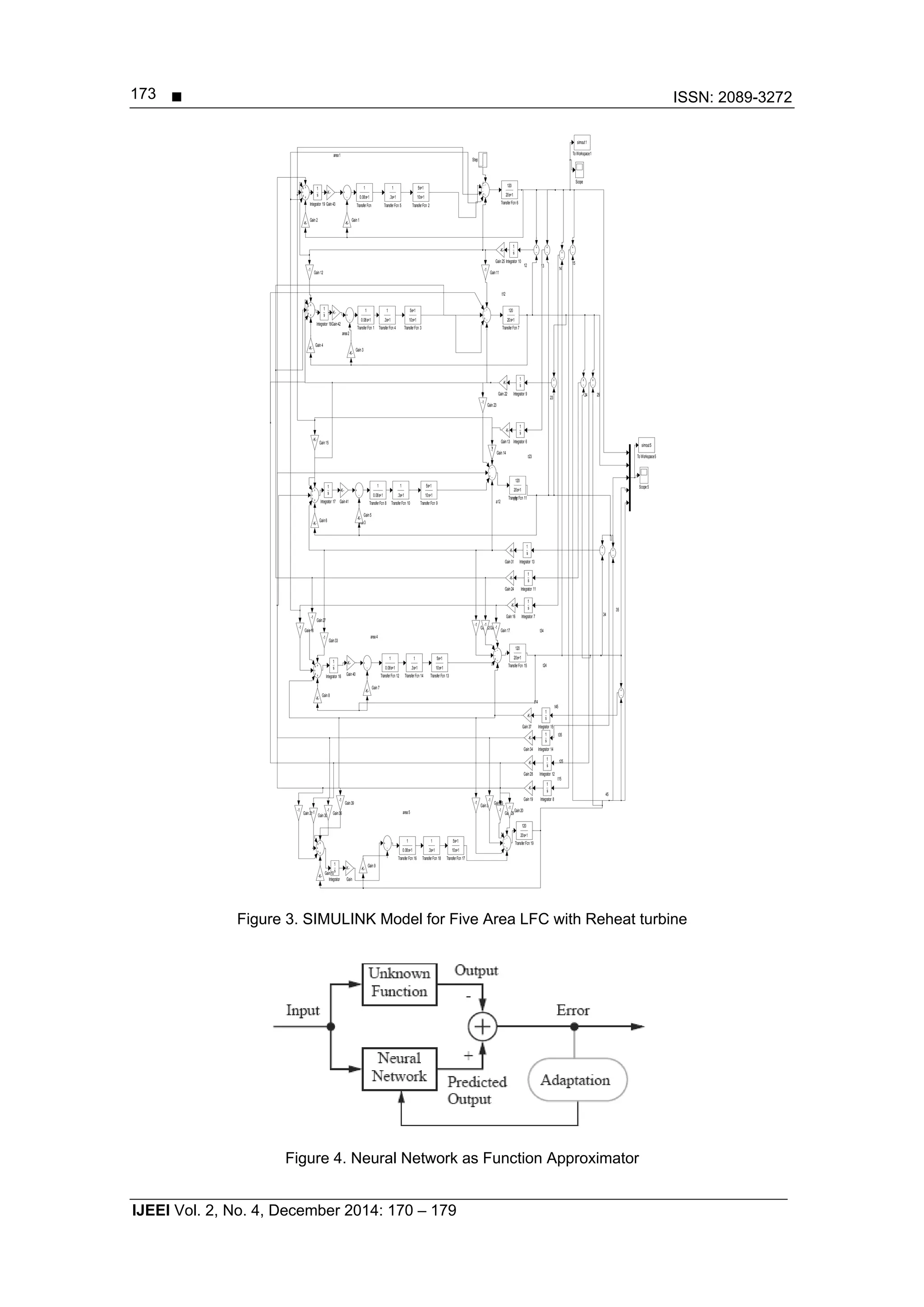
attains a constant value only when the frequency error has reduced to zero. The SIMULINK
model of a five area interconnected power system with reheat turbine using integral controller is
shown in Figure 3.
4. Artificial Neural Network
ANN as the name suggests is information processing system. In this system the
element used for processing the information is called as neurons. The connecting links used for
transmitting signals process an associated weight, which is multiplied along with the incoming
signal (net input) for any typical neural net. The output signal is obtained by applying activation
function to the net input. Neural network architecture-the multilayer perceptron as unknown
function are shown in Figure 4. Parameters of the network are adjusted so that it produces the
same response as the unknown function, if the same input is applied to both systems. The
unknown function could also represent the inverse of a system being controlled; in this case the
neural network can be used to implement the controller [25].
 ISSN: 2089-3272
IJEEI Vol. 2, No. 4, December 2014: 170 – 179
173
Figure 3. SIMULINK Model for Five Area LFC with Reheat turbine
Figure 4. Neural Network as Function Approximator
area1
area2
area3
area4
area5
t12
a12
t13
t14
t15
t23
12 13
14
15
t24
25
t25
23
24
34
35
t34
t35
t45
45
Transfer Fcn 9
5s+1
10s+1
TransferFcn 8
1
0.08s+1
TransferFcn 7
120
20s+1
TransferFcn 6
120
20s+1
TransferFcn 5
1
.3s+1
TransferFcn 4
1
.3s+1
TransferFcn 3
5s+1
10s+1
TransferFcn 2
5s+1
10s+1
Transfer Fcn 19
120
20s+1
TransferFcn 18
1
.3s+1
TransferFcn 17
5s+1
10s+1
Transfer Fcn 16
1
0.08s+1
TransferFcn 15
120
20s+1
TransferFcn 14
1
.3s+1
Transfer Fcn 13
5s+1
10s+1
TransferFcn 12
1
0.08s+1
TransferFcn 11
120
20s+1
TransferFcn 10
1
.3s+1
TransferFcn 1
1
0.08s+1
Transfer Fcn
1
0.08s+1
To Workspace5
simout5
To Workspace1
simout1
Step
Scope5
Scope
Integrator 9
1
s
Integrator 8
1
s
Integrator 7
1
s
Integrator 6
1
s
Integrator 19
1
s
Integrator 18
1
s
Integrator 17
1
s
Integrator 16
1
s
Integrator 15
1
s
Integrator 14
1
s
Integrator 13
1
s
Integrator 12
1
s
Integrator 11
1
s
Integrator 10
1
s
Integrator
1
s
Gain 9
-K-
Gain 8
-K-
Gain 7
-K-
Gain6
-K-
Gain5
-K-
Gain 43
-K-
Gain42
-K-
Gain41
-K-
Gain40
-K-
Gain 4
-K-
Gain39
-1
Gain38
-1
Gain37
-K-
Gain36
-1
Gain35
-1
Gain34
-K-
Gain33
-1
Gain32
-1
Gain31
-K-
Gain 30
-1
Gain 3
-K-
Gain 29
-1
Gain28
-K-
Gain27
-1
Gain26
-1
Gain 25
-K-
Gain24
-K-
Gain 23
-1
Gain 22
-K-
Gain 21
-1 Gain20
-1
Gain 2
-K-
Gain19
-K-
Gain18
-1
Gain 17
-1
Gain 16
-K-
Gain15
-K-
Gain 14
-1
Gain13
-K-
Gain 12
-1
Gain11
-1
Gain10
-K-
Gain 1
-K-
Gain
-K-
IJEEI ISSN: 2089-3272 
NARMA-L2 Controller for Five-Area Load Frequency Control (Priyanka Sharma)
174
The basis features of neural networks are high computational rates, fault tolerance, self-
decision capability, learning or training, goal –seeking, adaptive features, primitive
computational elements
5. NARMA-L2 Control
ANN controller architecture employed here is Nonlinear Auto Regressive Moving
Average(NARMA) model is representation of input output behavior of a finite-dimensional and
nonlinear discrete time dynamic plant in neighborhood of the equilibrium state [27-29]. The non-
linearity property of the ANN controller makes its implementation for real time control systems
difficult. To overcome computational complexity of ANN controllers, two classes of NARMA are
introduced in [27]: NARMA-L1 and NARMA-L2. The NARMAL2 is more convenient to practically
implemented using multi-layer neural networks.
This controller is simply a rearrangement of the neural network plant model, which is
trained offline, in batch form. NARMA L2 controller mainly consists of reference, plant output
and control signal. Computation required for this type of controller is very less. The plant output
is forced to track the reference model output and the effect of controller changes on plant output
is predicted for further calculations. The main quality of this controller is that permits the
updating of controller parameters.
 ISSN: 2089-3272
IJEEI Vol. 2, No. 4, December 2014: 170 – 179
175
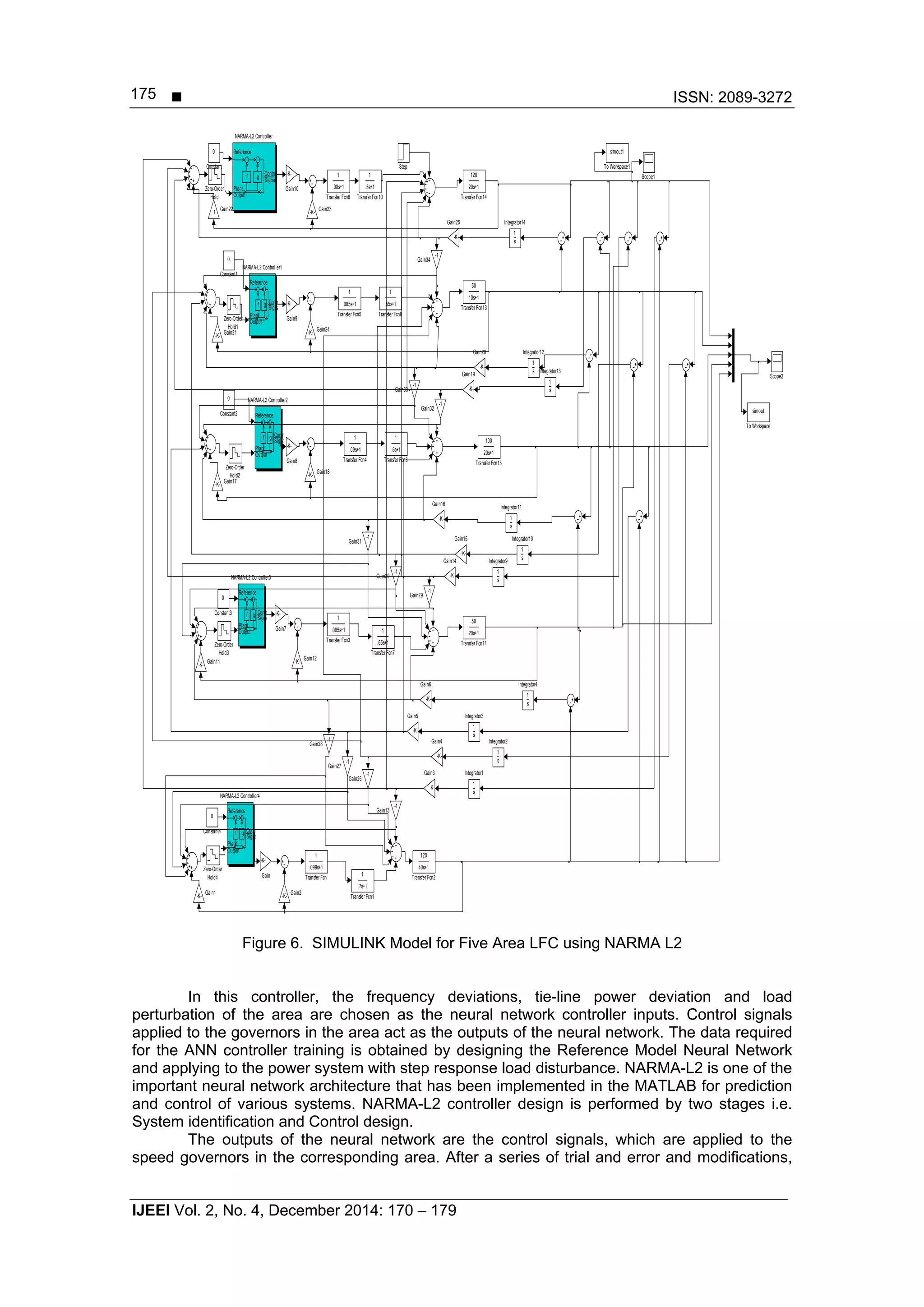
Figure 6. SIMULINK Model for Five Area LFC using NARMA L2
In this controller, the frequency deviations, tie-line power deviation and load
perturbation of the area are chosen as the neural network controller inputs. Control signals
applied to the governors in the area act as the outputs of the neural network. The data required
for the ANN controller training is obtained by designing the Reference Model Neural Network
and applying to the power system with step response load disturbance. NARMA-L2 is one of the
important neural network architecture that has been implemented in the MATLAB for prediction
and control of various systems. NARMA-L2 controller design is performed by two stages i.e.
System identification and Control design.
The outputs of the neural network are the control signals, which are applied to the
speed governors in the corresponding area. After a series of trial and error and modifications,
Zero-Order
Hold4
Zero-Order
Hold3
Zero-Order
Hold2
Zero-Order
Hold1
Zero-Order
Hold
1
.55s+1
Transfer Fcn9
1
.6s+1
Transfer Fcn8
1
.65s+1
Transfer Fcn7
1
.08s+1
Transfer Fcn6
1
.085s+1
Transfer Fcn5
1
.09s+1
Transfer Fcn4
1
.095s+1
Transfer Fcn3
120
40s+1
Transfer Fcn2
100
20s+1
Transfer Fcn15
120
20s+1
Transfer Fcn14
50
10s+1
Transfer Fcn13
50
20s+1
Transfer Fcn11
1
.5s+1
Transfer Fcn10
1
.7s+1
Transfer Fcn1
1
.099s+1
Transfer Fcn
simout1
To Workspace1
simout
To Workspace
Step
Scope2
Scope1
Plant
Output
Reference
Contr
Signa
f g
NARMA-L2 Controller4
Plant
Output
Reference
Contr
Signa
f g
NARMA-L2 Controller3
Plant
Output
Reference
Contr
Signa
f g
NARMA-L2 Controller2
Plant
Output
Reference
Contr
Signa
f g
NARMA-L2 Controller1
Plant
Output
Reference
Control
Signal
f g
NARMA-L2 Controller
1
s
Integrator9
1
s
Integrator4
1
s
Integrator3
1
s
Integrator2
1
s
Integrator14
1
s
Integrator13
1
s
Integrator12
1
s
Integrator11
1
s
Integrator10
1
s
Integrator1
-K-
Gain9
-K-
Gain8
-K-
Gain7
-K-
Gain6
-K-
Gain5
-K-
Gain4
-1
Gain34
-1
Gain33
-1
Gain32
-1
Gain31
-1
Gain30
-K-
Gain3
-1
Gain29
-1
Gain28
-1
Gain27
-1
Gain26
-K-
Gain25
-K-
Gain24
-K-
Gain23
.1
Gain22
-K-
Gain21
-K-
Gain20
-K-
Gain2
-K-
Gain19
-K-
Gain18
-K-
Gain17
-K-
Gain16
-K-
Gain15
-K-
Gain14
-1
Gain13
-K-
Gain12
-K-
Gain11
-K-
Gain10
-K-
Gain1
-K-
Gain
0
Constant4
0
Constant3
0
Constant2
0
Constant1
0
Constant
IJEEI ISSN: 2089-3272 
NARMA-L2 Controller for Five-Area Load Frequency Control (Priyanka Sharma)
176
the ANN architecture which provides the best performance is selected. In this case it is a three-
layer perceptron with five inputs, 13 neurons in the hidden layer, and one output in the ANN
controller that is selected. The activation function of the networks neurons is trainlm function.
300 training sample has been taken to train 300 no of epochs. The proposed network has been
trained by using the learning performance.
6. Simulation Results and Comparative Analysis
Simulation studies have been performed on five-area power system that was explained
in section 2 along with the block diagram is simulated using MATLAB/Simulink. Typical data for
system parameters have been given in appendix A. The main objectives of proposed controller
are regulation of the terminal frequency near to the nominal value at the area output and
minimizing the deviation between the actual and reference ACE values. The
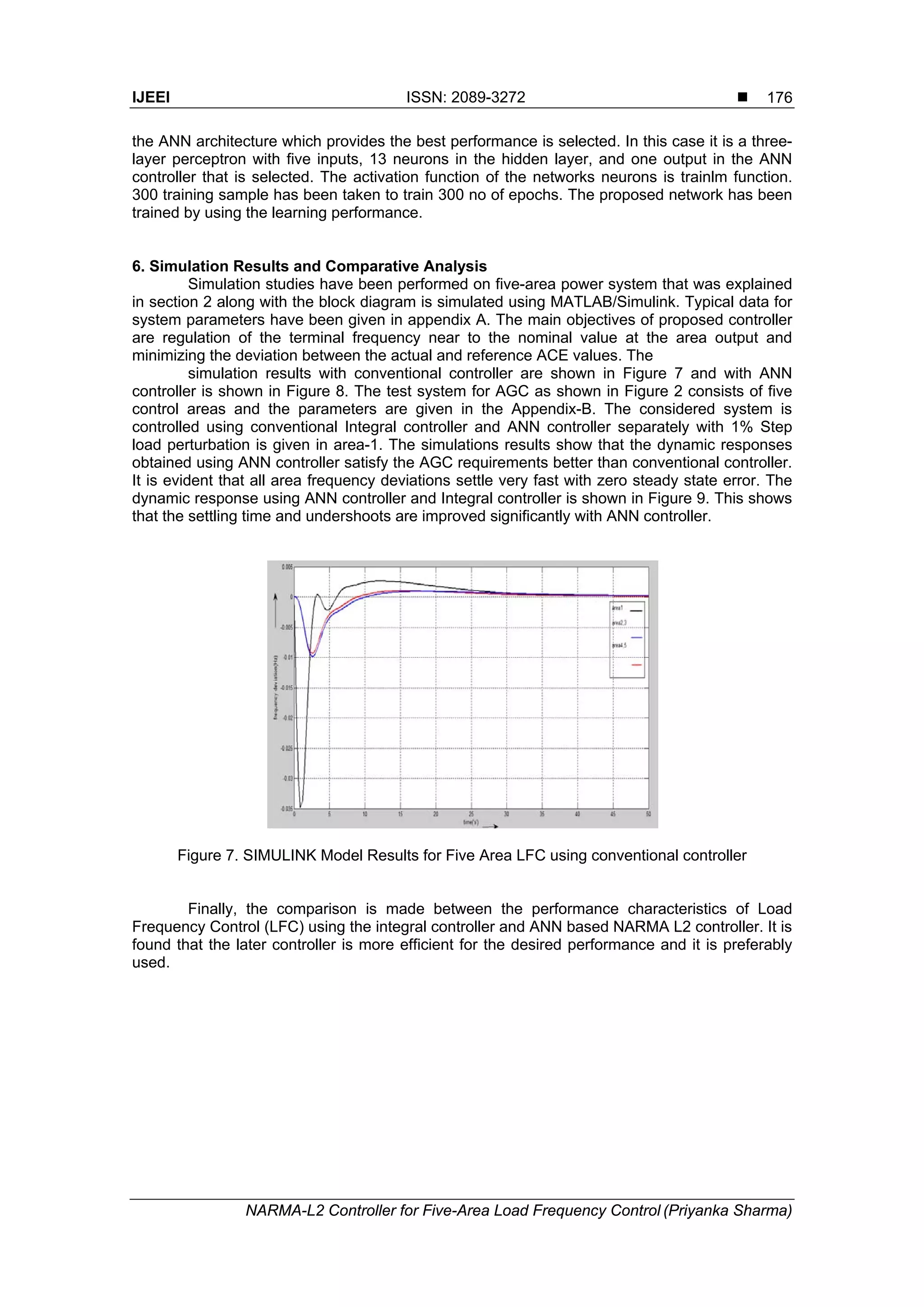
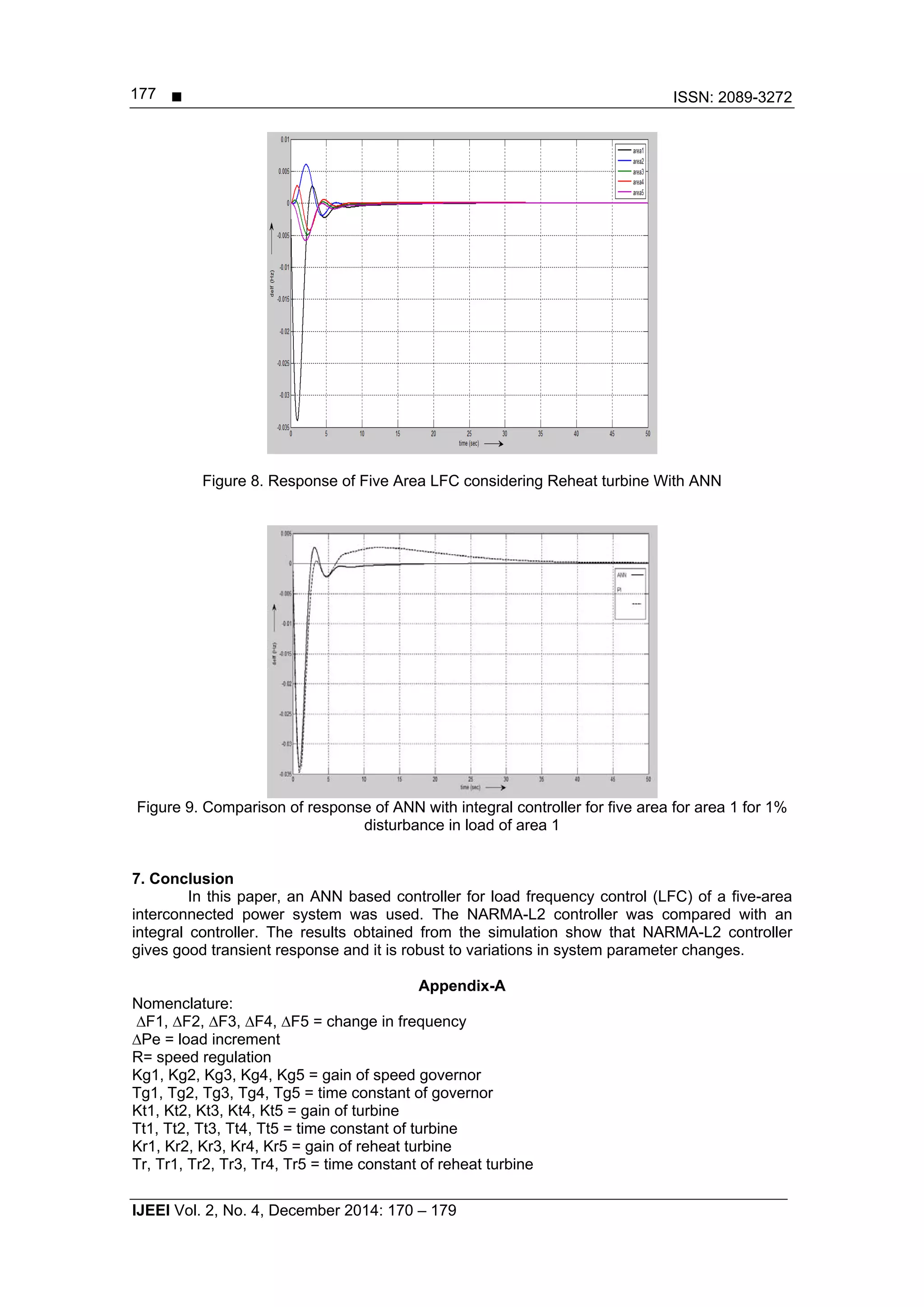
simulation results with conventional controller are shown in Figure 7 and with ANN
controller is shown in Figure 8. The test system for AGC as shown in Figure 2 consists of five
control areas and the parameters are given in the Appendix-B. The considered system is
controlled using conventional Integral controller and ANN controller separately with 1% Step
load perturbation is given in area-1. The simulations results show that the dynamic responses
obtained using ANN controller satisfy the AGC requirements better than conventional controller.
It is evident that all area frequency deviations settle very fast with zero steady state error. The
dynamic response using ANN controller and Integral controller is shown in Figure 9. This shows
that the settling time and undershoots are improved significantly with ANN controller.
Figure 7. SIMULINK Model Results for Five Area LFC using conventional controller
Finally, the comparison is made between the performance characteristics of Load
Frequency Control (LFC) using the integral controller and ANN based NARMA L2 controller. It is
found that the later controller is more efficient for the desired performance and it is preferably
used.
 ISSN: 2089-3272
IJEEI Vol. 2, No. 4, December 2014: 170 – 179
177
Figure 8. Response of Five Area LFC considering Reheat turbine With ANN
Figure 9. Comparison of response of ANN with integral controller for five area for area 1 for 1%
disturbance in load of area 1
7. Conclusion
In this paper, an ANN based controller for load frequency control (LFC) of a five-area
interconnected power system was used. The NARMA-L2 controller was compared with an
integral controller. The results obtained from the simulation show that NARMA-L2 controller
gives good transient response and it is robust to variations in system parameter changes.
Appendix-A
Nomenclature:
∆F1, ∆F2, ∆F3, ∆F4, ∆F5 = change in frequency
∆Pe = load increment
R= speed regulation
Kg1, Kg2, Kg3, Kg4, Kg5 = gain of speed governor
Tg1, Tg2, Tg3, Tg4, Tg5 = time constant of governor
Kt1, Kt2, Kt3, Kt4, Kt5 = gain of turbine
Tt1, Tt2, Tt3, Tt4, Tt5 = time constant of turbine
Kr1, Kr2, Kr3, Kr4, Kr5 = gain of reheat turbine
Tr, Tr1, Tr2, Tr3, Tr4, Tr5 = time constant of reheat turbine
IJEEI ISSN: 2089-3272 
NARMA-L2 Controller for Five-Area Load Frequency Control (Priyanka Sharma)
178
Kps1, Kps2, Kps3, Kps4, Kps5 = gain of generator
Tps1, Tps2, Tps3, Tps4, Tps5 = time constant of generator
Ts = sampling time
∆Pg1, ∆Pg2, ∆Pg3, ∆Pg4, ∆Pg5= governor output
∆Pt1, ∆Pt2, ∆Pt3, ∆Pt4, ∆Pt5 = turbine output
∆Pr1, ∆Pr2, ∆Pr3, ∆Pr4, ∆Pr5 = reheat turbine output
P12, P13, P14, P15, P23, P24, P25, P34, P35, P45 = tie line power
T12, T13, T14, T15, T23, T24, T25, T34, T35, T45 = tie line time constant
Ki = integral controller gain
b1, b2, b3, b4, b5 = bias factor
Appendix-B
Nominal parameters of the system investigated
F=50Hz,
Tg1=Tg2=Tg3=Tg4=Tg5=0.08s,
Tr1=Tr2=Tr3=Tr4=Tr5=10s,
H1=H2 =H3=H4=H5=5,
Tt1=Tt2=Tt3=Tt4=Tt5=0.3s
Kr1=Kr2=Kr3=Kr4=Kr5=0.5Hz/puMW,
Ptiemax=200MW,
Tps1=Tps2=Tps3=Tps4=Tps5=20s,
Kps1=Kps2=Kps3=Kps4=Kps5=120Hz/p.uMW;
T12=0.08674; Ki=0.1,Ts=0.01,
References
[1] Ashmole PH, Battebury DR, Bowdler RK. Power-system model for large frequency
disturbances. Proceedings of the IEEE. 1974; 121(7): 601–8.
[2] Pan CT, CM. An adaptive controller for power system load–frequency control. IEEE
Transactions on Power Systems. 1989; 4(1): 122–8
[3] Anderson PM, Fouad AA. Power system control and stability. Ames, IA: Iowa State University Press,
1977
[4] Debs AS. Modern power systems control and operation. Norwell, MA: Kluwer-Nijhoff Publishers,
1988.
[5] Wood AJ, Wollenberg BF. Power generation, operation and control. New York: Wiley, 1984.
[6] Elgerd OE. Electric energy system theory. New York: McGraw Hill,1982.
[7] Murty PSR. Power system operation and control. New Delhi: Tata McGraw Hill, 1984.
[8] Shayegi H, Shayanfar HA, Malik OP. Robust decentralized neural networks based LFC in a
deregulated power system. Electr Power Syst Res. 2007; 77: 241–51.
[9] Pan CT, Liaw CM. An adaptive control for power system LFC. IEEE Trans Power Syst. 1989; 4(1):
122–8.
[10] Talaq J, Al-basri H. Adaptive fuzzy gain scheduling for LFC. IEEE Trans Power Syst. 1999; 14(1):
145–50.
[11] Kocaarslan _Ilhan, C¸ am Ertug˘ rul. Fuzzy logic controller in interconnected electrical power systems
for load-frequency control. Int J Electr Power Energy Syst. 2005; 27(8): 542–9.
[12] Anand B, Ebenezer Jeyakumar A. Load frequency control with fuzzy logic controller considering non-
linearities and boiler dynamics. ICGST-ACSE J. 2009; 8(III).
[13] Sˇ ijak Tomislav, Kulja Ognjen, Kulja Ljubomir, Tesˇnjak Sejid. Design of fuzzy regulator for power
system secondary load frequency control. In: Proceedings of the 10th Mediterranean conference on
control and automation – MED2002, Lisbon, Portugal, 2002.
[14] C¸ am Ertug˘ rul. Application of fuzzy logic for load frequency control of hydro electrical power plants.
Energy Convers Manage. 2007; 48(4): 1281–8.
[15] C¸ am Ertu rul, Kocaarslan Ihan. Load frequency control in two area power systems using fuzzy logic
controller. Energy Convers Manage. 2005; 46(2): 233–43.
[16] Narendra KS, and S Mukhopadhyay. “Adaptive Control Using Neural Networks and Approximate
Models”. IEEE Trans. Neural Networks. 1997; 8: 475-485.
[17] H Demuth, M Beale, M Hagan. Neural network toolbox user’s guide.
[18] J Nanda S Mishra. "A novel classical controller for automatic generation control in thermal and
hydrothermal Power Electronics”. Drives and Energy Systems (PEDES). 2010; 6.
[19] JA Jaleel, TPI Ahammed. "Simulation of ANN Controller for Automatic Generation Control of
Hydroelectric Power System". TENCON-2008. 2008: 1-4.
 ISSN: 2089-3272
IJEEI Vol. 2, No. 4, December 2014: 170 – 179
179
[20] IA Chidambaram, R Francis. "Automatic Generation Control of a Two Area Reheat Interconnected
System based on CPS using Fuzzy Neural Network". Emerging Trends in Electricaland Computer
Technology (ICETECT). 2011: 200-205.
[21] Livingstone David. J. Artificial Neural Networks.
[22] CS Chang, Weihui fu. Area Load Frequency Control using Fuzzy Gain scheduling of PI controllers.
Electric Power Systems Research. 1997; 42:145-52.
[23] KP Singh Parmar, S Majhi and DP Kothari. Automatic Generation Control of an Interconnected
Hydrothermal Power System. IEEE Conf. proceedings, INDICON 2010, Kolkata, India.
[24] KP Singh Parmar, S Majhi and DP Kothari. Multi area Load Frequency Control in a Power System
Using Optimal Output Feedback Method. IEEE Conf. proceedings PEDES 2010, New Delhi, India.
[25] S Hykin. “Neural Network”. Mac Miller NY 1994.
[26] DM Vinod Kumar. "Intelligent Controllers for Automatic Generation Control". IEEE transactions. 1999:
557-574.
[27] Narendra KS and S Mukhopadhyay. “Adaptive Control Using Neural Networks and Approximate
Models”. IEEE Trans. Neural Networks. 1997; 8: 475-485.
[28] H Demuth, M Beale, M Hagan. Neural network toolbox user’s guide.
[29] Surya Prakash, SK Sinha. “Application of artificial intelligence in load frequency control of
interconnected power system”. International Journal of Engineering, Science and Technology. 2011;
3(4): 264-275.

NARMA-L2 Controller for Five-Area Load Frequency Control

  • 1.
    Indonesian Journal ofElectrical Engineering and Informatics (IJEEI) Vol. 2, No. 4, December 2014, pp. 170~179 ISSN: 2089-3272  170 Received May 13, 2014; Revised July 24, 2014; Accepted August 20, 2014 NARMA-L2 Controller for Five-Area Load Frequency Control Priyanka Sharma Department of Electrical Engineering, Maharishi Dayanand University, Rohtak, Haryana, India Email: priyanka.ganaur@gmail.com Abstract This paper investigates the load-frequency control (LFC) based on neural network for improving power system dynamic performance. In this paper an Artificial Neural Network (ANN) based controller is presented for the Load Frequency Control (LFC) of a five area interconnected power system. The controller is adaptive and is based on a nonlinear auto regressive moving average (NARMA-L2) algorithm. The working of the conventional controller and ANN based NARMA L2 controllers is simulated using MATLAB/SIMULINK package.. The Simulink link results of both the controllers are compared. Keywords: Area Control Error (ACE), Artificial Neural Network (ANN), Genetic Algorithm (GA), Load Frequency Control (LFC), Artificial Neural Network (ANN) 1. Introduction The organizations are responsible for providing electrical power with great reliability, availability and efficiency. In present time the demand for electrical power and load is not constant but kept on changing. It becomes necessary to change power generations according to load perturbations. A power system consists of a number of interconnected subsystems. For each subsystem it becomes compulsory to fulfill the requirements usually include matching system generation to system load and the associated system losses and then regulating system frequency and tie line power exchanges. This is usually known as load frequency control, also called Automatic Generation Control (AGC) problem and is very important in the operation of power systems [1, 2]. The main function of AGC is to maintain the real frequency and the desired power output (megawatt) in the interconnected power system and to control the change in tie line power between control areas. To maintain the system at normal operating state different types of controllers based on classical and modern control theories have been developed [3-5]. The conventional controller used for Load Frequency Control is integral controller. The integrator gain is set to a level such that relation between fast transient recovery and low overshoot in the dynamic response of the overall system can be maintained [6-7]. But the main disadvantage of this type of controller is slow and does not give desired performance to the designer corresponding to non-linarites in the generator unit. In recent years, modern control techniques, especially adaptive control configurations, are applied to load-frequency control. The applications of artificial neural networks, genetic algorithms, fuzzy logic and optimal control to LFC have been reported in [8-15]. In the paper, artificial neural network (ANN) based controller is used, which is an adaptive control configuration because this controller provides faster and desired control as compared to others. The beginning of artificial intelligence (AI) techniques leads to many problems. This technology mainly used systems which are operating nonlinearly over the operating range. ANN has also been used in frequency controller design for Multi area AGC scheme in deregulated electricity market. These networks are also applicable for pattern recognition, function approximation, time series prediction and classification problems for quite some time. . Nonlinear autoregressive moving average (NARMA) model is an exact representation of input-output behavior of a finite-dimensional and nonlinear discrete time dynamic plant in neighborhood of the equilibrium state [16,17]. This non-linearity, its implementation for real time control systems makes difficult. To overcome computational complexity related to use of this type of ANN, two classes of NARMA are introduced in [16]: NARMA-L1 and NARMA-L2. The latter is more convenient to be practically implemented using multilayer neural networks.
  • 2.
     ISSN: 2089-3272 IJEEIVol. 2, No. 4, December 2014: 170 – 179 171 2. FIVE-area Load-Frequency Control Model The configuration of the investigated power system is given in Figure 1. The directions of power transfer between areas have been considered as follow: - from area 1 to area 2 - from area 1 to area 3 - from area 1 to area 4 - from area 1 to area 5 - from area 2 to area 3 - from area 2 to area 4 - from area 2 to area 5 - from area 3 to area 4 - from area 3 to area 5 - from area 4 to area 5 Figure 1. Basic Block Diagram of FIVE area interconnected system A five area interconnected power system [18] is selected and load frequency control of this system is made primarily by integral controller and then by an ANN controller [19], [20], [21]. The five areas are interconnected to each other by tie-lines. It is seen that each area needs its system frequency to be controlled [22], [23], [24] to give desired performance. The reason for using the proposed controller is due to the fact that it firstly adapts to changing operating points and calculates optimal control commands, it can also perform effectively with nonlinearities and even if system inputs are temporarily lost or errors are introduced. The main characteristics of ANN controller is that it continues to function without needing any decision support software in case of a failure. For comparison, the AGC of considered power system is accomplished using: (i) Conventional Integral controller (ii) ANN based NARMA L2 Controller 3. Modelling and Simulation with Conventional Integral Controller In five area system, five single area systems are interconnected via tie-line. The interconnection of power systems increases the overall system reliability. In this case if some generating units in one area fail, the generating units in the other area can compensate to meet the load demand. The basic block diagram of five area interconnected power system is shown in Figure 1. The power transfer through tie line for the model is given by: 0 01 2 , 1 1 2 12 | || | sin( )tie V V P X    1, 2 = power angles (angle between rotating magnetic flux & rotor) of equivalent machines of the two areas
  • 3.
    IJEEI ISSN: 2089-3272 NARMA-L2 Controller for Five-Area Load Frequency Control (Priyanka Sharma) 172  Ptie, 1(pu) = T12 (1 - 2) Where 0 01 2 12 1 2 1 12 | || | cos( ) r V V T P X    = synchronizing coefficient Figure 2. Turbine model A conventional integral controller is used on five area power system model. The integral controller improves steady state error and allows a transient response with little or no overshoot. As long as error remains, the integral output will increase and the speed changer position attains a constant value only when the frequency error has reduced to zero. The SIMULINK model of a five area interconnected power system with reheat turbine using integral controller is shown in Figure 3. 4. Artificial Neural Network ANN as the name suggests is information processing system. In this system the element used for processing the information is called as neurons. The connecting links used for transmitting signals process an associated weight, which is multiplied along with the incoming signal (net input) for any typical neural net. The output signal is obtained by applying activation function to the net input. Neural network architecture-the multilayer perceptron as unknown function are shown in Figure 4. Parameters of the network are adjusted so that it produces the same response as the unknown function, if the same input is applied to both systems. The unknown function could also represent the inverse of a system being controlled; in this case the neural network can be used to implement the controller [25].
  • 4.
     ISSN: 2089-3272 IJEEIVol. 2, No. 4, December 2014: 170 – 179 173 Figure 3. SIMULINK Model for Five Area LFC with Reheat turbine Figure 4. Neural Network as Function Approximator area1 area2 area3 area4 area5 t12 a12 t13 t14 t15 t23 12 13 14 15 t24 25 t25 23 24 34 35 t34 t35 t45 45 Transfer Fcn 9 5s+1 10s+1 TransferFcn 8 1 0.08s+1 TransferFcn 7 120 20s+1 TransferFcn 6 120 20s+1 TransferFcn 5 1 .3s+1 TransferFcn 4 1 .3s+1 TransferFcn 3 5s+1 10s+1 TransferFcn 2 5s+1 10s+1 Transfer Fcn 19 120 20s+1 TransferFcn 18 1 .3s+1 TransferFcn 17 5s+1 10s+1 Transfer Fcn 16 1 0.08s+1 TransferFcn 15 120 20s+1 TransferFcn 14 1 .3s+1 Transfer Fcn 13 5s+1 10s+1 TransferFcn 12 1 0.08s+1 TransferFcn 11 120 20s+1 TransferFcn 10 1 .3s+1 TransferFcn 1 1 0.08s+1 Transfer Fcn 1 0.08s+1 To Workspace5 simout5 To Workspace1 simout1 Step Scope5 Scope Integrator 9 1 s Integrator 8 1 s Integrator 7 1 s Integrator 6 1 s Integrator 19 1 s Integrator 18 1 s Integrator 17 1 s Integrator 16 1 s Integrator 15 1 s Integrator 14 1 s Integrator 13 1 s Integrator 12 1 s Integrator 11 1 s Integrator 10 1 s Integrator 1 s Gain 9 -K- Gain 8 -K- Gain 7 -K- Gain6 -K- Gain5 -K- Gain 43 -K- Gain42 -K- Gain41 -K- Gain40 -K- Gain 4 -K- Gain39 -1 Gain38 -1 Gain37 -K- Gain36 -1 Gain35 -1 Gain34 -K- Gain33 -1 Gain32 -1 Gain31 -K- Gain 30 -1 Gain 3 -K- Gain 29 -1 Gain28 -K- Gain27 -1 Gain26 -1 Gain 25 -K- Gain24 -K- Gain 23 -1 Gain 22 -K- Gain 21 -1 Gain20 -1 Gain 2 -K- Gain19 -K- Gain18 -1 Gain 17 -1 Gain 16 -K- Gain15 -K- Gain 14 -1 Gain13 -K- Gain 12 -1 Gain11 -1 Gain10 -K- Gain 1 -K- Gain -K-
  • 5.
    IJEEI ISSN: 2089-3272 NARMA-L2 Controller for Five-Area Load Frequency Control (Priyanka Sharma) 174 The basis features of neural networks are high computational rates, fault tolerance, self- decision capability, learning or training, goal –seeking, adaptive features, primitive computational elements 5. NARMA-L2 Control ANN controller architecture employed here is Nonlinear Auto Regressive Moving Average(NARMA) model is representation of input output behavior of a finite-dimensional and nonlinear discrete time dynamic plant in neighborhood of the equilibrium state [27-29]. The non- linearity property of the ANN controller makes its implementation for real time control systems difficult. To overcome computational complexity of ANN controllers, two classes of NARMA are introduced in [27]: NARMA-L1 and NARMA-L2. The NARMAL2 is more convenient to practically implemented using multi-layer neural networks. This controller is simply a rearrangement of the neural network plant model, which is trained offline, in batch form. NARMA L2 controller mainly consists of reference, plant output and control signal. Computation required for this type of controller is very less. The plant output is forced to track the reference model output and the effect of controller changes on plant output is predicted for further calculations. The main quality of this controller is that permits the updating of controller parameters.
  • 6.
     ISSN: 2089-3272 IJEEIVol. 2, No. 4, December 2014: 170 – 179 175 Figure 6. SIMULINK Model for Five Area LFC using NARMA L2 In this controller, the frequency deviations, tie-line power deviation and load perturbation of the area are chosen as the neural network controller inputs. Control signals applied to the governors in the area act as the outputs of the neural network. The data required for the ANN controller training is obtained by designing the Reference Model Neural Network and applying to the power system with step response load disturbance. NARMA-L2 is one of the important neural network architecture that has been implemented in the MATLAB for prediction and control of various systems. NARMA-L2 controller design is performed by two stages i.e. System identification and Control design. The outputs of the neural network are the control signals, which are applied to the speed governors in the corresponding area. After a series of trial and error and modifications, Zero-Order Hold4 Zero-Order Hold3 Zero-Order Hold2 Zero-Order Hold1 Zero-Order Hold 1 .55s+1 Transfer Fcn9 1 .6s+1 Transfer Fcn8 1 .65s+1 Transfer Fcn7 1 .08s+1 Transfer Fcn6 1 .085s+1 Transfer Fcn5 1 .09s+1 Transfer Fcn4 1 .095s+1 Transfer Fcn3 120 40s+1 Transfer Fcn2 100 20s+1 Transfer Fcn15 120 20s+1 Transfer Fcn14 50 10s+1 Transfer Fcn13 50 20s+1 Transfer Fcn11 1 .5s+1 Transfer Fcn10 1 .7s+1 Transfer Fcn1 1 .099s+1 Transfer Fcn simout1 To Workspace1 simout To Workspace Step Scope2 Scope1 Plant Output Reference Contr Signa f g NARMA-L2 Controller4 Plant Output Reference Contr Signa f g NARMA-L2 Controller3 Plant Output Reference Contr Signa f g NARMA-L2 Controller2 Plant Output Reference Contr Signa f g NARMA-L2 Controller1 Plant Output Reference Control Signal f g NARMA-L2 Controller 1 s Integrator9 1 s Integrator4 1 s Integrator3 1 s Integrator2 1 s Integrator14 1 s Integrator13 1 s Integrator12 1 s Integrator11 1 s Integrator10 1 s Integrator1 -K- Gain9 -K- Gain8 -K- Gain7 -K- Gain6 -K- Gain5 -K- Gain4 -1 Gain34 -1 Gain33 -1 Gain32 -1 Gain31 -1 Gain30 -K- Gain3 -1 Gain29 -1 Gain28 -1 Gain27 -1 Gain26 -K- Gain25 -K- Gain24 -K- Gain23 .1 Gain22 -K- Gain21 -K- Gain20 -K- Gain2 -K- Gain19 -K- Gain18 -K- Gain17 -K- Gain16 -K- Gain15 -K- Gain14 -1 Gain13 -K- Gain12 -K- Gain11 -K- Gain10 -K- Gain1 -K- Gain 0 Constant4 0 Constant3 0 Constant2 0 Constant1 0 Constant
  • 7.
    IJEEI ISSN: 2089-3272 NARMA-L2 Controller for Five-Area Load Frequency Control (Priyanka Sharma) 176 the ANN architecture which provides the best performance is selected. In this case it is a three- layer perceptron with five inputs, 13 neurons in the hidden layer, and one output in the ANN controller that is selected. The activation function of the networks neurons is trainlm function. 300 training sample has been taken to train 300 no of epochs. The proposed network has been trained by using the learning performance. 6. Simulation Results and Comparative Analysis Simulation studies have been performed on five-area power system that was explained in section 2 along with the block diagram is simulated using MATLAB/Simulink. Typical data for system parameters have been given in appendix A. The main objectives of proposed controller are regulation of the terminal frequency near to the nominal value at the area output and minimizing the deviation between the actual and reference ACE values. The simulation results with conventional controller are shown in Figure 7 and with ANN controller is shown in Figure 8. The test system for AGC as shown in Figure 2 consists of five control areas and the parameters are given in the Appendix-B. The considered system is controlled using conventional Integral controller and ANN controller separately with 1% Step load perturbation is given in area-1. The simulations results show that the dynamic responses obtained using ANN controller satisfy the AGC requirements better than conventional controller. It is evident that all area frequency deviations settle very fast with zero steady state error. The dynamic response using ANN controller and Integral controller is shown in Figure 9. This shows that the settling time and undershoots are improved significantly with ANN controller. Figure 7. SIMULINK Model Results for Five Area LFC using conventional controller Finally, the comparison is made between the performance characteristics of Load Frequency Control (LFC) using the integral controller and ANN based NARMA L2 controller. It is found that the later controller is more efficient for the desired performance and it is preferably used.
  • 8.
     ISSN: 2089-3272 IJEEIVol. 2, No. 4, December 2014: 170 – 179 177 Figure 8. Response of Five Area LFC considering Reheat turbine With ANN Figure 9. Comparison of response of ANN with integral controller for five area for area 1 for 1% disturbance in load of area 1 7. Conclusion In this paper, an ANN based controller for load frequency control (LFC) of a five-area interconnected power system was used. The NARMA-L2 controller was compared with an integral controller. The results obtained from the simulation show that NARMA-L2 controller gives good transient response and it is robust to variations in system parameter changes. Appendix-A Nomenclature: ∆F1, ∆F2, ∆F3, ∆F4, ∆F5 = change in frequency ∆Pe = load increment R= speed regulation Kg1, Kg2, Kg3, Kg4, Kg5 = gain of speed governor Tg1, Tg2, Tg3, Tg4, Tg5 = time constant of governor Kt1, Kt2, Kt3, Kt4, Kt5 = gain of turbine Tt1, Tt2, Tt3, Tt4, Tt5 = time constant of turbine Kr1, Kr2, Kr3, Kr4, Kr5 = gain of reheat turbine Tr, Tr1, Tr2, Tr3, Tr4, Tr5 = time constant of reheat turbine
  • 9.
    IJEEI ISSN: 2089-3272 NARMA-L2 Controller for Five-Area Load Frequency Control (Priyanka Sharma) 178 Kps1, Kps2, Kps3, Kps4, Kps5 = gain of generator Tps1, Tps2, Tps3, Tps4, Tps5 = time constant of generator Ts = sampling time ∆Pg1, ∆Pg2, ∆Pg3, ∆Pg4, ∆Pg5= governor output ∆Pt1, ∆Pt2, ∆Pt3, ∆Pt4, ∆Pt5 = turbine output ∆Pr1, ∆Pr2, ∆Pr3, ∆Pr4, ∆Pr5 = reheat turbine output P12, P13, P14, P15, P23, P24, P25, P34, P35, P45 = tie line power T12, T13, T14, T15, T23, T24, T25, T34, T35, T45 = tie line time constant Ki = integral controller gain b1, b2, b3, b4, b5 = bias factor Appendix-B Nominal parameters of the system investigated F=50Hz, Tg1=Tg2=Tg3=Tg4=Tg5=0.08s, Tr1=Tr2=Tr3=Tr4=Tr5=10s, H1=H2 =H3=H4=H5=5, Tt1=Tt2=Tt3=Tt4=Tt5=0.3s Kr1=Kr2=Kr3=Kr4=Kr5=0.5Hz/puMW, Ptiemax=200MW, Tps1=Tps2=Tps3=Tps4=Tps5=20s, Kps1=Kps2=Kps3=Kps4=Kps5=120Hz/p.uMW; T12=0.08674; Ki=0.1,Ts=0.01, References [1] Ashmole PH, Battebury DR, Bowdler RK. Power-system model for large frequency disturbances. Proceedings of the IEEE. 1974; 121(7): 601–8. [2] Pan CT, CM. An adaptive controller for power system load–frequency control. IEEE Transactions on Power Systems. 1989; 4(1): 122–8 [3] Anderson PM, Fouad AA. Power system control and stability. Ames, IA: Iowa State University Press, 1977 [4] Debs AS. Modern power systems control and operation. Norwell, MA: Kluwer-Nijhoff Publishers, 1988. [5] Wood AJ, Wollenberg BF. Power generation, operation and control. New York: Wiley, 1984. [6] Elgerd OE. Electric energy system theory. New York: McGraw Hill,1982. [7] Murty PSR. Power system operation and control. New Delhi: Tata McGraw Hill, 1984. [8] Shayegi H, Shayanfar HA, Malik OP. Robust decentralized neural networks based LFC in a deregulated power system. Electr Power Syst Res. 2007; 77: 241–51. [9] Pan CT, Liaw CM. An adaptive control for power system LFC. IEEE Trans Power Syst. 1989; 4(1): 122–8. [10] Talaq J, Al-basri H. Adaptive fuzzy gain scheduling for LFC. IEEE Trans Power Syst. 1999; 14(1): 145–50. [11] Kocaarslan _Ilhan, C¸ am Ertug˘ rul. Fuzzy logic controller in interconnected electrical power systems for load-frequency control. Int J Electr Power Energy Syst. 2005; 27(8): 542–9. [12] Anand B, Ebenezer Jeyakumar A. Load frequency control with fuzzy logic controller considering non- linearities and boiler dynamics. ICGST-ACSE J. 2009; 8(III). [13] Sˇ ijak Tomislav, Kulja Ognjen, Kulja Ljubomir, Tesˇnjak Sejid. Design of fuzzy regulator for power system secondary load frequency control. In: Proceedings of the 10th Mediterranean conference on control and automation – MED2002, Lisbon, Portugal, 2002. [14] C¸ am Ertug˘ rul. Application of fuzzy logic for load frequency control of hydro electrical power plants. Energy Convers Manage. 2007; 48(4): 1281–8. [15] C¸ am Ertu rul, Kocaarslan Ihan. Load frequency control in two area power systems using fuzzy logic controller. Energy Convers Manage. 2005; 46(2): 233–43. [16] Narendra KS, and S Mukhopadhyay. “Adaptive Control Using Neural Networks and Approximate Models”. IEEE Trans. Neural Networks. 1997; 8: 475-485. [17] H Demuth, M Beale, M Hagan. Neural network toolbox user’s guide. [18] J Nanda S Mishra. "A novel classical controller for automatic generation control in thermal and hydrothermal Power Electronics”. Drives and Energy Systems (PEDES). 2010; 6. [19] JA Jaleel, TPI Ahammed. "Simulation of ANN Controller for Automatic Generation Control of Hydroelectric Power System". TENCON-2008. 2008: 1-4.
  • 10.
     ISSN: 2089-3272 IJEEIVol. 2, No. 4, December 2014: 170 – 179 179 [20] IA Chidambaram, R Francis. "Automatic Generation Control of a Two Area Reheat Interconnected System based on CPS using Fuzzy Neural Network". Emerging Trends in Electricaland Computer Technology (ICETECT). 2011: 200-205. [21] Livingstone David. J. Artificial Neural Networks. [22] CS Chang, Weihui fu. Area Load Frequency Control using Fuzzy Gain scheduling of PI controllers. Electric Power Systems Research. 1997; 42:145-52. [23] KP Singh Parmar, S Majhi and DP Kothari. Automatic Generation Control of an Interconnected Hydrothermal Power System. IEEE Conf. proceedings, INDICON 2010, Kolkata, India. [24] KP Singh Parmar, S Majhi and DP Kothari. Multi area Load Frequency Control in a Power System Using Optimal Output Feedback Method. IEEE Conf. proceedings PEDES 2010, New Delhi, India. [25] S Hykin. “Neural Network”. Mac Miller NY 1994. [26] DM Vinod Kumar. "Intelligent Controllers for Automatic Generation Control". IEEE transactions. 1999: 557-574. [27] Narendra KS and S Mukhopadhyay. “Adaptive Control Using Neural Networks and Approximate Models”. IEEE Trans. Neural Networks. 1997; 8: 475-485. [28] H Demuth, M Beale, M Hagan. Neural network toolbox user’s guide. [29] Surya Prakash, SK Sinha. “Application of artificial intelligence in load frequency control of interconnected power system”. International Journal of Engineering, Science and Technology. 2011; 3(4): 264-275.