International Journal of Power Electronics and Drive System (IJPEDS)
Vol. 9, No. 1, March 2018, pp. 126~138
ISSN: 2088-8694, DOI: 10.11591/ijpeds.v9.i1.pp126-138  126
Journal homepage: http://iaescore.com/journals/index.php/IJPEDS
Fractional Order PID Controlled Interleaved Boost converter
Fed Shunt Active Filter System
P. V. Ram Kumar1
, M. Surya Kalavathi2
1
Department of Electrical and Electronics Engineering, JNTU, Ananthapuramu
2
Department of Electrical and Electronics Engineering, J.N.T.U. College of Engg, Hyderabad, India
Article Info ABSTRACT
Article history:
Received May 25, 2017
Revised Dec 22, 2017
Accepted Jan 1, 2018
Interleaved Boost Converter (ILBC) is a better converter between Photo
Voltaic (PV) source and shunt active power filter. This paper deals with
comparison of time domain outputs of PI and Fractional Order PID(FOPID)
controlled ILBC fed shunt active filter in a grid connected PV system. The
aim of this work is to minimize current ripple using ILBC between PV
system and filter to improve the dynamic performance of shunt active filter.
Closed loop monitored PI and FOPID systems are modeled, and the
corresponding results are presented. MATLAB results of load voltage,
current, converter voltage and currents with FOPID exhibits enhanced
dynamic response. The proposed FOPID controlled ILBC Fed Shunt Active
Filter system (ILBCFSAF) has advantages like low settling time, less peak
over shoot and reduced steady state error in load voltage. The simulation
results of ILBCFSAF are compared with the corresponding hardware results.
Keyword:
FOPID Controller
Interleaved Boost Converter
Non linear load
Shunt Active Filter
Copyright © 2018 Institute of Advanced Engineering and Science.
All rights reserved.
Corresponding Author:
P. V. Ram Kumar,
Departement of Electrical and Electronics Engineering,
JNT University,
Ananthapuramu, India
Email: ramkumar_pv@yahoo.co.in
1. INTRODUCTION
Distribution sources such as Photo-Voltaic (PV) generation system, and wind power systems have
become popular since they are green power source. The DC-AC inverter can be used as Shunt Active
Filter(SAF) whose output is controlled by pulses to convert dc power of PV into ac and to inject equivalent
currents to compensate harmonics. The pulses are produced by a controller which monitors the deviation
between system voltage and input dc voltage of converter. Conventionally PI or PID controllers are used for
this purpose but suffer from frequent tuning of their parameters for different load and disturbance conditions.
The step up converters have drawbacks of low voltage gain and low power rating. Interleaved Boost
converter has reduced ripple currents in both the input and output sides.
Different steps involved in design of MPPT controller and evaluation of the need of storage devices,
load take off strategies of PV system is presented in [1]. Effect of partial shading on building Integrated PV
systems, causes and mitigation techniques using software and hard ware solutions is presented in [2]. A
fractional-order PID (FOPID) controller is designed in[3] to control a DC-DC boost converter in a PV-
system. To obtain the best system performance, parameters of the proposed controller are tuned by using
Particle Swarm Optimization (PSO) algorithm. Analysis and hardware implementation of two phase ILBC is
proposed in [4] where in design of magnetic component i.e., inductor is studied. High gain four stage ILBC is
proposed in [5] which is a combination of two 2 phase interleaved boost converters to obtain smooth output
ripple current, increase in power rating and efficiency. Basic concepts regarding design of ILBC which
involves selection of inductors, input and output capacitors, power switches etc., was given in[6]. As far as
the controlling of SAF is concerned, the Instantaneous Power Theory (IPT) and its application to power
Int J Power Electron & Dri Syst ISSN: 2088-8694 
Fractional Order PID Controlled Interleaved Boost…(P.V. Ram Kumar)
127
conditioning given by Akagi [7] is the basis for SAF. A detailed review of SAF with respect to control
techniques and topology is presented by Bhimsingh[8].A method to evaluate the performance of utility
interactive PV system is given by Abouzahr[9]. The design of SAF with output LCL filter is given by
Tang[10]. The control algorithm of SAF for voltage regulation and PFC is depicted by Haddad[11]. A
selection methodology for the number of phases and analysis of the input current ripple with CCM and DCM
is for an ILBC is given in [12]. A study of various PV fed Active filters with respect to their circuit and
control methods is presented in [13]. To investigate various Power Quality issues such as THD, phase
imbalance and excessive neutral currents etc., a predictive control technique using FLC is proposed in [14]
where in FLC is applied for MPPT. A single-phase dual-stage PV-Grid system with active filtering capability
is constructed in [15] with simple circuits such as current transducer. The system used a boost chopper as
MPPT controller.
Lot of research on single stage PV grid-connected system with power quality improvement has been
done so far but not many studies are available on Boost Converter topologies used to boost the low
magnitude PV voltages. In this paper, a novel high capacity grid-connected PV system based on Interleaved
Boost converter fed Shunt active filter is proposed, which has reduced current ripple.The problem
formulation involves improving dynamic response of ILBCFSAF system. The pulse width applied to the
ILBC is adjusted to obtain constant voltage at the output. The FOPID is proposed to improve the dynamic
response.
The content of this paper is organized as follows: Section.2 deals with description of existing and
proposed system. Control schemes of the systems are described in the 3rd section. Simulation results are
described in section 4. A prototype model with hard ware components is developed, the details of which are
presented in section 5. The work is concluded in section 6.
2. DESCRIPTION OF THE PROPOSED SYSTEM
The block diagram of conventional SAF system is shown in Figure 1. The SAF is connected near
the non linear load.
Figure 1. Block diagram of conventional system Figure 2. Block Diagram of Proposed ILBCFSAF
System
Block diagram of the proposed ILBCFSAF system is shown in Figure.2. A three phase voltage
source inverter is made to work as SAF and is the key component of the system, dc required to charge the
capacitor of the SAF is obtained from ILBC. Actual voltage of this DC Link capacitor is compared. With the
reference voltage and the voltage error is applied to the FOPID. The output of the FOPID controls the pulse
width applied to ILBC.
3. RESEARCH METHOD
3.1. Inter Leaved Boost Converter
ILBC overcomes the drawbacks of conventional boost converters, its static and dynamic
performances are poor. Hence, an effective control of these converters is needed. Though conventional PI or
PID controllers are useful, tuning of these for different loads is problematic. This paper proposes a fractional
 ISSN: 2088-8694
Int J Power Electron & Dri Syst Vol. 9, No. 1, March 2018 : 126 – 138
128
order PID controller for controlling ILBC to derive good dynamic response of the load voltage. The circuit
diagram of ILBC is shown in Figure.3.
Figure 3. Circuit diagram of ILBC
The design considerations of ILBC are as follows
L and C for ILBC are determined using
L = Vi D f I
⁄ (3.1)
C = D 2. f. R
⁄ (3.2)
L1 and L2 works out to 130mH and C workout to 470µF
3.2. Control of SAF
p-q theory is used for controlling the three leg VSI inverter. As this thery is based on α-β-0 frameed
quantities, Conversion of source voltages and currents in to this frame is done using a transformation matrix
C.
[
v0
vα
vβ
] = C [
va
vb
vc
] ; [
i0
iα
iβ
] = C [
ia
ib
ic
] (3.3)
where C = √
2
3
[
1
√2
1
√2
1
√2
1 −
1
2
−
1
2
0
√3
2
−
√3
2 ]
(3.4)
The active and reactive power demanded by the load can be decomposed into
pL = pL
̅̅̅ + pL
̃ ; qL
= qL
̅̅̅̅ + qL
̃ (3.5)
The reference source currents in the α-β-0 frame are as follows:
[
isRf0
isRfα
isRfβ
] =
1
vα
2 +vβ
2 [
v0 0 vβ
vα −vβ 0
vβ vα −v0
−vα
v0
0
] × [
p
̅Lαβ + p
̅L0
0
0
0
] =
p
̅Lαβ +p
̅L0
vα
2 +vβ
2 [
0
vα
vβ
] (3.6)
Assuming Ls= 10mH, the capacitance of SAF is calculated by
fs = 1 2π√Ls Cs
⁄ (3.7)
Pulse width of inverter is found to be 0.66ms for a supply frequency of 50Hz.
Int J Power Electron & Dri Syst ISSN: 2088-8694 
Fractional Order PID Controlled Interleaved Boost…(P.V. Ram Kumar)
129
3.3. Proposed FOPID Controller
The enhanced version of conventional PID controller is the fractional order PID (FOPID) controller
and is designed on the basis of fractional calculus. For many decades, PID controllers have been very
popular in industries due to their simplicity of design and good performance. As a result of, continuous
efforts to improve their quality and robustness,in the field of automatic control, the fractional order
controllers would lead to more precise and robust control performances.
In order to implement the control Scheme of a SAF in a closed loop, the DC capacitor voltage of the
converter Vdc is sensed and then compared with the reference value Vdcref. The error e(n) = Vdcref – Vdc
is in frequency domain. The output and inputs of the controller are related as follows:
Vo(s) = Vi(s) (K1+ K2/Sm+K3Sn) (3.8)
where m and n are fractions.
4. SIMULATION RESULTS AND ANALYSIS
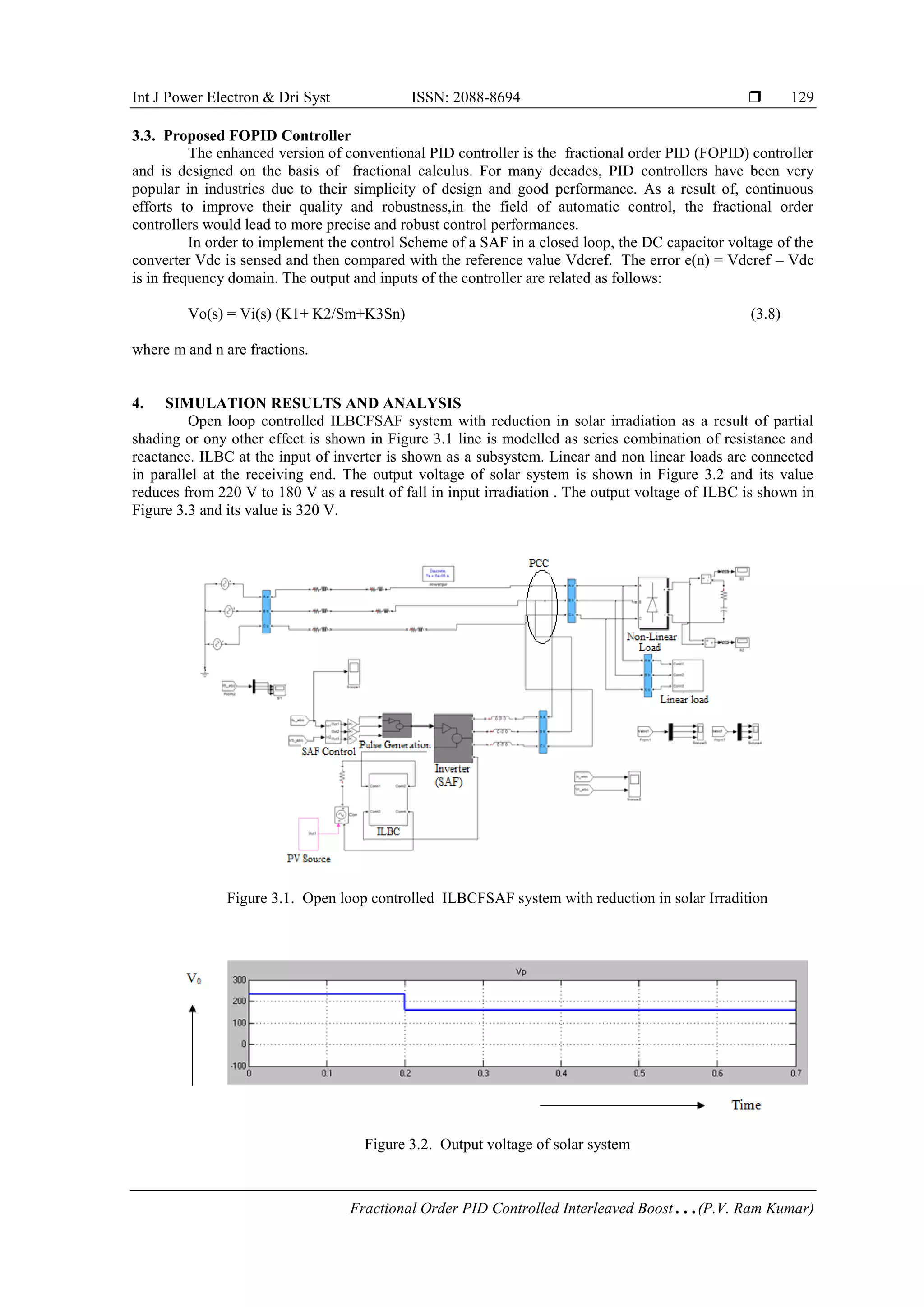
Open loop controlled ILBCFSAF system with reduction in solar irradiation as a result of partial
shading or ony other effect is shown in Figure 3.1 line is modelled as series combination of resistance and
reactance. ILBC at the input of inverter is shown as a subsystem. Linear and non linear loads are connected
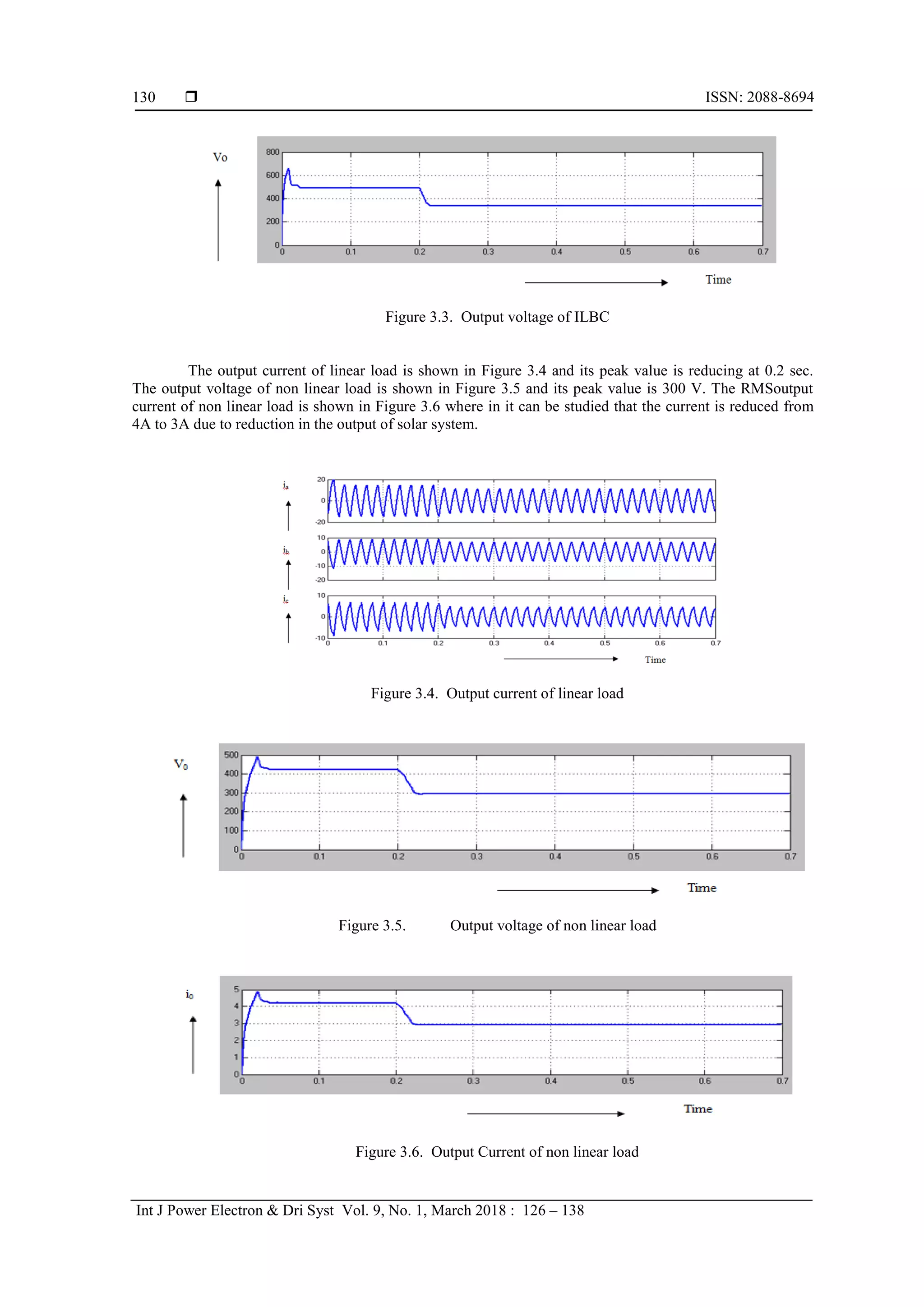
in parallel at the receiving end. The output voltage of solar system is shown in Figure 3.2 and its value
reduces from 220 V to 180 V as a result of fall in input irradiation . The output voltage of ILBC is shown in
Figure 3.3 and its value is 320 V.
Figure 3.1. Open loop controlled ILBCFSAF system with reduction in solar Irradition
Figure 3.2. Output voltage of solar system
 ISSN: 2088-8694
Int J Power Electron & Dri Syst Vol. 9, No. 1, March 2018 : 126 – 138
130
Figure 3.3. Output voltage of ILBC
The output current of linear load is shown in Figure 3.4 and its peak value is reducing at 0.2 sec.
The output voltage of non linear load is shown in Figure 3.5 and its peak value is 300 V. The RMSoutput
current of non linear load is shown in Figure 3.6 where in it can be studied that the current is reduced from
4A to 3A due to reduction in the output of solar system.
Figure 3.4. Output current of linear load
Figure 3.5. Output voltage of non linear load
Figure 3.6. Output Current of non linear load
Int J Power Electron & Dri Syst ISSN: 2088-8694 
Fractional Order PID Controlled Interleaved Boost…(P.V. Ram Kumar)
131
The closed loop ILBCSAF system with PI controller is simulated. The output of ILBC is senced and
is compared with the reference voltage. The error is applied to a PI controller. The output of PI controller is
applied to a comparator. The comparator produces updated pulse for driving MOSFETS of ILBC. The output
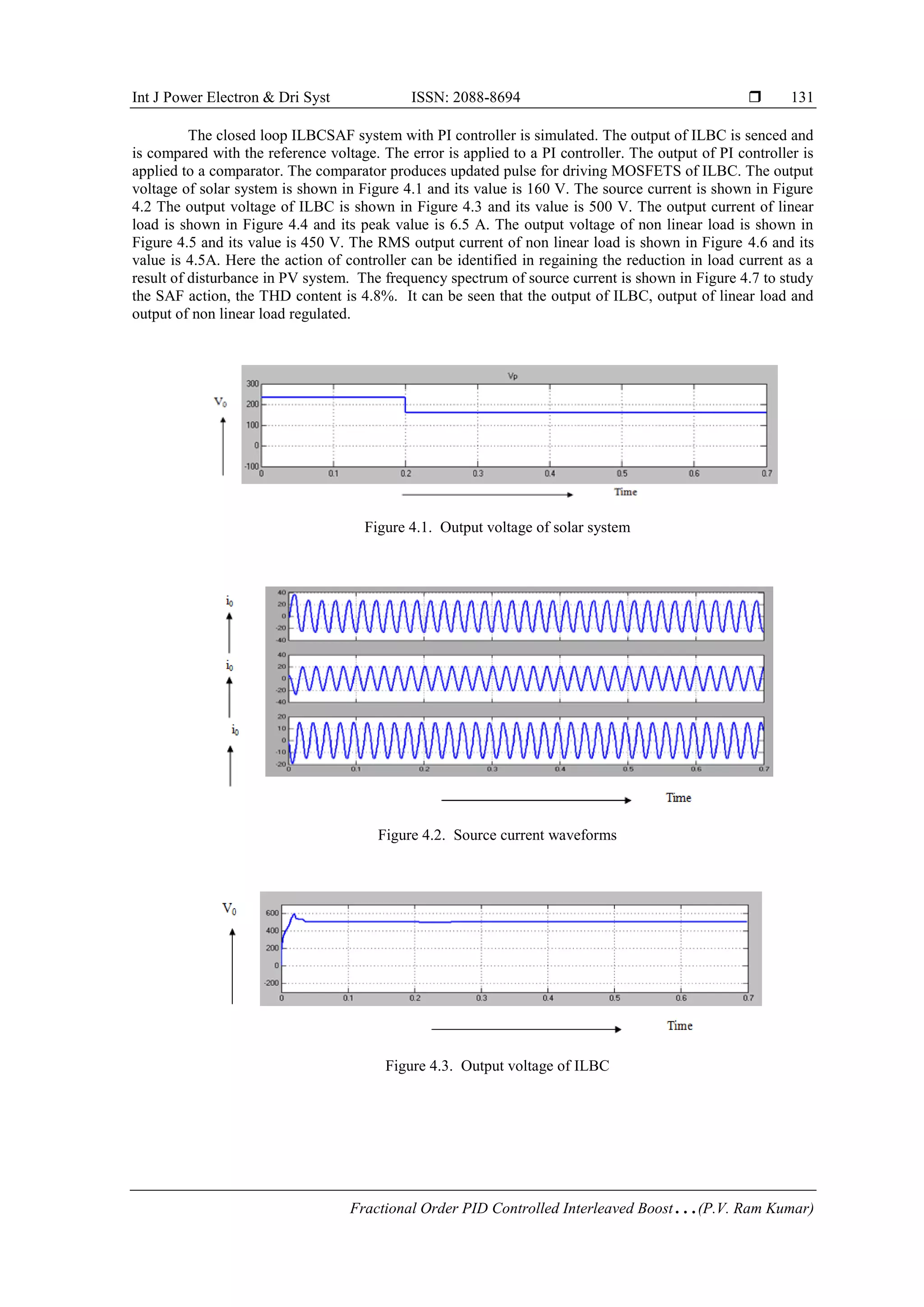
voltage of solar system is shown in Figure 4.1 and its value is 160 V. The source current is shown in Figure
4.2 The output voltage of ILBC is shown in Figure 4.3 and its value is 500 V. The output current of linear
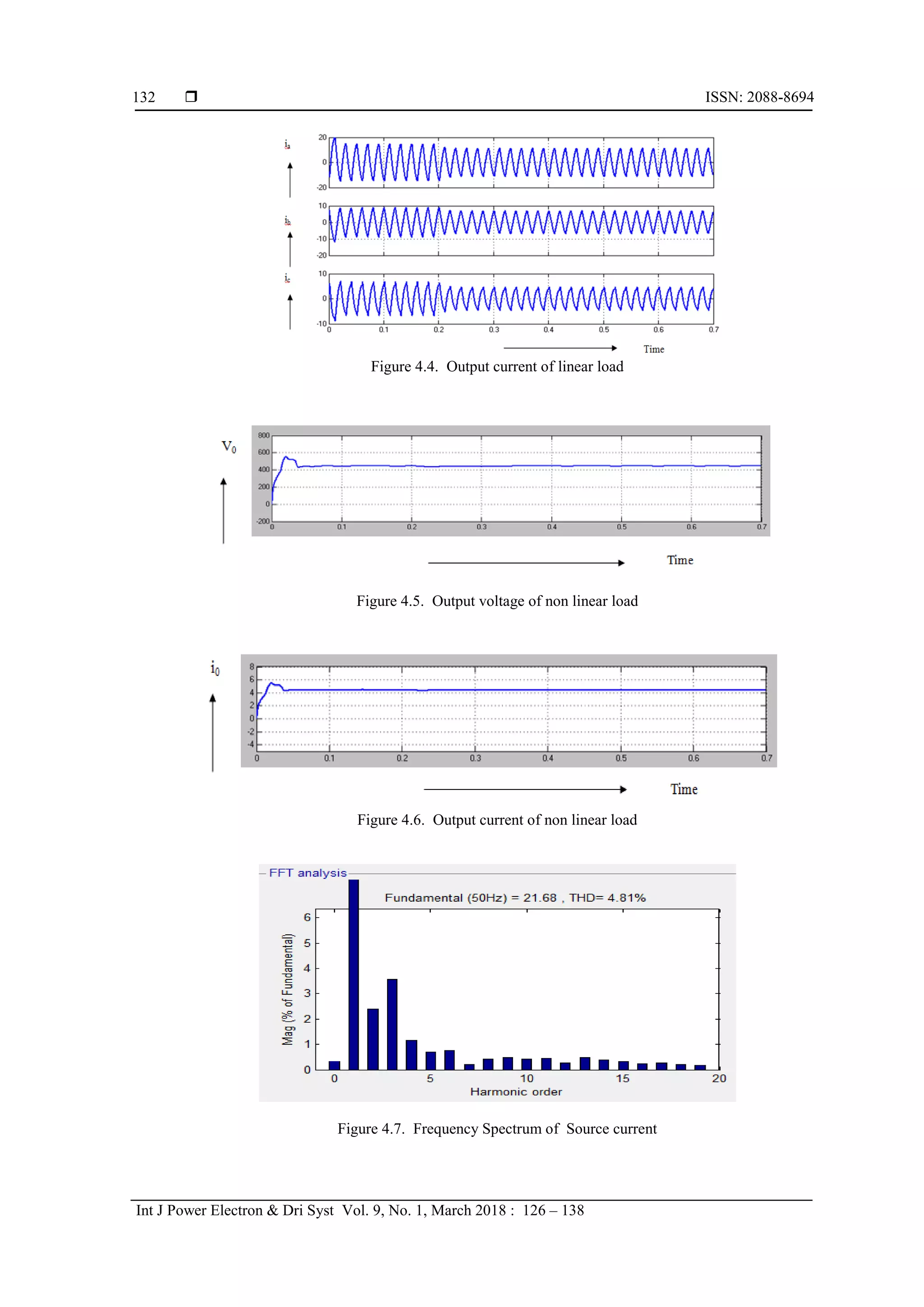
load is shown in Figure 4.4 and its peak value is 6.5 A. The output voltage of non linear load is shown in
Figure 4.5 and its value is 450 V. The RMS output current of non linear load is shown in Figure 4.6 and its
value is 4.5A. Here the action of controller can be identified in regaining the reduction in load current as a
result of disturbance in PV system. The frequency spectrum of source current is shown in Figure 4.7 to study
the SAF action, the THD content is 4.8%. It can be seen that the output of ILBC, output of linear load and
output of non linear load regulated.
Figure 4.1. Output voltage of solar system
Figure 4.2. Source current waveforms
Figure 4.3. Output voltage of ILBC
 ISSN: 2088-8694
Int J Power Electron & Dri Syst Vol. 9, No. 1, March 2018 : 126 – 138
132
Figure 4.4. Output current of linear load
Figure 4.5. Output voltage of non linear load
Figure 4.6. Output current of non linear load
Figure 4.7. Frequency Spectrum of Source current
Int J Power Electron & Dri Syst ISSN: 2088-8694 
Fractional Order PID Controlled Interleaved Boost…(P.V. Ram Kumar)
133
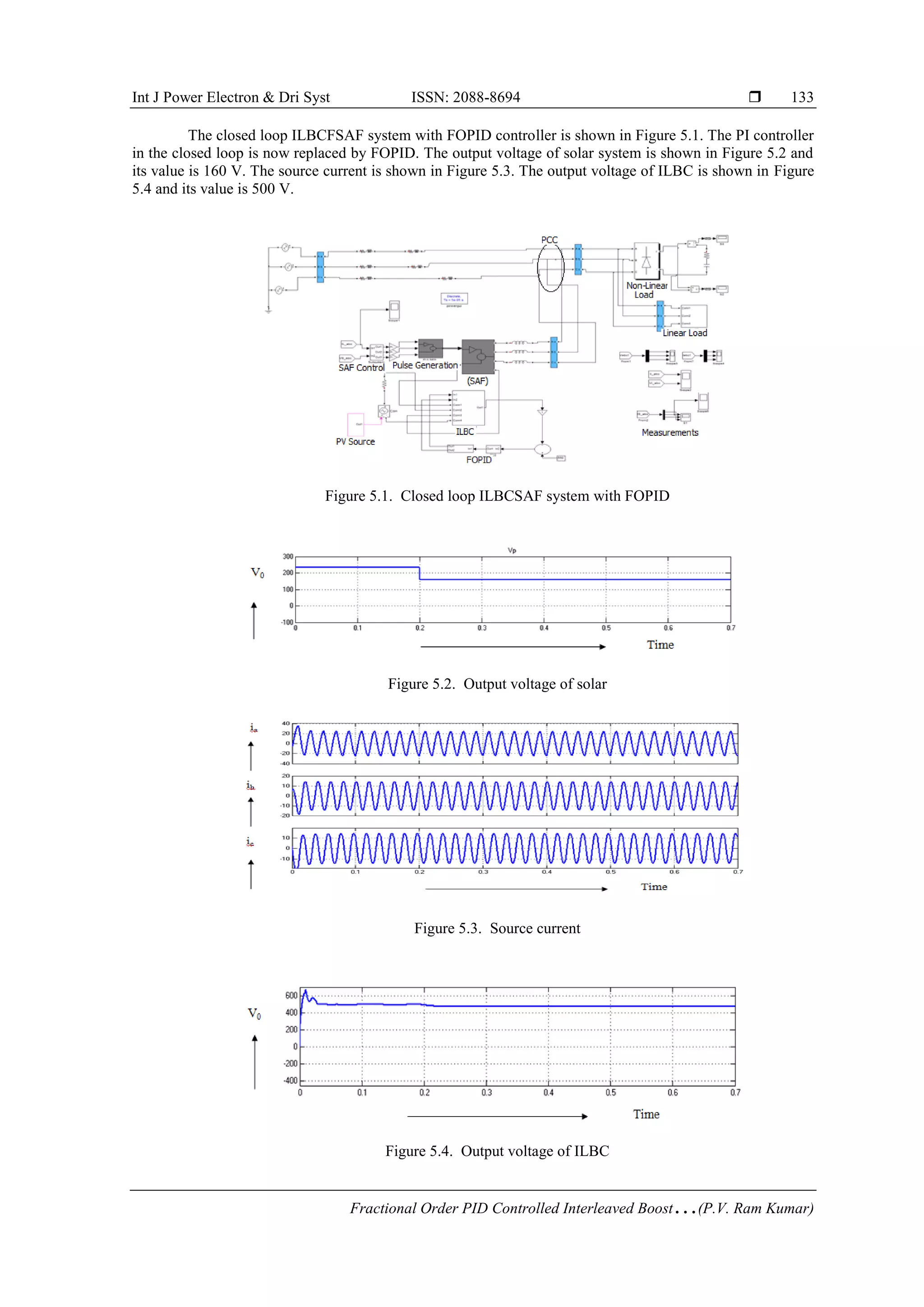
The closed loop ILBCFSAF system with FOPID controller is shown in Figure 5.1. The PI controller
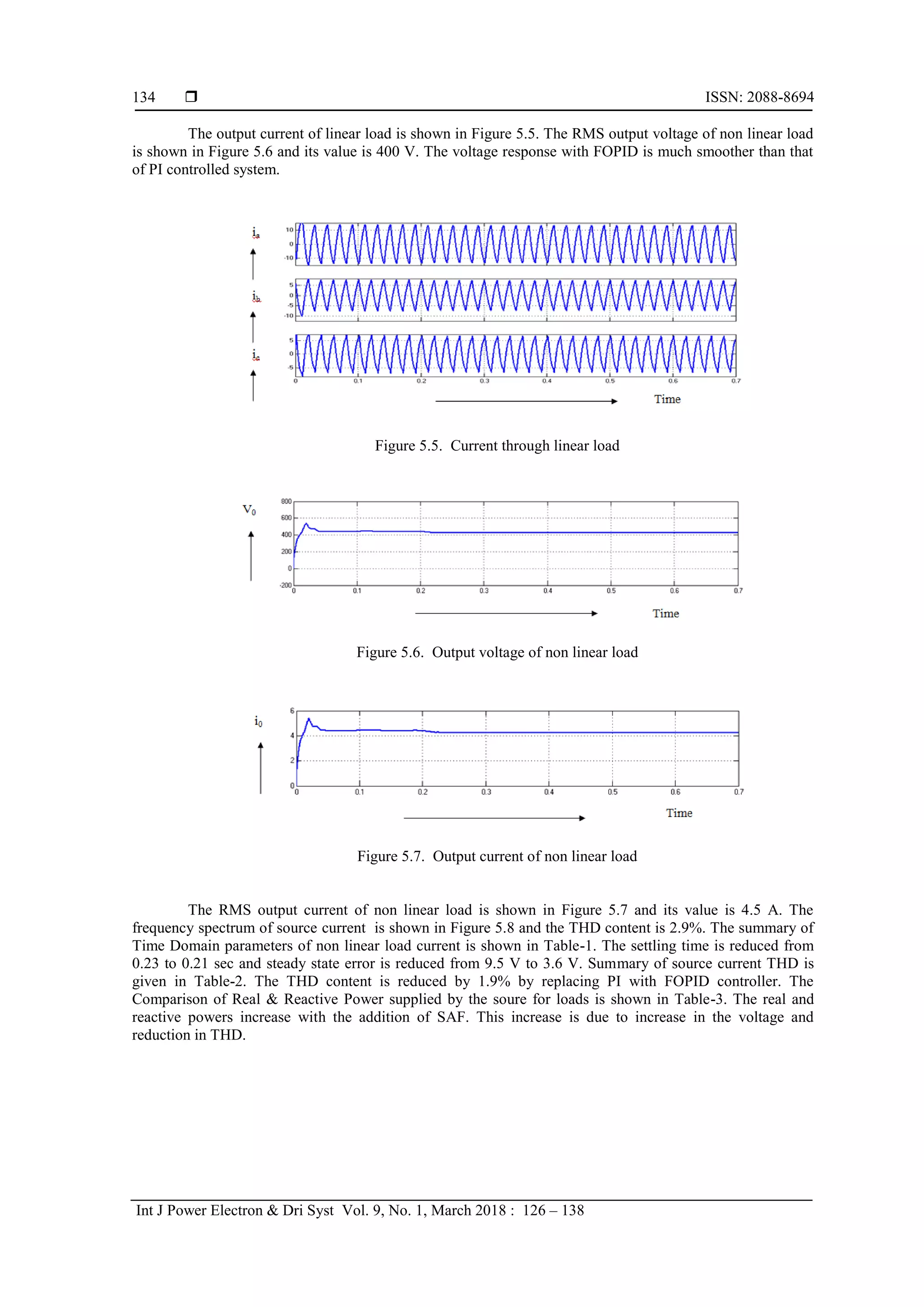
in the closed loop is now replaced by FOPID. The output voltage of solar system is shown in Figure 5.2 and
its value is 160 V. The source current is shown in Figure 5.3. The output voltage of ILBC is shown in Figure
5.4 and its value is 500 V.
Figure 5.1. Closed loop ILBCSAF system with FOPID
Figure 5.2. Output voltage of solar
Figure 5.3. Source current
Figure 5.4. Output voltage of ILBC
 ISSN: 2088-8694
Int J Power Electron & Dri Syst Vol. 9, No. 1, March 2018 : 126 – 138
134
The output current of linear load is shown in Figure 5.5. The RMS output voltage of non linear load
is shown in Figure 5.6 and its value is 400 V. The voltage response with FOPID is much smoother than that
of PI controlled system.
Figure 5.5. Current through linear load
Figure 5.6. Output voltage of non linear load
Figure 5.7. Output current of non linear load
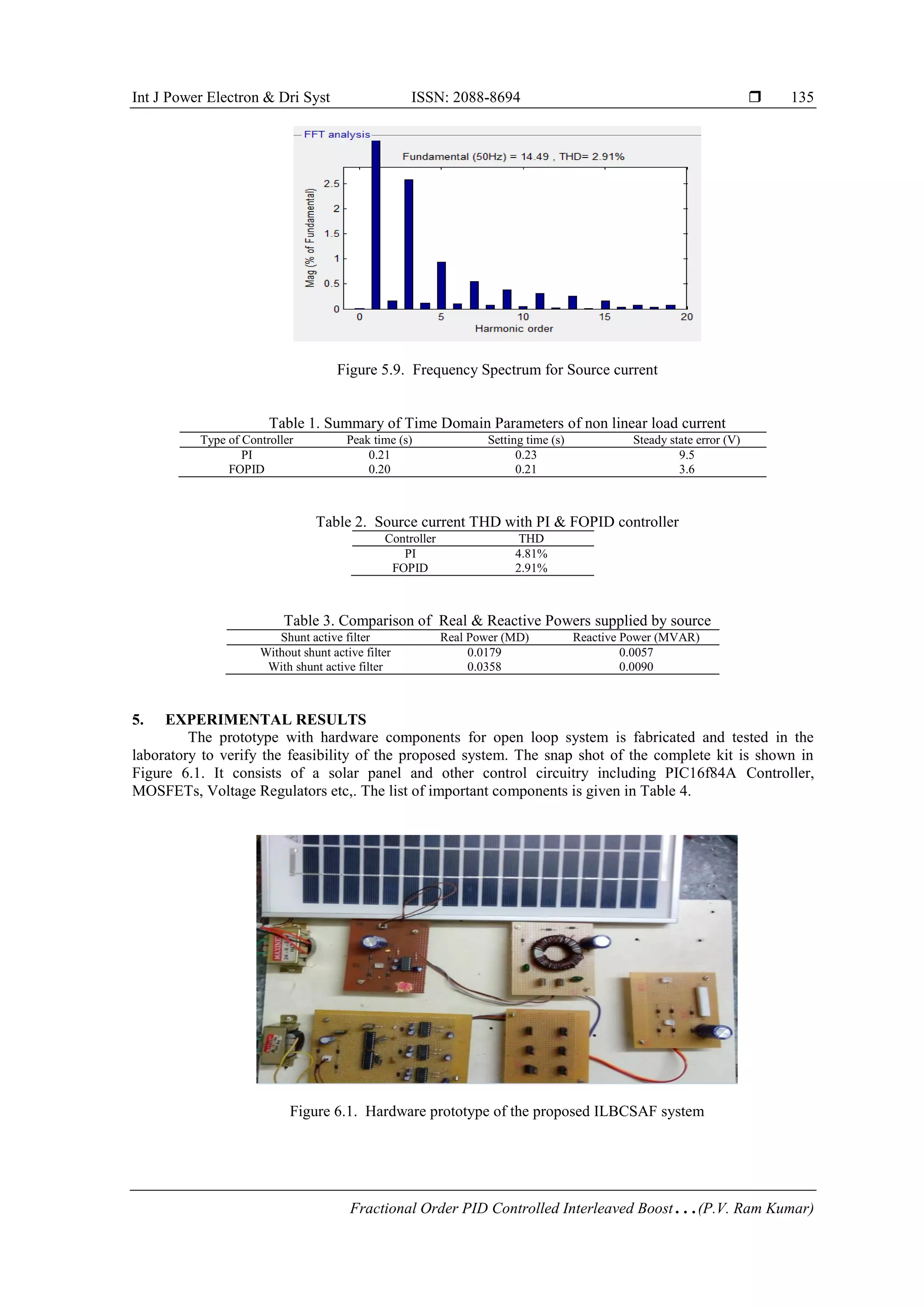
The RMS output current of non linear load is shown in Figure 5.7 and its value is 4.5 A. The
frequency spectrum of source current is shown in Figure 5.8 and the THD content is 2.9%. The summary of
Time Domain parameters of non linear load current is shown in Table-1. The settling time is reduced from
0.23 to 0.21 sec and steady state error is reduced from 9.5 V to 3.6 V. Summary of source current THD is
given in Table-2. The THD content is reduced by 1.9% by replacing PI with FOPID controller. The
Comparison of Real & Reactive Power supplied by the soure for loads is shown in Table-3. The real and
reactive powers increase with the addition of SAF. This increase is due to increase in the voltage and
reduction in THD.
Int J Power Electron & Dri Syst ISSN: 2088-8694 
Fractional Order PID Controlled Interleaved Boost…(P.V. Ram Kumar)
135
Figure 5.9. Frequency Spectrum for Source current
Table 1. Summary of Time Domain Parameters of non linear load current
Type of Controller Peak time (s) Setting time (s) Steady state error (V)
PI 0.21 0.23 9.5
FOPID 0.20 0.21 3.6
Table 2. Source current THD with PI & FOPID controller
Controller THD
PI 4.81%
FOPID 2.91%
Table 3. Comparison of Real & Reactive Powers supplied by source
Shunt active filter Real Power (MD) Reactive Power (MVAR)
Without shunt active filter 0.0179 0.0057
With shunt active filter 0.0358 0.0090
5. EXPERIMENTAL RESULTS
The prototype with hardware components for open loop system is fabricated and tested in the
laboratory to verify the feasibility of the proposed system. The snap shot of the complete kit is shown in
Figure 6.1. It consists of a solar panel and other control circuitry including PIC16f84A Controller,
MOSFETs, Voltage Regulators etc,. The list of important components is given in Table 4.
Figure 6.1. Hardware prototype of the proposed ILBCSAF system
 ISSN: 2088-8694
Int J Power Electron & Dri Syst Vol. 9, No. 1, March 2018 : 126 – 138
136
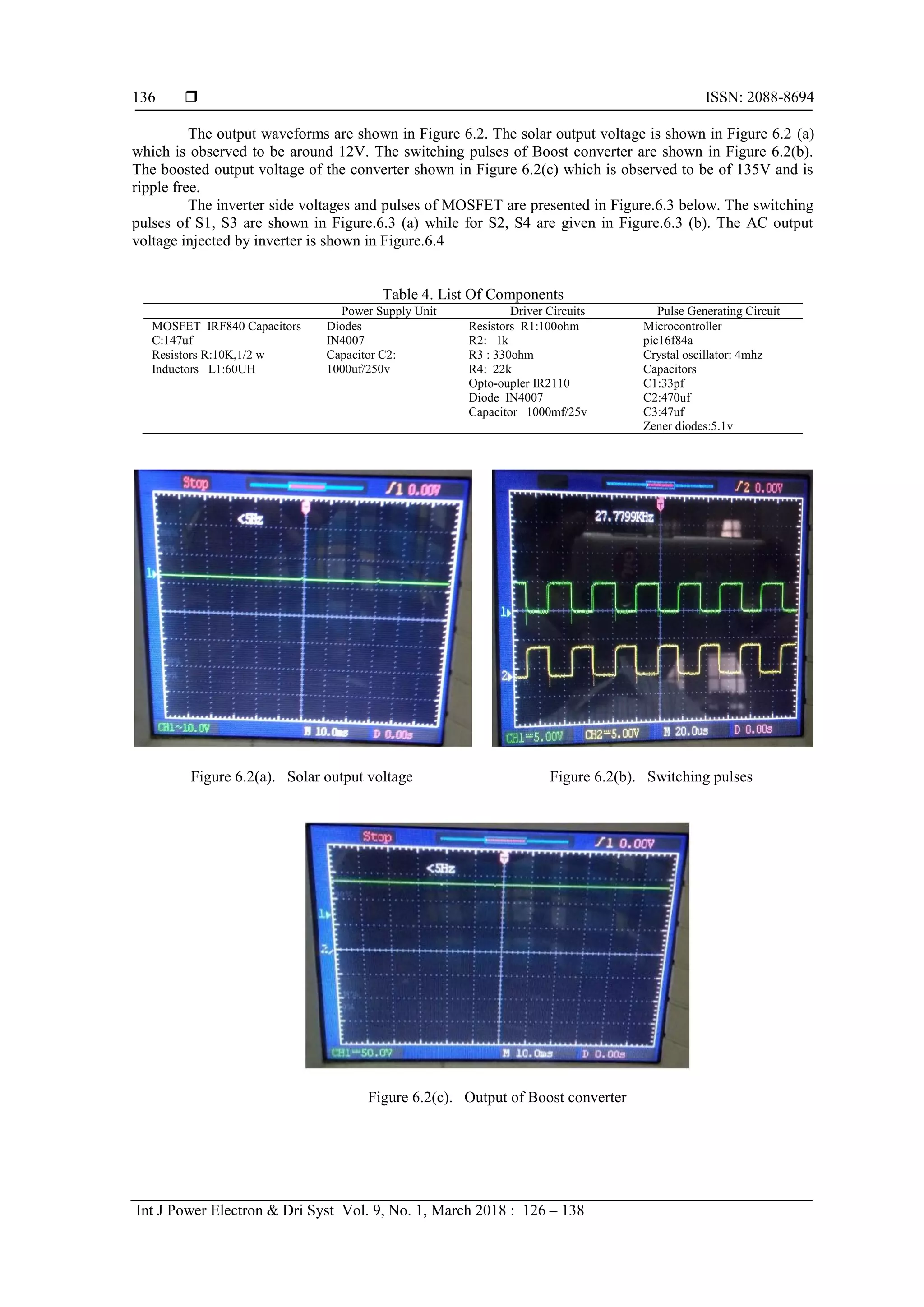
The output waveforms are shown in Figure 6.2. The solar output voltage is shown in Figure 6.2 (a)
which is observed to be around 12V. The switching pulses of Boost converter are shown in Figure 6.2(b).
The boosted output voltage of the converter shown in Figure 6.2(c) which is observed to be of 135V and is
ripple free.
The inverter side voltages and pulses of MOSFET are presented in Figure.6.3 below. The switching
pulses of S1, S3 are shown in Figure.6.3 (a) while for S2, S4 are given in Figure.6.3 (b). The AC output
voltage injected by inverter is shown in Figure.6.4
Table 4. List Of Components
Power Supply Unit Driver Circuits Pulse Generating Circuit
MOSFET IRF840 Capacitors
C:147uf
Resistors R:10K,1/2 w
Inductors L1:60UH
Diodes
IN4007
Capacitor C2:
1000uf/250v
Resistors R1:100ohm
R2: 1k
R3 : 330ohm
R4: 22k
Opto-oupler IR2110
Diode IN4007
Capacitor 1000mf/25v
Microcontroller
pic16f84a
Crystal oscillator: 4mhz
Capacitors
C1:33pf
C2:470uf
C3:47uf
Zener diodes:5.1v
Figure 6.2(a). Solar output voltage Figure 6.2(b). Switching pulses
Figure 6.2(c). Output of Boost converter
Int J Power Electron & Dri Syst ISSN: 2088-8694 
Fractional Order PID Controlled Interleaved Boost…(P.V. Ram Kumar)
137
(a). Switching pulses for S1 and S3 (b). Switching pulses for S2 and S4
Figure 6.3. Switching pulses of inverter
Figure 6.4 Output voltage of SAF Figure.6.5. Output voltage of nonlinear load
6. CONCLUSION
ILBCFSAF system controlled by PI and FOPID are modelled and simulated using SIMULINK. The
simulation results of PI and FOPID controllers are presented and analysed. The settling time with FOPID for
output voltage is 0.21 sec and steady state error in voltage is as low as 3.6V. Therefore the response of
FOPID based ILBCSAF system is better than that of PI controlled system. The advantages of proposed
system are low ripple content of PV voltage and current injected at PCC and improved time domain response
of load voltage.The disadvantage of proposed system is that hardware count of ILBC is twice that of normal
boost converter. This work deals with comparison PI and FOPID based ILBCFSAF systems.
REFERENCES
[1] BV Rajanna, SVNL Lalitha, G Joga Rao, S.K Shrivastav., “Solar Photovoltaic Generators with MPPT and Battery
Storage in Microgrids,” International Journal of Power Electronics and Drive System (IJPEDS), Vol. 7, No. 3, pp.
701-712, September 2016.
[2] Zainal Salam, Zulkifli Ramli, Jubaer Ahmed and Muhammad Amjad., “Partial Shading in Building Integrated PV
System: Causes, Effects and Mitigating Techniques,” International Journal of Power Electronics and Drive
System (IJPEDS), Vol. 6, No. 4, pp. 712-722, December 2015.
[3] Erdnic Sahin, Mustafa Sinasi Ayas,”A PSO optimized fractional-order PID controller for a PV system with DC-DC
boost converter,” 2014 16th International Power Electronics and Motion Control Conference and Exposition
(PEMC), Antalya, Turkey.
 ISSN: 2088-8694
Int J Power Electron & Dri Syst Vol. 9, No. 1, March 2018 : 126 – 138
138
[4] Nasir Coruh, Satilmis Urgun, Tarik Erfidan, Semra Ozturk.,” A Simple And Efficient Implemantation Of
Interleaved Boost Converter” 978-1-4244-8756-1/11/$26.00 c2011 IEEE.
[5] Weerachat Khadmun and Wanchai Subsingha., “High Voltage Gain Interleaved DC Boost Converter Application
for photo voltaic System” 10th Eco-Energy and Materials Science and Engineering(EMSES2012), Elsevier,Energy
procedia 34, pp.390 – 398, 2013.
[6] “AN-1820 LM5032 Interleaved Boost Converter” Texas Instruments Incorporated Application Report
SNVA335A–May 2008–Revised May 2013.
[7] H. Akagi, E. Watanabe, M. Aredes “Instantaneous Power Theory and Applications to Power Conditioning: Wiley-
IEEE Press, 2007.
[8] Bhim Singh, Kamal Al-Haddad, Ambrish Chandra., “A Review of Active Filters for Power Quality Improvement”
IEEE Transactions on Industrial Electronics, Vol. 46, No. 5, pp. 60 – 71, October 1999.
[9] I. Abouzahr and R. Ramakumar., “An approach to assess the performance of utility-interactive photovoltaic
systems,” IEEE Trans. Energy Convers., Vol. 8, No. 2, pp. 145–153, Jun.1993.
[10] Y. Tang, P. C. Loh, P. Wang, F. H. Choo, F. Gao, and F. Blaabjerg,“Generalized Design of High Performance
Shunt Active Power Filter With Output LCL Filter” IEEE Transactions on Industrial Electronics, Vol. 59, No.3,
pp. 1443- 1452, March 2012.
[11] Ambrish Chandra, Bhim Singh, B. N. Singh, and Kamal Al-Haddad, “An Improved Control Algorithm of Shunt
Active Filter for Voltage Regulation,Harmonic Elimination, Power-Factor Correction, and Balancing of Nonlinear
Loads” IEEE Transactions on Power Electronics, Vol. 15, No. 3, pp. 495 -507, May 2000.
[12] Gyu-Yeong Choe, Jong-Soo Kim, Hyun-Soo Kang and Byoung-Kuk Lee “An Optimal Design Methodology of an
Interleaved Boost Converter for Fuel Cell Applications” Journal of Electrical Engineering & Technology Vol. 5,
No. 2, pp. 319~328, 2010.
[13] H. Patel, V. Agarwal, “Investigations into the performance of photo voltaics-based active filter conFigureurations
and their control schemes under uniform and non-uniform radiation conditions” IET Renew. Power Gener, Vol. 4,
Iss. 1, pp. 12–22, 2010.
[14] Hamad, M.S, Fahmy, A.M, and Abdel-Geliel, M, “Power Quality Improvement of a Single-Phase Grid-Connected
PV System with Fuzzy MPPT Controller” IEEE, 978-1-4799-0224-8/13/$31.00, 2013.
[15] Slamet Riyadi, Yanuarsyah Haroen, “, “A Single-Phase Dual-Stage PV-Grid System with Active Filtering”
International Journal of Power Electronics and Drive System (IJPEDS), Vol. 6, No. 3, pp. 449~458, September
2015.
BIOGRAPHIES OF AUTHORS
P. V. Ramkumar is a Research Schollor in JNT University, Ananthapuramu. He has received his
B.Tech (EEE) from Andhra University and M.Tech (Information Technology in Power
Engineering) from JNTU,Hyderabad. His research interests include Electrical, Power Quality
Issues.
Dr. M. Surya Kalavathi is currently working as a Professor in JNTU University, Hyderabad. She
has received her B.Tech. (EEE) & M.E (Power Systems) from SV University, and Doctorate
degree (Ph.D.) from JNTU, Hyderabad, and Post Doc. from CMU, USA. Her research interests
include Power Systems, High Voltage Engineering and Control Systems, Power Electronics and
Simulation studies on Transients of different power system equipment. Published more than 100
Research Papers in international and nataional journals. She has guided 9 Ph.D scholars and
presently guiding 5 Ph.D. Scholars. She has specialized in Power Systems, High Voltage
Engineering and Control Systems.

Fractional Order PID Controlled Interleaved Boost converter Fed Shunt Active Filter System

  • 1.
    International Journal ofPower Electronics and Drive System (IJPEDS) Vol. 9, No. 1, March 2018, pp. 126~138 ISSN: 2088-8694, DOI: 10.11591/ijpeds.v9.i1.pp126-138  126 Journal homepage: http://iaescore.com/journals/index.php/IJPEDS Fractional Order PID Controlled Interleaved Boost converter Fed Shunt Active Filter System P. V. Ram Kumar1 , M. Surya Kalavathi2 1 Department of Electrical and Electronics Engineering, JNTU, Ananthapuramu 2 Department of Electrical and Electronics Engineering, J.N.T.U. College of Engg, Hyderabad, India Article Info ABSTRACT Article history: Received May 25, 2017 Revised Dec 22, 2017 Accepted Jan 1, 2018 Interleaved Boost Converter (ILBC) is a better converter between Photo Voltaic (PV) source and shunt active power filter. This paper deals with comparison of time domain outputs of PI and Fractional Order PID(FOPID) controlled ILBC fed shunt active filter in a grid connected PV system. The aim of this work is to minimize current ripple using ILBC between PV system and filter to improve the dynamic performance of shunt active filter. Closed loop monitored PI and FOPID systems are modeled, and the corresponding results are presented. MATLAB results of load voltage, current, converter voltage and currents with FOPID exhibits enhanced dynamic response. The proposed FOPID controlled ILBC Fed Shunt Active Filter system (ILBCFSAF) has advantages like low settling time, less peak over shoot and reduced steady state error in load voltage. The simulation results of ILBCFSAF are compared with the corresponding hardware results. Keyword: FOPID Controller Interleaved Boost Converter Non linear load Shunt Active Filter Copyright © 2018 Institute of Advanced Engineering and Science. All rights reserved. Corresponding Author: P. V. Ram Kumar, Departement of Electrical and Electronics Engineering, JNT University, Ananthapuramu, India Email: ramkumar_pv@yahoo.co.in 1. INTRODUCTION Distribution sources such as Photo-Voltaic (PV) generation system, and wind power systems have become popular since they are green power source. The DC-AC inverter can be used as Shunt Active Filter(SAF) whose output is controlled by pulses to convert dc power of PV into ac and to inject equivalent currents to compensate harmonics. The pulses are produced by a controller which monitors the deviation between system voltage and input dc voltage of converter. Conventionally PI or PID controllers are used for this purpose but suffer from frequent tuning of their parameters for different load and disturbance conditions. The step up converters have drawbacks of low voltage gain and low power rating. Interleaved Boost converter has reduced ripple currents in both the input and output sides. Different steps involved in design of MPPT controller and evaluation of the need of storage devices, load take off strategies of PV system is presented in [1]. Effect of partial shading on building Integrated PV systems, causes and mitigation techniques using software and hard ware solutions is presented in [2]. A fractional-order PID (FOPID) controller is designed in[3] to control a DC-DC boost converter in a PV- system. To obtain the best system performance, parameters of the proposed controller are tuned by using Particle Swarm Optimization (PSO) algorithm. Analysis and hardware implementation of two phase ILBC is proposed in [4] where in design of magnetic component i.e., inductor is studied. High gain four stage ILBC is proposed in [5] which is a combination of two 2 phase interleaved boost converters to obtain smooth output ripple current, increase in power rating and efficiency. Basic concepts regarding design of ILBC which involves selection of inductors, input and output capacitors, power switches etc., was given in[6]. As far as the controlling of SAF is concerned, the Instantaneous Power Theory (IPT) and its application to power
  • 2.
    Int J PowerElectron & Dri Syst ISSN: 2088-8694  Fractional Order PID Controlled Interleaved Boost…(P.V. Ram Kumar) 127 conditioning given by Akagi [7] is the basis for SAF. A detailed review of SAF with respect to control techniques and topology is presented by Bhimsingh[8].A method to evaluate the performance of utility interactive PV system is given by Abouzahr[9]. The design of SAF with output LCL filter is given by Tang[10]. The control algorithm of SAF for voltage regulation and PFC is depicted by Haddad[11]. A selection methodology for the number of phases and analysis of the input current ripple with CCM and DCM is for an ILBC is given in [12]. A study of various PV fed Active filters with respect to their circuit and control methods is presented in [13]. To investigate various Power Quality issues such as THD, phase imbalance and excessive neutral currents etc., a predictive control technique using FLC is proposed in [14] where in FLC is applied for MPPT. A single-phase dual-stage PV-Grid system with active filtering capability is constructed in [15] with simple circuits such as current transducer. The system used a boost chopper as MPPT controller. Lot of research on single stage PV grid-connected system with power quality improvement has been done so far but not many studies are available on Boost Converter topologies used to boost the low magnitude PV voltages. In this paper, a novel high capacity grid-connected PV system based on Interleaved Boost converter fed Shunt active filter is proposed, which has reduced current ripple.The problem formulation involves improving dynamic response of ILBCFSAF system. The pulse width applied to the ILBC is adjusted to obtain constant voltage at the output. The FOPID is proposed to improve the dynamic response. The content of this paper is organized as follows: Section.2 deals with description of existing and proposed system. Control schemes of the systems are described in the 3rd section. Simulation results are described in section 4. A prototype model with hard ware components is developed, the details of which are presented in section 5. The work is concluded in section 6. 2. DESCRIPTION OF THE PROPOSED SYSTEM The block diagram of conventional SAF system is shown in Figure 1. The SAF is connected near the non linear load. Figure 1. Block diagram of conventional system Figure 2. Block Diagram of Proposed ILBCFSAF System Block diagram of the proposed ILBCFSAF system is shown in Figure.2. A three phase voltage source inverter is made to work as SAF and is the key component of the system, dc required to charge the capacitor of the SAF is obtained from ILBC. Actual voltage of this DC Link capacitor is compared. With the reference voltage and the voltage error is applied to the FOPID. The output of the FOPID controls the pulse width applied to ILBC. 3. RESEARCH METHOD 3.1. Inter Leaved Boost Converter ILBC overcomes the drawbacks of conventional boost converters, its static and dynamic performances are poor. Hence, an effective control of these converters is needed. Though conventional PI or PID controllers are useful, tuning of these for different loads is problematic. This paper proposes a fractional
  • 3.
     ISSN: 2088-8694 IntJ Power Electron & Dri Syst Vol. 9, No. 1, March 2018 : 126 – 138 128 order PID controller for controlling ILBC to derive good dynamic response of the load voltage. The circuit diagram of ILBC is shown in Figure.3. Figure 3. Circuit diagram of ILBC The design considerations of ILBC are as follows L and C for ILBC are determined using L = Vi D f I ⁄ (3.1) C = D 2. f. R ⁄ (3.2) L1 and L2 works out to 130mH and C workout to 470µF 3.2. Control of SAF p-q theory is used for controlling the three leg VSI inverter. As this thery is based on α-β-0 frameed quantities, Conversion of source voltages and currents in to this frame is done using a transformation matrix C. [ v0 vα vβ ] = C [ va vb vc ] ; [ i0 iα iβ ] = C [ ia ib ic ] (3.3) where C = √ 2 3 [ 1 √2 1 √2 1 √2 1 − 1 2 − 1 2 0 √3 2 − √3 2 ] (3.4) The active and reactive power demanded by the load can be decomposed into pL = pL ̅̅̅ + pL ̃ ; qL = qL ̅̅̅̅ + qL ̃ (3.5) The reference source currents in the α-β-0 frame are as follows: [ isRf0 isRfα isRfβ ] = 1 vα 2 +vβ 2 [ v0 0 vβ vα −vβ 0 vβ vα −v0 −vα v0 0 ] × [ p ̅Lαβ + p ̅L0 0 0 0 ] = p ̅Lαβ +p ̅L0 vα 2 +vβ 2 [ 0 vα vβ ] (3.6) Assuming Ls= 10mH, the capacitance of SAF is calculated by fs = 1 2π√Ls Cs ⁄ (3.7) Pulse width of inverter is found to be 0.66ms for a supply frequency of 50Hz.
  • 4.
    Int J PowerElectron & Dri Syst ISSN: 2088-8694  Fractional Order PID Controlled Interleaved Boost…(P.V. Ram Kumar) 129 3.3. Proposed FOPID Controller The enhanced version of conventional PID controller is the fractional order PID (FOPID) controller and is designed on the basis of fractional calculus. For many decades, PID controllers have been very popular in industries due to their simplicity of design and good performance. As a result of, continuous efforts to improve their quality and robustness,in the field of automatic control, the fractional order controllers would lead to more precise and robust control performances. In order to implement the control Scheme of a SAF in a closed loop, the DC capacitor voltage of the converter Vdc is sensed and then compared with the reference value Vdcref. The error e(n) = Vdcref – Vdc is in frequency domain. The output and inputs of the controller are related as follows: Vo(s) = Vi(s) (K1+ K2/Sm+K3Sn) (3.8) where m and n are fractions. 4. SIMULATION RESULTS AND ANALYSIS Open loop controlled ILBCFSAF system with reduction in solar irradiation as a result of partial shading or ony other effect is shown in Figure 3.1 line is modelled as series combination of resistance and reactance. ILBC at the input of inverter is shown as a subsystem. Linear and non linear loads are connected in parallel at the receiving end. The output voltage of solar system is shown in Figure 3.2 and its value reduces from 220 V to 180 V as a result of fall in input irradiation . The output voltage of ILBC is shown in Figure 3.3 and its value is 320 V. Figure 3.1. Open loop controlled ILBCFSAF system with reduction in solar Irradition Figure 3.2. Output voltage of solar system
  • 5.
     ISSN: 2088-8694 IntJ Power Electron & Dri Syst Vol. 9, No. 1, March 2018 : 126 – 138 130 Figure 3.3. Output voltage of ILBC The output current of linear load is shown in Figure 3.4 and its peak value is reducing at 0.2 sec. The output voltage of non linear load is shown in Figure 3.5 and its peak value is 300 V. The RMSoutput current of non linear load is shown in Figure 3.6 where in it can be studied that the current is reduced from 4A to 3A due to reduction in the output of solar system. Figure 3.4. Output current of linear load Figure 3.5. Output voltage of non linear load Figure 3.6. Output Current of non linear load
  • 6.
    Int J PowerElectron & Dri Syst ISSN: 2088-8694  Fractional Order PID Controlled Interleaved Boost…(P.V. Ram Kumar) 131 The closed loop ILBCSAF system with PI controller is simulated. The output of ILBC is senced and is compared with the reference voltage. The error is applied to a PI controller. The output of PI controller is applied to a comparator. The comparator produces updated pulse for driving MOSFETS of ILBC. The output voltage of solar system is shown in Figure 4.1 and its value is 160 V. The source current is shown in Figure 4.2 The output voltage of ILBC is shown in Figure 4.3 and its value is 500 V. The output current of linear load is shown in Figure 4.4 and its peak value is 6.5 A. The output voltage of non linear load is shown in Figure 4.5 and its value is 450 V. The RMS output current of non linear load is shown in Figure 4.6 and its value is 4.5A. Here the action of controller can be identified in regaining the reduction in load current as a result of disturbance in PV system. The frequency spectrum of source current is shown in Figure 4.7 to study the SAF action, the THD content is 4.8%. It can be seen that the output of ILBC, output of linear load and output of non linear load regulated. Figure 4.1. Output voltage of solar system Figure 4.2. Source current waveforms Figure 4.3. Output voltage of ILBC
  • 7.
     ISSN: 2088-8694 IntJ Power Electron & Dri Syst Vol. 9, No. 1, March 2018 : 126 – 138 132 Figure 4.4. Output current of linear load Figure 4.5. Output voltage of non linear load Figure 4.6. Output current of non linear load Figure 4.7. Frequency Spectrum of Source current
  • 8.
    Int J PowerElectron & Dri Syst ISSN: 2088-8694  Fractional Order PID Controlled Interleaved Boost…(P.V. Ram Kumar) 133 The closed loop ILBCFSAF system with FOPID controller is shown in Figure 5.1. The PI controller in the closed loop is now replaced by FOPID. The output voltage of solar system is shown in Figure 5.2 and its value is 160 V. The source current is shown in Figure 5.3. The output voltage of ILBC is shown in Figure 5.4 and its value is 500 V. Figure 5.1. Closed loop ILBCSAF system with FOPID Figure 5.2. Output voltage of solar Figure 5.3. Source current Figure 5.4. Output voltage of ILBC
  • 9.
     ISSN: 2088-8694 IntJ Power Electron & Dri Syst Vol. 9, No. 1, March 2018 : 126 – 138 134 The output current of linear load is shown in Figure 5.5. The RMS output voltage of non linear load is shown in Figure 5.6 and its value is 400 V. The voltage response with FOPID is much smoother than that of PI controlled system. Figure 5.5. Current through linear load Figure 5.6. Output voltage of non linear load Figure 5.7. Output current of non linear load The RMS output current of non linear load is shown in Figure 5.7 and its value is 4.5 A. The frequency spectrum of source current is shown in Figure 5.8 and the THD content is 2.9%. The summary of Time Domain parameters of non linear load current is shown in Table-1. The settling time is reduced from 0.23 to 0.21 sec and steady state error is reduced from 9.5 V to 3.6 V. Summary of source current THD is given in Table-2. The THD content is reduced by 1.9% by replacing PI with FOPID controller. The Comparison of Real & Reactive Power supplied by the soure for loads is shown in Table-3. The real and reactive powers increase with the addition of SAF. This increase is due to increase in the voltage and reduction in THD.
  • 10.
    Int J PowerElectron & Dri Syst ISSN: 2088-8694  Fractional Order PID Controlled Interleaved Boost…(P.V. Ram Kumar) 135 Figure 5.9. Frequency Spectrum for Source current Table 1. Summary of Time Domain Parameters of non linear load current Type of Controller Peak time (s) Setting time (s) Steady state error (V) PI 0.21 0.23 9.5 FOPID 0.20 0.21 3.6 Table 2. Source current THD with PI & FOPID controller Controller THD PI 4.81% FOPID 2.91% Table 3. Comparison of Real & Reactive Powers supplied by source Shunt active filter Real Power (MD) Reactive Power (MVAR) Without shunt active filter 0.0179 0.0057 With shunt active filter 0.0358 0.0090 5. EXPERIMENTAL RESULTS The prototype with hardware components for open loop system is fabricated and tested in the laboratory to verify the feasibility of the proposed system. The snap shot of the complete kit is shown in Figure 6.1. It consists of a solar panel and other control circuitry including PIC16f84A Controller, MOSFETs, Voltage Regulators etc,. The list of important components is given in Table 4. Figure 6.1. Hardware prototype of the proposed ILBCSAF system
  • 11.
     ISSN: 2088-8694 IntJ Power Electron & Dri Syst Vol. 9, No. 1, March 2018 : 126 – 138 136 The output waveforms are shown in Figure 6.2. The solar output voltage is shown in Figure 6.2 (a) which is observed to be around 12V. The switching pulses of Boost converter are shown in Figure 6.2(b). The boosted output voltage of the converter shown in Figure 6.2(c) which is observed to be of 135V and is ripple free. The inverter side voltages and pulses of MOSFET are presented in Figure.6.3 below. The switching pulses of S1, S3 are shown in Figure.6.3 (a) while for S2, S4 are given in Figure.6.3 (b). The AC output voltage injected by inverter is shown in Figure.6.4 Table 4. List Of Components Power Supply Unit Driver Circuits Pulse Generating Circuit MOSFET IRF840 Capacitors C:147uf Resistors R:10K,1/2 w Inductors L1:60UH Diodes IN4007 Capacitor C2: 1000uf/250v Resistors R1:100ohm R2: 1k R3 : 330ohm R4: 22k Opto-oupler IR2110 Diode IN4007 Capacitor 1000mf/25v Microcontroller pic16f84a Crystal oscillator: 4mhz Capacitors C1:33pf C2:470uf C3:47uf Zener diodes:5.1v Figure 6.2(a). Solar output voltage Figure 6.2(b). Switching pulses Figure 6.2(c). Output of Boost converter
  • 12.
    Int J PowerElectron & Dri Syst ISSN: 2088-8694  Fractional Order PID Controlled Interleaved Boost…(P.V. Ram Kumar) 137 (a). Switching pulses for S1 and S3 (b). Switching pulses for S2 and S4 Figure 6.3. Switching pulses of inverter Figure 6.4 Output voltage of SAF Figure.6.5. Output voltage of nonlinear load 6. CONCLUSION ILBCFSAF system controlled by PI and FOPID are modelled and simulated using SIMULINK. The simulation results of PI and FOPID controllers are presented and analysed. The settling time with FOPID for output voltage is 0.21 sec and steady state error in voltage is as low as 3.6V. Therefore the response of FOPID based ILBCSAF system is better than that of PI controlled system. The advantages of proposed system are low ripple content of PV voltage and current injected at PCC and improved time domain response of load voltage.The disadvantage of proposed system is that hardware count of ILBC is twice that of normal boost converter. This work deals with comparison PI and FOPID based ILBCFSAF systems. REFERENCES [1] BV Rajanna, SVNL Lalitha, G Joga Rao, S.K Shrivastav., “Solar Photovoltaic Generators with MPPT and Battery Storage in Microgrids,” International Journal of Power Electronics and Drive System (IJPEDS), Vol. 7, No. 3, pp. 701-712, September 2016. [2] Zainal Salam, Zulkifli Ramli, Jubaer Ahmed and Muhammad Amjad., “Partial Shading in Building Integrated PV System: Causes, Effects and Mitigating Techniques,” International Journal of Power Electronics and Drive System (IJPEDS), Vol. 6, No. 4, pp. 712-722, December 2015. [3] Erdnic Sahin, Mustafa Sinasi Ayas,”A PSO optimized fractional-order PID controller for a PV system with DC-DC boost converter,” 2014 16th International Power Electronics and Motion Control Conference and Exposition (PEMC), Antalya, Turkey.
  • 13.
     ISSN: 2088-8694 IntJ Power Electron & Dri Syst Vol. 9, No. 1, March 2018 : 126 – 138 138 [4] Nasir Coruh, Satilmis Urgun, Tarik Erfidan, Semra Ozturk.,” A Simple And Efficient Implemantation Of Interleaved Boost Converter” 978-1-4244-8756-1/11/$26.00 c2011 IEEE. [5] Weerachat Khadmun and Wanchai Subsingha., “High Voltage Gain Interleaved DC Boost Converter Application for photo voltaic System” 10th Eco-Energy and Materials Science and Engineering(EMSES2012), Elsevier,Energy procedia 34, pp.390 – 398, 2013. [6] “AN-1820 LM5032 Interleaved Boost Converter” Texas Instruments Incorporated Application Report SNVA335A–May 2008–Revised May 2013. [7] H. Akagi, E. Watanabe, M. Aredes “Instantaneous Power Theory and Applications to Power Conditioning: Wiley- IEEE Press, 2007. [8] Bhim Singh, Kamal Al-Haddad, Ambrish Chandra., “A Review of Active Filters for Power Quality Improvement” IEEE Transactions on Industrial Electronics, Vol. 46, No. 5, pp. 60 – 71, October 1999. [9] I. Abouzahr and R. Ramakumar., “An approach to assess the performance of utility-interactive photovoltaic systems,” IEEE Trans. Energy Convers., Vol. 8, No. 2, pp. 145–153, Jun.1993. [10] Y. Tang, P. C. Loh, P. Wang, F. H. Choo, F. Gao, and F. Blaabjerg,“Generalized Design of High Performance Shunt Active Power Filter With Output LCL Filter” IEEE Transactions on Industrial Electronics, Vol. 59, No.3, pp. 1443- 1452, March 2012. [11] Ambrish Chandra, Bhim Singh, B. N. Singh, and Kamal Al-Haddad, “An Improved Control Algorithm of Shunt Active Filter for Voltage Regulation,Harmonic Elimination, Power-Factor Correction, and Balancing of Nonlinear Loads” IEEE Transactions on Power Electronics, Vol. 15, No. 3, pp. 495 -507, May 2000. [12] Gyu-Yeong Choe, Jong-Soo Kim, Hyun-Soo Kang and Byoung-Kuk Lee “An Optimal Design Methodology of an Interleaved Boost Converter for Fuel Cell Applications” Journal of Electrical Engineering & Technology Vol. 5, No. 2, pp. 319~328, 2010. [13] H. Patel, V. Agarwal, “Investigations into the performance of photo voltaics-based active filter conFigureurations and their control schemes under uniform and non-uniform radiation conditions” IET Renew. Power Gener, Vol. 4, Iss. 1, pp. 12–22, 2010. [14] Hamad, M.S, Fahmy, A.M, and Abdel-Geliel, M, “Power Quality Improvement of a Single-Phase Grid-Connected PV System with Fuzzy MPPT Controller” IEEE, 978-1-4799-0224-8/13/$31.00, 2013. [15] Slamet Riyadi, Yanuarsyah Haroen, “, “A Single-Phase Dual-Stage PV-Grid System with Active Filtering” International Journal of Power Electronics and Drive System (IJPEDS), Vol. 6, No. 3, pp. 449~458, September 2015. BIOGRAPHIES OF AUTHORS P. V. Ramkumar is a Research Schollor in JNT University, Ananthapuramu. He has received his B.Tech (EEE) from Andhra University and M.Tech (Information Technology in Power Engineering) from JNTU,Hyderabad. His research interests include Electrical, Power Quality Issues. Dr. M. Surya Kalavathi is currently working as a Professor in JNTU University, Hyderabad. She has received her B.Tech. (EEE) & M.E (Power Systems) from SV University, and Doctorate degree (Ph.D.) from JNTU, Hyderabad, and Post Doc. from CMU, USA. Her research interests include Power Systems, High Voltage Engineering and Control Systems, Power Electronics and Simulation studies on Transients of different power system equipment. Published more than 100 Research Papers in international and nataional journals. She has guided 9 Ph.D scholars and presently guiding 5 Ph.D. Scholars. She has specialized in Power Systems, High Voltage Engineering and Control Systems.