Load Frequency Control in a
Deregulated Power System Using
IPP Design
-Presented
By
R.selvakumar
1) Dept of electrical engg
Reg no : 922215105305
Tksct , Theni
Abstract:
This paper deals with a load frequency control in a
deregulated power system, in which the independent generator
utilities may or may not participate. A suitable method has been
developed for analyzing the performance of such a system. The
load frequency control is performed by this method on the basis
of parameters set by the participating generator companies.
The method is based on an Independent System Operator (ISO).
The participated companies are generators utility and
Independent Power Producer (IPP). The generator utilities
define which units will be under load frequency control , while
the independent power producer may or may not participate in
the load frequency control. The generator utility defines the
generation limits, rate of change and economic participation.
The ISO gets this information. The ISO also controls the
interconnected system operation while at the same time
allows the utilities to economically dispatch system.
Key words:
Area control error (ACE), load frequency
control(LFC), deregulated system.
Introduction :
The world – wide many electric utilities and
power companies have been forced to change their
way of operation and business, from vertically
integrated utilities to open market systems. For
developing countries the demand of power has been
increased ,complexity is associated with it like
management and irrational tariff policies.
The restructured or deregulated system is more
economical and beneficial to the consumers, but the
problem of load frequency control is associated with
it. The power systems are interconnected and their
operation has an important aspect of load frequency
control problem. In an interconnected system
operation load frequency control needs the technical
consideration.
Area control error(ACE):
The area control error (ACE)has the ability to monitor the
load-generation-and-frequency. On the basis of the ACE
value the generating units of the system are controlled. At
least after few minutes utilities have been operated in such
a way that the area control error of each utility would
reached to zero, meaning that the load and generation
balance each other and the frequency is equal to the
normal .
Due to this the system performance increases but it
influences the cost of the system. The increased cost is not
preferable of the infrastructure, required for the feedback.
From the frequency control action the wear and tear
occurs on the power plant equipment. The system gives
the excellent performance as all the utilities are
participating in the load frequency control problem. The
excellent performance justifies the increased cost of the
load frequency control.
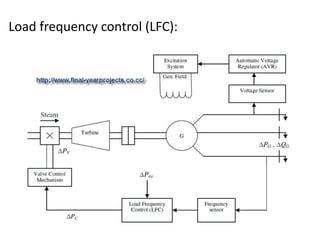
Load frequency control (LFC):
Load frequency control in a deregulated power
System:
Now a days the electric utilities preferred
deregulated or restructured system for trading. The
load frequency control in the open market and
deregulated environment has become a commodity
which can be traded. In such a system the
generating utilities may or may not preferred to
take part in the bidding competition of load
frequency control. The performance of such a
system is to maintain nearly constant frequency and
closely monitoring the load. Thus for large deviation
of load at a time the load frequency control is low
compared to the load.
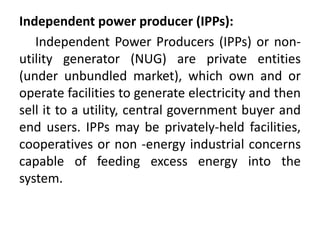
Independent power producer (IPPs):
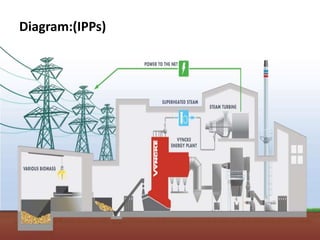
Independent Power Producers (IPPs) or non-
utility generator (NUG) are private entities
(under unbundled market), which own and or
operate facilities to generate electricity and then
sell it to a utility, central government buyer and
end users. IPPs may be privately-held facilities,
cooperatives or non -energy industrial concerns
capable of feeding excess energy into the
system.
Diagram:(IPPs)
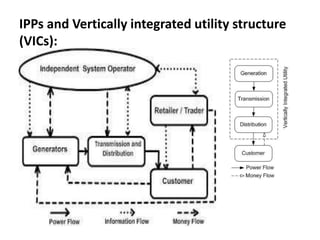
IPPs and Vertically integrated utility structure
(VICs):
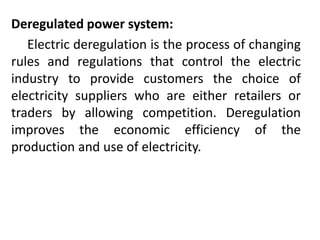
Deregulated power system:
Electric deregulation is the process of changing
rules and regulations that control the electric
industry to provide customers the choice of
electricity suppliers who are either retailers or
traders by allowing competition. Deregulation
improves the economic efficiency of the
production and use of electricity.
The main objectives of the deregulated power
market:
• To provide electricity for all reasonable
demands.
• To encourage the competition in the
generation and supply of
electricity.
• To improve the continuity of supply and the
quality of services.
• To promote efficiency and economy of the
power system.
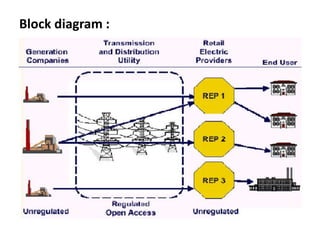
Block diagram :
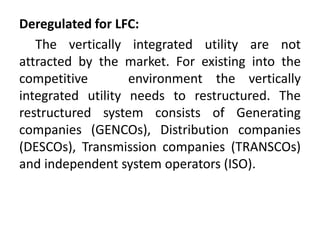
Deregulated for LFC:
The vertically integrated utility are not
attracted by the market. For existing into the
competitive environment the vertically
integrated utility needs to restructured. The
restructured system consists of Generating
companies (GENCOs), Distribution companies
(DESCOs), Transmission companies (TRANSCOs)
and independent system operators (ISO).
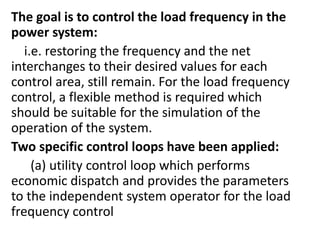
The goal is to control the load frequency in the
power system:
i.e. restoring the frequency and the net
interchanges to their desired values for each
control area, still remain. For the load frequency
control, a flexible method is required which
should be suitable for the simulation of the
operation of the system.
Two specific control loops have been applied:
(a) utility control loop which performs
economic dispatch and provides the parameters
to the independent system operator for the load
frequency control
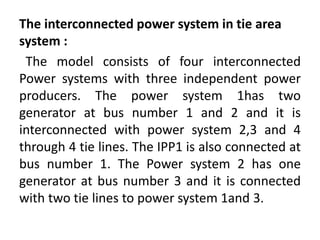
(b) the load frequency control is performed by
the independent system operator control loop.
The independent power producers (IPP) and
utilities provide the information or parameters
to the independent system operator on the
basis of which it controls the load frequency in
the power system. For the specific conditions
the model computes the load frequency of the
system.
System performance is measured in two types :
(a) utility control error and (b) independent
unit – load balance
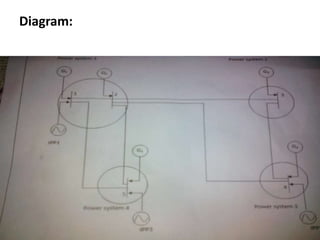
The interconnected power system in tie area
system :
The model consists of four interconnected
Power systems with three independent power
producers. The power system 1has two
generator at bus number 1 and 2 and it is
interconnected with power system 2,3 and 4
through 4 tie lines. The IPP1 is also connected at
bus number 1. The Power system 2 has one
generator at bus number 3 and it is connected
with two tie lines to power system 1and 3.
Diagram:
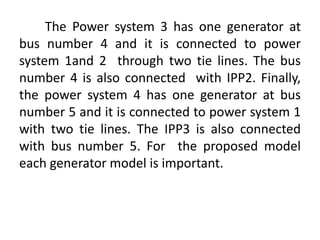
The Power system 3 has one generator at
bus number 4 and it is connected to power
system 1and 2 through two tie lines. The bus
number 4 is also connected with IPP2. Finally,
the power system 4 has one generator at bus
number 5 and it is connected to power system 1
with two tie lines. The IPP3 is also connected
with bus number 5. For the proposed model
each generator model is important.
Conclusion :
It is observed that if the number of participating
generating unit in the load frequency control
method is less, the system performance is not
satisfactory which is unacceptable. But in the
deregulated environment it is the choice of the
generating unit to participate or not to participate
in the load frequency control operation. It is thus
recommended that there must be a minimum
participation. The minimum participation depends
up the system establishment. There is a need of
further study to establish a minimum acceptable
limit of the nonparticipating unit to the load
frequency control problem.
REFERENCES:
1. International Journal of Engineering
Research and General Science Volume 5, Issue 3,
May-June, 2017
2. IEEE Std. 95, Definition for
Terminology for Automatic Generation Control
on Electric Power Systems.
3.NPTEL Phase-2 course in deregulated
power system in IIT ,MADRAS.
Any questions…..

Load frequency control in a deregulated power system

  • 1.
    Load Frequency Controlin a Deregulated Power System Using IPP Design -Presented By R.selvakumar 1) Dept of electrical engg Reg no : 922215105305 Tksct , Theni
  • 2.
    Abstract: This paper dealswith a load frequency control in a deregulated power system, in which the independent generator utilities may or may not participate. A suitable method has been developed for analyzing the performance of such a system. The load frequency control is performed by this method on the basis of parameters set by the participating generator companies. The method is based on an Independent System Operator (ISO). The participated companies are generators utility and Independent Power Producer (IPP). The generator utilities define which units will be under load frequency control , while the independent power producer may or may not participate in the load frequency control. The generator utility defines the generation limits, rate of change and economic participation. The ISO gets this information. The ISO also controls the interconnected system operation while at the same time allows the utilities to economically dispatch system.
  • 3.
    Key words: Area controlerror (ACE), load frequency control(LFC), deregulated system.
  • 4.
    Introduction : The world– wide many electric utilities and power companies have been forced to change their way of operation and business, from vertically integrated utilities to open market systems. For developing countries the demand of power has been increased ,complexity is associated with it like management and irrational tariff policies. The restructured or deregulated system is more economical and beneficial to the consumers, but the problem of load frequency control is associated with it. The power systems are interconnected and their operation has an important aspect of load frequency control problem. In an interconnected system operation load frequency control needs the technical consideration.
  • 5.
    Area control error(ACE): Thearea control error (ACE)has the ability to monitor the load-generation-and-frequency. On the basis of the ACE value the generating units of the system are controlled. At least after few minutes utilities have been operated in such a way that the area control error of each utility would reached to zero, meaning that the load and generation balance each other and the frequency is equal to the normal . Due to this the system performance increases but it influences the cost of the system. The increased cost is not preferable of the infrastructure, required for the feedback. From the frequency control action the wear and tear occurs on the power plant equipment. The system gives the excellent performance as all the utilities are participating in the load frequency control problem. The excellent performance justifies the increased cost of the load frequency control.
  • 6.
  • 7.
    Load frequency controlin a deregulated power System: Now a days the electric utilities preferred deregulated or restructured system for trading. The load frequency control in the open market and deregulated environment has become a commodity which can be traded. In such a system the generating utilities may or may not preferred to take part in the bidding competition of load frequency control. The performance of such a system is to maintain nearly constant frequency and closely monitoring the load. Thus for large deviation of load at a time the load frequency control is low compared to the load.
  • 8.
    Independent power producer(IPPs): Independent Power Producers (IPPs) or non- utility generator (NUG) are private entities (under unbundled market), which own and or operate facilities to generate electricity and then sell it to a utility, central government buyer and end users. IPPs may be privately-held facilities, cooperatives or non -energy industrial concerns capable of feeding excess energy into the system.
  • 9.
  • 10.
    IPPs and Verticallyintegrated utility structure (VICs):
  • 11.
    Deregulated power system: Electricderegulation is the process of changing rules and regulations that control the electric industry to provide customers the choice of electricity suppliers who are either retailers or traders by allowing competition. Deregulation improves the economic efficiency of the production and use of electricity.
  • 12.
    The main objectivesof the deregulated power market: • To provide electricity for all reasonable demands. • To encourage the competition in the generation and supply of electricity. • To improve the continuity of supply and the quality of services. • To promote efficiency and economy of the power system.
  • 13.
  • 14.
    Deregulated for LFC: Thevertically integrated utility are not attracted by the market. For existing into the competitive environment the vertically integrated utility needs to restructured. The restructured system consists of Generating companies (GENCOs), Distribution companies (DESCOs), Transmission companies (TRANSCOs) and independent system operators (ISO).
  • 15.
    The goal isto control the load frequency in the power system: i.e. restoring the frequency and the net interchanges to their desired values for each control area, still remain. For the load frequency control, a flexible method is required which should be suitable for the simulation of the operation of the system. Two specific control loops have been applied: (a) utility control loop which performs economic dispatch and provides the parameters to the independent system operator for the load frequency control
  • 16.
    (b) the loadfrequency control is performed by the independent system operator control loop. The independent power producers (IPP) and utilities provide the information or parameters to the independent system operator on the basis of which it controls the load frequency in the power system. For the specific conditions the model computes the load frequency of the system. System performance is measured in two types : (a) utility control error and (b) independent unit – load balance
  • 17.
    The interconnected powersystem in tie area system : The model consists of four interconnected Power systems with three independent power producers. The power system 1has two generator at bus number 1 and 2 and it is interconnected with power system 2,3 and 4 through 4 tie lines. The IPP1 is also connected at bus number 1. The Power system 2 has one generator at bus number 3 and it is connected with two tie lines to power system 1and 3.
  • 18.
  • 19.
    The Power system3 has one generator at bus number 4 and it is connected to power system 1and 2 through two tie lines. The bus number 4 is also connected with IPP2. Finally, the power system 4 has one generator at bus number 5 and it is connected to power system 1 with two tie lines. The IPP3 is also connected with bus number 5. For the proposed model each generator model is important.
  • 20.
    Conclusion : It isobserved that if the number of participating generating unit in the load frequency control method is less, the system performance is not satisfactory which is unacceptable. But in the deregulated environment it is the choice of the generating unit to participate or not to participate in the load frequency control operation. It is thus recommended that there must be a minimum participation. The minimum participation depends up the system establishment. There is a need of further study to establish a minimum acceptable limit of the nonparticipating unit to the load frequency control problem.
  • 21.
    REFERENCES: 1. International Journalof Engineering Research and General Science Volume 5, Issue 3, May-June, 2017 2. IEEE Std. 95, Definition for Terminology for Automatic Generation Control on Electric Power Systems. 3.NPTEL Phase-2 course in deregulated power system in IIT ,MADRAS.
  • 22.